Tag: Mexico

  • Is Climate Change Really the Cause of Mexico City’s Water Problems?

    A couple weeks ago the New York Times ran a gigantic front-page Sunday article by architecture critic Michael Kimmelman on Mexico City’s water crisis.

    This piece was billed as the first installment in a series on the effect of climate change on cities. Which is a head-scratcher, since Mexico City’s problems don’t seem to have anything to do with that.

    Mexico City is a megacity of 21.2 million people, making it roughly the size of greater New York. It’s also a mile and a half above sea level on a former lake bed in a valley among the surrounding mountains. So it’s at a significantly higher elevation than even Denver.

    This creates huge problems. A gigantic city has huge water needs. At high elevation, using a gravity feed for water is complicated to say the least. This necessitates costly pumping to delivery water from remote sources. The city is surrounded by mountains making even drainage complex. Much of the city’s water supply has come from its own ground water, and the city is sinking from the subsidence as a result of pumping.

    And of course Mexico and its capital are in the developing world, and so do not have the wealth to construct and maintain New York City style infrastructure.

    All of this is basically covered in the Kimmelman piece, which is good in many ways. But it’s not clear where climate change comes in. All of these problems would exist apart from any climate change. At best, he simply argues that climate change will make things worse, though without citing any real specifics. He only says:

    “It is a cycle made worse by climate change. More heat and drought mean more evaporation and yet more demand for water, adding pressure to tap distant reservoirs at staggering costs or further drain underground aquifers and hasten the city’s collapse.”

    Why in the world would the Times want to make this into a climate change story? It’s manifestly obvious from the article itself that the core water problems in Mexico City have nothing to do with climate change, but come from geography, size, and bad decision making.

    Trying to make it a climate change story only draws attention away from the need to make local changes to address the water situation. It also won’t convince anybody of anything. People who already believe in climate change don’t need any convincing. Those who don’t are never going to be convinced by this article. What’s the point?

    It seems to me that too many urbanist writers today simply can’t resist trying to make every single thing some manifestation of climate change. In that regard, they simply link more and more policy areas to something which is politically gridlocked in the United States. So what people do when they make things about climate change is to implicitly state that they don’t actually want to do anything about it.

    Many changes are eminently justifiable on their own merits. Bringing in climate changes only poisons the waters politically. And it’s a cop out. If you can’t make the case for, say, transit, without resorting to climate change, then your case is simply weak.

    When it comes to things like Mexico City’s water, where there’s a real problem and some action should be taken, better to avoid talking about climate change if you actually want to get anything done.

    Aaron M. Renn is a senior fellow at the Manhattan Institute, a contributing editor of City Journal, and an economic development columnist for Governing magazine. He focuses on ways to help America’s cities thrive in an ever more complex, competitive, globalized, and diverse twenty-first century. During Renn’s 15-year career in management and technology consulting, he was a partner at Accenture and held several technology strategy roles and directed multimillion-dollar global technology implementations. He has contributed to The Guardian, Forbes.com, and numerous other publications. Renn holds a B.S. from Indiana University, where he coauthored an early social-networking platform in 1991.

    Photo: Fidel Gonzalez [CC BY-SA 3.0 or GFDL], via Wikimedia Commons
  • TruMpISSION: Impossible – Border Wall

    While running for office, President Trump said the border wall would cost about $8 billion, a figure widely recognized as an unreasonably low estimate”. This week, the Department of Homeland Security (DHS) estimated the cost of construction at $21.6 billion. Figuring out what the wall would cost has been a source of debate for longer than the last election cycle. In 2013, the bipartisan “Gang of Eight” senators set aside $1.5 billion for a plan to add 700 miles of wall – also a completely unrealistic budget.

    In this edition of TruMpISSION: Impossible we examine the numbers behind building a wall along the U.S.- Mexico border. There are five main reasons why this mission is impossible.

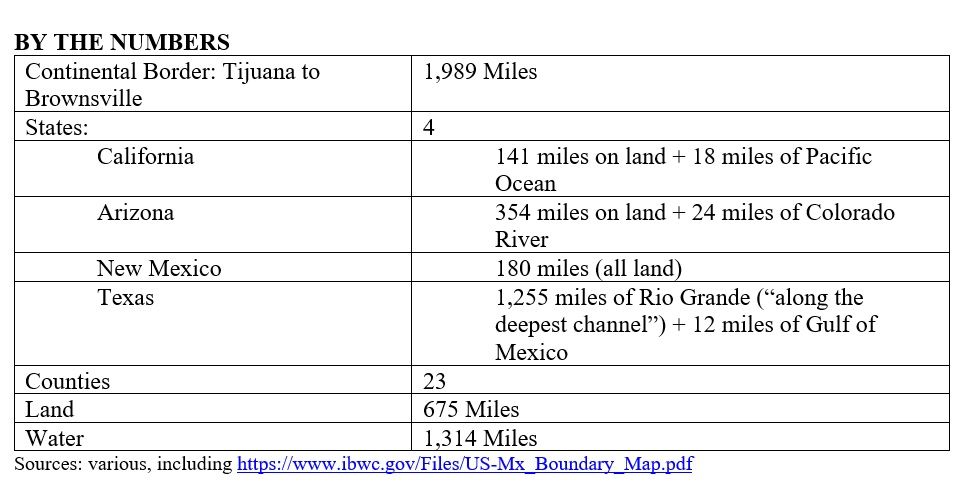
    1. It will be hideously expensive. The un-walled portion of the border covers the most difficult terrain, a lot of which could cost $17 million per mile. Historically, building on flat land cost about $4 million per mile. The government spent $2.4 billion between 2006 and 2009 to build a stretch of wall along 670 miles of easy terrain (Secure Fence Act of 2006). A 2009 attempt to build along one rugged stretch of the border was budgeted at $58 million for just 3.5 miles.

    Since most of the easier stuff is already built, I calculated that the cost for the next 1.289 miles could easily run $19.3 billion – I think the new DHS estimate is close to the mark. To put the number into perspective, the cost will be about seven times the entire 2016 budget of the U.S. Border Portal. Construction isn’t the only expense. Section 10 of the Executive Order basically “deputizes” local law enforcement – at the expense of local taxpayers – to act as immigration officers for carrying out deportations.

    2. More than 1,000 of the open border is under water. Building a wall in the water would be wildly expensive and would have to be replaced frequently. In February 2012, construction began to extend began to extend an 18-foot high border fence 300 feet into the Pacific Ocean to seal off the gap that opened at the beach between Tijuana and San Diego during low tide. The private contractor who built it (Granite Construction Company, NYSE:GVA) gave the government a 30-year warranty. The budget for that Surf Fence Project was $4.3 million (I did not find the final cost in any public source). Based on that budget, the cost of building the wall in water could run $75.9 million per mile or about 4.5 times the cost of building on rugged land and nearly 20 times the cost of building the parts on more level ground. Building a fence on the water part of the border would cost close to $9 billion alone.

    3. Maybe Trump does not really mean to build on the border that lies underwater. The Executive Order defines the “Southern border” as only the “land border”. To avoid the extra expense of building in the ocean, the gulf, and two rivers, we can build on the land outside the flood-plain/tidal-zone. It is likely the Mexican president Enrique Peña Nieto has heard of the “adverse possession”. Along the border, state laws transfer rights to abandoned property to the possessor in 5 to 10 years. Building just one half mile from the rivers means the United States could relinquish at least 657 square miles to Mexico. Are we prepared to cede to Mexico an area 1.5 times the size of Los Angeles?

    Fox News has noted that “[w]hile 1,254 miles of [the] borders is in Texas, the state has only 100 miles of wall”. At least 65 miles of the 100 mile route proposed through Texas in 2008 sat a half mile from the border. In some places, like the McAllen area of Texas, the proposed track separated a water reservoir from the pumping stations that bring water to US citizens. Building up to a mile into the US side has already stranded the property of US citizens on the Mexico side of the wall.

    4. The border land that is not under water or already fenced is mostly in private hands. In a January 2016 story Fox News recognized that finishing the wall along the border in Texas could require hundreds of lawsuits by the federal government. The Washington Post also reported going into the 2009 expansion of the wall that much of the planned route would slice through private property. Private property adds an average of $61,491 per mile (based on actual costs in 2012). During the 2009 expansion, 135 private landowners refused to let surveyors onto their property. Seventy percent of the landowners who held out were in Texas. Anybody remember Jade Helm 15 when part of Texas was labeled “hostile territory” during military exercises? The Governor ordered the Texas State Guard to monitor the exercises. What do you think will happen if bulldozers show up uninvited to begin claiming 1,000 miles of Texan’s private property? The federal government can use eminent domain, but it is costly, takes a long time and holds an uncertain outcome.

    5. There may not be enough brick and mortar to build a wall along the US/Mexico border, especially if Trump keeps talking it up. During the 2009 expansion of the wall, cost estimates ballooned as a Border States construction boom led to labor shortages and rising costs for construction materials (e.g., steel and cement). Try building more than 1,000 miles of border wall while re-building transportation infrastructure, the strain will be beyond the global peak in prices seen when shovel-ready projects were initiated under post-financial-crisis stimulus spending.

    The Executive Order gave DHS 180 days (until about the second anniversary of Jade 15) to come up with a plan. DHS also has to figure out how to return deportable aliens “to the territory from which they came” – imagine millions of aliens lined up along the US/Mexico border. DHS has less time (until March 26) to figure out how to pay for the wall by withholding “all bilateral and multilateral development aid, economic assistance, humanitarian aid, and military aid” that the US may be planning to send to Mexico. That sounds like it could actually work to balance the budget outlay. Except that it won’t actually work. Total U.S. foreign aid to Mexico disbursed from all agencies in 2015 was $338.5 million (that’s “million” with an “m”). At that rate, it will take 54 years to recover the cost!

    Aid to Mexico includes $215 million for international drug and law enforcement plus $50 million more for in-country drug enforcement. The other hundred million or so was for justice projects, legal reform, crime prevention and military support. According to former Secretary of Homeland Security Jeh Johnson, “…experience teaches that border security alone cannot overcome the powerful push factors of poverty and violence that exist in Central America. Ultimately, the solution is long-term investment in Central America to address the underlying push factors in the region.”

    [After I calculate the costs for several more truMpISSIONs, I will calculate the cost of financing with debt. Just because something is impossible, doesn’t mean Trump won’t spend your money on it.]

    Susanne Trimbath, Ph.D. is CEO and Chief Economist of STP Advisory Services. Dr. Trimbath’s credits include appearances on national television and radio programs and the Emmy® Award nominated Bloomberg report Phantom Shares. She appears in four documentaries on the financial crisis, including Stock Shock: the Rise of Sirius XM and Collapse of Wall Street Ethics and the newly released Wall Street Conspiracy. Her newest book, Lessons Not Learned: 10 Steps to Stable Financial Markets, was published in November by Spiramus Press (UK). Dr. Trimbath teaches graduate and undergraduate finance and economics.

    Photo: ourfunnyfarm, CC License

  • America’s True Power In The NAFTA Century

    OK, I get it. Between George W. Bush and Barack Obama we have made complete fools of ourselves on the international stage, outmaneuvered by petty lunatics and crafty kleptocrats like Russia’sVladimir Putin. Some even claim we are witnessing “an erosion of world influence” equal to such failed states as the Soviet Union and the French Third Republic. “Has anyone noticed how diminished, how very Lilliputian, America has become?” my friend Tunku Varadajaran recently asked.

    In reality, it’s our politicians who have gotten small, not America. In our embarrassment, we tend not to notice that our rivals are also shrinking. Take the Middle East — please. Increasingly, we don’t need it because of North America’s unparalleled resources and economic vitality.

    Welcome then to the NAFTA century, in which our power is fundamentally based on developing a common economic region with our two large neighbors. Since its origins in 1994, NAFTA has emerged as the world’s largest trading bloc, linking 450 million people that produce $17 trillion in output. Foreign policy elites in both parties may focus on Europe, Asia and the Middle East, but our long-term fate lies more with Canada, Mexico and the rest of the Americas.

    Nowhere is this shift in power more obvious than in the critical energy arena, the wellspring of our deep involvement in the lunatic Middle East. Massive finds have given us a new energy lifeline in places like the Gulf coast, the Alberta tar sands, the Great Plains, the Inland West, Ohio, Pennsylvania and potentially California.

    And if Mexico successfully reforms its state-owned energy monopoly, PEMEX, the world energy — and economic — balance of power will likely shift more decisively to North America. Mexican President Pena Nieto’s plan, which would allow increased foreign investment in the energy sector, is projected by at least one analyst to boost Mexico’s oil output by 20% to 50% in the coming decades.

    Taken together, the NAFTA countries now boast larger reserves of oil, gas (and if we want it, coal) than any other part of the world. More important, given our concerns with greenhouse gases, NAFTA countries now possess, by some estimates, more clean-burning natural gas than Russia, Iran and Qatar put together. All this at a time when U.S. energy use is declining, further eroding the leverage of these troublesome countries.

    This particularly undermines the position of Putin, who has had his way with Obama but faces long-term political decline. Russia, which relies on hydrocarbons for two-thirds of its export revenues and half its budget, is being forced to cut gas prices in Europe due to a forthcoming gusher of LNG exports from the U.S. and other countries. In the end, Russia is an economic one-horse show with declining demography and a discredited political system.

    In terms of the Middle East, the NAFTA century means we can disengage, when it threatens our actual strategic interests. Afraid of a shut off of oil from the Persian Gulf? Our response should be: Make my day. Energy prices will rise, but this will hurt Europe and China more than us, and also will stimulate more jobs and economic growth in much of the country, particularly the energy belts of the Gulf Coast and the Great Plains.

    China and India have boosted energy imports as we decrease ours; China is expected to surpass the United States as the world’s largest oil importer this year. At the same time, in the EU, bans on fracking and over-reliance on unreliable, expensive “green” energy has driven up prices for both gas  and electricity.

    These high prices have not only eroded depleted consumer spending but is leading some manufacturers, including in Germany, to look at relocating production , notably to energy-rich regions of the United States. This shift in industrial production is still nascent, but is evidenced by growing U.S. manufacturing at a time when Europe and Asia, particularly China, are facing stagnation or even declines. Europe’s industry minister recently warned of “anindustrial massacre” brought on in large part by unsustainably high energy prices.

    The key beneficiaries of NAFTA’s energy surge will be energy-intensive industries such as petrochemicals — major new investments are being made in this sector along the Gulf Coast by both foreign and domestic companies. But it also can be seen in the resurgence in North American manufacturing in automobiles, steel and other key sectors. Particularly critical is Mexico’s recharged industrial boom. In 2011 roughly half of the nearly $20 billion invested in the country was for manufacturing. Increasingly companies from around the world see our southern neighbor as an ideal locale for new manufacturing plants; General Motors GM -0.96%Audi , Honda, Perelli, Alcoa and the Swedish appliance giant Electrolux have all announced major investments.

    Critically this is not so much Ross Perot’s old “sucking sound” of American jobs draining away, but about the shift in the economic balance of power away from China and East Asia. Rather than rivals, the U.S., Mexican and Canadian economies are becoming increasingly integrated, with raw materials, manufacturing goods and services traded across the borders. This integration has proceeded rapidly since NAFTA, with U.S. merchandise exports to Mexico growing from $41.6 billion in 1993 to $216.3 billion in 2012, an increase of 420%,while service exports doubled. MeanwhileU.S. imports from Mexico increased from $39.9 billion in 1993 to $277.7 billion in 2012, an increase of 596%.

    At the same time, U.S. exports to Canada increased from $100.2 billion in 1993 to $291.8 billion in 2012.

    Investment flows mirror this integration. As of 2011, the United States accounted for 44% of all foreign investment in Mexico, more than twice that of second-place Spain; Canada, ranking fourth, accounts for another 10%. Canada, which, according to a recent AT Kearney report, now ranks as the No. 4 destination for foreign direct investment, with the U.S. accounting for more than half the total in the country. Over 70% of Canada’s outbound investment goes to the U.S.

    Our human ties to these neighbors may be even more important. (Disclaimer: my wife is a native of Quebec). Mexico, for example, accounts for nearly 30% of our foreign-born population, by far the largest group. Canada, surprisingly, is the largest source of foreign-born Americans of any country outside Asia or Latin America.

    We also visit each other on a regular basis, with Canada by far the biggest sender of tourists to the U.S., more than the next nine countries combined; Mexico ranks second. The U.S., for its part, accounts for two-thirds of all visitors to Canada and the U.S. remains by far largest source of travelers to Mexico.

    These interactions reflect an intimacy Americans simply do not share with such places as the Middle East (outside Israel), Russia, and China. There’s the little matter of democracy, as well as a common sharing of a continent, with rivers, lakes and mountain ranges that often don’t respect national borders. Policy-maker may prefer to look further afield but North America is our home, Mexico and Canada our natural allies for the future. Adios, Middle East and Europe; bonjour, North America.

    This story originally appeared at Forbes.

    Joel Kotkin is executive editor of NewGeography.com and Distinguished Presidential Fellow in Urban Futures at Chapman University, and a member of the editorial board of the Orange County Register. He is author of The City: A Global History and The Next Hundred Million: America in 2050. His most recent study, The Rise of Postfamilialism, has been widely discussed and distributed internationally. He lives in Los Angeles, CA.

    NAFTA logo by AlexCovarrubias.

  • Rethinking Risk During a Financial Crisis: Learning from Mexico

    Last month I visited a small town in southern Mexico. It is a quiet and modestly prosperous place. Outside some of the homes are older Suburbans, Jeeps and Explorers; the license plates show that their owners have recently returned from the US, driven out by the collapsing economy and heightened nativist anxieties. Almost every family, it seems, has some member who has spent time up north; only a very few of them are still hanging on through the recession.

    For the most part, Mexicans are innocent by-standers in the current financial debacle. They didn’t allow themselves to be talked into strange mortgages or multiple credit cards; whether north or south of the border, this is for them still predominantly a cash economy. Even for those who went to the US, their key goal was to accumulate dollars and send them south, where, as pesos, they provide the basics and even a few luxuries for many families. Until recently, these remittances have been second only to oil income in importance for Mexico; now both are shrinking fast.

    There is something more than a little unfair in the manner in which the recession is hurting our southern neighbor. Mexicans, for the most part, have a personal risk calculus that is the complete reverse of ours. Like most people who have experienced hard times, they are not obsessed with the little things that might go awry; they don’t place little flags around puddles in the grocery store, and most dogs have never received a rabies shot. The sidewalks often look as though a tree is trying to push its way through the ground and electrical cables are frequently visible. It’s not unusual to see a local butcher frying up vast cauldrons of meats in front of his carnecineria, something that would drive American health inspectors to apoplexy.

    In contrast to their wealthier Northern neighbors, Mexicans seem quite happy to take responsibility for themselves and don’t expect to sue someone every time they stub their toe. But their collective view of risk is also the reverse of ours. Property is, for most people, something to live in and not something for speculation. Building one’s own home is common but it’s usually done in stages, whenever there is cash to spare. The results may be untidy, with streets perpetually possessing the appearance of construction zones, but there is no evidence of any foreclosure crisis—forests of ‘for sale’ signs are absent, in Veracruz, at least.

    Nor is that the only visual difference between nondescript Mexican and American cities. Antiseptic zoning is much less common in Mexico, with the result that families live above the store, or behind the workshop, or even on the roof of some buildings. Affluent homes may stand next to literal ruins. In most American cities, this would be evidence of a neighborhood slipping into decay, causing realtors to flee to more ordered areas. But for Mexicans, this juxtaposition simply adds to the sense of being in an organic place rather than on a Disney set. What it means for neighborliness is hard to judge, but it would certainly make an interesting comparative research project.

    Of course, there are some equivalents to the homogenous subdivisions that dominate the American housing market. I saw several large up-scale gated communities that were standing idle, waiting for better times. I was also shown several housing developments, where government agencies were building terraced homes for state workers. What is striking to the visitor is that these would never be offered in the US housing market, as they would be judged to be unacceptably small. At approximately one thousand square feet, they are half the size of the average American home, (approximately 2200 square feet) and significantly smaller than most new houses.

    Even though Mexican families are, on average, larger (with more children and more generations living together), the expectation is not that every member of the family gets a bathroom or even a bedroom. It is also common to buy small and build out, or up, as needs dictate and finances permit. Anyone who has traveled in Asia will also be familiar with this phenomenon, which manifests itself in ground floor apartments that encroach upon the street, balconies that become bedrooms and so forth. High density and modest means lead to invention, if not the kinds of appearance mandated by Home Owner Associations or preferred by the fusspot New Urbanist designers.

    In the past, the Mexican financial system has been criticized for maintaining a tight hold on credit. Even before the current crisis, high interest rates were unfriendly to the consumer, slowing the pace of both urban development and speculation. Given our current crisis, perhaps it’s worth asking whether this points to how the American market may develop in the future. Certainly, we can expect that credit will remain tight for a significant while. The rules for obtaining a mortgage will become more onerous; interest rates will be fixed, appraisals will be exact. McMansions will be of little interest except to large families of means; smaller and older homes will be at a premium. Definitions of overcrowding may change; design expectations will be downsized, and home maintenance will become more usual. As opportunities in the formal labor marketplace shrink, perhaps for an extended period, more Americans will work from their homes and garages, much as occurs in many developing countries.

    There may also be significantly less mobility, with little or no speculative purchasing. This is likely to have the greatest impact on the condominium market. Even affluent parents will be obligated to keep their college-age kids on campus rather than in condos that they hope to flip after graduation. And even when they have a degree, these young adults – with large student loans, minimal credit and no cash for a down payment – will become used to staying with their parents for longer periods, as is frequently the case in Mexico and other developing markets. This could extend into marriage and even family formation. The condos themselves will, for the foreseeable future, revert to rental properties, catering to those who can no longer maintain a foothold in the owner market.

    This does not imply that American cities are going to turn into Mexican ones any time soon. But there is much to be learned by studying the ways that Mexicans calculate risk. We might have fewer families borrowing beyond their means, and continually trying to beat the market. And with less aggregate risk in one part of our lives, we might then view other parts of our daily world with a little less obsession with control. We might be a little more relaxed about who lives next door; we might also be a little more tolerant about the age of their truck or the color of the drapes. After all, they might be Mexican, in which case we know that, if they are there, they can probably actually afford it.

    Andrew Kirby is the editor of the interdisciplinary Elsevier journal “Cities.”This is his 20th year as a resident of Arizona.