Tag: Miami

  • Florida Metropolitan Areas Disperse; City of Miami Continues to Densify

    Miami: The Miami metropolitan area grew 11 percent between 2000 and 2010 according to the recently released census count. The population growth was from 5,008,000 in 2000 to 5,575,000 in 2010. This growth, only modestly above the national average, caused Miami to slip behind Dallas-Fort Worth and Houston, to become the nation’s 7th largest metropolitan area. The Miami metropolitan area was expanded after the 2000 census to include not only the core county of Miami-Dade, but also Broward (Fort Lauderdale) and Palm Beach (West Palm Beach) counties.

    The historical core municipality, the city of Miami, grew from 362,000 to 399,000 and accounted for 7 percent of the metropolitan area growth. Miami is unique among the nation’s historic core municipalities in having densified in every census period since 1960, despite not annexing new territory and not having substantial greenfield space for development.

    The suburbs captured 93 percent of the growth. Growth was modest in all counties, but was the greatest in the most outlying, Palm Beach, at 17 percent.

    Orlando: The Orlando metropolitan area grew nearly 30 percent between 2000 and 2010 according to the recently released census count. Orlando grew from 1,645,000 in 2000 to 2,134,000 in 2010. The historical core municipality, the city of Orlando, grew from 194,000 to 238,000 and accounted for 9 percent of the metropolitan area growth. The suburbs captured 91 percent of the metropolitan area growth, expanding their population by 31 percent. Outlying (Osceola 55 percent) and Lake (41 percent) counties grew the fastest.

    Tampa-St. Petersburg: The Tampa-St Petersburg metropolitan area grew 16 percent between 2000 and 2010 according to the recently released census count. The population growth was from 2,396,000 in 2000 to 2,448,000 in 2010. The historical core municipality, the city of Tampa grew from 303,000 to 336,000 and accounted for 8 percent of the metropolitan area growth. The suburbs captured 92 percent of the growth. The fastest growing counties were both outlying, Pasco (35 percent) and Hernando (32 percent).

    Jacksonville: The Jacksonville metropolitan area grew nearly 20 percent between 2000 and 2010 according to the recently released census count. Jacksonville grew from 1,123,000 in 2000 to 1,346,000 in 2010. The historical core municipality, the city of Jacksonville, grew from 736,000 to 822,000 and accounted for 39 percent of the metropolitan area growth. The city of Jacksonville is essentially combined with Duval County has a largely suburban form and includes rural areas. The consolidation occurred between the 1960 and 1970 censuses, with the new jurisdiction covering nearly 25 times that of the old (768 square miles as opposed to 32 square miles), while the population of the new jurisdiction was somewhat more than 2.5 times that of the old. Jacksonville covers more than twice the land area than New York City and has approximately one-tenth the population.

    The suburbs captured 61 percent of the growth. The fastest growing counties were both outlying, St. John’s (54 percent) and Clay (36 percent), which captured more than one-half of the metropolitan area growth.
  • Miami Condo Price Implosion Continues

    The National Association of Realtors has just published its quarterly median house prices and the trend continues downward in Miami. At the end of the third quarter, the median condominium price had dropped to $82,900 in Miami, about the same as the list price for a BMW-7 sedan. This places condominium prices at 77 percent below the 2007 second quarter median of $367,000.

    While Miami has experienced perhaps the most substantial condominium bust in the nation, other metropolitan areas, such as Atlanta, Seattle, Los Angeles, San Diego, Chicago and Portland (Oregon) have seen huge decreases and a spate of spate of distress auctions and conversion of units to rentals.

    A recent article in The Wall Street Journal noted that condominiums have experienced an even greater market decline than detached housing. The over-building of condominiums may have been spurred by rose predictions from urban planners about the demand for central city housing being far greater than the supply. For example, the developer of City Center Las Vegas indicated that they built too many condominium units, at least in part in response to information received an urban planning symposium.

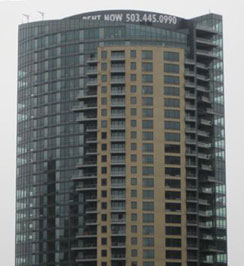
    Photograph: Condominium Conversion to Rentals in Portland (by author).

  • Second Thoughts on the Condo Market

    Mega-builder Larry Murren, whose company (MGM Mirage) opened the “largest privately funded construction project in U.S. history” told WSJ (the Wall Street Journal Magazine) that if he had to do it all over again, he would reconsider the condo-residential component of the project. “We would have built about half of those units” at the new $8.5 billion “City Center” development.

    The less than stellar performance condominium sales in the project was reported by the Las Vegas Review Journal, which indicated that only 78 of the project’s approximately 675 condominium units have sold. MGM Mirage is not alone in this plight. The Review Journal further notes that Las Vegas has a reports a 250 month or nearly 21 year supply of unsold condominium units. This means that some of today’s unsold units could still be on the market for parents in a suburban Las Vegas house to move to when their newborn heads off to college. These numbers qualify Las Vegas for finals of the Condo Bust World Cup, against other strong competitors Miami and Dubai.

    Murren credits a mixed-use symposium as the inspiration for City Center. Murren would not be the first developer to have been smitten by over-promotion of condominium market prospects. However the balance of Center City (shopping, entertainment, hotels and casinos) appears to be doing far better than the condominium element.

    Second thoughts have been occuring to a number of additional central city condominium developers around the nation as the central city condominium market continues its meltdown. The most recent evidence comes with condo auctions in the cores of Baltimore, St. Petersburg and Boston.

    In Baltimore, Pier Homes at Harborview has scheduled an auction of new units with minimum bids discounted from 55% to 75% below list prices. This means that the minimum bid, the Baltimore Sun indicates that only half of the units (completed two years ago) have been sold.

    In St. Petersburg, units in the 36-story Signature Place condominium tower were auctioned last month, with average bid prices 50% off the previous list prices. The Boston Globe indicates that “another” condo/loft auction is to occur in that city on June 26, with minimum bid prices up to 60% off list.

    The extraordinary risk of the central city condominium market was summarized by Larry Murphy, a Las Vegas real estate analyst: “It takes two to three years to build a high-rise project, and it can’t be done in phases like a new-home subdivision. All of the units have to be built at once.” He further noted that “Most of the units are sold within the first three months of completion. After that, sales drop off dramatically.” These inherent complexities of the condominium market will not be solved by mixed use seminars.