Tag: middle class

  • Conferences and Progress

    Californians attend innumerable conferences on housing and economic growth.  Year after year, in counties across California, the same people show up to say and hear the same things.  Mostly what they say and hear is naive, and nothing ever changes.

    I was reminded of this when I saw a report on what appears to have been a typical conference at the Harris Ranch on Growing the Central Valley Economy.

    There is no doubt that the Central Valley economy could use some economic growth.  After years of paying a disproportionate share of the costs of California’s coastal-driven energy, environmental and water regulations, the Valley’s economy is suffering.  Poverty is rampant, as California leads the nation with a three-year average poverty rate of 23.4 percent according the Census Bureau’s most recent comprehensive poverty measure.

    The Valley and some other inland areas are the primary reason California leads the nation in poverty and inequality.  Throughout the Valley, economic growth is anemic.  It’s negative in some areas.  Some counties are seeing declining populations.

    Conferences, at least the typical California conference, won’t help.  They only serve to provide a low-cost means to salve the participants’ consciences, allowing them to feel that they are doing something.

    Consider the recommendations that came through the report:

    Creative thinking from the public policy sector

    You can bet your net worth that you will hear about creative thinking or thinking outside the box at every California housing or economic development conference. At best, it doesn’t mean anything. If it does mean anything, creative thinking from the public policy sector is the worst thing that could happen.

    Public policy sector creative thinking is what has created the San Joaquin Valley’s stagnant economy and California’s poverty and inequality in the first place. California’s ruling elite are proud of California’s regulatory quagmire. No one could have imagined 20 years ago how successful they would be in putting it in place. Today, it remains unduplicated by any state, but Oregon is trying.

    The public sector does not create jobs or wealth, although it can provide preconditions through infrastructure development or contracts. But government is not the source of innovation or wealth creation. That comes from entrepreneurs, whether in the once-dominant aerospace industry or the early days Silicon Valley’s world-leading tech sector.  It won’t create any in the future.

    The best that government can do is to get out of the way of innovators—that means stream-lining the regulatory process and protecting property rights, in order to provide a predictable business environment.

    Let’s hope we don’t see more creative thinking from the public policy folks.

    Putting a “face” on the Valley and individual lives affected, emphasizing the continuing drought, pending fracking legislation, and burgeoning trade and logistic sectors in the seven-county region known as the San Joaquin Valley

    I think the idea is that if the coastal elite could just see the impacts of their policies, they would change those policies to allow more economic vigor in the Valley. The naivety is touching, and shockingly naive.

    Let’s face it, California’s coastal elite likely care more about some Minnesota dentist’s shooting a lion than they care about the lives of Valley residents. Their policies are there to save the world. If they cause some inconvenience for people in the Valley, well that’s just the cost of progress.

    It might be different if they thought their policies would impact their own incomes. Their policies don’t. Tech sector people know their incomes come from all over the world, and they just relocate plants, call centers, tech support and even development outside of California if costs become too high. There is a reason that the Silicon Valley no longer is building more of the chip factories for which it was named.

    The retired coastal elite’s income is mostly independent of California’s economy. Once again, the checks come from someplace else.

    Accessing and employing the most effective tools from science, engineering and technology to responsibly advance technological applications

    Yep, and motherhood is a wonderful thing. Technology and applications will advance, regardless of what happens in the San Joaquin Valley. How is this supposed to help the Valley? California has priced itself out of competitive tradable goods production. That’s why Intel, Apple, Facebook and others are spending billions expanding outside of California.

    Technology will benefit Valley residents, but it won’t be a source of economic growth until the Valley has a competitive cost structure. And that cannot happen until the state takes its foot off the valley’s neck.

    Building coalitions to ensure adequate resources and investment in the Central Valley during what is likely to be a dramatic transition period

    Coalitions are another topic that comes up in every California conference. We’ve heard this for decades, and nothing has happened.

    All that coalitions, at least as they materialize in California, can do is advocate. Most often, they advocate to the government. Since governments are the source of the problem and not the source of economic growth and wealth, this not an effective strategy. The coalitions might extract some wealth from someone else, but they are not going to create economic vigor.

    Focusing locally on training and retaining that will help boost opportunities for employment and contribute to an improved quality of life as the region continues its transformation to a progressively more sustainable future

    This is another thing you hear constantly California conferences. Education and training are something that we have chosen to do for our young people. It can be an economic development tool. In California today, though, education is not an economic development tool.

    San Joaquin Valley graduates of high school or college can’t get jobs in the Valley. The Valley’s unemployment rates are way above the State’s even in good years. More individuals with degrees won’t change this. All it means is that Texas, Arizona, Utah, and other states will have a better pool of California workers to supply their economies. We may feel a moral obligation to educate, but it’s not a local economic development tool.

    What Could Work?

    The California Environmental Quality Act (CEQA) was originally enacted to protect California’s pristine natural environments. Since then it’s evolved into a tool which allows almost anyone to stop or delay just about any project. In fact, the threat of a CEQA case is often wielded by project opponents in order to extort concessions from companies.

    CEQA dramatically increases the uncertainty and costs associated with California projects. It needs to be rewritten to achieve its original purpose while limiting its use as a tool for maintaining the status quo.

    California’s other regulations that most hurt economic growth are either environmental or are designed to bring in “stakeholders .” All need to be evaluated on a cost-benefit basis.

    Chapman University researchers have presented compelling evidence that California’s greenhouse gas regulations have almost no impact on global carbon levels, but we know they have considerable costs.

    Regulations designed to bring in “stakeholders” effectively grant almost everyone veto power over most projects. You could hardly design a more effective method to slow or stop growth.

    Politically, there is no chance of making necessary regulatory revisions anytime soon. There is hope, though. California’s minority caucus recently stopped proposed regulation mandating a 50 percent decrease in California’s use of gasoline. The minority caucus’ constituents are California’s primary regulatory victims. It was good to see them stand up for their constituents. I hope to see more of it in coming years. That will be far more effective than another conference.

    Bill Watkins is a professor at California Lutheran University and runs the Center for Economic Research and Forecasting, which can be found at clucerf.org.
  • New Report: Putting People First

    This is the abstract from a new report “Putting People First: An Alternative Perspective with an Evaluation of the NCE Cities ‘Trillion Dollar’ Report,” authored by Wendell Cox and published by the Center for Opportunity Urbanism. Download the full report (pdf) here.

    A fundamental function of domestic policy is to facilitate better standards of living and minimize poverty. Yet favored urban planning policies, called "urban containment" or "smart growth," have been shown to drive the price of housing up, significantly reducing discretionary incomes, which necessarily reduces the standard of living and increases poverty.

    This makes the alleviation of poverty, the opportunity for better living standards and aspirations for upward mobility secondary to contemporary urban planning prescriptions. Despite this, calls to intensify land use regulations are becoming stronger and more insistent.

    A New Climate Economy report (NCE Cities report), by Todd Litman, "Analysis of Public Policies that Unintentionally Encourage and Subsidize Urban Sprawl," contends that the failure to implement urban containment policy (smart growth) costs more than $1.1 trillion annually in the United States. The urban containment policies favored by the NCE Cities report seek substantially increase urban population densities and transfer urban travel from cars to transit, walking and cycling.

    There are serious consequences to such policies, which lead to lower standards of living and greater poverty. This report evaluates the NCE Cities report which places urban containment policy as its most important priority. This Evaluation report offers an alternate vision, focused on improving living standards for all, while seeking to eradicate poverty.

    The NCE Cities report relies heavily on social costing and externality analysis of lower density development. While these are useful tools, they are ultimately subjective and should be used with great caution.

    This Evaluation identifies a number of issues with respect to the NCE Cities report cost analysis.

    1. Nearly 90% of the cost is attributable to personal vehicle use, and is based on a fixed cost per mile differential between the Most Compact (densest) quintile of US urban areas and the four quintiles that are less dense. This Evaluation finds a range of differences in per capita mileage among the quintiles that is far smaller than the NCE Cities report estimates. Adjustment for this and other issues would reduce the NCE Cities report cost estimate by nearly 85 percent, to a maximum that is under $200 billion. Other, unquantified issues are identified that could reduce the reduced estimate even further.

    2. The NCE Cities report largely dismisses the housing affordability consequences of urban containment policy. By rationing land, urban containment policy drives up the price of housing and has been associated with an unprecedented loss of housing affordability in a number of metropolitan areas in the United States and elsewhere. Urban containment policy has also been associated with greater housing market volatility. This is a particular concern given the role of the 2000s US housing bubble and bust in precipitating the Great Financial Crisis that resulted in a reduction of international economic output.

    3. Urban containment policy has significant negative externalities. A recent economic analysis associates an annual loss of nearly $2 trillion in gross domestic product in the United States with more stringent housing regulation. This estimate would nullify the NCE Cities report cost of dispersion estimate by more than 1.5 times. More significantly, it would dwarf the NCES Report cost estimate as adjusted in this Evaluation.

    The purpose of public policy in cities is not to focus a particular urban form, planning philosophy, type of housing, population density, or mode of transport. The purpose is rather to seek better lives for people. The most appropriate form of urban planning policy is that which facilitates better living standards and less poverty. There is increasing evidence that urban containment policy is not only irreconcilable with housing affordability and price stability but also with better standards of living and reduced poverty.

    Download the full report (pdf) here.

    Wendell Cox is Chair, Housing Affordability and Municipal Policy for the Frontier Centre for Public Policy (Canada), is a Senior Fellow of the Center for Opportunity Urbanism (US), a member of the Board of Advisors of the Center for Demographics and Policy at Chapman University (California) and principal of Demographia, an international public policy and demographics firm.He is co-author of the "Demographia International Housing Affordability Survey" and author of "Demographia World Urban Areas" and "War on the Dream: How Anti-Sprawl Policy Threatens the Quality of Life." He was appointed to three terms on the Los Angeles County Transportation Commission, where he served with the leading city and county leadership as the only non-elected member. He served as a visiting professor at the Conservatoire National des Arts et Metiers, a national university in Paris.

  • Is Owning A Car Too Expensive?

    Many analysts—usually planners—have been regularly offering a wealth of exhortations concerning how uneconomical it is to purchase, operate and maintain a private car. Is this a valid assertion of a household economic burden? And what is the likelihood that the advice will ultimately prove useful? Household economic decision-making varies greatly, depending principally upon income levels, personal circumstances, and preferences. A single mother with children, or a part-time worker, will make transport choices for radically different reasons than a management executive. With their priorities already set, each of these individuals has little use for generic advice; it is either unhelpful or irrelevant to them.

    Such advice often crops up in planning-related journals or web sites. Given that laypeople are unlikely to read these sources, however, the efforts may be largely wasted.

    Underlying the production of advice is the presumption that households need it. In theory, consumers can be unaware of costs in certain cases, for example, if a product is relatively new or not universally used, such as e-cigarettes.

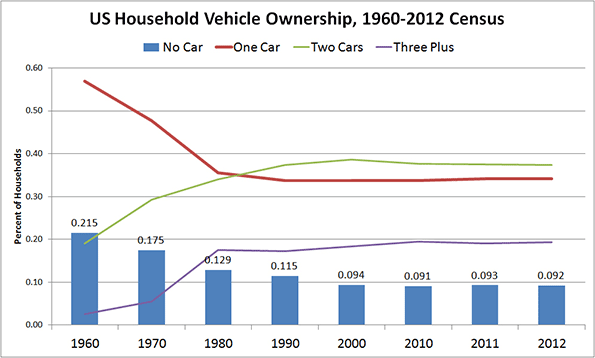
    This could hardly apply to households and the car market. There are 828 cars per 1000 people in the US; 620 in Canada. Even more telling is market participation by households, as shown by the blue bars in Chart 1, below. By 2012, only about 9% of households did not own a vehicle, compared to over 20% in 1960. These figures speak of a large majority of households in the car market. As for households that opted not to own a car, their absence from the market may be due, at least partly, to their knowledge of the costs.

    Chart 1 Source: Oak Ridge National Laboratory; Transportation Energy Data Book. Table 8.5.
    If knowledge is not at issue, the question becomes whether households manage their expenses on this item prudently, or if they could use expert advice to do so.

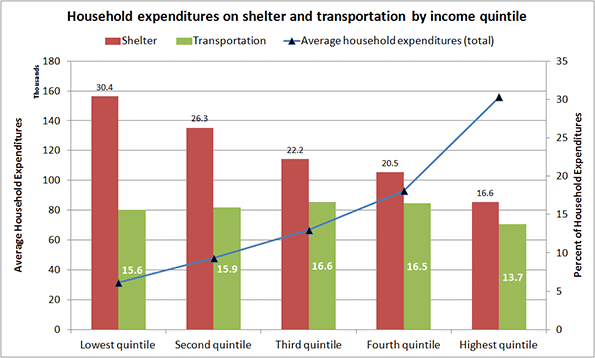
    Advice on how to manage household transportation expenses is, evidently, also unnecessary. Statistics on household expenditures leave little doubt that households manage their transportation budgets surprisingly well. Consumer surveys show that among all income quintiles, with total household expenditures ranging from about $31,000 to five times that ($155,000), the percentage allocated to transportation is fairly constant – around 15% (Chart 2). The only exception is found among the highest quintile, which may simply be indicative of higher disposable incomes. (We hope readers will be lenient about our use of statistics from multiple countries. The intent is to show trends, rather than report on the specifics of a chosen country.)

    Not only is the mid-teen figure constant across different income groups, it is also constant across countries. The European Union, for example, reports 13.0% and 13.2% all across the EU (excluding its newest members). It is hard to interpret this consistency as anything other than an ability to control transportation costs in a way that meets a household’s needs and budget, particularly when seen in juxtaposition to the expenditure on shelter.

    Chart 2 Source: Statistics Canada, Survey of Household Spending. Table 2: Budget Shares Of Major Spending Categories By Income Quintile, 2012.
    This consistency of the transportation expense at all income levels is intriguing and instructive.Researchers have suggested that it represents a universal constant. Regardless of its universality, it indicates the adaptability people demonstrate in controlling this expense. This adaptability ranges from choosing the means of transport (foot, bike, transit, car or rail), their level of effort, the time they are willing to spend traveling, and their flexibility in reaching destinations.

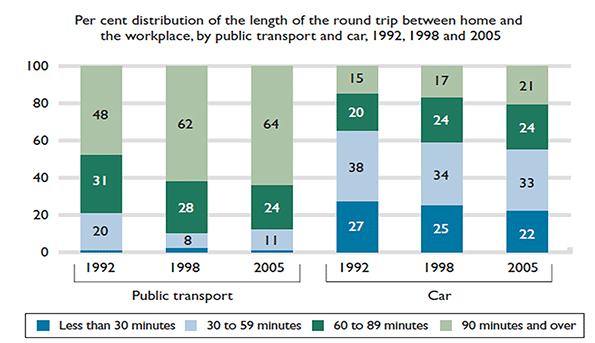
    For example, public transport lowers costs, but is generally slower than a car (Chart 3). In 2005, 21% of drivers recorded a 90+ minute round trip as opposed to three times that (64%) reported by transit riders. As might be expected, public transport users are predominantly lower quintile households that trade cost for time (Chart 4).

    Chart 3 Source: Statistics Canada, General Social Survey, Trip Duration, 1992, 1998, and 2005.
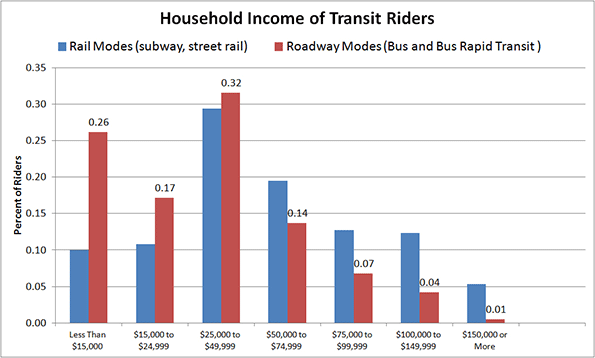
    Choosing the mode of transport is one path to controlling costs, and certain households are clearly doing so. As the chart below shows, about 75% of bus riders (adding the first three bars) earn up to $50,000 a year, a lower-rank quintile income. Riding the bus is a conscious choice, as percentages of riders of other income brackets suggest, but for the 75% it may also be an economic necessity.

    Chart 4 Source: American Public Transportation Association, A Profile of Public Transportation Passenger Demographics and Travel Characteristics, 2007.
    Other options in controlling transportation costs include walking and bicycling where possible, accessing the second-hand car market, and choosing other motorized transport.

    One good example of ‘other’ motorized transport is motor scooter ownership in developing nations, and in certain industrialized countries. In Taiwan, for example, “….Scooter is the primary mode of transport on this densely populated island – there are about 15 million for 23 million citizens.” Such wide-spread dependence on scooter-based motorized mobility correlates well with its cost and the per capita GDP of its users. Italy, for example, tops the EU in scooter/motorbike ownership. It may not be pure coincidence that it also has one of the lowest GDPs per capita among EU nations.

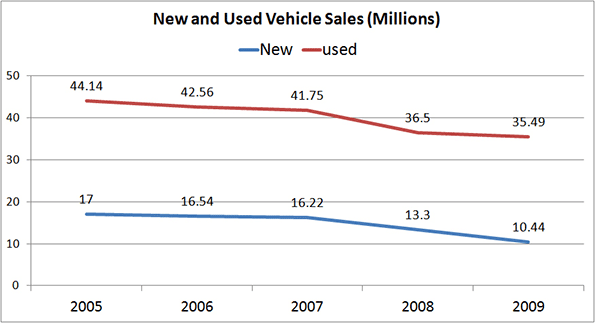
    The resale market for cars in the US outstrips the new car market by about one to three (Chart 5). Not only is the market large but also, significantly the average cost of a pre-owned car is generally about half its original price.

    Chart 5 Source: NIADA’s Used Car Sales Industry Report; Relative Size of Car Markets for New and Used Cars, 2010.
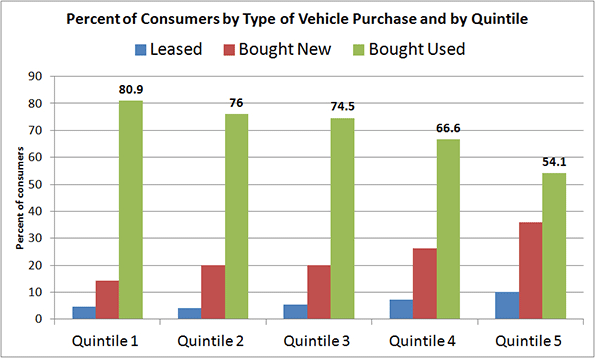
    The size of the resale market demonstrates yet another means by which consumers—particularly the lower quintile households— seek and grasp the opportunity to control car-related costs. As is evident from Chart 6, three of the five quintiles limit their new car purchases extensively; an overwhelming majority of consumers (averaging 77%) buy used cars. That figure reaches about 81% among the lowest quintile households.

    Chart 6 Source: Laura Paszkiewicz, The Cost and Demographics of Vehicle Acquisition, Consumer Expenditure Survey Anthology, 2003 (61) Division of Consumer Expenditure Surveys, US Bureau of Labor Statistics.
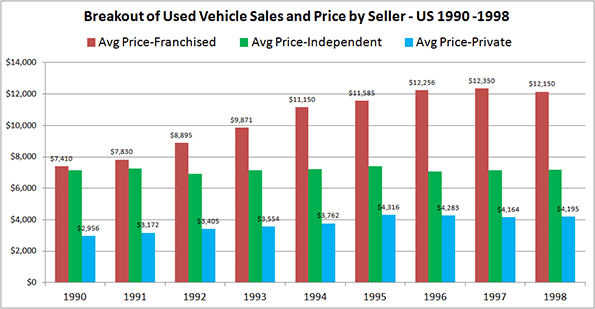
    Not only does the resale market allow for control of a buyer’s initial investment, but segments within the market further enhance that ability. As Chart 7 shows, the price differential between a private sale and that from a franchised dealer can range from double to triple.

    Chart 7 Source: The Used Vehicle Market in Canada, DesRosiers Automotive Consultants Inc., 2000.

    The twentieth century saw momentous change and variety in the means of transport, both personal and collective. All new entries except bicycles are motorized, and were unimaginable a mere century earlier. The previous means of transportation — horse-dependent — lasted for at least forty centuries, during which collective transport was non-existent. Motorized personal transport is just one instance in a trend of displacing muscle-dependent activities with motor-driven ones (such as climbing stairs being supplanted by using elevators). The change has been astonishing, unusually fast, and, judging by the plethora of articles on the topic, a cause for concern to some.

    Statistics and examples so far allow us to draw at least one indisputable conclusion: Households do know their transportation costs, and adjust their expenditures according to their needs and budget by taking advantage of available opportunities. It would appear that there is little need for guidance on either front.

    Fanis Grammenos heads Urban Pattern Associates (UPA), a planning consultancy. UPA researches and promotes sustainable planning practices including the implementation of the Fused Grid, a new urban network model. He is a regular columnist for the Canadian Home Builder magazine, and author of Remaking the City Street Grid: A model for urban and suburban development. Reach him at fanis.grammenos at gmail.com.

    After twenty-four years at Canada Mortgage and Housing Corporation, Tom Kerwin now leads an active volunteer life, including being the Science and Environment Coordinator for the Calgary Association of Lifelong Learners. He holds a Master’s degree in Environmental Studies from York University.

    Special thanks to Luis Rodriguez for collaborating in shaping this article.

    Flickr photo by promich: Car Town, a used car lot in Chicago.

  • Economic Progress is More Effective Than Protests

    The election of Barack Obama promised to inaugurate the dawn of a post-racial America. Instead we seem to be stepping ever deeper into a racial quagmire. The past two month saw the violent commemoration of the Ferguson protests, “the celebration” of the 50th anniversary of the Watts riots, new police shootings in places as distant as Cincinnati and Fort Worth, and renewed disorder, tied to a police-related shooting, in St. Louis last week.

    When President Obama was elected, two-thirds of Americans thought race relations were good. Now six in 10 think they are bad, according to a New York Times poll, including some 68 percent of African Americans.

    This extreme alienation creates a rich soil for resurgence of a cramped form of black nationalism, as revealed in such widely read books as Ta-Nehisi Coates’s Between the World and Me. Coates, like the black nationalists of the ’60s, is fawned over by today’s progressive gentryNew York Times film critic A.O. Scott gushed that Coates’s writing is “essential, like water or air.” Yet the new nationalists do not, like many previous iterations, look to Africa for salvation, and as a potential place of re-settlement. Instead they may look to Africa for inspiration, but seem content to stew in the American racial cauldron, always apart but also here.

    Yet to this reader, it’s hard to regard Coates’s book as anything more than a narrow selfie that holds little hope for any future racial progress. To Coates, America itself seems irredeemable, its very essence tied to racial oppression and brutality. America is not about ideals not yet fulfilled, but a legacy of “pillaging,” the “destruction of families,” “the rape of mothers,” and countless other outrages. Today’s abusive police—and clearly some can be so described—are not outliers who should be punished but “are merely men enforcing the whims of our country, correctly interpreting its heritage and legacy.” His alienation from America is so great that he admits to little sympathy for the victims of 9/11.

    He has particular contempt for those blacks who seek to succeed within the American system, although Coates, a talented rhetorician, has clearly done well for himself. To him, they are deluded into believing they can make their way by “acting white, of talking white, of being white.” African-American families that have broken away from the inner city or the poor small town and found a home in the suburbs, he suggests, “would rather live white than live free.” In language no doubt reassuring to New York urbanistas, he even accuses these blacks of participating in a grand global destruction merely because they drive cars and live in suburbs.

    Coates’s book also reinforces other nationalist voices such as can be found in certain vocal corners of the “Black Lives Matter” movement, which seems to have little room for the inclusive humanism that characterized the early ’60s civil rights campaigners. They shout down genuine progressives like Bernie Sanders and poseurs like Martin O’Malley for insisting that “all lives matter.” In this world-view all police are tarred similarly; in this construct, clear abuses, such as the Eric Garner case, are no different than that of Michael Brown in Ferguson, which even the Obama Justice Department found unworthy of federal prosecution.

    The current radicalization of some prominent black thinkers poses some challenges to Democrats in particular, reflecting their increased dependence on lopsided support from African Americans. Republicans may be doomed to become “the white man’s party,” as my old friend Harold Meyerson suggests, but who thinks the GOP’s insularity deserves emulating? Do the new black nationalists think they have anything to sell outside the confines of liberal bastions or inner-city African-American communities?

    Ultimately this program represents a dead end, both for the country and its increasingly diverse population. Ta-Nehisi Coates can’t expect to castigate whites as brutes who need to oppress blacks for both self-esteem and economic survival and then expect these same brutes to get on board with concessions, subsidies, and even reparations. Many academics and mainstream journalists may go along with such a program, but this is not a reasonable strategy for the rest of the country.

    ***

    When desegregation began in earnest in the ’60s, the hope was that we would see the emergence of greater equality between minorities and whites. And to be sure, there was reduction in black poverty in the booming ’60s, and then again during the Reagan and Clinton expansions. Yet in ensuing years, and especially with the onset of the Great Recession, this progress reversed, in large part because black and Latino families bore the brunt of the foreclosure crisis. African Americans saw their household wealth plunge 31 percent during the recession, including a steep 35 percent decline in their retirement assets, according to the Urban Institute. By comparison, the wealth of white families fell a relatively mild 11 percent from 2007 to 2010.

    This growing disparity has prompted demands for expanded racially-derived benefits that, according to advocates like former Attorney General Eric Holder, should be a permanent part of national policy. “The question,” says Holder, “is not when does it end, but when does it begin … When do people of color truly get the benefits to which they are entitled?”

    This idea has been further expanded by the Obama administration’s commitment to correcting what it calls “disparate impact,” which would force communities—presumably middle-class suburbs—to accommodate poor and minority residents at taxpayer expense, if the federal Housing and Urban Development or the courts deem it appropriate.

    Such an approach negates the aspirations of middle-class families, including many African Americans who have headed to the suburbs for a better life.Upwardly mobile African Americans have been deserting core cities for years: Today, only 16 percent of the Detroit area’s African Americans live within the city limits.

    The big problem here is the emphasis on legal remedies and identity politics, rather than focusing on economic empowerment for Americans of all ethnicities. Perhaps as much as any senior government official, Holder argued in support of a quota regime, which at its logical extreme guarantees that even the children of black billionaires get preferences easier than a white kid brought up in an Appalachian hovel.

    Yet this is the same official who gently treated Wall Street malefactors—the very people in large part responsible for millions of foreclosures, including those that affected many blacks—to an extent that even the usually pro-Obama Rolling Stone openly wondered if he was a “Wall Street double agent.”

    The Obama years—following the previous disasters left over from the Bush regime—have been largely an economic disaster for black America. Child poverty is at the highest level in 20 years, and among African Americans it stands at a disastrous 38 percent, rising even during the recovery. After decades of gradual decline, concentrated urban poverty has grown rapidly over the past decade.

    Nor have African Americans benefited much from the recovery. White American unemployment is either about the same or below what it was before the recession levels, while the gap with African Americans has grown, in some states two and a half times that of the majority population. In Washington, D.C., the fundamental center of blue-state America, it’s five times as high.

    Far more helpful than expanding racial quotas would have been steps to put African Americans to work, particularly teenagers, who suffer nearly 30 percent unemployment rate, twice the national average. Many African Americans, for example, could have benefited more from a revival of the old Works Progress Administration, which would have put unemployed and underemployed people to work, than from any extension of affirmative action in universities. It’s hard to see how doling out “green” subsidies and breaks to Silicon Valley and Wall Street crony capitalists has been much of a benefit to African-American communities, or other underserved minorities.

    Nor is the overall Obama environmental program—particularly on energy—helpful to African-Americans who need jobs in basic industries and in some places, such as California, are stuck with high electricity bills. Harry Alford, head of the U.S. Black Chamber of Commerce, accuses the EPA of “apparent indifference to the plight of low-income and minority households,” which he calls “inexcusable.”

    For Coates’s part, he claims several times in his book that America depends on the oppression of blacks—who, he claims, represent “the essential below,” an oppressed class of workers whose sweat and blood propel America’s economy. This may well have been true in the times when cotton was king and the South produced most of our exports. But for many states in 2015, the fact is that the low-wage labor force is now made up of workers largely from Latin America or Asia, who do the grueling work that blacks too often performed in the past.

    In a multi-racial society—where African Americans are in many places the second- or third-largest minority—black communities must focus on developing a competitive economic advantage. There are traditions here to draw on, from such disparate figures as Booker T. Washington and Marcus Garvey, who emphasized the need to be competitive with other peoples. The role models are not posturing Black Panthers but those who built institutions like Tuskegee Institute or even Howard University, Coates’s “Mecca.” Instead, Coates seems to prefer the theatrical racialism of the Panthers, whose legacy of violence left little in terms of tangible accomplishments, but who, like him, can count on the continued fawning approval of white intellectuals.

    Revolutionary posturing and racial redress may appeal to New York publishers, but economic success requires more than identity politics. Community members must loan to each other, start banks and nonprofits, and seek to dominate specific niches. In contrast, how much independent wealth or how many jobs have been created by the likes of Al Sharpton, whose career is largely one of extracting money from frightened corporate donors seeking anti-racist absolution?

    Ultimately the fate of black America is no different from the fate of the country as a whole: Both depend on economic progress more than political agitation. In a recent study I conducted with colleagues at the Center for Opportunity Urbanism, we found that the cities where African Americans and other minorities did best—measured by employment, income, homeownership—were those that created the most jobs, particularly for mid-skilled workers, and kept costs, particularly for housing, low.

    These included primarily regions in the least “progressive” parts of the country, such as the Southeast. Since 2000, when the census registered the first increase in the region’s black population in more than a century, the “Great Migration” to the North has now reversed and is heading back South. In our survey, the South accounted for a remarkable 13 of the top 15 metro areas for African Americans. Blacks in Texas, for example, suffer an unemployment rate 50 percent lower than blacks in California. School segregation, notes the University of California’s Civil Rights Project, is greatest in the Northeast and urban areas and least pronounced in the Southeast and the suburbs. 

    ***

    Despite all the negative aspects of America’s tortured racial history, comparing today’s situation to that of the early 20th or even 19th centuries—most particularly in the South—is misleading and hyperbolic. America is no longer a black-white country and many newcomers, such as Asians, also suffered severe discrimination but have made enormous progress. Yet today Asians enjoy higher incomes and levels of education than whites. Increasingly they are no longer the subjects of affirmative action, but among its primary victims.

    Perhaps even more revealing has been the progress of African immigrants, who represent one of the fastest-growing parts of our newcomer population. Between 2000 and 2010, their numbers grew from 800,000 to more than 1.6 million, and since 2010 grew by another 100,000, expanding faster as an immigrant group than those from any part of the world. Like African Americans, they are moving increasingly to Southern states, notably Texas and Virginia. As a group, they have done well in terms of income, education, and entrepreneurship.

    To be sure, most Africans in America, like Latinos and Asians, do not carry with them the burdens of slavery, or as consistent a long history of legal discrimination. They came here by choice and this no doubt influenced their behavior. Yet the success of other minorities does suggest that lingering racism, so deeply entwined in the analysis of Coates and other neo-black nationalists, does not present an insurmountable barrier.

    Of course, there is no clear pattern of such discrimination by police against Asians, and no way to distinguish the experiences of African immigrants from other blacks in terms of crime. Yet each group each is physically distinct, and they have not allowed this fact to prevent their ascendency in American society. This is not to say that serious changes in policing are not necessary—there certainly are—but that the focus of ethnic uplift needs to be focused not on what “they” do to you, but what you can manage to accomplish yourself despite their depredations.

    America’s racial divide cannot be bridged anymore by demonizing the country than by ignoring the issue. America is not, and won’t be, entirely “color blind” any time soon. But that is somewhat beside the point—the key to economic success lies not in celebrating or exploiting victimhood but in people moving forward both as individuals and groups.

    Simply put, to suggest that America is as racist today as in 1865 or 1965 is absurd, given the reality of the Obama presidency or, more specifically, given the demonstrable change in national attitudes. In 1958, a mere 4 percent of the population endorsed racial intermarriage, while today that percentage has risen to 87 percent. These views are particularly deeply felt among millennials, who are themselves the most diverse generation in American history.

    In the long run, demanding an economy with sufficient opportunities represents the best way to address racial disparities. The new black nationalists may be feted by the intellectually chic, but in the end their strategies can only leave their people in a cul-de-sac of disappointment, anger, rage, and, ultimately, impotence.

    This piece first appeared in The Daily Beast.

    Joel Kotkin is executive editor of NewGeography.com and Roger Hobbs Distinguished Fellow in Urban Studies at Chapman University, and a member of the editorial board of the Orange County Register. He is also executive director of the Houston-based Center for Opportunity Urbanism. His newest book, The New Class Conflict is now available at Amazon and Telos Press. He is also author of The City: A Global History and The Next Hundred Million: America in 2050. He lives in Orange County, CA.

    Photo by flickr user amir aziz

  • Urban Rebirth in a Cincinnati Rowhouse

    I filmed this story in Cincinnati’s Over-the-Rhine neighborhood. As always, my far more talented friend Kirsten Dirksen did the editing. There are also glimpses of other nearby neighborhoods such as East Walnut Hills and some views for the city taken from across the Ohio River in Kentucky. Michael Uhlenhake is an architect and long time resident of the city. The story of his own practice and home renovation follows the trajectory of the city as a whole.

    Rust Belt cities like Cincinnati, Pittsburgh, and Buffalo are all much better than many people imagine. I tell folks that if you want Brooklyn, or Portland, or Wicker Park in Chicago, or the Mission in San Francisco, but at 1/10th the price… go to these fabulous, but seriously undervalued smaller cities in the Midwest. Not only will you save a huge amount of money, but waves of cool people have already started to colonize these neighborhoods ahead of you. You won’t be a lone pioneer.

    I love the magnificent architecture, the cool people, and the gorgeous natural beauty that surrounds the city. And I’m incredibly excited that many of the best historic neighborhoods are coming back to life after a fifty year slumber brought on by middle class exodus to the suburbs, deindustrialization, and general neglect. There’s a serious pent up market demand for vibrant, mixed use, walkable neighborhoods all across the country with shockingly little supply. We just haven’t built places like this since World War II and there’s a hunger for it in the real estate market. After decades of decline and abandonment Cincinnati is being repopulated by a new generation of people who value urban living.

    Check out this similar video from Walnut Hills in Cincinnati.

    And here’s one from Yellow Springs, Ohio if a small college town in the country is more your style.

    John Sanphillippo lives in San Francisco and blogs about urbanism, adaptation, and resilience at granolashotgun.com. He’s a member of the Congress for New Urbanism, films videos for faircompanies.com, and is a regular contributor to Strongtowns.org. He earns his living by buying, renovating, and renting undervalued proper

  • The Peril to Democrats of Left-Leaning Urban Centers

    Twenty years ago, America’s cities were making their initial move to regain some of their luster. This was largely due to the work of mayors who were middle-of-the-road pragmatists. Their ranks included Rudy Giuliani in New York, Richard Riordan in Los Angeles, and, perhaps the best of the bunch, Houston’s Bob Lanier. Even liberal San Franciscans elected Frank Jordan, a moderate former police chief who was succeeded by the decidedly pragmatic Willie Brown.   

    In contrast, a cadre of modern mayors is minting a host of ideologically new urban politics that put cities at odds with millions of traditional urban Democrats. This trend is strongest on the coasts, but is also taking place in many heartland cities. Bill de Blasio is currently its most prominent practitioner, but left-wing pundit Harold Meyerson says approvingly that many cities are busily mapping “the future of liberalism” with such policies as  the $15-an-hour minimum wage, stricter EPA greenhouse gas regulations, and housing policies intended to force people out of lower density suburbs and into cities.

    For the Democrats, this urban ascendency holds some dangers. Despite all the constant claims of a massive “return to the city,” urban populations are growing no faster than those in suburbs, and, in the past few years, far slower than those of the hated exurbs. This means we won’t see much change in the foreseeable future in the current 70 to 80 percent of people in metropolitan America who live in suburbs and beyond. University of Washington demographer Richard Morrill  notes that the vast majority of residents of regions over 500,000—roughly 153 million people—live in the lower-density suburban places, while only 60 million live in core cities.  

    This leftward shift is marked, but it’s not indicative of any tide of public enthusiasm. One-party rule, as one might expect, does not galvanize voters. The turnout  in recent city elections has plummeted across the country, with turnouts 25 percent or even lower. In Los Angeles, the 2013 turnout that elected progressive Eric Garcetti was roughly one-third that in the city’s 1970 mayoral election.

    Bolstered by this narrow electorate, liberal pundits celebrate the fact that 27 of the largest U.S. cities voted Democratic in 2012, including “red” state municipalities such as Houston — but without counting the suburbs, where voter participation tends to be higher. An overly urban-based party faces the same fundamental challenges of a largely rural-oriented one—for example, the right-wing core of the GOP—in a country where most people live in neither environment.

    Demographic and Political Transformation of American Cities

    City dwellers have historically voted more liberally than their country or suburban cousins, but demographic trends are exacerbating this polarizing impulse. Simply put, the cities that could elect a Giuliani or a Riordan no longer exist. The centrist urban surge of the 1990s was both a reaction to the perceived failures of Democratic “blue” policies as well a reflection of the makeup of white-majority, middle-class neighborhoods in places like Brooklyn, Queens and the San Fernando Valley that featured healthy numbers of politically moderate “Reagan Democrats”—or Bill Clinton Democrats, circa 1992

    Since then, these communities have been largely supplanted by groups far more likely to embrace a more progressive political stance: racial minorities, hipsters, and upper-class sophisticates. These groups have swelled, and gotten much richer, in places like brownstone Brooklyn  or lakeside Chicago, while the number of inner city middle-class neighborhoods, as Brookings  has demonstrated, have declined, to 23 percent of the central city—half the level in 1970.

    This new urban configuration, notes the University of Chicago’s Terry Nichols Clark, tend to have different needs, and values, than the traditional middle class. Since their denizens are heavily single and childless, the poor state of city schools does not hold priority over the political power of the teachers unions. The key needs for the new population, Clark suggests, are good restaurants, shops and festivals, not child-friendly parks and family-oriented stores. Sometimes even crazy notions—such as allowing people to walk through the streets of San Francisco naked—are tolerated in a way no child-centric suburb would allow.

    These tendencies underscore as well the increasingly homogeneous political culture emerging in cities. In 1984, for example, Ronald Reagan took 31 percent of the vote in San Francisco, and 37 percent in New York. He actually carried Los Angeles. By 2012, a Republican with a more moderate history could not muster 20 percent of the vote in San Francisco. And Mitt Romney lost Los Angeles by more than a 2-1 margin, while garnering barely 20 percent in all New York boroughs besides Staten Island.

    Economic Hubris

    These changes also reflect a shift in the economic role of cities. Until the 1970s, cities were centers of production, distribution and administration. Then the industrial base of urban areas, and related jobs such as logistics, began moving away from the traditional manufacturing cities  to overseas, the suburbs or the Southeast.  In 1950 New York, according to economic historian Fernand Braudel, 1 million people worked in factories, mostly for small companies. Today the city’s industrial workforce now stands at a paltry 73,000, a dramatic decline from some 400,000 as recently as the early 1980s.

    A similar, if less spectacular, decline has taken place in what are still the two largest industrial metropolitan statistical areas, Chicago and Los Angeles. The one-time “City of Big Shoulders” and its environs had 461,600 industrial jobs in 2009. Today it has fewer than 300,000. Los Angeles, in a process that started with the end of the Cold War, has seen its once-diverse industrial base erode rapidly, from 900,000 just a decade ago to 364,000 today. 

    In some cities, a new economy has emerged, one that is largely transactional and oriented to media. The upshot is that denizens of the various social media, fashion and big data firms have little appreciation of the difficulties faced by those who build their products, create their energy and food. Unlike the factory or port economies of the past, the new “creative” economy has little meaningful interaction with the working class, even as it claims to speak for that group.

    This urban economy has created many of the most unequal places  in the country. At the top are the rich and super-affluent who have rediscovered the blessings of urbanity, followed by a large cadre of young and middle-aged professionals, many of them childless. Often ignored, except after sensationalized police shootings, is a vast impoverished class that has become ever-more concentrated in particular neighborhoods. During the first decade of the current millennium, neighborhoods with entrenchedurban poverty actually grew, increasing in numbers from 1,100 to 3,100. In population, they grew from 2 million to 4 million.Some 80 percent of all population growth in American cities, since 2000, notes demographer Wendell Cox, came from these poorer people, many of them recent immigrants.

    Such social imbalances are not, as is the favored term among the trendy, sustainable. We appear to be creating the conditions for a new wave of violent crime on a scale not seen since the early 1990s. Along with poverty, public disorderlinessgang activityhomelessness and homicides are on the rise in manyAmerican core cities, including Baltimore, Milwaukee, Los Angeles and New York. Racial tensions, particularly with the police, have worsened. So even as left-leaning politicians try to rein in police, recent IRS data in Chicago reveals, the middle class appears to once again be leaving for suburban and other locales. 

    Urbanity and Politics

    These social and economic changes inform the new politics of the Democratic Party. On social policy, the strong pro-gay marriage and abortion positions of the Democrats makes sense as cities have the largest percentages of both homosexuals and single, childless women. When the party had to worry about rural voters in South Dakota or West Virginia, this shift would have been more nuanced, and less rapid.

    Yet with those battles essentially won, the new urban politics are entering into greater conflict with the suburban mainstream, which tends to be socially moderate, and even more so with the resource-dependent economies of rural America. The environmental radicalism that has its roots in places like San Francisco and Seattle  now directly seeks to destroy whole parts of middle America’s energy economy.

    Such policies tend to radically raise energy costs. In California, the green energy regime has already driven roughly 1 million people, many of them Latinos in the state’s agricultural interior, into “energy poverty”—a status in which electricity costs one-tenth of their income. Not surprisingly, those leaving California, notes Trulia, increasingly are working class; their annual incomes in the range of $20,000 to $80,000 are simply not enough to make ends meet.

    Geography seems increasingly to determine politics. Ideas on climate policy that seem wonderfully enlightened in Manhattan or San Francisco—places far removed from the dirty realities of production—can provide a crushing blow to someone working in the Gulf Coast petro-chemical sector or in the Michigan communities dependent on auto manufacturing.

    It’s more than suburban or rural jobs that are on the urban designer chopping block. Density obsessed planners have adopted rules, already well advanced in my adopted home state of California, to essentially curb  much detested suburban sprawl and lure people back to the dense inner cities. The Obama administration is sympathetic to this agenda, and has adopted its own strategies to promote “back to the city” policies in the rest of the country as well.

    But as these cities go green for the rich and impressionable, they must find ways to subsidize the growing low-paid service class—gardeners, nannies, dog walkers, restaurant servers—that they depend on daily. This makes many wealthy cities, such as Seattle or San Francisco, hotbeds for such policies as a $15-an-hour minimum wage, as well as increased subsidies for housing and health care. In San Francisco, sadly, where the median price house (usually a smallish apartment) approaches  $1 million, a higher minimum wage won’t purchase a decent standard of living. In far more diverse and poorer Los Angeles, nearly half of all workers would be covered — with unforeseen impacts on many industries, including the largegarment industry.

    These radicalizing trends are likely to be seen as a threat to Democratic prospects next year, but instead will meet with broad acclaim among city-dominated progressive media. Then again, the columnists, reporters and academics who embrace the new urban politics have little sympathy or interest in preserving middle-class suburbs, much less vital small towns. If the Republicans possess the intelligence—always an open question—to realize that their opponents are actively trying to undermine how most Americans prefer to live, they might find an opportunity far greater than many suspect.

    This piece first appeared at Real Clear Politics.

    Joel Kotkin is executive editor of NewGeography.com and Roger Hobbs Distinguished Fellow in Urban Studies at Chapman University, and a member of the editorial board of the Orange County Register. He is also executive director of the Houston-based Center for Opportunity Urbanism. His newest book, The New Class Conflict is now available at Amazon and Telos Press. He is also author of The City: A Global History and The Next Hundred Million: America in 2050. He lives in Orange County, CA.

    Photo by Kevin Case from Bronx, NY, USA (Bill de Blasio) [CC-BY-2.0], via Wikimedia Commons

  • Progressive Policies Drive More Into Poverty

    Across the nation, progressives increasingly look at California as a model state. This tendency has increased as climate change has emerged as the Democratic Party’s driving issue. To them, California’s recovery from a very tough recession is proof positive that you can impose ever greater regulation on everything from housing to electricity and still have a thriving economy.

    And to be sure, the state has finally recovered the jobs lost in the 2007-09 recession, largely a result of a boom in values of stocks and high- end real estate. Things, however, have not been so rosy in key blue-collar fields, such as construction, which is still more than 200,000 jobs below prerecession levels, or manufacturing, where the state has lost over one-third of its employment since 2000. Homelessness, which one would think should be in decline during a strong economy, is on the rise in Orange County and even more so in Los Angeles.

    The dirty secret here is that a large proportion of Californians, roughly one-third, or some 3.2 million households, as found by a recent United Way study, find it increasingly difficult to keep their heads above water. The United Way study, surprisingly, has drawn relatively little interest from a media that usually enjoys highlighting disparities, particularly racial gaps. Perhaps this reflects a need to maintain an illusion of blue state success. If Republican Pete Wilson were still governor, I suspect we might have heard much more about this study.

    Read the entire piece at The Orange County Register.

    Joel Kotkin is executive editor of NewGeography.com and Roger Hobbs Distinguished Fellow in Urban Studies at Chapman University, and a member of the editorial board of the Orange County Register. He is also executive director of the Houston-based Center for Opportunity Urbanism. His newest book, The New Class Conflict is now available at Amazon and Telos Press. He is also author of The City: A Global History and The Next Hundred Million: America in 2050. He lives in Orange County, CA.

  • The Really Big Housing Picture

    Everywhere I go it seems there’s some kind of housing crisis. In some places home values are dropping precipitously, people are unable to sell and move on, and formerly middle class homes are being abandoned or converted to poorly maintained rental properties. In other places home values and rents are obscenely high and ordinary people and essential workers are being driven out of whole cities and counties. The national economy has bifurcated and the shrinking middle class is reflected in a two tiered housing market. I’d like to explore the root causes of the situation.

    Woodstock-kidsWikipedia

    Reagan_et_ThatcherWikipedia

    Our current real estate schism is based on two forces. First, we as a society decided decades ago that we didn’t want to be shackled by the social conventions and obligations that hindered individuals in their quest for personal fulfillment and private gain.

    For liberals this took the form of women’s liberation, black liberation, gay liberation… Everyone wanted to throw off the yoke of conformity. For conservatives it took the form of tax revolts, rebellions against regulations of every kind, a search for open space, cheap labor, and new markets.

    These two groups were in no way mutually exclusive. Both the California Hippy and Evangelical Christian from South Carolina were pushing the country in the same direction for decades whether they knew it or not. Everyone was rebelling against social constraints and dismantling the old system that created the broad stable middle class in the first place.

    Screen Shot 2015-07-23 at 9.05.36 PM

    Screen Shot 2015-07-23 at 8.59.17 PM

    Screen Shot 2015-07-23 at 9.06.57 PM

    Screen Shot 2015-07-23 at 9.16.12 PM

    The second force in the housing crisis is based on physical mobility made possible by car culture, affordable commercial aviation, containerized cargo shipping, and modern telecommunications. Geography stopped being a material limitation for the last few generations. As a result, people have self segregated. The rich have congregated in a handful of premium locations and radically driven up the cost of living in those spots. The poor have been left to their own devices in economically and culturally abandoned regions. And the ever diminishing middle class has leveraged itself into a thousand little niches in an attempt to keep up as their incomes and status decline.

    Screen Shot 2015-06-12 at 1.16.04 AM

    Screen Shot 2015-06-12 at 6.52.37 PM

    I was recently at a meeting in Northern California where government officials, local business people, and community organizers all gathered to promote their various objectives. These were all incredibly kind, decent, responsible people who truly cared about their town. The difficulties on hand will be familiar if you live in one of the more expensive parts of the country.

    There’s a desperate need for affordable housing. There’s huge pressure to preserve productive farmland and the natural landscape. There’s fierce NIMBYism that stops new growth of every kind. There’s serious money pressing down on the scarce property that is available. There’s a water shortage brought on by years of drought. And there simply is no culturally or politically tolerable mechanism to reconcile any of these conflicting forces. Honestly, for the people who already own property in the area the situation is pretty sweet – so long as the authorities manage to keep the ever growing homeless camps out of sight. The default setting is to simply let things fester and muddle through.

    Screen Shot 2015-03-18 at 1.26.28 AM

    Screen Shot 2015-03-10 at 5.31.42 PM

    Screen Shot 2015-03-12 at 2.10.06 AM

    Just a month earlier I was at a different meeting in another town where the problem was reversed. A formerly prosperous town was hitting an economic wall as growth and development had come to a complete halt with unpleasant consequences. There was plenty of cheap land all around and everyone was desperate to see it covered in new homes, shopping malls, and office parks as quickly as possible. But market demand evaporated. Developers couldn’t justify building much of anything because there were no buyers on hand. Too much of the existing building stock was already sitting vacant.

    You’d think these two problems could solve each other. Why don’t all the people desperate for affordable housing in one place simply move to the place with abundant vacancies? Of course, it doesn’t work that way. Communities are more than a pile buildings. People need the right mix of employment, education, culture, and so on. You can’t live in a cheap place if you have no access to jobs. And you can’t take a job in a place where there is no available housing.

    Screen Shot 2015-07-23 at 9.05.36 PM

    Let’s go over some of the particulars again. Mass motoring allowed almost everyone to move away from the things and people they didn’t like. If your taxes went up you moved away. If “undesirables” arrived on your block you moved away. If you didn’t like the snow you moved away. Cheap private transportation on America’s highways made it possible for the vast 20th century middle class to remove itself from traditional communities and find bliss is splendid isolation.

    Screen Shot 2015-07-23 at 8.59.17 PM

    Affordable commercial aviation let people migrate to previously remote locations. A car could get you from New Jersey to Florida in a couple of days, but a plane could get you there in a couple of hours. Air transport preferentially poached the affluent, the young, the educated, and retirees from established towns and delivered them to previously obscure destinations. The ability to hop quickly and cheaply from place to place was a tremendous boon to some lucky towns, but the death knell to others.

    Screen Shot 2015-07-23 at 9.06.57 PM

    Containerized shipping brought raw materials and cheap manufactured goods in from every corner of the globe. If workers threatened to strike you moved your company away. Far away. If you found a better tax deal you moved away. If you needed the authorities to turn a blind eye to your company’s waste stream you moved away. The toaster ovens, refrigerators, and steel belted radial tires could all be made somewhere else for a lot less money.  And along with those jobs went a big chunk of the old middle class.

    Screen Shot 2015-07-23 at 9.16.12 PM

    Information technology has added a new layer of mobility to the population. It’s now possible to use your mobile phone to turn your home air conditioner on and off from six thousand miles away. On the one hand this sort of technological magic allows millions of people to earn a living remotely. An accountant from Albuquerque can live in a beach cabin in Hawaii while still drawing her livelihood from New Mexico.

    On the other hand, what happened to blue collar jobs in the past is now happening to white collar jobs. Your CT scan or X-rays can now be sent via the Internet to a technician in the Philippines who will interpret your medical condition remotely. Film editing can be done entirely online from Brazil. Computer code can be written in India. Architectural and engineering work can be done digitally in the Ukraine. If a job can be scanned, or Skyped, or pushed through a fiber optic wire somehow it will eventually be sent to a low wage region to be done by someone who is smarter, faster, and more desperate for work than you are.

    And this isn’t factoring in the jobs that will soon be done entirely by machine intelligence. That accountant in Hawaii needs to pay attention to what she’ll do when her clients all switch to the cheaper advanced computer program that can wiggle around the tax code better than she can. Then again, the guy who writes that computer code will become very rich and might be able to move to Hawaii himself.

    unnamed-5

    unnamed-3

    unnamed

    So what are the options here? First, we can allow the already stressed middle class to continue to shrink so that the U.S. becomes a two tiered society of haves and have nots – with many more losers than winners. Inevitably this will require an increase in both government police and private security to keep the wealthy protected from the pissed off impoverished masses. There are plenty of examples of what that looks like around the world.

    Or, we could tax the rich and redistribute the funds to the formerly middle class population that has trouble feeding itself and keeping a roof over their heads. We also know what that looks like.

    Or we could create a new social, political, and economic national compact that restructures absolutely everything. Some old fashioned societal constraints might be a prerequisite for equity and a renewed middle class. Rights come with responsibilities. Aging Baby Boomers will fight that sort of thing tooth and nail. But Millennials will likely grab at it with both hands. Toss in fuel supply disruptions and a break down in international trade relations and American society might find itself coalescing in very different ways.

    John Sanphillippo lives in San Francisco and blogs about urbanism, adaptation, and resilience at granolashotgun.com. He’s a member of the Congress for New Urbanism, films videos for faircompanies.com, and is a regular contributor to Strongtowns.org. He earns his living by buying, renovating, and renting undervalued properties in places that have good long term prospects. He is a graduate of Rutgers University.

  • Rethinking the Scandinavian Model

    During a tour to Paris, Bruce Springsteen explained that his dream was for the US to adapt a Swedish style welfare state. The famous musician is far from alone in idealizing Nordic policies. The four Nordic nations (Denmark, Finland, Norway and Sweden) are often regarded as prime role-models the policies to be emulated by others. Internationally, advocates of left of centre policies view these countries as examples of how high tax social democratic systems are viable and successful. Paul Krugman, for example, has said: “Every time I read someone talking about the ‘collapsing welfare states of Europe’, I have this urge to take that person on a forced walking tour of Stockholm”.

    This admiration has a long history. In the mid-1970s Time Magazine described a country that sounded much like a utopia. “It is a country whose very name has become a synonym for a materialist paradise”, the international magazine wrote and continued to report about Sweden: “No slums disfigure their cities, their air and water are largely pollution free… Neither ill‑health, unemployment nor old age pose the terror of financial hardship.” Similarly, political scientist John Logue argued in 1979: “A simple visual comparison of Scandinavian towns with American equivalents provides strong evidence that reasonably efficient welfare measures can abolish poverty as it was known in the past; economic growth alone, as the American case indicates, does not”. Logue believed that the greatest threat to the Nordic welfare states was that they were too successful; eliminating social problems to such a degree that people forgot the importance of welfare policies.

    The high regard comes as no surprise. Nordic societies are uniquely successful. Not only are they characterised by high living standards, but also by other attractive features such as low crime rates, long life expectancy,  high degrees of social cohesion and even income distributions. Various international rankings conclude that they are amongst the best, if not the best, places in the world in which to live. One example is the “Better Life Index”, complied by the OECD. In the 2014 edition of the index Norway was ranked as the nation with the second highest level of well-being in the world, followed by Sweden and Denmark in third and fourth position. Finland ranked as the eighth best country.

    The OECD “Better Life Index”


    1. Australia

    2. Norway

    3. Sweden

    4. Denmark

    5. Canada

    6. Switzerland

    7. United States

    8. Finland

    9. Netherlands

    10. New Zealand


    If one disregards the importance of thinking carefully about causality, the argument for adopting a Nordic style economic policy in other nations seems obvious. The Nordic nations – in particular Sweden, which is most often used as an international role‑model – have large welfare states and are successful in a broad array of sectors. This is often seen as proof that a ”third way” policy between socialism and capitalism works well, and that other societies can reach the same favourable social outcomes simply by expanding the size of government. If one studies Nordic history and society in‑depth, however, it quickly becomes evident that the simplistic analysis is flawed.

    To understand the Nordic experience one must bear in mind that the large welfare state is not the only thing that sets these countries apart from the rest of the world. The countries also have homogenous populations with non-governmental social institutions that are uniquely adapted to the modern world. High levels of trust, strong work ethic, civic participation, social cohesion, individual responsibility and family values are long-standing features of Nordic society that pre-date the welfare state. These deeper social institutions explain why Sweden, Denmark and Norway could so quickly grow from impoverished nations to wealthy ones as industrialisation and the market economy were introduced in the late 19th century. They also play an important role in Finland’s growing prosperity after the Second World War.

    Take Sweden as an example. In 1870 free markets were introduced in this agrarian society. During the coming 100 years Sweden combined low taxes, liberal regulations and strong working ethics to experience an unrivalled growth rate in Europe. In 1870 Sweden’s GDP per capita was 57 per cent lower than in the UK. In 1970 it had risen to become 21 per cent higher. The shift towards high taxes and state involvement actually began   occurred around 1970, resulting in a long-lasting period of stagnation that was broken through ambitious market reforms during the 1990s and onward.

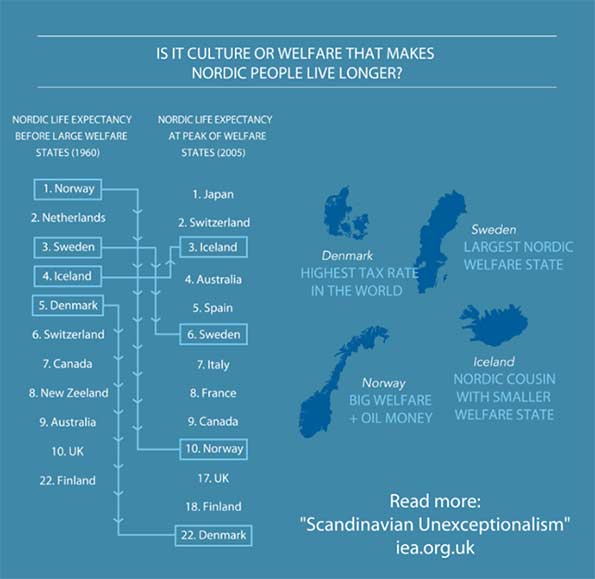
    Perhaps even more interestingly, even the social progress that Nordic countries are admired for developed during the latter part of the 19th century and the first half of the 20th century, developed not under socialism but at a time when Nordic countries combined free markets and low taxes with small (and efficient) welfare states. Researchers have for example shown that it was during this period that Sweden and Denmark developed a relatively equal income distribution. Long life expectancy is another example. In the picture below I show the life expectation at birth is shown for various OECD nations in 1960 – when Nordic nations had small welfare states – and 2005 – when Nordic welfare states were at their peak. In both periods Nordic countries were characterized by relatively long life expectancy, but if anything, this was more the case when the countries had small rather than large welfare states. The reason is simply that everything is not politics, cultural attributes such as a love for nature and healthy diets explains much of Nordic citizens good health.

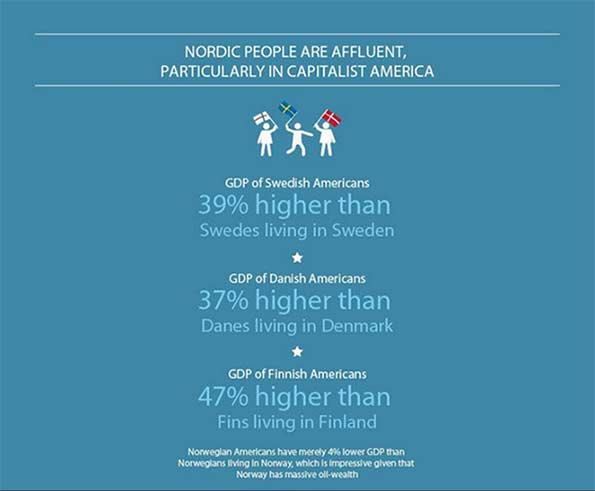
    Similarly, it comes as no surprise that descendants of the Nordics who migrated to the US in the 19th century are still characterised by favourable social outcomes, such as a low poverty rate and high incomes. In fact, as shown below, Nordic Americans have considerably higher living standard in capitalist America than their cousins in the Nordics. This is interesting, since those Nordic citizens who migrated to the United States in large groups during the 19th and 20th centuries were anything but an elite group. Rather, it was often the poor who left for the opportunities on the other side of the Atlantic.

    A key lesson from the success of Nordic society lies in what can broadly be defined as “culture matters”. We should not be surprised that it is these nations, with their historically strong work ethic and community-based social institutions, t  have had fewer adverse effects from their welfare states and are therefore used as the poster child for those wishing to extol the benefits of active welfare policies. On the other hand, Southern European countries with similar sized welfare states and size of government have had less favourable outcomes.

    Paul Krugman is right in noting that a forced walking tour of Stockholm disproves the idea of the collapsing welfare states of Europe. Nordic societies have not collapsed under the weight of welfare policies, particularly since they have lately adopted by introducing market reforms, reducing the generosity of welfare programs and cutting taxes. Such a tour may perhaps also be wise for Krugman himself, in teaching that Scandinavian countries have been rather unexceptional. The normal economic rules apply: incentives, economic freedom, a strong self-sufficient culture and a regime of good governance all matter when it comes to economic success. The question that remains is whether Scandinavian countries will continue their return to the free-market roots that have historically served them so well. If so, the Nordic culture of success can in combination with sound policies allow growth, innovation and entrepreneurship to flourish.

    Dr. Nima Sanandaji is a research fellow at CPS, and the author of “Scandinavian Unexceptionalism – Culture, Markets and the Failure of Third-Way Socialism”. The book, which was recently released is currently being translated to a number of different languages. The entire book is available through the Institute of Economic Affairs which has published it.

  • What Jane Jacobs Got Wrong About Cities

    Few people have had more influence on thinking about cities than the late Jane Jacobs.

    The onetime New Yorker turned Torontonian, Jacobs, who died in 2006, has become something of a patron saint for American urbanists, and the moral and economic case she made for urban revival has been cited by everyone frompundits and think tanks to developers.

    However, though widely celebrated for her insights and unabashed embrace of dense urbanism, Jacobs may ultimately prove more influential than relevant. Her writing was often incisive and inspiring, particularly when she opposed planning and overdevelopment and embraced the role of middle-class families in cities. But the urban revival that has actually taken place is at variance with her own romantic version of cities and how they work.

    Currently the American cities that are doing best are not those with a flourishing middle class but those have become the preferred playgrounds of the rich and famous—New York, San Francisco, even Washington, D.C. At the same time, vast portions of urban America remain cut off from society’s mainstream.

    The Nature of the New Urban Revival

    When Jacobs published her most important work, The Death and Life of Great American Cities,in 1961, America’s cities were clearly in trouble. Racial tensions and a massive flight to suburbia were undermining the promise of cities, and the only response of planners at the time seemed to be to expand freeway access, tear down old neighborhoods, construct massive apartment blocks, and subsidize big employers.

    Jacobs rightly opposed these approaches, and constructed a far more human and enduring vision of urbanism. Her appealing perspective was based on middle-class neighborhoods, families, and grassroots economic activity. Her maxim about the best role for places remains a guiding light to those who care about upward mobility: “A metropolitan economy, if it is working well, is constantly transforming many poor people into middle-class people, many illiterates into skilled people, many greenhorns into competent citizens. … Cities don’t lure the middle class. They create it.”

    Yet when cities did begin to come back—a handful in the ’80s and then again more around the time of the millennium—the revivals were in many ways the opposite of her grassroots vision. Instead of creating more family-oriented middle-class neighborhoods, the urban revival ended up being based on “luring” the affluent, the still forming young person, or the accomplished, childless professional than generating a new middle class.

    Witold Rybczynski noted in 2010 that the rise of successful urban cores increasingly has little in common with Jacobs’s romantic bottom-up organic urbanism:

    “The most successful urban neighborhoods have attracted not the blue-collar families that she celebrated, but the rich and the young. The urban vitality that she espoused—and correctly saw as a barometer of healthy city life—has found new expressions in planned commercial and residential developments whose scale rivals that of the urban renewal of which she was so critical. These developments are the work of real estate entrepreneurs, who were absent from the city described … but loom large today, having long ago replaced planners and our chief urban strategists.”

    As Rybczynski suggests, the current rise of “urban vitality” derives not from the idiosyncratic, diverse and, if you will, democratic form that Jacobs celebrated but in a more manufactured matter that at times outdoes suburbs for conformity and boredom.

    The Evisceration of the Urban Middle Class

    Jacobs’s vision failed in large part because today’s cities play a different economic role than they did in the past. The economic basis of her New York—small businesses, manufacturers, business service firms employing masses of middle-class workers—has declined while the city has evolved into what Jean Gottman called the “transactional metropolis,” dependent on the most elite financial services, high-end consumption, and the all too present media industry.

    This urban economy has many strengths but increasingly relies on the rich. A Citigroup study suggested that cities, particularly New York and London, have become “plutonomies”—economies driven largely by the wealthy class’s investment and spending. In this way the playground or luxury cores serve less as places of aspiration than geographies of inequality.

    New York, for example, is by some measurements the most unequal of American major cities: Gotham’s 1 percent earns a third of the entire city’s personal income—almost twice the proportion for the rest of the country.

    Other luxury cores exhibit similar patterns. A 2014 recent Brookings report found that virtually all the most unequal large central cities—with the exception of Atlanta and Miami—are dense, luxury-oriented cities such as San Francisco, Boston, Washington, New York, Chicago, and Los Angeles. Although high-wage jobs have increased in these metropolises, the bulk of new employment in cities like New York has been in low-wage service jobs.

    As urban studies author Stephen J.K. Walters notes, these cities tend to develop highly bifurcated economies, divided between an elite sector and large service class. He notes this is “the opposite of [Jane] Jacobs’s vision of cities” that relied on “transforming” poor people into the middle-class people

    Even diversity, often cited by Jacobs as a great asset of cities, has suffered. Among the most successful cities today are what analyst Aaron Renn has labeled “the white cities”—places like Boston, San Francisco, Seattle, and Portland, Oregon—which have historically been home to relatively small and now shrinking, minority populations. San Francisco’s black population is 35 percent lower than what it was in 1970. In the nation’s whitest major city, Portland, African-Americans are being driven out of the urban core by gentrification, partly supported by city funding. Similar phenomena can be seen inSeattle and Boston, where long existing black communities are rapidly shrinking.

    In the more diverse big cities like Los Angeles, New York, and Chicago, gentrification takes place alongside growing concentrations of poverty. It is often forgotten, according to demographer Wendell Cox, that 80 percent of the increase in urban core population in the last decade was from poor people; overall, despite the growth of poverty in suburbs, the core poverty rate remains more than twice as high.

    Nor is this situation necessarily improving. During the first 10 years of the new millennium, neighborhoods with entrenched urban poverty actually grew, increasing in numbers from 1,100 to 3,100 and in population from 2 million to 4 million. “This growing concentration of poverty,” note urban researchers Joe Cortright and Dillon Mahmoudi (PDF), “is the biggest problem confronting American cities.”

    We see this in places like Brooklyn and Chicago, two much-hyped epicenters of urban gentrification. Brooklyn’s poorer sections—a quarter of the residents are onfood stamps—have become even more so, notes analyst Daniel Hertz. Incomes between 1999 and 2001, he notes, dropped overall, falling in the poorer areas even as they soared in the more gentrified neighborhood closer to Manhattan and surrounding Prospect Park.

    Hertz found similar, if more extreme, phenomena in Chicago, which has also seen an unwelcome return to high crime rates, particularly in its poorer sections. Gentrification has indeed expanded into formerly working- and middle-class neighborhoods, but poverty and despair still characterize much of the city. As Chicago urban analyst Pete Saunders has put it: “Chicago may be better understood in thirds—one-third San Francisco, two-thirds Detroit.”

    Here Comes the Childless City

    Arguably Jacobs’s biggest miscalculation related to urban demographics. As H.G. Wells predicted well over a century ago, cities now depend in large part on affluent, childless people, living what Wells labeled a life of “luxurious extinction.” Jacobs’s contemporary, the great sociologist Herbert Gans, already identified a vast chasm between suburbanites and those who favor urban core living who he identified as “the rich, the poor, the non-white as well as the unmarried and childless middle class.”

    Jacobs never got this point, perhaps because she instinctively hated where families were in fact headed: the suburbs. Like many intellectuals in the ’50s and ’60s, she saw no need for suburbs, even as they experienced explosive growth, just dense city surrounded by traditional countryside.

    Perhaps nothing of Jacobs seems more dated than her assertion that “suburbs must be a difficult place to raise children.” She lovingly portrayed neighborhoods like her own West Village as ideal places where locals watched out for each other. She wrote about how “Mr. Lacey, the locksmith, bawls out one of my sons for running into the street, and then later reports the transgression to my husband as he passes the locksmith shop. Mr. Lacey, with whom we have no ties other than street propinquity, feels responsible for him to a degree.”

    At best, Jacobs’s compelling portrait from 1961 is something of an anachronism. Families in urban apartments today, notes Cornell researcher Gary Evans (PDF), generally have far weaker networks of neighbors than their suburban counterparts, a generally more stressful home life, and significantly less “social support.” Toronto author Phillip Preville notes, “In the years since, all the Mr. Laceys of the world have died and gone to downtown heaven,” he notes. “We can all talk Jane’s talk, but some people are pickled in Jane’s brine.”

    Certainly statistics back up Preville’s assertion. Greenwich Village today now largely consists of students, wealthy people, and pensioners. Despite the presence of many young people, children and teens between 5 and 17 account for only 6 percent of the Village’s population, far below the norms for New York City (PDF), and less than half the 13.1 percent found across the United States’s 52 largest metropolitan areas. Overall, Manhattan has among the lowest percentage of children in the country; a majority of its households are made up of singles.

    This pattern holds across the country. According to census data, in 2011 children 5-14 constitute about 7 percent in core districts across the country, roughly halfthe level seen in suburbs and exurbs. By 2011 people in their 20s constitute roughly one-quarter of the residents in urban cores, but only 14 percent or fewer of those who live in suburbs, where the bulk of people go as they start to reach the point of establishing families.

    Even in Toronto, generally seen as one of the world’s most livable cities and Jacobs’s chosen home, Statistics Canada notes that for every person who moved from the hinterlands to the city, 3.5 moved towards the periphery. The people most likely to move out are 25 to 44, people entering the stage of family formation. As one Torontonian, who recently moved to the suburbs, observed: “The big city has its uses. It served me well, and I served it back. Living in Toronto enabled me to transform my life in ways I dearly wanted: marriage, fatherhood, career advancement. That transformation has brought with it needs that Toronto cannot adequately provide: personal space, affordability, an emphasis on community over privacy. The intensity and the anonymity of the city now hinder my life more than they help. Simple as that. I’m outta here.”

    Overall, high-density cores, whether in Canada, America, or East Asia, consistently exhibit the lowest percentages of children. The far more ultra-dense cities of East Asia—Hong Kong, Singapore, and Seoul—exhibit the lowest fertility rates on the planet (PDF), sometimes less than half the number required simply to replace the current population. Due largely to crowding and high housing prices, 45 percent of couples in Hong Kong say they have given up on having children.

    In Asia people have few opportunities to move to lower-density housing. But in the United States, with abundant and often much cheaper land, super-urbanity often serves as a kind of way station in which people spend only a portion—often an exciting and career-enhancing one—of their lives. But when they grow older, and particularly when they decide to start families, they tend to leave for the periphery.

    Getting Beyond Nostalgia

    Nostalgia makes people feel good. Some still dream about a coming revival of diverse, child-friendly, dense city neighborhoods. They dream, in the words of oneauthor, of bringing us “back to the way we were, when most people lived in cities, did not own a car, walked or took the bus or train to work, and lived in much smaller residences.”

    Wishing to return to something that last predominated a half-century ago does not mean it will occur. Just as conservatives who hearken for a return to the ’50s are sure to be disappointed, urban advocates who suggest a “return to the city” for middle-class families will be as well. Both minorities and millennials, often thought of as spearheading a “back to the city” drive, are, according to most indicators, moving out to the suburbs as they enter their 30s and start families.

    Dense urbanity, of course, remains a huge contributor to the nation’s economy and culture. Urban centers are great places for the talented, the young, and childless affluent adults. But for most Americans, the central city offers at best a temporary lifestyle. It does not fit with what people can afford and where they want to live. There is a reason why 70 to 80 percent of Americans in our metropolitan areas live in suburbs, and those numbers are not likely to change appreciably in the coming decade.

    Cities, as Jacobs hoped, have indeed experienced a renaissance, but not in the form she preferred. To be sure, this revival is a hell of lot better than the urban dystopia that developed in the years after Jacobs’s Death and Life of Great American Cities first appearedBut it’s time to recognize that we are not seeing a renaissance of the kind of middle-class urbanity that she loved and championed. That city has passed into myth, and, unless society changes in very radical ways, it is never going to come back.

    This piece originally appeared at The Daily Beast.

    Joel Kotkin is executive editor of NewGeography.com and Roger Hobbs Distinguished Fellow in Urban Studies at Chapman University, and a member of the editorial board of the Orange County Register. He is also executive director of the Houston-based Center for Opportunity Urbanism. His newest book, The New Class Conflict is now available at Amazon and Telos Press. He is also author of The City: A Global History and The Next Hundred Million: America in 2050. He lives in Orange County, CA.

    By Phil Stanziola [Public domain], via Wikimedia Commons