Tag: middle class

  • 21st Century California Careers

    California is undergoing profound change.  Most strikingly, people are leaving the Golden State, which was once the preferred destination of migrants worldwide.  California’s domestic migration has been net negative for over 20 years.  That is, for 20 years, more people have been leaving California for other states than have been arriving from other states.  The state’s population is only growing because of a relatively high birthrate, mostly among immigrants.

    Domestic migration is not a one-way street.  It may be net negative, but lots of people are coming to the state.  It’s just that more are leaving. Generally speaking, low and middle-income people are leaving.  Those coming tend to be wealthier and older than those leaving.  They are people who can afford California’s higher costs and limited opportunity.  These migratory trends are increasing income-inequality in America’s most unequal state.

    Businesses are leaving the state too, but not all businesses.  Tradable goods producers are leaving California, because the state has for ten years maintained the single worst business climate in America.  Tradable goods are goods that can be produced in one place and consumed in another.  Manufacturing is the classic example, but technology is changing what is a tradable good.

    Today, many jobs that used to be considered non-tradable services are now tradable services.  Back-office accounting functions can be done anywhere, as can legal research or title research.  Just about any job that is done at a computer is now a tradable service.

    Unless they have a monopoly, tradable goods and tradable service providers face relentless price competition.  California’s high-cost environment is forcing them to relocate to lower-cost communities to survive.  Tradable producers won’t be providing 21st Century California jobs.

    California, with its beaches, deserts, mountains, cosmopolitan cities and other attractions, is a major tourism destination.  These amenities also make California a wonderful place to live for those who can afford it.  So, wealthy people come to or stay in California, and then try to close the gate behind them.  Our cities become ever more divided between the older haves and the younger have-nots, between opulent consumption and not-so-much consumption.

    So who will provide jobs for 21st Century Californians?  In a single word the rich and upper middle class affluents. When they come as tourists, they spark demand for leisure and hospitality jobs.  Consequently, this sector has been California’s second most rapidly growing sector with over 15 percent (239,400 jobs) growth since the beginning of the recession in October 2007.  Only healthcare grew faster or created more California jobs.  Since it is hard to guide tourists or change bed sheets remotely, these are non-tradable services jobs. 

    The resident rich will also create jobs.  We see this already in places like Santa Barbara, where there are types of jobs that were unimaginable until recently.  People will come to your house to cook your gourmet meal, clean your house, bathe your dog, trim your toenails, and supervise your exercise. They’ll even bring an athletic gym in the back of a truck.  There are doggy day care centers, with web cams to watch your puppy while you’re separated.  There is a pet cremation center.  There is a dog bakery.  Some people make a living walking other people’s dogs, while some people make a living taking older, apparently poorly-motivated, people for exercise walks.   

    Huge amounts of money are spent on homes, and not just on the purchase.  Remodels are almost perpetual for some, and they are happy to pay huge sums for quality craftsmanship.  So it is with cars.  Car collectors used to be hands-on.  Today, many hire someone to restore their cars.

    The list of services that wealthy people are willing to pay for is unlimited.  Rich people, indeed all of us if we could afford it, enjoy paying someone else to do even mildly unpleasant chores. 

    This has resulted in rapid-for-California growth in non-tradable services jobs.  According to the California Employment Development Department, non-tradable services jobs grew 14 percent since 2000, while tradable-goods jobs declined by 24 percent.

    We’ve seen this before.  Domestic service was a large sector in Victorian England, peaking about 1891 when internal combustion engines and automobiles brought renewed economic growth.  This provided new opportunities for workers and raised the cost of service workers.

    California won’t see a new burst of economic or job growth in tradable sectors, particularly when the current tech boom evaporates. This is because California’s coastal elites will more successfully restrain growth than did their Victorian predecessors, perpetuating and increasing the state’s income inequality. 

    While the Irish Potato Famine and popular pressure forced the Corn Laws’ repeal, California’s elite face no such pressure.  In California’s one-party system, environmental purity easily trumps economic opportunity, and since California is only a state, it has a relief valve for disaffected citizens.  They can easily leave, and everyone that leaves increases the sustainability of the Coastal Elite’s no-growth, consumption based economy.

    California’s bureaucracy will provide plenty of jobs too.  When the bureaucracy decides everything, as it does in California, it’s a unique source of middle class jobs.  Working for California’s bureaucracy pays well, but other options can be more profitable.  Lobbying and fighting the bureaucracy can be big business.  As it is, every California community has people whose only job is to help businesses and people navigate the local bureaucracy.

    California’s formidable tech sector will diminish as a source of jobs and economic growth.  Venture capital’s changing economics and California’s ever-increasing costs will drive new growth to up-and-coming centers of innovation, places like Austin.  As it is, Austin, with 73.9 percent growth in tech-sector jobs between 2004 and 2014, saw more rapid growth in tech-sector jobs than San Jose, with 70.2 percent growth in tech-sector jobs over the same period.

    We’ll be left with a bunch of rich people and a big bureaucracy and the people who serve them.  California will still be a beautiful place, but it’ll hide an increasingly ugly social reality.

    Bill Watkins is a professor at California Lutheran University and runs the Center for Economic Research and Forecasting, which can be found at clucerf.org.

  • America’s Cities Mirror Baltimore’s Woes

    The rioting that swept Baltimore the past few days, sadly, was no exception, but part of a bigger trend in some of our core cities towards social and economic collapse. Rather than enjoying the much ballyhooed urban “renaissance,” many of these cities are actually in terrible shape, with miserable schools, struggling economies and a large segmented of alienated, mostly minority youths.

    We are witnessing an unwelcome reprise of the bad old days of the late ’60s, when much of American core cities went up in smoke. Already this year there have been serious disturbances in St. Louis as well as neighboring Ferguson. There’s also been a cascading of urban violence in cities such as Chicago, where the murder rate in 2013 exceeded that of the Capone era. Overall, the geography of fear remains very much what it was a half century ago. The most dangerous places in in the U.S. in terms of violent crime tend to be heavily black cities, led by Detroit, Oakland, Memphis, St. Louis, and Cleveland. Baltimore ranks sixth.

    Of course not everything is as it was. Some cities, notably New York and Los Angeles, are much safer today, and there remains a strong pull for younger people, particularly the well-educated, to move to core cities, at least in their 20s. Black urban professionals enjoy opportunities that were rare a generation ago to reach the highest levels in our most elite cities.

    But, as Baltimore makes clear, we are still very far from what Aaron Ehrenhalt has labeled the “great inversion,” in which our cities change into affluent redoubts while the suburbs devolve into future slums. In reality, this is very far from the truth: cities are, if anything, becoming more bifurcated than ever, with a large, and seemingly unmovable, population that has benefited little from the gentrification of some urban neighborhoods, including some in Baltimore itself.

    The Persistence of Concentrated Poverty

    Perhaps the biggest sign of how limited the urban renaissance has been is to look at the growth of precisely the kind of highly concentrated poor areas like those that blew up in Baltimore. Yet although the suburbs’ share of poverty may have increased, the average poverty rate in the historical core municipalities in the 52 largest U.S. metro areas remains at 24.1 percent, more than double the 11.7 percent rate in suburban areas—despite a considerable urban turnaround in this period.

    BALTIMORE, MD - AUGUST 20: Vacant houses on August 20, 2010 in Baltimore, Maryland . There are an estimated 30,000 vacant homes in Baltimore. More than one third of these buildings are now owned by the city.  (Photo by David S. Holloway/Getty Images)David S. Holloway/Getty

    In fact, neighborhoods suffering entrenched urban poverty (PDF) actually grew in the first decade of the new millennium, increasing in numbers from 1,100 to 3,100 and in population from two to four million. In other words, poverty spread but also became far more intense in cities. “This growing concentration of poverty,” note urban researchers Joe Cortright and Dillon Mahmoudi, “is the biggest problem confronting American cities.”

    Certainly Sandtown-Winchester—where Freddie Gray, whose death sparked the riots, grew up—fits this mode. As the liberal Think Progress website explains, more than half of that neighborhood’s people between the ages of 16 and 64 are out of work and the unemployment rate is double that for the rest of the city. Median income is below the poverty line for a family of four, and nearly a third of families live in poverty. About a quarter to a third of the buildings are vacant, compared to 5 percent in the city as a whole.

    Yet the people in these neighborhoods do not represent the majority of black America. Besides the gap between blacks and whites, there is also a growing one among African-Americans themselves. This is painfully obvious in the Baltimore region which, extending to the Washington, D.C., suburbs, has some of the highest black wages and homeownership rates of any of the county, and ranks among the best places for African-Americans in a new study I co-authored for the Center for Opportunity Urbanism.

    In fact, five of the ten wealthiest black communities in America are in Maryland. Needless to say, residents in those towns are not rioting. There is an increasingly enormous gap between entrenched poor communities, such as those in Baltimore, and a rapidly expanding black suburban population. Barely half of the 775,000 African-Americans in the Baltimore metropolitan region live in the city, and those outside do far better than inside the city limits. In the last decade, suburban Baltimore County added160,000 blacks, far more than moved into the city (PDF). The black suburbanites not only make more money than their urban counterparts but their life expectancy (PDF) is at least eight years longer.

    These trends can be seen nationwide. In the last two decades of the 20th century, more blacks moved into the suburbs than in the previous 70 years, a trend that continues unabated. The 2010 Census indicated that 56 percent of African Americans in major metropolitan areas live in the suburbs. This movement was particularly marked among families with children; the number of black children living in cities like New York, Oakland, Atlanta, Los Angeles all dropped precipitously, as families sought out safer streets, better schools, and more affordable space.

    The Changing Nature of Urban Economies

    African-Americans came to Baltimore and other northern cities in large part to work in the steel, port, and other blue collar, industrial businesses that flourished in mid-century America. Yet most of those jobs are now gone, leaving behind those who must scramble to find work in the growth industries of today—education, technology, medical services. This is the case in almost all heavily black cities, not only in the Northeast, but the Midwest and even parts of coastal California. But today’s star urban industries, notably technology and high-end business services, employ few working class blacks. African-Americans, for example, occupy only the tiniest sliver of jobs—roughly 2 percent—in Silicon Valley. Nor have African Americans done well in the tech boom, driven by software-related firms more likely to staff themselves with Indian technocoolies than boys up from the ’hood. Between 2009 and 2011, earnings dropped 18 percent for blacks and 5 percent for Latinos, according to a 2013 Joint Venture Silicon Valley report.

    Overall the places where these industries have grown often produce not more opportunities for poor people or minorities but rather a subtle form of “ethnic cleansing.” A recent report from the Urban League, for example, pointed out that the very cities most praised as exemplars of urban revival—San Francisco, Chicago and Minneapolis—also suffer the largest gaps between black and white incomes. Notwithstanding the rhetoric, much of the “hip cool” world increasingly consists of monotonic “white cities” with relatively low, and falling, minority populations, such as San FranciscoPortland, and Seattle. These places are achingly political correct in theory, but are actually becoming whiter and less ethnically diverse as the rest of the country diversifies. The situation has changed so much that former MayorGavin Newsom even initiated a task force to address black out-migration.

    Inverting the Inversion

    Baltimore proves that the “great inversion,” insofar as it exists at all, positively affects a relatively small part of the urban population, particularly in historically black cities. Cities may well have become a popular abode for the young, well-educated, and the rich (usually white), but they also contain another, usually much larger population of those, mostly minorities, who have been left behind in the urban evolution. Midwestern urban analyst Pete Saunders describes Chicago in this manner: “one third San Francisco, two thirds Detroit.”

    This is precisely what we see in Baltimore and many traditionally black cities. Everything that does not work in cities today—education, for example, and sometimes law enforcement—most directly affects minorities and the poor. Crime may be down overall in many cities, but not necessarily in predominately minority neighborhoods. As blogger Daniel Hertz has demonstrated, violent crime has actually increased since the early ’90s in several large, predominately African-American Chicago neighborhoods.

    Clearly what we are seeing then is not an urban kumbaya you see in TV ads for fast food and web services, but a hardening of class and racial divisions. Suburban poverty and crime may have increased in recent years, but they are not nearly as entrenched on the periphery as they are in the city. Places like inner Baltimore function essentially as a kind of dead-end, a cul-de-sac for dreams of a better future.

    The Changing Geography of African-American Opportunity

    We are witnessing a very unwelcome resurgence of racial tensions over the past six years, with concern about racism at the highest level since the Rodney King riots in 1992. Today, particularly in the divisive aftermath of Ferguson and other police-related controversies, two in five Americans feel race relations have gotten worse since President Obama took office, while only 15 percent thought they had gotten better.

    How do we reverse this ugly trend? Sadly it takes more than good intentions and handouts. To be sure, the initial Great Society programs helped reduce chronic black poverty. But the poverty rate was already dropping: in the prosperous early ’60s, black poverty plummeted from 56 percent to 34 percent; in contrast, in the years after President Lyndon Johnson launched the war on poverty, it dropped only slightly, to 32 percent. But by the ’70s this progress—despite the implementation of such programs as affirmative action—slowed to a crawl, in large part due to cascading social problems, particularly in industrial cities like Baltimore.

    Many progressives have blamed conservatives starting with President Reagan for the conditions that still prevail for many African Americans. Yet it turns out that expansive era was pretty good for blacks, if not for their leaders. Even as poverty spending growth slowed, the poverty rate dropped in the Reagan years to around 30 percent for African-Americans. Similarly the economic boom of the Clinton era saw even greater progress, with poverty dropping to 25 percent. It began to rise again, albeit slowly, during the tepid recovery of the Bush era, but then began to rise more steeply during the Great Recession, and through the slow, and also tepid, recovery of the Obama years.

    Clearly an improved economy is more important than ramping up social spending. Indeed, according to USC’s Luke Phillips, states. like New York, Massachusetts , California and Illinois spend almost twice as much on welfare payments than do states like North Carolina, Texas, or Florida, both in terms of GDP and state spending. Yet the best results for African Americans in our Center for Opportunity Urbanism study were found overwhelmingly in the former Confederacy, states generally not well known for their generosity to the poor or interest in racial redress.

    This is leading to a stunning reversal in black migration patterns. Between 1910 and 1970 six million African Americans migrated from the South to the North in what became known as the Great Migration. But since World War II the migration has changed course: ambitious blacks now head toward the suburbs, or the South. Between 2000 and 2013, the African American populations of Atlanta, Charlotte, Orlando, Houston, Dallas-Fort Worth, Raleigh, Tampa-St. Petersburg, and San Antonio all experienced growth of close to 40 percent or higher, well above the average of 27 percent for the 52 metropolitan areas.

    “Blacks who have relocated tend to be either retirees or well-educated, well-off middle-agers with children,” John Giggie, associate professor of history and director of graduate studies at the University of Alabama in Tuscaloosa, toldBET.com. They move to the South not because they like the politics (most probably don’t) but because they seek economic progress. Part of the reason may be that sunbelt cities have more broad based opportunites for middle and working class residents than have the increasingly post-industrial economies of California and the Northeast corridor.

    Our leadership class, black and white, misses all this. Sending Al Sharpton, President Obama’s highly publicized advisor, to Baltimore hardly bodes well for improving things on the ground. A little bit of catharsis, perhaps, but at some point you need to deal with reality.

    It would be far better if some CEOs or investors—American, Asian, or European—came to the old Chesapeake city bearing plans for expanding jobs and opportunities. That, at least, would begin to address the economic and social isolation that, inevitably, finds its expression in fires on the street. Good jobs and the prospect of a better future—not good intentions—is what ultimately matters.

    This piece first appeared at The Daily Beast.

    Joel Kotkin is executive editor of NewGeography.com and Roger Hobbs Distinguished Fellow in Urban Studies at Chapman University, and a member of the editorial board of the Orange County Register. He is also executive director of the Houston-based Center for Opportunity Urbanism. His newest book, The New Class Conflict is now available at Amazon and Telos Press. He is also author of The City: A Global History and The Next Hundred Million: America in 2050.  He lives in Los Angeles, CA.

    Photo by Voice of America, Victoria Macchi

  • Southern California Housing Figures to Get Tighter, Pricier

    What kind of urban future is in the offing for Southern California? Well, if you look at both what planners want and current market trends, here’s the best forecast: congested, with higher prices and an ever more degraded quality of life. As the acerbic author of the “Dr. Housing Bubble” blog puts it, we are looking at becoming “los sardines” with a future marked by both relentless cramming and out-of-sight prices.

    This can be seen in the recent surge of housing prices, particularly in the areas of the region dominated by single-family homes. You can get a house in San Francisco – a shack, really – for what it costs to buy a mansion outside Houston, or even a nice home in Irvine or Villa Park. Choice single-family locations like Irvine, Manhattan Beach and Santa Monica have also experienced soaring prices.

    Market forces – overseas investment, a strong buyer preference for single-family homes and a limited number of well-performing school districts – are part of, but hardly all, the story. More important may be the increasingly heavy hand of California’s planning regime, which favors ever-denser development at the expense of single-family housing in the state’s interior.

    Read the entire piece at The Orange County Register.

    Joel Kotkin is executive editor of NewGeography.com and Roger Hobbs Distinguished Fellow in Urban Studies at Chapman University, and a member of the editorial board of the Orange County Register. He is also executive director of the Houston-based Center for Opportunity Urbanism. His newest book, The New Class Conflict is now available at Amazon and Telos Press. He is also author of The City: A Global History and The Next Hundred Million: America in 2050.  He lives in Los Angeles, CA.

    Photo by Downtowngal (Own work) [CC BY-SA 3.0 or GFDL], via Wikimedia Commons

  • The Big Idea: California Is So Over

    California has met the future, and it really doesn’t work. As the mounting panic surrounding the drought suggests, the Golden State, once renowned for meeting human and geographic challenges, is losing its ability to cope with crises. As a result, the great American land of opportunity is devolving into something that resembles feudalism, a society dominated by rich and poor, with little opportunity for upward mobility for the state’s middle- and working classes. 

    The water situation reflects this breakdown in the starkest way. Everyone who follows California knew it was inevitable we would suffer a long-term drought. Most of the state—including the Bay Area as well as greater Los Angeles—is semi-arid, and could barely support more than a tiny fraction of its current population. California’s response to aridity has always been primarily an engineering one that followed the old Roman model of siphoning water from the high country to service cities and farms.  

    But since the 1970s, California’s water system has become the prisoner of politics and posturing. The great aqueducts connecting the population centers with the great Sierra snowpack are all products of an earlier era—the Los Angeles aqueduct (1913), Hetch-Hetchy (1923), the Central Valley Project (1937), and the California Aqueduct (1974). The primary opposition to expansion has been the green left, which rejects water storage projects as irrelevant. 

    Yet at the same time greens and their allies in academia and the mainstream pressare those most likely to see the current drought as part of a climate change-induced reduction in snowpack. That many scientists disagree with this assessment is almost beside the point. Whether climate change will make things better or worse is certainly an important concern, but California was going to have problems meeting its water needs under any circumstances.  

    Not Meeting the Challenges. 

    It’s not like we haven’t been around this particular block before. In the 1860s, a severe drought all but destroyed LA’s once-flourishing cattle industry. This drought was followed by torrential rains that caused their own havoc. The state has suffered three major droughts since I have lived here—in the mid ’70s, the mid ’80s and again today—but long ago (even before I got there) some real whoppers occurred, including dry periods that lasted upwards of 200 years.  

    This, like the threat of earthquakes, is part of the price we pay to live in this most beautiful and usually temperate of states. The real issue is how to meet this challenge, and here the response has been slow and lacking in vision. Not all of this is to be blamed on the greens, who dominate the state politically. California agriculture, for example, was among the last in the nation to agree to monitoring of groundwater. Farmers have also been slow to adjust their crops toward less water-dependent varieties; they continue to plant alfalfa, cotton, and other crops that may be better grown in more water-rich areas. 

    Many cities, too, have been slow to meet the challenge. Some long resisted metering of water use. Other places have been slow to encourage drought-resistant landscaping, which is already pretty de rigeur in more aridity-conscious desert cities like Tucson. This process may take time, but it is already showing value in places like Los Angeles where water agencies provide incentives. 

    But ultimately the responsibility for California’s future lies with our political leadership, who need to develop the kind of typically bold approaches past generations have embraced. One step would be building new storage capacity, which Governor Jerry Brown, after opposing it for years, has begun to admit is necessary. Desalinization, widely used in the even more arid Middle East, notably Israel, has been blocked by environmental interests but could tap a virtually unlimited supply of the wet stuff, and lies close to the state’s most densely populated areas. Essentially the state could build enough desalinization facilities, and the energy plants to run them, for less money than Brown wants to spend on his high-speed choo-choo to nowhere. This piece of infrastructure is so irrelevant to the state’s needs that even many progressives, such as Mother Jones’ Kevin Drum, consider it a “ridiculous” waste of money. 

    And there needs to be, at least for the short term,an end to dumping water into San Francisco Bay for the purpose of restoring a long-gone salmon run, or to the Delta, in order to save a bait-fish, the Delta smelt, which may already be close to extinct. This dumping of water has continued even as the state has faced a potentially crippling water shortage; nothing is too good for our fish, or to salve the hyper-heated consciousness of the environmental illuminati. 

    The Political Equation 

    The biggest reason California has been so slow, and uncharacteristically feckless, in meeting this existential challenge lies with psychology and ends with political power. The generation that built the sinews of modern California—most notably the late Governor Pat Brown Sr., the current governor’s father—sprang from the old progressive spirit which saw in infrastructure development a chance not only to create new wealth, but also provide opportunity to working- and middle-class Californians. 

    Indeed, if you look at California’s greatest achievements as a society, the Pat Brown legacy stands at the core. The California Aqueduct turned vast stretches of the Central Valley into one of the most productive farming regions in the world. The freeway system, now in often shocking disrepair, allowed for the construction of mass suburbia that offered millions a quality of life never experienced by previous generations. At the same time the development of energy resources—California still boasts the nation’s third-largest oil production—helped create a huge industrial base that included aerospace, semiconductors, and a host of specialized industries, from logistics to garment manufacturing. 

    In contrast, Jerry Brown has waged a kind of Oedipal struggle against his father’s legacy. Like many Californians, he recoiled against the sometimes haphazard and even ugly form of development that plowed through much of the state. Cutting off water is arguably the most effective way to stop all development, and promote Brown’s stated goal of eliminating suburban “sprawl.” It is typical that his first target for cutbacks this year has been the “lawns” of the middleclass suburbanite, a species for which he has shown little interest or tolerance.  

    But it’s not just water that exemplifies the current “era of limits” psychology. Energy development has always been in green crosshairs and their harassment has all but succeeded in helping drive much of the oil and gas industry, including corporate headquarters, out of the state. Not building roads—arguably to be replaced by trains—has not exactly reduced traffic but given California the honor of having eight of the top 20 cities nationally with poor roads; the percentage of Los Angeles-area residents who take transit has, if anything, declined slightlysince train-building began. All we are left with are impossible freeways, crumbling streets, and ever more difficulty doing anything that requires traveling.  

    The Road to Feudalism 

    These policies have had numerous impacts, like weakening California’s industrial sector, which cannot afford energy prices that can be twice as high as in competing states. Some of those who might have worked in the factories, warehouses, and farms of California now help swell the numbers of the welfare recipients, who remarkably make up one-third of the nation’s total. As recently as the 1970s and ’80s, the percentage of people living in poverty in California wasbelow the national average; California today, based on cost of living, has thehighest poverty rate in the country.  

    Of course, the rich and entitled, particularly in Silicon Valley have achieved unprecedented riches, but those middle-class Californians once served by Pat have largely been abandoned by his son. California, long a relative beacon of equality and opportunity, now has the fourth-highest rate of inequality in the country. For those who, like me, bought their first home over 30 years ago, high housing prices, exacerbated by regulation, are a personal piggybank. But it’s doubtful either of my daughters will ever be able to buy a house here. 

    What about “green jobs”? California leads in total number of green jobs, simply by dint of size, but on a per-capita basis, a recent Brookings study notes, California is about average. In wind energy, in fact, California is not even in first place; that honor goes to, of all places, Texas, which boasts twice Californias level of production. Today even  The New York Timeshas described Governor Jerry Brown’s promise about creating a half-million green jobs as something of a “pipe dream.” Even surviving solar firms, busy in part to meet the state’s strict renewable mandates, acknowledge that they won’t be doing much of the manufacturing here, anyway. 

    The Cost of Narcissism 

    Ultimately this is a story of a state that has gotten tired, having lost its “animal spirits” for the policy equivalent of a vegan diet. Increasingly it’s all about how the elites in the state—who cluster along the expensive coastal areas—feel about themselves. Even Brown knows that his environmental agenda will do little, or nothing, to combat climate change, given the already minimal impact of the state on carbon emissions compared to escalating fossil fuel use in China, India and elsewhere. But the cosmopolitan former Jesuit gives more priority to his spiritual service to Gaia than the needs of his non-affluent constituents.  

    But progressive narcissism is, as some conservatives assert, not the main problem. California greens are, to be sure, active, articulate, well-organized, and well-financed. What they lack is an effective counterpoint from the business class, who would be expected to challenge some of their policies. But the business leadership often seems to be more concerned with how to adjust the status quo to serve privileged large businesses, including some in agriculture, than boosting the overall economy. The greens, and their public-sector allies, can dominate not because they are so effective as that their potential opposition is weak, intimidated, and self-obsessed. 

    What we are witnessing the breakdown of a once-expansive, open society into one dominated by a small group of plutocrats, largely in Silicon Valley, with an “amen” crew among the low-information donors of Hollywood, the public unions, the green lobby, and wealthy real estate developers favored by Brown’s pro-density policies. This coalition backs Brown and helps maintain the state’s essentially one-party system. No one is more adamant about reducing people’s carbon footprint than the jet set of Silicon Valley or the state’s planning elite, even if they choose not to live in a manner that they instruct all others.

    This fundamentally hypocritical regime remains in place because it works—for the powerful and well-placed. Less understandable is why many Hispanic politicians, such as Senate Leader Kevin de Leon, also prioritize “climate change” as his leading issue, without thinking much about how these policies might worsen the massive poverty in his de-industrializing L.A. district—until you realize that de Leon is bankrolled by Tom Steyer and others from the green uberclass.

    So, in the end, we are producing a California that is the polar opposite of Pat Brown’s creation. True, it has some virtues: greener, cleaner, and more “progressive” on social issues. But it’s also becoming increasingly feudal, defined by a super-affluent coastal class and an increasingly impoverished interior. As water prices rise, and farms and lawns are abandoned, there’s little thought about how to create a better future for the bulk of Californians. Like medieval peasants, millions of Californians have been force to submit to the theology of our elected high priest and his acolytes, leaving behind any aspirations that the Golden State can work for them too.

    This piece originally appeared at The Daily Beast.

    Joel Kotkin is executive editor of NewGeography.com and Roger Hobbs Distinguished Fellow in Urban Studies at Chapman University, and a member of the editorial board of the Orange County Register. He is also executive director of the Houston-based Center for Opportunity Urbanism. His newest book, The New Class Conflict is now available at Amazon and Telos Press. He is also author of The City: A Global History and The Next Hundred Million: America in 2050.  He lives in Los Angeles, CA.

    Los Angeles aqueduct photo by BigStockPhoto.com.

  • Affordable Housing Maui Style

    I was recently at a friend’s wedding on Maui. It was a beautiful ceremony in a magnificent location. The wedding was a week-long affair and the other guests were thrilled to enjoy the beach and sip drinks along the cascade of infinity pools at the resort. But I’m weird. I can’t sit still that long so I started to explore how the place works – not just the one resort, but the whole Maui tourist economy. First, I checked out real estate prices in the area. The cost of even the most modest homes and apartments are off the charts expensive. Property is pegged to what wealthy outsiders from the mainland and abroad are willing and able to pay rather than what the local population can afford.

    Screen Shot 2015-03-29 at 2.01.11 AM Screen Shot 2015-03-29 at 2.00.58 AM

    I was recently at a friend’s wedding on Maui. It was a beautiful ceremony in a magnificent location. The wedding was a week-long affair and the other guests were thrilled to enjoy the beach and sip drinks along the cascade of infinity pools at the resort. But I’m weird. I can’t sit still that long so I started to explore how the place works – not just the one resort, but the whole Maui tourist economy. First, I checked out real estate prices in the area. The cost of even the most modest homes and apartments are off the charts expensive. Property is pegged to what wealthy outsiders from the mainland and abroad are willing and able to pay rather than what the local population can afford. That got me thinking about where the hotel staff lived. So I asked the people I encountered how they manage under the circumstances. There were a few standard answers.

    Screen Shot 2015-03-29 at 2.42.19 AM Screen Shot 2015-03-29 at 2.31.29 AM Screen Shot 2015-03-29 at 3.11.24 AM Screen Shot 2015-03-29 at 2.32.05 AM Screen Shot 2015-03-29 at 2.15.56 AM

    First, there was upper management who were highly trained and well educated professionals who earned tolerable salaries and, with a spouse’s professional income and a little help from family, were able to own a modest property within a reasonable commute from work. Next, were the clerks, waiters, bartenders, and such. They were generally young and spending a bit of post-college pre-marriage time in a gorgeous place doing work that was either pleasant or at least bearable given the location. The largest proportion of these folks lived in nearby properties owned by older relatives. If dad or grandma is providing free or heavily subsidized accommodations it really doesn’t matter what the place costs on the open market. A good percentage of these homes are seasonal second or third homes and would sit empty or rented to strangers anyway. Having young family members occupy these vacation and retirement properties while they work at the hotels makes perfect sense. The third most common housing arrangement involved a few people pooling their resources and sharing a single apartment to cover the rent. There was a general lack of space and privacy in these situations, but everyone understood it was temporary for a season or two. The Hawaiian adventure was worth any inconvenience.

    Screen Shot 2015-03-29 at 2.52.24 AM Screen Shot 2015-03-29 at 4.50.01 AM Google
     Screen Shot 2015-03-29 at 2.53.09 AM Screen Shot 2015-03-29 at 4.44.48 AM Google
     Screen Shot 2015-03-29 at 2.48.10 AM Screen Shot 2015-03-29 at 5.04.34 AM Google
     Screen Shot 2015-03-29 at 2.48.34 AM Screen Shot 2015-03-29 at 4.56.41 AM Google
     Screen Shot 2015-03-29 at 2.49.27 AM Screen Shot 2015-03-29 at 5.11.31 AM Google

    Within a fifteen minute drive of the beachfront resorts I discovered a variety of housing types ranging from multi-million dollar single family homes to three hundred square foot studio apartments. None of these were what anyone with a normal budget or a family to support would ever call “affordable”. But one way or another the young front-end staff at the hotels find ways to make things work.

    As I explored I was fascinated by the market segmentation of each product type. The subdivisions were sealed off from each other. It would be inconceivable for the people in a $5,000,000 home on a half acre lot to exist in the same pod as a complex of $900,000 two bedroom condos. The condos would be far too trashy for them. And the folks who owned $900,000 condos would be scandalized if someone tried to build $1,800 a month studio rental apartments inside their pod. That would attract “the wrong element”. The pods could all exist next to each other across the shrubbery and landscaped berms so long as they each had their own home owners associations and the roads in and out were completely segregated – preferably with a gate. Endless rules and restrictions, both private and municipal, control each pod to ensure property values are maintained at the appropriate level. This is the default suburban arrangement all over North America – give or take a few zeros and a comma.

    Screen Shot 2015-03-29 at 2.11.29 AM Screen Shot 2015-03-29 at 2.14.52 AM Screen Shot 2015-03-29 at 2.59.00 AM Screen Shot 2015-03-29 at 3.24.54 AM

    It was a little trickier to discover where the maids and gardeners lived. The majority were older than the kids waiting tables and working the front desk and they were overwhelmingly immigrants from the Philippines. Unlike bartenders they were not generally inclined to chat with hotel guests in a casual manner. My inquiries about affordable workforce housing were met with confusion or slight suspicion. But I was eventually able to identify a few neighborhoods and the general living arrangements.

    Screen Shot 2015-03-29 at 2.04.03 AM Screen Shot 2015-03-29 at 2.03.23 AM Screen Shot 2015-03-29 at 2.05.48 AM Screen Shot 2015-03-29 at 2.04.55 AM

    There’s simply no economic or political force on Maui that can provide sufficient affordable housing for the number of low wage workers required to run the tourist economy. Land is too expensive. Government and philanthropic funds are entirely inadequate. And political will to construct subsidized housing absolutely anywhere is a non starter at every level of the approval and community engagement process. The minimum wage in Hawaii is $7.25 per hour. The best paid housekeepers on Maui earn no more than $14.50 per hour. The median home price on Maui is $527,500 although that half million dollar number is actually misleading due to the geography of the island. Jobs are concentrated in a handful of locations where housing is significantly more expensive. Lower cost housing is in remote areas that are outside a reasonable commuting distance. HOA restrictions and a host of municipal regulations prevent too many people from sharing a rented apartment in the more expensive regions. Landlords in prime locations can pick and choose who to rent to and they tend toward Canadian tourists rather than immigrant cleaning ladies. So the sweet spot for these workers involves ordinary tract homes in specific older subdivisions that lack HOAs, are far enough from wealthy neighborhoods to escape regulatory push back, yet are close enough for a tolerable commute.

    Screen Shot 2015-03-29 at 2.31.42 PM Zillow
    Screen Shot 2015-03-29 at 2.30.47 PM Zillow
    Screen Shot 2015-03-29 at 2.30.59 PM Zillow
    Screen Shot 2015-03-29 at 2.31.19 PM Zillow
    Screen Shot 2015-03-29 at 2.31.32 PM Zillow

    Here’s an example I pulled from a real estate site. This 1962 three bedroom one bath tract home is among the least expensive properties on the island. It’s listed for $449,000. It doesn’t get any more affordable than this. It’s been on the market for a year and the price was recently cut by $100,000. If someone were to buy this place with a standard 20% down payment of $90,000 the monthly mortgage would be $1,642. At either $7.25 or $14.50 per hour for low wage workers the numbers don’t add up unless many people occupy the space to get the per person rent or mortgage down to a manageable level. So each bedroom gets multiple sets of bunk beds. The living room is a bedroom. The dining room is a bedroom. The garage is a bedroom. People work day, night, and swing shifts so the same beds and parking spots are used at different times by different people. They call these homes “hot beds” since the mattresses are always occupied and never have a chance to cool. (This is exactly how my Sicilian grandparents grew up in Brooklyn during the Great Depression and war years. This kind of arrangement isn’t really new or different.)

    Screen Shot 2015-03-29 at 5.03.45 PM Screen Shot 2015-03-29 at 5.44.53 PM Screen Shot 2015-03-29 at 5.45.43 PM

    This particular subdivision is protected from gentrification and redevelopment since it’s sandwiched between the airport runway and the oil tank farm of the industrial seaport. Most of these homes are owned and occupied by extended multigenerational families. Cousins arrive, work and save, send money back to their home country, or prioritize their children’s advancement. They scrub things clean and give the walls fresh paint. They make due with the resources they have. The arrangement might not be ideal, but it gets the job done in the absence of any other option. Neighbors tend to live and let live since they’re all in the same position. Local authorities are disinclined to engage in too much code enforcement since the county would simply create a homeless problem they know they can’t resolve. Employers at the resorts wouldn’t like it too much either if members of their cleaning and gardening staff suddenly stopped showing up for work. So there you have it. Affordable housing – Maui style.

    John Sanphillippo lives in San Francisco and blogs about urbanism, adaptation, and resilience at granolashotgun.com. He’s a member of the Congress for New Urbanism, films videos for faircompanies.com, and is a regular contributor to Strongtowns.org. He earns his living by buying, renovating, and renting undervalued properties in places that have good long term prospects. He is a graduate of Rutgers University.

  • California Should Make Regular People More of a Priority

    California in 1970 was the American Dream writ large. Its economy was diversified, from aerospace and tech to agriculture, construction and manufacturing, and allowed for millions to achieve a level of prosperity and well-being rarely seen in the world.

    Forty-five years later, California still is a land of dreams, but, increasingly, for a smaller group in the society. Silicon Valley, notes a recent Forbes article, is particularly productive in making billionaires’ lists and minting megafortunes faster than anywhere in the country. California’s billionaires, for the most part, epitomize American mythology – largely self-made, young and more than a little arrogant. Many older Californians, those who have held onto their houses, are mining gold of their own, as an ever-more environmentally stringent and density-mad planning regime turns even modest homes into million-dollar-plus properties.

    What about California society as a whole? The Chapman University Center for Demographics and Policy released a report this month, by attorneys David Friedman and Jennifer Hernandez, on “California’s social priorities.” It painstakingly lays out our trajectory over the past 40 years. For the most part, it’s not a pretty picture and – to use the most overused word in the planning prayer book – far from sustainable from a societal point of view.

    Read the full article at The Orange County Register.

    Joel Kotkin is executive editor of NewGeography.com and Roger Hobbs Distinguished Fellow in Urban Studies at Chapman University, and a member of the editorial board of the Orange County Register. He is also executive director of the Houston-based Center for Opportunity Urbanism. His newest book, The New Class Conflict is now available at Amazon and Telos Press. He is also author of The City: A Global History and The Next Hundred Million: America in 2050.  He lives in Los Angeles, CA.

    Photo by Thomas Pintaric (Own work) [GFDL or CC-BY-SA-3.0], via Wikimedia Commons

  • How the California Dream Became a Nightmare

    Important attention has been drawn to the shameful condition of middle income housing affordability in California. The state that had earlier earned its own "California Dream" label now limits the dream of homeownership principally to people either fortunate enough to have purchased their homes years ago and to the more affluent. Many middle income residents may have to face the choice of renting permanently or moving away.

    However, finally, an important organ of the state has now called attention to the housing affordability problem. The Legislative Analyst’s Office (LAO) has published "California’s High Housing Costs: Causes and Consequences," which provides a compelling overview of how California’s housing costs have risen to be by far the most unaffordable in the nation. It also sets out the serious consequences.

    The LAO says that:

    Today, an average California home costs $440,000, about two-and-a-half times the average national home price ($180,000). Also, California’s average monthly rent is about $1,240, 50 percent higher than the rest of the country ($840 per month).

    LAO describes the evolution:

    Beginning in about 1970, however, the gap between California’s home prices and those in the rest country started to widen. Between 1970 and 1980, California home prices went from 30 percent above U.S. levels to more than 80 percent higher. This trend has continued.

    Much of the LAO focus is on California’s coastal counties, where:

    ….community resistance to housing, environmental policies, lack of fiscal incentives for local governments to approve housing, and limited land constrains new housing construction.

    These causes result from conscious political decisions. While California’s coastal counties do not have the vast stretches of flat, appropriately developable land that existed 50 years ago, building is increasingly  prohibited on that which remains (for example, Ventura County, northern Los Angeles county and the southern San Jose metropolitan area).

    Demonstrating an understanding of economic basics not generally shared by California policymakers or the urban planning community, LAO squarely places the blame on the public policy limits to new housing construction:

    This competition bids up home prices and rents.

    In other words, where the supply of a demanded good is limited, prices can be expected to rise, other things being equal. LAO describes the impact of so-called "growth control" policies, which are also called "urban containment" or "smart growth:"

    Many Coastal Communities Have Growth Controls. Over two-thirds of cities and counties in California’s coastal metros have adopted policies (known as growth controls) explicitly aimed at limiting housing growth. Many policies directly limit growth—for example, by capping the number of new homes that may be built in a given year or limiting building heights and densities. Other policies indirectly limit growth—for example, by requiring a supermajority of local boards to approve housing projects. Research has found that these policies have been effective at limiting growth and consequently increasing housing costs.

    According to LAO, the problem is exacerbated by voter initiatives: "More often than not, voters in California’s coastal communities vote to limit housing development when given the option." It is hard to imagine a more sinister disincentive to aspiration, under which voters can deny equality of opportunity in housing to others by artificially driving up the price.  Because new housing further from coast is also limited, options for a middle income living standard are also diminished.

    These public policies have consequences.

    Notable and widespread trade-offs include (1) spending a greater share of their income on housing, (2) postponing or foregoing homeownership, (3) living in more crowded housing, (4) commuting further to work each day, and (5) in some cases, choosing to work and live elsewhere

    Each of these consequences is described below.

    LAO Consequence #1: Spending a Greater Share of Income on Housing

    LAO models the market situation from 1980 to 2010 to estimate the prices that would have prevailed if the regulatory environment had permitted building sufficient to satisfy customer demand at previous lower price levels. In both years, LAO estimates that the median priced house would have cost 80% more than in the rest of the nation (actual data in 1980, modeled data in 2010). This would have kept California house price increases at the national level. I think it would have been better to have modeled from 1970, before the huge house prices before 1980 described by Dartmouth economist William Fischel.

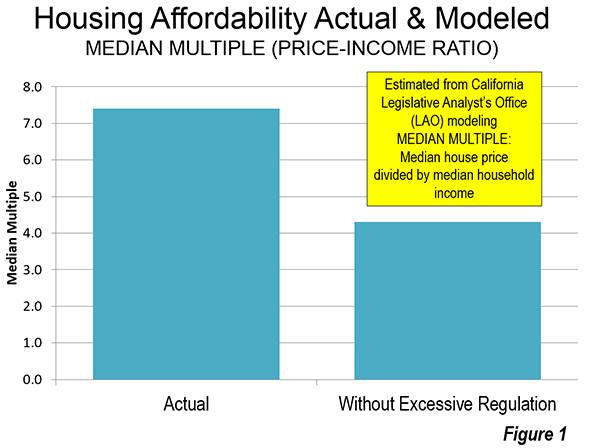
    I have applied this LAO model estimate to the median multiple for California’s six major metropolitan areas (Los Angeles, San Francisco-Oakland, Riverside-San Bernardino, San Diego, Sacramento, and San Jose) to identify how much better middle income housing affordability would be without California’s excessive regulation. Using the LAO estimates the median multiple (median house price divided by median household income) in 2014 would have been at least 40% lower than the actual level in each of the metropolitan areas (Figure 1).
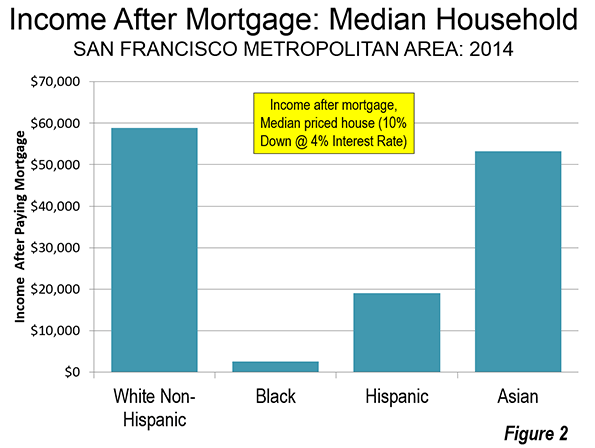
    Many California households already have been priced out of the market. In the worst case, it is estimated that in the San Francisco metropolitan area, a median income White Non-Hispanic household will have nearly $60,000 annually left over after paying the mortgage on the median priced house. This is less than they would have if house prices had remained reasonable, but it’s enough to live on. The median income Asian household would do almost as well, with about $50,000 left over. The median income Hispanic household would have less than $20,000 left, which is considerably less than is likely to be needed for other essentials. The median income Black household would have less than $3,000 left over (Figure 2). If the price ratios of 1980 were controlling, that amount would rise by $16,000.
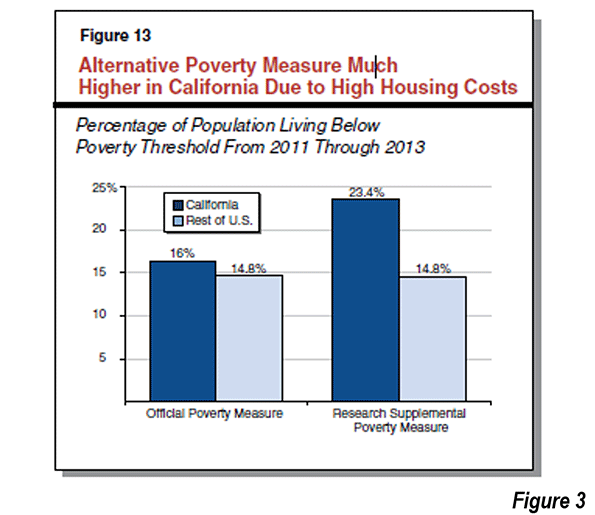
    LAO also points out that the Golden State has the highest housing cost adjusted poverty rate in the nation. The latest data shows housing-adjusted poverty rate is far higher even than that in states with a reputation for grinding poverty. California’s housing adjusted poverty rate is more than 50% higher than that of Mississippi and approaches double that of West Virginia (Figure 3, LAO Figure 13)
    LAO Consequence #2:  Postponing or Forgoing Homeownership

    LAO indicates that California ranks 48th in homeownership percentage, behind only New York and Nevada. LAO emphasizes the value of home ownership:

    Homeownership helps households build wealth, requiring them to amass assets over time. Among homeowners, saving is automatic: every month, part of the mortgage payment reduces the total amount owed and thus becomes the homeowner’s equity. For renters, savings requires voluntarily foregoing near-term spending. Due to this and other economic factors, renter median net worth totaled $5,400 in 2013, a small fraction of the $195,400 median homeowner’s net worth.

    Californians are buying their first houses later. LAO indicates that the average first home buyer in California is three years older than the national average.

    LAO Consequence #3:  Living in More Crowded Housing

    The nation’s worst overcrowding is an unfortunate result of California’s housing policies.

    LAO indicates that California’s overcrowding rate is well above that of the rest of the nation’s rate. Among Hispanics, which were expected to exceed the White-Non-Hispanic population in 2014, to become the state’s largest ethnic group, California overcrowding is more than 2.5 times the Hispanic rate elsewhere. Among households with children, overcrowding in California is four times the national households with children rate. Among renters, overcrowding in California is more than three times the national renter rate (Figure 4, LAO Figure 15).
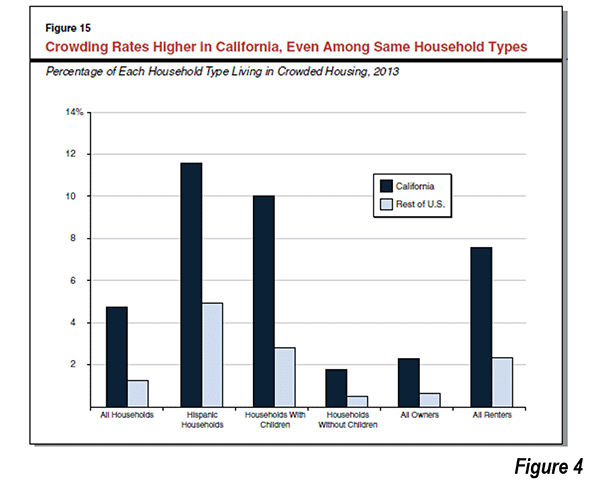
    This has important negative social consequences. According to LAO, research indicates that overcrowding retards well-being and educational achievement:

    Individuals who live in crowded housing generally have worse educational and behavioral health outcomes than people that do not live in crowded housing. Among adults, crowding has been shown to increase stress and aggression, lead to social isolation, and weaken relationships between parents and their children. Crowding also has particularly notable effects on children. Researchers have found that children in crowded housing score lower on standardized math and reading exams. A lack of available and distraction-free studying space appears to affect educational achievement. Crowding may also result in sleep interruptions that affect mood and behavior. As a result, children in crowded housing also displayed more behavioral problems at school.

    Overcrowding is particularly acute in the higher cost coastal metropolitan areas of Los Angeles, San Francisco, San Diego, and San Jose. There, overcrowding among households with children reaches 10%, and among Hispanic households, overcrowding reaches 18%. Among households with children the figure is slightly higher (Figure 5, LAO Figure 16). Overcrowded housing is generally worse, according to LAO, in areas with higher house prices.
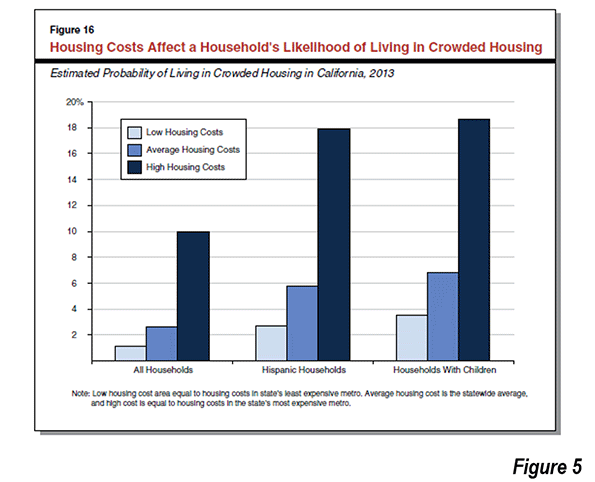
    In a state with a political establishment that prides itself in watching out for low income citizens and ethnic minorities, the need to reform the responsible policies could not be clearer.

    LAO Consequence #4: Commuting Farther to Work

    LAO finds that California’s average work trip commuting times are only moderately above the national average. However, LAO suggests that the commute lengthening impact of higher house prices may be reduced by California’s widespread (I call it dispersed) development pattern, its freeway system and the "above-average share of commuters who drive to work. (Driving commutes are generally fast, and therefore metros with higher shares of driving commuters tend to have shorter commute times.)"

    Nonetheless, according to LAO:

    …our analysis suggests that California’s high housing costs cause workers to live further from where they work, likely because reasonably priced housing options are unavailable in locations nearer to where they work.

    LAO Consequence #5:  Choosing to Work and Live Elsewhere

    LAO also indicates that California’s high housing prices are likely to have reduced its population (and economic) growth. LAO sites the strong net outmigration of California households to other states. LAO also finds in its national metropolitan area analysis that counties with higher growth rates tend to have better housing affordability than counties with lower growth rates.

    There has also been strong net outmigration from the coastal counties to inland counties. This is most evident in the growth of the Riverside-San Bernardino metropolitan area (the Inland Empire) between 2000 and 2010. The Inland Empire captured more than two thirds of the population growth of the Los Angeles Combined Statistical Area (Los Angeles, Orange, Riverside, San Bernardino and Ventura counties). LAO notes the impact of the excess of demand in the coastal counties, again recognizing the nexus between overzealous regulation and the loss of housing affordability:

    This competition bids up home prices and rents. Some people who find California’s coast unaffordable turn instead to California’s inland communities, causing prices there to rise as well.

    LAO also refers to the difficulty that employers have in retaining and recruiting staff. LAO cited survey data from the Silicon Valley, which has for years been California’s economic "Golden Goose" in recent years:

    In a 2014 survey of more than 200 business executives conducted by the Silicon Valley Leadership Group, 72 percent of them cited “housing costs for employees” as the most important challenge facing Silicon Valley businesses.

    In addition, there has been a strong movement of California companies to other parts of the nation, where more liberal regulations foster a better business climate.

    Restoring Housing Affordability

    LAO indicates the importance of fundamental reform and calls for putting "all policy options on the table."

    Major changes to local government land use authority, local finance, CEQA (California Environmental Quality Act), and other major polices would be necessary to address California’s high housing costs.

    In addition:

    The greatest need for additional housing is in California’s coastal urban areas. We therefore recommend the Legislature focus on what changes are necessary to promote additional housing construction in these areas.

    Perhaps the only weakness of the report deals with densification, particularly in coastal counties. For example, LAO suggests that without the housing restrictions the city of San Francisco is population would be 1.7 million, rather than the approximately 800,000 who live there today. In fact that would be unprecedented beyond belief. No core city that had become fully developed and reached 500,000 people by 1950 has achieved growth of this magnitude. The greatest growth was less than 10%, in this category of 60 core cities (which includes the city of San Francisco). Even less likely would be public support for such huge population growth in the second densest major municipality in the nation.

    While LAO does not indicate the additional population that its estimates would have placed in the core of Los Angeles, given the scale of the San Francisco increase, this could be a number of up to 3 million. This area, the broadest expanse of over 10,000 population per square mile density in the nation outside New York City is in the middle of the urban area with the nation’s worst traffic congestion, according to the Texas A&M Transportation Institute. It is doubtful that residents would have the "stomach" to expand roadway capacity to keep the traffic moving. Transit could not have made much difference. Even with its now extensive rail network that has opened since the early 1990s, driving alone accounted for 85% of the additional travel to work from 2000 to 2013 in the city of Los Angeles. Yet, the city of Los Angeles has the most extensive transit in the metropolitan area, including service by all rail lines.

    In reality, core densification is likely to be modest. Keeping housing affordability from getting worse requires regulatory liberalization throughout California, including coastal and inland areas
    The reality is that if California had permitted growth, it would naturally occurred mostly on the periphery. Even with the restrictions on building, the preference for suburban living (largely in detached housing) could not be repressed between 2000 and 2010. Less than 10% of the population growth in the Los Angeles and San Francisco Bay areas occurred in the cores.

    The Challenge

    Should the state of California begin to seriously discuss housing affordability, it will be important to ease restrictions throughout the state, not just in the coastal counties. There are serious barriers to placing the appropriate priority on improving the standard of living and minimizing poverty rates among California’s diverse population. Perhaps the biggest impediment is Senate Bill 375, which is being interpreted by the state and its regional planning agencies to require even more stringent land-use regulation.

    In this environment, LAO rightly raises this concern:

    If California continues on its current path, the state’s housing costs will remain high and likely will continue to grow faster than the nation’s. This, in turn, will place substantial burdens on Californians—requiring them to spend more on housing, take on more debt, commute further to work, and live in crowded conditions. Growing housing costs also will place a drag on the state’s economy.

    It is to be hoped that California’s distorted policy priorities will be righted to restore the California Dream.

    Photograph: Dense suburban development: Inland Empire (San Bernardino Freeway with Uplard toward the top and Ontario toward the bottom) – By author

    Wendell Cox is an international public policy consultant and principal of Demographia in St. Louis. He is a native Los Angelino, having been born within two miles of City Hall. He was appointed to three terms on the Los Angeles County Transportation Commission by Mayor Tom Bradley. Full biography is here.

  • California’s Social Priorities, A New Report

    This is the introduction to a new report, California’s Social Priorties, from Chapman University’s Center for Demographics and Policy. The report is authored by David Friedman and Jennifer Hernandez. Read the full report (pdf).

    California has achieved a great deal since 1970, including much cleaner air, water and more effective resource stewardship notwithstanding a population increase from approximately 19.9 million in 1970 to over 38 million by 2014. 2 Nevertheless, the state continues to face significant, and in many cases increasingly adverse educational and social equity challenges. As summarized in more detail below:

    • California’s grade 9-12 dropout rates remain high and, contrary to national trends, the state’s population of adults with less than a high school education significantly increased from 1970 and currently accounts for nearly 20% of the state’s adults, second highest in the nation. The number of Americans with less than a high school education fell by over 23 million during 1970-2012, and rose in only four states: California, Nevada, Arizona and New Mexico. California’s net increase—over 515,000 adults—was greater than the increase in the other three states combined (409,000).
    • The state’s population of high school and community college graduates grew much slower than in the rest of the country, and the population of 4-year or more college educated adults barely kept pace with average national growth rates. In contrast, Texas, also a large, high-immigration state, has added high school and community college-level educated adults more rapidly than the national average since 1970, while the number of adults with less than a high school education declined.
    • Inequality has dramatically increased since 1970, when California’s rate of inequality was 25th in the nation. By 2000, the state had the second worst in – come inequality in the country, trailing only New York. The state’s inequality remained fourth worst in the nation (behind only New York, Connecticut and Louisiana) in 2013.
    • Income growth for all but the richest 20% of all California households was below the national average from the mid-1970s to the mid-2000s. Incomes for the richest 20% and 5% of all house – holds rose much faster than in the rest of the country.
    • Between 1970 and 2013, California’s official poverty rate (which ignores cost of living differences in the U.S.) rose from less than 10% to over 16% of the population. In 2012, the U.S. Census Bureau developed a supplemental poverty measure that accounted for higher living costs in coastal locations such as California. The supplemental measure indicated that, during 2010-2012, nearly 9 million Californians, or about 24% of the state’s population, was impoverished, by far the largest poverty rate in the country. Although California accounts for 12% of the U.S. population, the state has over 18% of the nation’s poor.
    • California’s capacity to generate new jobs has severely diminished over time. During 1970-1990, the state generated nearly 5.6 million new jobs and 14.5% of the total employment growth in the country although it accounted for less than 10% of the nation’s population in 1970. From 1991-2013, the state produced 2.6 million new jobs, just 9.7% of the net U.S. employment growth, and well below the state’s 12% share of the nation’s population in 1990. Although the state’s population rose by roughly similar amounts in 1970-1990 (9.8 million) and 1991-2013 (8.6 million), California was unable to generate even half the number of jobs during 1991- 2013 than were created in 1970-1990.
    • Annual nonfarm employment growth averaged 3% in 1970-1990, well above the national average, but just 0.8% in 1991-2013, well below the national average. In contrast Texas, with 70% of California’s population, produced over 4 million new jobs during 1991-2013, and Florida, with half of California’s population, generated nearly the same number of new jobs as California (2.2 million). During 1991-2013, California more closely resembled historically slow growing northeastern and Midwest states than faster-growing regions of the U.S., especially in the southeast.

    These data show that California needs to address significant, and growing social priorities, including significant improvement in adult educational rates at the high school and post-secondary level, increasing employment opportunities at a rate sufficient to serve past and forecast population growth, and reducing the state’s inequality and very high poverty rates.

    California continues to lead the country, and by some measures even the world, in environmental quality and climate change initiatives. But public policy must evolve to leverage these environmental achievements into corresponding improvements in educational attainment and middle class job creation. With more than 18% of the nation’s poor, and less than 1%3 of global greenhouse gas emissions, California should also embrace the challenge of leading the world in the creation of middle class manufacturing jobs for the rapidly evolving clean and green technology that California’s laws mandate, California’s educational and technology sectors invent, and California’s venture capital investors bring to the global market.

    Instead, California’s policies, and regulatory and legal costs and uncertainties, tend to divert thousands of middle class jobs even in emerging green industries (including those not requiring high school diplomas) to other locations, including the Tesla battery manufacturing facility, which moved to Nevada. The loss of projects that help achieve important environmental objectives, create high quality jobs, and comply with California’s strict environmental and public health protection mandates, continues to occur in part because well-funded special interest groups ranging from business competitors to labor unions file "environmental" lawsuits as leverage for achieving narrow political or pecuniary objectives rather than to protect the environment and public health. This study suggests that the state must work much harder to ensure that California’s landmark environmental laws are not misused or pursued in a manner that adversely affects other, equally important policy priorities for California’s large undereducated and underemployed population.

    Read the full report (pdf).

  • Misunderstanding the Millennials

    The millennial generation has had much to endure – a still-poor job market, high housing prices and a generally sour political atmosphere. But perhaps the final indignity has been the tendency for millennials to be spoken for by older generations, notably, well-placed boomers, who often seem to impose their own ideological fantasies, without actually finding out what the younger cohort really wants. The reality, in this case, turns out far different than what is bespoken by others.

    Nowhere is this tendency clearer than in the perception of what kind of life – and what places – will millennials find attractive. Generally, the narrative goes like this: Millennials are different, they don’t care about owning homes, detest the suburbs and would prefer to spend their lives in dense apartment blocks, riding the rails or buses to whatever work they might be able to find.

    Urban theorists, such as Peter Katz, insist that millennials (the generation born after 1983) have little interest in “returning to the cul-de-sacs of their teenage years.” Manhattanite Leigh Gallagher, author of “The Death of Suburbs,” asserts with certitude that “millennials hate the suburbs” and prefer more eco-friendly, singleton-dominated urban environments.

    Such assessments thrill the likes of real estate speculators, such as Sam Zell, who welcomes “reurbanization” as an opportunity to cash in by housing a generation of Peter Pans in high-cost, tiny spaces unfit for couples and unthinkable for families. Others of a less-capitalistic mindset see in millennials a post-material generation, not buying homes and cars and, perhaps, not establishing families. Millennials, for example, are portrayed by the green magazine Gris as “a hero generation” – one that will march, willingly, even enthusiastically, to a downscaled and, theoretically, greener future.

    Read the entire piece at The Orange County Register.

    Joel Kotkin is executive editor of NewGeography.com and Roger Hobbs Distinguished Fellow in Urban Studies at Chapman University, and a member of the editorial board of the Orange County Register. He is also executive director of the Houston-based Center for Opportunity Urbanism. His newest book, The New Class Conflict is now available at Amazon and Telos Press. He is also author of The City: A Global History and The Next Hundred Million: America in 2050.  He lives in Los Angeles, CA.

    New home photo by BigStockPhoto.com.

  • What’s This Place For?

    I was recently asked by Gracen Johnson (check out her site here) to elaborate on the possible future of suburbia. How are the suburbs likely to fare over time? This coincided with a city planner friend of mine who asked a more poignant question about the suburban community he helps manage. “What’s this place for?” If we can answer that question we might be able to get a handle on the possible trajectories of various suburbs.

    unnamed-2 unnamed-1 unnamed-5 unnamed-3

    For example, we all understand what a farm town is for. Small rural towns produce food. The people who live in the countryside are actively engaged in the business of feeding society. They take soil, water, plants and animals and convert it all into breakfast, lunch and dinner. For the people who want to live this way there are tremendous benefits: fresh air, open space, privacy, independence, a direct connection to nature, strong family bonds, tradition, and so on. Whatever else we might say about farm country we can be certain that it will carry on one way or another or else civilization will grind to a halt pretty quickly.

    IMG_0126 (800x533) IMG_0085 (800x533) IMG_0093 (800x533)

    We also know what industrial cities are for. They take the raw materials from the surrounding countryside and transform them into finished goods. Grain becomes flour and bread. Timber becomes lumber, then homes and furniture. Iron ore and coal become machinery and power. Crude oil becomes gasoline, petrochemicals, and plastics. There are obvious trade offs for industrial workers, but for many people it’s a pretty good arrangement. If we expect to have manufactured goods in the future these cities will have to continue somehow.

    Screen Shot 2015-01-31 at 6.49.37 AM Screen Shot 2015-01-31 at 6.54.26 AM Screen Shot 2015-01-31 at 6.56.05 AM Screen Shot 2015-01-31 at 6.55.40 AM

    The new post-industrial locus is a bit trickier to pin down. The service economy doesn’t actually produce any “thing” so the workforce is liberated to live just about anywhere in a way that farmers and factory workers can’t. Oddly, well educated highly paid people don’t actually spread out and inhabit a million cabins in the woods as you might expect. Instead they clump up in a handful of regions that provide abundant cultural amenities. At the same time the post-industrial economy exists in a physical world and all those people and electronic components rely on the underlaying farms, factories, and raw resources that support them. The so-called dematerialization of the economy still requires a serious amount of real “stuff” to function.

    Screen Shot 2015-01-29 at 6.18.31 AM Screen Shot 2015-01-29 at 6.05.55 AM Screen Shot 2015-01-29 at 6.06.18 AM

    So what does this all mean for the suburbs? The nature of suburbia has always been consumptive rather than productive. People move to the suburbs in order to purchase and enjoy things: a spacious home, a good school district, security, a clean environment, more respectable neighbors, and so on. The majority of the commercial activity is actually in service to suburbia itself. The mortgage brokers, insurers, real estate agents, landscapers, school teachers, firefighters, orthodontists, pancake houses, and auto body shops are all there to help keep the suburbs humming along. But they’re all consumptive in nature. No one is making the tennis shoes sold at the mall or growing the oranges at the supermarket. This is compounded by the fact that the suburbs are maintained largely through debt. Private debt is required for all the mortgages, car loans, credit cards, student loans, and business loans while municipal bonds prop up many essential suburban government functions. The fact that many people don’t understand the difference between production and consumption is one of the big problems the suburbs are going to have to sort out in the future.


    Screen Shot 2015-01-28 at 9.22.31 PM Screen Shot 2015-02-03 at 2.12.50 AM

    I’m going to get a lot of push back on this concept. I’m sure many of you think that your suburb is full of productive enterprises: the Krispy Kreme, the Jiffy Lube, the dozen Shell and Exxon stations, the Applebee’s, the Foot Locker, the Honda dealership, and the Kroger’s. But these are merely outlets for things that were produced elsewhere. Let me offer another example from my own life. I spent a chunk of my childhood in the San Fernando Valley in Los Angeles. Back in the 1960’s and 1970’s nearly everyone had some connection to companies like Rocketdyne, Litton, and General Dynamics. Those were the engines of the local economy for decades. And they did in fact produce real physical things. But they were all funded entirely by the federal government. Tax money was skimmed off the national productive economy (all those farms and factories) and then spent on missile guidance systems, satellites, and fighter jets. The same was true in Huntsville, Alabama and Marietta, Georgia. Remember what happened to all those places when the feds turn off the spigot during budget cuts? Money flowed in, not out. There’s a reason Peru doesn’t have a space program. The underlying national economy isn’t productive enough to support such extravagant government spending.

    As the material abundance we enjoyed in the Twentieth Century tightens up suburbs will have to become much more efficient places that provide things the outside world needs and is willing to pay for. At the same time internal consumption and debt are going to have to be pulled back. That doesn’t necessarily mean a lower quality of life, but it does demand that suburbs retool and ask themselves, “What’s this place for?”

    John Sanphillippo lives in San Francisco and blogs about urbanism, adaptation, and resilience at granolashotgun.com. He’s a member of the Congress for New Urbanism, films videos for faircompanies.com, and is a regular contributor to Strongtowns.org. He earns his living by buying, renovating, and renting undervalued properties in places that have good long term prospects. He is a graduate of Rutgers University.