Tag: middle class

  • Opportunity Urbanism: Creating Cities for Upward Mobility

    This is the introduction to a new report commissioned by the Greater Houston Parnership and HRG and authored by Joel Kotkin with help from Tory Gattis, Wendell Cox, and Mark Schill. Download the full report (pdf) here.

    Over the past decade, we have witnessed the emergence of a new urban paradigm that both maximizes growth and provides greater upward mobility. We call this opportunity urbanism, an approach that focuses largely on providing the best policy environment for both businesses and individuals to pursue their aspirations.

    Although contrary to much of the conventional wisdom about cities and regions, this is not a break with traditional urbanism, but instead a reinforcement of old traditions. Long ago, Aristotle reminded us that the city was a place where people came to live, and they remained there in order to live better. “A city comes into being for the sake of life, but exists for the sake of living well.”  In the end, opportunity urbanism rests on the notion that cities serve, first and foremost, as engines to create better lives for its residents.

    The Houston and Luxury Models

    We have focused on the Houston metropolitan area because in many ways it reflects the idea of opportunity urbanism more closely than any major metropolitan area. Across a broad spectrum—income growth, new jobs, housing starts, population growth and migration—no other major metropolitan region in the country has performed as well over the past decade. This was among the first major metropolitan regions to replace the jobs lost in the recession, and has experienced by far the largest percentage job growth since, with Dallas-Ft. Worth second.

    In many ways, opportunity urbanism contrasts with the prevailing urban planning paradigm—variously called new urbanism or smart growth—which seeks to replicate the dense, highly concentrated mono-centric city of the past. At the core of this approach is the notion that policies of forced density, through regulatory mandates and often subsidies, are critical to attracting both young, educated people and the global business elite.4 This approach describes the successful city, in the words of former New York Mayor Michael Bloomberg, as “a luxury product.”

    This notion of the “luxury city” can be seen to have worked, at least for some, in well-appointed older cities such as New York, San Francisco and Boston. Unlike most American cities, these boast long-established dense cores and transit-oriented commuter sheds. They possess great amenities tied to their past, from world class art museums and universities, to charming historic districts, parks and public structures.

    But this model of urbanism does not fit the profile of most American metropolitan regions, which tend to be far more recent in their development, more dispersed and overwhelmingly auto-dominated in terms of commuting. Indeed, most of the fastest growing regions in this country—Houston, Dallas-Ft. Worth, Oklahoma City or Atlanta—function in a highly multi-polar model, that contrasts sharply with that of cities like New York, Boston or Chicago.

    Prospects for Upward Mobility

    The luxury paradigm has worked for some in some cities, but has failed, to a large extent, in providing ample opportunities for the middle and working classes, much less the poor. Indeed, many of the cities most closely identified with luxury urbanism tend to suffer the most extreme disparities of both class and race.

    If Manhattan were a country, it would rank sixth highest in income inequality in the world out of more than 130 countries for which the World Bank reports data. New York’s wealthiest one percent earn a third of the entire municipality’s personal income-almost twice the proportion for the rest of the country.

    Indeed, increasingly, New York, as well as San Francisco, London, Paris and other cities where cost of living has skyrocketed—are no longer places of opportunity for those who lack financial resources. Instead they thrive largely by attracting people who are already successful or living on inherited largesse.

    They are becoming, as journalist Simon Kuper puts it, “the vast gated communities where the one percent reproduces itself.”  

    Not surprisingly, the middle class is shrinking rapidly in most luxury cities. A recent analysis of 2010 Census data by the Brookings Institution found that the percentage of middle incomes in metropolitan regions such as New York, Los Angeles and Chicago has been in a precipitous decline for the last thirty years, due in part to high housing and business costs. A more recent 2014 Brookings study found that these generally high-cost luxury cities—with the exception of Atlanta—tend to suffer the most pronounced inequality: San Francisco, Miami, Boston, Washington DC, New York, Chicago and Los Angeles. Income inequality has risen most rapidly in the very mecca of luxury progressivism, San Francisco, where the wages of the poorest 20 percent of all households have actually declined amid the dot com billions.

    Like other large cities, Houston also suffers a high level of inequality, but its lower costs have helped its middle and working class populations to enjoy a higher standard of living than their luxury city counterparts. The promise of the opportunity urbanism model also can be demonstrated by lower income disparities between racial groups, higher GDP growth, less expansion of poverty and the greater production of high-paying mid-skilled jobs. In these aspects, opportunity cities like Houston greatly out-performed their often more celebrated rivals.

    How to Measure “Living Well”

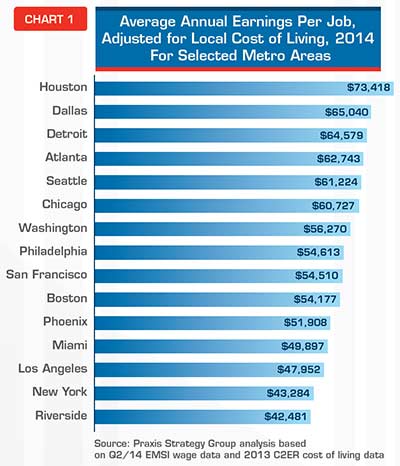
    We leave this introduction with one statistic that most encompasses the success of the Houston opportunity model and exposes the weakness of smart growth: the cost-of-living adjusted average paycheck.

    Despite the assertions of Paul Krugman, among others, that the Texas urban economy is based on low wages, the fact is Harris County’s average household income is above the national average; close to that of Boston. But once the cost of living is factored in, Houston does far better for its citizens compared to any of the legacy cities. Houston, with Dallas-Ft. Worth a strong second, is able to provide its citizens the highest standard of living, as measured by average annual adjusted wages, of any major metro in America. This is different than subjective “quality of life,” but includes such basics as jobs, housing and overall cost of living.

    Download the full report (pdf) here.

    Joel Kotkin is executive editor of NewGeography.com and Roger Hobbs Distinguished Fellow in Urban Studies at Chapman University, and a member of the editorial board of the Orange County Register. His newest book, The New Class Conflict is now available at Amazon and Telos Press. He is author of The City: A Global History and The Next Hundred Million: America in 2050. His most recent study, The Rise of Postfamilialism, has been widely discussed and distributed internationally. He lives in Los Angeles, CA.

  • Battle of the Upstarts: Houston vs. San Francisco Bay

    “Human happiness,” the Greek historian Herodotus once observed, “does not abide long in one place.” In its 240 years or so of existence, the United States has experienced similar ebbs and flows, with Boston replaced as the nation’s commercial capital first by Philadelphia and then by New York. The 19th century saw the rise of frontier settlements—Cincinnati, Pittsburgh, Cleveland, and finally Chicago—that also sought out the post position. In the mid 20th century, formerly obscure Los Angeles emerged as New York’s most potent rival.

    Today we are seeing yet another shuffling of the deck among American regions. New York remains the country’s preeminent city, but its most powerful rivals are likely to be neither Chicago nor Los Angeles, but rather two regions rarely listed in the hierarchy of influential regions: the San Francisco Bay Area and Houston.

    Making of a new pecking order

    The Bay Area does not rank among the 20 top global cities in most studies, such as the 2014 A.T. Kearney listings. In the respected rankings of the London-based Globalization and World Cities Network, the Bay Area stood below not only Chicago, which is considered an “alpha” global city, but also such places as Toronto and Mexico City.

    Yet such rankings vastly underestimate the power now being wielded by the San Francisco region. As the headquarters for the largest concentration of cutting edge tech firms in the world, the Bay Area increasingly shapes the operations of companies from manufacturing and marketing to retail and media. And given that roughly half the nation’s venture capital is still being lavished on area start-ups, it is not surprising that Silicon Valley ranks number one in the world as a place to launch tech ventures, according to the Startup Genome.

    Tech dominance, according to a recent study on global cities conducted by my firm NewGeography, explains why the San Francisco Bay Area nudges out much larger Los Angeles for bragging rights on America’s Pacific Rim. Technology leaders, including Intel, Apple, Oracle, Google, and Facebook, are based in Silicon Valley, while Asian global tech firms such as Samsung also have North American headquarters there. Top technology firms from other cities often have their key R&D functions in the Bay Area. Even a frugal firm like Wal-Mart is enlarging its Silicon Valley presence.

    The current social media bubble will surely pop, but as Michael S. Malone and others have noted, the Bay Area’s preeminence will likely continue, fueled by its unique concentration of engineers, entrepreneurs, and risk capital. As a lure for the ambitious, Silicon Valley and San Francisco are replacing Wall Street. Google alone has 1,200 employees who formerly worked for large U.S. investment banks, and migration from the Big Apple to California is now at its highest level since 2006.

    Much of the appeal of the Bay Area is a result of happy coincidence of history and geography. The Bay Area—where I went to school and got my start in journalism, and where parts of my family have resided since the ’50s—has been blessed with excellent higher education and is centered around what is arguably America’s most beautiful city. Good weather, beautiful vistas, and access to nature have made the Bay Area a natural lure for people who can afford to live wherever they want.

    The Energy Capital

    Houston, where I have been working as a consultant, hardly qualifies as one of the most physically attractive or temperate cities. San Francisco may well have been, as Neil Morgan suggested a half century ago, “the Narcissus of the West,” but Houston, in most accounts, has been widely disparaged as hot, steamy, ugly and featureless. Yet despite this, its ascendency is no less compelling than that of the Bay Area.

    Houston’s trump card, like the Bay Area’s, resides in its control of one strategic industry, in this case energy. The majority of traded foreign oil majors, such as London-based Shell and British Petroleum, have their U.S. headquarters in Houston, and even companies based elsewhere boast a significant Houston presence. For example, Exxon, although it has its headquarters in Dallas-Fort Worth, is opening a massive Houston campus that will be home to 10,000 employees. Additionally, a majority of the world’s largest oil services companies, such as Baker Hughes, Schlumberger, and FMC Technologies, are based in Houston.

    Altogether, more than 5,000 energy-related companies call Houston home. The city employs three times more people in energy than its second place rival, Dallas-Ft. Worth, and more than the next five cities combined. This growth is likely to accelerate because foreign companies, notably from Germany, have begun buying up energy firms in the area, including Siemens’s recent $7.6 billion dollar purchase of the Dresser Rand Group, an energy equipment firm.

     Houston has added more than 10 percent more jobs since 2008, almost twice the increase in the Bay Area. Since 2000 Houston’s employment figures have shot up 32 percent, while the Bay Area has grown by barely 4 percent. And it’s not just energy that’s driving things—Houston is now the nation’s largest export port and boasts the world’s largest medical center. It has also become, by some measurements, the most ethnically diverse (PDF) region in the country. In the last decade, for example, Houston increased its foreign-born population by 400,000, second only to New York and well ahead of much larger Los Angeles.

    The big losers: LA and Chicago—but also New York

    In the past century New York and Los Angeles have dominated American media. This is being severely undermined by the Bay Area’s digital economy. Since 2001, notes Mark Schill at Praxis Strategy (where I am a senior fellow), book, periodical, and newspaper publishing—all traditionally concentrated in the New York area—have lost some 250,000 jobs, while Internet publishing and portals generated some 70,000 new positions, many of them in the Bay Area or Seattle.

    Google and Yahoo are already among the largest media companies in the world. (Yahoo now refers to itself as a digital media company rather than a technology company). With the ubiquity of its iTunes platform, Apple exercises ever greater control over consumer distribution of entertainment products such as music and video; Netflix, Hulu, and YouTube could become the studios of the future. This could shift global media decision-making from its familiar New York-Los Angeles axis to the Bay Area.

    This is particularly bad news for Los Angeles, whose grip on the entertainment industry was weakening even before Silicon Valley’s rise. Since 2004, LA’sentertainment industry lost roughly 11 percent of its jobs, as production shifted to Canada, Louisiana, and other locales.

    The decline in media employment comes on the heels of a rapid industrial decline—the area has lost more than 90,000 aerospace jobs since the end of the Cold War. The situation is so dismal that a report issued by many of the region’s top business and political leaders concluded that the city “is barely treading water while the rest of the world is moving forward.”

    Chicago’s situation is arguably even worse, but it is more threatened by Houston, which has already passed the Windy City in numbers of corporate headquarters. Since 2010, when U.S. industry began recovering, Houston manufacturing employment expanded by more than 17 percent, compared to flat growth in Chicago.

    “Houston is the Chicago of this era—like the old Chicago,” remarks David Peebles, who runs the Texas office of Odebrecht, a $45 billion engineering firm based in Brazil. “In the ’60s you had to go to Chicago, Cleveland, and Detroit. Now Houston is the place for new industry.”

    With its industrial base eroding, Chicago is no longer a strategic hub for any key industry. Outside of trading commodities, it also no longer serves as a major global financial center. Regional population growth has been meager over the past decade, and the city’s own pension issues may be worse than Detroit’s.

    Chicago retains its brilliant skyline, great cultural institutions, powerful political influence, and a strong business community. But its days of America’s number two city are long gone, and, as we enter the mid-2000s, it is falling behind not only Los Angeles and New York but the two rising Texas cities, Houston and Dallas, both expected to pass the “city of big shoulders” in population by mid-century, or earlier.

    Engineering the Future

    In the coming decades, New York will remain the nation’s top global city, due to its remarkable urban legacy, the power of Wall Street, and the entrenched traditional media. But its Achilles heel is a lack of the engineering power necessary to address key challenges such as the digitization of industry, energy efficiency or climate change. New York is profoundly weak in engineering talent (PDF)—ranking 78th out of 85 metropolitan areas in engineers per capita.

    In contrast, the Bay Area represents the epitome of engineering power, with the San Jose area boasting the largest per capita concentration of engineers of any major metropolitan area. The Bay Area’s power to develop new technologies and its almost unfathomable wealth will continue to undermine traditional institutions, from Hollywood and Wall Street to business services, tourism, automotive, and even aerospace industries.

    Far less appreciated, Houston, rather than being a southern city of duller wits, actually ranks second in engineers per capita. If the Bay Area is master of the digital economy, Houston ranks as the technological leader of the material one; it is the capital for the energy-driven revival of U.S. industry, not only in Texas but throughout the old industrial heartland. Revealingly, Houston actually has seen far more rapid growth in both college educated and millennial population since 2000 than the Bay Area, as well as New York, Chicago, and Los Angeles.

    Rival Approaches to Urbanism

    The Bay Area, for all its vaunted progressivism, increasingly resembles a “gated community” whose high prices repel most potential newcomers, particularly families. Already by far the nation’s least affordable city—only 14 percent of current residents can possibly afford to buy a home—it represents a growth model that is by definition exclusive, almost a throwback to medieval forms where the rich clustered inside the city gates.

    High housing prices, notes economist Jed Kolko, account for the fact that, despite the boom, population growth in the Bay Area remains well below national averages. From 2000 to 2013, the region lost approximately 550,000 domestic migrants. Despite sizable immigration, the regional population growth rate has fallen below the national average.

    In contrast, Houston is among the fastest growing regions in the country, with rapid increases both in domestic migrants and newcomers from abroad. This stems from both lower housing prices and a growth model that is far more amenable to higher paid blue collar and middle management positions. Since 2000, Houston’s population has grown by 30 percent compared, three times that of the Bay Area.

    Ironically, Houston’s growth has been more egalitarian than that of the notionally super-progressive San Francisco region. A recent Brookings report found that income inequality has increased most rapidly in what is probably the most left-leaning big city in America, where the wages of the poorest 20 percent of all households have actually declined amid the dot com billions.

    This inequality has a distinct racial element. The Bay Area gap between white residents (who dominate the tech economy) and minorities is among the highest in the nation while, during the boom, income has fallen for Hispanics and African-Americans, according to Joint Venture Silicon Valley.

    This racial divergence is far less pronounced in Houston, while the growth of poverty since 2000 has been slower, increasing at one third the rate of New York and San Francisco, and half that of Los Angeles. The Texas city may lack the great views of San Francisco, but Houston has turned out to be a better city for middle class minorities. Homeownership among African Americans stands at 42 percent and for Latinos at more than 53 percent; this compares to 32 and 37 percent in the Bay Area.

    Perhaps the biggest differences can be seen in families. Of the nation’s 52 largest metropolitan areas, the Bay Area has the lowest percentage, 11.5 percent, of people ages 5 to 14. In Houston, 23 percent of the population fits this age category. In particular San Francisco is notoriously inhospitable to families, with the lowest percentage of kids of any major city.

    The two regions also reflect very different urban forms. The Bay Area’s leadership has opted to favor dense “in fill” growth and sought to restrict suburbandevelopment. Houston has taken a different tack. As its population has expanded, so too has the metropolitan area. This includes the development of many planned communities that appeal to middle class families and many immigrants. In 2013, Houston alone had more housing starts than the entire state of California.

    But it would be wrong to dismiss Houston’s model as merely “sprawl.” Instead it is better seen as simply expansive. In fact, arguably no inner ring in the country has seen more rapid growth, with high-rise, mid-rise and townhouse development in many long neglected districts. The increase in high-density housing tracts (more than 5,000 per square mile) since 2000 has been almost ten times higher than the Bay Area.

    The Political Battle for the Future

    Increasingly America’s future will be determined by these two cities, with the issue of addressing climate change at the fore. Much of the Bay Area’s leadership—led by the likes of Google Chairman Eric Schmidt and investor Tom Steyer—have all but declared war on the oil and gas industry. Several colleges and universities in the region, including Stanford, have shed their energy holdings, and Silicon Valley has nurtured movements such as Bill McKibben’s 350.org that seek to revoke the “social license” of big oil, a tactic used previously against the tobacco companies and firms that did business in apartheid South Africa.

    The elites of Silicon Valley and San Francisco are not just interested in saving the earth; they wish to profit from a change in the nation’s energy economy. Google, Sun Microsystems founder Vinod Khosla, and top venture capitalists such as John Doerr have bolstered their already ultra-thick wallets by capitalizing on “green energy” subsidies and outright grants from various levels of government. Given these investments, it’s easier to understand the Valley’s support for draconian climate change legislation, complete with attempts to demonize “Texas oil.” (One won’t see such populist zeal on , say, increasing capital gains rates.)

    The Valley’s hostility to fossil fuel energy, and its jihad to destroy an entire industry, is only barely recognized in Houston. I also have never heard anyone there suggest that Silicon Valley should be closed down as a danger to the planet (or at least a threat to the attention span of younger Americans). Houstonians, particularly in the energy industry, generally lack media savvy, which is one reason why energy is widely rated as the country’s least popular industry. Also missing, thankfully, is the sense of entitlement and self-congratulation one finds in the Bay Area. But once the intention to devastate the oil and gas industry is better understood, expect the energy capital to square off against the tech center, generating what may be the regional battle royal of our era.

    This piece originally appeared at The Daily Beast.

    Joel Kotkin is executive editor of NewGeography.com and Roger Hobbs Distinguished Fellow in Urban Studies at Chapman University, and a member of the editorial board of the Orange County Register. His newest book, The New Class Conflict is now available at Amazon and Telos Press. He is author of The City: A Global History and The Next Hundred Million: America in 2050. His most recent study, The Rise of Postfamilialism, has been widely discussed and distributed internationally. He lives in Los Angeles, CA.

    Photos courtesy of University of Texas Health Science Center at Houston Office of Communications and Vincent Bloch.
  • Millennials: A Powerful, Suburban Living Generation

    The latest survey data on the  living preferences of the Millennial generation (born 1982-2003) once again validates the picture of a cohort  that, contrary to urban legend, actually prefers the suburbs, even as they prepare to shape the suburbs in their own image. We and others have previously made this data-based point on this website. The results of the survey challenges the often wishful thinking of academics and ideologues who yearn for a more urbanized, denser America. 

    The Demand Institute commissioned the Nielsen company, to survey 1000 Millennial households about where and how they plan to live over the next five years, The results suggest a major transformation of the country’s housing markets is about to take place that will benefit those who know and understand Millennials and respond to their desires.

    There are 13.3 million households headed by Millennials today. During the next five years that number is projected by the Demand Institute to increase by over 60% to 21.6 million as many Millennials take their first steps toward marriage and family formation. While only 30% of the 18-29 year olds interviewed were now married, seven out of ten said they expected to be within the next five years. A majority (55%) also anticipate becoming parents during this period. As a result, 71% of those interviewed said, that over the next five years, they planned on moving to a  better home or apartment; about half expect to “own, not rent” their new home.   

    This burst of family formation, of course, is quite typical for thirty-year olds, a plateau that millions of Millennials will reach in the next half-decade. And, rather than diverge from the pattern, Millennials are following it in their own way. This is good news long term for the economy since their major lifestyle changes will lead to a burst of spending by Millennials. The Demand Institute’s report suggests that, between now and 2018 the generation will spend $1.6 trillion on home purchases and $600 billion in rent. The big questions are where will they spend all that money and what will they spend it on?

    The Suburbs is the clear answer to the first question. Forty-eight percent of the Millennials interviewed said they planned on moving to the suburbs, while only 38% said they would be moving into large urban areas.  A scant 14% planned to move to rural environments.

    The type of suburban living these Millennials favor, however, is a little different than many of the developments builders are planning to offer. Sixty-one percent say they are looking for more space in their next home than they currently enjoy. An additional 24% want at least the same amount of space. A mere 15% express a desire to live in less space, something often assumed by retro-urbanists, in a presumably more crowded urban environment. Furthermore, although substantial numbers prefer having major amenities within walking distance, most Millennials say they are willing to take a “short drive” to restaurants (54%), grocery stores (61%), and even shopping centers (57%). This suggests that new “walkable” suburbs, including large planned developments on the fringe and Millennial-“gentrified” close in suburbs, all with single family homes, are likely to be the places that benefit most from this wave of Millennial family formation and spending on housing.  

    The single biggest barrier to the country enjoying this burst of new spending remains the Millennial generation’s unique burden of student debt. While three-fourths of Millennials believe home ownership is both an important long term goal and a good investment, only 36% believe they will be able to buy their next home, rather than rent. The impact of student debt on this purchasing decision can clearly be seen in the current behavior of 30-35 year old Millennials.  Only half of those with student debt now own homes, while two-thirds of those lucky enough to graduate college without such debt are home owners. This clearly indicates that student debt reform is the single most important issue facing realtors and home builders future success. It should be their priority in Washington.

    In the meantime, there may be some creative ways to confront this problem; 69% of the four-in-ten Millennials who believe they could not qualify for a traditional mortgage are open to leasing a new home with an option to buy it later.  

    The results of this survey make it clear that the nation’s housing future remains in its suburbs. Those communities which can offer Millennials the type of lifestyle they desire will be rewarded with growth. Those that cling to outdated notions of what constitutes urban or suburban living will find it difficult to compete for the Millennial generation’s housing dollar and the vibrant economic activity that will flow from their choices.

    Morley Winograd and Michael D. Hais are co-authors of the Kindle book Millennial Majority, along with Millennial Momentum: How a New Generation is Remaking America and Millennial Makeover: MySpace, YouTube, and the Future of American Politics and fellows of NDN and the New Policy Institute.

  • Why Suburbia Irks Some Conservatives

    For generations, politicians of both parties – dating back at least to Republican Herbert Hoover and Democrat Franklin Roosevelt – generally supported the notion of suburban growth and the expansion of homeownership. “A nation of homeowners,” Franklin Roosevelt believed, “of people who own a real share in their land, is unconquerable.”

    Support for suburban growth, however, has ebbed dramatically, particularly among those self-styled progressives who claim FDR’s mantle. In California, greens, planners and their allies in the development community have supported legislation that tends to price single-family homes, the preference of some 70 percent of adults, well beyond the capacity of the vast majority of residents.

    Less well-noticed is that opposition to suburbs – usually characterized as “sprawl” – has been spreading to the conservative movement. Old-style Tories like author-philosopher Roger Scruton do not conceal their detestation of suburbia and favor, instead, European-style planning laws that force people to live “side by side.” Densely packed Paris and London, he points out, are clearly better places to visit for well-heeled tourists than Atlanta, Houston or Dallas.

    There may be more than a bit of class prejudice at work here. British Tories long havedisliked suburbs and their denizens. In a 1905 book, “The Suburbans,” the poet T.W.H. Crossland launched a vitriolic attack on the “low and inferior species,” the “soulless” class of “clerks” who were spreading into the new, comfortable houses in the suburbs, mucking up the aesthetics of the British countryside.

    Not surprisingly, many British conservatives, like Scruton, and his American counterparts frequently live in bucolic settings, and understandably want these crass suburbanites and their homes as far away as possible. Yet, there is precious little concern that – in their zeal to protect their property – they have also embraced policies that have engendered huge housing inflation, in places like greater London or the San Francisco Bay Area, that is among the most extreme in the high-income world.

    Of course, the conservative critique of suburbia does not rest only on aesthetic disdain for suburbs, but is usually linked to stated social and environmental concerns. “There’s no telling how many marriages were broken up over the stress of suburb-to-city commutes,” opines conservative author Matt Lewis in a recent article in The Week. In his mind, suburbs are not only aesthetically displeasing but also anti-family.

    What seems clear is that Lewis, and other new retro-urbanist conservatives, are simply parroting the basic urban legends of the smart-growth crowd and planners. If he actually researched the issue, he would learn that the average commutes of suburbanites tend to be shorter, according to an analysis of census data by demographer Wendell Cox, than those in denser, transit-oriented cities. The worst commuting times in America, it turns out, to be in places such as Queens and Staten Island, both located in New York City.

    Other conservatives also point to the alleged antisocial aspect of conservatism, a favored theme of new urbanists everywhere. A report co-written by the late conservative activist Paul Weyrich supported forcing “traditional designs for the places we live, work and shop,” which “will encourage traditional culture and morals,” such as community and family.

    Once again, however, a serious examination of research – as opposed to recitation of planners’ cant – shows that suburbanites, as University of California researchers found, tend to be more engaged with their neighbors than are people closer to the urban core. Similarly, a 2009 Pew study recently found that, among the various geographies in America, residents in suburbia were more “satisfied” than were either rural or urban residents.

    In working against suburbia, these conservatives are waging a war on middle-class America, not necessarily a smart political gambit. Overall, conventional suburban locations are home to three-quarters of the metropolitan population. And even this number is low, given that large parts of most large American cities – such as Los Angeles, Phoenix, Dallas, Kansas City and Houston – are themselves suburban in character, with low transit use and a housing stock primarily made up of single-family residences built during the auto-dominated postwar period. Only approximately 15 percent of residents in major metropolitan areas actually live in dense, transit-oriented communities.

    Given these numbers, one might think conservatives would take issue with progressive plans to circumvent preferences and market forces by constraining suburban and single-family home growth. They might spot a strategic opening to secure the urban periphery, the one area still up for grabs in American politics. In contrast, the blue core cities and red countryside have, for the most part, chosen sides, and both return huge consistent majorities to their preferred party.

    Lured by their own class prejudice, some conservatives nevertheless seem willing to abandon market forces, a supposed conservative virtue. In reality, imposing Draconian planning is not even necessary for the growth of density. In places that are have both liberal planning regimes and economic growth, such as Houston and Dallas, there has been a more rapid increase in multifamily housing than in such cities such as Boston, Los Angeles, San Francisco or New York. The cost is just much lower.

    Unfortunately, few mainstream conservatives apparently bother to study such things, and, as prisoners of the conventional wisdom, embrace the notion that, on economic grounds, suburbs are becoming irrelevant. Some, such as the libertarian economist Tyler Cowen, suggest that a stagnating post-recession America has to adjust to what has been described as a “new normal” of declining expectations.

    With middle-class opportunity seen as largely moribund, many financial interests see America becoming a “rentership” society; for these rent-seeking capitalists, the death of suburbs would be not only morally correct, but also economically advantageous.

    It’s hard for me, even as a nonconservative, to see how this trajectory works for the Right.

    Renters, childless households, highly educated professionals, as well as poor service workers, clustering in dense cities are not exactly prime Republican voters. Without property, and with no reasons to be overly concerned with dysfunctional schools, the new urban population tilts increasingly, if anything, further to the left.

    Meanwhile, the middle-class homeowner, and those who aspire to this status, increasingly find themselves without a party or ideology that champions their interests. In exchange for the approval of the cognitive elites in the media, in academia and among planners, conservatives will have, once again, missed a chance to build a broad popular coalition that can overcome the “upstairs, downstairs” configuration that increasingly dominates the Democratic Party.

    Yet, there remains a great opportunity for either party that will appeal to, and appreciate, the suburban base. Conservative figures such as Ronald Reagan and Margaret Thatcher understood the connection between democracy and property ownership and upward mobility. Much the same could be said for traditional Democrats, from Roosevelt and Harry Truman, all the way to Bill Clinton.

    For all their faults, suburbs represent the epitome of the American Dream and the promise of upward mobility. That they can be improved, both socially and environmentally, is clear. This is already happening in new, mostly privately built, developments where the “ills” of suburbia – long commute distances, overuse of water and energy – are addressed by building new town centers, bringing employment closer to home, the use of more drought-resistant landscaping, promoting home-based business and developing expansive park systems. This seems more promising than following a negative agenda that seeks simply to force ever-denser housing and create heat-generating concrete jungles.

    The abandonment of the suburban ideal represents a lethal affront to the interests and preferences of the majority, as well as their basic aspirations. The forced march towards densification and ever more constricted planning augurs not a return to old republican values, as some conservatives hope, but the transformation of America from a broadly based property-owning democracy into something that more clearly resembles feudalism.

    This piece originally appeared at The Orange County Register.

    Joel Kotkin is executive editor of NewGeography.com and Distinguished Presidential Fellow in Urban Futures at Chapman University, and a member of the editorial board of the Orange County Register. His newest book, The New Class Conflict is now available at Amazon and Telos Press. He is author of The City: A Global History and The Next Hundred Million: America in 2050. His most recent study, The Rise of Postfamilialism, has been widely discussed and distributed internationally. He lives in Los Angeles, CA.

  • Brooklyn is Getting Poorer

    I’m trying to make more of an effort, whenever I write or talk about gentrification, to point out that the real issue is larger: that gentrification is only one aspect of income segregation – specifically, the part where the borders between rich and poor neighborhoods shift – and that the real problem is that we have such sharply defined rich and poor neighborhoods to begin with.

    I might also throw in that income segregation used to be much less severe.

    Anyway, one problem with our obsession with gentrification as the end-all of urban equity issues is that it discourages us from talking about other important things happening in our cities. In some instances, gentrification has become such a dominating narrative that it has completely erased broader trends that we really ought to be concerned about.

    Case in point: Brooklyn is getting poorer.

    Does that shock you? Were you under the impression that all of Brooklyn was in the process of becoming one giant pickle boutique? That would be forgivable, given that nearly every article filed from Brooklyn for a decade or so has been about gentrification. But no.

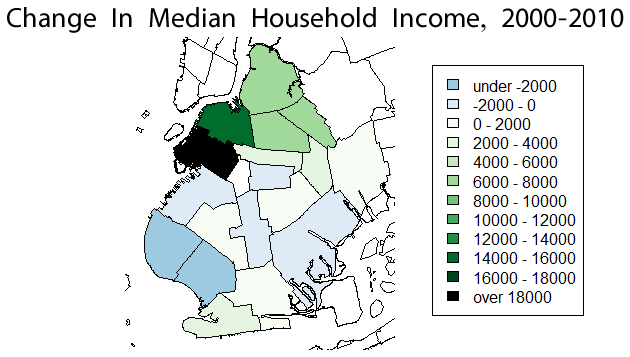
    I recently ran across a post from data-crunching blog extraordinaire Xenocrypt, which noted that from 1999 to 2011, median household income in Brooklyn fell from $42,852 to $42,752. That’s not a huge drop, obviously. The national median income fell from $56,000 to $50,000, so Brooklyn is actually catching up, sort of, to the country as a whole. But it still got poorer in absolute terms.

    Moreover, if you map (as Xenocrypt did) the borough’s neighborhoods by change in median income, you get a really striking picture:


    Credit: Xenocrypt.blogspot.com

    …which is that, indeed, a good three-fifths or so of Brooklyn is actually getting poorer. Have you read any articles about that? No, I will wager that you have not. Neither have I. I strongly suspect that is because they don’t exist – at least not in any outlet that might be considered mainstream.

    And what about housing prices?


    Brooklyn Gentrification Map: Increase, Decrease in Home Values 2004 vs. 2012
    Credit: http://www.citylimits.org/

    So in large parts of Brooklyn, real estate prices are falling.

    I have nothing particularly intelligent to say about this – these maps were news to me – except that it’s maybe the most dramatic example I’ve seen yet of just how limiting our fixation on gentrification is. I mean that both in a sort of journalistic sense, in that we’re being deprived of an accurate sense of what is actually going on in our cities, as well as from an advocate’s perspective: how can we claim to be working for fairer, more equitable, etc., cities, if we’re ignorant of their most basic economic and demographic changes?

    This post originally appeared in City Notes on May 3, 2014. Daniel Hertz is a masters student at the Harris School of Public Policy at the University of Chicago.

    Lead photo: “BK” by Theeditor93Own work. Licensed under CC BY-SA 3.0 via Wikimedia Commons.

  • Southern California Becoming Less Family-Friendly

    The British Talmudic scholar Abraham Cohen noted that, throughout history, children were thought of as “a precious loan from God to be guarded with loving and fateful care.” Yet, increasingly and, particularly, here in Southern California, we are rejecting this loan, and abandoning our role as parents.

    This, of course, is a process seen around the high-income world, and even in some developing countries. But, here in America, some regions are moving in this post-familial direction faster than others, and, sadly, Southern California, for the most part, is leading the trend.

    Historically, Southern California, as a lure first for domestic migrants and, later, for foreign immigrants, has been an incubator of families. As recently as 2000, the proportion of population ages 5-14 in Los Angeles and Orange counties stood at 16 percent, the sixth-highest level among the nation’s 52 largest metropolitan areas. Thirteen years later, that proportion had dropped to 12.8 percent, ranking 33rd. The area experienced a 20 percent drop in its share of youngsters, the largest decline among U.S. metro areas.

    Of course, not everywhere in Southern California has experienced such a precipitous shift. The Inland Empire, which stands apart in census data, remains a relative bastion of familialism, with 15.3 percent of the population between ages 5-14. Yet even the Inland Empire is slipping somewhat, from having the highest percentage of children to a ranking of fourth, and experiencing a 17 percent decline in children’s share of the population, the fourth-largest percentage drop in the nation.

    If we try to focus even more closely, the patterns of decline, and the few bright spots, become more clear. Using 2010 U.S. Census data for specific regions (more up-to-date numbers are not yet available at the local level), it’s clear where much of this loss is concentrated.

    The most precipitous declines have been in the inner city, notably Central Los Angeles, which experienced a net loss of 87,000 youngsters from 2000-10. Although their rate of loss was not as severe as in the core, other, once family-rich parts of the region – the San Fernando and San Gabriel valleys, Santa Ana/Anaheim, Long Beach and Whittier-Southeast Los Angeles County – all posted double-digit percentage drops in children.

    Only a few areas of Southern California experienced growth in the number of children. Much of the growth was in the vast, outer suburbs and exurbs – places such as the Victor Valley, San Bernardino, Perris-Temecula, Santa Clarita-Antelope Valley and Riverside-Moreno Valley, as well as decidedly more upscale Irvine-South Orange County.

    In a sense, these numbers tell several stories. To be sure, high housing prices seem to have a direct impact on family formation, pushing people further out to the periphery or, in some cases, out of the region entirely. Overall, according to recent analysis of census data, high-cost areas tend to repel families; almost all the most expensive areas in the country, such as the Bay Area, New York and Boston, have all experienced strong drops in numbers of children.

    This has resulted, as demographer Ali Modarres has demonstrated, in a gradual emptying out of families from the poor, but still expensive, inner core of Los Angeles. These areas tend to be heavily immigrant, and once were seen as the generators of a new generation of Angelenos. Now, however, as Modarres suggests, these areas are also “getting old,” with grandparents remaining but the new generation headed to other locales within or beyond the region. This process, he notes, has been accelerated by a decline in immigration to the region, particularly among Latinos, who long settled in these areas.

    Housing prices are not the only determinant. Prices are even higher in the Bay Area, which has seen a falling number of children, but not as severe as in Los Angeles.

    One likely explanation is the Southland’s relatively weak economy, which continues to create jobs sluggishly, and an unemployment rate, particularly in Los Angeles County, well above the state and national averages. High prices repel families, but this is particularly true in a region generating relatively little economic opportunity.

    There are other factors, particularly for middle-class families, who tend to have more choice where to locate. One seems to be education. For example, Irvine-South Orange County does well in this regard, but its housing costs are beyond the budgets of most other than upper-middle-income households, which tend to be Asian or non-Hispanic white. Irvine has a national reputation for excellent schools, a major lure to families who wish to avoid the expense of private education.

    For some in Southern California, particularly those pushing high-density and rental housing, these shifts may be considered a boon. After all, households with children, even more than most people, tend to prefer single-family homes and tend to embrace the notion of ownership. Single people are more likely to choose – by preference or because of cost – rental properties. The vision of Southern California as primarily dominated by high-density rentals correlates with requirements of state law and plans of the Southern California Association of Governments.

    At the same time, the economic languor of this region may make many of these bold designs untenable. People without decent – or any – employment do not make ideal tenants any more than they constitute potential homeowners. Given the high costs of high-density construction, this suggests that many units will be rentable only by aging former homeowners or by several families sharing a unit.

    Sadly, the decline in homeownership and the single-family housing market may contribute long term to the region’s continued relative economic eclipse. Single-family home construction is among the most reliable contributors to local economic growth and job creation. In contrast, each multifamily unit constructed contributes 60 percent less to the GDP.

    More important still, the loss of families presages a future that we can already see in many European and east Asian countries. There is the development of an aging, inner core, made up largely of retirees, both poor and affluent, sprinkled among areas dominated by young, mostly childless, people. Over time, this leads to a less-dynamic region, as the workforce and consumer base shrinks, and politics shift emphasis from economic growth to redistribution. Meanwhile, many of the poor and working-class families are forced out toward the furthest periphery, often far from employment and relatives.

    Can this process be reversed? Certainly a stronger economy, with more middle-wage jobs, might encourage people to have families, and give them the incentive, as well as the wherewithal, to buy a house. It would provide parents, and potential parents, with the notion that they can create a new generation with reasonable economic prospects.

    The other key factor is a radical reordering of our education systems. It is clear from the data that areas with good schools, such as Irvine, continue to attract families, even at very high housing price points. If middle-class families feel they can access a decent public education in the older, settled areas, such as the San Fernando Valley, L.A.’s Westside or North Orange County, they might be more willing to put down roots in these places, which would help create the greater stability generally associated with families, especially homeowners.

    Sadly, political leadership in most of Southern California and Sacramento seems blissfully unaware of these trends, or the potential danger to the area’s economic, as well as its demographic, vitality. Perhaps a region dominated by aging populations, and fewer families, by nature tends to look backward and neglect the kind of infrastructure investment, including in education, that families and business require.

    A resurgent hipster economy may not require much economic growth, or changes in the political system, but the region’s families need a thorough reversal in course if this region hopes to retain its appeal as an incubator of future generations.

    This piece originally appeared at The Orange County Register.

    Joel Kotkin is executive editor of NewGeography.com and Distinguished Presidential Fellow in Urban Futures at Chapman University, and a member of the editorial board of the Orange County Register. His newest book, The New Class Conflict is now available at Amazon and Telos Press. He is author of The City: A Global History and The Next Hundred Million: America in 2050. His most recent study, The Rise of Postfamilialism, has been widely discussed and distributed internationally. He lives in Los Angeles, CA.

    Baby photo by Bigstock.

  • Class Issues, Not Race, Will Likely Seal the Next Election

    Recent events in Ferguson, Missouri and along the U.S.-Mexico border may seem to suggest that race has returned as the signature issue in American politics. We can see this already in the pages of mainstream media, with increased calls for reparations for African-Americans, and expanded amnesties for the undocumented. Increasingly, any opposition to Obama’s policies is blamed ondeep-seated white racism.

    Yet in reality, race will not define the 2014 election, or likely those that follow. Instead the real defining issue—class—does not fit so easily into the current political calculus. In terms of racial justice, we have made real progress since the ’60s, when even successful educated minorities were discriminated against and the brightest minority students were often discouraged from attending college. Today an African-American holds the highest office in the land, and African Americans also fill the offices of U.S. attorney general and national security advisor. This makes the notion that race thwarts success increasingly outdated.

    But at the same time that formal racial barriers have been demolished, the class divide continues to grow steeper than in at any time in the nation’s recent history. Today America’s class structure is increasingly ossified, and this affects not only minorities, who are hit disproportionately, but also many whites, who constitute more than 40 percent of the nation’s poor. Upward mobility has stalled under both Bush and Obama, not only for minorities but for vast swaths of working class and middle class Americans. Increasingly, it’s not the color of one’s skin that determines one’s place in society, but access to education and capital, often the inherited variety.

    Worries about upward mobility have been mounting for a generation, and according to Pew, only one-third of Americans currently believe the next generation will do better than them. Indeed, in some surveys pessimism about the next generation stands at an all-time high.

    But race is not the main determinant in looking to the future. The greatest dismay, in fact, is felt among working class and middle class whites, who are generally much more pessimistic about the future for themselves than are either African-Americans or Hispanics.

    This pessimism—for all the discussion on campuses about “white privilege”—is even more deeply seated among young whites. According to a poll conducted by the left-leaning advocacy group Demos, only 12 percent of whites 18 to 34 believe they will do better than their parents, compared to 31 percent for African-Americans and 36 percent among young Hispanics.

    This suggests that the issue of restoring upward mobility has more widespread resonance than a more narrow race-based approach. The political party that best addresses this concern will be in the strongest position to dominate the political landscape not only in 2014, but well beyond.

    The problem for the Democrats in this regard: the record of the last six years. President Obama has presided over an economy that, even when healing, has done little to improve the economic conditions of most Americans. The incomes of middle class Americans have remained stagnant, or shrunk, even as we have seen record corporate profits, a soaring stock market, and huge run ups in elite property markets.

    This failure may explain why some Democrats and progressives feel tempted to go back to race-related issues—as well as social concerns such as gay and abortion rights—to stir their political base. The president’s suggestion of executive action on immigration would be in part to “galvanize” support among Latinos, many of whom can relate personally to the dilemma faced by the undocumented.

    The stirring of resentment among African-Americans has become the critical component of race-based Democratic strategy. The president’s embrace of hoary racial warlord Reverend Al Sharpton, a well-known charlatan and occasional anti-semite, as his “go to guy” demonstrates the administration’s willingness to use the tragedy of the Ferguson shooting case to rally African-American voters for the off-year election.

    These tactics may have some political efficacy, but it’s doubtful that ’60s progressive bromides of race-based politics or calls for redistribution can seriously address inequality or poverty. Certainly the idea that greater dependence on government handouts—the main social focus of modern progressives—has not aided minority uplift or promoted upward mobility. The Great Society may have reduced poverty initially, but in the past decade poverty rates have risen to the highest level since the ’60s.

    If anything, under the most progressive-dominated regime since at least the New Deal, things have gotten even worse. African-American youth unemployment is now twice that of whites while according to the Urban League, the black middle class, once rapidly expanding, has essentially lost the gains made over the past 30 years.

    In the same vein, Hispanic income also has declined relative to whites. Latino poverty rates now stand at 28 percent. The administration’s leniency that permits impoverished kids to flock here from Central America may make moral or political sense, but its actual impact on communities could prove problematical.

    Indeed one has to question the viability of new mass immigration of poor, poorly educated kids at a time when poverty among Latino children already here has risen since 2007, according to the American Community Survey, from 27.5 percent to 33.7 percent in 2012, an increase of 1.7 million. Given their own economic problems, and the vital need to improve their educational performance one has to wonder whether African-Americans or even many Latinos, as opposed to the activist base, actually would welcome a fresh infusion of impoverished refugee children from Central America into the country. A recent Pew survey found that not only half of all whites, but nearly two-fifths of African Americans and roughly a third of Hispanics approved of increased deportations of the undocumented.

    Some Latino and African-American Democrats have already departed from the party line on immigration. Texas Rep. Henry Cuellar, a moderate border district Democrat, has called “the border incursion” “Obama’s Katrina moment” and he is co-sponsoring legislation with Republican Sen. John Cornyn of Texas to speed up the deportation process for kids detained at the border.

    Perhaps even more serious are divisions among Democrats on key economic and regulatory issues. In California, for example, Latino Democrats, particularly from the hard hit interior, have revolted against their party’s “cap and trade” policies, which will lead to ever higher energy costs, and threaten industries that tend to employ working class Latinos. Similarly some unions in the interior, notably the Teamsters and Laborers, have taken strong positions favoring energy development, notably the Keystone pipeline, in sharp opposition to the president’s core supporters.

    And then there’s the reality that blue states—with all the usual progressive policies—suffer the widest gap between the classes. Indeed, notes demographer Wendell Cox, New York City now has an income distribution that approaches that of South Africa under apartheid.

    Similarly a recent Brookings report found the greatest income disparity in such bastions of progressivism as San Francisco, Miami, Boston, Washington D.C., New York, Oakland, Chicago and Los Angeles. Oddly enough, minorities seem to do better, relative to whites, in states that have had more conservative governance, in part because they also tend to have lower costs of living.

    This disconnect between progressive aims and reality stems from the shift in the Left’s class and geographic base. Once dependent on industrial and construction workers, many of them unionized, the party increasingly depends for support from green activists, urban land speculators, and “creative class” workers in expensive regions where regulatory constraints tend to discourage industrial and housing growth. In contrast many red state metros such as Houston, Oklahoma City, Salt Lake, and Dallas-Ft. Worth tend to produce more higher paid, blue collar growth.

    Given these realities, perhaps progressives need to move away from symbolic issues, such as reparations and racial name-calling, and instead directly address middle class and working class concerns. Yet this creates a potential for internecine conflict with other key party constituencies, which seem more interest in suppressing middle class aspirations than fulfilling them.

    It should be clear by now that regulatory and tax regimes imposed in blue states tend to stunt middle and working opportunities, with the worst effects on minorities and working class whites. Blue-state progressive can whine about race, inequality, and poverty with the best of them, but they would contribute far more if they started to address these issues with something other than well-rehearsed indignation and rhetoric.

    But while progressive attempts to address the class divide have been less than successful, can the Republicans fill the breach? Already working class whites are arguably the GOP’s strongest base and Republicans should be able to exploit class resentment toward the increasingly gentrified Democratic leadership. Yet to date, they have shown a remarkable inability to do so, in part due to the ideological constraints and racial baggage of the increasingly Southern-oriented GOP.

    Republicans, particularly those closest to Wall Street, also seem to have a problem even admitting the existence of the class issue. Conservatives economists repeatedly downplay ever greater insecurity about jobs, the affordability of decent housing and generally lower net worths for all but the highly affluent. Convinced that any discussion about these issues constitutes unseemly “class warfare,” the right’s intellectual leadership seems incapable of addressing these concerns.

    What would a policy that addresses inequality look like? Some steps would offend some Republicans, such as restarting a modern version of the Depression era Works Progress Administration. Instead of a stimulus directed at government workers and crony-capitalists, as Obama employed in 2009, a program that brought young people into the work force would help them gain needed practical skills while repairing our increasingly woeful infrastructure.

    Other reforms would include a major overhaul of the tax system, particularly equalizing capital gains and income taxes. Whatever the benefits we may have seen from lower capital gains rates in the past, the current, incredibly unequal recovery undermines the legitimacy of this approach. Rather than stir investment and create middle income jobs, capital gains have become a ruse for the rich to get even richer, largely through asset inflation. Companies, notes a new Harvard Business Review study, have used the low interest bonanza and access to cheap money to boost profits, not by expanding employment but by buying back their own stock.

    Ultimately, the best way to address class concerns, as well as those of minorities, would be to spark strong economic growth, particularly in the energy, manufacturing, and construction sectors, which tend to offer higher wage employment for them. Both Latinos and African-American made their biggest economic strides when the economy was booming under Presidents Reagan and Clinton, both of whom have been criticized for “trickle down” policies.

    A growth agenda is a winning one for the party that embraces and effectively advocates it. A recent analysis (PDF) of public opinion by the Global Strategy Group found that although roughly half of Americans believe inequality per se is a major issue, more than three-quarters believe that faster economic growth should be the main priority.

    In the old Democratic Party, from Truman to Clinton, this approach would be an easy sell. A policy that encouraged building new water facilities, expanding domestic energy , manufacturing and construction, particularly single family homes, would have widespread appeal to working and middle class voters. But a growth agenda likely would face much opposition from the president’s green gentry base, who seem perfectly content with an economy that rewards insiders, venture capitalists, and companies that employ few people, largely the best educated and positioned.

    Republicans could seize the momentum here, but to do so would require shedding some ideological baggage, as well standing up to some of their more ruthless backers on Wall Street and the corporate community. Similar a return to a more traditional growth oriented liberalism would help hard pressed Democrats, particularly in red states, who desperately need to recapture some of their traditional working class backers. It will be here, in the nexus of policy and class, not racial posturing, the political future of the country may well be determined.

    This piece originally appeared at The Daily Beast.

    Joel Kotkin is executive editor of NewGeography.com and Distinguished Presidential Fellow in Urban Futures at Chapman University, and a member of the editorial board of the Orange County Register. His newest book, The New Class Conflict is now available at Amazon and Telos Press. He is author of The City: A Global History and The Next Hundred Million: America in 2050. His most recent study, The Rise of Postfamilialism, has been widely discussed and distributed internationally. He lives in Los Angeles, CA.

  • Welcome to the Billion-Man Slum

    When our urban pundit class speaks of the future of cities, we are offered glittering images of London, New York, Singapore, or Shanghai. In reality, the future for most of the world’s megacities—places with more than 10 million people—may look more like Dhaka, Mumbai, or Kinshasa: dirty, poverty- and disease-ridden, and environmentally disastrous.

    Harvard’s Ed Glaeser suggests that megacities grow because “globalization” and “technological change have increased the returns to being smart.” And to be sure, megacities such as Jakarta, Kolkata (in India), Mumbai, Manila, Karachi, and Lagos—all among the top 25 most populous cities in the world—present a great opportunity for large corporate development firms and thrilling treasure troves for both journalists and academic researchers. But surely there’s a better alternative to celebrating misery, as one prominent author did recently in aForeign Policy article bizarrely entitled “In Praise of Slums.”

    Bigger is no longer better.

    Let’s start with the idea that, in an urbanizing world, bigger is no longer necessarily better. In a recent study I conducted with Ali Modarres, Aaron Renn, and Wendell Cox for Singapore’s Civil Service College and Chapman University, we ranked cities by importance as global centers. Of the world’s estimated 29 megacities, only a handful made into the top 20. Most leading megacities were either long-established Western cities—Tokyo, New York, London, Los Angeles—or located in booming East Asia, including Beijing, Shanghai, and Seoul.

    Notably missing are fast-growing growing megacities such as Lagos, Karachi, and Dhaka, as well as the 16 additional megacities—mostly in developing countries in Africa and south Asia—that will pass the 10 million mark by 2030. Yet despite their girth, the majority of megacities are not particularly attractive for foreign investors or as locations for regional corporate offices. These firms tend to cluster instead in westernized cities such as Singapore, Hong Kong, or Dubai, and visit places like Jakarta, Manila, and Cairo only when necessary.

    History drives some of this. The great global cities rose as centers of industry and trade, while developing from there an excellence in related services. They created pockets of a more advanced economy to serve the predominately rural hinterland, or in some cases colonial possessions. This imperial relationship spurred the rise of London, Paris, and New York in the early 20th century, and also that of Tokyo, still the world’s biggest city.

    Some new megacities, some such as Guangzhou and Shenzhen (which in 1979 had roughly 30,000 people, compared to its 10.6 million today) have a real economic shot at becoming top global cities due to China’s emergence as the world’s workshop. But, as we explain in a recent paper from Chapman University, this is far less the case for most megacities in the developing world.

    Unlike their Chinese counterparts, these megacities’ expansion has not been driven by economic growth but more by bringing people from their own impoverished countryside into the city. Critically, in contrast to the peasants who came to Tokyo in the ’50s or Shanghai in the ’90s, there is no huge demand for an industrial workforce in cities in South Asia, Africa, or Latin America, where manufacturing is far less prevalent—manufacturing’s share of India’s GDP, for example, is half that of China.

    Here’s the difficult truth: Most emerging megacities, particularly outside of China, face bleak prospects. Emerging megacities like Kinshasa or Lima do not command important global niches. Their problems are often ignored or minimized by those who inhabit what commentator Rajiv Desai has described as “the VIP zone of cities,” where there is “reliable electric power, adequate water supply, and any sanitation at all.” Outside the zone, Desai notes, even much of the middle class have to “endure inhuman conditions” of congested, cratered roads, unreliable energy, and undrinkable water.

    The slums of Bangladesh’s capital, Dhaka, swell by as many as 400,000 new migrants each year. Some argue that these migrants are better off than previous slum dwellers since they ride motorcycles and have cellphones. Yet access to the wonders of transportation and “information technology” don’t compensate for physical conditions demonstrably worse than those endured even by Depression-era poor New Yorkers. My mother’s generation at least could drink water out of a tap and expect consistent electricity, if the bill was paid, something not taken for granted by their modern-day counterparts (PDF) in the developing world.

    More serious still, the slum dwellers face enormous risk from unsafely built environments. Traffic, as anyone who has spent time in these cities easily notices, poses particular threats to riders and pedestrian alike. According to researchers, developing countries now experience a “neglected epidemic” of road-related injuries accounting for 85 percent of the world’s traffic fatalities.

    And don’t drink the water, please. Nearly two-thirds of the sewage in the megacity of Dhaka, with 15 million people, is untreated. As Dr. Marc Reidl, a specialist in respiratory disease at UCLA, puts it, “Megacity life is an unprecedented insult to the immune system.”

    Cities of disappointment.

    Over these environmental problems loom arguably greater social ones. Many of the megacities—including the fastest growing, Dhaka—are essentially conurbations dominated by very-low-income people; roughly 70 percent of Dhaka households earn less than $170 (U.S.) a month, and many of them far less. “The megacity of the poor,” is how the urban geographer Nazrul Islam describes his hometown.

    Inequality is expanding in most of these places. A recent Euromonitor International study found that larger “city size remains the key explanatory factor for income inequalities across the world’s urban agglomerations.” Even megacities that we might refer to as “middle income,” such as Tehran and Istanbul, are becoming what geographer Ali Modarres calls “cities of disappointment.” In many cases, high housing prices and a lack of space have already reduced the birthrate to well below the replacement level. Increasingly, many women are choosing to remain single—heretofore something rare in these countries.

    One scholar, Jan Nijman, suggests that most gains in recent years have accrued to the upper echelons of the middle class in Indian cities while “the ranks of the lower middle income classes have shrunk, and the ranks of the poor have expanded rapidly.” Much of the growth in a perceived middle class, Nijman argues, is based not on income but on consumption driven by credit. The informal sector—drivers, stall-owners, repair-people, household industries—account for much of Mumbai’s employment growth.

    Housing costs are the key here. Researcher Vatsala Pant estimates a monthly total household “middle class income” in Mumbai at 40,000-50,000 rupees; equivalent to less than $1,000 U.S. dollars. Yet monthly salaries for teachers, police officers, and other mid-level jobs are often half that amount. Not surprisingly, even these workers often find themselves living in slum neighborhoods, which are also known as jhopad-patti, jhuggi-jhopadi or busties. “It’s the dream of an immigrant for a place in Mumbai … and ends up with a slum,” she notes.

    Is there a better alternative?

    Future urbanization does not need to pose a choice between rural hopelessness and urban despair. This is a critical issue, even for high-income countries. The rise of a mass of poor slum dwellers—estimated as high as 1 billion—threatens the social stability not only of the countries they inhabit, but the world, as they tend to generate high levels of both random violence and more organized forms ofthuggery, including terrorism.

    Fortunately, an alternative structure of urbanization is beginning to emerge that emphasizes a spreading diversity of cities as opposed to gigantic agglomerations. In the coming decade, McKinsey predicts megacities will underperform economically and demographically, as growth shifts to “fast growing middleweights,” many of them in China and India.

    There needs to be a far greater emphasis on these smaller cities, as well as working to develop a viable economy for the villages. In India, migration to large cities already is beginning to slow, as more potential migrants weigh the costs and opportunities of making such a move as opposed to staying closer to home. This phenomenon has been called “rurbanization” and was an important provision of the campaign of India’s new prime minister, Narendra Modi, who implemented such programs as chief minister of the state of Gujarat. Modi speaks of human settlements with the “heart of a village” and developing “the facilities of the city.”

    A growing array of critics understand the need to break with the megacity mantraAshok R. Datar, chairman of the Mumbai Environmental Social Network and a longtime adviser to the Ambani corporate group, says the emerging megacities of the developing world need to stop emulating the Western model of rapid, dense urbanization. “We are copying the Western experience in our own stupid and silly way,” Datar says.

    He suggests a policy focusing on more human-scale growth. One does not have to be a Gandhian idealist to suggest that Ebenezer Howard’s “garden city” concept—conceived as a response to miserable conditions in early 20th century urban Britain—may be a better guide to future urban growth than the current trend of relentless concentration.

    The “garden city” alternative could help ameliorate the downsides of  mass urbanization in China as well, where the government is seeking to move 250 million more people from the countryside to urban areas over the next decade. “There’s this feeling that we have to modernize, we have to urbanize, and this is our national-development strategy,” said Gao Yu, China country director for the Landesa Rural Development Institute, based in Seattle. Referring to the disastrous Maoist campaign to industrialize overnight, he added, “it’s almost like another Great Leap Forward.”

    As the world urbanizes, we need to start thinking about how to make cities better, not simply bigger. The primary goal of a city should not be to enrich already wealthy landlords and construction companies. It should not be to make politicians more powerful. And it certainly should not be mindless, pointless growth for its own sake. Urbanism should not be defined by the egos of planners, architects, politicians, or the über-rich but by what works best for the most people.

    This piece originally appeared at The Daily Beast.

    Joel Kotkin is executive editor of NewGeography.com and Distinguished Presidential Fellow in Urban Futures at Chapman University, and a member of the editorial board of the Orange County Register. His newest book, The New Class Conflict is now available for pre-order atAmazon and Telos Press. He is author of The City: A Global History and The Next Hundred Million: America in 2050. His most recent study, The Rise of Postfamilialism, has been widely discussed and distributed internationally. He lives in Los Angeles, CA.

    Dhaka photo by Wendell Cox.

  • A Typology of Gentrification

    Patterns of gentrification vary by city, and the spread of gentrified areas is partly determined by the city’s predominant development form and the historic levels of African-American populations within them. Gentrification is a nuanced phenomenon along these characteristics, but most people engaged in any gentrification fail to acknowledge the nuances.

    Spurred on by the recent debate on the impact of limited housing supply on home prices and rents, thereby “capping” gentrification, (taken on fantastically by geographer Jim Russell in posts like this), I decided to do a quick analysis of large cities and see how things added up. The analysis was premised on a couple observations of gentrification, one often spoken and one not. One, gentrification seems to be occurring most and most quickly in cities that have an older development form, offering the walkable orientation that is growing in favor. Two, gentrification seems to be occurring most and most quickly in areas that have lower levels of historic black populations. This less noted observation was the thrust of a study by Harvard sociology professor Robert Sampson and doctoral student Jackelyn Hwang, recently described here. Here’s what they said, after conducting an exhaustive study of gentrification patterns in Chicago:

    After controlling for a host of other factors, they found that neighborhoods an earlier study had identified as showing early signs of gentrification continued the process only if they were at least 35 percent white. In neighborhoods that were 40 percent or more black, the process slowed or stopped altogether.

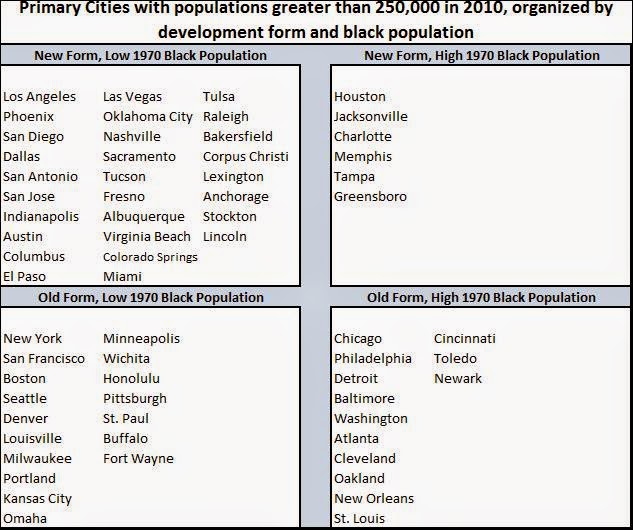
    That prompted my quick study. I wanted to categorize cities by old and new development forms, and low and high historic levels of black population. To do that I came up with an arbitrary proxy for the age of development form. Using decennial Census data, if a city reached 50 percent of its peak population by 1940, it was deemed to have an old development form; if a city reached 50 percent of its peak population in 1950 or later, it was deemed to have a new development form. Here’s a quick example of how this works. Baltimore, currently with a population of a little over 600,000, reached its peak of 949,000 in 1950. Baltimore reached half its peak, or about 475,000, by 1890, a time at which it could be said that Baltimore’s form as a city had been firmly established. Similarly, Austin reached its peak of 790,000 in 2010. The fast-growing Texas city was half that size in only 1990, a year in which it could be said that its development form was established and the city began to see itself as a major city. Imprecise, yes, but a decent proxy for examining old and new city development forms.

    The second piece of analysis was gathering Census data on central city black populations in 1970. This decade was chosen largely because it represents the end of the Great Migration, when millions of African-Americans left the rural South for cities across the nation. By that time the cities which are generally recognized as having large black populations had already been identified, and it’s possible to explore the impact of the migration on them. I arbitrarily said cities with black populations lower than 25 percent of the total in 1970 had a low black population, and those above 25 percent had a high black population.

    Using those two factors, I put together this table of the 64 primary cities over 250,000 in the U.S.:


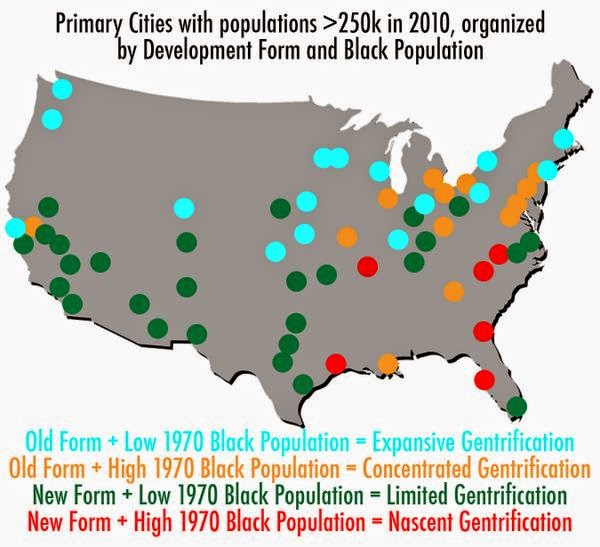
    There are more than a few cities that are exceptions, largely because recent consolidations or large-scale annexations have boosted them into more unfamiliar boxes. But some patterns are evident, and if you think of these in terms of gentrification, you might be able to make the following general assumptions:

    Old Form + Low Black Population = Expansive Gentrification (OFLB)
    Old Form + High Black Population = Concentrated Gentrification (OFHB)
    New Form + Low Black Population = Limited Gentrification (NFLB)
    New Form + High Black Population = Nascent Gentrification (NFHB)

    Identifying the examples might be the best way to explain what I mean. New York, San Francisco and Boston are the prototypical OFLB cities, and gentrification has made its widest impact in these three cities. Chicago, Washington and Atlanta are the classic OFHB cities, where gentrification is concentrated in certain areas of the city (or region), and eludes the heavily African-American parts of the city. Phoenix, San Diego and Las Vegas might be the prototypical NFLB cities, all of which came of age with the car as the dominant mode of transport and with few African-Americans. NFLB cities may also be the leaders and innovators in seeking ways to catalyze their inner cities, with greater tangible investments in public transit and mixed use development. The relatively few NFHB cities are a distinctly Southern phenomenon, and by all appearances gentrification activity lags behind other cities, with sprawl still the dominant development engine.


    Cities by gentrification type. Special thanks to Adam Carstens for producing this map.

    Why would any of this matter? Nationally, the gentrification debate is defined by the experiences of the OFLB types like New York, San Francisco and Boston. There, the issues are rapidly growing unaffordability, concerns with displacement and growing inequality. But the gentrification debate is quite different in OFHB cities like Philadelphia and Atlanta, where seeking ways to more equitably spread the positive benefits of revitalization might lead such discussions.

    In other words, it’s not exactly correct to look at what’s happening in Los Angeles or San Diego, or Baltimore or St. Louis, in the New York-San Francisco-Boston context. Different forces and different experiences are creating different outcomes in each city, and if we want to understand how to look at gentrification’s impact, we need to understand its foundations.

    This post originally appeared in Corner Side Yard on August 15, 2014.

    Pete Saunders is a Detroit native who has worked as a public and private sector urban planner in the Chicago area for more than twenty years.  He is also the author of “The Corner Side Yard,” an urban planning blog that focuses on the redevelopment and revitalization of Rust Belt cities.

  • The Problem With Being Global

    The globalization of cities and their elites often comes at the expense of many of the people who live there. Forced to compete with foreign capital and immigrant workers, native-born residents of cities from Los Angeles and London to Singapore often feel displaced, becoming strangers in what they thought was their own place.

    This phenomena is common for virtually all the leading lights on our list of The Most Influential Global Cities. Higher prices and greater labor force competition seem to be the natural result of global city status, posing enormous challenges to local populations and those that govern them.

    Since the late Enlightenment, great cities, often built around markets, were typically places for the aspirational middle and lower classes. The ability to rise in cities from North America and Europe to Asia — through what historian Peter Hall calls “this unique creativity of great cities” — stands as one of the great social achievements of modern times.

    But in this era of powerful oligarchs and growing inequality, these planetary centers are less places for upward mobility than most other cities. This is clearly true in the United States, where its premier global city, New York, as well as its prime competitors for international standing, Chicago, Los Angeles and the San Francisco Bay Area, rank among the 10 most unequal cities in the nation.

    The property market has a distorting effect. Home prices in affordable markets tend to average three times household incomes. The ratio for the top 10 global cities tend to be much higher, often upward of 10 times incomes.

    Pied a terre and investment purchases by wealthy residents of the former Soviet Union, China, the Indian diaspora and the Middle East play a role in this inflation, particularly in London, where an onslaught of Asian buyers, now, by one estimate, purchases 70% of the city’s newly built homes.For young people in London, the possibility of home ownership has begun to evaporate. Regulations that restrict new construction and raise development costs also play a substantial role in the diminishing amount of affordable housing in cities like London, New York and San Francisco.

    The Disappearance Of The Middle Class

    Rising home prices are among the impacts of globalization that tend to force out the middle class. Even in traditionally egalitarian Toronto, a study by the University of Toronto found that between 1970 and 2001 the proportion of middle-income neighborhoods in the core city had dropped from two thirds to a third, while poor districts had more than doubled to 40%. By 2020, according to the study, middle-class neighborhoods could fall below 10%, with the balance made up of affluent and poor residents.

    This leads even usual urban booster to question the direction of their cities, as they lose their counter-culture gloss. As one green journalist laments: “But what are we getting when we throw away height limits and barriers to development, stop worrying about shadows and views, and let the developers loose? Also importantly, who are we getting?”

    The impact of rising prices clearly reshapes societies. In Manhattan, half of households are single, according to the American Community Survey; in the city of San Francisco, there are now 80,000 more dogs than children. Similar trends can be seen in London, Paris, Tokyo, Hong Kong, Singapore and other top global cities. Due to high prices, some 45% of Hong Kong’s middle-class couples have abandoned the idea of having children anytime soon, according to a survey commissioned by Citibank.

    The Jobs Dilemma

    Property prices and development pressures represent just one aspect of how globalization impacts the native working and middle class. The globalized economy often favors the employment of the very skilled, and those who serve them. Many companies, such as in finance, move their middle management jobs to other, less pricey places, from Sioux Falls to India and virtually anywhere else, reducing global cities’ mid-income employment and middle-class populations.

    At its apex, in places like New York and London, the new global economy creates what economist Ajay Kapur calls a “plutonomy,” an economy that revolves around serving the wealthiest. This leaves the primary global cities as centers for both concentrated wealth and the greatest poverty, as we have seen in London, New York and other major global cities.  In New York, over a third of workers labor in low wage, service jobs, a percentage that has increased steadily through the recovery, notes a recent study by the Center for an Urban Future.

    Not surprisingly the luxury cities — the most affluent parts of certain metropolitan areas — tend to have the highest concentrations of inherited and other rentier wealth in the nation, as well as some of the greatest concentrations of poverty. An asset-based recovery, like America’s current one, favors places like Manhattan, but does little for the Bronx, just across the Harlem River, which ranks at the bottom among the nation’s large counties for the percentage of residents’ income that comes from investments, rents and dividends.

    Increasingly, the cores, and often the suburbs, of global cities such as New York San Francisco, London, Paris and other cities where the cost of living has skyrocketed are no longer places where one goes to be someone; they are where you live when already successful or living on inherited largess. They are, as journalist Simon Kuper puts it, “the vast gated communities where the one percent reproduces itself.”

    Political Consequences

    These trends could shape the future of cities socially and politically. In New York, the election of a strong left-wing mayor, Bill de Blasio,reflected the concerns of working- and middle-class Gothamites that they were becoming superfluous in their own town. Similar leftward trends can be seen in Seattle, another city that has experienced widespread gentrification, and recently passed a $15 an hour minimum wage.

    This shift represents, in part, a reaction to the fact that gentrification has done little to address the large and growing population of the poor in many global cities. London may, by recent accounts, have more billionaires than any city on the planet, but it also has the highest incidence of child poverty in the United Kingdom.

    Even many of the lower-end service jobs in restaurants, construction and retail have not redounded to the benefit of the native-born in Britain; more than 70% of the jobs created between 1997 and 2007 in the United Kingdom went to foreigners, according to the OECD. Indeed, economist Tony Travers at the London School of Economics estimated that during the last decade London received more immigrants, many from the rest of the EU, than New York or Los Angeles.

    Cultural Displacement

    The combination of mass migration and the power of the city-hopping global wealthy makes many native-born residents in global cities worried, as one London writer put it, about losing “the soul” of their city.

    This trend can be discerned in almost any global city. A Tommy Hilfiger or other chain store in Causeway Bay in Hong Kong, Fifth Avenue in New York, or Regent Street in London is pretty much like any other. Yet for independent merchants in global cities, the price of being there is often too much to bear. In the process many of the most unique shops and restaurants are displaced by the largely high-end chains that can handle the rent.

    At the same time, globalization and migration have inspired dangerous reactions, notably nativism, and a growing chasm between guest workers and residents. This has become a political issue even in the most cosmopolitan cities such as London, Singapore and the Randstadt (Amsterdam-Rotterdam-the Hague-Utrecht ).

    The fundamental challenge: the global city must accommodate two identities, a global and a local one. A great global city must serve its international role as well as its local economy and the needs of its local residents. A city must be more than a fancy theme park or a collection of elite headquarter towers. It needs a middle and working class, not just the global rich and their servants. It needs families and ordinary residents who may rarely leave town, not just globe-trotters. It needs to be true to itself and the people who, in the first place, created it.

    This piece originally appeared at Forbes.

    Joel Kotkin is executive editor of NewGeography.com and Distinguished Presidential Fellow in Urban Futures at Chapman University, and a member of the editorial board of the Orange County Register. His newest book, The New Class Conflict is now available for pre-order atAmazon and Telos Press. He is author of The City: A Global History and The Next Hundred Million: America in 2050. His most recent study, The Rise of Postfamilialism, has been widely discussed and distributed internationally. He lives in Los Angeles, CA.

    Hong Kong photo by BighStockphoto.com