Tag: middle class

  • There Will Be No Real Recovery Without The Middle Class

    What if they gave a recovery, and the middle class were never invited? Well, that’s an experiment we are running now, and, even with the recent strengthening of the jobs market, it’s not looking very good.

    Over the last five years, Wall Street and the investor class have been on a bull run, but the economy has been, at best, torpid for the vast majority of the population. Despite blather about our “democratic capitalism,” stock ownership is increasingly concentrated with the wealthy as the middle class retrenches. The big returns that hedge funds, real estate trusts or venture capitalist receive are simply outside the reach of the vast majority.

    A recent study by the Russell Sage Foundation suggests these patterns of inequality, which have been developing over the last several decades, have become more pronounced in the post-Recession years. In 2013 the wealth of those at the 90th and 95thpercentiles was actually higher than 10 years ago. Everyone else is lower.

    The labor market may be strengthening, with the unemployment rate falling to 6.1% last month, but too many of the new jobs are low wage or part time. They aren’t providing the kick the economy got in the last, more broad-based expansion from robust consumer spending.

    Wage growth has been weak, rising 2.5% annually since 2009, according to Bloomberg, compared with a 4.3% annual rise from 2001 to 2007. Consumer spending, which makes up roughly 70% of the economy, has expanded an average 2.2% since the recession ended, behind the 3% advance in the prior expansion.

    And many working-age people are still sitting discouraged on the sidelines – the labor force participation rate remains the lowest since 1979.

    People in marginal or part-time jobs are not likely to drive consumer spending. Instead we have seen the emergence of a new, top-heavy consumer market. Since 1992 the top 5% of households have increased their share of total spending to almost 40%, up from 27% in 1992.

    Former Citigroup economist Anjay Kapur has described this situation as a “plutonomy,” in which the economy is increasingly based on the global wealthy and their tastes and predilections.

    Meanwhile broader consumer confidence remains weak. Last year some two-thirds of Americans polled by the Washington Post and the Miller Center said they felt life had become tougher over the last five years compared to just 7% who thought theirs had improved. Pollsters also have found almost two-thirds of parents felt their children would do worse in life, a stunning shift from far more optimistic readings back in 1999.

    The Housing Market

    Historically housing has been the primary asset held by the middle and working class. Despite government efforts to keep mortgages affordable, post-crash, growth has been slow, and much of the buying restricted to investors, including major financial interests. Particularly damaging, there has been a marked decline in the “trade up market” and even more so, sales to first-time buyers, whose share of the market has declined to under 30%, well below the historic average of 40%. This reflects the weak economy, tighter lending standards, and, for younger customers, the heavy burden of student loans.

    Some on Wall Street hope to profit from a perceived shift in America to a “rentership society.” Housing more of the population in rental apartments would do little to improve social mobility, as people end up working not for their own equity but to pay the mortgage of their landlords. Nor can the economic payoff from apartment construction come close to that of single-family homes. According to the National Association of Home Builders, building 100 new single-family homes adds 324 jobs to the average metropolitan economy in the year of their construction and 53 jobs annually in the following years. This compares to 122 jobs per 100 new apartments in the year of construction and 32 in the following years. With home starts at less than a third their 2005 level, lack of construction employment also deals a body blow to one of the primary sources of higher-paying blue collar jobs.

    The Emasculation Of Small Business

    In previous recoveries, small businesses have provided much of the spark and job creation. Not so this time. Small business start-ups have declined as a portion of all business growth from 50% in the early 1980s to 35% in 2010, while its share of employment dropped down from 20% to 12%. Indeed, a 2014 Brookings report revealed that small business “dynamism,” measured by the growth of new firms compared with the closing of older ones, has declined significantly over the past decade, with more firms closing than starting for the first time in a quarter century.

    Nor is the future prognosis too good. The rise of the regulatory state, including the Affordable Care Act and higher taxes, amplified in deep blue states such as California, has hit smaller businesses hard. The gradual culling of smaller banks, traditional lenders to entrepreneurs, and the growing concentration of assets in the “too big to fail” banks, historically unfocused on the needs of small companies or individual proprietors, suggests credit may remain tough for grassroots entrepreneurs.

    Needed: A New Paradigm

    The recession and the weak recovery have taught us you cannot have strong economic growth without the participation of the vast majority of Americans. We’ve run an experiment under Bernanke, Bush and Obama to pump up the economy from above, and what we’ve done is squash the aspirations of those middle orders, particularly small business and the self-employed.

    This issue should be at the center of the political debate.  I would welcome suggestions from the right and left about how best to restart a broad-based economic recovery. The best ideas may come from across the spectrum, such as flatter taxes, supported by many conservatives, as well as new spending on major infrastructure projects as improved roads, rivers and ports that generally come from more liberal groups.

    The good news is the fundamentals for a broader-based prosperity, including the creation of high-paying blue-collar jobs, remain in place. Progress is already evident in the energy and some manufacturing-oriented regions. Restarting the housing sector — particularly the single-family home component — would do wonders for middle and working class people in many regional economies, as can be seen, for example, in Houston, where more homes will be built this year than in the entire state of California. Nationwide, the gap between  between demand and potential housing, according to the NAB, is roughly 1 million homes, which translates into close to 3 million jobs.

    How to drive growth to these and other productive sectors may require not only changes in government policy but also reacquainting the investor class with the virtues of long-term growth, productivity and the revival of the mass economy. Perhaps once they do investors might earn something other than intense dislike from the rest of the population.

    This story originally appeared at Forbes.

    Joel Kotkin is executive editor of NewGeography.com and Distinguished Presidential Fellow in Urban Futures at Chapman University, and a member of the editorial board of the Orange County Register. He is author of The City: A Global History and The Next Hundred Million: America in 2050. His most recent study, The Rise of Postfamilialism, has been widely discussed and distributed internationally. He lives in Los Angeles, CA.

  • Confessions of a Rust Belt Orphan

    How I Learned to Stop Worrying and Love Northeast Ohio

    Go to sleep, Captain Future, in your lair of art deco
    You were our pioneer of progress, but tomorrow’s been postponed
    Go to sleep, Captain Future, let corrosion close your eyes
    If the board should vote to restore hope, we’ll pass along the lie

    -The Secret Sound of the NSA, Captain Future

    As near as I can tell, the term “Rust Belt” originated sometime in the mid-1980s. That sounds about right.

    I originated slightly earlier, in 1972, at St. Thomas Hospital in Akron, Ohio, Rubber Capital of the World. My very earliest memory is of a day, sometime in the Summer of 1975, that my parents, my baby brother, and I went on a camping trip to Lake Milton, just west of Youngstown. I was three years old. To this day, I have no idea why, of all of the things that I could remember, but don’t, I happen to remember this one. But it is a good place to start.
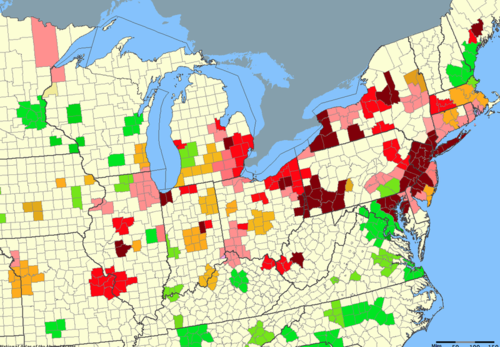
    image
    Image Source: Wikipedia: Change in total number of manufacturing jobs in metropolitan areas, 1954-2002. Dark red is very bad. Akron is dark red.

    The memory is so vivid that I can still remember looking at the green overhead freeway signs along the West Expressway in Akron. Some of the signs were in kilometers, as well as in miles back then, due to an ill-fated attempt to convert Americans to the Metric system in the 1970s. I remember the overpoweringly pungent smell of rubber wafting from the smokestacks of B.F. Goodrich and Firestone. I recall asking my mother about it, and her explaining that those were the factories where the tires, and the rubber, and the chemicals were made. They were made by hard-working, good people – people like my Uncle Jim – but more on that, later.

    When I was a little bit older, I would learn that this was the smell of good jobs; of hard, dangerous work; and of the way of life that built the modern version of this quirky and gritty town. It was the smell that tripled Akron’s population between 1910 and 1920, transforming it from a sleepy former canal-town to the 32nd largest city in America. It is a smell laced with melancholy, ambivalence, and nostalgia – for it was the smell of an era that was quickly coming to an end (although I was far too young to be aware of this fact at the time). It was sometimes the smell of tragedy.

    We stopped by my grandparents’ house, in Firestone Park, on the way to the campground. I can still remember my grandmother giving me a box of Barnum’s Animals crackers for the road. She was always kind and generous like that.

    Who were my grandparents? My grandparents were Akron. It’s as simple as that. Their story was Akron’s story. My grandfather was born in 1916, in Barnesboro, a small coal-mining town in Western Pennsylvania, somewhere between Johnstown, DuBois, and nowhere. His father, a coal miner, had emigrated there from Hungary nine years earlier. My grandmother was born in Barberton, in 1920. Barberton was reportedly the most-industrialized city in the United States, per-capita, at some point around that time.

    They were both factory workers for their entire working lives (I don’t think they called jobs like that “careers” back then). My grandfather worked at the Firestone Tire & Rubber Company. My grandmother worked at Saalfield Publishing, a factory that was one of the largest producers of children’s books, games, and puzzles in the world. Today, both of the plants where they worked form part of a gutted, derelict, post-apocalyptic moonscape in South Akron, located between that same West Expressway and perdition. The City of Akron has plans for revitalizing this former industrial area. It needs to happen, but there are ghosts there…

    My name is Ozymandias, King of Kings, 
    Look on my works, ye Mighty, and despair!
    Nothing beside remains. Round the decay 
    Of that colossal wreck, boundless and bare 
    The lone and level sands stretch far away.

    -Percy Bysshe Shelley, Ozymandias

    My grandparents’ house exemplified what it was to live in working-class Akron in the late 1970s and early 1980s. My stream-of-consciousness memories of that house include: lots of cigarettes and ashtrays; Hee-HawThe Joker’s Wild; fresh tomatoes and peppers; Fred & Lamont Sanford; Archie & Edith Bunker; Herb Score and Indians baseball on the radio on the front porch; hand-knitted afghans; UHF/VHF; 3, 5, 8, and 43; cold cans of Coca-Cola and Pabst Blue Ribbon (back when the pop-tops still came off of the can); the Ohio Lottery; chicken and galuskas (dumplings); a garage floor that you could eat off of; a meticulously maintained 14-year-old Chrysler with 29,000 miles on it; a refrigerator in the dining room because the kitchen was too small; catching fireflies in jars; and all being right with the world.

    I always associate the familiar comfort of that tiny two-bedroom bungalow with the omnipresence of cigarette smoke and television. I remember sitting there on May 18, 1980. It was my eighth birthday. We were sitting in front of the TV, watching coverage of the Mount St. Helens eruption in Washington State. I remember talking about the fact that it was going to be the year 2000 (the Future!) in just twenty years. It was an odd conversation for an eight year old to be having with adults (planning for the future already, and for a life without friends, apparently). I remember thinking about the fact that I would be 28 years old then, and how inconceivably distant it all seemed. Things seem so permanent when you’re eight, and time moves ever-so-slowly.

    More often than not, when we visited my grandparents, my Uncle Jim and Aunt Helen would be there. Uncle Jim was born in 1936, in West Virginia. His family, too, had come to Akron to find work that was better-paying, steadier, and (relatively) less dangerous than the work in the coal mines. Uncle Jim was a rubber worker, first at Mohawk Rubber and then later at B.F. Goodrich. Uncle Jim also cut hair over at the most-appropriately named West Virginia Barbershop, on South Arlington Street in East Akron. He was one of the best, most decent, kindest people that I have ever known.

    I remember asking my mother once why Uncle Jim never washed his hands. She scolded me, explaining that he did wash his hands, but that because he built tires, his hands were stained with carbon-black, which wouldn’t come out no matter how hard you scrubbed. I learned later, that it would take about six months for that stuff to leach out of your pores, once you quit working.

    Uncle Jim died in 1983, killed in an industrial accident on the job at B.F. Goodrich. He was only 47. The plant would close for good about a year later.

    It was an unthinkably tragic event, at a singularly traumatic time for Akron. It was the end of an era.

    Times Change

    My friend Della Rucker recently wrote a great post entitled The Elder Children of the Rust Belt over at her blog, Wise Economy. It dredged up all of these old memories, and it got me thinking about childhood, about this place that I love, and about the experience of growing up just as an economic era (perhaps the most prosperous and anomalous one in modern history) was coming to an end.

    That is what the late 1970s and early 1980s was: the end of one thing, and the beginning of a (still yet-to-be-determined) something else. I didn’t know it at the time, but that’s because I was just a kid.

    In retrospect it was obvious: the decay; the deterioration, the decomposition, the slow-at-first, and then faster-than-you-can-see-it unwinding of an industrial machine that had been wound-up far, far, too-tight. The machine runs until it breaks down; then it is replaced with a new and more efficient one – a perfectly ironic metaphor for an industrial society that killed the goose that laid the golden egg. It was a machine made up of unions, and management, and capitalized sunk costs, and supply chains, and commodity prices, and globalization. Except it wasn’t really a machine at all. It was really just people. And people aren’t machines. When they are treated as such, and then discarded as obsolete, there are consequences.

    You could hear it in the music: from the decadent, desperately-seeking-something (escape) pulse of Disco, to the (first) nihilistic and (then) fatalistic sound of Punk and Post-Punk. It’s not an accident that a band called Devo came from Akron, Ohio. De-evolution: the idea that instead of evolving, mankind has actually regressed, as evidenced by the dysfunction and herd mentality of American society. It sounded a lot like Akron in the late 1970s. It still sounds a little bit like the Rust Belt today.

    As an adult, looking back at the experience of growing up at that time, you realize how much it colors your thinking and outlook on life. It’s all the more poignant when you realize that the “end-of-an-era” is never really an “end” as such, but is really a transition to something else. But to what exactly?

    The end of that era, which was marked by strikes, layoffs, and unemployment, was followed by its echoes and repercussions: economic dislocation, outmigration, poverty, and abandonment; as well as the more intangible psychological detritus – the pains from the phantom limb long after the amputation; the vertiginous sensation of watching someone (or something) die.

    And it came to me then 
    That every plan 
    Is a tiny prayer to Father Time

    As I stared at my shoes
    In the ICU
    That reeked of piss and 409

    It sung like a violent wind
    That our memories depend
    On a faulty camera in our minds

    ‘Cause there’s no comfort in the waiting room
    Just nervous paces bracing for bad news

    Love is watching someone die…

    -Death Cab For Cutie, What Sarah Said

    But it is both our tragedy and our glory that life goes on.

    Della raised a lot of these issues in her post: our generation’s ambivalent relationship with the American Dream (like Della, I feel the same unpleasant taste of rust in my mouth whenever I write or utter that phrase); our distrust of organizations and institutions; and our realization that you have to keep going, fight, and survive, in spite of it all. She talked about how we came of age at a time of loss:

    not loss like a massive destruction, but a loss like something insidious, deep, pervasive.

    It is so true, and it is so misunderstood. One of the people commenting on her blog post said, essentially, that it is dangerous to romanticize about a “golden age”; that all generations struggle; and that life is hard.

    Yes, those things are all true. But they are largely irrelevant to the topic at hand.

    There is a very large middle ground between a “golden age” and an “existential struggle”. The time and place about which we are both writing (the late 1970s through the present, in the Rust Belt) is neither. But it is undoubtedly a time of extreme transition. It is a great economic unraveling, and we are collectively and individually still trying to figure out how to navigate through it, survive it, and ultimately build something better out of it.

    History is cyclical. Regardless of how enamored Americans, in general, may be with the idea, it is not linear. It is neither a long, slow march toward utopia, nor toward oblivion. When I look at history, I see times of relative (and it’s all relative, this side of paradise) peace, prosperity, and stability; and other times of relative strife, economic upheaval, uncertainty, and instability. We really did move from one of those times to the other, beginning in the 1970s, and continuing through the present.

    The point that is easy to miss when uttering phrases like “life is hard for every generation” is that none of this discussion about the Rust Belt – where it’s been, where it is going – has anything to do with a “golden age”. But it has everything to do with the fact that this time of transition was an era (like all eras) that meant a lot (good and bad) to the people that lived through it. It helped make them who they are today, and it helped make where they live what it is today.

    For those that were kids at the time that the great unraveling began (people like me, and people like Della) it is partially about the narrative that we were socialized to believe in at a very young age, and how that narrative went up in a puff of smoke. In 1977, I could smell rubber in the air, and many of my family members and friends’ parents worked in rubber factories. In 1982, the last passenger tire was built in Akron. By 1984, 90% of those jobs were gone, many of those people had moved out of town, and the whole thing was already a fading memory. Just as when a person dies, many people reacted with a mixture of silence, embarrassment, and denial.

    As a kid, especially, you construct your identity based upon the place in which you live. The whole identity that I had built, even as a small child, as a proud Akronite: This is the RUBBER CAPITAL OF THE WORLD; this is where we make lots and lots of Useful Things for people all over the world; this is where Real Americans Do Real Work; this is where people from Europe, the South, and Appalachia come to make a Better Life for themselves; well, that all got yanked away. I couldn’t believe any of those things anymore, because they were no longer true, and I knew it. I could see it with my own two eyes. Maybe some of them were never true to begin with, but kids can’t live a lie the way that adults can. When the place that you thought you lived in turns out not to be the place that you actually live, it can be jarring and disorienting. It can even be heartbreaking.

    We’re the middle children of history, man. No purpose or place. We have no Great War. No Great Depression. Our great war is a spiritual war. Our great depression is our lives.

    Tyler Durden, Fight Club

    I’m fond of the above quote. I was even fonder of it when I was 28 years old. Time, and the realization that life is short, and that you ultimately have to participate and do something with it besides analyze it as an outside observer, has lessened its power considerably. It remains the quintessential Generation X quote, from the quintessential Generation X movie. It certainly fits in quite well with all of this. But, then again, maybe it shouldn’t.

    I use the phrase “Rust Belt Orphan” in the title of this post, because that is what the experience of coming of age at the time of the great economic unraveling feels like at the gut-level. But it’s a dangerous and unproductive combination, when coupled with the whole Gen-X thing.

    In many ways, the Rust Belt is the “Generation X” of regions – the place that just doesn’t seem to fit in; the place that most people would just as soon forget about; the place that would, in fact, just as soon forget about itself; the place that, if it does dare to acknowledge its own existence or needs, barely notices the surprised frowns of displeasure and disdain from those on the outside, because they have already been subsumed by the place’s own self-doubt and self-loathing.

    A fake chinese rubber plant
    In the fake plastic earth
    That she bought from a rubber man
    In a town full of rubber plans
    To get rid of itself

    -Radiohead, Fake Plastic Trees

    The whole Gen-X misfit wandering-in-the-Rust Belt-wilderness meme is a palpably prevalent, but seldom acknowledged part of our regional culture. It is probably just as well. It’s so easy for the whole smoldering heap of negativity to degenerate into a viscous morass of alienation and anomie. Little good can come from going any further down that dead-end road.

    Whither the Future?

    The Greek word for “return” is nostosAlgos means “suffering.” So nostalgia is the suffering caused by an unappeased yearning to return.
    – 
    Milan Kundera, Ignorance

    So where does this all leave us?

    First, as a region, I think we have to get serious about making our peace with the past and moving on. We have begun to do this in Akron, and, if the stories and anecdotal evidence are to be believed, we are probably ahead of the region as a whole.

    But what does “making our peace” and “moving on” really mean? In many ways, I think that our region has been going through a collective period of mourning for the better part of four decades. Nostalgia and angst regarding the things that have been lost (some of our identity, prosperity, and national prominence) is all part of the grieving process. The best way out is always through.

    But we should grieve, not so we can wallow in the experience and refuse to move on, but so we can gain a better understanding of who we are and where we come from. Coming to grips with and acknowledging those things, ultimately enables us to help make these places that we love better.

    We Americans are generally not all that good at, or comfortable with, mourning or grief. There’s a very American idea that grieving is synonymous with “moving on” and (even worse) that “moving on” is synonymous with “getting over it”.

    We’re very comfortable with that neat and tidy straight, upwardly-trending line toward the future (and a more prosperous, progressive, and enlightened future it will always be, world without end, Amen.)

    We’re not so comfortable with that messy and confusing historical cycle of boom-and-bust, of evolution and de-evolution, of creation and destruction and reinvention. But that’s the world as we actually experience it, and it’s the one that we must live in. It is far from perfect. I wish that I had another one to offer you. But there isn’t one on this side of the Great Beyond. For all of its trials and tribulations, the world that we inhabit has one inestimable advantage: it is unambiguously real.

    “Moving on” means refusing to become paralyzed by the past; living up to our present responsibilities; and striving every day to become the type of people that are better able to help others. But “moving on” doesn’t mean that we forget about the past, that we pretend that we didn’t experience what we did, or that we create an alternate reality to avoid playing the hand that we’ve actually been dealt.

    Second, I don’t think we can, or should, “get over” the Rust Belt. The very phrase “get over it” traffics in denial, wishful thinking, and the estrangement of one’s self from one’s roots. Countless attempts to “get over” the Rust Belt have resulted in the innumerable short-sighted, “get rich quick” economic development projects, and public-private pyramid-schemes that many of us have come to find so distasteful, ineffective, and expensive.

    We don’t have to be (and can’t be, even if we want to) something that we are not. But we do have to be the best place that we can be. This might mean that we are a smaller, relatively less-prominent place. But it also means that we can be a much better-connected, more cohesive, coherent, and equitable place. The only people that can stop us from becoming that place are we ourselves.

    For a place that has been burned so badly by the vicissitudes of the global economy, Big Business, and Big Industry, we always seem to be so quick to put our faith in the Next Big Project, the Next Big Organization, and the Next Big Thing. I’m not sure whether this is the cause of our current economic malaise, or the effect, or both. Whatever it is, we need to stop doing it.

    Does this mean that we should never do or dream anything big? No. Absolutely not. But it does mean that we should be prudent and wise, and that we should tend to prefer our economic development and public investment to be hyper-nimble, hyper-scalable, hyper-neighborhood-focused, and ultra-diverse. Fetishizing Daniel Burnham’s famous “Make no little plans…” quote has done us much harm. Sometimes “little plans” are exactly what we need, because they often involve fundamentals, are easier to pull-off, and more readily establish trust, inspire hope, and build relationships.

    Those of us that came of age during the great economic unraveling and (still painful) transition from the Great American Manufacturing Belt to the Rust Belt might just be in a better position to understand our challenges, and to find the creative solutions required to meet them head-on. Those of us that stuck it out and still live here, know where we came from. We’re under no illusions about who we are or where we live. I think Della Rucker was on to something when she listed what we can bring to the table:

    • Determination
    • Long-game focus
    • Understanding the depth of the pit and the long way left to climb out of it
    • Resourcefulness
    • Ability to salvage
    • Expectation that there are no easy answers
    • Disinclination to believe that everything will be all right if only we do this One Big Thing

    When I look at this list, I see pragmatism, resilience, self-knowledge, survival skills, and leadership. It all rings true.

    He wanted to care, and he could not care. For he had gone away and he could never go back any more. The gates were closed, the sun was gone down, and there was no beauty but the gray beauty of steel that withstands all time. Even the grief he could have borne was left behind in the country of illusion, of youth, of the richness of life, where his winter dreams had flourished.

    “Long ago,” he said, “long ago, there was something in me, but now that thing is gone. Now that thing is gone, that thing is gone. I cannot cry. I cannot care. That thing will come back no more.”

    -F. Scott Fitzgerald, Winter Dreams

    So, let’s have our final elegy for the Rust Belt. Then, let’s get to work.

    This post originally appeared in Jason Segedy’s Notes From the Underground on November 2, 2013.

    Segedy is the Director of the Akron Metropolitan Area Transportation Study, the Metropolitan Planning Organization serving Akron, Ohio.  As a native of Akron, and as an urban planner, he has a strong interest in the future of places throughout the Great Lakes region, and in the people that inhabit them.

  • Energy Preferences to Play Big Role in November

    The November election will be played out along all the usual social memes – from gay marriage, racism and immigration to the “war against women.” But what may determine the outcome revolves around one key economic issue: energy. This has all come to a boil now as President Obama has backed an Environmental Protection Agency effort to accelerate tougher emissions standards, something that could shutter hundreds of coal-fired power plants and slow fossil fuel development across the country.

    The energy issue has become in our era what tariffs were in the 19th century: an increasingly insurmountable partition that separates Americans by region and class and which, ultimately, touches on the long-term economic trajectory of the country.

    Of course, we have always had politics over energy – given regional variations in sources and kinds of supplies – but, until recently, both parties generally favored developing more oil and natural gas, largely because of the associated high-wage employment growth and potential for reducing the nation’s trade deficit. Now, energy increasingly has become a deeply partisan issue, with Democrats largely in opposition to fossil-fuel development and Republicans, fairly predictably, in support.

    Reflecting this trend has been the rise of opposing sets of contributors whose primary concerns are wrapped around energy. On the Republican side, energy industry contributors, including the billionaire industrialist Koch brothers, have become increasingly dominant. More than 90 percent of campaign donations from the oil and gas industries in 2012 went to Republicans.

    At the same time, environmentally focused Democratic contributors, led by hedge-fund manager Tom Steyer, have made being anti-fossil-fuel de rigueur for most candidates in the party. Steyer and his allies have become the favorite place to go for cash for Senate Majority Leader Harry Reid of Nevada and other top Democrats.

    The Geography of Energy

    The most-evident division – and most politically relevant – is geographic. A huge swath of the country, mainly along the Gulf Coast, Texas and the Great Plains, where shale-oil production has grown fourfold since 2007, is enjoying an energy boom that has created a surge in other high-wage, blue-collar fields such as manufacturing and construction. With the delays in approving the Keystone XL oil pipeline and looming new EPA emissions standards, Democratic senators and candidates from these states are, understandably, trying to distance themselves from their party’s increasingly anti-fossil-fuel policies.

    More significant, over time, may be how energy plays out in the country’s major political battleground, the rust-belt states. Most of these states are highly dependent on coal for electricity, and some, such as Pennsylvania, Ohio and West Virginia, are seeking to develop new oil and gas finds. Policies that limit fossil-fuel development, may prove a tough sell in some districts and could cost the Democrats several additional Senate seats.

    In contrast, the most fervent support for strict climate-change legislation comes mostly from states – notably, the Northeast – that produce little in the way of energy and use relatively little carbon to power their economies. These states need less power than other areas as they already have deindustrialized and have very little population growth.

    Two other ultrablue bastions, California and the Pacific Northwest, also advocate a green energy position. The Northwest relies largely on hydro power for its robust industrial sector, lessening dependence on carbon-based energy for electricity. California, itself rich in fossil fuels, largely disdains its resources, and its leaders prefer, for ideological reasons, to subsidize expensive renewable energy. Roughly one-fourth of all energy used in California comes from out of state, much of it from coal. But since this “dirty” power comes from elsewhere, the progressives in places like Hollywood and Silicon Valley can still feel good about our state’s “enlightened” policies, whatever their real effect.

    The Class Divide

    Historically, Democrats have been big supporters of expanding the energy sector, which includes such things as dams, nuclear power plants and pipelines. But the growing influence of the green movement has reversed that. Green policies are widely embraced by largely Democratic crony capitalists in places like Silicon Valley. They also enjoy almost universal support in academia, where boycotts of fossil-fuel companies are increasingly common. The media, too, is an ally, as is the predictably progressive entertainment industry.

    Rest assured, we will never see an HBO series that celebrates George Mitchell, the entrepreneur most responsible for developing fracking. But campus-climate scientists who diverge in any way from the party line on global warming are routinely excoriated as“deniers” of “settled” science, even in the face of 15 years of relatively stable global temperatures. The media has also become a fierce defender of climate orthodoxy. TheLos Angeles Times, as well as the website Reddit, have chosen to exclude contributions from skeptics.

    Of course, many traditional Democrats, notably in the construction trades and manufacturing, oppose this drift. Construction unions are apoplectic about the president’s endless delays on Keystone XL, which has two-thirds support from the public. The United Mineworkers, not surprisingly, oppose the new EPA emissions limits, claiming they will cost upward of 75,000 mining jobs.

    Some Ohio construction unions, incensed by green opposition to both Keystone and fracking, have shifted support to prodevelopment GOP Gov. John Kasich, despite his conflict with public employee groups. The only prominent national Democrat to identify as pro-fossil-fuel is former Montana governor Brian Schweitzer whose possible run for the presidential nomination seems a bit quixotic in a party increasing dominated by environmental activists and their gentry allies.

    What Kind of America do we want?

    Ultimately, the energy debate reflects a larger discussion about the future of the country and the economy. This is not merely about emissions and climate change, per se. California’s Draconian laws, even supporters admit, will have no appreciable effect on a global basis, particularly given the state’s already relatively low carbon footprint (largely a factor of the mild climate and the slow growth in its interior in recent years). Indeed, virtually all the world’s significant increases in CO2 are coming from developing countries; since 1990, China has increased its emissions almost threefold, while America’s have dropped. China now emits roughly twice as much greenhouse gas as the U.S.

    Some of the steps taken by environmental and renewable-energy interests against natural gas development can even be seen as counterproductive. The U.S.’s better recordon reducing emissions reflects overwhelmingly the shift from coal to natural gas for generating electricity, which has helped the U.S. reduce its carbon emissions more than either Asia or Europe.

    Fracking, like any energy technology – including wind and solar – clearly creates environmental problems. There should be strong rules to regulate fracking to make it safer, as Colorado’s Democratic Gov. John Hickenlooper has worked to pass in his state. In addition, major reductions can be achieved through a shift away from oil and coal and toward natural gas, as well as conservation efforts.

    Progressives, in particular, need to focus far more on what effects an ultrahigh-cost energy economy would have on the middle and working class. More attention should be paid in accelerating the current spike in job-creating foreign investment into the country, attracted in large part by the development of low-cost, clean natural gas. In contrast, policies hostile to fossil fuels will drive industry to less-environmentally conscious countries, particularly in the developing world.

    Sadly, none of this is necessary. America’s economic future is best guaranteed by marrying the successes of Silicon Valley and Hollywood with a robust blue-collar sector that includes fossil fuels, manufacturing, logistics and construction. Emissions can be cut, for the time being, by such steps as replacing coal for generating electricity, improving efficiencies, promoting telework and boosting the use of natural gas for transportation.

    Dividing the country, and the electorate, into totally polarized camps over energy may benefit the consultants in both camps who feed off contentious and expensive election campaigns, but will do little to help the futures of most Americans.

    This article first appeared in the Orange County Register.

    Joel Kotkin is executive editor of NewGeography.com and Distinguished Presidential Fellow in Urban Futures at Chapman University, and a member of the editorial board of the Orange County Register. He is author of The City: A Global History and The Next Hundred Million: America in 2050. His most recent study, The Rise of Postfamilialism, has been widely discussed and distributed internationally. He lives in Los Angeles, CA.

    Photo by gfpeck

  • Dawn of the Age of Oligarchy: the Alliance between Government and the 1%

    When our current President was elected, many progressives saw the dawning of a new epoch, a more egalitarian and more just Age of Obama. Instead we have witnessed the emergence of the Age of Oligarchy.

    The outlines of this new epoch are clear in numerous ways. There is the diminished role for small business, greater concentration of financial assets, and a troubling decline in home ownership. On a cultural level, there is a general malaise about the prospect for upward mobility for future generations.

    Not everyone is suffering in this new age. For the entitled few, these have been the best of times. With ever more concentration of key industries, ever greater advantage of capital over labor, and soaring real estate values in swanky places such as Manhattan or San Francisco which , as one journalist put it, constitute “vast gated communities where the one percent reproduces itself.” The top hundred firms on the Fortune 500 list has revenues, in adjusted dollars, eight times those during the supposed big-business heyday of the 1960s.    

    This shift towards oligarchy well precedes President Obama’s tenure. It was born from a confluence of forces: globalization, the financialization of the economy, and the shift towards digital technology. Obama is not entirely to blame, it is more than a bit ironic that these measurements have worsened under an Administration that has proclaimed income inequality abhorrent.

    Obama’s Oligarchs

    Despite this administration’s occasional rhetorical flourishes against oligarchy, we have seen a rapid concentration of wealth and depressed conditions for the middle class under Obama. The stimulus, with its emphasis on public sector jobs, did little for Main Street. And under the banner of environmentalism, green cronyism has helped fatten the bank accounts of investment bankers and tech moguls at great public expense.

    Wall Street grandees, many of whom should have spent the past years studying the inside of jail cells for their misbehavior, are only bothered by how to spend their ill-gotten earnings, and how not to pay taxes on it. The Obama Administration in concert with the Congress , have consented to allow  the oligarchy to continue paying capital gains taxes well below the income tax rate paid by poor schmuck professionals, small business owners and high-skilled technical types. 

    In this, both political parties are to blame. Republican fealty to the interests of the investor class has been long-standing. But Obama and the Democrats are also increasingly backed in their “progressive” causes by the very people — Wall Street traders, venture capitalists and tech executives — who benefit most from the federal bailouts, cheap money, low interest rates, and low capital gains tax rates.   

    Large financial institutions also have benefited greatly from regulations that guaranteed their survival while allowing for increased concentration of financial assets. Indeed in the first five years of the Obama Administration the share of financial assets held by the top six “too big to fail” banks soared 37%, and now account for two-thirds of all bank assets.  

    “Quantitative easing,” the government’s purchase of financial assets from commercial banks, essentially constituted a “too big to fail” windfall to the largest Wall Street firms, notes one former high-level official. By 2011, pay for executives at the largest banking firms    hit new records, just three years after the financial “wizards” left the world economy on the brink of economic catastrophe. Meanwhile, as “too big to fail” banks received huge bailouts, the ranks of  community banks continues dropping to the lowest number since the 1930s, hurting, in particular, small businesspeople that depend on loans from these institutions.

    This tilt towards of the financial elites, as Elizabeth Warren has noted, occurred during both the Bush and Obama Administrations. “The government’s most important job,” she remarks, “was to provide a soft landing for the tender fannies of the banks.”

    Warren’s observation reflects the influence exercised by the oligarchs in both parties, a bipartisan alliance of the super-rich to buy government influence and protect theior wealth. A recent Mercatus Center report found that politically connected banks received larger bailouts from the Federal Reserve during the financial crisis than financial institutions that spent less or nothing on lobbyingand contributions to political campaigns. Another study by two University of Michigan economist found a strong correlation between receiving TARP assistance and a company’s degree of connectedness to members of congressional finance committees.

    As well as they have done lately, Wall Streeters have not been the only oligarchs to thrive under Obama. The tech industry, once an exemplar of dynamic capitalism, has become increasingly dominated by a handful of firms and their venture capital backers. These tech fortunes are greatly enhanced by monopolistic control of key markets, whether in search (Google); computer operating systems (Microsoft); internet retail sales (Amazon); or social media(Facebook). All of the tech giants are incessantly trying to extend their dominion into control of people’s lives, whether by tying them to a device, like the newAmazon phone, or by re-selling people’s data to advertising.

    These tech companies, which author Rebecca MacKinnon (labels) calls “the sovereigns of cyberspace,” all enjoy strong, even intimate, ties to the Obama Administration. They have little reason to fear anti-trust crackdowns or scrutiny of their increasingly gross violations of privacy from friendly government lawyers.

    Of course, if thing ever soured with the Democrats, the oligarchs can always look for benefactors among Republicans legislators, as Facebook and Google are already doing,. After all, most Republicans, particularly in the Senate, embraced the bailout of the large financial institutions — the very essence of the crony capitalism that favors large, well-connected institutions over smaller ones.

    For the most part, the oligarchs have lined up with Obama from the start. Indeed, at his first inaugural, notes one sympathetic chronicler, the biggest problem for donors was to find sufficient parking space for their private jets. As an observer at the left-leaning Huffington Post put it, “the rising tide has lifted fewer boats during the Obama years -and the ones it’s lifted have been mostly yachts.”      

    The War Against Small Business

    If Obama has proven a god-send for the oligarchs, he has been less solicitous of small business. Long a key source of new jobs, small business start-ups have declined as a portion of all business growth from 50 percent in the early 1980s to 35% in 2010. Indeed, a 2014 Brookings report, revealed small business “dynamism,” measured by the growth of new firms compared with the closing of older ones, has declined significantly over the past decade, with more firms closing than starting for the first time in a quarter century.

    There are many explanations for this decline, including the impact of offshoring, globalization and technology. But much can be traced to the expansion of regulatory power. Small firms, according to a 2010 report by the Small Business Administration, spend one-third more per employee than larger firms on staff  who can help them meet with federal dictats. The biggest hit to small business comes from environmental regulations, which cost 364% per employee more for small firms than large ones. Small business owners and self-employed professionals also have also been among those most impacted, through the cancellations of their health care policies, by the Affordable Care Act.

    The Politics of Oligarchy

    To be sure, every society has its Oligarchs, those who take leadership and lay foundations for the future. Economically, the oligarchs are necessary as creators and investors in new economic potential. The great 19th century robber barons, though often exceedingly ruthless in their practices, left an enormous legacy in the form of industries such as steel, utilities and railroads that underpinned the industrial era. But only later, due to reforms and the further expansion of the economy, did the oligarch’s work translate into mass affluence.

    The need to put limits on oligarchic power was clear to leaders such as Theodore Roosevelt who labeled his era’s moguls as “malefactors of great wealth.” In the early 20th century, many progressives and populists, as well as a growing socialist movement, rose to oppose oligarchy. But for most this was not so much an anti-capitalist, or even anti-market movement as a concern great power and wealth concentrated in the hands of the few. That seem fear of concentrated, anti-democratic power worried the founders, like Jefferson and Madison, who confronted a very different kind of oligarchy during the war for independence. 

    “We can have democracy in this country, or we can have great wealth concentrated in the hands of a few,” Supreme Court justice Louis Brandeis once noted, “but we can’t have both.”

    These sentiments are still valid. Many, if not most Americans, recognize that our political economy is not working for the majority of the country. The vast majority recognize the reality of crony capitalism and understand that government contracts go to the politically connected. More troubling still, less than one third believe the country even operates under a free market system. Most suspect that the American dream is falling increasingly out of reach. By margins of more than two to one, Americans say they enjoy fewer economic opportunities than their parents, and that their offspring will have far less job security and disposable income.     

    Today, Americans increasingly see the same threat Brandeis saw. American politics has ceased to function as a rising democracy and come to resemble an emerging plutocracy. These days, political choice is fought over by dueling groups of billionaires appealing to right and left to see who will best look after their interests. This can be seen in the emergence of conservative oligarchs like the energy billionaire Koch Brothers or the heirs to the Wal-mart fortune, who have emerged as the ultimate bêtes  noires for Democrats like Senate Majority Leader Harry Reid.

    Yet Reid and other Democrats have less problem with their own oligarchs. Among the .01 percent wealthiest Americans who increasingly dominate political giving, the largest contributions besides the conservative Club for Growth went to Democrat aligned groups such as Emily’s list, Act Blue and Moveon.org. Seven of the ten Congressional candidates most dependent on the money of the ultra-rich were Democrats. In 2012, President Obama won eight of the country’s ten wealthiest counties, sometimes by margins of two-to-one or better. He also triumphed easily in virtually all the top counties with the highest concentrations of millionaires and among wealthy hedge fund managers.  

    The Oligarchs pervasive influence buying from both parties undermines the very structure of the democratic system as well as a competitive economy. It allows specific interests -developers, Wall Street, Silicon Valley, renewable or fossil fuels producers – enormous  range to make or break candidates. As the powerful battle, the middle classes increasingly become spectators.  It’s not far off from the decadent phase at the end of Greek democracy or the late Roman Republic, examples that resonated with our classically educated founders.

    Many Americans today are alarmed, and rightfully so, by this concentration of wealth and power. But right now this grassroots reaction mainly finds its expression from the political fringes. The Tea Party, for example, had its origins in opposition to the bank bailouts that followed the financial crisis. This, not surprisingly, has made some large bank executives as wary of this right-wing movement as they were of Occupy Wall Street.

    In contrast, the oligarchs have little to fear from the mainstream of either party, though there are signs that smoke is wafting over the political horizon. The defeat of house majority leader Eric Cantor partly reflected concern over his incessant lobbying and cozying up to Wall Street. Similarly, nascent opposition to Hillary Clinton’s corporatist campaign is coming from at least some Democrats, notably Massachusetts Senator Elizabeth Warren. The recent shift leftwards of the Democratic Party, epitomized by New York’s Bill de Blasio but spreading nationwide testifies to growing unrest among the grassroots.

    These voices, both right and left, are still far from the main corridors of federal power but they are getting closer. The oligarchs should not rest too comfortably. An observer of gilded age America may have also assumed that the oligarchic power of the robber barons and industrial magnates would continue to wax inexorably. Yet, there comes a time — as occurred in the early years of the last century and again in the 1930s — when the political economy so poorly serves the vast majority that it ignites a political prairie fire. We are not there yet, in either party, but if the corrupt bargain between the oligarchs and the political class goes unbroken, the wait may not be long.

    This story originally appeared at The Daily Beast..

    Joel Kotkin is executive editor of NewGeography.com and Distinguished Presidential Fellow in Urban Futures at Chapman University, and a member of the editorial board of the Orange County Register. His next book The New Class Conflict is now available for pre-order. He is author of The City: A Global History and The Next Hundred Million: America in 2050. His most recent study, The Rise of Postfamilialism, has been widely discussed and distributed internationally. He lives in Los Angeles, CA.

    Barack Obama photo by Bigstock.

  • Enterprising States 2014: Re-creating Equality of Opportunity

    This is the executive summary for the U.S. Chamber of Commerce Foundation’s 5th Annual Enterprising States report, authored annually by Praxis Strategy Group. View the interactive map with state-by-state data and download the full report here.

    The growing skills gap is one of the most persistent challenges affecting thriving and lagging state economies—the disparity between the skills companies need to drive growth and innovation versus the skills that actually exist within their organizations and in the labor market. This disconnect, expected to grow substantially as the boomer generation retires, causes workers and companies to miss out on realizing their full potential. A sizable skills gap impacts virtually every aspect of the economy, thereby affecting our national competitiveness and, in turn, causing the economy to fall short of its potential.

    The nature of the skills gap that employers face varies by geography. Each state has its own economic DNA with varying levels of growth and specialization for each industry. The energy-related skills gap in Texas or North Dakota, for example, is different from a manufacturing-driven gap in Michigan, aerospace in Washington, information technology in Utah, or the chemical industry in Louisiana.

    Businesses and the public sector must work side by side to identify where there is a deficit of talent, reskill incumbent workers, and skill new entrants into the workforce to close the gaps within their communities. This is not a problem that can be solved quickly, but it can be solved. Strengthening America’s science, technology, engineering, and mathematics (STEM) and middle-skills pipeline will require public-private partnerships as well as collaborations across federal, state, and local governments.

    States as a Focal Point for Action

    States and their governors play a pivotal role in filling the talent pipeline, providing critical leadership to link businesses with the education, workforce, and economic development systems. Solutions will vary by state of course, but there is an emerging framework built on a foundation of both basic education and an employer-responsive workforce pipeline.

    Economic development starts with strong schools focused on 21st century skills. For the past three decades, efforts by U.S. businesses, government, and educational organizations focused on retooling K–12 science, mathematics, and reading education and on addressing persistently high dropout rates in inner cities. Progress has been slow to remedy the looming skills shortage, but there is a growing sense of optimism that industry sector partnerships, greater attention to career pathways, and the implementation of integrated education and training will help to close the gap.

    An employer-responsive talent pipeline requires aligning education, workforce development, and economic development. Postsecondary education institutions now get a considerably lower percentage of their funding from state sources than just a decade ago, but states continue to make significant financial investments in higher education. Yet, a common refrain is that postsecondary offerings—at both two- and four-year institutions—are not sufficiently aligned with the skills needed in the workforce. For years, knowledge creation, research and development, and technology transfer have dominated higher education’s economic development role. However, higher education’s most important contribution to state economic competitiveness in the future might be teaching and talent production because states with the most high-level talent will have a leg up in the future economy of decentralized global networks.

    Investing in people is perhaps the most effective long-term economic growth strategy. Training and education offer the best chance for workers to find well-paying long-term employment, while providing businesses and employers in every sector with the talent they need to grow.

    Coordinating education, workforce development, and economic development has proven to be challenging among the states because the three fields are historically separate systems, with separate cultures and perspectives. States that are successful in navigating program integration and facilitating collaboration between these traditionally separate institutions will put themselves in the forefront of meeting one of the primary challenges to building a 21st century economy.

    Because of these complexities, a governor serves the issue best by playing a leadership role in forming partnerships – particularly between business and education – and creating the structure to ensure effectiveness and efficiency in a demand-driven education to workforce pipeline. Often this involves a decentralized approach so that more decisions can be made at the local level.

    Enterprising States 2014

    Now in its fifth edition, the Enterprising States study measures state performance overall and across five policy areas important for job growth and economic prosperity. Those five areas include:

    • Talent Pipeline
    • Exports and International Trade
    • Technology and Entrepreneurship
    • Business Climate
    • Infrastructure

    The 2014 report relates these policies and practices to the need for collaboration between education, workforce development, and economic development to positively combat the nation’s growing skills gap.  

    Top Performers

    Utah lands in the top 6 in each of the five policy categories and 3rd in overall economic performance. It is the only state to finish in the top 10 on all six lists.

    Colorado appears on 5 top 10 lists, Texas on 4, and Washington is in the top 15 of five lists.

    North Dakota is another strong performer, leading by a large margin in economic performance and ranking 1st in talent metrics and 9th in business climate.

    Florida and Nevada rank well on many policy measures, a sign that the economies of those states may be ripe for a turnaround.

    Virginia ranks 5th in technology and entrepreneurship, and talent metrics, helping it land just outside the top 10 in economic performance.

    Minnesota ranks 10th in economic performance, partly due to its second place in talent pipeline. 

    See how your state ranks by viewing our interactive map. Or view a PDF of the full report.

    Enterprising States is authored by Praxis Strategy Group along with Joel Kotkin. Praxis Strategy Group is an economic research, analysis, and strategic planning firmJoel Kotkin is executive editor of NewGeography.com and author of the forthcoming The New Class Conflict.

  • Is Brazil Still the Country of the Future?

    Not long ago, Brazil was riding high. It was feted as one of the “BRIC” nations destined to be the next world economic powers. The commodities boom had its natural resources and agricultural sectors humming. The press – for example, Monocle magazine’s swooning over Brazil’s push to boost its diplomatic presence – was adoring. And Rio was awarded the 2014 World Cup and the 2016 Olympics, two events that were intended to both serve as a catalyst for further development, and also as a coming out party of sorts for the country.

    The World Cup is underway, but otherwise things haven’t quite worked out as Brazil thought they would. The average citizen of the country is upset at the vast sums being spent on international events that don’t benefit them. The last two years have featured riots, strikes, and various other expressions of unrest. Economic growth in the country has collapsed. In a special section last September, the Economist asked, “Has Brazil Blown It?

    Late last month the McKinsey Global Institute issued a major report on the country called “Connecting Brazil to the World: A Path to Inclusive Growth.” At 104 pages, it’s massive, but a must read for anybody interested in South America’s giant.

    And it’s a somewhat depressing read as well. Though there are immense strengths and opportunities for the future, Brazil has big problems too, most of them longstanding, and which hobble its aspirations.

    Brazil is the 7th largest economy in the world and the 7th leading destination for foreign direct investment. But it’s 95th in per capita GDP, 114th in the quality of its infrastructure, and 124th in its level of ease in trading across borders. Its export sector is also heavily commodity dependent, particularly oil. Ranked only 43rd in global connectedness on McKinsey’s index, they estimate a potential boost of 1.25% (presumably percentage points) to annual GDP growth from improvements on that measure alone.

    Three particular items jumped out at me from the study. One is the “custo Brasil” – the Brazil cost, so notorious it gets its own Wikipedia entry. A variety of factors from bureaucracy to the tax regime to an uncertain legal climate, poor infrastructure, crime, and corruption make the cost of doing business in Brazil very pricey indeed.

    The second is the very low rate of investment in the economy. Brazil’s gross investment rate as a percentage of GDP is 18%, compared with 26% in Chile, 29% in Mexico, 40% in India, and 49% in China. Conversely, government consumption is at 22% in Brazil vs. 12% in Chile and Mexico, 13% in India, and 14% in China. Private consumption is similar in the countries except for China, which is notably lower. This probably helps explain the poor state of the infrastructure in the country.

    The third is something I have personal experience with, namely protectionist trade barriers designed to create and sustain domestic industries in sectors like autos and computers. I suspect these rules were modeled on Japan, and more lately China, which used rules and business practices to build successful local champions. But in Brazil this has rendered its industry sclerotic. In effect, cars sold in Brazil have to be made in Brazil, ditto for computers, etc. This is where my personal experience comes in. When we were doing global PC procurement, Brazil was always a special case and our vendors had to have special Brazil made PCs for domestic use. This may not be an actual rule, but tariffs produce a de facto barrier. While this technique may have worked in Japan, it’s clear that it failed in Brazil. As the exception that proves the rule, McKinsey uses the example of regional jet manufacturer Embraer as a counterfactual. That company was privatized and opened to global competition. The result is that its got tough itself and is now an industrial champion for Brazil.

    There are tons of statistics in the study that are worth scanning just to see. Brazil is consistently benchmarked against Chile and Mexico in Latin America, as well as fellow BRICs India and China. The comparisons aren’t pretty.

    Reading a lot about the country in the last year, I put its problems into three categories: poor governance, geographic disadvantage, and scale disadvantage.

    1. Poor Governance
    Most of the issues pointed out by McKinsey fall squarely under the heading of poor governance. The contrast with nearby Chile could not be more plain across every dimension: corruption, the rule of law, investment, public sector debt, tax burden, infrastructure, regulation, etc.

    Latin America seems to prefer two sorts of governments these days. One is a right wing nationalist heir to the military juntas of the past, best exemplified by the Kirchner regime in Argentina. The other are left wing populist-nationalist movements like Venezuela that tend to feature a streak of anti-Americanism. Both of these have produced pitiful results.

    Brazil is a sort of lite version of the latter. Lula da Silva was a charismatic labor activist who led strikes and was jailed by the previous military dictatorship in his youth. Post-democratization, he went into politics. After moderating some of his more radical views, he was elected president on a reform agenda. While he had some success and was arguably and improvement on his predecessors, he ultimately failed to deliver on material changes in governance. His hand picked successor Dilma Rousseff has not been as effective and is in an electoral struggle for another term.

    In line with the nationalist streak of this governing type, one of Da Silva’s primary concerns was Brazil’s amour-propre. As one of the world’s largest countries, he found it self-evident that Brazil should be treated as a great power. He lobbied for Brazil to have a permanent seat on the UN Security Council. He and others responded in kind to any affront to the nation’s pride, such as requiring American and only American visitors to be finger printed after the US imposed a fingerprinting requirement on foreign visitors. He sought out diplomatic coups where ever he could find them, which included cozying up to unsavory characters like Mahmoud Ahmadinejad who thinks Israel should be destroyed and that Iran has no gays (presumably because he has them executed when he can find them).

    Da Silva forgot that there’s more to being a great power than being a big country – you’ve got to earn it. And as a very popular politician he did not seize his moment of opportunity to truly grasp the nettle of reform.

    Meanwhile nearby Chile is one of the Latin American governments that’s followed a different model. It’s been run by center-left governments more or less the entire time since the restoration of democracy, and they’ve delivered on a good governance model that has taken them to effectively developed country status. Chile is now even a member of the OECD. Chile is basically the Minnesota of Latin America, and the results demonstrate it. This should show Brazil the size of the prize if the get their act together.

    2. Geographic Disadvantage
    Brazil is simply a long way from major developed markets. This puts it at a geographic disadvantage versus many other countries. Current airplanes cannot make a non-stop flight from Brazil to East Asia, arguably the most important emerging part of the world. It’s even a long haul from the United States, with relatively few gateway cities vs. say major European capitals. Brazil is time-zone advantaged with the US, however. It also speaks Portuguese instead of Spanish, which imposes a linguistic handicap.

    3. Scale Disadvantage
    Brazil is a big country, geographically and in population. Size can be an advantage, but it also makes reform difficult as it’s hard to turn a battleship. Brazil’s population of 200 million is more than ten times that of Chile.

    Brazil’s two principal cities, São Paulo and Rio de Janeiro, are also megacities. São Paulo in particular is huge, and at north of 20 million people (more than the entire country of Chile) is the 10th largest city in the world. I recently wrote that it’s unlikely the world’s emerging megacities will turn the corner in eliminating dysfunction. Their problems are just too huge and their national growth rate too low. Though I’d consider this more hypothesis than conclusion at this point, my rule of thumb is that a megacity can only achieve escape velocity from pervasive dysfunction if they are a major city in a country that is the world’s current rising economic (or historically imperial) power.

    Brazil is not that country, and two mega cities will be a drag on growth. Although São Paulo is an important emerging global city – 23rd in the world in a forthcoming report I helped create – I’m told that both São Paulo and Rio are growing more slowly than secondary cities in the country. A previous McKinsey study threw cold water on the idea that megacities are an advantage, noting their under performance by saying:

    It is a common misperception that megacities have been driving global growth for the past 15 years. In fact, most have not grown faster than their host economies, and MGI expects this trend to continue. Today’s 23 megacities—with populations of 10 million or more—will contribute about 10 percent of global growth to 2025, below their 14 percent share of global GDP.

    In contrast, 577 middleweights—cities with populations of between 150,000 and 10 million, are seen contributing more than half of global growth to 2025, gaining share from today’s megacities.

    So I’m not surprised that it’s Curitiba, not one of the megacities, that’s where the innovative BRT revolution was begun. If I were looking to invest in Brazil, I’d be looking at this next tier of cities. Nor is it surprising that Santiago, Chile (population 5.4 million) has had great success in modernizing given its more moderate size.

    Plain and simple the degree of difficulty is higher in Brazil because of the size.

    Brazil is also a very racially diverse country with a number of challenges resulting from its history of oppression. Brazil had more slaves than any other country in the world and was the last New World colony/nation to abolish it. If slave reparations are on the agenda in the United States, how much more so similar issues in Brazil? Again, contrast with Chile, which never had very many slaves and abolished slavery in 1818. With the exception of a relatively few indigenous peoples on reservations, Chileans largely perceive themselves as ethnically homogenous, though with some skin tone based status (moderately sized…historically racially homogenous…Minnesota?)

    Which is to say that it’s tough to entirely fault Brazil for not living up to the example of Chile. Its degree of difficulty is much higher. And its geography hamstrings its global interaction.

    Nevertheless, solving the governance challenges to address the real issues Brazil faces remains the top agenda item. McKinsey has laid out a number of good suggestions, the real question is whether or not Brazil’s socio-political system can produce the ability to implement them.

    Aaron M. Renn is an independent writer on urban affairs and the founder of Telestrian, a data analysis and mapping tool. He writes at The Urbanophile, where this piece originally appeared.

    Photo: Ponte estaiada Octavio Frias – Sao Paulo by Marcosleal

  • America’s New Industrial Boomtowns

    David Peebles works in a glass tower across from Houston’s Galleria mall, a cathedral of consumption, but his attention is focused on the city’s highly industrialized ship channel 30 miles away. “Houston is the Chicago of this era,” says Peebles, who runs the Texas office of Odebrecht, a $45 billion engineering firm based in Brazil. “In the sixties you had to go to Chicago, Cleveland and Detroit. Now Houston is the place for new industry.”

    With upward of $35 billion of new refineries, chemical plants and factories planned through 2015 for Houston and the surrounding Gulf Coast, companies like Odebrecht, which runs chemical plants and is working on a new freeway in the area, have converged on the nation’s oil and gas capital. They are part of the reason why the Texas metropolis ranks first on our list of the best large cities for manufacturing.

    Houston, with 255,000 manufacturing jobs, is not yet the country’s largest industrial center; it still lags behind the longtime leaders Los Angeles, with 360,000 manufacturing jobs, and Chicago, home to 314,000. But it is clearly on a stronger trajectory. Since 2008, Houston’s manufacturing workforce has expanded 5% while Los Angeles has lost 13% of its industrial jobs and Chicago’s factory workforce has shrunk 11%.

    View the Best Cities for Manufacturing Jobs 2014 List

    Why Manufacturing Matters

    Whether America is on the path to a sustainable industrial expansion or is just seeing a weak bounce back has been widely debated, but the recent numbers are impressive. Since 2010 the U.S. has added 647,000 manufacturing jobs. New energy finds have led to the construction and expansion of pipelines and refineries, and has sparked foreign industrial investment reflecting electricity costs that are now well below those in Europe or East Asia. Besides Houston, also ranking high on our big cities list are two other energy towns, No. 5 Oklahoma City and No. 10 Ft. Worth, Texas. Our mid-sized cities list is led by Lafayette, La., with nearby Baton Rouge in 11th place.

    Evangelists of the “information economy” may think that industrial jobs are passé, as epitomized by a recent Slate article that recommended that working-class people from places like Detroit should move to areas like Silicon Valley or Boston where they can make money cutting the hair and walking the dogs of high-tech magnates. But the notion that U.S. manufacturing is doomed, and that the jobs are of lower quality than those in high-tech centers, is largely bogus; even in Silicon Valley the majority of new projected jobs are expected to pay under $50,000 annually. In contrast manufacturers pay above-average wages, in some cases due to unionization, but in many others because of the increasing sophisticated skills required by today’s factories.

    Although we will likely never see a boom in factory employment on the scale experienced in the last century, the demand for blue-collar skills is projected to increase in future years. Among all professions for non-college graduates, manufacturing skills are most in demand, according to a study by Express Employment Professionals. By 2020, according to BCG and the Bureau of Labor Statistics, the nation could face a shortfall of around 875,000 machinists, welders, industrial-machinery operators, and other highly skilled manufacturing professionals.

    Southern Comfort

    Our research suggests that much of this growth will be in metro areas in the South and the Great Plains that are known for friendly business climates. New industrial investment is tending to go to places that are largely non-union, and feature lower taxes and light regulation. Epitomizing this trend is the No. 2 city on our large metro area list, Nashville-Murfreesboro-Franklin, Tenn., where manufacturing employment is up 6% since 2008. Nashville has become a hotbed for foreign investment in manufacturing, with the expansion of the Nissan facilities in nearby Smyrna, as well as a host of suppliers.

    This is occurring, in part, because some large companies are shifting production to America from China in response to rising Chinese wages as well as sometimes unpredictable business conditions there.

    Investment inflows, both from overseas and domestic companies, have boosted other standout southern industrial hubs, as well as the smaller metro areas on our mid-sized city list, notably Mobile, Ala. (third place), with its expanding industrially oriented port, and No. 14 Charleston-North Charleston-Summerville, S.C., which has been a beneficiary of major new foreign investment as well as the expanded presence of U.S. aerospace giant Boeing. The South also is home to our No. 1 small manufacturing city, Florence-Muscle Shoals, Ala.

    The Resurgence of the Rust Belt

    The progress is not confined to the Sun Belt. The resurgence of the U.S. auto industry has revived the economy of Warren-Troy-Farmington Hills, Mich., also known as “automation alley.” The home to many parts suppliers, engineering and tech support for the car industry, this area has enjoyed an impressive 12.7 percent growth in manufacturing jobs since 2008, placing it third on our big cities list.

    Detroit, the center of the auto industry, ranks a respectable 16th on our big city list, but the big improvements in the Rust Belt are occurring in mid-sized cities such as Lansing-East Lansing, Mich. (eighth), Grand Rapids (ninth) and Ft. Wayne, Ind. (10th).

    But arguably the strongest Rust Belt recovery has occurred in Elkhart-Goshen, Ind., third on our small cities list. Since 2008 Elkhart’s industrial employment — much of it in the recreational vehicle industry — has expanded 30%, one of the most dramatic employment turnarounds of any place in America. Unemployment has fallen to 5% from a recession high of 20.2%.

    Western Exposure

    The South and the Great Lakes may be America’s industrial heartland, but there are several strong pockets in the West. One region that is doing particularly well is the Pacific Northwest, led by Seattle-Bellevue-Everett, which has experienced 11% manufacturing employment growth since 2010.

    Boeing is key here, but the Pacific Northwest’s industrial expansion has also been fueled by low electricity rates, largely due to the area’s strength in hydroelectricity. Portland-Vancouver-Hillsboro OR-WA (11th) is usually associated more with hipsters, but manufacturing growth has taken off, particularly with the expansion of Intel’s large semiconductor facility in suburban Hillsboro.

    Another Western industrial hotspot is Utah, a state with low energy costs and business friendly regulation. Salt Lake City, 12th on our large metro area list, has enjoyed a 5.7% increase in industrial jobs since 2010. Growth has been even stronger in two other Utah cities, Provo -Orem and Ogden-Clearfield, which rank fifth and seventh, respectively, on our mid-sized cities list.

    One surprising place where manufacturing is making a mild comeback is in the Bay Area, which for years has exported high-tech manufacturing jobs to places like Utah as well as the rest of the world. Despite ultra-expensive electricity, high labor costs and some of the world’s most demanding environmental laws, San Jose (13th on our big metros list) San Francisco-San Mateo-Redwood (15th) have posted solid industrial growth after years of decline. Yet both remain below their 2008 levels, and may find new growth difficult once the current tech bubble collapses.

    Laggards

    Two of the worst performers on this list are the big metro areas that have for decades been the country’s largest industrial hubs, Los Angeles-Long Beach-Glendale (55th) and Chicago-Joliet-Naperville (56th). It appears they lack the cost competitiveness and specialized focus of America’s ascendant industrial regions.

    Another clear loser is the Northeast, which accounts for seven of the eight lowest ranked big metro areas. Since 2008, Philadelphia (62nd) has lost 21% of its once-large industrial job base, while New York City, which has been losing industrial jobs for decades, ranks 45th. Here, too, high costs and regulation are a factor, as well as the loss of industrial know-how resulting from long-term erosion of their manufacturing bases.

    Of course, some information age enthusiasts may argue that losing such jobs is something of a badge of honor, since “smart” regions do not focus on the gritty business of making things. Yet if you look across the country, you can see that many of the strongest local economies, from Houston and Nashville to Seattle, have taken part in the U.S. industrial resurgence. It seems this is one party more worth joining than avoiding.

    View the Best Cities for Manufacturing Jobs 2014 List

    This article first appeared at Forbes.com.

    Joel Kotkin is executive editor of NewGeography.com and Distinguished Presidential Fellow in Urban Futures at Chapman University, and a member of the editorial board of the Orange County Register. He is author of The City: A Global History and The Next Hundred Million: America in 2050. His most recent study, The Rise of Postfamilialism, has been widely discussed and distributed internationally. He lives in Los Angeles, CA.

    Houston skyline photo by Bigstock.

  • Let’s Make Kalamazoo’s Promise America’s Promise

    In 2005, in order to boost their city’s economy, a small group of donors in the city Glenn Miller made famous created the Kalamazoo Promise. It  offered any graduate of the city’s public schools a four-year scholarship covering all tuition and mandatory fees at any of Michigan’s public colleges or universities, provided those students maintained a 2.0 grade average in college and made regular progress toward a degree.

    The offer had an immediate and noticeable effect on public school enrollments and home construction within the city as families moved back in to take advantage of the chance to boost their children’s higher education opportunity. Enrollments in the public schools rose initially by 17.6% even as high school dropout rates fell by half. Residential construction permits within the district rose from 30% within the overall metropolitan area to 50%.  The program’s success caused other cities across the country as disparate as El Dorado, Arkansas and Tulsa, Oklahoma to adopt similar programs.

    Now a recent national study of the results of such initiative has documented the positive impact such promise programs can have on increasing educational attainment, while encouraging more students to attend a wide range of colleges.  University of Pittsburgh professors, LeGower and Walsh found that programs offering scholarships to all students regardless of merit, and to the widest range of two and four year colleges and universities, saw the biggest gains in enrollment. Their research published in a National Bureau of Economic Research working paper, documented enrollment gains in Kalamazoo and other identical programs.

    With these compelling results in hand, it’s time to make Kalamazoo’s promise America’s promise. A bi-partisan proposal from the non-profit Redeeming America’s Promise seeks to do just that by creating a federal American Promise Scholarship program that would pay the cost of tuition for every academically capable and personally determined high school student in America from families earning $180,000 or less. The plan would offer two year scholarships for high school graduates of $2500 per year, and four year scholarships worth on average $8500 per year to students graduating with a 2.75 GPA. These rates represent the current average cost of in state resident tuition at our public community colleges and universities. States would need to agree to accept such scholarships in lieu of any tuition payments from the families of APS students and at a minimum maintain their current level of support for their institutions. Additional incentives would be provided to encourage them to do even more to make sure a college education is both accessible and affordable for their residents. According to the Bipartisan Policy Center, there is $52 billion in current expenditures which can be used to fund the American Promise Scholarships by redirecting the money the federal government currently spends on tuition tax credits as well as by integrating the Pell Grant program into this new form of support.

    Other parts of the plan, which can be downloaded in its entirety at redeemingamericaspromise.org, would provide additional support for students who are the first in their family to attend college and reward college completion as well as post-graduation service to community or country. Money for these programs can be found by reducing the level of profits the government currently makes on student loans and ending other college support programs which have not proven their effectiveness.  

    The current system of financing higher education is unsustainable.  Student loan debt, which is not dischargeable in bankruptcy, now exceeds one trillion dollars—more than all the credit card debt in the country. The burden is felt disproportionately by lower and middle income families and is a severe drag on the desire of members of the Millennial Generation (born 1982-2003) to start a family, buy a house and have children. Furthermore, there is no historical precedent for placing such a burden on our youngest citizens.

    Since the country’s founding, education has been a key component of the promise of upward economic mobility. This has been true in every era, beginning with the Northwest Ordinance setting aside land for one room schoolhouses to the institution of mandatory, free primary education in all states at the time of the Civil War. The expansion of educational opportunities continued in the 20th Century as our growing Industrial Age economy required workers with a high school education for our factories and offices. Government funds in every state and community were set aside to provide a free, public high school education for boys and girls to respond to these new demands. Later in the century, after WWII, the GI Bill of Rights and then the Higher Education Act 0f 1965 were enacted to further encourage college enrollment, thereby establishing the educational foundation for our rapidly expanding middle class. It is only in this century that we have asked a generation, Millennials, to self-finance the education they need, and our country needs, to be economically successful.

    This wrong-headed inter-generational and economically disastrous policy needs to end before America loses its global competitive edge for good. The current system is creating a skills gap.

    America needs to make Kalamazoo’s Promise a promise every American can count on and that can address the growing skills gap in many parts of the occupational spectrum.  By joining with the Democrats and Republicans, young and old, who are already supporting Redeeming America’s Promise’s plan to make college tuition free we can ensure that day arrives sooner rather than later.

    Morley Winograd is co-author of the newly published Millennial Momentum: How a New Generation is Remaking America and Millennial Makeover: MySpace, YouTube, and the Future of American Politics and fellow of NDN and the New Policy Institute.

    Graduation photo by Bigstock.

  • Inland California Needs to Get in the Zone

    California’s dream is shrinking inexorably, and only radical steps can prevent the condition from becoming permanent. Compared with previous economic expansions, fewer state residents and communities are benefiting from this recovery, which has largely been restricted to the small coastal zone surrounding the Bay Area, as well as certain parts of western Los Angeles, Orange and San Diego counties.

    As the economy has strengthened, what is called a “boom” in the mainstream media is really a story of one region. Some 300,000 jobs have been created as the recovery has strengthened over the past 15 months,but three-quarters of them have been concentrated along the coast, mostly in the San Francisco-San Jose corridor.

    In contrast, much of the interior of the state, from the Inland Empire, where the poverty rate has doubled since 1990, to the Central Valley, is doing far less well. Unemployment has dropped to near 5 percent in the Bay Area, but remains above 8 percent in the Inland Empire, and above 10 percent in many interior communities, from Fresno and Modesto to Bakersfield. Viewed in the national media as some sort of permanent basket case, the inland regionbooming a decade ago, was recently compared by a UCLA economist to Appalachia.

    Get in the ‘zone

    California’s interior clearly needs a form of new deal that will allow it to participate in the state’s recovery. This plan starts with declaring the entire area an “enterprise zone” that allows communities to opt out from some of the harshest, coastally driven regulations.

    Enterprise zones typically refer to economically ailing portions of cities where policies to encourage economic growth and development are implemented for businesses in the designated area. Such policies, on a regional scale, are needed in inland California.

    Extraordinary controls on development, expensive “green energy” policies and high taxes on small enterprises may seem reasonable, or at least bearable, in a coastal economy fueled by soaring capital gains, with the prospect that the gentry rich can supply trickle-down service jobs to the hoi polloi.

    But such policies are often disastrous for the state’s interior, which lacks the resources or appeal of the coastal havens. Take the issue of electricity prices, which have soared, in large part, because of the green-energy policies favored by influential residents along the coast. Energy costs for many California businesses are roughly twice those for consumers in the Pacific Northwest, Salt Lake City or Denver. Yet here’s the rub: The climate along the coastal strip requires less air conditioning or heating, unlike that of the interior regions, where temperatures rise and fall more severely.

    Worse yet, there’s more pain to come: California’s recently enacted carbon “cap and trade” system could boost gasoline prices, already 55 cents per gallon above the national average, another dollar.

    Unaffordable Coast

    Many wealthier coastal residents can afford housing close to major job centers and, for that matter, more expensive gasoline. But the same pump prices are a dagger aimed at the finances of many middle- and working-class people who live in the interior and have to commute to employment. The gentry retort – that such people should move to the city – ignores the fact that most middle- and working-class people can’t afford to live decently in places like Los Angeles, much less San Francisco, given current prices.

    People in recent decades have moved to the interior largely to improve conditions for their families, not to lower their quality of life. Rising gas prices won’t lead them “back to the city” but, more likely, will force many to cut back further, or consider moving elsewhere. There’s no discernible movement of people to the coastal counties from the interior; if anything, the pattern, although less marked than a decade ago, remains quite the opposite.

    Despite a growing population, the long-term sustainability of the interior’s economy now is questionable. High energy costs, onerous regulatory burdens and land-use constraints imposed by Sacramento are systematically undermining industries that have traditionally driven growth in the state’s interior. These include construction, manufacturing, ranching and farming, along with logistics and business services, all of them employers of middle- and working-class Californians.

    Creating an expansive enterprise zone would allow these businesses to compete more successfully with other states. It might encourage, for example, manufacturers leaving or expanding away from the coast to head to inland California instead of to another state, or propel builders to construct affordable housing, including single-family homes, in places like the Inland Empire, as opposed to in Texas or Arizona.

    Why should the Bay Area oligarchy agree to such a step? One reason may be to avoid the soaring cost of supporting so many poor and needy people in the interior. When the tech bubble bursts, the state will face another cash crunch. Having a vast impoverished population then will mean even higher taxes and worse services, something that will affect all but the most high-end businesses.

    Dreams, green or otherwise, take money, but our bifurcated economy relies increasingly on the fortunes of the few. California’s top 1 percent of earners paid 50 percent of state income taxes in 2012, up from 40 percent the year earlier. This is not surprising since so much of the state is either impoverished or stagnating. Once aspirational regions, proud contributors to the Golden State’s economic diversity, increasingly resemble dependent countries in the Third World.

    Modern-day progressives respond to these realities by pushing for such things as raising the minimum wage, or imposing even more Draconian labor regulations. This may help some low-income workers, but it’s hard to see how it would boost the interior’s competitiveness. In contrast, the creation of an enterprise zone would give these areas at least a fighting chance.

    Ultimately, what kind of California do we want for our children? Right now, the state is evolving into something of a neofeudalist society, consisting of an affluent few, concentrated in the coastal belt, a large and expanding poverty class and a struggling, shrinking middle class. There’s the California of the oligarchs with 111 billionaires, by far the most of any state, with personally held assets worth $485 billion. Together, they own more than the GDP of all but 24 countries in the world. At the other end of the scale is a state with the nation’s highest poverty rate (adjusted for housing costs) – above 23 percent – and roughly one-third of the nation’s welfare recipients.

    This condition has been aptly labeled by one Central Valley writer as “liberal apartheid.”The well-heeled, largely white and Asian coastal denizens live in an economically inaccessible bubble – due to extremely high housing prices – while the largely poor, working class, heavily Latino communities eke out a meager existence in the state’s eastern interior.

    To be sure, many forces beyond Sacramento’s control – globalization, immigration, the asset-oriented nature of the recovery – have contributed to this growing wealth gap. But gentry-led pubic policies have exacerbated the refeudalization. Young Californians, notes one study, already are now less likely to graduate from college than were their parents.

    A Shrinking middle

    Meanwhile, the middle class, the social and economic linchpin of the state, continues to decline, with a far more dramatic drop in state households earning $35,000 to $75,000, according to research from the California Lutheran University forecast project, than the national average. As late as the 1980s, the Golden State was about as egalitarian as the rest of the country, and roughly 60 percent of its population was middle class. But now, for the first time in decades, the middle class is a minority in California.

    In fact, many Californians face a future as modern-day land serfs, renting and paying someone else’s mortgage. If they choose to start a family, they increasingly look to settle elsewhere, ironically, some to locations like Oklahoma and Texas, places that historically sent eager migrants to the Golden State, whose appeal combined economic opportunity, its milder climate and spectacular scenery.

    The prospect facing California is not unlike that seen in other Democratic-dominated regions, such as New York, where a well-organized and savvy, affluent, urban minority can impose ever-greater restrictions on the relatively unorganized, inarticulate exurban populations. Like New York’s Appalachia-like upstate regions, interior California faces a dismal future that, over time, will lead to increasing demands on the middle and upper classes. Only by allowing the interior a decent chance can California truthfully claim that its economy has, indeed, turned around.

    This article first appeared in the Orange County Register.

    Joel Kotkin is executive editor of NewGeography.com and Distinguished Presidential Fellow in Urban Futures at Chapman University, and a member of the editorial board of the Orange County Register. He is author of The City: A Global History and The Next Hundred Million: America in 2050. His most recent study, The Rise of Postfamilialism, has been widely discussed and distributed internationally. He lives in Los Angeles, CA.

    Photo by Altus via Flickr

  • What We Earn

    Discussions about housing affordability focus almost exclusively on the price of the real estate, movements in which are monitored by multiple organisations on a seemingly daily basis. There is comparatively little discussion about people’s incomes, which are equally as important as prices in determining what can and can’t be reasonably afforded. The income profile of what most Australian’s actually earn paints a sobering picture which could more often be taken into account in debates about housing and affordability.

    It’s becoming fashionable again for business lobbies to complain about Australia’s high wage structure. It explains, they’ll argue, why we lost Holden, Ford, Toyota, and (almost) Qantas, among other things. And yes, Australia’s wages are high by competitor standards – but so are our costs. One of the most fundamental of needs, along with food and clothing, is shelter. And it’s the cost of shelter relative to incomes which has been stretched to beyond reach for a large proportion of young Australians.

    Reducing minimum wages or reducing wage growth further, if at the same time allowing housing costs to further escalate, will only make this situation worse. Arguably, if we could substantially reduce the cost of supplying new housing, this would relieve upward pressure on wages and work towards improving our global competitiveness – along with repairing living standards for working and middle class families, rather than eroding them.

    First, here are some of the facts on the infrequently discussed income side of the equation. (I am again indebted to the team at Urban Economics for making these available. These are top line numbers only: if you want more detailed analysis, please contact Kerrianne Bonwick).

    Nearly two in three of all Australians earn less than $52,000 per annum. It doesn’t much matter whether it’s Brisbane, Sydney or Melbourne; the proportion is roughly the same.  It’s not much. Slightly more than another one in every eight earn from $52,000 to $78,000 per annum. Roughly eight in ten Australians earn less than $78,000 per annum.

    Personal Incomes

    Brisbane

    Sydney

    Melbourne

    < $52,000

    64.4%

    62.8%

    65.4%

    $52,000-$78,000

    15.0%

    13.8%

    14.1%

    $78,000 to $104,000

    7.0%

    7.2%

    6.4%

    > $104,000

    6.3%

    8.2%

    6.5%

    Not Stated

    7.2%

    8.1%

    7.7%

    Source: Urban Economics

    Problem? It is if you’re trying to buy into the housing market. Take a modest house of say $400,000 (very modest depending on location). A worker on $50,000 – and these represent nearly two thirds of all workers remember – is facing a price multiple which is 8 times their gross pre-tax income.  Basically, two thirds of us are stuffed in terms of affording even a modest $400,000 property if we weren’t already in the market. A more reasonable price multiple of say 5 times income would require an income of $80,000 per annum or more. But there are less than 15% of Australians who fit this category.

    But wait, shouldn’t we count household, as opposed to personal, incomes? A good point, particularly for younger families and young couples, where dual incomes are the norm due to necessity.

    But even based on combined household incomes, a third of all households earn less than $52,000 per annum. Another 14% to 15% earn between $52,000 and $78,000 and another 11% or 12% earn between $78,000 and $104,000. A reasonably healthy 30% of all households bring in a combined $104,000 per annum or more, but seven in ten bring in less than that.

    Taking our modest $400,000 home again, and  roughly half of all household incomes fall short of the $80,000 mark required for a price-to-income multiple of five. For one in three of every households, their combined income means a price to income multiple of eight times. They are pretty much stuffed, still.

    Household Incomes

    Brisbane

    Sydney

    Melbourne

    < $52,000

    32.8%

    32.2%

    34.3%

    $52,000-$78,000

    15.5%

    14.1%

    15.5%

    $78,000 to $104,000

    12.3%

    11.3%

    11.8%

    $104,000 – $156,000

    18.1%

    18.0%

    17.1%

    $156,000 – $208,000

    7.7%

    8.7%

    7.3%

    > $208,000

    3.6%

    5.5%

    3.8%

    Not Stated

    10.1%

    10.3%

    10.4%

    Source: Urban Economics

    Hang on, isn’t it more relevant to focus on the demographic that’s more likely to be trying to get into the property market, because older people and retirees, who already own or are paying off homes, may skew the figures? Absolutely: this is the key demographic, especially if you’re a developer of new detached housing product – which is what this cohort mainly wants to buy to raise a family in (as opposed to the apartment they might rent while pre-children).

    Personal income profiles of the 25-34 year old age group are pretty much in line with the Australia wide picture. More than half earn less than $52,000 and roughly eight in ten earn less than $78,000 per annum, which means eight in ten of this age group – who are at the peak of their family formation potential – would be faced with a price multiple of more than 5 times incomes on a $400,000 property, and more than half would be faced with a price multiple which is eight times their income, or more.

    Personal Incomes 25-34 year olds

    25-34year olds

    Brisbane

    Sydney

    Melbourne

    < $52,000

    55.2%

    52.9%

    56.2%

    $52,000-$78,000

    23.1%

    21.7%

    22.9%

    $78,000 to $104,000

    9.3%

    10.0%

    8.4%

    > $104,000

    5.6%

    7.4%

    5.4%

    Not Stated

    6.8%

    8.0%

    7.0%

    Source: Urban Economics

    None of this is great news. For developers trying to provide affordable new housing in new greenfield estates in urban fringe locations, the reality of these income profiles can’t be escaped. I had the privilege of visiting one such estate in south east Queensland recently and what I saw was absolutely first class product at very good entry level prices in a very well designed environment. No ‘McMansions’ here – just quality new detached three and four bedroom homes, on small lots, priced from around $350,000 – and in some cases less.

    But even at $350,000, only around 15% or so of the target 25 to 34 year old demographic could afford to get in with a price multiple of less than 5 times an individual’s income. That proportion would rise taking into account combined incomes for this age group, but it won’t rise beyond around a quarter or a third.  The reality is that more than half this age group would find an entry level $350,000 home would be six times their combined incomes or more. It would be tough going.

    Granted, interest rates are currently very low and some governments are offering stamp duty and other concessions to first time buyers. But these are having next to no impact on this market. Rates of first home buyer activity are at generational lows.  And interest rates won’t stay this low forever. A significant rise in variable home loan rates could tip a substantial number of families in this age group from the ‘just making it’ basket into the ‘we’re stuffed’ basket.

    Since the ‘do nothing’ policy approach doesn’t seem to be working, what could be done to turn the situation around? Basically, it’s a simple formula between incomes and prices. You either increase incomes or reduce prices. The first probably isn’t an option unless incomes can gradually creep up with inflation and with productivity gains over time.

    But what could also happen is the cost of supplying new housing (not referring to existing stock) could be reduced. New housing is heavily taxed and over regulated (the same cannot be said of existing stock). Something like a quarter to a third of the cost of the new home in an urban fringe location is due entirely to various taxes, charges and compliance costs (which do not apply to existing stock). It is also affected by the rapid escalation in land costs due to policy induced supply constraints in areas of ample available land (the same can’t be said of existing stock in mostly built-out inner or middle ring areas). Most of these additional costs of supply owe themselves to policy changes made since the early 2000s – precisely the time when the affordability gap began to widen.

    It does seem a compelling place to start.

    We should aspire to a more competitive Australia but this policy effort cannot just focus on labour costs because our incomes, while high by competitor standards, are now generally insufficient to cover one of the basic necessities of life: shelter. We have made this happen because policy makers have deliberately increased the cost of delivering new housing with new taxes, charges and compliance costs, all justified on esoteric planning or sustainability principles but impossible to justify on social equity or economic grounds.

    These policy changes were made to suit political agendas at the time: they were not needs-based or market-based policy changes. (It also has to be said the political agendas at the time were in the hands of Labor State governments, starting with Bob Carr in NSW but which spread rapidly to other jurisdictions. Why Labor Governments introduced policies which hurt people on working wages is as mystifying to me as to why Liberal Governments have continued to maintain the same policy positions, with minimal amendment).

    The gap between the cost of supplying even relatively basic housing on the urban fringe, and the incomes of the people who in past generations could afford it, will continue to widen unless regulators and policy makers begin to grasp the wider economic consequences of policy-inflated costs for new housing supply.

    Footnote: why a five times multiple? There is no strong reason. The authors of the global housing affordability report Demographia will argue that affordable housing should be around three times incomes. Moderately unaffordable they define as between 3 and 4, and between 4 and 5 is defined as ‘seriously unaffordable.’ The multiples of 7 or 8 times incomes, which we’re seeing in Australia, are off the scale. But for the purpose of argument, if even relatively high (by international standards) multiples of 5 times incomes seems like a utopian dream, it illustrates how far incomes need to rise or costs of new supply should fall before we get even close to the situation that prevailed for most of our history. It’s a big challenge.

    Ross Elliott has more than 20 years experience in property and public policy. His past roles have included stints in urban economics, national and state roles with the Property Council, and in destination marketing. He has written extensively on a range of public policy issues centering around urban issues, and continues to maintain his recreational interest in public policy through ongoing contributions such as this or via his monthly blog The Pulse.