Tag: middle class

  • Focusing on People, Not Sprawl

    For seven decades urban planners have been seeking to force higher urban population densities through urban containment policies. The object is to combat "urban sprawl," which is the theological (or ideological) term applied to the organic phenomenon of urban expansion. This has come at considerable cost, as house prices have materially increased relative to incomes, which is to be expected from urban containment strategies that ration land (and thus raise its price, all things being equal).

    Smart Growth America is out with its second report that rates urban sprawl, with the highest scores indicating the least sprawl and the lowest scores indicating the most (Measuring Sprawl 2014).

    Metropolitan Areas and Metropolitan Divisions

    For the second time in a decade Smart Growth America has assigned a "sprawl" rating to what it calls metropolitan areas. I say "what it calls," because, as a decade ago, the new report classifies "metropolitan divisions" as metropolitan areas (Note 1). Metropolitan divisions are parts of metropolitan areas. This is not to suggest that a metropolitan division cannot have a sprawl index, but metropolitan divisions have no place in a ranking of metropolitan areas. Worse, metropolitan areas with metropolitan divisions were not rated (New York, Los Angeles, Chicago, Dallas-Fort Worth, Philadelphia, Washington, Miami, San Francisco, Detroit, and Seattle).

    This year’s highest rating among 50 major metropolitan areas (over 1,000,000 population) goes to part of the New York metropolitan area (the New York-White Plains-Wayne metropolitan division) at 203.36. The lowest rating (most sprawling) is in Atlanta, at 40.99. This contrasts with 2000, when the highest rating was in part of the New York metropolitan area (the New York PMSA), at 177.8, compared to the lowest, in the Riverside-San Bernardino PMSA portion of the since redefined Los Angeles metropolitan area, at 14.2. Boston is excluded due to insufficient data (Note 2)

    Rating Sprawl

    The sprawl ratings are interesting, though obviously I would have done them differently.

    Overall urban population density would seem to be a more reliable indicator (called urbanized areas in the United States, built-up urban areas in the United Kingdom, population centres in Canada, and urban areas just about everywhere else). For example, the Los Angeles metropolitan area (combining its two component metropolitan divisions), has an index indicating greater sprawl than Springfield, Illinois. Yet, the Los Angeles urban area population density is about four times that of Springfield (6,999 residents per square mile, compared to 1747 per square mile, approximately the same as bottom ranking Atlanta). The implication is that if Los Angeles were to replicate the individual ratings that make up its index, and covered (sprawled) over four times as much territory, it would be less sprawling than today.

    This case simply illustrates the fact that sprawl has never been well defined. Indeed, the world’s most dense major urban area, Dhaka (Bangladesh), with more than 15 times the urban density of Los Angeles and 65 times the urban density of Springfield, has been referred to in the planning literature as sprawling.

    Housing Affordability

    The principal problem with the report lies with its assertions regarding housing affordability. Measuring Sprawl 2014 notes that less sprawling areas have higher housing costs than more sprawling areas (Note 3). However, it concludes that the lower costs of transportation offset much more all of the difference. This conclusion arises from reliance the US Department of Housing and Urban Development (HUD) and US Department of Transportation (DOT) Location Affordability Index, which bases housing affordability for home owners on median current expenditures, not the current cost of buying the median priced home. Nearly two thirds of the nation’s households are home owners, and most aspire to be.

    HUD-DOT describes its purpose as follows:

    "The goal of the Location Affordability Portal is to provide the public with reliable, user-friendly data and resources on combined housing and transportation costs to help consumers, policymakers, and developers make more informed decisions about where to live, work, and invest." 

    Yet, a consumer relying on the Location Affordability Index could be seriously misled. The HUD-DOT index (Note 4) does not begin to tell the story to people seeking to purchase homes. The costs are simply out of pocket housing costs, regardless of whether the mortgage has been paid off and regardless of when the house was bought (urban containment markets have seen especially strong house price increases).An index including people who have no mortgage and people who have lower mortgage payments as a result of having purchased years ago cannot give reliable information to consumers in the market today.

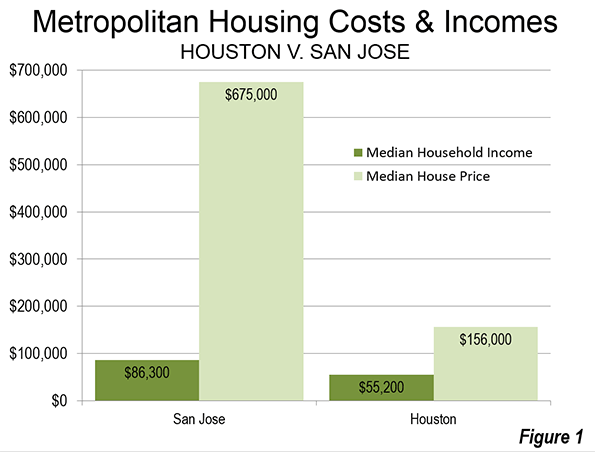
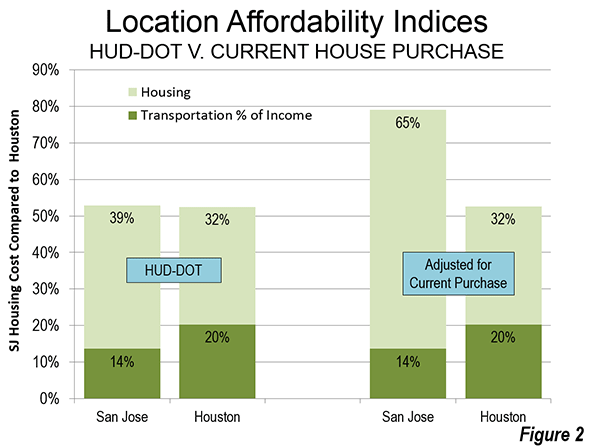
    A household relying on this source of information would be greatly misled. For example, comparing Houston with San Jose, according to HUD-DOT, owned housing and transportation consume virtually the same share of the median household income in each of the two metropolitan areas. In Houston, 52.5 percent of income is required for housing and transportation, while the number is marginally higher than San Jose (52.9 percent).

    But the HUD-DOT numbers reflect nothing like the actual costs of housing in San Jose relative to Houston. The median price house in Houston was approximately $155,000, 2.8 times the median household income of $55,200 (this measure is called the median multiple) during the 2006-10 period used in calculating the HUD-DOT index. In San Jose, the median house price was approximately $675,000, 7.8 times the median household income of $86,300 (Figure 1).
    If the Location Affordability Index reflected the real cost for a prospective home owner (HUD-DOT costs including a market rate mortgage for the house), a considerable difference would emerge between San Jose and Houston. The combined San Jose Location Affordability Index for home owners would rise to 85 percent of median household income, a full 60 percent above the Houston figure, rather than the minimal difference of less than one percent indicated by HUD-DOE (Figure 2).
    Under-Estimating the Cost of Urban Containment

    There is a substantial difference between the HUD–DOT housing and transportation cost and the actual that would be paid by prospective buyers. Five selected urban containment markets indicate a substantially higher actual housing cost than reflected in the HUD–DOT figures. On the other hand, in the selected liberally regulated markets (or traditionally regulated markets), the HUD–DOE figure is much closer to the current cost of home ownership (Figure 3). This is a reflection of the greater stability (less volatility) of house prices in liberally regulated markets. Overall, based on data in the 50 major metropolitan areas, owned housing costs relative to incomes rise approximately 6 percent for each 10 percent increase in the sprawl index – that is, less sprawl is associated with higher house prices relative to incomes (Note 6).
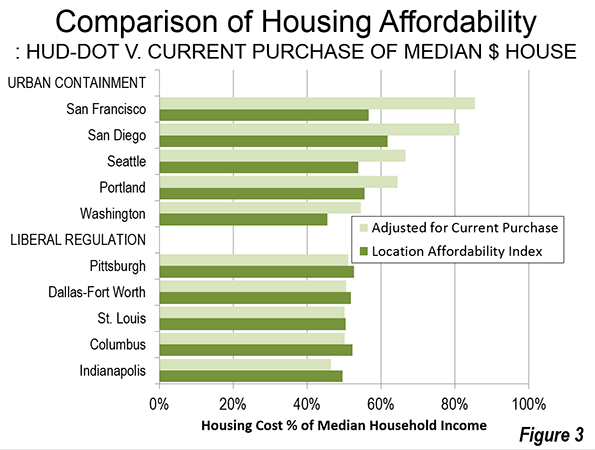
    The increasing impacts of urban containment’s housing cost increases have been limited principally to households who have made recent purchases. The effect will become even more substantial in the years to come as the turnover of the more expensive housing stock continues.

    Granted, the 2006 to 2010 housing data includes part of the housing bubble and its higher house prices. However, house prices relative to incomes have returned to levels at or above that recorded during the period covered by Measuring Sprawl 2014 in "urban containment" markets, such as San Francisco, San Jose, Los Angeles, San Diego, Seattle, Portland, and Washington.

    Economic Mobility and Human Behavior

    Another assertion requires attention: economic mobility is greater in less sprawling metropolitan areas. The basis is research by Raj Chetty and Nathaniel Hendren of Harvard University and Patrick Kline and Emmanuel Saez of the University of California, Berkeley. However, the realities of domestic migration suggest caution with respect to the upward mobility conclusions, as is indicated in Distortions and Reality About Income Mobilityand in commentary by Columbia University urban planner David King.

    Virtually all urban history shows city growth to have occurred as people have moved to areas offering greater opportunity. Jobs, not fountains, theatres and art districts, drive nearly all the growth of cities. This means that there should be a strong relationship between the cities net domestic migration and the economic mobility conclusions of the research. The strongest examples show the opposite relationship.

    Domestic migration is strongly away from some metropolitan areas identified in the research as having the greatest upward income mobility also had substantial net domestic migration losses. For example, despite claims of high economic mobility New York, Los Angeles and the San Francisco Bay area, each lost approximately 10 percent of their population to net domestic migration in the 2000s. On the other hand, some metropolitan areas scoring the lowest in upward economic mobility drew substantial net domestic migration gains. For example, low economic mobility Charlotte and Atlanta gained 17 percent and 10 percent due to net domestic migration in the 2000s. Thus, the results of the economic research appear to be inconsistent with expected human behavior (Note 7).

    Sprawl: An Inappropriate Priority

    The new sprawl report is just another indication that urban planning policy has been elevated to a more prominent place than appropriate among domestic policy priorities. The usual justification for urban containment is a claimed sustainability imperative for its densification and anti-mobility policies. Yet, these policies are hugely expensive and thus ineffective at reducing greenhouse gas emissions, and thus have the potential to unduly retard economic growth (read "the standard of living and job creation"). Far more cost-effective alternatives are available, which principally rely on technology.

    There is a need to reverse this distortion of priorities. Little, if anything is more fundamental than improving the standard of living and reducing poverty (see Toward More Prosperous Cities). Housing is the largest element of household budgets and policies of that raise its relative costs necessarily reduce discretionary incomes (income left over after paying taxes and paying for basic necessities). There is no legitimate place in the public policy panoply for strategies that reduce discretionary incomes.

    London School of Economics Professor Paul Cheshire may have said it best, when he noted that urban containment policy is irreconcilable with housing affordability.

    ———

    Note 1: The previous Smart Growth America report used primarily metropolitan statistical areas (PMSAs), which have been replaced by metropolitan divisions. The primary metropolitan statistical areas were also subsets of metropolitan areas (labor market areas). This is problem is best illustrated by the fact that the Jersey City PMSA, composed only of Hudson County, NJ, is approximately one mile across the Hudson River from Manhattan in New York. Manhattan is the world’s second largest central business district and frequent transit service connects the two. Obviously, Jersey City is a part of the New York metropolitan area (labor market area), not a separate labor market.

    Note 2: Because of incomplete data, Boston is not given a sprawl rating in Measuring Sprawl 2014. A different rating system in the previous edition resulted in a Boston rating among the least sprawling. Yet, the Boston metropolitan area is characterized by low density development. Outside a 10 mile radius from downtown, the population density within the urban area is slightly lower than that of Atlanta (same square miles of land area used).

    Note 3: Higher house prices relative to household incomes are more associated with policies to control urban sprawl (such as urban growth boundaries and other land rationing devices), than with the extent of sprawl. More compact (less sprawling) urban areas do not necessarily have materially higher house prices. For example, in 1970, the Los Angeles urban area was one of the most dense in the United States, yet it was within the historical affordability range (a median multiple of less than 3.0). The emergence of Los Angeles as the nation’s most dense urban area in the succeeding decades (and 30 percent increase in density) is largely the result of a change in urban area criteria. Through 1990, the building blocks of urban areas were municipalities, which meant that many square miles of San Gabriel Mountains wilderness were included, because it was in the city of Los Angeles. Starting in 2000, the building blocks or urban areas became census blocks, which are far smaller and thus exclude the large swaths of rural territory that were included before in some urban areas.

    Note 4: The transport costs from the Location Affordability Index are accepted for the purposes of this article.

    Note 5: The current purchase housing cost is based on the average price to income multiple over the period of 2006 to 2010, relative to the median household income (calculated from quarterly data from the Joint Center for Housing Studies of Harvard University, State of the Nation’s Housing 2011). It is assumed that the buyer would finance 90 percent of the house cost at the average 30 year fixed mortgage rate with points over the period. The 10 percent down payment is allocated annually in equal amounts over the 360 months (30 years). The final annual cost estimate is calculated by adding the monthly mortgage payment and down payment allocation to the median monthly housing cost in each metropolitan area for households without a mortgage.

    HUD-DOT uses the "selected monthly owner cost" from the American Community Survey (ACS) for its cost of home ownership. According to ACS, “Selected monthly owner costs are calculated from the sum of payment for mortgages, real estate taxes, various insurances, utilities, fuels, mobile home costs, and condominium fees."

    Note 6: This is based on a two-variable regression estimation (log-log) with the sprawl index as the independent variable and the substituted housing share of income as the dependent variable for the 50 largest metropolitan areas (excluding Boston), It is posited that most of the variation in housing costs is accounted for by variation in land costs. Other significant factors, such as construction costs and financing costs in this sample vary considerably less. A sprawl index for each metropolitan areas represented by metropolitan divisions (not provided in the sprawl report) is estimated by population weighting.

    Note 7: Another difficulty with that research is that it measured geographic economic mobility at age 30, well before people reach their peak earning level. This is likely to produce less than reliable results, since those who achieve the highest incomes as well as the most educated such as medical doctors and people with advanced degrees) are likely to have larger income increases after age 30 than other workers.

    Wendell Cox is principal of Demographia, an international public policy and demographics firm. He is co-author of the “Demographia International Housing Affordability Survey” and author of “Demographia World Urban Areas” and “War on the Dream: How Anti-Sprawl Policy Threatens the Quality of Life.” He was appointed to three terms on the Los Angeles County Transportation Commission, where he served with the leading city and county leadership as the only non-elected member. He was appointed to the Amtrak Reform Council to fill the unexpired term of Governor Christine Todd Whitman and has served as a visiting professor at the Conservatoire National des Arts et Metiers, a national university in Paris.

    Suburban neighborhood photo by Bigstock.

  • Watch Chicago’s Middle Class Vanish Before Your Very Eyes

    Note: I owe both the concept for this measurement of income segregation and much of the actual data – all of it, except for 2012 – to Sean Reardon andKendra Bischoff, who wrote a series of wonderful papers on the subject and then were kind enough to send me a spreadsheet of their data from Chicago a while ago. The maps, however, are mine, as is all the data from 2012, and any mistakes in them or in the interpretation of the data is entirely my responsibility.

    I think one reason I’ve felt less than compelled by Chicagoland, CNN’s reasonably well-made documentary series, is that its tale-of-two-cities narrative is so worn, so often repeated, that it’s become a little dull. Not the actual fact of inequality – which only seems to cut deeper over time – but its retelling.

    In fact, I think the point has long passed at which simply repeating the story of Chicago’s stratification is equivalent to fighting it. For a lot of people, in my experience, it’s the opposite: an opportunity for distancing, for washing of hands. It’s a ritual in which we tell each other that this is the way it’s always been – The Gold Coast and the Slum was written about already well-entrenched institutions, after all, over three-quarters of a century ago – that these facts somehow seep out of the ground here, as much a part of the city as the lake, and that as a result there’s really nothing we can do about it.

    But this obscures much more than it clarifies. Inequality has always been a part of Chicago – as it has always been a part of the United States, and a part of humanity – but the forms it has taken, and the severity of those many forms, have changed in truly dramatic ways. Take, for example, today’s monolithic segregation of African Americans: at the turn of the last century, black Chicagoans were less segregated than Italians, and not because Italians were then hyper-segregated.

    Moreover, decisions made by people in the city have played, and continue to play, a huge role in determining what those changes look like. Had Elizabeth Wood received any serious support from white residents or their elected representatives – instead of meeting Klan-like violent resistance – the history of racial integration, economic integration, and public housing in this city would be very, very different. This isn’t to say that national and global factors aren’t important, since they obviously are. But neither do we lack responsibility.

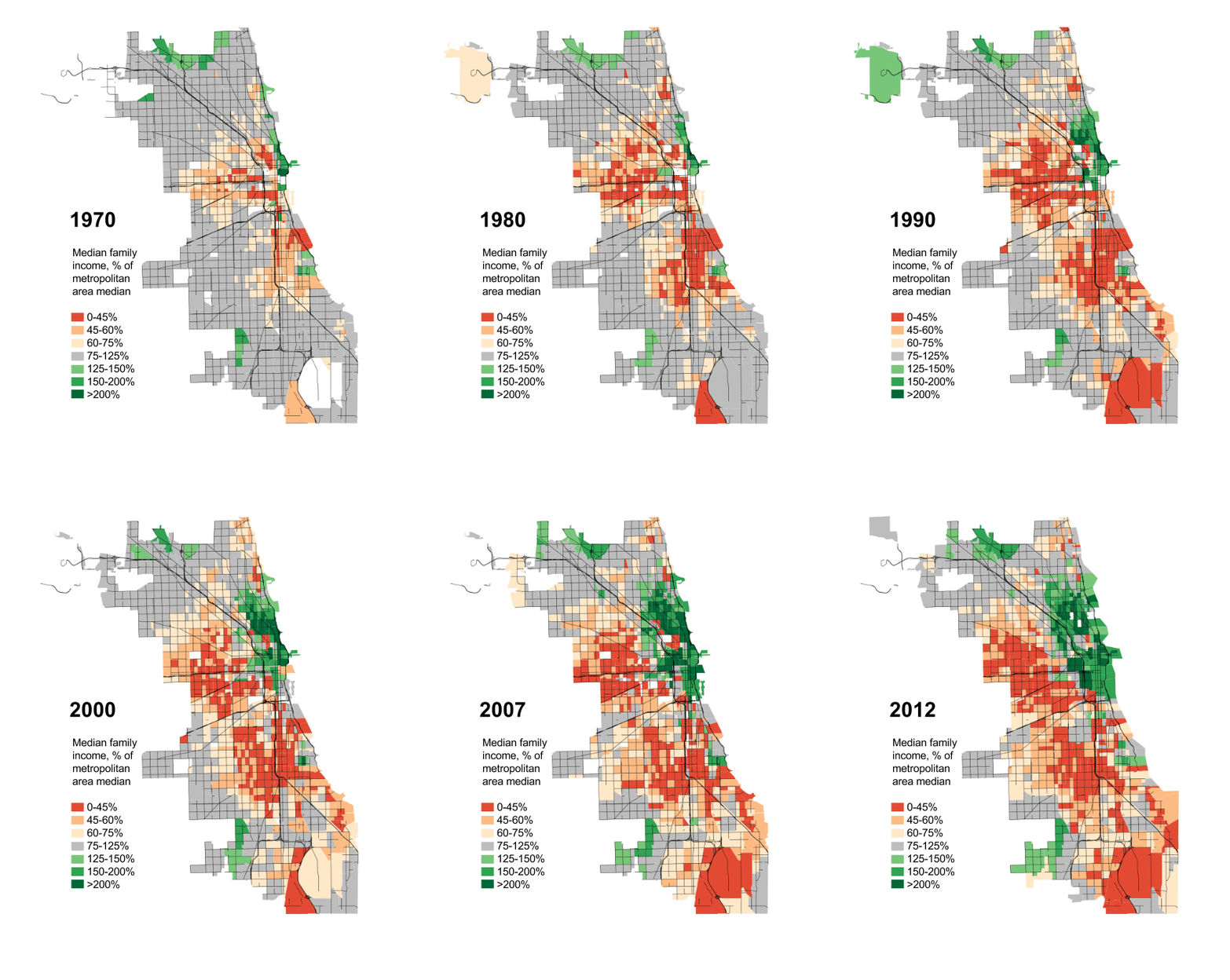
    Anyway, this is all by way of introducing the following maps: their goal is not merely to depress you (you’re welcome!), but to suggest just how dramatically the reality of Chicago’s “two cities” has changed over the last few generations, how non-eternal its present state is, and that a happier alternate reality isn’t just possible, but actually existed relatively recently.

    I feel relatively comfortable telling the story of how Chicago came to be so segregated by race; I’m much humbler about my ability to explain this, except inasmuch as the ever-widening ghetto of the affluent could not exist without, yes, radically exclusionary housing laws, and I will take that up separately in another post. In the meanwhile, I’ll take a page from Ta-Nehisi Coates and ask you all, if you have some background in this, to talk to me like I’m stupid: what does the literature say about growing economic segregation? Who and what should I be reading?

    One last piece: the obvious and immediate reaction to these maps is to see them as a direct consequence of rising income inequality. There is some truth to that, but the researchers from which much of this data came have already discovered that income segregation has actually risen faster than inequality. So that’s not the end of the story.

    Anyway, here you go: the disappearance of Chicago’s middle-class and mixed-income neighborhoods since 1970, measured by each Census tract’s median family income as a percentage of the median family income for the Chicago metropolitan region as a whole.

    Seg70aSeg80a


    Seg90aSeg00aSeg07aSeg12a


    IncSegGIF


    This piece first appeared at Daniel’s blog City Notes.

  • Good Jobs Often Not Matter of Degrees

    If there’s anything both political parties agree upon, it’s that our education system is a mess. It is particularly poor at serving the vast majority of young people who are unlikely either to go to an elite school or get an advanced degree in some promising field, particularly in the sciences and engineering.

    Historically, education has been a key driver of upward mobility and progress in our society. But, increasingly, its impact on boosting incomes has slowed, or even reversed, and, for many, the attempt to get a four-year degree ends in debt and widespread unemployment or underemployment. Worse still, many don’t make it. Indeed, according to a 2010 report by the Public Policy Institute of California, young adults in California are less likely to graduate from college than were their parents.

    These failures make things even worse for workers with only a high school education, as they must compete for even low-wage jobs with people who either have been in college or have graduated. So, we now see college graduates working in jobs as humdrum as barista or even janitor. This has even led to some pretty dubious lawsuits against schools by disgruntled graduates who feel they were misled by post-graduate employment claims.

    The worst performance is at the grade-school and high school levels, particularly in California. Blame funding, teachers unions or demographics, but our state’s basic education system has been deteriorating for decades. California was ranked 48th in 2009 for high school attainment. In 2000, it ranked 40th. In 1990, it was tied with Illinois for 36th place.

    Clearly, if we are to advance as a state, and a country, we need to develop a new perspective on education. It’s not just a matter of money, as progressive journalists,teachers unions, education lobbyists and advocates for various ethnic and political causes all insist. Money should be spent but more emphasis needs to be placed on how it is spent. After all, America boosted per-pupil spending on public elementary and secondary education by 327 percent from 1970-2010 (adjusted for inflation) with no rise in student test scores.

    As for the effectiveness of college, a recent Rutgers University report found that barely half of college graduates since 2006 had full-time jobs. And it’s not getting better: Those graduating since 2009 are three times more likely to not have found a full-time job than those from the classes of 2006-08. Since 1967, notes one 2010 study, the percentage of underemployed college graduates has soared from roughly 10 percent to more than 35 percent.

    What we need to do is rethink the notion, supported by President Obama and others, that the solution to our education woes primarily is “more.” More what? What are the job prospects for the new crop of ethnic-studies majors, post-modern English graduates and art historians, for example, particularly those from second-tier institutions? These kind of liberal-arts degrees are, as the New York Times recently reported, that tend to earn graduates the least, while those degrees that pay the most are largely offered by schools aimed at technology, mining and other “hard skills.”

    First, we need to understand that educational differences and capabilities exist and cannot be easily adjusted simply by forever lowering standards. Our most competitive institutions need to make sure that people leave with the highest degree of critical skills. Grade inflation at Harvard may not produce unemployables, but it does weaken the value of the degree and, even worse, suggests that one can not expect too much knowledge, or reasoning capacity, from graduates. Indeed, many employers complain about the lack of “soft skills,” such as communication and critical thinking, as much as they do about applicants’ lack of harder skills such as math and science.

    This suggests that even those of us who teach at more selective universities cannot just rest on laurels. Schools have to focus more on developing actual skills – notably in presentation and research – even among the brightest students. Instead, all too often, as the Manhattan Institute’s Heather McDonald has pointed out, political education – usually, but not always, tending toward the progressive left – actually predominates over learning how to think critically and express ideas coherently.

    More important is the need to put greater effort in lifting students who may not be ideal for a classical liberal four-year education. This may include a greater emphasis on skills with practical applications, such as nursing, rehabilitation, technical and scientific areas of specialization. It also includes expanding innovative programs, such as at LaGuardia College in New York, that helps high school dropouts to get their diplomas.

    Although some of these students will still seek four-year degrees, for many, the best opportunities for employment do not require more than a two-year degree, or simply a certificate. This may be particularly critical for the roughly 40 percent of students who attend college but don’t finish.

    These include many fields where employment has been growing, notably, in energy, manufacturing and – with the resurgence of the housing market – construction. But the biggest shift may be as a result of the current energy revolution, which, notes the president of the engineering and electronics conglomerate Siemens, Joe Kaeser, “is a once-in-a-lifetime moment.” Cheap and abundant natural gas, in particular, is luring investment from European and Asian manufacturers and sparking demand not only for geologists and engineers but also machinists, rig operators and truck drivers.

    The workforce in many of these fields is rapidly aging, and the demand for new, updated skills, particularly involving computers, has soared, leaving manufacturers desperate for necessary workers.

    There is already, notes a recent Boston Consulting Group study, a shortfall of some 100,000 skilled manufacturing positions. In this respect, millennials – which I have called “the screwed generation” – may have finally caught a break. By 2020, according to the consultancy BCG and the Bureau of Labor Statistics, the nation could face a shortfall of about 875,000 machinists, welders, industrial-machinery operators and other highly skilled manufacturing professionals.

    This already is the case in parts of the country now enjoying the energy and manufacturing renaissance. In training facilities in the New Orleans area, where some of the new trade school students have migrated after receiving four-year degrees, and near Columbus, Ohio, you can see many young people preparing for positions not only in medical fields, but as technicians, machinists, plumbers and electricians.

    Businesspeople almost everywhere decry such labor shortages, but rarely lament a lack of English post-modernist scholars. As I saw on a recent trip to Houston – in many ways the country’s most economically dynamic city – developers enjoy high demand by are stymied by a lack of skilled labor. In some cases, companies are beginning to invest not only in community colleges but also looking to recruit high school students into these professions.

    This practical approach may offend people to whom it seems reminiscent of the infamous “tracking” system, which was used to steer even the most academically gifted minority students into manual professions. Still, stuffing more students into a system that, in the end, fails to prepare young people for the future, and lands them in debt, makes little sense. Today a record 1-in-10 recent college borrowers has defaulted on student debt, the highest level in a decade. And, with wages for college graduates on a downward slope, one has to wonder how many more will join them.

    Some “progressives” believe the solution lies in subsidizing even more the current system. In reality, such an approach will only continue the current failures, with fewer students graduating with needed skills and more years of wasted effort. Shifting the financial burdens from parents and students and onto business and the taxpayer does not seem the best way to boost public support for education.

    Instead of bailing out the current system, we need to find ways to change our educational focus from the elite level to the certificate program, in ways that serve the needs of both the economy and the next generation. For the talented students I so often encounter at Chapman, this means greater rigor, more serious reading and opening themselves to conflicting ideas. But, for many others, the focus should be on practical skills that can lead to middle-class jobs. We have to learn to appreciate that there’s nothing wrong with a son or daughter, rather than aspiring to become a doctor or lawyer, instead, earning a good living as a plumber.

    This story originally appeared at The Orange County Register.

    Joel Kotkin is executive editor of NewGeography.com and Distinguished Presidential Fellow in Urban Futures at Chapman University, and a member of the editorial board of the Orange County Register. He is author of The City: A Global History and The Next Hundred Million: America in 2050. His most recent study, The Rise of Postfamilialism, has been widely discussed and distributed internationally. He lives in Los Angeles, CA.

    Graduation photo by Bigstock.

  • Where Inequality Is Worst In The United States

    Perhaps no issue looms over American politics more than worsening  inequality and the stunting of the road to upward mobility. However, inequality varies widely across America.

    Scholars of the geography of American inequality have different theses but on certain issues there seems to be broad agreement. An extensive examination by University of Washington geographer Richard Morrill found that the worst economic inequality is largely in the country’s biggest cities, as well as in isolated rural stretches in places like Appalachia, the Rio Grande Valley and parts of the desert Southwest.

    Morrill’s findings puncture the mythology espoused by some urban boosters that packing people together makes for a more productive and “creative” economy, as well as a better environment for upward mobility. A much-discussed report on social mobility in 2013 by Harvard researchers was cited by the New York Times, among others, as evidence of the superiority of the densest metropolitan areas, but it actually found the highest rates of upward mobility in more sprawling, transit-oriented metropolitan areas like Salt Lake City, small cities of the Great Plains such as Bismarck, N.D.; Yankton, S.D.; Pecos, Texas; and even Bakersfield, Calif., a place Columbia University urban planning professor David King  wryly labeled “a poster child for sprawl.”

    Demographer Wendell Cox pointed out that the Harvard research found that commuting zones (similar to metropolitan areas) with less than 100,000 population average have the highest average upward income mobility.

    The Luxury City

    Most studies agree that large urban centers, which were once meccas of upward mobility, consistently have the highest level of inequality. The modern “back to the city” movement is increasingly less about creating opportunity rather than what former New York Mayor Michael Bloomberg called “a luxury product” focused on tapping the trickle down from the very wealthy. Increasingly our most “successful cities” have become as journalist Simon Kuper puts it, “the vast gated communities where the one percent reproduces itself.”

    The most profound level of inequality and bifurcated class structure can be found in the densest and most influential urban environment in North America — Manhattan. In 1980 Manhattan ranked 17th among the nation’s counties in income inequality; it now ranks the worst among the country’s largest counties, something that some urbanists such as Ed Glaeser suggests Gothamites should actually celebrate.

    Maybe not. The most commonly used measure of inequality is the Gini index, which ranges between 0, which would be complete equality (everyone in a community has the same income), and 1, which is complete inequality (one person has all the income, all others none).  Manhattan’s Gini index stood at 0.596 in 2012, higher than that of South Africa before the Apartheid-ending 1994 election. (The U.S. average is 0.471.) If Manhattan were a country, it would rank sixth highest in income inequality in the world out of more than 130 for which the World Bank reports data. In 2009 New York’s wealthiest one percent earned a third of the entire municipality’s personal income — almost twice the proportion for the rest of the country.

    The same patterns can be seen, albeit to a lesser extent, in other major cities. A 2006 analysis by the Brookings Institution showed the percentage of middle income families declined precipitously in the 100 largest metro areas from 1970 to 2000.

    The role of costs is critical here. A 2014 Brookings study showed that the big cities with the most pronounced levels of inequality also have the highest costs: San Francisco, Miami, Boston, Washington, D.C., New York, Oakland, Chicago and Los Angeles. The one notable exception to this correlation is Atlanta. The lowest degree of inequality was found generally in smaller, less expensive cities like Ft. Worth, Texas; Oklahoma City; Raleigh, N.C.; and Mesa, Ariz. Income inequality has risen most rapidly in the bastion of luxury progressivism, San Francisco, where the wages of the 20th percentile of all households declined by $4,300 a year to $21,300 from 2007-12. Indeed when average urban incomes are adjusted for the higher rent and costs, the middle classes in metropolitan areas such as New York, Los Angeles, Portland, Miami and San Francisco have among the lowest real earnings of any metropolitan area.

    Rural Poverty

    But cities are not the only places suffering extreme inequality. Some of the nation’s worst poverty and inequality, notes Morrill, exist in rural areas. This is particularly true in places like Texas’ Rio Grande Valley, Appalachia and large parts of the Southwest.

    Perhaps no place is inequality more evident than in the rural reaches of California, the nation’s richest agricultural state. The Golden State is now home to 111 billionaires, by far the most of any state; California billionaires personally hold assets worth $485 billion, more than the entire GDP of all but 24 countries in the world. Yet the state also suffers the highest poverty rate in the country (adjusted for housing costs), above 23%, and a leviathan welfare state. As of 2012, with roughly 12% of the population, California accounted for roughly one-third of the nation’s welfare recipients.

    With the farm economy increasingly mechanized and industrial growth stifled largely by regulation, many rural Californians particularly Latinos, are downwardly mobile, and doing worse than their parents; native-born Latinos actually have shorter lifespans than their parents, according to a2011 report. Although unemployment remains high in many of the state’s largest urban counties, the highest unemployment is concentrated in the rural counties of the interior. Fresno was found in one study to have the least well-off Congressional district.

    The vast expanse of economic decline in the midst of unprecedented, but very narrow urban luxury has been characterized as “liberal apartheid. ” The well-heeled, largely white and Asian coastal denizens live in an economically inaccessible bubble insulated from the largely poor, working-class, heavily Latino communities in the eastern interior of the state.

    Another example of this dichotomy — perhaps best described as the dilemma of being a “red state” economy in a blue state — can be seen in upstate New York, where by virtually all the measurements of upward mobility — job growth, median income, income growth — the region ranked below long-impoverished southern Appalachia as of the mid-2000s. The prospect of developing the area’s considerable natural gas resources was welcomed by many impoverished small landowners, but it has been stymied by a coalition of environmentalists in local university towns and plutocrats and celebrities who have retired to the area or have second homes there, including many New York City-based “progressives.”

    Where Inequality Is Least Pronounced

    According to the progressive urbanist gospel, suburbs are doomed to be populated by poor families crowding into dilapidated, bargain-priced former McMansions in the new “suburban wastelands.” Suburbs, not inner cities, suggests such urban boosters as Brookings Chris Leinberger, will be the new epicenter of inequality, even though the percentage of poor people, as shown above, remained far higher in the urban core.

    Yet , according to geographer Morrill, in comparison with urban cores, suburban areas remain heavily middle class, with a high proportion of homeowners, something rare inside the ranks of core cities.The average poverty rate in the historical core municipalities in the 52 largest U.S. metro areas was 24.1% in 2012, more than double the 11.7% rate in suburban areas. Between 2000 and 2010, more than 80% of the new population.

    in America’s urban core communities lived below the poverty line compared with a third of the new population in suburban areas, although the majority of poor people lived there, in large part because they are also the home to the vast majority of metropolitan area residents.

    An analysis by demographer Wendell Cox of American Community Survey Data for 2012 indicates that suburban areas suffer considerably less household income inequality than the core cities. Among the 51 metropolitan areas with populations over 1 million, suburban areas were less unequal (measured by the Gini coefficient) than the core cities in 46 cases.

    The Racial Dynamic

    There is also a very clear correlation between high numbers of certain groups — notably African Americans but also Hispanics — and extreme inequality. Morrill’s analysis shows a huge confluence between states with the largest income gaps, largely in the South and Southwest, with the highest concentrations of these historically disadvantaged ethnic groups.

    In contrast, Morrill suggests, areas that are heavily homogeneous, notably the “Nordic belt” that cuts across the northern Great Lakes all the way to the Seattle area, have the least degree of poverty and inequality. Morrill suggests that those areas dominated by certain ethnic backgrounds — German, Scandinavian, Asian — may enjoy far more upward mobility and less poverty than others.

    Some, such as UC Davis’ Gregory Clark even suggest that parentage determines success more than anyone suspects — what the Economist has labeled “genetic determinism.” None of this is particularly pleasant but we need to understand the geography of inequality if we want to understand the root causes of why so many Americans remain stuck at the lower ends of the economic order.

    This story originally appeared at Forbes.com.

    Joel Kotkin is executive editor of NewGeography.com and Distinguished Presidential Fellow in Urban Futures at Chapman University, and a member of the editorial board of the Orange County Register. He is author of The City: A Global History and The Next Hundred Million: America in 2050. His most recent study, The Rise of Postfamilialism, has been widely discussed and distributed internationally. He lives in Los Angeles, CA.

  • The Great Skills Gap Myth

    One of the great memes out there in trying to diagnose persistently high unemployment and anemic job growth during what is still, I argue, the Great Recession is the so-called “skills gap”. The idea here is that the fact that there are millions of unfilled job openings at the same time millions of people can’t find work can be chalked up to a lack of a skills match between unemployed workers an open positions. To pick one random example out of many, here’s the way US News and World Report put it last year:

    Some 82 percent of manufacturers say they can’t find workers with the right skills. Even with so many people looking for jobs, we’re struggling to attract the next generation of workers. The message about the opportunities in manufacturing doesn’t seem to be reaching parents and counselors who help guide young people’s career ambitions.

    We face two major problems – a skills gap and a perception gap. Today’s modern, technology-driven manufacturing is not your grandparents’ manufacturing, yet for many, talk of the sector evokes images from the Industrial Revolution.

    What’s interesting about this is that the “skills gap” continues to have tremendous resonance in public policy discussions I come across although it’s very easy to find many mainstream press articles that challenge it. So I want to take my shot at the problem.

    Is there a skill gap? In select cases I’m sure there’s a mismatch in skill, but for the most part I don’t think so. I believe the purported inability of firms to find qualified workers is due largely to three factors: employer behaviors, limited geographic scope, and unemployability.

    Employer Behaviors

    Let’s be honest, it’s in the best interest of employers to claim there’s a skills gap. The existence of such a gap can be used as leverage to obtain public policy considerations or subsidies. So there’s a self-serving element.

    But beyond that, several behaviors of present day employers contribute to their inability to hire.

    1. Insufficient pay. If you can’t find qualified workers, that’s a powerful market signal that your salary on offer is too low. Higher wages will not only find you workers, they also send a signal that attracts newcomers into the industry. Richard Longworth covered this in 2012. He explains that companies have refused to adjust their wages due to competitive pressures:

    In other words, Davidson said, employers want high-tech skills but are only willing to pay low-tech wages. No wonder no one wants to work for them….So why doesn’t GenMet pay more? In other words, why doesn’t it respond to the law of supply and demand by offering starting wages above the burger-flipping level? Because GenMet is competing in the global economy. It can pay more than Chinese-level wages, but not that much more.

    In other words, this company in question doesn’t have a skill gap problem, they have a business model problem. They aren’t profitable if they have to pay market prices for their production inputs (in this case labor). It’s no surprise firms in this position would be seeking help with their “skill gap” problem – it’s a backdoor bailout request.

    2. Extremely picky hiring practices enforced by computer screening. If you’ve looked at any job postings lately, you’ll note the laundry list of skills and experience required. The New York Times summed it up as “With Positions to Fill, Employers Wait for Perfection.” Also, companies have chopped HR to the bone in many cases, and heavily rely on computer screening of applicants or offshore resume review. The result of this automated process combined with excessive requirements is that many candidates who actually could do that job can’t even get an interview. What’s more, in some cases the entire idea is not to find a qualified worker to help legally justify bringing in someone from offshore who can be paid less.

    3. Unwillingess to invest in training. In line with the above, companies no loner want to spend time and money training people like they used to. I strongly suspect most of those over 50 machinists and such we keep hearing about learned on the job. Why can’t companies simply train people in the skills they need? When I started work at Andersen Consulting in 1992, we weren’t expected to have any specific skill. Instead, they were looking for general aptitude and spent big to train us in what we needed to know. In a sense, outside of some professional services fields, today’s companies, despite their endless talk about talent, don’t actually recruit talent at all. They are recruiting people with specific skills and experience. That’s a very different mindset.

    4. Aesthetic hiring. This one I think is specific to select industries, but in some fields if you don’t have the right “look”, you’re going to find it difficult. For example, the NYT Magazine just today has a major piece called “Silicon Valley’s Youth Problem” talking about this very issue. Hip, cool startups see their working environment and culture as critical to success. And that’s true, but those cultures aren’t very inclusive, which is why many Silicon Valley firms are continuously under fire for various forms of discrimination. When they’re trying to be the hot new thing, the last thing an app startup wants is some 55 year old dude with a pocket protector cramping their style, no matter how much of a tech guru he might be.

    Limited Geographic Scope

    You frequently see the skills gap phrased in terms of specific geographies. For example, a state. Rhode Island has X number of unemployed people and Y number of unfilled jobs. So what do we do to match them up?

    This type of thinking is too limited. I attended an hour brainstorming session on the Rhode Island skills gap a while back and not once did anyone suggest anything that crossed the state boundary. One person mentioned these technical high schools in Boston that produce grads with exactly the skills the market is needing. His idea was that Rhode Island needed to create these types of institutions. Not a bad idea, but I was struck that nobody thought about sending these Rhode Island employers who can’t find workers on the one hour drive to Boston to go hire some of those grads directly out of Boston’s high schools. Problem solved. And maybe while bringing some young, fresh blood into the state to boot.

    Similarly, no one ever suggested that an unemployed person in Rhode Island might seek work out of state. Realistically, America has often solved unemployment problems through migration. People need to be willing to move to where the job opportunities are. In fact, if you look at the highly educated people who might say telling people to move in order to find work is evil awful, they are actually the most mobile people there are. Clearly the highly skilled see the value in pursuing opportunity through migration. We need to extend the same opportunity to those who are currently stuck in place.

    Unemployability

    A third problem is that a significant number of adults in this country are simply unemployable. If you’re a high school dropout, a drug user, etc. you are going to find it tough slogging to find work anywhere, regardless of skills required.

    Watching the Chicagoland documentary and seeing what kids in these inner city neighborhoods face, a lack of machine tool or coding skills is far from the problem. Similar problems are now hitting rural and working class white communities where the economic tide has receded. Heroin, meth, etc. were things that just didn’t exist in my rural hometown growing up – but they sure do now.

    These aren’t skill problems, they are human problems. And the answer isn’t simply job training. These problems are much, most more complex and they are incredibly difficult to solve. They need to be tackled by very different means than a job skills problem.

    If you want more info that documents that there is no skills gap, google around and find plenty of economists crunching the numbers to show that’s the case. But I hope this gives you a sense of some of the trends that explain why there can be persistent unemployment with many job openings without recourse to a skills gap to explain it.

    Aaron M. Renn is an independent writer on urban affairs and the founder of Telestrian, a data analysis and mapping tool. He writes at The Urbanophile, where this piece originally appeared.

    Auto manufacturing photo by BigStockPhoto.com.

  • Taking the Main Street Off-ramp

    To some, the $19 billion paid by Facebook for the Silicon Valley start-up What’s App represents the ultimate confirmation of the capitalist dream. After all, these riches are going first and foremost to plucky engineers whose goals are simply to make life better for the public. Got a problem with that?

    Yes, actually. Sure, people should be rewarded, even lavishly, for their innovations. But $19 billion for 50-something people in a company with no profits and no prospects of having any, at least in the short term? Is this app worth more than Southwest Airlines, or Sony, or scores of other companies with thousands of employees and decades’ worth of profits? Put another way, the $19 billion makes Vladimir Putin’s now-defunct bailout of Ukraine seem puny. Ukraine, the homeland of What’s App’s CEO, if you don’t remember, is a country of 46 million people.

    Yet, this is the form of capitalism that we now have, one tilted so heavily to the few well-connected souls, whether on Wall Street or among the chummy “directors club” keiretsu of Silicon Valley. But the heart and soul of free enterprise – small and medium-size companies – remain in the doldrums. They are producing jobs at rates lower than those before the most-recent recession. According to the Bureau of Labor Statistics, firms with less than 50 employees are adding jobs at rates well below 2007 levels. Drivers of the recovery early in the prior decade, they have become laggards as larger firms have expanded modestly.

    Indeed, by 2013, smaller firms, those with less than 100 employees, added far fewer jobs than in the decade before. In previous recoveries, small firms led the way, but in the post-2007 recovery, these grass-roots companies continued to lose ground. In 1977, Small Business Administration figures show, Americans started 563,325 businesses with employees. In 2009, they started barely 400,000.

    This is not just a story of clueless mom-and-pops left behind by progress. Business start-ups, long a key source of new jobs – as a portion of all businesses – have declined from 50 percent in the early 1980s to 35 percent in 2010.

    Many people who once had decent incomes and may have owned, or hoped to start, a business have slipped to the economic lower rungs. Their decline is not widely mourned in the academic, financial or media worlds. Last year, one Financial Times columnist contended that the middle class, “after a good run” of some two centuries, now faces “relative decline” and even extinction. Not that this trend disturbed the author, who noted that “classes come and classes go” and that, when the middle orders disappear, about the only ones sorry to see them go might be the “middle classes themselves. Boo hoo.”

    Like the yeoman farmer, the artisan and the shopkeeper during the 19th century’s Gilded Age or in Victorian England, millions of smaller business entrepreneurs are threatened with what I call “proleterianization,” that is, a descent from the relatively secure, property-owning class to the permanently insecure masses, living paycheck to paycheck. This process is driven largely by powerful economic forces, such as technological change and globalization, but has been exacerbated by the actions of the political class.

    Much of the blame starts with Federal Reserve policy, which has been totally designed to favor high-risk investments – like What’s App – at the expense of the more modest savers along Main Street. The winners in the era of low interest rates and the Fed’s bond-buying binge have been venture capital firms, hedge funds and Wall Street investment banks. Capital has not been flowing to consumers, or smaller firms, noted one top former manager. The Fed has lost “any remaining ability to think independently from Wall Street,” asserts Andrew Huszar, who managed the Federal Reserve’s $1.25 trillion agency mortgage-backed security purchase program.

    Fed policy, through TARP, bailed out the big banks, which generally are loath to loan money to small businesses, but has done little for smaller banks, who generally do make such loans, and which have continued to contract. The rapid decline of community banks, for example, down by half since 1990, has hit small-business people most directly, as those institutions have been a traditional source of small-business loans.

    All these problems have been made worse by a tide of new regulations, notably the Affordable Care Act, which, like most top-down systems, most hurts the middle class. When Obamacare took effect in 2013, it was the small-business owners and the self-employed who suffered the brunt of health insurance cancellations and higher premiums. In addition, the ever-growing net of regulations, covering everything from labor to the environment, has placed a far greater burden on smaller firms than their larger counterparts.

    2010 SBA report found that federal regulations cost firms with less than 20 employees more than $10,000 a year per employee, while bigger firms paid roughly $7,500 per employee. The biggest hit to small business is environmental regulations, which cost small firms 364 more percent than large ones. Small companies spend an average $4,101 per employee on such regulations, compared with $1,294 at medium-size companies (20 to 499 employees) and $883 at the largest companies. This has come over a period when many of the key costs faced by the business-owning middle class – house prices, health insurance, utilities and college tuition – have all soared.

    Given these conditions, it’s not surprising that small-firm owners are about the most alienated large constituency in America, according to Gallup. Yet, their once-considerable clout has faded, particularly among Democrats, who have found new allies within Silicon Valley, much of Wall Street and, most of all, a growing, connected clerisy of government workers, academics, high-end professionals and much of the media.

    Progressive theorists, such as Ruy Teixeira, have suggested that, in the evolving class structure, the rise of a mass “upper-middle class” consisting largely of professionals, tech workers, academics and high-end government bureaucrats, allows Democrats to win without the support of shopkeepers or even industrial workers.

    Such people may turn to the GOP, or elements of the Tea Party, but neither of those groups really addresses their needs. Mainstream Republicans remain fundamentally loyal to those big-business and the money powers that still tolerate them. The Tea Party, sadly, now captive to the well-financed hard Right, has diverted its attention from crony capitalism to tired social issues like gay marriage and immigration. In doing so, the Tea Party has unwittingly alienated many small businesses, notably those owned by minorities, women and gays.

    This political calculus is devastating to the interests of smaller firms. Main Street may remain the symbol of the American Dream, and it represents “the human face” of capitalism. It is roughly three times as popular as unions, big business, banks and, of course, the political class itself.

    Yet, for all its popularity, Main Street increasingly is in danger of becoming an off-ramp from the American Dream. It may be celebrated in countless political speeches, but, for the most part, gets ignored in the legislative process, being unable to compete against better-organized, and better-funded, business, labor and issue-oriented lobbies.

    Main Streeters, to preserve themselves and provide for their children, need to develop, for lack of a better word, a kind of class consciousness. They must understand that, in today’s world, what’s good for Facebook, Google or General Electric may not necessarily be good for them. Indeed, policies that encourage shoving billions into the hands of the few – whether pinstriped Wall Street sharpies or hoodie-wearing techies – will not leave much on the table for those small-scale entrepreneurs now finding themselves increasingly on the fringe of American capitalism, looking in.

    This story originally appeared at The Orange County Register.

    Joel Kotkin is executive editor of NewGeography.com and Distinguished Presidential Fellow in Urban Futures at Chapman University, and a member of the editorial board of the Orange County Register. He is author of The City: A Global History and The Next Hundred Million: America in 2050. His most recent study, The Rise of Postfamilialism, has been widely discussed and distributed internationally. He lives in Los Angeles, CA.

    Facebook photo by BigStockPhoto.com.

  • East of Egan: Success in California is Not Evenly Distributed

    The New York Times ran a Timothy Egan editorial on California on March 6.  The essay entitled Jerry Brown’s Revenge was reverential towards our venerable Governor.  It did, however, fall short of declaring Brown a miracle worker, as the Rolling Stone did last August.  These and other articles are part of an adoring press’s celebratory spasm occasioned by the facts that California has a budget surplus and has had a run of strong job growth.

    Egan at least pauses in his panegyrical prose to mention that all is not perfect in California:

    Without doubt, California has serious structural problems, well beyond the byzantine hydraulic system that allows the state to flourish. For all the job growth, the unemployment rate is one of the highest in the nation. It has unsustainable pension obligations, a bloated public-employee sector led by the prison guard union. And it is so expensive to live here that clashes over the class divide are threatening to get nasty.

    That’s not the worst of it.  Before going there, though, let’s consider Brown’s most celebrated achievement, a budget surplus. 

    California has a budget surplus because of a temporary income tax on its highest earning citizens and because of large capital gains reaped during an amazing year for stocks.  The S&P 500 was up almost 30 percent last year, an event unlikely to be repeated.  California’s tax revenues are excessively dependent on a relatively few wealthy tax payers.  This makes revenues extremely volatile.  When these tax payers do well, Sacramento is flush with cash.  When the high end tax payers don’t do well, Sacramento has very serious problems.

    By increasing California’s reliance on a few wealthy tax payers, Brown’s tax increase made California’s revenues more volatile.  The ongoing bull stock market would have generated higher tax revenues for California without the tax increase.  It generated even more with the tax increase.  When a bear market comes, the state will again face deficits.  This is one reason that Standard and Poors ranks California’s credit as second worst in the country, only above Illinois.

    So far, to his credit and in stark contrast to what we saw in the dot-com boom under Gray Davis, Jerry Brown has, with the exception of his pet project, the high-speed train, effectively resisted the legislature’s knee-jerk impulse to increase long-term spending commitments.  What he has not done is perhaps more important: addressing California’s other financial issues, the ones that are contributing to California’s dismal credit rating.

    California has had several quarters of stronger-than-the-nation job growth, but is still 113,500 jobs below the level in 2007; in contrast Texas is 844,300 jobs above that number.  

    Nor can it be sure that growth will continue. Unfortunately, the day after Egan’s celebratory essay, California’s Economic Development Department announced that the state had lost 31,600 jobs in January.  That’s an initial estimate, and it will be changed, but it’s hard to tell which direction.  The data released with that estimate appear to be a bit of a mess and are internally inconsistent.  We’ve asked for some clarification.

    Regardless of the most recent data point, California’s job performance has been better than expected, and we should all be thankful for that.  However, comparison with the United States average is not the only metric.  Comparison with California’s potential is the correct metric, and there California is underperforming in a big way.  Given all of its advantages, California should be leading the nation in job creation and opportunity.

    California has been averaging about 27,000 new jobs a month over the most recent 12 months for which we have data.  It should be averaging at least 40,000.  This would be slightly more than Texas’ average of 33,900,.  But, it still represents only 3.2 percent job growth, well below Texas’ 3.7 percent job growth rate.

    The state is sitting over estimated oil reserves that are about four times as large as the Bakken Shield, a major contributor to North Dakota’s boom.  Any serious effort to tap that resource would generate huge numbers of jobs.  Many of those jobs would be high wage positions for less educated workers who were hurt the most by the recession.

    California has many advantages over North Dakota, or Texas for that matter, besides oil.  These are well known and include location between Pacific Rim producers and the world’s largest consumer market, ports, workforce, and climate.  Even without oil, we should be doing better.  Policy though, particularly environmental policy, is restraining the state’s job creation.

    Egan makes a big deal of migration.  Here is his first paragraph (emphasis is his):

    Let’s review. Just a few years ago California was a punching bag for conservative scolds — a failed state, profligate with its spending and promiscuous with its ambition. Ungovernable. And everybody’s leaving.

    Later, he returned to the topic:

    Third, the great exodus never happened. Since the dawn of the recession, the state has added about 1.5 million people — almost three Wyomings. And yes, 67,702 people moved from California to Texas in 2012. But 43,005 people moved from Texas to California. (Population growth is not necessarily a good thing, especially in this overstuffed state, but that’s another topic).

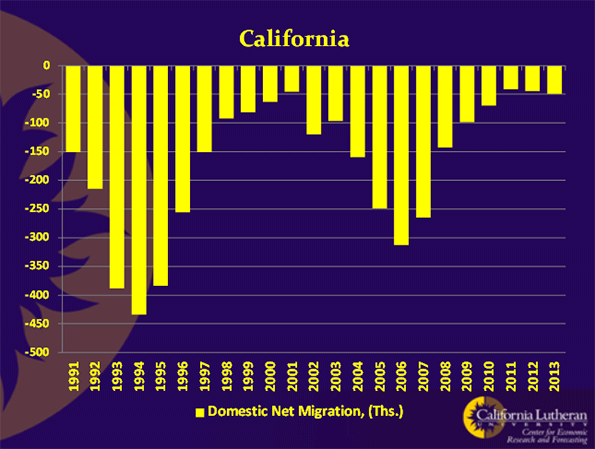
    This is really curious.  A whopping 57 percent more people moved from California to Texas than moved from Texas to California, which was the case for decades.  This is an argument that people aren’t leaving California?  California’s population is up 1.5 million?  California’s population growth is mostly a result of California’s fertile young people.  Census data show that California’s domestic migration has been negative for over 20 consecutive years.   It may not be The Great Exodus, but it’s a reversal of about a 150 year of migratory trend.

    Then there is poverty and unemployment.  Poverty, unemployment and lack of opportunity are why California’s domestic migration data is negative.  Lack of opportunity may be hard to measure, but we have lots of data on unemployment and poverty.   Some examples:

    • San Bernardino has the second highest poverty rate of any major U.S. metropolitan areas.  Only Detroit is worse.
    • California, with about 12 percent of the U.S. population, has 34 percent of U.S. welfare recipients.
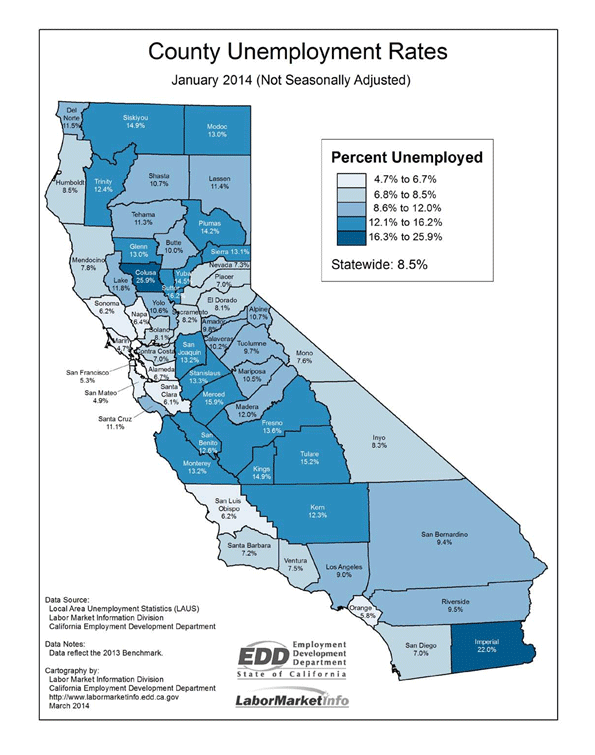
    • Two California counties, the geographically separated Colusa and Imperial, have unemployment rates over 20 percent.
    • Thirty-one of California’s 58 counties have unemployment rates in double digits.

    The geographic distribution of California’s poverty is one reason many people fail to understand California.  Most of California’s poverty is concentrated in regions where the political class —or wayfaring editorialists — seldom venture.  It’s mostly inland, not where most of California’s elite live or travel.  If you stay on the 101 corridor, or hug scenic Route 1, it’s easy to avoid.  You can find it, but you have to have eyes that are open to it, and it helps if you get off the beaten path. 

    Egan wrote his piece in Santa Barbara, where life can be as good as it gets, particularly for the affluent and boomers who bought their homes decades ago.  But, the city of Guadalupe in Santa Barbara County could give him a taste of how the other half lives. Just take a look sometime: it’s about as hardscrabble a town as the Texas town in the movie “The Last Picture Show”.

    California’s poverty is harder to ignore along the 99, but is even more evident in roads like 33 which winds along the eastern side of the coastal range.  Go there, and you will find it hard to believe that you are still in the United States, much less California.  There you will find grinding, hopeless poverty more reminiscent of the Third World than the center of the economic jobs.

    A high speed train won’t help these people.  Neither will Silicon Valley tech jobs, even if they don’t shrink in the inevitable social media shakeout.  Neither will Sacramento, apparently.  Until we start doing something for the state’s huge and struggling working and middle class, and that means creating opportunity for them, we should refrain from congratulating ourselves and each other for our good work.

    Bill Watkins is a professor at California Lutheran University and runs the Center for Economic Research and Forecasting, which can be found at clucerf.org. A slightly different version of this story appeared in CLU Center for Economic Research and Forecasting’s September, 2013 California Economic Forecast.

  • The U.S. Cities Profiting The Most In The Stock Market And Housing Boom

    If anything positive can be said for the current tepid economic recovery, it has been very good to those who invest in the stock market or own real estate.

    Property owners have been able to reap higher rents and sale prices, and the stock market has soared while the overall economy has registered only modest gains. However, only a precious few have benefited from the bull market on Wall Street. According to Pew Research, only 47% of American households own some stock, down from nearly two-thirds in 2007.

    And of those who do own equities, the upper crust control the lion’s share. As of 2010, the wealthiest 20% of U.S. households held 91.7% of all U.S. stock; the top 5%, a shade over two-thirds; and the top 1% controlled 35%.

    While incomes for the middle and working class have stagnated in the recovery, the booming stock market helped swell the income of the top 1% by 31.4% through 2012. Overall, the rich now account for 50% of the country’s wealth, more than at any time since 1917, when the income tax was introduced, and well above the level in 1928, at the end of the Roaring Twenties stock boom.

    Just as the current asset-driven recovery has had disparate impacts depending on social class, it has affected different regions in divergent ways. To gauge which areas have benefited the most from asset inflation, Mark Schill, head of research at Praxis Strategy Group, looked at the percentage of income derived from rents, dividends and interest in the nation’s 52 largest metropolitan areas and 100 most populous counties.

    The Codger Economy

    The top of our list is dominated by areas where retirees and aging boomers, particularly the more affluent, are concentrated. Some 57% of Americans aged 50 to 64 own stock, according to Pew, twice as high a percentage as those under 30. People over 55 control well over half the nation’s wealth.

    Also as they reach retirement, seniors are less likely to be earning income from wage and salary work, further driving up the share of income from rents, interest and dividends in retirement hot spots. The most well-to-do retirees are the most likely to become migratory snow birds, clustering in the nation’s warmest climes.

    This includes the top five metro areas on our list, led by the Miami-Fort Lauderdale-West Palm Beach Metropolitan Statistical Area, where roughly 26.5% percent of income was earned this way in 2012, compared to a national average of 18.2%.

    It’s followed by Tampa-St. Petersburg-Clearwater, Fla., and San Diego-Carlsbad, Calif.

    These trends are even more evident when we look at the nation’s 100 largest counties. The top of the list is dominated by wealthy retirement counties, led by Palm Beach, Fla., where a remarkable 39.8% of income comes from stocks, rents and interest payments. It’s followed by two other affluent Florida counties: Lee (39.6%), whose largest city is Cape Coral, and Pinellas (29.1%), which is the home county for both St. Petersburg and Clearwater. Other retirement counties at the top of the list include No. 7 Broward (Ft. Lauderdale) and Pima, Ariz., which contains the city of Tucson.

    Superstar Cities

    The surge of profits for investors also boosts incomes in some of the metro areas whose economies have done the best overall in the asset-driven recovery. This is most marked in the San Francisco Bay area, which added more billionaires  last year than anyplace else in the country.

    San Francisco-Oakland-Hayward ranks sixth on our metro area list, with 20.7% of residents’ income coming from rents, dividends and interest, and San Jose-Sunnyvale-Santa Clara comes in seventh (19.3%). This places them well ahead of traditional centers for plutocrats, such as Boston-Cambridge-Newton (16th) and, remarkably, the home of Wall Street, the primary beneficiary of asset inflation, New York-Newark-Jersey City (23rd).

    Our counties list offers a more precise map of where asset-driven wealth is, showing that much of it is concentrated in the suburban reaches. Although much of the hype about new billionaires revolves around San Francisco, the real star in the Bay Area is somewhat more prosaic San Mateo County (fifth on our county list), home to tech giants such as Genentech and Oracle , and seven of the 10 largest venture capital firms in the Bay Area. In contrast, San Francisco County ranks 36th.

    This diversion in the patterns of where investors and rentiers congregate can also be seen in the sprawling metropolitan area that contains the nation’s financial capital, the 19 million-person New York region. Greater Gotham is home to a remarkable four of the top 15 counties on our list, starting with No. 4 Fairfield County, Conn., a major center for the hedge fund and private equity industries, followed by two affluent suburban counties, Westchester (ninth) and Nassau (13th).

    Among the five boroughs only one, No. 14 Manhattan (New York County) ranks in the upper echelon, while three outer boroughs — Queens, Brooklyn (Kings County) and the Bronx — are in the bottom 15 of the 100 largest counties. The heavily minority and poor Bronx ranks last.

    Strongest Economies At The Bottom

    Not surprisingly, many of the metropolitan areas at the bottom of our ranking are older Rust Belt towns, such as Cleveland-Elyria (44th) and Detroit (46th). These are places where poverty is more concentrated and much of the money has moved away, often to Sun Belt locales such as Florida.

    However, the bottom of our list also features many of the nation’s most dynamic economies, including Raleigh, N.C. (43rd); Dallas-Ft. Worth-Arlington, (45th); Charlotte-Concord-Gastonia, N.C. (47th); Columbus, Ohio, (49th); and third to last and second to last among the 52 biggest metro areas, Houston-The Woodlands-Sugar Land, Texas, and Nashville-Davidson–Murfreesboro-Franklin, Tenn.

    This appears to be largely a function of age. All these fast-growing areas are also thosemost attractive to young families  with children. These people are drawn primarily by the good prospects for wage employment — needed to support their families and buy houses — and are less likely to depend on rentier profits. Clipping bond coupons may play a big role in some economies, largely on the East and West Coasts, and notably Florida, but far less in those areas that are growing the old-fashioned way, by working for a paycheck.

    Income from Interest, Dividends, and Rent
    52 Largest U.S. Metropolitan Areas
    Rank Area Population 2012 Share of Income from interest, dividends, & rent
    United States (Metropolitan Portion) 267,664,440 18.2%
    1 Miami-Fort Lauderdale-West Palm Beach, FL 5,762,717 26.5%
    2 Tampa-St. Petersburg-Clearwater, FL 2,842,878 24.6%
    3 San Diego-Carlsbad, CA 3,177,063 21.9%
    4 Jacksonville, FL 1,377,850 21.5%
    5 Virginia Beach-Norfolk-Newport News, VA-NC 1,699,925 21.3%
    6 San Francisco-Oakland-Hayward, CA 4,455,560 20.7%
    7 San Jose-Sunnyvale-Santa Clara, CA 1,894,388 19.3%
    8 Richmond, VA 1,231,980 19.2%
    9 San Antonio-New Braunfels, TX 2,234,003 19.0%
    10 Las Vegas-Henderson-Paradise, NV 2,000,759 19.0%
    11 Los Angeles-Long Beach-Anaheim, CA 13,052,921 18.8%
    12 St. Louis, MO-IL 2,795,794 18.6%
    13 Sacramento–Roseville–Arden-Arcade, CA 2,196,482 18.6%
    14 Washington-Arlington-Alexandria, DC-VA-MD-WV 5,860,342 18.5%
    15 Orlando-Kissimmee-Sanford, FL 2,223,674 18.5%
    16 Boston-Cambridge-Newton, MA-NH 4,640,802 18.5%
    17 Hartford-West Hartford-East Hartford, CT 1,214,400 18.4%
    18 Austin-Round Rock, TX 1,834,303 18.4%
    19 Seattle-Tacoma-Bellevue, WA 3,552,157 18.2%
    20 Rochester, NY 1,082,284 18.1%
    21 Denver-Aurora-Lakewood, CO 2,645,209 18.1%
    22 Portland-Vancouver-Hillsboro, OR-WA 2,289,800 18.1%
    23 New York-Newark-Jersey City, NY-NJ-PA 19,831,858 17.9%
    24 Baltimore-Columbia-Towson, MD 2,753,149 17.9%
    25 Chicago-Naperville-Elgin, IL-IN-WI 9,522,434 17.4%
    26 New Orleans-Metairie, LA 1,227,096 17.4%
    27 Milwaukee-Waukesha-West Allis, WI 1,566,981 17.3%
    28 Salt Lake City, UT 1,123,712 17.1%
    29 Buffalo-Cheektowaga-Niagara Falls, NY 1,134,210 17.0%
    30 Minneapolis-St. Paul-Bloomington, MN-WI 3,422,264 16.7%
    31 Providence-Warwick, RI-MA 1,601,374 16.7%
    32 Oklahoma City, OK 1,296,565 16.6%
    33 Kansas City, MO-KS 2,038,724 16.6%
    34 Phoenix-Mesa-Scottsdale, AZ 4,329,534 16.4%
    35 Philadelphia-Camden-Wilmington, PA-NJ-DE-MD 6,018,800 16.2%
    36 Riverside-San Bernardino-Ontario, CA 4,350,096 16.2%
    37 Atlanta-Sandy Springs-Roswell, GA 5,457,831 16.2%
    38 Birmingham-Hoover, AL 1,136,650 16.2%
    39 Grand Rapids-Wyoming, MI 1,005,648 16.0%
    40 Cincinnati, OH-KY-IN 2,128,603 15.9%
    41 Pittsburgh, PA 2,360,733 15.8%
    42 Louisville/Jefferson County, KY-IN 1,251,351 15.7%
    43 Raleigh, NC 1,188,564 15.7%
    44 Cleveland-Elyria, OH 2,063,535 15.4%
    45 Dallas-Fort Worth-Arlington, TX 6,700,991 15.2%
    46 Detroit-Warren-Dearborn, MI 4,292,060 14.8%
    47 Charlotte-Concord-Gastonia, NC-SC 2,296,569 14.4%
    48 Indianapolis-Carmel-Anderson, IN 1,928,982 14.3%
    49 Columbus, OH 1,944,002 13.3%
    50 Houston-The Woodlands-Sugar Land, TX 6,177,035 13.3%
    51 Nashville-Davidson–Murfreesboro–Franklin, TN 1,726,693 12.8%
    52 Memphis, TN-MS-AR 1,341,690 12.7%
    Source: Bureau of Economic Analysis
    Analysis by Mark Schill, Praxis Strategy Group
    Income from Interest, Dividends, and Rent
    Top & Bottom 25 Among the 100 Largest U.S. Counties
    Rank County Population 2012 Share of Income from interest, dividends, & rent
    1 Palm Beach, FL 1,356,545 39.8%
    2 Lee, FL 645,293 39.6%
    3 Pinellas, FL 921,319 29.1%
    4 Fairfield, CT 933,835 25.4%
    5 San Mateo, CA 739,311 24.4%
    6 Lake, IL 702,120 23.8%
    7 Broward, FL 1,815,137 23.0%
    8 St. Louis, MO 1,000,438 22.8%
    9 Westchester, NY 961,670 22.5%
    10 Pima, AZ 992,394 22.0%
    11 Hillsborough, FL 1,277,746 21.9%
    12 San Diego, CA 3,177,063 21.9%
    13 Nassau, NY 1,349,233 21.7%
    14 New York, NY 1,619,090 21.7%
    15 Honolulu, HI 976,372 21.4%
    16 El Paso, CO 644,964 21.3%
    17 Montgomery, MD 1,004,709 20.9%
    18 Norfolk, MA 681,845 20.5%
    19 Ventura, CA 835,981 20.3%
    20 Travis, TX 1,095,584 20.2%
    21 Bergen, NJ 918,888 20.2%
    22 Middlesex, MA 1,537,215 20.1%
    23 Fairfax, Fairfax City + Falls Church, VA 1,155,292 20.0%
    24 Orange, CA 3,090,132 19.7%
    25 Baltimore, MD 817,455 19.7%
    76 Snohomish, WA 733,036 14.8%
    77 Mecklenburg, NC 969,031 14.8%
    78 Worcester, MA 806,163 14.7%
    79 Suffolk, MA 744,426 14.6%
    80 Collin, TX 834,642 14.5%
    81 San Bernardino, CA 2,081,313 14.5%
    82 Gwinnett, GA 842,046 14.4%
    83 Marion, IN 918,977 14.2%
    84 Jackson, MO 677,377 14.2%
    85 Kern, CA 856,158 14.1%
    86 Queens, NY 2,272,771 14.0%
    87 Tarrant, TX 1,880,153 14.0%
    88 Franklin, OH 1,195,537 13.9%
    89 Wayne, MI 1,792,365 13.8%
    90 Macomb, MI 847,383 13.7%
    91 Shelby, TN 940,764 13.6%
    92 Harris, TX 4,253,700 13.2%
    93 Denton, TX 707,304 13.2%
    94 Davidson, TN 648,295 12.8%
    95 Kings, NY 2,565,635 12.8%
    96 Will, IL 682,518 12.8%
    97 Hudson, NJ 652,302 12.7%
    98 Philadelphia, PA 1,547,607 12.5%
    99 Hidalgo, TX 806,552 11.1%
    100 Bronx, NY 1,408,473 11.1%
    Source: Bureau of Economic Analysis
    Analysis by Mark Schill, Praxis Strategy Group


    This story originally appeared at Forbes.com.

    Joel Kotkin is executive editor of NewGeography.com and Distinguished Presidential Fellow in Urban Futures at Chapman University, and a member of the editorial board of the Orange County Register. He is author of The City: A Global History and The Next Hundred Million: America in 2050. His most recent study, The Rise of Postfamilialism, has been widely discussed and distributed internationally. He lives in Los Angeles, CA.

    Miami photo by Wiki Commons user Comayagua.

  • Bubble Trouble in Silicon Valley

    Third-generation venture capitalist Tim Draper believes he has a solution for California’s problems that will make the Silicon Valley safe for its wealthy: secession. In a recent interview, Draper suggested that California be divided into six states, including one dominated by the Valley and its urban annex, San Francisco.

    By jettisoning California’s deeply troubled components – the Central Valley, the Inland Empire, Los Angeles – the Silicon Valleyites can create their own enclave, where incomes will be far higher – $63,288 per capital compared with the $46,477 for the whole state. If adopted, Draper’s proposal would mean our self-styled cognitive leaders wouldn’t have to deal with interior California’s massive poverty, double-digit unemployment, farmer demands for scarce water supplies or manufacturers seeking reasonable energy prices.

    Yet, for some in the Valley, Draper’s proposals don’t go far enough. Another venture capitalist recently suggested that the Valley do away with this whole United States thing entirely and form its own Republic. “We need to run the experiment, to show what a society run by Silicon Valley looks like,” venture capitalist Chamath Palihapitiya argued.

    The notion here is that Silicon Valley might do best if detached from the limitations of American citizenship, with firms essentially running their own countries from islands or man-made, offshore facilities, as proposed by libertarian investor Peter Thiel. What the Valley wants, then, is to be left alone – unencumbered by the masses – so that the clever crowd can live with low taxes, in a perfectly socially liberated environment, but without the encumbrances that come with having to worry about the less-cognitively gifted.

    “People,” as technology author Jaron Lanier has noted, “are the flies in Moore’s Law’s ointment.”

    This can be seen in the growing pushback over such things as massive wealth accumulation for dubiously useful ventures, and egregious privacy violations. The luxurious Google employee buses shuttling in and out of San Francisco are resented by some residents stuck riding the often poorly maintained, sometimes awful Muni.

    One top venture capitalist, Thomas Perkins was so upset over what he sees as scapegoating of the rich that he compared their condition to Jews in Nazi Germany. His directness upset some, but may have expressed more of what is really thought by smoother, younger, more PC-conscious executives.

    This is more than simply the usual case of rich people being out of touch. These are not media constructs like Kim Kardashian or Paris Hilton but very powerful, incredibly wealthy people who increasingly are a dominant force in California and national politics. Yet, their political positions often have a “let them eat cake” character. And to be sure, some new oligarchs lean right, mostly on the libertarian side, but these are a distinct minority. The notion of some in the Republican Party who see the Valleyites as saviors is nothing short of delusional.

    For the most part, executive and workers at firms such as Google, Apple, Facebook and Twitter are strong proponents of every politically correct idea from climate change legislation to opposing the expansion of suburbia and favoring gay marriage. Yet they are also becoming the wealthiest entities in the nation; besides GE, a classic conglomerate, the largest cash hoards now belong to Apple, Microsoft, Cisco, Oracle and Google, all of which sometimes have more dollars on hand than the U.S. government. Seven of the eight biggest individual winners from stock gains in 2013 were tech entrepreneurs. They were led by Amazon’s Jeff Bezos, who added $12 billion to his paper wealth; Mark Zuckerberg, who raked in an additional $11.9 billion; and Google co-founders Sergey Brin and Larry Page, who each gained roughly $9 billion.

    Given their phenomenal wealth, one observer compared Silicon Valley politics to those of a mall outlet selling Che Guevara t-shirts. They no doubt nod their heads when President Obama speaks of economic inequality, but when it comes to doing something about it, their general response is: Nevermind.

    However they color themselves politically, the oligarchs live above and apart from the rest of society – and, like Draper, want to keep it that way. Their desire to separate from the hoi polloi is natural and stems, in part, from their notion of being a class apart from mere mortals. “We live in a bubble, and I don’t mean a tech bubble or a valuation bubble. I mean a bubble as in our own little world,” Google CEO Eric Schmidt boasted to the San Francisco Chronicle in 2011. “And what a world it is. Companies can’t hire people fast enough. Young people can work hard and make a fortune. Homes hold their value. Occupy Wall Street isn’t really something that comes up in a daily discussion, because their issues are not our daily reality.”

    Certainly, politically correct gestures, like support for climate change legislation, don’t change this calculus. Google executives, for example, urge the middle class and working class to pay for subsidized, expensive energy – which they also invest in – but maintain their own fleet of private planes.

    The distinct sets of rules for oligarchs and everyone else extends even to the most personal issues. Yahoo’s Marissa Mayer, a former Google executive, banned telecommuting options for employees – particularly critical for those unable to house their families anywhere close to Yahoo’s ultrapricey Sunnyvale home town. Yet, Mayer, pregnant at the time, saw no contradiction in building a nursery in her office.

    Nor can it be said that the Valley elite gives at the office. Rather than “share the pain,” tech firms are notorious for not paying much in the way of taxes, including taxes on their properties. Facebook, for example, paid no taxes in 2012, despite making a profit of over $1 billion. Apple, which the New York Times recently described as “a pioneer in tactics to avoid taxes,” has kept much of its cash hoard as part of its basic corporate strategy.

    Individuals like Microsoft Chairman Bill Gates have voiced support for higher taxes on the rich, yet Microsoft has saved nearly $7 billion on its U.S. tax bill since 2009 by using loopholes to shift profits offshore, a Senate panel said in a recent report. As former congressman Barney Frank noted recently, Microsoft and other tech titans “have as good a record of tax evasion as anybody.”

    Such miserliness also extends to private philanthropy. There is no equivalent financed by Silicon Valley of anything comparable with the energy-industry-financed Texas Medical Center, nor can we expect any of the tech elite to leave behind anything so durable as the Carnegie libraries. For all their loud advocacy on environmental and education issues, the Valleyites are generally considered miserly when it comes to charity, as only four of the top 50 charitable contributors in 2011 came from the tech sector.

    They may give big to the elite universities, like Stanford, but they seem oddly unengaged in the struggles of the vast working-class population around them: Poverty rates in the Valley’s home of Santa Clara County since 2001 have soared from 8 percent to 14 percent, a jump of 75 percent. The self-proclaimed “capital of Silicon Valley,” the city of San Jose,notes urban geographer Jim Russell, is beginning to resemble a post-industrial “rust belt” city. To expect the Valley elite, ensconced in superpricey Palo Alto or San Francisco, to concern themselves with the Central Valley, beyond the Diablo Range to the east, is beyond wishful thinking.

    Remarkably some people, on both the right and left, believe that the Valley’s tech community should reform the nation, and recreate the government in their image. True, the likes of Harry Reid and Mitch McConnell do not inspire much confidence, but a society run by the tech lords would be very cold, and highly stratified.

    Silicon Valley’s problem, as author Jaron Lanier has put it, “is people.” Ultimately, human beings will resent being transformed into little more than digits in a Google algorithm that is then sold to advertisers. Most Americans reject being looked down on by a group that, given accidents of birth, access to money, social networks or even high intelligence, wishes not to share a state, or even a nation, with those who have less. That these attitudes now emanate from people who consider themselves both progressive and uniquely enlightened is not only hypocritical, but almost qualifies as obscene.

    This story originally appeared at The Orange County Register.

    Joel Kotkin is executive editor of NewGeography.com and Distinguished Presidential Fellow in Urban Futures at Chapman University, and a member of the editorial board of the Orange County Register. He is author of The City: A Global History and The Next Hundred Million: America in 2050. His most recent study, The Rise of Postfamilialism, has been widely discussed and distributed internationally. He lives in Los Angeles, CA.

  • Boeing’s Long Shadow

    The recent wrangling over decisions on where to build the next version of Boeing’s 777 has left a residue of bitterness and rancor around the Puget Sound region. Were the Machinists forced to give too much? Were the taxpayers squeezed too far? While views will differ on those questions, one thing is clear: jobs lost at Boeing are very difficult, if not impossible to replace.

    In the Seattle region we can easily forget how insanely fortunate we are to have Boeing Commercial Airplanes located here. As much as we love to talk about software, gaming, life sciences, internet commerce and other 21st century industries, Seattle owes its status as a large and prosperous metropolitan area almost entirely to the economic base established by Boeing fifty years ago.

    And if we can avoid becoming another San Francisco, with high levels of income inequality, outrageous housing prices, a shrinking middle class and a consequent increase in social tensions, we will owe Boeing for that too.

    Maybe we paid too much for the 777. But the alternative – Puget Sound minus Boeing – is a frightening idea. Ever since the Boeing Bust of 1969, Seattle area leaders have been trying to diversify the region’s manufacturing economy, and with few major successes. The reason for this is obvious: our location in the upper left hand corner of the map.

    Manufacturing industries tend to locate near their customers and suppliers to minimize transportation costs. Puget Sound is simply too far from national markets to make sense as a location for heavy industry. By the 1950s, the region had maxed out its potential in timber, fishing and shipping, and the economy stagnated. The manufacturing boom that followed World War II largely passed the region by, and in 1957 a prominent businessman accurately described the Northwest as "America’s most important colony."

    Then came Boeing’s entry into the commercial jet aircraft business. Prior to World War II Boeing had served as a sort of R&D shop for the U.S. government, developing innovative military and airmail planes that never sold very well. Boeing developed the first modern commercial transport, the 247, which was immediately eclipsed by the Douglas DC-3. Boeing had some commercial success, but was still a minor player in the propeller age.

    After World War II the military stopped buying B-17 and B-29 bombers, for obvious reasons, and Boeing fell into a slump. It gradually revived itself with the successful B-47 and B-52 jet bomber programs. But it was another military program–developing a jet powered refueling tanker that could keep up with the new jet bombers–that was the key. That tanker airframe was repurposed into the 707, an aircraft that revolutionized civilian air transport and led to the transformation of the Puget Sound economy.

    With commercial jet aircraft factories, the region finally had a large, scalable manufacturing industry that did not depend on low transportation costs. In fact, the products deliver themselves! With the success of the 707 Boeing began a very aggressive strategy, launching four new airplane programs during the 1960s: the 727, 737, 747 and the ill-fated SST. Before the bust of 1969, Boeing employed well over 100,000 people in the region, accounting for nearly all the net job growth of the decade.

    Since then, Boeing’s Puget Sound area employment has fluctuated between 60,000 and 110,000. And although it is gradually shrinking as a share of the economy, Boeing provides one thing that fewer and fewer industries can offer: large numbers of secure, high-paying blue collar jobs. Boeing investments are measured in decades, and even with recent give-backs, the machinists enjoy a very nice compensation package. The layer of middle class employment at Boeing is what makes the Puget Sound region different from San Francisco, and holds the line against our evolution into a Superstar City.

    Yes, Boeing’s tactics have wounded pocketbooks and left a bad taste in the region’s mouth. And its status as a largely Midwestern company (just try to find any Northwest connections on its board) further diminishes the emotional tie. But we cannot lose sight of the value it brings. There is simply no better industry around which to build a regional economy and we are incredibly lucky to have it here. So we’ll swallow some pride and hold tight to a company that every region in the world would kill to get its hands on.

    The Seahawks 12th Man paint job that Boeing workers put on a brand new 747 freighter just before the Super Bowl brought back a glimpse of the Boeing connection that we used to take for granted. The challenge for Boeing and for regional leaders is to rebuild that connection. In Seattle we will always live in the "Jet City."

    Michael Luis is a consultant in public affairs and communications, based in the Seattle area, and is the author of Century 21 City: Seattle’s Fifty Year Journey from World’s Fair to World Stage. He also serves as councilmember and Mayor of the city of Medina, Washington. He can be reached at luisassociates@comcast.net.

    Seattle photo courtesy of BigStockPhoto.com.