Tag: middle class

  • Drought Stokes California’s Class War

    As all the Californians who celebrated the deluge of rain that fell the week before last know, it did not do much to ameliorate the state’s deep drought. We are likely to enter our traditionally dry spring, summer and fall in a crisis likely to exacerbate the ever greater estrangement between the state’s squabbling regions and classes.

    There are two prevailing views about how to deal with the drought. Farming interests in the Central Valley want the state to fund construction of additional water storage capacity so that the 700,000 acres of some of world’s richest farmland now fallowed by steep water cutbacks can be put back into production.

    The predominant view embraced by the media and ruling political class identifies the drought as yet another manifestation of relentless global warming, which means the focus should be on reducing greenhouse gas emissions. Greens balk at the idea of massive new spending on water storage for the agriculture sector, the state’s biggest water user, advocating instead for more conservation. New dams and reservoirs would have high environmental impacts, they argue, and their benefits may not justify the costs.

    Yet many believe more storage is precisely what the state needs, including Democratic Sen. Dianne Feinstein, and the state Assembly’s Democratic leadership, under pressure from Republicans and Central Valley Democrats, recently added $1 billion in funding for water storage projects to a draft water bond proposal.

    The southern part of the state, which tends to be drier than the north, has managed to avoid the worst of the drought by investing in its own storage facilities, something the more green-oriented north largely has avoided.

    “Pat Brown understood you had to build capacity and store a lot of water,” former Salinas Mayor Dennis Donahue, a lifelong Democrat and radicchio grower, told me. “As a state we have decided not to build capacity that we could have built. To make this a morality tale about climate change is an insult to the 40% of people who are unemployed in some of our rural towns.”

    California’s drought has become a national partisan issue, but storage is hardly a Tea Party or libertarian obsession. Hard-hit farming regions, in fact, are not calling so much for less government, but an expansion of water facilities largely owned and operated by state and federal agencies.

    Their strongest arguments are economic and, equally important, basic social justice. California produces upwards of of the nation’s fruits and vegetables, and the economy of the interior, and much of the central coast, revolves around agriculture. The interior region suffered the brunt of the Great Recession in California but now must endure the lost of some $5 billion in farm-related revenues; 11 of the 20 metropolitan areas with the highest unemployment in the countryare already located in the interior region of the Golden State.

    Not surprisingly many in the interior and rural parts of California see themselves as victims of wealthy coastal counties, whose economies have been bolstered by rising stock prices and absurd home valuations in Silicon Valley. These people regard high-priced water, like expensive energy, as a relatively minor inconvenience. San Francisco actually depends as much or more as any place in California on imported water, but rich urbanistas do not make their living from growing food, manufacturing or logistics. For them, high prices for resources is a kind of moral penance for lives that contribute to the threat of global warming.

    At the same time, the basic claim that California’s drought is an inevitable product of warmer temperatures seems a stretch. Anyone somewhat familiar with California water issues — as I have been for the better part of 40 years — knows that the state has a history of alternating wet and dry periods dating back hundreds of years. Indeed, while the most recent rains may not augur a new, wetter period, statewide precipitation has now rebounded to levels much closer to historic parameters.

    To be sure, human-caused environmental degradation is real and must be acknowledged, but it’s clear that  droughts have occurred, in California and elsewhere, for thousands of years. Some have lasted for a century or more. The worst dry periods, according to tree records, took place in the 1500s, somewhat before the first SUV hit the road. The 1860s saw massive rains and flooding throughout the state, followed by a severe drought that almost wiped out the state’s cattle industry.

    In the last century, California suffered from severe droughts in the 1920s, the late 1970s and again in the 1990s; all ended when rainfall resumed in subsequent years. Even over a period in which greenhouse gas concentrations were increasing dramatically, three California droughts began and ended in much the same way.

    More generally, the notion that the United States is entering an era of deep and abiding water shortage also remains dubious. A 2008 federal report on climate and drought concluded that the last decade was not as dry as either the 1930s or the 1950s.

    Just a few years ago climate activists were claiming that a major drought throughout the Southeast was a clear harbinger of howglobal warming would affect everyone. Similar claims have been made for a recent drought in the Midwest. According to the U.S. drought monitor map, neither the southeast nor the vast majority of the heartland suffers from serious drought conditions. Indeed over the last year, according to the U.S. Department of Agriculture, the percentage of the country suffering any drought at all has dropped from 66% to close to 50%.

    To be sure there needs to be more attention paid — in California and elsewhere — to water issues and conservation, as many greens suggest. But  that’s  no reason to abandon prudent water management, like storage, in the belief that massive desertification is inevitable. California’s Inland leaders are simply calling for  retrofitting and improving water facilities, many of which were built a half century ago, and create additional wet-period storage capacity. If it does not, a large part of the state’s heartland will return to a  desert more by fiat than climate, leaving behind a huge, largely unemployable, and predominately Latino underclass.

    Fortunately, not all is lost. For all his sometimes obsessive concern on climate change, Governor Jerry Brown has proposed major improvements in the state water system, much of which was built by his father. In this, he has been willing to challenge the green interests, who inevitably will try to block any new facilities. In the past, even Brown has found changing any of California’s complex environmental laws very difficult given the power of the green lobby, particularly within the courts and the regulatory agencies.

    Clearly the  more reasonable water conservation measures urged by the environmentalists should also be adopted. Vast lawns and golf courses watered from the Sierra make little sense in a state whose population and economic centers are totally dependent on imported H20. Yards consume more than half of California’s urban water supply; using more drought resistant plants — my family is replanting our front yard with desert cover — and expanding already available, highly treated recycled water for exterior irrigation are commonsense changes cities and towns throughout the southwest should pursue. Agriculture, which uses more that 75% of the state’s water supply, must also become more conservation-oriented.

    Water-hungry crops, like rice and perhaps even cotton, may need to be phased out. More use should be made of drip irrigation, which is employed extensively in other dry climates such as Israel. A greater emphasis on California’s unique advantages for specialty crops like nuts, green vegetables and fruits inherently makes more sense than growing water-hungry crops in competition with more water-rich locales.

    But unless Brown can fashion a compromise, the drought will continue to serve as propaganda fodder for the climate change community while promoting the demise of yet another basic industry, joining fossil fuel energy and, increasingly, manufacturing. This assault on tangible industries  devastates scores of poorer, less media-savvy communities. The social results of such an approach is already apparent in the state: the highest poverty rate in the nation and one-third of the nation’s welfare recipients. It may seem moral to link this drought to warming for the sophisticates who control California, but from here, the whole approach seems pretty cold indeed.

    This story originally appeared at Forbes.com.

    Joel Kotkin is executive editor of NewGeography.com and Distinguished Presidential Fellow in Urban Futures at Chapman University, and a member of the editorial board of the Orange County Register. He is author of The City: A Global History and The Next Hundred Million: America in 2050. His most recent study, The Rise of Postfamilialism, has been widely discussed and distributed internationally. He lives in Los Angeles, CA.

    Los Angeles aqueduct photo by BigStockPhoto.com.

  • What America’s Fastest-Growing Economies Have in Common

    Midland and Odessa in West Texas. Pascagoula, a port town on the Mississippi Gulf Coast. Fargo and Bismarck, the two largest cities in North Dakota. These were among the USA’s 10 fastest-growing metro economies in 2013, as ranked by growth in real gross metropolitan product (GMP), and they have a few things in common.

    For one thing, none are huge population magnets. They’re also either at the center of the energy boom or indirectly benefiting from the advances in fracking technology. And they share another common trait, too: along with Columbus, Ind., also in the top 10, most of these metro areas depend on one major, export-oriented industry sector to bring in outside income and drive growth.

    In Columbus’ case, it’s manufacturing. In Odessa and Midland’s, it’s oil and gas extraction. Fargo and Bismarck have diversified economies, but they’ve a seen surge in economic activity because of North Dakota’s oil and gas boom. And in Pascagoula, it’s shipbuilding (and shipments of liquefied natural gas through the Port of Pascagoula).

    USA TODAY had a good rundown from 24/7 Wall St. of the top 10 (and bottom 10) economies, which were based on a Conference of Mayors report released in January. The authors of the piece touched on the reliance most of these metros have on one industry, and the ups and downs that can come with that. In the case of Columbus, they pointed to EMSI’s recent analysis:

    The area is highly dependent on manufacturing, and according to a 2012 report from Economic Modeling Specialists Intl., it highly “exemplifies the intriguing potential, and inherent risks, that come with relying on the manufacturing sector.” Engine and motor vehicle parts makers are a huge part of the area’s economy, where manufacturing jobs accounted for nearly 20,000 of the 53,000 total jobs as of November.

    Columbus, Ind., which was No. 9 on the fastest-growing economy list, is home to engine-maker Cummins. The central Indiana metro has a remarkable concentration of manufacturing jobs — more than a third of jobs in Columbus are manufacturing-based, and it has the highest share of mechanical engineers in the U.S. (just ahead of Peoria and Bloomington-Normal, Ill.). In recent years, employment growth in Columbus has sizzled, while Cummins continues to prosper.

    When a regional economy relies on a single basic industry like manufacturing or energy for much of its employment and exports, it can mean lots of prosperity — and a big jump in gross metro product, as USA TODAY’s list indicates. But it’s also a risky proposition. For every spike in manufacturing production, there are pullbacks and plant shutdowns. Energy booms don’t (usually) last for decades.

    “If you’re a small metro area depending on a vulnerable export sector, once that industry goes, you’re in big trouble,” Alec Friedhoff of the Brookings Institution told 24/7 Wall St.

    For metros like Midland and Odessa, the natural multiplier effects that come with energy booms will lead to more jobs in business services, retail, and especially transportation. Public-sector infrastructure jobs also usually follow. But the end goal is to spur innovation and sustainable job creation elsewhere in the economy.

    With that in mind, which of these 10 fastest-growing metros based on GMP growth is the most diversified already? The following table shows the largest contributor to gross regional product (as shown EMSI’s Analyst), as well as the sector with the largest share of jobs in each metro. The table is ranked by how the 10 metros fared in 2010-2013 job growth.

    Fastest-Growing MSAs (Based on 2013 GMP Growth) 2013 Jobs 2010-2013 % Job Growth Largest Sector Largest Contributor to 2012 GRP (Private)
    Source: QCEW Employees, Non-QCEW Employees & Self-Employed – EMSI 2013.4 Class of Worker; EMSI Social Accounting Matrix model (2012)
    Midland, TX 92,857 23% Mining/Oil & Gas Extraction (22% of jobs) Mining/Oil & Gas Extraction (55% of total)
    Odessa, TX 80,360 23% Mining/Oil & Gas Extraction (15% of jobs) Mining/Oil & Gas Extraction (28% of total)
    Columbus, IN 52,014 18% Manufacturing (36% of jobs) Manufacturing (50% of total)
    Bismarck, ND 75,090 10% Government (19% of jobs) Health Care (13% of total)
    Fargo, ND-MN 143,563 9% Health Care (13% of jobs) Manufacturing, Wholesale Trade, Finance/Insurance, and Health Care (each 10% of total)
    Sioux Falls, SD 153,358 6% Health Care (17% of jobs) Finance/Insurance (18% of total)
    Cheyenne, WY 53,917 6% Government (32% of jobs) Manufacturing and Real Estate (each 10% of total)
    Trenton-Ewing, NJ 253,751 4% Government (27% of jobs) Professional, Scientific, and Technical Services (13% of total)
    St. Joseph, MO-KS 60,643 2% Manufacturing (17% of jobs) Manufacturing (25% of total)
    Pascagoula, MS 60,214 -3% Manufacturing (22% of jobs) Manufacturing (46% of total)

    Manufacturing in Columbus makes up the highest percentage of jobs (36%), and mining and oil and gas extraction in Midland is the most dominant GRP force (55% of the total in 2012). Fargo and Bismarck, despite getting lumped in with other North Dakota oil hubs, are fairly spread out in both employment and contributors to GRP. And Pascagoula, where manufacturing accounted for 46% of GRP in 2012, is the only one of the fastest-growing metros to see an employment decline (-3% since 2010).

    Sioux Falls, however, stands out in terms of industry mix and GRP — finance and health care are strong industries, and the metro has seen seen steady job growth.

    SiouxFalls_2003-2013

    Employment has increased 17% since 2003, and the gains have been broad-based. Nine major sectors, including health care, retail trade, finance, government, and professional, scientific, and technical services, have added at least 1,000 jobs in the last decade.

    That’s a diversified economy, all right. But most of the other less-diversified economies on this list are doing just fine, too.

    Joshua Wright is an editor at EMSI, an Idaho-based economics firm that provides data and analysis to workforce boards, economic development agencies, higher education institutions, and the private sector. He manages the EMSI blog and is a freelance journalist. Contact him here.

  • The U.S. Middle Class Is Turning Proletarian

    The biggest issue facing the American economy, and our political system, is the gradual descent of the middle class into proletarian status. This process, which has been going on intermittently since the 1970s, has worsened considerably over the past five years, and threatens to turn this century into one marked by downward mobility.

    The decline has less to do with the power of the “one percent” per se than with the drying up of opportunity amid what is seen on Wall Street and in the White House as a sustained recovery. Despite President Obama’s rhetorical devotion to reducing inequality, it has widened significantly under his watch. Not only did the income of the middle 60% of households drop between 2010 and 2012 while that of the top 20% rose, the income of the middle 60% declined by a greater percentage than the poorest quintile. The middle 60% of earners’ share of the national pie has fallen from 53% in 1970 to 45% in 2012.

    This group, what I call the yeoman class — the small business owners, the suburban homeowners , the family farmers or skilled construction tradespeople– is increasingly endangered. Once the dominant class in America, it is clearly shrinking: In the four decades since 1971 the percentage of Americans earning between two-thirds and twice the national median income has dropped from 61% to 51% of the population, according to Pew.

    Roughly one in three people born into middle class-households , those between the 30th and 70th percentiles of income, now fall out of that status as adults.

    Neither party has a reasonable program to halt the decline of the middle class. Previous generations of liberals — say Walter Reuther, Hubert Humphrey, Harry Truman, Pat Brown — recognized broad-based economic growth was a necessary precursor to upward mobility and social justice. However, many in the new wave of progressives engage in fantastical economics built around such things as “urban density” and “green jobs,”  while adopting policies that restrict growth in manufacturing, energy and housing. When all else fails, some, like Oregon’s John Kitzhaber, try to change the topic by advocating shifting emphasis from measures of economic growth to “happiness.”

    Other more ideologically robust liberals, like New York Mayor Bill de Blasio, call for a strong policy of redistribution, something with particular appeal in a city with one of the highest levels of income inequality in the country. Over time a primarily redistributionist approach may improve some material conditions, but is likely to help create a permanent underclass of dependents, including part-time workers, perpetual students, and service employees living hand to mouth, who can make ends meet only if taxpayers subsidize their housing, transportation and other necessities.

    Given the challenge being mounted by de Blasio and hard left Democrats, one would imagine that business and conservative leaders would try to concoct a response. But for the most part, particularly at the national level, they offer little more than bromides about low taxes, particularly for the well-heeled investor and rentier classes, while some still bank on largely irrelevant positions on key social issues to divert the middle class from their worsening economic plight.

    The country’s rise to world preeminence and admiration stemmed from the fact that its prosperity was widely shared. In the first decades after the Second World War, when the percentage of households earning middle incomes doubled to 60%, it was no mirage, but a fundamental accomplishment of enlightened capitalism.

    In contrast, the current downgrading of the middle class undermines the appeal of the “democratic capitalism” that so many conservative intellectuals espouse. In reality, capitalism is becoming less democratic: stock ownership has become more concentrated, with the percentage of adult Americans owning stock the lowest since 1999 and a full 13 points less than 2007. The fact that poverty — reflected in such things as an expansion of food stamp use — has now spread beyond the cities to the suburbs, something much celebrated among urban-centric pundits, is further confirmation of the yeomanry’s stark decline.

    How our political leaders respond to this challenge of downward mobility will define the future of our Republic. Some see a future shaped by automation that would “permanently end” what one author calls “the age of mass human labor,” allowing productivity to rise without significant increases in wages. In this world, the current American middle and working class would be economically passé.

    One would hope business would have a better option that would restart upward mobility. Lower taxes on the investor class, less regulation of Wall Street, and the mass immigration of cheap workers — all the rage among investment bankers, tech oligarchs and those with inherited wealth — does not constitute a compelling program of middle-class uplift. Nor does resistance, particularly among the Tea Party, to make the human and physical infrastructure investment that could help restore strong economic growth.

    Fortunately history gives us hope that this decline can be turned around. The early decades of the Industrial Revolution saw a similar societal decline, as once independent artisans and farmers became fodder for the factory lines. Divorce and drunkenness grew as religious attendance failed. But a pattern of reform, in Britain, America and even Germany, helped restore labor’s place in the economy, and rapid growth provided the basis not only for the expansion of the middle class, but remarkably improvements in its well-being.

    A pro-growth program today could take several forms that defy the narrow logic of both left and right.  We can encourage the growth of high-wage, blue-collar industries such as construction, energy and manufacturing. We can also reform taxes so that the burdens fall less on employers and employees, as opposed to those who simply profit from asset inflation. And rather than impose huge tuitions on students who might not  finish with a degree that offers employment opportunities, let’s place new emphasis on practical skills training for both the new generation and those being left behind in this “recovery.” Most importantly, the benefits of capitalism need be more widely shared if business hopes to gain support from the middle class for their agenda.

    This story originally appeared at Forbes.com.

    Joel Kotkin is executive editor of NewGeography.com and Distinguished Presidential Fellow in Urban Futures at Chapman University, and a member of the editorial board of the Orange County Register. He is author of The City: A Global History and The Next Hundred Million: America in 2050. His most recent study, The Rise of Postfamilialism, has been widely discussed and distributed internationally. He lives in Los Angeles, CA.

  • Searching Out The Half-Full Glass

    There is a shiny, brittle skin to the economic recovery that conceals an unhealthy flesh underneath. It is tempting to call this condition a glass half empty. But seeking the healthy and the fit in nontraditional places has become a quest for more and more Americans who are leading us down a pathway that diverges, from the mainstream towards a new future. Out of earshot of the mainstream media and off of Main Street, there is a glass half full.

    The official storyline of the economic recovery began in 2009 almost as soon as the stock market lost half its value, and masses of unemployed people listened to cheery reports that the recession was over, even as unemployment surged to 10%. With waning confidence in our institutions and leaders to guide us, people seemed genuinely at a loss to define a shared future of abundance and beauty. Since then, insidious corrosion has eaten away our traditional sources of optimism. In a sea change, the focus of many people is slowly shifting away from that glossy promotional veneer back towards person-to-person relationships and rebuilding moral capital one transaction at a time.

    For many employees, a fulfilling career is a lost dream, traded instead for salary and benefits. In this phase of the curve it is still an employer’s market, and most employers manipulate the terror over loss of job to their advantage. Working hours are now pretty much 24/7 for many people, taking work home on weekends; answering business emails and phone calls at all hours of the day and night.

    Today’s workers are jumpy and work far harder, for less than they had made in the before-times.
    Many employers, starved for profit in recent years, finally took what little profit they had in 2013, sharing little or none with the hardworking employees who had helped them to regain their economic footing. Those workers at the top who sweated the worst of it divided meager earnings among themselves, leaving little for the rest of the workforce.

    Mainstream America bravely soldiers on, making 2004 wages, but with 2014 expenses. We are presented with more stuff to buy, more media to consume, and more gadgets to worship. Experiences that were once fundamentally outside of the mainstream economy – one’s college years, for example – are now a big business. There seems to be no refuge from the insistent, shrill attempts to monetize everything. It is easy to feel pessimistic and just a little debased, and to begin feeling dissident urges. Under our noses, however, another America lurks.

    This is an America which hasn’t bought into the “too big to fail” system, and it has at least two demographic bases. The first is the portion of the millennial generation that has seen the damage done to their elders, and is now waiting it out, sneering at “suits” and instead creating its own economy out of localized, small moves. It operates with a healthy disregard for the establishment system. This group is in its first historical phase of creating its own food and shelter, carefully selecting strains of sustenance from local sources and operating a kind of “starting over” effort at the basic need level of the Maslow hierarchy. Food and shelter first, they reason; rebuilding a new system will come later.

    It’s a generation that has suffered from what philosopher Henri Lefebvre called the reproduction of the space of production in their youth. This somewhat laborious phrase cites the space of production – the factory floor – as the model upon which all the rest of our space has been molded. School, said Lefebvre, is molded upon the factory floor, where students are taught to memorize and obediently regurgitate facts to their teacher/boss. Business leaders, anxious to produce workers, insist upon teaching to standardized tests, to reproduce the results they expect upon graduation. Education is replaced with being taught the business culture.

    What Millennials reject is not so much the establishment itself, but rather the manager-worker relationship that has seeped into every corner of daily life, driven by the pressure for higher profits and faster throughput. What looks to boomers as sloth (because we are conditioned to respect this pace of production) is to them a form of dissent.

    It’s too soon to tell whether the millennial generation, like the boomers before it, will eventually succumb to the corporate world. Allied with them, however, are the new, immigrant Americans; people who have come to our shores to seek a new place to live and work. To the rest of the world, America is still the land of the free. People are escaping terrible conditions in cities like Cairo, Rio and Istanbul, and even more frustrating powerlessness in cities all around the world. To these new arrivals, many from non-OECD countries, America still represents opportunity.

    New arrivals are treated with suspicion by a xenophobic, fear mongering media precisely because they are correctly viewed as not-yet properly conditioned. Those immigrants who buy into the promise of wealth may perpetuate a realm that is corporate-dominated, but many others may not. Our genius is our open borders, and as a nation of immigrants America has always renewed itself with their diversity.

    A future of abundance and beauty must begin with small moves: a foundation upon which moral capital can be rebuilt. If integrity and trust can be found in simple transactions between individuals, then progress can indeed be made. It is here that a glass half full can be found, and it is here that the social space of America is being re-made. Dying strip malls are being replaced by farmer’s markets; vacant glass towers are being replaced by warehouse-based laboratory startups and home offices, just to name a few examples. This new generation, and these new immigrants, are proving that America is all right after all, and can rebuild itself without the worst trappings of the 20th century corporate world.

    These are small, unglamorous trends. If they occur without “help” from Wall Street or without government regulation, are they dissent? Then so be it. Good people can bring to society a sense of uncorrupted – dare one say humanistic? – values. Our half-full glass should include a re-creation of space on a new model: space modeled not on production, but rather upon a shared and positive vision of the future.

    Richard Reep is an architect and artist who has been designing award-winning urban mixed-use and hospitality projects, domestically and internationally, for the last thirty years . He is Adjunct Professor for the Environmental and Growth Studies Department at Rollins College, teaching urban design and sustainable development, and is president of the Orlando Foundation for Architecture. He resides in Winter Park, Florida with his family.

    Flickr photo by khersee: Warehouse — waiting to be repurposed?

  • The Illusions of Charles Montgomery’s Happy City (Part 2)

    This is the second of a two-part series discussing Charles Mongomery’s Happy City. Read part one here.

    ‘The system that built sprawl’

    Montgomery faces the hurdle of explaining why, if low-density suburbs cause unhappiness, so many millions of people, over so many decades, across several countries, flocked to that way of life. As he writes, ‘since 1940, almost all urban growth has actually been suburban.’ He must account for this fact, even though it means little to him personally. For the green-tinged intelligentsia, working and middle-class people are pawns who rarely think for themselves.      

    Still, in Montgomery’s case the hurdle is high, since his objections to dispersion go much further than conventional gripes about fragile economic foundations. Happy City does peddle the myth, in passing, that the financial crisis brought suburbanisation to a crashing halt. There’s an assertion that ‘census data in 2010/2011 showed that major American cities showed more growth than their suburbs’, and a hope this points to forces ‘systemic and powerful enough to permanently alter the course of urban history’. Montgomery even compares buying a detached home on the urban edge to ‘gambling on oil futures and global geopolitics’. As it turns out, he misconstrues the available data. Suburbanisation barely missed a beat in the United States and continues in earnest. 

    Montgomery’s essential point, though, is that suburban life is contrary to deep-seated human yearnings. This endows him with an even more patronising attitude to working people than his forerunners Richard Florida – who endorses the book – and Edward Glaeser. One line of argument in Happy City, which also features in Glaeser’s Triumph of the City, claims dispersion was forced on people by greedy land owners and property developers in cahoots with weak-kneed or compromised politicians and officials.

    He puts it his way: ‘sprawl, as an urban form, was laid-out, massively subsidized and legally mandated long before anyone actually decided to buy a house there … it is as much the result of zoning, legislation and lobbying as a crowded city block.’ In another chapter, Montgomery warns of the challenge for pro-density New Urbanism: ‘the system that built sprawl – huge state subsidies, financial incentives and powerful laws – is still in place.’ Popular preferences don’t even rate a mention. Similar comments appear throughout the book, adding up to an audacious feat of historical revisionism.

    The standard interpretation of urban evolution, from the walking city to the monocentric and then polycentric metropolis, places breakthroughs in transport technologies first, most notably railways, streetcars (trams) and affordable motor vehicles, followed by mass shifts in transportation modes and population movements second, with land owners and politicians ready to exploit the new conditions. Of course, transportation technologies have such a powerful impact because of pent up demand for space and lower densities.

    Essentially, Montgomery reverses the causative sequence, claiming government and business interests dragged people to the fringes and this induced a transformation of transportation modes, which may or may not have been viable under prevailing technologies. This anomalous theory puts him at odds with some of the most recognised urban thinkers:  

    • Lewis Mumford in The City in History: ‘what has happened to the suburb is now a matter of historic record … as soon as the motor car became common, the pedestrian scale of the suburb disappeared …’
    • Peter Hall in Cities in Civilization, discussing Los Angeles: ‘the car was doing more than decentralize; it was decentralizing in a new way’.
    • Robert Bruegmann in Sprawl: A Compact History: ‘families wishing to live at lower densities could be seen as the primary cause of the growth in … the railroad, public transportation and finally the automobile industry … each of these means of transportation did, in fact, give families increased mobility.’
    • Joel Kotkin in The City: A Global History: ‘as automobile registrations soared in the 1920s, suburbanization across the rest of [the United States] also picked up speed, with suburbs growing at twice the rate of cities.’
    • Shlomo Angel in Planet of Cities: ‘a third and more radical transformation, from the monocentric to the polycentric city, began in the middle decades of the twentieth century with the rapid increase in the use of cars, buses, and trucks.’

    Such quotes can be piled up all day long.    

    Happy City is open to the same criticism as Glaeser’s book, namely that as a matter of chronology, urban dispersion took off before the interstate highway system, tax deductibility of home mortgage interest, the relative decline of inner-city schools, many development controls, and other factors cited by both as having pushed Americans to the periphery. In Downtown: Its Rise and Fall 1880-1950, Robert Fogelson explains that ‘by the mid and late 1920s, however, some Americans had come to the conclusion that the centrifugal forces were beginning to overpower the centripetal forces – or, in other words, that the dispersal of residences might well lead in time to the decentralization of business.’ And suburbs have been popular in countries other than the US, like Australia, where these sorts of factors are absent.

    Blinded by science

    For his part, Montgomery envisages an alternative past, in which demands for space and mobility hardly figure. ‘Well, the path that led … to today’s sprawl was not straight’, he writes, ‘it meandered back and forth between pragmatism, greed, racism and fear.’ Rewriting history may be audacious, but that’s just the beginning. The book doesn’t stop at denouncing suburbanisation as a form of organised compulsion. Montgomery’s ultimate purpose, drawing on ‘happiness science’, is to expose suburban life as a mass delusion. ‘We need to identify the unseen systems that influence our health and control our behaviour’, he writes.     

    Much of Happy City is devoted to a succession of studies and experiments by a range of neuroscientists, psychologists and behavioural economists on the conditions that stimulate feelings of well-being and contentment. Montgomery focuses on research into different spatial environments: densely or sparsely populated, high-rise or street-level, crowded or uncrowded, mixed-use or homogenous, auto-dependent or walkable, near or far from nature, and so on.

    Many people have no clue that their deeper inclinations are out of synch with their surroundings, he maintains, painting a less than flattering portrait of human nature. ‘The more psychologists and [behavioural] economists examine the relationship between decision-making and happiness,’ he repeats in various ways, ‘the more they realize … we make bad choices all the time … in fact we screw up so systematically …’

    Building a case that most of us are hobbled by delusions, Montgomery delights in claiming ‘we are far less rational in our decisions than we sometimes like to believe …’, and ‘we regularly respond to our environment in ways that seem to bear little relation to conscious thought or logic.’ Personal motives can be reduced to a stew of physiological and chemical stimuli, all summed up in a single paragraph:  

    Neuroscientists have found that environmental cues trigger immediate responses in the human brain even before we are aware of them. As you move into a space, the hippocampus, the brain’s memory librarian, is put to work immediately … it also sends messages to the brain’s fear and reward centres … it’s neighbour, the hypothalamus, pumps out a hormonal response … before most of us have decided if a place is safe or dangerous … places that seem too sterile or too confusing can trigger the release of adrenaline and cortisol, the hormones associated with fear and anxiety … places that seem familiar … are more likely to activate hits of feel-good serotonin, as well as the hormone that … promotes feelings of interpersonal trust: oxytocin.

    Nowhere is it acknowledged that if rational choice is devalued, people might end up being treated less like autonomous citizens and more like laboratory rats. Happiness ‘can’t be summed up by the number of things we produce or buy’, the book insists, ‘but the firing synapses of our brains, the chemistry of our blood …’

    Montgomery proceeds to grab hold of anything that discredits the real-life choices of suburbia’s teeming millions. One of many concepts he takes from neuroscience is ‘information propagation’. By operation of the hippocampus and other parts of the brain, we are told, our ‘concept of the right house, car or neighbourhood might be as much a result of happy moments from our past or images that flood us in popular media as of any rational analysis.’ From psychology he borrows the concept of ‘adaptation’, described as a ‘characteristic that exacerbates such bad decision-making [namely] the uneven process by which we get used to things.’

    He considers these important explanations for the appeal of suburban lifestyles when denser neighbourhoods are better for physical and mental health, at least according to his interpretation of studies and experiments on walking, cycling, social encounters, community activities, public space, streetscapes, grid planning, on-street parking and traffic velocity.  

    But his method of selecting a body of research, cobbling the results together, and equating this to the preconditions for a happy life, suffers from a fallacy of composition ─ the error of inferring that something is true of the whole from the fact that it is true of some part of the whole. Although Montgomery claims ‘most people, in most places, have the same basic needs and most of the same desires’, it doesn’t follow that research findings on parts of life should add up to a real whole life.

    Kirk Schneider, a prominent American psychologist, writes in Psychology Today that ‘prevailing studies of happiness … represent but a circumscribed range of how such phenomena are actually experienced on the ground, so to speak, in people’s everyday worlds.’ Schneider cautions that ‘those things represent only slices of life, not life itself.’

    There’s no reason why urban planning should start from abstract assumptions drawn from a bunch of controlled experiments, rather than from masses of people weighing up their full, lived experience.   

    In this and other ways, the book succumbs to a disturbing strain of authoritarianism. History teaches us to beware a state that deals with people through the prism of theories which second-guess their inner thoughts and feelings, rather than according to their outward conduct. Freedoms are at risk whenever powerful functionaries claim to know what people are thinking, because of ‘false consciousness,’ ethnic stereotypes, biological determinism, or whatever. And Montgomery is no freedom-fighter: ‘we are pushed and pulled according to the systems in which we find ourselves, and certain geometries ensure that none of us are as free as we might think.’  

    ‘Make them feel rich’

    In the end, Happy City fails to prove the assertions trumpeted in its opening pages. It fails to produce any direct evidence connecting flatlining assessments of well-being or rising rates of depressive illness to ‘sprawl’. Nor is there any indirect evidence from which a connection can be inferred. Just as research on parts of life don’t add up to a whole real life, neither can studies and experiments finding discontent in particular conditions translate to generalised disenchantment with a whole way of life.

    Montgomery’s style is to fill the gaps with a series of conveniently chosen anecdotes and vignettes, some designed to trash suburbia and others to wrap a glowing aura around transit-oriented density. Randy Straussner’s super-commuting horror story, which never goes away, is an example of the former. But the star of the book, and prominent case of the latter, is ‘The Mayor of Happy’.

    At the helm of impoverished Bogota between 1998 and 2001, Enrique Penalosa cancelled a highway expansion plan, used the funds for hundreds of miles of cycle paths, hiked fuel taxes by 40 per cent, banned drivers from commuting by car more than three times a week, introduced car-free days, dedicated a new chain of parks and pedestrian plazas, and built the city’s first rapid transit system. This made him a guru to green urbanists like Montgomery, who was inspired to write Happy City.

    ‘We might not be able to fix the economy’, Penalosa is quoted as saying in the book, ‘we might not be able to make everyone as rich as Americans … but we can design the city to give people dignity, to make them feel rich.’ Confronting an unemployment rate of 18 per cent when Penalosa left office, however, many Bogotans would have longed for the real thing. 

    John Muscat is a co-editor of The New City, where this piece first appeared.

  • America’s Glass Half-empty, or Half-full?

    The stock market is high, real estate prices have resurged, even the unemployment rate is dropping, yet Americans still feel pretty down about the future. A survey released in January by the AP-NORC Center for Public Affairs Research had 54 percent of respondents expecting American life to go downhill over the coming decades. In a December survey, 23 percent of respondents said things will improve over time.

    Yet, in reality, there are several huge trends – economic, environmental, demographic – working in favor of the United States. Despite 13 straight years of underwhelming leadership, the U.S. can emerge extraordinarily blessed from the Great Recession and lackluster recovery, if Americans take advantage of our current situation.

    Why, then, so glum? One explanation clearly is the shape of the economic recovery, which, due in part to Federal Reserve monetary policy, has favored the rich by primarily promoting stock market and other asset growth. “Qualitative easing,” notes one former high-level Fed official, essentially constituted a “too big to fail” windfall for the largest Wall Street firms. Executives at these same firms set new compensation records in 2011, just three years after the financial “wizards” left the world economy on the brink of economic catastrophe.

    As people on Wall Street, and their hipper counterparts in Silicon Valley, celebrate their good fortune, most people are not doing well, and they know it. Unemployment may have dropped officially, but the percentage of Americans in the workforce is now at the lowest level since December 1977. Huge parts of our society now face long-term unemployment or, at best, a marginal existence at the low end of the job market.

    This trend is most disturbing because it has been going on for a long time and, generally, has been getting worse. Since 1973, for example, the rate of growth of the “typical family’s income” in the United States has slowed dramatically; for males, it has actually gone backward when adjusted for inflation, at least until the early 1980s. In contrast, in 2012, the top 1 percent of earners accounted for one-quarter of all American income, the highest percentage in the past century.

    So, given these problems, why should anyone be optimistic? After all, by 2020, the CIA suggested in 2005, the U.S. world position will have eroded because of the rise, most notably, of India and China; many business leaders share this assessment.

    Nevertheless, here are five reasons for optimism.

    Everyone else is in worse shape

    Looking for a global hot spot that’s doing better? Look again. Virtually all America’s much-vaunted competitors of yesterday – notably, Japan and the European Union – have suffered slow economic and demographic growth. The much-ballyhooed winner of tomorrow, China, also appears to be slowing. Political corruption, soaring local debt and massive levels of pollution are creating a crisis of confidence, reflected by the growing exodus of the educated and affluent from China and Hong Kong , with many ending up in the United States.

    The other members of the so-called BRIC countries – a term coined by one of the geniuses at Goldman Sachs – also are stagnating. Brazil’s successful bids to host the 2016 Summer Olympics and this summer’s soccer World Cup have made ever more obvious the country’s massive poverty and political incompetence, made all the worse by a slowing economy. India, too, is experiencing weak growth and increased political instability. Russia’s uncrowned czar, Vladimir Putin, may be outmaneuvering our gullible, indecisive president but the country Putin controls is going nowhere, with the population stagnating and its weakening economy utterly dependent on extractive resources. Turkey, another favorite of the investment banks, is also showing signs of distress and instability.

    Energy revolution

    Barack Obama has tried to take credit for America’s huge shift toward self-sufficiency in oil and gas, a movement driven largely by wildcatters and independents. Of course, it would have never happened if he had his druthers; under his administration, energy production on federal lands has dropped steadily. Nevertheless, the president seems smart enough not to shut off this amazing development on private and state lands, despite incessant pressure from his environmentalist supporters.

    The energy revolution, notably in natural gas, changes everything. It allows us to tell many of the world’s leading malefactors – Russia, Venezuela, Iran and Saudi Arabia – to keep their oil. It also is driving continued improvement in air quality and reduced levels of greenhouse gases. American natural gas, rapidly replacing coal as an energy source, has turned this country into what one green think tank, the Breakthrough Institute, called “the global climate leader.” We are lowering our emissions far more rapidly than are the Europeans, people widely praised by some U.S. greens for having superior policies.

    Manufacturing resurgence

    For all the concern expressed about the “end of the car era,” the U.S. auto industry is doing pretty well, in fact, selling vehicles at about the levels experienced before the Great Recession. General Motors, nearly dead five years ago, is now investing $1.3 billion to upgrade five Midwest factories. New auto plants, particularly those of European and Asian carmakers, are being erected across the South. But the resurgence of U.S. manufacturing is about more than cars; there also is huge investment in other industries, notably in pharmaceuticals and refining, notably tied to the energy revolution.

    Critically, the vast supplies of oil and, most importantly, natural gas, are pushing down manufacturing costs well below those imposed on Asian and European firms. This is where industrial jobs have been growing the fastest, and are likely to expand in years ahead. In fact, U.S. industrial and energy production has driven U.S. exports to a record level, one clear sign that the nation’s competitiveness is beginning to move beyond our traditional strengths in entertainment, services and agriculture.

    Demographic advantages

    As in other countries, The U.S. birth rate fell during the recession, but this decline has now stopped as the economy has crawled back. Over the past decade, the U.S., through somewhat high birth rates and immigration, has avoided the kind of demographic implosions that afflict most of our key competitors. In the next few decades, the working population of Americans is expected to grow substantially, while those in Japan, Korea, Europe and China all taper off.

    America’s relative youth helps not only fiscally – with more young people to carry the burden of a swelling retiree population – but also culturally. Despite the rise of entertainment and media in other countries (for example, Bollywood films or Korean pop music), the domination of new culture remains overwhelmingly American. Critically, this applies not only to Hollywood but even more so to digital media, where U.S. domination is both overwhelming and terrifying our competitors, particularly the autocrats in Moscow and Beijing.

    Blessings of federalism

    Perhaps America’s greatest strength lies in its constitutional order. Unlike other countries, the U.S. was defined by a separation of powers that accommodates regional differences. The calls from Washington by both Left and Right for more national solutions is misplaced; whether used to promote conservative or liberal policies, one size does not fit nearly all in a country as diverse and differentiated as the United States.

    Instead, we need to let our states and regions seek out the approaches that work best for them. If Ohio and Pennsylvania allow fracking, and it creates significantly better results than those in anti-fossil-fuel states like New York and California, that would send a message to other states, but does not have to reflect a national policy.

    America’s regions have enormous assets and advantages in the global economy. If we allow them to exploit what they have, there may be more hope for the future than many now believe.

    This story originally appeared at The Orange County Register.

    Joel Kotkin is executive editor of NewGeography.com and Distinguished Presidential Fellow in Urban Futures at Chapman University, and a member of the editorial board of the Orange County Register. He is author of The City: A Global History and The Next Hundred Million: America in 2050. His most recent study, The Rise of Postfamilialism, has been widely discussed and distributed internationally. He lives in Los Angeles, CA.

    USA map image by BigStockPhoto.

  • Blue-Collar Hot Spots: The Cities Creating The Most High-Paying Working-Class Jobs

    It’s a common notion nowadays that American blue-collar workers are doomed to live out their lives on the low-paid margins of the economy. They’ve been described as “bitter,” psychologically scarred and even an “endangered species.”  Americans, noted one economist, suffered a “recession” but those with blue collars endured a “depression.”

    Yet in recent years, according to research by Mark Schill of the Praxis Strategy Group, there’s been a strong revival in higher-paid blue-collar industries in many of our largest metropolitan areas, and the momentum is, if anything, building. Schill analyzed employment changes from 2007 to 2013  among a group of higher-paying blue-collar industries: oil and gas and mining; construction; manufacturing; and wholesale trade, transportation, warehousing and waste handling. Compensation in these sectors average $58,000 a year; in oil and gas, pay tops $100,000. In any case, these fields pay far better than alternative sources of employment for people without college degrees, such as retailing ($27,500), food service ($16,000), hospitality, or the arts ($31,000). Nationally, this cross section of higher-value blue-collar industries employs 31.3 million people, just more than a fifth of the nation’s workforce, up 1.3 million jobs since 2010.

    This blue-collar resurgence seems likely to be  more than a merely cyclical phenomenon. The U.S. edge in energy and manufacturing, increasingly linked, has sparked major new investments by both domestic and foreign producers. The new energy finds have created employment in the construction and operation of such things as pipelines and refineries, and have also led manufacturers to plan new factories here due to electricity and feedstock costs that are now well below those in Europe or East Asia.

    The Boston Consulting Group suggests other factors sparking this revival. This includes  rising wages in China as well as sometimes unpredictable business conditions that are leading some large U.S. companies to move some production to America from China.

    Overall, since 2010 the number of high-value manufacturing jobs is up 167,000 in the 52 largest metropolitan areas while energy extraction added 50,000 positions. (Heavily subsidized renewables enjoyed a much smaller increase.) The wholesale trade and material handling sectors have added almost 300,000 jobs in  that time. And as the economy has recovered somewhat, demand for housing, including in some once distressed exurban areas, has sparked a nascent revival in higher-paying construction employment. This key blue-collar sector, devastated by the recession, has gained roughly 200,000 jobs since 2010.

    This revival is not evenly spread. The big winner is the Houston metro area, in large part due to the energy industry, which has added 23,000 jobs since 2010. It also reflects local growth in the high-wage manufacturing (up 30,000 jobs) and trade and transport sectors (up 26,000), while construction employment has surged nearly 20,000, a number matched only by the much larger New York metro area. Houston tops our list of the cities creating the most good blue-collar jobs. (Our ranking is based 50-50 on growth from 2007-13 and 2010-13.) Not far behind in second place is Oklahoma City, which has clocked a similarly broad increase, led by 28% growth in energy employment, 6% in construction and 15% in manufacturing.

    Many of the other metro areas in our top 10 fit the same mold — traditionally business-friendly Sun Belt locales with strong energy sectors, and expanding manufacturing.

    A Surge In The West

    The Intermountain West also continues to create manufacturing and trade jobs at a rapid rate. This region’s blue-collar star is Salt Lake City, which places seventh on our list, led by a strong expansion in energy sector employment and trade and transport, with decent growth in manufacturing.

    It’s not merely a “red state” phenomena. Progressive-dominated Denver places 11th on our list, with 32% growth in energy jobs as well as a 10% increase in construction employment. Similarly Portland (9th) and Seattle (10th) have produced more opportunities for blue-collar workers. This has been paced largely by strong growth in manufacturing, aided by low energy costs from hydro. Intel INTC +0.2% is building a large new factory near Portland, while Boeing BA -2.5% has continued to add jobs in the Seattle area – its headcount in Washington State is up 17% since 2010. Construction has also been healthy, in part due to migration from more expensive California, as well as trade, which ties into the region’s close ties to the Pacific Rim.

    In contrast the “big enchilada” economies of California have lagged, and overall employment in high-paying blue collar sectors remains well below 2007 levels. But since 2010, there has been a modest uptick in manufacturing and construction in San Jose/Silicon Valley, which ranks 13th on our list, while San Francisco (16th) has seen some recovery in the transportation and trade sectors.

    The Revival Of The Rust Belt

    No part of the country is more associated with high-paid blue-collar work, and its decline, than the Rust Belt. Employment in most Rust Belt cities is well below 2007 levels, but since 2010 there has been a resurgence in high-paying manufacturing industries, led by the third-ranked Detroit area, which added 37,000 jobs.

    This is clearly tied to the recovery of the U.S. auto industry. The East and West Coast media love to yammer about the demise of the car, but the industry’s production has returned to 2007 levels and automakers are investing in the region. GM has committed to spend over $1.3 billion to upgrade five factories in Ohio, Indiana, Detroit and the nearby Michigan cities of Flint and Romulus.

    It’s more than an autos story in the region. Grand Rapids, which has a highly diverse manufacturing sector, including many furniture companies,  has increased industrial employment 16% since 2010, putting it fourth on our list. Other Rust Belt metro areas making a blue-collar comeback  are Louisville, Ky. (12th), Minneapolis (15th), Columbus, Ohio (18th), and Pittsburgh (19th).

    The Laggards

    Some metro areas have continued to lose high-wage blue-collar jobs, led by Las Vegas (down 4.2% since 2010), Orlando (-13.6% since 2007), Providence, Rochester and Philadelphia. Our two largest industrial metro areas, Chicago and Los Angeles, have seen slow growth, ranking 25th and 28th, respectively. Rapidly de-industrializing New York ranks 35th, despite the metro area’s surge in construction employment.

    Yet overall, demand is rising for highly skilled workers at U.S. industrial and energy companies.

    At a time when the wages of college graduates have been falling, it might behoove more young people to realize that, in many cases, a degree in art is not worth as much as a certificate for machining, welding, plant management or plumbing. Some metro areas are bolstering their efforts in this area, notably New Orleans, Columbus, Nashville and even creative class-oriented Portland.

    To be sure, the golden days for working-class employment are over, but the future may prove to be a lot less dismal, particularly in some regions, than generally proclaimed by those who have rarely seen in the inside of factory or a refinery.

    Blue Collar Industry Growth Index
    Rank Region (MSA) Score Growth, 2010-2013 Growth, 2007-2013 2013 Avg Earnings Concentration, 2013
    1 Houston 97.3 12.6% 6.6% $102,726 1.41
    2 Oklahoma City 95.2 12.6% 4.4% $68,526 1.00
    3 Detroit 80.5 13.5% -12.3% $80,964 1.10
    4 Grand Rapids 80.2 11.3% -6.5% $66,157 1.30
    5 Nashville 80.1 12.1% -8.7% $64,217 1.01
    6 Austin 78.6 10.0% -4.7% $84,780 0.88
    7 Salt Lake City 71.7 8.3% -6.5% $67,794 1.09
    8 Dallas 70.3 7.2% -5.2% $79,645 1.15
    9 Portland 68.8 8.4% -9.7% $78,439 1.13
    10 Seattle 66.7 7.6% -9.5% $84,921 1.06
    11 Denver 66.1 6.9% -8.3% $77,652 0.94
    12 Louisville 64.4 6.3% -8.3% $66,783 1.26
    13 San Jose 62.2 5.4% -8.1% $148,369 1.20
    14 Charlotte 61.7 7.2% -13.5% $67,555 1.05
    15 Minneapolis 61.4 6.0% -10.2% $80,834 0.99
    16 San Francisco 60.2 6.3% -12.3% $96,017 0.82
    17 San Antonio 60.1 3.8% -5.7% $57,763 0.80
    18 Columbus 59.7 5.9% -11.7% $67,612 0.91
    19 Pittsburgh 59.0 4.0% -7.4% $70,676 0.96
    20 Phoenix 58.5 8.7% -20.3% $73,253 0.95
    21 Birmingham 57.4 5.6% -13.2% $68,810 1.08
    22 Milwaukee 54.5 4.1% -11.9% $74,417 1.18
    23 Virginia Beach 53.8 3.4% -10.9% $64,353 0.79
    24 Indianapolis 52.2 2.7% -10.5% $72,993 1.13
    25 Chicago 51.8 3.6% -13.3% $81,077 1.06
    26 Kansas City 51.4 2.7% -11.3% $67,777 0.98
    27 Baltimore 51.3 2.6% -11.1% $75,899 0.77
    28 Los Angeles 51.1 3.5% -13.8% $73,019 0.98
    29 New Orleans 50.4 1.0% -7.7% $78,854 1.06
    30 Raleigh 50.1 3.9% -15.8% $71,675 0.83
    31 Memphis 49.9 2.0% -10.8% $74,353 1.24
    32 Boston 49.1 1.9% -11.3% $91,328 0.78
    33 Miami 49.0 4.5% -18.3% $60,559 0.82
    34 San Diego 47.7 2.7% -14.6% $79,572 0.77
    35 New York 47.5 1.5% -11.7% $83,900 0.73
    36 Atlanta 47.4 2.6% -14.9% $73,156 1.01
    37 Cincinnati 47.1 1.8% -13.0% $71,311 1.12
    38 Tampa 46.9 4.5% -20.4% $60,296 0.76
    39 Buffalo 46.3 1.3% -12.4% $68,672 0.90
    40 St. Louis 46.1 2.5% -15.8% $72,353 0.96
    41 Hartford 44.5 0.6% -12.3% $82,968 0.96
    42 Richmond 44.4 2.4% -17.1% $66,079 0.85
    43 Riverside 44.4 4.0% -21.6% $56,220 1.06
    44 Cleveland 43.9 1.7% -15.7% $70,419 1.09
    45 Jacksonville 38.7 2.0% -21.6% $64,006 0.85
    46 Sacramento 37.9 2.3% -23.2% $68,535 0.69
    47 Washington 37.5 -0.4% -16.2% $75,597 0.50
    48 Philadelphia 37.2 -1.1% -14.7% $81,843 0.83
    49 Rochester 35.1 -1.6% -15.3% $70,776 0.96
    50 Providence 32.8 -1.2% -18.6% $68,235 0.91
    51 Orlando 31.7 0.3% -23.7% $60,493 0.70
    52 Las Vegas 1.0 -4.2% -41.1% $66,445 0.60

    Data source: QCEW Employees, Non-QCEW Employees & Self-Employed – EMSI 2013.4 Class of Worker. Analysis by Mark Schill, Praxis Strategy Group, mark@praxissg.com. The analysis covers 37 "blue collar" industry sectors at the 3-digit NAICS classification level, each averaging at least $40,000 in average annual pay (including benefits). Industries include oil and gas extraction, utilities, heavy and specialty construction, most manufacturing, merchant wholesale industries, most transportation sectors, warehousing and storage, and waste management.

    This story originally appeared at Forbes.com.

    Joel Kotkin is executive editor of NewGeography.com and Distinguished Presidential Fellow in Urban Futures at Chapman University, and a member of the editorial board of the Orange County Register. He is author of The City: A Global History and The Next Hundred Million: America in 2050. His most recent study, The Rise of Postfamilialism, has been widely discussed and distributed internationally. He lives in Los Angeles, CA.

    Auto manufacturing photo by BigStockPhoto.com.

  • Rich, Poor, and Unequal Zip Codes

    Income inequality is an increasingly dominant theme in American culture and politics. Data from the IRS covering mean and median income of filing households for 2012 by zipcode allow us to map and interpret the fascinating geography of income differences. Where are the richest areas, the poorest and the most unequal?

    The IRS data do not give us the distributions of incomes, so this report does not tell us where the largest numbers of rich or poor populations will be found; this can be done from the American Community Survey for large enough units of geography. With the IRS data, the median is the income of the household halfway between poorest to richest after all are ranked by income. The mean, or average income, is the aggregate income of all households divided by the number of households filing a return. 

    Most of the over 44,000 US zip codes have a sufficient mix of lower to higher income households that they do not stand out as extremely rich or poor. Even many zips with very low mean or median incomes are not so extreme since most of the poor population actually lives in more mixed income areas. Very unequal areas are defined here as having a far higher mean than median income, indicating an imbalance of incomes, e.g. a few very high income households inflate the average over the more typical, median income.

    The Richest Zip Codes

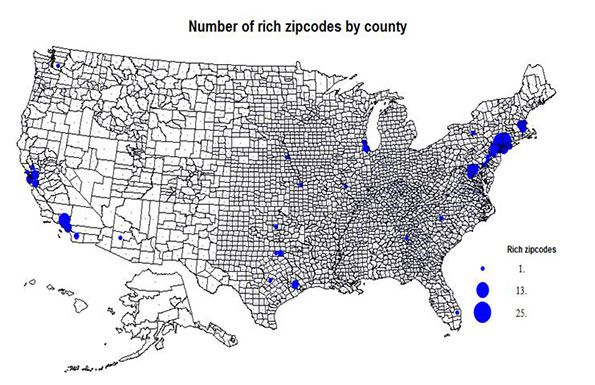
    Figure 1 maps the 170 zip codes with more than 1000 people and median incomes over $150,000 or mean incomes over $200,000. The most astounding thing about the map (which shows the number of rich zip codes by the county they are part of) is their  concentration  in a few areas, led by the country’s premier global city, greater New York city, with 75 of the 170. New York is followed by Washington DC with 23, another sign of the growing wealth of the national capital.  Boston follows with 10, Los Angeles, 18, San Francisco (14), and Chicago (6) and then a scattering in other leading metropolitan areas. There is no such concentration of the super-rich in any rural or small town area. But many are quasi-rural suburban and exurban.

    Richest Zip Codes
    State County Place Zipcode Mean (thousands)
    NY Westchester Purchase 10577 363
    NY Nassau Westbury 11568 351
    IL Cook Kenilworth 60043 342
    NY Westchester Pound Ridge 10576 338
    CA San Mateo Atherton 94027 337
    PA Montgomery Gladwyne 19035 333
    CA Los Angeles Bel Air 90077 327
    NJ Essex Short Hills 07078 322
    NY Nassau Glen Head 11548 316
    CT Fairfield Weston 06883 286
    CT Fairfield New Canaan 06840 308
    IL Cook Glencoe 60022 297


    But, the reader will protest, there are huge numbers of rich folk in Texas, Florida, Ohio, Pennsylvania, and other states. The reason is that these many rich households are “diluted” in impact because the zip codes are more variable in income. There really is something remarkable about the overwhelming affluence of the key suburban areas of Westchester and Nassau, New York; Fairfield, CT; Fairfax, VA; and Howard and Montgomery, MD. But I believe the map is telling and accurate at highlighting the utter dominance of the economic power of New York and then Washington. Boston retains power beyond its size, while Los Angeles, Chicago, San Francisco, and upstarts in the South scramble for a place.

    The Richest Areas

    The zip code with the highest and the 4th highest incomes are in Westchester County, close to the Connecticut border. The second richest, Westbury, is in Nassau county, New York, which also has the 9th richest. Also in the NYC suburbs are the 8th, in New Jersey just 20 miles west of New York, while 10th and 11th richest are both located  in Fairfield County, CT.

    Chicago’s north Cook county has the 3rd (Kenilworth) and 12th (Glencoe) richest areas.  Los Angeles is home to the 7th richest, Bel Air (northwest of Beverly Hills), Atherton, in San Mateo county, is the 5th richest, and Gladwyne in Montgomery County, PA is the 6th richest.  Greater New York then is home to 7 of the 12 richest, followed by Chicago with 2.  Quite a concentration. 

    The Poorest Zip Codes

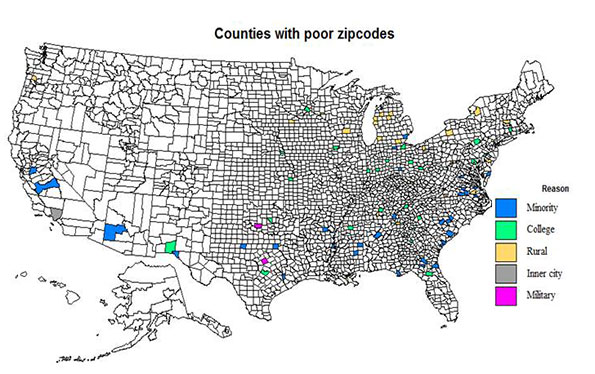
    The list and map (Figure 2) of counties with poor zip codes may surprise the reader more. I divide the 94 poorest areas into five types:

    • minority population domination, 35 areas,
    • college or university student majorities, with 25 places,
    • rural (in the sense of small communities in these counties having been left behind or declined) some 25 areas,
    • five inner city areas dominated by single men, 5, and
    • two areas dominated by a large military base.

    The poor college areas are zip codes for student dormitory housing, people who are temporarily poor; some military base areas are similarly poor because of barrack housing of single people.

    The poorest minority dominated areas are mainly Black and in the rural to small city South, except for a few Hispanic dominated areas in the west. The college poor areas are scattered across the country, especially in the East, the military base communities in Texas and Oklahoma. The rural set is surprisingly concentrated mainly in the north, especially in Michigan. The few inner city poor areas are in Los Angeles, Waterbury, CT: Portland, OR; Youngstown and Canton, OH; an odd set. A few of the rural areas also have correctional institutions.

    Poorest Zip Codes
    State County Place Zipcode Median
    NE Douglas Omaha 68178 $2,499
    KY Elliott Burke 41171 $3,494
    GA Clinch Cogdell 31634 $3,886
    FL Gulf Wawahitchka 32465 $4,481
    CT Tolland Storrs 06269 $6,124
    WI Dane Madison 53706 $6,359
    VA Nottoway Blackstone 23824 $6,421
    MI Clare LeRoy 49665 $6,639
    TN Rutherford Murfreesboro 37132 $7,125
    IN Delaware Muncie 47306 $6,750
    NY Cattaraugus Salamanca 14779 $7,395


    If I had relaxed limit by including more smaller population areas, or not quite such low incomes, many more college, military base, minority majority counties would appear on the map. But as noted up front, virtually none of these poorest zip codes are in big cities or their metropolitan areas, where millions of poor households live, simply because these metro zip codes tend to be large and more heterogeneous. This also does not factor in the cost of living, which can be high in some regions, particularly on the east and west coasts.

    The Poorest Areas

    The 12 poorest zip codes are different and quite varied in character. Five of the zip codes are essentially college or university student housing, and thus not indicative of an adult working population. Three areas are in part poor because of the presence of correctional institutions or adult care institutions. Two of these also have a significant minority (Black) population. Two rural areas, in GA and VA have high Black shares. This leaves two northern rural areas in Michigan (high seasonal dependency) and in New York, Salamanca, also a seasonal resort, as well as an Indian reservation.

    Unequal Zip Code

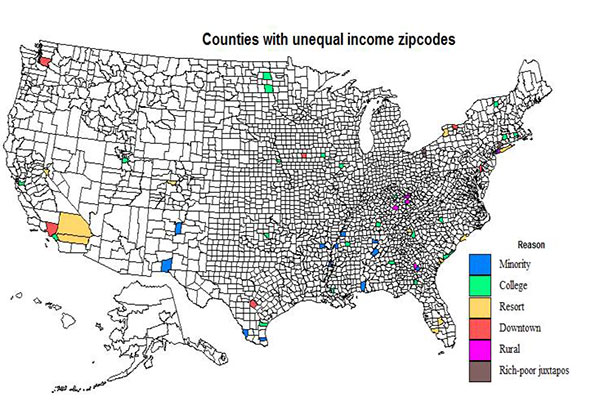
    The unequal zip codes (67) are mainly areas where the mean is at least twice the median, showing the disproportionate effect of a few very wealthy households. One critical area for high inequality are primarily beach or mountain communities with richer retirees serviced by lower-paid workers; these include 13 areas in California, South Carolina, Florida, New York, Nevada, North Carolina, and Colorado. Downtowns (8 areas) include a few actual downtown CBD zip codes with an older poor population and newer rich folk. Rural here identifies mainly small Kentucky zip codes with a very imbalanced income pattern (7 areas). Finally I note a few zip codes in exurban areas where there appears to be a juxtaposition of an older resident population, and newer wealthier households (3 areas). This pattern may become more common in both exurban and rural small-town environmental amenity areas.

    Most Unequal Zip Codes
    State County Place Zipcode Median Mean
    CA Alameda Berkeley 94720 $16,192 $79,238
    SC Pickens Clemson 29634 $12,159 $51,444
    LA E Carroll Transylvania 71286 $28,961 $96,377
    TX Starr 3 zips 78536etc $29,722 $98,048
    KY Elliott Ezel 41425 $29,980 $65,676
    TN Rutherford Murfreesboro 37132 $7,125 $21,863
    MA Suffolk Boston 02111 $31,442 $62,087
    VA Radford Radford 24142 $15,931 $46,860
    ND Cass Fargo 58105 $24,750 $70,633
    DC DC WashingtonDC 20006 $12,103 $32,155
    TX Bexar San Antonio 78205 $25,779 $69,628
    NC New Hanover WrightsvilleBch 28480 $70,375 $184,658
    NV Douglas Glenbrook 89413 $68,512 $172,004


    The Most Unequal Areas

    Of the 13 most unequal areas, 6 are college or university zip codes, areas with poor students and much higher income professionals. Two are downtown zip codes, Boston and San Antonio, two are minority population areas, Louisiana and Texas. Two are resort areas, in Nevada and North Carolina, but several similar areas are not far down on the list. One Kentucky area is classed as just rural, but again other similar counties are on the fuller list.

    Several zip codes are on both the poorest and the unequal zip code lists, most commonly the college and the minority-dominated areas. Rich suburban and exurban areas tend to be fairly consistently rich, resort areas tend to be more unequal.

    Conclusion

    The zip code data provide a partial, highly localized look at the geography of inequality. If American society continues to accept extreme income, the geography of inequality will only become not only more extreme, but more pronounced in a diverse set of locations.

    Richard Morrill is Professor Emeritus of Geography and Environmental Studies, University of Washington. His research interests include: political geography (voting behavior, redistricting, local governance), population/demography/settlement/migration, urban geography and planning, urban transportation (i.e., old fashioned generalist).

  • The Illusions of Charles Montgomery’s Happy City

    This is part one of a two-part series. Read part two here.

    Striking a pose of defiance, contemporary urbanists see themselves as the last champions of happiness in a world plunged into quiet despair, and Canadian writer and journalist Charles Montgomery is no exception. Drawing on the emerging ‘science of happiness’, his new book Happy City, subtitled ‘transforming our lives through urban design’, joins a wave of anti-suburban literature spurred on by climate fears and the financial crisis. ‘As a system’, writes Montgomery, the dispersed city ‘has begun to endanger both the health of the planet and the well-being of our descendants.’   

    Happy are the poor

    Repeating the fashionable wisdom, he says ‘cities must be regarded as more than engines of wealth; they must be viewed as systems that should be shaped to improve human well-being.’ Soon enough it’s apparent that to this way of thinking, well-being and poverty are by no means incompatible. ‘If a poor and broken city such as Bogota can be reconfigured to produce more joy’, he writes, ‘then surely it’s possible to apply happy city principles to the wounds of wealthy places.’    

    Montgomery starts off with ‘the happiness paradox’, arguing that ‘if one was to judge by sheer wealth, the last half century should have been a happy time for people in the United States and other rich nations … More people than ever got to live the dream of having their own detached home … The stock of cars far surpassed the number of humans who used them’. But, he is eager to explain, ‘the boom decades of the late twentieth century were not accompanied by a boom of happiness.’

    For evidence, he refers to ‘surveys’ showing that ‘people’s assessment of their own well-being’ had ‘flatlined’, and cites a few others reporting rising rates of mental conditions related to depression. None of these inculpate suburban affluence, however, or suggest people yearn to turn the clock back to before they acquired it. And nor does he explore the problems surrounding measurement of these trends.

    Moreover, such direct evidence as exists points in the opposite direction. A Pew Research Center survey, for example, found that far higher percentages of suburbanites than inner-city dwellers rated their communities as ‘excellent’ (Montgomery does concede that ‘residents in America’s central cities report being even less satisfied and even less socially connected than people in suburbia’, but does his best to explain it away).   

    The book openly admits that the idea of a link between unhappiness in the affluent west and urban form came from the rhetoric of Enrique Penalosa, former mayor of ‘poor and broken’ Bogota. Mr Penalosa declares that the unhappiest cities are not ‘the seething metropolises of Africa or South America’, but places like Atlanta, Phoenix and Miami in the US, ‘the most miserable cities of all’. Montgomery acknowledges this ‘is not science’, and ‘does not constitute proof’, but still sets out to show that ‘the decades-long expansion in the American [and Australian] economy’ and sagging levels of mental well-being aren’t just simultaneous developments, but connected, especially on the plane of ‘migration … from cities to the in-between world of sprawl.’ 

    Suburban Straw Man

    Before such a connection is anywhere near proven, though, Montgomery rushes in to assume it exists. Early in the first chapter, he is already asking ‘everything … would suggest that this suburban boom was good for happiness. Why didn’t it work?’ The habit of asserting yet-to-be or never-to-be established conclusions is commonplace throughout the book, and shapes the structure of his argument. Opening chapters set the scene with a case study of outer-suburban life which turns out to be a terrestrial version of Dante’s inferno.

    We’re introduced to the hapless Randy Straussner, a ‘super-commuter’ who drives 4 hours each workday on a round trip between his home in exurban Mountain House, California and his job 60 miles away in the San Francisco Bay Area. Most days he hits the road at 4:15 am to avoid the rush, putting off breakfast until he gets to work, and makes it back home at around 7:30 pm if ‘he was lucky.’ We’re told Randy won’t drink coffee or listen to talk radio, since ‘those just made him angry’ and aggravated ‘the pressures of the freeway.’ On arriving home, he would sometimes ‘grab a hose and water the garden until he calmed down’. Often he would hop ‘onto the elliptical trainer to straighten out his aching back’. When ‘the drive calcified his fatigue and frustration’, he drove to the gym where he could ‘sweat out his aggression.’

    Further, Randy ‘did not know, like or particularly trust his neighbours’ who ‘didn’t get to know one another’, so ‘he disliked his neighbourhood intensely.’ Montgomery adds that Randy felt ‘his own family paid the price for his stretched life’. His first marriage failed and his son ‘slid off the rails’, ending up in the county jail.

    Assuming this accurately accounts for Randy’s circumstances, just how representative is he of the typical outer-suburbanite? Peter Gordon, an urban economist at the University of Southern California, refers to empirical studies showing that ‘dispersed spatial structure was associated with shorter commute times’, suggesting “many individual households and firms ‘co-locate’ to reduce commute time [which] can be more easily [done] in dispersed metropolitan space …’

    This is borne out by the surprising stability of commute times over extended periods. According to the US Nationwide Household Travel Survey, explains Gordon, the average metropolitan commute time was 25 minutes 2009, just one minute more than in 2001, despite relevant population growth of 12 per cent. The averages for sub-area types described as ‘suburban’ and ‘second city’ were actually lower than for the ‘urban’ or core sub-area. Analysing the INRIX Traffic Congestion Scorecard and urban density data, demographer Wendell Cox also finds support for links between higher population densities and longer commute times.

    What about Randy’s other travails, are most suburbanites so estranged from their neighbours? A study cited by geographer Joel Kotkin found that for every 10 per cent drop in population density, the likelihood of people talking to their neighbours once a week rose 10 per cent. What about marital failure? Writing in the mid-2000s, Sue Shellenberger noted that ‘couples from central cities are 9 per cent more likely to crash and burn than couples from the suburbs, according to the National Center for Health Statistics.’ How about the prospect of winding up behind bars? On the basis of Brookings Institution research, Kotkin and Cox say suburban areas generally have substantially lower crime rates than ‘core cities.’

    (With their painstaking attention to statistics, Kotkin and Cox are the bêtes noires of pro-density urbanists, who tend to fall back on anecdotal evidence).

    ‘The masses will still need suburbia’  

    Use of Randy Straussner’s plight to discredit life on the urban fringe constitutes a classic Straw Man fallacy.

    From there, Montgomery proceeds to zig-zag between the fictional extremes of super-commuting hell and an opposite notion of high-rise ‘verticalism’, which he claims to reject. This dialectical type of approach has the advantage of inoculating him against the charge of ignoring inconvenient facts. In coming out for ‘a hybrid, somewhere between the vertical and horizontal city’, he gets to concede many pro-suburban realities, while clinging to his firmly anti-suburban conclusions.

    Concessions to suburbia on job location, home ownership and affordability, the popularity of driving, and economic dynamism are scattered throughout the book, intermixed with the general tone of disapproval.

    After many pages railing against ‘super-commuting’ and ‘detached houses with modest lawns … far from employment’, for instance, Montgomery is ready to admit that: ‘the US population is projected to grow by 120 million by 2050. Where will those people live? Downtowns and first-ring, streetcar-style suburbs will be able to accommodate only a fraction of the new demographic tidal wave. Most jobs have already moved out beyond city limits anyway.’ Then, quoting, he writes ‘the masses will still need suburbia.’

    This is noteworthy, since other green urbanists hold fast to the myth that jobs are concentrated in the urban core. Data in the 2011 American Community survey suggests that the ‘job-housing balance’, measuring the number of jobs per resident employee in a geographic area, is ‘nearing parity’ in suburban areas of US metropolitan regions with more than a million people. This isn’t dramatically different from the position in Australia’s 6 major cities, which have some of the world’s most dispersed patterns of employment (and will share an estimated 20 million more people by 2050). It’s all consistent with Gordon’s co-location thesis.

    In one chapter, Montgomery applauds his home town of Vancouver, which ‘has spent the past thirty years drawing people into density in a way that radically reversed a half century of suburban retreat.’ But he is forced to admit that ‘in 2012 Vancouver won the dubious honour of becoming the most expensive city for housing in North America. This means many people who work in the city … can’t afford to live there … ‘

    More generally, he says ‘the forces of supply and demand have helped make housing in some of the world’s most liveable cities’ –  for which read dense cities – ‘the least affordable.’ Again: ‘as the wealthy recolonize downtowns and inner suburbs, and property values rise accordingly, millions of people are simply being excluded.’ (Always dialectical, Montgomery mostly heaps praise on dense places like Vancouver and Portland, usually rated severely or seriously ‘unaffordable’ in the Demographia International Housing Affordability Survey, while singling out dispersed Atlanta for rebuke, despite a consistent rating of ‘affordable’.)

    And noting the influence of Vancouver’s high-rise density, spawning the label ‘Vancouverism’, Montgomery feels compelled to mention that ‘people living in towers consistently reported feeling more lonely and less connected than people living in detached homes.’ Later he writes that ‘most of us also want to live in a detached home with plenty of privacy and space.’

    On driving, the book is full of complaints that ‘governments have continued the decades-old practice of pouring tax dollars into highways … while spending a tiny fraction of that amount on urban rail and other transit service.’ Yet there is also the qualification that: ‘drivers experience plenty of emotional dividends. When the road is clear, driving your own car embodies the psychological state known as mastery: drivers report feeling much more in charge of their lives than transit users or even their own passengers.’ Montgomery lets slip the truth on popular preferences with the comment, ‘roads left to the open market – in other words, dominated by private cars.’

    Accordingly, the American Community Survey reports that between 2007 and 2012, ‘driving alone’ increased as the dominant mode of commuting in the United States, rising from 76.1 to 76.3 per cent of work trips. This bears some relation to the co-location of suburban residents and businesses.

    ‘A marvellous thing’

    Amidst his oscillations, Montgomery sketches an overview that reads like an encomium to the blessings of suburbia:

    The rapid, uniform and seemingly endless replication of this dispersal system was, for many people and for many years, a marvellous thing. It helped fuel an age of unprecedented wealth. It created sustained demand for the cars, appliances and furniture that fuelled the North American [and Australian] manufacturing economy. It provided millions of jobs in construction and massive profits for land developers. It gave more people than ever before the chance to purchase their own homes on their own land, far from the noise and haste and pollution of downtown.

    Having acknowledged the housing, transportation, employment and wider economic advantages of dispersion and suburbanisation, Montgomery could have come to the conclusion that they offer opportunities for a better life to millions of people, and should be embraced as a legitimate option by officials and planners. But that’s not where he ends up. Insisting that the dispersed city is now ‘inherently dangerous’, he signs on for pro-density ‘new urbanism’, calling for an overhaul of zoning codes, approval processes, infrastructure planning, tax incentives and funding practices to stimulate denser and less car-dependent redevelopment, aiming for transit-friendly, walkable, mixed-use, town centres and clusters of attached town-houses and low-rise apartments.

    While ‘new urbanism’ sweeps aside the advantages of dispersion, Montgomery’s misconceived ideas show that it offers nothing better. Take housing affordability. At first he toys with the faddish notion of ‘a by-law stating that 15 per cent of dwellings in every new subdivision … must be suitable for people of low or moderate income’, a costly burden on new construction for developers and the majority of home buyers. As the Australian experience attests, this type of planning fails to offset the spike in land values which accompanies density.

    Then, sensing this is far from enough, his demands escalate to the socialisation of housing supply: ‘it’s not enough to nudge the market towards equity … Governments must step in with subsidized social housing, rent controls, initiatives for housing co-operatives, or other policy measures.’ The destructive impacts of these sorts of measures on investment, market efficiency, public finances, and freedom of choice are passed over.

    Later in the book, Montgomery discusses ways to draw developers into density and social housing, including changes to ‘infrastructure-funding rules, tax incentives and permit requirements.’ He contends that ‘if this sounds like a big fat bonus for property developers well it is … but the truth is, as long as we inhabit a capitalist system, the future of suburbia depends on them.’

    It’s just that this isn’t capitalism as much as rent-seeking at the expense of consumers and other businesses, suppressing economic growth, opportunities and living standards. But that’s not a bad outcome for someone who extols the joys of poverty.

    John Muscat is a co-editor of The New City, where this piece first appeared.

    This is part one of a two-part series. Read part two here.

  • Britain’s Planning Laws: Of Houses, Chickens and Poverty

    Perhaps for the first time in nearly seven decades a serious debate on housing affordability appears to be developing in the United Kingdom. There is no more appropriate location for such an exchange, given that it was the urban containment policies of the Town and Country Planning Act of 1947 that helped drive Britain’s prices through the roof. Further, massive damage has been done in countries where these polices were adopted, such as in Australia and New Zealand (now scurrying to reverse things) as well as metropolitan areas from Vancouver to San Francisco, Dublin, and Seoul.

    A healthy competition has developed between the Conservative-Liberal Democrat coalition and the Labour Party to finally address the problem of the resulting land and housing shortage that has driven prices up so much relative to incomes.

    It probably helps that public opinion seems to be changing. A recent MORI poll found that 57 percent of respondents considered rising house prices to be a bad thing for Britain, compared to only 20 percent who though it a good thing.

    It has been more than a decade since Kate Barker, then a member of the Monetary Policy Committee of the Bank of England (the central bank) was commissioned by the Blair Labor government to examine the issues. Her conclusions were clear. Britain has a serious housing affordability problem and its restrictive land use policies were the cause. These higher housing costs, the largest element or household expenditure have reduced the standard of living and increased poverty beyond what would have occurred if urban containment regulation had not destabilized house prices. The Economist notes that home ownership is falling and that the number of couples with children who are renting has tripled since the late 1990s.

    Planning and Chickens

    This week, The Economist weighed into the debate (Britain’s planning laws: An Englishman’s home):

    "Now that the economy is at last growing again, the burning issue in Britain is the cost of living. Prices have outstripped wages for the past six years. Politicians have duly harried energy companies to cut their bills, and flirted with raising the minimum wage. But the thing that is really out of control is the cost of housing. In the past year wages have risen by 1%; property prices are up by 8.4%. This is merely the latest in a long surge. If since 1971 the price of groceries had risen as steeply as the cost of housing, a chicken would cost £51 ($83)."

    For those of us unfamiliar with the cost of chicken in British hypermarkets, The Daily Mail says it is about £2 ($3). Indeed, even the chicken industry suffers, as planning restrictions  are getting in the way of adding the chicken farms Britain requires.

    Moreover, the high costs cited by The Economist are after the house prices increases that had already occurred by 1970. Even then, before such inflationary pressures were seen elsewhere, Sir Peter Hall characterized soaring land and house prices as the biggest failure of the 1947 Act. Hall had led a major research effort on the subject, which produced a two-volume work, The  Containment of Urban England (See The Costs of Smart Growth Revisited: A 40 Year Perspective).

    From Affordable to Unaffordable

    While the historic relationship between household incomes and house prices (the "median multiple") was under 3.0 across the United Kingdom as late as the 1990s, it has now deteriorated to more than 7.0 inside the London Greenbelt. Unbelievably it has risen to elevated levels even in the less prosperous the north of England. For example, depressed Liverpool has a median multiple over 5.0, which is 60 percent above the maximum historic range and making the metropolitan area "severely unaffordable." Liverpool is probably best compared to Cleveland in the United States for its economic distress.

    The shortage of housing in Britain has become acute. There are additional concerns that the globalization of housing markets has hit London particularly hard and is driving households out of the housing market.

    More Money, Less House

    Through all of this, Briton’s are getting less for their money. Since 1920, the average size of a new large family house has been reduced 30 percent. Semi-detached houses are 44 percent smaller and townhouses (terrace housing) is 37 percent smaller (Figure 1). Britain now has some of the smallest new housing in the world. The average new house in continental Europe is 50% or more larger than in England and Wales. New houses are two to three times as large in Canada, New Zealand, Australia and the United States (Note 1). In some US cities, residents can build "granny flats" which are larger than new houses in Britain. For example, San Diego’s limit for granny flats of 850 square feet exceeds Britain’s average new house size of 818 square feet.

    Paving Over Ohio?

    Of course, those who see urban expansion (the theological term is "sprawl") as ultimate evil imagine an England and Wales being literally paved over by allowing people to live as they prefer. They need not worry.

    For example, England and Wales is less crowded than spacious Ohio, with its rolling hills and extensive farmland. According to the 2011 census, only 9.6% of the land in England and Wales is urban, the other 90.4% is rural. In Ohio, on the other hand, 10.8% of the land is urban and only 89.2% of the land is rural. Even the state of Georgia, with the least dense large urban area in the world, Atlanta, has roughly as much rural land (91.7 percent) as England and Wales (Figure 3).

    Every Gram is Sacred?

    Originally, urban containment was justified on social and aesthetic grounds. However, curbing greenhouse gases is now used as the raison d’etre for highly restrictive housing policies. Urban policy in England and Wales and elsewhere has been hijacked by a philosophy that any gram of greenhouse gas that can be reduced must be, regardless of its impact on society, the economy, the standard of living or poverty.

    One of the worst conceivable strategies for reducing greenhouse gas emissions is to waste money on costly and ineffective measures. The Intergovernmental Panel on Climate Change (IPCC) has indicated that sufficient reductions in greenhouse gas emissions can be achieved for a range of from $20 to $50 per ton. Urban containment policy cannot deliver for this price. In contrast, improving automobile fuel efficiency is forecast improve greenhouse gas emissions, even as driving continues to rise with a growing population (see Urban Planning for People). In addition, the higher house prices associated with urban containment policy are well beyond the IPCC range.

    No program can produce substantial greenhouse gas emission reductions that does not focus on higher value strategies. Urban containment has no high value strategies.

    Planning, People and Poverty

    Britain’s land policy competition between the political parties is long overdue. Coalition Communities Secretary Eric Pickles, decries "the way families are trapped in ‘rabbit hutch homes’." The Labour Party opposition has promised that, if elected in 2015, steps will be taken to increase land supply and housing affordability, so that "working people and their children" have the "decent homes they deserve."

    The Economist states the issue squarely:

    "Building on fields in a country that is as crowded as England will always rile some people, however well-designed the system. But the alternative is worse: a nation of renters and rentiers, where only the rich own houses."

    —————–

    Note 1: As Figure 2 indicates, Hong Kong housing is considerably smaller than that of England and Wales. Hong Kong really is the ultimate smart growth or urban containment city. It has the highest urban population density in the high income world. It has the highest share of its commuters using mass transit to get to work. Its traffic congestion is intense. And, predictably, it has the highest house prices relative to incomes yet documented in the high income world.

    We need to be spared the "sun rises in the west" economic studies claiming that somehow the laws of economics, that work so relentlessly to drive up prices where supplies are constrained in other industries (such as petroleum, corn, etc.) have no effect on land and housing.

    Wendell Cox is a Visiting Professor, Conservatoire National des Arts et Metiers, Paris and the author of “War on the Dream: How Anti-Sprawl Policy Threatens the Quality of Life.

    Photo: St. Pancras Station (London), by author