Tag: middle class

  • Demographic and Economic Challenges: The 9th Annual Demographia International Housing Affordability Survey

    The just released 9th Annual Demographia Housing Affordability Survey (pdf) indicates that housing affordability has deteriorated modestly in the last year. A number of major metropolitan areas remain severely unaffordable.

    Highlights: Metropolitan Areas

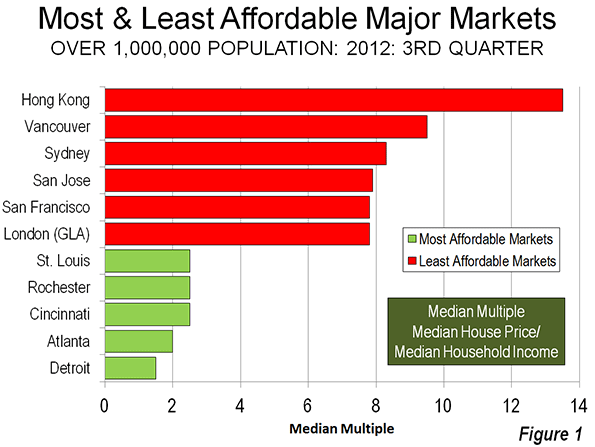
    Among the 337 Metropolitan markets analyzed, Hong Kong remained the most unaffordable, with a median multiple (median house price divided by pre-tax median household income) of 13.5, up nearly a full point from last year’s 12.6. No other housing market has ever reached such an intense level of unaffordability since the Survey began (Los Angeles reached 11.5 in 2007).

    Rounding out the least affordable major markets (over 1,000,000 population) were Vancouver at 9.5, Sydney at 8.3, San Jose (US) at 7.9, and a tie in fifth place between San Francisco and London (Greater London Authority) at 7.8. The most affordable markets were Detroit at 1.5 (Note 1); Atlanta, at 2.0 (Note 2); and Cincinnati, Rochester (US), and St. Louis at 2.5 (Figure 1).
    Rating Housing Affordability

    The Demographia Housing Affordability Surveydefines four housing affordability categories (Table 1), starting with "affordable." Affordable housing markets have a median multiple of 3.0 or less, the upper bound of overall housing affordability that existed virtually across all major markets in the United States, the United Kingdom, Canada, Australia, Ireland and New Zealand before the adoption of urban containment policy (also called densification policy, urban consolidation, compact cities, smart growth, or growth management).


    Table 1

    Demographia International Housing Affordability Survey

    Housing Affordability Rating Categories

    Rating

    Median Multiple

    Severely Unaffordable

    5.1 & Over

    Seriously Unaffordable

    4.1 to 5.0

    Moderately Unaffordable

    3.1 to 4.0

    Affordable

    3.0 & Under


    Highlights: Nations

    Of all nations, only the United States has affordable major markets and a strong representation in the moderately unaffordable category. Six major markets in the United States were rated in the severely unaffordable category, including San Jose, San Francisco, San Diego, Los Angeles and New York.

    Canada had two markets rated moderately unaffordable, while one half of its major markets were rated severely unaffordable, including Vancouver, Toronto and Montréal. Ireland’s one major market, Dublin, was rated moderately unaffordable.

    One half of the major markets in the United Kingdom were also rated severely unaffordable, including London (GLA), Plymouth & Devon, the London Exurbs (Southeast and East of England), Bristol, Liverpool, Newcastle, Birmingham, and Sheffield. All of the major markets in Australia (Sydney, Melbourne, Brisbane, Perth and Adelaide), China (Hong Kong), and New Zealand (Auckland) were rated severely unaffordable (Table 2).

    Hong Kong and Singapore are the world’s largest city-states. An analysis of a large share of the Singapore market suggests a median multiple of approximately 6.0, which is substantially more affordable than Hong Kong.

    Table 2

    Housing Affordability Ratings by Nation: Major Markets (Over 1,000,000 Population)

     Nation

    Affordable

    (3.0 & Under) 

    Moderately

    Unaffordable (3.1-4.0)

    Seriously Unaffordable (4.1-5.0)

    Severely Unaffordable (5.1 & Over)


    Total


    Median

    Multiple

     Australia

    0

    0

    0

    5

    5

    6.5

     Canada

    0

    2

    1

    3

    6

    4.7

     China (Hong Kong)

    0

    0

    0

    1

    1

    13.5

     Ireland

    0

    1

    0

    0

    1

    3.6

     New Zealand

    0

    0

    0

    1

    1

    6.7

     United Kingdom

    0

    0

    8

    8

    16

    5.1

     United States

    20

    20

    5

    6

    51

    3.2

     TOTAL

    20

    23

    14

    24

    81


    Longer Term Trends

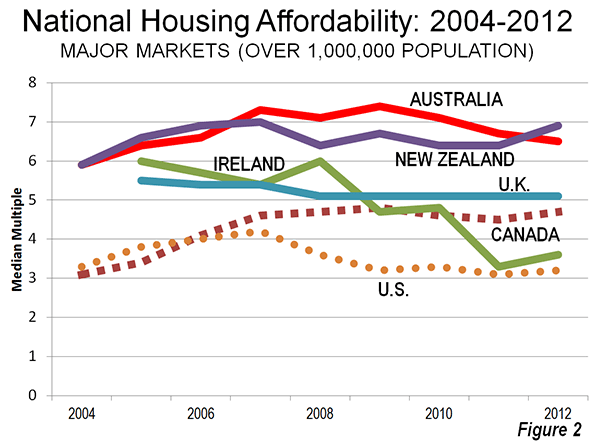
    Over the years of the Demographia International Housing Affordability Survey, housing affordability has improved by far the most in Ireland. It has also improved in the United States. Affordability in Canada’s major markets was the most favorable in 2004, but has seen large Median Multiple increases in each of the three largest metropolitan areas. As a result, there is increasing concern about housing affordability in Canada.

    Australia and New Zealand have had the most unaffordable major markets, with every market being severely unaffordable in every year, reflecting earlier adoption of densification policy by states and metropolitan areas. Housing affordability has also been severely unaffordable in United Kingdom major markets over the period covered (Figure 2).
    A Competitive Land Supply: Key to Housing Affordability

    Overwhelming economic evidence indicates that urban containment policies, especially urban growth boundaries raise the price of housing relative to income. This inevitably leads to a reduced standard of living and increases poverty rates, because the unnecessarily higher costs of housing leave households with less discretionary income to spend on other goods and services. The higher costs ripple into rental markets, tightening the budgets of lower income households, who already suffer from lower discretionary incomes.

    The principal driver of unaffordable housing relative to median incomes is failure to maintain a "competitive land supply." Brookings Institution economist Anthony Downs describes the process, noting that more urban growth boundaries can convey monopolistic pricing power on sellers of land if sufficient supply is not available, which, all things being equal, is likely to raise the price of land and housing that is built on it. This has, more often than not, been associated with urban containment policy and virtually never with the more liberal land use policy that preceded it.

    Recent Policy Developments

    The last year has seen public policy progress. The New Zealand central government plans to expand the land supply and provide alternatives for infrastructure finance, both of which are likely to lead to improved housing affordability. In his Introduction to this years’ Survey, Hon. Bill English, Deputy Prime Minister of New Zealand pinpoints the factors leading to the policy changes:

    It costs too much and takes too long to build a house in New Zealand. Land has been made artificially scarce by regulation that locks up land for development. This regulation has made land supply unresponsive to demand. When demand shocks occur, as they did in the mid-2000s in New Zealand and around the world, much of that shock translates to higher prices rather than more houses.

    The Conservative-Liberal Democrat Coalition is proposing policies to build housing on more competitively priced land, to improve housing affordability. Planning Minister Nick Boles has called Britain’s lack of housing affordability "the biggest social justice crisis we have," and called it bigger than education and unemployment (video). These proposals have been long in coming. It has been four decades since Sir Peter Hall and associates documented the consequences of urban containment, and nearly a decade since the similar conclusions of Kate Barker for the Labour Government.

    In Hong Kong, facing public demonstrations on issues such as housing affordability, the government has adopted a plan to improve housing affordability.

    However, the policy is deteriorating in California, where state regulations could virtually outlaw new single-family housing on the urban fringe. In the last year housing affordability losses have been substantial and could portend another housing bubble in this state that precipitated Great Financial Crisis with its egregious house price increases.

    Evolving Perspectives

    Planning perspectives could be evolving. New York University Professor Shlomo Angel writes in his book Planet of Cities of the importance of housing affordability and argues against urban planning restrictions that restricting adequate housing to ordinary households.

    A team of UK academic researchers questioned the "default" preference for urban containment policy. This is an important development, since much of urban planning is committed to outlawing more liberal land-use policies.

    The Economic Challenge

    Nations around the world face serious economic challenges. Governments have taken on unaffordable obligations, and repayment continues to elude authorities in the United States, the European Union, and elsewhere. Future demographic trends are likely to only exacerbate this difficulty, driven by plummeting birth rates and a rising elderly population (See The Rise of Post-Familialism: Humanity’s Future?).

    Urban policy needs a "reset." The emphasis should be shifted away from "designing" urban areas toward facilitating a better standard of living for the people who live in them. In his epic Civilization: The West and the Rest, historian Niall Ferguson, in his Civilization notes that

    The success of the civilization is measured not just in its aesthetic achievements but also, and surely more importantly in the duration and quality of life of its citizens.

    This requires greater affluence and less poverty, both of which require more affordable housing.

    —–

    Note 1: The city of Detroit has experienced a severe economic decline. However, the Detroit metropolitan area (which includes the city, the suburbs and exurbs) has fared much better. The city (municipality or local government authority of Detroit experienced a population loss from 1,850,000 to 714,000 in the last 60 years, while suburban and exurban areas added 2.2 million. There are a variety of theories about Detroit’s municipal decline, involving both "push" and "pull" factors (such as the incompetence and corruption of the municipal government to the not unrelated attraction of suburban living).  Further, the overall population growth rate of the Detroit metropolitan area has not been strong, but exceeded that of the other three worst hit "Rust Belt metropolitan areas, Cleveland, Buffalo and Pittsburgh (which lost population). Metropolitan Detroit’s growth rate was similar to that of the New York metropolitan area (35 percent compared to 42 percent), which ranked 46th in growth (out of 51) compared to Detroit’s 48th.

    Note 2: At the peak of the housing bubble, affordability deteriorated to a moderately unaffordable 3.1 in Atlanta. Atlanta had been among the high income world’s fastest-growing metropolitan areas for at least three decades, but slowed briefly during the Great Financial Crisis. Growth has returned, with Atlanta ranking third in net domestic migration among US metropolitan areas with more than 5 million population.

    —-

    Photograph: Hong Kong (by author)

    Wendell Cox is a Visiting Professor, Conservatoire National des Arts et Metiers, Paris and the author of “War on the Dream: How Anti-Sprawl Policy Threatens the Quality of Life.”
  • Rust Belt Cities: Invest in Odysseus, Not Barney Fife

    Given its legacy of shrinking, the Rust Belt has issues. The issues arose naturally, and relate to the fact things leave, or that so much has left. Particularly, when things leave, the mind—both the individual and the collective city mind—can get protective and restrictive. Neediness arises. The smell of desperation ensues like a pall that can tend to hang over cities, influencing decision making on all levels.

    Enter “brain drain”, or that term coined to refer to the outmigration of an area’s educated citizens, particularly it’s young. You know the drill: Johnny goes to State college, comes back home for a spell, but then leaves Cleveland, Ohio for Chicago or New York. That is brain drain. And city leaders hate it, spending billions of dollars to stop it—often at the cost of coming off ridiculous, lame.

    For instance, in Pittsburgh, there was a civic booster campaign thought up to keep educated folks from going. It was called “Boarder Guard Bob”. According to researcher Chris Briem, “Bob” was a Smokey-the-Bear-type of public service announcement made into a Barney Fife character, with the billboard-size messaging of “Bob” intended to “stop young people at Western Pennsylvania’s borders before they had a chance to leave for other cities”. And while this particular retention strategy (luckily) never went to print, various “plug the brain drain” strategies persist in one form or another at exorbitant cost to taxpayers.

    But beyond the near-pitiful messaging, there are major problems with the brain drain approach, especially from an economic development perspective. For example, when, as a community, you are intentionally telling your citizen’s not to go, you are asking them to sacrifice personal development for the benefit of a place. To this point, my colleague, Jim Russell—a leading thinker in brain drain boondoggles and blogger at Burgh Diaspora—says it best, stating: “Discouraging geographic mobility is the same as restricting access to higher education”. In other words, it’s like telling Johnny to stick with his high school diploma so as to forego leaving the community for a 4-year degree.

    What’s more, getting people to stay put does little to grow a local economy. In fact it hurts it. Because leaving home is often a rite of passage. It develops a person. I mean, can you imagine if there was no odyssey in the epic Odyssey? If so, Odysseus wouldn’t be the changed man with perspective and experience as he was when he returned back to his homeland, and so there’d be no “there” there. In this sense, the Rust Belt needs to engage their young to embark on their own “Hero Journey” if only to gain skills and broaden geographic connections. This is international economics 101 (see China, India, Brazil, etc.). It should be a domestic economic priority for the Rust Belt, and it would be if only the Cleveland’s of the world could let go of the protectionism that defines their longstanding existential fears of shrinking into one big pile of ruin porn.

    Of course confidently encouraging outmigration is part and parcel with an understanding that many expats will “boomerang” back. But many are, and at a faster rate. To wit: as the alpha cities of the America like NYC get too expensive or creatively-class cute, many Rust Belt refugees are pivoting back from a certain left-wanting lifestyle if only for the opportunity, tradition, and honest-to-god reality that is “Rust Belt Chic”. And when they do, they often become “economic ass kickers”, which is term Russell uses to exemplify the fruits of the Hero Journey that is not only individually experienced, but felt in the local economy as well.

    Take Sean Watterson, the co-proprietor of the wildly successful restaurant the Happy Dog on Cleveland’s Near West Side. He moved back from D.C. because, according to a recent Plain Dealer article, “Cleveland-ness is like Polish-ness or Irish-ness. It’s an ethnicity”. Here, Watterson not only runs a great hot dog business, but uses his establishment to advance a circulation of ideas by hosting a variety of events like “Life, the Universe, and Hot Dogs”, which is a series hosted by researchers from the Institute for the Society of Origins. Another big hit is the live performances by members of the Cleveland Orchestra called Classical Revolutions.

    Cool sounding events, sure. But there is more to it than that, as such happenings spark cross-fertilization between parts of Cleveland—the blue collar West Side and the intelligentsia of the East Side—that have long been divided, often at the cost of Cleveland as a place of cultural and economic innovation. And how exactly does Watterson’s own “Hero Journey” come into play in his self-stated goal to break down barriers “between east and west and between high culture and low culture”? It likely relates to the fact he experienced experience outside of a legacy city bubble that enabled him to see and cross bridges that others have difficulty envisioning.

    Now, does this mean that cities simply need to let people leave to prosper? Obviously not. If the place expats are boomeranging back to is stagnant and disparate, with openness and connection disabled by a collective insular mentality that: “that’s just the way things are done around here”, well, the boomeranging effect won’t hold. And the economic ass-kickers won’t ass-kick.

    The goal, then, of cities should be on fostering return migrant connections, or to know who they are, why they are there, and to help get them together so that their collective unchained perspective can pop bubbles of inert status quo. This need is real. For instance, take this first-hand return migrant account published in Rust Belt Chic by Dana Marie Textoris:

    Funny how your location-based identity, your physical and mental place in the world, can flip like a switch: Before I was a Clevelander managing to make it in San Francisco….right now I feel a lot like a San Franciscan stuck in Cleveland. In either place, I felt just a little bit Other. A bit of a novelty. Just a tad on the outside looking in. Where does that leave me? Where is home? As I type this, I realize, with sort of an internal groan, that the place I’m left in, the guide to what I’m searching for, is probably just right here, inside me, where my two lives — West Coast and Midwest — are now combined. I’m not really a true Clevelander anymore…I’ve picked up way too much San Francisco for that. The balance I’ve become, a little of this and that, is just what I’m hoping I’ll find, one day.

    So, to all Rust Belt cities—this is where your attention must be turned: not on the ones who are leaving for good reason, but on those returning who have not left for good. They have brought the path of their self-discovery back to your doorstep.

    Don’t close the door by screaming at the backs of others.

    Richey Piiparinen is a writer and policy researcher based in Cleveland. He is co-editor of Rust Belt Chic: The Cleveland Anthology. Read more from him at his blog and at Rust Belt Chic.

  • Globalization: Too Many Americans Are Dropping Under the Radar

    By the time I arrived in Silicon Valley in 1986 California’s middle class economy was already being remade by globalization. Globalization’s dramatic impact on northern California hit me square in the face the moment I arrived at my first career expo later that year at the Westin Hotel in Santa Clara. There I found myself surrounded by a multitude of H‑1B workers from all over the world, excitedly speaking in a myriad of languages. I was staggered. Born in the U.S.A., I felt like a foreigner in the land of my birth.  

    In this new Pacific Rim "promised land," an American-born engineer residing in Palo Alto would need four or five times his annual salary to purchase the same home his father had gotten with only two. Valley infrastructure was not keeping up with the expanding population and the inevitable supply-demand dynamic was rapidly dividing the middle class into winners and losers. The winners would enjoy at least a 4-bed/3-bath/2-car home and early retirement; the losers would compete for tiny 1-bed condos. This trend has not only continued but is escalating across a variety of benchmarks—both in the Valley and all over America.

    Now, let’s get close to the ground and see if we can find who’s been dropping under the radar.

    Some Are Hot, But Most Americans (Particularly White Males) Are Not

    Half of Silicon Valley’s technology workforce is now Asian, and many come from abroad. This was already the case among software development engineers back in 1990 when I was working for Consilium. Hispanics, Latinos, and African-Americans are all losing ground, though not as quickly as whites.

    US taxpayers have unknowingly funded a training program called JEEP to train foreign Asian students for jobs in some booming career fields such as offshore call centers that serve US businesses. As a result, according to Congressman Tim Bishop (D-New York), American workers have lost some five hundred thousand jobs in just five years.

    Last November figures obtained from inside IBM seemed to indicate that for the first time more of the tech giant’s workforce would be employed in India than in the US. Of IBM’s total global workforce of 430,000 less than one quarter now work in the US. IBM benefits from the hefty difference in employee salaries, which can amount to as much as $100,000 per year.

    All this cost-cutting from H-1B work visas, outsourcing, and offshoring is having a leveling impact on US wages, including among technology specialists such as software development engineers and project managers—even though new technology developments continue at a breathtaking pace.

    Age-Related Losers, Old and Young

    When I arrived, you could see how youth-obsessed 80s Silicon Valley was. It still is, only more so. In her article Silicon Valley’s Dirty Secret: Age Bias, Sarah McBride details a number of cases of age-related bias that show how much tougher it is for the over-40 techie to find her next job than for the 20s person, even from another country. I know Age-bias first-hand. One day in 2002, while a technical writer for startup E2open, I was confronted by two young  engineers: "What’s an over-40 dude doing here—aren’t you retired yet?"

    It’s not just Silicon Valley anymore. A 2012 United States GAO report noted that   "…long-term unemployment has particularly serious implications for older workers (age 55 and over). Job loss for older workers threatens not only their immediate financial security, but also their ability to support themselves during retirement."

    Think you’re too young to worry about age? Think again. Even pretty young women might not be quite good enough in the brave new world. In 2011, clothing giant H&M reported that they are now using "perfect" virtual models—not real humans—for their online shopping site.

    Globalization’s Broadband Impact on America

    In The Slow Disappearance of the American Working Man, Bloomberg Businessweek Magazine (Aug. 2011) highlights the particularly devastating impact on the American male worker.

    • "The portion of men who work and their median wages have been eroding since the early 1970s."
    • "The portion of men holding a job—any job, full or part-time—fell to 63.5 percent in July 2012."
    • "These are the lowest numbers in statistics going back to 1948."
    • "Among the critical category of prime working-age men between 25 and 54, only 81.2 percent held jobs."
    • "To put those numbers in perspective, consider that in 1969, 95 percent of men in their prime working years had a job."
    • "After accounting for inflation, median wages for men between 30 and 50 dropped 27 percent"…putting them "back at their earnings capacity of the 1950s."

    In Race Against the Machine (2011) MIT’s Erik Brynjolfsson and Andrew McAfee show how jobs formerly enjoyed by the median US worker are now being lost to cutting-edge technologies. Artificial Intelligence (AI) is to today’s white collar STEM worker what robotics was to many blue collar workers.   We were already advancing this trend at Oracle in 1990 with the development of our SQL*Forms application generator, obviating the need for thousands of application developers.

    A number of disturbing statistics indicate that US workers are now both producing and earning less.
    The Central Intelligence Agency World Factbook ranks the United States 11th in the world in GDP per capita. We used to be number 1. This figure indicates that while rich Americans keep getting ever richer, the middle class is producing less and less per capita. The US-born middle class worker keeps on sinking.

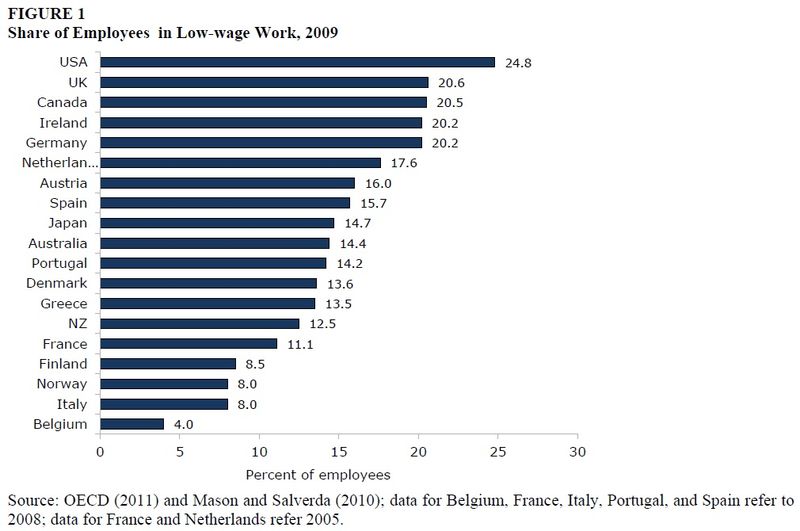
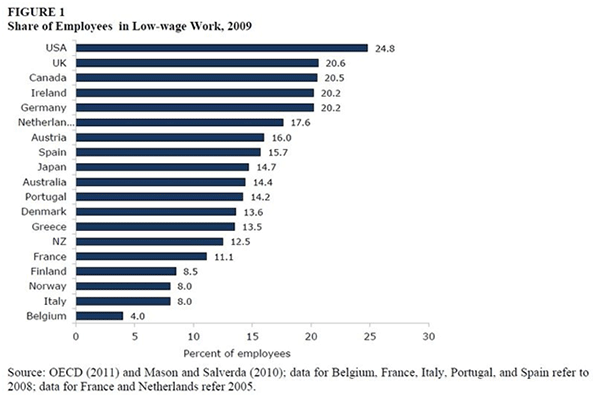
    A recent National Employment Law Project report indicates that the current "recovery" continues to be slanted toward low-paying jobs, reinforcing the mounting inequality s. The fastest growing low-wage jobs include retail salespeople, food prep workers, waiters and waitresses, laborers and freight workers, office clerks and customer representatives, and personal and home care aides—mostly paying median hourly wages between $7.69 and $13.83 per hour. Is this America’s new path to "prosperity?"

    The Organization for Economic Co-operation and Development (OECD) reports, amazingly, that the United States actually has a higher percentage of workers doing low-wage work than any other major industrialized nation:

    The Future: Dimmest for the Brightest, Brightest for the Dimmest?

    Last year a NY Times article covered the appalling plight of recent college grads. Half of today’s graduates are jobless or underemployed. They are more likely to be employed in jobs not requiring a college diploma—such as receptionists, cashiers and food-service helpers—than as engineers, physicists, or computer professionals.

    And while Americans are busy paying for US corporations to move work to Asia, US federal employment accounts for the entire net increase in jobs since at least 2008. Washington’s cure to de-industrialization of the US has been to expand government payrolls. But is the creation of more and more "security" jobs and unnecessary bureaucracy the proper cure for persistent unemployment and swelling welfare rolls?

    Where Do We Go From Here?

    All of the benchmarks point to the unavoidable conclusion that ever more Americans are simply dropping under the economic radar screen. This includes some very broad downtrends for American workers of all races; "older" workers; young workers who perform work that robotics and AI are learning to do more cost-effectively; the American male workforce and  middle income workers in general; and even recent college graduates. With neither the free market or   government helping very much the message seems quite clear: globalization’s losers must get organized and work together for improved economic opportunity.

    Rob Argento is a senior technical writer and project leader with a background in aerospace engineering and some 18 years in Silicon Valley with Oracle, Xerox, Microsoft, and Sony. His broad industry experience includes NASA, e-commerce, US Navy, Biotech, and PC Games. He has degrees in physics and theological studies.

    Global population photo by Bigstock.

  • “Livability” vs. Livability: The Pitfalls of Willy Wonka Urbanism

    livability: (livable) fit or suitable to live in or with; “livable conditions”.

    “Livability” has been a buzz word in city development for some time, and for good reason, as who doesn’t want livability, outside the zombie cohort? Things get hairy, though, when “livability”—as an economic development strategy—gets unpacked, because questions arise: “Livability” for whom? “Livability” at what cost?

    Making a city “livable” these days largely means appealing to a select group of folks so as to form “an attractive economic place”. This notion of “livability” really came on in the late 1980’s, and was done under the presumption that certain cities offered higher quality of life, read: better lifestyles. For instance, in 1989 geographer David Harvey wrote that cities need to “keep ahead of the game [by] engendering leap-frogging innovations in life-styles, cultural forms, products, and service mixes…if they are to survive.” This was a radical departure from previous societal efforts to make quality of life a priority (think: pollution remediation) in that “life” was swapped out for “lifestyle”.

    You could argue, then, that the original sin of “livability”-driven economic development begins right there. Namely, the emphasis will not be on the people of a city, but on potential consumers, particularly high-valued consumers with means, subsequently referred to as the “creative class”. As for creative class wants? They are, according to Richard Florida, “[an] indigenous street-level culture – a teeming blend of cafes, sidewalk musicians, and small galleries and bistros…” In this sense, the idea of “livability” gets precariously slimmed out.

    Nonetheless, this thinking has penetrated mainstream economic development, with cities attempting to one-up each other in their want to attract a slice of the “livability” electorate. The consequences have become predictable: more comfort for some, less comfort for most.

    ***

    Perhaps the city most famous for livability-driven economic development is Portland. It is America’s amenity apex, and a recent study showed it attracts the young by the boatload due to a certain leisure-lifestyle it affords.

    For example, from a recent article entitled “(P)retirement’s new frontier”, the author interviews a 36-year old who is “underemployed on purpose”, as well as a couple who quit their jobs in Austin, sold their car, and have backyard chickens, yet now feel “much richer”. Such folks are referred to by economist Joe Cortright as “lifestyle entrepreneurs”. Part of this entrepreneurial output, touched on in the article, is a website called Badass that rates Portland neighborhoods for amenities like pinball machines, food carts, and access to bike lanes. At times the article reads like Portland was dreamed up by Willy Wonka.

    Here, I half kid. From a description of the movie Charlie and the Chocolate Factory, notice the parallel themes: the Peter Pan motif, an escape from an unsatisfactory reality, and the promise of limitless sensory and savory experiences:

    The Chocolate Room is designed to look like an outdoor landscape complete with trees, flowers and a waterfall, but Wonka has made the entire scene out of candy and chocolate. Charlie and the other children see some doll-sized human beings in the Chocolate Room, and Wonka explains they are Oompa-Loompas whom he saved from the dangerous country of Loompaland. The Oompa-Loompas agreed to work for Wonka and live in his factory in exchange for a safe home and an endless supply of their favorite food, cacao beans.


    Courtesy of Knotworkshop

    Swap out the over-educated and underemployed for the Oompa-Loompas, chocolate for lifestyle amenities, and the Chocolate Room for the concept of “Portland-as-place”, and you got yourself a sequel. But there are problems with such city building: it’s too often defined by the ephemera, or that “transitory matter not intended to be retained or preserved”. And while the ephemera aren’t building blocks to economic growth—but instead represent America’s tendency to fix hard structural deficits with the airy promises of the pleasure principle—they are nonetheless a main cog in the modern day city-making machine. From an article entitled “Placemaking Revolution: the powerful role of ephemera and the arts in our cities”:

    Coletta addressed the question of how ephemeral events can have lasting impacts in cities. “I think you can do temporality with regularity. Some temporary events are so powerful that they stay in the memory for a long time, and spark the imagination.

    But I would argue that now more than ever we need less fantasy in city building than we do reality—as reality can’t keep being handed off to folks who are unable to consume their way to imagining existence as anything but decidedly not livable.

    ***

    “Livability” backlashes are becoming increasingly common across the country. For instance, a piece in Crain’s Chicago questions whether Chicago’s catering to the global creative class is worth the debt it is incurring, and whether the split between the amenity-rich rich neighborhoods and the amenity-poor poor neighborhoods is worth the investment, particularly given the record levels of violence that is tearing parts of the city to pieces. And while Mayor Emanuel’s bike-pathing of the City moves forward because “he wants all of [Seattle’s] bikers”, libraries are closing, red light cameras are ubiquitous, taxes are rising, and the city has a police manpower shortage of 1,000 that can’t be plugged because there’s no money. In fact things are so desperate that the City recently turned to Twitter to fight crime.


    Stop-The-Violence Campaign in Chicago. Courtesy of Metropolis Coffee

    In New York, the President of NYU is under a vote of no confidence for his plans to extend the creative classification of the campus into Greenwich Village. And while this has been ongoing—for instance, one commenter in the bookWhile We Were Sleeping: NYU and the Destruction of New York” states “There are days when I feel like I’m stranded in some upscale mall in Pasadena”—the recent city-sanctioned plan to bulldoze and “mix use” a residential neighborhood for “livability” purposes in order to “attract ambitious students and faculty to sustain the region’s economic base and quality of life” has pushed faculty and the community over the edge.

    Perhaps not coincidentally, the plan—and fight for it—comes at a time with Richard Florida joining NYU as a Global Research Professor, with the President commenting on the unison this way:

    There is a certain symmetry here: Richard Florida is joining NYU…at a moment when the University has begun responding to the forces that give rise to his most trenchant insights.

    Even in Portland, the “livability” backlash is present. A September 2012 article entitled “Portland’s livability conflicts: Contradictions of affluence and affliction” states:

    With its tree-lined streets, bike paths and transit options, Portland is beautiful and very safe. But behind that facade, Portland is also a city of contradictions.

    These contradictions, according to the author, involve the discordance brewing between the poverty and “alarmingly large number of hypodermic needle” situation on one hand, and the topographical layering of that “everything is fine” sheen that remains intact for many coming to seek it.

    Others in the community are questioning the theory of livability-driven economic development in its own right. For instance, in a piece entitled “The Portland Question: Livability or Job Growth?”, the author notes the growing worries in the region as to the path Portland is on:

    Last year, Portland’s own catalyst for economic change, the Portland Development Commission, warned that the city’s traditional focus on livability projects such as streetcars and housing had not delivered the job growth needed to stay competitive. That’s a strong statement considering that livability has become what largely defines Portland’s character.

    ***

    Taken together, perhaps it’s time for city leaders and citizens alike to take stock in how cities are being made, and for whom the making is focused. In fact maybe it’s time to drop the “livability” gimmicks that define Willy Wonka urbanism–or to squeeze “the style” out of “lifestyle” so as to expose the highest priority, the highest necessity: which is life.

    So, you wanna make your city “hot”? Then cook the irons of affordable housing, mobility, education, and solid jobs.

    Or, you know: livability.


    Richey Piiparinen is a writer and policy researcher based in Cleveland. He is co-editor of Rust Belt Chic: The Cleveland Anthology. Read more from him at his blog and at Rust Belt Chic.

    Kauffman Performing Arts Center photo by Bigstock.

  • Is America’s Future Progressive?

    Progressives may be a lot less religious  than conservatives, but these days they have reason to think that Providence– or Gaia — has taken on a bluish hue.

    From the solid re-election of President Obama, to a host of demographic and social trends, the progressives seem poised to achieve what Ruy Texeira predicted a decade ago:  an “emerging Democratic majority”.

    Virtually all the groups that backed Obama — singles, millennials, Hispanics, Asians — are all growing bigger while many of the core Republican groups, such as evangelicals  and intact families, appear in secular decline.

    And then, the Republicans, ham handed themselves, are virtually voiceless (outside of the Murdoch empire) in the mainstream national media.

    Whatever the issue that comes up — from Hurricane Sandy to the Newtown shootings or the “fiscal cliffs” — the Republicans, congenitally inept to start with, end up being portrayed as even more oafish.

    Not surprising then that progressive boosters feel the wind of inexorability to their backs. Red states, and cities, suggests Richard Florida are simply immature versions of blue state ones; progress means density, urbanity, apartment living and the decline of suburbs. Republicans, he argues, are “at odds with the very logic of urbanism and economic development.”

    Yet I am not sure all trends are irredeemingly progressive. For one thing, there’s this little matter of economics. What Florida and the urban boosters often predict means something less progressive than feudalist. The Holy Places of urbanism such as NewYork, San Francisco, Washington DC also suffer some of the worst income inequality, and poverty, of any places in the country.

    The now triumphant urban gentry have their townhouses and high-rise lofts, but the service workers who do their dirty work have to log their way by bus or car from the vast American banlieues, either in peripheral parts of the city (think of Brooklyn’s impoverished fringes) or the poorer close-in suburbs. This progressive economy works from the well-placed academics, the trustfunders and hedge funders, but produces little opportunity for a better life for the vast majority of the middle and working class.

    The gentry progressives don’t see much hope for the recovery of blue collar manufacturing or construction jobs, and they are adamant in making sure that the potential gusher of energy jobs in the resurgent fossil fuel never materializes, at least in such places as New York and California. The best they can offer the hoi polloi is the prospect of becoming haircutters and dog walkers in cognitively favored places like Silicon Valley. Presumably, given the cost of living there, they will have to get there from the Central Valley or sleep on the streets.

    Not surprisingly, this prospect is not exciting many Americans. So instead of heading for the blue paradises, but to lower-cost, those who move now tend towards low-cost, lower-density regions like Dallas-Fort Worth, Houston, Atlanta, Austin, Charlotte and Raleigh. Even while voting blue, they seem to be migrating to red places. Once there, one has to doubt whether they are simply biding their time for Oklahoma City to morph into San Francisco.

    In this respect, the class issue so cleverly exploited by the President in the election could prove the potential Achilles heel of today’s gentry progressivism. The Obama-Bernanke-Geithner economy has done little to reverse the relative decline of the middle and working class, whose their share of national income have fallen to record lows. If you don’t work for venture-backed tech firms, coddled, money-for-nearly-free Wall Street or for the government, your income and standard of living has probably declined since the middle of the last decade.

    If the main focus of progressives was to promote upward mobility, they would deserve their predicted political hegemony. But current-day leftism is more about style, culture and green consciousness than jobs and opportunity. It’s more Vogue’s Anne Wintour than Harry Truman. Often times the gentry agenda — for example favoring higher housing and energy prices — directly conflicts with the interests of middle and working class families.

    The progressive coalition also has little to offer to the private sector small business community, which should be producing jobs as they have in the wake of previous recessions but have failed to do so this time. A recent McKinsey study  finds that small business confidence is at a 20 year low, entrepreneurial start-ups have slowed, and with it, the innovation that drives an economy from the ground up.

    These economic shortcomings are unlikely to reverse themselves under the Obama progressives. An old Democrat of the Truman and Pat Brown, perhaps even Bill Clinton, genre would be pushing our natural gas revolution, a key to blue-collar rejuvenation, instead of seeking to slow it down. They would be looking to raise revenues from Wall Street plutocrats rather than raise taxes on modestly successful Main Street businesses. A HUD interested in upward mobility and families would be pressing for more detached housing and dispersal of work, not forcing the masses to live in ever smaller, cramped and expensive lodgings.

    Over time, the cultural identity and lifestyle politics practiced so brilliantly by the President and his team could begin to wear thin even with their core constituencies.  Hispanics, for example, have suffered grievously in the recession — some 28%  now live in poverty, the highest of any ethnic group.

    It’s possible that the unnatural cohesion between gentry progressives and Latinos will tear asunder. For one thing Hispanics seek out life in suburbs with homes and backyards, and often drive more energy-consuming cars that fit the needs of family and work, notably construction and labor blue collar industries — all targets of the gentry and green agenda.

    Arguably the biggest challenge for the blue supremacists may prove the millennials, a group I have called the screwed generation. They have been vulnerable in a torpid recovery following a deep recession since they depend on new jobs or having their elders move to better ones; more than half of those under 25 with college degrees are either looking for work or doing something that doesn’t require tertiary education.

    For now, millennials — socially liberal, ethnically diverse and concerned with economic inequality — naturally tilt strongly to the President. Their voting power continue to swell as they enter the electorate. As Morley Winograd and Mike Hais have demonstrated, if they remain, as they predict, solidly Democratic, the future will certainly be colored blue.

    But this result is not entirely assured. Now that the first wave of millennials are hitting their thirties, they may not want to remain urban Peter Pans, riding their bikes to their barista jobs, as they age. A growing number will start getting married, looking to buy homes to raise children. The urban developers and gentry progressives may not favor this, preferring instead they remain part of “generation rent”  who remain chained to leasing apartments in dense districts.

    And then there’s the economy. What happens if in two or four years, millennials find opportunity still lagging?  Cliff Zukin, at Rutger’s John J. Heidrich Center for Workforce Development, predicts the young generation will “be permanently depressed and will be on a lower path of income for probably all their life”. One has to wonder if, at some point, they might rebel against that dismal fate. Remember the boomers too once tilted to the left, but moved to the center-right starting with Reagan and have remained that way.

    Of course, the blues have one inestimable advantage: a perennially stupid Republican party and a largely clueless, ideologically hidebound conservative movement. Constant missteps on issues like immigration and gay rights could keep even disappointed minority or younger votes in the President’s pocket. You can’t win new adherents by being the party of no and know-nothing. You also have to acknowledge that inequality is real and develop a program to promote upward mobility.

    Unless that is done, the new generation and new Americans likely will continue to bow to the blue idols, irrespective to the failures that gentry progressivism all but guarantees.

    Joel Kotkin is executive editor of NewGeography.com and is a distinguished presidential fellow in urban futures at Chapman University, and contributing editor to the City Journal in New York. He is author of The City: A Global History. His newest book is The Next Hundred Million: America in 2050, released in February, 2010.

    This piece originally appeared at Forbes.com.

    Barack Obama photo by Bigstock.

  • America the Mostly Beautiful

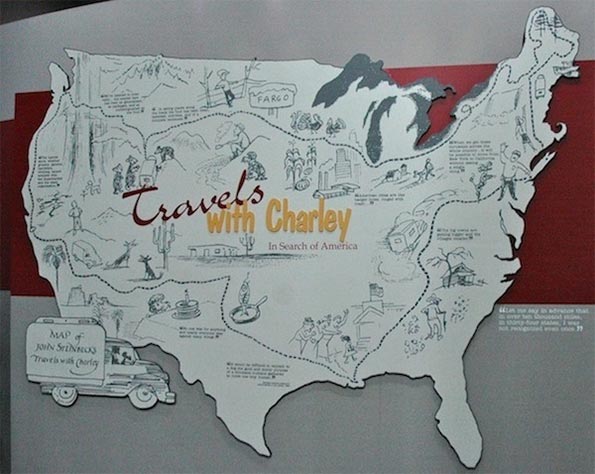
    In the fall of 2010, as part of a book project, ex-newspaperman Bill Steigerwald retraced the route John Steinbeck took in 1960 and turned into his classic “Travels With Charley.” Steigerwald drove 11,276 miles in 43 days from Long Island to the top of Maine to Seattle to San Francisco to New Orleans before heading back to his home in Pittsburgh.  In “Dogging Steinbeck,” his new e-book about how he discovered “Charley” was not nonfiction but a highly fictionalized and dishonest account of Steinbeck’s real trip, Steigerwald describes the America he saw.

    "Big."

    "Empty."

    "Rich."

    "No change since 1960."

    Long after the old farms and new forests of New England disappeared in my rearview mirror, I was still scrawling those words in the reporter’s notebook on my knee. Big, empty, rich and unchanged – that’s a pretty boring scouting report for the America I “discovered” along the Steinbeck Highway. You can add a bunch of other boring but fitting words – “beautiful,” “safe,” “friendly,” “clean,” and “quiet.”

    Like Steinbeck, I didn’t see the Real America or even a representative cross-section of America, neither of which exist anyway. Because I went almost exactly where Steinbeck went and stopped where he stopped, I saw a mostly White Anglo Saxon Protestant Republican America, not a “diverse and politically correct” Obama one. Mostly rural or open country, it included few impoverished or crime-tortured inner cities and no over-developed/underwater suburbs.

    America the Beautiful was hurting in the fall of 2010, thanks to the bums and crooks in Washington and on Wall Street who co-produced the Great Recession.  It still had the usual ills that make libertarians crazy and may never be cured: too many government wars overseas and at home, too many laws, politicians, cops, lawyers, do-gooders and preachers.

    But America was not dead, dying or decaying. There were no signs of becoming a liberal or conservative dystopia. The U.S. of A., as always, was blessed with a diverse population of productive, affluent, generous, decent people and a continent of gorgeous natural resources.

    Everyday of my trip I was surrounded by undeniable evidence of America’s underlying health and incredible prosperity. Everywhere I went people were living in good homes, driving new cars and monster pickup trucks and playing with powerboats, motorcycles and snowmobiles. Roads and bridges and parks and main streets were well maintained. Litter and trash were scarce. Specific towns and regions were hurting, and too many people were out of work, but it was still the same country I knew.

    I didn’t seek out poverty or misery or pollution on my journey, and I encountered little of it. The destitute and jobless, not to mention the increasing millions on food stamps, on welfare or buried in debt, were especially hard to spot in a generous country where taking care of the less fortunate is a huge public-private industry – where even the poor have homes, cars, wide-screen TVs and smart phones.

    I saw the familiar permanent American socioeconomic eyesores – homeless men sleeping on the sidewalks of downtown San Francisco at noon, the sun-bleached ruins of abandoned gas-stations on Route 66, ratty trailer homes parked in beautiful locations surrounded by decades of family junk. I saw Butte’s post-industrial carcass, New Orleans’ struggling Upper Ninth Ward and towns that could desperately use a Japanese car plant.

    But the country as a whole was not crippled or even limping. In the fall of 2010, nine in 10 Americans who said they wanted jobs still had them. The one in 10 who were jobless had 99 weeks of extended unemployment benefits and more than 90 percent of homeowners were still making their mortgage payments.

    Most of the states I shot through – including Maine, northern New Hampshire and Vermont, upstate New York, Wisconsin, Minnesota, North Dakota, Montana – had unemployment and foreclosure rates well below the national averages.

    I didn’t visit the abandoned neighborhoods of poor Detroit. I didn’t see battered Las Vegas, where 14.5 percent of the people were unemployed and one in nine houses – five times the national average – had received some kind of default notice in 2010. But I spent almost two weeks in the Great Train Wreck State of California, where jobless and foreclosure rates were higher than the national average and municipal bankruptcies loomed.

    America had 140 million more people than it did in 1960, but from coast to coast it was noticeably quiet – as if half the population had disappeared. Despite perfect fall weather, public and private golf courses were deserted. Ball fields were vacant. Parks and highway rest stops and ocean beaches were barely populated. Except for metropolises like Manhattan and San Francisco and jumping college towns like Missoula and Northampton, people in throngs simply did not exist. I went through lots of 30-mph towns that looked like they’d been evacuated a year earlier.

    As I drove what’s left of the Old Steinbeck Highway – U.S. routes 5, 2, 1, 11, 20, 12, 10, 101 and 66 – it was obvious many important changes had occurred along it since 1960. Industrial Age powerhouses like Rochester, Buffalo and Gary had seen their founding industries and the humans they employed swept away by the destructive winds of technology and global capitalism. Small towns like Calais in northeastern Maine had lost people and jobs, and vice versa.

    New Orleans had shrunk by half, and not just because of Katrina. The metro areas of Seattle, San Francisco and Albuquerque had exploded and prospered in the digital age. The populations of the West Coast and the Sunbelt had expanded since 1960. The South had shed its shameful system of apartheid and its overt racism, as well as much of its deep-rooted poverty and ignorance. The Northeast had bled people, manufacturing industries and its once overweening role in determining the nation’s political and cultural life.

    Change is inevitable, un-stoppable, pervasive. Nevertheless, it was clear that a great deal of what I saw out my car windows had hardly changed at all since Steinbeck and his French poodle Charley raced by.

    He saw more farmland and fewer forests than I did, especially in the East. But in many places I passed through almost nothing was newly built. Many farms and crossroads and small towns and churches were frozen in the same place and time they were eons ago, particularly in the East and Midwest.

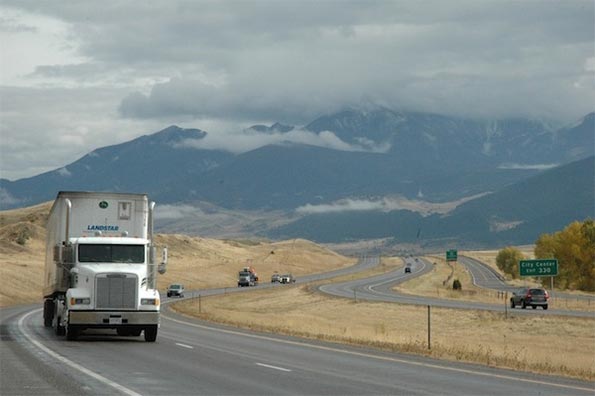
    In Maine the busy fishing village of Stonington was as picturesque as the day Steinbeck left it. He’d recognize the tidy farms of the Corn Belt and the raw beauty of Redwood Country and the buildings if not the people of the Upper Ninth Ward. And at 70 mph whole states – North Dakota and Montana – would look the same to him except for the cell towers and Pilot signs staked out at the interstate exits.

    Steinbeck didn’t like a lot of things about Eisenhower America – sprawl, pollution, the rings of junked cars and rubbish he saw around cities. And he lamented – not in “Charley” but in letters to pals like Adlai Stevenson – that he thought America was a rotting corpse and its people had become too soft and contented to keep their country great and strong.

    But Steinbeck had America’s future wrong by 178 degrees. Fifty years later, despite being stuck in an economic ditch, the country was far wealthier, healthier, smarter and more globally powerful and influential than he could have imagined. Its air, water and landscapes were far less polluted. And, most important, despite the exponential growth of the federal government’s size and scope and its nanny reach, America in 2010 was also a much freer place for most of its 310 million citizens, especially for women, blacks, Latinos and gays.

    You don’t have to be a libertarian to know America is not as free as it should be. But there’s no denying that today our society is freer and more open than ever to entrepreneurs, new forms of media, alternative lifestyles and ordinary people who want to school their own kids, medicate their own bodies or simply choose Fed Ex instead of the U.S. Post Office.

    As for the stereotypical complaints about America being despoiled by overpopulation, overdevelopment and commercial homogenization, forget it. Anyone who drives 50 miles in any direction in an empty state like Maine or North Dakota – or even in north-central Ohio or Upstate New York – can see America’s problem is not overpopulation. More often it’s under-population. Cities like Butte and Buffalo and Gary have been virtually abandoned. Huge hunks of America on both sides of the Mississippi have never been settled.

    From Calais, Me., to Pelahatchie, Miss., I passed down the main streets of comatose small towns whose mayors would have been thrilled to have to deal with the problems of population growth and sprawl.  If anyone thinks rural Minnesota, northwestern Montana, the Oregon Coast, the Texas Panhandle or New Orleans’s Upper Ninth Ward have been homogenized, taken over by chains or destroyed by too much commercial development, it’s because they haven’t been there.

    The America I traveled was unchained from sea to sea. I had no problem eating breakfast, sleeping or shopping for road snacks at mom & pop establishments in every state. The motels along the Oregon and Maine coasts are virtually all independents that have been there for decades. You can go the length of old Route 66 and never sleep or eat in a chain unless you choose to.

    Steinbeck, like many others have since, lamented the loss of regional customs. (I don’t think he meant the local “customs” of the Jim Crow South or the marital mores of the Jerry Lee Lewis clan.)  I didn’t go looking for Native Americans, Amish, Iraqis in Detroit, Peruvians in northern New Jersey or the French-Canadians who have colonized the top edge of Maine.  But I had no trouble spotting local flavor in Wisconsin’s dairy lands, in fishing towns along Oregon’s coast, in the redwood-marijuana belt of Northern California, in San Francisco’s Chinatown or the cattle country of Texas.

    Not to generalize, but the New York-Hollywood elites believe the average Flyover Person lives in a double-wide or a Plasticville suburb, eats only at McDonald’s, votes only Republican, shops only at Wal-Mart and the Dollar Store, hates anyone not whiter than they are, speaks in tongues on Sunday and worships pickup trucks, guns and NASCAR the rest of the week.

    Those stereotypes and caricatures are alive and well in Flyover Country. But though I held radical beliefs about government, immigration and drugs that could have gotten me lynched in many places, I never felt I was in a country I didn’t like or didn’t belong in. Maybe I just didn’t go to enough sports bars, churches and political rallies, but for 11,276 miles I always felt at home.

    Bill Steigerwald, born and raised in Pittsburgh, is a former L.A. Times copy editor and free-lancer who also worked as a docudrama researcher for CBS-TV in Hollywood before becoming a reporter for The Pittsburgh Post-Gazette and a columnist for The Pittsburgh Tribune-Review. He recently retired from daily newspaper journalism.

  • Obama’s Energy Dilemma: Back Energy-Fueled Growth or Please Green Lobby

    Talk all you want about the fiscal cliff, but more important still will be how the Obama administration deals with a potential growth-inducing energy boom. With America about to join the ranks of major natural gas exporters and with the nation’s rising oil production reducing imports, the energy boom seems poised to both  boost our global competitiveness and drive economic growth well above today’s paltry levels.

    This puts President Obama in a dilemma. To please his core green constituency, he can strangle the incipient energy-led boom in its cradle through dictates of federal regulators. On the other hand, he can choose to take credit for an economic expansion that could not only improve the lives of millions of middle- and working-class Americans, but also could assure Democratic political dominance for a decade or more.

    Stronger economic growth remains the only way to solve our nation’s fundamental fiscal problems other than either huge tax hikes or crippling austerity. As economist Bret Swanson has pointed out, the best way to raise revenues and reduce expenditures, particularly for such things as welfare and unemployment, would be to increase overall growth from the current pathetic 2 percent rate to something closer to 3 or 4 percent.

    Swanson suggests in a few simple charts (PDF) that a 4 percent growth rate would drive output to levels that would cover even our current projected spending levels. Even at 3 percent, the additional revenue would be enough, for example, to fill in Medicare’s looming $24.6 billion liability that is projected to 2050. The effects of higher growth are likely far greater than either any anticipated bonanza by raising taxes on the “rich” or enacting the most extreme austerity.

    The energy revolution presents Obama with the clearest path to drive this critical boost to greater economic growth. New technologies for finding and tapping resources, such as fracking and other new technologies to tap older oil fields, could make America potentially the largest oil and gas producer by 2020, according to the International Energy Agency.

    Equally important, an increasingly energy self-sufficient America would enjoy significantly greater independence from pressure from the often hoary influence of such unattractive regimes as Saudi Arabia, Venezuela, and Russia. Approval of the controversial Keystone pipeline from Canada to Texas would cement what would effectively be a North American energy community utterly independent of these trouble spots.

    Those that have embraced the energy revolution have already created a gusher in energy jobs, which pay wages on average higher (roughly $100,000 annually )  than those paid by information, professional services, or manufacturing . The six fastest-growing jobs for 2010-11, according to Economic Modeling Specialists International, are related to oil and gas extraction. In total, nine of the top 11 fast-growing jobs in the nation over the past two years are tied in one way or another to oil and gas extraction.

    Over the decade, the energy sector has created nearly 200,000 jobs in Texas, as well as 40,000 in Oklahoma, and more than 20,000 in Colorado. Growth on a percentage basis is even higher in North Dakota, which saw a 400 percent increase in these jobs, as well as Pennsylvania, where jobs increased by 20,000.

    In contrast California, whose Monterey Formation alone is estimated to be four times larger than North Dakota’s Bakken reserve, has chosen, in its irrepressible quest for ever greater greenness, to sharply limit its fossil-fuel industry As a result, it has generated barely one-tenth the new fossil fuel jobs generated in archrival Texas. Not surprisingly, California and other green-oriented states have lagged behind in GDP and income growth while the energy states have for the most part enjoyed the strongest gains.

    In addition, domestic energy growth directly spurs the construction of new, as well as the rehabilitation of old, industrial facilities. This already is occurring across a vast swath of America, from revived steel mills in Ohio and Pennsylvania to massive new petrochemical plants being planned along the Gulf Coast. Further development of energy resources, according to a study by Price Waterhouse Coopers, could create upwards of a million industrial jobs over the next few years.

    For Obama, getting behind energy boom presents both enormous opportunities as well a serious political dilemma. In terms of cutting emissions, the rising use of natural gas has been a huge boon, allowing the U.S. to make greater cuts than any other major country over the past four years. Yet, the green lobby, once sympathetic to this relatively clean fuel, has turned decisively against any new gas development.

    As a major component of Obama’s wide-ranging  coalition of grievance holders, environmentalists expect  to exercise greater influence in the second Obama term. Hollywood, now virtually an adjunct to the “progressive” coalition, will soon weigh in with Promised Land, a predictably anti-fracking movie, starring Matt Damon. Living up to Hollywood’s tradition of serving as what Lenin called “useful idiots”, the movie is financed in large part  by investors from the United Arab Emirates, whose profits would be threatened by the growth of American energy production.

    The ideological stakes for the green movement are tremendous . Greatly expanded American fossil-fuel production violates the “peak oil” mantra that has underpinned environmental thinking for decades, and undermines some of the core rationale for subsidizing expensive renewables such as solar and wind.

    Geography also may play a major role here. Outside of Colorado, the industrial Midwest and western Pennsylvania, where the shale boom is widely seen as boosting local economies, the vast majority of energy-producing states tilt strongly to the GOP. In contrast, Obama’s strongest support comes from green-oriented coastal residents whose familiarity with energy production starts and ends with turning on a light or switching on an Ipad.

    Obama’s financial base—in contrast to that enjoyed by the Republicans—relies little on the energy industry. The president’s corporate support comes largely from the entertainment, media, and software industries. Many of Obama’s strongest business backers, particularly in Silicon Valley, have become entangled financially with “renewable energy” schemes, many of which can only survive with massive subsidies in the form of tax credits, loans, and surcharges on energy consumers.

    Yet the president has good political reasons not to undermine the energy boom tht can deliver on his promise to deliver high-wage jobs and prosperity to the beleaguered middle class and working classes. In the campaign, the president wisely and openly sublimated his inner green, even taking credit for the expansion of fossil-fuel production. As the campaign came to a close, as Walter Russell Mead observed, “the less we hear about green and the more we hear about brown, about oil and gas drilling.”

    As in so many areas, Obama’s political judgments were on target. His “brown” shift helped deprive the GOP of a key issue in critical swing states such as Colorado, Ohio, and Pennsylvania. Seeming moderation on energy also helped keep Democratic Senate seats in such key producing states as West Virginia, North Dakota, and Montana. A sharp turn back to a hard green position, particularly a ban on fracking, would leave these and other energy-state Democratic miracle babies isolated and vulnerable .

    Right now, the administration’s energy policy seems a bit muddled, as the Obama team emerges from the fog of the campaign wars. On the one hand, there are signs that the Bureau of Land Management may take upwards of 1.5 million acres of western lands off the table for energy production. Yet at the same time, the bureau has announced plans to open 20 million acres off the Gulf Coast for exploration.

    One can understand Obama’s ambivalence on the issue. Embracing the energy boom, and the ensuing economic expansion, could create an economic bonanza while continuing to reduce carbon emissions. This can be further enhanced by backing efforts by natural-gas producers to expand more into the bus, heavy equipment and truck market. On the other hand, this tack will risk the ire of rent-seeking renewable-energy firms and greens,  as well as their media and Hollywood claques.

    Rather than divide the country into green and brown camps, the Breakthrough Institute’s Ted Nordhaus and Michael Shellenberger suggest, the administration should seek “a rapprochement” between the natural gas industry and the environmental movement. Dirtier energy sources, notably coal, could be jettisoned while the country shifts, at least for the medium and short run, toward a greater reliance on cleaner gas energy.

    Ultimately, the decision whether to embrace an energy-led growth strategy may well determine whether President Obama can improve middle-class prospects. In the coming months, he will need to choose between pleasing the green purists around him and generating a long boom that would elevate him to Mount Rushmore levels, and assure his party’s political dominion for a generation.

    Joel Kotkin is executive editor of NewGeography.com and is a distinguished presidential fellow in urban futures at Chapman University, and contributing editor to the City Journal in New York. He is author of The City: A Global History. His newest book is The Next Hundred Million: America in 2050, released in February, 2010.

    This piece originally appeared at The Daily Beast.

    Midwest drilling rig photo by Bigstock.

  • Off the Rails: How the Party of Lincoln Became the Party of Plutocrats

    For a century now, Republicans have confused being the party of plutocrats with being the party of prosperity. Thus Mitt Romney.

    To win back the so-called 47 percent—an insulting description Romney doubled down after the election when he blamed his loss on Obama’s “gifts”—Republican might look farther back, past Calvin Coolidge and Herbert Hoover to their first president, Abraham Lincoln.

    Not only did he spring from the ranks of the plebeian, not the preps, but—as Michael Lind points out in What Lincoln Believed—he aimed to both increase opportunity and expand national power. A corporate attorney, he backed railroad interests and their expansion, which paced the nation’s economic ascendancy, but saw this as part of creating greater opportunity, particularly in the West, for the country’s middle and working classes. He also enacted the Homestead Act, which supplied aspiring settlers with a gift: 160 acres of federal land.

    Whether or not these acts were populist in their intent, their effects helped people achieve their aspirations. Expansion westward was nothing less than the basis of the American dream, allowing millions, many from land-poor and feudalized Europe, an opportunity to strike out on their own.

    This aspirational element should be the centerpiece of the Republican message in this age of growing class bifurcation. The loss of upward mobility long predates President Obama, though it has accelerated under him—with median household incomes down by more than $4,000 since he took office. Even the tepid economy has not done much to improve middle-class fortunes since nearly three-fifths of new jobs are in lower-wage positions.

    Without some unforeseen economic rebound, class issues will dominate our politics in the future even more than they do today. To recover, Republicans, now losing consistently (and often deservedly) on cultural issues, need to outmaneuver the Democrats on their ability to provide opportunity and upward mobility to a broad range of Americans.

    In his time, Lincoln understood the usefulness of class warfare. Tied to industrial interests, he waged a bloody class war on the slave-owning gentry of the South, a group so detestable it makes today’s Wall Street elites seem almost saintly by comparison. Financiers and industrialists may have supported this brutal war between the states, but it was largely aspiring yeoman farmers, skilled workers, and small merchants—all beneficiaries of Lincoln’s expansive economic vision—who fought it.

    In recent decades, Republicans—conscious of their patrician backers—have suppressed thinking about class, often criticizing Democrats for having no such scruples.

    This made them unable to turn issues such as the bank bailouts to their favor; Romney, himself an economic royalist, could not bring himself to denounce the administration’s policies that have worked out wonderfully for large banks now enjoying record profits while pummeling the middle class.

    In the past, Republican deflected class concerns by focusing on cultural issues, national defense, or ideology—but these tactics have worn themselves out. Of course, some conservatives will blame their defeat on a candidate of uncertain convictions and without commitment to the social regressive policies. Yet evangelicals mounted a record effort to get out the vote; it’s hard to see how Romney would have done better trying to sound more like Todd Akin and Richard Mourdock.

    What should concern Republicans was declining turnout in traditionally GOP-leaning suburbs, the very places where middle-class professionals and business owners reside. These voters were not energized by Romney. So even though he improved the GOP’s 2008 vote among the middle class and independents, Romney’s total was about 1,000,000 below that of John McCain. Had Romney equaled McCain’s performance in four states (Florida, Ohio, Virginia, and Colorado), he would have won, rather than losing to a president who received 7 million fewer votes than in the previous election.

    Let’s take a measurement of base stagnation: the nation’s population has grown 20 million since George Bush was elected in 2004, but the GOP vote has actually shrunk. This correlates as well with a stunning decline of roughly 8 million white voters compared to 2008. The white population may be getting old, but it’s not dying off that rapidly.

    This low turnout is remarkable given how unfavorably Obama is viewed by much of the yeoman class. In fact, as Gallup notes, nearly 60 percent of small-business owners disapprove of Obama. The problem was many simply did not see Romney as a viable—let alone an attractive—alternative. In contrast, the Obama team did a far better job of turning out their base of minority, youth, single and childless women, and union members—an effort that delivered their margin of victory in swing states including Ohio, Nevada, and Colorado.

    To change the political dynamic, Republicans need to address class concerns, particularly those of small property owners and aspirant small entrepreneurs. Yet the GOP has no program for this group other than lower taxes and hollow promises to cut the budget (which, of course, they have not done, even when holding both houses of Congress and the presidency). The party’s hodgepodge of corporate managerialism, social regressiveness, and, above all, protection of the plutocratic class is demonstrably not compelling to most Americans.

    It’s hard for a Main Street business owner, or sole proprietor working from home, to relate to a plutocrat, like Romney, who pays lower effective tax rates than they do. Outrage against looming tax hikes would be justifiable, if the true motivation were not so plainly to preserve the privileges of the haute bourgeoisie. This is a politically doomed approach; while small business is widely revered by Americans, big business and banks are among the least well-regarded.

    Class also would provide a means to define negatively the current regime. Instead of making silly attacks on President Obama as a “socialist,” he would be more accurately portrayed as the tribune of both the crony capitalists on Wall Street or Silicon Valley and of big labor, particularly public-employee unions. Obama should also be toxic to grassroots entrepreneurs, who will bear the brunt of the new regulatory regime, health-care system, higher energy prices, as well as rising income taxes.

    Rather than label him as a radical, Republicans should identify him as an avatar of those who are doing best in our concussed economy, and presumably want things to stay that way. His most ardent backers include many of our richest, most celebrated citizens—fabulously wealthy Hollywood types, the Silicon Valley elite as well as those controlling our major media and universities. There’s a reason Obama bested Romney in eight of America’s 10 richest counties.

    In Marin County, Calif.—where Obama claimed nearly 75 percent of the vote—expensive energy and higher housing prices represent not a burden but an environmental good, and, when it comes to housing, an economic opportunity for some to benefit from artificial, government-imposed scarcity. Ban new single-family homes, and the value of the existing stock goes up; for the elite investing class, incentives for “green energy” developments offer insider opportunities to enjoy windfall profits at the expense of middle-class-rate payers.

    If Wall Street wants to join the “progressive” gentry parade again, as it did in 2008, Republican should encourage them. Being the candidate of the phenomenally unpopular financial overclass may have bought Romney the nomination, but it sealed his fate in the general election.

    To reclaim its Lincolnesque transformation, the GOP needs to fundamentally pivot on the role of government. Laissez-faire ideology has its merits, but cannot compete successfully with a population weaned on the welfare state, whose members are keenly attuned to their vulnerability in our volatile era.

    By admitting that government is sometimes a necessary partner in nurturing and sometimes financing infrastructure critical for economic expansion, Republicans can offer their own vision of what growth-inducing services such as new roads—as opposed to the increased regulation and transfer payments and pension bloat peddled by Democrats—government can and should provide. This could appeal to Hispanics, Asians, and younger people who would be the prime beneficiaries of tangible investments.

    As generational chroniclers Morley Winograd and Mike Hais have suggested, most younger people support government action to solve problems but generally dislike the kind of top-down solutions often supported by Democrats. As these voters age, seek to buy homes and start businesses, they might listen to a sensible alternative that does not seek to enhance the left-wing clerisy’s ambition to control all aspects of their lives.

    It’s time for Republicans to break with the traditions of Goldwater, Reagan, and, particularly, Bush and shift to something more akin to the party’s roots in the mid-19th century. This party needs less preaching and libertarian manifestos that essentially defend plutocracy. Instead it’s time to embrace class warfare on today’s gentry, and embrace the aspirations of today’s middle-class. Honest Abe in 2016?

    Joel Kotkin is executive editor of NewGeography.com and is a distinguished presidential fellow in urban futures at Chapman University, and contributing editor to the City Journal in New York. He is author of The City: A Global History. His newest book is The Next Hundred Million: America in 2050, released in February, 2010.

    This piece originally appeared at The Daily Beast.

    Lincoln Memorial photo by Bigstock.

  • Review: Driving Detroit, The Quest for Respect in the Motor City

    For more than a century, the city of Detroit has been an ideological and at times actual battleground for decidedly different views about the economy, labor and the role of government.  At one time it was the center of a can-do entrepreneurialism that helped launch the American automobile industry.  By 1914, for example, no fewer than 43 start-up companies were manufacturing automobiles in the city and surrounding region.  Following a wave of sit-down strikes that began almost immediately after FDR’s landslide victory in 1936, the economic character of the city changed dramatically.  Detroit soon became the quintessential union town, producing in the first decades after World War II the closest facsimile of Social Democracy that the United States has ever seen and in all likelihood will ever see again.    

    Detroit also specialized in race riots.  In 1943, for example, a brawl that broke out at a popular getaway on a Sunday evening in June quickly escalated into mob attacks that resulted in the death of nine whites and 25 blacks.  Because the white police force could not or would not restrain the violence, the mayor asked the governor to call in federal troops.  Twenty four years and one month later in 1967, another Sunday riot broke out.  This time most of the violence occurred between black residents and the police and National Guard.  The death toll was similar, 10 whites and 33 blacks.  Property damage, on the other hand, was far more extensive.  Before the week was out, President Johnson appointed the Kerner Commission to make sense of the conflict and the growing unrest that was afflicting numerous cities all across America. 

    The next major event in the history of Detroit occurred in 1973, when Coleman Young was elected as the city’s first African-American mayor.   He would go on to serve five terms.  While clearly a reflection of the changing demographics in Detroit, Young also personified the city’s long history of union activism, having first gained prominence in the early 1950’s as the leader of the National Negro Labor Council.  In the early 1980’s, in response to persistent economic decline, Young also led the fight to increase the city’s income tax, which included a tax on commuters.  This signaled an important shift in progressive politics in Detroit and elsewhere.  Rather than trying to wring additional revenue from private sector shareholders, labor and its political allies would now focus on the public sector as the preferred vehicle for income redistribution.

    In Driving Detroit: The Quest for Respect in the Motor City, George Galster employs a multi-layered technique to bring the history of the city to life and help explain its current economic predicament.  The title, for example, invokes the R&B classic “Respect” released by Aretha Franklin in 1967.  Lyrics from other popular songs are also quoted, as well as a steady stream of poems by local Detroit poets.  In addition, Galster weaves the stories of select individuals and families into the broader narrative that he constructs.  At the very end, we learn that among the people we have gotten to know are his German-American parents and their forebears.   And finally, Galster, who is the Clarence Hilberry Professor of Urban Affairs at Wayne State University, tries to explain the development of the city and region through what he calls geology, but in urban economics would more commonly be called geography.  This may be the book’s most interesting contribution.

    Galster emphasizes respect, which he defines as a combination of physical, social and psychological needs, because he argues that for many people in Detroit, for a long period of time, these needs were not adequately met.  This was true for blacks, who faced racial prejudice.  It was also true for factory workers, who historically had to endure dangerous working conditions, the monotony of the assembly line, and cyclical unemployment.  The labor movement helped soften the sharper edges of factory work, but Galster shows that it was far less successful at promoting racial harmony.  In part, this was a function of history.  The largest boom in Detroit occurred during World War II, when the city was dubbed the Arsenal of Democracy.  Because immigration had been stopped in the 1920’s, many of the new transplants came from the old South, often bearing well practiced well animosities.  Solidarity in this context was difficult to achieve.   

    Along with the burden of history, another major challenge that Detroit faces today, surprisingly enough, is geography.  In traditional terms, Detroit was an excellent place to build a city, located on a river that has never flooded and soon reaches Lake Erie.  But in modern times, the local topography has proven something of a curse in disguise.  Galster calls this topography a “featureless plain.”   From the beginning, the city and region grew in a land extensive way.   Assembly line manufacturing contributed to lower land use density, because efficiency required large, one story buildings.   Typically, these factory buildings were interspersed among residential communities.  This arrangement made for an attractive and prosperous lifestyle, but with de-industrialization, Detroit has not been able to fall back on a vibrant “old city” that could attract new and creative businesses.

    So what kind of future can Detroit expect?  Galster does not address this question directly, but clearly he appreciates the magnitude of the challenges at hand.  The phenomena that characterize the metropolitan region are not unique, he says, but “Greater Detroit is distinguished by the intense degrees of all these phenomena and their special origins.”  So perhaps the best take-away of Galster’s analysis is that the experience of Detroit should not be used to reach broad conclusions about the prospects of older industrial cities in general.  Rather, it should be used as a cautionary case study.  Detroit cannot alter its topography, but it can address problems like political chauvinism and sub-standard governance that Galster demonstrates have clearly had a negative impact on the business climate.  Progress here in combination with a low cost-of-living and the revolution in natural gas production might then make it possible to attract the investment that the economy needs to re-invent itself.   Certainly that would be the best case scenario.

    Eamon Moynihan is Managing Director for Public Policy at EcoMax Holdings, a specialty finance company that focuses on the redevelopment of previously used properties. 

  • The Biggest Losers In The 2012 Elections: Entrepreneurs

    Who lost the most in economic terms Tuesday? Certainly energy companies now face a potentially implacable foe — and a re-energized, increasingly hostile bureaucratic apparat. But it’s not them. Nor was it the rhetorically savaged plutocrats who in reality have been nurtured so well by the President’s economic tag team of Ben Bernanke and Tim Geithner.

    The real losers are small business owners, or what might be called the aspirational middle class. The smaller business — with no galleon full of legal slaves pulling for them — will face more regulation of labor, particularly independent contracting. There will be more financial regulation, which is why Romney’s top contributors were all banks.

    Small businesses will also face challenges associated with Obamacare, which now will sail on unchallenged. Health care costs are expected to go up 6.5% per employee. Some 58% of businesses say they will shift the costs to their employees. Many owners will face a higher individual tax bill: couples making $250,000 or more and singles making $200,000 or more will pay a 3.8% Medicare tax starting 2013.

    All this is troubling, as American start-up rates are already falling. Much of what happens now occurs not from a great hunger to succeed as a desire to maintain. Outside of the inherently entrepreneurial immigrant classes, the only group of Americans starting business more than before are the fifty somethings and above. Many of these may simply be former employees of larger firms, now doing work sometimes in the same industry and even for the same company.

    Business owners feel under attack. Gallup reports that, of all professions, those who own or operate their own business dislike President Obama the most.

    So what happens now? As an employment engine, small business will continue to hobble given the expected renewed regulatory onslaught. In the blue states, this may come from local authorities, but everywhere from the increasingly powerful federal bureaucratic class. But there may be growth still in the individual proprietor class. For some of them Obama has cut health care costs and start-up costs and increased deductions. And if you take on no or few employees, many of the most difficult mandates will be less onerous.

    In the next few years, entrepreneurial America will morph increasingly into what might be called “the 1099 economy.” Every state in the union has gained these kind of jobs, which include everything from a handyman to a physicist for rent, even those still way behind their 2007 employment.

    This is occurring in both red and blue states. But increasingly it may become the best strategy to survive in the renewed blue America. If you can’t beat them in a stifling regulatory environment, you look to stay under the radar. No surprise then that self employment now accounts for the highest percentage of the workforce in the bluest of states. California, for example, ranked fourth, behind just Vermont, Maine and Montana.

    Obama’s victory, to be sure, places new barriers in front of entrepreneurs of all kinds. But it will not kill off the entrepreneurial spirit, even if it increasingly occurs in an old closet or at the kitchen table.

    Joel Kotkin is executive editor of NewGeography.com and is a distinguished presidential fellow in urban futures at Chapman University, and contributing editor to the City Journal in New York. He is author of The City: A Global History. His newest book is The Next Hundred Million: America in 2050, released in February, 2010.

    This piece originally appeared at Forbes.

    Barack Obama photo by Bigstock.