Tag: middle class

  • Kevin Starr, chronicler of the California dream

    “From the Beginning, California promised much. While yet barely a name on the map, it entered American awareness as a symbol of renewal. It was a final frontier: of geography and of expectation.”

    — Kevin Starr, “Americans and the California Dream, 1850-1915” (1973)

    In a way, now rare and almost archaic, Kevin Starr, who died last week at age 76, believed in the possibilities of California, not just as an economy or a center for innovation, but also as precursor of a new way of life. His life’s work focused on the broadest view of our state — not just the literary lions and industrial moguls but also the farmworkers, the plain “folks” from the Midwest, the grasping suburbanites who did so much to shape and define the state.

    His California was not just movie stars, tech moguls, radical academics, talentless celebrities and equally woeful party hacks who dominate the upper echelons. A native San Franciscan, who grew up in a contentious working-class Irish family and never forgot his roots, Kevin’s California was centered on providing, as he said in a recent interview with Boom California magazine, “a better life for ordinary people.” The diverging fortunes of our people — with many in semi-permanent poverty while others enjoy unprecedented bounty — disturbed him profoundly, and, in his last years, darkened his perspective on the state.

    Over recent years, Kevin was increasingly distraught by what he saw as “the growing divide between the very wealthy and the very poor, as well as the waning of the middle class” that now so characterizes the state. He saw San Francisco changing from the diverse city of his youth, made up of largely ethnic neighborhoods, to a hipster monoculture. With typical humor, he labeled his hometown as essentially “a Disneyland for restaurants,” a playground with little place for raising middle-class families. California has, indeed, changed over the decades, but not always in a good way.

    Kevin Starr’s California

    Kevin Starr represented another, more congenial California, one where people could still disagree on issues, but work for common goods. He was, as his wife Sheila told the New York Times, largely a man of the 1950s, a creature of consensus seekers. He served as state librarian under governors Pete Wilson, Gray Davis and Arnold Schwarzenegger. A conservative-leaning centrist Democrat, he did not fit comfortably in a state that has drifted from a vibrant two-party culture to a dominant progressive monoculture with little more than a Republican rump.

    In today’s hyperpartisan environment, the Golden State must either be a dystopia (the conservative view) or an emerging paradise on earth (the common progressive mantra). Starr, as a fair-minded historian, saw both realities — not only today but through time. In his multipart “California Dream” series, Starr both confronted reaction against ethnic change and celebrated the process of integration, whether for Latinos, Asians or Anglo Okies, whose unique presence, outside of their descendants, is all but lost in contemporary California.

    But what most separated Kevin’s view of California from many others were his humanity and empathy with the aspirations of the state’s middle- and working-class families. Many intellectuals denounce suburbs as racist and exclusionary, as well as environmentally and culturally damaging. Starr saw in them something else — what author D.J. Waldie has described as “Holy Land” — in places like Lakewood, the Bay Area suburbs and Orange County. To him, these were not only places of opportunity, but also landscapes of a reborn “more intimate America,” home to an expanding middle class.

    Read the entire piece at The Orange County Register.

    Joel Kotkin is executive editor of NewGeography.com. He is the Roger Hobbs Distinguished Fellow in Urban Studies at Chapman University and executive director of the Houston-based Center for Opportunity Urbanism. His newest book, The Human City: Urbanism for the rest of us, was published in April by Agate. He is also author of The New Class ConflictThe City: A Global History, and The Next Hundred Million: America in 2050. He lives in Orange County, CA.

    Photo: Institute of Museum and Libraries Service (IMLS website) [Public domain], via Wikimedia Commons

  • The Irony That Could Trip Up Trump’s Quest To Make The U.S. Economy ‘Great Again’

    Perhaps no president in recent history has more pressure on him to perform economic miracles than Donald Trump. As someone who ran on the promise that he could fix the economy — and largely won because of it — Trump faces two severe challenges, one that is largely perceptual and another more critical one that is very real.

    To start, Trump must cope with the widespread idea, accepted by much of the media, that we are experiencing something of an “Obama boom.”

    He is widely portrayed as inheriting a very strong economy, notes MSNBC, in which the U.S. is “the envy of the world.” Fortune sees Trump inheriting “the best economy in a generation.”

    Yet this is more a matter of perception than reality, a kind of “fake news.” To be sure, President Barack Obama inherited a disastrous economy from George W. Bush and can claim, with some justification, that on his watch millions of jobs were restored and the economy achieved steady, if unspectacular, growth. Under Obama average GDP growth has been almost twice as high as under his predecessor, but roughly half that of either President Reagan or Clinton.

    Less appreciated, however, are the fundamental long-term weaknesses in the U.S. economy that Obama and Bush have left for Trump. A recent report from the U.S. Council on Competitiveness details a litany of profound, lingering flaws — historically slow growth, rising inequality, stagnant incomes, slumping productivity and declining lifespans. As the report concludes: “The Great Recession may be over, but America is dangerously running on empty.”

    These make for challenging conditions for Trump to make good on his promise to “make America great again.”

    Since 2005 the vast majority of new jobs created have been part-time, and most have been in low-end service professions. Full-time middle-class employment, particularly in fields like manufacturing, construction and energy, has recovered some, but not enough to rekindle a broad sense of economic opportunity. Both the numbers of the rich, and those of the poor, grew markedly under our now departing President. There are now 16 million more people on food stamps than in 2008, and homeownership is down to the lowest level in nearly 50 years.

    Trump may have lost the popular vote but given his awful approval numbers, it’s a testament to how deep the distress is for millions amid this economic malaise that he managed to come even close. Perhaps more importantly House Republicans, also running against the economy, outpolled their rivals by 3.5 million votes. Their constituents differ from that of the blue states won by Hillary Clinton. These states, whose economies depend more on financial engineers, real estate speculation, media and technology development, did well – or at least those who worked in these industries did.

    Trump’s Biggest Challenge

    Trump won because of Middle America — largely white, suburban and small town, mainly in the vast region between the Appalachians and the Rockies. To consolidate his grip on power, and that of his unruly party, he needs to extend the weak, but long-lasting Obama recovery into something that drives up higher wage employment in manufacturing, energy and services.

    This is where Trump’s emerging nationalist policies could come into play. Conservatives and liberals alike sneer at his needling of big corporations, foreign and domestic, over jobs, but what is the job of a President? Shouldn’t he be on the side of average citizen in Podunk, USA? If Trump can bring good jobs back to Middle America, notes analyst Aaron Renn , a native of southern Indiana, they’ll appreciate it. Trump, he notes, is “sending a powerful message to workers that they matter and he will fight for their interests. “

    His jawboning of CarrierFordGM and Sprint, and even the mighty Apple, could all be dissected as dependent on subsidies, incentives and intimidation. But people in Indianapolis, southeast Michigan and Kansas City are not theoretical beings waiting for the welfare leavings of the coastal super-rich. Their desires matter as much as those of sensitive souls in San Francisco or Brooklyn.

    There are certainly ways — tax policies, regulatory reform, infrastructure investment — that might spark growth and get companies to create more jobs here.

    Is Trump Up To The Job?

    There is nothing better for an economy than mass prosperity, which is something now sorely missing. That means people buying houses, getting married, having babies, the essentials of a strong middle class economy. Anyone who delivers those goods — last accomplished by Bill Clinton and Ronald Reagan — seems certain of re-election. This is particularly critical for the roughly seven in 10 Americans who have less than $1,000 in savings.

    Of course, Trump seeks to achieve this goal is using a very different approach than either Clinton or Reagan. He has chosen to follow an economic nationalist course that, in some ways, seek to reverse the approach embraced by both of these successful Presidents and much of the nation’s establishment. In contrast to virtually everyone who has held the White House since the 1940s, Trump did not run for leader of the world; he ran, very purposely, as the candidate of Americans. Clinton, like the European Union have offered more complexity, notes the Guardian; Trump, like many effective leaders, boiled everything down to simple memes.

    Whether this populist course will work is not clear. Critics in the Democratic Party have pointed out, correctly, that Trump’s cabinet hardly fits a populist mold. It’s full of Wall Street financiers and high level corporate executives. He also will face opposition within his own party, which remains largely chained to big business interests and includes many advocates for ever expanding globalization. Similarly many “routine” jobs that paid well have fallen not simply to foreigners, but to automation and technology.

    Yet ultimately Trump has proven himself something of savvy politician — far more than anyone suspected — and seems, at least for now, to be keeping his eye on the ball. The specter of tax, regulatory reform and more infrastructure spending is already ramping up projections of long lagging investment from businesses. And the general population, however deeply divided, seems more optimistic than in previous years, which could further stimulate the economy.

    This could reinforce the notion that Trump’s hectoring of executives, and pushing economic nationalism, could prove effective in creating broad based economic growth for the emerging post-globalization era. Now it’s a matter of whether he can pull this off without sparking a trade war, an international meltdown or another recession that could turn him not into the new Reagan, but the latest version of Herbert Hoover.

    This piece originally appeared in Forbes.

    Joel Kotkin is executive editor of NewGeography.com. He is the Roger Hobbs Distinguished Fellow in Urban Studies at Chapman University and executive director of the Houston-based Center for Opportunity Urbanism. His newest book, The Human City: Urbanism for the rest of us, was published in April by Agate. He is also author of The New Class ConflictThe City: A Global History, and The Next Hundred Million: America in 2050. He lives in Orange County, CA.

    Photo by Gage Skidmore from Peoria, AZ, United States of America (Donald Trump) [CC BY-SA 2.0], via Wikimedia Commons

  • Working-Class Nostalgia

    The first time I presented a paper at an academic conference, I was accused of being nostalgic. My mistake, as my fellow academic pointed out, was that in my bid to find some value in working-class occupational cultures I was guilty of backward looking romanticism. It wasn’t meant to be constructive criticism, but over the years I’ve developed a longstanding interest in the idea of nostalgia which is often attached to working-class life.

    So I’ve been especially interested in the ways that political developments on both sides of the Atlantic have involved nostalgia as the backward-looking voters supported Brexit in the UK and Trump in the US.  We may see more of this in France, with support for Le Pen later this year. Charges of nostalgia in these situations refer to a whole range of stances and attitudes, from the more benign sentiments of those who want a return to full industrial employment or desire a greater sense of community to those who more darkly ‘want their country back’, which too often is code for freedom to discriminate. Looking beyond recent elections, we can to detect a backward-looking trend in television, in programmes such as Call the MidwifeDownton AbbeyMad MenEndeavour, or the new Netflix series, The Crown.  In politics and popular culture, many seem to be happiest when living in the past.

    However, by using the term nostalgia as a catchall criticism we often miss the complexity and nuance involved, and class often has a big part to play here. Those who study nostalgia note that it almost always tells us more about attitudes toward the present than views of the past. It is precisely because people feel unsettled about their current unstable situation and unknowable future that they seek solace in the comfort of the past. Scholars also point out that nostalgia is very rarely ‘simple’ in the sense that people want to live in the past. They are almost always critical, even reflective, about both the present and the past, and they find something of value in that past that may have been lost.

    Finally, while it is true that nostalgia is often portrayed as an anti-progressive, anti-modern conservative emotion, it can also have a more creative, progressive, even radical side. I think it is this aspect of nostalgia that can help us think more critically about working-class culture. Reporters and commentators explain voting behaviour using the familiar tropes of ‘smokestack nostalgia’ and ‘rustbelt romanticism’. But dig a little deeper, listen a little more carefully, and it’s easy to see why people might want to return to the past when industrial workers earned $28 per hour and enjoyed good pensions, health care, and perhaps above all, long-term job security. To be nostalgic for those aspects of the past is not only understandable, it’s completely rational. While these positive aspects of the past may sometimes erase less desirable aspects of history, many workers who mourn the loss of earlier jobs are at the same time critical of the past or the work they may have done. As part of my research, I often interview workers who did routine and mundane jobs. Quite a few have said that they hated their jobs but loved the people they worked with. I remember vividly a former coal miner from the North East of England telling me that he despised the physical labour of the mine but would return tomorrow if he could because he missed the comradeship of those he had worked with.

    Here then is the point about nostalgia. It seems to me that we need to listen carefully when people talk about their pasts. Dismissing a desire for positive aspects of a remembered past as romantic, conservative, and anti-progressive is wrong-headed, and it also misses a real opportunity. Surely, we want working-class people to remember what collective action and union shops achieved.  We want people to be ambitious for themselves and their kids.

    But above all we need to harness the more radical and progressive aspects of a nostalgia that leads people to ask why. Why is it that industrial working-class jobs paid more in the past than they do now? Why were terms and conditions better in the thirty years of the long boom after World War Two? And why did working-class people in that period enjoy rising standards of living year after year, while today similar groups know only precarity? Once we ask these questions, we can start to argue for a more positive, open, and progressive future. We cannot just leave the past to more reactionary voices who want to capture the negative aspects of nostalgia for their own ends.

    This piece first appeared at Working Class Perspectives.

    Tim Strangleman, University of Kent

  • The Demographics of Poverty in Santa Clara County

    Tucked away in the bottom corner of the San Francisco Bay, tech royalty make themselves at home in their silicon castles. Santa Clara County is the wealthiest county in California, and 14th in the nation, boasting an average median household income of $96,310. However, where there are kings, there must be subjects. Despite its affluence, Santa Clara remains one of the most unequal counties in the United States. The combined forces of enormous wage gaps, exorbitant housing prices, and shifts in the regional economy have compounded over recent years, resulting in a shrunken middle class and increased poverty levels.

    Santa Clara County contains just over 1.9 million people and is home to much of the Silicon Valley. The relatively recent explosion of growth in the high-wage technology industry has generated a new rank of upper-middle class to fabulously wealthy individuals. But, even in the economic miracle that is Silicon Valley, poverty remains a prevalent force and affects a disturbing number of lives in the region. Although, according to the Census Bureau, only 8.3% of Santa Clara County residents live at or below the Federal Poverty Level (FPL), this number drastically underestimates the true number of people that are experiencing financial hardship in the region. In a study conducted by United Way, it was found that the real cost budget for a family of four residing in Santa Clara County stands at $65,380 per year, or 281% of the FPL.

    High regional housing costs account for much of the discrepancy in poverty levels between the county and the nation. A study out of the California Budget and Policy Center calculated that the poverty rate in Santa Clara County soars to 18% when factoring in housing costs, meaning nearly one in five residents live in poverty.

    It is for this reason that the region has one of the largest homelessness populations in the nation, with around 7,600 homeless individuals residing within Santa Clara County. When local homeless individuals were surveyed regarding obstacles to securing housing, the top four answers were as follows: No job/income, no money for moving costs, bad credit, and lack of available housing. Of course, poverty is cyclical, and these answers affect one another to some extent: a lack of income means no money for moving costs, which may lead to bad credit and which could then lead to an inability to secure permanent housing. Around 56% of survey respondents also reported being homeless for over a year, up significantly from 47% just two years prior, indicating that the homeless in Santa Clara County continue to face significant obstacles to securing housing. High homelessness rates are symptoms of a greater trend: the fact that gross income inequalities in Santa Clara County have created a society of have’s and have not’s, separated by an income gap that shows no sign of closing.

    Housing Trends

    The most significant impediment to financial security in the county is the volatile housing market and the exorbitant cost of owning a home. According to a report conducted by the U.S. Department of Housing and Urban Development on the South Bay Area, the average price of houses sold in 2014 stood at $788,500 for an existing home and $828,000 for a new home. This is over four times the median value of homes nationally, which stands at $178,600. The disparity is even more prevalent in the areas of the region closer to large technology firms, such as Palo Alto, where the average home costs $2.43 million. San Jose also has the 7th largest share of renters in major U.S. cities, 56 percent, a rate that only continues to increase as housing costs do the same. The median gross rent in Santa Clara County stands at $1705 per month, nearly double the national average.

    Current trends indicate that the increasing housing costs show no signs of reversing, which does not bode well for residents that are already struggling financially. A study from the California Budget and Policy Center found that, in 2013, over 50% of households classified as low-income were at risk of moving out of the area due to increased housing costs.

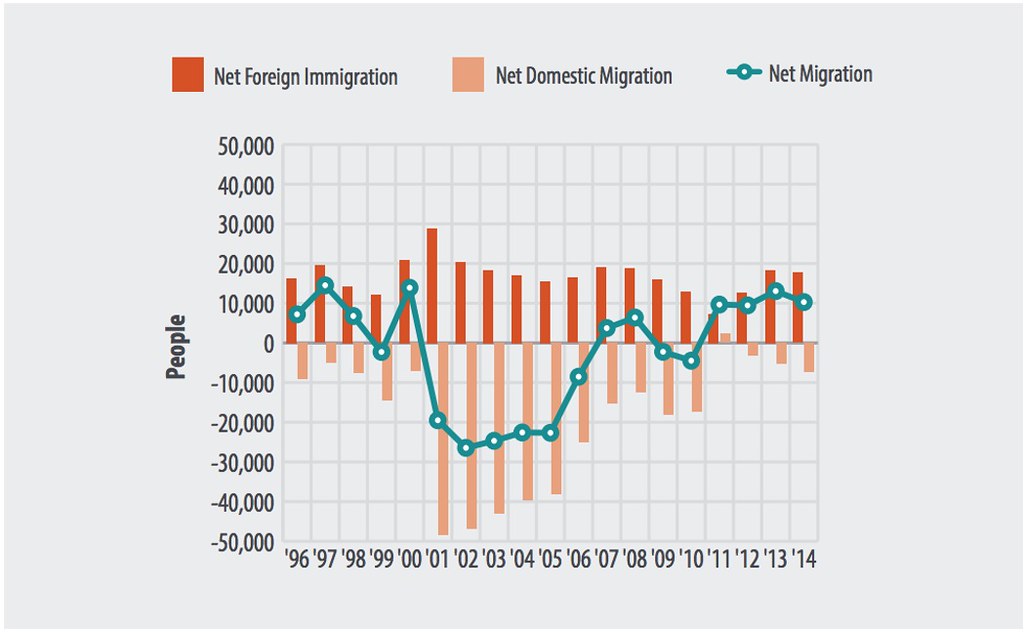
    Net domestic migration in Santa Clara County is overwhelmingly negative.

    The result of high housing costs? Net domestic migration has been negative every year since 1996, except 2011, and appears to be dipping further, despite the fact that the population of Silicon Valley has grown continually in recent years. This can be attributed to a combination of natural births and massive foreign immigration rather than domestic migration. Therefore, negative net domestic migration suggests that a large portion of residents are leaving the area due to a lack of an income that cannot keep up with rising costs of living.

    However, for those who stay, high housing prices lead to a plethora of other disadvantages, creating a cycle of poverty that decreases social mobility in the region. A search for cheaper housing has led many to seek living arrangements in the southern and eastern parts of San Jose, where housing is cheaper, but comes at the cost of higher crime rates and worse school districts. Additionally, job growth has been concentrated in the western parts of the county. The search for cheap housing has led to an increase in overcrowded households, as residents move in with one another in order to share the costs of rent. The Santa Clara County Department of Public Health concluded in 2014 that 14% of residents were living in overcrowded households, with 5% living in severely overcrowded households. Latinos in the region are disproportionately affected, with 31% living in overcrowded households and 12% living in severely overcrowded households.

    The combination of these factors limits social mobility by undermining each individual’s access to economic opportunity. Moving into an overcrowded house in an underfunded public school district limits potential to obtain a quality education that may provide access to high-skilled, high-wage jobs.

    The Income Gap

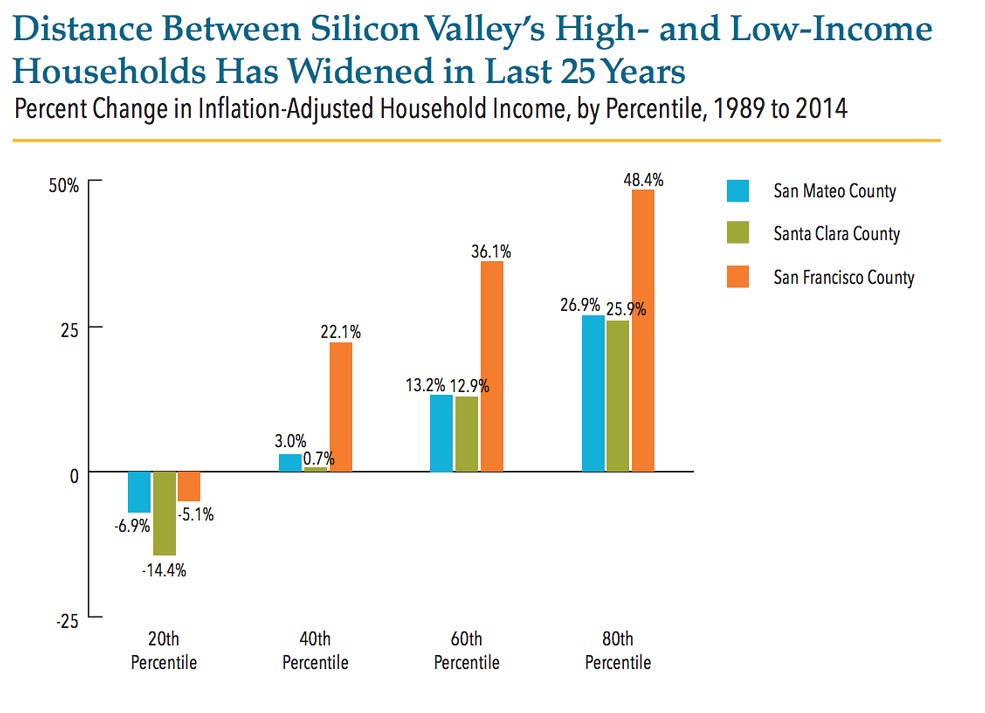
    Inequality in the region is perpetuated by a growing income gap, and the ardent hunt for afford-able housing may be explained by the gross income disparities among residents. As housing prices have skyrocketed over recent years, incomes simply have not kept up with costs of living, particularly at the lower end of the spectrum.

    Santa Clara County’s income gap has widened considerably since 1989.

    Economic gains in the region have flowed overwhelmingly to the top quintile of income-earners, who have seen their wages increase by over 25% over the past 25 years. In a shocking comparison, income levels have declined for low-income households since 1989, a clear sign of a widening wealth gap in the region. Those at the bottom also find themselves working harder for less money: the average income for those living above the previously described real cost of living in Santa Clara County stands around $27 per hour, whereas the average income for those living below the real cost of living comes in at a bit over $10, around the current California minimum wage.

    To make matters worse, government efforts have proven relatively ineffective in remedying regional inequality. A recent study has shown that even when a family is a recipient of CalWORKS and CalFresh benefits, government-funded initiatives to provide benefits to needy families, an average family of four is still tens of thousands of dollars away from comfortably subsisting in Santa Clara County. Additionally, government benefits are not reaching populations that would benefit from them the most: a United Way study found that less than 19% of single mothers and less than 5% of immigrants statewide subscribe to these programs.

    Shifts in the Regional Economy

    Efforts to increase wages of low-paying jobs may alleviate financial hardship to a certain degree, but these actions fail to consider an underlying trend in Santa Clara County: low-skilled, blue collar jobs are disappearing. Wage increases in industries heavily populated by lower income earners matter little if those jobs do not exist. Historically, Santa Clara County was a manufacturing hub, famous for producing semi-conductors along with other components vital to the burgeoning technology industry. However, recent years have seen manufacturing jobs leaving the area in droves, either to other parts of the country or abroad.

    Sector growth in the region, percentage change, 2000-2014.

    The chart above shows that job growth in Santa Clara County has only been observed in a few sectors of the local economy. Despite this growth, total nonfarm payroll employment has decreased in the past 15 years, and the impact of this job loss may be observed across the economy. The most significant reductions of the workforce have occurred in sectors referred to as “blue-collar,” typically middle income jobs that may or may not require higher education. These types of jobs cover many of those within the goods-producing sectors, comprised here of the mining, logging, construction, and manufacturing industries.

    The rapid decline of “blue collar” jobs in the region may be attributed at least in part to the explosive growth of Silicon Valley. As the region attracts more skilled workers, increases the region’s desirability, and pays workers competitive wages capable of keeping up with costs of living, those very expenses will continue to drive upwards. As a result, workers across all economic sectors have demanded higher wages, a sentiment exemplified in the recent minimum wage hikes. Unfortunately, this drives lower-paying blue-collar industries to relocate, often out of the state, so they can lower their input costs, creating a polarized society of high-wage earners in the information sector along with low-wage earners in a service sector dedicated to the needs of the technocrats.

    Santa Clara County is a place of immense, but heavily-concentrated wealth. Multi-billion-dollar technology campuses dot the landscape like behemoths, yet the wealth and progress that accompanied the growth of the Silicon Valley has also left a significant proportion of its population behind. The environment is increasingly hostile to social mobility, the manufacturing sector has skipped town, and government efforts to mitigate the effects of these changes have proven relatively unsuccessful. Trends have shown that the region’s poor are increasingly confined to specific industries and geographies, and their freedoms restricted as they are subject to a degree of economic violence that shows no immediate signs of relenting. Significant shifts in local policy are needed to reverse the current social and economic trends and ameliorate the situation in an increasingly polarized Santa Clara County.

    Alex Thomas is currently a sophomore at Chapman University pursuing a major in Political Science. He is originally from San Jose, California, and has worked extensively within the city and surrounding areas. He hopes to further his interest in local politics through continued study and community involvement in the upcoming years.

    Photo: Coolcaesar [CC BY-SA 3.0], via Wikimedia Commons

  • Our Most Popular Stories of 2016

    2016 is gone, 2017 is here. Here’s a look back at the most popular stories at New Geography in 2016. Happy New Year, and thanks for reading.

    12. This is Why You Can’t Afford a House. Back in February, Joel Kotkin made the case that housing costs are a huge burden on America’s middle class and argued for more discussion on the topic at the national level. This piece was also published by The Daily Beast.

    11. Super Bowl: Super Subsidy Sunday. Just in time for last year’s Super Bowl, Matthew Stevenson outlined the massive public subsides enjoyed by pro sports franchises.

    10. The New War Between States. In this Real Clear Politics Essay, Joel points out the variation in economic DNA across different regions of the country and the need to adjust policy to leverage those differences as a national competitive advantage.

    9. What Happens When Wal-Mart Dumps You. Joel breaks down the future of the retail industry and its potential impacts on communities of all types: urban areas, suburbs, and small towns. This piece was also published by The Daily Beast.

    8. Farewell Grand Old Party. From his weekly Orange County Register column, Joel notes how the rise of Trump signals a turning point for the Republican Party.

    7. America’s Next Boom Towns: Regions to Watch in 2016. One year ago Joel and I created an index to identify some of the best-performing large U.S. metropolitan areas. This piece appeared in Forbes.

    6. Best Cities for Jobs 2016. Our annual Best Cities for Jobs index ranks all of America’s metropolitan areas according to short- and longer-term job growth performance. Follow the link to see the various topical rankings.

    5. New York’s Incredible Subway. In this piece Wendell Cox describes New York City’s subway system, unlike any other transit system in the United States.

    4. Best and Worst: 2015 International Housing Affordability Survey. Wendell’s Annual Demographia International Housing Affordability Survey is a critical comprehensive reference on worldwide housing affordability by urban area. Here’s the highlights of the report.

    3. Today’s Tech Oligarch’s are Worse than the Robber Barons. Joel argues that the political influence of high-tech business leaders are worse than the robber barons of the last century because today’s tech firms offer little to improve the lives of the middle class.

    2. An Open Letter to the Democratic National Committee from a Rural Democrat. Former North Dakota State Senator Tyler Axness offers his advice to Democratic Party leaders from the perspective of rural America.

    1. Largest Cities in the World: 2016. Wendell’s annual World Urban Areas report is perhaps the most comprehensive resource for worldwide urban population data. This April 2016 article summarizes the report.

    Mark Schill is a community and corporate strategy consultant with Praxis Strategy Group and Managing Editor of New Geography.

  • Obama’s not so glorious legacy

    Like a child star who reached his peak at age 15, Barack Obama could never fulfill the inflated expectations that accompanied his election. After all not only was he heralded as the “smartest” president in history within months of assuming the White House, but he also secured the Nobel Peace Prize during his first year in office. Usually, it takes actually settling a conflict or two — like Richard Nixon or Jimmy Carter — to win such plaudits.

    The greatest accomplishment of the Obama presidency turned out to be his election as the first African American president. This should always be seen as a great step forward. Yet, the Obama presidency failed to accomplish the great things promised by his election: racial healing, a stronger economy, greater global influence and, perhaps most critically, the fundamental progressive “transformation” of American politics.

    Racial healing

    Rather than stress his biracial background, Obama, once elected, chose to place his whiteness in the closet and identified almost entirely with a particular notion of the American black experience.

    Whenever race-related issues came up — notably in the area of law enforcement — Obama and his Justice Department have tended to embrace the narrative that America remains hopelessly racist. As a result, he seemed to embrace groups like Black Lives Matter and, wherever possible, blame law enforcement, even as crime was soaring in many cities, particularly those with beleaguered African American communities.

    Eight years after his election, more Americans now consider race relations to be getting worse, and we are more ethnically divided than in any time in recent history. As has been the case for several decades, African Americans’ economic equality has continued to slip, and is lower now than it was when Obama came into office in 2009, according to a 2016 Urban League study.

    The economic equation

    On the economy, Obama partisans can claim some successes. He clearly inherited a massive mess from the George W. Bush administration, and the fact that the economy eventually turned around, albeit modestly, has to be counted in his favor.

    Yet, if there was indeed a recovery, it was a modest one, marked by falling productivity and low levels of labor participation. We continue to see the decline of the middle class, and declining life expectancy, while the vast majority of gains have gone to the most affluent, largely due to the rising stock market and the recovery of property prices, particularly in elite markets.

    At the same time, Obama leaves his successor a massive debt run-up, doubling during his watch, and the prospect of steadily rising interest rates. Faith in the current economic system has plummeted in recent years, particularly among the young, a majority of whom, according to a May 2016 Gallup Poll, now have a favorable view of socialism. Economic anxiety helped spark not only the emergence of Bernie Sanders, but later the election of Donald Trump.

    Read the entire piece at the Orange County Register.

    Joel Kotkin is executive editor of NewGeography.com. He is the Roger Hobbs Distinguished Fellow in Urban Studies at Chapman University and executive director of the Houston-based Center for Opportunity Urbanism. His newest book, The Human City: Urbanism for the rest of us, was published in April by Agate. He is also author of The New Class ConflictThe City: A Global History, and The Next Hundred Million: America in 2050. He lives in Orange County, CA.

    Photo: The Official White House Photostream (originally posted to Flickr as P012109PS-0059) [CC BY 2.0 or Public domain], via Wikimedia Commons

  • “There Can’t Be a Successful Indianapolis Without a Successful Indiana”

    Back in 2008 or 2009 I gave a Pecha Kucha presentation in Indianapolis in which I said:

    “Cities can’t survive on gentrification alone. The broad community has to be a participant in its success. That’s why I’m somewhat down on the notion of the creative class. It’s good as far as it goes, but it’s a self-consciously elitist vision. Where’s the working class in that?

    Arguing among ourselves [city vs. suburbs] is like beggars fighting over table scraps. We need to build the city up without tearing the suburbs down.

    There can’t be a successful Indianapolis without a successful Indiana….While [metro] Indy has 25% of the states’ population, it has 60% of the state’s population growth and 80% of its economic growth. That’s not healthy. Like it or not, we’re dependent on the state for critical infrastructure funds and other things. So our challenge is how to bring the rest of the state along with us.”

    I’ve long been an advocate for the restoration what I call the commonwealth, the idea that we rise and fall together as a people and all have skin the game. This idea has gone by the wayside to say the least.

    It may well be that American society has become irredeemably tribalized. I hope not. At a minimum, there are significant sized groups with fundamentally incompatible ideas of the public good. There’s a lot to unpack in that statement, but not today.

    Richard Florida has talked about a “great reset” of the economy. Clearly we need some sort of institutional reset to contain or resolve these differences. We’ve done this before in creating the original Constitution to replace the Articles of Confederation, fighting a Civil War and redefining the federalism of that constitution, the New Deal era changes, and perhaps others.

    What that looks like, I don’t know. But if we are to reach it without even more severe upheavals, it’s likely to involve some renewed form of federalism, agree to disagree, live and let live, etc – and on durable basis, not just an opportunistic and self-interested one.

    This will involve painful change and difficult decisions. One of them is that we must be willing to give others the freedom to make choices for themselves and their communities that we fundamentally disagree with.

    To the extent that we believe all of the big decisions of our society are morally determined, and thus not properly the subject of political debate, this means we are in a winner take all world. If you want that world, you’d better be really sure you are right and sure you are going to win – because you face ruination if you’re wrong on either count.

    It also means that we need to figure out how to have both love and accountability towards all of our citizens. Right now that means that rural white Republicans in victory cannot ignore the continued urgent need to integrate urban black America into full participation in middle class success and to address other aspects of what Richard Florida has labeled the “new urban crisis.”

    It also means that working class whites must be challenged to change. I have made no secret in these pages that these communities too often have sabotaging traits that really aren’t necessary to cling to – such as the disparagement of ambition for better.

    But urban and left leaning populations, including minority groups, need to likewise address travails of the white working class, and be willing to make painful changes of their own.

    To be honest, I’m not optimistic. But I am hopeful. The future hold possibilities for ill that we cannot know – but it likewise holds the possibility for good things we can’t yet imagine.

    Aaron M. Renn is a senior fellow at the Manhattan Institute, a contributing editor of City Journal, and an economic development columnist for Governing magazine. He focuses on ways to help America’s cities thrive in an ever more complex, competitive, globalized, and diverse twenty-first century. During Renn’s 15-year career in management and technology consulting, he was a partner at Accenture and held several technology strategy roles and directed multimillion-dollar global technology implementations. He has contributed to The Guardian, Forbes.com, and numerous other publications. Renn holds a B.S. from Indiana University, where he coauthored an early social-networking platform in 1991.

    Photo: By Daniel Schwen (Own work) [CC BY-SA 4.0], via Wikimedia Commons

  • How Silicon Valley’s Oligarchs Are Learning to Stop Worrying and Love Trump

    The oligarchs’ ball at Trump Tower revealed one not-so-well-kept secret about the tech moguls: They are more like the new president than they are like you or me.

    In what devolved into something of a love fest, Trump embraced the tech elite for their “incredible innovation” and pledged to help them achieve their goals—one of which, of course, is to become even richer. And for all their proud talk about “disruption,” they also know that they will have to accommodate, to some extent, our newly elected disrupter in chief for at least the next four years.

    Few tech executives—Peter Thiel being the main exception—backed Trump’s White House bid. But now many who were adamantly against the real-estate mogul, such as Clinton fundraiser Elon Musk, who has built his company on subsidies from progressive politicians, have joined the president-elect’s Strategic and Policy Forum. Joining Musk will be Uber’s Travis Kalanick, who half-jokingly threatened to “move to China” if Trump was elected.

    These are companies, of course, with experience making huge promises, and then changing those promises to match new circumstances. Uber, for instance, touted itself as a better deal than a cab for both riders and drivers before it prepared to tout a better deal for riders by replacing its own soon-to-be obsolete drivers with self-driving cars.

    Silicon Valley and its leading mini-me, the Seattle area, did very well under Barack Obama, and expected the good times to continue under Hillary Clinton. Tech leaders were able to emerge as progressive icons even as they built vast fortunes, largely by adopting predictably politically correct issues such as gay rights and climate change, which doubled as a perfect opportunity to cash in on Obama’s renewable-energy subsidies. Increasingly tied to the ephemeral economy of software and media, they felt little impact from policies that might boost energy costs or force long environmental reviews for new projects.

    No wonder Silicon Valley gave heavily to Obama and then Clinton. In 2016, Google was the No. 1 private-sector source of donations to Clinton, while Stanford was fifth. Overall the electronics and communications sector gave Democrats more than $100 million in 2016, twice what they offered the GOP. In terms of the presidential race, they handed $23 million to Hillary, compared to barely $1 million to Trump.

    Yet, there is one issue on which the Valley has not been “left,” and that is, predictably, wealth. It may have liked Obama’s creased pants and intellectually poised manner, but it did not want to see the Democrats become, God forbid, a real populist party. That is one reason why virtually all the oligarchs favored Clinton over Sanders, who had little use for their precious “gig economy,” the H-1B high-tech indentured-servants program, or their vast and little-taxed wealth.

    Jeff Bezos, the Amazon founder with a net worth close to $70 billion, used his outlet, The Washington Post, to help bring down Bernie, before being unable, despite all efforts, to stop Trump. So now Bezos sits by Trump’s side, hoping perhaps that the president-elect’s threats to unleash antitrust actions against Amazon will be conveniently forgotten as an artful “deal” is struck.

    For these and other reasons, there’s little doubt that the tech elite would have been better off under Clinton, who likely would have, like Obama, disdained antitrust actions and let them keep hiding untaxed fortunes offshore. Now, they will have to share the head table with the energy executives they’d hoped to replace with their own climate-change-oriented activities.

    The tech oligarchs have long had a problem with what many would consider social justice. Although the tech economy itself has expanded in the current period, its overall impact on the economy has been less than stellar. For all of its revolutionary hype, it’s done little to create a wide range of employment gains or boost worker productivity.

    To be sure, there have been large surges of employment in the Bay Area, Seattle, and a handful of other places. California alone has more billionaires than any country in the world except China, and nearly half of America’s richest counties.

    But for much of the country, notably those areas that embraced Trump, the tech “disruption” has been anything but welcome news. This includes heavily Latino interior sections, home to many of America’s highest employment rates. Overall, the “booming” high-wage California economy celebrated by progressive ideologues like Robert Reich does not extend much beyond the Valley. In most of California, job gains have been concentrated in low-wage professions.

    Despite its vast wealth, California has the highest cost-adjusted poverty rate in the country, with a huge percentage of the state’s Latinos and African Americans barely able to make ends meet. California metropolitan areas, including the largest, Los Angeles, account for six of the 15 metro areas with the worst living standards, according to a recent report from demographer Wendell Cox. Meanwhile, the middle and working class, particularly young families, continue to leave, with more people exiting the state for other ones than arriving to it from the, in 22 of the past 25 years.

    Even in Silicon Valley itself the boom has done little for working-class people, or for Latinos and African Americans—who continue to be badly underrepresented at the top tech firms as many of those same firms aggressively promote diversity. A study out of the California Budget and Policy Center (PDF) concluded that with housing costs factored in, the poverty rate in Santa Clara County soars to 18 percent, covering nearly one in every five residents, and almost one-and-a half times the national poverty rate. Since 2007, amidst an enormous boon, adjusted incomes for Latinos and African Americans in the area actually dropped (PDF).

    Much of this has to do with change in the Valley’s industrial structure, which has shifted from manufacturing to software and media. The result has been a kind of tech alt-dystopia, with massive levels of homelessness, and housing costs that are prohibitive to all but a small sliver of the local population.

    With a president whose base is outside the Bay Area, and dependent on support in areas where jobs are the biggest issue, the tech moguls will need to find ways to fit into the new agenda. The old order of relentless globalization, offshoring, and keeping profits abroad may prove unsustainable under a Trump regime that has promised to reverse these trends. In some senses the Trump constituency is made up of people who are the target of Silicon Valley’s “war on stupid people.” Inside the Valley, such people are seen as an obstacle to progress, who should be shut up with income supports and subsidies.

    So can Silicon Valley make peace with Donald Trump, the self-appointed tribune of the “poorly educated”? There are two key areas where there could be a meeting of minds. One is around regulation. One of the great ironies of the tech revolution is that the very places that are home to many techies—notably blue cities such as San Francisco, Austin, and New York—also tend to be the very places most concerned with the economic impacts of the industry.

    Opposition to disruptive market makers in the so-called sharing economy like Uber, Lyft, and Airbnb is greatest in these dense, heavily Democratic cities. What’s left of the private-sector union movement and much of the progressive intelligentsia is ambivalent if not downright hostile to the “gig” economy. Ultimately, resistance to regulations relating to this tsunami of part-time employment could be something that Trump’s big business advisers might share in common with the techies.

    More important will be the issue of jobs. It may not work anymore for firms to lower tech wages by offshoring jobs or importing lots of foreign workers under the H-1B visa program, since Trump has denounced it. IBM’s Ginni Rometty, who had been busily replacing U.S. workers with ones in India, Brazil, and Costa Rica, has now agreed to create 25,000 domestic jobs. Other tech companies—including Apple—have also been making noises shifting employment to the United States from other countries. Trump may well feel what “worked” with Carrier can now be expanded to the most dynamic part of the U.S. economy.

    If the tech industry adjusts to the new reality, they may find the Trump regime, however crude, to be more to their liking than they might expect. Companies like Google may never again have the influence they had under Obama, but many techies may be able to adjust. As long as the new president “deals” them in, the techies may be able to stop worrying about Trump and begin to embrace, if not love, him.

    This article first appeared on The Daily Beast.

    Joel Kotkin is executive editor of NewGeography.com. He is the Roger Hobbs Distinguished Fellow in Urban Studies at Chapman University and executive director of the Houston-based Center for Opportunity Urbanism. His newest book, The Human City: Urbanism for the rest of us, was published in April by Agate. He is also author of The New Class ConflictThe City: A Global History, and The Next Hundred Million: America in 2050. He lives in Orange County, CA.

    Photo by Gage Skidmore from Peoria, AZ, United States of America (Donald Trump) [CC BY-SA 2.0], via Wikimedia Commons

    Photo: MCR World

  • The Future of Racial Politics

    From its inception, the American experiment has been dogged by racial issues. Sadly, this was even truer this year. Eight years after electing the first African-American president, not only are race relations getting worse, according to surveys, but the electorate remains as ethnically divided as in any time of recent history.   

    Donald Trump has emerged in most media accounts as the candidate of Anglo voters, with a margin of 21 percentage points over Hillary Clinton among that segment of the electorate. Clinton’s embrace of “identity” politics may have played a role in turning off many of these white non-Hispanic voters, who might otherwise had voted Democratic.

    Many Democrats maintain still, with some justification, that as demographics evolve over the next decade, the increasingly diverse electorate will reward their identification with racial minorities. The country, and the electorate, seem destined to become ever less white in the coming decades.  Between 2000 and 2015, the nation’s population makeup became increasingly minority, from 31 percent to 38 percent. This trend will continue, with the country conceivably becoming 45 percent non-white by 2030 and 53 percent by 2050.

    White Men Can’t Jump, But They Can Still Vote

    It may well be that Democrats this year jumped the demographic gun. Even as the white population diminishes, it retains a dominant influence in elections. One reason: Whites tend to vote more. Most critical, the African-American share of the electorate, which reached record highs with Barack Obama atop the ticket,  actually dropped by a percentage point in 2016. Latino turnout, widely seen as a surge that would elect Clinton, represented  about the same percentage –11 percent — in 2016 as in 2012.  

     Thesedynamics keyed the Trump victory, particularly in heavily white working-class precincts in the Midwest, Pennsylvania and Florida, where he secured his electoral victory. Many of the pivotal states electorates remain very white indeed. In Wisconsin, for example, more than 80 percent of voters are white, and most of them are not residents of liberal college towns like Madison. This is also the case for Pennsylvania, where more than 75 percent of voters are Caucasian. Even Florida – itself a very diverse state — still has a heavily white electorate, accounting for more than 55 percent of voters.  

     These patterns will remain critical past what might be seen as their sell-by date for two critical reasons. One has to do with the concentration of minority voters. Nearly 60 percent of African-Americans live in Southern states where Trump won by dominating a very conservative white electorate. Other minority voters are clustered in big cities in the Northeast, which are not remotely contestable for Republicans.

     Latino voters, and also Asians, are likewise heavily concentrated, particularly in California,   now essentially a non-GOP zone, as well as the similarly politically homogeneous Northeastern cities and Chicago. To be sure, Latinos are also critical in Texas, and Asians too (increasingly so), but for now the Texas white population still outvotes them by a considerable margin.

     Another problem for the much-ballyhooed “emerging Democratic majority” lies in one stubborn fact: The elderly, most of whom are white, are not dying out quickly enough for Democrats to win. Although the extension of life spans may have slowed, or even slightly reversed in some demographic segments, seniors are clearly living longer than before.  

    The Limits of Identity Politics    

    Ignoring the reality of economic decline in the states that swung to Trump, some observers maintain that the increased conservatism among white working-class voters reflects deep-seated racial antagonisms. But this does not explain the considerable movement  of these voters, particularly in the Rust Belt, from support for Obama to support for Trump, as seen in such places as Youngstown, Ohio, Wheeling, W.Va., Macomb County, Mich., and Erie, Pa.

    The Democratic Party made things easier for Trump by adopting identity politics as its mantra. This is particularly maddening when charges of racism are leveled by affluent professionals, academics and bureaucrats, many from elite universities, who are themselves privileged.

    To their credit, some  progressives suggest shifting away — at least in the short run — from identity politics. But racial determinism may now be too central to their ideological core. Bernie Sanders’ campaign spokesperson Symone Sanders, for example, said that when it comes to picking a new leader for the  Democratic National Committee, whites need not apply.    

     Matthew Yglesias, always an excellent window on progressive dogma, insists that “there’s no other kind of politics” but identity politics; Democrats, he asserts, simply need “to do it better.” Progressives seem about as ready to ditch racialist politics  as Southern segregationists were willing to abandon Jim Crow in 1948.

    The Coming GOP Crisis

    For Republicans, identity politics is the gift that keeps giving, but the question is for how long. If you want a nightmare racial scenario for the GOP, just look at California. Since 1994, when the state passed Proposition 187, a measure widely perceived as anti-Hispanic, the Anglo population has dropped by more than 2 million as the state has added 9 million people, including more than 7 million Hispanics. Minorities now account for 62 percent of the population, compared to 43 percent in 1990. The shift in the electorate has been slower but still significant. In 1994, 49 percent of the electorate was Democratic and 37 percent Republican. Due in large part to ethnic change, by 2016 the Democratic margin was 45 percent-26 percent.

    In California this surge in minority voters has accompanied a gradual erosion of the white population, a large portion of which has left for other states. The Golden State  also has gone out of its way to encourage immigration of undocumented aliens by offering them driver’s licenses, subsidized health care and  financial aid for college; 74 percent of all California children under 15 are  now minorities, compared to 66 percent in 2000, and  25 percent of them live below the poverty line. This is 2.5 times the white non-Hispanic rate in California.  

    Despite largely positive results outside the blue coastal states, potentially the biggest long-term problem facing Republicans is in a dominant aspect of geography:  suburbia. Trump lost   some largely affluent suburban areas like Orange County, where 55 percent the population is Latino or Asian, up from 45 percent in 2000.  Perhaps most emblematic of potential GOP problems was Trump’s — and the GOP’s —  loss of Irvine, a prosperous Orange County municipality that is roughly 40 percent Asian.

    Republicans should be even more worried about trends in Texas, where Latinos are already close to a plurality and the Asian population is surging. There are still enough conservative whites to win elections in Texas — Trump won by 10 percentage points — but the margins will continue to shrink. This trend can already be seen in Houston’s sprawling, increasingly multiracial suburbs. Trump, for example, lost solidly middle-class Fort Bend County, by some estimates among the most diverse in the country, which voted Republican in every presidential elections since 1968.

    If this pattern continues, the die may indeed be cast for the GOP. As most minorities now live in the suburbs — a trend that continues to increase — a loss of suburban voters, given the total Democratic lock on inner city electors, would be too much for rural and small-town whites to overcome.  Simply put, by 2030, losses in the multicultural suburbs could make dreams of progressive long-term dominance all but inevitable.

    How Republicans Can Withstand the Racial Shift

    Republicans must reverse these trends if they don’t want to go the way of the dinosaur. They can take some limited satisfaction in knowing that Trump did somewhat  better than Mitt Romney or John McCain among Hispanics and blacks  as well as improving slightly among Asians.

    To expand on these modest gains, Republicans need to focus not on race but economics.  Our recent study for the Center for Opportunity Urbanism demonstrates clearly that minorities generally do far better in red states than in blue ones, based on such factors as income, homeownership, entrepreneurship and migration. Minorities all continue to move in ever larger numbers to red states because their economic climate and regulatory regime work better for them.

    Conservatives can make a case that Barack Obama’s progressive agenda actually favored the highly affluent, who tend to be disproportionately white.  According to a 2016 Urban League study,  African-American levels of economic equality are lower now than in 2009, surely a disappointment for a black middle class so understandably proud of Obama’s elevation.

    The best role model for the GOP could be in Texas. Latinos in the Lone Star State generally do better than their counterparts in California — as measured by homeownership, marriage rates, incomes — and also tend to vote more conservatively. In 2014, for example, Republican Gov. Greg Abbott won 44 percent of Texas Latinos. In contrast, that same year Democratic Gov. Jerry Brown won 73 percent of the Latino vote in California.  

    Other factors, notably upward mobility among  Latinos, African-Americans and Asians, could play a transformative role. As they continue to move to the suburbs, buy houses and start businesses, they may become less likely to support a high-regulation, high-tax and redistributionist agenda. Since 2000, more than 95 percent of the minority growth (black, Asian and Hispanic) in the 52 largest metropolitan areas has been in suburban and exurban areas. Trump did much better among college-educated black males, for example,  than those with no college education — 16 percent vs. 11 percent.

    If more minorities enter the middle class, particularly under Trump, this  could provide an opening for Republicans, just as occurred after the World War II when Italian, Irish, Polish and other eastern European voters moved to the suburbs and assimilated, even intermarried, after years of living apart. A message that targets the middle class aspirations of minorities could be more effective in the long run than appealing merely to xenophobic sentiments shared by an inexorably diminishing population.

    Critically, in the coming  decades, the vast majority of Latinos and Asians will be native-born. They will have spread out increasingly not only within regions but to more conservative parts of the country, notably Texas and the Southeast. At the same time, the population of undocumented workers, the least assimilated and generally the poorest demographic, is already declining, down by 300,000 since 2008. If it continues to decline, which may be likely under Trump, immigration may soon fade away as a primary issue for Latinos.

    Perhaps even more critical, however, may be the growing trend toward intermarriage among minorities. Among second-generation Latinos and Asians, interracial marriage is creating what could become an increasingly fluid racial identity. Intermarriage involving African-Americans is also on the upswing. The new generation of ethnic hybrids, most with one Anglo parent, will no longer be easily pigeon-holed ethnically. Overall, 15 percent of marriages were between partners of different ethnic groups in 2012.

    These are all opportunities to succeed, but the GOP can only prolong itself if it finds a way to reach minority voters based on an appeal of economic mobility. Whether they take this tack, or simply play for time until white voters lose their primacy, may determine whether it is the stupid party that some suggest, and one that, even at its great moment of opportunity, is destined to remain permanently so.

    Ultimately, Republicans could build on Trump’s economic message by demonstrating its efficacy for minority voters. This may be the party’s only hope in the future, given the demographic trends. The competition could also encourage Democrats to focus more on “bread and butter” issues. If future presidential campaigns are waged over key economic issues, rather than pitting ethnicities against one another, the nation will be both unified and stronger.

    This article first appeared on Real Clear Politics.

    Joel Kotkin is executive editor of NewGeography.com. He is the Roger Hobbs Distinguished Fellow in Urban Studies at Chapman University and executive director of the Houston-based Center for Opportunity Urbanism. His newest book, The Human City: Urbanism for the rest of us, was published in April by Agate. He is also author of The New Class ConflictThe City: A Global History, and The Next Hundred Million: America in 2050. He lives in Orange County, CA.

    Wendell Cox is principal of Demographia, an international public policy and demographics firm. He is a Senior Fellow of the Center for Opportunity Urbanism (US), Senior Fellow for Housing Affordability and Municipal Policy for the Frontier Centre for Public Policy (Canada), and a member of the Board of Advisors of the Center for Demographics and Policy at Chapman University (California). He is co-author of the “Demographia International Housing Affordability Survey” and author of “Demographia World Urban Areas” and “War on the Dream: How Anti-Sprawl Policy Threatens the Quality of Life.” He was appointed to three terms on the Los Angeles County Transportation Commission, where he served with the leading city and county leadership as the only non-elected member. He served as a visiting professor at the Conservatoire National des Arts et Metiers, a national university in Paris.

    Photo: Steve White, Creative Commons
  • Babes In Trumpland: The Coming Rise Of The Heartland Cities

    Contrary to the media notion that Donald Trump’s surprising electoral victory represented merely the actions of unwashed “deplorables,” his winning margin was the outcome of rational thinking in those parts of the country whose economies revolve around the production of tangible goods.

    And their economies stand to gather more steam in the years ahead.

    Trump’s victory was largely minted in the suburbs and smaller cities of the new American Heartland, from Pittsburgh to Omaha to Dallas-Ft. Worth. The heartland regions depend on agriculture, home construction, manufacturing and energy, all of which could benefit from the policies of the new presidential administration and Republican Congress. In contrast, Hillary Clinton favored extending the Obama administration’s policies on fossil fuels and housing that may win support in the dense progressive bastions of the East and West coasts, but were viewed with alarm by many tied to heartland industries, some of which have been under pressure from a global decline in commodity prices.

    Trump’s pro-fossil fuel stance may be anathema in the coastal cities, but will have a very positive effect on the many cities in the “oil patch” that extends from Texas’ Permian Basin to North Dakota, Ohio and western Pennsylvania. This is not just a matter of roughnecks out on the Gulf or West Texas; many of the 100,000 or so jobs lost in the energy industry over the past few years were located in major cities, such as Houston, where many of the employees are both well-educated and dwell close to the urban core.

    Most important of all, manufacturing matters in the heartland in ways that no longer resonate in coastal areas, particularly New York and San Francisco. Since 2000, two of America’s historic centers for manufacturing, Los Angeles and New York together have lost over 600,000 manufacturing positions. Trump’s call for more U.S. industrial jobs could turn out a swan song, but every job that stays in America due to his cajoling is more likely to benefit people in suburban St. Louis or Detroit than Manhattan or Malibu.

    Building on Momentum

    Critically, Trump’s election comes at a time when heartland cities already had economic momentum, including in the Rust Belt.

    The stock, real estate and tech booms on the coasts, as well as increased regulation and taxation there, have made interior cities increasingly attractive to relocating companies and migrants. This is most evident in Texas’ leading metropolitan areas — Dallas-Ft. Worth, Austin, San Antonio and, until recently, Houston — which have consistently led the nation in job and population growth.

    When California companies like Apple look to add middle-class jobs, they don’t often do it in the Golden State, but in more affordable places like Austin. Every big Texas city in recent years can show you a big scalp from my adopted home state: Occidental to Houston, for example, or Toyota America and Jacobs Engineering to Dallas.

    Similar patterns can be seen in the rapid expansion of such smaller cities as Nashville, Charlotte, Columbus, Salt Lake City — all in states that Trump won handily. These cities have developed impressive central cores, but have seen larger scale growth on their periphery. Resilient Great Plains cities like Fargo, Omaha and Sioux Falls have spiffed up and attracted investments in everything from tech and financial services to health care.

    Other industries, such as financial services and business and professional services, are also moving increasingly to heartland cities, and some are building impressive presences in health care.

    Voting With Their Feet

    Perhaps the most underreported, but significant shift towards heartland cities has been a human one. Before, educated people generally clustered in favored blue cities such as San Francisco, New York, Boston, Washington, D.C., and Chicago. This thesis was well documented by urban analyst Richard Florida in his “Rise of the Creative Class.”

    Yet when Richard and I were together in Kansas City last month we were treated to a tour of the region’s ascendant neighborhoods, both in the city and in adjacent parts of Kansas.Cities like Kansas City have seen their downtown residential populations surge, but the vast majority of growth there, as well as in the rest of heartland, tends to be on the periphery.

    As growth in New York and other “hip” cities has slowed, populations are shifting to less expensive ones. Research by demographer Wendell Cox has found that since 2010 over 1.45 million people net have moved from Clinton states to those that favored Trump.

    This increasingly includes young people, according to research conducted at Cleveland State University. There has been a sea change in the migration patterns of educated millennials since 2010, with faster growth in heartland cities than the Bay Area, Washington or New York.

    The biggest drivers for migration to Trumpland tends to be housing prices and rents. Housing prices across the New heartland overall Is 3.4 times the median household income (this is a price-to-income ratio called the “median multiple”). This compares to 7.5 times in California and 4.3 times in the Northeast Corridor (Washington to Boston).Given the choice between more expensive locales on the coasts and less expensive ones in the interior, many people have begun to flock to places like Des Moines, Omaha, Indianapolis and Columbus.

    These trends may become more pronounced when the bulk of millennials enter their 30s and begin to start families and buy homes. Derek Thompson of the Atlantic observes: “The great irony of national migration is that media headquarters overwhelmingly reside in the same dense urban areas that other Americans are desperately trying to escape (or cannot afford).”

    A similar trend may soon take place among immigrants. The Trump campaign may have sought to demonize some of the foreign born, notably the undocumented and Muslims, but many of the cities now growing their immigrant populations most rapidly are in the heartland.

    Houston has been gaining more foreign-born residents than Los Angeles; Dallas now has a higher share of foreign-born residents than Chicago.

    Now the immigrants are expanding to other mid-American outposts such as Nashville, Indianapolis and Columbus. Trumpian politicians may seek to exploit xenophobic sentiments, but metropolitan boosters across the heartland are quick to promote their appeal with foreign-born residents, seeking their entrepreneurial energy and enriching cultural influences. When in Nashville, boosters take you not just to the old country music haunts, but to thriving Kurdish, Somali,  and Mexican enclaves.

    Can Trumpland take success?

    Yet for Trump and his allies in the Republican Party, the resurgence of heartland cities will also bring with it risks. Some of those who now find their future in Kansas City or Houston also bring with them attitudes shaped in blue states, something some progressives are counting on. They may have escaped the worst aspects of ultra-high taxes and abusive regulations, but sometimes this does not stop them from wanting to repeat the old patterns in their new homes.

    the core cities in most of the larger heartland metropolitan areas are either deep blue, as is the case in the Great Lakes, or are turning blue, including Dallas and Houston. The suburbs, particularly the new, further out ones, have remained deeply conservative, but this also could change over time as more young people and immigrants migrate there. Heartland success could undermine some of the very reasons for their resurgence.

    Success also has strange impacts on people’s thinking, and ultimately a resurgent heartland, populated by newcomers and immigrants, could take a very different turn in the decades ahead.

    But this can only happen if Democrats somehow learn to craft their appeal to places outside their current deep-blue bastions. Trump may have won in large part due to the misfortunes heaped on these in the past, but, unless challenged, he ultimately may further consolidate his base by riding on the ascendancy.

    This piece first appeared in Forbes.

    Joel Kotkin is executive editor of NewGeography.com. He is the Roger Hobbs Distinguished Fellow in Urban Studies at Chapman University and executive director of the Houston-based Center for Opportunity Urbanism. His newest book, The Human City: Urbanism for the rest of us, will be published in April by Agate. He is also author of The New Class ConflictThe City: A Global History, and The Next Hundred Million: America in 2050. He lives in Orange County, CA.

    Photo by Max Goldberg from USA (Trump Cedar Rapids) [CC BY 2.0 (http://creativecommons.org/licenses/by/2.0)], via Wikimedia Commons