Tag: middle class

  • Mapping the College Culture Gap

    Although the television series “Mad Men” has yet to take up the subject of college applications, I could well imagine an episode in which ad man Don Draper spends his day consuming vast quantities of Scotch and cigarettes, only to come home and have his wife say (while ignoring the lipstick on his collar): “I spoke to Millie today, and she had some good things to say about Williams.”

    When Britain still had an Empire, what mattered most was to get your daughters married and your sons into a good regiment. In Homeland America, all that matters to middle-class and affluent parents is getting their children into the best colleges that money can buy or that the Standardized Aptitude Test will allow.

    Friends of mine who have college-bound children talk only about test schedules, AP credits, summer programs for gifted children, sports highlight reels, and the easiest routes to Duke or Pomona.

    They search family trees for ancestral connections or minority status, and make charts of other friends who might know someone at Yale. Editors at the New Yorker are consulted about personal statements. During school downtime, kids are dispatched to examine China’s terra-cotta warriors or Seattle’s soup kitchens, all with the goal of padding the college application.

    I say all this as a parent who is about to launch his third child in the direction of the ivory towers, with no better idea than what guided us in sending off the first two. For years my wife and I have talked about colleges the way other couples play canasta. We use it to fill the lazy hours in the car or after dinner, as each of us is already familiar with each other’s reading lists and views about Rick Santorum.

    What prolongs these familiar exchanges is that we are the parents of American children who have grown up in Switzerland, attending public schools in French. The college conversation has become a proxy for whether we are Europeans or Americans. Whatever decisions we make, they feel like the wrong ones.

    When the children stay in Switzerland, I feel they have missed out on what I had in the American liberal arts, although when they leave for the States, it feels far away, expensive, and obsessed with the cult of Goldman’s Sachs-ism.

    Swiss secondary education is roughly similar to U.S. high school, although collège, as it is called in French, has a thirteenth year and every year students are weeded out of the university track. Our daughter Helen was the only member of her sixth grade class to graduate from a Swiss university. Of the 350 students who started with her in the tenth grade at collège, only about 200 graduated; the rest were relegated to apprenticeships or trade schools.

    For anyone in Switzerland who earns their high school diploma (known as a maturité gymnasiale), the entire university system is an open door, and tuition is $1000 a year. The country has little college testing and applications. To attend law or business school, a student merely adds his or her name to a list. The trick to staying at university is maintaining a B average, and only about two-thirds of each class does.

    University in Switzerland is much closer to American graduate school than a U.S. liberal arts education. Students specialize in a branch of study, say, law, economics, literature, or engineering. Classes, at least in the first year, are large lectures, and the best grades are given to those students who write down what the professor has said and recall this wisdom on the final exam.

    Readings only supplement the lectures. In later years, there are more seminars and papers, but the system recalls the hierarchy of a German universität more than a Berkeley teach-in. Facts count far more than expressing your feelings about Siddhartha.

    In physical layout, Swiss universities look like inner-city high schools. Few offer social clubs, sports programs, psychological counseling, toga parties, or alumni gatherings. Their goal is to teach a specified curriculum. If the Ivy League is best understood as the first class ticket of higher education, a Swiss university is more like Southwest or easyJet—the seats are cramped and the champagne is extra.

    With another daughter at an American college, I am struck—in comparison with the Swiss system—by the engagement that the U.S. professors have with their students, and at their goal of inspiring undergraduates to think for themselves. One professor said to my daughter, early on in her studies: “Laura, you’ve written a Swiss paper. I want an American paper. Tell me what you think.”

    Of course, such independence of mind costs $200,000 over four years, so that your child can then spend another eighteen months as an unpaid intern at Sterling Cooper, gaining what the market, as well as Balzac, might call “experience.”

    With our nineteen-year-old son, now in his last year of collège, we decided to split the geographical and financial differences between the U.S. and Switzerland, and encouraged him to apply to British universities, which are a cross between America’s liberal arts and Europe’s narrow focus.

    Three years’ tuition in England is about $50,000, and London is only an hour’s flight from where we live. We liked the idea that he would be studying in English and in small tutorials with eccentric professors. When I went with my son to his interview at Cambridge (he did not get in), I was struck by how detached Britain is from the rest of Europe. Not a single Swiss student has been admitted to the university in three years, and the translation of Swiss transcripts into English grades makes it clear that it might be another decade before any more are admitted.

    Britain, like America, suffers from grade inflation, so everyone comes out of high school sounding terrific, with great marks and astonishing teacher recommendations. By contrast, the Swiss take great pleasure in grade deflation (the motto might be: “Every Child Left Behind”), and do a terrible job of promoting their students to the rest of the world.

    An excellent average in a Swiss collège gets reported to Britain or the U.S. as someone with C+ grades. My daughter finished third in her Swiss class, and her recommendation letter from the school, in its entirety, read: “Laura Stevenson has fulfilled all the requirements of Collège de Saussure.” Little wonder that she was turned down at many American universities.

    What do I want from a university for my children? I want them to be able to write clear, forceful English (or French) that is informed and, if they choose, amusing. I want them to have the intellectual ability to challenge accepted assumptions—for example, that the New Deal ended the Depression, George Washington had a great military mind, or Shakespeare wrote all his plays.

    I would like them to learn to read critically, so that can they scoff at cant and pretense: for example, to see that Yale man Bob Woodward writes in language that looks as if it has been translated from Slovakian. I would also like them to view their education as a plant that needs watering on most days following graduation.

    If my older son goes to college in England, we might be tempted to send our last child, also a son, to university in either France or Germany. That way, each of our children will have been educated in a different system. Then, in ten years, as we judge their successes or failures, we can rail about the rigidity of the Confederation of the Rhine, the British class system, Swiss banality, or U.S. careerism—or we can sing the praises of German rigor, the legacy of the English enlightenment, Swiss precision, or the iconoclastic American mind.

    Photo: Prof Believeau’s Yale University by Ina Centaur

    Matthew Stevenson is the author of Remembering the Twentieth Century Limited, a collection of historical essays. He lives in one of the wine regions of Switzerland. His next book is Whistle-Stopping America.

  • Don’t Bet Against The (Single-Family) House

    Nothing more characterizes the current conventional wisdom than the demise of the single-family house. From pundits like Richard Florida to Wall Street investors, the thinking is that the future of America will be characterized increasingly by renters huddling together in small apartments, living the lifestyle of the hip and cool — just like they do in New York, San Francisco and other enlightened places.

    Many advising the housing industry now envisage a “radically different and high-rise” future, even though the volume of new multi-unit construction permits remains less than half the level of 2006. Yet with new permits at historically low levels as well for single-family houses, real estate investors, like the lemmings they so often resemble, are traipsing into the multi-family market with sometimes reckless abandon.

    Today the argument about the future of housing reminds me of the immortal line from Groucho Marx:Who are you going to believe, me or your lyin’ eyes? Start with the strong preference of the vast majority of Americans to live in detached houses rather than crowd into apartments. “Many things — government policies, tax structures, financing methods, home-ownership patterns, and availability of land — account for how people choose to live, but the most important factor is culture,” notes urban historian Witold Rybczynski.

    Homeownership and the single-family house, Rybczynski notes, rests on many fairly mundane things — desire for privacy, need to accommodate children and increasingly the needs of aging parents and underemployed adult children. Such considerations rarely enter the consciousness of urban planning professors, “smart growth” advocates and architectural aesthetes swooning over a high-density rental future.

    Just look at the numbers. Over the last decade— even as urban density has been embraced breathlessly by a largely uncritical media — close to 80% of all new households, according to the American Community Survey, chose to settle in single-family houses.

    Now, of course, we are told, it’s different. Yet over the past decade, vacancy rates rose the most in multi-unit housing, with an increase of 61%, rising from 10.7% in 2000 to 17.1% in 2010. The vacancy rate in detached housing also rose but at a slower rate, from 7.3% in 2000 to 10.7% in 2010, an increase of 48%. Attached housing  – such as townhouses –  posted the slightest increase in vacancies, from 8.4% in 2000 to 11.0% in 2010, an increase of 32%.

    The attractiveness of rental apartments may soon be peaking just in time for late investors to take a nice haircut. Rising rents, a byproduct of speculative buying of apartments, already are making mortgage payments a more affordable option in such key markets as Atlanta, Chicago, Miami, Phoenix and Las Vegas.

    Urbanist pundits often insist the rush to rental apartments will be sustained by demographic trends. One tired cliché suggest that empty nesters are chafing to leave their suburban homes to move into urban apartments. Yet, notes longtime senior housing consultant Joe Verdoon, both market analysis and the Census tells us the opposite: most older folks are either staying put, or, if they relocate, are moving further out from the urban core.

    The two other major drivers of demographic change — the millennial generation and immigrants — also seem to prefer suburban, single-family houses. Immigrants have been heading to the suburbs for a generation, so much so that the most diverse neighborhoods in the country now tend to be not in the urban core but the periphery. This is particularly true in Sunbelt cities, where immigrant enclaves tend to be in suburban areas away from the core.

    Millennials, the generation born between 1983 and 2003, are often described by urban boosters as unwilling to live in their parent’s suburban “McMansions.” Yet according to a survey by Frank Magid and Associates, a large plurality define their “ideal place to live” when they get older to be in the suburbs, even more than their boomer parents.

    Ninety-five million millennials will be entering the housing market in the next decade, and they will do much to shape the contours of the future housing market. Right now many millennials lack the wherewithal to either buy a house or pay the rent. But that doesn’t mean they will be anxious to stay tenants in small places as they gain some income, marry, start a family and simply begin to yearn for a somewhat more private, less harried life.

    In the meantime, many across the demographic spectrum are moving not away from but back to the house. One driver here is the shifting nature of households, which, for the first time in a century are actually getting larger. This is reflected in part by the growth of multi-generational households.

    This is widely believed to be a temporary blip caused by the recession, which clearly is contributing to the trend. But the move toward multigenerational housing has been going on for almost three decades. After having fallen from 24 percent in 1940 to barely 12 percent in 1980, the percentage topped over 16 percent before the 2008 recession took hold. In 2009, according to Pew Research Center, a record 51.4 million Americans live in this kind of household.

    Instead of fading into irrelevance, the single-family house seems to be accommodating more people than before. It is becoming, if you will, the modern equivalent of the farm homestead for the extended family, particularly in expensive markets such as California. This may be one of the reasons why suburbs — where more than half of owner-occupied homes are locatedactually increased their share of growth in almost all American metropolitan areas through the last decade.

    Some companies, such as Pulte Homes and Lennar, are betting that the multi-generational home — not the rental apartment — may well be the next big thing in housing. These firms report that demand for this kind of product is particularly strong among immigrants and their children.

    Lennar  has already developed models — complete with separate entrances and kitchens for kids or grandparents — in Phoenix, Bakersfield, the Inland Empire area east of Los Angeles and San Diego, and is planning to extend the concept to other markets. “This kind of housing solves a lot of problems,” suggests Jeff Roos, Lennar’s regional president for the western U.S. “People are looking at ways to pool their resources, provide independent living for seniors and keeping the family together.”

    But much of the growth for multigenerational homes will come from an already aging base of over 130 million existing homes. An increasing number of these appear to being expanded to accommodate additional family members as well as home offices. Home improvement companies like Lowe’s and Home Depot already report a surge of sales servicing this market.

    A top Home Depot manager in California traced the rising sales in part to the decision of people to invest their money in an asset that at least they and their family members can live in. “We are having a great year ,” said the executive, who didn’t have permission to speak for attribution. “ I think people have decided that they cannot move so let’s fix up what we have.”

    These trends suggest that the widely predicted demise of the American single family home may be widely overstated. Instead, particularly as the economy improves, we may be witnessing its resurgence, albeit in a somewhat different form. Rather than listen to the pundits, perhaps it would be better to follow what’s before your eyes. Don’t give up the house.

    This piece originally appeared in Forbes.com.

    Joel Kotkin is executive editor of NewGeography.com and is a distinguished presidential fellow in urban futures at Chapman University, and contributing editor to the City Journal in New York. He is author of The City: A Global History. His newest book is The Next Hundred Million: America in 2050, released in February, 2010.

    Photo by Bigstockphoto.com.

  • Housing Affordability: St. Louis’ Competitive Advantage

    Things are looking better in St. Louis. For decades, St. Louis has been one of the slowest-growing metropolitan areas of the United States. Its historical core city has lost more than 60 percent of its population since 1950, a greater loss than any other major core municipality in the modern era.  Nonetheless, the metropolitan area, including the city, added nearly 50 percent to its population from 1950. The fate of St. Louis has been similar to that of Rust Belt metropolitan areas in the Midwest and East, as the nation has moved steadily West and South since World War II (Note).

    Expensive Housing and Driving People Away: During the past decade, high house prices have driven residents away from areas with better amenities, especially California’s coastal metropolitan areas and metropolitan New York. Between 2000 and 2009, Los Angeles exported 1.4 million domestic migrants, the San Francisco Bay Area 600,000 (San Francisco and San Jose) and San Diego 125,000. New York lost nearly 2,000,000. St. Louis did much better, losing less than 45,000 domestic migrants. On a per capita basis, St. Louis also performed better, losing 1.6 domestic residents per capita to migration, compared to 4.5 in San Diego, 10 in the San Francisco Bay Area and 11 in New York.   This may not sound like an accomplishment, but the St. Louis area has probably not outperformed California in terms of migration since it entered the Union in 1850.

    The big change between the 2000s and previous decades lies in housing price. It is in this period that America became effectively two nations in housing affordability. The major metropolitan areas that experienced that largest housing bubble lost 3.2 million domestic migrants, while those with lesser or no bubble gained 1.5 million. Demonstrating the preference of people for more dispersed surroundings, even more (1.7 million) moved to smaller metropolitan areas. Housing affordability has emerged as a principal competitive factor among metropolitan areas.

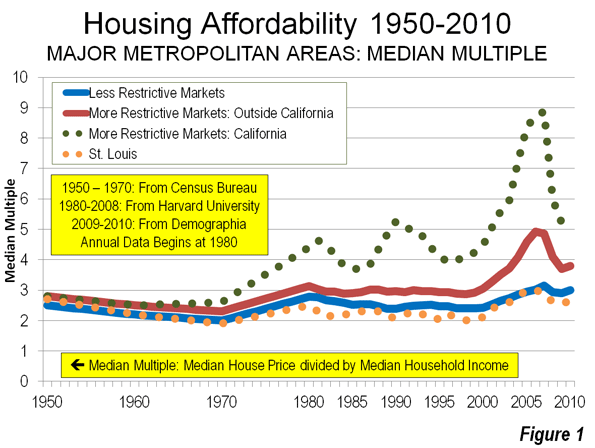
    Superior Housing Affordability: This is where St. Louis excels. As of the third quarter of 2011, the median house price was 2.6 times the median household income in St. Louis, according to the 8th Annual Demographia International Housing Affordability Survey, which covered seven nations (the United States, United Kingdom, Canada, Australia, Ireland, New Zealand and Hong Kong, in China). Dividing the median house price by the median household income gives St. Louis an affordability rating (Median Multiple) of 2.6. By comparison the Median Multiple was 4.2 in Portland (60 percent more expensive ), 4.5 in Seattle (75 percent more),  6.1 in San Diego (135 percent more) and 6.9 in San Jose (175 percent more. While other metropolitan areas were reeling from house price increases that still have not returned to normal, St. Louis (and other metropolitan areas, like Dallas-Fort Worth, Houston and Indianapolis) have continued to experience affordable and far more steady house prices (Figure 1).

    Lowest Cost of Living: Affordable house prices are associated with a lower cost of living. St. Louis does very well here. According to the latest data from the US Bureau of Economic Analysis regional price parity program, the cost of living in St. Louis is the lowest among major metropolitan areas (those with more than 1,000,000 population). In St. Louis, the cost of living is:

    • 29 percent less than in New York.
    • 31 percent less than in San Jose.
    • 23 percent less than in San Diego.
    • 19 percent less than in Seattle.
    • 12 percent less than in Portland.

    Things Could Get Better for St. Louis: Moreover, the gap could become larger, especially as governments in California try to outlaw new detached housing, under Senate Bill 375. None of this is good for young households or less affluent households who will have to leave to find housing that meets their desires. Many will need to leave to fulfill their dreams.

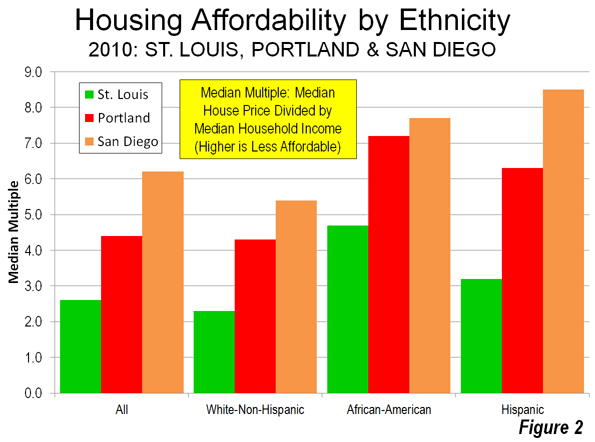
    Inevitably, the higher housing costs associated with these policies (called by various names, such as "livability," "smart growth" and "growth management") fall hardest on lower income households (often minorities), who have less to spend, are forced to move away or cannot afford to move in. The consequences were articulated by California’s Hispanic oriented Tomas Rivera Policy Institute (Figure 2):

    While there is little agreement on the magnitude of the effect of growth controls on home prices, an increase is always the result.

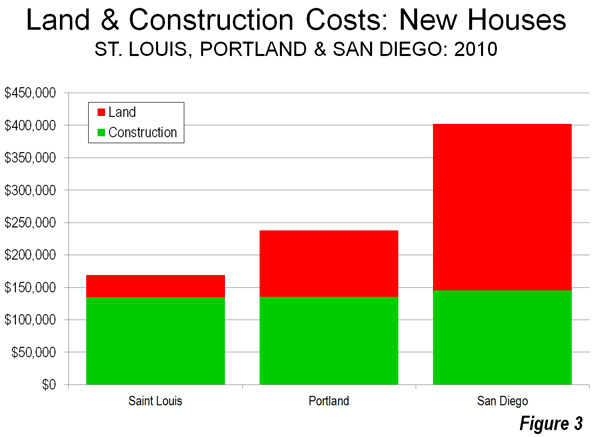
    The Secret: Just what did the St. Louis leadership do to improve its competitiveness so much? Nothing. They just stayed out of the way. Unlike their counterparts where house prices exploded, St. Louis officials did not prohibit people from living where they wanted on the urban fringe and they did not force new houses to be built on postage stamp lots. Nor did they adopt land use regulations that drive up the price of land (Figure 3) and, in consequence housing), just as an OPEC embargo would raise the price of gasoline. When the easy money came and lenders were begging households with insufficient resources to take mortgages, the planning embargoes drove up house prices and invited undue participation by speculators who know the difference between a competitive and a rigged market.

    There are positive signs as a result of this affordability advantage. St. Louis has been attracting more young residents. Recent data indicates that St. Louis ranked 15th in high tech job growth out of the 51 metropolitan areas with more than 1,000,000 over the past decade. It would be expected that St. Louis would trail fast growing Seattle, Raleigh and Charlotte and perennial tax consumer Washington. However, St. Louis can be placed better than perennial leaders San Jose, Boston, Portland, Austin and New York. Budding local efforts are aimed at encouraging entrepreneurship, even as California and New York search for new ways to say "no."

    Succeeding by Being St. Louis: The improving prospects of St. Louis are not the result of a taxpayer financed marketing campaign or a payoff from the usual "let’s copy Portland" strategies (or even Cleveland, as one analyst put it a couple of decades ago). St. Louis cannot compete with the weather in the Bay Area, does not have San Diego’s beaches, the mountains near Denver nor the natural beauty surrounding Seattle. But it does have an affordable life style.

    St. Louis can succeed only by being St. Louis. It is a metropolitan area with a great past, and many fine civic institutions, including great parks, sports teams and a world class orchestra. This long laggard Midwestern metropolitan area may face its best competitive prospects since Chicago passed it in population in 1870. Local and state leaders need to stay away from the policies that would dilute St. Louis’ principal competitive advantage, a low cost of living, due to a housing market left to operate without destructive distortion.

    Wendell Cox is a Visiting Professor, Conservatoire National des Arts et Metiers, Paris and the author of “War on the Dream: How Anti-Sprawl Policy Threatens the Quality of Life

    —-

    Photo: Cathedral Basilica of St. Louis (by author)

    Note: This is adapted from a policy study by the author for the Show Me Institute: Housing Affordability The St. Louis Competitive Advantage

  • Clues from the Past: The Midwest as an Aspirational Region

    This piece is an except from a new report on the Great Lakes Region for the Sagamore Institue. Download the pdf version for the full report including charts and maps on the region.

    The American Great Lakes region has long been a region defined by the forces of production, both agricultural and industrial. From the 1840s on, the region forged a legacy of productive power, easily surpassing the old northeast as the primary center of American industrial and agricultural might.

    The Rise of the Great Lakes

    Natural forces shaped the region, from its waterways and mineral resources, which made it ideal for industrial development. The lakes themselves are the largest sources of freshwater on the planet; the five lakes together are twice the size of England. This “fresh water Mediterranean” provided an essential pathway for transport between the various regions of the Great Lakes, as well as a connection to the northeast and, through the Saint Lawrence and the Erie Canal, to New York and the Atlantic.

    But more than anything, it has been the people of the Great Lakes that proved its greatest resource. In the early 19th Century, the region’s development was paced by migrants from New England, who brought with them their values of thrift, hard work and a passion for education and self-improvement. Later others, notably Germans and Scandinavians, injected a similar culture of self-improvement to the area.

    Like New England, the Great Lakes, noted author John Gunther, was possessed with a “gadget mind” that sparked the innovations that gave America command of the industrial revolution. Much of the brawn for this came from the poorer parts of Europe — Russia, Italy, and most particularly Poland, which led one observer to call Chicago “a mushroom and a suburb of Warsaw.” By 1920 one third of third of the population of Chicago, Cleveland and Detroit was foreign born.

    Initially based largely on agricultural exports, by 1860 the region had blossomed into an urbanized industrial powerhouse. “All over the Middle West,” wrote historians Charles and Mary Beard, “crossroads hamlets grew into trading towns, villages spread into cities, cities became railway and industrial centers.” The area’s rapid growth sparked great optimism; in 1841 journalist and land speculator predicted that by 1940 Cincinnati would be the largest city in North America and by 2000 “the greatest city in the world.” Cleveland, Cincinnati, Toledo, Milwaukee and most of all Chicago stood at the center of a “web of steel” that marked the region as the world’s preeminent industrial center. It also sparked other innovations, from the auto assembly line and the high-rise building to the mail order catalog.

    This growth cascaded in the early years of the last century. It became the nation’s primary growth engine. Between 1900 and 1920 Chicago added a million people while Cleveland doubled its population and Detroit, epicenter of the emerging “automobile revolution”, grew three fold. In everything from architecture and city planning to literature, the Great Lakes stood at the national, even global, cutting edge.

    A Half Century of Decline

    By the 1970s, the Great Lakes region, including Ontario, accounted for two-thirds of the North America’s automobile production, 70 percent of pig iron and three quarters of its steel. Yet by that time, this close tie to industry was seen not as an advantage but as a curse, driving the region towards precipitous decline.

    By then America was widely seen as entering a “post-industrial era,” and the Great Lakes, the former bastion of the manufacturing economy, seemed the odd region out. Defined as the “foundry” in Joel Garreau’s Nine Nations of North America, it was the only one he identified as in decline. He described the region’s inner cities as “North America’s Gulag Archipelago.”

    Once a magnet for newcomers, the region now took a back seat as a place that attracted domestic or foreign migrants.10 With the exception of Chicago, the Lakes region have continues to lag both in domestic migration and foreign immigrants. Newcomers were reinventing places like Los Angeles, Houston, Miami and New York, but relatively few were coming to Cleveland, Detroit or Cincinnati.

    The Great Lakes cities, also with the sometimes exception of Chicago, also found themselves increasingly regarded as cultural backwaters. Occasional stories of restoration and renaissance made the rounds in the media, but the trend was to greater obsolescence, to becoming permanently “a cultural colony” of the coasts. “To a Californian or a New Yorker,” noted Indiana-based historian Jon Teaford, “Cleveland, Detroit, Indianapolis and Saint Louis were down-at-the-heel, doughty matrons, sporting last year’s cultural fashions.”

    Until recently there has been ample reason to believe this decline would continue. Only nine of the Midwest’s 40 largest metropolitan areas have a higher per capita GDP than the national average. This reflected a deep seated loss of jobs paced by industrial decline but not made up for by gains in other fields.

    During this period the region not only lost many of its industrial jobs but, more pointedly, failed to replace them with the technology and service jobs that grew rapidly elsewhere. As a result, the region’s percentage of the national workforce dropped steadily over the past half century. In 1966, the Great Lakes region possessed one in four jobs in the country; by 2010 that percentage had fallen to less than one in five.

    As a response to the perception of industry-led decline, some Great Lakes leaders sought out other sources of employment and growth. In Detroit, for example, much emphasis was placed on casino development. Michigan’s former Governor Jennifer Granholm, sought to reverse decline by targeting the so-called “creative class” by turning its hard-hit towns into “cool cities.” Across the region, others focused on convention centers, arts attractions such as museums and other entertainment venues as the way to improve their sagging fortunes.

    Seeds of Resurgence
    None of these efforts – although much heralded throughout the 1980s and 1990s – did much to reverse the region’s decline. Notes Jim Russell, author of the widely read Burgh Diaspora website:

    Should Akron start putting more money in skateparks or global warming?

    There are huge problems in spending money in order to attract the geographically fickle. Fads fade and the mobile – largely people under 30 – will move again…Tying up the urban budget with projects aimed at retaining the creative class has its own perils. There is little, if any, evidence indicating that this policy will decrease the geographic mobility of the well-educated. Many cities stuffed with cultural amenities also sport high rates of out-migration. Furthermore, tastes change. “Best places to live” lists change quite a bit from one year to the next.

    Instead, the region’s current rebound is occurring in surprising fashion. The real lure of the Great Lakes lies in its own fundamental advantages: lower housing prices, business climate and perhaps, more importantly, a nascent industrial rebound.

    This can be seen, most importantly, in employment numbers. Starting in the last few years, the area’s share of jobs has remained steady. The highest unemployment rates in the country are no longer concentrated in the Great Lakes region, but in states such as California and Nevada. In many Great Lakes states, unemployment rates have been dropping more rapidly than the national average.

    Critically this resurgence has not resulted in a shift away from industrial growth. Instead, we are witnessing the early stages of what could be a profound increase in both the economic heft and job creation tied to the industrial sector. But the Great Lakes rebound is not merely a cyclical, one dimensional rise; it also includes growth in a host of other sectors, including in the information area and, perhaps even more remarkably, in energy, particularly shale gas.

    At the same time the rise in non-industrial jobs also should testify to the growing attractiveness of the region, particularly for young families. After decades of mass outmigration, the region has begun to achieve a more favorable balance with the rest of country. Outmigration rates for states in the region are at or below national levels.

    Migration in the Midwest, as Russell and others have pointed out, should be regarded more from the vantage point of recruitment, not retention. By promoting its affordability and improving economy, the region could improve its trailing inmigration rates. As people vote with their feet for the region, they are laying down the foundation for the area’s resurgence in the coming decades.

    The Rise of New Growth Nodes

    The Great Lakes demographic and economic turnaround does not mean that growth has occurred in the pattern of the early 20th Century. Instead we see the emergence of a new set of leadership cities. If Akron, Detroit, Cleveland and Chicago paced the region’s early 20th century ascendency, the new “winners” appear to include affordable, attractive cities, many of whom are home to major universities, state capitals and key research institutions.

    These areas have done well in attracting many people from the less successful metropolitan areas of the region. Columbus, for example, evidenced strong growth from the rest of Ohio and other parts of the Midwest, notably Michigan and Illinois. But perhaps more importantly, the area enjoys strong in-migration from those parts of country — notably the Northeast and California — that have traditionally dominated knowledge-intensive industries.

    A similar pattern can be seen in Indianapolis. In recent years, as urban analyst Aaron Renn notes, the Indiana capital has enjoyed “a profile closer to the Sun Belt than the Rust Belt.” It grew its population at a rate 50 percent greater than the national average, and also had strong net inmigration, with almost 65,000 net people deciding to pack up and move to the Indiana capital.

    Already a center of regional culture and services, the area has succeeded as well in attracting new migrants not only from big Midwestern cities such as Chicago, but also from the two coasts.

    By way of contrast, Chicago’s migration patterns look much different than those in Columbus and Indianapolis. Many other regions around the country benefited from people leaving the Windy City than Chicago gained from them. Chicago’s biggest gains have come from other, more troubled Great Lakes regions, while Indianapolis, for instance, has taken advantage of Chicagoans looking for more opportunity elsewhere.

    Behind this shift in migration from the coasts lie many factors, such as taxes and regulations.
    But perhaps most important may be the region’s greater affordability. Even after the bubble, for example, many key eastern and west coast regions suffer a ratio housing prices to annual incomes of five, six or even seven to one. For the most part, virtually all parts of the Great Lakes have ratios of three or less.

    Over time, this could prove a critical advantage to the Great Lakes. As the current millennial generation – the largest generation in American history – enters their 30s, it is likely that they will seek out places where they can afford to buy a home and enjoy a middle class quality of life. The Great Lakes will be one place that can offer that opportunity.

    Key to recovery: Both Brain and Brawn

    The future of the Great Lakes region lies neither in simply the “information” economy nor in the brute force of manufacturing. Instead it is as a result of a combination both of the industrial sector and the high-value service sectors that feed into it.

    Critically, the region boasts many areas where the information and service economies are particularly strong. Of the nine Midwestern metropolitan areas with per capita GDP growth above the national average, four are capital cities and six are home to major universities. Given governmental involvement in two of the fastest-growing sectors of the economy, health care and education, it is no surprise that seats of government and large state-funded research universities – which also double as the hotbeds of medical services – are growing ahead of other regions with a more traditional, and perhaps outdated, economic base.

    Indeed, some Midwestern areas are outperforming the coastal economies even in the realm of high-tech. In a recent ranking by Forbes magazine of best areas for tech growth among the nation’s 51 largest metropolitan areas, the region boasted three of the top fifteen areas, led by #3 Columbus, followed by Indianapolis and St. Louis.

    However, it would be inaccurate to portray the Midwest as depending purely on a service or information economy. Producing things for sale and export is still alive and well, and the Midwestern regions that have blended their traditional capacity for manufacturing with newer fast-growing sectors of the economy.

    Cedar Rapids, Iowa enjoyed the highest rate of GDP growth from 2001-2010 of any metropolitan area in the Midwest. Between Cedar Rapids and Iowa City, home to the University of Iowa, a new high-tech corridor has grown up that takes advantage of the area’s historical manufacturing capacity and the new technology driven through the university.

    Terre Haute, Indiana, fifth on the list of GDP leaders, reflects even more completely the blending of the “old” Midwest with the emerging one. Manufacturing has held steady as a share of the local economy at about 15.5 percent since 1991, but health and education have jumped from 14 to 17 percent, while wholesale services and agriculture have dropped. Terre Haute is home to Indiana State University and Rose-Hulman Institute of Technology, a regional leader in engineering, science, and mathematics education.

    Peoria, Illinois is second behind Cedar Rapids in GDP growth the past ten years. It is home to more than 200 manufacturing firms, two of the world’s largest earth-moving equipment makers, and coal fields. Peoria is also a leader in college degree attainment in the Great Lakes. While its absolute attainment levels are still low, its college educated population is growing faster than nearly every community in the Midwest. Peoria is one example of how brains + brawn, and not just brains, is the key to Midwestern growth going forward.

    Consider what we might call the dynamic of the Badgers and the Wolverines. In Wisconsin, home of the Badgers, there exists an east-west corridor between Madison, home to the state university and state capital, and Milwaukee, the state’s historical center of industry and commerce. In Michigan, home of the Wolverines, an east-west corridor stretches between Ann Arbor, home to the University of Michigan, and Detroit, the state’s historical center of industry and commerce.

    In Figure 14 we see that both Ann Arbor and Madison have high levels of bachelor degrees compared to the national average. But Madison is leading the Midwest in bachelor degree growth while Ann Arbor rate remains fairly static. Meanwhile, even though Detroit surprises with a fairly high rate of bachelor degree growth, Milwaukee stays in front of the national average in both growth and absolute numbers of college-educated workers.

    Some might say that the Badgers are beating the Wolverines in the knowledge-intensive sectors of the economy, but that the lead manufacturing is up for grabs. But the truth is that the Wisconsin corridor also enjoys positive marks in manufacturing.

    Milwaukee, for example, leads Detroit in the growth of manufacturing jobs. And Madison is emerging as a manufacturing center while Ann Arbor lags far behind. The knowledge economy and the old-time manufacturing economy can work happily together, in the case of Madison Milwaukee, or so far less so in the case of Ann Arbor-Detroit.

    The New Industrial Paradigm

    Despite the attempts to write it off as a spent force, manufacturing will remain a key driver of Midwestern and national growth. Despite the many job losses that impacted this sector over the past generation, American manufacturing remains remarkably resilient, with a global market share similar to that of the 1970s.

    More recently, however, American industrial base has begun to expand and begin to gain on its competitors. This places the Great Lakes in an advantageous position. American manufacturing after a decade of decline has outpaced the overall recovery over the two years, in part due to soaring exports. In 2011 American manufacturing continued to expand even as Germany, Japan and Brazil all weakened in this vital sector.

    Many factors are driving this change. One is a tie to the growing domestic energy industry, which has already sparked growth in the shale areas of eastern Ohio and other parts of the Great Lakes region. The United States together now boast the largest natural gas reserves in the world. In Ohio alone, new finds in the Utica shale could be worth as much as $500 billion; one energy executive called it “the biggest thing to hit Ohio since the plow.”

    The boom in natural gas has already sparked a considerable industrial rebound including the building of a new $650 million steel plant for gas pipes in the Youngstown area.18 Karen Wright, whose Ariel Corporation sells compressors used in gas plants, has added more than 300 positions over the past two years. “There’s a huge amount of drilling throughout the Midwest,” Wright says. “This is a game changer.”

    It also leads to the prospect that as coal-fired plants become more expensive to operate due to concerns over greenhouse gas emissions, the region will have a new, cleaner and potentially less expensive power source.

    Another critical factor has been the rise of wage rates in both Europe and East Asia. Increasingly, American-based manufacturing is in a favored position as a lower cost producer. Concerns over “knock offs” and lack of patent protection in China may also be sparking a “back to USA” trend, something particularly favorable to the Great Lakes region.

    Yet the new industrial base will not resemble old one. We are seeing both an industrial renaissance in the country and one that is heavily concentrated in the Great Lakes region. But it is a resurgence that is as much brain as brawn; an industry increasingly dependent not just on hard work, but skilled labor.

    This pattern cuts across industry lines. Indeed even as the share of the workforce employed in manufacturing has dropped from 20 percent to roughly half that, high skilled jobs in industry have soared 37 percent. Even after years of declining employment, manufacturers in heavy industry, such as automobiles, are running short on skilled workers. Industry expert David Cole predicts there could be demand for 100,000 new workers by 2013. Overall, 83 percent of all manufacturers, according to Deloitte Touche, suffer a moderate or severe shortage of skilled production workers.

    This remains a fundamental strength of the region. Much of the skilled labor base in the nation remains in the Midwest. The region is also home to four of the highest ranked, according to US News, industrial engineering schools in the nation: the University of Michigan at Ann Arbor, Northwestern, the University of Wisconsin at Madison and Purdue.

    Equally important for the region will be replacing the large cadre of skilled workers, many of whom are entering the late 50s and early 60s. “We have a very skilled workforce, but they are getting older,” says Ariel Wright, who employs 1,200 people at three Ohio factories. “I don’t know where we are going to find replacements.”

    For now the very culture of production – often seen as a liability in the past – could prove a key to the Great Lakes’ future resurgence. These advantages are already redounding to the region. Indeed a recent Forbes survey of “heavy metal” industries – that is those involved heavy industry, metals, vehicles and complex machinery – found the region in surprisingly good shape.

    The Milwaukee area, for example, ranked number 2 among the 50 metropolitan areas on the list, while Detroit clocked in with a respectable 6 placed finish. Cincinnati, Kansas City and Cleveland all ranked well within the top 20. In all, the 40 Great Lakes metropolitan areas added 50,000 heavy metal industry jobs since 2009.

    Looking Forward

    For the first time in a generation, the Great Lakes are experiencing demographic and economic trends in their favor. Yet in everything from migration to industrial growth, the region can expect to face strong competition from other areas, most notably Texas, the Southeast, the Great Plains and the Intermountain West for new jobs and production.

    To meet this challenge, and truly take advantage of improved conditions, the region must develop a strategy that is suited to its particular advantages. There is no need to try to compete with Manhattan on urban chic, with Silicon Valley in high-tech startups or with Hollywood in entertainment – as some growth theorists would likely recommend.

    The Great Lakes needs to focus primarily on those very values of production and community that sparked its original ascendance. Once these are identified and strengthened, the region can once again not only rebound, but define its own space in the national and global economy.

    Perhaps the first priority has to do with education. The Great Lakes has an enormous edge in terms of first-class engineering schools, and needs to become more focused on these programs and those associated with them, including the information sciences. It needs to supplement this focus on the top echelon with a greater effort — as we can now see in Ohio — in training more of the skilled workforce desperately needed for the region’s resurgent manufacturers.

    By 2018, 63 percent of the nation’s jobs will require some type of post-high school training credential. Increasingly successful education programs have to focus on aligning with jobs available within a state or region. This can only occur with explicit cooperation between education, government, and the business community.

    Likewise, business collaboration with universities can boost the amount and the impact of industry R&D investments that fosters innovation. University-based research and technology development can yield fast-growing, high-technology firms that create higher-paying middle skill and professional, scientific and technical jobs.

    The second priority lies in developing critical infrastructure to keep the region’s economy humming. This includes a greater emphasis on developing energy resources, rebuilding and modernizing the freight rail, waterways and ports, as well as highways that connect the Great Lakes to the rest of the country and the world.

    In the modern economy, creating economic advantage also includes paying attention to specialized infrastructure such as university and lab facilities, technology and training centers, multi-modal shipping and logistics facilities, and research parks. These infrasystems – integrated fusions of facilities, technology and advanced socio-technical capabilities – can drive innovation, particularly for future higher-value industries and higher-paying jobs. The full range of today’s infrastructure assets is shown in the figure below.

    Third, and perhaps most important, the region needs to maintain the housing affordability and other quality of life attributes critical to attracting both immigrants and domestic migrants. As Millennials enter their 30s in large numbers over the next decade, the region needs to improve its public schools, parks and other amenities to attract them.

    Ultimately, this represents a distinctly common-sense means to overcome a legacy of failure and create a new paradigm of success for the region. The Great Lakes, rather than trying to arrest its decline by completely running away from its past, can now recover the great sense of potential so evident in its heroic history.

    Download the full pdf version of the report, including charts and maps about the Great Lakes Region. The report was authored for the Sagamore Institute with support from the Lynde and Harry Bradley Foundation.

    Joel Kotkin is executive editor of NewGeography.com and is a distinguished presidential fellow in urban futures at Chapman University, and contributing editor to the City Journal in New York. He is author of The City: A Global History. His newest book is The Next Hundred Million: America in 2050, released in February, 2010.

    Mark Schill is Vice President of Research at Praxis Strategy Group, an economic development and research firm working with communities and states to improve their economies.

    Ryan Streeter is Distinguished Fellow for Economic and Fiscal Policy at the Sagamore Institute. You can follow his work at RyanStreeter.com and Sagamoreinstitute.org.

    Photo courtesy of BigStockPhoto.com.

  • President Obama Courts Silicon Valley’s New Digital Aristocracy

    President Obama’s San Francisco fundraiser with the tech elites today, along with the upcoming IPO for Facebook, marks the emergence of a new, potentially dominant political force well on its way to surpassing Hollywood and even Wall Street as the business bulwark of the Obama Democratic Party.

    In 2008 the industry gave Obama more than $9 million, three times what it raised for any other politician; it was the first time the digerati outspent Hollywood. The numbers will surely go up this year.

    “The Facebook instant millionaires and billionaires are about all Democrats,” said Morley Winograd, a longtime California Democratic activist and chronicler of information-age politics. “There’s an enormous amount of power residing there—and it will only get greater.”

    Even when they’ve competed with and acted like more established power brokers, the digital ruling class are treated with kid gloves compared to other wealthy elites, rarely suffering the disdain aimed at amoral bankers and at Hollywood’s general venality. Instead, the creators of our iPhones, social networks and Twitter accounts are held up as tool makers and business titans. That esteem is most pronounced among millenials, 75 percent of whom use social media, more than twice the percentage for boomers, according to Pew. When asked what makes their generation “unique,” the most common answer to the open-ended question is technology.

    Those who will benefit most from Facebook and other IPOs resemble the “one percent” about as much as Wall Street.

    In effect, it’s OK to be in the “1 percent”—or even the .0001 percent—if you develop nifty devices and invest in green companies. "We live in a bubble, and I don’t mean a tech bubble or a valuation bubble. I mean a bubble as in our own little world," Google chairman Eric Schmidt recently told the San Francisco Chronicle. "And what a world it is: companies can’t hire people fast enough. Young people can work hard and make a fortune. Homes hold their value. Occupy Wall Street isn’t really something that comes up in daily discussion, because their issues are not our daily reality."

    For their part, the “Occupiers” who struggled mightily to shut down the blue-collar Port of Oakland seem to never have considered an action against the pampered techies at Facebook’s lavish campus.

    The new plutocrats are unburdened by the obligations that come with existing large institutions; with no union presence, they don’t have to worry about anxious retirees or redundant older workers. Green pet causes that align with their financial interests buy more cover from the left, while conservatives, who rarely see anything wrong with extreme wealth, seem somewhat unconscious about the political orientation of the emerging new elite. Ninety-two percent of Facebook executive donations so far this year went to Democrats. This exceeds even the rock-solid support the Democrats enjoy among more established firms like Google and Apple, where support for Democrats runs to the high 80s. Although its former CEO, Meg Whitman, ran as the Republican candidate for governor in 2010, 96 percent of eBay-associated donations went to Democrats. The Seattle area’s two top digital firms, Amazon and Microsoft make two thirds or more of their donations to Democrats.

    The Obama administration’s opposition to the anti-piracy bills SOPA and PIPA came despite intense lobbying for the bill by his party’s long-time allies in Hollywood. Whatever the bills’ failings, their defeat also formally introduced the new power of the digerati moguls and their millions of followers. The presence of Steve Jobs’s wife, Lauren, as Michelle Obama’s guest at the State of the Union speech further cemented the ever-closer ties between the valley’s upper echelon and the president’s party.

    In California, the alliance between progressive Democrats and high tech is palpable. The digital elite has been a consistent backer of Gov. Jerry Brown’s jihad on greenhouse gases, helping finance the campaign against a 2010 measure intended to reform state’s draconian and likely job-killing energy and land-use laws. Google has emerged both as a key backer of the state’s climate-change politics and sought to profit by investing nearly a billion dollars in renewable-energy companies. These firms in turn depend on the state’s strict mandates on utilities to use “green” electricity for their revenues. It’s no coincidence that prominent valley VCs have been particularly active in alternative-energy firms such as Solyndra.

    Brown and the Democratic Party increasingly have come to regard these companies as a potential source of fiscal salvation for the perennial cash-short state. As the Golden State has banked on the valley, the tech firms have become ever more indispensable and now are even dipping their toes in the grubby waters of municipal politics, helping finance the campaign of San Francisco Mayor Ed Lee—who generously concocted new tax breaks for local firms such as Twitter and Zynga.

    The leftward shift by tech firms is a fairly recent development. In the 1970s and 1980s, the formative period for Silicon Valley, the area was politically contested. Valley constituencies routinely sent to Congress moderate Republicans like Pete McCloskey, Ed Zschau, and Tom Campbell. Today the GOP is virtually absent from the valley at all levels of government.

    Some old-line companies, like Hewlett-Packard and Intel, still tend to be fairly evenhanded in their political donations, but they are increasingly rare. Long-time valley maven Leslie Parks explains that the shift came as the Valley’s economy changed. In the 1980s and 1990s—the area’s greatest period of growth—its roots stood solidly in high-tech manufacturing. Now it focuses almost exclusively on product design and information: software, search, and social media. Over the past decade the San Jose area lost one third of its industrial workforce while the neighboring San Francisco region lost some 40 percent—the largest consistent loser among the nation’s 51 metropolitan areas.

    High-tech firms once concerned themselves with many of the same things as other manufacturing companies. They worried about electricity rates, obtrusive environmental legislation, high housing prices, and dysfunctional public education. Many naturally supported Republicans, or business-oriented Democrats.

    But as tech separated from industry, the valley moved leftward.

    Today’s digital aristocrats manufacture virtually nothing here; anything made in volume is produced outside California and usually out of the country. Software-based firms don’t worry about energy costs, since they can simply place their heavy user server farms in places like the Pacific Northwest with low electricity rates. They do not use much in the way of toxic chemicals or groundwater, making it easier to avoid scrutiny and harassment from California’s hyper-aggressive environmental regulators. Because they rely on an increasingly narrow band of highly educated employees from elite schools, the secular decline of the state’s higher education system hardly impacts them. And as many of their employees are young and tend to buy houses after collecting the spoils of an IPO, even high housing costs and poor public K-12 education don’t matter much.

    The growing diversity of the valley has also helped the Democrats. Although relatively few Latinos or African-Americans work in the new companies, new immigrants from Asia and the Middle East and their offspring abound. “You had a big change in diversity, and let’s face it the Republicans do not do well with diversity,” said Parks, who is Japanese-American. “The Democrats, particularly Obama, recognized appealing to these people was a necessity.”

    Many who celebrate this emerging power elite are still slow to recognize that they are in these company’s sights. As we become more dependent on internet based news and entertainment, cultural power is migrating away from New York publishers and Los Angeles studios towards Palo Alto and Menlo Park. Old-line media firms such as newspapers, book companies and the major networks may find themselves overmatched.

    This growing power may do more to concentrate economic power than any development since the Second World War. With their stockpile of personal data on their hundreds of millions of users, firms like Google and Facebook could prove the biggest threat to privacy since Big Brother. As Jason Lanier, a scholar-at-large at Microsoft Research, noted in a recent New York Times op-ed piece, the same companies that led the fight to keep the Internet “free” want to sell hundreds of billions of dollars in advertising built from that free, user-provided information.

    While the old valley empowered people by supplying technology, says Chicago law professor Lori Andrews, social-media firms instead leverage our personal information into fodder for not just advertisers but people reviewing job applications, medical records, and more.

    What’s more, the dominant firms are rapidly becoming oligopolies. In the old days, valley companies battled over everything from semiconductor chips and disk drives to servers and operating systems. In contrast, today’s digital industry tends to gravitate to the best-financed (usually by venture capital) and most well-connected companies. Microsoft, for example, still controls 90 percent of the operating-system-software industry; Facebook is likely to continue with a 60 percent to 70 percent share of the social-media marketplace. Google enjoys a higher than 80 percent share in search.

    This is a degree of control that exists in few older industries. Like the railroads of the old robber barons, those few firms who control the limited number of digital platforms can limit the profitability of smaller would-be competitors—and could end up slowing the rate of innovation in order to maintain their own positions. They may wear T-shirts to work, but the tycoons of Silicon Valley are, in some respects, J.P. Morgan’s true heirs.

    Populism may now be de rigeur inside of the Democratic Party, but the world being created by the new digital haute bourgeoise is anything but social democratic. Parks notes that the lower end of the valley economy, like janitors or food-service workers, generally labor for flinty-eyed outside contractors so they share as little as possible of the wealth collected by higher-skilled employees.

    Even Silicon Valley’s geography is increasingly unfriendly to the mass middle class, much less the aspiring working class. Due largely to strict land-use regulations, median housing costs, even adjusted for income, are among the highest in the nation, more than twice as high as those in places like Raleigh, Salt Lake City, Houston. or Dallas. With a 2,300-square-foot home in Palo Alto going for nearly $1.8 million, the digital heartland is largely off limits for most of us.

    Those who will benefit most from Facebook and other IPOs resemble the “1 percent” about as much as Wall Street. They may see themselves as “progressive,” but they create few broad-based opportunities for members of the middle and working class. A bit of their wealth may trickle down to Democratic politicians, but the rest of us, as dependent as we have become on their technology, have reaped little financial benefit from them. Whatever the value of their creative efforts, the new digital aristocracy’s political ascendency threatens both the populist roots of the Democratic Party and perhaps the delicate social balance of our Republic as well.

    This piece originally appeared in TheDailyBeast.

    Joel Kotkin is executive editor of NewGeography.com and is a distinguished presidential fellow in urban futures at Chapman University, and contributing editor to the City Journal in New York. He is author of The City: A Global History. His newest book is The Next Hundred Million: America in 2050, released in February, 2010.

    Official White House Photo by Pete Souza.

  • Time to Rethink This Experiment? Delusion Down Under

    The famous physicist, Albert Einstein, was noted for his powers of observation and rigorous observance of the scientific method. It was insanity, he once wrote, to repeat the same experiment over and over again, and to expect a different outcome. With that in mind, I wonder what Einstein would make of the last decade and a bit of experimentation in Queensland’s urban planning and development assessment? 

    Fortunately, we don’t need Einstein’s help on this one because even the most casual of observers would conclude that after more than a decade of ‘reform’ and ‘innovation’ in the fields of town planning and the regulatory assessment of development, it now costs a great deal more and takes a great deal longer to do the same thing for no measureable benefit. As experiments go, this is one we might think about abandoning or at the very least trying something different.

    First, let’s quickly review the last decade or so of change in urban planning and development assessment. Up until the late 1990s, development assessment was relatively more straightforward under the Local Government (Planning and Environment) Act of 1990. Land already zoned for industrial use required only building consent to develop an industrial building. Land zoned for housing likewise required compliance with building approvals for housing. These were usually granted within a matter of weeks or (at the outset) months. 

    There were small head works charges, which essentially related to connection costs of services to the particular development. Town planning departments in local and state governments were fairly small in size and focussed mainly on strategic planning and land use zoning. It was the building departments that did most of the approving. Land not zoned for its intended use was subject to a process of development application (for rezoning), but here again the approach was much less convoluted that today. NIMBY’s and hard left greenies were around back then, but they weren’t in charge. Things happened, and they happened far more quickly, at lower cost to the community, than now.

    In the intervening decade and a bit, we’ve seen the delivery and implementation of an avalanche of regulatory and legislative intervention. It started with the Integrated Planning Act (1997), which sought to integrate disparate approval agencies into one ‘fast track’ simplified system. It immediately slowed everything down.  It promised greater freedom under an alleged ‘performance based’ assessment system, but in reality provoked local councils to invoke the ‘precautionary principle’ by submitting virtually everything to detailed development assessment. The Integrated Planning Act was followed, with much fanfare, by the Sustainable Planning Act (2009). Cynics, including some in the government at the time, dryly noted that a key performance measure of the Sustainable Planning Act was that it used the word ‘sustainable’ on almost every page. 

    Overlaying these regulations have been a constant flow of land use regulations in the form of regional plans, environmental plans, acid sulphate soil plans, global warming, sky-is-falling, seas-are-rising plans – plans for just about everything which also affect what can and can’t be done with individual pieces of private property.
    But it wasn’t just the steady withdrawal of private property rights as state and local government agencies gradually assumed more control over permissible development on other people’s land. There was also a philosophical change on two essential fronts.

    First, there was the notion that we were rapidly running out of land and desperately needed to avoid becoming a 200 kilometre wide city. Fear mongers warned of ‘LA type sprawl’ and argued the need for densification, based largely on innocuous sounding planning notions like ‘Smart Growth’ imported from places like California (population 36 million, more than 1.5 times all of Australia, and Los Angeles, population 10 million, roughly three times the population of south east Queensland).  The first ‘South east Queensland Regional Plan 2005-2026’ was born with these philosophical changes in mind, setting an urban growth boundary around the region and mandating a change to higher density living (despite broad community disinterest in density). It was revisited by the South East Queensland Regional Plan 2009-2031 which formally announced that 50% of all new dwellings should be delivered via infill and density models (without much thought, clearly, for how this was to be achieved and whether anyone particularly wanted it). Then there was the South East Queensland Regional Infrastructure Plan 2010-2031 which promised $134 billion in infrastructure spending to make this all possible (without much thought to where the money might come from) and a host of state planning policies to fill in any gaps which particular interest groups or social engineers may have identified as needing to be filled.

    The significant philosophical change, enforced by the regional plan, was that land for growth instantly became scarcer because planning permission would be denied in areas outside the artificially imposed land boundary. Scarcity of any product, particularly during a time of rising demand (as it was back then, when south east Queensland had a strong economy to speak of) results in rising prices. That is just what happened to any land capable of gaining development permission within the land boundary: raw land rose in price, much faster than house construction costs or wages. 

    The other significant philosophical change that took root was the notion of ‘user pays’ – which became a byword for buck passing the infrastructure challenge from the community at large, to new entrants, via developer levies. Local governments state-wide took to the notion of ‘developer levies’ with unseemly greed and haste. ‘Greedy developers’ could afford to pay (they argued) plus the notion of ‘user pays’ gave them some (albeit shaky) grounds for ideological justification. Soon, developers weren’t just being levied for the immediate cost of infrastructure associated with their particular development, but were being charged with the costs of community-wide infrastructure upgrades well beyond the impact of their proposal or its occupants. 

    Levies rose faster than Poseidon shares in the ‘70s. Soon enough, upfront per lot levies went past the $50,000 per lot mark and although recent moves to cap these per lot levies to $28,000 per dwelling have been introduced, many observers seem to think that councils are now so addicted that they’ll find alternate ways to get around the caps.

    So the triple whammy of ‘reform’ in just over a decade was that regulations and complexity exploded, supply became artificially constrained to meet some deterministic view of how and where us mere citizens might be permitted to live, and costs and charges levied on new housing (and new development generally) exploded.

    At no point during this period, and this has to be emphasised, can anyone honestly claim that this has achieved anything positive. It has made housing prohibitively expensive, and less responsive to market signals. Simply put, it takes longer, costs more, and is vastly more complicated than it was before, for no measureable gain.

    An indication of this was given to me recently in the form of the Sunshine Coast Council’s budget for its development assessment ‘directorate.’ (How apropos is that term? It would be just as much at home in a Soviet planning bureau).  Their budget (the documents had to be FOI’d) for 2009-10 financial year included a total employee costs budget of $17.4 million.  For the sake of argument, let’s assume the average directorate comrade was paid $80,000 per annum. That would mean something like more than 200 staff in total. Now they might all be very busy, but it surely says something about how complexity and costs have poisoned our assessment system if the Sunshine Coast Council needs to spend over $17 million of its ratepayer’s money just to employ people to assess development applications in a down market.

    If there had been any meaningful measures attached to these changes in approach over the last decade, we’d be better placed to assess how they’ve performed. But there weren’t, so let’s instead retrospectively apply some:

    Is there now more certainty? No. Ask anyone. Developers are confused. The community is confused. Even regulators are confused and frequently resort to planning lawyers, which often leads to more confusion. The simple question of ‘what can be done on this piece of land’ is now much harder to answer.

    Is there more efficiency? No. Any process which now takes so much longer and costs so much more cannot be argued to be efficient.

    Is the system more market responsive? No. Indeed the opposite could be argued – that the system is less responsive to market signals or consumer preference. Urban planning and market preference have become gradually divorced to the point that some planners actively view the market preferences of homebuyers with contempt.

    Are we getting better quality product? Many developers will argue that even on this criteria, the system has dumbed down innovation such that aesthetic, environmental or design initiatives have to fight so much harder to get through that they’re simply not worth doing.

    Is infrastructure delivery more closely aligned with demand? One of the great promises of a decade of ‘reform’ was that infrastructure deficits would be addressed if urban expansion and infrastructure delivery were aligned. Well it’s been done in theory via countless reports and press releases but it’s hardly been delivered in execution. And when the volumes of infrastructure levies collected by various agencies has been examined, it’s often been found that the money’s been hoarded and not even being spent on the very things it was collected for.

    Is the community better served? Maybe elements of the green movement would say so, but for young families trying to enter the housing market, the answer is an emphatic (and expensive) no. How can prohibitively expensive new housing costs be good for the community? For communities in established urban areas, there is more confusion about the impact of density planning, which has made NIMBY’s even more hostile than before.

    Has it been good for the economy? South east Queensland’s economy was once driven by strong population growth – the very reason all this extra planning was considered necessary. But growth has stalled, arguably due to the very regulatory systems and pricing regimes that were designed around it. We now have some of the slowest rates of population growth in recent history and our interstate competitiveness – in terms of land prices and the costs of development – is at an all time low. That’s hardly what you’d call a positive outcome.

    Is the environment better served? If you believe that the only way the environment can be better served is by choking off growth under the weight of regulation and taxation, you might say yes. But then again, studies repeatedly show that the density models proposed under current planning philosophies promote less environmentally efficient forms of housing, and can cause more congestion, than the alternate. So even if the heroic assumptions for the scale of infill and high density development contained in regional plans was actually by some miracle achieved, the environment might be worse off, not better, for it. 

    All up, it’s a pretty damming assessment of what’s been achieved in just over a decade. Of course the proponents of the current approach might warn that – without all this complexity, cost and frustration – Queensland would be subject to ‘runaway growth’ and a ‘return to the policies of sprawl.’ The answer to that, surely, is that everything prior to the late 1990s was delivered – successfully – without all this baggage. Life was affordable, the economy strong, growth was a positive and things were getting done. Queensland, and south east Queensland in particular, was regarded as a place with a strong future and a magnet for talent and capital. Now, that’s been lost.

    Einstein would tell us to stop this experiment and try something else if we aren’t happy with the results. To persist with the current frameworks and philosophies can only mean the advocates of the status quo consider these outcomes to be acceptable.  Is anyone prepared to put up their hand and say that they are?

    Ross Elliott has more than 20 years experience in property and public policy. His past roles have included stints in urban economics, national and state roles with the Property Council, and in destination marketing. He has written extensively on a range of public policy issues centering around urban issues, and continues to maintain his recreational interest in public policy through ongoing contributions such as this or via his monthly blog The Pulse.

    Photo by Flickr user Mansionwb

  • How Lower Income Citizens Commute

    One of the most frequently recurring justifications for densification policies (smart growth, growth management, livability, etc.) lies with the assumption that the automobile-based mobility system (Note 1) disadvantages lower income citizens. Much of the solution, according to advocates of densification is to discourage driving and orient both urbanization and the urban transportation system toward transit as well as walking and cycling.

    Of course, there is no question but that lower income citizens are disadvantaged with respect to just about everything economic. However, there are few ways in which lower income citizens are more disadvantaged than in their practical access to work and to amenities by means of transit, walking and cycling. Indeed, the impression that lower income citizens rely on transit to a significantly greater degree than everyone else is just that – an impression.

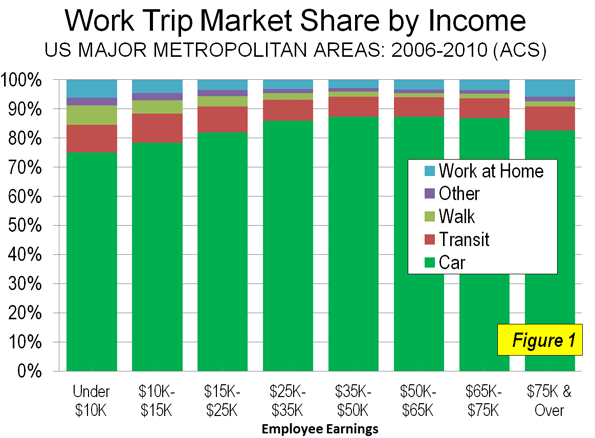
    The Data: This is illustrated by a compilation of work trip data from the five-year American Community Survey for 2006 to 2010. In the nation’s 51 major metropolitan areas (more than 1,000,000 population), 76.3% of lower income employees use cars to get to work, three times that of all other modes combined (Figure 1).

    Admittedly, this is less than the 83.3% of all employees who use cars for the work trip, but a lot more than would be expected, especially among those who believe that transit is the principal means of mobility for low income citizens. Overall, 8 times as many lower income citizens commuted by car as by transit. In this analysis, lower income citizens are defined as employees who earn less than $15,000 per year, which is approximately one-half of the median earnings per employee of $29,701. .

    Perhaps most surprising is the fact that only 9.6% of lower income citizens used transit to get to work. This is not very much higher than the 7.9% of all workers in the metropolitan areas who use transit. (Table 1).  

    Table 1
    Work Trip Market Share: 2006-2010
    Lower Income Employees and All Employees
    Metropolitan Areas Over 1,000,000 Population
      Lower Income Employees
    All Employees Market Share Employees Earning Under $15,000 Annually Market Share
    Car, Truck & Van: Alone 56.72 73.4% 9.56 63.1%
    Car, Truck & Van: Carpool 7.67 9.9% 2.00 13.2%
    Car, Truck & Van: Total 64.38 83.3% 11.56 76.3%
    Transit 6.14 7.9% 1.46 9.6%
    Walk 2.19 2.8% 0.89 5.9%
    Other (Taxi, Motorcyle, Bicycle & Other) 1.34 1.7% 0.39 2.6%
    Work At Home 3.24 4.2% 0.85 5.6%
    Total 77.29 100.0% 15.16 100.0%
    In Millions
    Note: Median Earnings: $29,701
    Source: American Community Survey: 2006-2010


    Transit’s small market share has to do with its inherent impracticality as a means of getting to most employment. According to ground-breaking research by the Brookings Institution, low-income citizens could reach only 35 percent of jobs in the major metropolitan areas by transit in 90 minutes. In other words, you cannot get from here to there, at least for most trips. It is no more reasonable for lower income citizens to spend three hours per day commuting than it is for anyone else. A theoretical 90 minute one-way standard is no indicator of usable mobility. It is likely that only about 8 percent of jobs are accessible by lower income citizens in 45 minutes (Note 2) and 4 percent in 30 minutes.

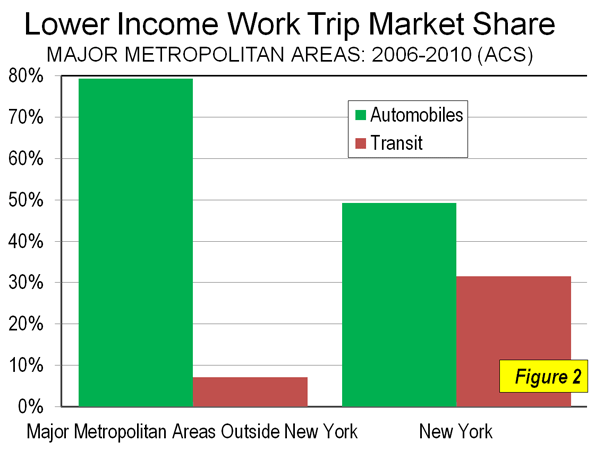
    Automobility: Among the major metropolitan areas, lower income citizens use automobiles to get to work most in Birmingham (90.6%). Fourteen other metropolitan areas have lower income automobile market shares of 85% or more, including Charlotte, Detroit, Dallas-Fort Worth, Indianapolis, Jacksonville, Kansas City, Louisville, Memphis, Nashville, Oklahoma City, Raleigh, San Antonio, St. Louis and Tampa-St. Petersburg. As in all things having to do with urban transportation, there are two Americas: New York and outside New York. By far the lowest automobile market share for low income citizens is in New York, at 49.3%. The second lowest lower income automobile market share is in San Francisco-Oakland, at 63.1%. Washington and Boston are also below 70% (Table 2).

    Table 2
    Work Trip Market Share: Car, Truck or Van: 2006-2010
    Lower Income Employees and All Employees
    Metropolitan Areas Over 1,000,000 Population
      Lower Income Employees
    Metropolitan Area All Employees Employees Earning Under $10,000 Employees Earning $10,000-$14,999 All Under $15,000 (Combined)
    Atlanta, GA 88.3% 82.1% 83.8% 82.8%
    Austin, TX 87.2% 77.8% 82.3% 79.5%
    Baltimore, MD 85.9% 73.8% 77.7% 75.1%
    Birmingham, AL 94.6% 89.3% 92.6% 90.6%
    Boston, MA-NH 77.2% 66.4% 73.4% 68.5%
    Buffalo, NY 89.7% 79.8% 84.3% 81.3%
    Charlotte, NC-SC 90.9% 85.3% 88.5% 86.4%
    Chicago, IL-IN-WI 80.0% 73.0% 77.0% 74.4%
    Cincinnati, OH-KY-IN 91.2% 82.7% 87.9% 84.4%
    Cleveland, OH 87.3% 78.1% 84.3% 80.3%
    Columbus, OH 90.8% 80.3% 87.1% 82.6%
    Denver, CO 85.3% 76.9% 82.1% 78.9%
    Detroit. MI 93.1% 85.8% 89.9% 87.2%
    Dallas-Fort Worth, TX 91.5% 85.4% 88.7% 86.7%
    Hartford, CT 89.7% 76.8% 83.1% 78.8%
    Houston. TX 90.7% 83.6% 86.4% 84.7%
    Indianapolis, IN 92.6% 85.1% 90.2% 86.9%
    Jacksonville, FL 91.6% 85.4% 88.3% 86.5%
    Kansas City,  MO-KS 90.6% 85.2% 87.6% 86.2%
    Los Angeles, CA 84.7% 70.8% 74.1% 72.2%
    Las Vegas, NV 89.7% 80.0% 82.4% 81.0%
    Louisville, KY-IN 92.4% 85.6% 87.6% 86.3%
    Memphis, TN-MS-AR 93.3% 85.0% 89.6% 86.7%
    Miami, FL 88.3% 79.0% 80.9% 79.9%
    Milwaukee, WI 89.3% 78.0% 83.5% 79.8%
    Minneapolis-St. Paul, MN-WI 86.8% 76.9% 81.1% 78.2%
    Nashville, TN 92.0% 86.8% 89.5% 87.8%
    New Orleans, LA 90.0% 80.9% 83.8% 82.0%
    New York, NY-NJ-PA 57.6% 50.0% 48.1% 49.3%
    Oklahoma City, OK 93.1% 86.8% 90.8% 88.2%
    Orlando, FL 89.6% 79.7% 86.1% 81.8%
    Pittsburgh, PA 86.2% 77.9% 81.8% 79.2%
    Philadelphia, PA-NJ-DE-MD 82.1% 70.6% 76.2% 72.4%
    Phoenix, AZ 88.6% 80.5% 83.9% 81.8%
    Portland, OR-WA 81.6% 69.3% 75.1% 71.3%
    Providence, RI-MA 89.9% 79.9% 87.1% 82.3%
    Raleigh, NC 90.8% 84.0% 88.0% 85.4%
    Rochester, NY 89.9% 76.7% 87.0% 80.0%
    Riverside-San Bernardino, CA 90.6% 83.4% 87.1% 84.8%
    Richmond, VA 91.3% 83.2% 86.2% 84.2%
    Sacramento, CA 90.7% 80.8% 86.3% 82.9%
    San Antonio, TX 92.1% 85.7% 88.2% 86.6%
    San Diego, CA 85.9% 73.6% 79.9% 76.0%
    Seattle, WA 81.3% 72.4% 76.1% 73.7%
    San Francisco-Oakland, CA 72.4% 63.3% 63.4% 63.3%
    San Jose, CA 87.1% 74.3% 80.2% 76.4%
    Salt Lake City, UT 88.1% 79.6% 83.4% 81.0%
    St. Louis, MO-IL 91.1% 83.8% 88.6% 85.4%
    Tampa-St. Petersburg, FL 90.1% 84.1% 87.6% 85.5%
    Virginia Beach-Norfolk, VA-NC 89.8% 81.9% 81.8% 81.9%
    Washington, DC-VA-MD-WV 77.1% 67.8% 71.4% 69.0%
    Total: 51 Metropolitan Areas 83.3% 75.1% 78.3% 76.3%
           New York 57.6% 50.0% 48.1% 49.3%
          Outside New York 86.5% 77.8% 81.8% 79.3%
    Average of Metropolitan Areas 87.7% 78.9% 83.0% 80.4%
    Median 89.7% 80.0% 84.3% 81.8%
    Maximum 94.6% 89.3% 92.6% 90.6%
    Minimum 57.6% 50.0% 48.1% 49.3%
    Note: Median Earnings: $29,701
    Source: American Community Survey: 2006-2010


    Transit: It’s not surprising that New York has by far the highest transit market share among lower income commuters. However, New York’s lower income transit market share is only marginally higher than its market share among all commuters, at 31.5%, compared to 30.0% for the entire workforce. San Francisco-Oakland had the second highest lower income transit market share at 16.8%. Boston, Chicago, Philadelphia and Washington were also above 10%. The lowest transit market share among lower income citizens was 1.1% in Oklahoma City. Six other metropolitan areas had lower income transit market shares under 2.5%, including Birmingham, Indianapolis, Jacksonville, Nashville, Raleigh and San Antonio (Table 3).

    Table 3
    Work Trip Market Share: Transit: 2006-2010
    Lower Income Employees and All Employees
    Metropolitan Areas Over 1,000,000 Population
      Lower Income Employees
    Metropolitan Area All Employees Employees Earning Under $10,000 Employees Earning $10,000-$14,999 All Under $15,000 (Combined)
    Atlanta, GA 3.4% 5.6% 6.2% 5.8%
    Austin, TX 2.6% 5.9% 5.3% 5.6%
    Baltimore, MD 6.3% 9.8% 9.3% 9.6%
    Birmingham, AL 0.7% 1.8% 1.8% 1.8%
    Boston, MA-NH 11.9% 12.3% 13.3% 12.6%
    Buffalo, NY 3.7% 6.9% 5.8% 6.6%
    Charlotte, NC-SC 2.0% 3.5% 3.1% 3.3%
    Chicago, IL-IN-WI 11.4% 11.9% 12.5% 12.1%
    Cincinnati, OH-KY-IN 2.4% 4.3% 3.8% 4.1%
    Cleveland, OH 2.7% 5.3% 3.1% 4.5%
    Columbus, OH 1.7% 3.5% 3.8% 3.6%
    Denver, CO 4.6% 7.2% 7.2% 7.2%
    Detroit. MI 1.5% 3.5% 3.1% 3.3%
    Dallas-Fort Worth, TX 1.6% 2.6% 2.9% 2.7%
    Hartford, CT 2.8% 5.4% 5.0% 5.3%
    Houston. TX 2.6% 4.1% 4.3% 4.1%
    Indianapolis, IN 1.0% 2.6% 1.6% 2.2%
    Jacksonville, FL 1.1% 2.5% 2.4% 2.5%
    Kansas City,  MO-KS 1.7% 3.8% 3.4% 3.6%
    Los Angeles, CA 6.1% 11.7% 13.9% 12.6%
    Las Vegas, NV 3.6% 7.4% 7.6% 7.5%
    Louisville, KY-IN 2.2% 4.7% 3.7% 4.3%
    Memphis, TN-MS-AR 1.3% 3.3% 3.1% 3.3%
    Miami, FL 3.7% 7.9% 8.3% 8.1%
    Milwaukee, WI 3.7% 7.7% 7.4% 7.6%
    Minneapolis-St. Paul, MN-WI 4.6% 6.4% 6.4% 6.4%
    Nashville, TN 1.0% 1.8% 2.0% 1.9%
    New Orleans, LA 2.5% 5.0% 5.3% 5.1%
    New York, NY-NJ-PA 30.5% 30.0% 34.0% 31.5%
    Oklahoma City, OK 0.5% 1.3% 0.8% 1.1%
    Orlando, FL 3.9% 7.4% 5.9% 6.9%
    Pittsburgh, PA 5.8% 6.2% 6.4% 6.3%
    Philadelphia, PA-NJ-DE-MD 9.3% 12.2% 11.8% 12.1%
    Phoenix, AZ 2.2% 4.2% 4.9% 4.5%
    Portland, OR-WA 6.2% 9.3% 8.3% 8.9%
    Providence, RI-MA 2.6% 3.3% 3.2% 3.3%
    Raleigh, NC 0.9% 1.9% 2.1% 2.0%
    Rochester, NY 2.0% 4.8% 3.0% 4.2%
    Riverside-San Bernardino, CA 1.6% 2.7% 2.3% 2.6%
    Richmond, VA 1.9% 3.8% 4.4% 4.0%
    Sacramento, CA 2.2% 5.1% 4.6% 4.9%
    San Antonio, TX 1.3% 2.3% 2.8% 2.5%
    San Diego, CA 3.3% 6.9% 6.1% 6.6%
    Seattle, WA 8.2% 9.9% 10.5% 10.1%
    San Francisco-Oakland, CA 14.6% 15.8% 18.4% 16.8%
    San Jose, CA 3.3% 6.1% 6.0% 6.1%
    Salt Lake City, UT 3.2% 5.2% 4.5% 5.0%
    St. Louis, MO-IL 2.6% 4.8% 3.4% 4.4%
    Tampa-St. Petersburg, FL 1.4% 2.9% 2.3% 2.7%
    Virginia Beach-Norfolk, VA-NC 1.7% 3.8% 4.7% 4.1%
    Washington, DC-VA-MD-WV 13.9% 14.3% 15.8% 14.8%
    Total: 51 Metropolitan Areas 7.9% 9.4% 10.1% 9.7%
           New York 30.5% 30.0% 34.0% 31.5%
          Outside New York 5.1% 7.1% 7.4% 7.2%
    Average of Metropolitan Areas 4.3% 6.3% 6.3% 6.3%
    Median 2.6% 5.1% 4.7% 4.9%
    Maximum 30.5% 30.0% 34.0% 31.5%
    Minimum 0.5% 1.3% 0.8% 1.1%
    Note: Median Earnings: $29,701
    Source: American Community Survey: 2006-2010


    Automobile and Transit Metrics: The difference in automobile commuting between all employees and lower income employees turns out to be surprisingly small. The least variation is in Birmingham, where the automobile market share among lower income commuters is 4.3% below that of all commuters. Charlotte, Kansas City and Nashville also have lower income market share variations of less than 5%. The greatest variation is in Los Angeles, where the automobile market share among lower income commuters is 14.7% less than for all commuters. The lower income automobile market share is also at least 12.5% below that of all commuters in Baltimore, New York and Portland.

    Oklahoma City has the most lower income automobile commuters in relation to transit commuters, with 81.3 times as many lower income commuters using automobiles as opposed to transit. In Birmingham, Nashville and Raleigh, there are more than 40 lower income automobile commuters per transit commuter.  In contrast, the number of low-income automobile commuters in New York is 1.6 times that of lower income transit commuters. Again, New York is in a class by itself (Figure 2). Outside New York, there are 11.0 times as many lower income automobile commuters as transit commuters. San Francisco-Oakland (3.8) and Washington (4.7) are the only other metropolitan areas with fewer than five lower income automobile commuters per transit commuter (Table 4).

    Table 4
    Work Trip Market Share: 2006-2010
    Lower Income Employees and All Employees
    Metrics: Car, Truck or Van & Transit
    Metropolitan Areas Over 1,000,000 Population
    Lower Income Car, Truck or Van Market Share Compared to All Car Truck or Van Market Share Times Transit
    Metropolitan Area Employees Earning Under $10,000 Employees Earning $10,000-$14,999 All Under $15,000 (Combined)
    Atlanta, GA -7.0% -5.0% -6.3% 14.2
    Austin, TX -10.8% -5.5% -8.8% 14.1
    Baltimore, MD -14.1% -9.6% -12.6% 7.8
    Birmingham, AL -5.6% -2.1% -4.3% 50.7
    Boston, MA-NH -14.1% -5.0% -11.2% 5.4
    Buffalo, NY -11.1% -6.0% -9.4% 12.4
    Charlotte, NC-SC -6.1% -2.6% -4.9% 25.9
    Chicago, IL-IN-WI -8.8% -3.8% -7.0% 6.1
    Cincinnati, OH-KY-IN -9.3% -3.6% -7.4% 20.4
    Cleveland, OH -10.5% -3.3% -8.0% 17.7
    Columbus, OH -11.5% -4.0% -9.0% 23.1
    Denver, CO -9.8% -3.8% -7.5% 10.9
    Detroit. MI -7.8% -3.5% -6.4% 26.2
    Dallas-Fort Worth, TX -6.7% -3.0% -5.2% 31.7
    Hartford, CT -14.4% -7.4% -12.2% 15.0
    Houston. TX -7.9% -4.8% -6.6% 20.5
    Indianapolis, IN -8.1% -2.5% -6.2% 39.1
    Jacksonville, FL -6.8% -3.6% -5.6% 35.1
    Kansas City,  MO-KS -5.9% -3.4% -4.9% 23.7
    Los Angeles, CA -16.4% -12.4% -14.7% 5.7
    Las Vegas, NV -10.8% -8.1% -9.8% 10.8
    Louisville, KY-IN -7.4% -5.3% -6.6% 19.9
    Memphis, TN-MS-AR -9.0% -4.0% -7.1% 26.7
    Miami, FL -10.5% -8.4% -9.6% 9.9
    Milwaukee, WI -12.6% -6.5% -10.6% 10.5
    Minneapolis-St. Paul, MN-WI -11.4% -6.5% -9.8% 12.2
    Nashville, TN -5.7% -2.7% -4.6% 46.1
    New Orleans, LA -10.2% -6.9% -8.9% 15.9
    New York, NY-NJ-PA -13.1% -16.5% -14.4% 1.6
    Oklahoma City, OK -6.8% -2.5% -5.3% 81.3
    Orlando, FL -11.1% -3.9% -8.7% 11.8
    Pittsburgh, PA -9.7% -5.2% -8.2% 12.7
    Philadelphia, PA-NJ-DE-MD -14.0% -7.2% -11.8% 6.0
    Phoenix, AZ -9.1% -5.3% -7.6% 18.1
    Portland, OR-WA -15.1% -7.9% -12.5% 8.0
    Providence, RI-MA -11.1% -3.1% -8.4% 25.3
    Raleigh, NC -7.4% -3.1% -5.9% 42.8
    Rochester, NY -14.7% -3.3% -11.0% 19.1
    Riverside-San Bernardino, CA -8.0% -3.9% -6.5% 32.7
    Richmond, VA -8.9% -5.6% -7.7% 20.9
    Sacramento, CA -10.9% -4.8% -8.6% 17.0
    San Antonio, TX -7.0% -4.2% -6.1% 35.1
    San Diego, CA -14.3% -7.0% -11.5% 11.5
    Seattle, WA -10.9% -6.4% -9.3% 7.3
    San Francisco-Oakland, CA -12.5% -12.4% -12.5% 3.8
    San Jose, CA -14.7% -8.0% -12.3% 12.6
    Salt Lake City, UT -9.6% -5.3% -8.1% 16.3
    St. Louis, MO-IL -8.0% -2.8% -6.3% 19.6
    Tampa-St. Petersburg, FL -6.6% -2.7% -5.1% 31.8
    Virginia Beach-Norfolk, VA-NC -8.7% -8.9% -8.8% 19.8
    Washington, DC-VA-MD-WV -12.0% -7.3% -10.4% 4.7
    Total: 51 Metropolitan Areas -9.8% -6.0% -8.4% 7.9
           New York -13.1% -16.5% -14.4%                   1.6
          Outside New York -10.1% -5.5% -8.4% 11.0
    Average of Metropolitan Areas -10.1% -5.5% -8.5% 12.7
    Median -9.8% -5.0% -8.2%                17.0
    Maximum -5.6% -2.1% -4.3%                81.3
    Minimum -16.4% -16.5% -14.7%                   1.6
    Note: Median Earnings: $29,701
    Source: American Community Survey: 2006-2010


    A Line Driven in a Car: Why is this the case?  The "bottom line" has been perhaps best characterized by Marge Waller and Mark Allen Hughes in a research paper for the Progressive Policy Institute of the Democratic Leadership Council.

    In most cases, the shortest distance between a poor person and a job is along a line driven in a car. Prosperity in America has always been strongly related to mobility and poor people work hard for access to opportunities. For both the rural and inner-city poor, access means being able to reach the prosperous suburbs of our booming metropolitan economies, and mobility means having the private automobile necessary for the trip. The most important response to the policy challenge of job access for those leaving welfare is the continued and expanded use of cars by low-income workers

    Concerns about the automobile based urban transportation system excluding lower income citizens are misplaced. Despite all the hand-wringing, America’s lower income population has considerable access to cars and far greater mobility as a result. It is no more than a figment of planner’s imaginations that lower income citizens would be best served by constraining car use and trying to force them into transit service that more often than not gives circuitous, slower and often impossible for access to work opportunities.

    Wendell Cox is a Visiting Professor, Conservatoire National des Arts et Metiers, Paris and the author of “War on the Dream: How Anti-Sprawl Policy Threatens the Quality of Life

    —–

    Note 1: As used in this article, automobile includes cars, trucks and vans.

    Note 2: This estimate estimates lower income 45 minute access using the ration between 90 minute and 45 minute for all employees (as reported in the Brookings Institution report)

    Photograph: Classic early 1950s Buick, Sinsheim Auto & Technik Museum, Sinsheim, Baden-Württemberg, Germany (by author).

  • The Three Laws of Future Employment

    As a college educator I am tasked with preparing today’s students for their future careers.

    Implicit is that I should know more about the future than most people. I do not – at least not in the sense of specific predictions. But I can suggest some boundaries on the path forward.

    Let’s start with the three Laws of Future Employment. Law #1: People will get jobs doing things that computers can’t do. Law #2: A global market place will result in lower pay and fewer opportunities for many careers. (But also in cheaper and better products and a higher standard of living for American consumers.) Law #3: Professional people will more likely be freelancers and less likely to have a steady job.

    Usually taken for granted is that future jobs depend on STEM disciplines (science, technology, engineering, and math). This view is eloquently expounded by Thomas Friedman, who argues that the US is falling behind China and India in educating for STEM careers.

    Alex Tabarrok makes a case for STEM in his excellent little e-book, Launching the Innovation Renaissance. He points out that “the US graduated just 5,036 chemical engineers in 2009, no more than we did 25 years ago. In electrical engineering there were only 11,619 graduates in 2009, about half the number of 25 years ago.” Similarly, the numbers of US computer science grads is flat over the past quarter century. Thus Tabarrok believes the US is falling behind in innovation and related technologies.

    But Tabarrok and much of the conventional wisdom are  wrong. The job that electrical engineers did 25 years ago has almost nothing to do with the job they do today. Computers now do much of the work that people used to do – computers design circuits, do all the drafting, plan the manufacturing, etc. It used to be that an electrical engineer designed the electronics in your car. To some extent they still do, but today even the smallest components come with operating systems – in other words, your car is programmed rather than designed. Electrical engineering is a career that follows Law #1: much of it has been (and will continue to be) computerized out of existence.

    Computer science careers illustrate Law #2. Computer science services are among the most tradable in the world. It is literally a global job market. Thus the number of computer scientists graduating from American colleges is an irrelevant number. Further, computer science jobs are themselves being computerized. The job description for today’s computer scientist is only tenuously related to what they did 25 years ago.

    Laws #1 & 2 predict that there will likely be fewer STEM jobs in the future – they are both easily computerized and tradable. People will always be employed in STEM disciplines, many of them highly paid, but they’ll be paid for smarts rather than education. The disciplines will be much more competitive, with older and less talented workers left on the sidelines. Tom Friedman and Alex Tabarrok, reflecting conventional wisdom,  are mistaken in maintaining that increasing STEM education is a key to future economic competitiveness.

    So if computerized, tradable skills won’t create much new employment, if any, what will? Clearly, it will be non-tradable skills that can’t be computerized. At their most valuable these jobs depend on human-human interaction – empathy. Counseling (of any sort: psychiatric, financial, weight loss, etc.), sales, customer service, management, and personal services all rely on empathy, as does waitressing. While much teaching can be computerized, what remains will depend more on empathy than anything else. “They don’t care what you know, but they will know if you care,” is a maxim future teachers should take to heart.

    According to Ronald Coase it is generally cheaper to engage freelance labor than to hire employees, unless the market transaction costs are too high. The internet lowers transaction costs and makes smaller firms (fewer employees) more economical. Thus we arrive at the Third Law of Future Employment: professional people will more likely be freelancers and less likely to have jobs. This already happens in computer science: projects are put out to bid on websites for global competition. Much journalism today is freelance, as is graphic design, engineering, or any number of other skills. The third law predicts this trend will grow.

    The bottom line is that today’s young people need to develop an individually unique set of marketable skills for tomorrow’s job market. A marketable skill is more than an education (which is not a skill), and also more than just job training (a skill, but no larger expertise). The useful benchmark is it takes 10,000 hours to become expert in something.

    I recently had a student – an English major – in my chemistry class. He had no good reason for being there; he could have fulfilled requirements with much less effort. So I asked him why?

    “It fit into my schedule and I felt like doing it. I like it.”

    “What are you going to do with an English degree?” I asked.

    “I’m writing a novel. It’s about cowboys.”

    Now conventional wisdom says this guy is all wet. Alex Tabarrok would have him drop the English degree in favor of chemistry (or chemical engineering). His English professors will say that his chances of publishing a novel (much less earning a living off one) are next to zero. SUNY Chancellor Nancy Zimpher has Six Big Ideas for SUNY – and my student doesn’t fit into any of them.

    But think about the skill set needed to write a novel, of which writing may be the least of it. He has to have something to write about, which means nurturing a general curiosity about the world – not just cowboys, but apparently also chemistry. He learns to be a keen observer of people: their appearance, what they wear, their character, mannerisms, and language. He develops the self-discipline and self-confidence to finish a project because it is intrinsically important, not because people say “Wow, that’s wonderful. You’re writing a novel!” Because of his novel my student becomes expert in many skills that can translate into a wonderful career.

    How is that different from mere education? The typical English major writes papers comparing Proust with Balzac. Not that there’s anything wrong with that, but it isn’t building the 10,000 hours.  It simply amounts to following directions carefully, and eventually collecting a credential. True expertise, by contrast, is something self-generated, following your own passion and talents. This isn’t to say education is always a waste of time, but it will no longer be sufficient to build a career.

    So here is my career advice to today’s students:

    • If you passionately like something and are good at it, then do that. STEM, for example, will always have a place for smart, hardworking people. Likewise, good writing can’t be computerized, but you need both talent and passion to be successful.
    • Start work on the 10,000 hours. Your education may help, but very little you do in school contributes to the total. Be it car detailing, truck driving, computer programming, drawing, writing – acquire an expert skill in something. Write a novel.
    • Empathize if you can. Computers can’t do that. Jobs that involve empathy (along with other skills) will always be in demand.
    • If you got it, flaunt it. That’s something else computers can’t do. Beauty has value, especially for women but also for men. This is wonderfully described in Catherine Hakim’s book, Erotic Capital. Even if you don’t got it, take advantage of youth. Acquire a fashion sense, take care of yourself, look as good as you can.

    Work hard. Have fun. Get rich.

    Daniel Jelski is a professor of chemistry at New Paltz, and previously served as dean of New Paltz’s School of Science & Engineering.

  • Making Room for the Old and the New Economies

    The announcements by Sens. Ben Nelson (D-Neb.) and Kent Conrad (D-N.D.) that they would not run for reelection reflects what may be the last gasps of the Great Plains Democrats, much as California’s 2010 Democratic landslide assured that Republicans are soon to become endangered species in places like Los Angeles and Silicon Valley.

    The conventional explanation for these trends centers on culture or ideology, but the real cause may lie with an evolving conflict between two dueling political economies.

    On one side lies the information or “creative” economy, centered in coastal big cities and university towns. On the other lies the larger “basic” economy, which produces tangible items like food, manufactured goods and fossil-fuel energy.

    In the past, both political parties had liberals as well as conservatives and operated in both of these economies. Republicans thrived not only in the Heartland but also in information hubs like Silicon Valley, Southern California and even parts of Manhattan.

    Similarly, Democrats were influential in large swaths of the resource and agriculture-dependent parts of the country, including the Great Plains.

    However, this is increasingly no longer true. Plains Democrats, like former Sen. Byron Dorgan of North Dakota, struggled to sell the state’s remarkable energy-driven recovery to an administration hostile to fossil fuels. Many in his state, and other energy centers like Texas, view the Obama administration’s resistance to oil and gas development as an assault on economies that, over the past decade, have had the highest rates of job creation and per capita income growth in the nation.

    Dorgan, frustrated with Obama’s economic policy, chose not to run for reelection in 2010. But his House colleague, Earl Pomeroy, as well as Stephanie Herseth Sandlin (D-S.D.) were defeated. Nelson’s decision reflected a reaction to the strong GOP tide in the Plains. Registered Democrats in Nebraska have dropped from 38 percent to 33 percent just since 2008. The Republicans are at 48 percent.

    This is a remarkable fall from grace. As recently as 2006, Democrats held four of the six Senate seats representing the 650 miles of plains from Nebraska north to the Canadian border. If, as expected, Nelson’s seat is taken by the GOP, there will be only one — Sen. Tim Johnson (D-S.D.), who is up for what might a difficult reelection battle in 2014.

    Yet another energy-state Democrat, Sen. John Tester of Montana, is facing a tough reelection contest. If he is defeated, only a handful of Democrats from energy-producing states — Joe Manchin and Jay Rockefeller of West Virginia and Mary Landrieu of Louisiana — will be left in the Senate.

    For the most part, these Democrats are not being chased from office by cultural brawls over issues like gay rights or abortion — particularly in the socially moderate northern Great Plains. More damaging is the perception that Obama Democrats have little regard, even contempt, for the fundamental economics of basic industries.

    The battle over energy extends beyond the major oil-producing states. In places like eastern Ohio and western Pennsylvania, a nascent shale oil and gas boom is helping strengthen resurgence in industrial jobs lost decades ago. To many business people and workers in cities like Fort Wayne, Ind., looming Environmental Protection Agency regulations on mercury as well as carbon emissions could threaten this nascent revival. Reviving the Rust Belt, many believe, requires the cheap, reliable energy that, in the near future, can come only from fossil fuels.

    Instead, the Obama team reflects an urban, information economy bias. In contrast to President Bill Clinton, who supported industrial and agricultural development back when he was governor of Arkansas, Barack Obama represents an odd admixture of faculty lounge and urban bloc machine. He never developed any links to the basic economy; his worldview appears largely divorced from the realities of production. “It’s MoveOn.org run by the Chicago machine,” according to the mayor of a California farming town, a longtime Democrat.

    This tilt can also be seen in the widely touted strategy of conceding working-class white voters in states like Pennsylvania and Ohio in favor of what Democratic strategist Ruy Texeria calls “the mass upper middle class.”

    Today barely half of white union members, says researcher Alan Abramowicz, tilt Democratic compared with nearly two-thirds who supported them in the 1960s, when Democrats still identified strongly with the industrial and energy sectors.

    This trend may be further accelerated by the prospect of deep defense cuts. Many Plains and Southern states are dependent on defense-related expenditures. In the past, Plains Democrats and Southern Democrats, like retiring Sen. Jim Webb (D-Va.), were the product of or identified strongly with the military. But today, the Democratic Party’s hawkish traditions — extending from Harry S. Truman and Sen. Henry M. Jackson to Georgia’s Sam Nunn and Webb — is all but extinct.

    A parallel development can be seen in the information hubs of the Northeast and West Coast. As recently as the 1990s, Republicans could muster considerable numbers both in Silicon Valley and throughout the Los Angeles Basin. Manhattan’s “silk stocking district” regularly sent Republicans to the House.

    These exceptions barely exist today. Los Angeles County, home to nearly 10 million people, has only one Republican congressman. The Bay Area, which includes the district of House Minority Leader Nancy Pelosi (D-Calif.), and Manhattan each has none. The same pattern is evident at the state and local levels — where almost the entire delegation is now “progressive” Democrats.

    As in the Great Plains, this shift parallels changes in the political economy. Over the past decade, the Bay Area experienced the single largest decline in manufacturing in the country, and New York ranked second. Now the information sector — as well as related finance, health and education sectors — dominate these economies. Even business people in these areas share little in common with business people in the manufacturing or energy economies.

    With dense population and far less reliance on cheap energy like coal, greater metropolitan areas like New York or San Francisco find it easier to embrace the administration’s green (read expensive) energy agenda. Indeed, many companies, including Google and several investment banks, have invested in new renewable fuel and electric battery firms that have received large loans and other subsidies from Washington and sympathetic local governments, notably in California.

    The information economy is also dependent on international markets, capital and, most particularly, brainpower. This makes them more sensitive to the nativist pandering that has been de rigueur in GOP national politics. Republican politicians, who now usually cater to their religious right by campaigning against gay marriage and abortion, turn off even libertarian voters in information hotbeds, where such views are anathema.

    Sadly, these two economic visions exacerbate already existing cultural and political divisions. This also threatens the country’s ability to compete globally at a time of great opportunity. To overcome our competitors, particularly China, the United States needs a Washington that embraces both the information economy — where the United States still remains pre-eminent — and the basic economy — where we are seeing signs of a nascent renaissance.

    Only when both economies are appreciated and supported in both parties can we find the common ground necessary to succeed in the coming decade.

    This piece originally appeared in Politico.

    Joel Kotkin is executive editor of NewGeography.com and is a distinguished presidential fellow in urban futures at Chapman University, and contributing editor to the City Journal in New York. He is author of The City: A Global History. His newest book is The Next Hundred Million: America in 2050, released in February, 2010.

    Photo from BigStockPhoto.com.

  • Housing Affordability and Public Policy

    Nothing in the world today affects citizens more directly than the home in which they live.  And when it comes to housing no piece of recent research opens more interesting avenues of investigation than the Demographia International Housing Affordability Survey.

    Individuals and families across the economic and social spectrum all over the world are eager to gain as much control as they can over the place where they live.  They wish to make sure it cannot be taken away from them arbitrarily; they wish to control who has access to it and who can benefit from it; and, as much as possible, they wish to protect it against negative influences in the larger community around it.   

    This combination of goals sets up some inherent conflicts in every society.   What is good for a given individual or family is not necessarily good for a society as a whole, and what is good for society as a whole is not necessarily good for any given individual or family.  From this fundamental tension has sprung a bewildering set of arrangements for allocating and regulating land and residential structures on it.   At one end of the political spectrum have been societies in which land is owned in common and is supposed to be allocated to individuals and families on the basis of merit or need.  Such has been the case with many Utopian and Socialist societies.  At the other end of the spectrum have been societies where the individual ownership of land and homes is considered a bedrock condition of a democratic society, where ownership is widely dispersed, and individual rights and preferences have been zealously safeguarded from all but the most necessary intervention.   One of the best examples of this would have been the United States, Canada or Australia in the nineteenth century.  The trend over the last fifty years has been a convergence toward the middle of this spectrum as Socialist countries have abandoned the dream of complete common ownership and societies that traditionally were loath to interfere with individual property rights have adopted layer after layer of regulation intended to secure the health, safety and wellbeing of the larger society.

    Given the fundamental importance of housing in all societies, it is remarkable how little we know about the results of housing policies in various parts of the world.   In my own field of architectural and urban history, for example, if you were to ask even some of the greatest experts to compare what an average house or apartment unit in any two given cities looked like at some date in the past or even the present, what it would cost to buy and to operate them and what regulations would affect them, it is very unlikely that the individual would have more than rudimentary hunches.  Historians can tell you in great detail about the palaces, townhouses and country estates of the powerful and wealthy, then and now, and about some of the efforts at reform housing by the government or charitable organizations, but at least until recently, the lack of information about how and where ordinary individuals live has been remarkable. 

    Part of this neglect is due to a discredited but lingering attitude that history is made overwhelmingly by the rich and famous and not by the decisions of millions of ordinary citizens.  Part of it is simply that real estate ownership is now so dispersed and so intensely affected by local conditions that it is hard to quantify in ways that allow for comparative analysis.  Partly it has been due to a widespread belief that commerce and industry are the driving forces in the world economy and that housing is a by-product of the larger economy. This attitude is, of course, obviously wrong-headed, as the central role of residential real estate in the recent economic downturn has proved.  Residential real estate plays a huge and increasingly important role in the economy of every nation. 

    Given the obvious importance of housing, what should public policy be and the role of the individual, the developer, governmental agencies?  Is there an optimal size for cities, for housing units?  How much land should housing occupy?  Should housing be separated from or integrated with other uses?  Should government promote one kind of residential tenure over another, individual home ownership over rental or various kinds of collective ownership over individual property, for example?   Have the citizens of a given city or nation underinvested or overinvested in housing?  Are housing prices in line or out of line with individual and family incomes?   Unfortunately there has been very little data for anyone trying to find answers to questions like these. 

    It was against this backdrop that the appearance, in 2004, of the first international housing affordability survey by Wendell Cox and Hugh Pavletich was such a revelation.  It provided some of most reliable information ever compiled for those who wished to compare nations around the world with quite different housing policies.   Cox and Pavletich had their own point of view.  It is fair to say that both of them tend to favor market solutions to many of the most difficult questions about housing and how it is allocated and regulated, but their compilation of data, like the data found on Cox’s demographia.com website generally can stand on its own as one of the most impressive and reliable collections of comparative urban statistics to be found anywhere.

    The issue that appears to have been the principle motivation to compile this data was the rise of various forms of “Smart Growth” policies around the world.  Whether these policies were intended to enhance the environment or limit sprawl, they clearly had an effect on the price of housing, but what these effects were was very much in dispute.  In the United States, for example, the question of whether the growth boundary around Portland, Oregon, has had an effect in raising housing prices, as some observers claim, or that the dual focus on development at the center and regulation at the edge has kept housing prices reasonable, has raged for a number of years now.  The same debate has been joined in many other places, for example in Australia where the recent rise in prices has been particularly sharp and, given the vast extent of the country, the urban containment policies particularly contentious.

    Cox and Pavletich went out in search of the data they felt could answer questions of this kind.  Their conclusion, that the land use policies in places like coastal California, Vancouver, Britain and Australia, have dramatically driven up the cost of housing, and that the less intrusive policies of places like Atlanta and Houston has kept prices down has been controversial, but I think it is fair to say that a growing number of people who have looked at the figures have tended to agree that a good many well-meaning policies involving housing may be pushing up prices to such an extent that the negative side-effects are more harmful than the problems the policies were intended to correct.   These observers have also noted that measures that restrict land supply, slow growth in the immediate area where the policies are in place and push up housing prices can be very attractive to individuals who already own their own homes.

    In any case, the figures presented in this survey, like the collection of data on demographia.com more generally, are endlessly fascinating and very important.  They provide some basis for exploring issues that will figure importantly in discussions of housing policy for decades to come.

    Robert Bruegmann is professor emeritus of Art history, Architecture and Urban Planning at the University of Illinois at Chicago.
    ____

    Note: This article appeared as the Introduction of the 8th Annual Demographia International Housing Affordability Survey, released January 22, 2012