Tag: middle class

  • Chicago: Out of the Loop

    The “global city” is one of the dominant themes related to  urban success today.  In this model, cities serve both as huge agglomerations of top specialized talent and also as “control nodes” of the global economy serving as key sites for the production of financial and producer services demanded by the new globalized economy. In her seminal book on the subject, Saskia Sassen noted New York, London, and Tokyo as the paradigmatic examples of the global city.

    The status of global cities, however, is protean, and not all “global cities” are created equal or occupy a similar status. Tokyo, for example, is clearly fading in the face of the shift of economic power from Japan to the Chinese sphere of influence – Shanghai, Beijing, Hong Kong and Singapore.

    Chicago has long prided itself as one of those cities, and consistently rated in the top ten global cities in various surveys. It’s a huge business services hub, financial hub, transport hub, cultural center, and massive draw for talent. The greater Loop area is clearly a classic global city area, densely packed with knowledge workers, with gleaming towers all around – over a hundred of which went up in the last decade. The transformation of the Loop and the surrounding neighborhoods in the last 20 years has been nothing short of stunning and remains a testament to the record of both Mayor Daleys.

    Even at its best, the global city model has its weaknesses, such as extreme income inequality, but at least it seems to provide a model that works in an era when so many urban formulas have failed.  Chicago, for example, has used its global city status to avoid the rot that has hit so many Midwestern cities.

    But for Chicago, though its global city side is running strong, there’s a serious problem. Although impressive both economically and awe-inspiring in its physical form, the greater Loop economy is just too small – especially relative to the size of the region. This suggests that the Chicago region cannot rely primarily on the global city to carry its economy.

    This might seem difficult to believe given that the greater Loop is the second largest business district in the United States and home to over half the region’s office space. But it can be easily illustrated by comparing Chicago employment to that in Manhattan.  Here’s a comparison of total jobs in Manhattan vs. all of Cook County, Illinois.


    Source: Quarterly Census of Employment and Wages

    As you can see, Manhattan has almost as many jobs as all of Cook County, and the two are converging. Given trends in both cities, it doesn’t seem unreasonable to think that in the near future Manhattan may actually have more jobs than Cook County.  Not only are there more jobs in Manhattan, but they pay significantly higher wages.  Here is a comparison of the average weekly wage between the two:


    Source: Quarterly Census of Employment and Wages

    Manhattan wages dropped as a result of the financial crash, but still remain 70% higher than Cook County – and until the crash had been pulling away.  They may be surging again as Wall Street has been a notable beneficiary of the bailouts. But the difference in scale is significant under any circumstances. Manhattan, with a mere tenth of the regional population, has about as many jobs as Cook County, which has over half the regional population. The wealth and income engine of Manhattan is simply of a different order and power than any other US city. As a result, the global city side of New York for which Manhattan is a proxy really can pay the freight for not just the outer boroughs, but also the greater region and the budgets of not only New York but to some extent New Jersey and Connecticut as well.

    By contrast, Chicago’s global city side, strong as it is, simply cannot perform the same role in powering its region and state. Though estimates are that it encompasses something like 600,000 people participate in it, and though the Loop along with select suburban business districts are legitimately thriving, this economy is just too small to support the entire region. In fact it can’t pay the bills even for the rest of Chicago itself, much less the region or state, especially considering that the non-global city parts are basically Rust Belt in character.  That’s one reason local government finance is in such rough shape.  The city is facing a deficit of about $650 million and the state’s unfunded future liabilities are upwards of $160 billion.

    Clearly, Chicago needs to continue focusing on expanding the size of its Loop economy and ensuring that it remains a top global city destination in the future. But unlike some other places that can hang their hat on that if they want, Chicago has to go beyond just being a global city and also be something more. After all, Chicago does not enjoy a “lock” on any industry, like New York with finance and media, or even Houston in energy, the Bay Area in technology or Los Angeles in entertainment. In almost every major business category it is not the lead player, which allows for greater economies of agglomeration and, perhaps even more importantly, a powerful and enduring global signature.

    But bluntly, the world city economy is too diffused and small to offer much to the 90% of its people who aren’t a part of that.  In short, Chicago needs more “outside the Loop” thinking.

    A critical aspect of the challenge here lies with improving  the state and local business climate, recently rated as one of the worst in the country by Chief Executive magazine. If you’re a hedge fund partner, architect, or celebrity chef, things are great. But for bread and butter type businesses and workers, which constitute the vast majority of the economy, things are quite different. That’s why everyone from the CEO of Caterpillar,based three hours from the city, on down is publicly complaining and threatening to move.

    Fixing this means finally rooting out the corruption that undermines confidence in local government, restructuring state and local finances to provide more certainty to investors, continuing to focus on education, addressing the infrastructure investment deficit, and radically reducing the red tape that plagues small and medium sized businesses.

    None of these are sexy or easy. In fact, the CEO of the Chicagoland Chamber of Commerce recently said he’s not putting any faith in claims by Rahm Emanuel, the new mayor  that red tape relief is on the way, reflecting the level of skepticism in the local business community right now. Today businesses in the city literally need a city ordinance passed in order to do seemingly simple things like add an awning or get a sidewalk café permit – something that is totally at the discretion of the alderman.  The Chicago Reader recently reported that this sort of “ward housekeeping” accounts for over 95% of city council legislation. Clearly this approach is toxic to business.  That’s why these items are absolutely mission critical items to creating a regional economy that can actually generate employment and pay the bills going forward. Glamor jobs and prestige employers downtown just aren’t going to cut it by themselves anymore.

    Aaron M. Renn is an independent writer on urban affairs based in the Midwest. His writings appear at The Urbanophile.

    Photo by Doug Siefken

  • Are We Unraveling?

    Is the fabric of society unraveling? That’s been a fear expressed throughout our history, and sometimes it has even been true (the Civil War comes to mind ). But our divisions have always healed over time. I would go so far as to say that nothing defines America more than its ability to absorb minority views, cultures, practices and peoples (a two-way street of acculturation by which outsiders are absorbed while the mainstream expands). 

    But I sense there is something else going on right now. I confess that after spending 30 years of debunking fears of unraveling in my writings and speeches, today I am not so sanguine. What’s different? What’s changed?

    Are we “one shock away from a full-blown crisis?” I dare say we are already there. But have we not overcome many grand crises over our history? What’s different this time? I fear we are losing three of our national characteristics: resiliency, dynamism, and social/cultural cohesion.

    Declining Resiliency

    Our economy and society are both based on the ability, proven time and again, to overcome hardships and bounce back from misfortune. Resiliency turns out to be a better approach to economic and social well-being than trying to avoid all risks. But that ethic is declining. Part of the problem is we are prevented from practicing it by legislators, regulators, lawyers, environmentalists, activists of all kinds – the entire edifice of nanny state , busybody America.

    Declining Dynamism

    Historically, the nation’s dynamism – its ability and proclivity to innovate – has brought economic inclusion by creating numerous jobs. It has also brought real prosperity – engaging, challenging jobs and careers of self-realization and self-discovery. But dynamism has been in decline for a decade. So write Edmund Phelps and Leo Tilman in the Harvard Business Review.

    There are several culprits for this decline: a stifling patent system; a focus among public companies on quarterly results, rather than long-term value creation; and a financial system that for a generation has focused its talent and resources not on funding business innovation but on proprietary trading, regulatory arbitrage and arcane financial engineering.

    Declining Social Cohesion

    In a recent lecture at the American Enterprise Institute, Charles Murray gave a preview of his forthcoming book, “Coming Apart at the Seams.” His thesis: America has never been a classless society, but over the last half century the United States has developed new lower and upper classes that diverge on core behaviors and values to an unprecedented degree. The divergence of America into these separate classes is different in kind from anything America has ever known, maintains Murray, and if it continues, will end “the American way of life.”

    What has Murray so troubled are disconcerting trends in the white working class, for if things are bad in the lower middle class, things can’t be good in the country as a whole. Looking at America’s four essential Founding virtues (Industriousness, Honesty, Marriage, and Religiosity), Murray finds widening gaps between the upper-middle and working classes:

    Marriage: In 1960, 88% of the upper-middle class was married, versus 83% of the working class, a negligible 5% gap. Today, 83% of the upper-middle class is married, but among the working class, marriage has collapsed: only 48% are married. That’s a revolutionary change, as is the percentage of children born to working class single women (from 6% to nearly 50% in the last 50 years).

    Industriousness: The percentage of working class males not in the workforce went from 5% in 1968 to 12% in 2008. Among those with jobs, the percentage working less than 40 hours a week increased from 13% in 1960 to 21% in 2008.

    Religiosity: The percentage of Americans saying they have no religion increased from 4% in 1972 to 21% in 2010. A substantial majority of the upper-middle class (58%) retains some meaningful form of religious involvement, whereas a substantial majority of the working class (61%) does not.

    Honesty: The great increases in crime and incarceration over the past decades have overwhelmingly victimized working class communities, while hardly touching upper-middle class communities.

    A New Lower Class

    In addition to the decay of the Founding virtues in the working class, Murray finds a new lower class emerging: people who are becoming increasingly detached from society. He measures the magnitude of the problem by considering three sets of people that cause difficulties for a free society: men who can’t make even a minimal living, single women raising minor children, and social isolates, people with no connections to family, church or any local activities. Such people are very rare in upper-middle class populations (around 5%), but are becoming very common in the working class, having grown from 10% of that group in 1960 to fully 35% today, representing a difference in degree so large as to constitute a difference in kind from anything the nation has ever seen.

    How do these numbers translate into real life in real communities? They translate into an unraveling of daily life in small ways and large.

    A New Upper Class

    In The Bell Curve (1994), Murray made the case that the nation was experiencing a fundamental change in the nature of its elites. All of the trends identified there have proven out:

    • The increasing market value for brains
    • A college system that gets almost all talented youth into college and sorts the very smartest into a handful of elite colleges
    • The increasing degree to which the most able marry the most able, and pass on not only their financial success to their children but their abilities as well

    This has led to an increasing isolation of the upper class from the rest of the country as it develops a distinctive culture of its own.

    So, are we unraveling?

    Everyone knows the movie Caddyshack. Indeed, for millions of us guys between the ages of 30 to 75, it’s considered a classic. Caddyshack was filmed in 1979, and released in 1980. Why did it resonate, and why does it still? Maybe because we all know the feeling that was expressed in the film’s marketing tag: “Some people just don’t belong.” And we have all worked lousy, low-paying jobs in which we had to suck up to people with money. I caddied every summer of my high school years in the 1960s. It was not unusual in those days, just as it is unheard of now, for teenagers to have such jobs (I also, at one time or another, delivered papers, drove a delivery truck, distributed telephone directories, painted outdoors, worked on a farm, and  a factory assembly line, as well as  other jobs I can’t even remember.) But here’s the thing: we did not resent, envy or hate the rich people – hell, we hoped to be rich some day ourselves. Instead, we actually found some  absurd humor in the American condition. Of course we didn’t belong among the priviledged – yet – but we resolved to act differently when and if we got there!

    We rubbed shoulders with the rich and privileged all the time everywhere: in school ( the public schools), in town, at the playground for pick-up games (!), at the frozen pond, at Little League games, at places of worship, at the shops, stores and markets, at the movies, etc. It was natural (and by the way, we would walk, run, or ride our beat-up bicycles). We used to consider ourselves as different parts of one American society. We respected the authority of adults, whatever their station. There were many points I could have gone wrong in life when young, but there was always a responsible adult standing in the way, and pointing in the other direction: a parent, teacher, coach, cop, rabbi, priest, or neighbor. They weren’t afraid to get involved, unlike today, where the fear of lawsuits or of being seen as judgmental has stunted this wholly voluntary communal behavior.

    Are there countervailing factors? Sure. Perhaps the biggest is that we have overcome threats to social cohesion before. But if our current situation is truly unprecedented, then as the warning goes, past performance is no guarantee of future success. Where might these trends go? I think we may be separating into two economies, societies, and cultures  into one that is highly productive and functional and one that is less so.

    Dr. Roger Selbert is a trend analyst, researcher, writer and speaker. Growth Strategies is his newsletter on economic, social and demographic trends. Roger is economic analyst, North American representative and Principal for the US Consumer Demand Index, a monthly survey of American households’ buying intentions.

    Photo by BerlinMoritz

  • Manufacturing Stages A Comeback

    This year’s survey of the best cities for jobs contains one particularly promising piece of news: the revival of the country’s long distressed industrial sector and those regions most dependent on it. Manufacturing has grown consistently over the past 21 months, and now, for the first time in years, according to data mined by Pepperdine University’s Michael Shires, manufacturing regions are beginning to move up on our list of best cities for jobs.

    The fastest-growing industrial areas include four long-suffering Rust Belt cities Anderson, Ind. (No. 4), Youngstown, Ohio (No. 5), Lansing, Mich. (No. 9) and Elkhart-Goshen, Ind. (No. 10). The growth in these and other industrial areas influenced, often dramatically, their overall job rankings. Elkhart, for example, rose 137 places, on our best cities for jobs list; and Lansing moved up 155. Other industrial areas showing huge gains include Niles-Benton Harbor, Mich., up 242 places, Holland-Grand Haven, Mich., (up 172),  Grand Rapids, Mich., (up 167)   Kokomo Ind., (up 177) ; and Sandusky, Ohio, (up 128).

    Industrial growth also affected some of the largest metros, whose economies in other areas, such as business services, often depend on customers from the industrial sector. Economist Hank Robison, co-founder of the forecasting firm EMSI, points out that manufacturing jobs — along with those in the information sector — are unique in creating high levels of value and jobs across other sectors in the economy.  They constitute a foundation upon which other sectors, like retail and government, depend on.

    Take the case of Milwaukee. The Wisconsin city rode a nearly 3% boost in industrial employment to increase its ranking among the best large metros for jobs: It rose from a near-bottom No. 49 (out of 65) to a healthy No. 23. As manufacturing employment surged, others sectors, notably business services, warehousing and hospitality, showed solid increases after years of slow or even negative growth.

    Milwaukee’s growth reflects some of the greater trends affecting the industrial sector, whose overall income is up 21% since mid-2009.  The Fed’s monetary policy, combined with deficit-related concerns, has certainly helped by depressing the value of the dollar, keeping American prices more competitive with foreign producers. Low prices have helped U.S. industrial exporters gain sales, much as it has boosted agricultural commodity producers to sell their goods to growing countries like China, India and Brazil. Exports now account for 12.8% of all U.S. output, the largest percentage since the Commerce Department starting tracking in 1929.

    These new markets are particularly strategic to regions like Milwaukee and other parts of the Great Lakes. Despite the industry’s massive shrinkage of the past decade, these areas retain significant specialized skills in fields like machine tools, automotive parts and temperature controls, which are all in demand in the developing world as well as at locally based firms, many of which are enjoying high profits. Allen-Edmunds, a high-end shoe maker based in the region, has seen export business surge.

    Similarly Peoria, Ill., has benefited from a boom in overseas orders for heavy equipment from Caterpillar, its dominant industrial company. Caterpillar sells the kind of heavy moving and mining machinery now in great demand, particularly in developing countries.

    One big driver of industrial growth has come from the source of so much pain in the past: the auto industry. Although production remains 25% below its 2007 peak, the industry, which accounts for roughly one-fifth of the nation’s industrial output, is on the rebound.  Ford Motor is achieving its best profits in over a decade, and both Chrysler and General Motors are officially in the black.

    Long-depressed industry center Warren-Troy-Farmington Hills, Mich., topped our list of manufacturing job-creators, with an impressive 8.2% increase. Second place went to the Detroit-Livonia-Dearborn area, which experienced 3.5% growth. Of course this recent expansion hardly makes up for decades of decline — auto industry employment, for example, is still down over 34% from its 2005 peak. But industrial expansion has clearly improved job prospects across the board; over the past year, for example, Warren experienced healthy growth in its information, business services and wholesale trade sectors.

    Of course, not all the big gainers in the industrial sphere are located in Great Lakes. The movement of manufacturing to other parts of the country, particularly to Texas and the Southeast means a better industrial climate helps those regions as well.  The list of fastest-growing industrial areas among our big metros includes San Antonio, Texas (No. 3); Atlanta (No. 7); Oklahoma City (No. 8) and Austin-Roundrock, Texas (No. 10) — all of which did very well in our overall jobs survey. Many of these areas are business-friendly, have low housing costs, reasonable taxation and business-friendly regulatory environments that induce industrial expansions.

    Another contributing factor to industrial growth in places like Austin is high-tech manufacturing. Covering everything from servers to specialized production equipments, the expansion of this sector accounts for a healthy 1.7% upturn in San Jose, No. 6 among our large metro regions, a welcome turnaround for an area that shed some 17% of its industrial jobs over the past decade.

    But some of the best progress took place in smaller communities spread across the country. Take Yakima, Wash., which came out first on our manufacturing job growth list with a heady 19% growth in industrial jobs.  Metal fabrication plants companies such as Canam Steel have led the way, with some of the new demand coming from Canadian sources.

    Other strong performers included Midland, Texas, which ranked sixth in our industrial rankings — fifth  among the smaller cities. Here an expanding oil and gas sector has sparked a strong revival not only in manufacturing but also in business services and finance.

    If manufacturing growth has become a new shaper of overall job growth, some regions may need to move beyond the post-industrial mindset that dominates so much of regional e development orthodoxy. Take the coastal areas in California: Los Angeles-Long Beach, which has the nation’s largest industrial base and high unemployment, continues to lose manufacturing jobs – over 28% gone over the past decade — in part due to strict regulatory controls and a basic inattention to this sector by government officials.

    In contrast, some hard-hit economic regions like Modesto, in California’s Central Valley, have promoted industrial growth. Last year, a nearly 14% increase in manufacturing jobs — much of it food related — helped the area gain some 92 places on our survey . They have not exactly won a gold medal, but certainly the improvement amount to  more than chopped liver.

    To be sure, cities can grow without robust manufacturing. Take financial centers like New York, university towns or Washington, D.C., where paper-pushing remains the core competency. But for many areas, particularly those beyond the urban “glamour zone,” getting down and dirty at the factory represents a solid economic strategy. In fact, it may be one of the best way to nurture your region back to health.

    Top Cities for Manufacturing Job Growth, 2009-2010
    Yakima, WA 19.0%
    Sebastian-Vero Beach, FL 17.4%
    Palm Coast, FL 16.7%
    Anderson, IN 14.3%
    Youngstown-Warren-Boardman, OH-PA 13.2%
    Midland, TX 13.0%
    Modesto, CA 12.0%
    Yuma, AZ 9.8%
    Lansing-East Lansing, MI 9.3%
    Elkhart-Goshen, IN 9.3%
    Top Big Cities for Manufacturing Job Growth, 2009-2010
    Warren-Troy-Farmington Hills, MI 8.2%
    Detroit-Livonia-Dearborn, MI  3.5%
    San Antonio-New Braunfels, TX 3.2%
    Milwaukee-Waukesha-West Allis, WI 2.9%
    Louisville-Jefferson County, KY-IN 2.0%
    San Jose-Sunnyvale-Santa Clara, CA 1.7%
    Atlanta-Sandy Springs-Marietta, GA 1.7%
    Oklahoma City, OK 1.6%
    Pittsburgh, PA 1.6%
    Austin-Round Rock-San Marcos, TX 1.5%

    This piece originally appeared in Forbes.com

    Joel Kotkin is executive editor of NewGeography.com and is a distinguished presidential fellow in urban futures at Chapman University, and an adjunct fellow of the Legatum Institute in London. He is author of The City: A Global History. His newest book is The Next Hundred Million: America in 2050, released in February, 2010.

    Photo by bobengland

  • Life and Death in the Labor Market

    The Wall Street Journal recently listed the Top 10 Dying Industries, via research firm IBISWorld. Some industries didn’t just see temporary decline during the recession – some won’t recover and will slowly (or quickly) disappear. IBISWorld’s data format is a little different than ours, and its categories are somewhat obscure, but we thought it would be interesting to pull together a similar table with the associated job data.

    With one major exception, all of these industries have seen some shakeup. But job loss by itself doesn’t tell the full story. Wired telecommunications carriers lost the most jobs, but are tied with newspaper publishing for the second smallest percentage change on the list. This is probably because these are entrenched industries and will take longer to become totally obsolete. Contrast those industries with photofinishing. Photofinishing has been a smaller industry all along, but its percent loss is at 68%. Consider the last time you looked at snapshots that weren’t digital, and then say a little prayer for the photofinishing industry.

    Description 2001 Jobs 2010 Jobs Change % Change
    Wired Telecom. Carriers 1,038,230 709,179 -329,051 -32%
    Mills 487,344 208,526 -278,818 -57%
    Apparel Manufacturing 273,650 127,175 -146,475 -54%
    Newspaper Publishing 428,659 289,997 -138,662 -32%
    DVD, Game & Video Rental 167,526 84,442 -83,084 -50%
    Record Stores 84,884 30,416 -54,468 -64%
    Photofinishing 66,170 20,901 -45,269 -68%
    Manufactured Home Dealers 43,203 19,430 -23,773 -55%
    Formal Wear & Costume Rental 19,889 12,217 -7,672 -39%
    Video Postproduction Services 26,098 26,319 221 1%


    The one industry on this list that is not like the others is video postproduction services. As we mentioned earlier, there’s not an exact relationship between our industry groups and IBISWorld’s, so where it has found overall decline we’ve found slight growth. Here’s a look at our overall fastest-declining industries since 2001:

    Description 2001 Jobs 2010 Jobs 2001-2010 % Change 2001-2010 Change 2009-2010 Change
    Crop and animal production 3,060,000 2,630,246 -14% -429,754 -11,754
    Professional Employer Organizations 798,710 432,936 -46% -365,774 -6,154
    Wired Telecommunications Carriers 1,038,230 709,179 -32% -329,051 -31,331
    New Single-Family Housing Construction (except Operative Builders) 849,104 526,926 -38% -322,178 -57,059
    Department Stores (except Discount Department Stores) 857,007 562,392 -34% -294,615 2,786
    Temporary Help Services 2,349,389 2,125,113 -10% -224,276 284,107
    New Car Dealers 1,118,633 902,006 -19% -216,627 -3,062
    Postal Service 866,747 698,630 -19% -168,117 -8,185
    Nonresidential electrical contractors 767,556 609,549 -21% -158,007 -47,931
    Scheduled Passenger Air Transportation 560,105 409,277 -27% -150,828 -2,988


    This table shows some pretty major decline in several industries. “Crop and animal production” along with “new single family housing construction” stand out. The interesting one on this list is “temporary help services.” That industry shows overall decline of over 224,000 jobs, but this amazing comeback from 2009-2010 where it gains over 284,000 jobs. It ends up with the smallest percentage decline on the list, 10%. However, if we look from 2001-2009, it would top the list here, with a loss of over 508,000 jobs, or 22% decline.

    The industry with the largest percentage loss over that period, “professional employer organizations,” shows 46% decline. That industry, a provider of leased employees typically for human resources management, has shown steady decline since 2003. While that decline looks to have slowed recently, it hasn’t stopped. We’ll have to wait for more data to see what happens.

    Is There Life in Manufacturing?

    Before we get to the better news, let’s look at a quick reminder about what manufacturing has been doing over the past 10 years. From 2001 to 2010 the manufacturing sector lost 4.7 million jobs nationally. Pretty dismal. However, there are industries within the sector that show growth. If we look from 2001-2010 the top 10 fastest-growing manufacturing industries are.

    Description 2001 Jobs 2009 Jobs 2010 Jobs 2001-2010 2009-2010
    Wineries 27,531 47,117 46,850 19,319 -267
    Perishable Prepared Food Manufacturing 24,584 36,785 36,962 12,378 177
    Oil and Gas Field Machinery and Equipment Manufacturing 48,327 61,698 59,673 11,346 -2,025
    Ship Building and Repairing 92,336 103,526 100,841 8,505 -2,685
    Surgical and Medical Instrument Manufacturing 107,547 115,938 115,721 8,174 -217
    Ethyl Alcohol Manufacturing 3,272 9,797 9,708 6,436 -89
    Plastics Packaging Film and Sheet (including Laminated) Manufacturing 5,879 11,782 12,302 6,423 520
    Digital Printing 20,894 27,531 27,308 6,414 -223
    In-Vitro Diagnostic Substance Manufacturing 13,444 19,916 19,458 6,014 -458
    Spice and Extract Manufacturing 16,126 20,708 20,980 4,854 272


    This still isn’t the good news. As the table demonstrates, most of the industries showing high growth from 2001 to 2010 have slackened considerably from 2009 to 2010, and many of them have declined. We would hope to be seeing some hint of recovery in these industries, but instead we’re seeing loss.

    To zero in on industries showing current growth in the manufacturing sector, we’ll look at the top 10 manufacturing industries showing the most growth from 2009 to 2010.

    Description 2001 Jobs 2009 Jobs 2010 Jobs 2001-2010 Change 2009-2010 Change
    All Other Plastics Product Mfg. 400,046 260,516 264,562 -135,484 4,046
    All Other Motor Vehicle Parts Mfg. 167,487 106,257 109,069 -58,418 2,812
    Automobile Mfg. 168,403 94,904 97,424 -70,979 2,520
    Travel Trailer and Camper Mfg. 36,231 23,190 25,347 -10,884 2,157
    Motor Home Mfg. 17,612 9,473 11,525 -6,087 2,052
    Motor Vehicle Metal Stamping 111,209 55,426 57,470 -53,739 2,044
    Wet Corn Milling 9,185 8,127 10,166 981 2,039
    Motor Vehicle Seating and Interior Trim Mfg. 65,601 40,325 42,194 -23,407 1,869
    Iron and Steel Mills 118,583 85,200 86,837 -31,746 1,637
    Motor Vehicle Transmission and Power Train Parts Mfg. 96,132 53,644 55,109 -41,023 1,465


    As you run over this list you’ll probably get the takeaway pretty quickly. The lesson of this table is that the federal auto manufacturing bailout had an immediate positive effect. In an already declining industry sector the bailout has enabled auto manufacturing to recover, very slightly, after a long period of decline.

    Of the three industries on this list not directly related to auto manufacturing (all other plastics mfg., wet corn milling, and iron and steel mills) only wet corn milling showed growth from 2001 to 2009. This means that nine of the top 10 manufacturing industries that have grown from 2009 to 2010 are industries showing a sudden turnaround, without a growth trend in place. Because these correlations are so close, we took a quick look at the relationship between auto manufacturing and iron and steel milling in our input-output model and did not find a strong industry tie. The same was true for auto manufacturing and all other plastics mfg.

    Life vs. Death

    So where do we go from here? First we looked at dying industries. Then we looked at industries within a dying industry sector that are recovering because of massive infusions of money from the government. Is it all really that depressing out there?

    The following table shows high growth industries looking into the future. We applied a filter to get industries growing beyond than the national average, percentage-wise, and then chose the top 10 projected to add the most new jobs from 2008 to 2014.

    Description 2008 Jobs 2014 Jobs Change % Change
    Local government 14,425,000 14,905,114 480,114 3%
    Crude Petroleum and Natural Gas Extraction 556,883 987,818 430,935 77%
    Home Health Care Services 1,294,652 1,697,041 402,389 31%
    Offices of Physicians (except Mental Health Specialists) 2,439,113 2,834,694 395,581 16%
    Investment Advice 855,566 1,220,851 365,285 43%
    Portfolio Management 731,703 1,088,517 356,814 49%
    General Medical and Surgical Hospitals 4,312,784 4,669,173 356,389 8%
    Private Households 1,623,184 1,922,073 298,889 18%
    Services for the Elderly and Persons with Disabilities 663,261 936,620 273,359 41%
    Federal government, civilian, except postal service 2,069,474 2,327,756 258,282 12%


    Local government tops the list, adding nearly a half million jobs. Its percentage growth is the lowest on the list, however. On the other hand, crude petroleum and natural gas extraction is projected to grow by around 430,000 jobs from 2008 to 2014 and projects 77% growth. Health industries make an excellent showing. Between home health care services, offices of physicians, general medical and surgical hospitals, and services for the elderly and person with disabilities, there’s a total projected addition of 1,427,718 jobs. Also notable: two finance industries show up here, investment advice and portfolio management, both of them indicating that after the crash folks are interested in getting some outside advice on their holdings. 

    Much of this growth appears to be driven by demographics: the huge baby boomer generation is reaching senior status, and the U.S. is projected to continue its overall population growth fueling the need for growth in local government and health care to serve growing demand.

    Of course, this isn’t a comprehensive look at industry growth. Everyone knows that the health sector is growing, and we’re starting to spot other reasons for hope. But the truth is that the US economy recently underwent a major shakeup, and hasn’t totally bounced back yet. As far as manufacturing goes, there’s not a ton of good news right now. There is some life out there. But we’ve still got a long way to go.

    Rob Sentz is the marketing director at EMSI, an Idaho-based economics firm that provides data and analysis to workforce boards, economic development agencies, higher education institutions and the private sector. He is the author of a series of green jobs white papers.

    Illustration by Mark Beauchamp

  • Getting Married Naked

    One of my girlfriends just invited me to attend her wedding ceremony next month. In our short conversation, I learned that she and her husband have already moved into their brand new, three-bedroom condo (we barely have any detached houses, called villas, in China), purchased a new car, and will have three separate wedding ceremonies: in the groom’s hometown, the bride’s hometown, and the city where they currently live. Based on this description, you are probably picturing a couple in their late 30s who must hold high-paying respectable jobs.

    But that assumption would be wrong. They are an average young Chinese couple in their mid-20s who’ve only just graduated from university a couple of years ago.  However, what they are planning for their wedding is typical in China today.

    So how can they afford all this? Even in go-go China, many in reality can’t afford, and increasingly some are eschewing, the wedding-related expenses.

    But how did we end up in the first place with a situation where pressures force some Chinese couples to disappoint their families, their friends and maybe themselves?  Why have the wedding game become so patently insane even for the relatively affluent.

    To answer this question, we must first become familiar with some Chinese wedding traditions. Primarily when it comes to the cost of a wedding, the groom’s family is expected to provide accommodations for the couple and pay for the wedding ceremony, while the bride’s family provides what could be loosely referred to as a dowry.

    For my parents’ generation (those born between 1955 to 1965), the above mentioned wedding traditions translate into:

    • The newlyweds live with the groom’s parents after getting married. Since housing was provided by the state owned companies in the 1980s, and younger generations were expected to show their filial obedience through living with their parents, no couple would even consider having a place of their own.
    • In respect that China was still going through an extreme resource insufficiency phase in the early 1980s, my mother’s dowry only consisted of two brand new red quilts.  
    • Wedding ceremonies usually took place in the courtyard where people lived. Good friends would come to help cook a “feast” for a relative handful of guests.


    Wedding ceremony in the 1980s


    Now, after the massive economic changes that have happened over the past two decades, these three wedding traditions tend to follow a somewhat different pattern:

    • The new couple absolutely must have their own home. In most cases the groom’s parents pay for this housing. It does not matter whether it is a three-story villa or a 40 square meter (425 square feet) bachelor apartment, whether it’s brand new or 20 years old. The key thing is that the property be ready for the new couple to move into. Depending on the family’s financial status, they either pay the full amount or at least the down payment on a mortgage, with the ownership under the new couple’s name. To pay for this, parents usually start saving as soon as their son is born.
    • The dowry given by the bride’s family is either in the form of a brand new car, a hefty deposit into the newlywed’s bank account, or payment of the cost of interior decoration for their new home (new properties in China are usually delivered as little more than a concrete shell).
    • Wedding ceremonies are commonly held at the best hotels in town, often with about 500 guests in attendance. The guests will be seated at tables of 10, while the new couple spends most of the time standing on a stage in front.  Chinese wedding ceremonies have shifted from pure traditional Chinese style to a kind of bizarre formality. It is neither traditionally Chinese nor Western and typically includes: wedding rings, glamorous wedding pictures taken at a professional studio, multiple dresses worn by the bride, a lavishly decorated dining room and reception area in the hotel, fancy cars to transport the newlyweds and their entourage, hiring a famous host (MC), a huge feast, copious quantities of alcohol, firecrackers, and party favors that include chocolate and cigarettes.


    Modern wedding ceremony

    Don’t feel surprised if you are feeling dizzy just glancing at the list, you are not alone. Newlyweds often start preparing for their wedding ceremony several months in advance. Whether decorating their condo or taking wedding photos, or huddling with the wedding planner about the details of the ceremony, there’s pressure to get everything ready for the big day.  By the time they can go on honeymoon, most couples would rather just stay home and rest.

    The reality is, everybody knows and complains about how tiring it is to organize a wedding, yet most couples still repeat the same motions. Are they sacrificing their efforts for tradition? Not at all. They do it because weddings have become a way for people to show off their social status.

    For the newlyweds it is like a competition with their peers. For the parents however, a fancy wedding ceremony seems to have more symbolic meaning. Due to the fact that they barely had anything when they got married, and most families only have one child, this seems a chance to realize their fantasies in ways virtually impossible for them to achieve 25 years ago. It is also a perfect occasion to show their old friends what a great life they have now.

    Yet, no matter how exciting a Chinese wedding might sound, we all have to face a cold fact: there are many people in China – even among those ensconced in the middle class – who cannot afford these new wedding traditions.

    According to some unofficial calculations, in 2009 the total expenditure directly related to weddings was 600 billion CNY (92 billion USD). In 2010 the average wedding expenditure (excluding housing costs) for a Shanghai couple was 187,000 CNY (28,600 USD).

    For people who do not have the luxury of being able to afford such tremendous costs, it is not uncommon for them to borrow from their friends and relatives in order to have an “unforgettable” ceremony.

    Others see the problem from a different angle. If their daughter were to fall in love with a poor boy, some parents would not grant their permission for them to get married. At the same time, arranged marriages, blind dates and nationwide broadcast dating shows have started to pick up in popularity. The most frequently asked question for the involved parties is: do you have a house under your name?

    Still others are attempting to break free from those so called social norms and traditions, by standing up and saying no to the modern social pressure.

    A new word – “Luohun” (which directly translates as “getting married naked”) – emerged in 2008. It means that two people get married without buying a house, a car, wedding rings, having a fancy wedding ceremony or an exotic honeymoon. Instead, they spend only 9 CNY (1.4 USD) to get registered and obtain their marriage license from the state. Considering two people only get recognized in the community as a couple after their wedding ceremony in the old days, this represents a monumental shift in thinking.

    Over the past 3 years, “Luohun” has won more favour, especially with those born after 1980. According to an online survey regarding marriage trends, 60% of those polled aged 20 to 35 indicated that they can accept this new concept. It’s a matter perhaps of re-adjusting to the realities of an economy that, while growing rapidly, has also become more expensive.

    And there’s certainly some benefit in getting hitched without all the debts and encumbrances that are hard to bear for a young couple. After all, who wouldn’t want to get married naked?

    Lisa Gu is a 26-year old Chinese national. She grew up in Yangzhou (Jiangsu) and lives and works in Nanjing (Jiangsu).

    Photo by sheilaz413

  • The Evolving Urban Form: Mumbai

    The continuing dispersion of international metropolitan areas is illustrated by recently released 2011 Census of India preliminary data for the Mumbai "larger" metropolitan area. The historical core, the "island" district of Mumbai (Inner Mumbai) lost population between 2001 and 2011, while all growth was in suburban areas outside the historic core. Indeed, since 1981, Inner Mumbai lost 140,000 residents, while suburban areas gained 13.2 million.

    The larger metropolitan area is defined by district boundaries, the census division level below that of the state. The Mumbai Metropolitan Region Development Authority has a more "tight" definition, composed of smaller administrative units (municipalities), however that data is not yet available on the internet (Note). The larger metropolitan area includes four districts, two of which compose the city of Mumbai, Inner Mumbai (the historic core), and Outer Mumbai. The larger metropolitan area also includes the district of Thane, which is to the east and north of Mumbai and the district of Raigarh, which is to the south of Mumbai. The overwhelming majority of growth outside the city of Mumbai has been in Thane, which is accessible by land and bridge to Mumbai. Raigarh is less accessible from Mumbai and requires travel through Thane to reach.

    The historic population trends of these four districts are described below. The evolution of the Mumbai urban form is illustrated by the following:

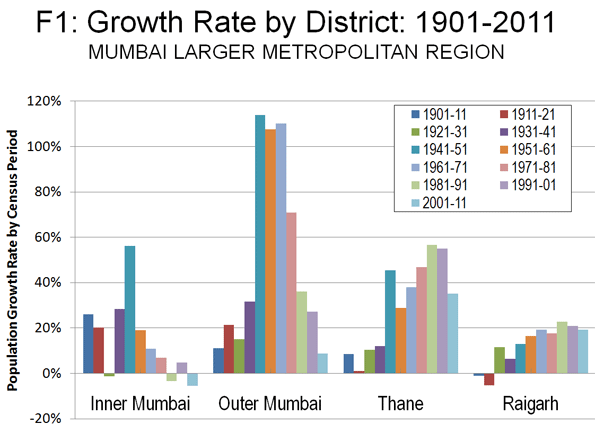
    (1) The population growth rate peaked first in the core, Inner Mumbai, Outer Mumbai later and then fell substantially. Recent growth has been concentrated in the outlying districts of Thane and Raigarh. Figure 1 shows the population growth rate by district for each decade since the 1901 census.

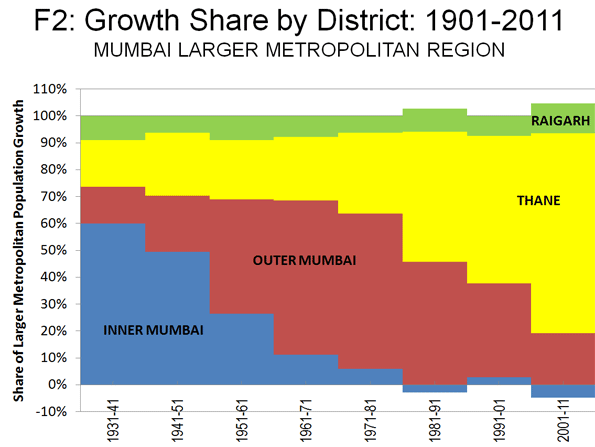
    (2) Much of the population growth was in Inner Mumbai until 1961. From 1961 through 1981, the bulk of the population growth moved to Outer Mumbai. By the 1981 to 1991 period, Thane emerged to virtually equal Outer Mumbai in its share of growth and has been dominant since 1991. Figure 2 indicates the share of the larger metropolitan area growth by district since 1901.

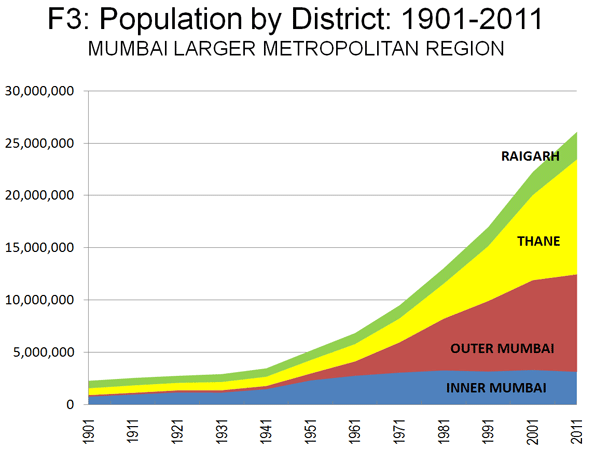
    (3) The population of Inner Mumbai has risen comparatively little since 1961, with nearly all growth occurring first in Outer Mumbai and later in Thane. These two suburban areas now account for 90 percent of the larger metropolitan area population, double the 44 percent of 1961. Figure 3 illustrates the actual population, by district, of the larger metropolitan area from 1901 to 2011.

    Inner Mumbai: The historic core (Inner Mumbai) registered 3.146 million residents, down from 3.327 million in 2001. The historic core now contains only 12 percent of the larger metropolitan area population, down from 40 percent in 1961, adding approximately 375,000 residents during that forty year stretch. Overall, since 1960, the island district has captured only 2 percent of the larger metropolitan area growth. This contrast with the period before 1951; Inner Mumbai had captured approximately 60 percent of the larger metropolitan region population growth between 1931 and 1941, and 49 percent between 1941 and 1951. However, Inner Mumbai’s share dropped to a 26 percent share in 1951 to 1961 and an 11 percent share in 1961-1971. This is consistent with the overall trend in urban core population growth in metropolitan areas around the world, with population stalling or even declining once there is little greenfield land remaining for development. Inner Mumbai had lost population in the 1981-1991 census period, however recovered to reach its population peak in 2001. The 2011 population for Inner Mumbai was the lowest since the 1971 census. These population losses have occurred despite an unprecedented building boom of high-rise residential towers.

    Outer Mumbai: The Mumbai Suburban district (Outer Mumbai) became a part of the city of Mumbai through a 1950 consolidation. As Inner Mumbai became fully developed, population growth shifted sharply to Outer Mumbai. By 2011, Outer Mumbai grew to 9.33 million residents, an increase of 7.95 million from its 1961 total of 1.38 million. Outer Mumbai captured 41 percent of the larger metropolitan area growth from 1961 to 2011. However, as the supply of greenfield land has been reduced, Outer Mumbai’s growth has also slowed considerably. In each of the three decades from 1941 to 1971, Outer Mumbai grew by more than 100 percent. Outer Mumbai attracted only 19 percent of the larger metropolitan area growth, down from a 58 percent peak in the 1971-1981 period. The 2001-2011 increase of 744,000 (8.7 percent) was the lowest since the 1951-1961 census period, and was substantially below the 27.2 percent from rate from 1991 to 2001.

    Thane: During the last 10 years, Thane has become the largest district in the Mumbai larger metropolitan area, with a population of 11.1 million, passing Outer Mumbai. Thane is now the largest district in India. In 2001 Thane had 8.1 million residents in 2001 and grew 35 percent to 2011. This, however, is down from a 55 percent growth rate between 1991 and 2001, reflecting a decline in the overall growth rate of the larger metropolitan area (see below). Thane has steadily increased its share of growth in the larger metropolitan area, from 24 percent between 1961 and 1971 to 55 percent between 1991 and 2001. Thane reached a peak in the 2001-2011 census period, capturing 74 percent of the larger metropolitan area growth. Since 1961, Thane has captured 49 percent of the growth in the larger metropolitan area and added 9.4 million residents. In each of the last two census periods, Thane has added 2.9 million residents, equal nearly to the population of the urban core, Inner Mumbai.

    Raigarh: More remote from the core, Raigarh has experienced considerably slower growth than Thane, and until recently slower than Outer Mumbai. Raigarh grew 19 percent, from 2.21 million in 2001 to 2.64 million in 2011, an increase of 19 percent. This was the only census period since 1901 in which Raigarh grew more quickly than Outer Mumbai. Raigarh accounted for 11 percent of the larger metropolitan area growth between 2001 and 2011 and 8 percent since 1960. Raigarh added approximately 1.575 million residents from 1961 to 2001, more than four times that of larger Inner Mumbai (the urban core).

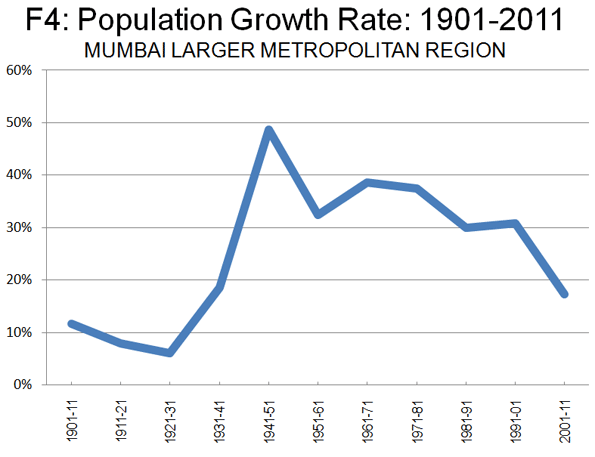
    Overall Population Growth: Consistent with the general population growth rate declines witnessed in less affluent nations, the Mumbai larger metropolitan area is growing less quickly than in previous decades. Between 2001 and 2011, the area grew 17.3 percent, which is down from 30.9 percent between 1991 and 2001.  The greatest growth had been between 1941 and 1951 (49 percent), with rates from 30 percent to 39 percent in each of the decades from 1951 to 1991 (Figure 4).

    Mumbai: Penultimate Density, Yet Representative: The core urban area (area of continuous urban development) of Mumbai represents approximately 80 percent of the larger metropolitan area population. Mumbai is the third most dense major urban area in the world at nearly 65,000 residents per square mile (25,000 per square kilometer), trailing Dhaka (Bangladesh) and Hong Kong. Yet even at this near penultimate density, Mumbai exhibits the general trends of dispersion and declining density that are occurring in urban areas around the world, from the most affluent to the least. In the two Mumbai city districts, as in other megacities, housing has become so expensive that population growth is being severely limited. Overall, the Mumbai larger metropolitan area may also be experiencing slower growth as smaller metropolitan areas outperform larger ones, a trend identified in a recent report by the McKinsey Global Institute. Finally, the over-crowded, slum conditions that prevail for more than one-half of the city’s residents could be instrumental in driving growth to more the distant suburbs of Thane and Raigarh.

    —-

    Note: This "larger metropolitan area" definition is consistent with the cruder US Bureau of the Census delineation for metropolitan areas, which is based upon counties (in 44 states), rather than tighter definitions, such as municipalities or census tracts.

    Photo: Chhatrapati Shivaji Terminus, formerly Victoria Terminus, Mumbai (by author)

    Wendell Cox is a Visiting Professor, Conservatoire National des Arts et Metiers, Paris and the author of “War on the Dream: How Anti-Sprawl Policy Threatens the Quality of Life

  • The Problem With Megacities

    The triumphalism surrounding the slums and megacities frankly disturbs me. It is, of course, right to celebrate the amazing resilience of residents living in these cities’ massive slums. But many of the megacity boosters miss a more important point: that the proliferation of these sorts of communities may not be desirable or even necessary.

    Cities may be getting larger, particularly in the developing world, but that does not make them better. Megacities such Kolkata (in India), Mumbai, Manila, Sao Paolo, Lagos and Mexico City — all among the top 10 most populous cities in the world — present a great opportunity for large corporate development firms who pledge to fix their problems with ultra-expensive hardware. They also provide thrilling features for journalists and a rich trove for academic researchers.

    But essentially megacities in developing countries should be seen for what they are: a tragic replaying of the worst aspects of the mass urbanization that occurred previously in the West. They play to the nostalgic tendency among urbanists to look back with fondness on the crowded cities of early 20th Century North America and Europe. Urban boosters like the Philadelphia Inquirer’s John Timpane speak fondly about going back to the “the way we were” — when our parents or grandparents lived stacked in small apartments, rode the subway to work and maintained a relatively small carbon footprint.

    Unfortunately such places were often not so nice for the people who actually lived in them. After all, they have been moving from higher to lower density locations for over fifty years, a trend still noticeable in the new Census. As my mother, who grew up a slum-dweller, says of her old Brooklyn neighborhood: “Brownsville was a crappy neighborhood then, and it’s a crappy neighborhood now.”

    My mother considers herself a tried and true New Yorker, but she and my late father chose to raise their kids on Long Island. She now lives in an apartment in Rockville Centre, somewhat farther out on the Island. One could imagine many slum-dwellers in developing countries would also choose a less crowded environment for themselves and their children, if that option existed.

    Most slum-dwellers, at least from what I have seen in India, move to the megacity not for the bright lights, but to escape hopeless poverty in their village. Some argue that these migrants are better off than previous slum-dwellers since they ride motorcycles and have cell phones.

    But access to the wonders of transportation and “information technology” is unlikely to compensate for physical conditions that are demonstrably worse than those my mother endured.  At least Depression-era poor New Yorkers could drink water out of a tap and expect consistent electricity, something not taken for granted by their modern day counterparts in Mexico City, Manila or Mumbai.

    More serious still, the slum-dwellers face a host of health challenges that recall the degradations of Dickensian London. Residents of mega-cities face enormous risks from such socially caused maladies as AIDS and other sexually transmitted diseases, urban violence, unsafely built environments, and what has been described as  ”the neglected epidemic” of road-related injuries. According to researchers Tim and Alana Campbell, developing countries now account for 85% of the world’s traffic fatalities.

    One telling indication of the difficulties the newcomers face is the relatively low level of life expectancy in the city — roughly 57 years — which is nearly seven years below the national average.

    Even with solid economic growth, these megacities are not necessarily becoming better places to live. In 1971, slum dwellers accounted for one in six Mumbai-kers; now they constitute an absolute majority. Inflated real estate prices drive even fairly decently employed people into slums. A modest one-bedroom apartment in the Mumbai suburbs, notes R. N.  Sharma of the Mumbai-based Tata Institute of Social Sciences, averages around 10,000 rupees a month, double the average worker’s monthly income.

    Traffic congestion is also worsening. Nearly half of Mumbai commuters spend at least one or two hours to get to work, far more than workers in smaller rivals such as Chennai, or Hyderabad. Fifty percent of formal sector workers expressed the desire to move elsewhere, in part to escape brutal train or car commutes; only a third of workers in other cities expressed this sentiment.

    What does this say about the future for megacities?  When conditions become oppressive enough, people generally respond by finding a better place to live. Poor village dwellers in Bihar may not all stay in the countryside, but they — and many better-skilled immigrants — may find other, less intense urban options.

    Recent research suggests that these immigrants will increasingly move to the urban fringe or to smaller cities. A massive research effort published earlier this year for the Lincoln Institute of Land Policy found that since 1990 “built-up area densities” have been dropping by roughly 2% a year, including in the developing world.

    An impressive new study by the McKinsey Global Institute, called “Mapping the Economic Power of Cities,” has found that “contrary to common perception, megacities have not been driving global growth for the past 15 years.” Many, the report concludes, have not grown faster than their host economies.

    McKinsey predicts these cities will underperform economically and demographically as growth shifts to   577 “fast growing middleweights,” many of them in China and India.  We can see this already in the shift of industrial growth to smaller cities in India. There may be an additional 25 million jobs added to the Indian auto industry by 2016, according to recent estimates, it appears most will go to other states, such as Gujarat, West Bengal and Tamil Nadu, enriching cities such as Chennai and Ahmedabad, nut not Mumbai.

    These realities lead some advocates in developing countries to question the logic of promoting megacities. Tata’s Sharma notes that as manufacturing and other industries move to smaller, more efficient cities, they remove many middle-income opportunities. Instead, the gap between the megacity’s rich and poor expands more rapidly.   “The boom that is happening is giving more to the wealthy.  This is the ’shining India’ people talk about,” Sharma says. “But the other part of it is very shocking, all the families where there is not even food security. We must ask: The ‘Shining India’ is for whom?

    Ashok R. Datar, chairman of the Mumbai Environmental Social Network and a long-time advisor to the Ambani corporate group, suggests that Asian megacities should stop emulating the early 20th Century Western model of rapid, dense urbanization. “We are copying the Western experience in our own stupid and silly way,” Datar says. “The poor gain on the rich. For every tech geek, we have two to three servants.

    Datar suggest that developing countries need to better promote the growth of more manageable smaller cities and try bringing more economic opportunity to the villages.  One does not have to be a Ghandian idealist to suggest that Ebenezer Howard’s “garden city” concept — conceived as a response to miserable conditions in early 20th Century urban Britain — may be better guide to future urban growth.

    Rejecting gigantism for its own sake, “the garden city” promotes, where possible, suburban growth, particularly in land-rich countries. It also can provide a guide to more human-scale approach to  dense urban development. The “garden city” is already a major focus in Singapore, where I serve as a guest lecturer at the Civil Service College. Singaporean planners are embracing bold ideas for decentralizing work, reducing commutes and restoring nearby natural areas.

    These ideas may be most relevant to cities on the cusp of rapid growth, such as Hanoi. As we walk through the high-density slums on the other side of the dike that protects Hanoi from the Red River, Giang Dang, founder of the nonprofit Action for the City, tells me that rapid growth is already degrading the quality of Hanoi’s urban life, affecting everything from the food safety to water to traffic congestion. Houses that accommodated one family, she notes, now often have two of three.

    Expanding Hanoi’s current 6 million people — already at least twice its population in the 1980s — to megacity size — say between 10 million and 15 million — may thrill urban land speculators but may not prove  so good for city residents.  Like Datar, Dang favors expanding conditions both smaller cities, and the Vietnamese countryside.

    “The city is already becoming unlivable,” she  insists. “More people, more high-rises will not make it better. Maybe it’s time to give up the stupid dream of the megacity.”

    Such voices are rarely heard in the conversation about urban problems.  But the urban future requires radical  new thinking.  Rather than foster an urban form that demands heroic survival, perhaps we should focus on ways to create cities that offer a more a healthful and even pleasant life for their citizens.

    This piece originally appeared in Forbes.com

    Joel Kotkin is executive editor of NewGeography.com and is a distinguished presidential fellow in urban futures at Chapman University, and an adjunct fellow of the Legatum Institute in London. He is author of The City: A Global History. His newest book is The Next Hundred Million: America in 2050, released in February, 2010.

    Photo by Dey Alexander

  • California: Club Med Meets Third World?

    On March 25th, the Bureau of Labor statistics released a report that showed that California jobs had increased by 96,000 in February.  The state’s cheerleaders jumped into action. Never mind that the state still has a 12.2 percent unemployment rate, and part of the decline from 12.4 percent is because just under 32,000 discouraged workers left California’s labor force in February. 

    Unfortunately, the cheerleaders are likely to once again be disappointed.  It is unwise to build a case on one data point.  Data are volatile and subject to all sorts of technical issues.  For example, the estimate of California’s job growth is seasonally adjusted data and subject to revision.

    More importantly, even if California did see 96,000 new jobs in February, that pace is unlikely to be maintained.  California’s economy is just too burdened by the State’s DURT: Delay, Uncertainty, Regulation, and Taxes.  Instead of enjoying the truly vibrant recovery one would expect given its climate, location, natural resources, university network, workforce, and natural and manmade amenities, California’s economy will grow far below its potential, burdened by its DURT. 

    People often ask me to identify the most important impediment to California’s economic growth, but there isn’t just one.  Every business is different.  One may be most impacted by regulation, another by taxes.  Instead, it is the total cost of the DURT.

    Taxes are certainly one component of DURT.  The Tax Foundation ranked California 49th in business taxes and Kiplinger ranks California worst in retiree’s taxes, which serves as a good proxy for individual tax burdens.  No doubt, California’s taxes are high, but that alone wouldn’t be too big a problem.  People happily pay to live in California.  Higher taxes and home costs are just the beginning.

    California is in its own class when it comes to regulation; nothing is unimaginable in a state where bulk of the executive leadership comes from the San Francisco-Oakland area.  Today, there are two regulations that are particularly hurting California’s economy, AB32 and SB375.  AB32 is California’s attempt to unilaterally solve the planet’s global warming problem.  It will have serious implications, all of them detrimental to economic activity.  SB375 attempts to advance its global warming  goals through regional planning mandates.  Here’s a sympathetic analysis of SB375 from a smart guy.

    Those are just the most onerous regulations.  California has thousands of regulations and more come daily.  California had 725 new laws come into effect on January 1, 2011, and the state has over 500 constitutional amendments, averaging over four new constitutional amendments a year.

    Which brings us to uncertainty.

    Uncertainty about the future regulatory environment is detrimental to economic activity.  It is extraordinarily difficult to plan when the regulatory environment is in such a state of flux, and nothing is unimaginable.

    Regulatory uncertainty is far from California’s only source of uncertainty.  California’s local governments are notoriously fickle, particularly in the generally affluent coastal areas.  I know of one project that spent four years in planning, only to be denied by the City Council, even though the project was supported by the planning department.  That’s just expensive.  Developers spend hundreds of thousands of dollars on architects, engineers, and planning consultants while jumping through the hoops set up by the planning department, neighborhood groups, environmentalists, and other special interest groups.

    This type of story is all too common in Coastal California.  Some California communities, such as Santa Monica, require that prior to building a new house, you must use two by fours, string, and flags to provide the outline of the proposed structure for up to 90 days.  This is to facilitate neighbor complaints before the project is built.

    The previous story also relates to delay.  Delay in California is legendary, a result of regulatory hurdles, demand for studies, and legal action.  California newspapers often describe projects as controversial, but this is redundant.  Every project is controversial in California. 

    Want to rebuild an aging bridge?  Someone will sue you and claim the old bridge is a historical landmark.  Want to put in a solar farm?  Someone will sue you because the land is home to endangered rats, turtles, salamanders, toads, fairy shrimp, or something.  Endangered species are everywhere in California.  Want to put a condominium project in a depressed part of town?  Someone will sue you because it doesn’t match the neighborhood.  Want to build a house?  Someone will sue you because it will block their view.

    All these things and more happen in California.  It’s no surprise that businesses find California a very challenging place to be profitable.  California’s markets are huge.  No doubt about it.  So, some business will operate in the state.  California’s location on the Pacific Rim and it ports also compel some business to be in California, even if costs are high.  California is a fantastic place to live.  So, people who can afford to will live here.  Some business owners will locate businesses where the owner wants to live.  But, most businesses are too competitive to give up profits to live in California.  Many keep their headquarter s here while shipping their new jobs to other states, or abroad.

    Even so, California is unlikely to become Detroit.  It, sadly, is also unlikely to achieve its potential or regain its previous economic vigor.  The cost of California DURT is just too high.  Instead, the place will become increasingly divided.  Coastal regions, for the foreseeable future, will become even more affluent, heavily white and increasingly Asian.  Hosts of unseen, less fortunate people support them, often commuting from more hardscrabble interior locations.

    Considerable poverty will coexist uncomfortably in California’s coastal paradise.  Working class families already crowd into housing units designed for one family, and this will likely only get worse. 

    What Coastal California won’t have is much of a middle class.  Lack of opportunity and high housing costs makes the most pleasant parts of California an unattractive place for people who define quality of life by opportunity and affordable housing, young families.  Domestic migration is likely to continue to be negative.

    For its part, inland California is already depressed, 27 counties have unemployment rates over 15 percent.  Eight have unemployment rates above 20 percent.  Even during the boom, many of California’s inland areas had extraordinarily high unemployment rates.  Central California’s poverty and blight will only get worse.

    All this is courtesy of expensive California DURT.  Because of it, California’s economy will lag.  More importantly, California seems to be morphing into almost a Hollywood caricature.  The self-absorbed hedonistic wealthy live side by side with the poor, like  a combination of a Club Med and Leisure Village in a third-world country.

    Bill Watkins is a professor at California Lutheran University and runs the Center for Economic Research and Forecasting, which can be found at clucerf.org.

    Photo by chavez25

  • Vietnam, No Longer an Underdeveloped Country

    The most recent estimates for 2010 indicate that Vietnam is no longer among the underdeveloped countries of the world and has moved onto the ranks of middle-income countries.  Financial remittances – better known as money being sent back to the home country – have lent a critical hand in accomplishing this major triumph in the country’s formerly depressed economy.

    The influx of money by overseas Vietnamese, many of whom fled as political refugees, has dramatically changed the economic landscape of the country in terms of poverty levels and development.

    Development Since the War

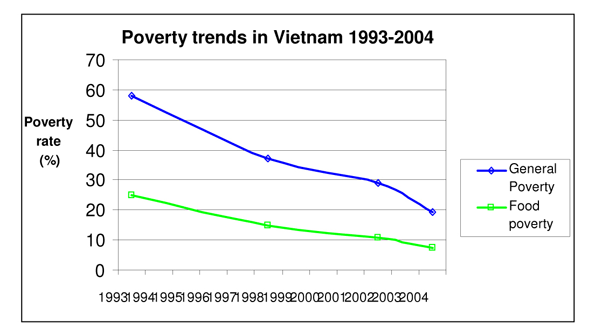
    The aftermath of the war had left Vietnam among the five poorest countries in the world with 75 percent of the population living in poverty in 1984. Since then, the poverty level had dramatically decreased to 37 percent in 1998 and later to 29 percent in 2002, according to the World Bank.

    The CIA World Factbook more recently estimated Vietnam as having only 10.6 percent of the population living below the poverty line in 2010, a far cry from the 75 percent just 26 years earlier. In terms of economic output, a brief on Vietnam by the World Bank reported that the real GDP increased by 7.3 percent per year during 1995-2005 and per capita income by 6.2 percent per year.

    Vietnam was expected to enter the ranks of other middle-income countries by reaching the $1,000 GDP per capita marker by 2010, which it did according to the International Monetary Fund (IMF). The IMF estimated Vietnam’s GDP per capita as $1,155 for the 2010 fiscal year. Since then, the country’s Ministry of Planning and Investment (MPI) has set a new target that nearly doubles Vietnam’s current GDP per capita over the next four years. An expected GDP per capita of $2,100 by 2015 will allow Vietnam to surpass India’s GDP per capita in the global economy and be among the ranks of the Philippines.

    The target GDP per capita, however, is still well below its communist competitor, China, which now boasts an average GDP per capita of $4,520. Even though China presently holds the title as the “Red Dragon of the East,” Vietnam, with its enormous potential for economic growth, has recently been referred to as the “Rising Dragon” and the “New Asian Dragon” by various scholars.

    The World Bank avowed, “Vietnam is one of the best performing economies in the world over the last decade.” It further stated, “Vietnam’s poverty reduction and economic growth achievement in the last 15 years are one of the most spectacular success stories in economic development.”

    Remittances Over the Years

    Financial remittances have had a notable influence on the improved economic conditions in Vietnam over the years. This has been especially evident since the U.S. rescinded the embargo against Vietnam in 1995, which allowed for greater opportunities to remit money through formalized channels.

    In the years immediately following the Vietnam War, it was close to impossible for Vietnamese-Americans to send money directly to their home country. The majority of remittances that were successfully sent back to the home country were primarily conducted through informal money transfers.

    The gradual increase in official remittances over the past few decades, however, has been attributed to a combination of key events, which include but are not limited to: the Vietnamese government launch of a renovation process (Doi Moi) in 1986, the U.S. lifting of the embargo against Vietnam in 1995, and Vietnam’s membership into the World Trade Organization in 2007.

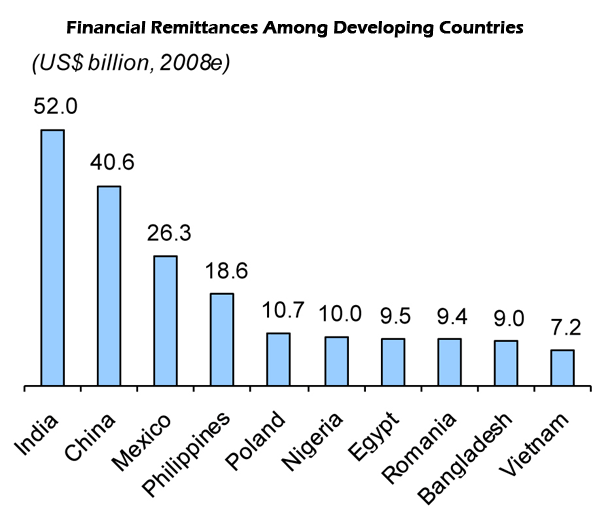
    In 2008, Vietnam emerged as the tenth leading recipient of migrant remittances among developing countries with $7.2 billion received during that year alone. The U.S. neighbor to the south, Mexico, with $26.3 billion, was third behind India and China.

    Later in 2009, Vietnam’s financial remittances fell slightly to $6.8 billion despite predictions of a greater drop among all developing countries. The slight decline during the considerable global economic downturn illustrated the resilience of money being sent to Vietnam from abroad, particularly from troubled economies such as the United States, France and in Eastern Europe.

    In addition, remittances appear again on an upswing.  By the end of the 2010 fiscal year, Vietnam set a new total inward remittance record of more than $8 billion through official channels. This $8 billion represented about 8 percent of the overall GDP for the country that year.

    The Role of remittances on development

    Although there have been no notable studies that directly connect migrant remittances and development specifically in Vietnam,  the effects of financial remittances on the Vietnamese economy are likely to be profound.

    Existing studies on other countries in the world have already illustrated the significant relationship between migrant remittances and development in the home country in terms of balance of payments, saving and investment, structural changes in the economy, and other channels influencing development and growth. In recent decades, these links between mother country and expatriates have played a critical role in the rise of both China and India.

    Such ties are particularly critical for developing countries which see remittances as a reliable long-term source of foreign capital. In 2000, the United Nations reported that financial remittances had increased the GDPs of El Salvador, Jamaica, Jordan, and Nicaragua by 10 percent. The World Bank in 2004 further revealed that financial remittances accounted for 31 percent, 25 percent, and 12 percent of the GDP in Tonga, Haiti, and Nicaragua, respectively.

    More recent data from the Migration Policy Institute (MPI) in 2009 astonishingly showed that remittances constituted 49.6 percent, 37.7 percent, and 31.4 percent of the overall GDP for Tajikistan, Tonga, and Moldova, respectively. Although Vietnam’s inward formal remittances comprise less than 10 percent of the country’s overall GDP, it was still ranked 16th among the top 30 remittance receiving countries by the World Bank in 2010.

    The existing potential of remittances on development has been notable in Vietnam and continues to grow exponentially – even despite the slowing of the economy in the rest of the world.

    Whether or not these effects are positive or negative may be a matter of ideology and politics. The Vietnamese government clearly wants to maximize the benefits of remittances. But there is concern about such issues as “dollarization” of the economy and the role such transfer may play in worsening the growing inequality between the rich and poor widely decried in Vietnam. Yet overall remittances should be seen as a net positive, helping to spark entrepreneurial ventures critical to the country’s movement from a third world to a solidly second world status.

    Jane Le Skaife is a doctoral candidate in the Department of Sociology at the University of California, Davis. She is currently conducting her dissertation research involving a cross-national comparison of Vietnamese refugees in France and the United States.

    Photo by Yen H Nguyen

  • Actually, Cities are Part of the Economy

    “The prosperity of our economy and communities is dependent on the political structures and mechanisms used to manage and coordinate our economic systems.”

    No politician expecting to be taken seriously would say that today. State intervention was discredited long before it collapsed in the 1980s. Even our prime minister in Australia pays lip-service to “flexible markets with the right incentives and price signals to maximise the value of our people and capital resources.” But how does that square with her government’s quiet push for a more intrusive urban policy agenda?

    Over the last twelve months, Infrastructure Minister Anthony Albanese has been laying the ground work for a grand National Urban Policy, to be announced later in the year. To this end, he released three dense documents. Last March we got State of Australian Cities 2010 (“Cities 2010”), a compilation of statistics confirming, amongst other things, that cities account for 80 per cent of our Gross Domestic Product. Then in December came a discussion paper and a background paper, both called Our Cities.

    Their general drift can be gauged from a line in the latter’s final chapter. It’s the sentence quoted at the top of this article, with the words “cities” and “urban” replacing “economy” and “economic.”

    Embarrassed to champion intervention at the macro level, progressives resort to carving chunks out of the national economy and relabeling them “the environment”, “social capital” or “urban planning” before turning reality upside down. As he moves urban policy to the environment ledger, Mr. Albanese promises to transform the “productivity, sustainability and liveability” of our cities. Intervention is bad for the national economy, it seems, but good for the 80 per cent of GDP generated by cities.

    Urban Myths

    The authors of Mr. Albanese’s documents are anonymous, but aficionados will recognize the handiwork of Curtin University’s Sustainable Policy Institute, Griffith University’s Urban Research Program, the Faculty of the Built Environment at NSW University, and other focal-points of green orthodoxy. The reference lists are full of their output. Their technique of persuasion, recycled by Mr. Albanese’s Department, is to evoke plausible images while perpetuating three myths: suburban growth worsens carbon emissions and traffic congestion, people are being forced to live far from jobs concentrated in CBDs, and denser development will make housing cheaper.

    The discussion paper says: “Australian cities generate very high carbon emissions and air pollution from our heavy reliance on carbon fuels for energy and transport. Carbon emissions from transport are principally due to the lengths of trips necessitated by our dispersed cities and our extensive use of private motor vehicles.” Variations of this passage recur throughout the documents. It sounds plausible enough. So many vehicles cris-crossing our wide open cities must be spewing out heaps of carbon dioxide. But the documents ignore evidence painting a different picture.

    There is the Australian Conservation Foundation’s Consumption Atlas, which found that dense, affluent, inner-suburbs account for more carbon than the dispersed fringe, suggesting that, as a factor in emissions, general consumption trumps settlement patterns; there is a 2007 study by Randolph and Troy confirming earlier findings that energy consumption per capita in high-density developments, like high-rise apartments, is notably higher than in detached housing; there is a recent report by Allen Consulting for the Victorian Building Commission, noting the absence of conclusive evidence that vertical living is more ‘sustainable’ than conventional homes; and there is more.

    None of these rate a mention in the documents. Chapter 5 of the background paper does reference a couple of studies by Alford and Whteman (2009) and Trubka, Newman and Bisborough (2010), but these focus on “transport energy consumption” and “transport greenhouse gases.” They don’t investigate the impact of urban form on general consumption, the real determinant of emission levels. And a study by Perkins et al (2009), cited in Cities 2010, actually contradicts the approved message: “overall, it cannot be assumed that centralised, higher density living will deliver per capita emission reductions for residents … ”

    There is no reliable evidence that suburban growth is worse for emissions. Even Griffith’s Brendan Gleeson, a very green urbanist, had to concede that “the faith … in residential density as a simple lever that can be used to manipulate urban sustainability appears to be misplaced. New Australian scientific analysis points to the consumptive lifestyle, not the nature of one’s dwelling, as the root of environmental woes.”

    In any event, transport accounts for 14 per cent of Australia’s 1.4 per cent share of global emissions, or a minuscule 0.197 per cent of the world’s carbon. We should retain a sense of perspective, even if the documents obsess about our high per capita emissions. If the climate is being affected (a big if), it’s absolute volumes that matter.

    Allied to the myth of carbon-spewing suburbs is the myth of centrally-located jobs. We read in Cities 2010 that “the impacts of outward expansion and low density residential development have been a greater separation between residential areas and locations of employment …” The discussion paper asserts, more directly, that “the trend to inner-city living reflects changing preferences for dwellings and location – living closer to employment that is concentrated in central areas.” Again, similar statements crop up throughout the documents. People shouldn’t have to drive or commute long distances to a “centre” where the jobs are.

    Evidence to the contrary is easy to find. According to the NSW Department of Transport, only 12 per cent of Sydney’s jobs are in the CBD, and second tier centres like North Sydney, Chatswood, Parramatta, Hustville and Penrith have no more than 1.8 per cent each. The rest are distributed throughout the metropolitan region. In the case of Melbourne, McCloskey, Birrell and Yip (2009) say it’s absurd to concentrate housing near transit lines since only 19 per cent of jobs within the Melbourne Statistical Division (MSD – Greater Melbourne) were located in the Melbourne Local Government Area (the CBD), while 81 per cent “are scattered throughout the rest of the MSD”.

    In fact, the background paper points out that a majority of the employed in Sydney, Melbourne and Perth live within 10 kilometres of their workplace, while around 15 per cent live more than 20 kilometres away. This is hardly a disaster in the making. Consistently, Cities 2010 refers to “evidence that commuting distances have been stable or even declining since the 1990s in a number of capital cities.”

    For green urbanists, these myths are indispensible. Their agenda hasn’t a hope unless the public accepts that suburban growth will spoil the climate, and hike congestion and transport costs. As for housing affordability, the documents take a leave-pass (social housing is another story). They promote the term “living affordability”, adding petrol prices and mortgage rates to the equation.

    Evidence linking costly housing to supply restrictions on the fringe, like the annual Demographia survey, is too inconvenient. When the background paper does get around to the subject, it says “multiple factors [impede] the delivery of an efficient supply of suitable and affordable housing.”
    These include “land zoning and building code regulations and other standards related to building quality.” A few pages later, however, canvassing some solutions to the problem, the paper proposes “reforming planning systems to … position a variety of residential development in close proximity to centres and transport infrastructure”. Doesn’t this mean a lot more inefficient “land zoning”?

    This is just one instance of disjointed logic and economic illiteracy; many others are scattered throughout the documents.

    The Invisible Hand and Land

    Actually, cities are part of the economy, and are subject to the same principles. The operations of demand, supply and prices are equally applicable to land and structures. They can’t be erased by regulation, even if it’s called planning and zoning. The inflationary effect of coercive zoning on land values is the elephant in the room. Nowhere is it acknowledged in the documents.

    Consider two recent press items. Retail tenants in Pitt Street Mall, the heart of Sydney’s CBD, are paying rents as high as $13,000 a square meter, while industrial tenants on the north-west outskirts pay around $237. These rent differentials are, of course, a function of distance, and influence the viability, not just the location, of various types of activities.

    Restricting expansion and other forms of coercive zoning place an escalating floor under peripheral rents and values. Mr. Albanese’s authors fail to appreciate the implications of this, not least for “urban productivity.” There is little call to dwell on economic mechanisms if you believe, as the discussion paper puts it, “the private sector, through a myriad of individual decisions and investments, guided and constrained by government investments, regulations or charges, is a powerful shaper of cities [emphasis added]”.

    In the documents, lifting productivity boils down to cutting the costs of traffic congestion, estimated to reach $20 billion a year by 2020, principally by reducing “car dependency” (another loaded term, echoing drug dependency).

    Ignoring the reality of high job dispersal, the background paper says “a key challenge is to reduce dependence on motor vehicles while maintaining access between and within locations … the Australian Government recognises that it has a role … in investing in major mass transit systems, identifying and protecting new transport corridors and supporting means to shift from private vehicles to public transport”. But as McCloskey, Birrell and Yip explain, “the high level of job dispersal around Melbourne [and other cities] cannot be easily unwound.” In those conditions, Mr. Albanese’s strategy is doomed to failure.

    Alternatively, when diseconomies from congestion start to outweigh economies from centrality, firms and commuters will move to other, less congested sites, easing congestion all-round. This is the only effective, long-term solution to congestion. However by mandating concentration rather than enabling dispersion, evidenced by a dim view of road-building, green planning stymies this process. The documents want to end it altogether.

    According to the background paper, “connectivity within cities can also be achieved by placing people closer to the jobs, facilities, goods and services they desire – or putting these closer to where people live. This highlights the important role of integrated land-use and infrastructure planning in managing the need for physical travel”. But this notion, that firms and residences can be “placed” by a central authority, is logically flawed. It suffers from something akin to a “coordination problem” (a concept from game theory).

    Suppose household A has, in existing circumstances, chosen its optimal location relative to (1) affordable housing, (2) employment and (3) services. How can the government arrange things so that A ends up in a more optimal location? Moving A closer to work may push it further from affordable housing and services. Moved closer to services, A may end up further from other factors, and so on. It’s unlikely that the government can ever place A in a better location relative to all three factors.

    Then suppose household B has chosen its own optimal location relative to the three factors, some distance away from the point chosen by A. How does the government improve the outcome for both households? Action benefiting A may hurt B and vice versa.

    The same problem can be framed for businesses locating relative to (1) competitive rents, (2) transport routes, (3) suppliers, (4) suitable labour and (5) customers (market). Our cities host hundreds of thousands of households and businesses. There is no way that a planning hierarchy can engineer a more efficient outcome than the people themselves, interacting freely in the marketplace. Official meddling is more likely to induce problems than solve them.

    Instances of disjointed logic abound. One paper talks about “micro-reforms to reduce costs to businesses and consumers”, but another urges “access to a range of [more expensive and less efficient] high-quality renewable energy sources”; a paper commends “the principle of subsidiarity, ensuring that the most local level of government is used …”, but then calls for “improving alignment and integration of planning and investment across all three levels of government to support the nationally agreed … objective”; a paper demands action to “reduce red tape”, but all three documents offer heaps more instruments and regulations.

    Ultimately, Mr. Albanese’s documents are the pretext for a new wave of intrusion into economic life. As such, they represent a glaring case of bureaucratic overreach. However much he may spruik flats, smaller houses, public transport and higher utility bills as an enhancement of urban “liveability”, most Australians will disdain them as anything but liveable.

    John Muscat is a co-editor of The New City, where this piece originally appeared. 

    Photo by Joseph Younis.