Tag: middle class

  • The Corbynization of the Democratic Party

    The Democratic Party’s current festival of re-examination is both necessary and justified. They have just lost to the most unpopular presidential candidate in recent memory. Lockstep media support and a much larger war chest were not enough to save them from losing not only the presidency, but also in state races across the country.

    Since President Obama’s first election, Democrats have lost control of the House and Senate, as well as a dozen governors’ houses and roughly 900 state legislative seats. Republicans have control of all levels of government in 24 states, while Democrats have total control over six. Overall, the party seems incapable of reaching out to the middle part of the country, white and middle-class voters.

    This contrasts with the 1990s, when a group of party activists consciously rebuilt the party to appeal to middle-class Americans. Groups like the Democratic Leadership Council — for whose think tank, the Progressive Policy Institute, I worked for several years — pushed notions of personal responsibility, welfare reform, tough crime policies and economic growth that, embraced by Bill Clinton, expanded the party’s base in the Midwest, the Appalachians and even the Southeast.

    Leftward Ho!

    Such a shift to the middle is unlikely today. Progressives generally see Hillary Clinton’s loss as largely a rejection of her husband’s neoliberal policies and want to push the party further to the left.

    This parallels developments in the United Kingdom, where, following their defeat in 2015, the Labour Party promoted a far-left figure, Jeremy Corbyn, as its leader. This was driven by grassroots progressives — deeply green, multiculturalist and openly socialist. Many, including several high up in Labour’s parliamentary party, believe the party has little chance to win under such leadership.

    Read the entire piece at The Orange County Register.

    Photo by Gage Skidmore from Peoria, AZ, United States of America – Hillary ClintonCC BY-SA 2.0

  • Tearing Down American Dream Boundaries: An Imperative

    Donald Trump’s election victory has been widely credited attracting households who have been “left behind,” by stagnating or declining income and lost jobs. But the left-behind also includes many households whose    standards of living are being reduced by the rising cost of housing. This is not about affordable housing for low-income households, itself very important, but a crisis among  middle-income households  no longer able to afford their own homes in some parts of the nation.

    Indeed, the lack of middle-income housing affordability has been associated with migration from more expensive to less expensive areas. Moreover, more people have been fleeing the states that supported Secretary Clinton, with their inferior housing affordability, and moving to those that supported Donald Trump (a net 1.45 million gain  in just  the last five years), where housing affordability is generally better.

    The differences in house prices are stunning. Between 1969 and 2014, the gap between the highest and lowest cost major metropolitan (over 1,000,000 population) housing markets had expanded 260 percent. This increase has been largely driven by markets that have become more restrictively regulated. In the more lightly regulated rental market the gap between the highest and lowest expanded only 30 percent, just one-ninth the change in the house price gap.

    In some highly regulated markets, notably California, it has become all but impossible to build the consumer-favored detached housing in the suburbs associated with the “American Dream.”

    In recent decades, California house prices have risen to as much as triple the costs relative to household incomes that exist in much of the rest of the country. A dense mesh of environmental regulation has been implemented,   far stronger than EPA regulations. Large parts of metropolitan areas are now off-limits for efficient housing tract construction, prohibited by “urban growth boundaries,” which can be characterized as “American Dream Boundaries.”

    Progressive politicians, dominant in California, talk incessantly about housing affordability, but blindly pursue policies that will make things even worse. It should not be surprising that the housing-cost adjusted poverty rate in California is the worst in union, underperforming even Mississippi. It should also not be surprising that Californians of every age group, including Millennials, are leaving state in larger numbers than they are being attracted.

    The San Francisco Bay Area’s two large metropolitan areas (San Jose and San Francisco) are the most unaffordable in the nation and rank fourth and seventh most unaffordable in the Demographia International Housing Affordability Survey among major metropolitan areas in nine nations. House prices have more than tripled relative to incomes since radical land-use regulation began. The problem is not a shortage of land. The Bay Area has more than enough developable land to accommodate up to four times the population. The shortage is in the amount of land governments allow to be developed. As a result, the Bay Area has become a rigged market that excludes many middle-income households by making housing unaffordable. This may be a boon for older property owners, but the burden falls most heavily on households that are minority or young. California’s housing affordability crisis is a profound public policy failure.

    The problem extends beyond California, especially to places like Oregon, Washington, Hawaii, Colorado, Maryland, and northern Virginia. The net effect is that households pay much more the necessary for housing and have a lower standard of living that is necessitated by government policy. It is no wonder that people think the future is less bright for their children.

    Moreover, no one should be misled by planning fantasies that backyard “Granny flats” or high-rise apartment towers are the answer. They have their market, but it does not include most aspiring households. Government has no business lowering living standards by forcing house prices up.

    A mortgage on a median priced house requires a qualifying income approximately double the median household income in San Diego, Los Angeles, San Francisco and San Jose (10 percent down payment assumption). In much of the country, by contrast, housing remains affordable, as in the past. A median income household can comfortably afford the median priced house in metropolitan areas like Dallas-Fort Worth, Atlanta and Kansas City.

    More Jobs and Economic Growth

    But beyond the lower standards of living attributable to American Dream Boundaries, building fewer detached houses than households demand has an important economic cost.

    Research by Chang-Tai Hseih of the University of Illinois, Chicago and Enrico Moretti at the University of California indicates that the gross domestic product was $2 trillion less than would have been expected in 2009, largely due to housing regulation. Matthew Rognlie of the Massachusetts Institute of Technology found that the widening inequality gap found by French economist Thomas Piketty was largely due to housing and suggested expanding the housing supply and re-examining land-use regulation.

    Jason Furman, President Chairman of President Obama’s Council of Economic Advisors has shown that single family houses make 2.5 times the contribution of apartment units to the gross domestic product. This fact eluded President Obama’s Department of Housing and Urban Development, which has spent years roaming the country inducing local officials to implement the policies like those noted above that make housing less affordable.

    But, as Furman’s data indicates, the detached housing Americans overwhelmingly prefer is better for the economy. This means more good jobs in building homes, economic ripple effects and additional revenues for local governments.

    Yet, seven years after the  Great Recession, California’s detached house construction rate is barely one half the national average.

    Much of this has to do with a planning philosophy called “smart growth,” often accompanied by prohibitions on new housing on the urban fringe. But there is nothing smart about policies that raise the price of houses for struggling families. Nor is there anything smart about reducing people’s standards of living. The more important priorities of facilitating better standards of living and reducing poverty are turned on their head by such myopic policies.

    It is time to restore priorities that put people first. Building the housing that people want would not only improve living standards, but would also boost the economy. The American Dream Boundaries need to be torn down.

    Wendell Cox is principal of Demographia, an international public policy and demographics firm. He is a Senior Fellow of the Center for Opportunity Urbanism (US), Senior Fellow for Housing Affordability and Municipal Policy for the Frontier Centre for Public Policy (Canada), and a member of the Board of Advisors of the Center for Demographics and Policy at Chapman University (California). He is co-author of the "Demographia International Housing Affordability Survey" and author of "Demographia World Urban Areas" and "War on the Dream: How Anti-Sprawl Policy Threatens the Quality of Life." He was appointed to three terms on the Los Angeles County Transportation Commission, where he served with the leading city and county leadership as the only non-elected member. He served as a visiting professor at the Conservatoire National des Arts et Metiers, a national university in Paris.

    Photograph: Suburban Kansas City (by author)

  • Five Ideas to Make America Greater

    Donald Trump’s presidential campaign was based on the notion that he could “Make America Great Again.” But beyond the rhetoric — sometimes lurching into demagoguery — the newly elected president comes to office, as one commentator suggests, “the least policy-savvy president in history.”

    To succeed, Trump must adopt innovative policies that transcend traditional right-left divides. He needs to find ways to help his heavily white, working-class base while expanding his appeal to minorities, millennials and educated people who are now largely horrified by his ascendency.

    In the short run, his biggest problem may lie with his own Republican Party establishment, which, rather than “drain the swamp,” would simply like to create one of its own. The looming presence of corporate lobbyists, swarming around the administration like hungry flies, is not encouraging at all, nor are GOP congressional plans to re-establish “earmarks.”

    The key lies not in empowering a different set of K Street parasites, but rather in reversing income stagnation. If he cannot, his triumph may prove to be no more consequential than an absurdist, Latin American-style telenovela.

    A flatter, fairer tax

    The basic instinct among many Republicans tends toward reducing taxes on their richest donors and making life easier for the ultrarich, including some on Trump’s economic team. Trump’s imperative should, instead, be to make the tax system fairer for the middle and working classes. One way would be to make a graduated flat tax that would mean that the rich, who make most of their money from investments, pay the same rate for capital gains as the rest of us do for income.

    Democrats will, no doubt, still charge Trump with being “unfair,” but, as Ronald Reagan proved 20 years ago, Americans support incentives for work if they don’t unfairly tilt conditions to the ultrarich. Main Street business owners, the most hostile constituency to the Obama administration’s policies, pay taxes based on their income and can’t manipulate the system like Apple, Google, Wall Streeters or, for that matter, real estate developers like Trump himself.

    A middle ground for immigration

    Opposition to illegal immigration helped drive the Trump campaign early on, but, outside of the GOP base, there is little support for a mass roundup of the undocumented. The vast majority of Americans, over 70 percent, also oppose “open borders.” After all, even President Obama evicted 2 million people during his two terms in office.

    Trump also can begin reordering our immigration policies toward skilled workers who are interested in becoming citizens. At the same time, Trump could score points by undermining the H1-B visa program, which allows Silicon Valley firms, along with corporations like Disney and Southern California Edison, to lay off American workers and replace them with temporary indentured servants.

    Read the entire piece at The Orange County Register.

    Joel Kotkin is executive editor of NewGeography.com. He is the Roger Hobbs Distinguished Fellow in Urban Studies at Chapman University and executive director of the Houston-based Center for Opportunity Urbanism. His newest book, The Human City: Urbanism for the rest of us, will be published in April by Agate. He is also author of The New Class ConflictThe City: A Global History, and The Next Hundred Million: America in 2050. He lives in Orange County, CA.

    Photo: Gage Skidmore from Peoria, AZ, United States of America (Make America Great Again hat) [CC BY-SA 2.0], via Wikimedia Commons

  • Trumping the Elites

    She had it all—the pliant media, the tech oligarchs, Wall Street, the property moguls, the academics, and the all-around “smart people.” What Hillary Clinton didn’t have was flyover country, the economic “leftovers,” the small towns, the unhipstered suburbs, and other unfashionable places. As Thomas Frank has noted, Democrats have gone “from being the party of Decatur to the party of Martha’s Vineyard.” No surprise, then, that working- and middle-class voters went for Donald Trump and helped him break through in states—Michigan, Wisconsin, Iowa—that have usually gone blue in recent presidential elections.

    Trump seized on the widespread sense that American life was destined to get worse from generation to generation. Americans wanted opportunity for the next generation, not a managed decline. Democrats—and I was one for over 40 years—once offered this to the working and middle classes that have now deserted the party.

    More than anything, the Trump vote says “no” to oligarchies and ruling classes that not only hoard their wealth but also are convinced that they are morally superior. Trump may be as ostentatious as anyone in flaunting his own wealth, but compared with his garishness, the hypocrisy of the elites is infinitely worse. It’s one thing to be told that decline and future stagnation are your lot by, say, selfless monks wearing hair shirts or tough party cadres who live, like the pre-revolutionary Bolsheviks, with the common people. It’s quite another, when the message comes from trustafarians writing for the New York Times or people who fly their own planes and own numerous homes.

    Concern about climate change galvanized the elites—Wall Street, Hollywood, Silicon Valley—but left Main Street cold. Wall Street placed its bets on Trump and, like many blocs within the new “progressive” constituency, reacted with shock that the American people hadn’t bought in to their investment.

    The map tells all. Clinton won by large margins in the Northeast and on the West Coast, and in states—Colorado, New Mexico, and Nevada—where Trump’s intemperate comments roused Latino voters. But outside of Illinois, a whole swath of the country, from the hills of Appalachia to the fringes of the Rockies, went solidly for Trump.

    Why would that be? Start with basic economics. The economy in the nation’s interior relies on producing things—an endeavor that the coasts have largely abandoned. Energy, manufacturing, and agriculture still define these economies, and employ many white-collar as well as blue-collar workers. If you live in Texas and Oklahoma, “decarbonization” is a much less attractive concept than it might seem in Manhattan or San Francisco. Trump swept the areas that keep the lights on and the motors turning—Ohio, Oklahoma, Louisiana, Texas, Wyoming, Idaho, Louisiana, and especially West Virginia, where he won by a remarkable 68 to 27 margin. 

    Among other things, the media missed the fact that the middle of the country and the South continue to gain population. The “blue” model, for the most part, expels people, while, in contrast, the “red” one appeals, particularly to middle- and working-class families. Texas and Florida are now our second and third most-populous states. Once the pacesetter, New York is a mere shadow of itself as a determiner of elections, and California, no longer growing quicker than the rest of the country, has perched itself on the Left fringe, with obvious bad ramifications—high housing and energy bills, depressed blue-collar sectors—for middle-aged, middle-class families.

    In contrast, Trump’s America presents an alternative model, which honors small enterprise, allows housing to meet demand, and does not see the United States as part of a global system to be managed. That there are xenophobic, and even racist, elements in the Trumpian ranks is undeniable—but for most Americans, the true “deplorables” have been the self-appointed regulators and financial masters who seem determined to halt their upward progress, and that of their children. If our governing elites want to know how Trump happened, they need only look in the mirror.

    This piece first appeared at The City Journal.

    Joel Kotkin is executive editor of NewGeography.com. He is the Roger Hobbs Distinguished Fellow in Urban Studies at Chapman University and executive director of the Houston-based Center for Opportunity Urbanism. His newest book, The Human City: Urbanism for the rest of us, will be published in April by Agate. He is also author of The New Class ConflictThe City: A Global History, and The Next Hundred Million: America in 2050. He lives in Orange County, CA.

    Photo: “US Secretary of State Hillary Rodham Clinton Meets Japanese Foreign Minister Seiji Maehara in Hawaii 101027-F-LX971-088” by Master Sgt. Cohen Young – https://www.dvidshub.net/image/1317097. Licensed under Public Domain via Wikimedia Commons.

  • The Improbable Demographics Behind Donald Trump’s Shocking Presidential Victory

    n an election so ugly and so close, one is reluctant to proclaim winners. But it’s clear that there’s a loser — the very notion of the United States of America.

    Instead we have populations and geographies that barely seem to belong in the same country, if not on the same planet. The electorate is so divided that many states went for either Donald Trump or Hillary Clinton by lopsided margins. The Northeast was solidly Democratic, with Clinton winning New York, Massachusetts and Vermont with three-fifths of the vote or more. Washington, D.C., heavily black and the seat of the bureaucracy and pundit class, delivered an almost Soviet-style 93% to 4% margin.

    On the other side were a series of states where Trump won just as easily, including Tennessee and Kentucky, with three-fifths of the vote, and West Virginia, by a margin of two-to-one  – higher than those attained by 2012 GOP presidential candidate Mitt Romney.

    Much of the rest of the map has followed the usual patterns: Democratic domination of Illinois and the West Coast, while Republicans held the South. Where the election was decided was in previous battleground states: Florida, North Carolina and Ohio.

    The Revolt of Middle America

    America is a nation of many economies, but those that produce real, tangible things — food, fiber, energy and manufactured goods — went overwhelmingly for Trump. He won virtually every state from Appalachia to the Rockies, with the exceptions of heavily Hispanic Colorado, Nevada and New Mexico, and President Obama’s home base of Illinois.

    Some of his biggest margins were in energy states — Texas, Oklahoma, West Virginia, Wyoming, North Dakota — where the fracking revolution created a burst of prosperity. Generally speaking, the more carbon-intensive the economy, the better the Republicans did. Many of his biggest wins took place across the energy-producing regions of the country, including Ohio, Texas, Louisiana, Wyoming, Idaho, and especially West Virginia, where he won by a remarkable margin of 68% to 27%. The energy industry could well be the biggest financial winner in the election.

    The Green Trap

    Clinton’s support for climate change legislation, a lower priority among the electorate than other concerns, was seen as necessary to shore up support from greens threatening to attack her from the left. Yet the issue never caught on the heartland, which tends to see climate change mitigation as injurious to them.

    This may have proven a major miscalculation, as the energy economy is also tied closely to manufacturing. Besides climate change, the heartland had many reasons to fear a continuation of Obama policies, particularly related to regulation and global trade, which seems to have been a big factor in Trump’s upset win in normally moderate to liberal Wisconsin.

    Trump either won, or closely contested all the traditional manufacturing states — Ohio, Wisconsin, Indiana, Iowa and even Michigan, where union voters did not support Clinton as they had Obama and where trade was also a big issue. Trump did consistently better than Romney in all these states, even though Romney was a native of Michigan. Perhaps the most significant turnaround was in Ohio, which Obama won with barely 51%  of the vote in 2012. This year Trump reversed this loss and won by over seven points.

    Agricultural states, reeling from the decline of commodity prices, not surprisingly, also went for the New Yorker.

    Premature Epitaphs For The White Voter

    Race, as is often the case, played a major role in the election. For much of the election, commentators, particularly in the dominant Eastern media, seemed to be openly celebrating what CNN heralded as “the decline of the white voter.” The “new America,” they suggested, would be a coalition of minorities, educated workers and millennials.

    To be sure, the minority share of the electorate is only going to grow — from less than 30% today to over 40% in 2032 — as more white Americans continue to die than be born. Just between 2012 and 2016, the Latino and Asian electorate grew 17% and 16%, respectively; the white electorate expanded barely 2%.

    In Colorado the new minority math was seen, with a strong showing among Latinos, the educated suburbs around Denver and millennials.

    That may be the future, but now is now. Exit polling nationwide showed Trump won two-to-one among people without a college degree, matched Clinton among college graduates, losing only those with graduate degrees, a group that has voted for the Democrats since 1988.

    But there’s simply more high school graduates then those with graduate degrees. And for now there are a lot more whites than minorities. As we look into the future, these groups will fade somewhat but right now they can still determine elections. Nowhere is this clearer than in Trump’s decisive win in Florida, a state that is home to many white retirees, including from the old industrial states.

    Latinos may be the one group in the “new America” that made a difference for Clinton, not only in Colorado, but also in Nevada. Republicans paid a price for Trump’s intemperate comments on immigration and about Mexico.

    They also made states like Texas and North Carolina closer, and may have helped secure Clinton’s win in Virginia. In contrast, neither African-Americans or millennials seem to have turned out as heavily, both in numbers and percentage terms, as they did for President Obama. Trump appears to have made some modest gains with both groups, contrary to the conventional wisdom.

    Class Warrior

    Class has been a bigger factor in this election than in any election since the New Deal era. Trump’s insurgency rode largely on middle- and working-class fears about globalization, immigration and the cultural arrogance of the “progressive” cultural elite. This is something Bill Clinton understandsbetter than his wife.

    Trump owes his election to what one writer has called “the leftover people.” These may be “deplorables” to the pundits but their grievances are real – their incomes and their lifespans have been decreasing. They have noticed, as Thomas Frank has written, that the Democrats have gone “from being the party of Decatur to the party of Martha’s Vineyard.”

    Many of these voters were once Democrats, and feel they have been betrayed. And they include a large swath of the middle class, whose fury explains much of what happened tonight. Trump has connected better with these voters than Romney, who won those making between $50,000 and $90,000 by a narrow 52 percent margin. Early analysis of this year’s election shows Trump doing better among these kind of voters.

    At the same time, however, affluent voters — those making $100,000 and above — seem to have tilted over to the Democrats this year. This is the first time the “rich” have gone against the GOP since the 1964 Goldwater debacle. Obama did better among the wealthy, winning eight of the 10 richest counties in 2012. In virtually all these counties, Clinton did even better.

    What does this mean for America’s traditional middle class, whose numbers have been fading for a generation? Long the majority, notes Pew, they are no longer, outnumbered by the lower and upper classes combined. Yet like the Anglo population, in this election what’s left of America’s middle class has shown itself not ready to face the sunset.

    Now What?

    Given the unpredictable nature of Trump, it’s hard to see what he will do. Although himself a businessman, he was opposed overwhelmingly by his own class. Clinton won more support from big business and the business elite. If you had a billionaire primary, Clinton would have won by as much as 20 to 1.

    Initially many of those business interests closest to both Obama and Clinton — Wall Street, Silicon Valley, Hollywood — will be on the outside looking in. Their advantages from tax avoidance could be lessened. Merger-mania, yet another form of asset inflation, will continue unabated, particularly in the tech and media space.

    The clear challenge for (I can’t believe I am writing these words) President Trump will not be so much to punish these enemies, but to embrace those people — largely middle class, suburban, small town and white — who are not part of his world, but made him President. If he embraces his role as a radical reformer, he could do much good, for example with a flatter tax system, restoring federalism, seizing the advantage of the energy revolution and reviving military preparedness.

    The question is whether he will, or is capable, of doing these things. A Hillary Clinton administration would have been safer, and predictable, but it would not have addressed the very things that made Americans turn to this bizarre political poseur. Now it’s up to Trump to live up to his promise to restore the country’s self-confidence, and, for the rest of us, to make sure he does it in accordance with the Constitution and basic decency.

    This piece first appeared at Forbes.

    Joel Kotkin is executive editor of NewGeography.com. He is the Roger Hobbs Distinguished Fellow in Urban Studies at Chapman University and executive director of the Houston-based Center for Opportunity Urbanism. His newest book, The Human City: Urbanism for the rest of us, will be published in April by Agate. He is also author of The New Class ConflictThe City: A Global History, and The Next Hundred Million: America in 2050. He lives in Orange County, CA.

    Photo by Gage Skidmore [CC BY-SA 3.0], via Wikimedia Commons
  • Can Working Class, Elite Form Alliance?

    Can the party of oligarchy also be the party of the people? Besides fending off the never-ending taint of corruption, which could weaken the extent of her “mandate,” this may prove the central challenge of a Hillary Clinton regime.

    No candidate in recent memory — at least, not since Lyndon B. Johnson in 1964 — has enjoyed more universal support from the rich, powerful and well-connected. They have provided her with “a towering cash advantage,” as a recent Bloomberg column described it, over her opponent. By one estimate, she is getting funds from 20 times as many billionaires as Trump.

    Yet, at the same time, Clinton faces a challenge from strident, and often anti-business, populists who now control much of the party base. The presidency may soon belong to Hillary, but its heart belongs to Vermont Sen. Bernie Sanders and Massachusetts Sen. Elizabeth Warren.

    These trends will pose a difficult, but not necessarily insurmountable, challenge. The Peronist Kirschners, Nestor and Christina, ruinously dominated Argentina’s politics for 12 years by providing lavish favors for business supporters while they expanded the country’s welfare state.

    Perhaps a more uplifting model could be gleaned from late 19th-century Britain, where “Tory Democracy” sought to forge an alliance between the struggling working class and the traditional landed gentry. This strategy was largely designed by Benjamin Disraeli, who served two terms as prime minister.

    This piece first appeared at The Orange County Register.

    Joel Kotkin is executive editor of NewGeography.com. He is the Roger Hobbs Distinguished Fellow in Urban Studies at Chapman University and executive director of the Houston-based Center for Opportunity Urbanism. His newest book, The Human City: Urbanism for the rest of us, will be published in April by Agate. He is also author of The New Class ConflictThe City: A Global History, and The Next Hundred Million: America in 2050. He lives in Orange County, CA.

    Photo by Gage Skidmore from Peoria, AZ, United States of America – Hillary ClintonCC BY-SA 2.0

  • Canada’s Middle-Income Housing Affordability Crisis

    The Canadian Mortgage and Housing Corporation (CMHC) has issued a “red warning” for the entire housing market in Canada.” According to CMHC the red warnings are due to “strong evidence of problematic conditions for Canada overall. Home prices have risen ahead of economic fundamentals such as personal disposable income and population growth. This has resulted in overvaluation in many Canadian housing markets.”

    This pattern has been present  in Canada for at least a decade. This was the subject of a policy report authored by Ailin He, a PhD candidate in economics at McGill University (Montréal) and me (Canada’s Middle-Income Housing Affordability Crisis), which was published by the Frontier Centre for Public Policy in Winnipeg. The report covered all census 33 metropolitan areas and two smaller census agglomerations.

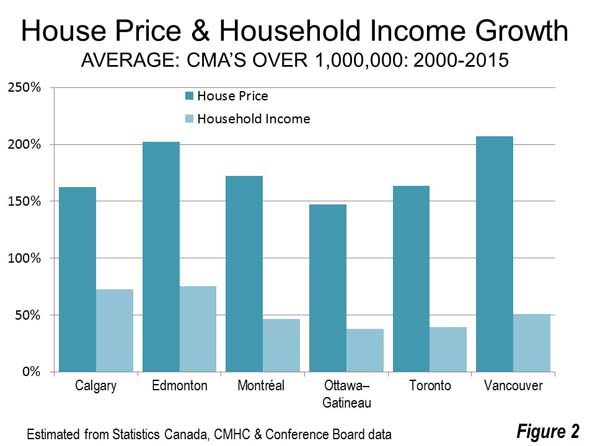
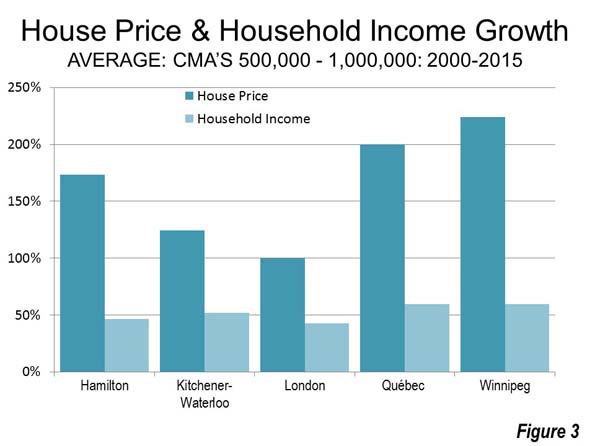
    The Executive Summary (adapted) and selected charts from Canada’s Middle-Income Housing Affordability Crisis are reproduced below.

    Canada has a serious middle-income housing affordability crisis. Canada’s house prices have grown nearly three times that of household income since 2000. This contrasts with the stability between growth in house prices and household income during the previous three decades. These house-price increases have raised serious concerns at the Bank of Canada and at international financial organizations such as the Organisation for Economic Co-operation and Development (OECD) and the International Monetary Fund (IMF).

    This public policy report examines overall housing affordability in 35 housing markets, including all 33 CMAs and two census agglomerations (Section 1).

    Higher house prices reduce the standard of living and constrain economic growth. Housing affordability is analyzed using indicators with comparisons between housing markets and within individual housing markets over time. Price-to-income multiples are used. Higher house prices mean less home buyer discretionary income (the amount left over after paying for necessities such as housing, food, clothing and transportation). Households have less income available for purchasing other goods and services, which can constrain economic growth and job creation. Moreover, less discretionary income translates into lower standards of living (Sections 1.1 and 1.2).

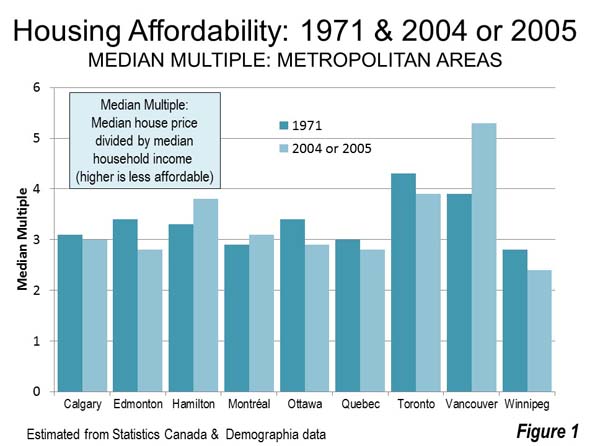
    There was serious deterioration in middle-income housing between 2000 and 2015. This analysis shows that house prices rose faster than income in each of the 35 markets. The largest losses in housing affordability occurred in the six markets with a population of more than one million (Calgary, Edmonton, Montréal, Ottawa-Gatineau, Toronto and Vancouver), where house prices rose on average 3.3 times that of household income. More alarmingly, house prices rose more than four times household income in Vancouver and Toronto. In the five metropolitan areas with between 500,000 and one million residents (Hamilton, Kitchener-Waterloo, London, Québec and Winnipeg), house prices rose 3.2 times that of household income. Even in the smaller markets, house prices rose on average by at least double that of household income (Section 2).

    Substantial mortgage affordability losses could occur with the expected interest increases. Should mortgage interest rates rise by 2020 as projected by The Conference Board of Canada, approximately 800,000 fewer households will be able to qualify for a mortgage on an average-priced house, all else being equal. This could have an impact sooner than expected, since many Canadian mortgages require renewing every five years (Section 3).

    Higher house prices have made it more difficult for middle-income households to afford the housing that Canadians have preferred for decades. Higher house prices appear to have been a principal factor in a trend toward smaller houses and condominiums across Canada between 2001 and 2011. This shift is most evident in Vancouver and Toronto, where housing markets also have the most-restrictive land-use regulation (Section 4).

    Restrictive land-use policy is associated with housing affordability losses. International economic literature associates more-restrictive land-use regulation with diminished housing affordability. The largest housing affordability losses have occurred in metropolitan areas (markets) that have adopted urban containment land-use strategies, which severely limit the land that can be used for building houses on and beyond the urban fringe. Consistent with basic economics, this reduction of land supply is associated with rising land prices, which lead to higher house prices. Without the substantial reform of restrictive land-use policies, housing affordability is likely to continue deteriorating (Section 5).

    Higher house prices impose adverse social and economic consequences. Higher house prices are associated with increased rates of internal migration out of higher-cost markets, increased inequality, overcrowding, the greater public expenditure that is required to support low-income housing and losses to the economy (Section 6).

    Solving the middle-income housing affordability crisis will require policy reforms. There is considerable evidence that restrictive land-use policies are associated with significant losses in housing affordability in Canada as is the case elsewhere. Metropolitan areas with restrictive land-use policy should undertake reforms aimed at improving housing affordability. There should be a moratorium on the adoption of urban containment policy where it is not yet in place. Concerns have been expressed about the potential for high house prices and high household debt to complicate the ability of central banks (such as the Bank of Canada) to perform their monetary policy responsibilities.  Conclusion:  that middle-income housing affordability in Canada is a profound social and economic crisis that warrants serious and concentrated public policy attention (Section 7).

    Wendell Cox is principal of Demographia, an international public policy and demographics firm. He is a Senior Fellow of the Center for Opportunity Urbanism (US), Senior Fellow for Housing Affordability and Municipal Policy for the Frontier Centre for Public Policy (Canada), and a member of the Board of Advisors of the Center for Demographics and Policy at Chapman University (California). He is co-author of the “Demographia International Housing Affordability Survey” and author of “Demographia World Urban Areas” and “War on the Dream: How Anti-Sprawl Policy Threatens the Quality of Life.” He was appointed to three terms on the Los Angeles County Transportation Commission, where he served with the leading city and county leadership as the only non-elected member. He served as a visiting professor at the Conservatoire National des Arts et Metiers, a national university in Paris.

    Photograph: Calgary (by author)

  • The Cities Where Your Salary Will Stretch The Furthest 2016

    When Americans consider a move to another part of the country, they sometimes are forced to make a tough choice: should they go to a city with the best job opportunities, or a less economically vital area that offers a better standard of living, particularly more affordable housing? However,  there are still plenty of metropolitan areas in the U.S. where you can get the best of both worlds.

    Center for Opportunity Urbanism senior fellow Wendell Cox has developed a set of rankings that identify metropolitan areas where salaries are relatively high relative to costs, and you get more for your paycheck. Our list is geographically and demographically diverse, both in terms of the top 20 and the places closest to the bottom.

    The COU Standard of Living Index takes the 2015 mean pay per job in the 106 metropolitan statistical areas with more than 500,000 population and adjusts it by cost of living. Metro areas that have a large proportion of high-wage jobs tend to do best, such as San Jose, Calif., and Houston. The biggest differences in terms of cost of living generally have to do with housing; costs for goods varied by 23 percent and for services by 35 percent in 2014 across the metropolitan data, but for rents the differential between the most and least expensive metro areas is 194 percent and, for housing purchased in 2014, a remarkable 775 percent. The composite cost of living index underlying the COU Standard of Living Index is developed from a blend of annual rent as well as home ownership costs for prospective home buyers.

    I have divided the top and bottom rankings into four basic groups: expensive but worth it; moderately priced but still high income; expensive but so costly as to  be economically barely worth it; and, finally, areas that are cheap, but not for the right reasons.

    Expensive, But Worth It

    There are several high-cost areas that do very well in this ranking, largely because they offer high incomes to match. The metro area with the highest annual wage when adjusted for cost of living is San Jose, the center of Silicon Valley. The cost of living there is 63 percent higher than the national average, the highest in the nation, but with the highest nominal pay per job at $112,300 ($27,000 above the next best), the metro area still ends up with the highest adjusted paycheck of $68,850.

    Four other high-cost areas also make our top 10. Two are in Connecticut: No. 4 Bridgeport-Stamford, where the cost of living is 45 percent above the national average, and No. 5 Hartford, where costs are 15 percent above the national average. But higher wages — $85,400 for Bridgeport and $62,600 for Hartford — give residents the buying power to absorb those costs, and places these metros areas high on the list.The other two are No. 6 Boston and 10th-ranked Seattle.

    One common thread that helps these metro areas overcome high costs is a high concentration of jobs in better paying fields such as technology and business and professional services.

    Opportunity Cities: Less Expensive And Economically Vital

    The other five top cities in our Standard of Living index fit a very different mold. These are what may be seen “opportunity cities,” where there are relatively high wages and somewhat low costs. If the successful blue cities can be seen as something of “gated communities” for well-educated, largely white and Asian residents, these cities offer a higher standard for a broader and often more diverse population.

    The epitome of opportunity cities, Houston, takes second place. Like San Jose, Houston has a strong concentration of engineering talent and STEM jobs, many of them related to the energy industry. The average annual paycheck in America’s Energy Capital is $65,000, well above the national average, and with a cost of living barely 5 percent above the usual, it’s only eroded slightly to an adjusted worth of $62,300.

    The other cities in our top 10 tend to feature high growth in STEM employment but moderate to low costs. They include No. 3 Durham, N.C., located in the tech-rich Research Triangle area, No. 7 Atlanta and No. 8 Detroit. In all these areas the cost of living is around the national average, but salaries are higher. You may be surprised by Detroit, but this ranking looks at the total metro area, which is in much better shape than the core city. With good-paying jobs, many connected to the revived auto industry, the Detroit metro area is in far better shape than is commonly suggested.

    Of course, the Motor City may lack the glamour and stratospheric wages of Silicon Valley, but its far lower costs offer a surprising high standard of living. Nor is it the only Rust Belt city that ranks highly. Consider No. 13 Cincinnati, No. 15 Pittsburgh, No. 16 Cleveland and No. 19 St. Louis. In the future it may make sense for more individuals and companies to take a second look at these areas.

    Expensive, And Not Producing Enough Good Jobs To Make Up For It

    Not all expensive cities are worth the cost, particularly if you are considering a move. Take 89thplace San Diego and 97th place Los Angeles, two California cities with idyllic climates and dynamic histories, but that now have become too expensive to offer a high standard of living for anyone not making far more than the local average salary.

    The tragedy for these Southern California metro areas is that, while they have seen a rapid escalation in housing prices and rents, they have not been able to take a meaningful part in the tech boom that has driven up wages in San Jose and the Bay Area. San Diego’s mean wage of $58,000 might seem more than respectable, but with a cost of living 36 percent above the national average, it reduces the real pay in this attractive coastal city to a more modest $42,700.

    Most critical, however, is the clear downshift in the standard of living in my adopted home region, greater Los Angeles. Once L.A. was full of high-wage jobs, many of them tied to aerospace and manufacturing, as well as high-end business services. Those industries have been eroding for well over a decade, replaced, in large part, by lower-wage positions in hospitality, retail and health. Now it is one of the poorest big cities in America, yet one with extraordinarily high costs, particularly for housing. The cost of living in LA is 46 percent above the national average, driving real wage from a respectable nominal average $59,000 to a dismal adjusted $40,400.

    Left Behind

    Most of the metro areas at the bottom half of our list are smaller, with barely a million people or less. Many of these are in high-cost regions, notably our last-place finisher, Honolulu. In the Hawaiian capital, the average paycheck is $48,800 but when you factor in our cost of living modifier, the real income falls to $33,900. That’s partly due to a lack of developable land that drives up property prices and also due to the high proportion of necessities that are imported, including food and oil.

    This pattern is repeated by many areas in our bottom 10, including the California cites Stockton (94th), Fresno (98th), Riverside-San Bernardino (102nd) and Santa Rosa (105th). In all these cases, incomes tend to be  modest, but costs, particularly for housing, are higher than their economies would logically warrant. Much of the “credit” here may well belong to California’s restrictive land use and housing policies, and generally poor climate for manufacturing, agriculture and other blue-collar businesses.

    What does this tell us? Metro areas that want  to improve in these rankings need to focus not just on developing their economies, but also policies that keep costs competitive with other regions.

    Center for Opportunity Urbanism
    Standard of Living Index: 2015
    Rank (of 106) Metropolitan Area Annual Pay Per Job, Adjusted by COU CoL Index
    1 San Jose, CA $68,855
    2 Houston, TX $62,305
    3 Durham, NC $59,526
    4 Bridgeport-Stamford, CT $58,704
    5 Hartford, CT $57,050
    6 Boston, MA-NH $56,979
    7 Atlanta, GA $56,647
    8 Detroit,  MI $56,421
    9 Dallas-Fort Worth, TX $55,529
    10 Seattle, WA $55,123
    11 Charlotte, NC-SC $55,122
    12 Washington, DC-VA-MD-WV $54,525
    13 Cincinnati, OH-KY-IN $54,265
    14 Birmingham, AL $54,256
    15 Pittsburgh, PA $54,168
    16 Cleveland, OH $54,059
    17 Minneapolis-St. Paul, MN-WI $53,668
    18 Denver, CO $53,526
    19 St. Louis,, MO-IL $53,519
    20 Nashville, TN $53,144
    21 Des Moines, IA $53,115
    22 Kansas City, MO-KS $53,009
    23 Austin, TX $53,002
    24 Memphis, TN-MS-AR $52,911
    25 Columbus, OH $52,319
    26 Philadelphia, PA-NJ-DE-MD $51,912
    27 Fayetteville (Bentonville), AR-M $51,876
    28 San Francisco, CA $51,723
    29 Baton Rouge, LA $51,492
    30 Chicago, IL-IN-WI $51,425
    31 Raleigh, NC $50,980
    32 Tulsa, OK $50,798
    33 Indianapolis. IN $50,781
    34 Akron, OH $50,578
    35 Harrisburg, PA $50,483
    36 Louisville, KY-IN $50,390
    37 Richmond, VA $50,053
    38 Oklahoma City, OK $50,018
    39 New York, NY-NJ-PA $49,760
    40 New Orleans. LA $49,739
    41 Albany, NY $49,578
    42 Phoenix, AZ $49,403
    43 Sacramento, CA $49,323
    44 Portland, OR-WA $49,262
    45 Dayton, OH $49,203
    46 Winston-Salem, NC $49,079
    47 Knoxville, TN $49,060
    48 Milwaukee,WI $49,022
    49 Baltimore, MD $48,771
    50 Toledo, OH $48,705
    51 Wichita, KS $48,608
    52 Melbourne (Palm Bay), FL $48,230
    53 Augusta, GA-SC $48,065
    54 Omaha, NE-IA $47,956
    55 San Antonio, TX $47,910
    56 Little Rock, AR $47,900
    57 Chattanooga, TN-GA $47,877
    58 Jacksonville, FL $47,810
    59 Madison, WI $47,510
    60 Rochester, NY $47,486
    61 Grand Rapids, MI $47,459
    62 Salt Lake City, UT $47,368
    63 Syracuse, NY $47,239
    64 Greensboro, NC $47,013
    65 Greenville, SC $46,762
    66 Buffalo, NY $46,500
    67 Columbia, SC $46,437
    68 Tampa-St. Petersburg, FL $46,410
    69 Allentown, PA-NJ $46,141
    70 Springfield, MA $45,585
    71 Providence, RI-MA $45,323
    72 Worcester, MA-CT $45,236
    73 Jackson, MS $45,196
    74 Colorado Springs, CO $45,017
    75 New Haven CT $44,848
    76 Charleston, SC $44,613
    77 Miami, FL $44,589
    78 Orlando, FL $44,527
    79 Virginia Beach-Norfolk, VA-NC $44,290
    80 Las Vegas, NV $44,265
    81 Spokane, WA $43,770
    82 Albuquerque, NM $43,486
    83 Tucson, AZ $43,484
    84 Bakersfield, CA $43,464
    85 Boise, ID $43,103
    86 Scranton, PA $43,082
    87 Lakeland, FL $42,907
    88 Youngstown, OH-PA $42,766
    89 San Diego, CA $42,716
    90 Lancaster, PA $42,227
    91 Modesto, CA $42,034
    92 Portland, ME $41,902
    93 Cape Coral-Fort Myers, FL $41,547
    94 Stockton, CA $40,512
    95 Provo, UT $40,473
    96 Sarasota (North Port), FL $40,434
    97 Los Angeles, CA $40,432
    98 Fresno, CA $40,226
    99 El Paso, TX $40,074
    100 Oxnard, CA $40,049
    101 Ogden, UT $39,966
    102 Riverside-San Bernardino, CA $38,598
    103 Daytona Beach (Deltona), FL $38,242
    104 McAllen, TX $38,182
    105 Santa Rosa, CA $35,370
    106 Honolulu, HI $33,903

    Joel Kotkin is executive editor of NewGeography.com. He is the Roger Hobbs Distinguished Fellow in Urban Studies at Chapman University and executive director of the Houston-based Center for Opportunity Urbanism. His newest book, The Human City: Urbanism for the rest of us, will be published in April by Agate. He is also author of The New Class ConflictThe City: A Global History, and The Next Hundred Million: America in 2050. He lives in Orange County, CA.

    Photo by w:Flickr user Bill Jacobus [CC-BY-2.0], via Wikimedia Commons

  • Suburban. Comma. Transit.

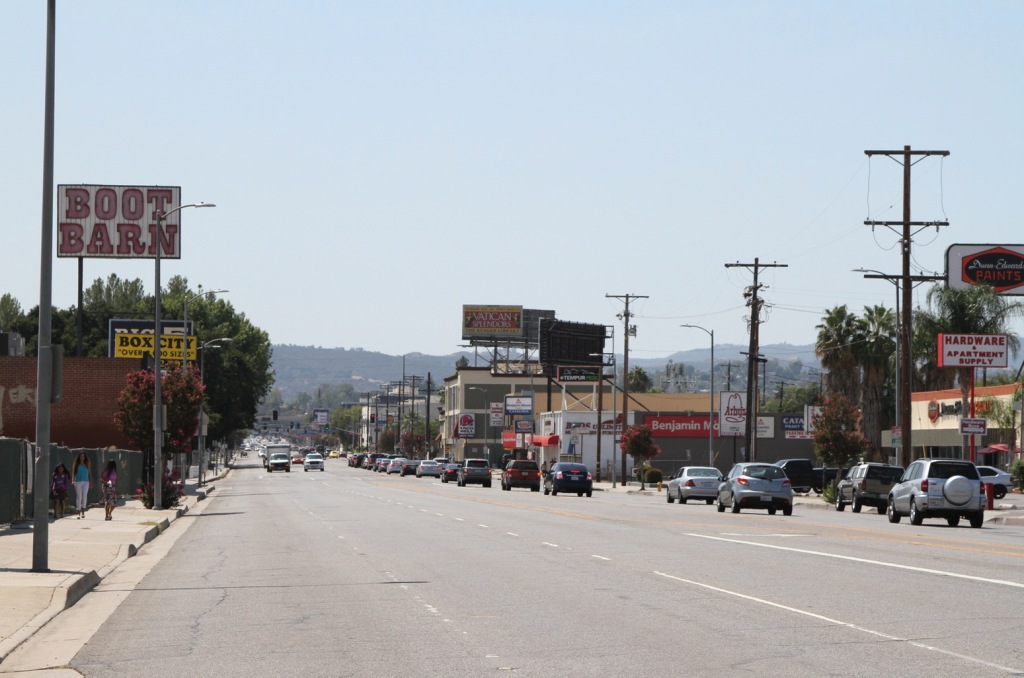
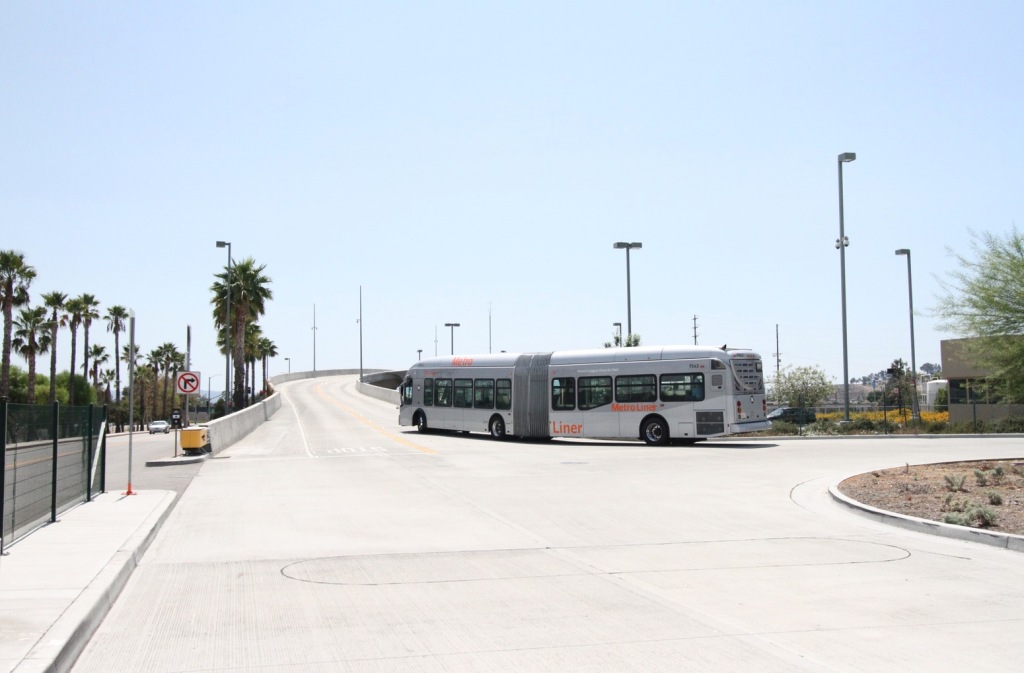
    I explored the Orange Line Bus Rapid Transit (BRT) system that runs for eighteen miles across the San Fernando Valley in Los Angeles. The Valley is a profoundly suburban city-within-a-city and home to 1.8 million people spread out over 260 square miles. Attempts to upgrade public transit by the central authorities in LA proper have been fought tooth and nail by folks in the Valley and illustrate why transit just doesn’t work when the local culture doesn’t want it. I’m not sure why LA keeps pushing on this particular string.

    Screen Shot 2016-09-04 at 7.29.48 AM

    screen-shot-2016-09-06-at-1-33-01-pm

    screen-shot-2016-09-06-at-1-37-08-pm

    Transit works best when one compact highly productive walkable neighborhood is connected to another compact highly productive walkable neighborhood. Manhattan or Hong Kong isn’t required. A plain vanilla Main Street with two and three story buildings works just fine.

    Suburbia is the exact opposite. Everything is spread out and oriented around private space, leisure, and consumption. Public space is an afterthought and any hint of density is anathema. Transit is believed to attract “the wrong element.” If this is the kind of world these folks want to inhabit… I say walk away and let them all enjoy the Jiffy Lubes and drive-thru burger joints without transit.

    Screen Shot 2016-09-04 at 7.44.46 AM

    Screen Shot 2016-09-04 at 7.45.15 AM

    Screen Shot 2016-09-04 at 7.29.12 AM

    Screen Shot 2016-09-04 at 8.36.14 AM

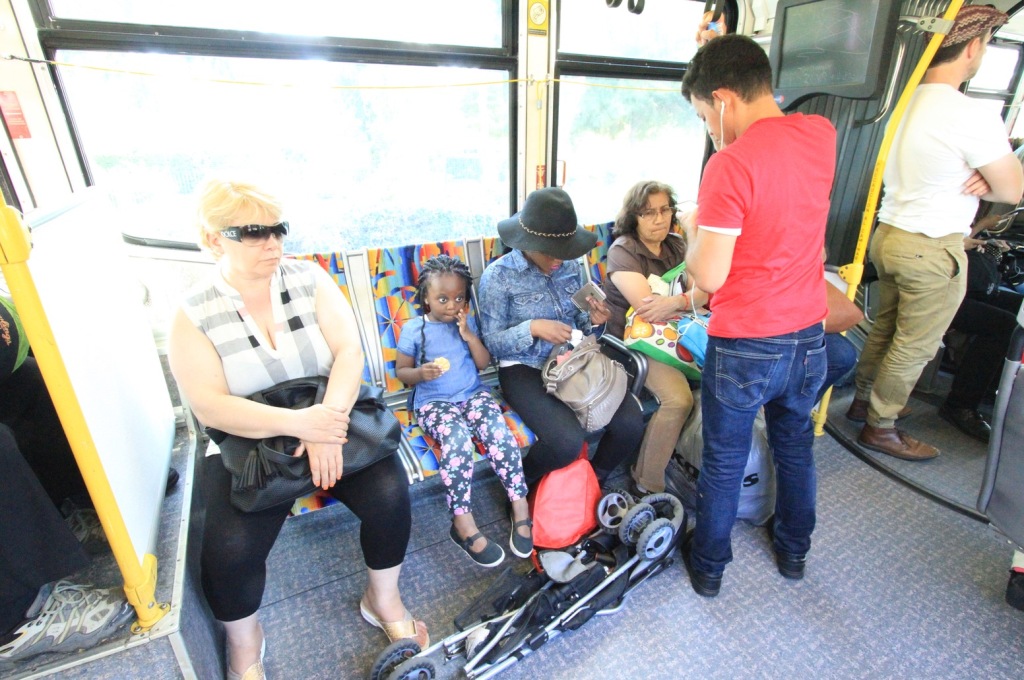
    This is the standard suburban environment with its sad begrudging crumbs of half assed bus service. It’s a monumental waste of scarce public funds to attempt to operate public transit here. The land use pattern and culture are in direct conflict with efficient cost-effective transit. And it’s punishing for the people who have no choice but to walk or take the bus: the young, the elderly, the infirm, and the poor.

    Screen Shot 2016-09-04 at 8.35.25 AM

    Screen Shot 2016-09-04 at 8.36.39 AM

    Screen Shot 2016-09-04 at 8.37.30 AM

    Screen Shot 2016-09-04 at 8.35.04 AM

    Screen Shot 2016-09-05 at 3.14.34 AM

    Screen Shot 2016-09-05 at 3.13.22 AM

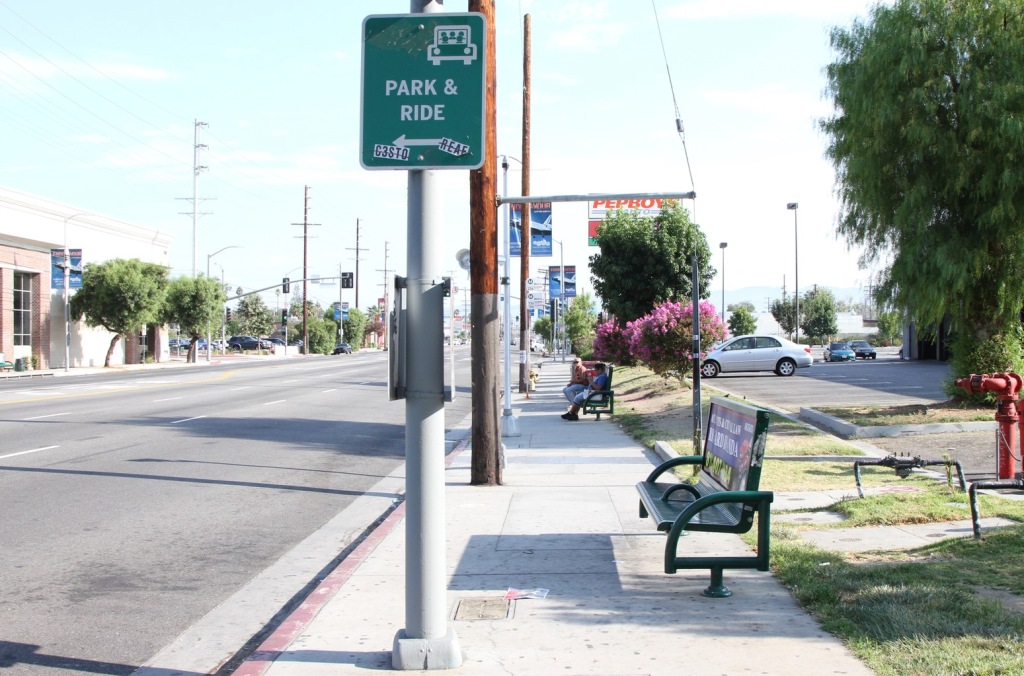
    Here’s how suburban communities typically deal with transit. To the extent that it’s tolerated at all the transit station is hidden away behind a row of self storage facilities and plumbing supply warehouses. The entrance is treated as if it were an office park. There’s an enormous amount of surface parking. The assumption is that people will drive to the bus or train station since transit is a bridge between the comforts of the private automobile and the necessary evil of commuting to a more congested urban destination.

    Screen Shot 2016-09-04 at 8.32.46 AM

    Screen Shot 2016-09-04 at 8.32.12 AM

    Screen Shot 2016-09-05 at 3.14.07 AM

    Screen Shot 2016-09-04 at 8.31.57 AM

    Screen Shot 2016-09-04 at 8.33.55 AM

    The Park and Ride model of transit like this Metro stop in Chatsworth (the terminus of the Orange Line) is moderately acceptable to middle class suburbanites so long as the station is properly landscaped. Absolutely nothing can be built anywhere near the station. Loitering must be prevented at all costs. Theoretically it’s possible to walk to and from the station, but the location and design of the place ensure it isn’t a common practice.

    Screen Shot 2016-09-05 at 4.07.31 AM

    Screen Shot 2016-09-05 at 4.06.35 AM

    Screen Shot 2016-09-04 at 9.04.15 AM

    Screen Shot 2016-09-04 at 9.03.57 AM

    Screen Shot 2016-09-04 at 9.04.53 AM

    I followed the entire route of the Orange Line and found the stations themselves are well designed, convenient, and efficient. The fully segregated busway disguised in a tunnel of greenery mean buses are never stuck in the same traffic that afflicts cars and trucks. The buses come frequently and predictably and travel is comfortable and fast. BRT simulates the benefits of a light rail system, but at a tenth the cost.

    Screen Shot 2016-09-04 at 9.06.44 AM

    Screen Shot 2016-09-04 at 11.53.30 PM

    Screen Shot 2016-09-04 at 9.05.59 AM

    Screen Shot 2016-09-04 at 9.06.25 AM

    Screen Shot 2016-09-04 at 9.07.05 AM

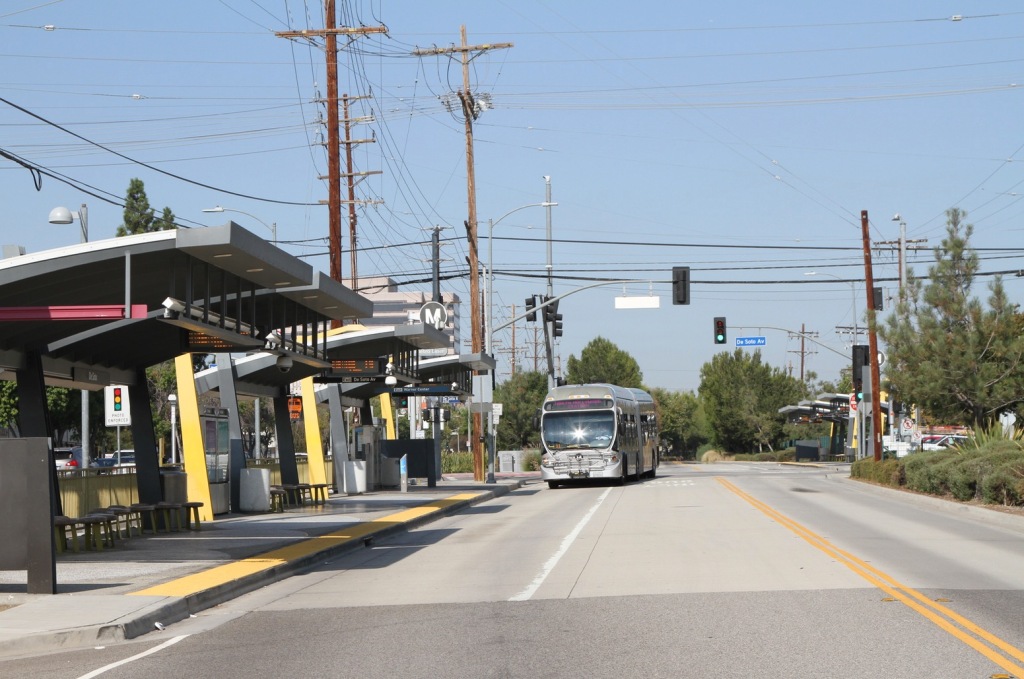
    But each station was built in a spot that makes it unlikely that transit will live up to its full potential. This is the De Soto stop. The buses do a great job of getting passengers from one isolated station to another. This isn’t an accident. It’s the only set of arrangements the locals would tolerate – and the locals have a lot of lawyers. Transit is associated with the lower class and home owners here want no part of it. So they litigated for years until the proposed rail line was beaten back to a bus route and some decorative shrubbery that didn’t go anywhere too offensive.

    Screen Shot 2016-09-05 at 12.37.57 AM

    screen-shot-2016-09-06-at-9-41-43-am

    screen-shot-2016-09-06-at-9-40-09-am

    screen-shot-2016-09-06-at-9-41-24-am

    screen-shot-2016-09-06-at-9-40-35-am

    screen-shot-2016-09-06-at-9-46-41-am

    Here’s the Balboa station. Abundant surface parking, plenty of landscaped strips, and a location that doesn’t infringe on nearby private property lets people drive to the bus. Unfortunately the effectiveness of good transit is negated by the barren surroundings. If you had access to a car and could drive to the bus… you wouldn’t really need the bus.

    Screen Shot 2016-09-04 at 11.57.48 PM

    Screen Shot 2016-09-04 at 11.54.47 PM

    Screen Shot 2016-09-05 at 12.09.34 AM

    Screen Shot 2016-09-04 at 11.51.50 PM

    Screen Shot 2016-09-04 at 11.52.09 PM

    Here’s the Sepulveda station. Notice how the pattern repeats. In the Valley it’s now possible to take a highly effective bus trip from the Costco parking lot in Van Nuys to a strip mall a dozen miles away in Canoga Park. That’s progress of a sort since the BRT is so much better than traditional suburban bus service. But the public investment in infrastructure isn’t being complimented by the required private investment near any of the stations. That’s because the culture rejects the kind of infill development that would make the stations economically meaningful.

    Screen Shot 2016-09-04 at 11.55.42 PM

    Screen Shot 2016-09-04 at 11.50.02 PM

    Screen Shot 2016-09-04 at 7.25.03 AM

    Screen Shot 2016-09-04 at 7.31.10 AM

    Screen Shot 2016-09-04 at 7.23.44 AM

    Screen Shot 2016-09-04 at 7.24.28 AM

    Bicycle and pedestrian paths parallel the BRT busway along many miles of the system. This allows people to get from Point A to Point B in a way that doesn’t rile up the locals quite as much as the proposed light rail did. Fenced in landscaped bike paths follow the suburban “Sunday in the park” model of leisure that’s at least borderline socially acceptable in the Valley. The fact that low income people also use the paths to peddle to work is an unfortunate and much lamented side effect. I noticed more than a few Spandexed guys on $4,000 bikes yelling at slow moving folks to get out of the way.

    screen-shot-2016-09-06-at-10-40-38-am

    The eighteen miles of Bus Rapid Transit in the Valley cost $324 million dollars to construct. That’s $18 million per mile. Compare that to the recent $1.1 billion road improvement project on a ten mile stretch of freeway in the Valley. The freeway was already ten lanes wide so adding slightly better on and off ramps and tweaking the car pool lanes did exactly nothing to relieve traffic congestion. That’s $110 million dollars per mile. The same people who lament the waste of taxpayer money on transit think the city should be spending more to upgrade the roads.

    Over the years community groups and their elected representatives in the Valley have created legislation that forbids the construction of light rail or the use of sales tax revenue to fund a subway. Other local groups created rules that mandated a fully underground subway system because they objected to surface or elevated rail lines in their neighborhoods. And the ubiquitous anti-infill and anti-density brigades continue as always.

    Personally, I don’t see the point of fighting locals who don’t value transit. I say give this part of the city no transit at all. But also require the locals to fund their own road projects from their own immediate tax base as well. Actually, I would love to see things taken a step farther. Cut the Valley loose from the City of Los Angeles altogether as so many folks in the Valley have attempted to do for decades. Let the Valley keep its own tax revenue and pay for its own services and infrastructure as an independent city. And let Los Angeles be free to focus on projects that actually make sense in the coastal communities that actively want transit and more intensive development. If that means the region is less integrated as a result… I don’t see how things could be worse.

    John Sanphillippo lives in San Francisco and blogs about urbanism, adaptation, and resilience at granolashotgun.com. He’s a member of the Congress for New Urbanism, films videos for faircompanies.com, and is a regular contributor to Strongtowns.org. He earns his living by buying, renovating, and renting undervalued properties in places that have good long term prospects. He is a graduate of Rutgers University.

  • Trump Will Go Away, but the Anger He’s Stirred Up Is Just Getting Started

    For progressives, the gloating is about to begin. The Washington Monthly proclaims that we are on the cusp of a “second progressive era,” where the technocratic “new class” overcomes a Republican Party reduced to “know-nothing madness.”

    To be sure, Trump himself proved a mean-spirited and ultimately ineffective political vessel. But the forces that he aroused will outlive him and could get stronger in the future. In this respect Trump may reprise the role played another intemperate figure, the late Senator Barry Goldwater. Like Trump, Goldwater openly spurned political consensus, opposing everything from civil rights and Medicare to détente. His defeat led to huge losses at the congressional level, as could indeed occur this year as well.

    Goldwater might have failed in 1964, but his defeat did not augur a second New Deal, as some, including President Lyndon Johnson, may have hoped. Instead, his campaign set the stage for something of a right-wing resurgence that defined American politics until the election of President Obama. Pushing the deep South into the GOP, Goldwater created the “Southern strategy” that in 1968 helped elect Richard Nixon; this was followed in 1980 by the victory of Goldwater acolyte Ronald Reagan.

    History could repeat itself after this fall’s disaster. People who wrote off the GOP in 1964 soon became victims of their own hubris, believing they could extend the welfare state and the federal government without limits and, as it turned out, without broad popular support. In this notion they were sustained by the even then liberally oriented media and a wide section of the “respectable” business community.

    Three decades later a similar constellation of forces —- Hollywood, Silicon Valley, Wall Street—have locked in behind Hillary Clinton. But it is the transformation of the media itself both more ideologically uniform and concentrated more than ever on the true-blue coasts, that threatens to exacerbate Progressive Triumphalism. In this election, notes Carl Cannon, no Trump fan himself, coverage has become so utterly partisan that “the 2016 election will be remembered as one in which much of the mainstream media all but admitted aligning itself with the Democratic Party.”

     Progressive Triumphalism may lead the Clintonites to believe her election represented not just a rejection of the unique horribleness of Trump, but proof of wide support for their favored progressive agenda. Yet in reality, modern progressivism faces significant cultural, geographic, economic and demographic headwinds that will not ease once the New York poseur dispatched.

    Successful modern Democratic candidates, including President Obama and former President Clinton, generally avoid openly embracing an ever bigger federal government. Obama, of course, proved a centralizer par excellence, but he did it stealthily and, for the most part, without the approval of Congress. This allowed him to take some bold actions, but limited the ability to “transform” the country into some variant of European welfare, crony capitalist state.

    Hillary Clinton lacks both Obama’s rhetorical skills and her erstwhile husband’s political ones. Her entire approach in the campaign has been based on creating an ever more intrusive and ever larger federal government. Even during Bill Clinton’s reign, she was known to be the most enthusiastic supporter of governmental regulation, and it’s unlikely that, approaching 70, she will change her approach. It seems almost certain, for example, that she will push HUD and the EPA to reshape local communities in ways pleasing to the bureaucracy.

    Yet most Americans do not seem to want a bigger state to interfere with their daily life. A solid majority—some 54 percent—recently told Gallup they favor a less intrusive federal government, compared to only 41 percent who want a more activist Washington. The federal government is now regarded by half of all Americans, according to another poll by Gallup, as “an immediate threat to the rights and freedoms of ordinary citizens.” In 2003 only 30 percent of Americans felt that way.

    Nor is this trend likely to fade with time. Millennials may be liberal on issues like immigration and gay marriage, but are not generally fans of centralization, fewer than one-third favor federal solutions over locally based ones. 

    Due largely to Trump’s awful persona, Hillary likely will get some wins in “flyover country,” the vast territory that stretches from the Appalachians to the coastal ranges. In certain areas with strong sense of traditional morality, such as in Germanic Wisconsin and parts of Michigan, notes Mike Barone, Trump’s lewdness and celebrity-mania proved in the primaries incompatible with even conservative small town and rural sensibilities, more so in fact than in the cosmopolitan cores, where sexual obsessions are more celebrated than denounced.

    Yet Trump’s strongest states, with some exceptions, remain in the country’s mid-section; he still clings to leads in most of the Intermountain West, Texas, the mid-south and the Great Plains. He is still killing it in West Virginia. This edge extends beyond a preponderance of “deplorables” and what Bubba himself has referred to as “your standard redneck.”

    Exacerbating this cultural and class discussion is the growing division between the coastal and interior economies. Essentially, as I have argued elsewhere, the country is split fundamentally by how regions makes money. The heartland regions generally thrive by producing and transporting “stuff”—food, energy, manufactured goods —while the Democrats do best where the economy revolves around images, media, financial engineering and tourism.

    Energy is the issue that most separates the heartland from the coasts. The increasingly radical calls for “decarbonization” by leading Democrats spell the loss of jobs throughout the heartland, either directly by attacking fossil fuels or by boosting energy costs. Since 2010, the energy boom has helped create hundreds of thousands of jobs throughout the heartland, many of them in manufacturing. At the same time, most big city Democratic strongholds continued to deindustrialize and shed factory employment. No surprise then that the increasingly anti-carbon Democrats control just one legislature, Illinois, outside the Northeast and the West Coast.

    Trump’s romp through the primaries, like that of Bernie Sanders, rode on the perceived relative decline of the country’s middle and working classes. For all her well-calculated programmatic appeals, Hillary Clinton emerged as the willing candidate of the ruling economic oligarchy, something made more painfully obvious from the recent WikiLeaks tapes. Her likely approach to the economy, more of the same, is no doubt attractive to the Wall Street investment banks, Silicon Valley venture capitalists, renewable energy providers and inner city real estate speculators who have thrived under Obama.

    Yet more of the same seems unlikely to reverse income stagnation, as exemplified by the huge reserve army of unemployed, many of them middle aged men, outside the labor force. The fact remains that Obama’s vaunted “era of hope and change,” as liberal journalist Thomas Frank has noted, has not brought much positive improvement for the middle class or historically disadvantaged minorities.

    The notion that free trade and illegal immigration have harmed the prospects for millions of Americans will continue to gain adherents with many middle and working class voters—particularly in the heartland. We are likely to hear this appeal again in the future. If the GOP could find a better, less divisive face for their policies, a Reagan rather than a Goldwater, this working-class base could be expanded enough to overcome the progressive tide as early as 2018.

    The one place where the progressives seem to have won most handily is on issues of culture. Virtually the entire entertainment, fashion, and food establishments now openly allied with the left; the culture of luxury, expressed in the page of The New York Times, has found its political voice by identifying with such issues as gay rights, transgender bathrooms , abortion and, to some extent, Black Lives Matter. In contrast, the Republicans cultural constituency has devolved to a bunch of country music crooners, open cultural reactionaries and, yes, a revolting collection of racist and misogynist “deplorables.”

    Yet perhaps nowhere is the danger of Progressive Triumphalism more acute. Despite the cultural progressive embrace of the notion that more diversity is always good, the reality is that our racial divide remains stark and is arguably getting worse. As for immigration, polls say that more people want to decrease not just the undocumented but even legal immigration than increase it.

    And then there’s the mountain rebellion against political correctness. Relative few Americans have much patience with such things as “micro-aggressions,” “safe spaces,” the generally anti-American tone of history instruction whose adherents are largely concentrated in the media and college campuses. Fewer still would endorse the anti-police agitation now sweeping progressive circles. For some, voting for Trump represents the opportunity to extend a “middle finger” to the ruling elites of both parties.

    Yet Trump’s appeal also represented something of a poke in the eye for the old-school religious right; Trump has actually helped the GOP by embracing openly gay figures like Peter Thiel. He may have caused many bad things, but the New Yorker succeeded, as no Republican in a generation, in making the holy rollers largely irrelevant.

    The dangers for the Democrats lie in going too far in their secularism. As recent emails hacked by WikiLeaks have demonstrated, there is widespread contempt in left circles for most organized religion, most importantly for the moral teachings of the Roman Catholic Church, even under a more progressive Pope. Some Democrats may argue that irreligiosity will remain “in” among millennials. Yet this was also said about boomers and turned out to be wrong. Few sociologists in the 1970s would have expected a religious revival that arose in the next decade.

    Simply put, millennials’ economic and cultural views could shift, as they become somewhat less “idealistic” and more concerned with buying homes and raising children. They could shift more the center and right, much as Baby Boomers have done.

    No matter what happens this year, the battle for America’s political soul is not remotely over. Trump may fade into deserved ignominy and hopefully obscurity, but his nationalist and populist message will not fade with him as long as concerns over jobs, America’s role in the world, and disdain for political correctness remain. If Hillary and her supporters over-shoot their nonexistent mandate and try to impose their whole agenda before achieving a supportable consensus, American politics could well end up going in directions that the progressives, and their media claque, might either not anticipate or much like.

    This piece first appeared in The Daily Beast.

    Joel Kotkin is executive editor of NewGeography.com. He is the Roger Hobbs Distinguished Fellow in Urban Studies at Chapman University and executive director of the Houston-based Center for Opportunity Urbanism. His newest book, The Human City: Urbanism for the rest of us, will be published in April by Agate. He is also author of The New Class ConflictThe City: A Global History, and The Next Hundred Million: America in 2050. He lives in Orange County, CA.

    Photo by Gage Skidmore [CC BY-SA 3.0], via Wikimedia Commons