Tag: middle class

  • How Liberalism Self-destructed

    Democrats are still looking for explanations for their stunning rejection in the midterms — citing everything from voting rights violations and Middle America’s racist orientation to Americans’ inability to perceive the underlying genius of President Barack Obama’s economic policy.

    What they have failed to consider is the albatross of contemporary liberalism.

    Liberalism once embraced the mission of fostering upward mobility and a stronger economy. But liberalism’s appeal has diminished, particularly among middle-class voters, as it has become increasingly control-oriented and economically cumbersome.

    Today, according to most recent polling, no more than one in five voters call themselves liberal.

    This contrasts with the far broader support for the familiar form of liberalism forged from the 1930s to the 1990s. Democratic presidents from Franklin D. Roosevelt to Bill Clinton focused largely on basic middle-class concerns — such as expanding economic opportunity, property ownership and growth.

    Modern-day liberalism, however, is often ambivalent about expanding the economy — preferring a mix of redistribution with redirection along green lines. Its base of political shock troops, public-employee unions, appears only tangentially interested in the health of the overall economy.

    In the short run, the diminishment of middle-of-the-road Democrats at the state and national level will probably only worsen these tendencies, leaving a rump party tied to the coastal regions, big cities and college towns. There, many voters are dependents of government, subsidized students or public employees, or wealthy creative people, college professors and business service providers.

    This process — driven in large part by the liberal attachment to economically regressive policies such as cap and trade — cost the Democrats mightily throughout the American heartland. Politicians who survived the tsunami, such as Sen. Joe Manchin in West Virginia, did so by denouncing proposals in states where green policies are regarded as hostile to productive local industries that are major employers.

    Populism, a traditional support of liberalism, has been undermined by a deep suspicion that President Barack Obama’s economic policy favors Wall Street investment bankers over those who work on Main Street. This allowed the GOP, a party long beholden to monied interests, to win virtually every income segment earning more than $50,000.

    Obama also emphasized an urban agenda that promoted nationally directed smart growth, inefficient light rail and almost ludicrous plans for a national high-speed rail network. These proposals appealed to the new urbanist cadre but had little appeal for the vast majority of Americans who live in outer-ring neighborhoods, suburbs and small towns.

    The failure of Obama-style liberalism has less to do with government activism than with how the administration defined its activism. Rather than deal with basic concerns, it appeared to endorse the notion of bringing the federal government into aspects of life — from health care to zoning — traditionally controlled at the local level.

    This approach is unpopular even among “millennials,” who, with minorities, represent the best hope for the Democratic left. As the generational chroniclers Morley Winograd and Michael Hais point out, millennials favor government action — but generally at the local level, which is seen as more effective and collaborative. Top-down solutions from “experts,” Winograd and Hais write in a forthcoming book, are as offensive to millennials as the right’s penchant for dictating lifestyles.

    Often eager to micromanage people’s lives, contemporary liberalism tends to obsess on the ephemeral while missing the substantial. Measures such as San Francisco’s recent ban on Happy Meals follow efforts to control the minutiae of daily life. This approach trivializes the serious things government should do to boost economic growth and opportunity.

    Perhaps worst of all, the new liberals suffer from what British author Austin Williams has labeled a “poverty of ambition.” FDR offered a New Deal for the middle class, President Harry S. Truman offered a Fair Deal and President John F. Kennedy pushed us to reach the moon.

    In contrast, contemporary liberals seem more concerned about controlling soda consumption and choo-chooing back to 19th-century urbanism. This poverty of ambition hurts Democrats outside the urban centers. For example, when I met with mayors from small, traditionally Democratic cities in Kentucky and asked what the stimulus had done for them, almost uniformly they said it accomplished little or nothing.

    A more traditional liberal approach might have focused on improvements that could leave tangible markers of progress across the nation. The New Deal’s major infrastructure projects — ports, airports, hydroelectric systems, road networks — transformed large parts of the country, notably in the West and South, from backwaters to thriving modern economies.

    When FDR commissioned projects such as the Tennessee Valley Authority, he literally brought light to darkened regions. The loyalty created by FDR and Truman built a base of support for liberalism that lasted for nearly a half-century.

    Today’s liberals don’t show enthusiasm for airports or dams — or anything that may kick up some dirt. Deputy Assistant Secretary of the Interior Deanna Archuleta, for example, promised a Las Vegas audience: “You will never see another federal dam.”

    Harold Ickes, FDR’s enterprising interior secretary, must be turning over in his grave.

    The administration would have done well to revive programs like the New Deal Works Progress Administration and Civilian Conservation Corps. These addressed unemployment by providing jobs that also made the country stronger and more competitive. They employed more than 3 million people building thousands of roads, educational buildings and water, sewer and other infrastructure projects.

    Why was this approach never seriously proposed for this economic crisis? Green resistance to turning dirt may have been part of it. But undoubtedly more critical was opposition from public- sector unions, which seem to fear any program that threatens their economic privileges.

    In retrospect, it’s easy to see why many great liberals — like FDR and New York City Mayor Fiorello LaGuardia — detested the idea of public-sector unions.

    Of course, green, public-sector-dominated politics can work — as it has in fiscally challenged blue havens such as California and New York. But then, a net 3 million more people — many from the middle class — have left these two states in the past 10 years.

    If this defines success, you have to wonder what constitutes failure.

    This article originally appeared in Politico.

    Joel Kotkin is executive editor of NewGeography.com and is a distinguished presidential fellow in urban futures at Chapman University and an adjunct fellow with the Legatum Institute in London. He is author of The City: A Global History. His newest book is The Next Hundred Million: America in 2050, released in February, 2010.

    Photo: Tony the Misfit

  • Livability and All That

    Livability is one of those once innocuous words, like sustainability, that now receive almost unquestioned acceptance in the bureaucracy, academia and the media. After all, words like sustainability and livability have no acceptable negative form. Who could be in favor of anything unlivable, insensitive, unhealthy or unsustainable?

    Back in the late seventies, when I served as Special Assistant for Information Policy in the Office of the Secretary, our shibboleth was “balanced”. Can anyone be in favor of unbalanced transportation? It didn’t matter that the word had no meaning and we couldn’t explain it to others, it still became standard in the rhetoric of secretarial officers. In an unkind moment a reporter asked the present DOT Secretary Ray LaHood what he meant by livable, given that the department had just added it to its criteria for giving away money. He replied vaguely it was something about being able to walk to work and the park and a restaurant, to a doctor and a few more things.

    Well it turns out I was living the livable life style when I was growing up in Queens, New York in the fifties and didn’t know it. Here all along I just thought we were poor.

    Aside from seeking to have the same modal shares of America in 1910, or Tajikistan today, this idea fails on both theoretical and practical grounds. Theoretically, whatever merit the idea might have, livability means very different things in a tenement in Brooklyn, or a place in Billings, Des Moines, or Peoria. I can recall being sent to the store for milk or lettuce by my Mom after school. If I didn’t get there in time the four heads of iceberg lettuce (I was 16 before I found out that there were other kinds) were gone. The milk was “milk”. Today in a supermarket the milk section is bigger than the grocery store I went to as a kid. There’s skim, 1%, 2%, whole, lactaid, acidophilus in quarts, half-gallons, and gallons and 86 kinds of lettuce. The typical market today has above 50,000 items. That means that the market shed for such stores is far broader than it was back in the day.

    We were three generations of the family in the same household and we all had the same doctor who lived two blocks away. Today I don’t have a doctor – I have half a dozen – none of them selected on the basis of distance. When one selects doctors, best, not closest, matters. Hospitals are growing in size but declining in the number of facilities per thousand population. All of this is simply representative of the immense trend towards specialization in our society – an increasing division of labor in all activities and an accompanying division of tastes and preferences in an increasingly affluent society. If you want a loaf of wonder bread there’s a 7-11 down the street; if its ciabatta with sun-dried tomatoes there’s this really great place I know a few miles off of exit 29 on the freeway.

    In today’s job market don’t we expect that people will be willing to go farther to find the job they want or can get? If the average travel time is about 25 minutes and a half-hour commute is acceptable, how long is one unemployed before the acceptable becomes 45 minutes or an hour? In this period of housing constraint in which people are even more locked into their homes by underwater mortgages, the commute will grow as people get desperate.

    In my town of College Point, Queens when the factory whistle blew a few thousand walked in the gate and out again when the whistle blew in the evening. People don’t live outside the factory gate anymore and haven’t for awhile. Again, specialization and division of labor are the main factor. Job groupings are far smaller today, and the rate of job turnover means more people won’t/can’t move every time they change jobs. Moreover, about 70% of workers live in a household with other workers – whose job will they live next to?

    More importantly, the great competitive strength of America lies in access to skilled workers. Employers will be reaching out farther and farther to find the specializations and skills they require. We should expect work trip lengths to grow not become walking trips. It won’t be inner city oriented either. The metropolis of today is of immense size because many employers need a market of hundreds of thousands of potential workers to reach the ones they need. The Atlanta region with 26 counties is not a great economic engine because it is 26 charming adjacent hamlets, but rather because the market reach of employers, suppliers, customers and job seekers spreads over several million residents.

    In this environment it takes massive transportation capability to assure that market shed. The questions are how many potential employees can I reach in half an hour; how many suppliers, how many customers? In the future more of us will be free to live where we want and work where we want. Most will not be willing to trade living floor space for a close-by sidewalk café. Americans will drive to where they want to walk.

    There remains, of course, lots of room now within the existing land use distribution to make it easier for those who wish to live closer to shops, jobs or entertainment. People also are free to go to the nearest store or nearest doctor. The fact that so few do so reflects the oft-forgotten fact that people have their own notions of what is most important. Trying to coerce them to live the way government – particularly the upper bureaucracy – thinks they should live holds many perils. The American people have no obligation to live in ways that make it convenient for government to serve them. Government isn’t smart enough to know how people should live or to order their lives in more “convenient” arrangements.

    On the practical side:

    It’s on the practical side that the concepts of livability really fail. The central failure inheres in what the Europeans call subsidiarity, proposes that any necessary activity of an authority should be conducted by that level of governance closest to the problem that can effectively address it. Having livability rise to become central principle of federal transportation investment planning is an egregious failure in our historical system of decentralized government. If sidewalks and bike paths are federal then everything is federal.

    The mayors of our cities love it. Why not? It is the closest they have come to being able to lay claim to direct federal funding, getting those pesky states and suburban communities where the majority of Americans live out of the way. They see it as finally being their turn at the money from Washington. In these times, when every government level is broke, livability and sustainability can prove a potential lifeline, and a bonanza as well to developers – often themselves subsidized – who focus on the inner city.

    The livability criterion is ultimately centralist: fed-centric. It is not up to local people if they want to densify or not, but real power will rest with a really “smart” guy behind a desk in Washington. Proposals for federal “performance measurement” degenerate into a charade that produces pre-ordained results. Now I can fund my friends, who are as right-thinking as I am!

    The problem here is a total disconnect between what people in a diverse democracy want, and what the central bureaucracy, and their academic allies, wish to impose. The livability agenda may be popular in the press and among pundits, but for most communities and people it’s neither popular nor remotely democratic.

    Alan E. Pisarski is the author of the long running Commuting in America series. A consultant in travel behavior issues and public policy, he frequently testifies before the Houses of the Congress and advises States on their investment and policy requirements.

    Photo by Mastery of Maps

  • The Two Worlds of Buenos Aires

    Central Buenos Aires is undoubtedly one of the world’s great tourist destinations. Days could be spent walking among its narrow streets admiring the plentiful art noveau, art-deco, beaux-arts and other architectural styles. The triumphal Avenida 9 de Julio is one of the world’s widest boulevards with two interior roadways of up to seven lanes and two service roads of two lanes, with a Washington Monument type obelisk at Avenida Corrientes (Top photo). Avenida 9 de Julio is bordered by buildings that are both ordinary and impressive, such as the Colon Opera House.

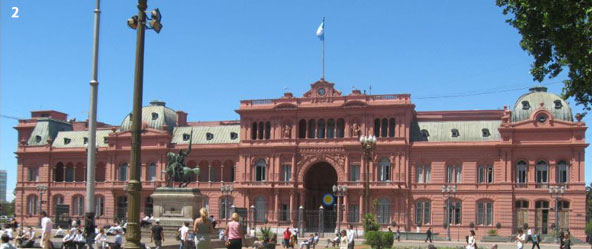
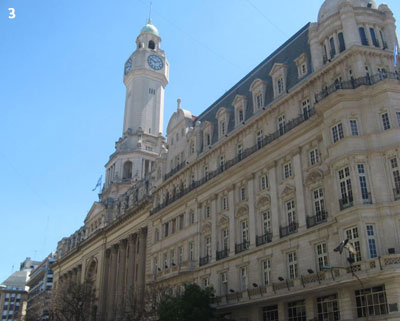
    There is also an attractive area of redevelopment adjacent to the core in the former dock area, Puerto Madero. The old port buildings have been converted to commercial uses, especially restaurants. A number of high-rise condominium buildings have been constructed beyond the old port basins. Government buildings more than match the commercial architecture, with the National Congress and the Casa Rosada, or “Pink House,” with its balconies from which President Peron and his wife Eva used to address the public (Photo 2). Not more than two weeks ago, former President Nestor Kirchner lay in state to be visited by in an emotional outpouring by hundreds of thousands of Argentineans. The city of Buenos Aires also has a distinctive legislative building (Photo 3).

    These older romantic styles make Buenos Aires a wonderful walking environment. Most were erected in the first three decades of the 20th century. This was Buenos Aires at its zenith. Then, Buenos Aires was capital of one of the world’s acknowledged economic powers. Argentina generally ranked around10th in gross domestic product (GDP) per capita during that period (Note 1). Thus, today, the tourist can enjoy the product of that prosperous time.

    Economic Stagnation: More recent years have not been good to the Buenos Aires area and Argentina. The nation has seen decades of ups and downs – but mostly downs. The nation has been buffeted between constitutional governments and military dictatorships. Too often, even the constitutional governments have placed too little emphasis on creating wealth and too much on redistributing it. A failed currency policy in the 1990s destroyed the savings of millions. All of this has led to Argentina’s migration from the top 10 economies to near the bottom of the top 100, now ranked at 82nd in the world in GDP per capita. No top ten nation from early in the 20th century has fallen so far. New Zealand managed to drop from 1st in the world in 1920 to 51st now, but still has a GDP per capita double that of Argentina.

    Argentina suffered the largest sovereign debt default in world history, at $100 billion in 2002. The nation’s former colonial master, Spain, trailed Argentina in GDP per capita throughout the 20th century to the 1980s, yet is now more than twice as prosperous (Figure 1)

    This economic decline is not so evident in the autonomous city of Buenos Aires, which is also called Capital Federal, analogous to the District of Columbia (DC) in the United States. This is the Buenos Aires of tourists, an area only slightly larger than Washington, DC, but with five times the population. The municipality of Buenos Aires is by far the most affluent urbanization in the nation. Even so, there are informal settlements within the city, such as Villa 31. Overall, approximately three percent of the city’s population is in these kinds of informal settlements.
    BA3-bencich
    Population and Distribution: According to the last census (2001), the city of Buenos Aires had fewer people than in 1947, having fallen from 3.0 million residents to 2.8 million. The city is also very dense, at 35,600 persons per square mile (13,700 per square kilometer), which is about one-half the density of Manhattan or the ville de Paris and double the density of the city of San Francisco.
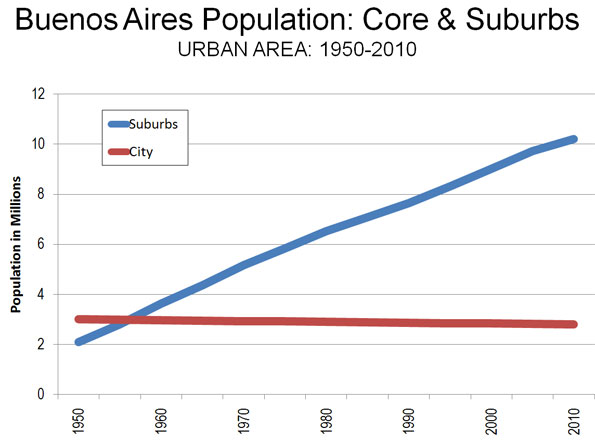
    Most of the population lives in peripheral areas. This dominant suburban growth pattern is typical of world urbanization, as can be seen in such high-income nation capitals as London, Washington, Brussels, Copenhagen has been in the suburbs. Indeed, all growth in Paris has been in the suburbs since 1881. Like the ville de Paris, the city of Buenos Aires now accounts for less than 25 percent of its metropolitan area population (Figure 2).

    Overall, the urban area (area of continuous development) has nearly 13 million people and covers more than 1,000 square miles (2,600 square kilometers) for a population density of 12,100 per square mile (4,700 per square kilometer). This is 70 percent more dense than Los Angeles and one-third more than Paris but less than one-eighth that of Dhaka (Bangladesh).

    Suburban Buenos Aires: The suburbs of Buenos Aires differ from those in high-income national capitals. Generally, the suburbs are far poorer than the city and reflect the more recently less affluent Argentina that has emerged in recent decades just as the central area testified to the nation’s former relative wealth. All of suburban Buenos Aires is in the adjacent Buenos Aires province, which has the largest population in the nation.

    Some of the suburbs are affluent, especially to the northwest, where suburban municipalities like Pilar and Tigre contain housing that could easily fit in upper middle income suburbs of the United States or Europe. However, even in these areas, there are close-by developments of low-quality and even informal housing, mostly housing domestic employees to the higher income population.

    The suburban poverty is far more pervasive to the southwest and the southeast. Many neighborhoods look similar to modest suburbs in Mexico City, though without the pervasive informal settlements. More people live in informal settlements in the suburbs than in the city, with estimates putting the number at above 500,000.

    More than the Core: Any thought, however, of Buenos Aires being a “compact city” is dispelled by the vast sea of lights visible on an evening flight out of Ezeiza International Airport. The urbanization stretches 30 to 40 miles in all possible directions, to the northwest, southwest and southeast (with the Rio de la Plata being to the northeast).

    However, probably no urban area illustrates the general rule that urban cores tend to be substantially different from their suburbs. Not only is suburban Buenos Aires far less dense, but it is far less affluent. Any who visits the city alone will have missed more than three-quarters of the reality.

    ————

    Note: GDP per Capita data based upon Angus Maddison’s work for the Organization for Economic Cooperation and Development.

    Photos (by the author):
    Top: Avenida 9 de Julio
    2: Casa Rosada
    3: City of Buenos Aires Legislative & Office Buildings
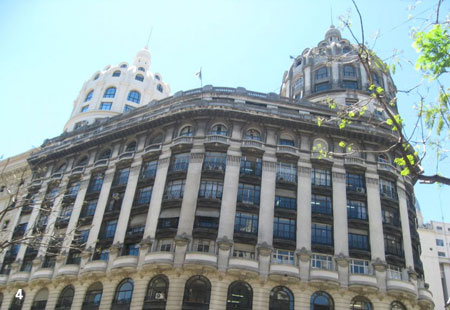
    4: Bencich Building
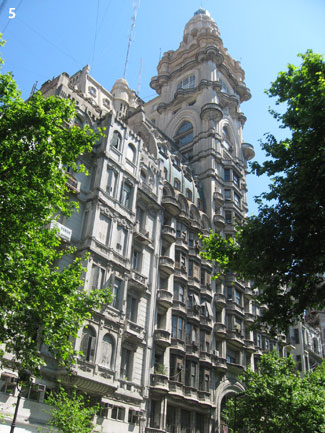
    5: Casa Borolo

    ————

    Wendell Cox is a Visiting Professor, Conservatoire National des Arts et Metiers, Paris and the author of “War on the Dream: How Anti-Sprawl Policy Threatens the Quality of Life

  • Asia’s Go-to Cities: Moving Between Mumbai and Singapore

    As someone who has lived in both Singapore and Mumbai, I can appreciate both in their uniqueness. Each city has its own unique place in the world, neither lesser than the other.

    In 2006, I left behind a slightly laid back, well run Singapore, a city trying to come to terms with its boring and over-regulated image. The Singapore of 2010 that I returned to, as a newspaper put it recently, has “grown up‟. It is a speeding, futuristic looking city. You can see signs of progress everywhere and among the people an almost obsessive desire to get ahead. The famed fines and traffic rules are still there, but you can see that the police force has its hands busy with issues that come with a fast pace of growth.

    Surprisingly Mumbai has much in common with Singapore. The India I had left behind was resigned to accept its second rate status in the developing world. Today’s Mumbai has become a city proud of its bustling economy, rearing to get ahead and much like the country, confident of its emergence on the world stage.

    The Immigration issue

    Although very different in their level of development both Mumbai and Singapore are very much ”go-to” cities, places where people believe ”things will get better.”.

    In Mumbai, there is an alluring aura that notwithstanding your education or background, if you were hardworking, you could get lucky. It was an “equal opportunity” city. This attracts opportunity seekers who migrate to the city from other parts of India. They are often seen as undercutting existing employment. This has led to widespread discontent and unrest among the existing unskilled population who have so far been enjoying the fruits of no competition.

    This has long been an issue in Mumbai, but the numbers of immigrants are so large politicians can no longer ignore the issue. Attacks on immigrants are now part and parcel of daily life in Mumbai, directed against fellow countrymen from poorer parts of North India.

    Singapore also faces an immense immigration issue. Many “locals” worry about the growing number of immigrants who have been accepted by the government as either Singaporeans or as permanent residents. The target of discontent could be anyone: the handymen or construction workers brought in from neighboring countries to cater to the booming construction industry or the highly paid executives brought in for their expertise. Of course, unlike Mumbai things never get too out of control. Most of it discontent is spoken quietly among individuals or discussed muted in few newspaper columns.

    Immigrants are a necessity for Singapore, perhaps even more essential than for Mumbai. Inviting foreigners was their way of coping with one of the world’s lowest birthrates and most rapidly aging populations.

    Bread and Butter

    Singapore has never been known for ”cheap food.” The small nation imports almost all of its fresh food produce from neighboring countries driving up prices significantly.

    As a result, food costs are a significant part of my household expenses here in Singapore, much more so than in Mumbai. The tropical temperatures do not allow long storage of fresh produce, enabling frequent trips to the supermarket or wet markets. Food is a very important part of life and a large part of the appropriately named ”cost of living.” Our family of four spends a lot to keep a regular, non-fancy table.

    The fact that I had just moved from Mumbai didn’t help. The diverse income segments and the need to woo them all in a democracy has led to a long tradition of government controlled, subsidized food pricing. Unprecedented inflation has toppled governments. Most importantly, unlike Singapore, the double digit wage inflation is quite ahead of the growth in cost of living, enabling more disposable income. In other words, even with lower tax rates of Singapore, I am outside my home country and poorer for it!

    On the topic of disposable income, families thirty years ago saved bit by bit to get their children married off. A lavish wedding, where you invited all to pay off your social debts was the one dream celebration of an Indian household. A wedding was the social antenna, the marriage bellwether, the occasion to be one up on your entire fraternity. They were occasions to savor and discuss for years to come. Everyone desired to hold/create a wedding for their children/close family that would henceforth be the new standard for weddings to come.

    Increasing affluence has given people the opportunity to make the ”lifetime celebration“ a more frequent affair and what could be a better occasion to show off that income than a birthday party for your little ones? Recently, my six year old was invited to a classmate’s birthday party. Everything about the party, starting from the invite and box of custom made chocolates tells you that no expense had been spared. The bash was at a swanky five star hotel in the suburbs, with two hundred invitees. There were chocolate fountains, different kinds of cuisine and professional entertainment: all elements that are by now mandatory parts of any self respecting birthday party. However, it was the custom labeled return gift, an I-Pod shuffle, which lifted the commonplace ”return gift” to a level significantly above the Joneses.

    Social pressures are similar in Singapore but they manifest themselves differently. The bar is always what you don’t have:,the latest BMW coupe, a condominium at the swankiest address in town, or the latest Louis Vuitton bag. Birthday parties are not the highlights but these acquisitions are.

    Condo-mania

    Every weekend, all Singaporeans indulge in property-porn, poring over newspaper advertisements on new construction openings, walking through the show flats, and marveling at the impressive fittings.

    Four years back, I lived within striking distance of the famous Orchard Road, near enough to walk to it, far enough to breathe. It had several condominiums but was punctuated nicely with green stretches of land. Come 2010, much of the greenery has vanished and been replaced by tall and narrow sky scrapers, most of them glass monstrosities. Many more are similarly taking up every inch of green space.

    Mumbai, like Singapore, is a growing island city where space is at premium. Growth is all vertical. Property prices are high and rising, albeit for completely different reasons.

    Mumbai’s population density of 22,000 people per sq km exceeds that of small Singapore by a factor of three. But the mentality is similar. Owning a place of your own in Mumbai is as much a dream as it is in Singapore. Your “own space“ could be just a small hovel or shanty or a flat in any suburb of Mumbai. The desire to own a place in any part of the city in a market tightly controlled by builders and ineffectively regulated by politicians, ensuring that prices will stay high. A 600 sq ft size of condo, in a distant suburb is priced at between USD$100-120,000.

    Of course, this is out of reach for most of the city’s residents. So most of them plod on, spending a significant part of their incomes squeezed into tiny rented spaces dreaming of a day when they can afford a roof of their own. More than the rentals, most landlords demand a fat lump sum equivalent to a year’s rent, ubiquitously termed ”deposit.” In the absence of any regulation, this safeguards the owner from renters who might refuse to vacate units or destroy and mutilate them. It also benefits the renter, as it sits in the bank for a year and earns interest which – given India’s comparatively high interest rates – is not insignificant.

    On the other hand, 82% of Singaporeans stay in state-provided Housing Development Board flats. What keeps the real estate market fanned and growing is the desire to upgrade; from a rented property to an owned one, from a HDB flat to an executive condominium and from there to a private condominium with its own swimming pool and gymnasium.

    Wherever you turn you can see signs of show flat enticing you to invest more than USD 1 million for a mere 600 sq ft of private condominium space. Since space is at a premium, the buildings get narrower, the units get smaller and prices only go north. Builders try to outdo each other on the concept; enticing buyers with high end kitchen fittings like wine chillers and coffee machines from aspirational European brand names like “Kupperbusch” and “Gaggenau”.

    Most of the investors – Singaporeans and outsiders – have bought property for its appreciation, not to create a source of rental income. Therefore rent is high, averaging USD 3-4 for every sq ft. And you if plan to be here for the long haul, that is a significant part of your income.

    In Conclusion

    Moving between countries is always an enlightening experience. Among other things, it also teaches you to appreciate things about the country you have left behind. When I left Singapore for Mumbai, I took with me an appreciation of systems that work, roads clean enough to eat off and a daily routine that largely remained unchanged for four years.

    On my return to Singapore, I have brought with me memories of a dynamic city, confident that it will only offer a better life to its citizens. I have come from one a growing, global city to another, still unsure of what the implications of that term will be in how people can live.

    Vatsala Pant is a management graduate with several years of business leadership experience and a connoisseur of people, places and cultures. She currently lives in Singapore.

    Photo by a-n-d-y-l-e-o-s-s

  • Greetings From Recoveryland: Ten Places to Watch Coming Out of the Recession

    Like a massive tornado, the Great Recession up-ended the topography of America. But even as vast parts of the country were laid low, some cities withstood the storm and could emerge even stronger and shinier than before. So, where exactly are these Oz-like destinations along the road to recovery? If you said Kansas, you’re not far off. Try Oklahoma. Or Texas. Or Iowa. Not only did the economic twister of the last two years largely spare Tornado Alley, it actually may have helped improve the landscape.

    We have compiled a list of the 10 American cities best situated for the recovery. These are places where the jobs are plentiful, and the pay, given the lower cost of living, buys more than in bigger cities. In other words, places unlike much of the rest of the country. The cities, most of which lie in the red-state territory of America’s heartland, fall into three basic groups. There’s the Texaplex—Austin, Dallas, San Antonio, and Houston—which has become the No. 1 destination for job-seeking Americans, thanks to a hearty energy sector and a strong spirit of entrepreneurism. There are the New Silicon Valleys—Raleigh-Durham, N.C.; Salt Lake City; and urban northern Virginia—which offer high-paying high-tech jobs and housing prices well below those in coastal California. And then there are the Heartland Honeys—Oklahoma City, Indianapolis, and Des Moines, Iowa—which are enjoying a revival thanks to rising agricultural prices and a shift toward high-end industrial jobs.

    Unlike the Sun Belt states and cities along the East and West coasts, these locales not only grew during the boom of the mid-2000s, they suffered least in the Great Recession. The fact that they are mostly in red states should give the newly ascendant GOP comfort as it tries to deliver on its election-year promise to right the economy. That isn’t to say all the blue states will remain weather-beaten. Wall Street, heady with cheap money, has sparked a return to opulence. And the strong demand for high-tech products and services will likely keep places like Boston, San Francisco, and San Diego from devolving into fancy versions of Detroit. Yet given the results of last week’s election and the increasing odds against another bailout of state governments, the near-broke and highly regulated blue states will be hard-pressed to generate much new employment.

    Of course, not everyone living in our Top 10 cities has avoided the heartache. And the continued slow pace of the economic recovery could hamper expansion even in the most-favored cities. If energy tanks as a result of a renewed global slowdown, it could hurt Texas and Oklahoma; dropping agricultural prices would hit some of the Heartland Honeys hard. But relatively—and that is the operative word in this tough economy—our 10 cities should fare better than most anywhere in America. And they could offer us a road map for what the nation’s economy will look like once the dust settles.

    THE TEXAPLEX

    For sheer economic promise, no place beats Texas. Though the Lone Star State’s growth slowed during the recession, it didn’t suffer nearly as dramatically as the rest of the country. Businesses have been flocking to Texas for a generation, and that trend is unlikely to slow soon. Texas now has more Fortune 500 companies—58—than any other state, including longtime corporate powerhouse New York.

    Austin boasted the strongest job growth in our Top 10, both last year and over the decade. Home to the state capital and the ever-expanding University of Texas, the city is arguably the best-positioned of the nation’s emerging tech centers. It enjoys good private-sector growth, both from an expanding roster of homegrown firms and outside companies, including an increasing array of multinationals such as Samsung, Nokia, Siemens, and Fujitsu.

    Yet Austin’s newfound prosperity isn’t simply a product of its university culture or its synergetic collection of technology firms. Its success owes a great deal to simply being in Texas—a state itching to eclipse its historic archrival, the increasingly troubled California. Indeed, Texas is becoming to the Golden State what Arizona, Nevada, and Oregon were in the last decade: a refuge for workers and companies fed up with California’s high unemployment, cost of living, and dysfunctional state government.

    The Texas economy has benefited from widening diversification. Houston has a robust energy business and medical-services industry, and thriving international trade—all long-term growth areas. Dallas enjoys an expanding tech sector and well-developed business-service industries tied to a powerful corporate base. San Antonio has a strong military connection and an expanding manufacturing capacity, and it is a key locale for the growing Latino marketplace. What’s more, Texas offers pro-business policies and relatively low taxes, and the physical infrastructure in the cities is generally as good or better than in many East and West coast metropolitan areas.

    People are voting with their feet. All four Texas cities are enjoying strong immigration from the rest of the country and abroad. Houston and Dallas have higher rates of immigration than Chicago, and if the job picture stays the same, those cities could someday rival New York and Los Angeles in terms of ethnic diversity.

    THE NEW SILICON VALLEYS

    Although Massachusetts and California are lauded as the places “where the brains are,” neither ranked high in the growth of tech jobs over the past decade. More important is where the brains are headed.

    A lot of them are going to North Carolina, Virginia, and Utah. The population of Raleigh-Durham grew faster than any major U.S. metropolitan area during the recession, and the city ranked third on our list in terms of job growth over the last decade. To the north, in Virginia, lies another Silicon Valley wannabe, stretching across Alexandria, Arlington, and Fairfax counties. And then there’s Salt Lake City and its environs, buoyed by the arrival of such big names as Adobe, Twitter, and Electronic Arts. The Greater Salt Lake region, which follows the Wasatch Mountains from Provo to Ogden, has much to attract tech companies: short commutes, decent public schools, spectacular nearby recreation, and, perhaps most important, affordable housing. Roughly 75 percent of households in Salt Lake can afford a median-priced house, as compared with 45 percent in Silicon Valley and roughly half that in New York City and San Francisco. The cost advantages of cities like Salt Lake and the other high-tech hubs are expected to prove especially attractive to millennials—the generation born after 1982—as they begin forming families and buying homes en masse.

    None of these Silicon Valleys may ever reach the critical mass of the real thing in California, but they will become increasingly more effective competitors and take an expanding market share of the nation’s technology business.

    THE HEARTLAND HONEYS

    The oft-ignored center of the country boasts a thriving economy that seems poised for further expansion. The region is well positioned to take advantage of growing markets for agricultural commodities and farm machinery in fast-growing countries such as India and China. The Great Plains and parts of the southern Midwest have also attracted new investments in manufacturing, both from domestic and foreign firms.

    Having largely missed out on the housing bubble, the region also avoided the hangover. As a result, after watching generation after generation move away, several heartland cities are enjoying a noticeable uptick in domestic migration as well as immigration. During the Great Depression, it was Oklahomans who moved to California to escape the Dust Bowl. Now there are considerably more people moving from California to Oklahoma than the other way around.

    Indianapolis, once written off as “Indiana no-place,” is one emerging hotspot. The area’s housing affordability now stands at a remarkable 90-plus percent. Although the recession has hit some of Indiana’s manufacturing-oriented northwest corner, over the past decade Indianapolis’s population grew at a rate 50 percent greater than the national average, notes urban analyst Aaron Renn. Much of this success is due to an aggressively pro-business attitude that promotes growing clusters such as life sciences, motor sports, and Internet marketing.

    Oklahoma City and Des Moines have also enjoyed steady growth in both jobs and net migrants over the past decade. Des Moines was recently rated the No. 1 spot in the country for business and careers by Forbes magazine, thanks to a surging agricultural sector and strength in the business-services segment. And Oklahoma City—which enjoys low unemployment as a result of its steadily growing energy and aerospace sectors—has been ranked among the best job markets for young people, ahead of Dallas, Seattle, and even New York (having Kevin Durant lead the NBA’s Oklahoma City Thunder for the foreseeable future can only improve the buzz).

    Of course, none of the cities in our list competes right now with New York, Chicago, or L.A. in terms of art, culture, and urban amenities, which tend to get noticed by journalists and casual travelers. But once upon a time, all those great cities were also seen as cultural backwaters. And in the coming decades, as more people move in and open restaurants, museums, and sports arenas, who’s to say Oklahoma City can’t be Oz?

    Job Growth
    Net Domestic Migration
    Total 2010
    2009
     
    10yr
    7yr
    2yr
    1yr
    9yr
    6yr
    2yr
    1yr
    Emplymt
    Population
    Northern Virginia 13.8% 11.5% -1.0% 1.2% 12.3 3.2 10.1 8.3 1,309,675 2,558,256
    Raleigh 13.5% 13.7% -4.9% -0.4% 236.7 186.6 47.2 18.4 496,900 1,125,827
    Salt Lake City, Ogden, Provo 7.7% 8.5% -6.7% -1.4% 9.2 15.9 7.4 2.4 961,900 2,227,413
    Austin 14.1% 17.8% -0.9% 1.7% 177.2 136.5 37.3 15.5 768,500 1,705,075
    Dallas-Fort Worth 3.7% 8.1% -3.6% 0.8% 59.3 44.8 14.3 7.2 2,876,925 6,447,615
    Houston 11.7% 10.9% -3.6% -0.5% 51.2 42.9 15.5 8.7 2,518,675 5,867,489
    San Antonio 11.4% 10.8% -2.7% -0.2% 102.1 86.4 21.3 9.3 833,325 2,072,128
    Oklahoma City 4.9% 6.7% -2.2% 1.0% 37.8 32.7 11.6 7.3 561,125 1,227,278
    Des Moines 7.8% 7.4% -3.5% -0.9% 63.6 56.2 14.0 6.1 316,975 562,906
    Indianapolis 1.6% 0.3% -5.5% -0.3% 45.9 34.6 8.0 4.1 870,850 1,743,658
    New York -1.5% 0.3% -4.1% -0.5% -104.7 -82.6 -13.8 -5.8 8,288,300 19,069,796
    Los Angeles -6.2% -5.2% -8.0% -1.0% -107.9 -89.0 -15.7 -6.3 5,118,950 12,874,797
    San Francisco -13.1% -6.0% -8.9% -2.6% -83.1 -57.6 3.4 1.9 1,853,350 4,317,853
    Chicago -8.0% -4.8% -7.4% -1.7% -60.0 -45.8 -8.8 -4.2 4,235,175 9,580,567
    Nation -1.2% 0.4% -4.9% -0.1%   130,690,750  
    Areas are Metroplitan Statistical Areas
    Northern Virginia, Va. includes Arlington, Clarke, Fairfax, Fauquier, Loudoun, Prince William, Spotsylvania, Stafford, and Warren Counties and Alexandria, Fairfax, Falls Church, Fredericksburg, Manassas, and Manassas Park Cities in Virginia.
    Salt Lake City region includes Ogden and Provo Metroplitan Statistical Areas
    Job growth uses May-August average for each year.
    Job data:  U.S. Bureau of Labor Statistics, Current Employment Survey
    Migration data:  U.S. Census Population Estimates.  Migration is cumulative over 10, 7, 2, or 1 yr period.  Number is rate per 1,000 residents in base year.

    —————-

    This article originally appeared in Newsweek.

    Praxis Strategy Group and Zina Klapper provided research for this article.

    Joel Kotkin is executive editor of NewGeography.com and is a distinguished presidential fellow in urban futures at Chapman University and an adjunct fellow with the Legatum Institute in London. He is author of The City: A Global History. His newest book is The Next Hundred Million: America in 2050, released in February, 2010.

    Photo: Jeanette Runyon

  • The Smackdown Of The Creative Class

    Two years ago I hailed Barack Obama’s election as “the triumph of the creative class.” Yesterday everything reversed, as middle-class Americans smacked down their putative new ruling class of highly educated urbanistas and college town denizens.

    More than anything, this election marked a shift in American class dynamics. In 2008 President Obama managed to win enough middle-class, suburban voters to win an impressive victory. This year, those same voters deserted, rejecting policies more geared to the “creative class” than mainstream America.

    A term coined by urban guru Richard Florida, “the creative class” also covers what David Brooks more cunningly calls “bourgeois bohemians”–socially liberal, well-educated, predominately white, upper middle-class voters. They are clustered largely in expensive urban centers, along the coasts, around universities and high-tech regions. To this base, Obama can add the welfare dependents, virtually all African-Americans, and the well-organized legions of public employees.

    These are the groups for whom Obama’s persona and policies pack the greatest appeal. Since Obama took office, the prime beneficiary of fiscal and monetary policies has been Wall Street, which has seen a nice 30% rise in the market and record bonuses. Large corporations, which are largely financed by stocks and bonds, have seen their profits soar over 40%, in part due to access to easy money.

    The financial boomlet is most marked in key creative class strongholds such as Manhattan, Boston and San Francisco, as well as their surrounding, super-affluent suburbs. The largesse benefits not only the traders, but the high-priced lawyers, accountants and publicists serving the financial elite. It has also benefited the high-end consumer industry, including the arts, which support much of the creative class. Not surpisingly, the Democrats scored well in these areas last night despite the GOP tide.

    The creative class also has benefited from the lavish expenditures of public funds to major universities for research. This has lifted the prospects of the professoriate at the elite colleges from which Obama takes much of his advice. Finally the administration has rewarded its friends and funders among Silicon Valley venture capitalists. Once self-described paragons of entrepreneurial risk-taking, they increasingly search out government incentives and subsidies to pay for their large bets on renewable energy technology.

    In contrast, the traditional middle class has not fared well at all. This group consists of virtually everyone who earns the national household median income of $50,000 or somewhat above. They tend to be white, concentrated outside the coasts (except along the Gulf), suburban and politically independent. In 2008 they divided their votes, allowing Obama, with his huge urban, minority and youth base, to win easily.

    Since Obama’s inauguration all the economic statistics vital to their lives–job creation, family income, housing prices–have been stagnant or negative. Not surprising then that suburbanites, small businesspeople and middle-income workers walked out on the Democrats last night. They did not do so because they loved the Republicans but because the majority either fears unemployment or already have lost their jobs. Many were employed in the industries such as manufacturing and construction hardest hit in the recession; it has not escaped their attention that Obama’s public-sector allies, paid with their taxes, have remained not only largely unscathed, but much better compensated.

    Of course, few on the progressive left–more expressive of a dictatorship of the professoriate than that of the proletariat–seem likely to confront these class realities. Many will ascribe last night’s disaster to the dunderheadness of the American people, or to the clever venality of the right. Certainly some tea party candidates, inexperienced and untested, did appear incapable of passing a high school civics test. But the results had less to do with Karl Rove’s money than the Democrats disconnect with the middle class.

    The real problem for the Democrats lies with fundamental demographics. The middle class is a huge proportion of the population. Thirty-five million households earn between $50,000 and $100,000 a year; close to another 15 million have incomes between $100,000 and $150,000. Together these households overwhelm the number of poor households as well as the highly affluent.

    In contrast, the “creative class” represents a relatively small grouping. Some define this group as upward of 40% of the workforce–largely by dint of having a four-year college degree–but this seems far too broad. The creative class is often seen as sharing the hip values of the Bobo crowd. Lumping an accountant with two kids in suburban Detroit or Atlanta with a childless SoHo graphic artist couple seems disingenuous at best. In reality the true creative class, notes demographer Bill Frey, may constitute no more than 5% of the total.

    At the same time, this affluent constituency may be more than offset by another more traditional upper class. This consists of people closely tied to such basic sectors as agriculture, fossil fuel production, suburban home-builders and the aerospace industry. These voters have, for the most part, remained solidly Republican for generations, and but many followed the “creative class” into the Democratic Party in 2006 and 2008. Last night this part of the upper class shifted back toward their political home.

    But the real decider–to use George W. Bush’s unfortunate phrase–remains the much larger, more amorphous middle class. Given the economy of the past two years, the subsequent alienation of this group should pose no mystery. Suburban swing voters didn’t suddenly turn into racists or right-wing cranks. Instead they have seen, correctly, that Obama’s economic policy has to date worked to the advantage of others far more than themselves or their families. Until the Democrats and Obama can prove that they once again can serve the interests of these voters, they will continue to struggle to recapture the optimism so appropriate two years ago.

    This article originally appeared at Forbes.com.

    Joel Kotkin is executive editor of NewGeography.com and is a distinguished presidential fellow in urban futures at Chapman University. He is author of The City: A Global History. His newest book is The Next Hundred Million: America in 2050, released in February, 2010.

    Photo by World Economic Forum

  • Cruising Into Student Debt

    I once calculated that, for the cost of four years of education at a private American university, a student could take 105 cruises around the world. For the comparison, I chose only cruises that cost about $1,900, as who wants to go through college stuck with an inside cabin? As I imagine it, Cruise College (school motto: “Go Overboard on Learning”) even has some similarities to the landlocked undergraduate experience.
    For all I know it may exist, given that higher education is one of the few growth sectors in the U.S. economy.

    Despite the decline of American business, private colleges, state universities, night schools, and for-profit continuing education have boomed.

    Harvard College will get about 30,000 applications for the 1,700 places in next year’s freshman class. At the same time, there’s a strong demand for education at community colleges in economically depressed places, as laid–off workers retool for new jobs.

    Beyond colleges with bricks and mortar boards, there is also the flourishing world of online universities, which flash their pop–up banners each time you log onto the Internet. (“Welcome to Faber College: Knowledge is Good.”)

    “For profit universities” offer master’s in business administration or degrees in philosophy in exchange for computer clicks and (prepaid) tuition. But you don’t need an online degree from Ace’s Accounting and Appraisal Academy to understand that there are hidden costs.

    For years one of the hottest stocks on Wall Street has been Apollo Group, Inc., an education corporation that markets its degree under the flagship of the University of Phoenix.

    Its campuses (not to mention leafy computer servers, for online students) are spread across the country and operate in forty states. Among other theorems, Phoenix postulated that continuing educators like their “campus” to be near Interstate exits, and that students usually only will drive twenty minutes to attend class. (It was Mark Twain who said, “Never let college get in the way of the evening commute.”)

    Apollo’s stock went public in the 1990s, and reached a pre-crash high of $91 a share, before Wall Street reduced its grade to about $50. Still, it’s a billion dollar company with strong growth, and the University of Phoenix is larger than nearly all state universities, not to mention the Ivy League, with some 470,000 enrolled students.

    Faithful to its name, Phoenix believes in the redemption of the American spirit, and it attracts its students with the promise that more degrees will lead them out of their doldrums. Courses are practical, borrowing from the school of knocks.

    To “take this job and shove it,” Americans need new skills — as nurses, IT programmers, whatever — and Phoenix (“the drive-thru university”) markets classes at convenient times and places.

    The reality of online education, however, is more subtle, as students are not the instruments of a new enlightenment so much as the pipeline of subprime student debt. They are recruited not for their mastery in art or football, but for their ability to fill out bank forms that let Phoenix, like any for-profit school, tap into the vast subsidized gold mine of federal student loan programs.

    Imagine, one day, stickers on the back of their Volvos that read “Subprime State.”

    For-profit university cheerleaders and even the federal government often brag about the low default rates on student loans. The reason the loans stay current, long after students have flunked out of astrology, is because it’s impossible to walk away from the tuition bills.

    Neither a bankruptcy nor an incomplete allows a student an escape from lenders intent on debt collections. (John Blutarksy: “Christ. Seven years of college down the drain.”) Better yet, the ultimate guarantor of the loans is the U.S. government. Knowledge may be Good, but government-backed debt is better.

    According to the New York Times, the default rate on student loans was about 7 percent in 2008, the most recent year for which data are available; “In the 2008-9 award year, students at for-profit schools represented 26 percent of borrowers — but 43 percent of defaulters. The median federal loan debt for students earning associate degrees at for-profit institutions was $14,000.”

    There is an online Student Loan Debt Clock, which reports outstandings of $855 billion, more than the credit card debt in the United States. It goes up about $3,000 a second, which is 5,684 luxury cruises an hour.

    It could be argued that traditional universities have similar Faustian (he coached at Notre Dame) bargains with their students. In exchange for about $200,000, which funds all sorts of professorial sabbaticals and vague courses (“Proust, Prufrock, and Pederasty”), students get undergraduate degrees that can be redeemed for yet more study at the graduate level… should they want to find interesting jobs.

    Statistically, an undergraduate degree provides, on average, $50,000 more per year in salary than does a high school diploma, although it is about a wash, were you to invest the tuition money into an S&P stock fund. Engineers are paid more than poets; state universities offer better “returns” than private colleges. It’s hard to date a cheerleader at an online university.

    Is Cruise College a better deal than the great American undergraduate experience? I can only speak from personal experience, which is limited. I have only gone on one cruise, while I spent six years in the waters of American and European universities. My quick take: The cruise had better floor shows, but I preferred the college library. The food was about the same. Overall, it would be hard to distinguish those who were drunk at fraternity parties from those merely seasick on board.

    And at least the students at Cruise College, for their job networking practicum, can mix with retired American executives.

    Because I am a child of mid-century suburbia, I believe in the good of a college education. On the walls of my childhood room were the pennants of various schools, and we covered our grammar school books with the names of great universities. In high school, we laughed at the Woody Allen line: “I was thrown out of there during my freshman year, for cheating on my metaphysics final. You know, I looked within the soul of the boy sitting next to me.”

    I loved a lot about my university experiences — the seminars, my friends, and something the cafeteria staff called “Chicken Eugène.” Still, I have no doubt that learning has many paths and that, for some, cruising would work as well as Princeton or Cal State. And for universities to be the instruments of financial sleights-of-hand, as opposed to teaching the great books, seems as distorted as the sermons of Elmer Gantry.

    Herman Melville wrote: “A whale ship was my Yale College and my Harvard.” I never read Moby-Dick in college, but I heard that it was a quite a cruise.

    Photo by Jonathan Blundell

    Matthew Stevenson is the author of Remembering the Twentieth Century Limited, winner of Foreword’s bronze award for best travel essays at this year’s BEA. He is also editor of Rules of the Game: The Best Sports Writing from Harper’s Magazine. He lives in Switzerland and has two children at universities.

  • California’s Failed Statesmen

    The good news? Like most rock or movie stars, there’s nothing fundamentally wrong with California. It’s still talented, and retains great physical gifts. Our climate, fertility and location remain without parallel. The state remains pre-eminent in a host of critical fields from agriculture to technology, entertainment to Pacific Rim trade.

    California can come back only if it takes a 12-step program to jettison its delusions. This requires, perhaps more than anything, a return to adult supervision. Most legislators, in both parties, appear to be hacks, ideologues and time-servers. This time, when the danger is even greater, we see no such sense of urgency. Instead we have a government that reminds one more of the brutally childish anarchy of William Golding’s 1954 novel “Lord of the Flies.”

    Arnold Schwarzenegger has not turned out to be that supervision. Rather than the “post-partisan” leader hailed by the East Coast press, he has proven to be the political equivalent of the multi-personality Sybil. One day he’s a tough pro-business fiscal conservative; next he’s the Jolly Green Giant who seems determined to push the green agenda to a point of making California ever more uncompetitive.

    Contrast this pathetic performance with what happened after our last giant recession in the early 1990s. At that time, a bipartisan coalition of leaders – Speaker Willie Brown, State Senator John Vasconcellos and Governor Pete Wilson – worked together to address what was perceived as a deep economic crisis. They addressed some key problems and brought the state back from the brink. California recovered smartly between the mid-90s and the new millennium.

    Overall though, things are worse now. California has been flirting for the past year with its highest unemployment rate since the Great Depression. The last time we could blame the end of the Cold War for much of our economic distress; now the problem is a more broadly based, largely self-inflicted secular decline.

    A bloated government is part of the problem: Between 2003 and 2007, California state and local government spending grew 31 percent, even as the state’s population grew just 5 percent. The overall tax burden as a percentage of state income, once middling among the 50 states, has risen to the sixth-highest in the nation, says the Tax Foundation. Even worse, the state is getting ever less benefit from these revenues; since the Pat Brown era the percentage of budget spent on basic infrastructure has dropped from 20 to barely 5 percent.

    Although these taxes are often portrayed as “progressive,” California has continued to become more socially bifurcated. Our ranks of middle-wage earners are dropping faster than the national average even as the numbers of the affluent and poor swell. Overall California’s per capita income, roughly 20 percent above the national average in 1980, now barely stays with the national average. When housing and other costs are factored in, Los Angeles, San Francisco and Fresno rank among the top five major urban areas in America in terms of percentage of people in poverty, according researcher Deborah Reed of the Public Policy Institute of California. Only New York and Washington, D.C. do worse.

    At the root of these problems is an increasing lack of economic competitiveness. An analysis of the economy made for the Manhattan Institute shows California losing its edge in everything from migration, income, jobs and in entertainment industry employment. Tech companies may cluster in Silicon Valley but many are sending their new jobs abroad or to other sites. Recently, several leading Bay Area firms – Twitter, Adobe, eBay, Oracle and Adobe – have established major new operations in the Salt Lake area alone.

    So how do we turn it around? First, let’s find some adults, like former Speaker Robert Hertzberg or GOP financer Gerald Parsky, who know what it is to run a business and comprehend that the economy actually matters, and get them to head up a commission on the economy. Second, our leaders and policy elites must engage the emerging new business leadership of the state, which is increasingly immigrant, Asian and Latino.

    Right now neither party seems focused on the state’s future besides enriching their core constituencies. Lower taxes – the favored strategy of the right – on the already wealthy reflects an understandable desire to preserve one’s asset but is insufficient as a strategy.

    Democrats meanwhile seem determined to defend public sector pensions, Draconian labor, the high-speed rail boondoggle and environmental regulations, no matter what the cost to the economy.

    However contradictory their sound bites, the established parties are each following a script that would assure the next generation of Californians – largely Latino – remain an underclass that will have to move elsewhere to reach their aspirations. The left would do it by killing jobs in such fields as agriculture, manufacturing, construction and warehousing. As Robert Eyler, chairman of the economics department Sonoma State puts it, “the progressives have become the regressives.”

    For their part the GOP would kill the new California by starving it. They have no plan to bolster the basic services – like community colleges, roads, water and power systems – that will allow future working-class Californians to thrive.

    Their interests ignored by the parties, the immigrants and their offspring still represent the very key source of demographic energy and entrepreneurship that can revitalize the state. If you still want to see hopeful stirrings in California, go to places like Plaza Mexico in Lynwood or the new Irvine center recently built by the Diamond Development Group. Appealing to young families and distinct tastes, these retail facilities have thrived as the rest of the state’s overall retail economy has declined.

    More important still are the companies started by immigrant entrepreneurs like John Tu, CEO of Kingston Technology or scores of smaller Asian-owned firms in places like the San Gabriel Valley. Since the 1990s, newcomers have launched roughly one in four Silicon Valley startups.

    Add to this the muscle of the emerging Latino economy, led by food processing companies like the Cardenas Brothers, who now provide Costco with its frozen Mexican food.

    Due to their strong family and cultural ties in California, such ethnic firms appear less likely to move than more Anglo-dominated companies. But if the state keeps eroding public services and adding new regulations, these firms – like their counterparts in Silicon Valley and elsewhere – will place most of their new jobs as well in Utah, Texas or overseas.

    What we have here, in the end, is a massive disconnect between economics and politics. Does anyone in Sacramento talk to or even know about the largely Middle Eastern-led L.A. fashion industry? Is anyone talking to the hip sportswear mavens of Orange County’s own “Velcro valley”? Or what about agriculture, our traditional ace in the hole, which is largely disdained by the state’s intellectual and media class who see in large farms the work of the corporate devil?

    Somehow these productive voices – essential to our comeback – must be placed at the center of the debate. Sacramento’s leaders need to talk not just to lobbyists but to the key job-creators.

    These are the people who, even in hard times, are showing how we can grow an economy based on our natural advantages of climate, ethnic diversity, entrepreneurship and location.

    Ultimately we must make the creation of new jobs a priority that goes beyond formulaic mantras about lower taxes or illusory, state-supported “green jobs.” With a return to growth, California can still address its basic problems and challenges. But first we must corral the ideological hobbyhorses now running wild through Sacramento and make the needs of job-creators the central issue for our policy-makers.

    This article originally appeared in the Orange County Register.

    Joel Kotkin is executive editor of NewGeography.com and is a distinguished presidential fellow in urban futures at Chapman University. He is author of The City: A Global History. His newest book is The Next Hundred Million: America in 2050, released in February, 2010.

    Photo by Nate Mandos

  • Latino Dems Should Rethink Loyalty

    Given the awful state of the economy, it’s no surprise that Democrats are losing some support among Latinos. But they can still consider the ethnic group to be in their pocket. Though Latinos have not displayed the lock-step party loyalty of African-Americans, they still favor President Barack Obama by 57 percent, according to one Gallup Poll — down just 10 percentage points from his high number early in the administration.

    This support is particularly unusual, given that probably no large ethnic group in America has suffered more than Latinos from the Great Recession. This is true, in large part, because Latino employment is heavily concentrated in manufacturing, and even more so in construction.

    A half-million Latino workers in the construction sector — in which their share of the work force is double what it is in the broader economy — have lost their jobs since the start of the recession.

    Unfortunately, the Obama stimulus plan was light on physical infrastructure. It favored Wall Street, public-sector unions and large research universities. Big winners included education and health services — in which Latinos are under-represented.

    Not surprisingly, Latino communities across the country are in trouble. Today, of the 10 most economically “stressed” counties, seven are majority or heavily Latino, according to The Associated Press.

    Theoretically, Republicans should be able to take advantage of this situation. But not with the party’s increasing embrace of its noisy nativist right — evident not only in support of the controversial Arizona immigration law but also in the strong move against “birthright citizenship.” This makes the prospect of earning back President George W. Bush’s 40-plus-percentage-point support difficult at best.

    Thus, Latinos remain allied with Democrats whose policies inhibit the growth of construction and manufacturing jobs. This dichotomy puzzles many in the business community.

    “You have all these job losses in Latino districts represented by Latino legislators who don’t realize what they are doing to their own people,” said Larry Kosmont, a California business consultant. “They have forgotten there’s an economy to think about.”

    Despite that economic logic, Latino Democrats mindlessly follow liberal Democrats such as House Speaker Nancy Pelosi and Rep. Henry Waxman of California and Sen. John Kerry of Massachusetts, who represent largely white, affluent white-collar constituencies on issues such as cap and trade and federal regulation of greenhouse gases. Whatever the intent, these policies are likely to further decimate blue-collar employment in Latino districts.

    If they had independent thoughts, Latino Democratic politicians would be advocating positions that create new opportunities for their districts — particularly among young people. They could push, for example, a Works Progress Administration-like public works program that could provide new opportunities and skills training.

    One possible reason for not doing so is the opposition of public employee unions, which dominate Democratic politics, particularly in urban districts, and would see such a program as competing against their special interests.

    In contrast, Obama administration policies favor Ivy League schools, high-speed rail and light-rail service — issues with predominantly well-to-do, Anglo constituencies.

    This disjunction between interests and politics is particularly evident in California, the state with the largest Latino population. Latino Democrats have generally embraced the state’s draconian environmental and planning policies.

    The state’s fertile Central Valley offers one example. A green-inspired diversion of water from farms to save an obscure species of fish has forced more than 450,000 acres to lie fallow. Thousands of agricultural jobs — held mostly by Latinos — have been lost, perhaps permanently. Unemployment, which stands at 17 percent across the valley, reaches upward of 40 percent in towns like Mendota.

    These policy positions speak to the limits of the current Latino leadership. Latino political power has waxed in Sacramento since 1999 — the state Assembly has had three Latino speakers. But on the ground, things have waned for the state’s Latino working class. During the past decade, according to research from California Lutheran University, the state has experienced one of the nation’s most dramatic drops in household earnings — between $35,000 and $75,000 in lost income.

    The pain at the bottom of the economic ladder is even greater. Indeed, according to Deborah Reed of the left-leaning Public Policy Institute of California, when housing and other costs are factored in, three heavily Latino counties — Los Angeles, Fresno and Monterey — rank among the 10 poorest metropolitan areas in the United States. Increasing numbers of working- and middle-class Latinos have been migrating to more job-friendly areas such as Texas and the Plains states.

    Latino Democratic politics are equally dysfunctional at the local level. In the largely Hispanic industrial belt south of downtown Los Angeles, for example, a sprawling Latino machine, marked by near Chicago-scale corruption, now controls most elective posts. Many of its leaders — most outrageously in the city of Bell — have proved far more adept at feathering their own nests than at reviving local economies.

    A similar disconnect can be seen in the City of Los Angeles, where corruption and inefficiency have led some local entrepreneurs to invest in other regions. “It’s extremely difficult to do business in Los Angeles,” said retail developer Jose de Jesus Legaspi. “The regulations are difficult to manage. … Everyone has to kiss the rings of the [City Hall politicians].”

    L.A. Mayor Antonio Villaraigosa epitomizes this self-defeating ethnic politics. Last year, for example, Cecilia Estolano, executive director of the Los Angeles Community Redevelopment Agency, supported shifting resources from building high-end housing and amenities downtown to rejuvenating the large industrial district, a major employer of blue-collar Latinos.

    Her efforts quickly ran afoul of Villaraigosa, whose staff favors pouring more money into downtown amenities — even if doing so drives out industrial jobs. Estolano, who now works for a local nonprofit, says the lack of interest in manufacturing and the blue-collar economy is easy to explain: campaign contributions.

    “The problem is manufacturers in L.A. are mostly small and don’t contribute to campaigns,” Estolano said. “L.A.’s politics are controlled by real estate interests, their lawyers and consultants.”

    As Latinos become a critical part of our emerging economy, they need to develop a policy agenda that focuses less on old-style, machine ethnic politics and more on the critical issue of upward mobility.

    Latino voters might also consider avoiding the African-American one-party model by embracing both growth-oriented Democrats and enlightened Republicans. This is most likely to increase their political leverage, while creating a politics that supports their most fundamental interests.

    This article originally appeared at Politico.

    Joel Kotkin is executive editor of NewGeography.com and is a distinguished presidential fellow in urban futures at Chapman University. He is author of The City: A Global History. His newest book is The Next Hundred Million: America in 2050, released in February, 2010.

    Photo by chadlewis76

  • Why We Have to Learn to Love the Subdivision – Again

    When did anyone last hear officials and professionals talking enthusiastically about the social and economic benefits resulting from the subdivision of land to create secure, clean and tradable title?

    Indeed, any planning document is likely to include a long list of potential problems caused by the subdivision, but will mention few, if any, of the benefits. Maybe it’s time to rethink this conventional planning wisdom. In Peru, during the eighties, Hernando De Soto and the Institute for Liberty and Democracy promoted land reforms that led to more than 1.2 million rural families being given titles to the land they worked. One major grant of titles to a whole village was celebrated on television. When the reporter asked a woman “Why is having title important for your family?” she replied “Having secure title means I can now go out to work.” She went on to explain that the family’s past “customary settlement” required continual occupancy and eternal vigilance. Some member of the family had to be on the property at all times, or else someone else could move in.

    During a recent BBC television news bulletin on the floods in Pakistan, reporter Orla Guerin said “Many here are bound to their land and their livestock, and will live or die with them. We spotted one young boy, clinging to the top of an electricity pylon. He climbed down to collect a bag food aid, but refused to be removed from the waters.”

    I suspect he was also concerned with the need to help maintain his family’s right to occupy.

    City officials and urban planners in particular are always claiming that their cities are “running out of land”. Of course they are not running out of land. They are surrounded with it, as any air traveler knows, just from looking out the window.

    However, they are short of land with a certificate of title that allows the landowner to develop the property for housing or anything else. One reason for this shortage lies with the costs and often onerous conditions of compliance are simply too high. The French Revolutionaries learned that when they fixed the price of bread at less than it cost to bake a loaf, the bakers simply stopped baking bread. When it costs more to gain a title than the lot can be sold for, we should not be surprised if people stop creating lots.

    Suburban residential development creates many jobs and the residents who move continue to create new employment opportunities for decades. Every home owner becomes a property developer as they add rooms, sleepouts, new decks and swimming pools and upgrade their kitchens, and so on. I should have emphasized that it’s the land around the dwelling that enables so many of these projects to take place over the decades and to create so many jobs.

    If Smart Growth policies force people to live in apartments, their opportunities to improve their dwellings become seriously limited.

    City governments appear to overlook the economic and employment impact of rejecting large-scale developments, but the cumulative effect of a multitude of prohibitions of smaller proposals is equally serious – especially in a small economy like New Zealand or a relatively unpopulated place like Montana.

    During the nineteenth century the key function of governments in the New World was to churn out titles as quickly as possible.

    Surveyors served as the true frontiersmen, enabling the migrants to arrive, put down their roots, and build. The post-war suburban boom repeated this experience, supported by an equal enthusiasm for creating a property owning democracy.

    Then during the 1990s, “The Age of Environmentalism” arrived and activists persuaded decision-makers in the developed world that the creation of titles enabled polluting humans to possess the Earth Mother and must be stopped, or be made as difficult as possible. These constraints on land supply created the short-term property boom, and the inevitable bust that led to the greatest financial crisis in recent history.

    The developing nations and their economists continue to recognize the value of title. The works of Hernando de Soto, the Peruvian economist, emphasize that the major problem facing people in poor countries has been their lack of secure title to land, which constrains their ability to borrow significant sums of money and put down secure roots. As he says, the family with title builds a dwelling; the family that squats invests in furniture. This has led to his founding leadership of The Institute for Liberty and Democracy in Peru.

    At the recent conference of international surveyors in Sydney it was quite exhilarating to hear surveyors and officials from Peru talking of targets of 150,000 new titles per year. They knew full well that titles generate wealth. Maybe it’s time for New World cities to set similar targets and share de Soto’s enthusiasm for the contribution of subdivision to ongoing liberty and the pursuit of happiness.

    Bankers have long recognized that many families’ main means of saving is paying off their mortgage. Equally, many aging citizens fund their retirement by subdividing their large lots to create a nest egg for the future. Most university-indoctrinated central planners regard this as an “inappropriate” activity.

    Unexpected Super Large-Lot zoning in rural areas can suddenly deprive thousands of people of a secure and active retirement. Of course the planners claim the landowners are still able to subdivide, but just have to go through an approval process. Then the same planners make sure the costs and uncertainties render the exercise prohibitive. Their environmental cost benefit analysis ignores this destruction of individual wealth – and dreams.

    I wonder if any advanced developed country planning school has Hernando de Soto on its reading list?

    Instead of encouraging the creation of titles, as history suggests we should, the Smart Growth central planners have persuaded our governments to penalise the creation of new lots by imposing highly expensive and highly regressive fines called “development contributions” – which are actually anti-development levies.

    We tax cigarette smokers to discourage smoking, and we fine speedsters to discourage speeding. Should we be fining the creators of legal title if our aim is to encourage development, promote employment growth, increase savings and promote personal well-being?

    Some politicians, like Maurice Williamson, New Zealand’s Minister for Building and Construction ARE determined to reduce the costs of building consents and inspections. But these are trivial compared to the costs of subdivision and land use consents.

    And there is something of an international movement away from rule based management of development and a return towards broader concerns of society and the people who inhabit it.

    But before any legislative reforms can be effective we need to learn to once again celebrate secure, tradable, private title. This remains one of Western Civilisation’s greatest contributions to our wealth, health and general well-being.

    Owen McShane is Director of the Centre for Resource Management Studies, New Zealand.

    Photo by Brenda Anderson