Tag: middle class

  • Why Housing Will Come Back

    Few icons of the American way of life have suffered more in recent years than  homeownership. Since the bursting of the housing bubble, there has been a steady drumbeat from the factories of futurist punditry that the notion of owning a home will, and, more importantly, should become out of reach for most Americans.

    Before jumping on this bandwagon, perhaps we would do well to understand the role that homeownership and the diffusion of property plays in a democracy. From Madison and Jefferson through Lincoln’s Homestead Act, the most enduring and radical notion of American political economy has been the diffusion of property.

    Like small farmers in the 19th century, homeowners–and equally important, aspiring homeowners–now represent the core of our economy without which a strong recovery is likely impossible.  Houses remain as a financial bulwark for a large percentage of families, the anchor of communities, and, increasingly, home-based businesses.

    The reasons given for abandoning the homeownership ideal are diverse.  Conservatives rightfully look to diminish the outsized role of government in promoting homeownership.  Some suggest  that Americans would be better off  putting their money into things like the stock market or boosting consumer purchases.

    New-urbanist intellectuals like the University of Utah’s  Chris Nelson predict  aging demographics will lead masses to abandon their homes for retiree communities and nursing homes.   The respected futurist Paul Saffo predicts that as skilled laborers move from Singapore to San Francisco to New York and London, there is little need to “own” a permanent place. In the brave new future, he suggests, we will prefer time-sharing residences  as we flit from job to job across the global economy.

    Some of the greatest hostility towards homeownership increasingly comes from the progressive left, some of whom are calling for the total elimination of the homeowner mortgage interest deduction.  “The Case Against Homeownership,” recently published in Time,  encapsulates the current establishment’s  conventional wisdom: that homeownership is by nature exclusionist, “sprawl” promoting and responsible for “America’s overuse of energy and oil.”

    Yet for all the problems facing the housing market, homeownership–not exclusively single-family houses–is not likely to fade dramatically for the foreseeable future. The most compelling reason has to do with continued public preference for single-family homes, suburbs and the notion of owning a “piece” of the American dream.   This is why that four out of every five homes built in America over the past few decades, notes urban historian Witold Rybczynski, have less to do with government policy than “with buyers’ preferences, that is, What People Want.”

    What we are going through now is not a sea change but a correction from insane government and business practices.   The rise in homeownership from 44% in 1944 to nearly 70% at the height of the bubble reflected a great social democratic achievement. But by the mid-2000s government attempts to expand ownership–eagerly embraced by Wall Street speculators–brought in buyers who would have historically been disqualified.

    In some markets, prices exploded as people moved up too quickly into ever more expensive housing. Housing inflation was further exacerbated by “smart growth” policies, which limited new home construction in suburban areas and instead promoted dense, “transit oriented” housing with limited market appeal and economic logic.

    Rather than artificially constraining supply and protecting irresponsible borrowers,   we should let nature take its course. Home values need to readjust historic balance between incomes and prices. Over the past 60 years, notes demographer Wendell Cox, it took two to three years or less of median household income to purchase a median-priced home. At the peak of the boom, that ratio had ballooned to 4.6.

    The disequilibrium was the worst in regions like Los Angeles, Las Vegas, San Bernardino-Riverside and Miami. At the peak of the bubble, between 2006 and 2008, according to the National Homebuilders Association- Wells Fargo “Housing Opportunity Index,” barely 2% of families with a median income households in Los Angeles could afford to buy a median priced home; even in the traditionally affordable Riverside area, the number was roughly 7%. In Miami, barely 10% could afford such a purchase; in Las Vegas, often seen as one of the cheaper markets, only 15%.

    What a difference a market correction makes. The affordability number for Los Angeles is now 34%, 17 times better than two years ago, while Riverside is now near 70%. Miami’s affordability picture has improved to over 60% while in Las Vegas, it’s back over 80%.

    These lower prices–not Wall Street or federal gimmickry–will lure new buyers to the places that some new urbanists   have predicted will be “the next slums.” Already there’s evidence in places like Miami of a renewed interest in now-affordable suburban single-family homes while condos stay empty  or become rentals.

    Of course without a return to robust job growth, particularly in the private sector, the home market– and pretty much all mainstream consumer purchases–will remain weak. No matter how low prices get, people worried about losing employment do not constitute a promising new market for homes.

    But over the longer run most Americans will seek to purchase homes –whatever the geography. Increasingly this will be less a casino gamble, and more  a long-term lifestyle choice.  As America adds upwards of 100 million more Americans by 2050, the demand will stare us in the face.

    As boomers age, the two big groups that will drive housing will be the young Millenial generation born after 1983 as well as immigrants and their offspring. Sixty million strong, the millenials are just now entering their late 20s. They are just beginning to start hunting for houses and places to establish roots. Generational chroniclers  Morley Winograd and Mike Hais, describe millenials in their surveys as family-oriented young people who value homeownership even more than their boomer parents. They also are somewhat more likely to choose suburbia as their “ideal place to live” than the previous generation.

    These tendencies are even more marked among immigrants and their children. Already a majority of immigrants live in suburbia, up from 40% in the 1970s. They are attracted in many cases by both jobs and the opportunity to buy a single-family home. For an immigrant from Mumbai, Hong Kong or Mexico City, the “American dream” is rarely living in high density surrounded by concrete; if they wanted that, they could have stayed home.

    Over coming generations, changes in family and work life will make single-family homes, townhouses and other moderate-to-low density housing more attractive.  Contrary to the anonymity predicted by most futurists, your chosen place is becoming more important, as evidenced by numerous suburban and small town downtown revivals as well as growing local volunteerism.

    Equally important, multi-generational households are on the rise back to 1950s levels–in part due to immigrant lifestyle preferences. People are staying put; even before the bubble burst, mobility had dropped to the lowest level in over a half century. With the rise of new technologies allowing for dispersed work, the single family home increasingly houses not only residents, but part and full-time offices.

    Barring a long-term permanent recession or a national planning regime aimed at curbing single-family home construction, these factors should lead to a new surge in home buying starting later this decade. It may be too late to save many who overextended themselves in the bubble, but this resurgence could do much to propel our anemic economy, restoring the home to its rightful place one of the cornerstone not only of the American dream, but of our democracy.

    This article originally appeared at Forbes.com.

    Joel Kotkin is executive editor of NewGeography.com and is a distinguished presidential fellow in urban futures at Chapman University. He is author of The City: A Global History. His newest book is The Next Hundred Million: America in 2050, released in February, 2010.

    Photo by Wootang01

  • Urban Plight: Vanishing Upward Mobility

    Since the beginnings of civilization, cities have been crucibles of progress both for societies and individuals. A great city, wrote Rene Descartes in the seventeenth century, represented “an inventory of the possible,” a place where people could create their own futures and lift up their families.

    What characterized great cities such as Amsterdam—and, later, places such as London, New York , Chicago, and Tokyo—was the size of their property-owning middle class. This was a class whose roots, for the most part, lay in the peasantry or artisan class, and later among industrial workers. Their ascension into the ranks of the bourgeoisie, petit or haute, epitomized the opportunities for social advancement created uniquely by cities.

    In the twenty-first century—the first in which the majority of people will live in cities—this unique link between urbanism and upward mobility is under threat. Urban boosters still maintain that big cities remain unique centers for social uplift, but evidence suggests this is increasingly no longer the case.

    This process reflects a shift in economic and social realities over the past few decades. For example, according to a recent Brookings Institution study, New York and Los Angeles have, among all U.S. cities, the smallest share of middle-income neighborhoods. In 1980, Manhattan ranked 17th among the nation’s counties for social inequality; by 2007 it ranked first, with the top fifth earning 52 times that of the lowest fifth, a disparity roughly comparable to that of Namibia.

    President Obama’s hometown of Chicago shows much the same pattern, according to a recent survey by Crain’s Chicago Business. Conditions have improved for a relative handful of neighborhoods close to the highly globalized central businesses. But for many neighborhoods things have not improved, and in some cases have deteriorated. Even before the recession there were fewer jobs than in 1989 and fewer opportunities for the middle class, many of whom—including more than 100,000 African-Americans—have left the city over the past decade.

    This pattern does not reflect perverse conditions unique to the United States, as many academics and progressive pundits often suggest. Between 1970 and 2001, the percentage of middle-income neighborhoods in Toronto dropped from two-thirds to one-third, while poor districts had more than doubled to 41 percent. According to the University of Toronto, by 2020, middle-class neighborhoods could account for barely less than 10 percent of the population, with the balance made up of both affluent and poor residents.

    Similarly, Tokyo, once widely seen as an exemplar of egalitarianism, is transforming. The city’s post–World War II boom yielded a thriving middle class and remarkable social mobility. That is now giving way to a society where wealth is increasingly concentrated. The poverty rate, including some 15,000 homeless people, has risen steadily to the highest level in decades.

    Much the same process can be seen in great social democratic havens of Europe. In Berlin, Germany’s largest city, unemployment has remained far higher than the national average, with rates at around 15 percent. Some 36 percent of children are poor; many of them are from other countries. The city, notes one left-wing activist, has emerged as “the capital of poverty and the working poor in Germany.”

    To a large extent, urban poverty in Berlin and other European megacities is concentrated among Muslim immigrants. Muslims constitute at least 25 percent of the population of Marseilles and Rotterdam, 20 percent of Malmo, 15 percent of Birmingham, and 10 percent or more of London, Paris, and Copenhagen. Over the next few decades, according to a recent Pew Research Center study, Muslims will constitute a majority of the population in several of these European cities.

    The Case of London

    Perhaps nowhere is the growing class divide more evident than in London, perhaps the world’s most important megacity. Despite a massive expansion of Britain’s huge welfare state, the ladder for upward mobility seems broken, especially in London. This represents a dramatic shift from the period after World War II. In the ensuing decades, incomes for most Londoners grew, access to education expanded, and the sharply drawn and notorious class lines began to blur.

    But contemporary London’s emergence as the headquarters of globalization has had widely differentiated impacts on class. On the one hand, it has paced the emergence of the West End. Many once hardscrabble neighborhoods—including Shoreditch, Islington, and Putney—have gentrified. Yet walk a bare half mile or less from the Thames River, particularly to the south, and you encounter many marginal, and often dismal, districts. These areas have not much benefited from the global economy and are inhabited largely by those who survive at the expanding bottom of the wage profile.

    Equally troubling, globalization’s benefits have disproportionately accrued to those already possessing considerable means; the ranks of top professionals, according to a 2009 report by the British government’s social mobility task force, have been increasingly dominated by the children of the wealthiest families.

    Even less noted has been London’s deepening concentration of poverty. Today more than one-third of the children in inner London are living in poverty, as are one in five in the outer ring communities. London has the highest incidence of child poverty in Great Britain, even more than the beleaguered Northeast.

    Poverty also affects 30 percent of working-age adults, more than one-third of pensioners in inner London, and roughly one in five in outer London. The inner London rates are the worst in Britain. More than 1 million Londoners were on public support in 2002. These figures are certain to become worse as a result of the recession that began in 2008.

    The conditions are certainly not as extreme as those recorded in Friedrich Engels’s searing 1844 tome, The Condition of the Working Class in England, but there remains a macabre relationship between mortality and geography. Steve Norris, a former Conservative Party chairman and onetime head of London Transport, notes that public health data published by the King’s Fund demonstrates that life expectancy in the poorer parts of east London is 4.5 years lower than in West London. That’s six months for every station east of Waterloo on the Jubilee Line. This poverty, Norris adds, extends to many white Londoners. They often live cheek to jowl with immigrants, and feel themselves competing for housing, jobs, and government services. The rich, Norris adds, “Buy their way out of poor quality education and healthcare” while the working and middle classes “queue for public housing for themselves and their children.”

    Of note is the rise of the phenomena among the white working class described as “yobbism.” Large parts of Britain—including less fashionable corners of London—suffer among the highest rates of alcohol consumption in the advanced industrial world. London School of Economics scholar Dick Hobbs, who grew up in a hardscrabble section of east London, traces this largely to the decline of the blue-collar economy in London. Over the past decade, job gains in Britain, like those in the United States, have been concentrated at the top and bottom of the wage profile. The growth in real earnings for blue-collar professions—in industry, warehousing, and construction—generally has lagged those of white-collar workers.

    One other thing is clear: the welfare state has not reversed the growing class divide. Despite its proletarian roots, New Labour, as London Mayor Boris Johnson acidly notes, has presided over what has become the most socially immobile society in Europe.

    The Role of Housing and ‘the Green Factor’

    Housing costs have exacerbated these conditions. Due largely to restrictions on new housing on the periphery, London now ranks, next to Vancouver, as the most expensive city to buy a house in the English-speaking world. Estimates by the Centre for Social Justice finds that unaffordability for first-time buyers doubled between 1997 and 2007. This has led to a surge in waiting lists for government-funded “social housing”; by mid-2008, some 2 million households (5 million people) were on the waiting list for such housing. In London, this number reached one in ten in 2008.

    Broad-based economic growth might seem the most logical solution to this dilemma. In the past, socialists, liberals, and conservatives might vigorously have debated various approaches, but generally agreed about the desired end result: shrinking slums and expanding opportunity for the middle or working class. Today, however, many urban “progressives” do not trouble themselves overmuch about the hoi polloi. Instead, they are more likely to devise policies to lure the much-ballyhooed “creative class” of well-educated, often childless, high-end workers to their cities. This goes along as well with an increased focus on aesthetic and “green” issues.

    In many ways, these approaches actually work at cross-purposes with upward mobility. Green-oriented policies are often hostile to “carbon intensive” industries such as manufacturing, warehousing, or construction that employ middle-income workers. Green policies implicitly tilt towards industries such as media, entertainment, and finance that employ the best-situated social classes.

    Indeed, some climate change enthusiasts, such as The Guardian’s George Monbiot, see their cause in quasi-religious terms. In Monbiot’s words, he is waging “a battle to redefine humanity.” In his view, we must terminate the economic “age of heroism,” supplanting the “expanders” with anti-growth “restrainers.”

    This is not just the latest edition of British “loony Left” thinking. President Obama’s own science advisor, John Holdren, long has embraced the notion of what he calls “de-development” of Western economies to a lower level of affluence. Such approaches impose enormous costs on both the middle and working classes in European and North American cities, particularly given the unlikelihood of similar restrictions on competitors in China, India, Russia, and other countries. A huge shift to renewable fuels, for example, could quadruple the cost of energy in Britain, forcing a large percentage of the population into “fuel poverty.”

    Key Focus: Economic Growth

    The emerging class conflict in the great global cities ultimately could have many ill effects. Persistently high unemployment and underemployment in British metropolitan areas, for example, has spurred nativist sentiment and intolerance towards immigrants. This is true in America today as well. But views towards immigrants generally soften as an economy improves. Broad-based prosperity is a good antidote for intolerance.

    Attacking the class gap requires a redefinition of current views about the overused term “sustainability.” This concept needs to be expanded beyond its conventional environmental definition to reflect broader social and economic values as well. It is one thing to consider how, in an era dominated by dispersed work, core cities might still attract those elite workers needing direct “face-to-face contact.” It is quite another to develop strategies so that the vast majority will be able to find work doing anything other than servicing the needs of the upper echelons.

    In turning away from the fundamental issues of economic growth and upward mobility, these cities are in danger of permanently undermining the very thing that has made great cities so attractive over the centuries. The ultimate worth of urbanity lies in its ability to deliver a better life, not only to the established affluent and the most skilled, but to that broader population who, like others over the millennia, come to a big city to create a better life.

    This article originally appeared at The American.

    Joel Kotkin is executive editor of NewGeography.com and is a distinguished presidential fellow in urban futures at Chapman University. He is author of The City: A Global History. His newest book is The Next Hundred Million: America in 2050, released in February, 2010.

    Photo by ecstaticist

  • Progressives Against Progress

    For the first two-thirds of the twentieth century, American liberals distinguished themselves from conservatives by what Lionel Trilling called “a spiritual orthodoxy of belief in progress.” Liberalism placed its hopes in human perfectibility. Regarding human nature as essentially both beneficent and malleable, liberals, like their socialist cousins, argued that with the aid of science and given the proper social and economic conditions, humanity could free itself from its cramped carapace of greed and distrust and enter a realm of true freedom and happiness. Conservatives, by contrast, clung to a tragic sense of man’s inherent limitations. While acknowledging the benefits of science, they argued that it could never fundamentally reform, let alone transcend, the human condition. Most problems don’t have a solution, the conservatives maintained; rather than attempting Promethean feats, man would do best to find a balanced place in the world.

    In the late 1960s, liberals appeared to have the better of the argument. Something approaching the realm of freedom seemed to have arrived. American workers, white and black, achieved hitherto unimagined levels of prosperity. In the nineteenth century, only utopian socialists had imagined that ordinary workers could achieve a degree of leisure; in the 1930s, radicals had insisted that prosperity was unattainable under American capitalism; yet these seemingly unreachable goals were achieved in the two decades after World War II.

    Why, then, did American liberalism, starting in the early 1970s, undergo a historic metanoia, dismissing the idea of progress just as progress was being won? Multiple political and economic forces paved liberalism’s path away from its mid-century optimism and toward an aristocratic outlook reminiscent of the Tory Radicalism of nineteenth-century Britain; but one of the most powerful was the rise of the modern environmental movement and its recurrent hysterias.

    If one were to pick a point at which liberalism’s extraordinary reversal began, it might be the celebration of the first Earth Day, in April 1970. Some 20 million Americans at 2,000 college campuses and 10,000 elementary and secondary schools took part in what was the largest nationwide demonstration ever held in the United States. The event brought together disparate conservationist, antinuclear, and back-to-the-land groups into what became the church of environmentalism, complete with warnings of hellfire and damnation. Senator Gaylord Nelson of Wisconsin, the founder of Earth Day, invoked “responsible scientists” to warn that “accelerating rates of air pollution could become so serious by the 1980s that many people may be forced on the worst days to wear breathing helmets to survive outdoors. It has also been predicted that in 20 years man will live in domed cities.”

    Thanks in part to Earth Day’s minions, progress, as liberals had once understood the term, started to be reviled as reactionary. In its place, Nature was totemized as the basis of the authenticity that technology and affluence had bleached out of existence. It was only by rolling in the mud of primitive practices that modern man could remove the stain of sinful science and materialism. In the words of Joni Mitchell’s celebrated song “Woodstock”: “We are stardust / We are golden / And we got to get ourselves back to the garden.”

    In his 1973 book The Death of Progress, Bernard James laid out an argument already popularized in such bestsellers as Charles Reich’s The Greening of America and William Irwin Thompson’s At the Edge of History. “Progress seems to have become a lethal idée fixe, irreversibly destroying the very planet it depends upon to survive,” wrote James. Like Reich, James criticized both the “George Babbitt” and “John Dewey” versions of “progress culture”—that is, visions of progress based on rising material attainment or on educational opportunities and upward mobility. “Progress ideology,” he insisted, “whether preached by New Deal Liberals, conservative Western industrialists or Soviet Zealots,” always led in the same direction: environmental apocalypse. Liberalism, which had once viewed men and women as capable of shaping their own destinies, now saw humanity in the grip of vast ecological forces that could be tamed only by extreme measures to reverse the damages that industrial capitalism had inflicted on Mother Earth. It had become progressive to reject progress.

    Rejected as well was the science that led to progress. In 1970, the Franco-American environmentalist René Dubos described what was quickly becoming a liberal consensus: “Most would agree that science and technology are responsible for some of our worst nightmares and have made our societies so complex as to be almost unmanageable.” The same distrust of science was one reason that British author Francis Wheen can describe the 1970s as “the golden age of paranoia.” Where American consumers had once felt confidence in food and drug laws that protected them from dirt and germs, a series of food scares involving additives made many view science, not nature, as the real threat to public health. Similarly, the sensational impact of the feminist book Our Bodies, Ourselves—which depicted doctors as a danger to women’s well-being, while arguing, without qualifications, for natural childbirth—obscured the extraordinary safety gains that had made death during childbirth a rarity in developed nations.

    Crankery, in short, became respectable. In 1972, Sir John Maddox, editor of the British journal Nature, noted that though it had once been usual to see maniacs wearing sandwich boards that proclaimed the imminent end of the Earth, they had been replaced by a growing number of frenzied activists and politicized scientists making precisely the same claim. In the years since then, liberalism has seen recurring waves of such end-of-days hysteria. These waves have shared not only a common pattern but often the same cast of characters. Strangely, the promised despoliations are most likely to be presented as imminent when Republicans are in the White House. In each case, liberals have argued that the threat of catastrophe can be averted only through drastic actions in which the ordinary political mechanisms of democracy are suspended and power is turned over to a body of experts and supermen.

    Back in the early 1970s, it was overpopulation that was about to destroy the Earth. In his 1968 book The Population Bomb, Paul Ehrlich, who has been involved in all three waves, warned that “the battle to feed all of humanity is over” on our crowded planet. He predicted mass starvation and called for compulsory sterilization to curb population growth, even comparing unplanned births with cancer: “A cancer is an uncontrolled multiplication of cells; the population explosion is an uncontrolled multiplication of people.” An advocate of abortion on demand, Ehrlich wanted to ban photos of large, happy families from newspapers and magazines, and he called for new, heavy taxes on baby carriages and the like. He proposed a federal Department of Population and Environment that would regulate both procreation and the economy. But the population bomb, fear of which peaked during Richard Nixon’s presidency, never detonated. Population in much of the world actually declined in the 1970s, and the green revolution, based on biologically modified foods, produced a sharp increase in crop productivity.

    In the 1980s, the prophets of doom found another theme: the imminent danger of nuclear winter, the potential end of life on Earth resulting from a Soviet-American nuclear war. Even a limited nuclear exchange, argued politicized scientists like Ehrlich and Carl Sagan, would release enough soot and dust into the atmosphere to block the sun’s warming rays, producing drastic drops in temperature. Skeptics, such as Russell Seitz, acknowledged that even with the new, smaller warheads, a nuclear exchange would have fearsome consequences, but argued effectively that the dangers were dramatically exaggerated. The nuke scare nevertheless received major backing from the liberal press. Nuclear-winter doomsayers placed their hopes, variously, in an unverifiable nuclear-weapons “freeze,” American unilateral disarmament, or assigning control of nuclear weapons to international bodies. Back in the real world, nuclear fears eventually faded with Ronald Reagan’s Cold War successes.

    The third wave, which has been building for decades, is the campaign against global warming. The global-warming argument relied on the claim, effectively promoted by former vice president Al Gore, that the rapid growth of carbon dioxide in the atmosphere was producing an unprecedented rise in temperatures. This rise was summarized in the now-notorious “hockey stick” graph, which supposedly showed that temperatures had been steady from roughly ad 1000 to 1900 but had sharply increased from 1900 on, thanks to industrialization. Brandishing the graph, the UN’s Intergovernmental Panel on Climate Change predicted that the first decade of the twenty-first century would be even warmer. As it turned out, temperatures were essentially flat, and the entire global-warming argument came under increasing scrutiny. Skeptics pointed out that temperatures had repeatedly risen and fallen since ad 1000, describing, for instance, a “little ice age” between 1500 and 1850. The global-warming panic cooled further after a series of e-mails from East Anglia University’s Climatic Research Unit, showing apparent collusion among scientists to exaggerate warming data and repress contradictory information, was leaked.

    As with the previous waves, politicized science played on liberal fears of progress: for Gore and his allies at the UN, only a global command-and-control economy that kept growth in check could stave off imminent catastrophe. The anti-progress mind-set was by then familiar ground for liberals. Back in the 1970s, environmentalist E. J. Mishan had proposed dramatic solutions to the growth dilemma. He suggested banning all international air travel so that only those with the time and money could get to the choice spots—thus reintroducing, in effect, the class system. Should this prove too radical, Mishan proposed banning air travel “to a wide variety of mountain, lake and coastal resorts, and to a selection of some islands from the many scattered about the globe; and within such areas also to abolish all motorised traffic.” Echoing John Stuart Mill’s mid-nineteenth-century call for a “stationary state” without economic growth, Mishan argued that “regions may be set aside for the true nature lover who is willing to make his pilgrimage by boat and willing leisurely to explore islands, valleys, bays, woodlands, on foot or on horseback.”

    As such proposals indicate, American liberalism has remarkably come to resemble nineteenth-century British Tory Radicalism, an aristocratic sensibility that combined strong support for centralized monarchical power with a paternalistic concern for the poor. Its enemies were the middle classes and the aesthetic ugliness it associated with an industrial economy powered by bourgeois energies. For instance, John Ruskin, a leading nineteenth-century Tory Radical and a proponent of handicrafts, declaimed against “ilth,” a negative version of wealth produced by manufacturing.

    Like the Tory Radicals, today’s liberal gentry see the untamed middle classes as the true enemy. “Environmentalism offered the extraordinary opportunity to combine the qualities of virtue and selfishness,” wrote William Tucker in a groundbreaking 1977 Harper’s article on the opposition to construction of the Storm King power plant along New York’s Hudson River. Tucker described the extraordinary sight of a fleet of yachts—including one piloted by the old Stalinist singer Pete Seeger—sailing up and down the Hudson in protest. What Tucker tellingly described as the environmentalists’ “aristocratic” vision called for a stratified, terraced society in which the knowing ones would order society for the rest of us. Touring American campuses in the mid-1970s, Norman Macrae of The Economist was shocked “to hear so many supposedly left-wing young Americans who still thought they were expressing an entirely new and progressive philosophy as they mouthed the same prejudices as Trollope’s 19th century Tory squires: attacking any further expansion of industry and commerce as impossibly vulgar, because ecologically unfair to their pheasants and wild ducks.”

    Neither the failure of the environmental apocalypse to arrive nor the steady improvement in environmental conditions over the last 40 years has dampened the ardor of those eager to make hair shirts for others to wear. The call for political coercion as a path back to Ruskin’s and Mishan’s small-is-beautiful world is still with us. Radical environmentalists’ Tory disdain for democracy and for the habits of their inferiors remains undiminished. True to its late-1960s origins, political environmentalism in America gravitates toward both bureaucrats and hippies: toward a global, big-brother government that will keep the middle classes in line and toward a back-to-the-earth, peasantlike localism, imposed on others but presenting no threat to the elites’ comfortable lives. How ironic that these gentry liberals—progressives against progress—turn out to resemble nothing so much as nineteenth-century conservatives.

    This essay originally appeared in City Journal.

    Fred Siegel is a contributing editor of City Journal, a senior fellow at the Manhattan Institute, and a scholar in residence at St. Francis College in Brooklyn.

    Photo: CarbonNYC

  • The China Syndrome

    China’s ascension to the world’s second-largest economy, surpassing Japan, has led to predictions that it will inevitably snatch the No. 1 spot from the United States. Nomura Securities envisions China surpassing the U.S.’ total GDP in little more than a decade. And economist Robert Fogel predicts that by 2050 China’s economy will account for 40% of the world’s GDP, with the U.S.’ share shrinking to a measly 14%.

    Americans indeed should worry about the prospect of slipping status, but the idée fixe about China’s inevitable hegemony–like Japan’s two decades ago–could prove greatly exaggerated. Countries generally do not experience hyper-growth–the starting point for many predictions–for long. Eventually costs rise, internal pressures grow and natural limitations brake and can even throw the economy into reverse.

    Instead the U.S. has a decent chance of remaining the world’s pre-eminent economy not only over the next decade or two and even by mid-century. There are five key reasons for this contrarian conclusion.

    1. If Water is the “new oil,” China faces a thirsty future. China’s freshwater reserves are about one-fifth per capita those of the United States, notes Steve Solomon, author of Water: The Epic Struggle for Wealth, Power and Civilization. Much of that supply has become dangerously polluted; ours , for the most part, has become cleaner.

    More important, the U.S. has become more efficient in its water usage, says Solomon. China, with a far less developed economy, will face increasing demands from industrial and agricultural users as well as hundreds of millions of households that now don’t enjoy easy access to clean drinking water.

    2. China’s energy demands are soaring, but it lacks adequate domestic resources. China impresses journalists and policy-makers with grand “green” projects and heavy investment in renewables, but two-thirds of the country’s energy comes from that dirtiest of sources. China burns more coal than the U.S., Europe and Japan combined, often using very primitive technology. It has now overtaken the U.S. for the dubious honor of the most total energy use and highest greenhouse gas emissions. Since 1995 China’s dependence on foreign oil has grown from near to approaching 60%, and the country, long a coal exporter, is becoming a major importer of that unfashionable fuel.

    The U.S. meanwhile sits on largely untapped fossil fuel resources, including coal, natural gas and oil. Add Canada to the equation and North America ranks second, behind the Middle East, in energy resources. In contrast to China, America’s energy use and greenhouse emissions appear to be dropping while still enjoying enormous, still largely untapped renewable resources, particularly from wind power in the Plains and biomass.

    3. Food remains pressing problem for China. Scarce water, mass pollution and high energy costs all will limit China’s future food production. By some estimates acid rain falls on a third of all agricultural land; some climate experts predict long-term reductions in the country’s vital rice crop.

    Plagued by floods, China now will have to look to U.S. and Canada to meet demand for crucial foodstuffs, particularly corn. And the food deficit may get worse over time: As China becomes wealthier, demand for high-protein foods like beef and pork will increase. The U.S. remains the world’s most reliable supplier of many of those agricultural products.

    4. China’s rapidly aging population and shrinking workforce will slow growth, perhaps dramatically, by the next decade. Like that of the “Asian tigers” in the ’70s and ’80s, China’s rapid growth has been propelled in part by an expanding young workforce. Due to a very low birthrate, however, this trend will reverse within a decade or two. By 2050 31% of China’s population will be older than 60, compared with barely one-quarter in the U.S. There will be over 400 million elderly, with virtually no social security and few children to support them. Also worrisome: The preference for male children has skewed sex demographics dramatically, with roughly 30 million more marriageable boys than girls.

    The logical solution to this dilemma would be immigration, but China’s culture appears far too insular for such an event. Rather than a benevolent “socialist” super power China, whose population is made up over 90% Han Chinese, will bestride the world as a racially homogeneous, and communalistic “Middle Kingdom.” In contrast, the U.S., despite occasional fits of nativism, remains remarkably successful at integrating cultures from around the globe.

    5. Dictatorship thrives sometimes in a “take off” period, but often fails to compete well with more open societies during later stages of growth. Many American intellectuals and journalists celebrate China’s achievements, much as some of their predecessors admired past “successful” economic regimes in fascist Italy, Nazi Germany and the late Soviet Union. The longest lasting of the authoritarian superpowers, the Soviet state massively misallocated its resources in its unsuccessful competition with the more flexible systems of the U.S. and its allies.

    Big Brother economies experience more subtle problems. Chinese entrepreneurs , according to a survey by the Legatum Institute in London, depend far more than their more nimble and self-reliant Indian counterparts. Overweening Chinese state power also might be chasing many foreign businesses–and some developing countries– toward more congenial investment and trade partners.

    For all these problems, the Chinese emergence remains the dominant business event of our epoch. But world-wide dominion seems highly unlikely. One often overlooked factor: political problems stemming from growing inequality in this officially Marxist state. Over the past 20 years China’s income distribution pattern has shifted from the relative egalitarianism of Sweden, Japan or Germany to that of countries like Argentina and Mexico.

    The class divisions will deepen further as growth inevitably slows. Roughly one-third of 2008’s 5.6 million university graduates have been unable to find work. Things are even worse for those less skilled, rural residents and small manufacturers.

    Ironically, the Communist Party appears to further concentrate wealth and power; most of the richest people in China are linked to the party. Policies push growth, but with diminishing rewards to the masses. Over the last decade the share of GDP going to consumption dropped from 46% to less than 36%.

    Of course, a comparatively small number of skilled, with often well-connected professionals and investors flourishing, but opportunities for economic advancement may now be scarcer for most workers compared to the earlier period of China’s remarkable “liftoff” after 1980. Conditions for the working class in China remain more akin to Dickensian England than a Marxian “worker’s paradise.” China’s dismal health care system for example, ranks according to the World Health Organization, among the world’s most inequitable, 188th out of 191 nations.

    Not surprisingly, class anger has reached alarming proportions, with almost 96% of respondents, according to one recent survey, agreeing that they “resent the rich.”

    America also faces its own share of social problems but not to such an extreme degree. Many Americans resent the affluent, but also dream of becoming them. How else to explain the popularity of paeans to bourgeois vulgarity like Housewives of New Jersey?

    In the coming decades China, not the currently depressed U.S., may face greater headwinds. America’s biggest enemy will prove to be not China, but itself. The U.S. needs to move toward a pro-growth course driven by investments in our productive economy, basic infrastructure and skills-based education as well as sustainable immigration and population growth levels. If the country does these things then Americans will someday look back at their current Sinophobia as a delusion dressed up as irresistible conventional wisdom.

    This article originally appeared at Forbes.com.

    Joel Kotkin is executive editor of NewGeography.com and is a distinguished presidential fellow in urban futures at Chapman University. He is author of The City: A Global History. His newest book is The Next Hundred Million: America in 2050, released in February, 2010.

    Photo: Steve Webel

  • The Disappearance of the Next Middle Class

    Every week we read that yet another major housing project has been turned down by the Courts here in New Zealand because of the need to protect “rural character” or “natural landscapes”. This may well have profound short and long-term consequences for the future of our middle class, as it does for the same class in countries around the advanced world.

    Every week a multitude of smaller developers abandon their projects because Councils’ compliance costs and development contributions make the projects unviable – even if the land were free. And it’s not.

    The New Zealand Institute of Economic Research says the ten-year norm for New Zealand is 26,000 new dwellings built per year. Statistics New Zealand reported only 16,000 dwelling consents issued in 2009. The NZ Property Investors Federation says we are building only 7,000 dwellings a year.

    Some say the Property Investors Federation figures are too low given that Statistics New Zealand’s figures for the year to date suggest we shall issue between 13,000 and 11,000 consents this year, and that the “slippage” between consents and finished dwellings cannot be that great.

    However, this is rather like wondering whether you are driving towards a concrete wall at 100 mph or only 80 mph.

    Any current year estimates confirm we are on a slippery slope to catastrophe.

    Unemployment, especially among young unskilled males is on the rise. Given these dreadful build-rates, should we be surprised, since these workers depend on construction for economic opportunity?

    And why don’t we recognize the cause and do something about it?

    First let’s look at the statistics. A Google search under “construction multipliers” turns up statements such as “building 1,000 houses generates 2,300 permanent full time jobs”. Another will say “Every dollar spent in the sector has a multiplier effect between 2.1 and 2.8.” These “low multiplier” statistics seldom spell out what is meant by “the construction sector”, and most are annual figures, and focus on “permanent full time jobs”. But the construction sector generates a multitude of short-term contracts that presumably slip through the net.

    These low “construction” multipliers are reinforced by a post-modernist ideology that tries to persuade us that housing is an unproductive activity that takes productive rural land out of production and hence undermines the economy. This is the old “primary” industry myth, further reinforced by the quaint animist notion that subdivision causes “death by a thousand cuts”. The surveyors are out there wielding their long knives and watching the Earth Mother bleed to death.

    Smart Growth planners claim the “urban sprawl” that grew around our cities during the post-war decades was the terrible price paid for housing the baby boomers and must be replaced with Smart Growth (or perhaps more accurately, Dense Thinking).

    We have lost sight of the fact that those prosperous decades were actually in large part the result of those large-scale suburban developments.

    US economists generally explain the post-war boom as being driven by the work force switching from weapons to washing machines.

    In New Zealand we used to attribute those golden years to micro-management of the economy, and to import licensing in particular. In reality, our real genius was probably introducing the capitalized family benefit which led to our own “Levittown builders” such as Fletcher Construction and Neil Housing.

    Back in the late sixties, while reading for my thesis in urban development economics, I read a report on the drivers of the post-war boom in America, during the twenty years from 1945 – 1965. Wildavsky’s Oakland Project focused on behavioural analysis rather than econometrics.

    The authors concluded that the suburban development boom laid the foundations for the long-term development of the post-war American middle class.

    An equivalent thought experiment would now read something like this:

    • We begin with a clean greenfields site, presumably being farmed, or just open space of some kind.
    • A developer decides the land is well located for a new 1,000 lot residential development and hires consultants or staff to prepare an application. The process alone takes five to six years and provides unproductive employment for a host of highly paid professionals.
    • The project is then killed off by either the Council or the Courts.

    In a sensible world, as prevailed in the post war years, the project would move on to the next stage:

    • The land development teams move onto the site and start the final surveys, road-building, drainage and stormwater schemes, landscaping, and street-crossings, all required before the builders drive their first profile-pegs into the ground.
    • Then teams of contractors start building the houses, which will have been designed by architects, draughtsmen or architectural designers, and then processed through a simple consenting procedure.
    • The teams of carpenters, glaziers, plumbers, painters, roofers, stoppers, electricians and plumbers all move in to finish the houses ready for occupancy. A gang of maybe ten drain-layers could lay the drains for the 1,000 houses over a five year sales-and-build period – say 20 contracts a year.
    • These teams use products and materials cut from forests, mined from quarries, processed in mills, or produced in factories, or recycled products, all requiring employed labour.

    So after a few years the 1,000 homes may be built and occupied. The analysts in the sixties suggested the 1,000 houses would generate say 5,000 direct contract-jobs over those early years.

    However, they recognized that the real economic activity would continue for another fifteen years or more. The same happens today.

    • As the families move into the houses they buy kitchen equipment, drapes and light fittings, bookshelves, plasma TVs, computers, artworks and wine cellars and so on.
    • The owners lay paving, build decks, plant gardens, and landscape the property.
    • The gardens require lawn mowers, chain saws, hedge trimmers, nursery plants, and barbecues.
    • Then up go the Gazebos, the dog kennels, the play houses, the extra rooms, and so on.
    • And then come the swimming pools, spa pools, home offices, sleep-outs, and solar heaters.

    Many of these improvements are produced by the “sweat-equity” of the DIY owners and are a major means of increasing household wealth and well-being. They arealso a potent form of saving, provided the owners are investing in tangible improvements and not over-priced land.

    These suburban on-site improvements go on forever. Consequently, even today there are about 80,000 certified “alterations” a year in New Zealand – and many more that don’t get near a permit.

    All these activities create jobs for the people who make the spa pools, the plasma TVs, the gardening tools, the cars, and the Gazebos.

    After several years from start up the properties are likely to require a gardener once a week, and maybe a housekeeper one or two days a week, and baby sitters, and whatever else the modern family needs to manage its work-life balance. These are the on-site ‘jobs’, but the families also need teachers, doctors, day-care providers, retail staff and so on and so on.

    The sixties report concluded that every 1000 houses would generate a total of 40,000 contracts and jobs. Which seems outrageous until you divide the 40,000 by the fifteen to twenty years, which comes back to the multipliers of 2.0 to 2.6.

    The sixties thought-experiment reminds us that by driving our residential build-rate from 24,000 a year to a no more than 13,000 a year, and probably much fewer, we are turning off the boiler that regenerates our middle class.

    It also explains why an economy with a low “build-rate” is unlikely to enjoy full employment.
    Those suburbs were not “a sad price to pay for our post war housing” but were the economic driver of “the long summer of content” so well described by Bill Bryson in “The Thunderbird Kid.”

    So why are we allowing our institutions to destroy the ability to regenerate our own suburban middle class?

    Whatever happened to genuine sustainable development? Sustainable for middle class people and families too.

    Owen McShane is Director of the Centre for Resource Management Studies, New Zealand.

    Photo by pie4dan

  • China’s Sliver of a Housing Bubble

    Few finance issues have received such a wide range of opinions among financial experts than the “housing bubble” in China. This is an issue of international importance because what happens in what is now the world’s 2nd largest economy affects the rest of the world.

    Differing Views: There are frequent reports of excessively high purchase prices on new housing, which when compared with measures of average household income make it appear that China has the highest house price to income ratios in history. Andy Xie, a Shanghai economist formerly with Morgan Stanley sees a huge housing bubble, which he expects to burst. Stephen Roach, chairman of Morgan Stanley Asia denies there is a bubble, claiming that there is sufficient demand from the continuing migration to the cities for the housing market to be healthy.

    I have been reluctant to weigh in on the debate, simply because there has been insufficient data available to calculate inferior housing affordability measures (such as average price to average income), much less the data that would permit Median Multiples to be calculated. (The Median Multiple is the “middle” house price divided by the “middle” household income and is optimal for measuring middle income housing affordability).

    The problems in assessing China’s housing affordability have been manifold:

    • There has been virtually no median household income data.
    • There appears to be no data available on the median house price

    This means that it is impossible to calculate the Median Multiple.

    Housing Occupancy in Urban China

    Having visited all but two of China’s 20 largest urban areas and traversed them, east to west and north to south from the countryside to the countryside (as I do in obtaining photos and impressions for my “Rental Car Tours“), however, two things are obvious.

    • New high-rise housing is being built at a furious pace in the largest urban areas.
    • Nonetheless, the volume of this new housing pales by comparison to the lower rise, older housing that was built before the present boom (which appears to have started in the 1990s). It is clear that the vast majority of people do not live in the new high rise buildings.

    Nonetheless the press has been filled with absurd reports to the effect that there are 65 million empty housing units in China. The absurdity of this now discredited number is illustrated by the following.

    (1) All of China’s urban areas with more than 500,000 population, where much of the new high rise housing has been built, have less than 300 million people. At the average household size, this means there are no more than 100 million households. In such an environment, 65 million empty units would stick out like a sore thumb. They do not.

    (3) 65 million vacant units is more houses than have been constructed since 1990.

    The New National Economic Research Institute Data: Finally, however, some clarity may be being brought to the issue. Credit Suisse sponsored groundbreaking research by National Economic Research Institute (NERI) of the China Reform Foundation in Beijing, which was led by Deputy Director Dr. Wang Xiaolu. Dr. Wang’s principal contribution is to show that household incomes are considerably higher in China than official statistics indicate. This “grey income” or “hidden income” includes bonuses paid by local governments, payments to public officials, revenues from land development and other sources of income that are not reported in official data and amounts to 90% more than reported figures (report (Analyzing Chinese Grey Income, published by Credit Suisse). In the top decile (top 90-100% of household incomes), grey income added 200% to reported incomes, while in the second decile (80%-90%), grey income more than doubled reported incomes. Buried in the NERI report is median household income data and average multiple housing affordability indicators that are the best information yet made available.

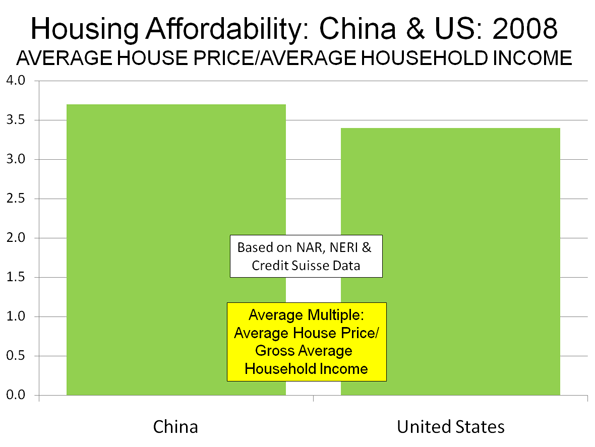
    China’s Average Multiple: Credit Suisse analyst Jinsong Du takes the NERI further to calculate housing affordability indicators that are far below the claims about the Chinese housing bubble. The average (mean) house price was 4.0 times the average disposable household income in 2008, after accounting for “grey income.” Based upon the national ratio of gross income to disposable income (from the China Yearbook), this would indicate an “average multiple” (average house price divided by gross average household income) of 3.7. This is similar to the US average multiple figure of 3.4 (Figure 1) in the same year (2008).

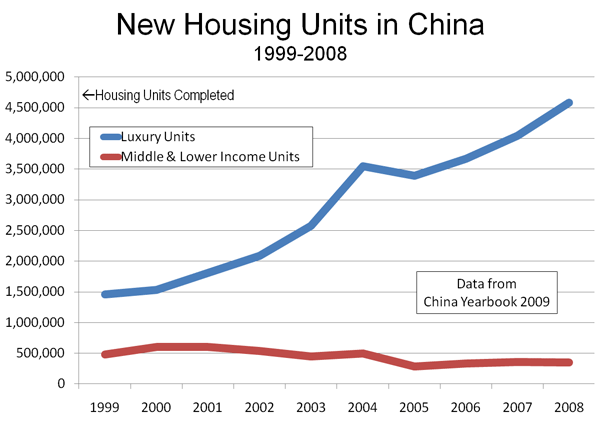
    China’s Median Multiple? This leaves the question of the Median Multiple. There is still no available median house price data. However, it is clear that the new housing is largely irrelevant to median house prices. According to data in the China Yearbook (Table 5-42), only 13% of the 31 million new houses were affordable to lower and middle income people (Figure 2). The new luxury units, with their widely touted prices, remain a minority of the houses, and, as a result, none of these can be the “middle” or median price

    In fact, the median priced house could be of a design similar to a Danwei (live-work unit) type design built before 1990. This is the type of housing that any walk or drive through a Chinese urban area will demonstrate to be dominant (and which is illustrated in the photograph above). There are huge disparities in both house prices and incomes in China. It would not be surprising for China’s Median Multiple to be similar to its average multiple, as is the case in the United States.

    Further, there is a huge difference between the US bubble and the Chinese bubble. In the United States the bubble drove up prices across all income spectrums in the impacted metropolitan areas. It burst largely because middle income households had taken on debt they could not afford. In China, the bubble may be limited to the top of the income scale, the very households that NERI finds are making two to three times as much as the official reports indicate.

    China’s Sliver of a Bubble: None of this is to suggest that house prices at the top of the market are not high. One of America’s leading housing economists, Joseph Gyourko of Wharton, along with Jing Wu and Yongheng Deng found that residential real estate auction prices rose 800% from 2003 to 2008 in Beijing (Note). Recently the government has taken action to cool the high end of the market and to encourage development of more housing for middle and lower income households. At the same time, the Gyourko research team found that new house prices had fallen relative to household incomes in Chengdu, Wuhan, Tianjin and Xi’an, all urban areas with more than 4,000,000 population.

    To accurately assess housing affordability it is necessary to have complete data. Housing affordability cannot be assessed in London using data from Belgravia, nor will Upper East Side data tell an accurate story about New York. The same is true in China. Stephen Roach said that China has a “sliver of a bubble.” That’s what the data seems to show.

    ——————

    Note: This annual rate of increase is approximately the same as was experienced in per acre government land sales in Las Vegas and Phoenix before the peak of the bubble (both urban areas are tightly ringed by “virtual” urban growth boundaries composed of government owned land).

    Wendell Cox is a Visiting Professor, Conservatoire National des Arts et Metiers, Paris and the author of “War on the Dream: How Anti-Sprawl Policy Threatens the Quality of Life

    Photograph: Median priced (?) flats in Fushun, Liaoning (photograph by the author)

  • Can We Socialize Ourselves to Good Health?

    How can we reduce health problems in society? Should we tackle poverty and social problems such as crime and drug abuse, or is the problem inequality in itself? If we reduce the income in a middle class neighborhood, will this in itself improve the health of poor people living in the same city?

    The latter form of reasoning is perhaps not so popular in the US, but quite so amongst European social democrats. A new book highlights how the European left is as concerned with fighting wealth as it is with fighting poverty.

    One year after its publication, the “The Spirit Level: Why More Equal Societies Almost Always Do Better” – by social epidemiologists Richard Wilkinson and Kate Pickett – has been embraced by many European intellectuals and politicians. The Social Democratic Party leader Mona Sahlin relies on the book as one of her main arguments during the current Swedish election campaign.
    Even conservative British Prime Minister David Cameron has praised the book, which claims that income inequality in itself causes more or less every problem in society. The argument goes: if your neighbor’s income increases, so does you chances of catching cancer.

    The authors of the book, Wilkinson and Pickett, seemingly make as strong argument for the notion that social ills are caused not by poverty but rather by inequality itself. Inequality, they say, acts like a “pollutant spread throughout society,” with rich and poor equally susceptible to its toxic effects.

    The book will likely soon appear also on the bookshelves of many US intellectuals, not least amongst the left. It is interesting then to note that its notions are dismissed by current research.

    Last year for example, the “Oxford Handbook of Economic Inequality” was published. There we could clearly read that income inequality in itself is not the cause of health problems or lifespan: “The preponderance of evidence suggests that the relationship between income inequality and health is either non-existent to too fragile to show up in a robustly estimated panel specification.”

    The same conclusion has been drawn in research conducted by Professor Angus Deaton, one of the world’s leading health economists. After a comprehensive survey of the scientific literature he concludes:
    “[I]t is not true that income inequality itself is a major determinant of public health. There is no robust relationship between life expectancy and income inequality among the rich countries, and the correlation across the states and cities of the United States is almost certainly the result of something that is correlated with income inequality, but is not income inequality itself.” (Published in Journal of Economic Literature, 2003).

    One could say that one of the main theses of the European social democracy – that inequality in itself is the problem – has been proven wrong by recent scientific studies. Social problems in themselves do cause inequality.

    If there are problems with drug abuse, racial tensions, unemployment, etc., in one neighborhood for example, this will decrease the income of the citizens. Thus income inequality arises compared to the middle class. Reducing social problems will also reduce inequality. But inequality in itself does not cause social problems.

    The socialist approach – to shrink the income of the middle class instead and hope this will aid the poor – is simply based on a skewed analysis of the correlation between social problems, poverty and inequality.

    A comparison between Sweden and the US is often used to argue that the European social democratic approach will reduce social problems and expand life span. As noted in a previous New Geography article, this reasoning is misleading.

    Sweden was characterized by an even income distribution, low poverty and long life spans already before the introduction of high-tax welfare policies. The difference in lifespan between Swedes and Americans was the same (2.6 years) in 1950 as it is today (2.7 years). And lastly, the 4.4 million Americans with Swedish origin are not only 50% more rich than Swedes living in Sweden, but also have the exact same level of poverty.

    It is simply wrong to assume that high tax welfare state policies automatically improve health. In 1960 Sweden was a low-tax country, with the third highest lifespan in the world. Switzerland was ranked on the sixth position. 45 years later, it was Switzerland that had the second highest lifespan, whilst Sweden was ranked on sixth position. Evidently, retaining a low-tax system did not hinder Switzerland from catching up to and surpassing Sweden.

    Low taxes might however explain why the poorest fifth of Swiss citizens have a considerably higher purchasing power compared to the same group in Sweden (the US figure is slightly, but not much, lower than in Sweden).

    And it is simply not true that socialist policies always lead to low income distribution, whilst free-markets increases inequality. Reforming away from communism to a very free-market oriented approach has for example allowed the Czech Republic, Slovakia and Slovenia from gaining a high living standard. But these nations do not have a low, but rather relatively high level of income equality. Moving away from socialism has benefited not only a small handful of capitalists, but rather the population as a whole.

    History teaches us that one society simply cannot change to another by simply changing its policies. Much can be achieved by focusing on the root of social problems – such as unemployment, crime and drug abuse – but society has little to gain and much to lose from thinking that we should hinder those who strive towards success in the name of social equality.

    Nima Sanandaji is president of the Swedish think tank Captus. He is the author of the book ”Entrepreneurs who go against the stream – what the 90s successful entrepreneurs can teach us” (Swedish title: ¨”Entreprenörer som går mot strömmen – vad 90-talets succéföretagare kan lära om dagens utmaningar”) for Fores.

    Photo by: JavierPsilocybin

  • Vancouver: Planner’s Dream, Middle Class Nightmare

    Vancouver is consistently rated among the most desirable places to live in the Economist’s annual ranking of cities. In fact, this year it topped the list. Of course, it also topped another list. Vancouver was ranked as the city with the most unaffordable housing in the English speaking world by Demographia’s annual survey. According to the survey criteria, housing prices in an affordable market should have an “median multiple” of no higher than 3.0 (meaning that median housing price should cost no more than 3 times the median annual gross household income). Vancouver came in at a staggering 9.3. The second most expensive major Canadian city, Toronto, has an index of only 5.2. Even legendarily unaffordable London and New York were significantly lower, coming in at 7.1 and 7.0 respectively. While there are many factors that make Vancouver a naturally expensive market, there are a number of land use regulations that contribute to the high housing costs.

    Vancouver is a unique real estate market: it’s the only major Canadian city that doesn’t experience frigid winters. This makes it a major draw for high skilled, high salary employees. It is also a major destination for wealthy Canadian retirees, who choose to actually spend their winters in Canada. There is little doubt that it is a naturally expensive real estate market. As with coastal California cities, people pay a premium for (in this case relatively) hospitable weather. The proximity to world class skiing, fishing, and hiking are no doubt another factor in the city’s high real estate costs. There is certainly a premium to be paid for living less than two hours away from the world’s best ski resort.

    Moreover, Vancouver has become an appealing real estate market for overseas investors, particularly Chinese nationals. There has been a good deal of news recently about how many of the nouveau riche in China are now looking to Vancouver, rather than Los Angeles or New York as an immigration destination. In absolute dollar terms, Vancouver is still cheaper than either city. This, combined with the more hospitable Canadian immigration system, has made Vancouver so attractive to overseas investors that real estate agents are now organizing house hunting tours for potential Chinese buyers.

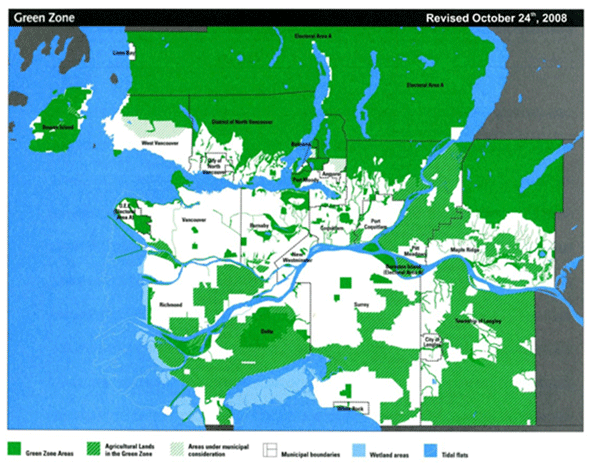
    To be sure, geography deserves much of the blame for Vancouver’s high housing costs. But a large chunk of the blame lies with restrictive municipal and provincial land use policies. Since the introduction of the city’s first comprehensive plan in 1929, Vancouver has used various land use regulations to create dense mixed use development in order to protect green space surrounding the city. In 1972, the provincial government passed legislation aimed at protecting BC farmland. This left less than half of the already scarce land in Greater Vancouver off limits to developers. As a result, the city is circled by undeveloped land, referred to as the Green Zone. The Green Zone acts as a de facto urban growth boundary, largely designed to prevent sprawl.

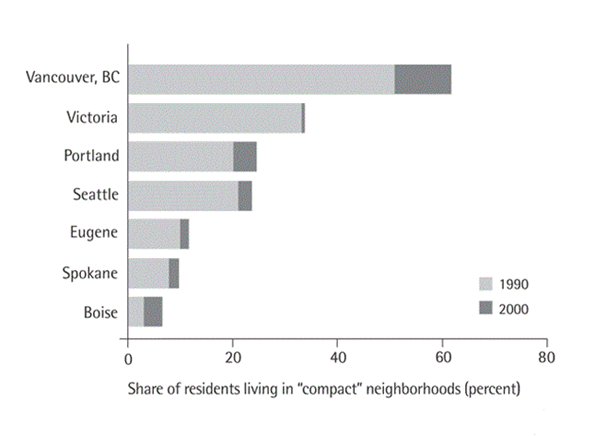
    As a result, Vancouver is one of the few North American cities that have been growing almost exclusively upwards, rather than outwards for the last century. Its narrow streets and lack of a major highway running through the city make it one of the least automobile friendly cities on the continent. Unsurprisingly, Vancouver was ranked the most smart growth oriented city in the Pacific Northwest by the Sightline Institute. Roughly three times more Vancouver residents live in compact neighborhoods as a percentage of the population compared than Portland or Seattle. This arguably makes Vancouver the most smart growth oriented city in North America.

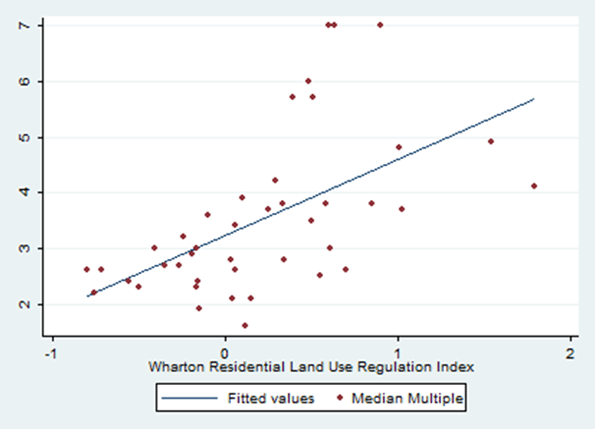
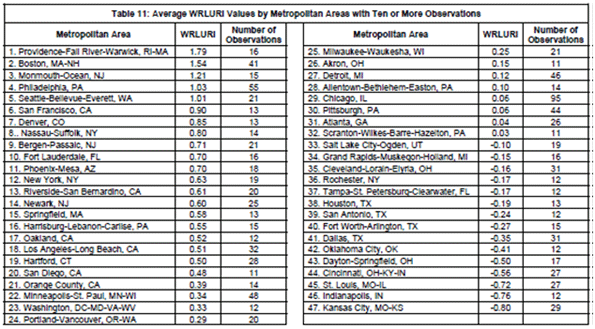
    Smart growth has become a truism for urban planners. Walkable communities with a mix of commercial and residential units combined with strict zoning regulations to encourage transit usage is a formula increasingly prescribed for North American cities. Though many smart growth principles are attractive, there is an strong correlation between heavy land use regulations and housing costs. Using data from the Wharton Residential Land Use Regulation Index (WRLURI), and Demographia’s International Housing Affordability Survey, a simple scatter plot diagram has been included to illustrate this correlation.

    The WRLURI measures the stringency of land use controls imposed on various US jurisdictions by state and local governments. There is a clear correlation between high regulations, and low housing affordability. Though the index does not include Canadian cities, it does include neighboring Seattle. Seattle ranks fifth of 47 cities on the Wharton Index. According to a recent study in Boston College International & Comparative Law Review by David Fox, Vancouver is decades ahead of Seattle in terms of smart growth policies. This means that Vancouver would rank at least fifth in North America on the index, though it is more realistic to assume it would most certainly top the index.

    In addition to smart growth policies, Vancouver also has very stringent inclusionary zoning laws. Inclusionary zoning requires developers to provide a certain number of affordable housing units in any given development. This policy might seem to make the city more affordable, but it functions exactly like rent control. Those fortunate enough to find spaces in the affordable housing units pay less, but the subsidized rent is made up for by higher rent in adjacent units. In a study of inclusionary zoning in California cities, Benjamin Powell and Edward Stringham from the Department of Economics at San Jose State University found that inclusionary zoning imposes an additional $33,000-$66,000 cost on adjacent market rate units.

    There have been some recent policy initiatives that may reduce the cost of housing marginally. In 2004, the city amended its zoning code to permit secondary suites throughout the city. Secondary suites are subdivided units of owner occupied homes that are used as rental units. This zoning change brought tens of thousands of relatively low cost units into the market. There are currently 120,000 secondary suites in the province. The city recently went one step further to allow homeowners to convert laneway garages into rental units. These units have a maximum of 500 square feet. There are 70,000 homes in Vancouver that are eligible for conversion, though it is unclear how many will take up the offer. This will add to the stock of relatively affordable rental housing in the city, but may not significantly reduce housing costs. In fact, by increasing the revenue generating potential of houses, it may actually increase the cost of purchasing a single dwelling home. After all, if the potential rental income of a single dwelling unit increases, the market price of the unit is likely to do the same. This isn’t necessarily an argument against the policy, though it does underscore the fact that housing costs in Vancouver will never decrease without liberalizing municipal and provincial land use policies.

    In short, the City of Vancouver and Province of British Columbia have chosen to favor compact growth over affordable housing costs. This likely makes the city more attractive to affluents from both the rest of Canada and abroad, but increasingly makes it unaffordable for middle class families. There is certainly some substance to the Economist’s claim that Vancouver is the most livable city on earth. It is a very attractive place for those who can afford it. Nevertheless, creating a city fit only for the wealthiest segments of society and non-families is hardly something to be proud of.

    Downtown Vancouver photo by runningclouds

    Steve Lafleur is a public policy analyst and political consultant based out of Calgary, Alberta. For more detail, see his blog.

  • Sarah Palin: The GOP’s Poison Pearl

    Sarah Palin has emerged as the right’s sweetheart, a cross between a pin-up girl and Joan of Arc. For some activists, like the American Thinker‘s Lloyd Marcus, she’s “my awesome conservative sister” who the mainstream media wants to “destroy at any cost.”

    On a more serious note, leading right-wing pundit Roger Simon argues Palin’s is now the biggest name in Republicandom, which he admits is not too great an accomplishment. Armed with “something more than intellect,” he praises her unique ability to “connect with the base.” He also believes, citing some polls for 2012, that she could run a close race against President Obama.

    These Republicans may grow to regret their embrace of Sarah Palin: She will likely prove less a gem than a poison pearl for conservatives. Sure, she can stir the base, but her crossover appeal remains limited. Recent Pew surveys show that she’s still toxic for the Independents and moderate Democrats who generally determine national elections.

    Palin keeps building her brand, but she may also be diminishing the GOP’s. She has helped propel several potentially weak, marginal “Tea Party” candidates such as Rand Paul in Kentucky and Sharron Angle in Nevada into the general elections. These could end up losing seats that more earth-bound Republicans could have won.

    But if conservatives really want evidence of Palin’s limitations, they only need to talk to people in her home state of Alaska. “She represents a constituency that is rural, but that’s it,” says Jim Egan, executive director of Commonwealth North, a local think tank. “What she says and does makes little sense in the urban environment that most Americans live in.” If it does not sell across the board in Anchorage, home to almost half of Alaskans, you wonder how well her message will play in Omaha or suburban Houston, much less New York or Los Angeles.

    Conservatives in Washington might also cool their drool, Egan suggests, if they examine Palin’s Alaska record. True, she did initially take on some in-bred corruption, but she left the state as dependent on oil revenues and federal largesse as before. She left no strong legacy, particularly in comparison with the late former Sen. Ted Stevens–known widely as “Uncle Ted”–who brought heaps of federal blubber to the Last Frontier.

    In contrast, Palin is seen by many Alaskans–including business-oriented conservatives–as a hopeless lightweight. “She’s a narcissistic individual,” suggests Republican State Sen. Craig Johnson. “What bothers me is people think we are like Sarah Palin. We’re not.”

    To Johnson and many Alaska political veterans Palin is more self-promoter than serious politician. Even as some are touting her as a serious candidate for president of the United States, it’s important to realize she proved ill-prepared to be governor of Alaska–more interested in powdering her nose than putting it to the grindstone.

    And remember that Alaska, a vast, underpopulated state of 700,000 hard-working individuals, does not require the horsepower needed to rule a disaster zone like Michigan, much less a mega insane asylum like California. For one thing, Alaska, due to its huge mineral wealth, is a comparatively rich state, with the eighth highest per capita income in the nation. Over 80% of the state budget comes through energy-related taxes. Everyone even gets a nifty $1,300 check as well, also paid for by the energy companies.

    Egan and others argue that Palin, who boosted the return to taxpayers from oil revenues, failed to capitalize on these assets. The state’s bulging revenues during the energy price spike of 2007-08 could have been applied to badly needed infrastructure and education, not to buy new snowmobiles and shotguns. “She epitomizes the whole idea of we get a piece and no sense of planning for the future, about thinking about what we need to do,” Egan says.

    In this sense Palin appeals to the grifter spirit of America–opportunistic and self-centered. This was amply evidenced by her decision to quit office mid-way through her first term for the more lucrative job of cashing in on her personality cult. “Sarah Palin was a breath of fresh air,” says one-time supporter Iris Gardner, who with her husband operates a mercantile store in Alaska’s scenic Seward (population 3,000). “But she blew all that when she quit. People have soured on her.”

    This view is widely shared in Alaska. Today, according to Alaskadispatch.com, about half of Alaskans want to be “done with her.” Only 56% of Republicans count themselves as Palin fans. She is widely unpopular among both Democrats and Independents, the state’s largest electoral base, the Dispatch noted.

    So we have to ask why Palin continues to be attractive for so many conservatives? It has more to do with subliminals than the subtleties of public policy. Palin’s power is not that of serious policymaker but rather as someone with a keen understanding of message and branding. Still, Palin’s appeal cannot be easily dismissed. Certainly charisma does not necessarily translate into a lack of gravitas. Prominent conservatives like Norman Podhoretz have pointed out that Ronald Reagan too was considered a lightweight by many in the mainstream media.

    Yet those who knew and covered Reagan–like my old boss Lou Cannon–always argued Reagan was a serious figure, surrounded by a coterie of very smart advisers. He had spent decades in and around politics before ascending to the White House. Palin, in contrast, seems to be making up her politics along the way.

    Reagan also served two terms as governor of California, despite running for the nomination in 1976. Even today he enjoys some considerable respect from longtime opponents, as well as something close to adoration among friends. As those who interviewed him can attest, he also was very sharp: Reagan would have never allowed a Katie Couric to get the better of him. To paraphrase the famous Lloyd Bentsen’s quip about Dan Quayle, Sarah Palin is no Ronald Reagan.

    Still Palin’s populist appeal seems well-suited against a Democratic Party–and a president–burdened with what seems like a congenital inability to connect with most middle- and working-class concerns. Barack Obama has turned intellectualism into a liability.

    There’s also the novelty factor working in Palin’s favor. “It’s a sense of mystery we can’t keep away from,” Jim Egan suggests. In this sense, oddly, she’s a bit like Barack Obama–someone people enthuse over not because they are ready for the job but because they appeal to some emotional need for novelty. But, as Palin herself would say, how’s that working out for ya?

    This article originally appeared at Forbes.com.

    Joel Kotkin is executive editor of NewGeography.com and is a distinguished presidential fellow in urban futures at Chapman University. He is author of The City: A Global History. His newest book is The Next Hundred Million: America in 2050, released in February, 2010.

    Photo: geerlingguy

  • Mass Transit: The Great Train Robbery

    Last month promoters of the Metropolitan Transit Authority’s Los Angeles rail projects, both past and future, held a party to celebrate their “success.” Although this may well have been justified for transit-builders and urban land speculators, there may be far less call for celebration among L.A.’s beleaguered commuters.

    Despite promises that the $8 billion invested in rail lines over the past two decades would lessen L.A.’s traffic congestion and reshape how Angelenos get to work, the sad reality is that there has been no increase in MTA transit ridership since before the rail expansion began in 1985.

    Much of the problem, notes Tom Rubin, a former chief financial officers for the MTA’s predecessor agency, stems from the shift of funding priorities to trains from the city’s more affordable and flexible bus network. Meanwhile, traffic has gotten worse, with delay hours growing from 44 hours a year in 1982 to 70 hours in 2007.

    Sadly, this situation is not unique to Los Angeles. In cities across the country where there have been massive investments in light rail–from the Portland area to Dallas and Charlotte, N.C., and a host of others–the percentage of people taking transit has stagnated or even declined. Nationwide, the percentage of people taking transit to work is now lower than it was in 1980.

    None of this is to argue that we should not invest in transit. It even makes sense if the subsidy required for each transit trip is far higher than for a motorist on the streets or highways. Transit should be considered a public good, particularly for those without access to a car–notably young people, the disabled, the poor and the elderly. Policy should focus on how we invest, at what cost and, ultimately, for whose benefit.

    In some regions with large concentrations of employment, downtown major rail systems often attract many riders (although virtually all lose lots of money). The primary example would be the New York City area, which is one of only two regions (the other being Washington, D.C.) with over one-fifth of total employment in the urban core. In the country as a whole barely 10% of employment is in the city; and in many cities that grew most in the 20th century, such as Dallas, Miami, Los Angeles and Phoenix, the central business district’s share falls well under 5%.

    Some other urban routes–for example between Houston’s relatively buoyant downtown and the massive, ever expanding Texas Medical Center–could potentially prove suitable for trains. But most transit investments would be far more financially sustainable if focused on more cost-efficient methods such as rapid bus lanes, which, according to the Government Accountability Office, is roughly one-third the cost of light rail.

    Making the right choices has become more crucial during the economic downturn, even in New York City. The city and the federal government continue to pour billions into a gold-plated Second Avenue subway but now plan to cut back drastically on the bus service that serves large numbers of commuters from the outer boroughs and more remote parts of Manhattan.

    Ultimately the choice to invest in new subways and light rail as opposed to buses reflects both a class bias and the agenda of what may best described as the “density lobby.” The people who will ride the eight-mile long Second Avenue subway, now under construction for what New York magazine reports may be a total cost of over $17 billion, are largely a very affluent group. The new subway line will also provide opportunity for big developers to build high-density residential towers along the route. In contrast, the bus-riders, as the left-of-center City Limits points out, tend to be working- and middle-class residents from more unfashionable, lower-density districts in the Bronx, Queens, Brooklyn and Staten Island.

    The proposals for High Speed Rail–a favorite boondoggle of the Obama administration and some state administrators–reveals some of the same misplaced fiscal priorities. California’s State Treasurer, Democrat Bill Lockyer, has lambasted the proposed HSR line between Los Angeles and the Bay Area, suggesting the state may not be able to sell private investors on between $10 billion and $12 billion in bonds without additional public subsidies.

    Other prominent Democrats as well as the State Auditor’s office have challenged the promoters’ claims about the viability of the system and its potential drain on more reasonable priced transit project.

    This issue funding priorities was raised recently by the current administrator of the Federal Transportation Authority, Peter Rogoff, who questioned the wisdom of expanding expensive rail and other transit projects when many districts “can’t afford to operate” their own systems. He noted that already almost 30% of all existing “transit assets” are in “poor or marginal condition.”

    Ultimately we need to ask what constitutes transit’s primary mission: to carry more people to work or to reshape our metropolitan areas for ever denser development. As opposed to buses, which largely serve those without access to cars, light rail lines are often aimed at middle-class residents who would also be potential buyers of high-density luxury housing. In this sense, light rail constitutes a critical element in an expanded effort to reshape the metropolis in a way preferred by many new urbanists, planners and urban land speculators.

    The problem facing these so-called visionaries lies in the evolving nature of the workplace in most parts of the country, where jobs, outside of government employment, are increasingly dispersed. Given these realities, transit agencies should be looking at innovative ways to reach farther to the periphery, in part to provide access to inner-city residents to a wider range of employment options. Considering more than 80% of all commuter trips are between areas outside downtown, priority should be given to more flexible, less costly systems such as rapid commuter bus lines, bus rapid transit, as well as subsidized dial-a-ride and jitney services that can work between suburban centers.

    If reducing energy use and carbon emissions remains the goal, much more emphasis should be placed as well on telecommuting. In many cities that have invested heavily in rail transit–Dallas, Denver and Salt Lake City, for example–the percentage of people working from home is now markedly larger than those taking any form of mass transit. Since the approval of the Dallas light rail system in the 1980s, for example, the transit share of work trips has dropped from 4.3% to 2.1%; the work-at-home share has grown from 2.3% to 4.3%.

    In fact, people who work from home now surpass transit users in 36 out of 52 metropolitan areas with populations over 1 million–and receive virtually no financial backing from governments. Yet if New York, home to roughly 40% of the nation’s transit commuters, was taken out of the calculations, at-home workers already outnumber the number of people taking transit to work; and since 2000 their numbers have been growing roughly twice as fast as those of transit riders.

    Clearly we should not spend our ever more scarce transit resources on a nostalgia crusade to make our cities function much the way they did in the late 1800s. Instead, we need to construct systems reflecting the technology and geographic realities of the 21st century and place our primary focus on helping people, particularly those in need, find efficient, economically sustainable ways to get around.

    This article originally appeared at Forbes.com.

    Joel Kotkin is executive editor of NewGeography.com and is a distinguished presidential fellow in urban futures at Chapman University. He is author of The City: A Global History. His newest book is The Next Hundred Million: America in 2050, released in February, 2010.

    Photo: Michael | Ruiz