Tag: middle class

  • Scenario Two: An Optimistic view of the United States future

    This is the second in a two part series exploring a pessimistic and an optimistic future for the United States. Part One appeared yesterday.

    A positive assessment of US prospects rests on at least seven propositions. First, the current crisis is not inherently more threatening than many others, most notably the Civil War, the Great Depression, and two World Wars. Quality leadership, building on the resilient political and economic institutions of the country, will prove sufficient to bring about needed sacrifices and transformations. We have seen this many times in the past from the Progressive Era to the New Deal, the Second World War and the winning of the Cold War, which was a uniquely bipartisan triumph.

    Second, despite the ongoing problems of racial inequality and tensions about immigration, the United States has been uniquely successful in having peacefully achieved a truly multi-racial and multi-ethnic state. It has welcomed waves of diverse immigrants, and integrated them into a broader, ever changing society. This process has culminated symbolically and literally in the election of a multi-racial president, Barack Obama.

    Third, economic corruption and financial crises have been recurring phenomena, and the nation has emerged out of these because of the sheer magnitude of talent and natural resources. This has been aided by a deep entrepreneurial capacity and willingness to take risks, and, overall, a willingness of most to work hard to improve life for themselves and their families.

    Fourth is the existence of a large and literate population, willing to work, certainly the world’s finest university system and research establishment, over and over again engendering innovations that create future economies: e.g., the computer revolution. American secondary education is still in need of great improvement, but the US University remains a beacon to talent from around the world.

    Fifth, despite the noise and uproar, despite the continuing clash between the traditional and the modern or secular, the nation, through its independent courts and helped by governmental decentralization, e.g. the Federal system, the country remains the freest society in human history. Despite the appearance of power of the religious right under the Republicans since the 1970s, serious erosion in freedom of thought has been kept to a minimum. Similarly, the cult of political correctness, although annoying, has become, if anything, less potent and increasingly the butt of jokes.

    Sixth, and perhaps most important, we have to consider demography. Despite current unemployment and despite the imminent retirement of the baby boomer generation, the United States, alone among the richest economies, will continue to have a relatively favorable ratio of wage earners to the elderly. This will enable us to afford social security and Medicare. The new generation – known as millennials – will constitute a large source of new labor, innovation and entrepreneurs needed to propel our economy.

    Finally, there are a few positive trends, including modest recovery in housing and in auto sales, hints of some pulling back from the out-sourcing of services, and continuing innovation and marketing of new products and services. On the political side, although the current anti-incumbent mood will likely reduce Democratic margins in Congress and in several states in 2010, the sheer lunacy of the “tea party“ activists, many of them unreconstructed “know nothings” may actually hurt the Republican party more than the Democrats. People are constantly being reminded why, for all the failings of the Democrats, they tossed the Republicans from power in the first place.

    An optimistic scenario rests on the historical precedent of muddling through crises and then creating new waves of innovation in products and services, and on the presence of a large labor force willing and able to work. A vital question is whether the President and Congress will have the courage to ask voters to make short-term sacrifices: higher income taxes on the rich and reduced subsidies to entrenched interests across the board that will be needed to restore fiscal health. And finally there is the big question, are the American people ready to do with less today to build a better future for the next generation?

    Richard Morrill is Professor Emeritus of Geography and Environmental Studies, University of Washington. His research interests include: political geography (voting behavior, redistricting, local governance), population/demography/settlement/migration, urban geography and planning, urban transportation (i.e., old fashioned generalist).

    Photo: elycefeliz

  • Scenario One: A Pessimistic Forecast for the United States

    This is the first in a two part series exploring a pessimistic and an optimistic future for the United States. Part Two will appear tomorrow.

    I’m an old (76) 1950s type liberal, and have lived to see the election on the nation’s first mixed-race president, as well as some remarkable social change in the general status of women and ethnic minorities. The United States has a remarkable heritage of entrepreneurship and resilience in its democratic institutions. Yet there are cogent reasons to be fearful and pessimistic about our capacity to maintain our preeminence, at least in the medium run (10-15 years). I obviously hope I’m wrong, and look forward to attempts to undermine my thesis – including, tomorrow, my own.

    Consider the numbers 17, 49 and 60. Seventeen is the real unemployment rate, not the “official” ten, when we take into account those dropping out of the labor force, or giving up. Forty-nine is the real percentage of home ownership, in our “ownership” society, not the 68 percent from the census. For mighty Los Angeles, the real number is 44 percent. The difference is the stupendous number of households whose equity in the house is less than they owe on the mortgage. This house of cards has increasingly been the engine of national growth. Sixty is the number of votes in the US Senate needed to stop a filibuster, and together with inept leadership, is responsible for the absurd failure of Congress and the effective collapse of collegial democracy.

    Economists say we are in a recovery. What recovery? The small increase in house sales is due to temporary incentives, but including speculators buying up homes, many foreclosed, for yet greater inequality. The main gains in jobs, not fully offsetting wider losses, are in temporary construction tied to government-funded projects. The growth in jobs and the economy in the last 20 years has been in services, stuff we do for each other, and the main fuel has been the pyramiding of house values. That is over. How can we restore growth through more consumption if the majority of the population no longer has the resources to invest or spend?

    By far the most destructive accomplishment of almost 30 years of restructuring has been the reestablishment of extreme inequality, the emergence and power of the ultra-rich, both “progressive” and conservative in orientation, to levels last seen before the Great Depression.

    But perhaps the greater root of our malaise, and perhaps the downfall of the American Empire, lies in excessive globalization and the loss of our capacity to make stuff, the outsourcing of, first, manufacturing and now even of services. It is instructive that this is the same story of imperial Rome, although long dependent on its empire, by the time of its collapse it imported virtually everything from its tributary states. Its finances could no longer pay the Army which was largely made up of people from outside Italy.

    I’d agree that the main hope in the economic arena is via the small entrepreneur, but they face the immense monopolistic power of ever-larger global capital. I’m proud to live in Seattle, which at least dared to fight back, as in the one and only US general strike, in 1919, and in the WTO protests in 1999. Perhaps this is not so surprising since Seattle still makes things: planes (Boeing), ships (Todd) and trucks (PACCAR).

    The saddest irony is that even as maybe half of us celebrate a Black president, we have utterly failed to follow up on the political civil rights gains on the 1960s to incorporate Black Americans into the mainstream economy. The status of the Black male is, relatively, worse in 2009 than it was in 1969. I would not be surprised to see a reprise of the 1960s race riots. But it is also relevant to reflect on the declining state of the white male, suffering increased drop-out rates from high school, declining enrollments in college, all in the face of reduced job opportunities for the less skilled and educated, plus competition from immigrants, legal and illegal. Is it any wonder that both nativism and populism is rising anew?

    One might dare to believe that large Democratic majorities in Congress would give us hope for effective responses to this national malaise. But I’d say the current Congress rivals the infamous 80th congress that Harry Truman excoriated, for its “do nothingness”. On the surface we can correctly observe that the Republican party, increasingly conservative, is more than willing to wreck the country in order to regain power.

    But part of the problem is that we no longer have a conservative and a liberal party, in an economic sense. We have two bourgeois parties, with the “new” Democratic Party increasingly dependent on the wealthy educated elite as well as well-paid public workers, it long ago abandoned the working class and did nothing to constrain globalization and the rise of the toxic financial practices. Thus we should not be surprised that the populist know-nothing uprising could bring to power large numbers of proudly uneducated folks.

    In the final analysis for this pessimistic scenario, the underlying culprit is the inexcusable failure of the US educational establishment, the astounding incapacity of our public and private schools to teach people to think and reason. And part of the reason for this incapacity is the excessive power of religion, which values belief over reason, in our culture. And this is why decadent Europe – aging and tax-burdened – could come out of this recession and malaise better than the United States. Perhaps we’ll see a reverse migration of surplus underemployed young Americans returning to their aging historic motherlands!

    Richard Morrill is Professor Emeritus of Geography and Environmental Studies, University of Washington. His research interests include: political geography (voting behavior, redistricting, local governance), population/demography/settlement/migration, urban geography and planning, urban transportation (i.e., old fashioned generalist).

    Photo: hz536n

  • Jerry Brown: Machiavelli Or Torquemada?

    For more than one-third of a century Jerry Brown has proved one of the most interesting and original figures in American politics–and the 71-year-old former wunderkind might be back in office in 2010. If he indeed wins California’s gubernatorial election, the results could range from somewhat positive to positively disastrous.

    Brown is a multi-faceted man, but in political terms he has a dual personality, split between two very different Catholic figures from the 15th century: Machiavelli and Tomas de Torquemada. For the sake of California, we better hope that he follows the pragmatism espoused by the Italian author more than the stern visage of the Grand Inquisitor.

    Like a good Jesuit, Brown certainly can be flexible. Back in 1978, for example, he worked against Howard Jarvis’ Proposition 13, which capped real estate taxes. But once the measure was passed, Brown embraced it as his own. Indeed, he was so enthusiastic about the tax-cutting measure that Jarvis actually voted for Brown’s re-election late that same year. A month after the vote a Los Angeles Times poll revealed most Californians thought Brown actually supported 13.

    Brown also has shown his flexibility by throwing even loyal allies under the bus. Elected largely due to the electoral coalition constructed by his father, Edmund G. “Pat” Brown, Brown made a point of tweaking and restraining the expanding bureaucracy largely created by his father. He also took on the University of California and the welfare bureaucracy as well as agriculture, residential real estate and manufacturing giants.

    This Oedipal battle reflected Brown’s personal crankiness. He came into office, recalled top aide Tom Quinn, “questioning the values of the Democratic Party.”

    Ascetic and even monk-like, he rejected his father’s “build, build, build” philosophy and embraced E. F. Schumacher’s “small is beautiful” ideology. Like the 15th-century Florentine Catholic monk Girolamo Savanarola, he came to rid Sacramento of suberbia and luxuria.

    Brown was also ahead of his time. His early embrace of green politics–particularly energy conservation and renewable fuels–foreshadowed that of later Democrats, particularly Barack Obama. His strong outreach to Latinos and other minorities expanded his political base among California’s fastest-growing populations.

    Yet Brown understood that economic prosperity–not civil rights or environmental zealotry–was key to political ascendancy. Eastern journalists dismissed him as “Governor Moonbeam,” but they ignored his Machiavellian skill in recognizing and reaching out to rising economic forces, notably the high-tech entrepreneurs in the Silicon Valley and across Southern California. The growth of this sector, along with rising trade with Asia and the military boom after the Soviet invasion of Afghanistan, set the pace for the state’s strong rebound from its early 1970s doldrums.

    But Brown’s inquisitorial side surfaced again as he prepared a second run–he had made a charmingly eccentric assault in 1976–for the White House. Perhaps the prospect of facing a man of infinite flexibility, Bill Clinton, pushed him over the top, but Brown re-invented himself as a high-octane and, at times, shrill populist.

    After some years in the political wilderness, he reemerged in 1998 as Mayor of Oakland, a tough job even in good times. Although he remained predictably arrogant and aloof, the job of managing a working-class city seemed to have brought him to his senses. Like the ideal politician in The Prince, Brown governed with something approaching strategic precision, pushing economic development, embracing the police and supporting new infrastructure spending.

    Brown’s newfound reputation as a canny realist helped him win the election as attorney general in 2006. Yet once back in statewide politics, the inquisitorial side found expression. Convinced about the impending threat of global warming, Brown used his new powers to push the Gorite agenda with the passion of a Torquemada.

    Although Brown was not quite torturing heretics, he certainly applied the legal equivalent of thumbscrews to anyone–developers, cities, counties–who did not follow his prescriptions about “carbon neutrality.” Even proposals for sensible, relatively dense “in fill” development were turned aside in favor of utopian, economically unsustainable ideas about forced density and transit friendliness.

    Today, with California’s economy is in tatters–its unemployment well over 12%–and Brown’s crusade seems likely to make it worse. Onerous regulation threatens everything from the construction of new single-family homes to new employment tied to anything that releases demon carbon–including manufacturing, oil drilling and large-scale agriculture.

    All this has made Brown widely feared in much of California’s fractured, traumatized business community. Even worse, he has emerged as the standard-bearer of the public employee unions, the very force whose political power and pensions are bringing the state to the verge of economic ruin. The fact that Brown’s campaign is funded largely by these unions makes it, at least on the surface, unlikely to challenge the hegemony of our putative “civil servants.” They are said to be ready to spend up to $40 million on “independent” campaigns to help beat back any chance of a GOP victory.

    This is worrisome given Brown’s role in fostering the expansion of public-sector unions during his term, a group whose ascendancy has become arguably the single biggest factor in the state’s precipitous decline during his last gubernatorial reign. As author Steven Greenhut has pointed out, unfunded pension liabilities in excess of $50 billion are one key element driving the state toward ever more depressed bond ratings and possible bankruptcy.

    Under normal circumstances, Brown’s ties to the public sector, his fickle nature and his dubious accomplishments would spell political doom. But amazingly, Brown’s long, if mixed, record might actually prove an advantage against his most likely opponent, former eBay executive Meg Whitman, who is running as an outsider.

    The problem for Whitman or any GOP candidate lies with the miserable legacy of another nominally Republican outsider, Arnold Schwarzenegger. The Terminator’s record of ineptitude and empty blather stands as a mega-advertisement against inexperience. Compared to the former body builder’s amateurish blundering, Brown’s wealth of knowledge of government looks appealing.

    Whitman, or her main challenger Insurance Commissioner Steve Poizner, also must struggle with a Republican Party out of sync with an increasingly multi-racial and socially liberal state. As long-time political analyst Allan Hoffenblum notes, for the first time there is not one congressional, state senate or assembly district with a GOP majority.

    So in the end, California’s fate may end up resting on which Jerry Brown emerges after the election. If he continues on his inquisitorial assault on carbon-creators, you can pretty much expect California’s middle class to continue diminishing while the state’s aspirational appeal ebbs ever further. The state could end up resembling Kevin Starr’s description of his native San Francisco– “a cross between Carmel and Calcutta.”

    But given his history, Brown could still surprise us. Stuck with responsibility for a decaying economy and fiscally burdened by the voracious public unions, Brown could do a “Nixon in China,” imposing controls on pensions and salaries. He could recognize that “green jobs” can not save California from the abyss and that a new “era of limits” must apply to the public sector as well as the rest of us. With the passionate climate-change constituency shrinking, he might even decide to accept a modicum of carbon heresy as a necessary evil.

    Brown should heed Machiavelli’s advice for rulers to be “merciful and not cruel” and “proceed in a temperate manner with prudence and humanity.” If in his old age Brown adopts the Italian writer’s credo of tactical flexibility, reason and tolerance, the Golden State may yet revive itself, and with it restore the legacy of its most storied political family.

    This article originally appeared at Forbes.com.

    Joel Kotkin is executive editor of NewGeography.com and is a distinguished presidential fellow in urban futures at Chapman University. He is author of The City: A Global History. His newest book is The Next Hundred Million: America in 2050, released in Febuary, 2010.

    Photo: Troy Holden

  • Obama’s Middle-Class Meltdown

    The rapid decline in public support for Democrats and President Obama represents one of the most breathtaking political collapses in modern times. Little over a year from a huge electoral triumph, President Obama’s level of support has dropped from around 65% to under 50%. The Democrats in Congress, who held as much as a 10% edge over the Republicans last spring, are actually losing a “generic” vote.

    Many Republicans and conservatives may think this represents a confirmation of their values. Yet in reality, the Democratic meltdown has less to do with belated admiration for the GOP—their support as a party remains at historically low levels—than a question of a massive disconnect between the people in power and the large, middle-class majority.

    The Great Disconnect reflects a growing chasm between the normative “wisdom” within political parties and their aligned media, academic and policy cadres. The Disconnect in part derives from the tendency of politicos and their associates to converse mostly with each other—and not develop much of a direct feel for that vast, and increasingly complex, country beyond the Beltway.

    As President, Barack Obama’s Great Disconnect seems most obvious. Although he occasionally uses populist middle-class rhetoric, both Obama’s priorities and body language suggest his inspiration comes largely from the rarified world of the universities and Democratic Party contributors.

    Not surprising then that he started with a stimulus package that, although one was needed, offered little to private sector Main Street businesses. Instead, the primary beneficiaries turned out to be Wall Street grandees, whose high salaries he variously denounces and excuses, and public employee unions.

    Obama’s move was encouraged by the aging leadership of the Democratic Party, shaped by places like Nancy Pelosi’s San Francisco and Henry Waxman’s lushly affluent Beverly Hills. It has little to do with the views of the middle class who reside generally in smaller towns and less-than-tony suburbs—but some of the wealthiest, and most privileged, populations on earth.

    President Obama’s other key constituency lies in the public sector unions, whose power in his home state of Illinois now rivals and perhaps surpasses that of the Daley machine. Even as middle-class voters see their pensions dwindle along with their housing prices and jobs, the public sector has waxed into something resembling the Blue Meanie in Yellow Submarine who consumes everything in sight, and ultimately itself.

    Perhaps nothing so illustrates the Great Disconnect than the president and the congressional lions’ embrace of the radical green climate change agenda. Still popular in upper-class urban areas and university towns, this agenda is notably less well-supported in middle and working class communities, particularly in the middle of the country.

    Even before the Climategate revelations—which led to one top warmist figure admitting to the BBC that there had been in fact “no statistically significant” warming over the past fifteen years—the agenda was losing support, ranking it dead last among 20 priorities in a Pew survey last year. Now the public is becoming openly skeptical, with support for the notion of primarily human-caused warming falling since April from 47 to 35%.

    President Obama must realize that prioritization of the climate agenda, along with other coastal liberal priorities, undermines Democratic support in the Great Plains and the Great Lakes, where the party recently has been making some significant gains. The recent withdrawals of Senators Byron Dorgan and Evan Bayh reflect the Democrats’ growing vulnerability in these regions. Recent polls in Iowa, where Obama won his signature primary victory in 2008, show the president’s popularity at less than 50 percent, in large part due to losses among independent voters.

    Yet if Americans have been departing the Democrats, does it follow that they will shift en masse to the GOP? There is reason for skepticism here as well. After all, this is the same party that, along with the Democrats, supported massive spending under George Bush and actively promoted the disastrous de-regulation of the financial markets. The prescience of the likes of former Majority Leader Dick Armey—a co-conspirator in the Bush era’s profligacy—at the forefront of the Tea Parties should worry even the most credulous small-government activist.

    The Republican claim to the populist mantle is even more suspect. Republicans like House Minority Leader John Boehner have cozied up to Wall Street, hoping to take advantage of rising “buyer’s remorse” among the grandees. Suggesting Republicans could shield the financial sector from even modest Democrat efforts to make them face consequences for their loathsome and disastrous folly, they unintentionally show that their critique of the president’s “crony capitalism” largely involves shifting the identity of the cronies.

    The Republicans also have a bit of a demographic problem. Their Neanderthal stance on social issues varies radically from the rising millennial generation, and threatens to alienate them permanently. And perhaps even more seriously, the strong nativist wing of the party, epitomized by Tea Party keynoter former Representative Tom Tancredo, represent a threat to the other large emerging voting block, immigrants and their offspring.

    If you want to see an illustration of what this means, just examine the plummeting GOP registration levels in increasingly multi-racial California. For the first time in modern history, according to veteran political observer Allan Hoffenblum, there is not a single congressional, state Senate or Assembly district in the state with a majority Republican registration.

    Although the Republicans are riding high now, do not overestimate their ability to seize the field now so ineptly being vacated by the Democrats. It may well turn out that President Obama still may overcome the Great Disconnect before the GOP does. Obama’s ability to change direction already can be seen in such things as his new-found enthusiasm for nuclear power and more drilling on public lands. His most recent jobs bill also has more of a focus on promoting private employment growth than past efforts.

    Ultimately, the party that wins in 2010 and beyond will be the one that addresses the real issues of this age—the battle for private sector jobs and upward mobility—that matter to the vast majority of Americans. It is on those issues, not global warming, ethnic purity or gay marriage that the political future will now turn.

    This article originally appeared at The Daily Beast.

    Joel Kotkin is executive editor of NewGeography.com and is a distinguished presidential fellow in urban futures at Chapman University. He is author of The City: A Global History. His newest book is The Next Hundred Million: America in 2050, released in Febuary, 2010.

    Photo: Official White House Photo by Pete Souza

  • Eminent Domain as Central Planning

    Free markets are out of vogue. The unfortunate lesson that policymakers have learned over the past two years is that a big, brainy government that supposedly creates jobs is superior to irrational, faceless markets that just create catastrophic errors. So Washington has seized on the financial and economic crises to enlarge its role in managing the economy—controlling the insurance giant AIG, for example, and trying to maintain high housing prices through tax credits and “mortgage modification” programs.

    But when it comes to central economic planning, New York City and State are way ahead of the feds. Empire State politicians from both parties already believe that it’s their responsibility to replace people and businesses in allocating the economy’s resources. They’re even confident that their duty to design a perfect economy trumps their constituents’ right to hold private property. Three current cases of eminent-domain abuse in New York show how serious they are—and how much damage such government intrusiveness can wreak.

    Brooklyn’s Prospect Heights, industrial and forlorn for much of the late twentieth century, was looking better by 2003. Government was doing its proper job: crime was down, and the public-transit commute to midtown Manhattan, where many Brooklynites worked, was just 25 minutes. That meant that the private sector could do its job, too, rejuvenating the neighborhood after urban decay. Developers had bought 1920s-era factories and warehouses and converted them into condos for buyers like Daniel Goldstein, who paid $590,000 for a place in a former dry-goods warehouse in 2003. These new residents weren’t put off by the Metropolitan Transportation Authority’s railyards nearby, and they liked the hardwood floors and airy views typical of such refurbished buildings. They also settled in alongside longtime residents in little houses on quiet streets. Wealthier newcomers joined regulars at Freddy’s, a bar that predated Prohibition. Small businesses continued to employ skilled laborers in low-rise industrial buildings.

    But Prospect Heights interested another investor: developer Bruce Ratner, who thought that the area would be perfect for high-rise apartments and office towers. Ratner didn’t want to do the piecemeal work of cajoling private owners into selling their properties, however. Instead, he appealed to the central-planning instincts of New York’s political class. Use the state’s power to seize the private property around the railyards, he told Governor George Pataki, Mayor Michael Bloomberg, and Brooklyn borough president Marty Markowitz. Transfer me the property, and let me buy the railyards themselves below the market price. I’ll build my development, Atlantic Yards, around a world-class basketball arena.

    New York, in short, would give Ratner an unfair advantage, and he would return some of the profits reaped from that advantage by creating the “economic benefits” favored by the planning classes. Architecture critics loved Frank Gehry’s design for the arena. Race activist Al Sharpton loved the promise of thousands of minority jobs. The Association of Community Organizations for Reform Now (Acorn) loved the prospect of administering the more than 2,000 units of “affordable” housing planned for the development, as well as the $1.5 million in loans and grants that Ratner gave it outright. When the state held public hearings in 2006 to decide whether to approve Atlantic Yards, hundreds of supplicants, hoping for a good job or a cheap apartment, easily drowned out the voices of people like Goldstein, who wanted nothing from the government except the right to keep their homes.

    Can New York legally seize private property and transfer it to a developer purely for economic development? The Fifth Amendment to the U.S. Constitution allows the government to take property for a “public use,” long understood to mean such things as roads and railways, so long as it makes “just compensation” for them. Starting around the 1930s, a number of court cases began to broaden “public use” to include more nebulous “public purposes,” such as slum clearance. And in 2005, in Kelo v. New London, the Supreme Court decided that these “public purposes” could even include economic development. But New York’s constitution theoretically holds the state to a higher standard. In 1967, Empire State voters voted not to add a “public purpose” clause to their constitution, preferring to stick with the stricter requirement of “public use.”

    The state hasn’t let this inconvenience derail its plans for Prospect Heights, however. For seven decades, courts have let New York seize and demolish slum housing if it’s blighted—which New York State defines as “substandard” and “unsanitary.” So the Urban Development Corporation (UDC), a public entity of New York State, decided that the “public use” of Atlantic Yards would be blight removal. The city had already designated part of the neighborhood as “blighted” 40 years earlier, long before its resurgence. As for the rest, the UDC commissioned consultants—previously employed by Ratner—who soon returned the requisite blight finding.

    But wait, you say: people don’t buy half-million-dollar apartments in “substandard” or “unsanitary” neighborhoods. You’re right; that’s why the consultants had to stretch. In the 1930s, as Goldstein’s attorney, Matthew Brinckerhoff, pointed out, “substandard” and “unsanitary” meant “families and children dying from rampant fires and pestilence” in tuberculosis-ridden firetraps. In 2006, by contrast, the UDC’s consultants found “substandard” conditions in isolated graffiti, cracked sidewalks, and “underutilization”—that is, when property owners weren’t using their land to generate the social and economic benefits that the government desired.

    In New York, this creative definition of blight is the new central-planning model. Consultants have also cited “underutilization” in West Harlem, where the city’s Economic Development Corporation wants to take land from private owners and hand it to Columbia University for an expansion project. Says Norman Siegel, who represents the owners: “A private property owner has the right to determine the best productive use of his property. It’s not a right to be ceded to any government.”

    And in Queens, the Bloomberg administration is preparing a similar argument to grab swaths of Willets Point, an area adjacent to Citi Field that’s populated with auto-repair shops. The city’s recent “request for qualifications” from would-be developers drew a sharp response from the people who owned the land: “We . . . hold the most significant qualification of all: we own the properties. We are motivated to improve and use our own properties, consistent with the American free market system. We would have done so in spectacular fashion already, had the city upheld its end of the bargain by providing our neighborhood with essential services and infrastructure.” Instead, the city has done the opposite, letting streets disintegrate into ditches to bolster its blight finding. The perversity is astonishing: rather than doing its own job of maintaining public infrastructure and public safety, the government wants to do the private sector’s job—and is going about it by starving that private sector of public resources.

    Property owners have looked to the judiciary to check the overweening grasp of the legislative and executive branches. But courts can be wrong for longer than it takes to save a neighborhood. In Brooklyn, Goldstein and his neighbors have lost their lawsuits—most recently, in New York’s highest court, the court of appeals. In November, the court decided 6–1 that “all that is at issue is a reasonable difference of opinion as to whether the area in question is in fact substandard and insanitary. This is not a sufficient predicate for us to supplant [the state’s] determination.” The court essentially abdicated its duty to protect property owners from the governor and the Legislature.

    Nine days later, the West Harlem owners fared better in a lower court. The first department of the state supreme court’s appellate division found, 3–2, that the blight studies that the city and state had commissioned to justify their rapacity were “bereft of facts”—and further tainted by the fact that one blight consultant also worked for Columbia. The blight designation “is mere sophistry,” the majority concluded, “hatched to justify the employment of eminent domain.” The court further noted that “even a cursory examination of the study reveals the idiocy of considering things like unpainted block walls or loose awning supports as evidence of a blighted neighborhood. Virtually every neighborhood in the five boroughs will yield similar instances of disrepair.”

    The selective and arbitrary process that deems one neighborhood blighted while leaving a similar neighborhood alone also violates due process, the justices went on, as “one is compelled to guess what subjective factors will be employed in each claim of blight.” Another violation: the government responded poorly to property owners’ document requests under the state’s freedom of information law, hampering their right to mount a solid case. Such requests are particularly important in eminent-domain cases because New York property owners don’t enjoy the right to a trial with a discovery phase, but must go straight to appeals court—a seventies-era “reform” meant to speed up development projects.

    The Harlem owners were able to convince the lower court partly because they had commissioned their own “no-blight” study. “We said, ‘Let’s create our own record . . . as a counterweight,’ ” said Siegel. The owners also presented as evidence a government study, performed before Columbia showed interest in the land, that West Harlem was revitalizing itself. This is all very well—but property rights shouldn’t depend on owners’ creativity and resourcefulness in proving beyond all reasonable doubt that their land isn’t blighted.

    Further, the lower-court ruling is a tenuous victory. The case is proceeding to the court of appeals, and though Siegel is “cautiously optimistic” that it will rule in his clients’ favor, there’s no way to be sure. Meantime, Goldstein and fellow residents and business owners in Brooklyn have asked the court of appeals to reconsider its Atlantic Yards ruling after it rules on Harlem. But the starkly different decisions in the Harlem and Brooklyn cases, coming so close together, have pointed up the need for the Legislature and Governor David Paterson to create clear standards for the government’s power to seize property.

    An obvious step is to dispense with “underutilization” as a justification for a taking. As the court noted in the Harlem case, “the time has come to categorically reject eminent domain takings solely based on underutilization. This concept . . . transforms the purpose for blight removal from the elimination of harmful social and economic conditions . . . to a policy affirmatively requiring the ultimate commercial development of all property.”

    But the state should go even further and eliminate blight itself as a justification for property seizure. Since the sixties, when creeping blight seemed to threaten the city’s existence, New York has learned that the real remedy for “substandard” conditions is good policing and infrastructure, which create the conditions for people and companies to move to neighborhoods and improve them. As for 1930s-style “unsanitary” conditions, modern health care, infrastructure, and building codes have eliminated them. Today, the biggest risks to public health are often on government property: dangerous elevators in public housing, for instance, or the 2007 fire that killed two firefighters in the Deutsche Bank building in lower Manhattan, owned by the city and state since 9/11. Unless it needs property to build a road, a subway line, a water-treatment plant, or a similar piece of truly public infrastructure—or unless a piece of land poses a clear and present danger to the public—the state should keep its hands off people’s property.

    Eminent-domain abuse, dangerous though it is, is a symptom of a deeper problem: government officials’ belief that central planning is superior to free-market competition. That’s what New York has decided in each of its current eminent-domain cases. In Brooklyn, high-rise towers and an arena are better than a historic low-rise neighborhood; in Harlem, an elite university’s expansion project is better than continued private investment; and in Willets Point, Queens, almost anything is better than grubby body shops.

    To cure yourself of the notion that the government can do better than free markets in producing economic vitality, stroll around Atlantic Yards. You’ll walk past three-story clapboard homes nestled next to elegantly corniced row houses—the supposedly blighted residences that the state plans to demolish. You’ll see the Spalding Building, a stately sporting-goods-factory-turned-condo-building that, thanks to Ratner and his government allies, has been slated for demolition and now stands empty. You’ll peer up at Goldstein’s nearly empty apartment house, scheduled to be condemned and destroyed.

    And you’ll see how wrecking balls have already made the neighborhood gap-toothed. A vacant lot, for example, now sprawls where the historic Ward Bakery warehouse was, until recently, a candidate for private-sector reinvestment. Today, Prospect Heights finally shows what the state and city governments want everyone to see: decay. The decay, though, isn’t the work of callous markets that left the neighborhood to perish. It’s the work of a developer wielding state power to press property owners to sell their land “voluntarily.” It’s also the result of a half-decade’s worth of government-created uncertainty, which stopped genuine private investment in its tracks.

    Such uncertainty offers a crucial lesson to the rest of the nation, and not just in the area of eminent domain. Whenever government fails to confine itself to a limited role in the economy, it creates similar uncertainty. Even when the results aren’t as poignantly obvious as they are in Brooklyn, the private economy suffers—whether it’s financial or auto bailouts unfairly benefiting some firms at the expense of others, or mortgage bailouts unfairly benefiting some home buyers at the expense of others. Free markets may be imperfect, but they’re far better than the alternative—the blight of arbitrary government control and the uncertainty that it creates.

    This article originally appeared at City Journal. Research for this article was supported by the Brunie Fund for New York Journalism.

    Nicole Gelinas, a City Journal contributing editor and the Searle Freedom Trust Fellow at the Manhattan Institute, is a Chartered Financial Analyst and the author of After the Fall.

    Photo: Tracy Collins

  • What is the Answer to the Suburban Question?

    We have recently assembled a special issue of the journal Cities with the title “The Suburban Question”, and we assume that many readers will assume the answer is “who cares”? The term ‘sub-urbs’ connotes a lesser form of urban life, and for decades it has been used dismissively to denote anything plastic, even hypocritical. Novelist Anthony Powell described one of his unsympathetic characters possessing a ‘‘face like Hampstead Garden Suburb”; the New York Times recently described architect Robert Stern as ‘‘a suede-loafered sultan of suburban retrotecture”. In the old days, record stores had ‘urban’ bins full of gangsta, but nothing marked ‘suburban’, although it is always easy to use the suburbs as a backdrop for duplicity, as in American Beauty, or the first series of Weeds (set in a gated community, a double score!).

    There has been some academic attention—Dick Walker, David Harvey, and of course Kenneth Jackson all wrote lasting pieces about the suburbs. But in these, they always appear as objects of inquiry, rather than subjects in their own right; and if academics live amongst the ‘little boxes of tickytacky’, they rarely write about them. This is more than unfortunate, for many reasons—the most obvious is that by most definitions, most of us are indeed suburbanites. But while there are endless dissertations on public housing, the decline of the inner city, and the much discussed revitalization of the inner city, there is precious little on their further-flung counterparts.

    It’s hardly the case, to answer the unspoken question, that there is nothing interesting to research ‘out there’. What about updating research on the ‘growth machine’? No one has really done any detailed work on the complexities of the home building industry, with its rigid design aspirations and complex financial connections. There is the gated community, which is still portrayed as ‘Fortress America’ even though there are significant proportions of Hispanic households living in gated communities, and many of these are rental properties and not the upscale compounds portrayed in textbooks. And there is the Home Owner Association. Despite the fact that millions of Americans live in them, relatively little research has been done on this important aspect of governance since the term ‘Privatopia’ was coined nearly two decades ago.

    A few authors have tried to push back against this indifference, arguing that suburbs appear to be ‘good places for most people’. Yet the reality that affordable homes-and-gardens are unquestionably popular does not seem to matter. In almost any manner imaginable, the suburban lifestyle has been savaged. Sprawl causes obesity; it destroys downtowns; it causes global warming. In Metroburbia, Paul Knox argues that the suburbs have turned us into monsters of capitalist consumerism, the sagging SUVs necessary to carry the wobbling masses from mall to McMansion.

    It is easy to argue that American suburbs are unsustainable, but to echo Peter Marcuse’s famous rhetorical question—‘sustainable for whom?’ Vibrant cities—New York, San Francisco, Boston—are expensive cities, and while that fabled creature, the Creative Worker (homo Floridian) is willing and, more importantly, able to pay large sums to live in very small spaces, most of us are not. Suburbs have attracted paying customers precisely because housing costs are low and conditions are attractive. Not many cool public spaces, but that’s less important to most people past their college years.

    This is the backdrop to the papers that we have collected in our special issue. Its aim is to present work that asks ‘what is happening in the suburbs, in terms of the built form, the economy and social relations’. They are not necessarily written ‘in defense of suburbs,’ but engage suburbs as if they matter. Nick Phelps leads off by emphasizing the contribution that suburbs make to our local and national economies. He reminds us of the transfers there of jobs and the growing importance of suburbs to the urban region and the economic health of our nations. He closes with an urgent reminder that the “economic centrality of suburbs within the contemporary economy should, perhaps more than anything else, signal the need for a re-balancing of urban studies to be more fully suburban in academic and policy focus.”

    A perfect example of this appears in a study of Phoenix by Carol Atkinson Palombo and Pat Gober. Their analysis of new housing construction in the prior two decades indicates trends that span different types of multi-family housing in suburban locations. They note, “densification no longer equates to urban infill but takes many forms and occurs all over the metropolitan region”. A complementary article by Roger Keil and Douglas Young focuses on their empirical work in Toronto, and especially what they have termed ‘the in-between city’. These places are “not quite traditional city and not quite traditional suburban”, forgotten geographies where many live and where their infrastructure reminds us that the placing of ‘urban versus suburban’ neglects the many shades of in-between urban places that require planning and policy attention.

    Toronto is the focus of another paper, in which Susan Moore explores the tenets of New Urbanism. In four case studies, she explores sub/urban forms, showing that the general edicts of the “densification-is-good” movement are contextualized in different settings, and reveals endless rounds of compromises between developers, planners, politicians and residents. In the end, this design imperative is unable to transcend the “urbanization of the suburbs or the suburbanization of the urban,” and once more we are challenged by the need to confront the assumed distinction between urban and suburban developments, or even cities and suburbs themselves.

    This theme is given additional attention in a further paper, by noted Turkish urbanist Feyzan Erkip, whose work explores, and contrasts, the new manifestations of Westernization in Ankara—malls and gated communities—with more traditional neighborhoods. She finds little difference between the views of the populations in the old and new, but the meanings that these new design features take on are very much conditioned by their context. For instance, the malls have a liberating veneer for Turkish women, who feel socially threatened in the streets but not in the private shopping districts. Conversely, gated communities adopt familiar design features but unlike their Western counterparts, these are essentially up-scale squatter settlements; this indeterminate legal status is attractive for some residents because it makes their homes less open to search by law enforcement or tax officials.

    We conclude our collection, and this piece, with a simple response: the answer to the suburban question is that they possess a rich history and a dynamic present and therefore demand more attention and a serious research agenda. We call for more academic attention to be given to places where a majority of Americans, many Europeans, and a growing number of Asians, Africans, and Latin Americans live. Urban studies should either become inclusive of all parts of the city—from edge to center—or the field of Suburban Studies, spearheaded by the New Suburbanism, is long overdue.

    Andrew Kirby is the editor of the interdisciplinary Elsevier journal “Cities.”This is his 20th year as a resident of Arizona. Ali Modarres is an urban geographer in Los Angeles and co-author of City and Environment.

    Photo: urbanfeel @ flickr

  • Welcome to Ecotopia

    In this era of tea-partying revolutionary-era dress-ups, one usually associates secessionism with the far right. But if things turn sour for the present majority in Washington, you should expect a whole new wave of separatism to emerge on the greenish left coast.

    In 1975 Ernest Callenbach, an author based in Berkeley, Calif., published a sci-fi novel about enviro-secessionists called Ecotopia; a prequel, Ecotopia Rising, came out in 1981. These two books, which have acquired something of a cult following, chronicle–largely approvingly–the emergence of a future green nation along the country’s northwest coast.

    Aptly described by Callenbach as “an empire apart,” this region is, in real life, among the world’s most scenic and blessed by nature. Many in this part of America have long been more enthusiastic about their ties to Asia than those with the rest of the country. It is also home to many fervent ecological, cultural and political activists, who often feel at odds with the less enlightened country that lies beyond their soaring mountains.

    Until the election of Barack Obama, the Pacific Northwest certainly was separating from the rest of America–at least in attitude. After George W. Bush’s victory the 2004 presidential election, the Seattle weekly The Stranger published an angry editorial about how coastal urbanites needed to reject “heartland values like xenophobia, sexism, racism and homophobia” and places where “people are fatter and dumber and slower.”

    Such a narrow, cynical view of the rest of the country is in line with Callenbach’s Ecotopia novels, in which the bad guys–representatives of American government and corporations–are almost always male, overweight and clueless about everything from technology to tending to the earth.

    Of course, would-be Ecotopians have much of which to be proud. The three great cities of the region–San Francisco, Portland and Seattle–easily rank among the most attractive on the continent. They all boast higher-than-average levels of education and–at least around San Francisco and Seattle–some of the world’s deepest concentrations of high-tech companies.

    Yet for all their promise, the Ecotopian regions cannot claim to have missed the current recession. Downtown Seattle currently suffers a vacancy rate in excess of 20%, the highest in decades; last year apartment rental rates dropped 13.8%, the steepest decline among American metros. Meanwhile vacancies in the Silicon Valley area south of San Francisco have soared to above 20%. By early this year, there was enough unoccupied office space in the Valley to fill 15 Empire State Buildings.

    This may seem a bit counter-intuitive for a region that boasts the headquarters of Microsoft, Costco, Amazon, Intel and Apple. But while such companies provide lots of high-wage employment, they are no longer enough to spark much growth across the region’s economy. The San Francisco area has actually lost jobs over the past decade and shows little sign of recovering its once prodigious growth rates.

    But easily the weakest of the economies has been Portland, which lacks the presence of major anchor firms like those in greater Seattle or the Bay Area. Portland’s unemployment rate has been well over 10% since late last year.

    A wave of youthful migration has made the city a slacker haven for the past decade and, in turn, exacerbated unemployment figures. Homeless kids now crowd the downtown area, which, although far from destitute, does appear pretty grungy in places.

    Yet, like the Ecotopians in the Callenbach novels, Portland residents and politicians seem nonplussed about their anemic economic performance. After all, the city voted heavily–despite solid opposition from the rest of the state–to raise Oregon’s taxes on wealthy individuals and corporations, a move likely to deter new in-bound investment.

    “You don’t have a big focus here on economic development,” observes Stephen B. Braun, dean of the School of Management at Portland’s Concordia University. “There’s much more emphasis on quality of life than on making a living.”

    The proof: Portland may have high unemployment, but the big idea around city hall is not how to promote jobs but about investing an additional $600 million in bike lanes.

    All these places, of course, avidly endorse green jobs even if there’s little prospect they could replace the jobs being lost in the fading blue-collar sectors. A growing green job sector needs a vibrant economy that produces things and builds new buildings, notions that have little currency across much of the region.

    This anti-growth attitude reflects that of Callenbach’s Ecotopia, which favors a “stable state” economy over job or wealth creation. Ecotopian politics explicitly ban both population increases and the private automobile.

    While the mayors of Portland, San Francisco and Seattle are hardly that extreme, they could propose policies that would make driving more burdensome. And they certainly seem to do wonders in chasing would-be baby-makers out of the city. All three cities have among the lowest percentages of children of any in the U.S.

    Perhaps the toughest issue facing the Ecotopian political economy lies with the issue of class. Callenbach’s Ecotopia adopts something of an anarchic socialism; the cities of the real ecotopia have tended toward ever greater class bifurcation.

    San Francisco, for example, boasts one of the highest per capita incomes in the nation and remains a favorite destination for inherited wealth, whether among individuals or nested in nonprofits. Yet according to the Public Policy Institute of California, if the cost of living is applied, San Francisco ranks high among urban counties in terms of its concentration of poverty.

    It doesn’t help that the city’s economy has been hemorrhaging corporate headquarters and mid-range middle-class jobs for decades. High-end workers commute to Google and other Valley companies, and others work in the financial or media sectors, but many mid-range jobs have been lost, many of them to more affordable business-friendly locales in places like Colorado.

    As middle-class jobs disappear, Ecotopia’s cities increasingly resemble restrictive communities that are anything but diverse. As analyst Aaron Renn has pointed out, Portland and Seattle stand as among the whitest big cities in the nation. And San Francisco’s once vibrant African-American population has been dropping for decades.

    In the coming years this pattern will likely become more pronounced in Seattle and Portland as well. These cities continue to attract many well-educated people, particularly from California, who in turn bring with them both significant accumulated wealth and anti-growth attitudes.

    Strict “green” planning regimes are also accelerating the decline of the local middle class by driving housing prices up, greatly diminishing the once wide affordability for the middle class. Seattle’s regulatory environment, according to one recent study, has bolstered housing prices in the region by $200,000 since 1989. The percentage of families who could afford a median price home in the area has fallen by more than half.

    Many observers see a similar outcome from Portland’s widely ballyhooed planning regime. Despite the massive acceptance by planners as something of a model for the restored city, the vast majority of all job and population growth in the region has occurred at the less pricey fringes, including across the river in Vancouver, Wash., which lies outside the fearsome Portland planning regime.

    So what is the future for the region, and particularly the eco-cities? If the country starts moving toward the center, and even the right, you can expect Ecotopian sentiment to rise again, perhaps not to the point of secession but expressed in attitude.

    But this may not be all bad. As America’s population grows and other regions rise, perhaps it’s helpful for the various parts of the country to experiment with different systems. Short of civil war, there’s something to be said for relentless, even if sometimes daft, experimentation at the local level. The rest of country may not follow all their strictures, but our would-be Ecotopians could produce some interesting and even usable ideas.

    This article originally appeared at Forbes.com.

    Joel Kotkin is executive editor of NewGeography.com and is a distinguished presidential fellow in urban futures at Chapman University. He is author of The City: A Global History. His newest book is The Next Hundred Million: America in 2050, released in Febuary, 2010.

  • The Heavy Price of Growth Management in Seattle

    The University of Washington Study: Economist Theo Eicher of the University of Washington has published research indicating that regulation has added $200,000 to house prices in Seattle between 1989 and 2006. Eicher told the Seattle Times that “Seattle is one of the most regulated cities and a city whose housing prices are profoundly influenced by regulations.”

    Not surprisingly, this caused consternation in the planning community, which would prefer to minimize or dismiss any negative consequences of planning regulations on housing affordability.

    The Washington Chapter of the American Planning Association (W-APA) published a response. Admitting that “land use regulations do add costs to housing”, it criticizes the Eicher study for focusing “solely on cost” and ignoring how land use regulations add to the quality of life. (Note 1). A recent Washington Policy Center report provides a detailed critique of the W-APA report. This article evaluates Seattle housing affordability trends using basic price and income data and the Median Multiple (median house price divided by median household income), a standard affordability measure that has been recommended by both the World Bank and the United Nations.

    How Growth Management Raises House Prices: It has been established that overly prescriptive land use regulation (called growth management or smart growth) raises house prices. As the former governor of the Reserve Bank of New Zealand Donald Brash has pointed out the affordability of housing is overwhelmingly a function of just one thing, the extent to which governments place artificial restrictions on the supply of residential land.

    However, the mere adoption of growth management or smart growth polices does not increase housing costs. Where, for example, an urban growth boundary (a favored strategy of growth management) is drawn far enough from the urban area, there may be little interference with developable land values. This was the case in Portland, for example, in its early growth management days. However, as land was developed and the urban growth boundary was not moved sufficiently outward in response, land became more scarce and land prices were driven up, leading to Portland’s severe housing unaffordability.

    How Growth Management Drives Up House Prices: Land prices are driven up as market participants perceive scarcity. When government policies constrict the supply of land, developers purchase “land banks” to ensure that they have access to land inventory. Without growth management, developers and builders can purchase land when they need it, because governments have not placed artificial restrictions on its supply.

    In the more prescriptive environment, property appraisals rise and sellers are able to obtain higher prices because development is prohibited on most land. In short, sellers face less competition and can command much higher prices.

    Sometimes growth management proponents claim that their communities have sufficient land available for building. However, the interplay between land buyers and sellers creates a rigged game that leads to higher land prices. This is obvious in everywhere from Seattle and Portland to California and Florida. In these markets, there is not a sufficient supply of “affordable land” for building. A New Zealand government’s “2025 Taskforce” found the price of comparable land to be about 10 times as high if it is inside an urban growth boundary rather than outside (essentially across the road).

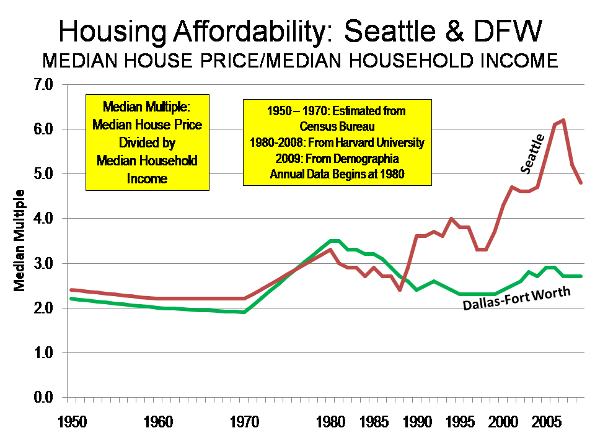
    Seattle’s Lost Housing Affordability Decade: During the decade of the housing bubble (1997 to 2007), the median house price increased from $169,000 to $395,000 in Seattle. In 1997, Seattle’s housing affordability was rated “moderately affordable,” with a Median Multiple of 3.3 (median house price divided by median household income). By 2007, the Median Multiple had escalated to 6.2, indicating housing unaffordability worse than any major metropolitan area between World War II and 1997. (Figure 1). Of course, other markets, particularly in California, became even more unaffordable after 1997.

    In Seattle and other more prescriptive markets, house prices exploded during the housing bubble. At the same time, many other markets experienced only modest house price increases. The easier money and profligate lending practices thus produced very different results. In more prescriptive markets, like Seattle, both underlying and speculative demand drove prices to unprecedented heights. In the more responsive markets, the generally higher underlying demand was accommodated by planning systems that permitted sufficient new housing to be built on affordable land and price escalation was far more modest (as were subsequent price losses).

    New House Example: The role of Seattle’s growth management in driving up land and house prices is obvious. According to W-APA, approximately 62% of the cost of a new house in 1999-2000 was in construction costs. A new house in 1997 costing the same as a median house price would have involved approximately $105,000 in construction costs. Based upon subsequent house cost increases and the decline in house construction costs relative to the rest of the nation in Seattle, construction costs on the same house should have risen $40,000 from 1997 to 2007 (Note 2). At the same time, the median house price in Seattle increased $225,000. Less ss than 20% of the cost escalation could be attributed to construction cost inflation. Nearly $185,000 was due to other factors, principally higher land prices.

    Comparing Seattle to Dallas-Fort Worth: Things were very different in more responsive markets, as is illustrated by Dallas-Fort Worth (Figure 2). Dallas-Fort Worth, now the nation’s fourth largest metropolitan area, trailing only New York, Los Angeles and Chicago has grown more than twice as fast as Seattle (21.2% from 2000 to 2008, compared to 9.6%). Dallas-Fort Worth’s underlying demand has been even greater relative to Seattle, as indicated by its net domestic migration. Dallas-Fort Worth has added more than 10 times as many domestic migrants (260,000 versus 23,000) and more than 5 times its 2000 population (5.0% v. 0.8%). Moreover, and perhaps surprisingly, the Dallas-Fort Worth urban area (along with Houston) is more compact (read “sprawls” less) than Seattle (Note 3). Finally, the share of sub-prime mortgages was higher in Dallas-Fort Worth than in Seattle.

    Yet, despite this huge demand, housing affordability has remained below the historic Median Multiple norm of 3.0. In 2007, the Dallas-Fort Worth Median Multiple was 2.7. The median house price increased $32,000 from 1997 to 2007 and more than 70% of the change was due to construction costs.

    In 1997, the Seattle median house price was $54,000 higher than in Dallas-Fort Worth. By 2007, the price of a median house in Seattle had escalated to nearly $250,000 more than its counterpart in Dallas-Fort Worth (Since 2007, house prices have dropped $90,000 in Seattle and $5,000 in Dallas-Fort Worth, illustrating the more intense price volatility of tightly regulated markets. Even so, Seattle housing affordability remains materially worse than before).

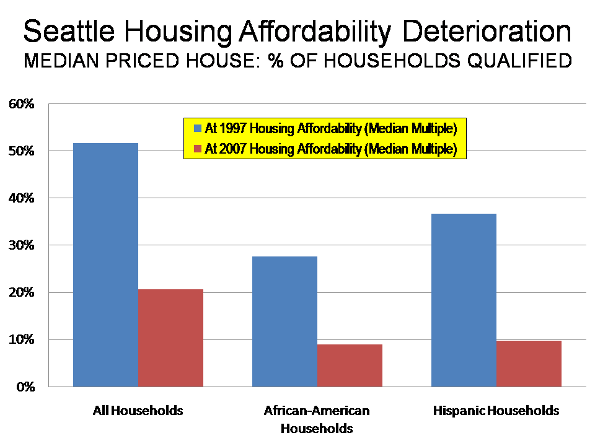
    Driving Households out of the Home Ownership Market: If 1997 housing affordability (using the Median Multiple) had been retained, 50% of Seattle households would have been able to qualify for a mortgage on the median priced house. However, by 2007 only about 20% of Seattle households could have qualified for a mortgage on the median priced house in 2007 at present FHA underwriting standards (Note 4).

    Impact on Minority Households: The highest price, however is being paid by Seattle’s minority households (Figure 2).

    • The share of African-American households able to qualify for a mortgage on the median priced house declined nearly 70% compared to 1997 affordability (Median Multiple). At 1997 housing affordability, more than 25% of African American households would have been able to qualify for a mortgage on the median priced house in 2007. In reality, by 2007, less than 10% of African-American households could have qualified for a mortgage on the median priced house.
    • The share of Hispanic households able to qualify for a mortgage on the median priced house declined more than 70% compared to 1997 affordability (Median Multiple). At 1997 housing affordability, more than 35% of Hispanic households would have been able to qualify for a mortgage on the median priced house in 2007; by 2007 than number had plunged to less than 10%.

    The High Price of Growth Management in Seattle: The 10-year trend of house prices increases in the Seattle metropolitan area supports Eicher’s analysis. We readily admit to the charge of evaluating housing affordability “solely on price.” There is still the dubious W-APA claim that land regulation adds to the quality of life. But whose quality of life? As housing affordability declines, the quality of life may be raised for some, but only by keeping others down.


    Notes:

    (1) The W-APA report makes the common error of presuming that land use restraints were not a factor in the house price escalation of Phoenix and Las Vegas. In fact, the Brookings Institution ranks both metropolitan areas as toward the more restrictive end of the regulatory spectrum. These overly prescriptive regulatory environments are exacerbated by the fact that in both metropolitan areas much of the developable suburban land is owned by government, and is being auctioned, though at a rate less than demand. These factors combined to drive auction prices per acre up nearly 500% in Phoenix and nearly 400% in Las Vegas during the housing bubble. Despite their high building rates, these land restrictions denied sufficient affordable land for development to keep house prices from rising rapidly. Further, W-APA refers to Phoenix and Las Vegas as having “relatively unfettered sprawl,” yet both are more compact than Seattle. In 2000, the Las Vegas urban area (area of continuous urban development) was 62% more dense than Seattle and the Phoenix urban area was 28% more dense than Seattle (calculated from US Bureau of the Census data).

    (2) There are no reliable sources for median new house prices at the metropolitan area level. Generally, however, US Bureau of the Census data indicates that in the West, the median priced new house costs have averaged 6% more than the median priced house in the 2000s. Construction cost escalation (national and Seattle) is calculated from R.S. Means Residential Square Foot Costs (1997 and 2007 editions).

    (3) In 2000, the Seattle urban area had a density of 2,844 persons per square mile. Dallas-Fort Worth had a density of 2,946 and Houston had a density of 2,951. All three were relatively close to Portland (3,340), but well behind Los Angeles (7,069), which is the most dense major urban area in the nation.

    (4) Estimated assuming a FHA “front end ratio” of 29%, (mortgage, property tax and homeowners insurance divided by gross annual income) and a 10% down payment. Calculated using 2007 American Community Survey income data for the Seattle metropolitan area.


    Wendell Cox is a Visiting Professor, Conservatoire National des Arts et Metiers, Paris. He was born in Los Angeles and was appointed to three terms on the Los Angeles County Transportation Commission by Mayor Tom Bradley. He is the author of “War on the Dream: How Anti-Sprawl Policy Threatens the Quality of Life.

  • Our Exurban Future and the Ecological Footprint

    ‘How shall we live?’ is a question that naturally concerns architects, planners, community representatives and all of us. It is a question that turns on the density of human settlements, the use of resources and the growing division of labour.

    Where Europeans lived mostly in the countryside in the eighteenth century, by the middle of the nineteenth century they had gathered in burgeoning towns and cities. The divide between town and country became a worldwide template in the twentieth century, as nations measured their economic growth by the pace of urbanisation. Today, more and more of the world’s population live in cities. In 1970, 35 per cent of the world’s population lived in urban environments; today that number has passed fifty per cent.

    The passage of people from the countryside to the city, though, was not the end of the great movement of peoples in the developed world. The developing world continues to urbanise, but North America and Europe started to move in the opposite direction in the 1920s, away from city centres outwards into new suburbs. Humanity, it seemed, was on the move again, and by the 1970s more Americans lived in suburbs than in cities or in the country.

    European cities, too, saw the growth of suburbs, as first wealthy people, and then later working people moved away from city centres, taking advantage of new railway and tramlines, and then later motorways, to commute to work, and return to homes beyond the urban boundary line. All these have been in one way or the other supported by governments.

    Roosevelt’s government Homeowners Loan Corporation, the Federal Housing Administration and then later the Veterans Administration provided cheap mortgages with fixed term repayments and a low interest rate. After World War II the rise continued, and by 1972 the FHA had helped nearly eleven million families to own homes. In those same years between 1934 and 1972, the percentage of American families living in owner-occupied dwellings rose from 44 per cent to 63 per cent.

    Between 1920 and 1930, when automobile registrations rose by more than 150 percent, the suburbs of the nation’s largest cities grew twice as fast as the core communities. Henry Ford said at the time ‘The City is doomed’ and that ‘we shall solve the city problem by leaving the city’. In 1956, the Interstate Highway Act created the largest freeway system in the world.

    In Britain, the postwar government planned and built garden suburbs and new towns, ringing London, on schemes first outlined by Ebenezer Howard at the end of the nineteenth century. Similar ‘garden cities’ were built in places like Hellerau, outside Dresden (1909) and Kapuskasing and Walkerville in Ontario, Canada.

    The reflux of people in the more developed world, away from the city centres, strains our distinctions between ‘city’ and ‘suburb’. The suburbs of the previous generation are the urban centres of the present. The dense settlements of Notting Hill, New Jersey and Sarcelles are the suburbs of twenty, fifty or a hundred years ago. As suburbanisation carries on, people are moving away from the suburbs their parents moved into, with much the same motives of seeking greener pastures or fleeing urban problems. New words are coined to describe the change: exurbs, edge cities, edgelands.

    This pace of suburbanisation has provoked its own anxieties. The great historian of ‘sprawl’, Robert Bruegmann, identifies three distinctive ‘anti-sprawl’ movements. In the 1920s Britain, intellectuals and Tory shire-dwellers raised a great protest against ‘ribbon development’ and what they condemned as ‘bungaloid growth’. In the late 1950s William H. Whyte, a journalist at Fortune magazine warned that ‘huge patches of once green countryside have been turned into vast, smog-filled deserts – at a rate of some 3000 acres a day’.

    Today suburbs are no longer just gauche or racist; they are killers of the planet. Herbert Girardet’s idea of the ‘human footprint’ was that each head of population would need a given area of land from which to raise his or her subsistence. As the mass of consumer goods each person used increased, he would need more land – the footprint would get larger. Indeed, says Girardet, if all the world lived at London rates of consumption, they would need three planets to sustain them, around 40 billion hectares, rather than the 14 billion hectares of landmass on our earth.

    Often ignored in such discussions is the fact that as consumption has grown, even more so has productivity. Across the world the land given over to grain harvesting shrunk from 732 million hectares in 1981 to 656 million in 2000 (after growing solidly from 587 million in 1950), even though the world population kept rising. That is because yields grew faster than consumption, releasing land from cultivation. Over the same years, grain yields from each hectare grew from 1.1 tons to 2.7 tons.

    This efficiency has done much to keep green land, well, green. We are seeing not deforestation but aforestation. In the United States forestland is growing 5886 square kilometres on average every year. In the European Union forests are growing 1428 square kilometres every year. And as farm land is retired, ever more land is protected in national parks worldwide.

    Much of the critique of the suburbs revolves around the car. The intrinsic link between suburbs and cars has many social consequences, but first and foremost it has consequences for energy use and globe-warming CO2 emissions. In thousands of ways, the more dispersed life of the suburbs would seem to be a much greater drain on resources than a more compact life in densely occupied cities.

    However, there is evidence that runs counter to our expectations of the association between settlement densities on the one hand, and energy use and greenhouse gas emissions on the other. Analysis of the Australian Conservation Foundation’s Conservation Atlas prepared for the Residential Development Council shows, surprisingly, that per capita greenhouse gas emissions are lower in suburban areas than city centres.
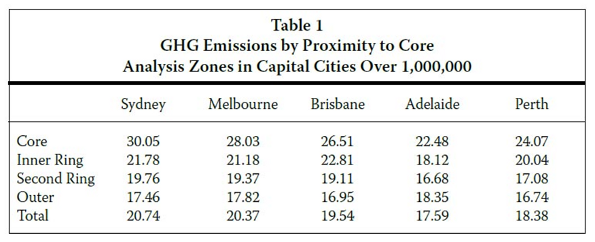

    Source: Greenhouse gas emissions, tonnes per capita, Housing form in Australia and its impact on greenhouse gas emissions, Residential Development Council 22 October 2007, p 11

    There are a number of reasons why this should be the case. First, suburban dwellings are often newer, incorporating more energy efficient means and materials – notably, better insulation. Second, though car journeys are less greenhouse gas efficient by the kilometre, the difference is not so great, and public transit is less efficient in other ways (because it rarely takes you just where you need to go) creating extra journeys and more waste.

    What is more, the view that suburban commuting must be a greater producer of greenhouse gas emissions does not take into account the changing patterns of home and work location in the newer suburbs. Our model of the diurnal commute, into the city in the morning and back to the dormitory town at night is becoming less typical.

    For many people, commuting is quicker in the suburbs than in cities. It takes residents within the suburbs and exurbs 24/25 minutes, much less than the 43 minutes for those living and working in Greater London. The case for reducing energy use by living at higher densities appeals to our common sense, but less dense living might provide answers to the problems of energy and emissions.

    Suburbanisation has raised fears of social division. Anxieties about social alienation, along with those about the environment, fit into a wider account of the problems of suburbanisation, and a proposed solution, which has been called the New Urbanism.

    One group that hoped to address the problem are the New Urbanists, a group of architects and planners who have turned the perceived problem of the suburbs around and created a manifesto to reverse those negative trends. Among the best-known exponents of the New Urbanism is Peter Calthorpe, for the arguments in his books The Next American Metropolis (1993) and Sustainable Communities (with Sim Van der Ryn, 1989).

    Calthorpe argues that we are still building suburbs that are ‘increasingly out of sync with today’s culture’ failing to take into account changing household composition, falling incomes and environmental concerns – a proposition that many American “progressives” held to be strikingly confirmed by the collapse of the US housing market in 2008/9, and its wider impact on the economy.

    Intriguingly, Calthorpe’s views on planning take us far away from technical considerations into an idea of what the good life ought to be. Calthorpe says that ‘we need to start creating neighbourhoods’, arguing that, ‘Our faith in government and the fundamental sense of commonality at the centre of any vital democracy is seeping away in suburbs designed more for cars than people, more for market segments than communities.’

    The New Urbanists were an influence on Britain’s Urban Task Force, under Lord Rogers of Riverside, who drew up the British government’s planning policy in the document Towards an Urban Renaissance in 1998. Rogers, too, favoured higher densities, mixed use and an end to suburban sprawl.

    Folding the idea of preserving our social capital into the broader ideas of environmentalism, New Urbanists, the Urban Task Force and Herbert Girardet have all gravitated towards a concept of ‘sustainable communities’. It is a concept that is at once recognisable and at the same time very vague. Still, it has been an enormous influence on policy makers, who have tried to give substance to its implications.

    However, the evidence is clear that despite the many policy initiatives that have been taken to create ‘sustainable communities’, developers, and perhaps consumers, too, have resisted the appeal. First, take the case of Europe. Analysis of 42 west European cities shows that in all but one (Berlin) the suburbs and exurbs are growing faster than the core.

    In 1965 44 million people lived in the center of these 42 cities, while 42 million lived in the suburbs and exurbs. By 2000, the inner city population had dropped to 39 million, while the suburban had grown to 71.6 million. On average, inner city populations declined by 13 per cent, while suburban and exurban populations increased by 113 per cent.

    • For example Madrid’s inner city population grew from 2.25 million to 2.4 million between 1965 and 2000, but its suburbs grew from 125,000 to 2.1 million.
    • Over the same period, Frankfurt’s inner city declined from 695,000 to 641,000, while its suburbs grew from 755,000 to 1.25 million
    • Brussels’ inner city shrunk by 30,000 to 137,000, while its suburbs grew from 1.8 to 2.3 million.
    • Even Barcelona, poster-boy for urban densification, saw its core decline from 1.6 million in 1965 to 1.5 million in 2000, while its suburbs grew from half a million to 2.26 million over the same period.

    Source: Western Europe: Metropolitan Areas & Core Cities 1965 to 2000/2001, Demographia, http://www.demographia.com/db-metro-we1965.htm.

    Policies that try to contain sprawl run against the grain of human nature. Many, even most people aspire to live at lower densities than they do right now.

    Still, there is a point to the Urban Renaissance. The gentrification of canal and riverside districts, and the creation of ‘cultural quarters’ is a well-documented trend. This was the sense in which there was an urban renaissance in the noughties: well-heeled yuppies took back parts of the inner city. Often single, they had less need of gardens and preferred loft living in Shoreditch or central Zurich to a detached house in the Suburbs, which were coming to be less exclusive, anyway.

    These developments should lead those polemicists painting the suburbs as the greedy well-to-do and the inner cities as disproportionately occupied by the suffering poor to recalibrate their argument. Tim Butler, Chris Hamnett and Mark Ramsden’s analysis of London’s employment in the 2001 census shows that outer London and the South East is more working class than inner London.

    The image of black inner cities and white suburbs is changing, too. Many major cities are suffering ‘black flight’ as black Americans move out to the more affordable suburbs: Chicago, Los Angeles, Houston, Dallas, San Diego, Washington and Oakland. San Francisco’s black population is down from 13.4 to 6.5 per cent.

    Not only do the New Urban policy prescriptions coincide with the recent gentrification of inner cities, there is some evidence that they have helped it. Portland, where the adoption of an urban growth boundary (or green belt) was intended to densify the city and protect the country, has seen house prices rise much faster than the national average (it was below that, now it is above). Inside Oregon’s protected ‘farm land’ many farmhouses turn out to be just country homes for the wealthy disguised as farms

    To show that Greenwich Millennium Village was not just more riverside yuppie flats, but a real community, architect Ralph Erskine built in a combined school and health centre, except that an old school, Anandale, had to be relocated from the centre of Greenwich to the peninsula to provide the children – and spookily, it has kept its old catchment. Erskine’s Potemkin Village recruits children from Greenwich to act the part of the local community. A few parents objected at first, but most changed their minds when they saw the quality of the facilities. Around ten of the families in the Village proper send their children there, and of those, the majority are in the 20 per cent of new homes that earmarked for social housing. Like other attempts to reinvent the village in the town, such as the Bo01 estate in Malmo, Sweden, Erskine’s Greenwich peninsula is overwhelmingly upper middle class.

    It is pointed that in Britain, where, thanks in part to Lord Rogers, planning restrictions on new development were greatest, there was no boom in housebuilding, unlike much of the rest of the world. Of course there was a boom in house-prices – quite a phenomenal one. But all through the period 1997 to 2008 house-building fell below the rate needed to replace Britain’s dilapidated housing stock.
    The New Urbanism was always rather more than an architectural style, but also a vision of the good life. It hoped to address the social divide, and the solipsistic withdrawal from city life. Curiously, it seems if anything to have played a part in accelerating the social divide, in particular the gentrification of inner city enclaves. Far from making the city more diverse, the new urbanism seems to be making it more uniform. In London the trend towards in-fill by building on brownfield land has had the unintended effect of the loss of green spaces in the City. In the north of the city, Londoners gathered to protest at the recreation of urban overcrowding, when Islington’s municipal authorities planned to force yet another apartment block on top of garages in Pilgrim’s Way.

    The New Urbanism describes one trend in society, the gentrification of inner cities. But many more people want to move outwards, to cheaper and more spacious homes. As communications improve, and more land is released from farm use by rising agricultural productivity, that shift towards more dispersed dwellings should find its place in architecture and planning theory, too.

    Ultimately more dispersed patterns of living lead to more dispersed commuting.

    South East England, the Bassin Parisien, Central Belgium, the Dutch Randstad, Rhine-Ruhr, Rhine-Main, Northern Switzerland, and Greater Dublin are examples of what geographers call polycentric urban regions. When industry moves out of monocentric cities, it disperses along valleys and communication lines.

    But the growth of Mega City Regions does not mean the countryside is all being concreted over. On the contrary, these economic regions are a lot greener, a lot more dispersed than the twentieth century city. Exurbs and edge towns are being populated in the yawning green spaces in between the industrial estates.

    The issue that needs to be addressed is: Can We Imagine A Dispersed Future?

    Far from being necessarily de-humanising, dispersed settlements are an opportunity for an enlargement of the human spirit. To imagine that there is anything in physical proximity that is essential to community is to confuse animal warmth with civilisation, and an unfortunately deterministic view of architecture’s relationship to society. But worst of all it misses out the great alternatives that are waiting to be made in new communities across the country.

    James Heartfield is author of Let’s Build! Why we need five million homes in the next ten years, and a director of www.Audacity.org.

  • The Death Of Gentry Liberalism

    Gentry liberalism, so hot just a year ago, is now in full retreat, a victim of its hypocrisy and fundamental contradictions. Its collapse threatens the coherence of President Barack Obama’s message as he prepares for his State of the Union speech on Wednesday.

    Gentry liberalism combines four basic elements: faith in postindustrial “creative” financial capitalism, cultural liberalism, Gore-ite environmentalism and the backing of the nation’s arguably best-organized political force, public employee unions. Obama rose to power on the back of all these forces and, until now, has governed as their tribune.

    Obama’s problems stem primarily from gentry liberalism’s class contradictions. Focused on ultra-affluent greens, the media, Wall Street and the public sector, gentry liberalism generally gives short shrift to upward mobility, the basic aspiration of the middle class.

    Scott Brown’s shocking victory in Massachusetts–like earlier GOP triumphs in Virginia and New Jersey–can be explained best by class. Analysis by demographer Wendell Cox, among others, shows that Brown won his margin in largely middle- and working-class suburbs, where many backed Obama in 2008. He lost by almost 2-to-1 among poor voters and also among those earning over $85,000 a year. He also won a slight margin among union members–remarkable given the lockstep support of their organizations for Brown’s Democratic opponent, Martha Coakley.

    Geography played a role, of course, but class proved the divider. Coakley did well in the wealthiest suburbs largely north and northwest of Boston. But Brown’s edge in the more middle- and working-class suburbs proved insurmountable.

    Obama, a genius at handling race, has always had problems with class. His early primary victories in 2008 resulted not only from superior organization but the preponderance of students and upper-income professionals in early primary states. Once Hillary Clinton morphed, just a bit late, into Harry Truman in a pants suit, she proved unstoppable, rolling over Obama in critical states like Pennsylvania, Texas, California, Florida, Michigan and throughout Appalachia.

    In the general election Obama succeeded in winning over a significant portion of these voters. Long-simmering disgust with the Bush administration and the Republican Congress, combined with a catastrophic economic collapse, undermined the GOP’s hold on middle-class suburbanites.

    Now that the ball is in his court, the president and his party must abandon their gentry-liberal game plan. The emphasis on bailing out Wall Street and public employees, supporting social welfare and manufacturing “green” jobs appealed to the core gentry coalition but left many voters, including lifelong Democrats, wondering what was in it for them and their families.

    In the next few elections there’s an even greater threat of alienation among millennial voters, who in 2008 accounted for much of the president’s margin of victory. Generational researchers Morley Winograd and Mike Hais note that millennials are starting to enter the workforce in big numbers. Right now their prospects are not pretty. The unemployment rate for those under 25 stands at 19%. Even for college graduates, wages are declining even as opportunities dry up.

    The greatest political danger is not so much a millennial switch to the GOP but a loss of enthusiasm that will diminish the youth vote. Winograd and Hais estimate only about one-third of those who voted in 2008 in Massachusetts voted in this last special Senate election. “Republicans will keep on celebrating victories until Democrats turn their attention to young voters and get them as excited as Obama did in 2008,” Winograd warns.

    Ever deepening disillusionment–not only among millennials–is inevitable unless Obama changes course and starts building a broad-based recovery. The president’s economic team is as pro-big-bank as any conjured up by the most rock-ribbed Republican. Its motto could be a reworking of that old notion by onetime GM CEO and Eisenhower Defense Secretary Charles Wilson: “What’s good for General Motors is good for the USA”–just substitute Wall Street for GM.

    But where GM brought jobs and prosperity to millions, the current Wall Street focus has forged a recovery that works for the gentry but fails to promote upward mobility. Bailed out from their disastrous risky bets and then provided with easy access to cheap credit, the financiers have had themselves a fine party while the rest of the private sector economy suffered. The partygoers have become so rarified that they are unable to lift even the New York City economy, whose unemployment rate now surpasses the national average.

    This spectacle has forced Obama to try locating his hidden populist, but dangers lurk in this shift. If he attacks Wall Street with any real ferocity, the only linchpin of the current weak recovery could crumple. An administration that has focused on finance as the essence of the economy may prove poorly suited to skewer its primary object of affection.

    Yet it may not be too late for the president to recover some of his economic mojo. Although his financial tax plan represents little more than petty cash at today’s absurd Wall Street rates, Obama’s endorsement of Paul Volcker’s more muscular reform agenda could rally Democrats while forcing Republicans into a doctrinal crisis. Some, like Sen. John McCain, may favor a policy to downsize the megabanks and limit their activities. But many others who hold up the holy grail of free markets über alles will expose themselves again as mindless corporate lackeys.

    But badmouthing the financial aristocracy is not enough. Obama also must jettison some of the lamer parts of the gentry agenda. Cap and trade, a gentry favorite that satisfies both green piety and Wall Street’s greedy desire for yet another speculative market, needs to be scrapped as a potential job-killer for many industries. Similarly, the administration needs to delay measures to impose draconian limits of greenhouse gas emissions through the Environmental Protection Agency, which could devastate large sectors of the economy, including manufacturing, agriculture and construction.

    Obama, particularly after the Copenhagen fiasco, needs to shift to more practical, job-creating conservation measures like tree-planting and reducing traffic congestion–notably by promoting telecommuting–while continuing research and development of all kinds of cleaner fuels. Measures that make America more energy-efficient and self-sufficient–without ruining the economy with ruinously high prices–would be far more saleable to the public than the current quasi-religious obsession with wind and solar.

    Obama also needs to stop his naive promotion of the chimera of “green jobs” as his signature answer to the country’s mounting employment woes. There is no way a few thousand, mostly heavily subsidized, jobs creating ever more expensive energy can turn around any economy. Just look at the economic carnage in Spain–where youth unemployment has now reached a remarkable 44%–which has bet much of its resources targeting “green” energy.

    More than anything the president needs to make the case that government can help the productive economy. This requires a scaling down of regulatory measures that are now scaring off entrepreneurs–including some aspects of health care reform–and beginning to demonstrate a direct concern for basic industries like manufacturing, agriculture and trade.

    Pivoting away from gentry liberalism will no doubt offend some of the president’s core constituencies. But if he does not do this soon, and decisively, he will find that the middle-class anger seen in Massachusetts will spread throughout the country. As a result Barack Obama, a man who would be Franklin Roosevelt and could settle on being the next Bill Clinton, will end up looking more like that sad sack of Democratic presidents, James Earl Carter.

    This article originally appeared at Forbes.com.

    Joel Kotkin is executive editor of NewGeography.com and is a distinguished presidential fellow in urban futures at Chapman University. He is author of The City: A Global History. His next book, The Next Hundred Million: America in 2050, will be published by Penguin Press February 4th, 2010.