Tag: middle class

  • Two Cheers for NIMBYism

    Politicians, housing advocates, planners and developers often blame the NIMBY — “not in my backyard” — lobby for the state’s housing crisis. And it’s true that some locals overreact with unrealistic growth limits that cut off any new housing supply and have blocked reasonable ways to boost supply.

    But the biggest impediment to solving our housing crisis lies not principally with neighbors protecting their local neighborhoods, but rather with central governments determined to limit, and make ever more expensive, single-family housing. Economist Issi Romem notes that, based on the past, “failing to expand cities [to allow sprawl] will come at a cost” to the housing market.

    A density-only policy tends to raise prices, turning California into the burial ground for the aspirations of the young and minorities. This reflects an utter disregard for most people’s preferences for a single-family home — including millennials, particularly as they enter their 30s.

    In California, these policies are pushed as penance for climate change, although analyses from McKinsey & Company and others suggest that the connection between “sprawl” and global warming is dubious at best, and could be could be mitigated much more cost-effectively through increased work at home, tough fuel standards and the dispersion of employment.

    Read the entire piece at The Orange County Register.

    Joel Kotkin is executive editor of NewGeography.com. He is the Roger Hobbs Distinguished Fellow in Urban Studies at Chapman University and executive director of the Houston-based Center for Opportunity Urbanism. His newest book, The Human City: Urbanism for the rest of us, will be published in April by Agate. He is also author of The New Class ConflictThe City: A Global History, and The Next Hundred Million: America in 2050. He lives in Orange County, CA.

  • America’s Next Great Metropolis Is Taking Shape In Texas

    If you drive south from Dallas, or west from Houston, a subtle shift takes place. The monotonous, flat prairie that dominates much of Texas gives way to a landscape that rises and ebbs.

    The region around Highway 35 is called the Hill Country, and although it does not seem so curvy to a Californian, it is some of the very nicest country in the state of Texas, attracting a growing coterie of wealthy boomers. It also turns out to be a growth corridor that is expanding more rapidly than any in the nation. The area is home to three of the nation’s 10 fastest-growing counties with populations over 100,000 since 2010.

    In fact, there is no regional economy that has more momentum than the one that straddles the 74 miles between San Antonio and Austin. Between these two fast-growing urban centers lie a series of rapidly expanding counties and several smaller cities, notably San Marcos, that are attracting residents and creating jobs at remarkable rates.

    Anchoring one end of the region is Austin, which has been the all-around growth champion among America’s larger cities for the better part of a decade. Texas Monthly has dubbed it the “land of the perpetual boom.”

    Austin has been ranked among the top two or three fastest-growing cities for jobs virtually every year since we began compiling our annual jobs rankings. Since 2000, employment in the Austin area has expanded 52.3%, 15 percentage points more than either Dallas-Ft. Worth or Houston.

    Comparisons with the other big metros are almost pathetic. Austin’s job growth has been roughly three times that of New York, more than four times that of San Francisco, five times Los Angeles’ and 10 times that of Chicago. Simply put, Austin is putting the rest of the big metro areas in the shade.

    Nor can Austin be dismissed as a place where low-skilled workers flee, as was said about other former fast-growing stars, notably Las Vegas. Just look at employment in STEM (science-, technology-, engineering- and math-related fields). Since 2001, Austin’s STEM workforce has expanded 35%, compared to 10% for the country as a whole, 26% in San Francisco, a mere 2% in New York and zero in Los Angeles. And contrary to perceptions, the vast majority of this growth has taken place outside the entertainment-oriented core, notes University of Texas professor Ryan Streeter, with nearly half outside the city limits.

    Austin has also been sizzling in the business services arena, the largest high-wage job sector in the country. Since 2001, employment in business services in the Austin area has grown 87%, more than any of the large Texas towns.

    No surprise then that Austin has become a magnet for people. Its population has grown at the fastest rate among U.S. metro areas above a million in the nation since 2000, an amazing 60%. That’s more than twice as fast as Atlanta, three times more than hipster haven Portland, roughly six times San Francisco and San Jose, and more than six times Los Angeles or New York. Much of the growth is coming from migration rather than births, and it boasts the highest rate of net in-migration of all the big Texas cities. The biggest sources of newcomers, according to an analysis of IRS data by the Manhattan Institute’s Aaron Renn, are California, the Northeast and Florida.

    San Antonio: The Emerging Upstart

    During the decades of Texas’ urban boom, San Antonio has been considered a laggard, a somewhat sleepy Latino town with great food and tourist attractions and a slow pace of life. “There has been a long perception of San Antonio as a poor city with a nice river area,” says Rogelio Sáenz, dean of the public policy school at the University of Texas-San Antonio.

    Economic and population data say otherwise. Since 2000, San Antonio has clocked 31.1% job growth, slightly behind Houston, but more than twice that of New York, and almost three times that of San Francisco and Los Angeles.

    And many of the new jobs are not in hospitality, or low-end services, but in the upper echelon of employment. This reflects the area’s strong military connections, which have made it a center forsuch growth industries as aerospace, and cyber-security. Although slightly behind Austin, San Antonio’s STEM job growth since 2001 — 29% — is greater than that of all other Texas cities, as well as San Francisco’s, and three times the national average.

    Similar growth can be seen in such fields as business and professional services, where the San Antonio area has expanded its job base by 44% since 2000. This just about tracks the other Texas cities, and leaves the other traditional business service hotbeds — New York, San Francisco, Chicago and Los Angeles — well behind. The city has also expanded its financial sector; the region ranked seventh in our latest survey of the fastest-growing financial centers. Once again, there is a military connection; much of the area’s financial growth has been based on USAA, which provides financial services to current and former military personnel around the country, and employs 17,000 workers from its headquarters in the city’s burgeoning northwest.

    But perhaps most encouraging has been the massive in-migration into San Antonio. Long seen as a place dominated by people who grew up there, the metro area has become a magnet for new arrivals. Since 2010, its rate of net domestic in-migration trails only Austin among the major Texas cities. Significantly, the area’s educated millennial population growth ranks in the top 10 of America’s big cities, just about even with Austin, and well ahead of such touted “brain centers” as Boston, New York, San Francisco.

    In the process, San Antonio is emerging as an attractive alternative for young professionals and families to an Austin that has become more congested and expensive. The cost of living in San Antonio is significantly lower than the other Texas cities, and less than half that of places like San Francisco and Brooklyn. As the vanguard of millennials moves into the family forming, childbearing and house-buying years in the coming decade, San Antonio, with its increasingly lively music, art and restaurant scence, is likely to grow in attractiveness.

    Greater San Marcos: Whoa Nellie!

    As impressive as San Antonio and Austin’s progress has been, the most dramatic locus for growth in the region is between the two cities. The San Marcos area, which lies at the center of the corridor, has clocked growth that is among the most rapid in the nation by several measures. Looking at population, two of the 10 fastest growing counties in the country since 2010 are located in this corridor — Hays and Comal. Their growth rate, 4% per annum since 2010, exceeds Austin’s 3% and is almost double the growth rate of Dallas-Ft. Worth and Houston.

    As is usual in Texas, and most American cities, urban growth tends to expand outwards, not only for population but also for jobs. Over the past decade, Hays and Comal’s job growth rate has been an astounding 37%, outpacing Austin’s impressive 31% growth, the other Texas cities, and over six times the pace of the country overall.

    Local boosters suggest that this growth will transform the San Marcos area into something like other suburban nerdistans, such as San Jose/Silicon Valley, north Dallas, Orange County and Raleigh-Durham. Certainly some of the same advantages those areas enjoyed are emerging, including the growth of Texas State University at San Marcos (now with over 38,000 students) as a major center of higher education.

    Equally important, note researchers John Beddow and James LeSage, the central location of the San Marcos area allows families to choose from not only local jobs, but those located in both San Antonio and Austin. And to be sure, tech, education, business and professional services are all growing rapidly, but so far much of the development is lower on the food chain, such as food service and wholesale trade. Amazon, for example, just recently opened a sprawling, 855,000-square-foot warehouse in San Marcos, which is slated to employ upwards of 1,000 people.

    Choices To Be Made

    If you were to look for the next great American metropolis, there’s probably no better bet than the emerging San Antonio-Austin corridor. The elements are all there: major universities, including the Austin and San Antonio campuses of the University of Texas, job and population growth, low housing prices and a burgeoning tech community. Perhaps even more important, this part of Texas is only marginally tied to the energy industry, which has become a huge drag on the economy of the state’s largest city, Houston.

    Yet there remain many challenges. One is transportation, particularly around freeway allergic Austin, although San Antonio has an excellent and largely free-flowing system. The Austin bottleneck is particularly troublesome because much of the city’s growth is to the north, which means commuters living in the San Marcos region have to navigate through painfully slow freeways. Another is education, despite the university presence. San Marcos and Austin may be above the national average in terms of the percentage of college-educated residents, but San Antonio and New Braunfels, a large town south of San Marcos, still lag.

    To maintain the area’s natural beauty, steps must be taken to prevent development from overrunning the Hill Country.

    But none of this should stop this region from coalescing into something that represents a Texas version of Silicon Valley — a little less dependent on the highest end of companies, less expensive and more diversified — providing a powerful new entrant among the nerdistans that increasingly dominate our national economy.

    This piece first appeared in Forbes.

    Joel Kotkin is executive editor of NewGeography.com. He is the Roger Hobbs Distinguished Fellow in Urban Studies at Chapman University and executive director of the Houston-based Center for Opportunity Urbanism. His newest book, The Human City: Urbanism for the rest of us, will be published in April by Agate. He is also author of The New Class ConflictThe City: A Global History, and The Next Hundred Million: America in 2050. He lives in Orange County, CA.

  • The New War Between the States

    In this disgusting election, dominated by the personal and the petty, the importance of the nation’s economic geography has been widely ignored. Yet if you look at the Electoral College map, the correlation between politics and economics is quite stark, with one economy tilting decisively toward Trump and more generally to Republicans, the other toward Hillary Clinton and her Democratic allies.

    This reflects an increasingly stark conflict between two very different American economies. One, the “Ephemeral Zone” concentrated on the coasts, runs largely on digits and images, the movement of software, media and financial transactions. It produces increasingly little in the way of food, fiber, energy and fewer and fewer manufactured goods. The Ephemeral sectors dominate ultra-blue states such as New York, California, Oregon, Washington, Massachusetts, Maryland, and Connecticut.

    The other America constitutes, as economic historian Michael Lind notes in a forthcoming paper for the Center for Opportunity Urbanism, the “New Heartland.” Extending from the Appalachians to the Rockies, this heartland economy relies on tangible goods production. It now encompasses both the traditional Midwest manufacturing regions, and the new industrial areas of Texas, the Southeast and the Intermountain West. 

    Contrary to the notions of the Ephemerals, the New Heartland is not populated by Neanderthals. This region employs much of the nation’s engineering talent, but does so in conjunction with the creation of real goods rather than clicks. Its industries have achieved  generally more rapid productivity gains than their rivals in the services sector. To some extent,  energy  and food producers may have outdone themselves and, since they operate in a globally competitive market, their prices and profits are suffering.

    Despite deep misgivings about the character of Donald Trump, these economic interests have led most Heartland voters  somewhat toward the New York poseur, and they are aligning themselves even more to down-ticket GOP candidates. In generally purple states like Missouri, Ohio and Iowa, where manufacturing is key, Trump still leads—at least he was before the latest spate of Trump crudeness was revealed, this time regarding women.

    The Republicans’ strongest base is in the energy belt where Trump has suggested policies that call for greater domestic production. This naturally resonates with businesses and working people in states ranging from Texas, Oklahoma and Louisiana to West Virginia, Wyoming and Alaska, which have borne the brunt of nearly 100,000 layoffs so far this year. It’s no surprise that all of these states constitute increasingly a lock for the GOP.

    Historical Precedents

    The conflict of economic interests has long defined American politics. America’s revolution was largely started by New England merchants rebelling against colonialist policies that sought to strangle our nascent capitalism in its infancy. The great economic tensions of the early 19th century centered on a struggle between the Jeffersonian and Jacksonian yeomanry and the powerful merchant class in the great Northeastern cities. A major point of contention was around such issues as the establishment of a national bank and high tariffs, bitterly opposed in the nation’s interior and the South.

    The biggest national crisis in our history underscored this clash of competing economic interests. Although the galvanizing issue on both sides of the Mason-Dixon line was slavery, the Civil War was also a war, as Karl Marx suggested, of competing economic visions: the agrarian, slave-fueled economy of the South vs. the rapidly industrializing Northeast and Midwest. 

    Post-war conflicts revolved about hostility between the urbanizing North and the more rural South and West. Finance and industrial capital, usually in cities like New York and Chicago, was largely Republican and protectionist. Democrats tried to cobble a coalition of Southern agriculturalists and the big city, ethnic working class. With the onset of the Great Depression, Democrats gained primacy by melding this coalition to a rising and increasingly progressive professional class.

    In the past, Democrats competed in the Heartland and backed its key industries. Lyndon Johnson was a proud promoter of oil interests; Robert Byrd never saw a coal mine he didn’t like for all but the end of his career. Powerful industrial unions tied the Democrats to the production economy. Now those voters feel abandoned by their own party, and even are dismissed as “deplorables”  

    Increasingly few Heartland Democrats, outside of some Great Lakes states, win local elections. In the vast territory between Northeast and the West Coast, Democrats control just one state legislature, the financial basket case known as Illinois.

    For their part, Republicans are becoming extinct in the Ephemeral states, a process hastened by the growing concentration of media on the true-blue coasts. Wall Street, Silicon Valley and Hollywood have been drifting leftward for a generation, and Trump has accelerated this movement. Joined by the largely minority urban working and dependent classes, progressives now have a lock on   the Northeast and the West Coast.

    The New Battle Lines

    The new conflict between regions reflects a conflict between different ways of making money. Ephemeral America’s media and academic adjuncts generally portray the New Heartland’s economy as exploitative and environmentally harmful. A massive oil discovery in Alaska may be welcome news there, but a horrific prospect in places like Seattle, New York, or San Francisco.

    Climate change increasingly marks a distinct dividing line. Manufacturing, moving goods, industrial scale agriculture, fossil fuel energy all consume resources in ways many progressives see as harming the planet. Progressives threaten these industries with increasingly draconian schemes to reduce greenhouse gas emissions. Gone are the days of supporting moderate shifts — which could work with some Heartland economies — from coal to gas and improving mileage efficiency.

    Instead the demand from the left is for a radically rapid de-carbonization, which will reduce jobs in the Heartland and lower living standards everywhere. In California, Jerry Brown  is fretting about ways to curb cow flatulence, an obsession that is unlikely to be popular in Kansas, Nebraska or Iowa.

    These divergent politics between states are accelerating the gap between the two economies. Since 2010, as the recovery kicked off, the big industrial job growth took place mostly in the Heartland — in Detroit, Charlotte, Atlanta, Phoenix and Houston. New York, Los Angeles, Philadelphia and Boston all managed to lose jobs. Since 2000, Los Angeles and New York together have lost over 600,000 manufacturing positions.

    As industry weakens in an area, opposition to radical climate mitigation declines. Someone representing an increasingly de-industrialized east Los Angeles or Brooklyn feels no pressing reason to advocate for industry. High energy and housing prices, both connected to draconian climate change policies, gradually empty out the middle-class families, the demographic bulwark of the GOP. Meanwhile, in their coastal bastions, the grandees of Silicon Valley and Wall Street increasingly disdain anything reliant on fossil fuels.

    The New Heartland has reason to resist such policies, which could turn what have been burgeoning economies back into backwaters. Regulatory regimes that radically boost energy costs, as in California and New York, hasten de-industrialization. The  rapid decline of areas such as interior California and upstate New York testifies what may be in store for the Heartland under a Hillary Clinton administration and a Congress controlled by the Democratic Party.

    This conflict will deepen in light of the ongoing gradual decline of key tangible industries — durable goods like heavy equipment and car manufacturing, fossil fuel energy, agribusiness. Back in 2012, all these sectors were doing well, something that helped President Obama win much of the old Rust Belt. In the current economic climate Republicans could still make significant progress, even with Trump at the top of the ticket. 

    In the process, the GOP, to the horror of many of its grandees and most entrenched interests, is becoming transformed. It is becoming something of a de facto populist party, based in the New Heartland, while the Democrats remain the voice of the coastal oligarchies who almost without exception back Hillary

    In the immediate future, given the likely trajectory of a Clinton presidency, things may get tougher times for the New Heartland and its industries. Federal regulators will ape their California counterparts, extending controls that seem sensible in San Francisco into dramatically different geographies.

    But don’t count the New Heartland, or the GOP, out. Once Trump is gone, there will be enough political will and money to mount a counter-offensive against the Ephemerals. The new War Between the States will not end in November. It will have hardly just begun.

    This piece first appeared in Real Clear Politics.

    Joel Kotkin is executive editor of NewGeography.com. He is the Roger Hobbs Distinguished Fellow in Urban Studies at Chapman University and executive director of the Houston-based Center for Opportunity Urbanism. His newest book, The Human City: Urbanism for the rest of us, will be published in April by Agate. He is also author of The New Class ConflictThe City: A Global History, and The Next Hundred Million: America in 2050. He lives in Orange County, CA.

  • Urban Containment, Endangered Working Families and Beleaguered Minorities

    Working families and the middle class are becoming an increasingly endangered species in   many parts of United States. Median household income remains below its 1999 peak (inflation adjusted). But the problem is not just stagnant incomes. Expenses are also rising, especially the costs of housing in some cities. As a result, it is becoming more and more difficult to make ends meet.

    Much of this has to do, as explained below, with attempts to stop development on the urban periphery which is indispensable to keeping housing affordable. Such prohibitions have been widely advocated by the  planning establishment. Moreover, a new White House Housing Development Toolkit,  rightly identifies housing unaffordability as an important issue but does not mention the important role of greenfield development in keeping costs down.

    Housing Affordability Problem

    Housing costs are generally responsible for the difference in cost of living between US cities (metropolitan areas). The range between cities in the Bureau of Economic Analysis (BEA) cost of living index (Regional Price Parities) in housing cost is far greater than that of its other two elements — 13 times goods and eight times services other than rents. It is no wonder that households are moving to affordable markets.

    Excessive land use regulation is a major cause of seriously unaffordable housing. Usually, these regulations include urban containment policy, which restricts or even prohibits building middle income detached housing on the urban fringe. As sure as OPEC cutbacks drive up the price of gasoline, urban planning land cutbacks drive up house prices. There is plenty of evidence that the law of supply and demand operates in urban land markets — that restricting the availability of land for development pushes land (Figure 1) and house prices up (See: A Question of Values: Middle-Income Housing Affordability).

    By definition, housing affordability must be measured in relation to incomes. It should also be compared to trends over time both within the metropolitan area (housing market) and between metropolitan areas (See Canada’s Middle-Income Housing Affordability Crisis).

    The most acute problem is in California, where house prices are up to four times those in liberally regulated US metropolitan areas. Before excessive land use regulations were imposed, housing affordability in California, prices relative to incomes, were similar to the rest of the nation, rarely exceeding 3.0 (measured by the “median multiple,” the median house price divided by the median household income).

    There is little comprehension of the seriousness of the housing affordability problem. With serious concerns being raised about income inequality, housing affordability represents one of the most important threats both to the well-being of middle-income households and poverty reduction. More than anywhere in the country, the price of middle income housing is beyond the reach of most middle income California households, including  those who would easily qualify in liberally regulated markets.

    At the same time, middle-income households in other excessively regulated markets, like Seattle, Portland, Denver, Miami, Boston and New York have seen their house prices double (or more) as regulations have been stiffened.  Finally, all of this increases the demand for subsidized housing. While there is plenty of rhetoric about affordable housing for lower income households, there is not and there is not likely to ever be enough money.

    The key issue is the cost of residential land under the house. Average residential land values are at least 75 percent of the house and land value in San Jose and San Francisco (Note 1), 70 percent in Los Angeles and 65 percent in San Diego. Our analysis of Lincoln Institute of Land Policy data indicates that the average house structure in the four California metropolitan areas had an average value is only 25 percent higher than that of the other major metropolitan areas. By contrast, the land value was more than 650 percent higher. It would be too expensive for middle income households to buy vacant residential lots, even if they intended living in tents.

    With such expensive land, there is virtually no hope to restore housing affordability without tackling the issue of land head on. In the meantime, house prices weigh heavily on all households, and many are leaving California, particularly in their mid-thirties and above.

    Lower Income Minorities: African Americans and Hispanics

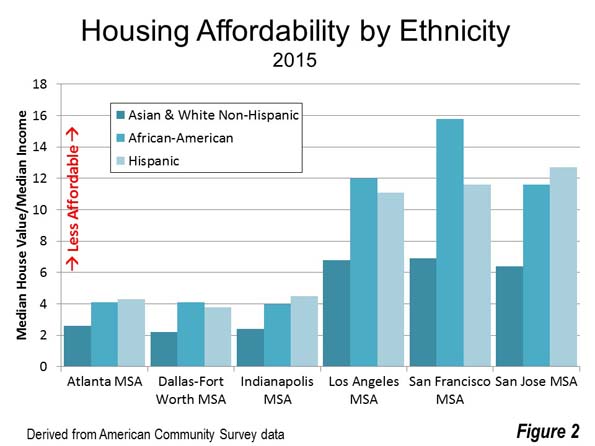
    The situation for housing is far worse for ethnic groups with lower incomes. The maximum housing affordability disadvantage faced by African Americans and Hispanics is illustrated in the following examples. In the San Francisco MSA, the median value house would cost the equivalent of 9 more years of median African-American income than for Asian or White-Non-Hispanics. This has escalated from 1.3 years before regulations were strengthened. An Hispanic household would need six more years of median income to pay for the median valued house in the San Jose MSA. There also large spreads, both for African-American and Hispanic households in other highly regulated metropolitan areas, such as Los Angeles, San Diego, Portland, Boston and New York (See Figure 2 and Table: Housing Affordability: Overall and by Ethnicity).

    Planning’s “Killer App”

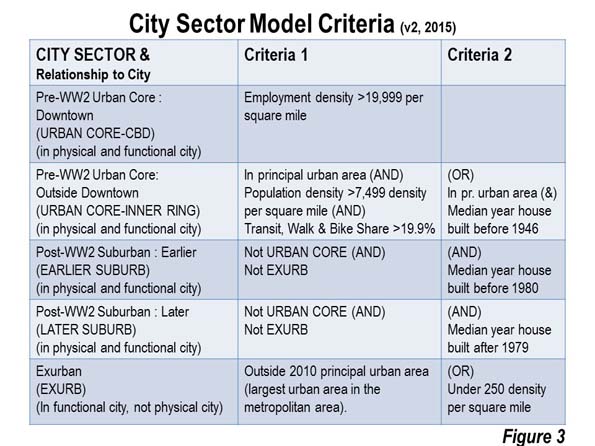
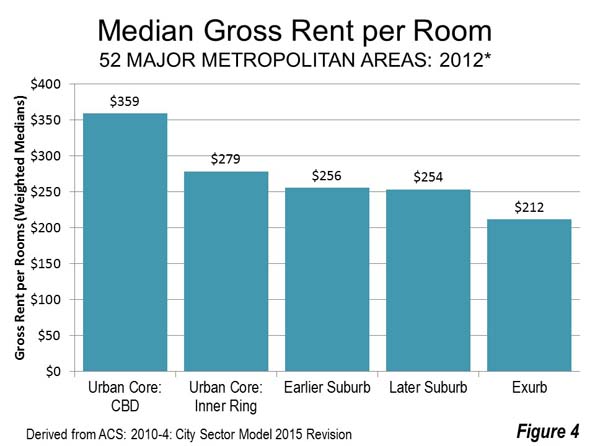
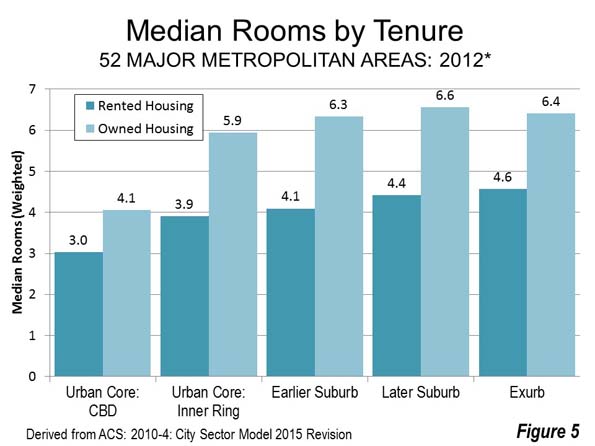
    It is popular to contend that housing affordability can be restored through   building higher densities. There are no examples of restoring metropolitan area housing affordability through intensification. A principal problem is higher prices. A City Sector Model (Figure 3) analysis indicates that the urban core rents per room are well above that of the suburbs (Figure 4). The differences are even greater in cities with the more aggressive intensification programs, such as Portland, Seattle and Los Angeles (Note 3).  Housing units are also smaller (Figure 5). “Granny flats,” basements and apartments are too small for many middle-income households. Forced intensification impairs the quality of life for many people, particularly families (Note 4)

    These policies also have the effect of widening economic divisions. Matthew Rognlie of the Massachusetts Institute of Technology examined French economist Thomas Piketty’s research on rising inequality and concluded that much of the observed inequality stems from housing. He went on to suggest re-examining the land use regulations that create scarcity, toward the end of increasing housing supply. My colleague Hugh Pavletich, co-author of Demographia International Housing Affordability Survey argues that without the “safety valve” of greenfield development, because housing cannot be kept affordable since urban containment destroys the competitive market for land.

    New Zealand consultant Phil Hayward observes: “There might be other policy mixes by which housing supply within a growth boundary could be made the means of keeping housing affordable, but publicly and politically, the debate is nowhere near tackling the complexities involved” (See The Myth of Affordable Intensification).

    Further, large lot or rural zoning is frequently cited as an impediment to housing affordability. This is consistent with economic theory, but its influence is miniscule compared to urban containment (Note 5). The metropolitan areas with substantial large lot zoning had an average price-to-income ratio of 3.0 in 2014, at the upper bound of affordability. This is in contrast with the seriously unaffordable price-to-income ratios (from 5.1 to 9.7) that have urban containment policy . The highest price-to-income ratios are in California’s large metropolitan areas, where there are smaller lot sizes.

    Based on the unparalleled damage they do to housing affordability, urban containment boundaries may be planning’s “killer app.” A principal objective of urban containment policy is to curb the outward expansion of cities (“urban sprawl”). But the “medicine” is far worse than the “cure” — lower standards of living and greater poverty, inflicting particular harm to lower income minorities.

    Necessary Reforms

    Unfortunately, housing affordability has not become an issue in this election year. Yet, policy reforms are appropriate:

    1. Urban containment policy should not be implemented where it has not been adopted.
    2. In urban containment metropolitan areas, improved housing affordability targets should be adopted (price to income ratios), with “event triggered” liberalization of urban fringe land use if the targets are not met. Similar reforms have been proposed in New Zealand and by Paul C. Cheshire, Max Nathan and Henry G. Overman of the London School of Economics.
    Housing Affordability: Overall and By Ethnicity
    Major Metropolitan Areas
    Median Multiple (Years of Median Income Needed to Buy the Median Priced House)
    Additional Years Requried
    All Asians and White Non-Hispanics African Americans Hispanic African Americans Hispanic
    United States 3.5 3.1 5.3 4.3 2.2 1.2
    Atlanta, GA 3.1 2.6 4.1 4.3 1.5 1.8
    Austin, TX 3.6 3.0 4.9 5.0 1.9 2.0
    Baltimore, MD 4.0 3.4 5.7 4.3 2.3 1.0
    Birmingham, AL 3.0 2.6 4.6 3.8 2.0 1.2
    Boston, MA-NH 5.0 4.5 9.3 9.2 4.8 4.7
    Buffalo, NY 2.6 2.3 5.1 5.3 2.8 3.0
    Charlotte, NC-SC 3.2 2.7 4.8 4.3 2.1 1.5
    Chicago, IL-IN-WI 3.6 2.9 6.4 4.5 3.5 1.6
    Cincinnati, OH-KY-IN 2.8 2.6 5.3 3.7 2.8 1.2
    Cleveland, OH 2.8 2.4 4.9 3.9 2.5 1.5
    Columbus, OH 2.9 2.6 4.6 3.7 2.0 1.1
    Dallas-Fort Worth, TX 2.8 2.2 4.1 3.8 1.8 1.5
    Denver, CO 4.5 4.0 7.4 6.3 3.3 2.3
    Detroit,  MI 2.8 2.4 4.7 3.6 2.3 1.2
    Grand Rapids, MI 2.7 2.6 5.2 3.7 2.7 1.1
    Hartford, CT 3.4 3.0 5.4 6.5 2.4 3.6
    Houston, TX 2.7 2.0 4.0 3.6 2.0 1.6
    Indianapolis. IN 2.7 2.4 4.5 4.0 2.1 1.6
    Jacksonville, FL 3.2 2.9 4.8 3.7 2.0 0.9
    Kansas City, MO-KS 2.7 2.5 4.5 3.7 2.0 1.2
    Las Vegas, NV 4.2 3.7 6.0 4.9 2.3 1.2
    Los Angeles, CA 8.6 6.8 12.0 11.1 5.2 4.2
    Louisville, KY-IN 2.9 2.7 4.9 3.4 2.3 0.7
    Memphis, TN-MS-AR 2.9 2.1 4.1 3.5 2.0 1.4
    Miami, FL 4.8 3.8 6.2 5.5 2.4 1.8
    Milwaukee,WI 3.5 3.0 6.9 5.0 3.9 2.0
    Minneapolis-St. Paul, MN-WI 3.3 3.0 7.3 5.1 4.3 2.1
    Nashville, TN 3.3 3.0 5.2 4.2 2.2 1.2
    New Orleans. LA 3.9 3.1 6.0 4.5 3.0 1.5
    New York, NY-NJ-PA 6.0 4.8 8.8 9.2 4.0 4.4
    Oklahoma City, OK 2.8 2.5 4.5 3.4 2.0 0.9
    Orlando, FL 3.4 2.9 4.4 4.3 1.5 1.4
    Philadelphia, PA-NJ-DE-MD 3.7 3.1 6.2 5.8 3.1 2.8
    Phoenix, AZ 3.9 3.5 5.4 5.2 1.9 1.7
    Pittsburgh, PA 2.6 2.5 5.4 3.4 2.9 0.9
    Portland, OR-WA 4.7 4.5 8.7 6.0 4.2 1.5
    Providence, RI-MA 4.3 4.0 6.7 7.6 2.7 3.7
    Raleigh, NC 3.4 2.9 5.1 5.7 2.1 2.7
    Richmond, VA 3.6 3.0 5.4 4.1 2.4 1.1
    Riverside-San Bernardino, CA 5.3 4.7 6.6 6.0 1.8 1.3
    Rochester, NY 2.6 2.3 4.6 4.5 2.3 2.2
    Sacramento, CA 5.4 4.9 8.4 6.8 3.6 1.9
    St. Louis,, MO-IL 2.9 2.6 4.9 3.5 2.3 0.9
    Salt Lake City, UT 3.8 3.6 6.2 5.3 2.6 1.7
    San Antonio, TX 2.7 2.2 3.1 3.3 0.9 1.1
    San Diego, CA 7.2 6.2 9.3 9.5 3.1 3.3
    San Francisco, CA 8.1 6.9 15.8 11.6 8.8 4.7
    San Jose, CA 8.1 6.9 11.6 12.7 4.7 5.8
    Seattle, WA 4.8 4.4 7.8 7.0 3.4 2.6
    Tampa-St. Petersburg, FL 3.4 3.2 4.7 4.0 1.5 0.8
    Tucson, AZ 3.5 3.1 5.0 4.2 1.8 1.1
    Virginia Beach-Norfolk, VA-NC 3.9 3.4 5.7 4.7 2.3 1.3
    Washington, DC-VA-MD-WV 4.3 3.6 5.9 5.8 2.3 2.2
    Data from American Community Survey: 2015
    AFFORDABILITY RATINGS    
    Affordable 3.0 or below
    Moderately Unaffordable 3.1 to 4.0
    Seriously Unaffordable 4.1 to 5.0
    Severely Unaffordable   5.1 and over


    Note 1: Commentators sometimes suggest the high housing prices in the San Francisco Bay Area are the result of land shortages created by topographic constraints, such as bodies of water and mountains. In fact, there is plenty of developable land in the Bay Area, which includes both the San Francisco and San Jose MSAs (See: The Incompatibility of Forced Densification and Housing Affordability).

    Note 2: This is without considering subsidies and tax breaks that can reduce some rents below market levels.

    Note 3: African American 1969 median household is estimated based on the variation in African American median family income from the overall median in that year. Median household income data was not published for ethnicities in the 1970 census. 

    Note 4: The planning establishment sometimes glosses over the reduced quality of life entailed in its efforts to discourage detached housing and force people into higher density housing. This is not their job. The quality of life can only be judged by households themselves.

    Note 5: Boston is an exception, which is the only seriously unaffordable major metropolitan area without urban containment policy. Boston has large lot zoning so expansive that it has created a severe shortage of land for development, with urban containment-like effects on house prices. Boston’s urbanization covers nearly as much land area as the Tokyo urban area, despite having only one-seventh the population. (See: The Evolving Urban Form: Sprawling Boston).

    Photo: Market Street, San Francisco, looking toward the Ferry Building (by author)

    Wendell Cox is principal of Demographia, an international pubilc policy and demographics firm. He is a Senior Fellow of the Center for Opportunity Urbanism (US), Senior Fellow for Housing Affordability and Municipal Policy for the Frontier Centre for Public Policy (Canada), and a member of the Board of Advisors of the Center for Demographics and Policy at Chapman University (California). He is co-author of the “Demographia International Housing Affordability Survey” and author of “Demographia World Urban Areas” and “War on the Dream: How Anti-Sprawl Policy Threatens the Quality of Life.” He was appointed to three terms on the Los Angeles County Transportation Commission, where he served with the leading city and county leadership as the only non-elected member. He served as a visiting professor at the Conservatoire National des Arts et Metiers, a national university in Paris.

  • Solidarity, not Division: Understanding London’s East End

    The East End of London has a long history of working-class community. It has been a place of industry, where the river Thames and the river Lea have provided work for many people. The area attracted many immigrants, including workers from Africa since Tudor times, sailors from China, former slaves from America, French Protestants facing religious persecution in the 1600s and Irish weavers working in the textile industries. There have been Jewish communities in the East End for centuries, too. The twentieth century saw an increase in immigrants from the former British colonies, including South Asia, particularly Bangladesh. Not only has it been a place to seek a livelihood, but it has also been a place of refuge.

    One side of my family hails from the East End and North East London, so I have a strong personal connection to this part of London. My ancestors worked in the local industries and on the river. We might not technically be ‘Cockneys’ (in that we weren’t all born within earshot of Bow Bells), but we are Cockney by nature. Family gatherings would include a raucous ‘knees-up’ (dancing and singing) and traditional local fare of jellied eels. We’re a working-class family who have lived in East London for generations.

    So I was interested when I came across a recent short BBC documentary called Last Whites of the East End. I was disturbed by the title, which suggested that white people in the area are somehow endangered – an odd idea and potentially a racist one. This racism was confirmed when I watched the show. The documentary focused on residents of Newham, one of the poorest working-class boroughs in England. The filmmakers interviewed a number of working-class residents about their experiences of living in the East End and the decisions of some of them to leave the area. The majority of the subjects were white, though they also included one man of Bangladeshi background and one man of white and Afro-Caribbean heritage.

    The narration of the documentary presented a racist agenda, describing the neighbourhood as at ‘tipping point’ with the ‘lowest white population in the UK’. It also noted a ‘dwindling cockney community’ who were in danger of disappearing in the face of increased immigration. Some of those interviewed were moving outside of London, to places like Essex, so they could live in areas with larger white populations. Some described themselves as ‘traditional East Enders’ and lamented the loss of the old community. They spoke of local services being shut down and the closure of the local pub. The film presented the interviewees as embodying white racism and a fear of the other, highlighting their reluctance to build bridges due to perceived differences. As one young white woman explained, they wanted to ‘stay with their own’.

    But there were many contradictions in the documentary, too. It included an elderly white woman, who was preparing to leave her home and move out of London, not due to her fear of her Muslim neighbours (as implied by the narration, despite the fact that she was obviously upset to say goodbye to her Somali neighbour), but because she was elderly and alone and wanted to move closer to her daughter. Like many of her neighbours, she had once been a new arrival to the neighbourhood, moving there from the north of England. The two people of colour in the film both spoke of their connections to the local area and their identification as East Enders. Like their white neighbours, they pointed to the changing environment, but I’d suggest that the changes they were criticising were not tied to the latest influx of new immigrants.

    Instead, they are matters of class. Gentrification and austerity are disrupting the lives of the working-class residents of the East End, not immigration. Housing has become too expensive, and government funding cuts are squeezing local schools and health services. Interviewees complained about the closure of a club which wasn’t just a local pub but also a community centre that elderly residents relied on for social events and to reduce isolation. Some white people are leaving, but, as I’ve seen with some friends and family members, that’s for financial reasons. They can purchase bigger properties if they sell their London homes, or they can pay less rent by moving to areas outside of London with smaller populations and less pressure on local services. And of course, not all of those leaving London are white.

    The documentary downplays this part of the story. It also downplays the working-class solidarity that connects residents despite their differences. Residents of the East End share the experience of hardship and struggle, and this shared struggle has a very long history. The East End has a tradition of political radicalism and collective action. East Enders have looked after each other during tough times and shown a united front against hostile external forces. Famously, in 1936, the local community stood up against a group of anti-Semitic fascists who wanted to march through a Jewish area. The confrontation, known as the Battle of Cable Street, was won because the community put their bodies on the line to keep the fascists out. The same community rallied during the Second World War and looked after each other during the bombing raids of the Blitz. More recently, local people have been supporting each other and engaging in collective action in the face of forced evictions as local public housing is sold and redeveloped for private profit.

    If the ‘traditional East End’ is disappearing, that isn’t because some working-class white are moving out of London. Working-class communities are not made up of just white people, and I’ve certainly never known a London that was mono-cultural. Yes, there are racist white working-class people. But the East End of London is a diverse and dynamic place, and always has been. It has also been a place of solidarity and struggle. The filmmakers chose to emphasize division instead of showing how East Enders act collectively, and it cast immigrants as a threat, when the real threats facing this community are austerity and gentrification.

    This piece first appeared at Working-Class Perspectives.

    Photo Credit: Daryl Hutchison, @daryldactyl

  • Jerry Brown’s Housing Hypocrisy

    Jerry Brown worrying about the California housing crisis is akin to the French policeman played by Claude Rains in “Casablanca” being “shocked, shocked” about gambling at the bar where he himself collects his winnings.

    Brown has long been at the forefront on drafting and enforcing regulations that make building housing both difficult and very expensive. And now he has pushed new legislation, which seems certain to be passed by the Legislature and signed by the governor, that makes it worse by imposing even more stringent regulations on greenhouse gas emissions, mandating a 40 percent cut from 1990 levels by 2030.

    The press and activists may cheer the new bill, which will require massively expensive and intrusive measures likely to further raise housing costs. A 2012 study by the California Council on Science and Technology found that, given existing and potentially feasible technology, cutting back carbon emissions by 60 percent, roughly comparable with the new legal mandate, would require that “all buildings … either have to be demolished, retrofitted or built new to very high efficiency standards.” Needless to say, this won’t do much for housing affordability.

    Brown’s bona fides in promoting housing inflation goes back, at least to his days as attorney general. Throughout his career, Brown has fostered policies that have contributed to the regulatory quagmire largely responsible for helping drive house values in California up more than three times the national rate in the last half century. Over that period, a dense mesh of regional and local regulations have seriously restricted land for urban development, adding significant costs for housing developers.

    Some have seen Brown’s recent suggestions to loosen up some regulations and add to housing subsidies as positive, although they have little chance of making it through Sacramento due to environmental, labor and municipal opposition.

    Read the entire piece at The Orange County Register.

    Joel Kotkin is executive editor of NewGeography.com. He is the Roger Hobbs Distinguished Fellow in Urban Studies at Chapman University and executive director of the Houston-based Center for Opportunity Urbanism. His newest book, The Human City: Urbanism for the rest of us, will be published in April by Agate. He is also author of The New Class ConflictThe City: A Global History, and The Next Hundred Million: America in 2050. He lives in Orange County, CA.

  • The New Culture War Dividing America

    The stirring speech made by the openly gay tech billionaire Peter Thiel at the Republican National Convention in Cleveland marked a critical change in the nature of the Culture Wars in the US. Rather than boo him for talking about his sexuality, or using it as a convenient opportunity for indulging in prayer, the sometimes less than gay-friendly GOP greeted his affirmation of his ‘proud’ sexuality with cheers, not jeers.

    Thus, in 2016, in Cleveland, died America’s decades-long Culture Wars, which revolved largely around issues such as gay marriage, abortion and prayer in school. Despite his many outrages, Donald Trump, through his identification with figures such as Thiel, has buried the old cultural conservatism, along with its last standard bearer, Texas senator Ted Cruz, whose grandstanding non-endorsement of Trump at the convention may well consign him to the GOP’s fringe.

    Trump, or perhaps more accurately his 13million primary voters, has improvised a new right-wing programme that emphasises economic nationalism, nativism and opposition to all things politically correct. Some pockets of the traditional right, horrified by Trump’s open hedonism and lack of grace, will no doubt resist this shift away from piety, but most of Middle America – the vast populace of the ‘flyover’ states, small towns and less-than-tony suburbs – seems to have moved on.

    Redefining the Culture Wars into class war

    Two developments have driven this change. One is an overall decline of religiosity among America’s working and middle classes. Concentrations of evangelicals in places like Iowa helped Cruz and sustained some of his better showings in the Deep South, but, overall, even in the heart of the so-called Bible Belt, the self-proclaimed prophet of the righteous proved no match for the raw nationalism of Trump.

    Despite the hysteria its members evoke among progressives, the religious right has been in, to coin a phrase, secular decline since the year 2000. The legions of evangelicals have stopped growing, even as mainstream Protestants, in particular, have lost ground. The big growth now is among the unaffiliated, whose numbers rose from 37.6million to 57million between 2007 and 2014.

    Trump – a thrice-married mainstream Presbyterian with little apparent knowledge of the Bible – benefited from this decline. He was rightly seen by Republican voters as the least religious of the major candidates, yet he outperformed the surgeon Ben Carson and the theocrat Cruz even among evangelicals.

    Class seems to have won over piety. The white working and lower-middle classes, the most heavily attracted to Trump’s message, are themselves increasingly irreligious. They are now coping with many of the predicaments – out-of-wedlock births, drug abuse, marginal employment – long endured in minority communities. Of all American groups, they are the ones afflicted both by shorter lifespans and rising rates of suicide. As Pittsburgh psychologist Kenneth Thompson, who treats both white and black working-class patients, puts it: ‘Their social habitat is strained, and the strain is showing up in a looming body count.’

    Faced with these grim trends, Middle Americans – particularly in the old factory towns of the Midwest and the Southeast – have stopped looking for God to save their communities. Instead they want someone like Trump, who promises, however cynically, to return good-paying middle-class jobs and block new trade deals. If the labour market can be improved by cutting off the flow of undocumented workers, much of Middle America is more than okay with that.

    The war against ‘The Stupid’

    Class increasingly defines America’s new Culture Wars, pitting the rising power of well-educated, and self-regarding, supermen (or should I say super-people), against those they regard as less cognitively gifted. This clerisy – the media, academia, the well-funded progressive non-profits – is now waging what the Atlantic recently called ‘a war on stupid people’, which, of course, extends particularly to those who back the loutish Trump. As a group, this educated caste shares increasingly uniformly progressive social views and are almost 50 per cent more likely to be Democrats than Republicans.

    There are good reasons for the new cognitive class to like the progressive status quo. Along with the corporate aristocracy who fund the Democratic Party, the hyper-educated have thrived under Obama. In contrast, the bulk of the working and middle class have seen their incomes stagnate or decline.

    The new class has little stake in the traditional economy – agribusiness, energy, manufacturing, suburban home-building – that has traditionally provided decent employment to the working and middle classes. Some among them, notably the environmental zealots, even decry rising living standards for ordinary Americans as the primary threat to the environment. The entire progressive agenda increasingly constitutes an attempt to drive poverty out of the centre of cities and into the middle class. And in Trumpian fashion, they want to make the middle class, with their tax dollars, pay for the privilege.

    Race, national identity and the American future

    Trump’s emergence has benefited from worsening race relations, as sadly demonstrated in the recent rash of cop killings. The terrorist attacks mounted primarily by young Muslims both here and in Europe, and a rise in violent crime, have contributed to the Trump campaign and could still make his victory, however unlikely, possible.

    The mass migration of largely undocumented poor people from developing countries – mainly Mexico and Latin America – is also less than welcomed by working- and middle-class people, who not only have to accommodate the newcomers in their schools and neighbourhoods, but must also compete with them for jobs. In contrast, the upper classes in tony suburbs or prime urban districts see immigration as all good – it supplies them with cheap household labour, better restaurants and it injects some ‘colour’ into otherwise predictably dull commercial districts.

    Nor has the progressive left done much to promote tolerance. The very premise of movements like Black Lives Matter implies that other lives, including those of police, are less important. The overwhelming white cognitive elite dismisses the legitimate concerns of the white working class and sees only unreconstructed racism.

    This contempt spills into a growing dispute about the validity of America’s traditional culture. Now denounced for its past racism, it is rarely celebrated for its continuing success at integration. Globalist progressivism is so deeply entrenched in blue lagoons like Silicon Valley, it’s doubtful the oligarchs in charge even notice. Google, for example, recently celebrated the life of the radical pro-Bin Laden activist Yuri Kochiyama, but saw fit to ignore the anniversary of D-Day. Facebook and Twitter now increasingly curate the news like 19th-century Boston Brahmins, usually with a decidedly progressive bias.

    Populism after Trump

    In his Cleveland speech, Thiel pointed to what should really matter – issues of community, of economic opportunity and, yes, pride in being a citizen of the most powerful republic in world history. Many in Silicon Valley and the media prefer that the big issues are those of gender, race and sexual preference. But Thiel rightly consigned them to secondary importance, saying: ‘Now we are told that the great debate is about who gets to use which bathroom. This is a distraction from our real problems. Who cares?’

    Trump sees this, too. He, at the very least, talks about sparking economic growth, which is a precursor to upward mobility. In contrast, the contemporary Democratic Party, notes former Bill Clinton adviser Bill Galston, now displays ‘near-silence on economic growth’.

    Some right-wingers believe that Trump can win the presidency purely as the candidate of resentment. But his stridency, racial innuendos, lack of respect for basic decencies, and often unsupported claims are more likely to alienate voters – particularly suburbanites and middle-class minorities, who might have otherwise rallied to his standard.

    Given its almost lock-step media backing, support from oligarchs everywhere, and Trump’s self-destructive lack of self-control, the Democratic establishment will likely prevail at the election. And it will use this as a perfect opportunity to turn more Americans into effective wards of the state. It will finance its agenda at the cost of the middle class while the hedge funders, tech oligarchs and real-estate speculators continue to feed at the trough.

    However, the forces stirred up and tapped by Trump will not go away anytime soon, even if he loses. What the rebellion now needs, more than anything, is a messenger like Ronald Reagan in 1980, who appealed to earlier resentments but with a fierce sense of discipline and decorum. Some day, the swagger, arrogance and manipulation of the united ruling classes may have to confront a messenger who, unlike Trump, can make a more convincing case against them. Those who laugh today at Trump and his ‘stupid’ supporters may not be so jocular that day.

    This piece first appeared at Spiked Online.

    Joel Kotkin is executive editor of NewGeography.com. He is the Roger Hobbs Distinguished Fellow in Urban Studies at Chapman University and executive director of the Houston-based Center for Opportunity Urbanism. His newest book, The Human City: Urbanism for the rest of us, will be published in April by Agate. He is also author of The New Class ConflictThe City: A Global History, and The Next Hundred Million: America in 2050. He lives in Orange County, CA.

    Trump rally photo by Marc Nozell [CC BY 2.0], via Wikimedia Commons

  • How the Middle Class Lost the Election

    Middle-class rage has dominated this election, but ultimately 2016 seems destined to produce not a populist victory but the triumph of oligarchy. Blame goes to a large section of the middle and working class itself, which, in rejecting political convention, ended up with a candidate who never would have served their interests. You can blame “elites” all you want, but in a republic, citizens need to act responsibly. And choosing Donald Trump doesn’t fit that description.

     Middle-class revulsion with the political mainstream has been driven by slow economic growthstagnant wages, a dysfunctional education system, and, for smaller businesses, a tightening regulatory regime. Homeownership is now at a nearly half-century low. New business start-ups, for the first time in three decades, are not keeping up with the number of deaths. Both stats reveal a real decline in aspiration. Most Americans, in a stunning reversal of past trends, see a worse future for their offspring than themselves. Who can blame them? Middle-class breadwinners and working-class wage-earners now suffer from deteriorating health and shorter lifespans.

    In other words, middle-class Americans could certainly use a champion. But those who chose Trump went off the rails.

    Trump’s landmark professional achievement has been in catering to the luxury market while building casinos that empty the pockets of people who often cannot afford the losses. The average price of a condo in Trump Tower in New York, the Donald’s signature property, rests around a median of $5 million.

    A Trump administration would be unlikely to reflect blue-collar interests, but rather those of his inner circle, which includes some of the most ravenous Wall Street operators. The same is true of his general election opponent.

    Hillary Clinton: Matriarch of Oligarchy 

    By elevating this disingenuous demagogue, Trump voters have assisted in the further ascendency of the oligarch class. The forces coalescing around Hillary Clinton — mainstream Wall Street, particularly hedge fundsbeltway lobbyists, the big media, Silicon Valley, Hollywood, and green capitalists  — do not share the priorities of Middle America. Bernie Sanders made an issue of Clinton’s Wall Street support, but the Vermont socialist was always too marginal, cranky and, ultimately, too doctrinaire to win even in today’s Democratic Party.

    With Sanders conveniently dispatched, the crony-capitalist class is assured its worldview prevails. They can check all the boxes that Rob Atkinson has labeled as “the Davos application” of open immigration, greater globalization, free trade, and higher carbon prices.

    With Trumpian nationalism dispatched, these globalists will be able to continue preening as noble post-national “citizens of the world.” Walter Russel Mead describes them as a “soul-sick leadership elite” that serves their class interests, but hardly those of their fellow citizens.

    These constituencies all have benefited from the Obama economy, with its slow growth and rapid asset inflation driven by cheap money. They can expect a continued positive relationship with Washington. The Clintonite core includes some of the world’s most adept tax-dodgers — Amazon, Apple and Google — who certainly do not want their special breaks reduced even if middle-income earners get hammered.

    Clinton seems certain to continue Obama’s policy of not subjecting the tech oligarchs to the anti-trust investigations that bedevil other industries. No surprise that many suspect that the new media moguls of Silicon Valley, along with the residue of the old mainstream media, are waging a multi-front campaign to tear down Trump to the benefit of their more reliable ally.

    The populists seem certain to have created their own worst nightmare. Under Hillary, industries such as fossil fuel energy, manufacturing, warehousing and agriculture, all of which employ many middle- and working-class people in large swaths of the American heartland, will see more regulation, and layoffs — not only among coal miners but in a broad array of primarily blue-collar industries. In contrast “green” corporatists like Elon Musk and Tom Steyer  know that by helping to fund the Clinton machine, they can look forward to continued government subsidies.

    Also primed for a reaming will be middle-class suburban voters, the geographic core  of the GOP. Many suburbanites are understandably turned off by Trump’s nativist and sexist braggadocio and may be now tilting towards Clinton.

    Yet they too will get their comeuppance when the Clintons return to the White House. Like President Obama, her urban policy will be city-centric, and negative towards the needs of the suburbs, where the vast majority of the population resides. Following the Obama lead, HUD will likely impose new regulations forcing middle-income communities to accept large numbers of poor people, effectively undermining local public schools and property values. 

    It’s not inconceivable that the EPA, following the environmental agenda perfected in California, will impose policies designed to reengineer suburbs into dense cities  that correlate to a lower standard of living. These rules, of course, will not impact their progressive betters — from movie stars to corporate executives — who will continue to live large while hectoring the hoi polloi to reduce their “footprint.”

    The Real Battle: 2018

    The upshot is that in the 2016 election cycle, populism first rose and then proceeded to consume itself. Even if Trump wins, he’ll will prove to be the insider New York businessman he always has been, and will likely do more good for the ultra-rich than the middle class. But most likely we will see the triumph of Hillary’s oligarchs, whose agenda will begin to impinge more seriously on the middle class and its way of life.

    Moreover, Trump’s negative coattails could put Democrats  back in control of the Senate, which translates to shaping the Supreme Court for a generation. Obama’s penchant for rule by decree will now grow without limit. Every community, every school, every business will fall ever more under the watchful eyes of the federal regime. Pain already evident in Appalachia will spread to the industrial sector, agribusiness, and, most of all, energy as Washington seeks to “save” the planet in ways that don’t threaten the profits of its oligarchic allies.

    Fortunately, we will still have elections, and 2018 could be decisive. Given the still weak state of the economy,   and the lack of tools to meet a downturn given consistent low interest rates, the country should be ready for a change. Unlike 2016, most of the vulnerable Senate seats will be held by Democrats, and 12 years of meager or no growth, and slumping productivity, do not augur well for them.

    The question is whether opposition to Clinton will be fundamentally populist in nature. If Trump loses by a large margin there will be calls to resurrect the GOP policies  on trade, immigration and “enrich the rich” taxation schemes that have proven consistently unable to spark either sustained growth or upward mobility.

    This approach will further alienate Trump voters, not to mention those who supported Sanders. These disillusioned voters — mostly, but not entirely, white — have already rejected the GOP’s country club agenda. An opposition that can incorporate some Trumpian themes, notably economic nationalism and control of immigration, without embracing his clear incompetence, narcissism and mean-spiritedness, could harness the populist wave.

    To succeed, the new populism has to extend itself beyond angry, aging middle-class whites. In 2018, the real struggle will be to attract increasingly diverse suburban voters who naturally seek to protect what they have from the central bureaucracy. Latino and African-American families now ensconced in a comfortable, safe suburbs with good public schools may not appreciate a political party that wants to turn their neighborhood into the very one they escaped.

    The great middle-class rebellion will not end with Donald Trump, or the putting away of Bernie Sanders. There is far too much disillusionment, and far too little prospect for upward mobility, to prevent grassroots anger from spilling over again. The question will be which party — or some new party — will ride that prairie fire to its logical extension.

    This piece first appeared at Real Clear Politics.

    Joel Kotkin is executive editor of NewGeography.com. He is the Roger Hobbs Distinguished Fellow in Urban Studies at Chapman University and executive director of the Houston-based Center for Opportunity Urbanism. His newest book, The Human City: Urbanism for the rest of us, will be published in April by Agate. He is also author of The New Class ConflictThe City: A Global History, and The Next Hundred Million: America in 2050. He lives in Orange County, CA.

    Photo by Gage Skidmore from Peoria, AZ, United States of America (Donald Trump) [CC BY-SA 2.0], via Wikimedia Commons

  • Culture, Circumstance, and Agency: Reflections on Hillbilly Elegy

    The intractability of poverty has been recognized since at least the time the Deuteronomist wrote, “The poor will never cease to be in the land.” Explanations vary: ill favor of the gods, deficient natural endowments, personal defects, the culture of the poor, external circumstances such as a lack of economic opportunity, some type of oppression—all have been popular options.

    In his bestselling new memoir Hillbilly Elegy, J.D. Vance takes a blended view, recognizing the role of economic and personal circumstances in poverty and life dysfunction but also stressing the way that the culture of his own working-class Appalachian tribe has crippled its response to life’s challenges. He comes down firmly on the side of individual agency and the ability of people to overcome obstacles through hard work and adopting the cultural habits of successful groups. He writes, “This book is about something else: what goes on in the lives of real people when the industrial economy goes south. It’s about reacting to bad circumstances in the worst way possible. It’s about a culture that encourages social decay instead of counteracting it.” And: “The truth is hard, and the hardest truths for hill people are the ones they must tell about themselves.”

    Vance’s book has hit a nerve by providing a compelling lens through which those appalled by the popularity of Donald Trump in working-class circles can understand his improbable rise. Who are these Trump voters? Hillbilly Elegyoffers an answer.

    Vance is a 31-year-old graduate from Yale Law School. Happily married to his wife Usha, whom he met there, he appears to be the perfect embodiment of upper-middle-class success. As it happens, though, he started out in the world of the deeply troubled working class. Vance was raised in Middletown, Ohio, today part of suburban Cincinnati, but his heritage is Appalachian Scots-Irish, and his family originated in Breathitt County, Kentucky—so-called Bloody Breathitt for its history of violent feuds and its military tradition—and is related to the Hatfields of Hatfield-McCoy feud fame. So he really is a legitimate hillbilly, not a pretender.

    It’s ordinarily presumptuous for a 31-year-old to write a memoir, but Hillbilly Elegy justifies the exception. Vance provides an honest and powerful account of his toxic upbringing and the long history of Appalachian dysfunction that produced it. His book also positions Vance, a conservative who has contributed to National Review and describes former Indiana governor Mitch Daniels as his “political hero,” as a potential post-Trumpian political figure. In that respect,Hillbilly Elegy is perhaps an aspirational analogue of Dreams From My Father. Vance’s story forms a bridge between the upper middle class, whose values he fully embraces, and the alienated white working class, with which he still claims tribal identity.

    Papaw and Mamaw, Vance’s maternal grandparents, moved to Ohio as teenagers after a pregnancy and shotgun wedding. Papaw got a good union job at Armco Steel, and the family was in theory financially prosperous and upwardly mobile. But the problems of Appalachia followed them to Ohio. They were poor money managers, with Papaw buying new cars on impulse. He was also a violent drunkard. Mamaw, with her own reputation for violence, once threatened to kill him if he ever came home drunk again, and, after he promptly transgressed, doused him with gasoline and set him on fire (he survived with only minor burns). At times she was a hoarder. Papaw and Mamaw ultimately separated but remained close.

    Their behavior came in part from the values they brought with them and in part from the many Appalachians who followed them along the “Hillbilly Highway” north, looking for work in booming Midwest factories. Though this migration has since radically slowed, cities like Indianapolis retain Appalachian “immigrant” neighborhoods today, some still being restocked with new arrivals.

    Vance’s mother Bev fared much worse than her parents, unable to maintain even the semblance of a steady romantic relationship. Vance barely knew his biological father until he was 12. He was adopted by one of his mother’s many husbands, but that fatherly bond proved no more durable than the biological one. He told conservative writer Rod Dreher that his mother had 15 husbands and boyfriends. None of his many brothers and sisters was full-blooded. Indeed, Vance’s family relationships boggle the mind:

    One of the questions I loathed, and that adults always asked, was whether I had any brothers or sisters. When you’re a kid, you can’t wave your hand, say, “It’s complicated,” and move on. And unless you’re a particularly capable sociopath, dishonesty can only take you so far. So, for a time, I dutifully answered, walking people through the tangled web of familial relationships that I’d grown accustomed to. I had a biological half brother and half sister whom I never saw because my biological father had given me up for adoption. I had many stepbrothers and stepsisters by one measure, but only two if you limited the tally to the offspring of Mom’s husband of the moment. Then there was my biological dad’s wife, and she had at least one kid, so maybe I should count him, too. Sometimes I’d wax philosophical about the meaning of the word “sibling”: Are the children of your mom’s previous husbands still related to you? If so, what about the future children of your mom’s previous husbands? By some metrics, I probably had about a dozen stepsiblings.

    Only his older half-sister Lindsay was a consistent presence. He cried when he learned that she was not his full sister.

    Bev continued to spiral downward, attempting suicide at least once, becoming abusive toward Vance, and ultimately falling into severe drug addiction. Vance shuttled between homes, sometimes with his mother, sometimes with his Mamaw, whom he credits as a positive influence. In an underexplored episode of his life, Vance meets and for a time lives with his biological father, who has embraced Pentecostal Christianity and turned his life around. “Dad had built a home with an almost jarring serenity,” Vance writes. “In some ways, I loved living with Dad. His life was normal in precisely the way I’d always wanted mine to be.” He prefers his Mamaw’s folk theology to his father’s intense religion, but recognizes the role that the latter, extreme though he perceives it to be, played in improving his father’s life.

    Yet he never feels fully comfortable living with his father. When Mamaw calls and asks him to move back, he abandons this healthy home to return to his previous life of chaos. Throughout the book, Vance displays an obvious and strong matriarchal orientation. He’s emotionally bonded to his deeply flawed Mamaw, whose family name he and his wife adopt when they marry. He idealizes his sister Lindsay and his wife Usha. But he seems unwilling to reflect on this female dependency or understand how it shaped decisions like leaving his father.

    Things get better for Vance later in high school, in part because he lives full-time with his Mamaw instead of shuttling back and forth between her and his drug-addicted mother’s various abodes. After graduation, he thinks seriously about going to college. Lacking the funds and recognizing he wasn’t ready, he wisely enlists in the Marines, which proves a transformative experience. Newly fashioned into a stable, functioning adult courtesy of the Corps, Vance enrolls in Ohio State, where he excels while working two or three jobs simultaneously to avoid taking on debt.

    He then applies to and is accepted at Yale Law School, where the cultural gulf between his hillbilly upbringing and the American elite first comes into full relief. He discovers the role that social capital, mentors, and connections play in success. One of his professors at Yale, Amy Chua, of Tiger Mom fame, becomes a key advisor and advocate for him. He struggles in settings upper middle-class students would navigate with ease. He spits out sparkling water in disgust and surprise the first time he drinks it. When a law firm takes him to an upscale restaurant for dinner, he has to call Usha, then his girlfriend, to ask how to use the silverware. At Yale, he discovers that he must not just reject the toxic elements of his old culture but also embrace this new one to get anywhere.

    The social deficiencies of the working class are under-appreciated by those who never suffered them. I also came from a working-class background. After flying to a job interview in Chicago in college, I didn’t know how to take a taxi and was too ashamed to ask. I tried getting in a cab dropping off passengers; the driver was kind enough to tell me where the cabstand was without humiliating me. I didn’t know how to use chopsticks. I didn’t know the way much of the professional world functioned. And a lot of those things I didn’t know that I didn’t know. I estimate that I started out five to ten years behind those who came from upper middle-class homes in important ways. I’ve heard the same from others of similar origins.

    E.D. Hirsch talks about the “core knowledge” every kid must learn. For those with above-average intelligence, knowledge is relatively easy to acquire if you don’t have it. But there’s also a set of core social knowledge and experiences needed to function effectively in educated society. This can be more challenging to obtain, especially without a mentor. Vance illuminates this oft-overlooked aspect of upward mobility.

    Hillbilly Elegy has received nearly universal praise on both the left and right, much of it well-deserved. Though Vance may be a conservative, his book has something for everyone.

    For the Right, Vance questions the efficacy of war-on-poverty solutions, which he sees as enabling the worst aspects of Appalachian culture. Upscale liberals find it difficult to comprehend why the white working class often despises the welfare programs from which their own communities would purportedly benefit. Vance helps them understand this rejection by describing the challenges of working-class life and how working-class communities can be easily undermined by government benefits. He worked for a time in a tile warehouse, earning $13 an hour for physically demanding labor. That’s a viable if modest living in a low-cost town, but it’s hard to motivate oneself to take such a backbreaking but low-wage job if benefits, even if less in cash value, can be had without working at all.

    Another aspect of the book that appeals to non-Trumpian conservatives is also what powerfully attracts it to the Left: its placing of the locus of responsibility for white working-class malaise in its own culture. Intellectuals on the left and right have been aghast at support for Trump from the white working class. Vance tells them what they want to hear: that the travails of this class stem in large part from their dysfunctional and self-destructive culture. Vance acknowledges that the white working class faces legitimate hurdles, such as the decline of union manufacturing jobs, an analysis that resonates with the Left. But ultimately he sees this demographic’s failure to overcome obstacles—as he did, and as President Obama, one of his examples, also did—as stemming from personal and cultural flaws, notably a lack of a sense of agency:

    Too many young men immune to hard work. Good jobs impossible to fill for any length of time. And a young man with every reason to work—a wife-to-be to support and a baby on the way—carelessly tossing aside a good job with excellent health insurance. More troublingly, when it was all over, he thought something had been done to him. There is a lack of agency here—a feeling that you have little control over your life and a willingness to blame everyone but yourself.

    Rather than seeing the working class as victims of, say, current economic policies, which would require addressing underlying structural inequities, Vance says that these people are in large part the authors of their own demise. Their predicament thus requires no fundamental change of course economically—a great relief to those prospering under the current regime. This flattering of audience sensibilities, combined with Vance’s immensely compelling life story, helps explain why Hillbilly Elegy has received so much praise and so little substantive criticism, despite some limitations.

    As someone who came of age 15 years before Vance, in a very different white working-class milieu, I see problems in the book that deserve more attention. The most significant is Vance’s conflating of his Appalachian Scots-Irish hillbilly world with the white working class generally. Appalachia has been a byword for poverty and dysfunction for generations. Vance’s culture has no living memory of anything else, so it’s natural for him to see the culture of his people as overwhelmingly influential in their fate. But this is not the case for the majority of the white working class. For example, sociologist Robert Putnam had a different experience in his hometown of Port Clinton, Ohio. The Port Clinton of his 1950s upbringing, as related in his book Our Kids, certainly had its share of working class poverty, but it was socially intact and functional—a world away from that experienced by Vance’s family.

    I grew up in white, working-class, rural Southern Indiana during the 1970s and 1980s. While it had some Appalachian cultural influence, its demographic and social conditions were different. German was the dominant ethnic background of the area. My family is of mostly German Catholic stock, with one Sicilian grandfather added to the mix. My recently divorced mother, brother, and I moved to Harrison County in 1976, when I was seven. We lived in a trailer on a gravel road. We soon built a house, but our water came from a cistern, we had a party-line telephone, and we burned our trash in a 55-gallon drum. I was a classic case of “poor but didn’t know it.” There was certainly a lot of poverty around. Yet I, too, recall a functional and socially intact, if hardly idyllic, community.

    Today, however, both Putnam’s Port Clinton and my Southern Indiana are a lot more like Vance’s Appalachian world than Putnam or I would have believed possible, even after allowing for nostalgia. We face a different question from the ones that confront Vance. We must ask what changed in only a generation or two to damage communities that once did broadly sustain healthy working-class marriages, families, and community life. It’s harder to blame culture entirely here when that same culture was producing respectable if unglamorous success as recently as 30 years ago.

    Some answers are easy. Hard drugs are available now in a way they weren’t before. Working-class communities were almost always hard-drinking ones. But the potential for destruction has been greatly magnified by meth, heroin, and prescription opioids—dangers that Putnam and I never had to face growing up. These drugs are devastating many working-class communities today.

    Other answers require facing up to unpleasant truths. For the Right, that means acknowledging that the economy has changed in ways that have badly disadvantaged the working class, offering lower pay and less job security than the solid base of union manufacturing jobs that previously anchored these communities. “Creative destruction” is not so great when you’re on the receiving end of the destruction, and when it’s human lives rather than widgets or corporate profits at stake. The scope of this displacement has been far larger than originally anticipated, with the prospect of more to come, thanks to rapidly advancing technology. Trade deals and tax cuts won’t fix the problem.

    For the Left, the unpleasant truth is what Vance makes clear if not explicit: the sexual revolution has been a disaster for the working class. No-fault divorce and the diminishment of the stigmas attached to casual sex and single or divorced motherhood have been a liberating dream—or at least a manageable reality—for educated urbanites. But these changes have been a nightmare for the children growing up in a white working-class world, where broken homes and a string of romantic and sexual partners for Mom is the new normal. “Of all the things that I hated about my childhood,” Vance writes, “nothing compared to the revolving door of father figures.”

    My own childhood was an early harbinger of bad things to come. I was a child of the first generation of no-fault divorce. But both sets of my grandparents were in lifelong marriages, and my community was mostly shaped by a culture of intact homes. My mother’s Pentecostal faith—similar to that of Vance’s father—shaped her conservative behavior with men after her divorce; I was spared the revolving door of boyfriends that Vance had to endure. Without these advantages, who knows where I would have wound up?

    Today, after 40 more years of broken marriages and out-of-wedlock births, far fewer people in my hometown come from intact families. I now see grandmothers, even great-grandmothers, sometimes single and, like Vance’s Mamaw, belatedly trying to make up for major life problems they themselves only recently emerged from, raising children of drug-addicted mothers. There remain some successful, intact families back home, but this new reality exerts a powerful influence on the local culture.

    Vance overcame his domestic instability. Many others don’t. Harvard economist Raj Chetty found that when it comes to explaining the variance in upward social mobility across so-called commuting zones, “the strongest and most robust predictor is the fraction of children with single parents.” That observation is likely to prove about as popular among liberals as the Moynihan Report.

    By Vance’s own account, the confidence, discipline, and work ethic he acquired in the Marine Corps enabled him to overcome a difficult background. But the Marines don’t instill order into the disordered lives of recruits by inspiration or encouragement; they impose it by force. Historically, de facto legal and social controls limited personally and socially destructive choices in many working-class communities (if not Appalachian ones). These norms were undoubtedly repressive and often cruel, but so are drill sergeants. The elimination of these norms—at the behest of the educated, not working, classes—has corrosively undermined the supports that once sustained functional working class communities, particularly when combined with the rise in college attendance that has sucked out the most talented, like Vance, and routed them to metro or neighborhood enclaves of the similarly successful. (Vance currently lives in San Francisco.)  

    The major form of social control that we have retained with full vigor is the criminal justice system. So today, problems previously handled through other means now fall into the lap of police and judges, with predictable challenges. We have continued to use traditional social-control mechanisms for some purposes: promulgating gay rights, reducing the use of the Confederate flag, and so on. Until we’re willing to re-embrace similar means to restore a semblance of family stability in poor and working-class communities—white or otherwise—too many children will never stand a chance.

    Vance also lacks self-awareness in some areas, especially in his rejection of the idea that talent—that is to say, good fortune—played a major role in his success. He instead attributes it to the character and work ethic he developed in the Marines, and explicitly rejects innate talent as a factor. “Today people look at me, at my job and my Ivy League credentials, and assume that I’m some sort of genius, that only a truly extraordinary person could have made it to where I am today,” he writes. “With all due respect to those people, I think that theory is a load of bullshit.”

    But undoubtedly Vance won the genetic lottery for IQ. He got into Yale Law School. Based on the LSAT scores needed for admission there, his IQ is likely north of 140—probably genius-level. No wonder he didn’t think that the people there were any smarter than he was. No amount of hard work can substitute for this. Untold numbers of people have worked extraordinarily hard and yet failed to gain admission to the Ivy League.

    Vance even concedes his good intelligence genes. His mother was also the salutatorian of her high school. “Mom was, everyone told me, the smartest person they knew,” he writes. “And I believed it. She was definitely the smartest person I knew.” He describes his cousin Amber as an “academic star” and tells legends of his Uncle Jimmy’s precociousness. But he doesn’t connect the dots.

    That’s not to say that his hard work was irrelevant or unimportant. I, too, went to a Big Ten state school, in my case Indiana University. Yet unlike Vance, who emerged from the Marine Corps driven and focused, I initially drifted through life, taking what success offered without much effort, though I was valedictorian of my high school and had a successful corporate consulting career. But while it’s purely speculative as to whether I could have gotten into Yale Law, it’s indisputable that I underperformed my potential, because I was lazy. Vance’s hard work was important, then, but the idea that he could have gone to Yale Law without unearned, innate intellectual talents is highly dubious.

    Thus, Vance falls into the trap of too many of today’s winners in a “meritocratic” (his term) system: he believes, in effect, that he morally merits his outsize success because he earned it through hard work. This is the flip side of his cultural condemnation. He understands that he benefitted from encouragement from Mamaw and others, which many kids in his milieu don’t receive: “Whatever talents I have, I almost squandered until a handful of loving people rescued me.” But he fails to recognize the role that unearned merit, in the form of those talent endowments, played in his success. This position is deeply unfair to the half of the population with below-average intelligence—tens of millions of them with significantly below-average intelligence—in a knowledge economy that greatly privileges brainpower over brawn. Someone born into a poor, chaotic community with an IQ below 100 can’t just solve his problems by bootstrapping himself into Yale, not even after a tour in the Marines.

    Hillbilly Elegy nevertheless remains remarkable for its first-person portrayal of Appalachian culture from someone who has affection for its people—indeed, still sees them as his people—but also the courage to admit its flaws. The larger problems come less from the book itself than from the way in which educated readers have seized on it to confirm their own negative impressions of the white working class—and, by extension, to flatter the superiority of their own cultural values and their sense of moral entitlement to the success they enjoy.

    At the heart of the matter, Vance is right. It’s not a question of either circumstances or culture, but “both-and.” The poor and working class do face challenging, sometimes horrific circumstances. They also have agency in choosing how to respond. Too often, their culture produces bad responses, even when the opportunity exists to choose otherwise. This culture itself may be an inheritance that individuals did not choose. But people can have disabilities for which they are not to blame. That doesn’t change their real-world effect. Unless both the external circumstances and the culture of the working class, of all races, are ameliorated, broad-based change is unlikely.

    This piece was originally published by the City Journal.

    Aaron M. Renn is a senior fellow at the Manhattan Institute, a contributing editor of City Journal, and an economic development columnist for Governing magazine. He focuses on ways to help America’s cities thrive in an ever more complex, competitive, globalized, and diverse twenty-first century. During Renn’s 15-year career in management and technology consulting, he was a partner at Accenture and held several technology strategy roles and directed multimillion-dollar global technology implementations. He has contributed to The Guardian, Forbes.com, and numerous other publications. Renn holds a B.S. from Indiana University, where he coauthored an early social-networking platform in 1991.

    Lead photo courtesy of The City Journal.
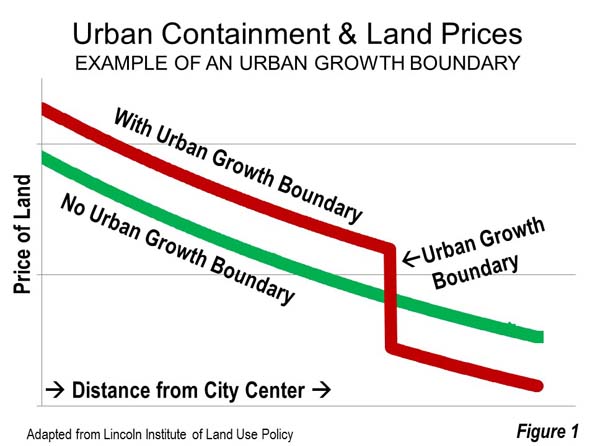
  • Trump’s Pitch to Blacks

    After Trump made a recent speech in Milwaukee in which he directly asked for black votes, I was asked to write a about it. My piece is now online in City Journal and is called “Trump’s Pitch to Blacks.”

    I personally doubt whether he’s really going after black votes (though of course he wouldn’t mind getting some). Rather, this is designed to polish his image as more inclusive. What’s more, his language of “law and order” seems more designed to appeal to whites, and he mentions nothing about black grievances with the police (in contrast to his previous rhetoric in which he labeled the shootings of Alton Sterling and Philandro Castile “terrible” and “disgusting”).

    He also talked about his economic policies, etc. But the focus of my piece was on his immigration pitch. Large scale immigration seems likely to downgrade black aspirations and social justice claims in the American political sphere over the long term:

    As ethnic groups multiply and grow in America, often borrowing the template of the civil rights movement for their own goals, they dilute the claims of black Americans. A study by sociologists Mary C. Waters, Philip Kasinitz, and Asad L. Asad argued that “the increasing racial diversity of the population owing to immigration means policies that aim to promote racial equality but that are framed in terms of diversity often do not address the needs of native African Americans who, arguably, need such policies the most.” Diversity used to mean “black.” Now it can mean anything from a Mexican small-business owner to a Chinese software developer to a Pakistani doctor. Major Silicon Valley firms actually employ a lower share of whites than the population as a whole—and virtually no blacks.

    Click through to read the whole thing.

    I have generally been a proponent of immigration (or outsiders generally), arguing that a critical mass of outsiders is necessary to civic dynamism, and that we have actually sucked out many of the risk takers and entrepreneurs from Mexico.

    But we can have too much of a good thing. Clearly, we’ve reached the point where the level of immigration is having socially destablizing consequences. Brexit is a perfect example. You can say that’s just racism or whatever. But even if it is, it doesn’t excuse Remainers who refused to make any changes from their share of the blame. Politics exists in the realm of human reality, not utopian ideals.

    One likely consequence of U.S. diversification resulting from the current immigration trend is that the claims of blacks will be downgraded in society. Black Americans are longstanding citizens who have suffered unique historic injustices and have yet to be integrated into the economic and cultural mainstream of the country. I believe that’s an urgent task. But it doesn’t seem likely that immigrants and their children will feel a special debt to black Americans in the way that whites – soon to be a minority themselves – do.

    Indeed, immigration has already shifted demographics in some cities to make the prospect of future black mayors very unlikely. I highlight this in the piece with regards to Chicago:

    Immigration has also badly diluted black voting power and political influence in many cities. In 1980, Chicago was about 40 percent black and 14 percent Hispanic. Blacks and lakefront liberals formed an electoral alliance to elect Harold Washington as the city’s first black mayor in 1983. Today, after black population losses and a doubling of Latino population share, the city’s one-third white, one-third black, and one-third Latino population produces a divide-and-rule dynamic benefiting white mayors like Richard M. Daley and Rahm Emanuel.

    Again, read the whole thing.

    Aaron M. Renn is a senior fellow at the Manhattan Institute, a contributing editor of City Journal, and an economic development columnist for Governing magazine. He focuses on ways to help America’s cities thrive in an ever more complex, competitive, globalized, and diverse twenty-first century. During Renn’s 15-year career in management and technology consulting, he was a partner at Accenture and held several technology strategy roles and directed multimillion-dollar global technology implementations. He has contributed to The Guardian, Forbes.com, and numerous other publications. Renn holds a B.S. from Indiana University, where he coauthored an early social-networking platform in 1991.

    Image at top my photo of an anti-Trump rally in New York. Cover photo by Gage Skidmore. CC BY-SA 3.0