Tag: middle class

  • How California Went From Top of the Class to the Bottom

    California was once the world’s leading economy. People came here even during the depression and in the recession after World War II. In bad times, California’s economy provided a safe haven, hope, more opportunity than anywhere else. In good times, California was spectacular. Its economy was vibrant and growing. Opportunity was abundant. Housing was affordable. The state’s schools, K through Ph.D., were the envy of the world. A family could thrive for generations.

    Californians did big things back then. The Golden State built the world’s most productive agricultural sector. It built unprecedented highway systems. It built universities that nurtured technologies that have changed the way people interact and created entire new industries. It built a water system on a scale never before attempted. It built magnificent cities. California had the audacity to build a subway under San Francisco Bay, one of the world’s most active earthquake zones. The Golden State was a fount of opportunities.

    Things are different today.

    Today, California’s economy is not vibrant and growing. Housing is not affordable. There is little opportunity. Inequality is increasing. The state’s schools, including the once-mighty University of California, are declining. The agricultural sector is threatened by water shortages and regulation. Its aging, cracking, highways are unable to handle today’s demands. California’s power system is archaic and expensive. The entire state infrastructure is out of date, in decline, and unable to meet the demands of a 21st century economy.

    Indications of California’s decline are everywhere. California’s share of United States jobs peaked at 11.4 percent in 1990. Today, it is down to 10.9 percent. In this recession, California has been losing jobs at a faster pace than most of the United States. Domestic migration has been negative in 10 of the past 15 years. People are leaving California for places like Texas, places with opportunity and affordable family housing.

    California’s economy is declining. Those of us who live here can all see it. Yet, Californians don’t have the will to make the necessary changes. Like a punch-drunk fighter, sitting helpless in the corner, California is unable to answer the bell for a new round.

    Pat Brown’s California – between 1958 and 1966 – crafted the Master Plan for Higher Education, guaranteeing every Californian the right to a college education, a plan that has served the state very well. That system is threatened by today’s budget crisis and may be on the verge of a long-term secular decline. California was a state where people said yes, a state where businesses could be created, grow, and prosper. Some of these businesses were run by Democrats, others Republicans but all celebrated a culture of growth and achievement.

    Today’s California is a state where building a home requires charrettes with the neighbors, years in the planning department, architects, engineers, and environmental impact studies – we built the transcontinental railroad in three years, faster than a builder can get a building permit in many California communities. People here dream of a green future but plan and build nothing. There’s big talk about the future, but California now turns more and more of our children away from college, and too many of our least advantaged children don’t even make it through high school.

    Once, California was a political model of enlightened government. Now it’s a chaotic place where everyone has a veto on everything; a state where people say no; a state where business is wrapped up in bureaucracy and red tape; a state our children leave, searching for opportunity; a state with more of a past than a future.

    Some things have not changed. California’s physical endowment is still wonderful. The state is blessed with broad oak-studded valleys, incredible deserts, magnificent mountains, hundreds of miles of seashore, and an optimal climate. California’s location on the Pacific Rim situates the state to profit from growing international trade with the dynamic Asian economies. California didn’t change, Californians changed. Californians have forgotten basics that Pat Brown knew instinctively.

    How did California get to this point? How did it move from Pat Brown’s aspirational California to today’s sad-sack version? What did Pat Brown know in 1960 that Californians now forget?

    First thing: Pat Brown knew that quality of life begins with a job, opportunity, and an affordable home. Other Californians in Pat Brown’s time knew that too. His achievements weren’t his alone. They were California’s achievements.

    It seems that California has forgotten the fundamentals of quality of life. Instead, the state has embraced a cynical philosophy of consumption and denial. The state’s affluent citizens celebrate their enjoyment of California’s pleasures while denying access to those less fortunate, denying not only the ticket, but the opportunity to earn the ticket. At best California offers elaborate social services in place of opportunity.

    Today, too many Californians don’t rely on the local economy for their income. For them, quality of life has nothing to do with jobs, opportunity, or affordable homes. Many see the creation of new jobs as bad, something to be avoided. They see no virtue in opportunity. They have theirs, after all. It is their attitude that if someone else needs a job, let them go to Texas; if people are leaving California, so much the better.

    They see someone else’s opportunity as a threat to them. Perhaps the upstarts will want a house, which might obstruct their view. They see economic growth as a zero sum game. Someone wins. Someone loses.

    This type of thinking is unsustainable. Opportunity is not a zero sum game. It may be a cliché, but it is true, that if something is not growing it is dying. Many of the things that make California the place it is are not part of our natural endowment. The Yosemite Valley is part of the state’s natural endowment, but the Ahwahnee Hotel is not. Monterey, Santa Barbara, San Francisco, the wine countries, and California’s many other destinations were made possible and built because of economic growth. Will California add to this impressive list in the 21st century?

    Not likely. Today, we are not even maintaining our infrastructure. Infrastructure investment’s share of California’s budget has declined for decades. In Pat Brown’s day California often spent over 20 percent of its budget on capital items. Today, that number is less than seven percent. It shows.
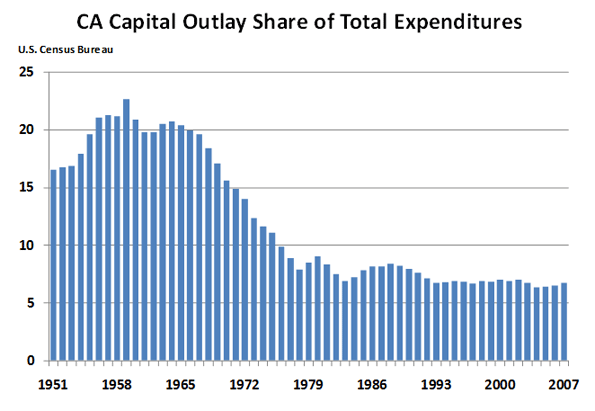
    Pat Brown also knew that with California’s natural endowment, all he had to do was build the public infrastructure and welcome business, business will come. Too many today act as if they believe that business will come, even without the infrastructure or a welcoming business climate. Indeed, many Californians – particularly in the leadership in Sacramento – seem to think that business will come no matter how difficult or expensive the state makes doing business in California. This is just not true.

    California needs to embrace opportunity and economic growth. It is necessary if California is to achieve its potential. It is necessary if California is to avoid a stagnant future characterized by a bi-modal population of consuming haves and an underclass with little hope or opportunity and few choices, except to leave.

    Bill Watkins is a professor at California Lutheran University and runs the Center for Economic Research and Forecasting, which can be found at clucerf.org.

  • The Crisis Next Time: Public Finance

    The financial crisis of 2008 paved the way for the employment crisis of 2009, which has now paved the way for the upcoming public finance crisis of 2010. Most federal, state and municipal budgets are strained to the breaking point while the economy still has not found its footing. Meanwhile our national politics is obsessed with expensive overhauls of environmental policy and healthcare reform. Our latest policy strategy is an attempt to borrow and spend our way to prosperity, ala Japan of the past twenty years.

    It’s tempting to point to a few simple causes of these economic misfortunes, such as mortgage subsidies, loose credit standards, or excess financial leverage, but the truth is that we are experiencing the fallout of a failed policy paradigm.

    This paradigm was rooted in the past century with the creation of the Federal Reserve in 1913, the Employment Act of 1946 and the Humphrey-Hawkins Full Employment and Stabilization Act of 1978. It’s a paradigm dependent on many admittedly useful policy tools, including both Keynesian demand stimulus and the Austrian school’s theory of money and credit, the monetarism of Friedman, as well as the supply-siders of the 1980s.

    So, in what ways have these approaches failed?

    The policy goals are clearly stated: stable GDP growth and full employment. But the economic results have been decidedly mixed: the growth of real incomes laden with an exploding entitlement state, structural budget crises, widening wealth disparities, a catastrophe-prone banking system, and volatile asset markets. We’ve heard the term “systemic risk” bandied about the recent financial crisis, but this report card captures the true risks of the system we’ve created.

    Politically and socially, Americans clearly want a society where a growing middle class thrives, opportunity exists for individual success and advancement, and a prosperous elite accepts the responsibilities of power not to exploit the weak and disadvantaged. Instead, our political economy is hollowing out the middle class, creating more dependency among the poor, and fostering a culture of corruption and irresponsibility among the elites. Elsewhere I’ve characterized this current state of affairs as Casino Capitalism and Crapshoot Politics.

    Second question: why has our democratic politics failed to deliver? The short answer: Our government is doing too much of what it shouldn’t be doing and not enough of what it should.

    Free market economies are very good at producing wealth by harnessing the incentives of market participants. Market prices are valuable information signals that tell everyone how much of each good to produce. Governments, however, no matter how enlightened, cannot attain this efficiency. But, due to the political imperative to “do something” in response to countless demands, they feel compelled to try. Thus the focus on “growing the economy” and “creating jobs.”

    Unfortunately, these goals often demand incompatible policies, highlighting the differences between the private and public sectors. Private firms earn profits (i.e., create wealth) by increasing productivity, often by reducing labor costs. However, the public sector follows no profit criteria, so the government increases employment without attention to productivity. Thus, with more public sector jobs we create more employment while producing less. At the same time, the growth of the public sector empowers a politically powerful public union interest in its continued expansion. This is no way for a nation to grow rich.

    When we peel away the logic we find the true goal of public sector job creation: political redistribution of the economy’s wealth-creating capacity in order to mitigate the effects of markets. This is not an unworthy societal goal, but our public policies adopt counterproductive means to achieve it.

    To be fair, the political problem arises because private markets are agnostic towards the distributional effects of their success. Inequality, poverty, pollution, environmental degradation, the concentration of economic and political power – all these are unfavorable distributional effects of markets that give rise to political demands. The question is over how government should meet these demands.

    The 20th century attempt to tax and redistribute wealth has landed the modern welfare state in a cul-de-sac of exploding budgets, rising costs of living, slower economic growth and structural unemployment. We’re robbing Peter to pay Paul and neither – except for a relative handful of bureaucrats and rent-seeking capitalists – is better off for it. This adds up to less opportunity all around. Again, the problem is with our failed paradigm. We need to align our policies with behavioral incentives without surrendering our policy goals to an agnostic market mechanism.

    To construct a new paradigm we might do best to return to first principles of what Americans want: freedom, opportunity and justice. In order to enjoy these principles, citizens need to be empowered with choice, autonomy, and protection from unmanageable risks. Only functioning free and competitive markets can provide the necessary resources.

    So, what should be the proper role for government?

    The maldistribution of resources can be mitigated if citizens participate in the wealth creating process as more than an input labor cost. Public policy should cease deficit spending to promote employment and instead look to creating the necessary environment for private risk-taking, saving, investment, and production. This includes insuring market competition and mitigating the effects of economic risk and uncertainty. Tax and regulatory policies should promote the widespread accumulation, diversification, and access to capital to empower individuals and families with the necessary resources to build wealth and insure themselves against uncertainty. Where private insurance markets are incomplete, there is a role for limited social insurance to fill the gap.

    Numerous specific policies flow from this general paradigm shift, for example, we can stop penalizing savings through overly loose credit and onerous tax policies on interest and dividend income. There is no reason not to have a tax-free threshold for capital income that reflects the desired savings level of the median annual income household.

    Why have we stuck with a failed policy paradigm? Part of the answer is the Kuhnian nature of scientific revolutions, but the pursuit of power and influence by narrow interests is certainly a determinant factor. Economically and socially, we know where we need to go. Getting there politically is another matter. Our present political leadership (of both parties) certainly is not taking us in that direction.

    Michael Harrington is a policy analyst and writer with a multidisciplinary background in economics, finance and political science. His specialties are international capital markets, trade, and social insurance. He has taught political science at UCLA and conducted economic research for The Reason Foundation, The Milken Institute and the US Chamber of Commerce. His published writings and opinions have appeared in numerous business journals, including the Wall Street Journal, Barron’s, BusinessWeek, the Economist, the Christian Science Monitor and the Los Angeles Times.

  • The Suburbs are Sexy

    The Administration’s Anti-Suburban Agenda: Nearly since inauguration, the Administration has embarked upon a campaign against suburban development, seeking to force most future urban development into far more dense areas. The President set the stage early, telling a Florida town hall meeting that the days of building “sprawl” (pejorative for “suburbanization”) forever were over. Further, a number of bills have been introduced in the Congress that would attempt to discourage suburban development, some under the moniker of “livability,” which promises to improve people’s lives by enforcing planner-preferred density. The war against the suburbs is by no means new, but the Administration and some members of Congress have proposed their own “surge” in hopes of suppressing them permanently.

    The Mythical “Demise” of the Suburbs: Nearly since the pace of suburbanization increased, following World War II, critics have been foretelling the demise of the suburbs. During the 1950s and 1960s, some planning “visionaries” such as Peter Blake were predicting widespread municipal bankruptcies in the suburbs and for residents. This was occurring even as other urban planners were tearing up cities with urban renewal projects and freeways, setting the stage for “block-busting” and an ever-widening racial divide. The early criticisms have been repeated through the years, justifying a paraphrase of the old saw about Brazil (“Brazil is the country of the future and always will be”): “The suburbs are the wasteland of tomorrow and always will be.”
    The Real Decline of the Cities: In fact, it has more generally been the central cities that nearly went bankrupt, not the suburbs. Examples include New York, Philadelphia, Pittsburgh, Cleveland and that jewel of municipal consolidation, Indianapolis, rescued last year by $1 billion in state taxpayer funds. There are hopeful signs of a renaissance in most central cities, however their financial difficulties remain intractable and large swaths of their land area remain desolate. Meanwhile, the lawns were mowed in the suburbs, the houses painted and a strong sense of community developed among residents that was far too subtle for the prophets of suburban doom to perceive.

    Greenhouse Gas Emissions: More recently, the effort to reduce greenhouse gas (GHG) emissions has given suburban critics new ammunition. A simple mantra was dictated by “planning common sense.” Cars produce greenhouse gases, therefore people must get out of cars and live in more dense conditions, where they will not need to drive as much. Further, they will live in smaller, multi-family dwellings, which planning common sense teaches are more GHG friendly than the despised – except by those who choose to live in them – detached housing in the suburbs.

    But a funny thing happened on the way toward GHG inspired desurburbanization. Some academics actually began looking at data. The reality of the suburbs turned out to be rather different from that portrayed by the conventional wisdom of the planners. The most comprehensive research comes from Australia, some of which has been previously covered here.

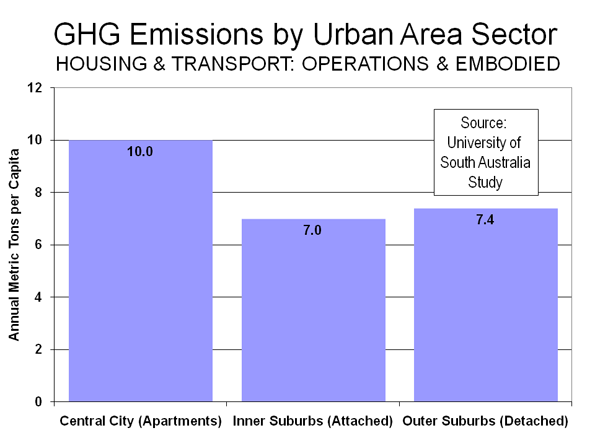
    University of South Australia: The most recent (and new) offering comes from a University of South Australia report thatallocates transportation and residential energy produced GHGs by location and housing type in the Adelaide area. The researchers found that the most GHG friendly sector of the urban area was the inner suburbs, which are dominated by single-family attached housing. GHG emissions per capita from housing and transportation were estimated at 7.0 metric tons of GHG emissions per capita annually.

    However, the outer suburbs, principally with detached housing, were not far behind at 7.4 tons GHG emissions per capita. The highest GHG emissions per capita, by far, were in the central area, with its predominance of multi-unit housing. There the annual GHG emissions were estimated at 10.0 tons per capita (See Figure). The University of South Australia study includes an element missing from virtually all other examinations of transportation and residential GHG emissions: “embodied emissions.” Embodied emissions are the GHGs from construction or manufacturing materials, and from building cars, transit vehicles and buildings. Embodied GHG emissions are ignored by much research, but are a significant factor in GHG emissions. For example, multi-unit housing, with higher use of concrete and more complex construction methods, tends to be substantially more GHG intensive than building detached housing or townhouses.

    GHGs from Common Energy: Previous work by Sydney researchers reached similar results – townhouse development was the most GHG friendly, followed closely by detached housing. Both were substantially less GHG intensive than high-rise condominium development. A principal reason for this conclusion stems in part from the fact that this research included GHGs from common energy, such as the electricity used to power elevators, parking lot and common area lighting, building-provided heating, air conditioning and water heating. American and Canadian research attempting to quantify GHG emissions by residential building type generally has not accounted for common energy and its GHG emission. Yet a gram of GHG from a residential elevator has the same impact as one produced by driving to the local Target store.

    GHG Friendly Suburbs: The most comprehensive research was conducted by the Australian Conservation Foundation. This was not the typical, incomplete or theoretical study of greenhouse gas emissions. The study included virtually every gram of greenhouse gas emissions in Australia and allocated them to consuming households in small residential zones within urban areas and around the nation. Suburban locations, with their greater use of cars and higher percentage of low density detached housing, had lower GHG emissions per capita than the core areas, with their greater use of transit and walking and their high-rise multi-unit housing.

    Compact Development: These findings provided the impetus to review the potential impact of compact development policies. Compact development policies (also called “smart growth” or “growth management”) generally seek to densify urban areas, by drawing urban growth boundaries, outside of which development is prohibited, and by trying to force people to drive less and to use transit more. Again, “planning common sense” clearly indicated to planners that compact development would yield substantial benefits in GHG emissions, principally because people would drive less.

    Yet the more recent research on compact development finds something much different. Densification scenarios from two recent reports, the congressionally mandated Driving and the Built Environment and a smart growth coalition’s Moving Cooler, showed that by 2050, compact development could reduce GHG emissions from driving by only 1% to 9%. At the high end of the range, the most new development would be directed to only a small part of present urban footprints, a policy outcome less believable than a balanced federal budget next year.

    Moreover, these projections have to be considered overly optimistic, because they make no allowance for the higher GHG emissions that occur as traffic slows and stops more in higher density conditions.

    The President Discovers the Suburbs? Meanwhile, on December 15, President Obama took the opportunity to visit a suburban Washington Home Depot, a chain that is a very symbol of American suburbanization. The President could have taken the opportunity to orate further against the suburbs in the insulation aisle, urging households to abandon the suburbs and move to high rise condominiums in the city.

    That was not to be. The President instead proposed providing incentives to people to make their houses more energy efficient, which would reduce greenhouse gas emissions and save money on consumer energy bills. In particular, he cited insulation, saying that “insulation is sexy”. It is worth noting that the Home Depot’s insulation is principally sold to suburban homeowners who can readily arrange for its installation. Residents of high-rise condominiums must rely on their building managers, who tend to purchase their insulation from wholesalers, rather than retailers like Home Depot and Lowes.

    The President explained why insulation was sexy, noting that saving money is sexy. Indeed, saving money is what the suburbs are about. The economic research is clear that housing costs are far less where suburban development is not limited by the compact development strategies that artificially create land scarcity. That’s why places like Dallas-Fort Worth, Atlanta and Houston, without compact development, had little, if any housing bubble, while housing bubbles of economy-wrecking proportions occurred in California and Florida, with their compact development.

    Yes, Mr. President, insulation is sexy. Saving money is sexy. And, the suburbs are sexy.

    Wendell Cox is a Visiting Professor, Conservatoire National des Arts et Metiers, Paris. He was born in Los Angeles and was appointed to three terms on the Los Angeles County Transportation Commission by Mayor Tom Bradley. He is the author of “War on the Dream: How Anti-Sprawl Policy Threatens the Quality of Life.

  • The Green Movement’s People Problem

    The once unstoppable green machine lost its mojo at the Climate Change Conference in Copenhagen. After all its laboring and cajoling, the movement at the end resembled not a powerful juggernaut but a forlorn lover wondering why his date never showed up.

    One problem is that the people of earth and their representatives don’t much fancy the notion of a centrally dictated, slow-growth world. They proved unwilling to abandon either national interest or material aspirations for promises of a greener world.

    The other problem is that divisions are now developing within the green camp. There are members, like Michael Shellenger and Ted Nordhaus, who recognize the serious fall out from the “Climategate” scandal, while others, including large parts of the media claque, dismiss any such possibility. There are the corporatists aligned with big business–who will live with any agreement that allows them to exact monopoly profits–and the zealots–like Greenpeace, Friends of the Earth and Bill McKibben–who see Copenhagen as an affront to themselves and to our endangered planet.

    But the main, fundamental problem facing the movement after Copenhagen–which none of the green factions have yet addressed–is its people problem. The movement needs to break with the deep-seated misanthropy that dominates green politics and has brought it to this woeful state. Its leaders have defined our species as everything from a “cancer” to the “AIDs of the earth.” They wail in horror at the thought that by the year 2050 there will likely be another 2 or 3 billion of these inconvenient bipeds. Leading green figures such as Britain’s Jonathan Porritt, Richard Attenborough and Lester Brown even consider baby-making a grievous carbon crime–especially, notes Australian activist Robert Short, in those “highly consumptive, greenhouse-producing nations.”

    Yet a slower population growth–while beneficial for poor, developing countries–can lead to a dismal, geriatric future in already low-birthrate nations like Germany, Italy, Spain, Japan, South Korea and Russia. And although birth rates are dropping in most developing countries, particularly those experiencing rapid economic growth, it will likely be decades before population stops increasing in most of the developing world.

    Besides, people in developing countries have much more important things to worry about–such as earning a living and getting ahead. Fighting climate change ranks low on the list of Third World priorities. The sprawling slums of Mumbai need more energy, not less; they want better roads, not fewer. More economic development would produce the money to help clean the now foul water and air, but also provide access to better education, one of the best ways to assure more manageable birth rates.

    Instead of looking to make developing countries even more dependent on Western largesse, greens should focus on ways to help improve the day-to-day lives of their people. Rather than prattle on about the coming apocalypse, they could work to replace treeless, dense slums with shaded low-lying clean houses that are easier to heat or cool. Those interested in nature might purchase land and rebuild natural areas. The children of cities like Mumbai should have the opportunity to experience wildlife other than crows, pigeons and rats.

    The environmental movement also might as well forget fighting the aspirations of the burgeoning middle class in India, or other developing countries. No developing world politician, whether from democratic India or Brazil or authoritarian China will embrace an agenda that stifles such aspirations.

    Post-Copenhagen greens need to reassess their relations with people in the developed countries as well. The popular call to transfer hundreds of billions of dollars from the so-called “rich” countries to combat the potential effects of climate change will not be very popular with the vast majority of the middle or working classes in these places.

    Much of the problem revolves around the loaded term “rich.” To be sure, many top climate-change scolds–Richard Branson, Al Gore, Arnold Schwarzenegger, Michael Bloomberg and, of course, his royal highness, Prince Charles–qualify easily. After all, no sweat off their well-massaged backs. The rock stars of the green millennium can buy their environmental indulgences so they can gorge good conscience on their carbon-rich world of private jets and lush estates.

    For them, going green means minimal sacrifice.

    Instead, the “rich” who will suffer the most will be the middle and working class of the developed countries. For them, carbon “sacrifice” may mean more than giving up needless luxuries like gas-guzzlers or monster plasma televisions. A green regime of enforced slow growth and ever greater regulation over carbon could threaten whole industries while environmental-planning policies will make purchasing a decent suburban house even more difficult.

    Such calls for sacrifice seem particularly ill-timed when 4 in 10 U.S. residents fear they could lose their jobs, with many rightly worried about holding onto their homes. With unemployment at 10%, few may be willing to wait around until the promised “green jobs” miraculously appear to save both them and the planet.

    But there’s an obvious way out of this dilemma: Start shifting away from fear-mongering and look to ways to achieve green goals without catastrophic economic losses. One clear way to start this process is through land-use policy. Right now many activists and their allies in the climate-industrial complex–which includes urban land interests–want to force suburban home dwellers into dense urban areas. They also want to coerce people to give up their individual mobility for trains, even if this means longer commutes and less convenience.

    Proposing a radical re-engineering of society does not constitute a winning political program. Environmentalists would do better to embrace a vision of “greenurbia,” allowing for dispersed living but in a environmentally responsible way. This could be done with practical steps–increased telecommuting, more tree-planting and flexible work arrangements–that would enhance not only the environment but also day-to-day life for hundreds of millions of people.

    Similarly, environmentalists should redouble their efforts to provide more access to open space for millions of people through expanded purchases of land throughout the country. America’s highly productive agricultural sector has jettisoned millions of acres of land from cultivation, providing an excellent opportunity for purchases for public use. In some areas, abandoned industrial or mining properties could be rehabilitated as natural areas.

    Such changes, however, require a re-evaluation of the values that now drive the green movement. Whether in California or Calcutta, it boils down to the existential question: Do humans matter?

    Frederick Law Olmsted explained his plan for New York’s Central as an attempt “to supply to the hundreds of thousands of tired workers … a specimen of God’s handiwork.” This represents the kind of sensibility that could transform the green movement from an obstacle to people’s aspiration to a force for greater human happiness.

    This article originally appeared at Forbes.com.

    Joel Kotkin is executive editor of NewGeography.com and is a distinguished presidential fellow in urban futures at Chapman University. He is author of The City: A Global History. His next book, The Next Hundred Million: America in 2050, will be published by Penguin Press early next year.

  • Nurturing Employment Recovery

    President Obama’s quick exit from Oslo and late arrival in Copenhagen suggest he’s finally ready to shift focus from Nordic adulation and fighting climate change and diplomacy to fixing the American economy. About time. As former Clinton adviser Bill Galston observed recently, the president needs “to pivot and make 2010 the year of jobs.”

    White House operatives, as well as the Democrats in Congress, know high unemployment could bring big political trouble next year. But in their rush to create new jobs, policy makers would do well to focus on the quality of jobs created over the next year and beyond.

    On this score, the slight improvements in the job picture are far from sufficient. The most recent analysis of employment over the past year by the Web site JobBait shows that almost all the growth has occurred in three fields–government, education and health care.

    The problem: All these fields are financed by taxpayers or through transfer payments. They do little to expand our exports, and they employ few of the blue- collar male workers who have been hardest hit by the “hecession.”

    Unemployment for men is over 2.5% higher than for women, the largest gap in history. In all but a handful of states, male-dominated fields such as transportation, mining and logging, manufacturing and warehousing have declined rapidly over the past year. The only states to experience gains were North Dakota, Montana and West Virginia.

    This reflects the critical weakness in the stimulus package. The stimulus focused on government bailouts and transfers of research funds to universities, while less than 5% went to basic infrastructure. But a greater emphasis on infrastructure would not only have created large numbers of construction jobs, it would have boosted our industrial competitiveness by eliminating bottlenecks in our transportation system.

    The only big regional beneficiary of expanding government employment has been, unsurprisingly, the Washington Beltway. Indeed, the number of federal bureaucrats making $100,000 or more jumped from 14% to 19% since the recession–and that’s $100,000 before overtime and bonuses.

    Elsewhere, the surge of government employment is petering out, particularly on the state and municipal levels. These jurisdictions are running out of money, since they are unable to print their own. Over the past year government jobs contracted in financially strapped states like California, Oregon, Michigan and Florida, as well as throughout the Northeast and New England. There’s little hope for much improvement in 2010.

    The other two sectors to enjoy significant growth have been education and health. Yet these fields do not seem to generate the broad-based economic growth needed to boost the overall economy. The region most often favorably linked with the “eds and meds” economy, Pittsburgh, has produced only modest, below-average job growth over the past generation. In fact, Pittsburgh has looked successful largely because the region has continued to hemorrhage its population to other regions, and it attracts few foreign immigrants.

    Yet the fiscal damage from dependence on public and nonprofit employment has been enormous. The city suffers a billion-dollar unfunded pension liability, among the highest in the nation on a per-capita basis. Due to the heavy local presence of institutions of higher education, nonprofits and hospitals, who keep about 40% of Pittsburgh’s property remains tax-exempt. In a sign of desperation Mayor Luke Ravenstahl recently proposed taxing tuition at local colleges and universities, eliciting outrage from the academic world.

    More important, the Pittsburgh “eds and meds” model can’t really be applied to a country whose workforce will expand by roughly 1 million annually over the next decade. The country now has fewer jobs than it had in March 2000, even though the labor force has grown by 12.1 million workers. There is no way we can produce enough growth depending on sectors that feed off taxpayers and private enterprise.

    This shortfall will be particularly tough on millenials as they enter their 20s and 30s. Already those 18 to 24 now have an unemployment rate over 18%. Not surprisingly, as Morley Winograd and Mike Hais observe, lack of jobs now stands as the No. 1 concern for those under 30.

    Another problem: We are now producing many more educated workers than we can gainfully employ. Information jobs may not be disappearing at the rate of industrial ones, but they have lost nearly 3 million positions since 1999. One likely result has been that returns to education–hyped by academics and “progressive” economists–have been dropping, particularly for younger workers. The unemployment rate for recent college grads is currently 10.6%, a record high.

    So, how to create opportunities that pay well? Some place their hopes in either the “green” or “creative” economies. But the green sector has been notably ineffective in sparking growth across other parts of the economy. A much-hyped report issued by California green-boosters bragged “green jobs”–which included everything from public relations representatives to marketing managers, accountants and brick-layers–account for something like 1% of employment. Even with heavy subsidies by taxpayers, the “green” sector seems unlikely to rescue an economy with 12.5% unemployment.

    Many politicians, particularly California’s increasingly delusional governor, also fail to recognize the cost that the “green agenda” exacts on a struggling economy. A draft report by a state advisory committee estimates California’s new draconian greenhouse gas laws could cost the state economy over $143 billion over the next decade. Efforts to spread this kind of regulation–either through federal legislation or EPA directives–would inflict similar pain to economies beyond the Sierra Nevada.

    As for the much ballyhooed “creative” sector, video producers, financial analysts, architects and other workers in the non-tangible economy are less susceptible to green pressures than factory workers, truckers or farmers. Yet as the JobBait report shows, information, business and professional services haven’t fared well over the past year. So far the only winners in professional and business services are in small states: New Mexico, Utah, South Carolina and, once again, West Virginia.

    Perhaps it’s time to abandon the notion that the U.S. can rely on preferred sectors–“green”, creative or “eds or meds”–to turn around our vast economy. Theorists often forget the essential ties that exist between tangible and intangible sectors. The strongest growth in high-end services are usually propelled by growth in tangible industries, such as energy, agriculture or manufacturing. When those industries tank, as in much of the upper Midwest, high-end services decline with them.

    Green jobs, too, require a strong economy. It is not by mistake that the big cities with the largest numbers of new “green” construction projects are not in Portland, San Francisco or other eco-capitals, but in more robust, if less organically obsessed places like Dallas and Houston. To create green jobs, you need to have growth, particularly in “hard” industries like construction and manufacturing.

    Instead of favoring certain sectors, the administration’s job “pivot” needs to focus across all economic sectors. This can be done in a pragmatic non-ideological manner. It could combine the increase in infrastructure and scientific research spending favored by many on the left with more market-friendly approaches–industrial tax credits and streamlining some regulatory standards–associated with conservatives.

    In the end the goal of policy should not be just to create more jobs, but to nurture employment that will make our economy stronger and more competitive over time. Until that happens, the recovery will create an economy fundamentally unable to sustain itself in an ever more competitive global environment.

    This article originally appeared at Forbes.com.

    Joel Kotkin is executive editor of NewGeography.com and is a distinguished presidential fellow in urban futures at Chapman University. He is author of The City: A Global History. His next book, The Next Hundred Million: America in 2050, will be published by Penguin Press early next year.

  • What To Look For In Healthcare Reform: Location, Location, Location

    A Reuters article that was widely picked up around the globe recently raised the question, Are Doctors What Ails US Healthcare? Comparing the New York suburb of White Plains to Bakersfield, California, the article uses the evergreen two-Americas paradigm to discuss disparities in health care. Drawing heavily on the Dartmouth Atlas of Healthcare, it highlights a sad but inescapable fact: doctors want to live in some places and not in others, giving the “have” populations more intensive medical care which they might or might not need, while have-nots, who tend to be older, sicker and poorer, get health care to match. The article asserts that there’s nothing in current health care reform legislation that will do anything to address the disparities.

    I agree. But then, what should we expect? The legislation, which I find marginally more desirable than doing nothing at all, is largely about insurance, not about health care. This is what happens when we emphasize how we pay for something, rather than what we are paying for. Are doctors what ails U.S. health care? Only in the sense that they are operating on the same basis as everyone else in the health care market: every man for himself.

    You don’t have to make bi-coastal comparisons to find the disparities highlighted in the Reuters article. My own Hudson Valley not-for-profit insurance company faces them every day. We cover the Medicaid populations from the aforementioned White Plains, NY, to the South, to the blighted economies of the Catskills to the North and West. The distance involved is only about 150 miles, but day in, day out it might as well be 1500. And socially, it might as well be 150 years. Sullivan County is still organized geographically the way it developed in the eighteenth and nineteenth centuries — farms, woods, and mills, only without the mill jobs.

    There was a brief shining moment (well, half a century) when urban Jews and other vacationers formed the basis of a thriving tourist trade in the “Borscht Belt” resorts of Monticello, Sullivan County’s hot spot. When they closed, they provided ideal settings for residential drug and alcohol rehab for poor people from New York City, but those aren’t exactly the foundation for high-quality community health care. When we initially started offering state-sponsored insurance to the poor of Sullivan County, the historical dearth of specialists made it a laboratory for what a free market looks like when there’s no competition. (Do I hear the words “strong public option”?) Because New York State requires us to have a decent network of contracted doctors for our enrollees, the sole cosmetic surgeon – for example – could extract pretty much any fee he wanted from us in exchange for seeing a patient who needed emergency reconstructive surgery.

    Your tax dollars meet supply and demand and a mandate to pay within a private market.

    I don’t blame the specialists. They are highly trained and skilled, and have paid their dues. If I blame anyone, it’s the system that sets the dues so high, in the form of college and medical school loans and years of fellowships that leave well-meaning doctors feeling that they deserve all that money, just like corporate farmers and hedge fund managers.

    It’s also not the doctors’ fault that they want good schools and cultural amenities. I haven’t seen much of Bakersfield, but I know that schools in and around White Plains have good reputations and are just twenty miles from Broadway and the Metropolitan Museum (and ten miles from my Tarrytown office). Maybe we can fix schools and reinvigorate the National Endowment for the Arts to make every remote locale more like Westchester, but that would be socialism.

    Dartmouth Atlas data is easily available online, and well worth spending some time with. You can use it to create all kinds of two-America scenarios that provide instant object lessons in our health care inequities. My personal favorite is that health care spending in Miami, Florida for Medicare patients in the last two years of life (highest in the nation) is exactly twice that in Portland, Oregon (lowest of the regions studied), with commensurate volumes of appointments, referrals, tests and hospitalizations, and no better outcomes. Here we see the same dynamics that make pawnshops spring up around gambling casinos and candy stores near public schools. Doctors go where the customers are, and once they arrive they maximize their revenues and measure success by volume, not outcomes.

    Why should we expect anything different, when reform legislation is captive to the same kind of have/have not dichotomy that shapes health care delivery itself? Senators Max Baucus of Montana and Kent Conrad of North Dakota are two of the pillars of the anti-public option caucus. They come from states with small populations, and both take barrels of money from the health insurance industry because they can’t raise it locally. If they play their cards right, who knows? They could leave Congress and become haves themselves, like Billy Tauzin, who is now Big Pharma’s man in Washington, having engineered the passage of Medicare Part D, or Tom Daschle, once a champion of single payer, who now plays both sides of the street with special interest money.

    Are Doctors What Ails US Healthcare? quotes David Goodman, Director of Health Policy Research at the Dartmouth Institute for Health Policy and Clinical Practice, who says there’s an “irrational distribution” of the most valuable and expensive U.S. health care resources. I would say that the distribution is entirely rational given the insanity of the larger situation.

    If we’re ever going to find our way out of this mess, we’re going to have to do for these health care backwaters, both rural and urban, what we used to do when private capital wouldn’t do the job. Set goals and build the infrastructure to serve them, because the market won’t do it. Want to electrify Appalachia? You need the TVA. Want to make the desert bloom? Build dams and aqueducts. Want to open up the interior of the country? Build an Interstate Highway system. Want doctors to practice in unattractive markets? Create an MD Bill for doctors like the old GI Bill for veterans, so that doctors emerge from training feeling more like public servants and less like indentured servants.

    I attended a discussion of health care reform not long ago at the Yale School of Public Health. The representative of the private health insurance industry put the issues in a compelling perspective, although not, perhaps, for the reasons he cited.

    His arguments were three: First, we require automobile owners to carry insurance, so requiring everyone to carry health insurance shouldn’t be a problem (I know that President Obama made this point, too, and I hated him for it). Second, do you want a health care system that runs like the Post Office, or one that runs like Federal Express? And third, the health insurance industry is really a jobs program, and do we really want to put all those people out of work?

    These are shallow arguments. Car insurance? There’s no law that says you have to own a car, but everyone needs health care. A health insurance mandate is more like forcing every American to buy a new car and giving them a choice between Ford or GM. Post Office and FedEx? A company that can’t send a package overnight from suburban Tarrytown into New York City without round-trip flights to Memphis and back is no model for health care delivery, and besides, I’d like to see what FedEx can do for the price of first class postage. Jobs? A dynamic economy finds ways of redeploying redundant workers in more significant jobs. Wouldn’t those actuaries make good math teachers?

    The arguments were so hollow that no one bothered to argue, and the insurance rep was undoubtedly relieved. A fellow panelist who practices medicine in Cambridge, Dr. David Himmelstein of Harvard, said simply, “My practice would have no trouble making money on Medicare, single-payer reimbursement rates if we didn’t have to pay so many people to argue with insurance companies.”

    Unfortunately, the larger discussion is still stuck on insurance, and as long as it is, the two health care Americas will never become one.

    Georganne Chapin is President and CEO of Hudson Health Plan, a not-for-profit Medicaid managed care organization, and the Hudson Center for Health Equity & Quality, an independent not-for-profit that promotes universal access and quality in health care through streamlining. Both organizations are based in Tarrytown, New York.

  • Demographics May Be Destiny, but Mind the Assumptions

    Demographic projections have become an essential tool of national, state and local governments, international agencies, and private businesses. The first step in planning for the future is to get a picture of what the terrain is going to look like when you get there. That’s mainly what I do for clients, audiences and subscribers, and demographics provide the frame (like assembling all the straight-edge pieces of a jigsaw puzzle first). But here’s the thing about projections: a small change at an inflection point, or the inclusion (or exclusion) of salient variables, can result in big changes to the future you are trying to describe. So like all treatments of the future, everything depends on the underlying assumptions, and the salience of the variables chosen for inclusion.

    Demographics and Depression?
    For example, a couple of recent essays on demographic trends start with different assumptions, consider different variables, and come to wildly divergent conclusions. David Goldman, associate editor at First Things, says the housing market has collapsed, and will remain in depression, because of the dearth of two-parent families with children.

    Goldman asserts that only a a policy to restore the traditional family to a central position in American life can work to save the housing market. Without this, he says, ”we cannot expect to return to the kind of wealth accumulation that characterized the 1980s and 1990s.“

    Goldman’s argument centers on the idea that the US housing market is driven by one variable: two-parent families with children. And since that variable has not been growing, neither can housing demand. Yet, obviously, other household types besides two-parent families with children desire, can afford, and live in detached houses. Indeed, 55.2% of all single-person households owned homes in 2007, up from 49% in 1990.

    There is also a large population of empty-nest households (people who have already raised their kids), but who choose to continue to live in houses. Other demographic trends that will contribute to the continued preference for detached houses: increased longevity, better health, later childbearing, more home-based businesses, the presence of “delayed launch” kids (or those who boomerang to live at home before “final launch”), or a desire to have room for grandkids to visit. There is also the reality that many people will not want to move because of proximity of neighbors, churches, clubs and work.

    One must also note that foreign immigration and domestic migration, even under lowest-variable projections, will still be substantial in coming decades, fueling housing demand.

    In addition, other demographic trends suggest family and household formations will, once employment and income conditions improve, again provide a demand for houses. For example, there are more people entering their 20s now than in any time since the 1960s and early 1970s. True, we have just passed through a period of slow growth in family-age household formation, but once this Millennial generation start making money in an improving economy, they will start forming families and households, and will start buying houses.

    The World’s New Numbers
    Another recent essay on demographic projections starts with different assumptions, looks at different variables, and comes to different conclusions. Martin Walker, writing in The Wilson Quarterly, notes that something dramatic has happened to the world’s birthrates: they are up in developed countries, and down in developing countries (the opposite of what most dire forecasts project).

    Walker starts by debunking the assumption that mass migration and low birthrates are transforming the ethnic, cultural and religious identity of Europe. He notes the decline of Muslim birthrates across the globe, and rising birth rates in Western Europe – albeit from very low levels – and consistently higher rates in the United States. He then explains that aging populations in Europe and the US will not place intolerable demands on governments’ pension and health systems, if we are willing and able to both raise the retirement age and increase the workforce participation rate.

    These two steps (not easily achieved, but simple in conception) will result in a very manageable dependency ratio, similar to those of the 1960s, writes Walker. In the United States, the most onerous year for dependency was 1965, when there were 95 dependents for every 100 adults between the ages of 20 and 64 (“dependents” include people both younger and older than working age). By 2002, there were only 49 dependents for every 100 working-age Americans. By 2025 there are projected to be 80, still well below the peak of 1965. The difference is that while most dependents in the 1960s were young, most of the dependents of 2009 and beyond are older. But the point is that there is nothing outlandish about having almost as many dependents as working adults.

    The assumption underlying this more favorable scenario is that given freedom and information, that is to say, given the choice, the continuum of progress and development is uniform and universal: people in all places and of all backgrounds desire middle-class lifestyles (which include single-family detached houses, by the way). And while the planet’s population is expected to grow by about one billion people by 2020, the global middle class will swell by as many as 1.8 billion, with a third of this number residing in China. The global economic recession will retard but not halt the expansion of the middle class.

    The economic transition that development brings is accompanied by the demographic transition to lower birth and death rates (social, cultural and political transitions then occur too). Industrialization, urbanization, suburbanization: that is the pattern of how middle-classes grow. First-world countries have traversed this path, and now emerging countries are following.

    Trends can and do change. In fact, it may even be said that every trend sows the seeds of its own reversal. But it has always been my goal to identify the constants across history, as a way to establish a baseline for evaluating the likelihood of future scenarios (again, the straight-edged pieces). I believe the “aspirational model” to be one of these constants.

    Dr. Roger Selbert is a trend analyst, researcher, writer and speaker. Growth Strategies is his newsletter on economic, social and demographic trends. Roger is economic analyst, North American representative and Principal for the US Consumer Demand Index, a monthly survey of American households’ buying intentions.

  • Is Obama Separating from His Scandinavian Muse?

    Barack Obama may be our first African-American president, but he’s first got to stop finding his muse in Scandinavia. With his speech for the Nobel, perhaps he’s showing some sign of losing his northern obsession.

    On the campaign trail, Obama showed a poet’s sensitivity about both America’s exceptionalism and our desire to improve our country. His mantra about having “a father from Kenya and a mother from Kansas” resonated deeply with tens of millions of Americans.

    Obama’s more recent recasting as a politically correct Nordic seemed out of sync. His speech in Oslo – a surprising defense of American values and role in the world – must have shocked an audience that all but the most passionate courtiers suspect he does not deserve.

    But the bigger challenge will come when he rushes off to Copenhagen to push for his politically dubious climate change agenda. This will take a more serious break from his unfortunate tendency to identify first with the global cognitive elite.

    This is a particularly European, and particularly Scandinavian, affliction. In these countries professors, high-level bureaucrats, and corporate chieftains usually dominate the media, policy making and public perceptions. This constitutes an essential part of what is often called the “Scandinavian consensus” model.

    It works pretty well there. Historically homogeneous, affluent and well-educated Scandinavians generally accept working hard and giving up much for people for the poorer members of societies. These admirable attitudes reflect noble Nordic virtues of thrift, study and social trust.

    These values also work reasonably well in Nordic parts of America, such as in North Dakota. When a local economist told Milton Friedman “In Scandinavia we have no poverty”, he replied: “That’s interesting because in America among Scandinavians, we have no poverty, either.”

    As Obama may finally be learning, America is not Scandinavia, outside a handful of places. It is a big, amazingly diverse country with an expanding population. In a country made up of so many crunched together cultures an expansive welfare state faces many problems. (This is one reason northern Europe is having such a difficult time with its immigrants.)

    In a diverse society, you cannot assume that everyone will play by the rules. Coexisting with very different kinds of people, Americans tend to be less than enthusiastic about paying high taxes to support them.

    Demographics are also a major factor. Our relatively youthful and socially diverse population includes a large component of people, particularly males, with limited skills and education. Yet, at least until they were blindsided by falling poll numbers and stubbornly high unemployment, Obama’s administration treated the recession as if it could be cured Euro-style by simply adding more employment in government, education and medical care.

    Similarly the president’s to date dogmatic embrace of an extreme climate change agenda seems one more saleable to Danes or Swedes than people in the Dakotas or South Carolina. After all, they are well-positioned to absorb the costs. Norway and Sweden enjoy huge reserves of hydropower, the largest sources of renewable fuels. Norway also has lots of oil to boot and fellow traveler Netherlands still boasts strong reserves of natural gas.

    The dense land use policies associated with the climate change agenda fit better into small compact cities like Amsterdam, Copenhagen, Stockholm and Oslo than their sprawling American counterparts. In America, the vast majority lives in sprawling suburbs and small towns. With the exception of the Northwest few parts of the U.S. rely on hydropower, with most of the country reliant on coal, oil and natural gas.

    Then there are political risks to Obama’s dogged embrace of the alarmist “climate change” agenda. Recent Gallup, Pew, and Rasmussen surveys show weakening interest in global warming and increasing levels of skepticism. Today we even have considerable disputes over whether the temperature is even warming. Certainly a series of cold winters and mild summers might make some casual citizens a bit skeptical.

    Even one of the scientists whose email was hacked recently at the UK’s University of East Anglia Climate Research Unit wondered, “Where the heck is global warming?” The revelations, now widely known as Climategate, make clear that some of the science – and the scientists – behind the most apocalyptic predictions are suspect, a view now held by a majority of Americans, according to a recent Rasmussen survey.

    Yet so far, Obama appears blissfully unaffected by the swirling controversy. But the man has a full capacity to surprise. Perhaps he will understand that just because the media and his climate advisors have circled the wagons, this may be a case where the “crowds” may be onto something that the self-proclaimed experts would rather ignore.

    Perhaps if President Obama had studied history, rather than law, he might realize that “smart” (i.e. highly credentialed) types often get things terribly wrong. After all, a century ago eugenics – that some races were intrinsically superior to others – stood as the reigning ideology of the scientific community. Back in the 1970s, the scientific consensus embraced by his science advisor, John Holdren, predicted imminent mass starvation, a catastrophic decline in resource availability, and a bleak future for all developing countries, including China and India. This assessment proved widely off the mark.

    Of course, having committed himself to today’s climate orthodoxy, Obama may find it difficult to reverse course. Not only does he seem ill-disposed to challenging the cognitive elites but he also gains support from the well-funded warming lobby – rent-seeking utilities, “green” venture capitalists, investment bankers and urban land speculators – who hope to wrest huge fortunes from a strict carbon regime.

    If he wants to regain his effectiveness, however, the president needs to realize that these groups and the science establishment are just a small fraction of the country that elected him. His speech in Oslo may be the first sign he may be waking up from his Scandinavian slumber to become the assertive, independent American leader that we need.

    Joel Kotkin is executive editor of NewGeography.com and is a distinguished presidential fellow in urban futures at Chapman University. He is author of The City: A Global History. His next book, The Next Hundred Million: America in 2050, will be published by Penguin Press early next year.

  • Capping Emissions, Trading On The Future

    Whatever the results of the Copenhagen conference on climate change, one thing is for sure: Draconian reductions on carbon emissions will be tacitly accepted by the most developed economies and sloughed off by many developing ones. In essence, emerging economies get to cut their “carbon” intensity–a natural product of their economic evolution–while we get to cut our throats.

    The logic behind this prediction goes something like this. Since the West created the industrial revolution and the greenhouse gases that supposedly caused this “crisis,” it’s our obligation to take much of the burden for cleaning them up.

    Plagued by self-doubt and even self-loathing, many in the West will no doubt consider this an appropriate mea culpa. Our leaders will dutifully accept cuts in our carbon emissions–up to 80% by 2050–while developing countries increase theirs, albeit at a lower rate. Oh, we also pledge to send billions in aid to help them achieve this goal.

    The media shills, scientists, bureaucrats and corporate rent-seekers gathered at Copenhagen won’t give much thought to what this means to the industrialized world’s middle and working class. For many of them the new carbon regime means a gradual decline in living standards. Huge increases in energy costs, taxes and a spate of regulatory mandates will restrict their access to everything from single-family housing and personal mobility to employment in carbon-intensive industries like construction, manufacturing, warehousing and agriculture.

    You can get a glimpse of this future in high-unemployment California. Here a burgeoning regulatory regime tied to global warming threatens to turn the state into a total “no go” economic development zone. Not only do companies have to deal with high taxes, cascading energy prices and regulations, they now face audits of their impact on global warming. Far easier to move your project to Texas–or if necessary, China.

    The notion that the hoi polloi must be sacrificed to save the earth is not a new one. Paul Ehrlich, who was the mentor of President Obama’s science advisor, John Holdren, laid out the defining logic in his 1968 best-seller, The Population Bomb. In this influential work, Ehrlich predicted mass starvation by the 1970s and “an age of scarcity” in key metals by the mid-1980s. Similar views were echoed by a 1972 “Limits to Growth” report issued by the Club of Rome, a global confab that enjoyed a cache similar to that of the United Nations’ Intergovernmental Panel on Climate Change.

    To deal with this looming crisis, Holdren in the 1977 book Ecoscience (co-authored with Anne and Paul Ehrlich) developed the notion of “de-development.” According to Holdren, poorer countries like India and China could not be expected to work their way out of poverty since they were “foredoomed by enormous if not insurmountable economic and environmental obstacles.” The only way to close “the prosperity gap” was to lower the living standards of what he labeled “over-developed” nations.

    These predictions were less than accurate. World-wide systemic mass starvation did not take place as population escalated. Rather those many millions wallowing in poverty in the developing world, particularly in Asia, lifted themselves into the global middle class. Far more efficient ways to use energy have been developed, and unexpected caches of new resources continue to be discovered all over the planet.

    Yet however wrong-headed, Holdren’s world view now has jumped from the dustbin of history into the craniums of presidents and prime ministers. President Obama’s pledge to “restore science to its rightful place” has morphed into state-sponsored scientific ideology.

    The blind acceptance of this agenda threatens the credibility of Obama and other Western leaders. For one, if the crisis is by its nature global why should we allow massive increases in carbon emissions in developing countries–China will soon surpass us in greenhouse gas emissions, if it hasn’t already–while we draconically cut ours? Does the planet really care if it’s turned to toast by American- vs. Chinese-made gas?

    Then there’s the specious historical narrative that insists we pay for creating the industrial revolution since it brought on global warming. Should the West pay for the sins of the British who brought electricity and railroads to India? Does America owe carbon penance for making the technology transfers critical to East Asia’s remarkable rise? Maybe we should start by making Wal-Mart cancel its China orders. That might help de-carbonize the planet a bit.

    There’s also growing skepticism about the whole warmist narrative. Climate change now ranks last among 20 top issues in a recent Pew report. There’s been a similar rise in skepticism in the U.K., once a hot bed of warmist sentiment.

    The reasons for the shift may vary. First, there’s a controversy over the temperatures of the past decade, with even some concerned about climate change admitting that there has not been the expected warming. Or perhaps a deep recession has made many “rich” countries feel a trifle less “overdeveloped.”

    And now we have Climate-gate–where leading warmist pedagogues are trying to suppress unsuitably conformist scientists and perhaps even cook the numbers a bit. Although you won’t see too much tough coverage in the mainstream press, the tawdry details have poured out over the Internet and diminished the aura of scientific objectivity of some leading global warming researchers. One recent poll shows that a large majority of Americans believe scientists may have indeed falsified their research data. By well over 4 to 1, they also believe stimulating the economy is a bigger priority than stopping global warming.

    Clearly the political risks of giving first priority to the carbon agenda are on the rise. Australia’s Senate just voted down that country’s proposed cap and trade scheme. The Western center-right, once intimidated by the well-financed greens and their media claque, has become bolder in challenging climate change alarmism.

    There’s also something of a rebellion brewing, at least toward emissions trading schemes, among some liberals from the South and Midwest, notably Wisconsin’s Russ Feingold and North Dakota’s Byron Dorgan. As analyst Aaron Renn has pointed out, these areas are most likely to be negatively affected by the current climate change legislation. Feingold recently stated that he was “not signing onto any bill that rips off Wisconsin.”

    So why do leaders like Barack Obama and British Prime Minister Gordon Brown continue identifying themselves with the climate change agenda and policies like cap and trade? Perhaps it’s best to see this as a clash of classes. Today’s environmental movement reflects the values of a large portion of the post-industrial upper class. The big money behind the warming industry includes many powerful corporate interests that would benefit from a super-regulated environment that would all but eliminate potential upstarts.

    These people generally also do not fear the loss of millions of factory, truck, construction and agriculture-related jobs slated to be “de-developed.” These tasks can shift to China, India or Vietnam–where the net emissions would no doubt be higher–at little immediate cost to tenured professors, nonprofit executives or investment bankers. The endowments and the investment funds can just as happily mint their profits in Chongqing as in Chicago.

    Global warming-driven land-use legislation possesses a similarly pro-gentry slant. Suburban single family homes need to be sacrificed in the name of climate change, but this will not threaten the large Park Avenue apartments and private retreats of media superstars, financial tycoons and the scions of former carbon-spewing fortunes. After all, you can always pay for your pleasure with “carbon offsets.”

    So who benefits from this collective ritual seppuku? Hegemony-seeking communist capitalists in China might fancy seeing America and the West decline to the point that they can no longer compete or fund their militaries. A weakened European Union or U.S. also won’t be able provide a model of a more democratic version of capitalism to counter China’s ultra-authoritarian version.

    The Chinese may win a victory in Copenhagen greater than anything accomplished so far in the marketplace–and our leaders will likely thank them for it. Forget bowing to the emperor in Tokyo; like vassal states at the height of the old Middle Kingdom, the new requisite diplomatic skill for Westerners will be kow-towing to Beijing.

    Yet most people in the developing world will not benefit from the suicide of the West. The warmists’ vision is not one of growing prosperity, but of capping wealth at a comparatively low level. De-industrialization means the West falls back while emerging economies grow a bit. The “prosperity gap” may close, but ultimately everyone is left with less prosperity.

    In the long run developing countries gain less from harvesting guilt than enjoying a bounty of customers, capital and expertise. The West’s experience and technology can assist developing nations in improving their far more greatly threatened environment. Turning the West into a spent force will leave the world poorer, dirtier and ultimately less hopeful.

    This article originally appeared at Forbes.com.

    Joel Kotkin is executive editor of NewGeography.com and is a distinguished presidential fellow in urban futures at Chapman University. He is author of The City: A Global History. His next book, The Next Hundred Million: America in 2050, will be published by Penguin Press early next year.

  • Growing Today’s Green Jobs Requires Solid Economic Development Policy

    I was hired for my first Green Job, thirty-four years ago, shoveling horse stalls for a barn full of Tennessee Walking Horses. The droppings and bedding that was removed from the stables was then composted and applied to my employer’s crops in lieu of chemical fertilizers. You don’t get much greener than that!

    Now don’t get me wrong, I am not bragging about holding such a lucrative job because the 75 cents an hour they paid me made this Ozark, Missouri boy feel rich. Actually, I am bragging that I learned the value of environmental stewardship and the interdependence of our economy at an early age. For our community, no horses meant no corn.

    My employer, a local auto dealer who owned the farm, created these value-added “green jobs” without any subsidy from the government or without a governmental policy forcing his customers to pay him a subsidy. But I guess that is the good old days. So much for market forces and producing a product that customers will pay for.

    I have spent more than 25 years in the profession of economic development serving at the community and state levels. I have worked with hundreds of companies to create tens of thousands of jobs. In that time, I have seen more “silver bullets” than the Lone Ranger ever gave away. These have included the following “you must have” edicts: four lanes/interstate highway; a new airport terminal; micro chips; nanotechnology; aqua culture; speculative buildings; a Super Bowl; a bohemian bastion; or a biotech cluster. Now, it’s environmentally friendly “green” businesses like wind farms and solar fields that are calling for precious public resources.

    Yet in reality, these silver bullets usually work only for a few places and certainly do not constitute a national strategy for job creation. Some places may benefit from the rush to wind and solar energy, although the benefits may well diminish if the panels or turbines are made elsewhere. There are not too many industries that have such a large profit margin that they can afford to pay double or triple their existing electric rates.

    In fact, the answer to job creation is definitely not financially supported and government-mandated green energy policy that focuses its efforts on wind and sun. The reasons why that policy won’t work include:

    1. A quick review of a recent issue of a national economic development trade publication featured ads by 32 states that claim to be the next green energy place, although they only focus on wind and solar. Maybe it is because the public is being coerced into subsidizing these industries. But at the end of the day there will NOT be 32 places nationwide that are green energy centers of excellence, but more likely a dozen or so globally.
    2. Most of these green initiatives rely on nature. Nature is not constant – that is what makes it “natural.” Wind may be a suitable form of power off the ocean on Monday, Tuesday and Wednesday evenings but what happens when it quits blowing? Not only are the resources stranded and not providing a return on investment but no power is being generated.
      Now don’t get me wrong, wind power has worked for years. Farmers have been using it to fill up water tanks for their animals for hundreds of years. But as all farmers know, if the wind quits for long enough, the animals die. Are we to bet our economies and our lives on the hope that maybe someone can develop a storage tank for electricity generated by the wind even if it quits?

    3. Solar power is great. But let’s be realistic. How are we ever going to get solar panels on the roof of every home – at a cost of $60,000 or more – in America when some people don’t even have cable television or broadband access yet? And what about the heat radiated from the panels themselves? And, solar power still has the same storage and reliability issues that come with wind power.

    Let’s be clear that here are two very clear outcomes we, as a nation, must strive to achieve: low cost, environmentally sensitive energy independence and job creation. These are not mutually exclusive goals.

    Energy independence will never come from wind and solar power; neither is dependable or manageable enough to meet our needs. Compound this with artificially mandated requirements and the hidden taxes that go with them and we are facing higher energy prices which will cripple the economy.

    When it comes to jobs, we must embrace the age-old adage: Be yourself but be great. We call this model Community Capitalism. In short, Community Capitalism is focused and organized philanthropy and business investment occurring simultaneously in five strategic areas based upon historical and geographical advantages in order to create jobs and wealth.

    I am blessed to live in a place, Kalamazoo, Michigan, that has embraced the fundamentals of Community Capitalism for more than 100 years. Kalamazoo is the place where the friable pill, a pill easily dissolved when ingested, was invented; where Dr. Homer Stryker invented the oscillating device that cuts casts off; where the yellow-checkered cab was invented; where most of the nation’s corsets and paper were once produced, and home of the Kalamazoo sled, the direct-to-you-from Kalamazoo Stove, Shakespeare Rod & Reel and Gibson Guitars.

    So what are we great at? We are one of only a few places globally where a drug can move from concept through trials to market. We are centrally located, a short drive to the logistical hub of Chicago. We can staff a call center or customer care center with the speed of light. We will leave the micro chips to Boise, the film industry to Hollywood, the Country music business to Nashville, the financial district to Manhattan; and telecommunications to Dallas. Not to say we won’t welcome a few of their companies. But they are great at those things; we will be good at best.

    So how do we create jobs using the five precepts of Community Capitalism: place, capital, infrastructure, talent and education? The same way communities have grown for hundreds of years.

    First is the concept of place. Great economic regions know who they are and that sense of identity ensures people are not only comfortable within the environment but can nurture their personal and professional growth. Think about places that do this really well and where place has become their brand – like Boise, Idaho; Austin, Texas; Melbourne, Australia and Gorongosa in Africa.

    Capital is critical to spur innovation and entrepreneurship. In the case of Kalamazoo, we established in 2005 a limited partnership venture fund to invest in early-stage life science companies. The $100 million Southwest Michigan First Life Science Fund is believed to be the largest sum of community-based private capital ever to be raised and managed by an economic development organization. Other communities have focused on angel networks, revolving loan funds or even micro lending. But whatever the source, we know that companies cannot grow without the capital to grow a business.

    Great communities understand that great minds need the right place to make things happen and are committed to providing the necessary infrastructure. For example, when we saw the need to create a place for local talent to incubate biotech concepts, we created a 69,000-square-foot accelerator to do just that. This same catalyst served the Palm Beach, Florida region’s desire to grow life science research when Scripps Research Institute decided to locate there and mix its DNA with the local biotech economy. It also worked for Corpus Christi, Texas when the Harte Research Institute was built to chart the future of the Gulf of Mexico.

    Communities cannot be great if they lack a long-term, funded commitment to education and academic excellence. Our legacy in life science and manufacturing prominence has resulted in an indigenous cluster of highly educated people. And we realize that educated people seek out strong education for their families which in turn produces a high-performance workforce.

    We are home to the world-renowned Kalamazoo Promise college scholarship program which provides free scholarships to every child that graduates from the Kalamazoo Public school system. In fact, Southwest Michigan’s diversified workforce is highly educated and boasts one of the nation’s highest concentrations of Ph.D.’s (1.84%), more than two times the national average per capita (0.81 %).

    Other economic regions have used “education” to make a difference. For example, the African Children’s Choir uses its funds to build schools, provide medical care and fund community development projects in the villages from which its young members come from. Oprah Winfrey’s Leadership Academy for Girls in South Africa looks to instill change for young girls in a place where almost a third of all pregnant women are afflicted with HIV.

    Finally, we recognize that a community needs to embrace talent. Kalamazoo is home to the Stryker Corporation, which is the only publicly traded company to achieve double-digit growth every year over a twenty-year period due to its commitment to putting the right people in the right place at the right time.

    I understand that none of these five things is as easy as the Lone Ranger’s silver bullet. It is much harder to raise capital to grow companies than it is to get your congressman to earmark dollars for highways or build a speculative building in a corn field. But if we are to truly build a sustainable economy that grows jobs and wealth, we must invest in Community Capitalism while limiting artificial governmental manipulations of the economy.

    Ron Kitchens serves as the Chief Executive Officer of Southwest Michigan First, as well as the General Partner of the Southwest Michigan First Life Science Fund. Ron has worked with more than 200 Fortune 500 corporations as a Certified Economic Developer in addition to starting multiple privately held companies and serving as a city administrator, elected official and staff member to United States Senator John Danforth.