Tag: middle class

  • When Granny Comes Marching Home Again… Multi-Generational Housing

    During the first ten days of October 2008, the Dow Jones dropped 2,399.47 points, losing 22.11% of its value and trillions of investor equity. The Federal Government pushed a $700 billion bail-out through Congress to rescue the beleaguered financial institutions. The collapse of the financial system in the fall of 2008 was likened to an earthquake. In reality, what happened was more like a shift of tectonic plates.

    *******************************************

    The driveway tells the story. The traditional two-story 2,200 square foot suburban home has a two-car attached garage. Today’s multi-generational families fill the garage, the driveway and often also occupy the curb in front of the home. The economic crisis that is transforming America is also changing the way we live. The outcome will change the way America views its housing needs for the balance of the 21st Century.

    As is often the case, we can more clearly see the future by looking into our past. That is because time and time again America has reverted to its roots when confronted with a challenge. The root of the American family is the home. A century ago, America was an agrarian nation. Most Americans grew up on the farm or in a small town often tied to agriculture. A century ago, our census was 92,000,000, less than one-third of today’s population. Los Angeles was a city of 319,000. Cleveland was the fifth largest city with 560,000. The tenth largest city in 1910 was Buffalo NY with 423,000 souls.

    A century ago, parents, children, grown children, and grandparents lived together in America’s homes. In 1910, the vast majority of kids did not go off to college. They stayed home and worked the farm. Mom certainly did not drive and usually she did not work outside the home. Grandma – who then as now usually outlived grandpa – did not go off to an active senior housing project or nursing home at age 55. With the average life expectancy at just 49 years, there was little market for such facilities. A young Grandma lived in the family home and helped with the cooking, the sewing and the child rearing.
    Along the way, we fought in two world wars, America industrialized and the great Middle Class exploded. Our children went off to college and did not return. Our cities exploded. By the end of the century, Los Angeles grew to 3,700,000. The tenth largest city was Detroit with 1,000,000. Children were expected to leave the home shortly after high school and never come back, except to visit.

    Big changes occurred on the other end of the demographic curve. As life expectancy grew to 75. Grandma had her choice of active senior living, congregate care or a skilled nursing facility when she hit 70 and slowed down.

    The expectations of greater family dispersion – with young people leaving home early and grandparents on their own – drove much of real estate thinking at the end of the 20th Century. With empty-nesters and young people both heading back to the city, urban planners were focusing on high-rise apartments and condominiums in dense urban areas. Many eagerly anticipated the death of the suburbs since the number of young families declined. Across the country, and even in suburban areas like the City of Irvine, CA brilliant urban planners began rezoning industrial land into high density housing. The face of America was thought to be changing in predictable ways.

    Then, along came 2008 and the economic crisis. The plates under our feet began to shift. The mass migration to dense urban living evaporated as people stayed put and speculating in condos lost all economic logic. The shiny new urban corridor in Irvine now lined with high rise housing sits empty, with many units vacant and foreclosed. In nearby Santa Ana, twin 25-story residential towers sit eerily vacant with not a single unit sold or occupied. Central Park, a giant new urban project in Irvine that boasted dense high-rise, townhouse and mid-rise units, sits vacant behind green security fences.

    Where did the buyers go? Many young people moved back home with their parents when their high paying jobs in real estate or mortgage brokerage disappeared. With their jobs and income gone, they sought refuge in the safety of their childhood homes. Their parents ended any speculation of selling and down-sizing when their children returned. With job creation non-existent, they do not plan on leaving anytime soon. In one recent Pew study, 13 percent of parents with grown children reported one of their adult offspring had moved back home in the past year. Roughly half of the population 18 to 24 still lives with their parents.

    This stay-at-home trend predates even the recession. According to the U.S. Census Bureau, the national relocation rate in 2008 was the lowest since the agency started tracking the data in 1948. The rate was 11.9 percent in 2008, a decline from 13.2 percent in 2007. The 2008 figure represents 35.2 million people, which is the smallest number of residents to move since 1962. The number was 38.7 million in 2007.

    What about Grandma and, increasingly, even Grandpa? Our parents, thanks to the miracle of modern medicine, are living longer than ever. If she has reached age 65, she can expect to live another 20 years. Unfortunately, her retirement account and savings plan may not. Many Americans are living well into their 90s and we will see the first wave of centurions in our lifetime. No one expected this to happen and we are unprepared for it. Grandma will not be able to afford the $3,000 to $4,000 a month expense of a quality retirement facility – for 20 years.

    This changing dynamic will alter movement of Americans, which has now been slowing down for a generation. In 1970, nearly 20 percent of Americans changed their place of residence every year. But by 2004, that figure had dropped to 14 percent, the lowest level since 1950. The tough economy and aging demographics will slow migration down even more. Mom and Dad will not find it easy to take that new position in another city with the kids at home and now Grandma, and even Grandpa, too.

    This will have profound impact on the kind of housing Americans will want. Homebuilders may find lower demand for single family houses as America doubles up but it will be the much ballyhooed drive to urbanize America with dense high-rise units that is most in danger.

    Extended families will want larger – not smaller – houses. They may not be able to afford McMansions, but conventional suburban houses will be changed to meet the demands of extended families. Granny flats, consisting of self contained ground floor units, will be in demand as the baby boomer generation moves into retirement. Smaller single floor homes called Casitas will need to be mixed into planned developments so that the Grandparents can live closer to the children.

    City staff and urban planners, already grappling with a mandate to accommodate global warming and carbon footprints, will have to rethink existing zoning rules which have not yet responded to the new reality. This reality will be driven by aging demographics, diminished capital and the shifting plates of our economy. The baby boomer “bubble” that is now beginning to retire is a well established fact. Lesser known is the impact of the financial crisis on young workers who simply have been priced out of the housing market. Along the pricier coasts and Northeastern cities, they will need the down payment from their parents – who in exchange will live with their kids – to purchase their own home.

    The kids have already come home. Like the financial downturn, they will not be leaving anytime soon. Grandma is next in line. When she comes home, the circle will be complete, with consequences few in the real estate industry have yet to contemplate seriously.

    **********************************
    This is the sixth in a series on The Changing Landscape of America. Future articles will discuss real estate, politics, and other aspects of our economy and our society.

    Robert J. Cristiano PhD is a successful real estate developer and the Real Estate Professional in Residence at Chapman University in Orange, CA.

    PART ONE – THE AUTOMOBILE INDUSTRY (May 2009)
    PART TWO – THE HOME BUILDING INDUSTRY (June 2009)
    PART THREE – THE ENERGY INDUSTRY (July 2009)
    PART FOUR – THE ROLLER COASTER RECESSION (September 2009)
    PART FIVE – THE STATE OF COMMERCIAL REAL ESTATE (October 2009)

  • For Millennials, It’s the Economy Stupid

    This month’s off year elections sent one message to Washington that has been heard loud and clear. Voters expect Congress to focus on the economy, especially employment, and take decisive and affirmative steps to deal with both the causes and ravages of the greatest economic downturn in the U.S. since the Great Depression. As the Obama administration considers a variety of new proposals to help bring down the unemployment rate, one key constituency is raising its voice and asking for a return on the investment it made in his presidency.

    Members of the Millennial generation, born between 1982-2003, who were eligible to vote in 2008 went for Barack Obama over John McCain by a 2:1 margin and made up over 80% of the President’s winning margin. They continue to support his presidency and identify as Democrats by similar margins. A late October Pew survey indicates that Millennials identify as Democrats over Republicans by almost 20 percentage points (52% vs. 34%), well above the 8-point Democratic advantage among older generations. In the latest Research 2000 weekly tracking survey conducted for Daily Kos, 80% of Millennials had a favorable opinion of the president; only 14% of everyone in this generation viewed him unfavorably. This compares with a 55% vs. 39% favorable/unfavorable ratio among the entire electorate in both the Research 2000 survey and in a series of November surveys conducted by organizations ranging from ABC News and the Washington Post to Fox, although some other polls put the President’s job performance ratings closer to 50%.

    But despite the clearly stronger support the President has among their generation, Millennials are increasingly restive about the lack of action in Congress to address the economic problems they face – both now and in the future.

    Recent Pew research studies underline the major impact that the recession has had on individual Americans and their families. Thirteen percent of parents with grown children told Pew researchers that one of their adult sons or daughters had moved back home in the past year. Pew found that of all grown children living with their parents, 2 in 10 were full-time students, one-quarter were unemployed and about one-third had lived on their own before returning home. According to the census, 56 percent of men 18 to 24 years old and 48 percent of women were either still under the same roof as their parents or had moved back home.

    The lack of jobs was particularly acute among adult members of the Millennial Generation (18-27 year olds), 61% of whom said that they or someone close to them was jobless recently. A clear plurality (46%) says that the “job situation” rather than rising prices (27%), problems in the financial markets (14%) and declining real estate values (7%) is their major economic worry.

    As a result, the number one concern among Millennials is the state of the economy and the need for jobs, but they have a unique perspective on how to deal with this issue.

    Millennials believe there is a clear link between education and employment and are increasingly concerned that the pathway through the educational system into the world of work is becoming increasingly more difficult and expensive to navigate. Last week, about one hundred of the nation’s top private sector and government leaders gathered for the Wall Street Journal’s CEO Council also identified education as the nation’s top economic priority.

    For Millennials, the problem is personal. A smaller share of 16-to-24-year-olds – 46 percent – is currently employed than at any time since the government began collecting that data in 1948. A job market with Depression-level youth unemployment (18.5%) and a wrenching transformation in the types of jobs America needs and produces makes the implicit bargain of education in return for future economic success harder for Millennials to believe in every day.

    Recently Matt Segal, Executive Director of the Student Association for Voter Empowerment (SAVE) and Founder and National Co-Chair of the “80 Million Strong for Young Americans Job Coalition” presented some ideas to the House Education and Labor Committee on what Congress could do to address this challenge. He advocated increased entrepreneurial resources be made available to youth; more access to public service careers through internships and loan forgiveness programs; and the creation of “mission critical” jobs in such fields as health care, cyber-security and the environment that would tap the unique talents of this generation. Since two-thirds of Millennials who graduate from a four-year college do so with over $20,000 in debt, debt, his testimony also urged immediate Senate approval of the student debt reform bill recently passed by the House.

    There is more that can be done beyond these excellent recommendations. This summer, the President’s Council of Economic Advisors released a report outlining the importance of community colleges in making America’s workforce more competitive in the global economy. “We believe it’s time to reform our community colleges so that they provide Americans of all ages a chance to learn the skills and knowledge necessary to compete for the jobs of the future.” The report urged Congress to pass House Democratic Caucus Chairman John Larsen’s bill, The Community College Technology Access Act of 2009, in order to help meet President Obama’s goal of graduating five million more Americans from community colleges by 2020.

    Millennials, like their GI Generation great grandparents in the 1930s, are facing economic challenges that caught them by surprise and for which no one prepared them. But Millennials aren’t looking for a handout or sympathy. Instead, in the “can do” spirit of their generation, they are organizing to overcome the challenges created for them by their elders. It’s time for the Democrats who control Congress to recognize these concerns and to act decisively on their behalf.

    Morley Winograd and Michael D. Hais are fellows of the New Democrat Network and the New Policy Institute and co-authors of Millennial Makeover: MySpace, YouTube, and the Future of American Politics (Rutgers University Press: 2008), named one of the 10 favorite books by the New York Times in 2008.

  • The Cycles of Industrial and Post-Industrial in Silicon Valley

    For many locals, Silicon Valley surrendered to the tyranny of development when it lost its last major fruit orchard in 1996. Olson’s family cherry orchards, a 100-year player in the valley’s agricultural history, shut down its main operations, and Deborah Olson mournfully told a local reporter then, “We’re down to 15 acres at this point.” There is a happy ending. With community support, the Olson family continues to sell its famous cherries at its fruit stand in Sunnyvale, Calif.

    Ultimately, Silicon Valley’s history is predicated on a continual progression from industrial to post-industrial. Adding to the chaotic ferment and success, multiple sectors co-exist at different stages of maturity at any given moment.

    Before its industrial period, the region was an agrarian economy. At the height of the farming boom in the 1920s and 1930s, over 100,000 acres of orchards blanketed the valley. In 2006, farming continued to thrive across the broader San Francisco Bay Area in resilient specialty pockets, which included organic farms, gourmet cheese producers, and wine vineyards. Stett Holbrook reported that roughly 20,000 acres of agriculture remained, most of it clustered in southern Santa Clara County around Morgan Hill, Gilroy, and the Coyote Valley. New technologies and tools modernized local farming practices, so that what exists today is a far cry from efforts a century ago. Now the region produces 1.3 million tons of food annually, according to the Greenbelt Alliance.

    By the 1920s, as farms began to industrialize, a big push occurred next in manufacturing, namely in automobile production, shipbuilding, and food canning.

    The local auto industry shows a constant rise and fall. In the 1920s, Oakland became known as the “Detroit of the West” with factories operated by General Motors, Chrysler, Fageol Motor Company, and Durant Motors. All closed over the next 30 years or so, as the auto industry first consolidated to the Great Lakes and later shifted overseas, as well as the southeast.

    The Bay Area saw a resurgent interest in car manufacturing in the 1980s when Toyota – a complete unknown in the earlier era – teamed up with GM to open the New United Motor Manufacturing Inc. (NUMMI) plant in Fremont, Calif. Now 25 years later, Toyota announced that all NUMMI operations will close by March in response to recent economic pressures.

    NUMMI’s closing is emblematic of the nature of employment change that accompanies broader industrial change. Currently, 4,700 people work at the auto factory, and another 50,000 people work for suppliers and other businesses that depend on NUMMI’s ongoing operations.

    Local and state leaders are concerned about the larger regional impact. Over the last 12 months, the East Bay has lost 4,400 manufacturing jobs, a decline of 5 percent in that industry, according to the U.S. Bureau of Labor Statistics. In comparison, Silicon Valley lost 13,800 manufacturing jobs, an 8 percent decline. Bruce Kern, executive director of the East Bay Economic Development Alliance, told the press, “You have the jobs from suppliers and other vendors that provide goods and services to NUMMI.” Most of these workers are stranded with skills only suitable for the industrial Silicon Valley, so Gov. Arnold Schwarzenegger announced that California state will focus on retraining them, as well as finding alternative uses for the roughly 5 million-square-foot NUMMI factory.

    On the other side of the Bay, Tesla Motors today is making the transition from a cottage to a production industry, and it has also shifted gears in its manufacturing plans. The highly subsidized company had originally planned to build an electric car factory in San Jose earlier this year, but Tesla is now close to a deal to build an electric car factory at the site of a former N.A.S.A. manufacturing plant in Downey, Calif., a blue-collar city south of Los Angeles.

    Shipbuilding offers a counter example. While efforts have largely vanished from the area, a few notable examples have survived in new form. For instance, Kaiser Shipyards in Richmond, Calif., developed a new medical system for its shipyard workers in WWII that eventually became the basis for Kaiser Permanente, a highly successful modern health care organization. Here is an early example of a company converting its business model from hardware to service.

    But the high point of the industrial era dates from the 1950s when U.S. defense contracts spurred the area’s growth, building aerospace and other military equipment largely through Lockheed Martin. Then, as magnetic core memories were replaced by semiconductor memory chips in computers, semiconductor and chip manufacturing soared in the 1960s and 1970s, dominating the Valley with industrial fervor.

    By the late 1970s, however, Silicon Valley had lost its lead in memory chips, thanks to several revolutionary measurement tools from Hewlett-Packard’s Japanese partnership. The Japanese soon took over the memory chip business, going from less than 10% to over 80% of worldwide chips in six short years. Today, the memory chip market is an $18 billion worldwide market with virtually no U.S. manufacturers. In order to thrive against this fierce competition, Silicon Valley companies had to re-invent themselves, such as Intel’s adoption of the microcomputer chipsets now known as Pentium.

    Other areas of the information technology (IT) industry have also undergone reinvention. Charles House, in The HP Phenomenon, points out that Hewlett-Packard has re-invented itself six times in seven decades. Apple has also done so in spectacular fashion, first with computers, then with music, and now smartphones. Since 1976, Apple has gradually evolved from a computer hardware manufacturer into a consumer electronics company. The company originally handled most manufacturing locally, but by 1992, Apple had closed its plant in Fremont, Calif., and moved all operations out to Colorado, Ireland, and East Asia. For a time, Apple elevated its role in the industrial process, noting on its products: “Designed in California, assembled in China.”

    Apple’s decision reflects a larger trend in Silicon Valley to shift more to post-industrialized work, marked by higher value technology services within a knowledge economy.

    Another example is VIA Technologies, a chip manufacturer founded in Fremont in 1987, which moved its headquarters in 1992 to Taiwan. Richard Brown, vice president of international marketing at VIA, explained, “The main reason was that we saw that Taiwan would replace Silicon Valley as the global hub for PC, notebook, and motherboard design and manufacturing.” He added, “It enabled us to get closer with key manufacturing partners in Taiwan.”

    Now expanded as a fabless semiconductor design company, VIA has kept a strong presence in Silicon Valley these last two decades. About 250 employees work locally. Brown said, “We conduct advanced R&D work on chipsets and graphics in our Fremont office, and we also have extensive customer support and sales operations covering the U.S. and Latin America.”

    Beyond IT, where is new industrial growth occurring in the Bay Area?

    One economic indicator is demand in office and warehouse space. The U.S. industrial vacancy rate hit a decade high last quarter, marking the eighth consecutive quarter of increasing vacancy, according to real estate services firm Colliers International. Nationally, warehouses under construction declined to the lowest number Colliers has on record, and both bulk warehouse space and tech/R&D space showed larger decreases in rental rates than prior years.

    The Silicon Valley market was the third largest contributor to the national drop after Chicago and the Los Angeles basin. Jeff Fredericks, senior managing partner out of Colliers’ San Jose office, has observed that no sector has been left unscathed locally.

    He noted, “Very little manufacturing or industrial space has been built in Silicon Valley in the last 10 years, and that trend is likely to continue.” Fredericks believes, however, that some light manufacturing will continue to exist within the region, either to support local technology companies or simply because the business owners choose to live here.

    He added, “Certainly, green tech is a market favorite right now, but that really only forms a small percentage of Silicon Valley’s total market. Nonetheless, it is a sector that is experiencing better growth than others.”

    Richard Ogawa has seen a similar regional boom in the clean tech industry. As an intellectual property attorney with Townsend and Townsend and Crew LLP, Ogawa currently advises several clean tech start-up companies that are funded by Khosla Ventures, among others. Several companies, such as Stion Corporation and Solaria Corporation, have built pilot production lines. Part of the clean tech growth can be attributed to stricter state regulations, which push for greater reliance on renewable energy sources. He said, “It’s very geographic-centric.”

    Ogawa has also seen a rise in small-scale manufacturing in other industries. For example, within the local apparel business, Levi Strauss & Co. shuttered its last operating factory in 2002, which had been operating since 1906. Many locals were discouraged to see the longtime factory close. Today, retail manufacturers like Golden Bear Sportswear and Timbuk2 actively operate in San Francisco, but of course with far smaller workforces.

    Personally, Ogawa is a wonderful embodiment of industrial and post-industrial Silicon Valley. As a third generation Northern Californian, whose father owned a farm in the Central Valley, Ogawa specializes in post-industrial work. His clients in semiconductors, software, networking, and lately clean tech mix industrial and post-industrial work, either shifting manufacturing abroad or undertaking light production locally.

    Reflecting on the changes he has witnessed over time, Ogawa said, “I’m not aware of any industry that’s left the area, at least in my lifetime.” In Silicon Valley, most industries simply take on new form as part of the constant evolution from industrial to post-industrial.

    Tamara Carleton is a doctoral student at Stanford University, studying innovation culture and technology visions. She is also a Fellow of the Foundation for Enterprise Development and the Bay Area Science and Innovation Consortium.

  • Housing Bubbles: Why are Americans Ignoring Reality?

    Dr. Housing Bubble (based in California), in “The comprehensive state of the US housing market”, asserts that of the 129 million residential units in the United States, some 15,950,000 are vacant, resulting in a huge oversupply of residential stock across the country.

    Other United States commentators are making the same assertions, such as Colin Barr of Fortune magazine with “Housing market still faces a big glut”.

    However – after a close read of the “US Census Residential Vacancies and Homeownership Report” released October 29, 2009, the figures are hardly cause for alarm.

    As of the 3rd Quarter 2009, Table 3 illustrates that there are an estimated 130.302 million housing units in the United States, of which 111.459 million (85.5%) are occupied, with 75.339 million (57.8%) owned and 36.119 million (27.7%) rented. The balance, being some 18.843 million (14.5%), is described as “vacant” (with a revised 3rd Qtr 2008 18.448 million units alongside). The “vacant” are loosely broken out in to year round, for rent, for sale only and seasonal. There has been no dramatic shift in these figures over the past 12 months.

    The US Census Population Clock states that the present US population is 308 million.

    The Census Bureau Residential Report illustrates that in the 3rd Quarter 2009, the estimated vacancy rate for usually occupied rentals was 11.1% (9.9% 3rd Quarter 2008) and 2.6% (2.8% 3rd Quarter 2008) for homeowner housing. There is nothing much to get excited about there, and in fact the somewhat elevated “rental vacancy” could prove a boon to the poor, particularly in regions with grossly excessive rents.

    The importance of “vacancy cushions” cannot be over emphasized, as they provide the necessary time for the construction industries to gear up, so that unnecessary property inflation does not occur.

    The US Census Quickfacts (Texas page – with US figures alongside) states that the 2008 US population for persons per occupied household in 2000 was 2.59.

    As societies become more affluent, people per household should fall (note: Texas persons per household is slightly higher on these 2000 figures at 2.74 per household, likely due to the higher Hispanic population with larger families).

    Conversely – through these economic downturns, it is likely that household sizes would also increase somewhat.

    For example, in using the US Population Clock as a rough guide with the 308 million population figure (and deliberately ignoring, for the purpose of this discussion, those in institutional care etc), if the people per household overall increased from, say, 2.59 per household requiring 118.53 million residential units – to, say, 2.79 people per household (as economic conditions worsen), just 110.03 million residential units would be required for occupation. Around 8.5 million less were occupied during the peak of the boom.

    Furthermore, significant numbers of second/vacation homes would no longer be required, as households struggle to lower their expenses through this economic phase.

    As an example, during the decade of the 1990s in Australia – as people became more affluent and family sizes decreased – household sizes moved from around 2.8 per household to approximately 2.6 per household, which was a big driver of the residential construction industry in that country. As they became more affluent, they bought or built more second/vacation homes as well. Australia’s population increased by about 12% through this period, as its housing stock increased by in excess of 22% (access Australian Bureau of Statistics for further information).

    Property commentators’ “estimates” are always interesting of course, but as with my own, should be treated with greatest caution. The critical issue in terms of housing is not necessarily demographics but THE ONLY TRUE MEASURE OF SCARCITY AND ABUNDANCE: PRICE.

    Over the years, Dr. Housing Bubble and many other American commentators have persisted in ignoring the glaring contrasts of the California and Texas housing markets. They have treated all markets as the same, without looking into profound regional differences.

    The latest “Houston Association of Realtors Sept 09 Monthly Report” makes very interesting reading indeed. For the months of September 2008 and September 2009, the numbers are as follows: property sales from 4,336 to 5,654 (+30.4%), dollar volume from $0.877 billion to $1.102 billion (+25.7%) and median single family sales price $155,920 to $156,200 (+0.2%).

    This performance reflects the reality that Houston (as with Texas and most of American heartland) is a “normal market” where supply is not purposely constrained and politicized. I touched on these matters in an article in February this year.

    Now let’s turn to discussing some numbers about “abnormal markets” and what is accurately referred to as the “Failed State of California” (“Failed states: Washington Examiner”), where it appears the politicians are determined to wipe the residential construction industry off the map.

    The state of the residential construction market in California can only be described as “horrific”.

    On October 26 2009, the California Building Industry Association released its report on the residential construction permit activity for the month of September 2009, stating that there were just 2,920 permits issued for the month, and that they have lowered their permit estimates for 2009 to an appalling 37,700 units.

    These are unbelievable figures when one considers that the estimated population of this State is 37 million.

    The internationally recognized measure for housing production and permitting is the build/permit rate per thousand population. The California residential permit rate for 2009 is therefore a shocking one unit per thousand population. I cannot recall a permit rate this low in recorded history anywhere in the world.

    Yes – it’s that bad.

    If Texas was permitting at the same rate for 2009, just 24,000 permits would be issued (Houston 5,600). On an international basis at 1/1000 population the figures would be: the United States overall 307,000, Canada 37,000, Australia 21,000, the United Kingdom 61,000 and New Zealand and Ireland around 4,400 each.

    The reason of course for these unbelievably low California permit rates, is because the Governments at all levels in the State have essentially banned the construction of affordable housing. Essentially the planners have erected a Berlin Wall around the state, all but stopping the building of housing, particularly single family units vastly preferred by the population.

    Meanwhile, back in the normal market of Houston, they are merrily building starter homes of 235 square meters (2,529 square feet) for $140,000 on the fringes ($30,000 for the lot, $110,000 for actual house construction).

    The Annual Demographia Surveys (5th Annual Edition), the Harvard Median Multiples and many other income-to-house price studies (e.g. Randal O’Toole of Cato’s extensive work), clearly illustrate that when house prices exceed three times annual household income it causes inevitable supply constraint issues.

    It appears too that Dr. Housing Bubble is “baffled” why California had such an inordinate share of sub-prime, Option ARMs and other grossly distorted mortgage structures, and delights in blaming the Bankers (banksters as he sometimes refers to them) for the unholy mess that is California (the epicenter of the Global Financial Crisis).

    Households should not spend any more than three times their gross annual household income to house themselves, and importantly, not load themselves up with any more than two and a half times their gross annual household income in mortgage debt. As the California bubble inflated, financial institutions simply had to increasingly lend outside these historic norms, if they wished to maintain market share.

    The financial institutions – not all dumb, and no doubt acutely aware of the risks – were very keen to securitize it and off load the risks to others.

    The only mistake they made was not offloading the risks adequately or fast enough! Herb Greenberg outlines this financial circus in Straight Talk on the Mortgage Mess from an Insider on his MarketWatch blog. Professor Robert Shiller of Yale University noted he was “terribly conflicted” about what is happening in his recent extraordinary Fox Business television interview (Shiller on Housing: ‘I am Terribly Conflicted’ (Glick Report))

    What is really needed here is the understanding – as is being developed in Australia and New Zealand – that structural changes need to be put in place to ensure that these disastrous housing bubbles don’t get underway again (refer to Performance Urban Planning for access to New Zealand Government statements. For recent Australian news and reports: Bottlenecks choking recovery | The Australian, More houses, not taxes | The Australian, AdelaideNow… Home ownership dream fading, say Flinders University researchers).

    These issues are not “ideological” or “environmental”, but have much more to do with deliberately misleading information being generated by professionals in collusion often with political and commercial elites, who are keen to promote housing bubbles for their own ends.

    Yet most Americans seem to persist in ignoring the real structural issues – and instead are choosing to “paper over the cracks” by financially bailing out everything in sight. This is an exercise in futility if ever there was one, as the Japanese have learned to their cost, following the collapse of their property bubble in 1989.

    It is to be hoped that the Americans belatedly start getting the public conversation underway, in working together exploring real solutions – like unnecessary supply constraints – to these unnecessary housing bubbles. We have done this in Australia and New Zealand these past five years and it is beginning to work.

    Hugh Pavletich is a New Zealander with thirty years experience as a commercial property development practitioner. He served as President of the South Island Division of the Property Council during the early 1990’s. In 2004 he was elected a fellow with the Unban Development Institute of Australia for services to the property industry. He has been involved with changes to local government financial management, heritage and land supply. During 2004 he teamed up with Wendell Cox of Demographia to develop and co author the Annual Demographia International Housing Affordability Survey. The 5th Annual Edition of this Survey was released January this year. His website is www.PerformanceUrbanPlanning.org.

  • It’s A Mall World After All

    If Indian Prime Minister Manmohan Singh wants a taste of home during his visit to Washington this week, he might consider a trip to McLean, Va., home to the region’s largest indoor mall, Tysons Corner Center. After all, there are few groups more mall-crazy than India’s expanding affluent class.

    Back here in the U.S., urban boosters and planners like to predict that malls are “vanishing.” But while consumer-deflated America may suffer from mall fatigue and a hangover from overbuilding, much of the developing world has experienced no such malaise. In 2000, for example, India was virtually mall-less. Today it has several hundred, with scores of new ones on the drawing boards.

    Malls are particularly attractive to India’s “aspiring” middle class, including those who have returned from work, study or travel abroad, suggests Vatsala Pant, director of client solutions at AC Neilson in Mumbai. Indian novelist and Mumbai blogger Amit Varma suggests that these folks like malls “because they are relatively clean and sanitized” as opposed to the city’s pollution-choked, beggar-ridden and often foul-smelling streets.

    Malls such as those built by mall developer Inorbit in suburban Malad or the new Paladium closer to the center of Mumbai boast many brands familiar to the suburban malls of the West–from Pizza Hut and Reeboks to Marks & Spencer. But they also contain scores of swanky shops selling saris and other Indian-made merchandise as well as trendy restaurants like the vegetarian thali palace Rajdahni. All cater almost exclusively to locals.

    This mall mania extends well beyond India. Today Asia is the site of seven of the world’s 10 largest malls, mainly in places like Beijing, Dongguan, China, Dubai and Kuala Lumpur, Malaysia. By 2010, China alone may be home to seven of the biggest shopping arcades on the planet.

    The rapid growth of mall culture in Asia and elsewhere reflects the rising incomes and expectations taking place across the globe. So while many malls struggle in North America, they are thriving in Asia due in part to suburbanization and automobiles. In the first 10 months of 2009, Chinese consumers alone purchased more cars than their American counterparts. India is also going through an automotive revolution, with sales up 20% since April and local firms like Tata, developer of the $2,500 minicar, Nano, gearing up for long-term growth.

    It’s not just growing affluence, car culture and suburbanization that are driving people into malls in India and other developing nations. Many of these places–like the American south and southwest–suffer hot, inhospitable climates. In Dubai, where the temperatures even in November hover well into the 90s, malls provide both a diverse shopping experience and relief from the heat.

    These malls also play a surprisingly democratic function often under-appreciated by urban theorists, planners and purveyors of architectural nostalgia. While Mumbai’s malls may not host the city’s scores of beggars, they can not be described as the exclusive province of the rich. The affluent may be there, of course, but so would their drivers, the factory workers and others of India’s growing aspirational population.

    “You get to see a massive cross-section of people, there for different reasons, all breathing the same [air conditioning],” Varma observes. “And really, these people only come together in the malls.”

    This oddly democratic phenomenon is also evident in the nearly 6 million square foot Dubai Mall. Of course, there are the evidently wealthy local Arabs in their traditional white flowing robes, but you also can spot the Filipino maids, British bankers, American and Korean engineers and a diverse array of Indians all shopping, eating and conversing in the air-cooled commercial oasis.

    “It’s the one place where people share a common culture,” observes Tabitha Decker, a Yale Ph.D. candidate working at the Dubai School of Government. “In a place like this, these are the boulevards.”

    This mall-ization of the developing world predictably offends many American and European critics who wish that the Third World remain “authentic.” The widely read Mexico City-based blogger Daniel Hernandez thinks places like Mexico’s swank Centro Santa Fe, on la capital’s southern edge, represents “all that is wrong with the rapid commercialization and privatization of urban development.”

    I wonder if he has tried making that case to the shoppers who flock west to the Santa Fe mall or the more middle-income Centro Comercial Perisur. These commercialized Mexicans look, dress and act remarkably like, well, Texans at the Houston Galleria rather than denizens of the traditional marketplaces so beloved by tourists and writers.

    Mexico-born developer Jose de Jesus Legaspi suggests that Mexicans come to malls because they find them more appealing than the somewhat grimy, and sometimes crime-ridden, traditional downtowns. “Some second- and third-generation Latinos may feel Mexicans should be dressing in huaraches, but really these places are like the traditional zocolo, a place to gather on Sunday,” Legaspi says.

    This social role, Legaspi believes, may prove critical to the future of the malls in America as well. Like many things in post-crash America, shopping is changing. But even though they’ve cut their purchases, Americans are hardly deserting malls any more than they are traditional urban downtown shopping districts. Just look at the dismal condition of Chicago’s State Street.

    Yet despite their travails, most malls likely won’t be stripped down in favor of dense urban neighborhoods or green fantasy zones for vegetable hothouses or bio-fuel production. Instead their future will depend on evolving from a purely consumptive palace to a “gathering place” that is safe and friendly, particularly for working- and middle-class families. In this sense, India, China, Dubai and Mexico may be not imitators as much as harbingers.

    Not surprisingly, in America the ethnic market is setting the new tone. The Latino-oriented mall Plaza Mexico in Lynwood, Calif., a 400,000 sq. foot open-air commercial center, consciously recreates the old zocolo through historic architecture, music and family-oriented fun. Even more ambitious is the enormous 1.2 million square foot La Gran Plaza in Fort Worth, Texas, which features such family-friendly fare as mariachis, Mayan dance, horse shows and even a Sunday Mass presided over by a local bishop.

    Equally revealing, both these centers also accommodate smaller, independent businesses in an adjacent mercado, in La Gran Plaza’s case one that extends 120,000 sq. feet. And you don’t have to have an ethnic focus for this formula to work. The Grove, a highly successful Los Angeles Mall, has emphasized family entertainment and a nearby link to the Farmer’s Market, a long-standing bastion of small, independently run businesses.

    Rick Caruso, the developer of the Grove, which now ranks among Southern California’s top tourist destinations, sees future American malls focusing on their social role, with closer links to local cultural events and celebrations. This is one way, Caruso believes, malls can compete with both big-box stores–stand alone centers built around a Wal-Mart, Target or Costco–and the rising force of Internet marketing.

    “The discussion of retail in America is really about community,” Caruso notes. “Lots of communities want to preserve something of Main Street and to keep the organic retailers who grew up in the area and are one of a kind. I think it works best in the long run. The key for a developer is how to keep both that feeling and the newer developments. You want to be seen as part of the future of the community.”

    Despite the predictions of their demise, the mall, both at home and abroad, appears far from finished. Like all urban forms, they must adjust to changing conditions but will likely thrive well after most of their critics are enjoying their university pensions. It looks like our increasingly small, globalized world will also be a malled one.

    This article originally appeared at Forbes.com.

    Joel Kotkin is executive editor of NewGeography.com and is a distinguished presidential fellow in urban futures at Chapman University. He is author of The City: A Global History. His next book, The Next Hundred Million: America in 2050, will be published by Penguin Press early next year.

    Photo by Rohtak8

  • Migration: Geographies In Conflict

    It’s an interesting puzzle. The “cool cities”, the ones that are supposedly doing the best, the ones with the hottest downtowns, the biggest buzz, leading-edge new companies, smart shops, swank restaurants and hip hotels – the ones that are supposed to be magnets for talent – are often among those with the highest levels of net domestic outmigration. New York City, Los Angeles, San Francisco, Boston, Miami and Chicago – all were big losers in the 2000s. Seattle, Denver, and Minneapolis more or less broke even. Portland is the only proverbially cool city with a regional population over two million that gained any significant number of migrants.

    Those who find this an occasion for a schadenfreude moment attribute it to tax and regulatory climates. Clearly, things like cost of doing business are clearly very important. And indeed this is often under-rated by cool city proponents. And other things equal, people do prefer low tax jurisdictions. Still, is this the only answer, or is there another explanation? Could it be that rather than high costs driving migration, both costs and migration are being driven by other underlying factors?

    Perhaps the root problem is structural change in the economy in the age of globalization. As business became more globalized and more virtualized, this created demand for new types of financial products and producer services – notably in the law, accounting, consultancy, and marketing areas – to help businesses service and control their far flung networks. Unlike many activities, financial and producer services are subject to clustering economics, and have ended up concentrated in a relatively small number of cities around the world.

    These so-called “global cities” serve as control nodes for various global networks and key production sites for these services, along with other specialized niches they long had. In effect, more distributed economic activities requires increasing centralization of select functions, particularly the most highly value-added functions. Yet these activities are not set in stone; for example, areas that were once centers for global business, like Cleveland or Detroit, are fading; others like Houston and Dallas are rising.

    Yet unlike the Texas cities, which retain a strong middle-class and middle-echelon economy, many of the more elite, established urban centers – for example New York and London – increasingly create parallel economies and labor markets in those cities. These cities now generally contain two kinds of people and firms: those who are part of the global city functions and those who are not. Those who are engaged in global city functions operate in a world of very high value-added activities; specialized, niche skill markets; and rising demand conditions. Those skills are not readily acquired outside of global cities. Often, they are sub-specialized to particular places as different global cities specialize in different niches.

    In many cases, these functions have not yet migrated to India or China or often even another global city. This tends to inflate salaries significantly for these specialized, niche skill jobs.

    On the other hand, many people who once thrived in these cities have not benefited from these economic forces. They often are in occupations where labor arbitrage is feasible, and their jobs can either be off-shored, or readily transferred to lower cost locales in the US. This includes manufacturing work, but also important but less specialized white collar occupations like basic accounting, loan officers, corporate IT, and HR. In short, the routine side of the traditional monolithic corporate headquarters and services firm.

    In effect, in these global cities, two economic geographies share the same physical geography – and those economic geographies are in conflict. One set requires catering to high skill, highly paid workers and firms where cost is a secondary concern. The other involves occupations and industries where cost is very much a concern. The occupants of these two geographies have very different public policy priorities. Which of them will win out?

    In a global city, particularly a mature and expensive one, the elite geography wins. It is generating the most money, and with money comes power and influence. Additionally, the high wage workers in these industries are simply able to pay more for real estate and other items. Their mere paychecks are driving up costs in the city they live in. They are re-ordering the city in their own high income image, aided and abetted by a speculative financial fueled housing bubble.

    The prestige of these industries burnishes the civic brand, making them attractive to civic boosters. What’s more, leaders in global cities feel that these are their businesses of their future. For them the attractiveness of concentrating in areas where you think you can create a “wide moat” advantage makes sense.

    This is why cities like Portland, Minneapolis, Denver, and Seattle haven’t fared nearly so badly – they aren’t really full metal global cities and thus, while not always cheap, have remained relatively affordable versus places like San Francisco and New York.

    At the same time it is not easy for these more expensive cities to adopt a low tax, low cost approach. For many reasons, places like San Francisco, New York, and London will never, no matter what they do, be able to match Atlanta, Houston, or Dallas, or even Chicago in a war on costs. That would be a suicide mission. Their logical strategy is to follow the law of comparative advantage, and specialize where you have the best competitive position in the market, and that’s global city functions.

    Many other cities have followed this strategy, but with differing success. Fearing to end up like the next Michigan and Detroit pair, many states and cities have invested heavily to build up urban amenities to cater to the global city firms and their workers: transit systems, showplace public buildings, art and culture events, bike lanes, and beautification. Cost fell by the wayside as a concern, as did investments in priorities of the traditional middle class.

    This explains why, for example, not only have taxes gone up, but things like schools and other basic services have declined so badly in places like California. Traditional primary and secondary education is not important to industries where California is betting its future. Silicon Valley, Hollywood, and biotech draw their workers from the best and brightest of the world. They source globally, not locally. Their labor force is largely educated elsewhere. Basic education and investments in poorer neighborhoods has no ROI for those industries. With the decline of high tech manufacturing in Silicon Valley, even previously critical institutions such as community colleges are no longer as needed.

    The same goes for growth and sprawl. They are playing a game of quality over quantity. They specialize in elite urban areas and elite suburbs or exurbs. For example, San Francisco also has Marin, Palo Alto and Los Altos Hills. New York has, in addition to Manhattan, Greenwich and northern Westchester. The only thing they need size for is sheer scale in certain urban functions, and they already have it. Growth is unnecessary for them and only brings problems.

    It also explains the highly pro-immigration stance of these cities, as a large service class is needed for globalization’s new aristocrats. Immigrants are needed as low cost labor in the burgeoning restaurant and hotel business. In America’s global cities immigrant housekeepers, landscapers, and nannies are common. They may not dress like His Lordship’s butler, but that doesn’t make them any less servants.

    Lastly, it explains why we have seen the same polarizing class pattern so consistently despite broad geographic and socio-political differences between places like Los Angeles, Boston, and Chicago, to say nothing of overseas locales like London. A common global phenomenon probably has a common underlying cause.

    The traditional middle class, feeling the squeeze, is simply moving to where its own kind is king and its own priorities are catered to. In a battle of conflicting economic geographies, the one with higher value added wins, displacing others in what Jane Jacobs termed the “self-destruction of diversity”. First, an attractive environment draws diverse uses, then one becomes economically dominant and, through superior purchasing power, displaces other uses over time. The story ends when that dominant economic activity exhausts itself – the true danger facing global cities, though fortunately they are generally not dependent on just one small niche. It’s basic comparative advantage.

    If you are just an average middle class guy, why live in one of those global cities anyway? Unless you have roots there that you value, take advantage of something you can’t get anywhere else such as by having a passion for world class opera, or are one of globalization’s courtiers – a hanger on like a high end chef, artist, or indie rocker, perhaps – why put up with the high cost and hassles? It makes no sense. You’re better off living in suburban Cincinnati than suburban Chicago.

    And frankly, the folks on the global city side prefer it if you leave anyway. Immigrants are unlikely to start trouble, but a middle class facing an economic squeeze and threat to its way of life might raise a ruckus. That won’t happen if enough of them move to Dallas and rob the rest of critical mass and resulting political clout.

    Many of those leaving are college educated, especially, when they get older, get married, and start having families. A relatively large number of these people could be replaced by a smaller number of elite bankers, biotech PhDs, and celebrity chefs. In that case, both “narratives” could hold simultaneously. One type of talent moves in, while a greater number of a different kind moves out. As with trade generally, this could even be viewed as a win-win in some regard.

    Again, it is easy to blame the costs and public policy. Clearly there is room for improvement in governance such as reigning in out of control civil service pay and pensions in places like California and New York. But what is more pernicious is the rising income gap in America, and the likely outcomes it drives when a city acquires a small elite economic class with incomes that far outstrip the average, and lacks strong economic linkages to the rest of the city other than for personal services. It sets in motion economic logic that undermines the traditional middle class, which then starts leaving, exacerbating the gap.

    For years we worried that a large, stable middle class with a permanent, largely minority underclass constituted an unjust order. As it turns out, the alternatives are sometimes worse. Ultimately some American cities have come to take on the cast of their third world brethren, a perhaps somewhat less extreme version of Mexico City or São Paulo, where vast wealth and glitter exist side by side with the favelas.

    This explains why America’s global cities often feel more kinship with their international peers than with many of the places in their own country. The global cities, which now enjoy something of a political ascendency, are also sundering the American commonwealth. Taking steps to prevent a further widening of the income gap may be the only way to save these cities’ middle class – and maintain the solidarity of the country.

    Aaron M. Renn is an independent writer on urban affairs based in the Midwest. His writings appear at The Urbanophile.

  • California: The Housing Bubble Returns?

    To read the periodic house price reports out of California, it would be easy to form the impression that house prices are continuing to decline. Most press reports highlight the fact that house prices are lower this year than they were at the same time last year. This masks the reality of robust house price increases that have been underway for nearly half a year. The state may have forfeited seven years of artificially induced house price escalation in just two years but has recovered about one-fifth of it since March.

    California Housing Market Since 2000: In 2000, the average median house price among California markets with more than 1,000,000 population was $291,000. The Median Multiple (median house price divided by median household income) was 4.5, making houses in California approximately 50% more costly relative to incomes than in the rest of the nation.

    According to the California Association of Realtors, the average median price peaked at $644,000 between 2005 and 2007, depending upon the particular market. This nearly 140% price increase translated into a more than doubling of the Median Multiple, to 9.2.

    Median prices fell rapidly from the peak, dropping at their low point to an average of $315,000. The average Median Multiple fell to 4.4, slightly below the 2000 level, but still well above the national level. All markets reached their low points in the first part of 2009.

    It is at this point that the business press lost track of what was going on. Of course, year on year price declines continued, but only because the price declines had been so severe early 2008. Since the bottoming out of house prices, there have been strong gains. As of September, the average median house price among the major metropolitan areas was $383,000, a nearly 20% increase from the low point. Moreover, in dollar terms, median house prices recovered nearly 20% of their loss from the peak to the low point.

    Major California Markets: Median House Prices: 2000 to Present
    Metropolitan Area (MSA) 2000 Peak Low Point 2009/09 Loss: Peak to Low Pt Change from Low-Pt
    Los Angeles: Los Ang. County  $ 215,900  $ 605,300  $  295,100  $  351,700 -51.2% 19.2%
    Los Angeles: Orange County  $ 316,200  $ 747,300  $  423,100  $  496,800 -43.4% 17.4%
    Riverside-San Bernardino  $ 144,000  $ 415,200  $  156,800  $  172,400 -62.2% 9.9%
    Sacramento  $ 172,000  $ 394,500  $  167,300  $  184,200 -57.6% 10.1%
    San Diego  $ 231,000  $ 622,400  $  321,000  $  386,100 -48.4% 20.3%
    San Francisco  $ 508,000  $ 853,900  $  399,000  $  536,100 -53.3% 34.3%
    San Jose  $ 448,000  $ 868,400  $  445,000  $  553,000 -48.8% 24.3%
    Average  $ 290,700  $ 643,800  $  315,300  $  382,900 -52.1% 19.4%
    Exhibit: Median Multiple            4.5            9.2            4.4            5.2
    Above Historic Norm (3.0) 50% 208% 46% 73%
    Derived from California Association of Realtors and National Association of Realtors data
    Note: California Association of Realtors divides the Los Angeles MSA into Los Angeles and Orange counties

    Profligate Lending: It is critical to note that the inflated house prices that existed two to three years ago were wholly artificial. Prices had been driven up by the special and hopefully never to be repeated conditions of profligate lending, which increased demand.

    California: Regulating Away Housing Affordability: But the increase in demand alone would not have been enough to produce the unprecedented house price increases had public officials and voters not established a veritable mish-mash of housing supply regulations. The house price increases were driven ever higher by these severe land use restrictions, which prevented housing markets state from meeting demand.

    Supply restrictions, which go under various names, such as compact development, urban containment and “smart growth,” have been a feature of California housing for some time. Examples of such policies are urban growth boundaries, building moratoria and expensive development impact fees which disproportionately tax new homes for the expanded community infrastructure a rising population requires.

    As more loose lending practices increased the demand for home ownership, the inability (and unwillingness) of the state’s land use regulations prevented the housing supply from increasing in a corresponding manner. With demand for housing far outstripping supply, prices had nowhere to go but up. The result was short term house price escalation that may have never occurred before in a first-world nation.

    Contrast with Healthy Housing Supply Markets: There was a stark contrast with house price increases in the liberally regulated markets around the nation. For example, in Atlanta, Dallas-Fort Worth and Houston, house prices remained near or below the historic Median Multiple norm of 3.0, as the supply vent was allowed to operate. This is despite the fact that there was a strong underlying increase in demand for home ownership (measured by domestic migration) in these and other liberally regulated markets. In the California markets, on the other hand, there was overall negative underlying demand, with significant domestic out-migration. Of course, speculation ran rampant in California, as could be expected in any market where asset values are responding to a severe shortage of supply relative to demand.

    By the 1990s, Dartmouth’s William Fischel had associated California’s high house prices relative to the nation with the intensity of its land use regulation. In 1970, as the more severe regulations were beginning, house prices in California were at approximately the same level relative to incomes as in metropolitan areas in the rest of the nation.

    California’s disproportionate losses are illustrated by the fact that its major metropolitan areas have less than twice as many total owned houses as those in Texas (Dallas-Fort Worth, Houston, San Antonio and Austin), yet experienced gross value losses 85 times as great as the Texas metropolitan areas by Meltdown Monday (September 15, 2008, when Lehman Brothers failed).

    Recent Price Increase Rate Exceeds the Bubble: While widely unnoticed, the post-bottom median house price has increased 20%. In six months or less, the average median price increase among California metropolitan areas exceeded the annual price increase for all of the bubble years except one, which was 22% in 2004. The 2009 price increase rate, annualized, is nearly double that. As a result, despite the widely reported bubble collapse, California’s housing affordability now is worsening relative to the rest of the nation. The prospect could be for further inflation of the bubble, with the passage of Senate Bill 375, which is likely to lead to even more intensive land use restrictions, on the false premise that higher densities will materially reduce greenhouse emissions. As governments increasingly force development to occur only where it prefers, the property owning winners can extract much higher prices than would occur if there were more competition.

    This of course will mean that the more dense housing units built will be even more expensive, even as the market is prohibited from supplying the larger detached homes that households overwhelmingly prefer. All this will make California less competitive, something the increasingly uncompetitive Golden State could do without.

    Another View: The recent price escalation, however, may be illusory. The widely read California real estate blog, Dr. Housing Bubble suggests that the first wave of “sub-prime” loan failures that constituted the bubble burst could be followed by a second wave over the next few years, driven by “option arm” mortgage resets. The Doctor notes that these loans are concentrated in California and other ground zero states (Florida, Arizona and Nevada), unlike the previous wave, which was more evenly spread around the nation.

    In the End: Regulation Will Lose the Day: Thus, the “jury is still out.” The bubble may be re-inflating in California, or another bust could be on the horizon. However, in a state that has given new meaning to regulatory excess, the longer run prospects call for artificially higher housing prices, unaffordable to much of the state’s middle class. This means that California will continue to become an ever-more bifurcated state, between an aging, largely affluent coastal homeowning population and, well, just about everyone else.

    Photograph: Los Angeles (Porter Ranch in the San Fernando Valley)

    Wendell Cox is a Visiting Professor, Conservatoire National des Arts et Metiers, Paris. He was born in Los Angeles and was appointed to three terms on the Los Angeles County Transportation Commission by Mayor Tom Bradley. He is the author of “War on the Dream: How Anti-Sprawl Policy Threatens the Quality of Life.

  • Boomer Economy Stunting Growth in Northern California

    The road north across the Golden Gate leads to some of the prettiest counties in North America. Yet behind the lovely rolling hills, wineries, ranches and picturesque once-rural towns lies a demographic time bomb that neither political party is ready to address.

    Paradise is having a problem with the evolving economy. A generational conflict is brewing, pitting the interests and predilections of well-heeled boomers against a growing, predominately Latino working class. And neither the emerging “progressive” politics nor laissez-faire conservatism is offering much in the way of a solution.

    These northern California counties–which include Sonoma, Napa, Solano and Marin–have become beacons for middle- and upper-class residents from the Bay Area. These generally liberal people came in part to enjoy the lifestyle of this mild, bucolic region, and many have little interest in changing it.

    “The yuppies have insulated themselves here for the long term,” notes Robert Eyler, a director at the Center for Regional Economic Analysis at Sonoma State University. “The boomers have blocked everyone else different in age and skill from rising up and making their place.”

    Nowhere is this more evident than in the “green,” anti-growth movement so prevalent in these places. Strong restrictions of business growth, bolstered by California’s draconian land-use regulations, have turned these areas into business no-go zones. This has become increasingly clear after the collapse of the real estate boom, which created thousands of jobs for agents, mortgage brokers and construction workers.

    Hard times have come to paradise. Unemployment in Sonoma now tops 10%, up from barely 3% two years ago, notes Eyler. The rate is slightly higher in neighboring Solano County but a bit lower in wealthy Marin and Napa. Across the region, vacancy rates for offices and other commercial buildings have reached as high as 30%. Overall, by some estimates, the vacancy rate is higher in Sonoma than in Detroit.

    These conditions, local business leaders suggest, seem to have no effect on the region’s well-organized and well-financed greenies, who often see any growth as a threat to their quality of life

    Of course, economic reversal can sometimes hurt the balance sheets of wealthy yuppies and early retirees, but Eyler suggests the change could prove most devastating to the next generation of residents. In 2000 these counties were almost 70% white; Eyler projects that by 2030 they will be majority minority, with the Latino percentage more than doubling to almost one-third the population.

    At the same time, the predominant white population will be getting older and even less supportive of economic growth. The boomers who moved to paradise may not have “put up a parking lot” as much as rooted themselves firmly into the ground. Already Marin, the wealthiest county, is among the oldest in California, vying with other high-end places like San Francisco and Orange and Ventura Counties.

    Today in Marin, there are still more people aged 40 to 55 than over 65. But by 2025 the over-65 crowd will be as large as the prime working-age population (which comprises those in their 30s and 40s) and should be larger than the under-25 population. The old and young also will diverge greatly in their ethnicities. In virtually all North Bay areas, the bulk of the codgers will be white, while most young people will be Hispanic or other minorities.

    In the past, besides construction, these young workers might have found employment in the area’s once-burgeoning electronics and telecommunications industry. But many of these companies have moved operations to more business-friendly regions or overseas. “When these kids who are in school now grow up, we are going to have a huge job crisis here,” Eyler warns. “But when the boomers are gone, what happens when all the jobs have moved to Des Moines?”

    Of course, the widely accepted solution to this dilemma comes in the color green–that environment jobs will provide the new employment. Indeed by some accounts, most embarrassingly in a recent Time magazine cover, the shift to green technologies has already created a “thriving” economy.

    This would be news to a state that suffers 12% unemployment, massive outmigration and among the worst business climates in the country. Time extols Google, Apple, Facebook, Twitter and the other Silicon Valley companies as exemplars leading to a glorious prosperity; somehow the article missed the empty factories, vacant offices and abandoned farms across the state.

    Not surprisingly, California’s middle class is getting hammered, and has for years. Since 1999, according to research at the California Lutheran University forecast project, the state has experienced a far more dramatic drop in households earning between $35,000 and $75,000, than the national average. At the same time California’s poverty rate has grown at a more rapid pace than the national average, with a huge spike since 2006.

    This reflects a strange disjunction between the optimism of the top-tier boomers–venture capitalists, academics and the self-described progressives–and the realities facing most Californians. For Apple’s Steve Jobs, Google’s Eric Schmidt and venture capitalists connected to Al Gore, these could well be the best of times. Fed policy prints money for investment bankers to speculate; stock prices rise as people have nowhere else to invest. And for the much celebrated venture community, there’s also an Energy Department that pours hundreds of millions into “green” start-ups that build things like expensive electric cars.

    California’s high-tech greens may talk a liberal streak in terms of diversity and social justice, but their prescriptions offer little for those who would like to build a career and raise a family in 21st century California. Their policies in terms of land use regulation and greenhouse gas emissions will make it even harder for existing factories, warehouses, homebuilders and other traditional employers of the middle- or working class. “In effect,” Eyler notes, “the progressives have become regressives.”

    In the real world hype and enthusiasm are not sufficient to create a sustainable economic model. In order to grow a “green” economy, you first have to have an economy. To be sure, there are potential opportunities in the development and implementation of energy-saving technologies in the next decade, including wind and solar energy, but it’s doubtful that many jobs can be generated without a major shift in the economic climate here.

    One key problem, as suggested in a recent analysis by Rob Sentz at Economic Modeling Specialists, is that green is not really about “what” you make but about “how” you make it. Green jobs, for the most part, will come from growth in construction, manufacturing and warehousing industries.

    Yet the “greenest” parts of the country–places like the northern end of the Bay Area–are among the toughest places to build or manufacture anything, without huge public-sector subsidies. Indeed, California’s new green requirements, compared with places like Texas or China where manufacturing has other advantages, would further undermine an already struggling sector. Few businesspeople see much growth in the near future in office or residential construction.

    This leaves “green” industries reduced to largely improving the energy footprint of existing structures, an effort that will no doubt be further undermined by the deteriorating picture for many commercial mortgages. At best, Eyler notes, this may create a small temporary surge in jobs, but the long-term effects will likely be limited.

    Ultimately, the only way out of this looming crisis lies with the boomer gentry doing something totally out of character: getting past their self-interest and self-love for the good of the next generation. In the process, they do not have to give up preserving paradise, but focus as well on creating economic opportunity for the emerging working and middle class majority. If not, their Eden will end up as a green version of a gated community.

    This article originally appeared at Forbes.com.

    Joel Kotkin is executive editor of NewGeography.com and is a distinguished presidential fellow in urban futures at Chapman University. He is author of The City: A Global History. His next book, The Next Hundred Million: America in 2050, will be published by Penguin Press early next year.

  • Predicting the Future of British House Building

    People are expecting British house building to pick up. Sadly they will be disappointed, even as the housing market inflates into another bubble.

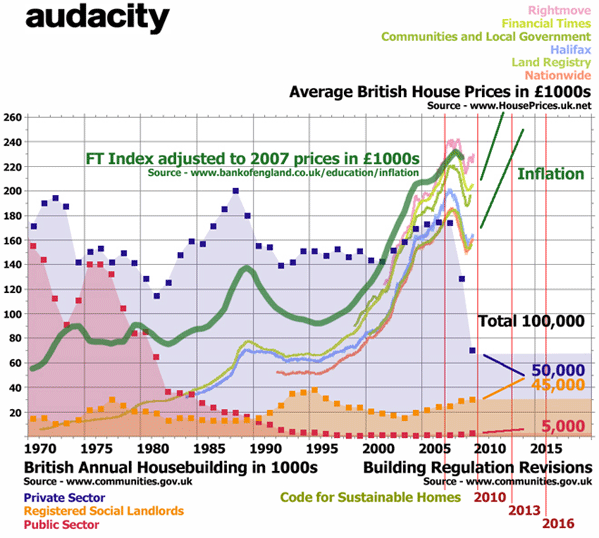
    There have been declines and recoveries in British house building before the 2007 collapse in construction activity. Data is in abundance. The total number of homes built annually has more than halved since the late 1960s, as successive governments withdrew from publicly funding the post-war welfare programme of council house building. There have been ups and downs in the volume of private housing built. After building 175,000 private homes in 2007 many expected that the market for new private housing would eventually recover from the financial crisis. The pent up demographic demand for new private housing would surely lead to a recovery of building if financing were made available. It seems irrational to suggest that the supply of housing will not recover to meet demand.

    In July 2008 audacity argued that British house builders would be collectively reduced in the planning regulated market to building 100,000 homes in 2009. They would shift from aspiring to build in “volume” to making their money from planning approved “eco-homes” for a luxury market. This has already occurred and there will be no necessary recovery of volume in a few years. Production may even decline from that level of inactivity.

    There seems little demand for new housing from the Public. Instead, we seem to be most concerned that housing continues to inflate in value as an asset. Most see obvious advantages in housing asset inflation, while complaining of the unaffordability of better housing. Britain is experiencing house price inflation again, but home owners know that the worsening gap between household income and the cost of buying a home, even on very low rates of interest, is frustrating new buyers, and the young in particular.

    Gordon Brown knows that playing the housing market is a mainstream activity for the electoral majority. New Labour is doing what is necessary to revive housing asset inflation. Some had hoped that the bursting of the bubble in 2007 would reconnect house prices with household income. Young people were understandably most hopeful of that prospect. Now prices are drifting upwards again to unaffordable highs. This is happening nationally, but is particularly true in greater London, where average house prices have recovered to nearly £270,000, which is where they were before the collapse of Lehman Brothers in September 2008. This makes an average house “affordable” to those earning more than £90,000 a year. That is a very small percentage of the region’s home buying public.

    Here’s what the restoration of higher prices means nationally, and in London in particular. There will be greater social immobility, expressed in more commuting, an extension of families, and several households living in the same home. Overcrowding will be more likely. Homelessness may slightly increase, but most housing difficulty will be accommodated within the existing stock.

    The mainstream majority of the electorate – those already owning homes – is likely to be grateful that the burst bubble did not turn into a crash. New Labour will try to take the credit for averting any further financial disaster. What will be ignored is that house price inflation suits Britain’s politicians, and the lending institutions in The City. The British economy is too weak to pay higher wages, and the mainstream majority are too politically weak to challenge that predicament. What other future is there for Britain except another asset inflation bubble?

    The problem then with restoring the Brown bubble is it solves none of our fundamental problems: notably a weak economy, low wages and lack of decent housing. David Cameron’s Conservative opposition will not make any difference to that predicament. They want to get rid of regional tiers of planners and to return control to local authorities, as was the intention of the 1947 Town and Country Planning Act. That is the legislation that stops the British public from building housing on cheap farmland.

    But it’s doubtful they will try to break the back of housing inflation and our country’s dependence on it. The British economy depends greatly on The City, which needs to expand the £1.2 trillion of mortgage lending in a secure way for lenders in the global financial system. This only happens when existing house prices are maintained well above the cost of constructing new ones, and best in a period of asset inflation. The trickle of new homes onto the market could reduce, and while any demographic demands of a growing population for the utility of housing would not be met, the political and economic demand for asset inflation and loan security will be satisfied.

    The way in which existing homes are made more expensive than the cost of building new ones is to inflate the price of land and keep it inflated. It is the high price of land approved for development within the 1947 legislation that is unaffordable. That is why government and house builders recognise there is “planning gain” to be negotiated over, as the uplift in land value that follows an approval to develop.

    Yet this stands in the way of a clear public interest. Government housing experts argue we need at least 240,000 new homes a year to meet demographic demand. Our inability, or even unwillingness, to tackle this issue would have shocked either the Conservatives or the Socialists of the last Century.

    What matters is to make materialist sense of the future. Society can’t live off asset inflation and debt. We must build new housing.

    We face a serious predicament today. Small quantities of highly subsidised and high density “eco-homes” are to be built by socially motivated architects, some working with the former “volume” house builders. How can building an insufficient number of homes be called “sustainable”? Instead of building new replacement homes Britain is also looking to finance a greener and endlessly refurbished housing stock, while producing too few “eco-homes” even to accommodate yearly household growth.

    The finance obsessed Green Capitalists of today are worse than their counterparts from a century ago. At least the Capitalists of the past were materialists, who believed in building more, and developing a construction industry based on materials manufacture and the skills of the workers they exploited. Those Capitalists were progressive materialists.

    The new capitalists in housing are not even interested in meeting the needs of the working and middle classes, but in pleasing environmentalists. Unsurprisingly, they also will not have to hire too many workers to build their meagre product. Today Capitalists are abandoning industrial production in favour of finance, and this is nowhere more evident than in housing. Hiding behind the moral claims of environmentalism the Capitalists of twenty-first century Britain have clearly abandoned any idea of social progress, when once they could claim to be materialists. What is noticeable is that they have so many moralistic Greens cheering them on.

    Sadly, there is no political association today to oppose Green Capitalists operating a nationalised planning system, in their effort to realise asset inflation in the form of a housing market. New Labour under Gordon Brown will not change this – indeed he clearly favours housing inflation and the City over the needs of aspiring families. So do the Conservatives under David Cameron. At the same time, they can play to a green constituency, which now dominates the media.

    Given the current planning regime and the moral imperative for building “eco-homes”, British house builders will be reduced to building around 100,000 homes for a very long time. They will aspire not to build in “volume” but instead take pride that their homes are “sustainable”.

    Only a political challenge will improve the situation. Gordon Brown faces no political challenge from David Cameron. He never will. Under New Labour or the Conservatives the only future for house builders will be to offer highly differentiated luxury “eco-homes” for the equity rich, or the top quintile of earners, supported with high subsidies in some form to build affordable “eco-homes”. Architects will particularly benefit from this shift in the market.

    New Labour will build a few council homes more as a publicity stunt to keep their middle class Old Labour supporters amused. Conservatives will not bother about such nonsense. They will both insist on “zero carbon” new housing by 2016. Both will focus on refurbishment of the existing stock, not replacement. Both will exclude more land from the planning system.

    The only people who will challenge this predicament, this retreat of Capitalism from population growth and industrial productivity, will be the working mainstream middle. Brown thinks he has bought off the majority of home owners with asset inflation, and temporarily he might have relieved many. Cameron thinks he can further mobilise established local residents attempting to extract more “gain” from the planning system. He imagines local opposition to development aggregating to a general protection of house price inflation nationally.

    These Red/Green and Blue/Green political leaders might be proved wrong. The construction industry matters, and with argumentative organisation materialists might push for house building against the greens of Britain. Most of all there is the new generation of British people – those entering their 20s and 30s – who will demand something other than over-priced, undersized and often miserably maintained housing for themselves and their families.

    A longer version of this article originally appeared at www.audacity.org/IA-07-11-09.htm

    Ian Abley, Project Manager for audacity, an experienced site Architect, and a Research Engineer at the Centre for Innovative and Collaborative Engineering, Loughborough University. He is co-author of Why is construction so backward? (2004) and co-editor of Manmade Modular Megastructures. (2006) He is planning 250 new British towns.

  • Honest Services From Bankers? Increasingly Not Likely

    Once you understand what financial services are, you’ll quickly come to realize that American consumers are not getting the honest services that they have come to expect from banks. A bank is a business. They offer financial services for profit. Their primary function is to keep money for individual people or companies and to make loans. Banks – and all the Wall Street firms are banks now – play an important role in the virtuous circle of savings and investment. When households have excess earnings – more money than they need for their expenses – they can make savings deposits at banks. Banks channel savings from households to entrepreneurs and businesses in the form of loans. Entrepreneurs can use the loans to create new businesses which will employee more labor, thus increasing the earnings that households have available to more savings deposits – which brings the process fully around the virtuous circle.

    As U.S. households deal with unemployment above 10% as a direct result of the financial crises caused by excessive risk-taking at banks, one bank, Goldman Sachs, posted the biggest profit in its 140-year history. According to Nobel laureate economist Joseph Stiglitz at Columbia University, Goldman’s 65% increase in profits is like gambling – the largest growth came from its own investments and not from providing financial services to households and businesses.

    Under fraud statutes created in 1988, Congress criminalized actions that deprive us of the right to “honest services.” The law has been used generally to prosecute fraudsters and potential fraudsters – from Jack Abramoff to Rod Blagojevich – whenever the public does not get the honest, faithful service we have a right to expect.

    The theory of “honest services” was used in one of the best known U.S. cases of financial misbehavior – Jeff Skilling of Enron – who has been granted a hearing early next year with the U.S. Supreme Court on the subject. Prosecutors won the original 2006 conviction on the strategy “that Skilling robbed Enron of his ‘honest services’ by setting corporate goals that were met by fraudulent means amid a widespread conspiracy to lie to investors about the company’s financial health.” The U.S. Attorney argued that CEO Skilling set the agenda at Enron. In this case, the fraud and conspiracy were means by which corporate ends were met.

    Skilling’s defense attorney admitted in his appeal before the 5th Circuit in April that his client “might have only bent the rules for the company’s benefit.” The appeal was not granted – a move by the court that is viewed as an overwhelming success for the prosecution. The application of the theory of “honest services” to the Skilling case – targeting corporate CEOs instead of elected officials – has been the subject of debate which may explain why the Supreme Court agreed to hear the arguments.

    Regardless of the outcome of that or other cases on the subject, the fact remains that bankers are doing better for themselves than they are for American households. This is the number one complaint we have about banks today. If I had to summarize the rest of what bothers us about banks, I would start with the fact that they are secretive. They take advantage of a very common fear of finance to convince consumers that they know what’s good for you better then you do.

    Next in line is the fact that they have purchased Congress. Banks have access to the halls of power that – despite 234 years of egalitarian rhetoric – ordinary voters can never achieve. Finally, we resent banks because we are required to use their services, like a utility, to gain access to the American Dream.

    Financial services contribute about 6 percent to the U.S. economy. Manufacturing and information industries use financial services, but the industry increasingly depends on itself: recall the portion of Goldman’s earnings growth coming from using its own investment services. According to the latest data from the Bureau of Economic Analysis, the financial services industry requires $1.27 of its own output to deliver a dollar of its final product to users. Despite the fact that our economic reliance on financial services has been creeping up steadily since 2001, they remain one of the least required inputs for U.S. economic output – only wholesale and retail trade have less input to the output of other industries.

    So, why did Congress vote them nearly a trillion dollars worth of life-support bailout money at the expense of taxpayers? Why did Wall Street get swine flu vaccine ahead of rural hospitals and health care workers? Why did they get the bailout without accountability? By making banks account for what they did with the money, congress could have 1) prohibited spending on bonuses and lavish retreats; 2) ensured improved access to credit for small and medium enterprises; and 3) provided transparency to taxpayers on who got how much and what they did with it. Need more reasons to demand honest services from a banker? Try this list:

    1. Congress raised the FDIC insurance to $200,000 to make depositors comfortable leaving money in banks; then the banks passed the insurance premium on to customers – including those that never had $200,000 cash in the bank in their lives and probably never will. Seriously, how much money do you have to have before it makes sense to have $200,000 in cash in a savings account earning 0.25%?
    2. Banks can borrow at 0% from the Fed yet they raise the interest rates they charge even their best customers. The bank I use for my company willingly lent me $10,000 last year to open a new office and approved a $7,000 credit card limit. Last month they sent me a letter saying they are raising the interest rate by +1.9 percentage point – though I have never missed a payment deadline.
    3. The banks can use our deposits to purchase securities issued by the Federal government, which are yielding better than 3 percent. They pay us about 0.25 percent yet still find it necessary to tack on a multitude of fees – which amount to 53 percent of banks’ income today, up from 35 percent in 1995.

    For now, Brother Banker skips along as lively as a cricket in the embers. But remember this: Marie Antoinette didn’t know anything about the French revolution until they cut off her head. Matt Taibbi, in a recent Rolling Stone article called Goldman Sachs a “great vampire squid wrapped around the face of humanity, relentlessly jamming its blood funnel into anything that smells like money.” We are at risk for leaving the virtuous circle behind and entering a vicious circle of spiraling inflation. A massive increase in government debt is being paid down by printing more money. Between July 2008 and November 2008, the Federal Reserve more than doubled its balance sheet from $0.9 trillion to $2.5 trillion. A year later, there is no evidence that they are trying to rein it in. As Brother Banker fails to provide honest services, a briar patch of a different kind may be waiting around the corner.

    Susanne Trimbath, Ph.D. is CEO and Chief Economist of STP Advisory Services. Her training in finance and economics began with editing briefing documents for the Economic Research Department of the Federal Reserve Bank of San Francisco. She worked in operations at depository trust and clearing corporations in San Francisco and New York, including Depository Trust Company, a subsidiary of DTCC; formerly, she was a Senior Research Economist studying capital markets at the Milken Institute. Her PhD in economics is from New York University. In addition to teaching economics and finance at New York University and University of Southern California (Marshall School of Business), Trimbath is co-author of Beyond Junk Bonds: Expanding High Yield Markets.