Tag: middle class

  • Obama Still Can Save His Presidency

    A good friend of mine, a Democratic mayor here in California, describes the Obama administration as “Moveon.org run by the Chicago machine.” This combination may have been good enough to beat John McCain in 2008, but it is proving a damned poor way to run a country or build a strong, effective political majority. And while the president’s charismatic talent – and the lack of such among his opposition – may keep him in office, it will be largely as a kind of permanent lame duck unable to make any of the transformative changes he promised as a candidate.

    If Obama wants to succeed as president he must grow into something more than movement icon, become more of a national leader. In effect, he needs to hit the reset button. Here are five key changes that Obama can implement to re-energize and save his presidency.

    1. Forget the “Chicago way.” The Windy City is a one-party town with a shrinking middle class and a fully co-opted business elite. The focused democratic centralism of the machine – as the University of Illinois’ Richard Simpson has noted – worked brilliantly in the primaries and even the general election campaign. But it is hardly suited to running a nation that is more culturally and politically diverse.

    The key rule of Chicago politics is delivering the spoils to supporters, and Obama’s stimulus program essentially fills this prescription. The stimulus’s biggest winners are such core backers as public employees, universities and rent-seeking businesses who leverage their access to government largesse, mostly by investing in nominally “green” industries. Roughly half the jobs saved form the ranks of teachers, a highly organized core constituency for the president and a mainstay of the political machine that supports the Democratic Party.

    The other winners: big investment banks and private investment funds. People forget that Obama, even running against a sitting New York senator, emerged as an early favorite among the hedge fund grandees. As The New York Times’ Andrew Sorkin put it back in April, “Mr. Obama might be struggling with the blue-collar vote in Pennsylvania, but he has nailed the hedge fund vote.”

    At best, the president’s policy seems like Karl Rove in reverse, essentially smooching the core and ignoring the rest. This is a formula for more divisiveness, not the advertised “hope” Americans expected last November.

    2. Focus on Real Jobs, Not Favored Constituencies . The Chicago approach works better in a closed political system controlled by a few powerbrokers than in a massive continental economy like the U.S. Health care and education, which depend on government largesse, are surviving. But the critical production side of the economy that generates good blue-collar jobs – like agriculture, manufacturing and construction – is getting the least from the stimulus.

    These industries need more large-scale infrastructure spending, as well as more focused skills training and initiatives to free capital for politically unconnected entrepreneurial businesses. Instead, productive industries face the prospect of more regulation while capital for small businesses continues to dry up.

    Those in post-industrial bastions tied to speculative capital – think Manhattan and the Hamptons – are the ones most benefiting from Obamanomics. College towns like Cambridge, Mass., Madison, Wis., Berkeley, Calif., and Palo Alto, Calif., will also prosper, becoming even richer and more self-important. It seems, then, that Obama has done best for elite graduates of Harvard and Stanford and other members of the “creative class.”

    The rest of America, however, is still waiting for a real sustained recovery. Industrial and office properties remain widely abandoned not only in Detroit but Silicon Valley. The future sustainability of our economy depends mostly on what happens to those who previously staffed these facilities – those who produced actual goods and services – not just on a relative handful of people working at Google or the national laboratories. In other words, we need jobs for machinists, welders and marketers as well as scientists with Ph.D’s.

    3. Step on the Gas. Providence has handed America – and Obama – an enormous gift in the now recoverable deposits of natural gas found across the continent. Proven levels have been soaring and now amount to 90 years’ supply at current demand. More will be found, and across a wide section of the country.

    Natural gas may be a fossil fuel, but it is relatively clean and thus the perfect intermediate solution to our energy problems. The problem: The president’s green advisers will seek to prevent developing these resources.

    Although Obama should support strong environmental controls on gas extraction, the greens should not be allowed to block this unique and historic opportunity to shift economic power back to North America. Along with modest increases in domestic and Canadian oil, natural gas could end our dependence on fossil fuels from outside North America. This would relieve our military from the onerous task of defending other people’s oil supplies. But most important, the new energy sources could expand our industrial and agricultural economies so they can capitalize on the huge potential growth from markets at home and in the developing world.

    The natural gas era could then finance continued research and deployment of renewable fuels. Let’s give it the 10 or 20 years that great transformations require. Quick fixes will lead us to subsidize the purchase of rapidly dated technology from China or Europe; we should aim at the energy equivalent of the moon shot, helping forge a huge technological advantage.

    4. Rediscover America. As a candidate, Obama spoke movingly about his Kansas roots, but lately he seems to have become all big city all the time. This administration offers very little to people who live in places like Kansas, as many of my heartland Democrat friends complain.

    Urbanites often forget that this is an enormous country. Crowded into dense cities themselves, they fail to look down from the window when crossing the country by plane. The vast majority of America is, well, vast – sparsely settled, if settled at all.

    Moreover, Obama’s people need to understand that 80% of America live in suburbs or small towns. They do not want to live in dense cities or realize a move there would mean living in less than idyllic conditions. If Obama wants to shape a green America, he must find ways that work with the majority’s preferences.

    But so far the president’s housing, transport and planning advisers seem to be pushing the death of suburbia and promoting ever more densification. It’s hardly surprising, then, that suburbs and small towns feel left out. After finally starting to inch toward the Democrats, they are now turning again to the right. If Democrats want to retain their majority, they need the strong support of these constituencies – without it the Congressional majority will be gone by the end of the second term, if not the first.

    5. Chuck the Nobel; Embrace Exceptionalism. Many progressives love Obama because they see him as one of them in the struggle with what the immortal Bill Maher calls “a stupid country.” But the president should remind himself that the country may not be quite as dumb as it sometimes looks from Oslo – or from Dupont Circle, Cambridge or Soho.

    Being smart was part of the reason the Republicans lost the majority. The voters understood the country was wasting resources – and young people – on internecine conflicts for energy that we could produce at home. The Bush years also undermined any GOP claim to fiscal responsibility.

    Initially Obama allowed us to redefine American exceptionalism as something more than monomaniacal use of force and overconsumption. He spoke to our traditions of inclusiveness, adaptability and idealism. He offered the perfect vehicle because he and his story are so exceptional. Yet Obama sometimes seems more interested in serving as the apologizer rather than as commander in chief. His vision appears less American than pseudo-European.

    This is not the path to success for American presidents. Whether Ronald Reagan or Franklin Roosevelt, Harry Truman or even Bill Clinton, a president has to be a spokesman for his country. Right now, on the world stage, Obama is looking more and more like Jimmy Carter.

    I suggest these things because, for all his missteps over the past year, Barack Obama is my president and I want him to succeed. But to do so, first he needs to hit his own reset button – and the sooner the better. Unlike some, I do not believe the Obama presidency is already doomed. Presidents often grow in office: Despite his exceptionalism in other areas, let’s hope that Obama proves the norm here.

    This article originally appeared at Forbes.com.

    Joel Kotkin is executive editor of NewGeography.com and is a distinguished presidential fellow in urban futures at Chapman University. He is author of The City: A Global History. His next book, The Next Hundred Million: America in 2050, will be published by Penguin Press early next year.

    Official White House Photo by Pete Souza

  • Congress and the Administration Take Aim at Local Democracy

    Local democracy has been a mainstay of the US political system. This is evident from the town hall governments in New England to the small towns that the majority of Americans choose to live in today.

    In most states and metropolitan areas, substantial policy issues – such as zoning and land use decisions – are largely under the control of those who have a principal interest: local voters who actually live in the nation’s cities, towns, villages, townships and unincorporated county areas. This may be about to change. Two congressional initiatives – the Boxer-Kerry Cap and Trade Bill and the Oberstar Transportation Reauthorization Bill – and the Administration’s “Livability Partnership” take direct aim at local democracy as we know it.

    The Boxer-Kerry Bill: The first threat is the proposed Senate version of the “cap and trade” bill authored by Senator Barbara Boxer-Kerry (D-California) and Senator John Kerry (D-Massachusetts). This bill, the Clean Energy Jobs and American Power Act (S. 1733), would require metropolitan planning organizations (MPOs) to develop greenhouse gas emission reduction plans. In these plans, the legislation would require consideration of issues such as increasing transit service, improvements to intercity rail service and “implementation of zoning and other land use regulations and plans to support infill, transit-oriented development or mixed use development.” This represents a significant step toward federal adoption of much of the “smart growth” or “compact development” agenda.

    At first glance, it may seem that merely requiring MPOs to consider such zoning and land use regulations seems innocent enough. However, the incentives that are created by this language could well spell the end of local control over zoning and land use decisions in the local area.

    True enough, the bill includes language to indicate that the bill does not intend to infringe “on the existing authority of local governments to plan or control land use.” Experience suggests, however, that this would provide precious little comfort in the behind-the-scenes negotiations that occur when a metropolitan area runs afoul of Washington bureaucrats.

    The federal housing, transportation and environmental bureaucracies have also been supportive of compact development policies. As these agencies develop regulations to implement the legislation, they could well be emboldened to make it far more difficult for local voters to retain control over land use decisions. There could be multiple repeats of the heavy-handedness exercised by the EPA when it singled out Atlanta for punishment over air quality issues. In response, the Georgia legislature was, in effect, coerced into enacting planning and oversight legislation more consistent with the planning theology endorsed by EPA’s bureaucrats. No federal legislation granted EPA the authority to seek such legislative changes, yet they were sought and obtained.

    There is also considerable support for the compact development agenda at the metropolitan area level. The proclivity of metropolitan and urban planners toward compact development is so strong as to require no encouragement by federal law. The emerging clear intent of federal policy to move land use development to the regional level and to densify existing communities could encourage MPOs to propose plans that pressure local governments to conform their zoning to central plans (or overarching “visions”) developed at the regional level. Along the way, smaller local jurisdictions could well be influenced, if not coerced into actions by over-zealous MPO staff claiming that federal law and regulation require more than the reality. It would not be the first time. Further, MPOs and organizations with similar views can be expected to lobby state legislatures to impose compact development policies that strip effective control of zoning and land use decisions from local governments.

    Surface Transportation Reauthorization: The second threat is the Surface Transportation Authorization Act (STAA or reauthorization) draft that has been released by Chairman James Oberstar (D-Minnesota) of the House Transportation and Infrastructure Committee. This bill is riddled with requirements regarding consideration of land use restrictions by MPOs and states. Unlike the Boxer-Kerry bill, the proposed STAA includes no language denying any intention to interfere with local land use regulation authority.

    Like the Boxer-Kerry Bill, the Oberstar bill significantly empowers the Department of Transportation and the Environmental Protection Agency and poses similar longer term risks.

    The Administration’s “Livability Agenda:” These legislative initiatives are reinforced by the Administration’s “Livability Agenda,” which is a partnership between the EPA, the Department of Housing and Urban Development and the Department of Transportation. Among other things, this program is principally composed of compact development strategies, including directing development to certain areas, which would materially reduce the choices available to local government. Elements such as these could be included in an eventual STAA bill by the Obama Administration.

    The Livability Agenda: Regrettably, the Boxer-Kerry bill, the Oberstar bill and the “Livability Agenda” will make virtually nothing more livable. If they are successful in materially densifying the nation’s urban areas, communities will be faced with greater traffic congestion, higher congestion costs and greater air pollution. Despite the ideology to the contrary, higher densities increase traffic volumes within areas and produce more health hazards through more intense local air pollution. As federal data indicates, slower, more congested traffic congestion produces more pollution than more freely flowing traffic, and the resulting higher traffic volumes make this intensification even greater.

    There are also devastating impacts on housing affordability that occur when “development is directed.” This tends to increase land prices, which makes houses more expensive. This hurts all future home buyers and renters, particularly low income and minority households, since rent increases tend to follow housing prices. It is particularly injurious to low income households, which are disproportionately minority. The large gap between majority and minority home ownership rates likely widen further. So much for the American Dream for many who have not attained it already.

    The Marginal Returns of Compact Development Policies: These compact development initiatives continue to be pursued even in the face of research requested by the Congress indicating that such policies have precious little potential. The congressionally mandated Driving and the Built Environment report indicates that driving and greenhouse gas emissions could be higher in 2050 than in 2000 even under the maximum deployment of compact development strategies.

    Local Governments at the Table? The nation’s local governments should “weigh in” on these issues now, while the legislation is being developed. If they wait, they could find bullied by EPA and MPOs to follow not what the local voters want, but what the planners prefer. Local democracy will be largely dead, a product of a system that concentrates authority – and perceived wisdom – in the hands of the central governments, at the regional and national level.

    Even more, local citizens and voters need to be aware of the risk. It will be too late when MPOs or other organizations, whether at their own behest or that of a federal agency, force the character of neighborhoods to be radically changed, as Tony Recsei pointed out is
    already occurring in Australia.

    Wendell Cox is a Visiting Professor, Conservatoire National des Arts et Metiers, Paris. He was born in Los Angeles and was appointed to three terms on the Los Angeles County Transportation Commission by Mayor Tom Bradley. He is the author of “War on the Dream: How Anti-Sprawl Policy Threatens the Quality of Life.

  • Go to Middle America, Young Men & Women

    A few weeks ago, Eamon Moynihan reviewed economic research on cost of living by state in a newgeography.com article. The results may seem surprising, given that some of the states with the highest median incomes rated far lower once prices were taken into consideration. The dynamic extends to the nation’s 51 metropolitan areas with more than 1,000,000 population (See Table).

    There is a general perception that the most affluent metropolitan areas are on the east coast and the west coast. Indeed, 8 of the 10 metropolitan areas with the highest nominal per capita income in 2006 were on the two coasts. These included San Francisco, San Jose and Seattle on the west coast and Washington, Boston, New York, Hartford and Philadelphia on the east coast. Middle-America is represented by Denver and Minneapolis-St. Paul. However, as anyone who has lived on the coasts and Middle America knows, a dollar in New York or San Francisco does not buy nearly as much as a dollar in Dallas-Fort Worth or Cincinnati.

    Per Capita Income: Purchasing Power Parity
    US Metropolitan Areas over 1,000,000 Population
        2006 Per Capita Income  
    Rank Metroplitan Area Purchasing Power Adjusted Nominal Nominal Rank
    1 San Francisco $46,287 $57,747 1
    2 Washington $45,178 $51,868 3
    3 Denver $44,798 $44,691 8
    4 Minneapolis-St. Paul $44,326 $44,237 9
    5 Houston $42,815 $43,174 11
    6 Boston $42,571 $50,542 4
    7 Pittsburgh $41,716 $38,550 20
    8 St. Louis $41,613 $37,652 27
    9 Milwaukee $41,572 $39,536 19
    10 Baltimore $41,451 $43,026 12
    11 Seattle $41,448 $45,369 6
    12 Kansas City $41,329 $37,566 28
    13 Hartford $41,104 $44,835 7
    14 New Orleans $40,935 $40,211 16
    15 Philadelphia $40,725 $43,364 10
    16 Dallas-Fort Worth $40,643 $39,924 17
    17 Cleveland $39,997 $37,406 30
    18 Indianapolis $39,843 $37,735 26
    19 Chicago $39,752 $41,591 14
    20 Richmond $39,282 $38,233 22
    21 New York $39,201 $49,789 5
    22 Birmingham $39,057 $37,331 31
    23 Cincinnati $38,691 $36,650 36
    24 Nashville $38,680 $37,758 25
    25 Detroit $38,670 $38,119 24
    26 Charlotte $38,632 $38,164 23
    27 Miami $38,555 $40,737 15
    28 San Jose $38,505 $55,020 2
    29 Jacksonville $38,413 $37,519 29
    30 Louisville $38,262 $36,000 41
    31 Oklahoma City $38,156 $35,637 42
    32 Las Vegas $37,691 $38,281 21
    33 Salt Lake City $37,381 $35,145 45
    34 San Diego $37,358 $42,801 13
    35 Rochester $37,066 $36,179 38
    36 Columbus $37,058 $36,110 39
    37 Atlanta $36,691 $36,060 40
    38 Memphis $36,501 $35,470 44
    39 Tampa-St. Petersburg $36,260 $35,541 43
    40 Portland $36,131 $36,845 35
    41 Buffalo $36,091 $33,803 48
    42 Norfolk (Virginia Beach metropolitan area) $35,418 $34,858 46
    43 Raleigh $35,087 $37,221 32
    44 San Antonio $34,913 $32,810 50
    45 Providence $34,690 $37,040 34
    46 Austin $33,832 $36,328 37
    47 Phoenix $33,809 $34,215 47
    48 Sacramento $32,750 $37,078 33
    49 Los Angeles $32,544 $39,880 18
    50 Orlando $32,095 $33,092 49
    51 Riverside-San Bernardino $25,840 $27,936 51
    Source:        
    http://www.bea.gov/scb/pdf/2008/11%20November/1108_spotlight_parities.pdf

    Purchasing Power Parity: Things change rather dramatically when purchasing power is factored in. Some years ago, international economic organizations, such as the Organization for Economic Cooperation and Development, the World Bank and the International Monetary Fund began using costs of living by nation to compare national economic performance, rather than currency exchange rate. This practice, called “purchasing power parity” is based upon the recognition that there may be substantial differences in the cost of living between nations.

    This can be illustrated by comparing Switzerland and the United States. For years, Switzerland has had a higher per capita GDP than the United States on an exchange rate basis. Switzerland’s gross domestic product per capita was $53,300 in 2006, nearly 30% above that of the United States ($42,000). However price levels in Switzerland are so high that incomes do not go nearly as far as the exchange rate would suggest. Once adjusted for purchasing power parity, the Swiss GDP per capita in 2006 drops to $39,000, well below that of the United States. Much of the difference has to do with regulation. The more liberal economy of the United States produces a lower cost economy than in Switzerland, or for that matter most of Western Europe. The US economic advantage would be even greater measured on a household basis, since US households include nearly 10% more members (generally children) than those in Western Europe.

    The same concept was applied by the Department of Commerce Bureau of Economic Analysis researchers in their review of purchasing power parities between US metropolitan areas in 2006. When purchasing power is factored in, five of the top metropolitan areas in nominal per capita income (not adjusted for purchasing power) drop out and are replaced by other metropolitan areas rarely thought of as among the nation’s most affluent.

    Among the three west coast nominal leaders, San Francisco remains as #1, in both nominal and purchasing power adjusted per capita income. Seattle dropped from 6th to 11th position. However, the real surprise is San Jose, which dropped from 2nd position to 28th.

    The east coast regions ranked among the top 10 metropolitan areas in nominal income also were decimated by their high costs, with only Washington (which rose from 3rd to 2nd) and Boston (which fell from 4th to 6th) remaining. New York fell from 5th to 21st, Hartford from 7th to 13th and Philadelphia from 10th to 16th.

    The two non-coastal metropolitan areas in the nominal top 10 remain, with Denver rising from to 3rd and Minneapolis-St. Paul rising from 9th to 4th.

    It can be argued that Middle-America replaced the five metropolitan areas dropping out of the top ten. Houston, long one of the most disparaged metropolitan areas among urbanists, occupies the 5th position (compared to its 11th ranking in the nominal list). Three of the new entrants are confirmed members of the Rust Belt: Pittsburgh (7th), St. Louis (8th) and Milwaukee (9th). Finally, there is a new east coast entrant, blue-collar Baltimore (10th).

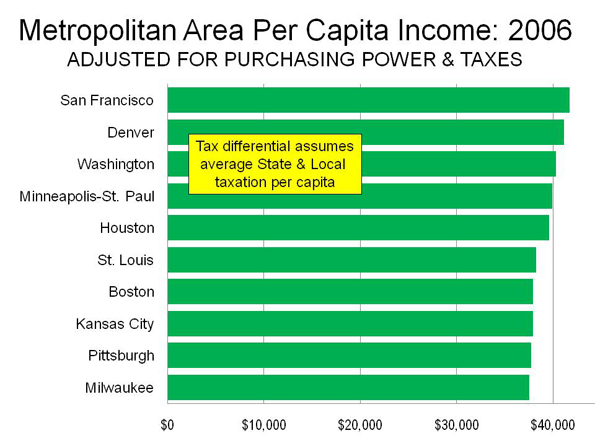
    The Impact of Taxes: But that is just the beginning. Taxes also diminish the purchasing power of households. Unfortunately, there is virtually no readily available information on state and local taxation by metropolitan area. There is, however state and local government taxation data at the state level. If it is assumed that this data is representative of metropolitan differences (weighted proportionately by state in multi-state metropolitan areas), there would be changes in rank among the top 10. Denver would displace Washington in the number two position, closing more than one-half the gap with San Francisco. Even more surprisingly, St. Louis would move ahead of both Boston and Pittsburgh to rank 6th. Kansas City would leap over #11 Seattle, Baltimore, Milwaukee and Pittsburgh to rank 8th, trailing #7 Boston by $25, not much more than the price of a Red Sox standing room ticket. Pittsburgh would occupy the #9 position and Milwaukee #10 (See Figure).

    More than Housing: The largest differences in purchasing power stem from housing, with east coast and west coast metropolitan areas having generally higher housing costs. As a result of the housing bust and the larger house price drops in those areas, purchasing power adjusted incomes could recover relative to those of Middle America. However, the high cost of living on the east and west coasts extend to more than housing prices. Generally, according to proprietary (and for sale) ACCRA cost of living data, the west coast and east coast metropolitan areas have higher costs of living even without housing. These differences are largely in grocery costs, which probably reflects the anti-big box store planning regulations and politics that exist in many of these areas. Grocery costs in the more affluent middle-American metropolitan areas tend to be lower.

    Other Surprises: Outside the top 10 most affluent metropolitan areas, there are other surprises. Urban planning favorite Portland ranks 40th, just above Buffalo. Rust Belt Cleveland ranks 17th, a few positions above New York. Kansas City, with its highly decentralized civic architecture, ranks 12th, just behind Seattle. Indianapolis (17th) is more affluent than Chicago (18th) and both are more affluent than New York.

    Five of the bottom 10 metropolitan areas are in the south, including Virginia Beach, Raleigh, Austin, San Antonio and Orlando. But perhaps the biggest surprise of all is that four of the five lowest ranking metropolitan areas are in the southwest: Phoenix (47th), Sacramento (48th), Los Angeles (49th) and Riverside-San Bernardino (51st).

    The Dominance of Middle America: But among the 10 most affluent metropolitan areas in the nation, six or seven may be counted as Middle-America (depending on how Baltimore is classified). Only three are from the original group that supplies 8 of the top metropolitan areas when purchasing power is not considered.


    Related articles:
    Gross Domestic Product per Capita, PPP: World Metropolitan Regions
    Gross Domestic Product per Capita, PPP: China Metropolitan Regions

    Photograph: Pittsburgh

    Wendell Cox is a Visiting Professor, Conservatoire National des Arts et Metiers, Paris. He was born in Los Angeles and was appointed to three terms on the Los Angeles County Transportation Commission by Mayor Tom Bradley. He is the author of “War on the Dream: How Anti-Sprawl Policy Threatens the Quality of Life.

  • There’s No Place Like Home, Americans are Returning to Localism

    On almost any night of the week, Churchill’s Restaurant is hopping. The 10-year-old hot spot in Rockville Centre, Long Island, is packed with locals drinking beer and eating burgers, with some customers spilling over onto the street. “We have lots of regulars—people who are recognized when they come in,” says co-owner Kevin Culhane. In fact, regulars make up more than 80 percent of the restaurant’s customers. “People feel comfortable and safe here,” Culhane says. “This is their place.”

    Thriving neighborhood restaurants are one small data point in a larger trend I call the new localism. The basic premise: the longer people stay in their homes and communities, the more they identify with those places, and the greater their commitment to helping local businesses and institutions thrive, even in a downturn. Several factors are driving this process, including an aging population, suburbanization, the Internet, and an increased focus on family life. And even as the recession has begun to yield to recovery, our commitment to our local roots is only going to grow more profound. Evident before the recession, the new localism will shape how we live and work in the coming decades, and may even influence the course of our future politics.

    Perhaps nothing will be as surprising about 21st-century America as its settledness. For more than a generation Americans have believed that “spatial mobility” would increase, and, as it did, feed an inexorable trend toward rootlessness and anomie. This vision of social disintegration was perhaps best epitomized in Vance Packard’s 1972 bestseller A Nation of Strangers, with its vision of America becoming “a society coming apart at the seams.” In 2000, Harvard’s Robert Putnam made a similar point, albeit less hyperbolically, in Bowling Alone, in which he wrote about the “civic malaise” he saw gripping the country. In Putnam’s view, society was being undermined, largely due to suburbanization and what he called “the growth of mobility.”

    Yet in reality Americans actually are becoming less nomadic. As recently as the 1970s as many as one in five people moved annually; by 2006, long before the current recession took hold, that number was 14 percent, the lowest rate since the census starting following movement in 1940. Since then tougher times have accelerated these trends, in large part because opportunities to sell houses and find new employment have dried up. In 2008, the total number of people changing residences was less than those who did so in 1962, when the country had 120 million fewer people. The stay-at-home trend appears particularly strong among aging boomers, who are largely eschewing Sunbelt retirement condos to stay tethered to their suburban homes—close to family, friends, clubs, churches, and familiar surroundings.

    The trend will not bring back the corner grocery stores and the declining organizations—bowling leagues, Boy Scouts, and such—cited by Putnam and others as the traditional glue of American communities. Nor will our car-oriented suburbs replicate the close neighborhood feel so celebrated by romantic urbanists like the late Jane Jacobs. Instead, we’re evolving in ways congruent with a postindustrial society. It will not spell the demise of Wal-Mart or Costco, but will express itself in scores of alternative institutions, such as thriving local weekly newspapers, a niche that has withstood the shift to the Internet far better than big-city dailies.

    Our less mobile nature is already reshaping the corporate world. The kind of corporate nomadism described in Peter Kilborn’s recent book, Next Stop, Reloville: Life Inside America’s Rootless Professional Class, in which families relocate every couple of years so the breadwinner can reach the next rung on the managerial ladder, will become less common in years ahead. A smaller cadre of corporate executives may still move from place to place, but surveys reveal many executives are now unwilling to move even for a good promotion. Why? Family and technology are two key factors working against nomadism, in the workplace and elsewhere.

    Family, as one Pew researcher notes, “trumps money when people make decisions about where to live.” Interdependence is replacing independence. More parents are helping their children financially well into their 30s and 40s; the numbers of “boomerang kids” moving back home with their parents, has also been growing as job options and the ability to buy houses has decreased for the young. Recent surveys of the emerging millennial generation suggest this family-centric focus will last well into the coming decades.

    Nothing allows for geographic choice more than the ability to work at home. By 2015, suggests demographer Wendell Cox, there will be more people working electronically at home full time than taking mass transit, making it the largest potential source of energy savings on transportation. In the San Francisco Bay Area and Los Angeles, almost one in 10 workers is a part-time telecommuter. Some studies indicate that more than one quarter of the U.S. workforce could eventually participate in this new work pattern. Even IBM, whose initials were once jokingly said to stand for “I’ve Been Moved,” has changed its approach. Roughly 40 percent of the company’s workers now labor at home or remotely from a client’s location.

    These home-based workers become critical to the localist economy. They will eat in local restaurants, attend fairs and festivals, take their kids to soccer practices, ballet lessons, or religious youth-group meetings. This is not merely a suburban phenomenon; localism also means a stronger sense of identity for urban neighborhoods as well as smaller towns.

    Could the new localism also affect our future politics? Ever greater concentration of power in Washington may now be all the rage as the federal government intervenes, albeit often ineffectively, to revive the economy. But throughout our history, we have always preferred our politics more on the home-cooked side. On his visit to America in the early 1830s, Alexis de Tocqueville was struck by the de-centralized nature of the country. “The intelligence and the power are dispersed abroad,” he wrote, “and instead of radiating from a point, they cross each other in every direction.”

    This is much the same today. The majority of Americans still live in a patchwork of smaller towns and cities, including many suburban towns within large metropolitan regions. There are well over 65,000 general-purpose governments, and with so many “small towns,” the average local jurisdiction population in the United States is 6,200, small enough to allow nonprofessional politicians to have a serious impact.

    After decades of frantic mobility and homogenization, we are seeing a return to placeness, along with more choices for individuals, families, and communities. For entrepreneurs like Kevin Culhane and his workers at Churchill’s, it’s a phenomenon that may also offer a lease on years of new profits. “We’re holding our own in these times because we appeal to the people around here,” Culhane says. And as places like Long Island become less bedroom community and more round-the-clock locale for work and play, he’s likely to have plenty of hungry customers.

    This article originally appeared in Newsweek.

    Joel Kotkin is executive editor of NewGeography.com and is a distinguished presidential fellow in urban futures at Chapman University. He is author of The City: A Global History. His next book, The Next Hundred Million: America in 2050, will be published by Penguin Press early next year.

  • Can Silicon Valley Attract the Right Workforce for its Next Turnaround?

    In less than 30 years, Silicon Valley has rocketed to celebrity status. The region serves as the top magnet for innovation, often occupying the coveted #1 position of global hot spot rankings. More of an informal shared experience than a physical place, Silicon Valley capitalizes on being centrally located in the San Francisco Bay Area, a broader regional zone that is an economic powerhouse.

    Keeping this leadership position requires constant transformation. The region has weathered and reinvented itself through previous downturns. These next few years, in the wake of what some have termed the Great Recession, will provide another test of economic recovery and relevance.

    Based on a recent in-depth research study of global innovation networks, several elements will be essential to the future success of the Bay Area. Two critical but often overlooked factors are specifically community colleges and local demographics. Both are tied directly to people.

    Almost any conversation of innovation assumes that the top research institutions are prerequisites. Boston has MIT and Harvard; the Bay Area has Stanford University and the University of California at Berkeley. One university professor said frankly, “Stanford is part of what the outside world sees as part of the Silicon Valley secret.”

    These tier-one universities do play a critical role within the local economy, receiving the greatest doses of federal research dollars and enjoying their pick of top young talent. They also soak up the spotlight, so much so that the tiers below them are often ignored by local policymakers.

    This elitist mentality dominates the top of the Bay Area food chain. An eminent faculty leader of a biotech institute was astounded when asked about the role of the other local schools for regional growth. He remarked, “We are more focused on the entrepreneurs than the foot soldiers. We kind of believe that [latter] part will take care of itself.”

    This kind of thinking is delusional. In truth, community colleges provide the bedrock for the region’s university ecosystem. They channel bright students up the local educational chain, helping train and transfer them to the upper tiers. Within the Bay Area, the Foothill-De Anza Community College has served a diverse student body, which includes a combination of younger, older, and re-entry students, for over 50 years.

    In particular, community colleges serve as a gateway to ambitious foreign-born talent. Foothill-De Anza admits more international students than any other community college in the U.S., notes Peter Murray, Foothill’s Dean of Physical Sciences, Mathematics and Engineering. Many of these students from outside the U.S. seek a natural entry to Silicon Valley. Once on a student visa, they aggressively pursue their career interests, often transferring to another state school, such as Stanford or the University of California system, to finish their degrees and join the local workforce. Others gain critical technical skills – such as in database management or bioinformatics – critical to operating sophisticated, technology-based companies.

    The community colleges also learn to do more with less. Although state-assisted, Foothill-De Anza funds students at a relatively low rate of $4019 per student, even compared to other national community colleges that average $8041 per student, according to Community College League of California statistics. This is far below what it costs to send students to Berkeley or Stanford.

    Most recently, the school’s administration has faced painfully deep state budget cuts, re-juggling curriculum priorities and teaching staff loads. They adjust by being flexible. The community college system recently announced a partnership with the University of California at Santa Cruz with ambitious plans to build a new billion-dollar multi-university campus at the NASA Ames Research Center. Carnegie-Mellon University in Pittsburgh and San Jose State University in San Jose, Calif., have joined the unique venture that mixes private, public, and industry spheres.

    The new campus will include a new School of Management, major science laboratories, engineering facilities, classrooms, and homes for 3,000 people on 75 acres. The backers are hopeful that this will lead to a “sustainable community for education and research.” If all goes accordingly to plan, this university will offer a new model of education that combines the best of a local community college, local metropolitan school, two universities at a distance, and a strong industry partner.

    Education constitutes only one part of the region’s human capital outlook. Local population trends can reflect the overall strength of the workforce and its ability for continued growth. On a more fundamental level, innovation efforts rest on people who start and grow new ventures. By understanding current demographics, you garner strong hints for future gaps and issues.

    Looking just at Silicon Valley, the area’s population grew modestly by 1.6% to a total of 2.6 million residents for 2008, according to the latest Silicon Valley Index. Compared to California and the U.S., Silicon Valley’s population consists of fewer children and more people between working ages (25–64). This combination bodes well for work productivity, but also indicates that many who start families soon drift to other states to raise the next set of young workers.

    Silicon Valley does better attracting and retaining foreign talent, who seek new opportunity and prosperity. AnnaLee Saxenian, a dean at the University of California at Berkeley, considers this global migration and circulation to be critical in maintaining regional advantage. Foreign immigration has driven Silicon Valley’s population growth. Looking solely at U.S. Census data estimates for the period of 2000 and 2003, foreign migration to the metropolitan cluster of San Francisco, Oakland, and Fremont rose by 10 percent each year, while domestic migration dropped by nearly 14 percent on average.

    Another good sign is that foreign students, particularly those receiving degrees in science and engineering, continue to stay higher in Silicon Valley than other U.S. regions. Unfortunately, when the student visas end, many of these bright workers, who would otherwise stay in the area, take their skills and dreams back home.

    More worrying, college graduates – both foreign and domestic – are leaving the region on their own volition. No city in the greater Bay Area sits in the top 20 list of places to work after college. If American youth are relocating to other areas, then the region may be destined to simply age in place. Local parents in my recent research study simply did not make the connection that nearly all their grown children lived elsewhere – and what that implication entailed for long-term regional vitality.

    Part of this difference in understanding can be explained by generational biases. Each generation brings a dominant set of traits that shape the tone and direction for local innovation. Baby Boomers (born 1943–1960) are focused on their own pursuits. Even when retired, Boomers stay active as consultants and independent contractors, partly to offset decreased life savings as well as enjoy a self-sufficient lifestyle. Often criticized for being narcissistic, they can help to influence innovation activities for others through policy and funding decisions. A senior research policymaker said emphatically, “What are we going to do for the generations out ahead of us? That’s what I care more about than anything.”

    Generation X (born 1961–1981) is the most entrepreneurial generation in U.S. history, but the smallest in size, so policymakers easily overlook them. Certain tensions exist with the prior generation. Research from Neil Howe and William Strauss show that the Boomers are increasingly resisting the decisions made by Gen X to the point of overlooking their contributions in favor of the next generation.

    This is a drastic mistake for two reasons. First, the average age for a U.S.-born technology entrepreneur to start a company is 39, which sits squarely in Gen X. This generation has already become the primary engine for Silicon Valley. Second, this generation has the best academic training and international experience in American history. They may be small in their weight class, but Gen X packs a hefty punch overall. The challenge will be for the Bay Area to retain this population group, as their family and career needs shift.

    In contrast, the Millennials (born 1982–2005) are generally focused on social bonding, authority approval, and civic duty – attributes that may make parents happy, but do not usually drive new economic growth. As the largest generation in American history, they are proving to be massive consumers of technology and social advocates. By and large, Millennials steer away from high-risk ventures, preferring community-oriented activities, and they bring a different set of demands to the Bay Area.

    In the innovation lifecycle, if Boomers serve as advisors and Gen Xers as the entrepreneurs, then the Millennials could provide potent networkers. Each plays an essential role in regional growth, and all frequently vote with their feet. The critical question is whether the Bay Area is positioned to retain the right workforce mix to harness its next turnaround, or whether the dynamism will shift to other regions both in America and abroad.

    Tamara Carleton is a doctoral student at Stanford University, studying innovation culture and technology visions. She is also a Fellow of the Foundation for Enterprise Development and the Bay Area Science and Innovation Consortium.

  • Crash in High-end Real Estate or a Roller Coaster Recession? :

    During the first ten days of October 2008, the Dow Jones dropped 2,399.47 points, losing trillions of investor equity. The Federal Government pushed TARP, a $700 billion bail-out, through Congress to rescue the beleaguered financial institutions. The collapse of the financial system was likened to an earthquake. In reality, what happened was more like a shift of tectonic plates.

    *******************************************

    In September 2009 the Fed proclaimed “The Recession is Over.” President Obama said his Stimulus Package saved the US economy and his international actions have “brought the global economy back from the brink.” Vice-President Biden declared, “The Stimulus Package worked beyond my wildest dreams.” I feel so much better. Living in California, I must have missed these events.

    If the recession is over, why is unemployment in California 12.2%? (Functional unemployment, the real number, is closer to 16%). In decimated areas like the Central Valley, unemployment is at Great Depression levels of 26%. If the economy was saved, why do our homes continue to lose value? And it is not just “our homes” that are impacted. Treasury Secretary Timothy Geithner was forced to rent out his Larchmont, N.Y., home after it failed to sell. President Obama’s Chicago home, purchased for $1.65 million with a $1.3 million jumbo mortgage at the height of the real-estate bubble is now worth less than $1.2 million according to an estimate by Zillow.

    The recession may be over but Americans are now experiencing The Roller Coaster Recession. Like a roller coaster chugging its way up to the top, home values climbed between 2002 and 2007. Beginning in the fall of 2007, home values declined, first slowly but inexorably until they bottom out and began to climb again. Have we bottomed out? The Atlantic screamed, “Home sales soared 11% in June”.

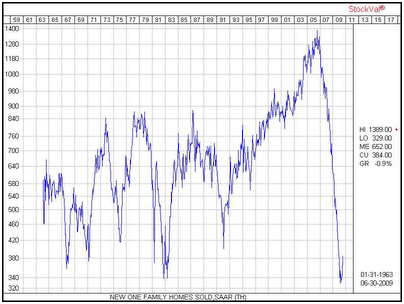
    Not so fast. Like the cars in a roller coaster, the first cars will begin to climb out while the last cars are still screaming downward at top speed. The Commerce Department reported sales in August rose a tepid .07% in August. What they did not highlight is that new home sales of 429,000 are at historical off the chart low compared to the last 50 years (see chart below).

    Such is the case with the Roller Coaster Recession. In California’s roller coaster ride the first car, The Inland Empire, crested the top in 2007. When pink slips were issued, these homeowners did not have deep pockets to sweat it out. All of their savings had been plowed into their down payment. When values declined, they had no staying power. They were gone in the first wave of foreclosures.

    Meanwhile, the rear car, Coastal California, continued to climb in value seemingly immune to the problems inland. The reason was staying power. The residents of tony Corona Del Mar were able to dump their third car, the Range Rover to keep solvent. When that ran out, Coastal California tapped their savings and finally used their equity lines to maintain their high mortgage payments while they waited for a buyer. But it is 2009 and the buyers have not materialized. More Jumbo Loans are falling behind in their payments. Watch the 60-day delinquency rate on prime Jumbo Loans. According to First American Core Logic, Jumbos in default jumped to 7.4% in May versus 4.9% for conforming loans

    Like our proverbial roller coaster, now it’s the turn for the first cars to rise. As the Inland Empire seems to have bottomed, Coastal California is still racing downward. There are 200 homes for sale between $1.5 and $3 million in ritzy Corona Del Mar. Even with a hefty 25% down payment, a $2 million property will require a $1,500,000 mortgage. Today’s lenders will require proof that the borrower can afford the $7,500 per month mortgage payment. They will demand a W-2 or 2008 tax return showing at least $22,500 per month in income to support a 30% housing expense ratio.

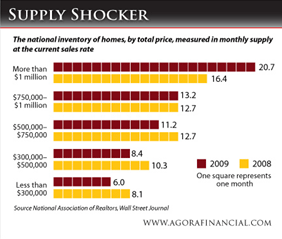
    The reality is there simply are not enough buyers earning $250,000 per year to buy up the 200 homes in Corona Del Mar. The current inventory will take 17 months to sell out but, as the recession continues, more homes are posting For Sale signs each month. Coastal California has not yet seen their bottom and they are still heading down at a rapid pace.

    Our national leaders may proclaim the end of the recession, but Californians have no reason to party. The Stimulus Package that shipped $50 billion to California was a one-time windfall that delayed but did not end California’s structural $26 billion budget deficit.

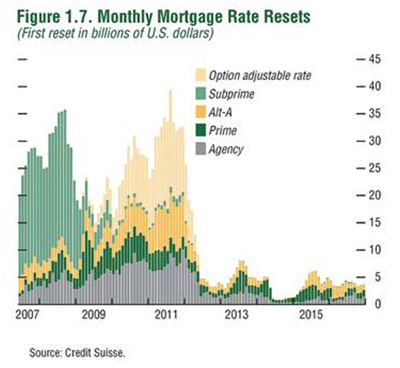
    Add to that the “Mortgage Armageddon” that is scheduled to hit next February. As the sub-prime mortgage defaults subside, the Option ARMS (adjustable rate mortgages) and Prime ARMs will begin to reset in early 2010 (see chart). This is not a working class but primarily a middle and upper-class problem. It is more a coastal than inland crisis; in New York terms, more Larchmont and less exurbia.

    There is a problem, however, with dinging the rich. They are the very folks expected to spend in our consumer-driven economy and invest in new ventures. If they have to re-route more dollars to mortgage payments, they not going to be able to help the economy.

    The Roller Coaster Recession will see more rises and dips before a sustainable recovery comes to California and other high-priced marekts. Those in the first car, like The Inland Empire, have nearly completed their ride. Any remaining dips will be minor in drop and brief in duration. But the genteel folks in the last car, in places like Coastal California, have another precipitous drop in front of them. This may come as a surprise to those believing the headlines that the recession was over. The wild ride for many is hardly over yet.

    ***********************************

    This is the fourth in a series on The Changing Landscape of America. Future articles will discuss real estate, politics, healthcare and other aspects of our economy and our society.

    Robert J. Cristiano PhD is a successful real estate developer and the Real Estate Professional in Residence at Chapman University in Orange, CA.

    PART ONE – THE AUTOMOBILE INDUSTRY (May 2009)
    PART TWO – THE HOME BUILDING INDUSTRY (June 2009)
    PART THREE – THE ENERGY INDUSTRY (July 2009)

  • Homebuilding Rebound… Or Boredom in the Burbs?

    The economy might come back – but will the housing market return? And in what form?

    Right now, builders are jumping into the low end of the market because of the $8,000 first time home buyer tax credit. This tax credit cannot survive indefinitely. Compared to homes sold in 2006, today’s are bare bones in size, materials and finishes in response to current, temporary market conditions. But the scrimping only makes the homes built in yesterday’s developments more attractive to potential buyers. The next wave of home buyers will have a choice: stay where they are, move to a more recently built (devalued) home, or buy new.

    Here’s a rundown on the major factors — and the forces on them — that will guide home buyers in their decisions. It’s also a rundown for any community, planner or developer — government or private sector — who would like to see the market rebound.

    Lot Size: Will buyers want to be shoehorned into new compressed development, or will they prefer to remain in the larger lot suburbs, where there are plenty of bargains today with usable yards and at least some views?

    The administration is pushing for compact (very dense) development, something the home buying market historically finds less desirable. If one hundred residents of a subdivision were asked the square footage of their lot, few would know the answer (more would be aware of their house’s square footage). Homes placed close to the street guarantee a claustrophobic feeling of space. Space is defined by that object that stops viewshed – typically a home, wall (fence) or low vegetation.

    Density is increased by the creation of narrower lots (and homes). When the lot narrows either the square footage of the house must plummet, or the home must get deeper. Assuming that facing directly into the home next door is not a quality view, the percentage of wall space that allows windows with a good view becomes very small as the home narrows.

    To illustrate, take a business card and look especially at the long edges. The shape emulates the rectangular perimeter of a typical suburban home built in the past few decades. Now imagine nice front and rear yard spaces with plenty of wall surface for windows, even with a garage taking up a portion of the front.

    Along comes the anti-sprawl movement pushing narrower lots, and making those on City Councils and Planning Commissions feel guilty about destroying the planet. Across America over the past two decades lots have been getting smaller – in some cases much smaller. Now take that business card and rotate it 90 degrees. This would represent the shape of a typical suburban home today.

    Huh. Wouldn’t all those side windows now look into the neighbors home? Well, windows now are placed along the short side of the home. What about the garage? Well, typically that’s still along the front, but since cars did not suddenly get 33% narrower, occupants just lost quite a bit of precious viewing area. Density went up by 33% but useable yards went down by 33%.

    Today we are building with much less width than we did during the past few decades. Yet the environmentalists and press do not seem to have taken notice.

    What is most likely coming down the road?

    Miniscule, very narrow lots combined with vertical growth. To illustrate, cut that business card in half. OK, so there goes the square footage right? Take one half and place it on top of the other. Well, it’s likely that the home was already two story, so that means three stories right? How much do you like climbing stairs? Better buy stock in residential elevator companies. So how do you park cars in this very narrow lot? If you do not want the street to appear as a solid wall of garage doors, then the only way to provide garage space is a single width garage, two stalls deep — another inconvenience — or a two car garage in the rear… but there goes any attempt for quality rear yard space.

    Architecture: Suburban homes have been looking pretty bland for the past few decades. Slapping on a front porch (most are the size of a stoop) really doesn’t make that much difference.

    Blame architects? An AIA registered, certified, artistically talented architect was not likely involved in the design process of the mass market home. It’s far cheaper to let Harry down the street (nephew of what’s his name) to draw up plans. How do you think many small home builders get financed? If they go to a lumber yard and select from a series of home plans, they can get a package deal; materials and financing furnished by the same source, standard packages from which to choose. Any wonder why 30 home builders in the same town seem to all build the same character-free house?
    Did the lumber yard hire a talented architect to gain advantage in the local market? What incentive do you think the supplier of the materials would have to actually be efficient in the drafting of the home? Excess material means increased profits!

    Homes in suburbia lack character and devalue a community as a general rule, but it’s not always the case. For example, in many areas in Texas, housing is affordable and full of architectural character with great landscaping. Builders in the major Texas markets know that if they shortcut curb appeal, nobody will clamor to their door. The local home buying market is astute… and today’s strongest home market.

    National large home builders? Most of the nationals expand into an area by buying out a local builder that showed signs of success (see above).

    Green: Ask your banker how much green means to the value of a home. Ask the appraisal company, does green add any value? Green certification is commonly messy and difficult, requiring builders to chase points instead of building wisely. Most green standards were inspired by a social engineering agenda. My own certified green home earns me lots of points because I’m near a bus stop and walking distance to a coffee shop. No wonder the financial people don’t take the movement seriously. My residential elevator? Not listed on the “points” system. Home designed to maximize quality viewsheds? No points! We had intended to place a 1 ½ inch foam insulation fill around the entire foundation surface, but a 2 inch minimum was required to earn points . That increased the cost of construction by $900. I’m not an expert in insulation, but it seems I spent 30% more to get a 0.1% benefit on my utility bill – hell of a deal! That $900 extra added to my payments – let’s see with interest, that cost me $5.25 every month… got my point though.

    Will the home market flourish when the economy returns?

    In the last few weeks I was Keynote Speaker at the Western States Planning Association Annual Meeting and at the North Dakota American Institute of Architects.

    Planners and Architects are very different groups. Ever wonder why the neighborhood plan and the architecture of the homes within it rarely seem related to each other? Nobody looks at mass market housing from a perspective of combined architectural spaces as a main component of the overall neighborhood design. The merging of planning and architecture on housing for the masses was well received by both groups.

    How will we bring the housing market back?

    Not by scrimping and reducing value, but by increasing value through a combined effort of architects, planners, and engineers to create a new era of sustainable communities that increase living standards affordably. Density is not a solution. A revolution in design is.

    Rick Harrison is President of Rick Harrison Site Design Studio and author of Prefurbia: Reinventing The Suburbs From Disdainable To Sustainable. His website is rhsdplanning.com.

  • How Smart Growth Disadvantages African-Americans & Hispanics

    It was more than 45 years ago that Dr. Martin Luther King, Jr. enunciated his “Dream” to a huge throng on the Capitol Mall. There is no doubt that substantial progress toward ethnic equality has been achieved since that time, even to the point of having elected a Black US President.

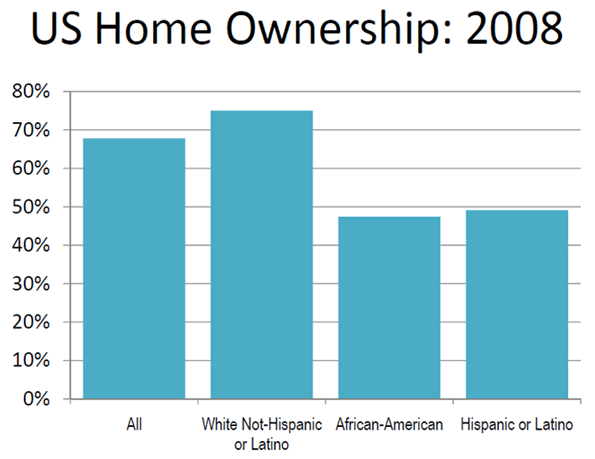
    The Minority Home Ownership Gap: But there is some way to go. Home ownership represents the core of the “American Dream” that was certainly a part of Dr. King’s vision. Yet, there remain significant gap in homeownership by ethnicity. Rather than a matter of discrimination, this largely reflects differing income levels between White-Non-Hispanics, African-Americans and Hispanics or Latinos. Today, approximately 75% of white households own their own homes. Whites have a home ownership rate fully one-half higher than that of African-Americans and Hispanics or Latinos at 47% and 49% (See Figure).

    Setting the Gap in Stone: A key to redressing this difficulty will be convergence of minority household incomes with those of whites, and that is surely likely to happen. However, there is another important dynamic in operation: house prices in some areas have risen well in advance of incomes, so that convergence alone can not narrow the home ownership gap in a corresponding manner. It is an outrage for public policy to force housing prices materially higher so long as home ownership remains beyond the incomes of so many, especially minorities.

    The Problem: Land Use Regulation: The problem is land use regulation. The economic evidence is clear: more restrictive land use regulation raises house prices relative to household incomes. This can be seen with a vengeance in the house price increases that occurred during the housing bubble. As we have previously described, metropolitan markets with more restrictive land use regulation (principally the more radical “smart growth” policies) experienced house price escalation out of all proportion to other areas in the nation. In some cases, they topped out at nearly four times historical norms. On the other hand, in the one-half of major metropolitan area markets where land use regulations were less severe, house prices tended to increase to little more than historic norms, at the most.

    How Smart Growth Destroys Housing Affordability: This difference is principally due to the price of land, which is forced upward when the amount of land available for building is artificially limited, as is the case in smart growth markets. At the peak of the bubble, there was comparatively little difference in house construction costs per square foot in either smart growth or less restrictive markets. However, the far higher land prices drove house prices in smart growth markets far above those in less restrictively regulated markets. Where house prices rise faster than incomes, housing affordability drops as prices rise at escalated rates.

    Wishing Away Reality: It is not surprising that the proponents of smart growth undertake Herculean efforts to deflect attention away from this issue. Usually they pretend there is no problem. Sometimes they produce studies to indicate that limiting the supply of land and housing does not impact housing affordability, which is akin to arguing that the sun rises in the West. Even the proponents, however, cannot “walk a straight line” on this issue, noting in their most important advocacy piece (Costs of Sprawl – 2000) that their more important strategies have the potential to increase the cost of housing.

    The Assault on Home Ownership: Worse, well connected Washington interest groups (such as the Moving Cooler coalition) and some members of Congress seek to universalize smart growth land rationing throughout the nation, which would cause massive supply problems and housing price inflation that occurred in some markets between 2000 and 2007. Even after the crash, these markets experienced generally higher house prices relative to incomes in smart growth markets than in traditionally regulated markets.

    House Price Increases and Minorities: House price increases relative to incomes weigh most heavily on ethnic minority households, because their incomes tend to be lower. This is illustrated by an examination of the 2007 data from the American Community Survey, in our special report entitled US Metropolitan Area Housing Affordability Indicators by Ethnicity: 2007. The year 2007 was the peak of the housing bubble, but represents a useful point of reference for when future “smart growth” policies were imposed nationwide.

    Median Priced Housing: The data (Table) indicates that median house prices were 75% or more higher for African-Americans than Whites, however that African-Americans in smart growth markets require 84% more to buy the median priced house. The situation was slightly better for Hispanics or Latinos with median house prices at least 50% more relative to incomes than for Whites. House prices relative to Hispanic or Latino median household incomes were 86% higher in smart growth markets than in less restrictively regulated markets.

    SUMMARY OF HOUSING INDICATORS BY
    LAND USE REGULATION CATEGORY
    Metropolitan Areas over 1,000,000 Population: 2007
    HOUSING INDICATOR Less Restrictive Land Use Regulation Markets More Restrictive Land Use Regulation Markets All Markets More Restrictive Markets Compared to Less Restrictive Markets
    MEDIAN VALUE MULTIPLE        
    All 3.1 5.8 4.5 1.89
    White Non-Hispanic or Latino 2.7 5.1 3.9 1.90
    African-American 4.9 8.9 6.9 1.84
    Hispanic or Latino 4.2 7.9 6.1 1.86
    LOWEST QUARTILE VALUE MULTIPLE      
    All 2.1 4.2 3.2 2.01
    White Non-Hispanic or Latino 1.8 3.7 2.8 2.01
    African-American 3.3 6.5 5.0 1.95
    Hispanic or Latino 2.9 5.7 4.4 1.98
    MEDIAN RENT/MEDIAN HOUSEHOLD INCOME      
    All 13.8% 17.1% 15.5% 1.24
    White Non-Hispanic or Latino 12.1% 15.1% 13.6% 1.25
    African-American 21.9% 26.1% 24.0% 1.19
    Hispanic or Latino 19.1% 23.0% 21.1% 1.20
    LOWER QUARTILE RENT/MEDIAN HOUSEHOLD INCOME    
    All 10.8% 13.1% 12.0% 1.22
    White Non-Hispanic or Latino 9.4% 11.6% 10.5% 1.23
    African-American 17.0% 20.0% 18.5% 1.17
    Hispanic or Latino 14.9% 17.5% 16.2% 1.18
    NOTES        
    Median Value Multiple: Median House Value divided by Median Household Income
    Low Quartile Value Multiple: Low Quartile House Value divided by Median Household Income
    2007 Data
    Calculated from American Community Survey (US Bureau of the Census) Data
    “More restrictive” land use regulation markets (generally "smart growth") include those classified as "growth management," "growth control," "containment" and "contain-lite" and "exclusions: in "From Traditional to Reformed A Review of the Land Use Regulations in the Nation’s 50 largest Metropolitan Areas" (Brookings Institution, 2006) and markets with significant large lot zoning and land preservation restrictions (New York, Chicago, Hartford, Milwaukee, Minneapolis-St. Paul, and Virginia Beach). Less restrictive" land use regulation markets (generally "traditional") include all others, except for Memphis, where urban growth boundaries have been drawn far enough from the urban area to have no perceivable impact on land prices and Nashville, where the core county is exempt from the urban growth boundary requirement in state law.

    Lower Priced Housing (Lowest Quartile): I recall being told by a participant at a University of California–Santa Barbara economic forum organized by newgeography.com contributor Bill Watkins that, yes, smart growth increases house prices, but not for lower income residents. My challenger went so far as to say that lower income households were aided economically by smart growth. The facts are precisely the opposite. Comparing the lowest quintile (lowest 25%) house price to median household incomes indicates that minorities pay even a higher portion of their incomes for lowest quintile priced houses than the median priced house. African-Americans in smart growth markets needed 95% more relative to incomes to afford the lowest quartile house. Hispanics or Latinos needed 98% more.

    Rental Housing: The problem carries through to rental housing. There is a general relationship between rental prices and house prices, though rental prices tend to “lag” house price increases. In the smart growth markets, minorities must pay approximately 20% more of their income for the median contract rental in smart growth metropolitan areas than in less restrictively regulated markets. Similar results are obtained when comparing minority household median incomes with lowest quintile contract rents, with African-Americans paying 17% more of their incomes in smart growth markets and Hispanics or Latinos paying 18% more.

    Moreover, it is important to recognize that all of the above data is relative, based on shares or percentages of incomes. Varying income levels are thus factored out. Minority and other households in smart growth markets face costs of living that are approximately 30% higher than in less restrictively regulated markets, according to analysis by US Department of Commerce Bureau of Economic Analysis economists. Some, but not all of the difference is in higher housing costs.

    Social Costs of Smart Growth: In 2004, the Tomas Rivera Policy Institute, which focuses on Latino issues, noted concern about the homeownership gap in California, which has been ground zero for land use regulation driven house price increases for decades:

    Whether the Latino homeownership gap can be closed, or projected demand for homeownership in 2020 be met, will depend not only on the growth of incomes and availability of mortgage money, but also on how decisively California moves to dismantle regulatory barriers that hinder the production of affordable housing. Far from helping, they are making it particularly difficult for Latino and African American households to own a home.

    Examples of the restrictions cited by the Tomas Rivera Policy Institute are restrictions on the supply of land, high development impact fees and growth controls.

    California has acted decisively, but against the interests of African-Americans and Hispanics or Latinos. The state enacted Senate Bill 375 in 2008, which will impose far stronger state regulations on residential development, increasing the likelihood that minorities in California will always be disadvantaged relative to White-Non-Hispanics. At the same time, State Attorney General Jerry Brown has forced some counties to adopt more restrictive land use regulations through legal actions. California, which had for decades been considered a state of opportunity, is making home ownership and the pursuit of the “American Dream” far more difficult, particularly for its ever more diverse population.

    Stopping the Plague: In California, the hope to increase African-American and Latino home ownership rates to match those of white-non-Hispanics may already be beyond reach due to the that state’s every intensifying radical smart growth policies. However, the “Dream” continues to “hang on” in many metropolitan markets. Hopefully Washington will not put a barrier in the way of African-Americans and Hispanics or Latinos that live elsewhere in the nation.

    US Metropolitan Area Housing Affordability Indicators by Ethnicity: 2007 includes tables with data for each major metropolitan area in the United States

    Photo: Starter house in Atlanta suburbs (by the author)

    Wendell Cox is a Visiting Professor, Conservatoire National des Arts et Metiers, Paris. He was born in Los Angeles and was appointed to three terms on the Los Angeles County Transportation Commission by Mayor Tom Bradley. He is the author of “War on the Dream: How Anti-Sprawl Policy Threatens the Quality of Life.

  • The Costs of Climate Change Strategies, Who Will Tell People?

    Not for the first time, reality and politics may be on a collision course. This time it’s in respect to the costs of strategies intended to reduce greenhouse gas emissions. The Waxman-Markey “cap and trade” bill still awaits consideration by the US Senate, interest groups – mainly rapid transit, green groups and urban land owners – epitomized by the “Moving Cooler” coalition but they are already “low-balling” the costs of implementation.

    But this approach belies a bigger consideration: Americans seem to have limits to how much they will pay for radical greenhouse emissions reduction schemes. According to a recent poll by Rasmussen, slightly more than one-third of respondents (who provided an answer) are willing to spend $100 or more per year to reduce greenhouse gas emissions. About 2 percent would spend more than $1,000. Those may sound like big numbers, but they are a pittance compared to what is likely to be required to meet the more than 80 percent reduction in greenhouse gas emissions that the Waxman-Markey bill would require. Even more worryingly for politicians relying on voters to return them to office, nearly two-thirds of the respondents would pay nothing to reduce greenhouse gas emissions.

    If we do a rough, weighted average of the Rasmussen numbers, it appears that Americans are willing to spend about $100 per household per year (Note 1). This includes everyone, from the great majority, who would spend zero to the small percentage who would spend more than $1,000. At $100 per household, it appears that Americans are willing to spend on the order of $12 billion annually. This may look like a big number. But it is peanuts compared to market prices for greenhouse gas emissions. This is illustrated by the fact that the social engineers whose articles of faith requires building high speed rail to reduce greenhouse gas emissions would spend $12 billion to construct just 150 miles of California’s proposed 800 mile system.

    Comparing Consumer Tolerance to Expected Costs: At $100 per household, Americans are prepared to pay just $2 per greenhouse gas ton removed. All of this is in a policy context in which the United Nations Intergovernmental Panel on Climate Change suggests that $20-$50 per greenhouse gas ton is the maximum that should be spent per ton. The often quoted McKinsey/Conference Board study says that huge reductions in greenhouse gas emissions can be achieved at $50 or less, with an average cost per ton of $17. International markets now value a ton of greenhouse gas emissions at around $20. At $2 per ton, American households are simply not on the same “planet” with the radical climate change lobby as to how much they wish to spend on reducing greenhouse gases.

    International Comrades in Arms? This is not simply about Americans and their perceived differences from others who are so often considered more environmentally sensitive. France’s President Sarkozy has encountered serious opposition in proposing a carbon tax on consumers to discourage fossil fuel use. He is running into problems not only among members of the opposition, but concerns have also been expressed by members of his own party. It appears that many French consumers (like their American comrades) are more concerned about the economy than climate change at the moment.

    China, India and Beyond: If only a bit more than one-third of American households are willing to pay much of anything to reduce greenhouse gas emissions, it seems fair to ask what percentage of households in China, India and other developing nations are prepared to pay anything? A possible answer was provided recently by India’s environment minister, Jairam Ramesh, who released a report predicting that India’s greenhouse gas emissions would rise from the present 1.2 billion tons to between 4 and 7 billion tons in 2030. The minister said the “world should not worry about the threat posed by India’s carbon emissions, since its per-capita emissions would never exceed that of developed countries.” . At the higher end of the predicted range, India would add more greenhouse gas emissions than the United States would cut under even the proposed 80 percent reduction scheme. Suffice it to say that heroic actions to reduce greenhouse gas emissions seem unlikely in developing countries so long as their citizens live below the comfort levels of Americans and Europeans.

    Lower Standard of Living not an Option: I have been giving presentations on this and similar subjects for some years. I have yet to discern any seething undercurrent of desire on the part of Americans (or the vast majority anywhere else) to return to the living standards of 1980, much less 1950 or 1750. Neither Washington’s politicians nor those in Paris or any other high income world capital are going to tell the people that they must accept a lower standard of living. Nor is there any movement in Washington to let the people know that their tolerance for higher prices could well be insufficient to the task.

    For Washington, the dilemma is that every penny of the higher costs will hit consumers (read voters), whether directly or indirectly. There could be trouble when the higher utility bills begin to arrive and it could mean difficulty in delivering on the primary policy objective of virtually all governments, which is to remain in power. This is not to mention the unintended consequences of higher prices on many key industries, notably agriculture, manufacturing, and transportation.

    There is an even larger concern, however, and that is the stability of society. Harvard economist Benjamin Friedman, in The Moral Consequences of Economic Growth suggested from an economic review of history that economies that fail to grow lapse into instability.

    A Public Policy Collision Course? A potential collision between economic reality and public policy initiatives could be in the offing. Many “green” proposals are insufficiently sensitive – even disdainful – towards the concerns of everyday citizens. This suggests that politically there should be an emphasis only on the most cost effective strategies. In a democracy, you must confront to the reality that people are for the most part more concerned about the economy than about strategies meant to slow climate change.

    The imperative then is not to ignore the problem, but to focus on the most rational, low-cost and effective greenhouse gas emission reduction strategies. Regrettably, it does not appear that Washington is there yet. The special interests whose agendas are to cultivate and reap a bounteous harvest of “green” profits or to convert the “heathen” to behaviors – such as riding transit and living in densely packed neighborhoods – that they have been advocating long before the climate change issue emerged.

    Those concerned about the future of the environment also have to pay attention to reality. Reducing greenhouse gases is not a one-dimensional issue. Environmental sustainability cannot be achieved without both political and economic sustainability.


    Note 1: The Rasmussen question was asked of individuals. It is assumed here, however, that the answers related to households. One doubts, for example, that a queried mother answered with an assumption that she would pay $100, her husband would pay $100 and each of the kids would pay $100, but rather meant $100 for the household, since, to put it facetiously, few households devolve their budgeting to the individual members.


    Wendell Cox is a Visiting Professor, Conservatoire National des Arts et Metiers, Paris. He was born in Los Angeles and was appointed to three terms on the Los Angeles County Transportation Commission by Mayor Tom Bradley. He is the author of “War on the Dream: How Anti-Sprawl Policy Threatens the Quality of Life.

  • Florida Drifts Into the Morass

    By Richard Reep

    Regarding Florida’s new outmigration, “A lot of people are glad the merry-go-round has finally stopped. It was exhausting trying to keep up with 900 new people a day. Really, there is now some breathing room,” stated Carol Westmorland, Executive Director of the Florida Redevelopment Association at the Florida League of Cities. Now that surf and sand are officially unpopular, the urban vs. suburban development debate has caught developers and legislators in a freeze frame of ugly and embarrassing poses at local, regional, and state levels.

    In South Florida, Miami’s city commissioners narrowly defeated a move to institute a form-based code on August 7, which would have increased regulation in the most populous city in the state. This code would have rigidly set Miami’s density levels and regulated building form all the way down to the location of the front door. It constituted a surprising hometown defeat for Andres Duany and Elizabeth Plater-Zyberg, originators of the New Urbanism movement and the prime consultants hired to create the code. Commission Chairman Joe Sanchez, worried about restricting people’s use of property, stated that Miami 21 “exposes us to tens of millions of dollars in lawsuits from loss of property value.” Not ready to throw in the towel, however, the New Urbanists are appealing the vote in two public hearings. “We’re confident that the issues can be resolved,” stated Maria Mercer, who works for DPZ. The commissioners may be worried about lawsuits. The people seem to be even more concerned about Big Brother fussing about their property, judging from the public input on the code’s website.

    Of course, the press has decried this as a vote for “sprawl,” rather than a vote for common sense. By now, the language of growth management has become so riddled with red-baiting words such as “sprawl” posed against lofty ideals such “smart growth” that the public can make no real sense of development proposals anymore. It is easy to see why New Urbanism was so seductive, for it seems to solve every problem once and for all – this goes here, that goes there – and there would be no more debate…unless, of course, the Master Planner made an error somewhere. But, like most consultants, the Master Planner has moved on to the next job and isn’t in charge of living with his plan. If he labels low-cost development “sprawl”, then so be it. And if he deems high-cost development “smart growth,” then so be it. Just like Ramses in The Ten Commandments, “So let it be said – so let it be done.”

    Blackballing suburbs with words such as “sprawl” is dissonant to most voters who, after all, live in these supposedly awful places; likewise words like “walkable urban cores” often conjure up the reality of parking and traffic nightmares. Then there’s something called the marketplace. Florida is becoming less about retirees, and more about families. The much ballyhooed flurry of high-density urban projects doesn’t seem to fit the lifestyle of cars and kids and soccer practice too well.

    Then there’s the other downside of new urbanist growth, which is its cost. Young, single service workers and retirees – a natural market for these urban villages – cannot afford either the pricey real estate or the stiff maintenance fees. On the other hand, Florida’s upwards of about 300,000 empty single-family homes, by the Orlando Sentinel’s count, could provide a natural lure to families, more so than the 65,000 or so condominium units on the market in the state. This so-called “overhang” of 3 to 5 years of unsold inventory only serves to terrify homeowners who remain in the state and have to deal with depreciating property values for some time in the future.

    Clearly more density has been no more successful than the most mindless sprawl. The New Urbanists’ often shrill rhetoric has frightened many planners into pushing density on Florida’s fleeing population. The disaster that is Miami’s downtown and beachfront may be the best known, but throughout the state Florida’s high density developers and landowners are facing foreclosures, fading credit, and loss of business on an unprecedented scale. Those who came late to the party – witness poor Hollywood, Florida, a city which finally got its act together and aggressively redeveloped its downtown – look like empty movie lots. Elsewhere in cities across the state, vast tracts have been razed, rezoned for high density and now lie fallow or unfinished, giving the face of Florida a remarkably post-apocalyptic quality.

    Neil Fritz, Hollywood’s Economic Development Director, is sanguine about the dire straits of his town. “Oh, the urban areas will come back before the suburbs,” he stated recently. But in reality, downtown condominiums are a latecomer to the Florida scene, and are a forced market. They were viable largely because they compared favorably to single family detached dwellings in terms of price and convenience.

    In fact, quite the opposite is likely to occur, with the single family suburb – particularly those located near jobs – rebounding first as people’s natural preference, as it has been for over a hundred years. This might chagrin the New Urbanists, who spent a great deal of effort inventing such earnest fantasies as a “sprawl repair kit”, even though safety, mobility and open space remain deeply ingrained in the American lifestyle. Also, the high-density movement was fed by investors and owners of second homes – rare commodities in this post-crash world.

    Overdevelopment is easy to blame on poor government, which allowed developers to overbuild on credit, but as with the financial crisis in general, there is enough blame to go around. What municipality would not like dense urban cores full of affluent taxpayers enjoying lattes on the boulevard? This dream sadly has turned to the reality of empty storefronts, condos being converted into low-income rentals, or worse yet, empty lots being assessed at their lowest possible taxable value. The fringes of most urban areas continued to be developed at low density, and while they are suffering the same fate as the denser areas now, the effect is less profound since it is more spread out.

    Florida’s government just has no place to turn for more revenue, and relies mostly on property taxes and fees. Its main economic engine is development. Local governments, increasingly unable to pay for services, naturally encouraged density as a way to levy more and more property taxes, largely ignoring the long-term economic viability of specific developments. So-called “smart growth” indeed seemed pretty smart to cities and counties needing the taxes that they believed dense urban cores might someday generate.

    The best hope for Florida lies neither in the God-like precepts of the New Urbanist movement, nor in the hands of the developers, but rather in the hands of intelligent, humanistic conversation revolving around a sense of shared community and deeper values. With the internet as a tool, cities could be encouraging citizen input in advance of a proposal, rather than the old, 20th century tool of public meetings. This conversation is necessary as our legislators and developers dance their kabuki dance around imagined future prosperity. Florida seems to be drifting aimlessly, as no one at the state level seems to be concerned about the loss of population, instead congratulating themselves on creating the next boom.

    The cities and counties of Florida would do well to use this interregnum to retool their public process to give people more access to the right information up front. By allowing internet-based review and participation, people can provide intelligent input into development proposals. Armed with the right information, Americans historically have made excellent decisions, and Florida can become an example in how to better manage its single most important industry. In the meantime, the leadership of Florida would do well to examine the negative connotations of “sprawl” when describing the native habitat of their voters and taxpayers, and examine the consequences of encouraging density for a market that has yet to exist, and may not exist for some time to come.

    Richard Reep is an Architect and artist living in Winter Park, Florida. His practice has centered around hospitality-driven mixed use, and has contributed in various capacities to urban mixed-use projects, both nationally and internationally, for the last 25 years.