Tag: middle class

  • Salinas Dispatch: A Silver Lining in the Golden State

    From a distance, a crisis often takes on ideological colorings. This is true in California, where the ongoing fiscal meltdown has devolved into a struggle between anti-tax conservatives and free-spending green leftist liberals.

    Yet more nuances surface when you approach a crisis from the context of a specific place. Over the past two years my North Dakota-based consulting partner, Delore Zimmerman, and I have been working in Salinas, a farm community of 150,000, 10 miles inland from the Monterey coast and an hour’s drive south of San Jose. Our work has been funded by a variety of sources, including the city, local business interests and the Chamber of Commerce.

    Our goal has been to find ways to promote upward mobility in the town, which is almost two-thirds Hispanic. Poverty is widespread, and gang problems rank among the worst in California. Unemployment, devastated by the recent recession, hangs at around 15%.

    These conditions are not at all unusual for inland California, and they are particularly prevalent in farm regions. In the Central Valley, over the next range of mountains, conditions are far worse, with some communities losing thousands of acres in production and unemployment rushing upward of 40%.

    One liberal journalist, Rick Wartzman, recently described the vast agricultural region around Fresno as “California’s Detroit.” As environmentalists push to cut back on water supplies and protect fish populations in the San Francisco Bay Delta, Wartzman notes, its local workers and businesspeople “are fast becoming a more endangered species than Chinook salmon or delta smelt.”

    In Salinas, where water comes from local aquifers, wells and the Salinas River, death seems less imminent, but there is a profound sense that things may be deteriorating. Local growers worry about regulatory constraints that will drive up costs to meet new state greenhouse gas standards. They also fear a possible county initiative, promoted by the well-funded local greens, to ban the growing of genetically modified foods.

    The growers’ response to the pressure – as with other businesses in California – is not to quit but to scale down operations. Some are cutting back thousands of acres of lettuce and other green crops that have been the prime business for the area for nearly a century.

    Yet we also see many reasons for hope. Salinas remains a unique place with an amazing richness in what the French call terroir, a combination of climate and soil. The city’s most famous son, John Steinbeck, wrote of the Valley’s unique topography:

    “The high gray-flannel fog of winter closed off the Salinas Valley from the sky and the rest of the world. On every side it sat like a lid on the mountains and made of the great valley a closed pot.”

    Growing conditions in Salinas cannot be easily duplicated elsewhere. Its richness has created a cornucopia responsible for the predominant part of the area’s private-sector employment.

    But it’s not just physical factors that make Salinas – and California – so productive. People matter too. The area is populated by scores of hard-driving agricultural families, people whose forebears transformed the place into the “salad bowl” of a nation. By 1952, when Steinbeck published East of Eden, Salinas produced 70% of the nation’s lettuce and much of its fresh vegetables.

    Salinas’ growers are not hereditary gentry; talk to local farmers and you find people whose roots lay in Italy, Portugal, Ireland, Japan and, increasingly, Mexico. “People, if given opportunity, can accomplish anything,” notes Lorri Kester, CEO of Mann Packing, a leading broccoli producer. “Many of the firms that lead us now were started by ‘Okies’ who worked the land. Now we see the same things with Latinos who started out as hands and now are foremen or managers.”

    What the Salinas growers do best – like their high-tech counterparts up in the Santa Clara Valley – is innovate. Working with the USDA and University of California-Davis scientists, they have led the way in creating new strains of vegetables and new ways of marketing, including the notion of “salad in a bag.”

    But not all the knowledge that makes Salinas such an economic powerhouse comes from entrepreneurs or PhDs. Like many agricultural communities, Salinas has had a sometime brutal labor history, particularly in the 1930s. The worst of this is now thankfully over, but farm labor remains a tough and often unrewarding profession.

    Yet even the hardest-edged growers acknowledge the importance of their labor force. Although education levels remain relatively low, our research revealed an extraordinarily high concentration of people with practical skills that can be applied to growing the agricultural economy. Future mechanization may reduce the overall employee counts but will make growers even more dependent on skilled workers in the fields.

    This proficiency, acquired in the fields and the processing sheds, has helped create another product for the Valley: expertise. Salinas growers, foreman, irrigation workers and marketers now sell their knowledge in other parts of California, as well as to Arizona, Mexico and, increasingly, East Asia. “I am seeing a lot of product and technical products from Salinas go to China and elsewhere,” notes Frank Pierce, a local agricultural consultant.

    Salinas also teaches you to avoid the great distinction made by many pundits between the “knowledge” industry and the productive type that focuses on tangible goods. A successful economy draws on information but also creates real products. There is a relationship between the two that is dynamic and has long been a critical component of California’s economic vitality.

    This is not just true of Salinas. I learned long ago from the founding fathers of Silicon Valley – people like Intel founder Bob Noyce and venture capitalist Don Valentine – that the practical knowledge from making circuits and chips helped create the Valley’s unique engineering terroir. Similarly, the “magic” of Hollywood does not emerge full-blown from the brain storms of stars and moguls. The entertainment complex’s unique abilities grow from the interplay of practical knowledge of less glamorous camera people, grips, editors, caterers and prop-managers servicing what Angelenos invariably refer to as “the industry.”

    Sadly, this insight largely has been lost on California’s political and business leadership. Among the so-called “progressive” community, production of any kind, outside of small artisanal farms or funky software shops, is disdained.

    This anti-development ethos has gained extra traction by claims that large farms and factories might add to the “carbon footprint” of a given place. Among well-funded foundations and some corporate leaders there remains an implicit sense that California can still mine enough riches in cyberspace to support the vast hoi polloi.

    Yet in reality, Californians need hard jobs, even mundane ones. The farm, sound stage or electronics factory provide the employment essential to broad-based prosperity. And when those jobs leave California they usually migrate to a place – whether over the border or abroad – where wages are lower and environmental controls are far weaker.

    This is not to argue that California’s right has the answers either. Lower taxes are generally preferable to higher ones. But in Salinas – and California – sometimes higher taxes might be preferable to cutting services, like the critical training offered by community colleges, which make the economy work and offer hope to the younger generation.

    In Salinas, Mayor Dennis Donahue, a Democrat of the Pat Brown variety, has embraced a call to raise the sales tax in order to maintain basic services. It’s not an ideal solution, but in the real world of running a city, particularly one with a big gang problem, you don’t want to cut back on police and libraries or add to already surging unemployment.

    What California needs most now is what it’s most missing: common sense and a sense of balance. This is what we learned in Salinas. California cannot be saved by ideologies – it needs to be saved from them.

    To be sure, preserving the land and air quality should remain a priority; it is the basis of California’s riches and unique appeal. But sustainability – the great buzzword of our time – needs to apply not only to the environment but also the economy and society. The right-wing solution of lower taxes even at the price of eviscerating the public sector and letting the infrastructure deteriorate does not constitute a program for long-term prosperity.

    We prefer an approach that focuses on practical steps for private and public sectors to collaborate on restoring economic growth. In Salinas, this means establishing – through cooperation with Hartnell, the local community college – a center for the development of agricultural technology. Salinas could use its combination of intellectual and grassroots knowledge to become the Silicon Valley of the “fresh” economy. It would also serve as a center of practical research on E. coli and other diseases that threaten the entire agricultural industry.

    Another step would be to expand the area’s thriving wine corridor to promote the region’s vintages. And there needs to be a plan to restore the historic central core into a bustling business district and to attract the predominately Latino shoppers, now lured to malls and outlet centers outside the city, back into town.

    These steps will take effort and money, but neither free market ideology nor green zealotry alone will get it done. California’s greatness was created not just by entrepreneurs or through its public sector, but in a clever, pragmatic melding of the two. Blessed with resources of topography, climate and human skill, our state should not allow dueling extremes to turn a global paragon into a planetary laughingstock.

    This article originally appeared at Forbes.

    Joel Kotkin is executive editor of NewGeography.com and is a presidential fellow in urban futures at Chapman University. He is author of The City: A Global History. His next book, The Next Hundred Million: America in 2050, will be published by Penguin early next year.

  • UK Green Path leads to Deindustrialization and Worsening Housing Shortage

    The First Secretary of State, Secretary of State for Business, Innovation and Skills, and Lord President of the Council, Peter Mandelson, together with Ed Miliband, the Secretary of State for Energy and Climate Change, have published The UK Low Carbon Industrial Strategy. They are claiming it promises an “economic revolution” but is in fact an environmentalist retreat from industrial production It is a disastrous strategy that will result in further de-industrialisation, supposedly with the aim of addressing a rather vague threat of climate change.

    Mandelson and Miliband insist The UK Low Carbon Industrial Strategy “can ensure that our economy emerges from the global downturn at the forefront of the technological and social shift that will define the next century.” Yet this is typical establishment “greenwash”, which many institutional and corporate leaders of the construction industry will sadly rush to endorse. It will shift us towards the laborious construction of new eco-homes, and the laborious refurbishment of the stock of mostly draughty, poorly insulated, and badly serviced housing. All this is aimed to achieve, at least on paper, a contribution to a national carbon reduction target by 2020.

    Government thinks that it will be building 240,000 “zero carbon” homes every year by 2106. In fact at least 500,000 homes are needed every year to meet household growth and replace the oldest of the stock at a rate of 1% a year. Yet in reality this year new house building is down to 100,000 a year, and there is no reason why that level of production will increase even when, as is starting to happen, house price inflation returns. Instead of promoting mass production, most house builders are quite likely to follow The UK Low Carbon Industrial Strategy to become luxury eco-home builders. They will be content to build around 100,000 “green” homes a year to get through the planning system. They will build homes that show their environmental credentials by the thickness of walls and roofs – full of sheep’s wool or hemp, packed with straw bales, or made from low-fired clay blocks.

    This, of course, is the approach to new house building promoted by Prince Charles and the other would be green gentry. He advocates “the use of local materials to create local identity which, when combined with cutting-edge developments in building technology, can enhance a sense of place and real community.” Just as Mandelson and Miliband claim theirs is an industrial strategy, Charles promotes green building technology.

    Charles talks of building walls and roofs thickly in “volume”, but what does his royal greenness know of the market? Government also imagines it can use renewable insulation materials to produce “affordable” housing. Walls and roofs will get thicker, but housing will not be built in sufficient quantity for a growing population, and will not be affordable on most British household incomes.

    The green tendency will be to use greater thicknesses of less processed, more laborious-to-install insulation materials, cut-to-fit on site. This will make the walls and roofs on new eco-homes around half a metre thick, but that might be fashionable. Having more material in the walls and roof will show how little energy is used in the new and expensive eco-home.

    Thick insulation is an immediate problem in the refurbishment of the stock of 26 million existing houses and flats. It is not always possible to cover the outside with great thicknesses of natural materials that, contrary to the Prince’s claim, have a low capacity to insulate. Even industrially produced fibres and foams, which green purists think are too processed, must be used thickly. It is less possible to apply thicknesses of insulation inside the existing home, when most British homes are so small. A lot of filling of masonry cavity walls has been carried out under energy efficiency schemes, with little regard for why the drained air cavity was there in the first place. But no existing housing has walls with cavities of up to the 300mm that would be required for insulants that satisfy greens.

    The architectural fact is that only made-to-fit insulation, prefabricated as an industrially processed product, can achieve the thermal performance being discussed with a minimal thickness.

    Sheep’s wool and hemp, straw bales, and low-fired clay blocks are positioned increasingly off the scale to the right on thickness. Foam glass as an industrial product is poor as an insulant, as is cellulose fibre. The sorts of glass and mineral fibre insulation that can be bought in any builder’s merchant require substantial thicknesses. Foams have better performance, and are familiar as cut-to-fit insulation. However only the use of processed vacuum insulation, as a made-to-fit industrial product reduces insulation thicknesses to the architectural dimensions required.

    On behalf of New Labour Miliband boasts that Britain has produced a carbon reduction plan to 2020 that should inspire other industrial and industrialising nations. “Having been the first country in the world to set legally binding carbon budgets, we are now the first country in the world to assign every department a carbon budget alongside its financial budget,” he told the House of Commons. We seem to be the first country in the world to ignore the space- and time-saving potential of construction technologies that require energy in their production processes, but save energy in the long term operation of well serviced buildings.

    Britain is retreating from industry and makes an environmental fetish out of bulky “natural” materials that don’t work well. Why favour materials that are lightly processed as agricultural crops, or are low-fired but need rendering? Why not accept processing, as all timber is processed, and welcome the durability of fully fired bricks? This carbon obsessed idiocy in construction works against other great materials like concrete, glass, steel and aluminium.

    For their part government is insisting that insulation must be renewable and crop-based rather than an industrially processed product. This means that small British houses and flats will be thickly walled and roofed and will be built in too few numbers to accommodate British household growth. Every existing home must be refurbished indefinitely. That is truly pitiful for an old industrial democracy like Britain.

    Government abuses the words Industrial and Strategy, sharing the Prince’s low aspirations for twenty-first century construction and architecture. An industrial strategy worthy of the name would promote the development of highly processed vacuum insulation, and would expect skills in design, manufacture, installation, and maintenance.

    An attempt to make “green jobs” rather than raise productivity and wages, The UK Low Carbon Industrial Strategy should be seen and criticised as an environmentalist strategy of de-industrialisation, because that is precisely what it is.

    Ian Abley, Project Manager for audacity, an experienced site Architect, and a Research Engineer at the Centre for Innovative and Collaborative Engineering, Loughborough University. He is co-author of Why is construction so backward? (2004) and co-editor of Manmade Modular Megastructures. (2006) He is planning 250 new British towns.

  • Moving to Reloville, America’s Cross-Country Careerists

    Peter T. Kilborn’s Next Stop, Reloville: Life Inside America’s New Rootless Professional Class documents an important piece of social history: the lives of relocating corporate executives. These modern-day ­nomads—overwhelming white, well-educated and middle-class—maintain the business machine of large companies. They include the technicians, marketing executives and professional managers who accept a rootless life in exchange for handsome remuneration.

    Most of these people live in what Mr. Kilborn calls ­Relovilles, an archipelago of mostly newer, upscale suburban communities that includes places such as Alpharetta, Ga., Highland Ranch, Colo., Overland Park, Kan., and a series of Texas locales from Plano, outside Dallas, to the Woodlands on the periphery of Houston.

    In the many vignettes he provides, Mr. Kilborn portrays these executives and their families in a dispassionate, even sympathetic manner. We meet Jim and Kathy Link, who have moved seven times in a little more than 10 years as Mr. Link pursued a career in selling ­employee-benefit services. The author rides along with Kathy as she shuttles the kids to ­soccer practice,and he tracks the buying and selling of the Links’ homes. “The basement is approximately the same size as my parents’ entire house,” says Jim, marveling at how much house his $200,000 annual ­income bought in Alpharetta.

    We also meet Matt Fisher and his family. He’s an inventory-management specialist who, we’re told, has “averted dead-ending his career by mining his network of contacts to move from Chicago to Cleveland, to Columbus, to Houston, and ­finally to Flower Mound,” in Texas. Matt explains: “You can escalate your career if you want to move around. The ones who don’t move around don’t get the calls . . . because ­nobody knows who they are.”

    Although Mr. Kilborn is clearly an advocate for the ideal of rooted, organic ­communities—a value shared by many of the “Relos” in his book—he evinces none of the snobbish dismissal of middle-class values and aspirations that one finds in the work of new urbanists such as James Howard Kunstler or Andres Duany. Yet despite the appealingly sensible outlook of ­“Reloville,” the book does not rise to the level of the great social histories, such as ­Herbert Gans’s “Levittowners” or even Alan Wolfe’s “One ­Nation.” Mr. Kilborn’s work lacks both the statistical rigor and deep historical perspective found in the best such works.

    Mr. Kilborn also falls into something of the old journalist’s trap: trying to sell your story as something bigger than it is. He calls the Relos “a disproportionately influential strain of the vast middle class.” Yet in many ways they may not be as important as he suggests.

    Overall, Mr. Kilborn estimates the total Relo population at around four million in 2007. The number includes something like 800,000 households that are moved every year by companies in the U.S.—not an insignificant group but hardly a major one in a country of more than 300 million people.

    Despite his claims of their significance, Mr. Kilborn ­acknowledges that the Relos are far from “masters of the universe” who actually shape economies and societies. In fact, most are more the servants of top management than people in control of their own destinies. They are, Mr. Kilborn notes, “twenty-first-century heirs of William S. Whyte’s ­‘Organization Man,’ who ­exchanged the promise of job security and a pension for his loyalty and toil.”

    Yet it seems clear that the whole world of “The Organization Man” of the 1950s—predicated on stable employment— is shrinking, and rapidly. The days of large corporate ­organizations with a secure cadre of midlevel executives seems ­itself an anachronism. Companies routinely restructure their bureaucracies and outsource—to smaller independent firms domestically as well as to firms overseas. Relos may represent less the wave of the future than a stubborn ­hangover from the past.

    One critical reason for the reduced need to uproot workers is new telecommunications technology. For generations, IBM was instrumental in shaping the Relo group that Mr. Kilborn describes. After all, this was a company with initials that, executives joked, really meant “I’ve been moved.” Yet today IBMers are not as mobile as in the past—not in terms of physical movement anyway. As much as 40% of the IBM work force operates full-time at home or remotely at clients’ businesses. For members of the company’s highly regarded consulting practice, the percentage is even higher—they’re logging frequent-flyer miles, and piling up points at ­Residence Inns, not putting down even shallow roots.

    Perhaps even more important may be social changes that could make Relos less relevant in the future. For decades in the post-World War II era it was believed that “spatial mobility” would increase, hastening social disintegration. This vision was epitomized in Vance Packard’s 1972 best-seller, “A Nation of Strangers,” with its vision of America as “a society coming apart at the seams.”

    But in fact, far from becoming ever more nomadic, Americans are becoming less so, as the population ages and as ­formerly urban amenities are more widely dispersed and ­accessible. As recently as the 1970s, 20% of Americans moved annually; by 2004 the number had dropped to 14%— the lowest since 1950. By 2008, barely 10% were relocating.

    These days human-resource executives complain that workers are increasingly unwilling to move even for a promotion, citing family and other concerns. With the recent economic downturn, worker ­mobility in the U.S. has waned further. The decline in the relocation tradition seems likely to persist in good times or bad.

    Even the denizens of ­Relovilles who bought houses under the assumption that they’d be selling and moving on after a few years are now deciding to stay put. And formerly transient communities are evolving into something more permanent. Recent interviews that I conducted in the Woodlands, near Houston—one of the Relovilles identified by the author—revealed a growing sense of community, with some three-generation families now settled in the area.

    Over the past 40 years the institutions of community have emerged in the Woodlands. For example, a well-managed and expansive social-service organization called Interfaith has risen to take care of many needs, from welcoming new families to providing services to children and seniors. A well-attended cultural center has grown up in the town, as has something of a Main Street shopping district. The Woodlands is shedding its past as a generic Reloville and becoming its own place.

    Urban critics might see these evolving Relovilles as too faux for their tastes, but they do hint at a more rooted, less mobile suburban world, far more human than that envisioned by many futurists over the past few decades. Mr. ­Kilborn’s “Reloville” may turn out to be less about America’s social future than a fair and well-written chronicle of a ­phenomenon that is slowly, but inexorably, relocating into the history books.

    This article first appeared in The Wall Street Journal.

    Joel Kotkin is executive editor of NewGeography.com and is a presidential fellow in urban futures at Chapman University. He is author of The City: A Global History. His next book, The Next Hundred Million: America in 2050, will be published by Penguin early next year.

  • The Next Culture War

    The culture war over religion and values that dominated much of the last quarter of the 20th century has ended, mostly in a rout of the right-wing zealots who waged it.

    Yet even as this old conflict has receded , a new culture war may be beginning. This one is being launched largely by the religious right’s long-time secularist enemies who are now enjoying unprecedented influence over our national politics.

    For all the manifest differences between these two groups, these culture warriors have much in common. Each represents an effort by a highly motivated minority to impose a particular vision of life on a population that does not share either their level of conviction or specific policy preferences.

    The Christian right saw its mission as using government policy to restore family and faith to a country they saw losing adherence to both. Not content with hometown pieties, they wanted to use government power to regulate areas ranging from abortion and gay marriage to stem cell research, in ways reflecting their values and agenda.

    For a while, their agenda also appealed to white ethnics in urban areas, largely Catholics, who recoiled against the crime and disorder in city streets. When they moved en masse to the suburbs, the religious right’s social base narrowed further.

    One critical weakness of the movement stemmed from the fact that many prominent figures like Pat Robertson, Jerry Falwell and Jesse Helms rose from the segregationist South. This limited their appeal outside the white Confederate ethnic enclaves in small towns and some Southern suburbs. They were notably less successful in the fastest-growing, more ethnically and socially diverse communities, where the future of evangelical Christianity now is being shaped.

    Many of the goals espoused by Christian political activists are clearly commendable – promoting charity and respect for human life. In some areas, such as abortion, they have made real inroads on influencing broader society’s attitudes. But overall, their political attempts to impose a narrow religious agenda has fallen into disrepute even among Republicans.

    Today, the locus of the culture war has shifted to the secularist left, whose primary geographic base lies in our densest, most elite cities. This group has evolved into its own version of what the Calvinists would call “the elect” – those chosen to thrive amid a sinful nation. They might also be called “the cognitive elite,” since their self-image comes not from religious worship but from a sense of higher intelligence, greater rationality and even superior healthfulness.

    Perhaps the most honest description of this largely urban grouping was made in the Seattle alternative paper The Stranger shortly after George Bush’s 2004 re-election. Shocked by John Kerry’s defeat, The Stranger defined their preferred constituency as “islands of sanity, liberalism and compassion.” The red regions, they concluded, were the abode of “people [who] are fatter and slower and dumber.”

    At the time, The Stranger’s solution was to secede in spirit from the red states and build a new America hewing to what they considered humane and scientific values. Yet four years later, the self-proclaimed “islands of sanity” now dominate the government in a manner unprecedented in recent American history.

    The rapid ascendancy of the new culture warriors has everything to do with class and caste. The religious right’s base lay predominately in the small towns and lower middle class. They may have had more votes than the sophisticated city-dwellers, but in the end they had little influence among Bush-era policy-makers, whose greater allegiance was to Wall Street, energy and other corporate interests.

    In sharp contrast, the cognitive elites rise straight from the critical bastions of Obama-era power. They draw strength from the mainstream media, the vast “progressive” non-profit community, the universities, and the professional policy elites. University and think-tank denizens, according to a recent National Journal survey, constitute 37 percent of the top 366 appointees by the Obama administration, far more than under the Bush regime.

    One group, not surprisingly far less well-represented, are white Christians, whose number, according to the National Journal, has dropped from 71 percent under Bush to 46 percent. It’s not that the Obamites lack faith, just that they lean less to conservative Christianity and more toward the gospel according to Al Gore.

    Like their Christian right counterparts, the cognitive elite’s agenda does address some important issues. You do not have to embrace the theology of global warming (aka climate change) to favor incentives for reducing energy use and cleaning up pollution. Advocating healthier outcomes through more walking, bike riding and better school lunches also make sense as public goals. And a planning approach that allows for more housing options in suburbs and better access to transit also could be useful.

    The problem here, as with the Christian right, lies with overzealousness and intolerance. Whether environmentalism qualifies as a religion or ideology for legal purposes, it is clearly being embraced in a quasi-theological way. As Bjorn Lomborg and others have pointed out, any objection to the Gorite carbon emissions agenda invites scorn and denunciation for, as Paul Krugman recently suggested, “treason against the planet.” Even mild skeptics can expect to be treated like a strident atheist at a mega-church – although probably with likely far less compassion or politeness.

    Critically, the climate-change zealots likely will be in our faces and wallets far more than the religious fulminators. Although the public is widely skeptical of the whole climate change agenda, they will have to confront a huge new bureaucratic apparatus that could impact millions of businesses and local planning decisions down to the household level.

    This desire to micromanage in the public interest also extends well beyond climate change. There is clear desire now to influence everything from how we live to what we eat. You can see the beginnings in everything from ever-higher cigarette taxes to bans on trans-fats at your local hot dog stand.

    San Francisco, always ground zero for such intrusive lunacy, now has determined to find ways to shove healthy foods on the plates of city residents, preferably from urban gardens. The city is even taking steps to prevent city workers from ordering donuts for meetings. Now bureaucrats must follow guidelines from the Health Department.

    City workers even have to cut bagels into quarters or halves, presumably so that workers may all look as svelte as Mayor Gavin Newsom. “We have an eating and drinking problem in America,” declared Newsom, a candidate for governor with an admitted former alcohol problem of his own.

    But perhaps the most intrusive changes may come in terms of planning and development. The Obama administration has already declared its desire to “coerce” people out of their cars and discourage sprawl in order to promote its health and carbon-cutting agendas.

    This could evolve into a concerted attempt to force more Americans into the high-density housing as opposed to the single family suburban homes they prefer for reasons ranging from cost to privacy and safety. It may be questionable how much these steps will improve health or the environment, but this may not matter much given the current theological consensus.

    What we now see is policy enacted in the name of scientific dogma, even though science’s essence lies in open inquiry and debate. In the process, agendas are often conflated; reports even mildly contrary to the received wisdom of climate change are ridiculed or ignored. For some urbanists, climate change also provides a convenient excuse to reverse the dispersion to suburbs that they have railed against for decades.

    What we need now is not self-interested dogma, but open, wide-ranging debate designed to find the most effective ways to achieve energy efficiency in both cities and suburbs. Amid the worst economic downturn in a half-century, we also might want to weigh the impact of some “green” policies on the employment, income and wealth prospects for middle- and working-class Americans.

    The anointed secular clerisy seems destined to become very unpopular. Americans do not like to be preached to by their political leaders about how to manage the details of their lives, particularly when the preachers often fail to follow their own precepts; this was a core problem with those who aligned with the religious right. Environmental and health activists would do better to focus more on suasion as opposed to coercion and to offer incentives rather than dictates to achieve their goals.

    They should also learn that problems are addressed most effectively at the local, community and familial levels. The wide access to information through the Internet undermines the very logic for relentlessly centralized solutions; the best “green” policies may be those that evolve organically and fit specific local conditions.

    Basically, cultural warfare makes for stupid politics, as the Republicans should have – but likely have not – learned by now. The new culture war now developing could pose similar dangers for the Democrats, if they are not careful.

    This article originally appeared at Forbes.

    Joel Kotkin is executive editor of NewGeography.com and is a presidential fellow in urban futures at Chapman University. He is author of The City: A Global History. His next book, The Next Hundred Million: America in 2050, will be published by Penguin early next year.

  • Who Killed California’s Economy?

    Right now California’s economy is moribund, and the prospects for a quick turnaround are not good. Unable to pay its bills, the state is issuing IOUs; its once strong credit rating has collapsed. The state that once boasted the seventh-largest gross domestic product in the world is looking less like a celebrated global innovator and more like a fiscal basket case along the lines of Argentina or Latvia.

    It took some amazing incompetence to toss this best-endowed of places down into the dustbin of history. Yet conventional wisdom views the crisis largely as a legacy of Proposition 13, which in effect capped only taxes.

    This lets too many malefactors off the hook. I covered the Proposition 13 campaign for the Washington Post and examined its aftermath up close. It passed because California was running huge surpluses at the time, even as soaring property taxes were driving people from their homes.

    Admittedly it was a crude instrument, but by limiting those property taxes Proposition 13 managed to save people’s houses. To the surprise of many prognosticators, the state government did not go out of business. It has continued to expand faster than either its income or population. Between 2003 and 2007, spending grew 31%, compared with a 5% population increase. Today the overall tax burden as percent of state income, according to the Tax Foundation, has risen to the sixth-highest in the nation.

    The media and political pundits refuse to see this gap between the state’s budget and its ability to pay as an essential issue. It is. (This is not to say structural reform is not needed. I would support, for example, reforming some of the unintended ill-effects of Proposition 13 that weakened local government and left control of the budget to Sacramento.)

    But the fundamental problem remains. California’s economy–once wondrously diverse with aerospace, high-tech, agriculture and international trade–has run aground. Burdened by taxes and ever-growing regulation, the state is routinely rated by executives as having among the worst business climates in the nation. No surprise, then, that California’s jobs engine has sputtered, and it may be heading toward 15% unemployment.

    So if we are to assign blame, let’s not start with the poor, old anti-tax activist Howard Jarvis (who helped pass Proposition 13 and passed away over 20 years ago), but with the bigger culprits behind California’s fall. Here are five contenders:

    1. Arnold Schwarzenegger

    The Terminator came to power with the support of much of the middle class and business community. But since taking office, he’s resembled not the single-minded character for which he’s famous but rather someone with multiple personalities.

    First, he played the governator, a tough guy ready to blow up the dysfunctional structure of government. He picked a street fight against all the powerful liberal interest groups. But the meathead lacked his hero Ronald Reagan’s communication skills and political focus. Defeated in a series of initiative battles, he was left bleeding the streets by those who he had once labeled “girlie men.”

    Next Arnold quickly discovered his feminine side, becoming a kinder, ultra-green terminator. He waxed poetic about California’s special mission as the earth’s guardian. While the housing bubble was filling the state coffers, he believed the delusions of his chief financial adviser, San Francisco investment banker David Crane, that California represented “ground zero for creative destruction.”

    Yet over the past few years there’s been more destruction than creation. Employment in high-tech fields has stagnated (See related story, “Best Cities For Technology Jobs“) while there have been huge setbacks in the construction, manufacturing, warehousing and agricultural sectors.

    Driven away by strict regulations, businesses take their jobs outside California even in relatively good times. Indeed, according to a recent Milken Institute report, between 2000 and 2007 California lost nearly 400,000 manufacturing jobs. All that time, industrial employment was growing in major competitive rivals like Texas and Arizona.

    With the state reeling, Arnold has decided, once again, to try out a new part. Now he’s posturing as the strong man who stands up to dominant liberal interests. But few on the left, few on the right or few in the middle take him seriously anymore. He may still earn acclaim from Manhattan media offices or Barack Obama’s EPA, but in his home state he looks more an over-sized lame duck, quacking meaninglessly for the cameras.

    2. The Public Sector

    Who needs an economy when you have fat pensions and almost unlimited political power? That’s the mentality of California’s 356,000 workers and their unions, who make up the best-organized, best-funded and most powerful interest group in the state.

    State government continued to expand in size even when anyone with a room-temperature IQ knew California was headed for a massive financial meltdown. Scattered layoffs and the short-term salary givebacks now being considered won’t cure the core problem: an overgenerous retirement system. The unfunded liabilities for these employees’ generous pensions are now estimated at over $200 billion.

    The people who preside over these pensions represent the apex of this labor aristocracy. This year two of the biggest public pension funds, CalPERS and CalSTERS, handed out six-figure bonuses to its top executives even though they had lost workers billions of dollars.

    Almost no one dares suggest trimming the pension funds, particularly Democrats who are often pawns of the public unions. Some reforms on the table, like gutting the two-thirds majority required to pass the budget, would effectively hand these unions keys to the treasury.

    3. The Environment

    Obama holds up California’s environmental policy as a model for the nation. May God protect the rest of the country. California’s environmental activists once did an enviable job protecting our coasts and mountains, expanding public lands and working to improve water and air resources. But now, like sailors who have taken possession of a distillery, they have gotten drunk on power and now rampage through every part of the economy.

    In California today, everyone who makes a buck in the private sector–from developers and manufacturers to energy producers and farmers–cringes in fear of draconian regulations in the name of protecting the environment. The activists don’t much care, since they get their money from trust-funders and their nonprofits. The losers are California’s middle and working classes, the people who drive trucks, who work in factories and warehouses or who have white-collar jobs tied to these industries.

    Historically, many of these environmentally unfriendly jobs have been sources of upward mobility for Latino immigrants. Latinos also make up the vast majority of workers in the rich Central Valley. Large swaths of this area are being de-developed back to desert–due less to a mild drought than to regulations designed to save obscure fish species in the state’s delta. Over 450,000 acres have already been allowed to go fallow. Nearly 30,000 agriculture jobs–held mostly by Latinos–were lost in the month of May alone. Unemployment, which is at a 17% rate across the Valley, reaches upward of 40% in some towns such as Mendota.

    4. The Business Community

    This insanity has been enabled by a lack of strong opposition to it. One potential source–California’s business leadership–has become progressively more feeble over the past generation. Some members of the business elite, like those who work in Hollywood and Silicon Valley, tend to be too self-referential and complacent to care about the bigger issues. Others have either given up or are afraid to oppose the dominant forces of the environmental activists and the public sector.

    Theoretically, according to business consultant Larry Kosmont, business should be able to make a strong case, particularly with the growing Latino caucus in the legislature. “You have all these job losses in Latino districts represented by Latino legislators who don’t realize what they are doing to their own people,” he says. “They have forgotten there’s an economy to think about.”

    But so far California’s business executives have failed to adopt a strategy to make this case to the public. Nor can they count on the largely clueless Republicans for support, since GOP members are often too narrowly identified as anti-tax and anti-immigration zealots to make much of a case with the mainstream voter. “The business community is so afraid they are keeping their heads down,” observes Ross DeVol, director of regional economics at the Milken Institute. “I feel they if they keep this up much longer, they won’t have heads.”

    5. Californians

    At some point Californians–the ones paying the bills and getting little in return–need to rouse themselves. The problem could be demographic. Over the past few years much of our middle class has fled the state, including a growing number to “dust bowl” states like Oklahoma, Texas and Arkansas from which so many Californians trace their roots.

    The last hope lies with those of us still enamored with California. We have allowed ourselves to be ruled by a motley alliance of self-righteous zealots, fools and cowards; now we must do something. Some think the solution is reining in citizens’ power by using the jury pool to staff a state convention, as proposed by the Bay Area Council, or finding ways to undermine the initiative system, which would remove critical checks on legislative power.

    We should, however, be very cautious about handing more power to the state’s leaders. With our acquiescence, they have led this most blessed state toward utter ruin. Structural reforms alone, however necessary, won’t turn around the economy’s fundamental problems and help California reclaim its role as a productive driver of the American dream.

    This article originally appeared at Forbes.

    Joel Kotkin is executive editor of NewGeography.com and is a presidential fellow in urban futures at Chapman University. He is author of The City: A Global History. His next book, The Next Hundred Million: America in 2050, will be published by Penguin early next year.

  • Lessons from the Left: When Radicals Rule – For Thirty Years

    Contrary to popular notions held even here in southern California, Santa Monica was never really a beach town or bedroom community. It was a blue-collar industrial town, home to the famed Douglas Aircraft from before World War II until the 1970s.

    When I first lived there in the early ’70s, the city was pretty dilapidated, decaying and declining (except for the attractive neighborhoods of large expensive homes in the city’s northern sections). I remember a lot of retirees, students, and like me and my wife, renters of small apartments in old buildings. The tiredness of the place was incongruous with its great location and weather. But then the first of several spectacular rises in real estate values took off. Rents started rising precipitously as well, and in a city where 80% of residents were renters, a political earthquake shook the establishment: in 1979 voters passed rent control and soon after that elected a slate of politicians backed by the SMRR – Santa Monicans for Renter Rights – to a majority on the city council. It has now been 30 years that the city of Santa Monica has been dominated by the politics and politicians of SMRR. What have they wrought?

    There have been some momentous battles. Property owners, denied the full use and fair value of their property, came to calling the place “the People’s Republic of Santa Monica.” As economists would predict, rent control resulted in the loss of rental units (and therefore the number of renters), slowed construction of new units, led to the deterioration of existing units as landlords deferred maintenance, decreased the city’s diversity, and increased its exclusivity. These were all opposite effects the original intentions of the new radical rulers.

    But rent control was not the only “social justice” concern on the SMRR agenda; “homeless friendly” policies led to an explosion of homeless people in the city, which comedian Harry Shearer reminds the nation every week on his NPR radio show is “The Home of the Homeless.”

    Other battles fought over the years have involved traffic issues, a living wage ordinance, preferential parking zones, McMansions, development and redevelopment, planning, zoning, schools, affordable housing requirements, and the height of fences and hedges – a thousand things big and small one would expect in a city of 85,000 residents and an annual budget of over $500 million. At some point in the 1980s, the SMRR-dominated City Council, once anti-development, realized that development could generate millions of dollars for city government necessary for funding its political agenda. Massive rezoning and redevelopment were approved.

    One might think that inconsistent policies often causing opposite effect of their intentions would have weakened the left. But two large factors have come into play over time. First, SMRR does not rule without consent and consensus – many, perhaps more than half, of home owners have supported the progressive politics and policies of the SMRR-controlled city council. Secondly, despite the concerns of some property owners and economists, Santa Monica has prospered. Despite powerful regulation, hotels, arts, jobs, and restaurants continue to flow into the city. Opponents on both sides concede most of the population is content and satisfied with the status quo.

    This has been accomplished with pragmatism and a willingness to change policies that were not working. The worst effects of rent control are in the past due to a state law that allowed vacancy decontrol. Same with homelessness: residents wanted to be “progressive” but realized that being kind to the homeless only increased their numbers. The city still overdoes it on permits, regulations, etc., but homeowners and business want to be “progressive,” so they go along with it (and they like regulation when it benefits their interests).

    The city decided to make itself a tourist destination, and it is, but when it looked like nothing but hotels would be built, voters passed a proposition to halt hotel development. On the other hand, last November voters defeated Prop T, which would have limited most commercial development in the city to 75,000 square feet a year for the next 15 years.

    Santa Monica Place, a huge indoor shopping mall, outlived its usefulness, so now it’s being rebuilt as an outdoor mixed-use development. A living wage law was passed by the City Council, and then repealed by voters.

    SMRR is a political machine that has dominated the city for 30 years, using money, favors, jobs for the connected (and bupkis for those not) to build voting blocs for power and control. It inserts its people onto all the boards and commissions with input into policymaking. Their power ultimately comes from persuading renters, who are still a big majority of the city’s inhabitants, that they need SMRR for protection from “greedy landlords.”

    So SMRR dominates political life in the city of Santa Monica, but it does so with the consent of many homeowners, property and business owners, as well as renters. Santa Monica is green, PC, insufferably “tolerant,” self-satisfied, etc., but still doing well for itself. Taxes, rules, regulations and restrictions are onerous, but people and businesses still want to be there.

    I have lived through and observed the political battles of the last 30 years as a renter, homeowner and briefly as a landlord (never again, thanks). The transformation of Santa Monica reflects an interesting story: left-leaning activists who realize they can bend the establishment by controlling it from the inside. They then become the new establishment, but like in today’s left-leaning academia, work to make sure they themselves are never similarly deposed. And yes, I wonder if it holds lessons for the nation, with President Obama and the Democrats now in control and looking to implement a left-leaning agenda.

    What might those lessons be? One, particularly difficult for conservatives to accept, is that the time-tested machinations of leftist political machines sometimes work. They work for the powerful and the connected (who get to have their cake and eat it too: financial reward with a patina of progressivism), and they are perceived to work for the powerless and unconnected (however deleterious in reality). And that the left can come to power and rule with the consent of the governed, if it doesn’t “push the envelope” beyond a certain point, changes course when warranted, rewards cronies and allies, co-opts opponents where possible (and freezes them out where not). It worked for Tammany Hall, it has worked for Mayor Daley, and it seems to be working for Obama. Saul Alinsky would be proud of his protégé.

    Perhaps at the heart of its success is that like all successful political machines, SMRR “fixes potholes.” Frank Gruber, who writes a weekly column about life and politics in Santa Monica for The Lookout News, calls this “squeaky wheel government.” SMRR council members try to turn every complaining resident – and there are many – into happy SMRR voters. Whatever the aims of SMRR, they have created a popular government.

    Gruber, who considers himself an “old leftie” of the “jobs, housing, education, environment” school, takes SMRR to task for putting the needs of comfortable voters (traffic, for instance) ahead of the needs of the larger community (such as jobs for minority youth). (A collection of Gruber’s columns has recently been published in a book called, fittingly, Urban Worrier: Making Politics Personal.)

    In the 2008 elections, in which Santa Monicans voted overwhelmingly for Barack Obama, all four incumbents of the City Council won easily. SMRR seems as entrenched as always. In at least this paradisiacal portion of Southern California, left-wing government appears to be working – even if sometimes at odds with its own old radical objectives.

    Dr. Roger Selbert is a trend analyst, researcher, writer and speaker. Growth Strategies is his newsletter on economic, social and demographic trends; IntegratedRetailing.com is his web site on retail trends. Roger is US economic analyst for the Institute for Business Cycle Analysis and its US Consumer Demand Index, a monthly survey of American households’ buying intentions.

  • Did Homeowners Cause The Great Recession?

    The person who caused the current world recession can be found not on Wall Street or the city of London, but instead could be you, and your next-door neighbor–the people who put so much of their savings and credit to buy a house.

    Increasingly, conventional wisdom places the fundamental blame for the worldwide downturn on people’s desire–particularly in places like the U.K., the U.S. and Spain–to own their own home. Acceptance of the long-term serfdom of renting, the logic increasingly goes, could help restore order and the rightful balance of nature.

    Once considered sacrosanct by conservatives and social democrats alike, homeownership is increasingly seen as a form of economic derangement. The critics of the small owner include economists like Paul Krugman and Ed Glaeser, who identify the over-hot pursuit of homes as one critical cause for the recession. Others suggest it would be perhaps nobler to put money into something more consequential, like stocks.

    Homeowners also get spanked by leading new urbanists, like Brookings scholar and urban real estate developer Chris Leinberger. He lays blame for the downturn not on unscrupulous financiers but squarely on aspiring suburban home buyers. “Sprawl,” he intones, “is the root cause of the financial crisis.”

    If only we built more high-density, transit-oriented housing–which, incidentally, is not exactly thriving–the crisis could be happily resolved, he believes. This approach is echoed by big-city theoreticians like Richard Florida, who believes that both homeownership and the single-family house “has outlived its usefulness.” In his “creative age,” we won’t have much room for either single-family homes or owners. Instead, we will be leasing our ever-more-tiny cribs–just like yuppies with their BMWs–as we wander from job to job.

    To be sure, many people who bought homes in the last few years should not have qualified. Weak lending standards, promoted by both unscrupulous industry figures like Countrywide’s Angelo Mozillo as well as Congress–including the many “friends” receiving cut-rate loans from the disgraced mortgage firm–clearly made things worse.

    Yet the recent real estate debacles should not obscure the tremendous positives associated with homeownership. Widespread and diffuse ownership of property has been a critical element in successful republics, from early Rome and the Dutch Republic to the foundation of the United States. Jefferson held that “small land holders are the most precious part of a state.” In the ensuing generation, progressives embraced widespread ownership of property as central to democratic aims. Lincoln’s Homestead Act stands out as a prime example.

    Even by the 1940s, this model was only partially realized. Barely 40% of the population owned their homes. Homeownership remained confined largely to small-town denizens and the urban upper classes. No one in my mother’s family–growing up in the tenements of Brownsville, Brooklyn–even considered homeownership an achievable goal. It was hard enough simply to pay the rent and put food on the table.

    Yet by the 1960s, rising prosperity and government-subsidized loans helped most of my numerous aunts and uncles own their residence.

    Presidents from Roosevelt to Clinton all identified homeownership as a critical social goal. Government loan programs exploded as housing starts doubled in the post-war era. By 2005, the homeownership rate was approaching 70%.

    This trend also took place in other advanced countries, from the U.K. and Australia to Canada and Spain. It reflected what the Italian urbanist Edgardo Contini once referred to as “the universal aspiration.” In some cases, such as Japan, societies that had been divided between landlords and peasants for millennia now boasted a huge, and growing, cadre of small owners.

    In virtually every country, this was largely a suburban phenomenon. People bought houses where land was cheaper, stores and schools newer. Here, too, people could transcend the often confining social limits of the old neighborhood. It was also, as the novelist Ralph G. Martin, noted “a paradise for children.”

    Through all this, the chattering class never lost its contempt for homeowners and their suburban refuges. Old gentry long disliked the idea of dispersed ownership of property–even if many got rich selling their own estates to developers. Aesthetes disliked the seemingly banal housing tracts “rising hideously,” as Robert Caro put it, from the urban periphery. This critique was applied not only to Queens and Long Island but also to places like Milton Keynes or Basildon outside London, and greater Tokyo’s Chiba prefecture.

    Along with the fashion police, the new owners also took criticism from their urban betters, many of them also owners of country homes, for deserting the city. Some on the left feared the homeowners as a bastion of conservative politics. Architects, planners and developers identified them as opponents of their grand plans to refashion suburbia into a denser, more rental-oriented environment.

    Yet, despite the disdain, the dream of homeownership survived. Many boomers, who in their 1960s radical phase denounced suburban tracts as sterile and racist, meekly ended up buying homes there. So, increasingly, did middle-class minorities, whose rates of homeownership rose faster after 1994 than that of whites.

    To be sure, the financial crisis has led to a sharp drop in levels of homeownership, as occurred in the last big recession of the early 1990s. In the future, some suggest that aging boomers will force the home market to collapse even more due both to the current mortgage meltdown and changing demographics.

    Yet there are limits to how far homeownership will drop. Urban boosters, apartment-builders and greens–all advocates of expanding the renter class–tend to ignore several key facts. For one thing, the vast majority of boomers are holding onto their mostly suburban homes far longer than ever suspected. Many will remain there until forced into assisted living, nursing homes or the cemetery.

    Then we have the X generation, who, if anything, has favored large homes and exurbs in large numbers. In addition, behind them lie the large cohorts of millenials, who according to surveys conducted by generational chroniclers Morley Winograd and Mike Hais, prioritize the ownership idea even more than their boomer parents do.

    No doubt, the weak economy will slow this generation’s push into the home market. However, by the next decade, as this generation enters the late 20s and early 30s, they will find their economic footing and be ready to enter the market for houses in a big way.

    The real question then will become which companies and regions will meet the expanding demand. Over the past decade, we saw the demand for housing push middle-class families toward destinations as varied as Las Vegas and Phoenix, Austin, Houston, Dallas and Atlanta. Others have started heading to more affordable markets in the nation’s heartland, to the metropolitan areas like Kansas City, Des Moines and Sioux Falls.

    Rather than a source of economic weakness, this renewed quest for homeownership could underpin a sustainable recovery. As prices fall to reasonable levels, more people will qualify for reasonable loans. First, the empty houses and somewhat later, the condominiums now on the market will find buyers, in most places in a matter of a few years.

    This shift will create huge opportunities for a diverse set of geographies. For urban areas like New York or Los Angeles, there will be a unique–perhaps once in a generation–chance to induce middle-class people to settle down in big-city homes or condominiums. If they become homeowners, they will be more likely to stay than move elsewhere to the suburbs or other regions when the time comes to buy a home.

    Other, more affordable, less regulated and often more economically dynamic places like Texas and the Great Plains may realize even greater gains. Over time, we will likely see a recovery in some now-suffering parts of the Sunbelt. The renewal of home demand could also help revitalize many of our hardest-hit sectors, including construction and manufacturing.

    Sadly, some policymakers in Washington seem less than enthusiastic about this prospect. Many close to President Obama seem to dislike single-family homes and suburbs. Some embrace the policy which the British called “cramming,” essentially forcing people into ever smaller, denser units. Energy Secretary Steven Chu recently praised the notion of small apartments with numerous people. “You know, body heat keeps a lot of the apartment warm,” he suggested. You can’t do this in a big apartment with a few people.”

    My suspicion is that most Americans are not quite ready to become their own heaters, any more than modern farm families like having farm animals live with them–although they, too, generate warmth. Instead, we should explore less unpleasant ways to cut energy use though such things as incentives for decentralizing work, promoting home-based labor, more tree planning and effective insulation.

    An administration that places itself at odds with the “universal aspiration” that has driven growth in the advanced world for over a half-century could delay a full recovery unnecessarily. Advocacy of what amounts to declining living standards and a return to feudalism might also prove a less than successful political strategy.

    This article originally appeared at Forbes.

    Joel Kotkin is executive editor of NewGeography.com and is a presidential fellow in urban futures at Chapman University. He is author of The City: A Global History. His next book, The Next Hundred Million: America in 2050, will be published by Penguin early next year.

  • Why The Left Is Questioning Its Hero

    Much has been made by the national media and the markets about the emergence from our desiccated economic soil of what President Obama has called “green shoots.” But although the economy may already be slowly regenerating (largely due to its natural resiliency), we need to question whether these fledglings will grow into healthy plants or a crop of crabgrass.

    The political right has made many negative assessments of the president’s approach, decrying the administration’s huge jump in deficit spending and penchant for ever more expansive regulatory control of the economy. Polling data by both The New York Times and the Wall Street Journal shows some growing unease about both the expanding federal role in the economy and the growing mountain of debt.

    But this conservative critique, which includes sometimes shrill accusations of nascent “socialism,” isn’t the most important counter to Obamanomics. Perhaps more on point – and politically risky for the administration – are criticisms coming from his supposed bedfellows further to the left.

    One recent example comes from a new report issued by my old colleagues at the liberal-leaning New America Foundation called “Not Out of the Woods: A Report on the Jobless Recovery Underway.” It amounts to a blistering, if largely unintentional, critique of the administration’s policies, providing a sobering antidote to manufactured euphoria peddled by both presidential spin-meisters and some Wall Streeters.

    The report baldly asserts that the president’s programs are simply not sufficient to make up for a “huge job creation deficit” that is getting worse by the day. It estimates the country needs to generate 125,000 or more new jobs a month just to keep pace with population growth – something few see happening for at least several years.

    Even with little immediate hope for such employment gains, the report does cite government and private-sector projections of upward of 10% unemployment well into next year. More worrisome still, the authors assert that the administration’s current program is unlikely to create a return to a “normal” level of joblessness – to between 4% and 5% – until after the president’s first term.

    The New America report then goes on to make some even scarier observations. It claims unemployment rates are far higher in reality than official statistics reveal, citing calculations by Chairman of New America’s Economic Growth Program Leo Hindery of what they call “effective unemployment.” This also includes the millions now working part-time but seeking “full-time and productive work.”

    Hindery is no conservative. He was an adviser to John Edwards and, more recently, to the president himself. Yet his prognosis is grimmer than the ones offered by most right-wingers. He calculates that the real unemployment rate in the country last month was not 9.3%, which is the figure that was reported, but rather closer to an alarming 16.8%. By that measure, more than 30 million people are effectively out of work. That’s nearly one-fifth of the labor force.

    Given current economic policies, the report suggests, we can expect “a six-year recovery for what has been to date only a year-and-a-half recession.” Hiring by government and green industries are clearly not going to make up for the massive losses in productive sectors like manufacturing, business services, energy and agriculture.

    Against this grim background, the president’s program seems inadequate and even chimerical. To be sure, the massive bailout of institutions such as the big banks – as well as Chrysler and General Motors – has provided some reassurance to Wall Street that paper assets may continue their recent upward climb.

    Yet that will do precious little to make a dent in unemployment elsewhere in the economy. Treasury Secretary Timothy Geithner, chief economic guru Larry Summers and others might see “green shoots” for investors, but those could turn out to be more like crabgrass for the rest of us.

    In fact, finance is surviving the recession remarkably unscathed. Just compare the numbers. Since 2007, manufacturing (and other blue-collar-dominated sectors) lost 13% of its employment, while construction payrolls have plunged over 16%. Meanwhile, finance, the industry arguably most responsible for the economic meltdown, has dropped a mere 5% of its jobs. Today unemployment in the financial sector stands at less than 5%, compared with nearly 20% in construction and over 12% for manufacturing.

    So as hundreds of thousands of construction and factory workers are being sacrificed, many grandees of finance – like top executives of Bank of America and Citigroup – remain in their plush perches. Even proven financial demolition experts like Mark Walsh, who led Lehman Brothers’ disastrous march into toxic properties, are now being paid to clean up the mess they so brilliantly created.

    No wonder some factions of the left are becoming uneasy with their hero. Some privately admit that the administration – despite its pro-middle class rhetoric – has adopted an economic program that makes Ronald Reagan seem like the vox populi. One wonders how they will react later this year, when continued high unemployment meets massive, perhaps even record, Wall Street bonuses.

    This state of affairs, as the New America report correctly suggests, does not lead us down a path toward “a strong and sustained recovery.” Clearly, we need something more. For one thing, the country needs to reassert its ability to produce more of what it consumes. (See Joel Kotkin’s earlier column, “We Must Remember Manufacturing.”)

    Others on the left are also making this point, perhaps none more effectively than an article in the Nation called “The Case for Kenosha.” The piece, in short, skewers the Obama administration’s manhandling the auto industry and manufacturing sectors. It accuses Obama of taking the old industrial belt on a “wild ride” that will lead to more plant shutdowns and increased outsourcing to foreign factories. “With ‘fixes’ like these,” the article states, “it’s hard to imagine how Obama plans to fulfill his campaign promise to ‘revive and strengthen all of American manufacturing.’”

    This is not to say that the entire left side of the political spectrum opposes the administration’s economic policy. There is now more than one left in this country, and the gaps between these lefts are every bit as wide as those between, say, small-government libertarians, social conservatives and messianic global interventionists.

    To date, the administration has listed toward the agenda of what may be best described as the left’s gentry wing. These include activists at universities, urban planners and liberal nonprofits, many of whom see in Obama’s pro-green policies and multicultural agenda the fulfillment of their long-time fantasies.

    This, at times, puts them at odds with large parts of the middle- and working-class base of the Democratic Party. The administration’s plans to”coerce” people out of their cars for the alleged good of the environment probably does not offer much “hope” for those working at auto plants. Highly dependent as they are on stocks and asset inflation for their income, the gentry are not likely to object to the administration’s coddling of large financial institutions.

    Then there is the party’s populist contingent, whose inspiration comes more from FDR and Harry Truman than from the likes of Barney Frank and Nancy Pelosi. They are less likely to see much of a difference between a Timothy Geithner or a Hank Paulson. To them, the two Treasury secretaries have both been useful servants for the nation’s “economic royalists.”

    Of course, most conservatives might despair over the populists’ tendency to embrace statist solutions to our economic problems. But would-be inheritors of the Reaganite mantle should at least sympathize with their goal to restore broad-based upward mobility and close-to-full employment. Indeed, if the Republican Party figures out how to take command of the issues like job creation and social mobility, they could even become relevant once again.

    Right now, though, critiques from the left may be more effective than yammering from the still-clueless right. The president knows that talk of green shoots makes people and markets feel better. But unless those shoots show some staying power, the long-term economic consequences – and ultimately political ones, too, for the president and his party – could prove unwelcome indeed.

    This article originally appeared at Forbes.

    Joel Kotkin is executive editor of NewGeography.com and is a presidential fellow in urban futures at Chapman University. He is author of The City: A Global History. His next book, The Next Hundred Million: America in 2050, will be published by Penguin early next year.

  • How Can Cities with Unaffordable Housing be Ranked Among the Most Livable Cities in the World?

    The Economist magazine’s “Economic Intelligence Unit” (EIU) has published its most recent survey of the most livable cities in the world.

    Vancouver, Canada, ranks number one, Vienna, Austria number two, Perth, Australia number five, Geneva number 8, Zurich, number 9, (both in Switzerland) and Auckland, New Zealand, number twelve.

    The comments on the EIU web page are plentiful and outspoken, most of them from people living in the ‘top-ranked’ cities explaining why the survey has got things ‘so wrong’ – or ‘so absolutely right’. Many point out that Vancouver, like so many of the top-rated cities, has severely unaffordable housing.

    Many also have high taxes, and some, like Auckland, have low wages by world standards. For most people, high wages, low taxes and affordable housing make a major contribution to livability.

    Anyone familiar with Zurich and Geneva knows that one has to be very wealthy to live there. For most of us, such cities are quite ‘unlivable’.

    However, the EIU is probably providing its customers with the right answers (or as right as such surveys can be) because their experts are ranking these cities according to their attractiveness to expatriate executives.

    Executives posted from New York to Vancouver or Sydney are unlikely to be concerned with the cost of housing because their housing will be provided free of charge, or subsidized by accommodation allowances. These rankings are not established by interviewing a random sample of residents, but are generated by a team of experts trying to assess these cities through the eyes of transferred executives setting up homes in new countries.

    This introduces another set of biases because even expert visitors have different priorities and preferences to long-term residents.

    Visitors to cities use public transport – especially shuttles, taxis and trains – if only because they do not carry their cars in their suitcase. Again, the comments on the EIU web page demonstrate that the public transport that serves visitors well may not be so impressive to the long term residents.

    Similarly, the Mercer Consulting’s Quality of Living survey ranks Auckland fourth, equal with Vancouver. Vienna, Zurich and Geneva are their top three, with Vancouver and Auckland fourth equal. Again, the Mercer ranking is designed “to help governments and major companies place employees on international assignments”. So housing affordability is not an issue. These are the best cities for ‘top’ people – and for government officials in particular.

    So, when pondering the rankings of these cities, we should understand they have been ranked according to the preferences of a high income, highly mobile, urban elite. This probably reduces their utility as a guide to overall public policy.

    Once we understand this perspective the rankings make much more sense. Whether this makes sense to people starting a career, or trying to raise a family on a middle or even upper middle class income, is dubious at best.

    Of course some will no doubt hail such surveys because they emphasize such things as physical beauty or cultural offerings. Yet they have precious little to do with what matters most, notably affordability of decent housing. For most migrants to these cities, the prospects of upward mobility – something not discussed or even considered – are probably less optimal than in places like Houston, Atlanta, and even New York.

    After all, for most people, the cost of housing is important in making location decisions, whether within their own countries or when considering migration to other lands.

    The 5th Annual Demographia International Housing Affordability Survey (2009) surveyed the Metropolitan Housing Markets of Australia, Canada, the Republic of Ireland, New Zealand, the United Kingdom, and the United States, so does not include the housing markets the EIU ranked in Europe, and elsewhere in the world.

    Even so, the list below shows that six of the ‘top twelve’ most livable cities prove to be ‘severely unaffordable’ as measured by Demographia’s Median Multiple Index. (Median house price divided by median household income.) A further two of the twelve, Toronto, ranked 4th, and Calgary, ranked fifth equal with Perth, are both ‘seriously unaffordable’.

    Most of us would expect housing affordability to be a key ingredient of livability. The list below included the eight EIU ranked cities (from top ranking Vancouver to 12th ranking Auckland) which were also surveyed for housing affordability by Demographia.

    1. Vancouver – 4th least affordable of all the severely unaffordable markets with a Median Multiple Index (MMI) of 8.4.
    3. Melbourne – Severely unaffordable; MMI of 7.1
    4. Toronto – Seriously unaffordable; MMI of 4.8.
    5. Perth – Severely unaffordable; MMI of 6.4
    5. Calgary – Seriously unaffordable; MMI of 4.8
    9. Sydney – 5th least affordable of all severely unaffordable markets; MMI of 8.3
    11. Adelaide – Severely unaffordable; MMI of 7.1
    12. Auckland – Severely unaffordable; MMI of 6.4.

    A survey that included housing affordability, per capita income, tax rates (central and local), and average drive-time to work, would almost certainly generate quite different rankings. Perhaps what has been missing is this acknowledgement that different factors motivate different kinds of people. The urban elite is very different from the middle class in its concerns. Pundits and planners would be well-served to note these differences before using such surveys as the basis for sound public policy.

    Owen McShane is Director of the Centre for Resource Management Studies, New Zealand.

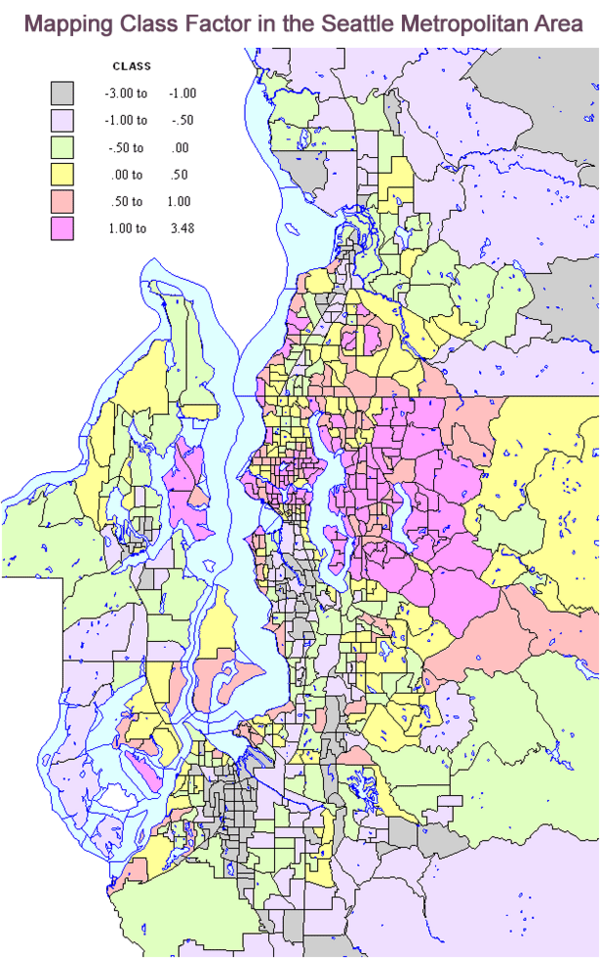
  • The Geography of Class in Greater Seattle

    Most readers may not be initially very interested in the detailed geography of “class” in Seattle, but it actually matters not only for our area but for the whole debate over the shape of the urban future. Academics, perhaps Americans in general, are loath to admit to class differences, yet they remain very crucial to the understanding of how cities and regions evolve.

    Seattle is a great example of the transformation of a 20th century model of the American metropolis to a 21st century-cum-19th century “old World” model of metropolis. It is often held up as one of the role models for other cities, so its experiences should be considered seriously not only for American cities but for regions throughout the advanced world.

    Many readers, including those afflicted with political correctness, probably many upper and lower class folk uncomfortable with their home areas being labeled as of a particular class, or others, might feel that class is an obsolete Marxist term. They may prefer I use the safer term “socio-economic status” rather than “class.” Let’s admit it: “class” is used widely, as in “the middle class is getting squeezed” or the “tax burden on the lower classes.” As it has been for hundreds of years, class remains a meaningful descriptor of areas of obviously differing well-being.

    We should understand by identifying upper or middle or lower classes this does not imply “better than.” Class simply reflects the mix of inheritance, education, biology, experience, discrimination, and life events that lead to variability in economic well-being. Class is real. But there is certainly a legitimate concern with the identification of heterogeneous areas like census tracts as of a particular class, based on average or median values for the in fact diverse households in a tract. This method is far from perfect but nevertheless we and others find such generalization common, meaningful and useful.

    This map plots “factor scores,” a statistically constructed variable or index divided into six levels of “class:” two upper, two middle and two lower. It is timely to do this, since it was 50 years ago when Calvin Schmid, demographer in Sociology at the University of Washington, and my early mentor, performed a pioneering factor analysis of crime in Seattle – and this was before modern computers! The derived scores most reflect high weighting of the variables: percent of adults with a BA or more, percent in professional versus laboring occupations, median house value and median household income.

    As you look at the map, it’s clear how Seattle reflects very strongly what is generally described as gentrification. This means the reclaiming of the central core by the highly educated and professional, eschewing the suburban metaphorical desert. In the case of Seattle, this process occurring between 1985-2005 resulted in the displacement of over 50,000 less affluent and often minority households to south King county. The city begins to resemble the historic pattern of the rich and important occupying the vibrant core of the city, relegating the working poor to the suburbs, with poor access and inadequate services. Indeed, even now I am involved in a project to assess the lack of access of poor children, often minority or foreign born, to health care in south King county.

    The dominant “upper class” area is the Eastside, east of Lake Washington, and location of the affluent “edge city” of Bellevue, home of the Microsoft campus. A second set of upper class areas are waterfront and view neighborhoods, taking advantage of the Seattle area’s broken topography. The third is simply the University of Washington immediate hinterland. I suspect the location of a large research university with 42,000 students and 22,000 staff increasingly propels Seattle’s unusually high status, income and popularity. I think this is increasingly more important a factor than the presence of an increasingly less important downtown Seattle business center.

    Conversely, lower class areas include traditional zones of mixed housing, industry and transport, such as south Seattle, the older satellite cities of Everett (north), Bremerton (west), and especially Tacoma (south). The largest area of lower class neighborhoods extends from south Seattle through south King county to Tacoma, marked by historical development, displacement from Seattle and high minority population. The second large zone of lower class settlement is the rural fringe, especially in Pierce (south) and Snohomish (north) counties, and may surprise those who think all rural areas are the home of rich estates.

    Then there is the middle class. This is where the suburbs matter most. On the map, middle class areas (yellow and green) are intermediate in location as well and dominate the outer suburban areas as well as some older inner neighborhoods of Seattle and Tacoma. It is unfortunately true that race, ethnicity and class remain highly correlated especially within the core cities of Seattle and Tacoma, reflecting the continuing history of unequal education and job preparation and prospects.

    This analysis suggests one possible future of urban development following something of a European model, with most middle class people in the suburbs, while the rich and poor concentrate either in the urban core or in selected locales in the periphery. As for the city itself, it’s clear that the total landscape is not simply becoming wealthier but increasingly bifurcated between the affluent and the long-term poverty population. And suburbia, home to the vast majority of the region’s population remains the predominant home of the middle and working classes, with pockets of both wealth and poverty.

    Richard Morrill is Professor Emeritus of Geography and Environmental Studies, University of Washington. His research interests include: political geography (voting behavior, redistricting, local governance), population/demography/settlement/migration, urban geography and planning, urban transportation (i.e., old fashioned generalist)