Tag: middle class

  • The Fate of America’s Homebuilders: The Changing Landscape of America

    During the first ten days of October 2008, the Dow Jones dropped 2,399.47 points, losing 22.11% of its value and trillions of investor equity. The Federal Government pushed a $700 billion bail-out through Congress to rescue the beleaguered financial institutions. The collapse of the financial system in the fall of 2008 was likened to an earthquake. In reality, what happened was more like a shift of tectonic plates.

    History will record that the tectonic plates of our financial world began to drift apart in the fall of 2008. The scale of this change may be most evident in housing.

    PART TWO – THE HOME BUILDERS

    For decades, home ownership epitomized the American dream. For years, Americans saved their money for the required 20% down payment to purchase their dream home and become part of the great American Middle Class. They saved their money in a special account at the local savings & loan that paid a little more interest than the banks. Interest rates were fixed by law. A typical mortgage was written at a fixed rate for 30 years. Most American home owners stayed in their homes and celebrated the pay-off with a mortgage burning party.

    In this arrangement, it was understood that the savings & loans were allowed to pay more interest because they provided long term home mortgages. They paid depositors 4 – 5% and lent money at 6% making a little profit on the arbitrage for their risk. With a 20% down payment, there was little risk. Mortgage bankers knew the homes they lent money on and more importantly, they knew their clients. The mortgage stayed on the books at the local savings & loan until paid.

    In this time, home builders were mostly small local shops known by their customers and the lenders. For decades the industry was quite stable. Homes averaged 1,400 square feet in 1970 according to the National Association of Homebuilders. A quality home could be purchased for under $20,000. Not everyone could afford to buy a home but almost everyone aspired to this. Savings & loans provided 60% of all home mortgages.

    The first crack in the dam appeared in the late 1970s. Under President Jimmy Carter, America suffered double-digit inflation. As the value of the dollar eroded, Americans sought investments that could protect their dollars from the ravages of inflation. Regulation D prohibited banks from paying interest on checking accounts. A tiny bank in Massachusetts, the Consumers Savings Bank of Worcester, Massachusetts introduced the NOW Account (Negotiable Order of Withdrawal) and began paying a higher rate of interest than the savings & loans. Money flooded into the bank.

    The Depository Institutions Deregulation and Monetary Control Act of 1980 began the six-year process of phasing out limits on interest rate. Money flowed out of savings & loans and into NOW accounts and MMDA accounts (Money Market Depository Accounts). The S&Ls, with long term fixed loans on their books and short term money leaving for higher rates at the banks, never fully recovered. The primary source of funding for America’s home building industry was changed forever.

    In the late 1980s the S&L industry attempt to recapture market share by entering the equity side of real estate development with disastrous consequences. The government was forced to seize most of the S&Ls and sell off their assets through the Resolution Trust Company (RTC). In 1989, Congress passed TEFRA, the Tax Equity and Fiscal Responsibility Act that effectively outlawed direct ownership of property by S&Ls. It was a death blow to the industry and the end of the 30-year home mortgage as we knew it.

    This is where the seeds of the current housing disaster and financial meltdown were sown. Wall Street and politics entered the financial vacuum left by the demise of the savings & loan industry. The Garn-St Germain Depository Institutions Act of 1982 introduced the ARM (adjustable rate mortgage) which allowed rates paid to depositors to balance rates charged to borrowers. Our politicians, filled with good intentions, began down an irreversible path of using the home mortgage for social engineering.

    Seeking to increase homeownership, Congress began to unwind the financial safety net that protected the American dream for nearly 100 years. An ugly brew was concocted with the marriage of too much money and too much power. Congress began to consider housing as a right instead of a privilege.

    Over the ensuing quarter century, Wall Street and Congress conspired to turn the traditional 20% down, fixed 30 year mortgage on its ear. In 1977, they passed the Community Reinvestment Act that outlawed red-lining and forced lenders to make loans to poor neighborhoods. In 1982, they passed the Alternative Mortgage Transactions Parity Act (AMTPA) that expanded the funding and powers of Fannie Mae and Freddie Mac by lifting the restrictions on adjustable rate mortgages (ARM), balloon payment mortgages and the Option ARM (negative amortization loan). When a savings & loan made a mortgage in the past, they held it for 30 years or until paid. Freddie and Fannie became the new absentee owner of the majority of mortgages by purchasing them from the originators in the secondary market.

    Thus the die was cast. Mortgage bankers and brokers became salesman and paper pushers packaging applications for the secondary market and financial investors who never saw the asset they lent money against or met the borrowers for whom they made the loan. But this was not enough to satisfy the greed of Wall Street which invented the CMBS (commercial mortgage backed security) in 1991. This was nothing more than a private label pool of mortgages that they sold off to equally unconnected financial investors in their own secondary market. Home mortgage lending by commercial banks went from nothing to 40% of the market in a matter of years.

    The market could have possibly tolerated this bastardization of the conventional mortgage but neither Congress nor Wall Street could control themselves. There was simply too much money to be made. Congress determined that the credit score was discriminatory and violated the rights of the poor and minorities. In 1994, Congress approved the formation of the Home Loan Secondary Market Program by a group called the Self-Help Credit Union. They asked for and received the right to offer loans to first time homebuyers who did not have credit or assets to qualify for conventional loans. Conventional 80% financing was replaced with 90% loans and then 95% and finally 100% financing that allowed a home buyer to purchase a home with no down payment. The frenzy climaxed with negative amortization loans that actually allowed homes to be purchased with 105% financing.

    In June of 1995, President Clinton, Vice President Gore, and Secretary Cisneros announced a new strategy to raise home-ownership to an all-time high. Clinton stated: “Our homeownership strategy will not cost the taxpayers one extra cent. It will not require legislation.” Clinton intended to use an informal partnership between Fannie and Freddie and community activist groups like ACORN to make mortgages available to those “who have historically been excluded from homeownership.”

    Historically, a good credit score was essential to receive a conventional mortgage. Under pressure from the politicians, lenders created a new class of lending called “sub-prime” and as these new borrowers flooded the market, housing prices rose. Lenders used “teaser rates”, a form of loss leader, to help the least credit worthy to qualify for loans.

    Congress instructed Fannie and Freddie to purchase mortgages even though there was no down payment and no proof of earnings by the applicant. An applicant could “state” his or her income and provide no proof of employment. Stated income loans eventually became known as “liar loans”. Sub-prime loans grew from 41% to 76% of the market between 2003 and 2005.

    This devilish brew caused a record 7,000,000 home sales in 2005, including more than 2,000,000 new homes and condominiums. Mortgage lending jumped from $150 billion in 2000 to $650 billion in 2005. Prices rose relentlessly, pushed by more and more buyers entering the market. The top 10 builders in the United States in 2005 were:

    1. D.R. Horton – 51,383 Homes Built
    2. Pulte Homes – 45,630 Homes Built
    3. Lennar Corp. – 42,359 Homes Built
    4. Centex Corp. – 37,022 Homes Built
    5. KB Homes – 31,009 Homes Built
    6. Beazer Homes – 18,401 Homes Built
    7. Hovnanian Enterprises –17,783 Homes Built
    8. Ryland Group – 16,673 Homes Built
    9. M.D.C. Holdings – 15,307 Homes Built
    10. NVR – 13,787 Homes Built

    Economists and pundits eventually began to identify the phenomenon as the housing bubble. And, bubbles burst. But Congress was not ready to confront reality. Rep. Barney Frank testified he “saw nothing that questioned the safety and soundness of Fannie and Freddie”. Fannie Mae Chairman Franklin Raines was paid $91.1 million in salary and bonuses between 1998 and 2004. In 1998 Fannie’s stock was $75/share. Today it is 67 cents.

    In 2007 as prices stopped rising, the flood of buyers entering the market ceased putting market values into a free-fall. Home building is not a nimble industry. It takes years of planning and development to bring a project to market. America’s homebuilders had hundreds of thousands of homes and condos under construction when the housing market came to a crashing halt in the fall of 2008. New home sales, which topped 2,000,000 units per year in 2005, fell to an annual level of under 400,000 units in early 2009. Prices have retreated to 2003 levels and in some markets even lower.
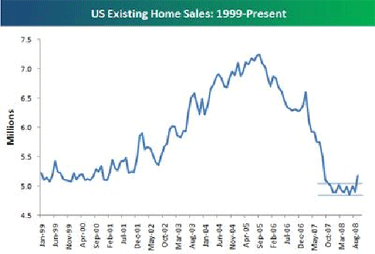

    What happens to America’s home builders? Do they follow General Motors and Chrysler into bankruptcy? Can they survive? New home sales are down 80% since 2005 – doing worse even than automobile sales. The tectonic plates of the housing industry are shifting rapidly and have not settled into any discernible pattern.

    Residential land has dropped precipitously in value but a case can be made that raw residential land now has a “negative residual value”. There are hundreds of thousands of completed but unsold, foreclosed, and vacant, homes littering the countryside. The chart above demonstrates how dramatically sales have fallen since their peak in 2005. This “overhand” inventory must be cleared out before any recovery can ensue. The prices of these units must be cut by draconian margins to attract the bottom fishers and speculators who will take the risk from the home builders and purchase the outstanding inventory. This will not happen quickly. This is not a market that can generate an early rebound.

    Has Congress learned from its mistakes? Apparently not. In March 2009, Democratic Representatives Green, Wexler and Waters introduced HR600 entitled “Seller Assisted Down Payments” that instructs FHA to accept 100% financing from those who cannot fund the required 3.5% down payment.

    A year from now the landscape of America will be forever changed. Five years from now, will American ingenuity have revolutionized the home building industry? The imperative is to find homebuilders who can speed production and lower costs. And government needs to learn from its own mistakes and realize that a successful housing sector depends on solid market fundamentals as opposed to pursuing an agenda of social engineering.

    ***********************************

    This is the second in a series on The Changing Landscape of America. Future articles will discuss real estate, politics, healthcare and other aspects of our economy and our society. Robert J. Cristiano PhD is a successful real estate developer and the Real Estate Professional in Residence at Chapman University in Orange, CA.
    PART ONE – THE AUTOMOBILE INDUSTRY (May 2009)

  • State of the Economy June 2009

    Nobel Prize-winning economist Paul Krugman was quoted widely for saying that the official recession will end this summer. Before you get overly excited, keep in mind that the recession he’s calling the end of started officially in December 2007. Now ask yourself this: when did you notice that the economy was in recession? Six months after it started? One year? Most people didn’t even realize the financial markets were in crisis until the value of their 401k crashed in September 2008. Count the number of months from December 2007 until you realized the economy was in recession, add that to September 2009 and you’ll have an idea of when you should expect to actually see improvements in the economy.

    Douglas Elmendorf, Director of the Congressional Budget Office (CBO), testified on “The State of the Economy” before the House Committee on the Budget U.S. House of Representatives at the end of May. CBO sees several years before unemployment falls back to around 5 percent, after climbing to about 10 percent later this year. Remember this phrase: Jobless Recovery; it happens every time we have a recession. Employment historically does not increase until 6 to 12 months AFTER GDP starts to improve. Even Krugman admits that unemployment will keep going up for “a long time” after the recession officially ends.

    While some of us are worrying about stagflation – a stagnant economy with rising prices – the CBO report does a good job of describing why deflation is worse than inflation. Deflation would slow the recovery by causing consumers to put off spending in expectation of lower prices in the future. The risk associated with high inflation is primarily that the Federal Reserve would raise interest rates too fast, stalling the economy – similar to what Greenspan did to prolong the recession in the early 1990s. We think the real conundrum is this: how do you deal with an asset bubble without deflating prices? Preventing deflation now simply passes the bubble on to some other asset class at some future time.

    CBO calculates that output in the U.S. is $1 trillion below potential, a shortfall that won’t be corrected until at least 2013. New GDP forecasts are coming in August from CBO. They say the August forecast will likely paint an even gloomier picture than this already gloomy report. Hard to imagine!

    There are plenty of reasons that Krugman and others are seeing encouraging signs in the economy. Social Security recipients received a large cost-of-living adjustment, payroll taxes were lowered so that employees are taking home bigger paychecks, larger tax refunds, lower energy prices – all of these lead to an uptick in consumer spending in the first quarter of 2009. I checked in with Omaha-area Realtor Rod Sadofsky last week. He has seen an improvement in sales in the range of median-priced homes which he attributes to the $8,000 tax credit available to first-time homebuyers (or those who have not owned for at least three years). Along with an up-tick in that segment of the market, those sellers are able to move up to higher priced homes a little further up the range, further improving home sales. However, the tax incentive is scheduled to expire at the end of 2009. When the stimulus winds down…well, there will be no more up-ticks. CBO agrees with Rod and warns of a possible re-slump in 2010 when the effects of the stimulus money begin to wane.

    CBO’s Dr. Elmendorf has a way to solve this problem: to keep up consumer spending, he suggests that people should work more hours and make more money. Duh! We think we hear Harvard calling – they want their PhD back! CBO seems undecided about which came first in the credit markets: problems in supply or problems in demand?

    “Growth in lending has certainly been weak, but a large part of the contraction probably is due to the effect of the recession on the demand for credit, not to the problems experienced by financial institutions.”

    “Indeed, economic recovery may be necessary for the full recovery of the financial system, rather than the other way around.”

    We shouldn’t be so hard on Elmendorf. The report makes it clear just how difficult it has been to figure out 1) what happened 2) why it happened 3) what do we do about it and 4) what happens next. CBO seems to be reaching for answers while to us it is obvious they are missing the point by not even considering that manipulation has wrecked havoc on the markets. Whenever things don’t make sense to someone like the Director of the CBO, experience tells us there’s a rat somewhere.

    Regardless of how overly-complicated financial products may become, the economy really shouldn’t be that hard to figure out. Still, no one seems to know how far down the banks can go – if banks don’t lend to businesses, businesses close, people lose their jobs, unemployed people default on loans, banks have less to lend, and banks can’t lend to businesses…Seems we are damned if we do and damned if we don’t: too much borrowing caused the crisis; too little spending worsens it. Do they want us to keep spending money we don’t have?

    While Krugman is admitting that the world economy will “stay depressed for an extended period” CBO is reporting that “in China, South Korea, and India, manufacturing activity has expanded in recent months.” The other members of the G8, however, aren’t faring any better than we are: GDP is down 10.4 percent in the European Union, 7.4 percent in the UK and 15.2 percent in Japan. Canada – whose banks are doing just fine without a bailout, thank you very much – saw GDP decline by just 3.4 percent in the last quarter of 2008.

    Undaunted by nearly 10 percent unemployment – after predicting it would rise no higher than 8 percent – President Obama announced today that the White House opened a website for Americans to submit their photos and stories about how the stimulus spending is helping them. If they can’t manage the economy, they can still try to manage our expectations about the economy.

    Susanne Trimbath, Ph.D. is CEO and Chief Economist of STP Advisory Services. Her training in finance and economics began with editing briefing documents for the Economic Research Department of the Federal Reserve Bank of San Francisco. She worked in operations at depository trust and clearing corporations in San Francisco and New York, including Depository Trust Company, a subsidiary of DTCC; formerly, she was a Senior Research Economist studying capital markets at the Milken Institute. Her PhD in economics is from New York University. In addition to teaching economics and finance at New York University and University of Southern California (Marshall School of Business), Trimbath is co-author of Beyond Junk Bonds: Expanding High Yield Markets.

  • Britain’s Labour Lessons For Obama

    LONDON – The thrashing of Britain’s New Labour Party – which came in a weak third in local and European Parliament elections this week – may seem a minor event compared to Barack Obama’s triumphal overseas tour. Yet in many ways the humiliation of New Labour should send some potential warning shots across the bow of the good ship Obama.

    Labour’s defeat, of course, stemmed in part from local conditions, notably a cascading Parliamentary expense scandal that appears most damaging to the party in power. Yet beyond those sordid details lies a more grave tale – of the possible decline of the phenomenon I describe as gentry liberalism.

    Gentry liberalism – which reached its height in Britain earlier this decade and is currently peaking in the U.S. – melded traditional left-of-center constituencies, such as organized labor and ethnic minorities, with an expanding class of upper-class professionals from field like media, finance and technology.

    Under the telegenic Tony Blair, an Obama before his time, this coalition extended well into the middle-class suburbs. It made for an unbeatable electoral juggernaut.

    But today, this broad coalition lies in ruins. An urban expert at the London School of Economics, Tony Travers, suggests that New Labour’s biggest loss is due to the erosion of middle-class suburban support. The party also appears to be shedding significant parts of its historic working-class base, particularly those constituents who aren’t members of the public employee unions.

    Even some longstanding ethnic minorities, most notably the highly entrepreneurial South Asians, also show signs of drifting away from Labour. The only Labour supporters left, then, are the liberal gentry, the government apparatus and the most aggrieved minorities.

    This process started before the Parliamentary scandals, Travers adds. Last year a Conservative, Boris Johnson, was able to unseat the sitting Labour-ite mayor of London, Ken Livingstone, largely due to votes from the outer boroughs of the city.

    The shift reveals the weakening hold of gentry liberalism. At its core, gentry liberalism depends on massive profits in key sectors – largely finance and real estate – to maintain its affluence while servicing both its environmentally friendly priorities and redistributing wealth to the long-term poor.

    This has also allowed for a massive expansion of both the scope and size of government. Today government-funded projects account for close to half of Britain’s gross domestic product (GDP), and this share is heading toward its highest level since the late 1940s. In some depressed parts of country, like in the north of England, it stands at over 60%.

    As long as the City of London was minting money – much of it recycled from abroad – the government could afford to pay its bills. But with the economy in a deep recession, Labour can no longer count on the same sources to finance expanding government.

    Although the liberal gentry are not much affected by diminished job opportunities, higher taxes or reduced services, those problems do afflict the tax-paying working and lower middle classes who dominate suburban areas. “We are not [just] dealing with upward mobility,” notes Shamit Saggar, a University of Sussex social scientist with close ties to the Labour Party, “but also the prospect of downward mobility.”

    Both in Britain and America, these middle-income suburban voters remain by far the largest electoral bloc. Last year they divided their votes about evenly between Obama and John McCain, which helped the Democrats, along with the huge supermajorities Obama racked up in the urban core, forge an easy victory.

    In Britain, however, now these suburban as well as small-town voters are tilting to the right, notes Sarah Castells of the Ipsos-Mori survey organization. This is in large part because they no longer believe the Labour Party supports their aspirations. “This is where we see a shift to the Tories,” Castells explains.

    The now-diminished Labour base of public employees, minorities and these gentry liberals is not a sustainable electoral coalition. In total, Labour can’t count for more than one-quarter of the electorate.

    Although vastly different in their class status, these groups share a common interest in an ever-more-expansive state. For public sector workers and the welfare-dependent poor, there is the reasonable motive of self-interest. In contrast, the liberal gentry’s enthusiasm for expanded government stems increasingly from their embrace of environmental regulation, which has become something of a religion among this set.

    You have to wonder what average Brits must make of the likes of Jonathon Porritt, the head of the government’s Sustainable Development Commission – a member of the gentry in both attitude and lineage. The Eton-educated Porritt’s recent pronouncements include such gems as a call to restrict the number of children per family to two to reduce Britain’s population from 60 to 30 million. He also has scolded overweight people for causing climate change.

    These do not seem like sure electoral winners. Today extreme green policies that were once merely odd or eccentric are becoming increasingly oppressive, leading to even more actions that disadvantage suburban lifestyles. Environmental activists’ solution for the country’s severe housing shortage – particularly in the London region – is to cram the working and middle classes into dense urban units resembling sardine cans and force even more suburbanites off the road.

    Even so, large-scale house production over the past decade has lagged behind demand and, as a result, the tidy single-family home with a nice back garden so beloved by the British public may soon be attainable only by the highly affluent – and, ironically, that includes much of the gentry. What an odd posture for a party supposedly built around working-class aspirations.

    “New Labour has brought in ‘New Urbanism,’ and the results are not pretty,” suggests University of Westminster social historian Mark Clapson, as he showed me some particularly tiny, surprisingly expensive new houses outside of London.

    This kind of approach has gained some proponents among the Obama crowd. Recent administration pronouncements endorse such things as “coercing” Americans from their cars, fighting suburban “sprawl” and even imposing restrictions on how much they can drive. It makes you wonder what future they have in mind for our recently bailed-out auto companies.

    It’s possible that America’s middle-income voters will eventually be turned off by such policies, as is the case in Britain. President Obama’s remarkable genius for political theater may insulate him now, but it won’t for eternity. Over time, some of the Democrats’ hard-won, suburban middle-class support could erode.

    The key here may be the quality of the opposition. In Britain, the Conservatives may have found at least an adequate leader in David Cameron. People see him as a viable prime minister. Right now, the Republicans have no such figure, allowing themselves to be led by gargoyles like Rush Limbaugh and Newt Gingrich.

    Yet the president cannot count on Republicans’ continued ineptitude. There’s only so much tolerance in the U.S. – both for cascading public debt and ever-expanding government regulation.

    Of course, Obama still has time to get it right. But if he remains the prisoner of the gentry, he and his party could experience some of the pain now being inflicted upon their ideological counterparts across the pond.

    This article originally appeared at Forbes.

    Joel Kotkin is executive editor of NewGeography.com and is a presidential fellow in urban futures at Chapman University. He is author of The City: A Global History. His next book, The Next Hundred Million: America in 2050, will be published by Penguin early next year.
  • Sweden’s Taxes – The Hidden Costs of The Welfare State

    By Nima Sanandaji and Robert Gidehag

    Sweden is a nation with extraordinary high tax rates. The average worker not only pays 30 percent of her or his income in visible taxes, but, additionally, close to 30 percent in hidden taxes. The defenders of the punishing tax burden argue that it is needed to maintain Sweden’s generous welfare system. While this claim may seem reasonable on its surface, a deeper look suggests that it is based on flawed analysis.

    Some level of taxation is, of course, required to fund the public sector. At the same time, a high level of taxation does not necessarily translate into an equally high level of welfare:

    Taxes discourage work and encourage tax avoidance. There is strong evidence that Sweden’s highest rate of individual and capital taxation actually reduces public revenue. For this reason, some taxes, such as the wealth tax, have recently been reduced. The result is estimated to be a net increase in tax revenues.

    When Swedish municipalities receive increased funding from the state, the money is used to expand the local bureaucracy, a government survey has shown, instead of going to educators and health care workers.

    Municipalities provide much of the welfare in Sweden. The Swedish Association of Local Authorities and Regions have shown in a study that funding for Swedish municipalities grew dramatically between 1980 and 2005. Despite this, the general public consensus is that the quality of welfare has declined during the same period.

    Welfare provisions don’t necessarily correspond with taxation levels. A 2005 research paper examines the efficiency of the public sector in 23 industrialized countries. The researchers found that Sweden only reaches a mediocre 12th place when it comes to how much the public sector provides in terms of welfare services. When the level of welfare is related to the level of taxation, Sweden falls to the last position in the index.

    There is a high variation in how effectively public money is spent within Sweden. The Swedish Taxpayers Association has, in a number of surveys, shown that identical welfare services such as care of the elderly, can vary in cost quite dramatically across Sweden.

    There are two important reasons why the average Swedish worker pays a large portion of her or his income in taxes, without necessarily receiving an equally high level of welfare.

    First, much of the money is spent on administrative costs at various levels of government. Although a small nation, Sweden has over a hundred public authorities. Vast sums are spent on political projects which fall outside the frames of general welfare. It is, for instance, not unusual for Swedish municipalities to fund bowling alleys, swimming pools, or camping places.

    Second, a large fraction of the population is living on benefits rather than working, due to the combination of high taxes, a rigid labour market and generous welfare benefits. Even before the economic crisis hit, for example, almost one out of five children in Sweden’s third largest city, Malmö, were living in a family supported by social security. Sweden has 105 local districts where the majority of the population lives off of various public benefits, and does not work. This unintended consequence of the welfare state has taken a heavy toll on public services, since an increasing share of tax revenue must be diverted to fund welfare payments, rather than social services.

    Many are immigrant dense neighborhoods; others are situated in the northern part of Sweden, where many cities with stagnating economies have suddenly experienced a boom in the fraction of the population who cannot work due to disability.

    The famous Swedish welfare state is to a large degree a notion of the past. Many feel that its glory days occurred during the late 1950s and early 1960s, when Sweden successfully combined welfare policies with an expanding economy. At that time, however, Swedish taxes were 27 percent of the GDP, compared to 47 percent today. The golden days of Swedish welfare did not coincide with the high tax regime we know today.

    How could Sweden fund a prospering welfare system with relatively low taxes in the past? As the researcher Erik Moberg documents in a book for the Ratio Institute, public money was spent much differently back then. The share of public revenues spent on health care and education at the end of the 1950s was greater than it is today.

    And, compared to the 1950s, close to three times as much of public revenues are now spent on public bureaucracy. Four times as much is spent on welfare payments and social insurance. As the level of taxation has increased, so has the share of taxes going to public bureaucracy and various government handouts.

    The historical comparison with the 1950s and 1960s is worth thinking about. It shows that a high quality of welfare can be achieved with a much lower tax level than we have today. If politicians slim down public bureaucracy and cut wasteful spending, resources can be opened up for increasing welfare and reducing taxes at the same time. If the system rewards work to a greater degree than it does living off the state, fewer will be dependent on the public for their daily living, again opening up tax revenues for better use.

    Sweden has long been a small homogeneous country with a high degree of economic equality. Strong norms related to work and responsibility made it possible to enact an effective welfare system early on. With time, however, welfare dependence has reduced the very norms that formed the foundation of Swedish welfare, and wasteful spending has increased.

    Many important social outcomes that the welfare state aims to address, and that Sweden is famous for, such as a low crime rate, have increased in recent decades, concurrent with the expansion of the welfare state. Even income inequality has increased in Sweden compared to, for example, the 1980s, despite similar or higher public expenditure.

    Swedish decision makers are doing their best to reduce public spending and lower taxes. The reforms have been highly successful so far. As taxes have decreased from 57 percent of GDP in 1989 to 47 percent of GDP in 2009, the incentives to work have improved, with Swedish growth rates benefiting. The convergence of lower taxes and lower public spending is likely to continue. After all, experience has made it quite apparent for many Swedes that extraordinary high taxes are not the key to qualitative welfare services and a well functioning society.

    Nima Sanandaji is president of think tank Captus and a fellow at the Swedish Taxpayers Association. Robert Gidehag is president of the Swedish Taxpayers Association.

  • The Luxury City vs. the Middle Class

    The sustainable city of the future will rest on the revival of traditional institutions that have faded in many of today’s cities.

    Ellen Moncure and Joe Wong first met in school and then fell in love while living in the same dorm at the College of William and Mary. After graduation, they got married and, in 1999, moved to Washington, D.C., where they worked amid a large community of single and childless people.

    Like many in their late 20s, the couple began to seek something other than exciting careers and late-night outings with friends. “D.C. was terrific,” Moncure recalled over lunch near her office in lower Manhattan. “It was an extension of college. But after a while, you want to get to a different ‘place.’”

    The “place” Ellen and Joe looked for was not just a physical location but something less tangible: a sense of community and a neighborhood to raise their hoped-for children. Although they considered suburban locations, as most families do, ultimately they chose the Ditmas Park neighborhood of Brooklyn, where Joe had grown up.

    At first, this seemed a risky choice. While Joe was growing up in the 1980s, the neighborhood — a mixture of Victorian homes and modest apartments — had become crime-infested. The old families were moving out, and newer ones were not replacing them. Yet Joe’s Mom still lived there, and they liked the idea of having grandma around for their planned-for family.

    In a city that has been losing middle-class families for generations, the resurgence of places like Ditmas Park represents a welcome change. In recent years, child-friendly restaurants and shops have started up along once-decayed Cortelyou Road. More important, some local elementary schools have shown marked improvement, with an increase in parental involvement and new facilities.

    Even in hard economic times, the area has become a beacon to New York families, as well as singles seeking a community where they will put down long-term roots. “There’s an attempt in this neighborhood to break down the city feel and to see this more as a kind of a small town,” notes Ellen. “It may be in the city, but it’s a community unto itself, a place where you can stay and raise your children.”

    The Decline of the Urban Middle Class

    The rise of neighborhoods like Ditmas Park suggests that cities can still nurture and accommodate a middle class. Yet sadly this trend continues to fight an uphill battle against a host of forces from high taxes and regulation to poor schools, highly bifurcated labor markets, and the scourge of crime.

    These problems can be seen in the migration numbers. A demographic analysis conducted by my colleagues at the Praxis Strategy Group over the past decade found that New York and other top cities — including Chicago, Los Angeles, San Francisco, and Boston — have been suffering the largest net out-migration of residents of virtually all places in the country, albeit the pattern has slowed with the recession.

    It’s astonishing that, even with the many improvements over the past decade in New York, for example, more residents left its five boroughs for other locales in 2006 than in 1993, when the city was in demonstrably far worse shape. In 2006, the city had a net loss of 153,828 residents through domestic out-migration, compared to a decline of 141,047 in 1993, with every borough except Brooklyn experiencing a higher number of out-migrants in 2006.

    Since the 1990s virtually all the gains made in the New York economy have accrued to the highest income earners. Overall, New York has the smallest share of middle-income families in the nation, according to a recent Brookings Institution study; its proportion of middle-income neighborhoods was smaller than any metropolitan area, except for Los Angeles.

    Much the same pattern can be seen in what has become widely touted as America’s “model city,” President Obama’s adopted hometown of Chicago. The city has also experienced a rapid loss of its largely white middle class at a rate roughly 40 percent faster than the rest of the country.

    Although there has been a considerable gentrification in some pockets around Lake Michigan, Chicago remains America’s most segregated big city. In contrast to the president’s well-integrated cadre of upper-class African Americans, Chicago’s black population remains among the poorest, and most isolated, of any ethnic population in America.

    And like other American cities, Chicago now has a growing glut of “luxury” condos, a pattern that became evident as early as 2006 and has now, as Chicago magazine put it, “stalled” as a result of a “perfect storm” of toughened mortgage standards, overbuilding, job losses, and rising crime.

    Yet there could be some good from the current crisis. Considerable drops in urban rents and residential housing prices should ease the burdens on those who struggle with extremely high prices and taxes. Younger people, including families, may now be able to consider whether a home in Brooklyn, Chicago’s Wicker Park, or Los Angeles’ Studio City might now be affordable and desirable enough to eschew the move to the suburbs.

    The Cost of Being Urban

    In doing scores of interviews recently for a report on New York’s middle class, my coauthor Jonathan Bowles of the Center for an Urban Future and I ran into many people who were considering moving out of the city or had friends who had recently left. This seems particularly true in the remaining middle-class enclaves in the outer boroughs.

    “Almost all the friends I grew up with have moved to Mahopac or Yorktown [in the Hudson Valley],” says Jimmy Vacca, a member of the City Council who represents communities in the Northeast Bronx such as Throgs Neck and Pelham Parkway. “There’s a flight out by many middle-class people because of the schools. A couple gets married and by the time their children gets to age five, they move.”

    Costs, particularly relating to child-raising, are killing the urban middle class. Urban residents generally pay higher taxes and more for utilities, insurance, trash, and sewer than those living elsewhere. Manhattan is by far the most expensive urban area in the United States, with an average cost of living that is more than twice as much as the national average; San Francisco, another city that has seen large-scale middle-class flight, ranks second. The Washington, D.C. area, Los Angeles, and Boston also suffer extremely high living costs.

    These costs are most onerous on the middle class, particularly those with children. This can be seen in the rapidly declining numbers of students in most urban school districts, including such hyped success stories as Chicago, Seattle, Portland, Washington, and San Francisco. Over the past seven years, for example, Chicago’s school system, which was run by new Education Secretary Arne Duncan, has declined by 41,000 students.

    America’s core cities — including the borough of Manhattan in New York — boast among the lowest percentage of children under 17 in the nation. Although Manhattan had a much discussed “baby boomlet” (the borough’s number of toddlers under the age of 4 grew 26 percent between 2000 and 2004), once children over 5 are taken into account, Manhattan’s under-age population is well under the national average. This indicates there may be a process of exhaustion — both mental and financial — as the costs of raising children drain family resources.

    The real issue for the urban middle class is not having babies but being able to sustain their families as the children age and as families expand. One reason: many middle class urbanites spend tens of thousands of dollars a year in additional expenses that those in other cities as well as surrounding suburbs often avoid. For instance, since most middle-class families in big cities today need to have two working parents just to get by, child care becomes a necessity for those without grandparents or other relatives to look after young children. In places like Chicago, Washington, Boston, San Francisco, New York, or Los Angeles these costs typically run from $13,000 to $25,000 per child annually.

    Later many of these same families, if they choose to stay, must then contemplate shelling out considerable sums to send their children to private schools, particularly after the elementary level. This can add from a few thousand dollars to $30,000 a year to their annual costs — and with no tax benefit.

    Do Cities Need a Middle Class?

    Ultimately, in good times or bad, cities have to want a middle class to have one. And politicians, if asked, will genuflect to the idea of maintaining a middle class, yet their actions — on taxes, regulations, schools, development — suggest otherwise.

    Indeed, in reality most urban areas have focused on creating what New York Mayor Michael Bloomberg famously dubbed the “luxury city.” To pay for often inflated public employee costs, the luxury city can only survive off the wealthy and on other groups — empty nesters, singles and students — who demand relatively little in the way of basic services like schools and public health facilities.

    City planners and urban developers favor the unattached: the “young and restless,” the “creative class,” and the so-called “yuspie” — the young urban single professional. Champions of the unattached suggest that companies and cities should capture this segment, described by one as “the dream demographic,” if they wish to inhabit the top tiers of the economic food chain.

    Another key group coveted by cities are the legions of baby boomers who have already raised children. No longer cohabiting with offspring, they are expected to give up their dull family existence and rediscover the allure of a fast-paced, defiantly “youthful” lifestyle. The new retirees, suggests luxury homebuilder Robert Toll, “are more hip-hop and happening than our parents.” They are more interested in indulging “the sophistication and joy and music that comes with city dwelling, and doesn’t come with sitting in the ’burbs watching the day go by.”

    A Demographic Dead End?

    This whole approach has severe limitations. Despite an enormous amount of publicity about empty nesters moving back to the city, surveys conducted by the housing industry find that most aging boomers — upwards of 70 percent — are aging in place, mostly in the suburbs. The numbers moving back into the urban core remain negligible, except in the pages of urban booster publications like The New York Times.

    The young singles provide a more promising demographic for cities. But even here time may be running out. This will be even more evident between 2010 and 2020, when the millennial generation hits their 30s and early 40s and enter the prime years for family formation. Surveys of the cutting edge of this group — the other large age cohort in the population — show that most prefer a single-family home and, like their parents, seem most likely to head to the suburbs.

    But perhaps most troubling of all is what this means in terms of the historic role of cities as incubators of upward mobility. Back in the 1960s, Jane Jacobs could still predict that Latino immigrants to New York, mainly from Puerto Rico, would inevitably make “a fine middle class.” Yet four decades later in the Bronx, the city’s most heavily Latino county, roughly one in three households lives in poverty, the highest rate of any urban county in the nation.

    On the other extreme, in Manhattan, where the rich are concentrated, the disparities between the classes have been rising steadily. In 1980 it ranked 17th among the nation’s counties for social inequality; today it ranks first, with the top fifth of wage earners earning 52 times that of the lowest fifth, a disparity roughly comparable to that of Namibia.

    The University of Chicago’s Terry Nichols Clark, one of the most articulate advocates for this new urban pattern, says cities should focus on acting not so much as vehicles for class mobility, but as “entertainment machines” for the privileged. For these elite residents, the lures are not economic opportunity, but rather “bicycle paths, beaches and softball fields,” and “up-to-the-date consumption opportunities in the hip restaurants, bars, shops, and boutiques abundant in restructured urban neighborhoods.”

    In this formulation cities become the domicile primarily of the young, the rich (and their servants), as well as those members of the underclass who persist in hanging around. What emerges, in the end, is a city largely without children, particularly of school-age, and with a diminishing middle class. Ironically, these are places that, despite celebrating diversity, actually could end up as hip, dense versions of the most constipated suburb imaginable.

    This shift will also limit the economic functions of certain elite cities. Cost pressures, for example, have already helped Houston to replace New York and Los Angeles as the nation’s energy capital; in the future, although now humbled by the collapse of Wachovia, more middle class-oriented Charlotte, as well as other cities, could continue to gain jobs in the post-bust financial sector. Charlotte real estate developer John Harris suggests the city can compete against an expensive metropolitan region not only at the top levels of management but across the board. “It’s hard to be a mass employer in San Francisco,” he notes.

    Joe Gyourko, a real estate professor at the Wharton School, suggests this elite model of urbanism will spread to other favored places such as Portland, Seattle, and possibly Austin. In all these places, we may be seeing the emergence of a European-style pattern of elite urbanism in the core, with a growing concentration of low-wage workers in the least favored parts of the urban periphery.

    The City of Aspiration

    Even if such a model proves sustainable, it certainly means a major change for American urbanism. Unlike most urban cultures, that of the United States has been dominated not by the dictates of princes or priests, but by the efforts of ambitious entrepreneurs and migrants.

    American cities have been driven by a protean, ever-shifting commercial and middle-class culture, willing to break the bonds of tradition. As the great sociologist E. Digby Baltzell noted, the population in New York and other American cities has been “heterogeneous from top to bottom.” Social mobility, Baltzell said, constituted the fundamental reality of American urbanism.

    In this country, cities emerged as the principal North American bastion for those who sought to improve their lives. As historians Charles and Mary Beard noted, “All save the most wretched had aspirations.”

    Such cities often were not inherently pleasant or culturally edifying. Although its wealth would propel it to one day become the world’s cultural capital, visitors from more genteel Philadelphia and Boston often regarded 19th-century New Yorkers as crass and money-oriented.

    The new cities on the opportunity frontier — Chicago, Cleveland, Cincinnati — were, if anything, even more egalitarian. After two years in Cincinnati, British writer Frances Trollope deplored how “every bee in the hive is actively employed in the search for honey…neither art, science, learning, nor pleasure can seduce them from their pursuit.” Chicago, a Swedish visitor commented in 1850, was “one of the most miserable and ugly cities” of America.

    Yet these places were ideal for taking advantage of new technologies from mass manufacturing to trains and the telegraph. They created dynamic societies that provided huge opportunities for vast waves of immigrants, who by 1890 accounted for as much as half of the nation’s urban dwellers.

    The newcomers were joined by others from rural America, including, by the early 20th century, many African Americans. The “Great Migration” of African Americans from the rural south, noted Gunnar Myrdal in 1944, created “a fundamental redefinition of the Negro’s status in America.” Urban life had its horrors, but in the cities it became increasingly difficult to restrict a person into “tight caste boundaries.” African-American migrants from the South may have been different in many ways from newcomers from Italy, Ireland, or Russia, but their fundamental aspirations were often very much the same.

    The Key to a Middle-Class Comeback: The Power of Plain Vanilla

    Compared to the dismal decline in the 1970s and early 1980s, urban prospects have improved, particularly in primary urban areas such as Chicago, New York, and San Francisco. Yet, if these and other cities are to sustain their momentum, they need to look beyond “the luxury city” to the potential of less glamorous neighborhoods that can attract the middle class and people with families.

    These “plain vanilla” neighborhoods include many places that managed to resist the urban decay of the 1970s and in many cases have begun to enjoy a steady resurgence. These include, for example, large swaths of Brooklyn and Queens, as well as the lovely, park-blessed sections of south and west St. Louis, or scattered Los Angeles neighborhoods in places like the San Fernando Valley.

    But these communities can only grow if cities focus on those things critical to the middle class such as maintaining relatively low density work areas and shopping streets, new schools, and parks.

    This would require a massive shift in urban priorities away from the current course of subsidizing developers for luxury mega-developments, new museums, or performing arts centers. To maintain and nurture a middle class, cities need to look at the essentials that have made great cities in the past and could once again do so in the future.

    The New Urban Middle Class

    Perhaps the other key question is what constitutes the economic base for the people who might settle and remain in cities. It’s clear that many traditional industries — heavy manufacturing, warehousing — as well as middle-management white collar jobs will diminish in the future. But it is possible to imagine the rise of a new kind of urban economy built around people working in small firms, or independently in growing fields such as information, education, healthcare, and culture, or as specialists in a wide array of business services.

    These are professions that continued to grow in many older cities, even as other fields declined. In San Francisco, for example, by 2006 there were an estimated 70,000 home-based businesses and a thriving culture of self-employed “Bedouins” working in post-industrial professions. These self-employed people, noted one study, were critical to helping the city withstand the ill effects of the post-2000 dotcom collapse.

    Similarly, the close-in communities of the San Fernando Valley of Los Angeles are home to large contingents of entertainment industry workers, many of them self-employed. According to studies by California State University’s Dan Blake, up to 60 percent of all L.A.-area workers in this highly dispersed industry reside somewhere in this sprawling urban region made up largely of post–World War II single-family houses. Workers in media, graphic arts, and other specialized services have also been among the few groups of middle and upper-middle income earners to see rapid growth in New York’s outer boroughs.

    These post–industrial age artisans — along with more traditional parts of the middle class such as civil servants, teachers, nurses, and other service workers — could provide the critical residential base for the plain vanilla urban neighborhoods’ work. Neither rich nor poor, these artisans could use the new telecommunications net to access clients who may exist in the sprawling suburban rings, throughout the United States, or overseas.

    Cities of the Future

    You can see this emerging reality in places like Ditmas Park, Brooklyn. Nelson Ryland, a film editor with two children who works part-time at his sprawling turn-of-the-century Flatbush house, suggests that the key to an urban revival lies not in the spectacular but in the mundane. “It’s easy to name the things that attracted us — the neighbors, the moderate density,” he says over coffee in a house close to that occupied by Ellen and Joe. “More than anything it’s the sense of community. That’s the great thing that keeps people like us here.”

    This “sense of community” will become the key currency of sustaining urban communities. Such middle-class sensibilities get short shrift by urban scholars such as Richard Florida, who argue that in the so-called “creative age” places of residence should be “leased” like cars. In his mind, single-family homes, the ideal of homeownership, should be replaced “by a new kind of housing” that embraces higher forms of density without long-term commitment to a particular residence or location.

    In fact, the sustainable city of the future will depend precisely on commitment and long-term residents. It also will rest on the revival of traditional institutions that have faded in many of today’s cities. Churches — albeit often in reinvented form — help maintain and nurture such communities. Similarly, extended family networks will be critical to future successful urban areas. As Queens resident and real estate agent Judy Markowitz puts it, “In Manhattan people with kids have nannies. In Queens, we have grandparents.”

    The modest and mundane ties between people that exist in such places represent the key to reviving America’s urban regions in the coming generation. It is in our urban neighborhoods — not in the glamour zones and high-end downtowns — that our country’s cities can find a new life and purpose in the 21st century.

    This article originally appeared at American.com.

    Joel Kotkin is executive editor of NewGeography.com and is a presidential fellow in urban futures at Chapman University. He is author of The City: A Global History and is finishing a book on the American future.

  • Lenny Mills to Urban America: Clock Is Ticking for Ranks of ‘New Homeless’

    I always do my best to make time for Lenny Mills because he’s earned that sort of consideration.

    Mills is the fellow who wrote several pieces under the banner of his trademark “7 Rules” outline, where he applies the tricks he learned as a telemarketer to analyses of real estate development, politics, and other matters.

    Mills did an especially fine job on the “7 Rules of Downtown Gentrification,” which appeared in the Garment & Citizen’s issue of April 21, 2006. He laid out a number of reasons – seven, to be exact –to consider the possibility that the residential real estate boom ringing through Downtown Los Angeles back then would eventually turn into a busted bubble.

    Events have certainly borne out Mills’ prediction, so he brought credibility with him on his latest visit to my office.

    Mills waved a recent copy of USA Today at me, saying that he’s worried about the sort of folks who were featured in a recent front-page story in the national publication, a piece that described the circumstances of some of “the new homeless.” These are individuals who worked steadily their whole lives before hitting the skids and losing their homes in the current economic downturn. It’s a trend that has become familiar these days, with homeless encampments cropping up in all sorts of places, including Los Angeles.

    Mills has some added credibility when he speaks about homelessness – he spent a number of years living on the streets. He knows what it means to go through life with a weather-beaten face, watching opportunities slip away for lack of a telephone number to leave behind when seeking work.

    Mills has a place to live now, but he remains determined to inject his warnings about the new homeless into the public debate. The clock it ticking, he says, and the deterioration that comes with life on the streets will make it harder and harder for folks to climb back into mainstream lives. Once the wardrobe starts to fray, he says, the odds against getting back on track grow longer. Once the teeth start to go, he adds, homeless individuals can just about write off any return to the life they once knew. Each bit of deterioration makes it tougher for the homeless individuals – and more likely that they will become permanent burdens to the rest of us in one way or the other.

    Mills is remarkable in a number of ways, including the ability he mustered to retain his social skills during his time on the streets – something that many individuals quickly lose. I disagree with him on some things, but I can’t fault his ability to make fine use of the language to get his points across.

    Mills used such skill during our recent talk, driving home a couple of points about the new homeless: Our society has a narrow window of opportunity to pay for programs to reverse the trend – and a failure to act soon will mean far greater costs in terms of human lives and the public purse.

    Mills can spout chapter and verse on what he sees as the causes of the increases in homelessness over the past 40 years. He can cite demographic trends, economic patterns, and public policies to make a compelling case that a lot of folks were swept into life on the streets by causes beyond their control. He firmly believes that we as a society could have prevented most of the homelessness we have seen over the years had we not lacked the will to do so.

    I wouldn’t describe Mills as a fun guy. He’s a valuable fellow, though, because he’s willing to tell you what you’d rather not hear – and he’s capable of doing so in reasoned tones.

    Give Mills his due for hitting upon something of vital importance now. It’s clear that all the talk we’ve heard about addressing the old homelessness has led to no great progress over the course of decades. What did that latest Blue-Ribbon Public-Private Committee to End Homelessness Forever accomplish besides a photo opportunity, anyway?

    Someone wake the Blue Ribbon brigade and fire all of them.

    We have a whole new homeless problem – and we’re in desperate need of new ideas.

    Jerry Sullivan is the Editor & Publisher of the Los Angeles Garment & Citizen, a weekly community newspaper that covers Downtown Los Angeles and surrounding districts (www.garmentandcitizen.com)

  • Who will win the Car-wars?

    General Motors, the venerable American auto manufacturer is sitting on the cliff’s edge in North America with a recent 3-month loss of $6 billion. However, GM watched its sales in China skyrocket 50% for the month of April, 2009. Ironically, Toyota, the company many Americans now cheer for, has posted a $7.7 billion loss for the first quarter.

    This now proves, without a doubt, that the auto industry – not just in the US – is going through a massive crisis. But it’s clear that American manufacturing has reached a critical, historical turning point. What was once good for General Motors is no longer good for the rest of the nation. The days are gone where an automobile must be designed in the Detroit region and manufactured in the Great Lakes. We have seen a shift in trade and production location from the north to the south. However, geographic arguments are only a small part of the overall challenge to the industry, especially in North America.

    When the dust settles, what will the American auto industry look like?
    Regardless of what some may say, there is no such thing as an “American” vehicle anymore. We are fast shifting into a global economy that requires the sharing and collaboration of multinational resources from across the globe. Consumers demand quality products at very affordable costs. Corporations have no choice but to comply with consumer demand even if it means off-shoring production and even trimming quality in order to save money. In many ways, this is the Wal-Martization of consumer goods.

    The 21st-century automotive industry will be geographically spread throughout North America. Modern technology allows engineers to work from just about any location regardless of population, climate or infrastructure. However, many engineering outfits have found that locating brainpower in dynamic places improves quality and innovation. A dynamic place is a place where the educated and skilled want to work. These includes places like southern California (where most of the design studios are located), Ann Arbor, Austin, and others.

    In the 1980s the Midwest watched the southern states gear up and recruit non-Detroit manufacturers, in large part due to the lack of unions in the land of Dixie. We have seen the southern United States explode in production and manufacturing capability. The two main reasons for this were lack of unions in the South as well as tax-payer funded incentives. However, the idea of receiving incentives from the public coffer can backfire.

    Just about every state offers some form of tax breaks or incentives to corporations looking to construct new facilities. Every large corporation now looks to the state where they can get the most incentives. Everything else, such as skilled workforce, distribution, infrastructure – that all comes secondary. In many ways, this is just an example of robbing Peter to pay Paul. And it doesn’t work. You cannot simply take tax dollars from one area of the state and pour them into another region with the long-shot hope that an industry will grow in that certain region. This is exactly what Tennessee is doing.

    However, the southern states have struggled and will continue to struggle to attract brainpower and engineering talent. What the American public doesn’t realize is that there is a lot more to the creation of a vehicle unit than mere assembly. Besides production, there is fabrication, engineering, design, testing, marketing, legal, and distribution. Even today, much of the world’s automotive intelligence and engineering is located in Southeast Michigan. This fact irks southern powerbrokers who have been so successful at bringing grunt work to their states.

    We will continue to see massive amounts of automotive-related manufacturing relocate to Mexico due to the extremely low cost of production. Many of the Japanese and German manufacturers are already starting to notice the negative consequences of setting up production facilities in the United States. Nissan, Toyota and Honda have all initiated cuts and hiring freezes in their American manufacturing facilities. These companies have also initiated major contact employee programs rather than hire full-time fully-hired help.

    So what happens now in the old auto belt? Certainly, Ohio as well as Michigan must figure out how they can re-deploy their engineering talent. Each seems to graduate a huge number of students year after year but this tends to benefit other places. States such as Wyoming, Arizona, Washington, and others have held job fairs in Michigan in order to gain talent. If there are no jobs in Michigan, why do they keep graduating so many students?

    Even without George Bush and the GOP in power, Texas seems also to be a big beneficiary of this brain drain. But for how much longer can this continue? Remember Texas went bust in the early 1980s with low energy prices. It could happen again.

    Another natural winner in the car-wars could be the southern states, but only once they consolidate their efforts to bring knowledge and engineering to the South. It is much easier to offer incentives for a production facility than to woo an engineering lab.

    Critically, there still seems to be a lack of emphasis on higher education in the south. Even the best universities in the South cannot fully compete with the universities in the Midwest from a technical standpoint. Institutions such as Michigan, Wisconsin, University of Chicago, Michigan State and Indiana are still levels above the universities found in Kentucky, Tennessee and Georgia. The Midwestern schools built their solid knowledge and research background over a period of decades. This cannot easily be duplicated.

    To be sure, the auto-dominated economies of Michigan and Ohio will be shrinking in the future. These states are shedding their manufacturing sectors while reinforcing their knowledge-based sectors. Over time they may find it much easier to morph into a knowledge-based economy by using previous know-how than to build a knowledge economy from scratch. Michigan, for example, may have been hit hard by this global schism in manufacturing, yet it has been left with the know-how and knowledge left over from industry in the form of a strong university system. In contrast, nowhere in the south can we find that.

    In conclusion, some individual Midwestern cities may come out of this crisis better than many expect. Younger workers in the future will look at specific towns such as Madison and Ann Arbor, which offer an excellent quality of life, rather than head off to the sunbelt. This may be particularly true as they enter their 30s and look for a good place to raise their children, hopefully close to grandparents. The Midwest may be down, but not all of it is out – far from it.

    Amy Fritz was born in Cambridge, England during World War II. Her mother was a seamstress and her father a pilot with the RAF. Her uncles worked in various capacities within the British automobile industry and her father became an engineer and professor.

    After studying engineering at Cambridge, Fritz developed an interest in automobiles and went to work for a now defunct automotive supplier. Her occupation took her to Europe, Asia and North America, where she eventually settled as a technical engineering contractor for various auto-related companies. She is now semi-retired and living in the Denver area.

  • Obama’s Energy Triangulation

    With the possible exception of health care reform, no major issue presents more political opportunities and potential pitfalls for President Barack Obama than energy. A misstep over energy policy could cause serious economic, social and political consequences that could continue over the next decade.

    To succeed in revising American energy policy, the president will need to try to triangulate three different priorities: energy security, environmental protection and the need for economic growth. Right now, the administration would like to think it could have all three, but these concerns often collide more than they align.

    A president should have no higher priority than to ensure that America becomes more independent from foreign producers, particularly those outside North America. This represents a great opportunity to diverge from the failure of the Bush administration to reduce this dependence and encourage conservation.

    Instead, the best course could be called an “all of the above” strategy. This would embrace not only conservation and investment in renewable fuels but also aggressive expansion of the electric grid, the domestic fossil fuel industry and nuclear power. In particular, the country should focus on exploiting our vast reserves of relatively clean natural gas and drive technologies that could also clean up emission from coal, our other large resource.

    Instead of promoting fossil fuel development, environmental lobbyists — and Obama — like to talk about “green jobs.” Although green elements need to be integrated into all walks of economic life, the notion that green jobs can provide economic salvation seems more like a marketing strategy than one based on reality.

    Given current energy prices, large-scale numbers of green jobs can be created only through huge subsidization, the costs of which would, of course, be born by other parts of the economy. At the same time, jobs lost in fossil fuel production and manufacturing because of the high costs associated with renewables would most likely far outweigh any imaginable surge of green jobs.

    A recent study conducted in Spain, another country with a history of strong subsidies for renewable fuels, found that the money invested in green jobs actually cost so much that the overall employment effects were negative. Increasingly, the “green jobs” mantra seems like a story we tell our children to get them to sleep.

    The mantra also obscures the critical fact that the true goal of the environmental lobby is, above all, to shrink the much detested “carbon footprint” of people and communities. People like Obama’s science adviser, John Holdren, do not place much priority on maintaining much of the present American way of life. An acolyte of the many-times-wrong neo-Malthusian Paul Ehrlich, Holdren has promoted the “de-development” of Western societies as a way to lower carbon emissions and redistribute the world’s wealth.

    Such an approach might be popular at academic soirees or even among some investment bankers who see their future in Shanghai as opposed to Saginaw or Sacramento. It may prove a bit less popular among those, particularly in the middle and working class, who might not welcome seeing their families and communities de-developed.

    This should be obvious to the president and the clever political tacticians around him. Recent polls reveal that voters now rate global warming among their 20 least-critical concerns. Not surprisingly, the economy and jobs ranked as the top two.

    There are also serious regional issues to consider. Areas with economies tied to fossil fuels — mainly in Texas, the Great Plains, the Southeast and Appalachia — view the issue differently than do places like Manhattan, San Francisco or Chicago’s Gold Coast, whose residents can afford much higher energy prices and have few ties to traditional productive industries.

    As leader of both the country and his party, the president will have to consider these regional and class divides. The Republicans may be irrelevant, but the swelling ranks of more-pragmatic Democrats from Western, Southern and exurban districts cannot be so easily dismissed.

    In this sense, the possibility of the election next year of Houston Mayor Bill White, a Democrat, to the Senate represents more of a threat to the green lobby than a Republican victory does. White, like many Texas Democrats, has close ties to the energy industry and has already expressed grave misgivings about the administration’s renewables-obsessed carbon emissions policies.

    Given growing opposition in Congress, green groups and their allies in legal circles now argue that the administration can transcend the messy political process by imposing a strict anti-greenhouse-gas policy through the Environmental Protection Agency apparat. This has the virtue of allowing the president to avoid direct confrontation with many congressional Democrats but leaves power firmly in the hands of zealots for whom both energy independence and economic growth are less-than-compelling priorities.

    Ultimately, energy policy is too important to the economy and security to be left in the hands of bureaucratic zealots and their allies. It is up to the president to forge an energy program that, while looking toward renewables in the long run, does not sacrifice the livelihoods of millions of American workers today or leave our country ever more susceptible to the machinations of hostile foreign powers.

    This article originally appeared at Politico.

    Joel Kotkin is executive editor of NewGeography.com and is a presidential fellow in urban futures at Chapman University. He is author of The City: A Global History and is finishing a book on the American future.

  • America’s (Sub)Urban Future

    Cities today have more political clout than at any time in a half century. Not only does an urbanite blessed by the Chicago machine sit in the White House, but Congress is now dominated by Democratic politicians hailing from either cities or inner-ring suburbs.

    Perhaps because of this representation, some are calling for the administration and Congress to “bail out” urban America. Yet there’s grave danger in heeding this call. Hope that “the urban president” will solve inner-city problems could end up diverting cities from the kind of radical reforms necessary to thrive in the coming decades.

    Demographics and economics make self-help a necessity. Despite the wishful thinking of urbanophile pundits and policymakers, central cities have little realistic chance to reclaim their pre-1950 role as the dominant arbiters of American life.

    Short of a catastrophic change, the country will remain predominately made up of suburban, exurban and small town residents. Since 2000, more than four-fifths of metropolitan growth has taken place in suburbs and exurbs. Economically, we see a similar pattern. According to a recent Brookings Institution study of 98 large metropolitan areas, only 21% of employees work within three miles of downtown. The report found that only three regions avoided the decentralizing trend.

    The Brookings report and many others decry all these trends as promoting “sprawl,” but name-calling will not assure that urban areas can impose their political hegemony over the long run. The Obama administration may try to boost cities by imposing barriers to suburban growth, but these seem doomed to failure given both the preference of most Americans for lower-density lifestyles and the president’s demonstrated ability to count votes.

    Rather than waiting for Barack, urban boosters should instead take up the New Testament injunction to “heal thyself.” Cities should have a chance to grow based on the roughly 10% to 20% of Americans who tell researchers they would like to live in a dense urban environment. With an extra 100 million Americans coming on line by 2050, cities could look forward to accommodating upwards of 20 million more people in the next few decades. As my grandmother would say, that’s not exactly chopped liver.

    Yet in order to enjoy this repast, cities will need to address three fundamental and inextricably related issues: public safety, business climate and political reform. Of these, public safety is the most critical. From the earliest times, security has represented a critical pre-condition for urban success. The huge surge in urban crime during the 1960s, for example, played an enormous role in the precipitous decline of cities in the ensuing decades.

    Conversely, improvements in public safety after 1990–notably in New York and Los Angeles but also in other large cities–helped slow the out-migration from urban cores and attract new residents, mostly young educated professionals and immigrants. Now urban crime may be on the rise, and could again threaten new growth.

    This is worrying because urban crime rates, notes demographer Wendell Cox, remain still three times higher than those of surrounding suburbs. Almost all the highest crime areas in America can be found in urban settings, while the safest places tend to be in suburban towns.

    Even the president’s much-celebrated hometown of Chicago suffered roughly a murder a day last year. On the city’s MTA trains, robbery soared 77% between 2006 and 2008. Now there’s also more than a stickup a day.

    Hard economic times may exacerbate these problems, with an estimated 250,000 more Chicagoans predicted to fall into poverty by the end of the year. More widely, unemployment among core urban populations–young people, minorities and immigrants–is on the rise, even more than in the general population. Indeed, for the first time since the mid-1990s, the foreign born now suffer a higher rate of joblessness than the native born.

    Yet even in the face of a tough economy, few cities seem to focus on long-term middle-class job creation. Most seem to prefer to indulge in marginally useful taxpayer-subsidized prestige projects like convention centers, arts complexes, ball parks and arenas. Meanwhile, the core issues stifling growth–high taxes, stiff regulatory burdens and sometimes corrupt governments–remain largely ignored.

    Recently while researching the middle class in New York, I met many otherwise committed urbanites considering leaving to less costly, lower-tax and more business-friendly locales. Up until recently, this problem was somewhat obscured by spectacular earnings on Wall Street, which engendered the growth of an extensive “luxury economy” largely insulated from high costs. But even Timothy Geithner won’t be able to bail out this favored segment of the economy ad infinitum.

    Instead cities, including New York, will have to diversify to less gilded industries. Increasingly cities will need to rely on small companies, micro-enterprises and self-employed high-tech artisans to drive their economies. To keep them there, they will need to attend to basic services–education, police and transportation–while managing to curb taxes and regulations.

    This will necessitate confronting the largest source of high city costs: public employee salaries and pensions. This problem is not unique to core cities, but tends to be more severe in urban areas where public employee unions often dominate local politics.

    Finally, cities need to address their educational systems. Despite all the talk of urban educational reform, the urban dropout rate, according to a recent study of the nation’s largest cities by America’s Promise Alliance remains around 50%, roughly 20 points higher than the rate for suburbs. Poor-quality urban schools drive out both the middle class and the most upwardly mobile segment of the working class.

    Even more money from Washington won’t solve this problem. Cleveland, with a 38% graduation rate, spent far more on students per capita than Ohio’s statewide averages. In contrast, the surrounding suburbs enjoyed an 80% graduation rate.

    Are cities capable of changing their governance for the better? In the 1990s, the emergence of tough, reform-minded mayors like New York’s Rudy Giuliani, Indianapolis’ innovative Steven Goldsmith, Richard Riordan in Los Angeles and Houston’s hard-driving Bob Lanier all sparked urban revivals in their cities.

    Today, however, there are few such personages; Houston’s Bill White is one glaring exception. Yet without an infusion of bold new leadership, the future of American cities, although not universally bleak, will not be nearly as bright as it should be. Rather than a constellation of strong, reviving cities, we can envision the emergence of a less promising set of scenarios.

    One archetype will be the Bloombergian “luxury city,” a very expensive urban area dominated by the wealthy and their servants, students and nomadic young workers as well as the poor. The affluent will drive this growth, but only in a relatively few neighborhoods in attractive places like New York, Chicago, Boston, Los Angeles, Seattle, Portland, Denver and Minneapolis.

    San Francisco may presage this urban form. Already middle-class families are becoming scarce in the city by the bay. The place seems increasingly something of a Disneyland for privileged adults, exempting of course the large homeless population. “A cross between Carmel and Calcutta,” jokes California historian and San Francisco native Kevin Starr.

    At the opposite end of the spectrum lie those cities consistently at the bottom of our Worst Cities For Jobs ranking. Despite some zones of gentrification, such once-great cities as Detroit, Cleveland, Memphis, Baltimore and Philadelphia could continue to suffer persistently high rates of poverty, diminished populations and high crime rates.

    Not that this has to be. These areas could stage a real resurgence if their governments determine to throttle criminals, improve basic services and nurture small businesses. Low housing prices, cheap land and, in some cases, strategic locations could attract businesses as well as some of the millions who will be seeking out an urban lifestyle in the coming decades.

    Currently the brightest hopes for America’s urban future lie with newer, “aspirational,” middle-class-oriented cities such as Houston, Dallas, Austin, Phoenix, Raleigh-Durham, Charlotte and Orlando. Although some are now suffering from the recession, these places will benefit from both lower costs and more business-friendly regimes. Primarily suburban in nature, many of these cities have worked to develop attractive dense urban districts, which could expand much further over the next few decades.

    There remains nothing pre-determined about the urban future. Some cities may surprise us by reviving strongly while others may continue to disappoint. Success will depend not on Washington, but on how each city addresses the basics of safety, economics and governance. Grasping this fundamental truth constitutes the first step towards creating a sustainable long-term urban resurgence.

    This article originally appeared at Forbes.

    Joel Kotkin is executive editor of NewGeography.com and is a presidential fellow in urban futures at Chapman University. He is author of The City: A Global History and is finishing a book on the American future.

  • How Austin’s Rise Became a Tale of Two Cities

    Austin has enjoyed healthy growth during its 150-year history. As a rule of thumb, its population doubles every 20 years, and has done so since it was founded. It continues to grow at a healthy clip: from a population of 345,000 in 1980 to 656,000 in 2000; the Census Bureau estimates it had nearly 750,000 residents in 2008.

    But if the city of Austin has grown briskly, its suburbs have exploded. Williamson County to its north was the sixth fastest-growing county in the United States between July 1, 2007 and July 1, 2008. Hays County to the south was the tenth.

    This is not a recent development. Williamson and Hays Counties have outpaced Travis County (Austin) and Texas for years:

    The figures for individual suburbs reflect this spectacular growth:

    • Between 1990 and 2007, Round Rock, ten miles north of Austin and home to Dell Computers, tripled from 31,000 to almost 100,000; its population grew by 50% between 2000 and 2007 alone.
    • Pflugerville, just south of Round Rock, grew from a tiny village of 4,000 in 1990 to 34,000 in 2007.
    • Cedar Park and Leander grew tenfold and sevenfold, respectively, between 1990 and 2007.

    The scale of rapid growth is noteworthy, but the distribution of growth is hardly unique. After all, American cities have been suburbanizing for the last 60 years (and in some cities, for much longer). Austin’s suburbanizing growth merely mirrors the national trend.

    But Austin’s growth evinces another pattern. As Austin and its suburbs have grown, families with children have left central Austin for its fringes, ceding central Austin to singles and couples without children.

    Central Austin is typically defined as the area urbanized by 1970, delineated by a perimeter of highways and lakes. But there’s an alternative definition: Central Austin is where the families with children are not.

    The map below tells the story. It depicts, using 2000 Census data, the percentage of households consisting of married couples with children. Darkly-tinted regions have a relatively high percentage of such households; lightly-colored regions, relatively few. The area bounded by the heavy, black line – the lightly-tinted region in the center of the map – is central Austin.

    This map excludes the suburbs in Williamson and Hays Counties. Needless to say, these cities would also be colored brown and deep-orange. For example, 45% of Cedar Park’s households in 2000 consisted of married couples with children. In Pflugerville, the figure was 48%. Over the last few decades, Austin has sorted itself into two cities: suburbs populated by families with children, and a central core populated largely by singles and childless couples.

    Why?

    This might seem a trite question at first blush. This pattern has repeated itself in one American city after another for many decades.

    But Austin’s case is interesting because many standard explanations do not hold. Austin’s families have not had to flee the central city to escape crime, or dense, overcrowded neighborhoods, or failing schools, or the pollution and blight of old, abandoned industrial sites. Nor have they had to abandon the central city in search of jobs.

    Austin historically has had a low crime rate with one of the lowest homicide rates in the country. And many of those crimes occur outside the central city. Austin’s slums are not located in central Austin, but in the aging suburbs just north and southeast of the urban core. Central east Austin – where African Americans and Latinos were banished for much of Austin’s history – was, and to some extent remains, an exception. But even that area has gentrified rapidly in recent years. And, in any event, neither east Austin’s problems nor a racist desire to avoid people of color can explain the flight of families from the historically “whiter” parts of town.

    Central Austin certainly has plenty of bad schools. But it also has plenty of good schools, and a liberal transfer policy. Moreover, many of the central schools began to deteriorate after they were abandoned by middle-class families. Thanks to declining populations of children, the Austin school district has been forced to close several small, neighborhood elementary schools, even as it strains to add classrooms to the burgeoning suburbs. Austin includes many of its suburbs – it grows rapidly through annexation – and AISD covers these.

    Families also did not have to flee central Austin to escape dense, overcrowded neighborhoods. The typical central Austin neighborhood is no denser than a typical suburban neighborhood. Most central Austin neighborhoods consist almost entirely of single-family residences. Indeed, in some, nearly 90% of the residential acreage is set aside for single-family housing, with multi-family developments relegated to busy streets. And yard sizes in suburbs are frequently little larger than the yards in the central neighborhoods.

    Nor did families flee central Austin in a quest for green space. Austin’s great parks are concentrated in its core. These include Zilker Park – Austin’s equivalent of central park; Barton Springs, fed by springs bubbling up from the Edwards Aquifer; Lady Bird Lake, neé Town Lake; and more green belts than a die-hard hiker could cover in a summer.

    Central Austin has no pollution or industrial blight. Austin has never been a manufacturing town. Its employment base has always been the University of Texas, the state government and, more recently, high tech.

    The high-tech job growth has blossomed in Austin’s suburbs. Austin styles itself “Silicon Hills,” and virtually all high-tech jobs have spring up in the rolling country west and north of the downtown. But the addition of jobs to the periphery does not explain why families have been abandoning the central city. Austin’s core has not only retained its jobs, it has seen healthy growth. A recent Brookings study estimates that central Austin employment grew by almost 13% between 1998 and 2006 According to the Brookings study, the number of jobs more than 10 miles from the CBD increased by 77,523, or 62%. Obviously, this was incredible growth. But this does not explain why families abandoned the central core when it, too, was adding jobs.

    In the end the key reason people have been moving to the suburbs lies in a mundane reality. Austin families have been moving to the suburbs because the suburbs have bigger, better and cheaper houses.

    Austin’s inner neighborhoods may be packed with single-family housing, but they are small, old and increasingly expensive. The central neighborhoods were built before 1970 and, in most cases, before 1960. The houses are usually no more than 1200 or 1400 square feet. And these houses are expensive (for Austin) and often fixer-uppers to boot.

    By contrast, the suburban stock is much newer and larger. Between 2000 and 2006, for example, the average new home in Circle C, a prominent suburb to the south, had 3,965 square feet; the average new home in Steiner Ranch, a western suburb had 3,915 square feet. And these houses were and are much cheaper than central city houses. One might find a 3,000 square-foot home in the suburbs for $250,000. The same home in central Austin might cost $750,000. Many suburban subdivisions have much smaller homes, of course, but a middle class family only able to afford an 1,800 square foot house in the suburbs is not likely to pay $400,000 for a smaller house in central Austin.

    Families want space, and the central housing stock is either too small or too expensive. This basic reality has transformed Austin into essentially two largely successful cities: a central core left to small households and suburbs that offer either larger housing, or smaller housing at much cheaper prices.

    This trend may have been slower if developers had been allowed to continue replacing small bungalows with larger, more modern houses. But this trend prompted an outcry from central Austin residents, who pushed the city council to enact a “McMansion” ordinance to “protect” central Austin neighborhoods. The title was a clever bit of marketing. The word “McMansion” evokes an enormous, pretentious structure – and who wants that? But Austin’s stringent ordinance takes aim at much more modest homes. Depending on lot size, a home with an attached two-car garage may be limited to 2,000 square feet, smaller than the typical new American home. The ordinance imposes other complicated limitations, turning modest home additions into a complicated, extensive ordeal. A homeowner who wants to add a second story, for example, must ensure that the second story fits within an elaborate “building envelope” – a complicated calculation unless the addition is centered in the lot – and new setback lines calculated as a rolling average of neighboring setbacks. (Incidentally, the new setbacks and square-foot limitations have all but eliminated granny flats.) The only option for adding a significant amount of new space is often the construction of a basement buried completely below grade; basements do not count against the square footage limits.

    Austin’s McMansion ordinance will ensure that its central Austin neighborhoods remain the domain of small, aging bungalows – and people without children – for the foreseeable future. In this way, it will reflect the demographic realities of many prosperous, “hip” cities from San Francisco and Boston to Seattle and Portland.

    Yet there’s an ironic side to this. Alarmed by the decline of families in the city, the same city council that enacted the McMansion ordinance created a new task force a few months later to determine why central Austin has now so few families with children.

    Chris Bradford is a 1992 graduate of the Yale Law School, where he was an Olin Fellow in Law and Economics. He is an attorney at Clark, Thomas and Winters, P.C. in Austin, Texas. Visit Chris’s blog at austincontrarian.com