Tag: middle class

  • New Towns and New Lives in the Country

    Back in the 1950s when I was growing up, pundits worried a lot about automation and the problem of leisure in a post-industrial society. What were the American people going to do once machinery had relieved them of the daily burden of routine labor? Would they paint pictures and write poetry? Armchair intellectuals found it hard to imagine.

    It was the age of Ozzie and Harriet, when ordinary working and middle-class families could aspire to a house in the suburbs and a full-time Mom who stays at home with the kids. Today, of course, that popular version of the American dream is a thing of the past, especially the part about a full-time Mom who stays at home with the kids.

    Ironically it was washing machines and automatic dishwashers – automation – that brought this idyll to an end. These two labor saving devices made it possible for housewives to go out into the workforce and compete with their husbands. At first they did it because they were bored at home and wanted to earn extra money, if only to help pay for those new household appliances. Gradually, however, it became a matter of necessity as two-paycheck families bid down wages even as they jacked up the price of suburban real estate in areas where the schools were good and the neighborhoods safe. By the time you subtracted the costs of owning a second automobile and using professional child care services, the advantages of that extra paycheck had largely disappeared.

    The biggest surprise – to me as well – was that labor-saving technologies do not automatically redound to the benefit of labor. Other things being equal they reduce the demand for labor and hence its price in the marketplace. We saw this happen in the 19th century when modern agricultural machinery forced three-quarters of the population off their farms and into the cities, where they had to compete with immigrants and each other in the new industrial economy. Not until the Fair Labor Standards Act of 1937, which outlawed child labor and established the 40 hour work week, did the world of Ozzie-and-Harriet become a democratic possibility.

    But of course Modern Marvels never cease. Thanks to a never-ending supply of new labor-saving machinery, today’s industry employs only half as many people as it did in the 1950s when housewives first started entering the job market. Meanwhile medical science has greatly extended the average human lifespan, which has created a much larger pool of able-bodied adults who must either work or be supported by those who do. The Wal-Martization of retail and wholesale trade is yet a third development tending in the same direction.

    Given this trajectory, perhaps it is time to consider a further reduction of the standard work week and the creation of new forms of suburban development. The goal would be for ordinary working families to begin enjoying the fruit of fifty years of economic and technological progress.

    In particular let us consider the advantages of a program to build new towns in the exurban countryside in which people would be employed half-time (18-to-24 hours a week) outside the home, and in their free time would participate in the construction of their own houses, cultivate gardens, cook and eat at home, and look after their own children (and grandchildren) in traditional neighborhood settings close to village greens.

    Once work and leisure are integrated into the fabric of everyday life people will not feel the same need to retire they do today. Instead of retiring in their sixties seniors could take easier jobs as they grow older and continue working for as long as they are able and willing. The Social Security crunch could be relieved without having to raise taxes on the younger generation.

    We might even consider a return to the three-generation form of the family – except under two roofs instead of one, say, at opposite ends of the garden. Grandparents could use their savings to help their children with the initial purchase of their homesteads, while later on their children and grandchildren could help care for them in their old age, providing a more humane (and far more affordable) alternative to nursing homes and assisted-living arrangements.

    And instead of being designed around high-speed automobiles the new towns could be small enough (25,000 to 30,000 inhabitants) and be laid out in such a way that the residents could get around on foot, by bicycle, or in “neighborhood electric vehicles” (souped up golf carts) designed to go 30 mph. In other words, with careful planning the efficiencies of urban density could be realized without forcing people to move back into the dense centers of our cities and surrounding both privacy and space.

    I once hired the Gallup Organization to survey the American public about a lifestyle similar to this. The question asked was the following:

    “As a new way to live in America, it has been suggested that we build our factories in rural areas outside the cities and run them on part-time jobs. Under this arrangement both parents would work six hours a day and three-days a week and in their spare time would build their own houses, cultivate gardens, and pursue other leisure-time activities. How interested would you be in living this way?”

    Forty percent of the population said they would be either “definitely” or “probably” interested in the idea, with another 25 percent expressing possible interest. Included in these figures were two-thirds of those who had attended college, 60 percent of people with incomes in the top quartile, and 80 percent of African Americans.

    Industries might be interested in the idea because part-time workers can work faster and more efficiently than full-time workers, just as in track and field the short-distance runners always run faster than the long-distance runners. When I explained this in a letter to one of America’s leading industrial relocation firms, the executive vice-president flew down to Tennessee the very next day to discuss it with me. He assured me that this was “a doable idea” and not “pie in the sky.”

    Even so building New Towns in the Country is no easy task. It won’t happen spontaneously if for no other reason that people will not move to places where industry does not exist, and industry will not move to places where people do not live. It takes coordination, planning, organization, and investment in infrastructure.

    There is a movement afoot in America for a new nation-wide infrastructure spending program. This proposal could be one part of it. After all, our federal government in the past has done things for the people to create a better way of life: the trans-continental railroad, the Homestead Act, the Interstate Highway System, the Fair Labor Standards Act, and the FHA.

    New Towns in the Country and a much shorter work-week would work well together, even if the two things are impossible to achieve by themselves. We need to reorganize both time and space if we hope to create a healthy, productive way of life for tomorrow’s working families.

    Luke Lea is a retired landscape gardening contractor and one-time professional carpenter. A graduate of Reed College, he lives in the small town of Walden, Tennessee, near Chattanooga where he was born.

  • Main Street Middle America: Don’t Get Mad, Get Ahead

    Like many on Main Street Paul Goodpaster is angry. Paul is my banker friend in Morehead, a retail, medical and education hub on the edge of eastern Kentucky. He observed that his bank was doing quite well – albeit hurt now by rising unemployment and an economy starting to have an impact even on those unglamorous places that had minded their business well.

    “If only some of those ’experts‘ would get out of their inside-the-beltway heads and visit with me here in Morehead, I’d give them ideas on how this October disaster could have been averted. “Too big to fail,” he scoffed. “It should be about too big to have been allowed to do business and thus too big not to fail!”

    So, what can forgotten middle America do about all this mess? Anger won’t get it; and self pity is a waste of time. Only by developing the “swagger” of elbowing our way through the noise can we hope to be heard. We still hear the cacophony of all the blither and blather coming out of the well-connected east coast crowd. Cutting through means learning how we in the “flyover“ zone can position ourselves in the national and global economy.

    The world most assuredly did change – likely in perceptible ways prior to but with an exclamation point in October. In November “we” – with more than a few exceptions in the south and middle country – elected a president that exemplified our hopes and dreams. He was touted as a guy who understands cities and community life better than any in modern history.

    But, all that being said, middle and certainly southern and Appalachian America did not vote for the president. We are a long way – in our economy, our habits and our viewpoints – from Chicago. We are the home of coal and factories and small places far out of the way.

    Our outlook, on the surface, could not be worse. As a community we are out of power and also perhaps out of favor. Yet the world changed for us as well and opportunity abounds for those who are willing and able to fight back. We discovered that (1) we are interdependent with the global community no matter where we are; (2) that the experts don’t all graduate from Harvard and Yale – note the Greenspan bewilderment in October, 2008 and (3) that a new kind of sensibility is emerging.

    As the world grows bewilderingly out of control, people will be seeking places that are affordable and welcome growth. That is where middle America comes in.

    We will have something close to another 100 to 120 million more people in this country by the year 2050. Conventional wisdom would have it that they will all move to glamorous, hip and fast places. But not so fast on that theory. A visit to Owensboro, Kentucky yields a different answer. Set on the Ohio River across from Evansville, Indiana, Owensboro is a town with a unique DNA that has been preserved over the years. With high performing schools and a rich tradition of civic activism, they are planning a major “quality of life” initiative that the Mayor Ron Payne describes as something aimed squarely at children and grandchildren – a statement that bucks the “all about me era.” Owensboro, with a diverse economy that never rode the wave of the “bubble” always minded its Ps and Qs. He is building walking and bike trails and bolstering a downtown that he describes as the living room to the community.

    Owensboro is also home to a world class performing arts center headed up by Zev Buffman, a master producer of over 40 Broadway plays, who made Owensboro his home after visiting the arts center and appreciating its high quality. Zev has convinced Broadway of the wisdom of “staging” plays in Owensboro at a fraction of New York City prices. What is the advantage to Owensboro? Young people can see first hand that life in middle America is not the same as being banished to the boonies. It can also be enriching and connected. As one young man put it: “I can get started earlier in owning a business in a place like Owensboro that would take years or never happen in one of the mega cities where I would just be a cog in the machinery.”

    In middle America, we need to learn that nothing is predictable. But we should have more confidence that we can build expertise at home. People like Mayor Ron Payne and Zev Buffman have taken their entrepreneurial spirit and applied it to an emerging new frontier of America’s battered small- to mid-sized cities in the middle of the country. It’s time for this portion of America to stop getting mad, and start getting ahead.

    Sylvia L. Lovely is the Executive Director/CEO of the Kentucky League of Cities and the founder and president of the NewCities Institute. She currently serves as chair of the Morehead State University Board of Regents. Please send your comments to slovely@klc.org and visit her blog at sylvia.newcities.org.

  • Credit Cards Flash At The White House

    Back in the 1980s, Citibank CEO John S. Reed looked at the bank’s earnings and said, more or less: This is really a credit card company with six other lines of business. That is, the card portfolio was making lots of dough, and carrying the rest. Commercial lending, real estate lending, clearing, foreign exchange, branch banking — all of them were flat or losing money, while the card business was cooking.

    Membership has its privileges indeed. I am reminded of this today because this past week President Obama has been meeting with the CEOs of the big credit card companies and trying to jawbone them into giving up some of the power they enjoy to goose their earnings by opportunistic manipulation of terms of service to their customers. It’s as if Mobil or BP had the power to come back in the dark of night and siphon off some of the gas they sold you in the afternoon.

    I wish the president well. He made it clear during his session with the card executives that he was familiar with their machinations from personal experience. We have come a long way since the first President Bush marveled at a bar code reader. But I have my doubts. Right now, the whole banking portfolio looks a good deal like Citibank did in those days. Commercial lending, mortgages, trading… all underwater.

    Credit cards may or may not be making money—that shoe doesn’t drop all at once—but when you can squeeze your customers the way all that fine print allows, you don’t give up the franchise lightly. Let’s not forget, the credit card business already had its bailout, in the form of the Bankruptcy Abuse Prevention and Consumer Protection Act of 2005, which functions according to the Law of Goodfellas: Drowning in medical bills? “F* you, pay me.” Swamped by alimony and child support? “F* you, pay me.”

    To that, add: Lost your job, house, and health insurance? “F* you!”

    When I arrived at Citibank in 1980, one of the first speeches I wrote was for the opening of Citibank, South Dakota, which was created expressly for the purpose of lodging the credit card business. Citibank had transplanted this business from New York State because New York still had usury laws, which capped retail interest rates at 12%.

    The bank was in big trouble. In the preceding years, Mr. Reed had flooded the nation with credit cards, a bold move in an era when people did their banking locally. A credit card was generally an extension of an existing banking relationship, replete with a credit history and some suasion of banker over customer. Reed’s folly, as it was occasionally called, entailed giving cards to total strangers by mass mailing—unlike retail banks, the U.S. Post Office could branch across state lines—many of whom were of dubious creditworthiness, or dubious character for that matter. With interest rates capped at 12% by New York law, and overnight money, borrowed as needed from other banks, floating north of that—this was when Paul Volcker was Fed chairman—something had to give. As Walter Wriston put it, “When you borrow money at 14% and lend it at 12%, you can’t make it up on volume.” When I was recruited as a Citibank speechwriter, among the perks my boss mentioned was that I could take out a loan at a low employee rate and buy a CD that paid a higher one.

    New York State legislators never imagined that one of the most venerable of banking institutions would relocate the business to a more favorable venue, a practice called jurisdiction shopping. But armed with some combination of the Bank Holding Company Act and other legislation, and something called the Commerce Clause of the U.S. Constitution, they found their way to South Dakota and its accommodating four-term Governor William Janklow. Governor Janklow’s signature legislative accomplishments were the reinstatement of capital punishment, and lifting the State’s usury limits. (He was later convicted of running a stop sign and hitting a motorcyclist, killing him. The family was precluded from collecting damages because Janklow was heading home from a speech at a country fair, and thus on official business. He is now a practicing lawyer.)

    But enough local color. Suffice it to say that the bank got what it wanted, and so did the State. The bank instantly became South Dakota’s largest employer, and, as we pointed out in our speeches, its college graduates found an employer where they could put their degrees to work without leaving home.

    This was so soon after I started working at Citibank that I was denied my first credit card because I hadn’t been at my job long enough. “I’m writing speeches for the chairman of the bank and for your boss, Rick Braddock,” I told the phone rep. “That may be,” she said, “but you haven’t been employed long enough to qualify.” When I told Rick, he laughed and said, “At least they’re doing their jobs. What do you want, plain vanilla or preferred?”

    Freed from the constraints of New York State law, Citibank survived its catastrophic loan losses and pioneered many now-standard innovations, including risk-based pricing, affinity cards, and a portfolio of cards targeted to different categories and classes of users.

    Even then, the promiscuous marketing of cards and the potential resulting horrors were manifest. Like pornographers’ lawyers, we found the germ of redeeming social importance. We were providing consumers with a tool for managing their personal and family finances. We were freeing working people from the necessity of relying on loan sharks from payday to payday. We were dealing with consenting adults.

    The bankers were fully aware, of course, that in spite of talk about sensible use of credit and managing the household budget, they were really selling liquor to the natives. Behind the scenes was a laboratory where young people with degrees in psychology were kicking the consumer behavior of millions around like a soccer ball, finding ways to hype the impulse to buy, buy, buy, and mining data to place “choices” in front of people based on their previous purchases. We take it all for granted now, with Amazon.com and a thousand other websites, but this took place in the years of the mid-1980s, one of which was 1984.

    By the end of last week, the biggest story out of the credit card summit was that Larry Summers fell asleep, a serendipity that is almost a reenactment of regulatory behavior over the past eight years or more (I am aware of the role Summers played under Clinton). The New York Times reported, “One executive told the president that although her assignment had been to try to persuade the president not to support new restrictions, ‘it was pretty clear I won’t succeed.’” The biggest underlying argument is that with the banks’ other businesses so weak, they don’t want to give up the one cash cow.

    My fear is that whatever new restriction is placed on this weasel industry, whether we have to wait for new Federal Reserve regulations in 2010 or they are expedited, the evil minions at the banks will find a way around it. This is the game they have long played. I have seen their tricks in my own accounts, including that first one that Mr. Braddock granted me. Lower the interest rate? They accelerate the repayment schedule, which means the customer has to pay just as much each month, resulting in lower repayment of interest as a share of the payment.

    It reminds me of the way cigarette companies lower the tar content of cigarettes by perforating the paper. The poor addict drags more often and harder, just to maintain the accustomed nicotine levels. Or the time I paid my balance in full—thousands of dollars worth—when my interest rate was low, then used the card in an emergency, only to find that my rate had shot up to Tony Soprano levels. Why? Because when I had paid my bill in full, they hadn’t yet posted $6 in new interest charges, which went unpaid, and therefore I was now being charged at deadbeat levels.

    Or, as Michael Corleone would put it, just when I thought I was out, they pulled me back in.

    Henry Ehrlich has written speeches as a freelancer for both the new, white-knight CEO of Fannie Mae and the former, disgraced CEO of Freddie Mac. He is author of Writing Effective Speeches and The Wiley Book of Business Quotations.

  • Is That an Economic Light at the End of the Tunnel or an Oncoming Train?

    When it comes to the state of the economy, is the worst behind us or still to come? Informed opinion is all over the map. The optimists are citing such factors as accommodative Federal Reserve Bank policy (massively increased liquidity), bank profitability (and yes, banks are lending, but only quality loans), money velocity (trending up), a positive yield curve (long-term vs. short-term rates), housing starts (surging), favorable financial rule changes (abandonment of mark-to-market accounting, reinstatement of the short uptick rule to prevent naked short-selling), retail sales (recovering), commodity prices (rising due to increased industrial demand), used car prices (firming), and new vehicle sales (rising off their sickening lows).

    Pessimists are pointing to job losses, bankruptcies, business closings, unfunded liabilities, budget deficits as far as the eye can see, potential for high inflation, the debt overhang, and more. They don’t believe any good news is real or sustainable. On housing, for example, they say prices have further to fall, and that new construction is mostly in condominiums, apartments and townhouses, not detached single family residences.

    But that’s disputable. In fact the housing trend has become much more positive. In California, existing home sales have jumped 30% over the past year, taking the inventory from an estimated 16.7 months to less than seven months.

    Nationwide, existing home sales have been on the rise for the last few months, with strongest growth occurring in Sunbelt markets in Arizona, Nevada and Florida, as well as in California. These are the places that experienced some of the greatest surges in prices, but have now seen declines of as much as 50% below peak, allowing new buyers to purchase affordably.

    If there is one iron-clad rule when it comes to the life cycle of recessions, it is that when things get cheap enough, buyers appear.

    In other words, there is a bottom somewhere, if for no other reason than even after the worst disaster, survivors must move ahead with their lives. And we all have to buy the basic staples (even the bare necessities add up to billions of dollars in expenditures). Will we completely change our lifestyles, living in smaller places, driving smaller cars, consuming less, become more frugal, less ostentatious, opting for voluntary simplicity, etc.? Fugetaboutit. I get asked about this during every downturn and I always say the same: only those who already have everything seem to buy into the notion of doing with less. And, as it turns out, they have to spend freely in order to impress themselves that they are living frugally.

    Going socialist?
    Some observers have said that if we continue down the current economic, social and political path, we will become like the social democracies of Western Europe, characterized by slow growth, heavy government involvement in all businesses an industries, high taxes and regulations, and a resultant lower quality of life. Others – say, those who have visited Europe and like what they see – say they would welcome the guaranteed health care, education and pension. If I may offer some personal and professional insight into the argument, as I have lived in, worked in, studied, researched and written about the European system, I would say the model is not transferable to the States, and is likely itself unsustainable even in Europe.

    Europe suffers from consistently slow growth, permanently high unemployment, aging populations, declining birthrates, rising fiscal deficits, and, worst of all, little prospect of change. The labor market is less flexible, regulations are onerous, fewer new businesses are formed, spending on research and development is lower than in the US. With so much regulation and “national champions”, barriers to competition are higher.

    Europeans are less productive, work less and earn less. And no, contrary to Jeremy Rifkin (The European Dream), this represents more than a voluntary choice of more leisure and lifestyle over income. A Federal Reserve Bank of Minneapolis study found that Europe’s higher taxes explain almost all the difference in labor-force participation rates between Europe and the US. When European tax levels were comparable, European work hours were similar. Having lived among the natives in the “café society” I can confirm that when marginal tax rates are confiscatory, the best and brightest will indeed either “go Galt” (withhold their full efforts from the labor market), or seek opportunities elsewhere abroad.

    Entrepreneurs and innovation – not ever expanded government – will save the US economy, but those are in short supply in Europe. We excel in them here, but they require low taxes, low levels of regulation, low barriers to entry and operation, the freedom to hire and fire freely, etc.

    Consumers
    What about consumers and consumer spending, such an important component of economic activity? Optimists point out that most people (upwards of 90%) are still working, earning, making their mortgage and credit card payments – and spending, if at a less frenetic pace. Pessimists see the credit contagion as spreading. They point to devastated domestic balance sheets, due to collapsing home values, declining net worth and reduced financial spending power.

    I can here also offer some personal and professional insight, from my long association with the Institute for Business Cycle Analysis: our own US Consumer Demand Index, the only monthly survey of American consumers which measures actual buying intentions (as opposed to sentiment, confidence or opinion, all of which are of course subjective). We query over 1,000 households a month on their specific spending plans across a broad range of durable and non-durable goods. We don’t ask their opinion of which direction the country is going, or on how good a job they think the President is doing. We ask them, are you, or are you not, in the next three months, going to be buying a car, PC or TV, white goods, home furnishings, kitchenware, toys, etc. In the case of food/groceries and clothing/shoes, we ask whether they are going to be purchasing more, less or the same amount as in the corresponding period of last year. Regarding those durable goods, we also ask, uniquely, if their household has no plans to be buying anything in those categories during the next three months. This gives us some unique insight into real consumer behavior.

    Our March data show a fairly strong upturn (from a very depressed level of -37 to a less depressed level of -11). This is a significant improvement, but we will refrain from calling a bottom or turnaround until we see our three-month moving average in positive territory for three consecutive months. (On the basis of this March report, the three-month moving average improved only one point, from -26 to -25, so there is still a long way to go, but the positive direction and momentum is encouraging.)

    [Feel free to contact me for a copy of the US CDI and subscription information (or feel free to visit www.consumerdemand.com). Our monthly surveys, which have been conducted since February 2001, give a fairly accurate forecast of the strength and direction of the PCE (Personal Consumer Expenditures) and ISM (Institute for Supply Management) indexes 4 to 6 months ahead of official data.]

    So where do I stand? I believe the tide is starting to turn – the rate of decline in most major economic indicators is clearly slowing. The forward looking stock market is well off its lows. In our latest CDI survey, the percentage of consumers declaring themselves on the sidelines decreased from the record high level of 68.4 in February to the still awful 62.2 in March (at least we’re moving in the right direction!).

    So is that flickering light we see the end of the tunnel or an oncoming train? Ask me in two months. I would offer a stronger opinion, but everyone in the “foreseeing” business ought to be properly humble from now on.

    Dr. Roger Selbert is a trend analyst, researcher, writer and speaker. Growth Strategies is his newsletter on economic, social and demographic trends; IntegratedRetailing.com is his web site on retail trends. Roger is US economic analyst for the Institute for Business Cycle Analysis in Copenhagen, and North American agent for its US Consumer Demand Index, a monthly survey of American households’ buying intentions.

  • Can Eddie Mac Solve the Housing Crisis?

    Every downturn comes to an end. Recovery has followed every recession including the Great Depression. In 1932, John D. Rockefeller said, “These are days when many are discouraged. In the 93 years of my life, depressions have come and gone. Prosperity has always returned and will again.” The question is not ”IF”, rather it is “WHEN” recovery will begin. The age-old question remains: what can government do to get the nation out of recession?

    Government can act wisely. In the past, it used tax legislation (the mortgage interest deduction) to create the highest home ownership rate in the industrialized world. It can also act stupidly by promoting “Sub-Prime” mortgages, “105%” financing and the “No-Doc” loan that got us into this financial mess. As many as 4.4 million more Americans could lose their homes – unless drastic action is taken to stop the process.

    Much of this was built on good intentions. One example of poor planning can be seen in Department of Housing Development’s “Dollar Homes” program. The HUD website describes this as an altruistic program “to foster housing opportunities for low and moderate income families” by selling homes for $1 after the Federal Housing Authority has been unable to sell them after six months.

    This sounds like a good idea but the program has become consumed by fraud and waste and has delivered little benefit to the parties intended. First, the policy eliminated any ability to sell the properties at market since it is clear that the value will be marked down to $1 in six months. The result was massive losses to the government as previously saleable properties were re-priced to $1. Second, the homes were snatched up by businessmen and the cronies of politicians who knew how to game the system. These homes were then sold on the retail market for huge profits. Very few homes made it to the needy parties intended. This dumb legislation created and fed a lazy, corrupt, bloated, ineffective and expensive bureaucracy.

    In contrast, smart legislation can end the housing crisis that threatens to send our economy reeling into the next Great Depression. A simple but effective governmental action does not have to cost a lot of money and more importantly, does not require a new permanent and expensive bureaucracy. It can be a win-win-win for federal government, local government and working families. This smart legislation is called Eddie Mac, which stands for the Empower Direct Ownership Mortgage Corporation.

    The genesis of Eddie Mac comes from the “good old days” when home prices were high. The most common complaint heard from police, fire, teachers, nurses and municipal workers was that they could not afford to live in the very communities where they worked. The lower wages of these groups forced them onto the freeways to more affordable neighborhoods in distant suburbs. The commute of hundreds of thousands of city workers across the nation clogged our roads, added harmful emissions to our atmosphere and exacerbated our dependence on foreign oil.

    Simply stated, the Eddie Mac program allows local government to buy vacant foreclosed homes from the banks and institutions. Local government then stimulates the local economy by hiring local realtors, appraisers and contracting with local labor to fix up the deteriorated properties. It then leases the properties to police, fire, teachers, nurses and municipal workers who otherwise could not afford to live in their own communities. Local government enters into an “Empower Direct Ownership Lease Option” with their employees so that the employees have the right to purchase the homes in the future using their rental payments to build equity. The Empower Direct Ownership Lease Option allows the employee to acquire the home in five years for the original purchase price plus 50% of the appreciated value.

    Instead of concentrating power in Washington, Eddie Mac empowers local government to solve their own local real estate economy. Eddie would employ local realtors to identify vacant foreclosed properties qualified for the Eddie Mac program. Realtors would earn a 1% fee for identifying and assisting local government with the acquisition. The purchase price would be set by a local appraiser who would also earn an appraisal fee. Use of local appraisers avoids banks profiting unfairly from a government program. The free market system would set the value. The purchase price would include an estimate of costs to bring the home back to local standards, using local workers to fix up these properties. Local government would obtain 100% financing for the acquisition from Eddie Mac bonds that would be sold on Wall Street along side of Fannie Mae, Freddie Mac and Ginnie Mae guaranteed loans.

    A $200,000 home, foreclosed upon, vacant and allowed to deteriorate has likely deteriorated to just $120,000. Its actual value will be determined by appraisal. At $120,000, a 4% guaranteed Eddie Mac mortgage would cost local government just $4,800 per year. Local government would be able to rent that home for $400 per month making it affordable to police, fire, teachers, nurses and municipal workers.

    The Empower Direct Ownership Lease Option allows the employee to acquire the home in five years for the original purchase price plus 50% of the appreciated value. If the baseline value is $120,000 and the home appreciates at 5% per year, it will increase in value $6,000 per year or $33,153 over 5 years. The employee’s Empower Direct Ownership Lease Option allows them to acquire the home in five years for the original purchase price plus 50% of the appreciation or $136,577. The price is $16,577 below market price, creating equity for the home buyer of $16,577 which can be used as the future down payment to acquire the home.

    This is a win-win-win scenario. Stopping the slide in home values by buying up foreclosed homes with federally insured 4% bonds is a low tech, low cost effort to put the brakes on the recession. And it entails no new bureaucracy. The Federal government is the big winner because they would be footing the bill for the bail-out if the economy continued to unravel. Local government wins by solving an age old dilemma of how to house its local work force. The local economy wins as fresh stimulus is put into the economy to locate, appraise, acquire, insure, repair, repaint and refurbish these homes. The city/county/municipal workers win with an opportunity to enjoy the American dream of home ownership in the very communities where they work. The environment wins as we take commuters off the road and lessen the environmental impact of their commute. And, we help reduce our dependence on Middle East oil as the ripple effect of tens of thousands of Eddie Mac homes are leased to local employees who now live and work in their own communities.

    Eddie Mac can become the firebreak to the mortgage crisis, the game changer needed to change market momentum. The hundreds and thousands of vacant foreclosed home sales generated by the implementation of the Eddie Mac program would send a strong signal to the public that the market has bottomed and the recovery has begun. Vacant homes would be acquired, fixed up and occupied by stable, important and long-term members of our communities.

    John D. Rockefeller once stood on the floor of the New York Stock Exchange and quieted the panic by firmly proclaiming; “Buy” in the dark days of the 1929 collapse. Our government can help stop the slide in prices by standing with our local governments and firmly encouraging “Buy” in the local markets. Reckless government got us into this mess. Smart government can get us out.

    Robert J. Cristiano Ph.D. has more than 25 years experience in real estate development in Southern California. He is a resident of Newport Beach, CA.

  • We Must Remember Manufacturing

    General Motors‘ reorganization and contemplated bankruptcy represents one possible – and dismal – future trajectory for American manufacturing.

    Unlike highly favored Wall Street, which now employs fancy financial footwork to report a return to profitability, the nation’s industrial core is increasingly marginalized by an administration that appears anxious to embrace a decidedly post-industrial future.

    Indeed, a recent survey of manufacturers found that most see the stimulus as only “slightly effective” for them. This is no surprise, since the lion’s share of the $800 billion is going to bolster the banks, with scraps spread out to green projects, health care and education.

    The administration’s priorities reflect a new political consciousness that, if not openly anti-industrial, seems to minimize manufacturing’s role in the nation’s long-term future.

    Just examine the demands placed upon General Motors and Chrysler. Their workers are being asked to make huge sacrifices – 1,600 new layoffs announced just this weekwhile their executives are largely shunned and demeaned compared with the generally more gentle treatment Wall Street malefactors get.

    This disparity reflects the close ties between Treasury Secretary Timothy Geithner, chief economic adviser Larry Summers and other top administration officials with the increasingly Democratic financial elite.

    Perhaps most revealing has been the somewhat bizarre choice to make mega-contributor and investment banker Steve Rattner as the “car czar” overlooking Detroit’s fate. Rattner, after all, has limited experience with the auto industry. (His expertise is largely in media.) “About all he knows about cars,” joked one person who has worked with him, “is that his chauffeur drives one.”

    Rattner may yet lose his post because of his involvement in New York’s latest pension fund scandal – but his appointment speaks volumes about the disdain with which the administration views the industrial economy.

    It also reflects an attitude – common among the academics, financiers and high-tech executives closest to the administration – that “smart” people can solve any problem better than someone with more hands-on experience but perhaps a less lofty IQ or a less tony advanced degree.

    To be sure, we should be wary of an approach like the Bush administration’s well-demonstrated embrace of mediocrity. But it is also dangerous to embrace a mindset that disdains all practical skill and areas of business not dominated by the cognitive elite.

    These days this mentality appears alongside an overall contempt for the tangible economy. Very few Obama appointees have ties to the country’s core productive sectors: manufacturing, agriculture, energy. Veterans of investment banking, academia or the public sector, they seem to see the economy more in terms of making media, images and trades – as opposed to actually making things.

    Such an approach also reinforces the administration’s surprising radicalism on the environmental front. Most industrial firms understand that precipitous moves to limit greenhouse gases and decimate domestic fossil fuels threaten America’s international competitiveness. Apparently, patience with and sympathetic understanding for Wall Street’s foibles is one thing; figuring out sustainable economic and energy policies that are friendly to industry is another.

    Unless something is done soon, the Obama policy could end up eroding more than just the nation’s industrial base. The president’s much-ballyhooed expansion of “green jobs” to make up for massive manufacturing layoffs worked well on the stump – but in reality it’s largely a fantasy.

    Certainly windmills and solar panels won’t rescue many of the communities at the bottom of our recent list of best cities for job growth. Industrial towns like Lansing and Flint, Mich., as well as Janesville, Wisc. may only see more devastation.

    Since 2007, these areas have lost somewhere between 15% and 25% of their industrial jobs. In Flint, nearly half have disappeared since 2003. These are the places where the American dream is dying most rapidly; Big Three bastions Michigan and Ohio have seen the quickest declines in per-capita incomes for most of this decade.

    The situation may be getting worse. Industrial decline could even be spreading to areas – like Houston, Texas, Fargo, N.D., Tulsa, Okla., or Anchorage, Alaska – that have actually been gaining industrial jobs. One culprit here may prove to be the administration’s anti-fossil fuels agenda, which could undermine even healthy firms and healthy regions. Even if Congress refuses to approve draconian rules for cap and trade or new taxes on greenhouse gas emissions, the “green” agenda could be imposed by the federal apparat anyway, through bureaucratic fiat. One harbinger could be the EPA’s recent actions to regulate carbon dioxide as a pollutant.

    All this doesn’t bode well for the country’s prosperity and for the prospects of millions of Americans. As demographer Richard Morrill has pointed out, traditionally, regions with industrial economies have been more egalitarian than the finance-driven areas. If this anti-manufacturing trend continues, more of America will resemble New York, Los Angeles or Chicago, places sharply divided between a growing class of low-wage workers and a relative few hegemons in finance, academia and media.

    Perhaps even worse, by stimulating everything but industry, the administration risks accelerating the very imbalance between production and consumption that is one key reason for the nation’s economic woes. Padding incomes by handing out money without increasing production may indeed prove a great way to stimulate economies – that is, those of industrial exporters like Germany, Japan and, most critically, China.

    Over time, Republicans may try to make these points. But economic conservatives have tended, if anything, to be at least equally clueless about the importance of industry. As far back as 1984 – the peak of the Reagan era – the New York Stock Exchange issued a report stating that “a strong manufacturing economy is not a requisite for a prosperous economy.”

    Disdain for industry has since grown as industrial employment has ebbed and the finance, service and media industries – and other non-tangible fields – have gained workers. Yet few understand how a swelling manufacturing trade deficit, which has grown ten-fold since 1984 to over $800 billion in 2007, has undermined the nation’s financial position. It has shifted so much wealth to countries focused on productive industry and energy.

    In the long run, too, it’s not just forlorn factory towns that get hurt. A strong manufacturing sector also boosts science and technology; the industrial workforce is increasingly dominated by engineers and highly trained technicians, many of whom are in increasingly short supply. Marketers, media firms, advertising agencies and software companies all benefit when industry expands.

    Fortunately, the situation isn’t hopeless. Despite commonly held assumptions, American can still compete industrially – and could do even better with the right investments in both human and physical infrastructure. In fact, despite unfavorable trade policies and growing regulatory burdens, American factories have remained among the most productive in the world; output has doubled over the past 25 years, and productivity has grown at a rate twice that of the rest of the economy.

    Clearly, not all American factories are run by the kind of boobs who governed General Motors and other failed enterprises. A 2008 McKinsey study noted American factories actually were, on average, considered the best-managed in the world – ahead, albeit slightly, of competitors based in advanced nations like Germany, Sweden and Japan, and considerably better than their counterparts in key emerging competitors China and India.

    To take advantage of these assets, American industry needs government to recognize their importance. We need incentives for improved productivity and investment, including ones for those companies employing “green” technologies. Another step would be to include accurate “carbon accounting” of goods produced elsewhere – particularly in places like China, whose production tends to generate more pollutants than those in more regulated countries like the U.S. Greening may be good, but it should not become another excuse for American de-industrialization.

    Finally, President Obama should recognize that expanding industry presents some of our best chances for future growth. Once the world recovers from the current financial crisis, there will be another surge in demand, particularly from developing countries, for the basic products that the U.S. can produce at prodigious levels, such as foodstuffs and airplanes, as well as farm, energy and construction equipment. The strategic opening for American firms may indeed be greater than any other time since the years after World War II.

    “We’re in the midst of 2 to 4 billion people around the world rising out of abject poverty and demanding a better living standard,” notes Daniel R. DiMicco, head of Nucor, the nation’s largest steelmaker. “That means we have a 20- to 30-year bull market in basic stuff.”

    Hopefully the Obama administration will overcome its preoccupation with post-industrial and green industries and allow American firms and workers to take advantage of this historic opportunity. If they fail to do so, the Great Lakes, Appalachia, parts of the Southeast and other regions can expect ever more economic devastation. Rather than delivering much-anticipated “hope” to the most beleaguered parts of the country, the administration could instead leave a legacy of wasted potential and economic misery that will haunt communities, and the entire country, for generations.

    This article originally appeared at Forbes.

    Joel Kotkin is executive editor of NewGeography.com and is a presidential fellow in urban futures at Chapman University. He is author of The City: A Global History and is finishing a book on the American future.

  • Sydney: From World City to “Sick Man” of Australia

    Americans have their “American Dream” of home ownership. Australians go one step further. They have a “Great Australian Dream” of home ownership. This was all part of a culture that celebrated its egalitarian ethos. Yet, to an even greater degree than in the United States, the “Dream” is in the process of being extinguished. It all started and is the worst in Sydney.

    Sydney is Australia’s largest urban area, having passed Melbourne in the last half of the 19th century. With an urban area population of approximately 3.6 million, Sydney leads Melbourne by nearly 300,000.

    The “Great Australian Dream” in Sydney: Sydney incubated and perfected the Great Australian Dream. New housing was built in all directions from the central business district. The most expensive was built to the east and north, while the least expensive – the bungalows and other modest detached houses – rose principally to the west and the south. Western Sydney is the culmination of the Great Australian Dream for perhaps more middle and lower middle income households than any other place in the nation.

    Of course, Western Sydney was not planned in the radical sense of the word currently used by contemporary urbanists. In fact, most have little more regard for Western Sydney than for the shantytowns of Jakarta or Manila. Yet, the people of Western Sydney, like the people of countless modest suburban areas around the world, are proud of their communities and of their homes.

    Rationing Land, Blowing Out Land Prices: About three decades ago, Sydney embarked upon what was to become one of the world’s strongest “smart growth” programs (called “urban consolidation” in Australia). Aimed at concentrating population closer to the core, urban consolidation sought to restrict and even prohibit new housing on the urban fringe. Sydney developed its own equivalent of the famous Portland urban growth boundary. The result is that every land owner knows whether or not their property can be developed, and the favored understandably take advantage by charging whatever price the highly constrained market will bear.

    Reserve Bank of Australia research indicates that the price of raw land – Sydney urban fringe land for building a house that has not yet been fitted with infrastructure (sewers, water, streets, etc.) has now risen to a price of about $190,000 for a one-eighth acre lot. In the days before smart growth, the land would cost about $1,000. Needless to say, adding an unnecessary nearly $190,000 plus margins to the price of a house makes housing less affordable.

    But even where development is nominally allowed, government restrictions make building almost impossible. For years the state government has promised to “release” land for new housing on the western fringe. Yet despite announcement and re-announcement, there have been interminable delays.

    Destroying Housing Affordability: As a result, Sydney is now the second most expensive major housing market in the six nations in our Demographia International Housing Affordability Survey, trailing only Vancouver. Sydney’s Median Multiple (the median house price divided by the median household income) is now 8.3. It should be close to the historic norm of 3.0 or less. Indeed, if land prices had risen with inflation from before urban consolidation, Sydney’s Median Multiple would be less than 3.0. As a result, households entering the housing market can expect to pay nearly three times as much for their houses than was the case before. This will lead to an inevitably lower standard of living compared to what would have otherwise been.

    Forcing Density: Urban consolidation is destroying not only housing affordability, but also the character of Sydney itself. Sydney is an urban area of low density suburbs. It is also an urban area of high rise living. These two housing forms have combined with one of the world’s most attractive geographical settings to create an attractive and livable urban area.

    The planners, empowered by the state of New South Wales government, are changing all of that. From the suburbs of Western Sydney to the attractive and more affluent North Shore suburbs, high-rise residential buildings are being thrust upon detached housing neighborhoods. One of Sydney’s great strengths is that the urban area has many local government areas (municipalities), empowering local democracy. These local governments have done their best to resist the state government densification mandates, in response to opposition from their citizens.

    Raw Exercise of Power: One of Sydney’s greatest weaknesses is that the state government exercises undue control over the municipalities and is using its power to “shoe-horn” high density into places where it makes no sense. High density is fine in the Toney Eastern suburbs, but has no place where detached housing is the rule. Unfortunately, the planners seem to presume communities with detached housing have no character worth salvaging.

    Urban Consolidation: Infrastructure Costs: Further, there is an inherent assumption that densification has no costs. The planners routinely exaggerate the cost of providing infrastructure on the urban fringes (failing, for example, to understand that much infrastructure is included in the price of the house, without government involvement). However, the infrastructure built for lower density detached housing is not sufficient for higher densities. As a result, there have been sewer overflows in densifying areas. Huge expenditures have been made for sewer upgrades. Tony Recsei, president of Save Our Suburbs, a community organization seeking to limit inappropriate densification, blamed recent power failures on an electricity infrastructure that was not built for high density in an April 7 Daily Telegraph letter, noting that “Cram in more people and overloading must result. That should not be too hard for people to understand.”

    Greater Traffic Congestion: And, of course, insufficient road expansion has been undertaken to accommodate the inevitable intensification of traffic congestion. The planners like to say that higher densities mean less traffic. In fact virtually all of the evidence, throughout the first world, indicates that more intense traffic congestion is associated with higher densities.

    Sydney is no exception. The average one-way work trip now takes 34 minutes, which equals that of America’s largest urban area, New York, which has more than five times the population and the land area as well as the longest travel time of any major urban area in the nation. Sydney’s planners delight in comparisons with Los Angeles, frequently suggesting that their regulations are necessary to ensure that Sydney does not “sprawl” as much as Los Angeles. Actually Sydney sprawls considerably more in relation to its population. The Los Angeles urban area is a full one-third more dense than the Sydney urban area. And despite the fact that nearly half of the planned Los Angeles freeway system was not built, Angelinos spend one hour less each week getting to work each than Sydneysiders. Even in Atlanta, with a pathetic freeway system little better than Sydney’s and one-third Sydney’s density, people spend an hour less commuting to and from work every two weeks and spend less total time traveling than in Sydney.

    The Economic Cost: There may also be an economic cost. Bernard Salt – perhaps Australia’s leading demographer – has predicted that Melbourne will overtake Sydney in population by 2028. Moreover, there has been substantial domestic migration from New South Wales to Queensland. At current growth rates this could lead the Brisbane-Gold Coast region being larger than Sydney by mid-century. Salt blames Sydney’s declining fortunes on its overly expensive housing.

    Sydney: World-Class City Status Threatened? Research in the United States has associated restrictive land use regulation with lower levels of employment growth in US metropolitan areas. In a more colorful finding, Australia’s Access Economics characterized the economy of New South as “so sick that it is at risk of adoption by Angelina Jolie.” A few decades ago, the English economy was referred to as the “sick man of Europe.” Sydney may well be on its way to becoming the “sick man of Australia.”

    Wendell Cox is a Visiting Professor, Conservatoire National des Arts et Metiers, Paris. He was born in Los Angeles and was appointed to three terms on the Los Angeles County Transportation Commission by Mayor Tom Bradley. He is the author of “War on the Dream: How Anti-Sprawl Policy Threatens the Quality of Life.

  • What Does Urban Success Look Like?

    What does urban success look like? Ask people around the country and they’ll probably say it looks something like Chicago.

    Arguably no American city over the past decade has experienced a greater urban core renaissance than Chicago. It is a city totally transformed. The skyline has been radically enhanced as dozens of skyscrapers were added to the greater downtown area. Millennium Park opened as a $475 million community showplace full of cutting edge contemporary architecture and art. There has been an explosion in upscale dining and shopping options, as well as large numbers of new art galleries, hotels, clubs and restaurants.

    But perhaps nothing shows the transformation of Chicago more than the huge condo boom, with thousands of new units coming online every year. This sent development waves rippling out from the Loop and North Lakefront, often into places that just a short time ago were no man’s lands. If you told someone 15 years ago you lived in the South Loop, they would have said, “Huh?” If you had told them you lived by the old Chicago Stadium, they would have thought you had lost your mind. These and other neighborhoods that were once derelict or dangerous, as well as some that were low key ethnic enclaves, have been transformed into bustling yuppie playgrounds for the new “creative class”.

    But there has been a downside to this for Chicago as well. The influx of the educated elite into the city has significantly raised housing prices in large parts of the city, rendering it unaffordable to others. Supporting the amenities demanded by the city’s new residents costs money, so taxes have gone up, doubling the squeeze on the city’s traditional residents, forcing many of them out.

    So in the end, despite its building boom, it is actually losing people. The Census Bureau estimates the city of Chicago’s population declined by about 60,000 people since 2000. That’s not much on a percentage basis, but, considering the urban core boom, it is telling. While Chicago’s metropolitan area continues to grow, it is doing so slower than the national average and has significant domestic out-migration. Chicago’s metropolitan area saw net domestic out-migration of 42,000 in 2008 and 57,000 in 2007. To put this in perspective, the poster child metro for urban decline, Detroit, Michigan, only lost 62,000 and 58,000 people in those years respectively. Only Chicago’s continued appeal as an immigrant magnet kept it from posting large overall migration losses as it had very high international in-migration.

    Chicago is an incredible urban success story, but only for some. International immigrants and the creative class are flocking, but everyone else is leaving.

    But there is another group of cities in the Midwest, much smaller cities, that are often overlooked, but which offer an alternative model. Places like Columbus, Indianapolis, and Kansas City provide a mirror image of Chicago. Their downtowns have resurged, if not from their glory days in the 1950s, then since their nadir in the 1970s. There is also significant condo construction in their cities. But, beyond these superficial similarities, they are nothing like Chicago. They lack the urban energy of that colossus, its huge inventory of swanky shops and high-end fine dining. They haven’t had a skyscraper boom. Most of their downtown development still requires significant tax subsidies. They feature largely vanilla brand images that don’t give them the coolness factor. And they continue to struggle in attracting top talent to live there.

    Yet in many ways these cities show signs of demographic and economic health that Chicago could only dream about. The Columbus, Indy, and KC regions are all growing faster than the national average in population and, unlike the vast bulk of the Midwest, have significant domestic in-migration. They are outperforming the nation in employment. In fact, it can be argued that they have as much in common with the Sun Belt as the Rust Belt. People are voting with their feet to move to these places. Between 2000 and 2005, about 7,000 net people moved from the Chicago metro area to Indianapolis, for example.

    One key to this lies in affordability. For years Indianapolis has been ranked as the least expensive major housing market in America. Blessed with few natural barriers and pro-private sector governments, housing supply in these cities has grown along with population. Yet at the same time the negative impacts of sprawl have been mitigated by their modest – compared say to Dallas, Phoenix or Houston – growth rates and relatively small size. This leaves them attractive, affordable, and offering a very high quality of life to people without elite professional incomes.

    In short, these cities are just as successful as Chicago; they just do it their own way and serve a different market.

    Indeed what we can see is that there are different forms of urban success. In an ever more diverse America, people define the good life differently. Too much urban policy is focused on one size fits all solutions that assume cities should look and function something like Chicago. But America’s cities are very diverse and require tailored policies to suit the local landscape, and the unique local geography, demography, history, culture, and values that our cities bring to the table. Great cities, like great wines, have to express their terroir.

    As with the consumer market, cities too need to recognize our increasingly complex and diverse population, and sharpen their strategic focus to the target segments they best serve. Chicago is tailoring its offerings to where it believes it can most effectively compete – new immigrants and world class talent. Places like Columbus, Indianapolis, and Kansas City are focusing on a broader middle class. Neither way is right or wrong. Both types of places, and others too, can all find success by offering unique places for people to realize their own personal American Dream.

    Aaron M. Renn is an independent writer on urban affairs based in the Midwest. His writings appear at The Urbanophile.

  • Can Sacred Space Revive the American City?

    By Richard Reep

    During most business downturns, nimble private business owners search for countercyclical industries to which they adapt. During this business downturn, the construction industry finds itself frantically looking for anything countercyclical. Private construction, almost completely driven by the credit market, has stopped, and public construction, driven by tax revenue, has also stalled. Religious institutions, however, seem to be continuing incremental growth and building programs, giving evidence to some people’s answers to spiritual questions being asked today.

    Christian congregations surged in the 1990s, building megachurches in mostly suburban neighborhoods throughout the country. In some cities, mostly in the South, the urban megachurch also became common. Fundraising for these followed patterns that made lending a fairly straightforward risk; many were financed by a combination of patron contributions and lending from local or regional banks. By the early part of this decade, the growth of megachurches was a well-established pattern, and had become a sophisticated niche within the booming development and construction industry, as reported by Forbes Magazine in 2003.

    Churches seem to remain one of the few work sectors for construction firms, architects and planners. This comes at a time when there appears to be very little new development, either private or public in Central Florida. Even small private projects that were funded by cash or private equity have been postponed or cancelled, as the money sits on the sidelines. Yet Christian churches continue to expand, forcing them to accommodate the needs of their worshippers.

    Unlike in the past decade, much of this expansion is taking place in smaller congregations, and is funded mostly by donations, pledges, and bequests. “Our church task force is looking at creative ways to raise money for facility expansion,” commented Scott Fetterhoff, President of Salem Lutheran Church. “We have to have faith however that our congregation, and those looking for spiritual growth in a society with eroding values, will support worthwhile causes.”

    Fetterhoff also displays a very worldly sense of pragmatism. ”Our expansion and outreach program will simply adjust to fit the available budget,” he adds. “On the bright side with a construction industry looking for work, that might allow us to do more for less.”

    This is one example of several recent interviews with local church leaders who are considering a construction project, and all are echoing similar themes. Salem’s expansion includes new classroom space which seems part of a growing interest to provide flexible multi-purpose space for church-based education and community use – largely in lieu of public education. No one in Florida can ignore the continuous stream of news reports of its legislature’s continued reduction of funds for Florida’s public education system, and many in Florida are trying to find alternatives for their children.

    Salem’s decision to expand is emblematic of other stories in the region. This incremental growth may signal a consolidation of sacred space into people’s lives, as we cope with the changes in our secular, consumer-driven culture. Salem Lutheran, and others like it, use the general uncertainty of our economic times to re-focus on faith based relationships. This is a true grass-roots trend.

    On a larger scale, the evangelical movement continues to encourage church construction on a more global, top-led basis, in what is termed “church planting” by its leadership. The surge of interest in nontraditional forms of churches in the Western Hemisphere is well-documented and remarkable, as this Christian movement is supplanting traditional denominations, particularly Catholicism. Religion remains formidable in America, but much of it reflects more of a shift from one form of Christianity to another.

    One organization, Capernaum Ministries, is developing a retreat for Christian pastors and ministers to provide leadership training to church leaders. Its founder, Jim Way, sees his mission as creating “a laboratory for building effective relationships between leaders of various denominations and independent ministries.” Way, a minister and founder of Capernaum Ministries, has affiliations with over 3,000 churches. “I see this as an opportunity to study, and solve, the problem of how the decline of the denominational church influence is affecting American culture”.

    As cities have grown in the past several decades, the well-documented lack of sacred space has been notable as governments meticulously avoid any tangible form of religious expression, and mainstream religions find themselves in retreat. While public space in American cities has always been constitutionally secular, sacred space usually evolved with the development of cities, towns and neighborhoods.

    Sadly, this has been missing from private development for some time. Church growth in the suburbs usually occurs after the fact, not as part of a planned community, for developers are loathe to forfeit profits on a choice parcel of land.

    Church building has historically been a narrow niche market avoided by most design and construction professionals who have preferred more lucrative building types, like hotels or hospitals. If one believes in the organic model of city growth and development, this has been a serious deficiency.

    But now, amidst lower costs for construction and more need for their services, some congregations seem to be taking stock, making plans, and acting. Salem Lutheran, like many, has members who come from the design and construction industries. These congregants know how to efficiently deliver a building, and are offering these skills to their congregations, while their regular businesses sit idle.

    Whether global or grass-roots, the development of sacred space will need to overcome the substantial obstacle of financing, difficult in the best of times, using new means and methods. Nontraditional means including volunteer labor, outright donations, in-kind donations, and bartering will bring costs down to more affordable levels. As projects are realized, alternative practices to achieve affordability could result in interesting innovations.

    If the current economic crisis begs some larger spiritual questions in people, then there may be a countercyclical trend towards investment in sacred space. Faced with lowered expectations and a lost sense of prosperity, people naturally long for some aspect of their lives that transcends the material. Church building, however incremental and small, demonstrates that sacred space is important to enough people to do something about it. Their actions speak loudly in these uncertain economic times.

    Richard Reep is an Architect and artist living in Winter Park, Florida. His practice has centered around hospitality-driven mixed use, and has contributed in various capacities to urban mixed-use projects, both nationally and internationally, for the last 25 years.

  • Greenhouse Gas Emissions and Reality: Residential Emissions

    In the quest to sufficiently reduce greenhouse gas (GHG) emissions, it is crucial to “get the numbers right.” Failure to do so would, in all probability, mean that the desired reductions will not be achieved. Regrettably, much of what is being proposed is not based upon any comprehensive quantitative analysis, but is rather rooted in anti-suburban dogma.

    Further, ideologically based approaches carry the risk of severe economic and social disruption, which could make it even more difficult, in a political world, to reach GHG emission reduction objectives. Unconsidered attacks on suburbs could also backfire, setting back more reasonable attempts to reduce emissions over time.

    For example, a recent New York Times blog entitled “The Only Solution is to Move” presumed it a necessity to (1) move from the suburbs to the city, where (2) “you are near everything you need” and to (3) abandon cars, which the author contends “cannot be reformed.” This screed provides an ideal point of reference. We start with the comparative GHG emissions efficiency of suburbs and deal with the other issues in future articles.

    The Need for Comprehensiveness: Any plausible attempt to reduce GHG emissions must start with a comprehensive understanding of the issue, including the comparative GHG intensity of various types of living and mobility patterns.

    This requires a “top down” analysis of GHG emissions by mode and locality. Such an analysis must start with the gross GHG emissions in a nation and allocate each gram to a consuming household. A household allocation is necessary, because businesses emit GHGs only to satisfy the immediate or eventual demand of consumers. “Top down” is required because that is the only way to make sure the analysis includes everything. The typical “bottom up” analysis runs the risk of missing large amounts of emissions as analysts highlight their own “hobby horse” sources, while excluding the inconvenient. This is why we have “double entry” bookkeeping – to make sure that the sums balance.

    “Top down” comprehensiveness has been best developed by the Australian Conservation Foundation (ACF) Consumption Atlas, which is the only study I have found that allocates every gram of GHG emissions in a nation to households. That is a minimum requirement.

    Residential GHG Emissions

    Having reviewed the need for comprehensiveness, the balance of this article will deal with residential GHG emissions. Despite all the airtime – and trees – sacrificed for lengthy columns on GHG emissions, it is clear that the state of the research in the United States remains abysmal.

    GHG Emissions: A Function of House Size: Research has been published that suggests the dominant suburban housing form (the detached single-family dwelling) is more GHG intensive than more urban, multi-unit and high-rise apartment and condominium housing forms. However, the entire supposed city versus suburbs advantage relates to house size. The Department of Energy’s Residential Energy Conservation Survey (RECS) data shows that the energy consumption per square foot is 70 percent higher in residential buildings with five or more units (the largest building size reported upon) than in detached houses. Full disclosure on the part of the anti-suburban crowd would require telling people that their conclusions would mean much smaller house sizes.

    Common Area GHG Emissions: There is, however, a far more fundamental problem. The databases usually relied upon (The Bureau of the Census’s PUMS and the Energy Department’s RCES), as cited in the USDOE 2008 Buildings Energy Data Book, do not provide sufficient information to demonstrate any high-density GHG emissions advantage.

    None of these data sources include the GHG emissions from “common” energy consumption in multi-unit residential buildings. Their information is limited to energy consumption as directly billed to consumers. Thus, in a high-rise building, common energy consumption sources such as elevators, common area lighting, parking lot lighting, swimming pool heating, common heating, common water heating, common air conditioning, etc. are not included. Detached housing generally does not have common energy consumption.

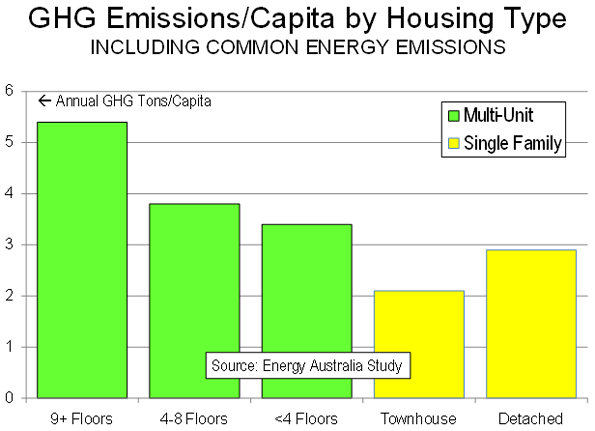
    The “common” consumption omission is serious. Other Australian research indicates how inaccurate consumer based inventories can be. Energy Australia has showed that, in the Sydney area, GHG emissions per capita, including common consumption, in high-rise residential buildings are 85 percent greater than in single family detached dwellings. Other multiple unit buildings are also more GHG intensive, while townhouses (row houses) are the best (see Figure).

    The inclusion of common consumption may be a principal reason why the ACF data associates lower GHG emissions with single family detached housing.

    Construction Materials: There is a further complicating factor. The materials that must be used to construct high-rise residential buildings, chiefly concrete and steel, are far more GHG intensive than the wood used in most single family dwelling construction. A 1997 Netherlands study indicates that the GHG emissions per square foot of high rise construction may be as much as five times that of a detached dwelling. In the newest energy efficient housing, the same study finds that the GHG emissions, over a building’s lifetime, can be greater than the emissions from day to day operation. The report notes that construction materials will become more important in residential GHG emissions, because improvements in routine energy consumption are likely to be more significant than those in building materials production.

    Then there is the issue of the GHG emissions in the construction process. It would not be surprising, for example, if heavy cranes could also tip the balance against high-rise towers.

    Dynamic Rather Than Static Analysis: Anyone who has studied economics understands the importance of “dynamic” versus “static” analysis. Dynamic analysis takes account of likely changes, while static analysis assumes that everything will continue to be as it is today. Much of the research on residential GHG emissions is based upon a static analysis. Yet, the housing stock (like the automobile stock) was largely produced during a time when there was little policy incentive to reduce GHG emissions. We are entering what may well be a very different policy environment. The comparatively recent emphasis on GHG emissions is producing a plethora of ideas, research and solutions. A recent Chicago Tribune article noted a surge in university graduates interested in research to reduce the GHG intensity of energy. The zero emission suburban house is on the horizon, which could take housing form “off the table” as a GHG emission issue and render static research to the internet equivalent of rarely accessed library stacks. Dynamic analysis asks “what can be,” not just “what is.”

    Cost per GHG Ton Reduced: All of this raises a question about how to identify policy strategies. The answer is to compare costs. The Intergovernmental Panel on Climate Change suggests that the maximum costs should be on the order of $20 to $50 per ton. McKinsey has published research indicating that steep reductions can be produced in the United States at less than $50 per ton.

    Yet, the costs of GHG emissions reduction are as absent from much of the present literature as the GHG emissions from elevators in high-rise towers. But costs are important. Economic and social disruption is likely to be greater to the extent that people are forced to change their lives. There is a big difference between requiring people to reduce their emissions where they live versus trying to uproot them – as well as their families and business – to urban cores. The former offers the hope of achieving sufficient GHG emission reductions, while the latter promises to incite a bitter fight between the bulk of the middle class and the regulatory apparatus. All this with a high probability that GHG emissions will not be sufficiently reduced.

    The Bottom Line: Outside some in the urban planning community, there is no lobby for reducing people’s standard of living. At least with respect to residential development and housing form, this does not appear to be necessary. The common area and construction GHG impacts of high-rise condominium buildings could well be greater both per capita and per square foot than those of detached housing. There is no need to force a move into a futuristic Corbusian landscape of skyscrapers. Indeed, it could even make things worse – for households, communities and even the environment.


    Previous posts on this subject:
    Regulating People or Regulating Greenhouse Gases?
    Greenhouse Gas Reduction Policy: From Rhetoric to Reason
    Enough “Cowboy” Greenhouse Gas Reduction Policies