Tag: middle class

  • How the Financial Crisis Threatens Localism

    By Richard Reep

    As in many places, the poor economy is forcing many families in affluent Winter Park, Florida to make some necessary adjustments. One of the most basic adjustments relates to shopping for food and staples. In better times, Winter Park was ruled by two Publix supermarkets and a Whole Foods. Grocery-cart conversation among friends became a common event; now this smooth, middle-class lifestyle pattern has been disrupted.

    Hard times are driving people to less intimate settings, largely to Wal-Mart and other discount stores, whose offerings and management are largely interchangeable between places. In this way hard times could be shifting the pendulum swing away from localism and towards globalism. For now, Wal-Mart’s globalism offers the advantage of low prices, overcoming the disdain that many in Winter Park expressed at this store; for it is the antithesis of Winter Park’s treasured shopping culture epitomized by Park Avenue, a quaint strip of unique boutiques. Even if you did buy those steaks at Wal-Mart, you didn’t exactly advertise the fact at your dinner party.

    Winter Parkers had thought that their basic food needs had been comfortably institutionalized. As neighborhood touchstones go, Publix is Florida’s gold standard. Winn-Dixie, Albertson’s, and other competition paled in comparison to the customer loyalty that Publix brought. Their brands weren’t much different, and neither were their prices. There was just something about that kelly green logo that inspired people to integrate Publix into their own personal culture and lexicon.

    For years, this chain has built a loyal following in Florida. Good customer service, great store brands, convenient and quality stores all contributed to their preeminence in the grocery market, and allowed them to expand in the Southeast. Today, however, Publix is challenged by its own reputation, and has become vulnerable to competition as local shoppers tighten their pocketbooks.

    Winter Parkers had two choices between their Publix: Hollyanna and Lakemont. The brand veneer, both in content and in form, was subtly bent to suit local tastes. People referred to their favorite as “my Publix”, and even when the Baldwin Park Publix opened in 2003 closer to many folks, their loyalty with their particular store kept them from going to the Baldwin Park store. (Its architecture doesn’t help; this storefront might have been designed by Albert Speer).

    Suddenly, however, Publix faces real competition from stores that traditionally do not overlap with its market share. This Lakeland-based company, which boasts an excellent reputation, finds itself now with both emptier parking lots and smaller cash register totals. What’s going on here?

    At the Lakemont Publix, the organic produce area has grown, in direct response to hip, organic Whole Foods up the street. Whole Foods, however, is suffering mightily in this economy – who needs $8.00 strawberries? If you are skeptical about this, a tour of their largely deserted parking lots and front entry areas on Sunday afternoon, when grocery shopping is near-peak, can be quite telling.


    Whole Foods has some great parking spaces right near the front door, and the entry area, usually clogged with shoppers, seemed to be nearly desolate. A few students sat at the bistro tables tapping on laptops; not the usual rich scene for this upscale store.

    Publix at Lakemont also had some great parking spaces right near the front door, and an even more desolate entry area. In fact, where are the Girl Scouts?


    Where have all these people gone? The answer lies up State Road 436 to the left, ladies and gentlemen – Wal-Mart! Parking near the front…forget it. At the entry, a line of people going in and full shopping carts coming out! And the Girl Scouts are smart enough to realize that this is where the local culture is going these days! Is Wal-Mart the new Publix?

    As everyone is frantically re-tooling their own personal economy, Wal-Mart has become the grocer of choice for more and more of Winter Park. Are the prices really lower? A little bit. Will Publix adapt to the new, changing times to meet this challenge? For this 79-year-old Florida-based grocery store chain, and all its loyal (but more loyal to their checkbooks) customers, we certainly hope so.

    The buying power of globalism continues to disrupt and shift local patterns. As Wal-Mart, Costco, and others compete in this New Economy, local and regional chains need to react quickly to gain back their customer base, or they will find themselves in for a difficult struggle to regain lost ground.

    Richard Reep is an Architect and artist living in Winter Park, Florida. His practice has centered around hospitality-driven mixed use, and has contributed in various capacities to urban mixed-use projects, both nationally and internationally, for the last 25 years.

  • How Houston Will Weather The Recession

    In the past year or so, traveling the various geographies of this country has become increasingly depressing. From the baked Sun Belt suburbs to the green Valhallas of Oregon and the once luxurious precincts of Manhattan, it is hard to find much cheer–at least from entrepreneurs–about the prospects for the economy.

    Until recently Texas, and particularly Houston, has been one of the last bastions of that great traditional American optimism–and for good reason. Over the past few years, Houston has outperformed every major metropolitan area on virtually every key economic indicator.

    Last year, the region was rated among the major metropolitan areas as the best place for everything from earning a living to college grads to manufacturing, according to such publications as Forbes, Business Week and Kiplinger’s.

    But the city that could may soon not. Like a couple of bad storms, the recession is barreling in from east and west, shutting off credit to even the most successful businesses. Just last month, Hanley Wood’s Builder ranked Houston the “healthiest” housing market in the nation. But when you get on the ground, things appear far less sanguine.

    Particularly hard hit has been the once-vibrant inner city condominium market, which has been attracting a whole new generation of young professionals to urban living. Now some condominiums, suggests developer Tim Cisneros, are being abandoned by younger workers who have become the prime victims of a contracting economy. As seen in other regions, others are turning to rentals as potential buyers fail to qualify even at Houston’s reasonable prices.

    However, the biggest problem facing Houston today revolves around the energy industry, which represents to this region of well over 5 million what finance does to New York. Already lower energy prices, along with the global slowdown, have taken a dent in job growth. Just last week, the Texas Workforce commission reported a 0.7% employment increase for the area in 2008, compared with a robust 3.5% the year before.

    Bill Gilmer, a veteran economist who covers energy for the Dallas branch of the Federal Reserve, reports that proposed new taxes and regulations plus falling prices have started to decimate the domestic oil and gas industry. Over the past year, he reports the number of rigs in operation across the country dropped from 2,000 to some 1,300.

    The impact of this on Houston’s energy economy, Gilmer suggests, will be severe, and it will drag the region and much of Texas down with it. “We are talking about a Texas recession now without question,” he says. “I lived through the Jimmy Carter era before, and now it’s déjà vu.”

    Of course, some high-end jobs in energy will remain, particularly for those who work on massive new projects overseas, like in Saudi Arabia. Instead, the biggest hits will affect the production sector, which until recently was a prodigious creator of high-wage blue-collar jobs. Over the coming years, the production downturn could devastate places like western Texas, the Dakotas, Louisiana, California’s Kern County and anywhere else that produces American crude and gas.

    Indeed, it may turn out to be one of the great ironies that the Obama administration, which campaigned earnestly against our “dependence on foreign oil,” will in the end make us more so. Barring an unexpected shift toward nuclear power, it is hard to see how the country–given the administration’s stance–will produce enough energy to meet its need in the near or even mid-term without turning increasingly to the Saudis and others overseas.

    Of course, the Houston-centered domestic energy industry may not go quietly into the night. The D.C. correspondent for the Energy Compass, Bill Murray, expects a “battle royal” in Congress over climate change legislation this fall.

    Houston Mayor Bill White, who is running for the Senate in 2010, also seems ready to fight the anti-oil and gas prejudices of key administration insiders. Natural gas, he suggests, “has to be a big part of the future if [we] have any chance at all to have electric power that is affordable and cleaner.”

    It is critical to point out that White is not some Neanderthal GOP “ditto head” but a former assistant energy secretary under Bill Clinton, a one-time chairman of the Texas Democratic Party and a widely popular figure in majority non-white Houston. He has a long record championing energy conservation and alternative fuels, but he says he cannot embrace an inquisitional approach to his city’s signature industry.

    “There’s a difference,” he said, with obvious reference to the Democrats in Washington, “between mandating one kind of technology and reality.”

    Yet even if the green Torquemadas have their way, White thinks Houstonians will find a way to keep their city ahead of the country’s other urban sad sacks. Throughout the expansion of recent years, when other cities went on insane spending sprees, Houston has kept the cost of services low and focused on basic infrastructure. Critically, Houston is also among the few big cities that has streamlined its pensions for public employees.

    Houston may also benefit from its historical experience dealing with near-depression conditions. When energy prices collapsed after 1983, the region went through a decade-long recession. The city went from being one of the country’s busiest construction sites to being filled with empty “see-through” office buildings and expanses of foreclosed homes.

    Under another Democratic mayor, the revered Bob Lanier, Houston gamely recovered, without much help from Washington. Lanier and other Houston leaders drove to diversify the economy–particularly in medical services, international trade and manufacturing–by investing in basic infrastructure and keeping costs low.

    “We’ve already lived through one depression,” says local real estate investor David Wolff, who also serves as chairman of the region’s transit agency, Metro. “We have already learned humility, and we have learned how to prepare for the world when everything shifts under our feet.”

    So despite all the problems surrounding energy and the encroaching recession, Houstonians continue to be cautiously optimistic about their future.

    They still excel at all the hallmarks of a progressive economy, such as improving both road and rail transport, reforming the school system and working to expand new industries, such as medical services, that have not yet been targeted by the Obamamians.

    To be sure, Houston, which missed the Bush recession, is beginning to feel the pain during the new administration’s watch. But Houstonians long have displayed remarkable grit and creativity in the face of tough times. Having survived catastrophic energy price declines, several huge hurricanes and endless humid summers, Houston is still among the best bets to survive these tough times and come out, in the end, a strong winner.

    This article originally appeared at Forbes.

    Joel Kotkin is executive editor of NewGeography.com and is a presidential fellow in urban futures at Chapman University. He is author of The City: A Global History and is finishing a book on the American future.
  • Sunbelt Indianapolis

    For decades, the overwhelming majority of population and economic growth has occurred in the Sun Belt – the nation’s South and West as defined by the United States Bureau of the Census. This broadly-defined area stretches south from the Washington-Baltimore area to the entire West, including anything but sunny Seattle and Portland. Any list of population growth or employment growth among the major metropolitan areas will tend to show the Sun Belt metropolitan areas bunched at the top and the Frost Belt areas (the Northeast and Midwest regions) bunched at the bottom. Since World War II, no state has experienced the growth that has occurred in California.

    However, the trends in the last decade indicate a shift, certainly away from California, which has experienced a net domestic migration (people moving to other parts of the nation). The overall loss reaches over 1.2 million people; the state’s overall population growth rate is now only little more than average. Some metropolitan areas in the Frost Belt have begun to perform better in population and domestic migration, but most continue to experience growth that is well below that of the Sun Belt.

    The exception to this is Indianapolis, which has developed growth rates that would put it right in the middle of Sun Belt metropolitan areas, if it were not in the Frost Belt.

    Indianapolis is a metropolitan area of 1.7 million population. Indianapolis added nearly 11 percent to its population between 2000 and 2007 (latest data available) and ranks 19th in population growth among the 50 metropolitan areas with more than 1,000,000 population (New Orleans has been excluded from this analysis because of the hurricane related population losses). Indianapolis is growing faster than Washington, DC or Seattle and nearly as fast as Portland or Denver. Its population growth rate has been double that of San Diego, triple that of Los Angeles or San Jose and more than six times that of San Francisco, which has seen its growth slow to a rate no better than that of Italy. Overall Indianapolis would rank 18th out of the 32 largest US Sun Belt metropolitan areas in total population growth. It is the fastest growing of the 18 largest Frost Belt metropolitan areas.

    Between 2000 and 2007, the Indianapolis metropolitan area added 55,000 domestic migrants, equal to 3.6 percent of its 2000 population. No other Frost Belt metropolitan area comes close. Columbus and Kansas City had domestic migration gains, at 1.2 percent of their population. All other Frost Belt metropolitan areas lost domestic migrants. Indianapolis, however, would have ranked 17th out of the 32 largest Sun Belt metropolitan areas trailing Portland, but leading Seattle and Denver.

    The distribution of domestic migration within the Indianapolis metropolitan area is also significant. For one-half century various analysts have predicted the decline of the suburbs. Indianapolis, like most metropolitan areas around the country, shows exactly the opposite: the suburbs continue to attract central city residents and have yet to fall into this seemingly inevitable decline.

    While the Indianapolis metropolitan area gained 55,000 domestic migrants from 2000 to 2007, Marion County, the central county which is nearly co-existent with the central city of Indianapolis, lost 46,500 domestic migrants. All of the domestic migration growth was in the suburbs, which attracted 101,800 new residents from Indianapolis/Marion County and the rest of the nation.

    What is it that has allowed Indianapolis to experience Sun Belt growth despite being in the Frost Belt? This is not the place for a full attempt to identify all of the causes, but some observations can be made.

    Perhaps it is most important to understand what is not the cause of the superior growth in Indianapolis. It is not the city’s “unigov” governance structure. In the early 1970s, to the great fanfare of urban planners, Indianapolis merged with most of Marion County, increasing the city’s population by approximately 50 percent. Proponents of local government consolidations often (and speciously) suggest that these consolidations will make metropolitan areas more attractive (this issue is discussed in detail in our Pennsylvania report on local government consolidation). Yet, Indianapolis, one of the nation’s largest consolidated local governments, is losing residents to the suburbs. It is also worthy of note that state taxpayers provided a $1 billion pension bailout to the city last year.

    One factor that clearly makes Indianapolis attractive is its housing affordability, which is the best among metropolitan areas with more than 1,000,000 residents in six nations. According to our 5th Annual Demographia International Housing Affordability Survey, Indianapolis had a Median Multiple (median house price divided by median household income) of 2.2 in the third quarter of 2008, well below the historic norm of 3.0. Indianapolis has been ranked near the top in each of the preceding four editions as well. In recent years, new suburban starter houses of 1,500 square feet have been advertised at less than $110,000, less than the price of land for a house in many metropolitan areas.

    Superior housing affordability constitutes a critical important attractor. At the height of the housing bubble, a household living in the median priced house in Indianapolis would have saved more than $1,000,000 in down payment and mortgage payments over 30 years, compared to San Diego.

    Indianapolis also has the advantage of a comfortable lifestyle. Commuters spend 2 minutes less per day than the national average getting to work, according to the 2007 United States Bureau of the Census American Community Survey. The Texas Transportation Institute indicates that traffic congestion is less severe in Indianapolis than average and that it has become better in the last 10 years. Indicating its usual irrelevance to traffic congestion, Indianapolis has the smallest transit market share of any urban area over 1,000,000 in the nation, at approximately 0.2 percent. This compares to 11 percent in New York, 5 percent in San Francisco and 2 percent in Los Angeles and Portland.

    Where does Indianapolis go from here? So far, Indianapolis has shown resiliency in the current economic crisis. The December 2009 unemployment rate was 6.7 percent, which is below the 7.2 percent national rate. Other parts of Indiana are not doing nearly as well, especially in smaller metropolitan areas that rely to a greater extent on manufacturing. For example, unemployment has reached 15 percent in Elkhart.

    To some extent, the metropolitan area’s huge advantage in housing affordability has been eroded by the collapse of prices in the most expensive Sun Belt metropolitan areas, such as in California and Florida. Yet, Indianapolis remains far more affordable, even after these losses.

    Indianapolis also has an advantages for business. In the State Business Tax Climate Index, Indiana is ranked highly, at 14th in the nation. With the prospect of higher taxes, both at the federal level and in many states, this should help Indianapolis retain an impressive advantage and continue to perform as if it were a Sun Belt metropolitan area, but without the problems associated with the housing bubble, massive congestions and growing social inequality.

    Wendell Cox is a Visiting Professor, Conservatoire National des Arts et Metiers, Paris. He was born in Los Angeles and was appointed to three terms on the Los Angeles County Transportation Commission by Mayor Tom Bradley. He is the author of “War on the Dream: How Anti-Sprawl Policy Threatens the Quality of Life.

  • Urban Inequality Could Get Worse

    President Obama’s stated objective to reduce inequality, as laid out in public addresses and budget plans, is a noble one. The growing income gap – not only between rich and poor, but also between the ultra-affluent and the middle class – poses a threat both to the economy and the long-term viability of our republic.

    But ironically, what seems to be the administration’s core proposal, ratcheting up the burden on “rich” taxpayers earning over $250,000, could have unintended consequences. For one thing, it would place undue stress on the very places that have been Obama’s strongest supports, while providing an unintended boost to those regions that most oppose him.

    At the heart of the matter is the age-old debate about who is “rich.” If you define wealthy as $250,000 a year for a family of four, that means different things in different places. America is a vast country, and the cost of living varies widely. What seems a princely sum in, say, red state Oklahoma City is barely enough to eke out a basic middle-class life in blue bastions like New York, Los Angeles or San Francisco.

    In the recent study on the New York middle class that I conducted with Jonathan Bowles at the Center for an Urban Future, we compared the cost of a “middle class” standard of living in New York and other cities. The report found that Manhattan is by far the most expensive urban area in the country, with a cost of living that’s more than twice the national average. (This is according to a cost of living index developed by the ACCRA, a research group formerly known as the American Chamber of Commerce Researchers Association.)

    But even Queens, the city’s middle-class haven and the only other borough included in the ACCRA analysis, suffers the eighth highest cost of living in the country.

    What does that mean? An individual from Houston who earns $50,000 would have to make $115,769 in Manhattan and $81,695 in Queens to live at the same level of comfort. Similarly, earning $50,000 in Atlanta is the equivalent of earning $106,198 in Manhattan and $74,941 in Queens. (See “New York Should End Its Obsession With Manhattan.”)

    The cost of housing constitutes one critical part of the difference. Average monthly rent in New York was $2,720 in the fourth quarter of 2007, by far the top in the nation. That total was both 55% higher than the second place city, San Francisco, where average effective rents are $1,760, and nearly triple the national average of $975.

    Even in relative boom times, such high costs have been driving many out of New York, and now it could get worse. During tough times, people’s incomes drop, so they are less able to absorb high costs and taxes, which are rising in many blue cities and states. Imposing more taxes on some label-rich New Yorkers or Angelenos, who earn $250,000 a year, won’t make them more likely to stay.

    Perhaps even worse, higher taxes probably won’t help the inequality issue. True, historically and to this day, the greatest levels of inequality occur in low-tax areas like the Mississippi Delta, the Rio Grande Valley and Appalachia. But, increasingly, this unsavory distinction is shared by big cities like New York, Los Angeles and Chicago. In contrast, the most egalitarian states are generally deep red places – such as the Dakotas, Alaska, Nebraska and Wyoming.

    Higher costs – manifested in everyday expenses like sales taxes and energy bills – now contribute in a large way to growing inequality even in the richest, most elite cities. When housing and other costs are factored in, notes researcher Deborah Reed of the left-leaning Public Policy Institute of California, deep-blue mainstays Los Angeles and San Francisco rank among the top 10 counties in America with respect to the percentage of people in poverty. Only New York and Washington, D.C., do worse.

    Worst of all, the rise of inequality in these high-cost blue cities seems to be connected to policy decisions. High taxes and strict regulations have expelled relatively well-paying blue collar jobs in manufacturing and warehousing from expensive urban areas. Without them, an extremely bifurcated economy and society forms because no traditional ladders for upward mobility remain; they are critical to a successful urbanity.

    Back in the 1960s, Jane Jacobs predicted that Latino immigrants to New York, mainly from Puerto Rico, would inevitably make “a fine middle class.” Yet four decades later, in the Bronx, the city’s most heavily Latino county, roughly one in three households lives in poverty – the highest rate of any urban county in the nation.

    At the other extreme, in Manhattan, where the rich are concentrated, the disparities between socioeconomic classes have been rising steadily. In 1980, the borough ranked 17th among the nation’s counties for social inequality; today it ranks first, with the top fifth of wage earners earning 52 times that of the lowest fifth, a disparity roughly comparable to that of Namibia.

    To an old-fashioned Truman Democrat like me, this is bad news. But some modern-day “progressives,” like Richard Florida, celebrate the concentration of rich people. They see them as guarantors that places like New York will be the winners of the post-crash economy. The losers? Goods-producing regions of the Great Plains, the industrial Midwest and, of course, those unenlightened, suburban middle-class people.

    Yet it seems more and more likely that raising taxes for urban middle-income workers will, over the long term, add to the flood of people fleeing to less costly locales with lower taxes. This will be particularly true for the growing ranks of information economy “artisans” who might find critical write-offs for home offices and other business expenses cut from their next tax return.

    None of this is necessary. The “creative destruction” resulting from the downturn might actually prove a boon to these big cities – by making them more affordable for the urban middle class. This help would be accelerated if city governments – as in Los Angeles, New York, Houston and even San Francisco during the early 1990s – nurture local businesses.

    But “growth” – a word not widely embraced in this greenest of administrations – does not seem to be a priority in either Washington or in most city halls. There are murmurs that investment in high-cost, subsidized alternative energy will create vast numbers of new jobs, but this is likely just wishful thinking for everyone but Al Gore’s business partners.

    This is not to say cities’ policies need to return to Bush-style Republicanism. Tax breaks for big-time investors and real estate speculators do not make a sustainable urban policy either. What’s needed is something closer to lunch-bucket liberalism, which focuses on productivity-enhancing initiatives and sparking entrepreneurial growth. America – its cities in particular – could do with more private-sector stimulation and a lot less high-minded social engineering.

    With policies geared toward the latter at the expense of the former, one of the great ironies of the Obama era will continue to unfold.

    By targeting the urban middle class to pay for its deficit and new social programs, the president’s plan could end up draining wealth – and boosting inequality – from our nation’s great cities, where he currently draws overwhelming support, to its hinterlands. Not exactly what the White House had in mind, no doubt, but, sadly, it’s a distinct possibility.

    This article originally appeared at Forbes.

    Joel Kotkin is executive editor of NewGeography.com and is a presidential fellow in urban futures at Chapman University. He is author of The City: A Global History and is finishing a book on the American future.

  • The Aging of Paradise in Ventura County California

    You could say that Ventura County, just north of Los Angeles, represents what is best about California. Some people believe that its amenities – beaches, gorgeous interior valleys and parks – assure perpetual economic growth for Ventura County and California. They are wrong. There is trouble in paradise.

    Ventura County has changed, and not for the better. It is aging, losing its demographic as well as economic vitality. This represents a relatively new phenomenon, the slow decline of even formerly healthy suburban areas.

    The current recession illustrates the change. In the past Ventura County suffered mild recessions even as the country and the region suffered mightily. The County saw no annual net job losses in the 2001 recession. The early 1990s recession was more painful, but Ventura County did far better than California as a whole.

    All of that has changed with the current recession. Ventura County has recently been losing jobs at a faster pace than California. In 2007, the County lost jobs while California gained jobs.

    The picture is even worse when Ventura County’s economy is compared to the Los Angeles County economy. In 2008, Ventura County’s economy shrank at a rate about five times faster than did Los Angeles’s economy.

    What is going on here? In the past, Ventura County has been buffered by its twin giants, Amgen and Countrywide. Amgen’s Ventura County growth has slowed. Countrywide has done much worse than Amgen, and its demise has been well documented.

    But you can’t blame all of Ventura County’s weakness on Countrywide. It has contributed, but it is not Ventura County’s sole source of economic weakness. The weakness is quite general, spanning the construction sector, non-durable manufacturing, retail trade and other services. Each lost over 1,000 jobs in 2008. By contrast, the finance, insurance, and real estate sectors, where Countrywide resides, lost just fewer than 900 jobs, accounting for about 4 percent of the job losses.

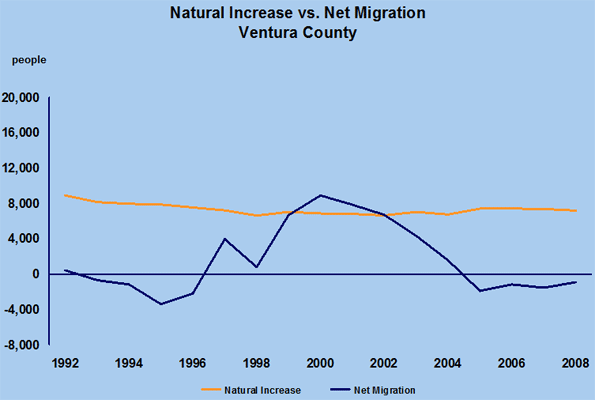
    My sense is the real underlying problem is demographic, and this may not go away even if the economy recovers. One clue is that more people have been leaving Ventura County than moving in from all sources, and this has been happening long enough to be a trend. It reflects still-high housing costs and limited opportunity. It implies a weak future.

    This chart shows that in exactly half of the past 16 years, migration has been negative. That is total migration, not just domestic migration.

    Think about this for a moment. More people are leaving Ventura County than are moving in. That is certainly counter to what has happened in most of the past 150 years.

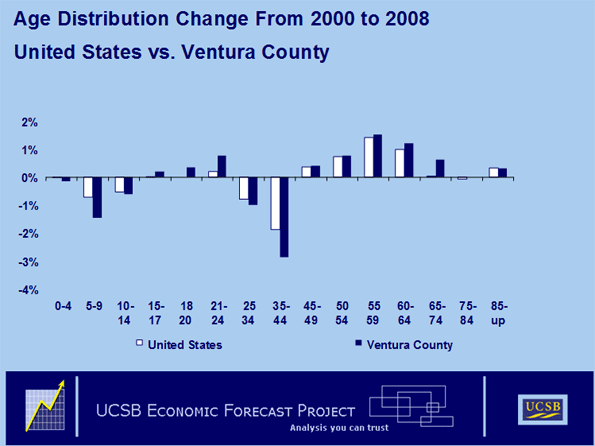
    Ventura County’s net out migration has impacts beyond its effect on the size of the population. The composition of the county is also changing, away from working age people and families and towards people either close to retirement or already there.

    The above chart compares relative changes, by age cohort, in Ventura County’s population since the 2000 census with changes in the United States population since the 2000 census. The County’s population between 25 and 44 years of age and their children has been collapsing. At the same time, the County’s populations of both young adults and people over 45 have been growing as a percentage of the total population. The bulk of that growth has occurred in the over 55 cohort.

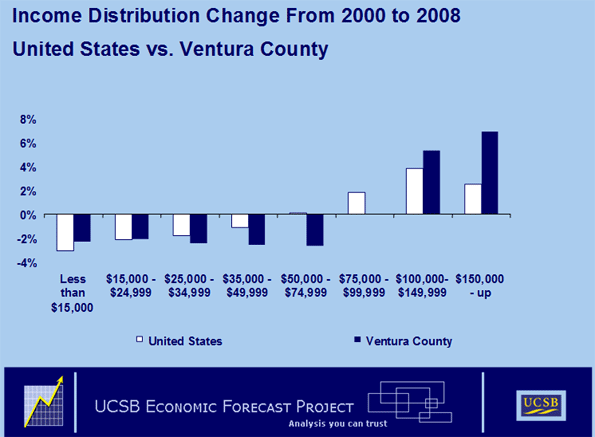
    The migration out of Ventura County has also resulted in changes to the County’s income distribution. The following chart compares changes in the County’s income distribution to changes in the United States income distribution since the 2000 census:

    The comparisons are telling. The County has been losing very-low-income people at a slower pace than has the United States. At the same time, the growth in population with incomes over $100,000 has been spectacular. The local population with incomes between $25,000 and $75,000 has fallen far more rapidly than that of the United States. The County’s population with incomes between $75,000 and $100,000 is relatively unchanged, while that of the United States has shown significant growth.

    People – particularly in the late 20s and early 30s – aren’t leaving Ventura County because amenities have suddenly disappeared. They are leaving because of a deficit in opportunity. Their leaving has consequences. Ventura County’s population is aging more rapidly than it otherwise would. The net result of these demographic changes is that Ventura County’s median real per-capita income is declining, while the County’s median age is rising. Real per-capita personal income has fallen almost $1,000 in only eight years, to $32,718 (Constant 2000 dollars) from $33,797 in 2000.

    Ventura County’s demographic changes can be easily summarized. It is losing its middle class and becoming bi-modal. The young families that provide a community’s vigor and future have been leaving. There is no reason to believe that the trend will reverse itself. Ventura County home prices are still relatively high, while opportunity is declining.

    The County is left with an aging and increasingly wealthy population along with the lower-income people that service the wealthy aged and the very-low-income farm workers. In a sense, it now resembles what we see in many expensive city cores – even if it is on the periphery!

    This creates enormous risks. Most amenities are luxury goods. Poor people don’t invest in luxury goods. Generally, the lower-income population does not have the resources to provide leadership or invest in a community’s future. They have their hands full just taking care of their families, particularly in an expensive place like Ventura County. Their children will likely join the middle class, but in someplace more affordable like Texas, Arizona, or Nevada.

    High concentrations of older people and declining incomes are often associated with deteriorating schools, amenities and increasing crime. The aged wealthy are not in Ventura County to invest in its future. They are there to consume it. They will not invest in the future – particularly if their children and relatives have gone elsewhere.

    Ventura County is not unique. It is fairly representative of Coastal California. Communities like Ventura, Goleta, and San Luis Obispo used to be middle-class communities that valued opportunity. Things are even more extreme in California’s elite playgrounds: Monterey, Malibu, and Santa Barbara. Populations in Monterey and Santa Barbara have actually declined over the past several years. Similar phenomena may be noticeable in other formerly elite suburbs within our most favored metropolitan areas.

    These changes present serious challenges to California’s workers, businesses, and those policy makers who still care about something other than greenhouse gases and public employee pensions. Something needs to be done, and quickly. But the immediate prognosis is less than encouraging. Like Ventura County, California is suffering its worst recession in decades, and policy makers don’t seem to be focusing on policies that may help the area return to its previous status as a region of opportunity.

    Portions of this essay have previously appeared in a UCSB-EFP Ventura County Forecast.

    Bill Watkins, Ph.D. is the Executive Director of the Economic Forecast Project at the University of California, Santa Barbara. He is also a former economist at the Board of Governors of the Federal Reserve System in Washington D.C. in the Monetary Affairs Division.

  • Democrats Could Face an Internal Civil War as Gentry and Populist Factions Square Off

    This is the Democratic Party’s moment, its power now greater than any time since the mid-1960s. But do not expect smooth sailing. The party is a fractious group divided by competing interests, factions and constituencies that could explode into a civil war, especially when it comes to energy and the environment.

    Broadly speaking, there is a long-standing conflict inside the Democratic Party between gentry liberals and populists. This division is not the same as in the 1960s, when the major conflicts revolved around culture and race as well as on foreign policy. Today the emerging fault-lines follow mostly regional, geographical and, most importantly, class differences.

    Gentry liberals cluster largely in cities, wealthy suburbs and college towns. They include disproportionately those with graduate educations and people living on the coasts. Populists tend to be located more in middle- and working-class suburbs, the Great Plains and industrial Midwest. They include a wider spectrum of Americans, including many whose political views are somewhat changeable and less subject to ideological rigor.

    In the post-World War II era, the gentry’s model candidate was a man such as Adlai Stevenson, the Democratic presidential nominee who lost twice to Dwight D. Eisenhower. Stevenson was a svelte intellectual who, like Barack Obama, was backed by the brute power of the Chicago machine. After Stevenson, the gentry supported candidates such as John Kennedy – who did appeal to Catholic working class voters – but also men with limited appeal outside the gentry class, including Eugene McCarthy, George McGovern, Gary Hart, Bill Bradley, Paul Tsongas and John Kerry.

    Hubert Humphrey, a populist heir to the lunch-pail liberalism of Harry Truman (and who was despised by gentry intellectuals) missed the presidency by a hair in 1968. But populists in the party later backed lackluster candidates such as Walter Mondale and Dick Gephardt.

    Bill Clinton revived the lunch-pail Democratic tradition; and the final stages of last year’s presidential primaries represented yet another classic gentry versus populist conflict. Hillary Clinton could not match Barack Obama’s appeal to the gentry. Driven to desperation, she ended up running a spirited populist campaign.

    Although peace now reigns between the Clintons and the new president, the broader gentry-populist split seems certain to fester at both the congressional and local levels – and President Obama will be hard-pressed to negotiate this divide. Gentry liberals are very “progressive” when it comes to issues such as affirmative action, gay rights, the environment and energy policy, but are not generally well disposed to protectionism or auto-industry bailouts, which appeal to populists. Populists, meanwhile, hated the initial bailout of Wall Street – despite its endorsement by Mr. Obama and the congressional leadership.

    Geography is clearly a determining factor here. Standout antifinancial bailout senators included Sens. Byron Dorgan of North Dakota, Tim Johnson of South Dakota, and Jon Tester of Montana. On the House side, the antibailout faction came largely from places like the Great Plains and Appalachia, as well as from the suburbs and exurbs, including places like Arizona and interior California.

    Gentry liberals, despite occasional tut-tutting, fell lockstep for the bailout. Not one Northeastern or California Democratic senator opposed it. In the House, “progressives” such as Nancy Pelosi and Barney Frank who supported the financial bailout represent districts with a large concentration of affluent liberals, venture capitalists and other financial interests for whom the bailout was very much a matter of preserving accumulated (and often inherited) wealth.

    Energy and the environment are potentially even more explosive issues. Gentry politicians tend to favor developing only alternative fuels and oppose expanding coal, oil or nuclear energy. Populists represent areas, such as the Great Lakes region, where manufacturing still plays a critical role and remains heavily dependent on coal-based electricity. They also tend to have ties to economies, such as in the Great Plains, Appalachia and the Intermountain West, where smacking down all new fossil-fuel production threatens lots of jobs – and where a single-minded focus on alternative fuels may drive up total energy costs on the farm, make life miserable again for truckers, and put American industrial firms at even greater disadvantage against foreign competitors.

    In the coming years, Mr. Obama’s “green agenda” may be a key fault line. Unlike his notably mainstream appointments in foreign policy and economics, he’s tilted fairly far afield on the environment with individuals such as John Holdren, a longtime acolyte of the discredited neo-Malthusian Paul Ehrlich, and Carol Browner, who was Bill Clinton’s hard-line EPA administrator.

    These appointments could presage an environmental jihad throughout the regulatory apparat. Early examples could mean such things as strict restrictions on greenhouse gases, including bans on new drilling and higher prices through carbon taxes or a cap-and-trade regime.

    Another critical front, not well understood by the public, could develop on land use – with the adoption of policies that favor dense cities over suburbs and small towns. This trend can be observed most obviously in California, but also in states such as Oregon where suburban growth has long been frowned upon. Emboldened greens in government could use their new power to drive infrastructure spending away from badly needed projects such as new roads, bridges and port facilities, and toward projects such as light rail lines. These lines are sometimes useful, but largely impractical outside a few heavily traveled urban corridors. Essentially it means a transfer of subsidies from those who must drive cars to the relative handful for whom mass transit remains a viable alternative.

    Priorities such as these may win plaudits in urban enclaves in New York, Boston and San Francisco – bastions of the gentry class and of under-35, childless professionals – but they might not be so widely appreciated in the car- and truck-driving Great Plains and the vast suburban archipelago, where half the nation’s population lives.

    If he wishes to enhance his power and keep the Democrats together, Mr. Obama will have to figure out how to placate both his gentry base and those Democrats who still see their party’s mission in terms that Harry Truman would have understood.

    This article originally appeared at Wall Street Journal.

    Joel Kotkin is executive editor of NewGeography.com and is a presidential fellow in urban futures at Chapman University. He is author of The City: A Global History and is finishing a book on the American future.

  • The Decline of Los Angeles

    Next week, Antonio Villaraigosa will be overwhelmingly re-elected mayor of Los Angeles. Do not, however, take the size of his margin – he faces no significant opposition – as evidence that all is well in the city of angels.

    Whatever His Honor says to the media, the sad reality remains that Los Angeles has fallen into a serious secular decline. This constitutes one of the most rapid – and largely unnecessary – municipal reversals in fortune in American urban history.

    A century ago, when L.A. had barely 100,000 souls, railway magnate Henry Huntington predicted that the place was “destined to become the most important city in this country, if not the world.” Long run by ambitious, often ruthless boosters, the city lured waves of newcomers with its pro-business climate, perfect weather and spectacular topography.

    These newcomers – first largely from the Midwest and East Coast, and then from around the world – energized L.A. into an unmatched hub of innovation and economic diversity.

    As a result, L.A. surged toward civic greatness. By the end of the 20th century, it stood not only as the epicenter for the world’s entertainment industry, but also North America’s largest port, garment manufacturer and industrial center. The region also spawned two important presidents – Richard Nixon and Ronald Reagan – and nurtured a host of political and social movements spanning the ideological spectrum.

    Now L.A. seems to be fading rapidly toward irrelevancy. Its economy has tanked faster than that of the nation, with unemployment now close to 10%. The port appears in decline, the roads in awful shape and the once potent industrial base continues to shrink.

    Job growth in the area, notes a forecast by the University of California at Santa Barbara, dropped 0.6% last year and is expected to plunge far more rapidly this year. Roughly one-fifth of the population depends on public assistance or benefits to survive.

    Once a primary destination for Americans, L.A. – along with places like Detroit, New York and Chicago – now suffers among the highest rates of out-migration in the country. Particularly hard hit has been its base of middle-class families, which continues to shrink. This is painfully evident in places like the San Fernando Valley, where I live, long a middle-class outpost for L.A., much like Queens and Staten Island are for New York.

    In such a context, Villaraigosa’s upcoming coronation seems hard to comprehend. By most accounts, he has been at best a mediocre mayor, with few real accomplishments besides keeping police chief Bill Bratton, a man appointed by his predecessor. So far, Bratton has managed to keep the lid on crime, a testament both to his skills and to the demographic aging of much of the city.

    Besides this, virtually every major initiative from Villaraigosa has been a dismal failure; from a poorly executed program to plant more trees to a subsidized drive to refashion downtown Los Angeles into a mini-Manhattan. Instead of reforming a generally miserable business climate, Villaraigosa has fixated on fostering “elegant density” through massive new residential construction. This gambit has failed miserably, with downtown property values plunging at least 35% since their peak. Many “luxury” condominiums there, as well as elsewhere in the city, remain largely unoccupied or have turned into rentals.

    More recently the mayor has presided over a widely ridiculed scheme to hand over the solar business in Los Angeles to a city agency, the Department of Water and Power (DWP), whose workers are among the best paid and most coddled of any municipal agency anywhere. Most solar plans by utilities focus more on competitive bidding by outside contractors. Villaraigosa’s plan, which recent estimates suggests will cost L.A. ratepayers upward of $3.6 billion, would grant a powerful, well-heeled union control of the city’s solar program.

    This has occurred despite years of overruns on previous DWP “clean energy” projects. Not surprisingly, the plan was widely blasted – by the city’s largest newspaper, the rapidly shrinking Los Angeles Times, the feistier LA Weekly and the last independent voice at City Hall, outgoing City Controller Laura Chick, who proclaimed that the whole scheme “stinks.” Yet despite the criticism, a ballot measure endorsing the plan – opponents have little money to stop it – seems likely to be approved next week.

    With his firm grip on political power, Villaraigosa likes to think of himself as a West Coast version of New York’s Michael Bloomberg or Chicago’s Richard Daley. Yet at least they have demonstrated a modicum of seriousness about the job.

    In contrast, Villaraigosa, according to a devastating recent report in the LA Weekly, spends remarkably little time – about 11% – actually doing his job. The bulk of his 16-hour or so days are spent politicking, preening for the cameras and in other forms of relentless self-promotion.

    So how is this person about to be re-elected with only token opposition? Rick Caruso, the developer of luxury shopping center The Grove and one of L.A.’s last private sector power brokers, ascribes this to a growing sense of powerlessness, even among the city’s most important business leaders.

    “People feel it’s kind of hopeless. It’s a dysfunctional city,” Caruso, who once considered a run against Villaraigosa, told me the other day. “They don’t think there’s anything to do.”

    Certainly, odds against changing the current political system seem long to an extreme. The once-powerful business community has devolved into a weak plaintive lobby who rarely challenge our homegrown Putin or his allies in our municipal Duma.

    Of course, entrepreneurial Angelenos still find opportunities, but largely by working at home or in one of the city’s surrounding communities. They tend to flock to locales like Ontario, Burbank, Glendale or Culver City, all of which, according to the recent Kosmont-Rose Institute Cost of Doing Business Survey, are less expensive and easier to do business in than L.A.

    “It’s extremely difficult to do business in Los Angeles,” observes Eastside retail developer Jose de Jesus Legaspi. “The regulations are difficult to manage. … Everyone has to kiss the rings of the [City Hall politicians].”

    Legaspi, like many here, still regards Southern California as an appealing place to work, but takes pains to avoid anything within the purview of City Hall. As the economy recovers, I would bet the smaller cities around L.A. and even the hard-hit periphery rebounds first.

    The only immediate chance of relief for us Angelenos is if Villaraigosa (who will soon face term limits) takes off to run for governor. As the sole southern Californian and Latino candidate, he could prevail in a crowded Democratic primary. But the idea of this empty suit running the once great state of California – not exactly a paragon of good governance – may be enough to push even more people to the exits or, at very least, think about taking a very strong sedative.

    This article originally appeared at Forbes.

    Joel Kotkin is executive editor of NewGeography.com and is a presidential fellow in urban futures at Chapman University. He is author of The City: A Global History and is finishing a book on the American future.

  • What Does “Age of Hope” Mean in the Mississippi Delta?

    It was during the inaugural days that an article appeared in The Washington Post about the predominantly black Mississippi Delta going for Obama – no surprise! But juxtaposed in the same time period there appeared in a Kentucky newspaper the story of predominantly white Menifee County, my birthplace – deep in the heart of Appalachia – defying the red sea of Kentucky all around it and also going for Obama.

    Quite a pairing of places. It caused the logical mind to go quickly to work. What did they have in common? The likely answer was a common thread of hope – in two places very different yet alike. Two places long left behind as programs have come and gone. Did this present them with their chance?

    It is easy to say – as I said to a group of automotive middle managers hit hard both emotionally and in the pocketbook by the feared demise of the U.S. auto industry – buck up and get over it. The world has changed. It is time to read What Would Google Do? and reinvent yourselves and your industry. So, too, the business of moving people from point A to point B will always be with us – just how to do that will be left to inventive minds which should include all of us.

    But the auto industry is not alone. Neither are Menifee County and the Mississippi Delta. We do not yet know how to grow legs under this thing called “Obama hope” for communities like those of the Delta or Menifee County. Maybe it’s easier if you’re a college student in California, Manhattan or Chicago to take pride in the greater articulateness and ‘vision’ of our new President.

    Beyond “hope”, an intrinsically ephemeral thing, what are we doing for places like the Delta and Menifee County? It is clear the world has changed. October taught us that, yes indeed, we are globally interdependent. Expertise doesn’t lie in the likes of Greenspan and CEOs and senators and representatives. Finally, government has a role to play – we humbly acknowledge after years of bashing it.

    So, what makes Obama so different and what can he do to live up to his reputation? He gave hope perhaps because he is so different, with an exotic name and so deliciously diverse ethnically that he appears to be out of central casting. Like Superman or Spiderman, he has an edge because he is not exactly like the rest of us.

    We wait and see. There is a major debate over whether places like the Delta or Menifee County can be saved…or should be saved. President Obama can be counted on to focus on other places – like San Francisco, Manhattan and, of course, Chicago – where his most intense supporters live and where the media clusters.

    The Delta and Menifee may have voted for him, but are they on the Presidential view screen? These places are not on the beaten path of interstate highways. They are not part of so-called “metro” or “hot” spots. They are small places with small towns. They are places of strong religious values. They won’t attract the creative class seeking nightclubs and outdoor cafes.

    Yet these places do have their positive attributes – Menifee lies near a lake and people looking for affordable second homes. The land is of great beauty and there are people there who know – as Wendell Berry speaks in reverence – every nook and cranny of every precious inch. So too it is with the Delta, a place full of history, folklore and the richest American musical traditions.

    There is some palpable evidence that these kinds of places may be more attractive than we may have thought prior to the October financial collapse. If you can’t live well in New York for under $500,000 a year, perhaps smaller, more nurturing places can provide a higher quality of life for far less money.

    Perhaps it will take more than government “programs” and outsiders coming in as saviors. Perhaps it will take the people of those regions coming together in some way to tout their regional rural attributes – perhaps their local culture and microentrepreneurship – with some obviously needed but as yet undefined help from “higher-ups.”

    Will local folks be willing to step up to that challenge? Let’s listen to Mayor Will Cox of Madisonville, Ky. and his “on-the-street reassurance” of his constituents through Facebook and his iPhone during the catastrophic Kentucky ice storm of ‘09. He didn’t fan flames of anger but rather was honest and straightforward and ultimately soothing. At the end of the day he got the power back on. “Obama hope” will not stoke the fire or feed the kids, but perhaps it can inspire us to do more for ourselves.

    I await spring with a little more enthusiasm this year. My father hails from Menifee County. He says to plant your corn when the tree buds are the size of squirrel ears. He is a plain old man and loves that place. We are a patchwork country with many differences, but we’re more alike than we think. Just ask the folks in the Delta and Menifee County, poor whites and blacks who opted for the same President. It’s time to grow legs under hope and act with some new thinking.

    Sylvia L. Lovely is the Executive Director/CEO of the Kentucky League of Cities and the founder and president of the NewCities Institute. She currently serves as chair of the Morehead State University Board of Regents. Please send your comments to slovely@klc.org and visit her blog at sylvia.newcities.org.

    Photo courtesy of Russell and Sydney Poore

  • Death of the California Dream

    For decades, California has epitomized America’s economic strengths: technological excellence, artistic creativity, agricultural fecundity and an intrepid entrepreneurial spirit. Yet lately California has projected a grimmer vision of a politically divided, economically stagnant state. Last week its legislature cut a deal to close its $42 billion budget deficit, but its larger problems remain.

    California has returned from the dead before, most recently in the mid-1990s. But the odds that the Golden State can reinvent itself again seem long. The buffoonish current governor and a legislature divided between hysterical greens, public-employee lackeys and Neanderthal Republicans have turned the state into a fiscal laughingstock. Meanwhile, more of its middle class migrates out while a large and undereducated underclass (much of it Latino) faces dim prospects. It sometimes seems the people running the state have little feel for the very things that constitute its essence — and could allow California to reinvent itself, and the American future, once again.

    The facts at hand are pretty dreary. California entered the recession early last year, according to the Forecast Project at the University of California, Santa Barbara, and is expected to lag behind the nation well into 2011. Unemployment stands at roughly 10 percent, ahead only of Rust Belt basket cases like Michigan and East Coast calamity Rhode Island. Not surprisingly, people are fleeing this mounting disaster. Net outmigration has been growing every year since about 2003 and should reach well over 200,000 by 2011. This outflow would be far greater, notes demographer Wendell Cox, if not for the fact that many residents can’t sell their homes and are essentially held prisoner by their mortgages.

    For Californians, this recession has been driven by different elements than the early-1990s downturn, which was largely caused by external forces. The end of the Cold War stripped away hundreds of thousands of well-paid defense-related jobs. Meanwhile, the Japanese economy went into a tailspin, leading to a massive disinvestment here. In South L.A., the huge employment losses helped create the conditions conducive to social unrest. The 1992 Rodney King verdict may have provided the match, but the kindling was dry and plentiful.

    This time around, the recession feels like a self-inflicted wound, the result of “bubble dependency.” First came the dotcom bubble, centered largely in the Bay Area. The fortunes made there created an enormous surge in wealth, but by 2001 that bust had punched a huge hole in the California budget. Voters, disgusted by the legislature’s inability to cope with the crisis, recalled the governor, Gray Davis, and replaced him with a megastar B-grade actor from Austria.

    Yet almost as soon as the Internet bubble had evaporated, a new one emerged in housing. As prices soared in coastal enclaves, people fled to the periphery, often buying homes far from traditional suburban job centers. At first, it seemed like a miraculous development: people cheered as their home’s “value” increased 20 percent annually. But even against the backdrop of the national housing bubble, California soon became home to gargantuan imbalances between incomes and property prices. The state was also home to such mortgage hawkers as New Century Financial Corp., Countrywide and IndyMac. For a time the whole California economy seemed to revolve around real-estate speculation, with upwards of 50 percent of all new jobs coming from growth in fields like real estate, construction and mortgage brokering.

    As a result, when the housing bubble burst, the state’s huge real-estate economy evaporated almost overnight. Both parties in the legislature and the governor failed miserably to anticipate the impending fiscal deluge they should have known was all but inevitable.

    To many longtime California observers, the inability of the political, business and academic elites to adequately anticipate and address the state’s persistent problems has been a source of consternation and wonderment. In my view, the key to understanding California’s precipitous decline transcends terms like liberal or conservative, Democratic and Republican. The real culprit lies in the politics of narcissism.

    California, like any gorgeously endowed person, has a natural inclination toward self-absorption. It has always been a place of unsurpassed splendor; it has inspired and attracted writers, artists, dreamers, savants and philosophers. That’s especially true of the Bay Area—ground zero for California narcissism and arguably the most attractive urban expanse on the continent; Neil Morgan in 1960 described San Francisco as “the narcissus of the West,” a place whose fundamental asset was first its own beauty, followed by its own culture of self-regard.

    At first this high self-regard inspired some remarkable public achievements. California rebuilt San Francisco from the ashes of the great 1906 fire, and constructed in Los Angeles the world’s most far-reaching transit system. These achievements reached a pinnacle under Gov. Pat Brown, who in the 1960s oversaw the expansion of the freeways, the construction of new university, state- and community-college campuses, and the creation of water projects that allowed farming in dry but fertile landscapes.

    Yet success also spoiled the state, incubating an ever more inward-looking form of narcissism. Even as the middle class enjoyed “the good life” — high-paying jobs, single-family homes (often with pools), vacations at the beach — there was a growing, palpable sense of threats from rising taxes, a restless youth population and a growing nonwhite demographic. One early expression of this was the late-1970s antitax movement led by Howard Jarvis. The rising cost of government was placing too much of a burden on middle-class homeowners, and the legislature refused to address the problem with reasonable reforms. The result, however, was unreasonable reform, with new and inflexible limits on property and income taxes that made holding the budget together far more difficult.

    Middle-class Californians also began to feel inundated by a racial tide. This was not totally based on prejudice; Californians seemed to accept legal immigration. But millions of undocumented newcomers provoked fear that there were no limits on how many people would move into the state, filling emergency rooms with the uninsured and crowding schools with children whose parents neither spoke English nor had the time to prepare their children for school. By 1994, under Gov. Pete Wilson, the anti-immigrant narcissism fueled Proposition 187. It was now OK to deny school and medical services to people because, at the end, they looked different.

    Today the politics of narcissism is most evident among “progressives.” Although the Republicans can still block massive tax increases, the predominant force in California politics lies with two groups — the gentry liberals and the public sector. The public-sector unions, once relatively poorly paid, now enjoy wages and benefits unavailable to most middle-class Californians, and do so with little regard to the fiscal and overall economic impact. Currently barely 3 percent of the state budget goes to building roads or water systems, compared with nearly 20 percent in the Pat Brown era; instead we’re funding gilt-edged pensions and lifetime guaranteed health care. It’s often a case of I’m all right, Jack — and the hell with everyone else.

    The most recent ascendant group are the gentry liberals, whose base lies in the priciest precincts of San Francisco, the Silicon Valley and the west side of Los Angeles. Gentry liberalism reflects the narcissistic values of successful boomers and their offspring; their politics are all about them. In the past this was tied as much to cultural issues, like gay rights (itself a noble cause) and public support for the arts. More recently, the dominant issue revolves around environmentalism.

    Green politics came early to California and for understandable reasons: protecting the resources and beauty of the nation’s loveliest landscapes. Yet in recent years, the green agenda has expanded well beyond that of the old conservationists like Theodore Roosevelt, who battled to preserve wilderness but also cared deeply about boosting productivity and living standards for the working classes. In contrast, the modern environmental movement often adopts a largely misanthropic view of humans as a “cancer” that needs to be contained. By their very nature, the greens tend to regard growth as an unalloyed evil, gobbling up resources and spewing planet-heating greenhouse gases.

    You can see the effects of the gentry’s green politics up close in places like the Salinas Valley, a lovely agricultural region south of San Jose. As community leaders there have tried to construct policies to create new higher-wage jobs in the area (a project on which I’ve worked as a consultant), local progressives — largely wealthy people living on the Monterey coast — have opposed, for example, the expansion of wineries that might bring new jobs to a predominantly Latino area with persistent double-digit unemployment. As one winegrower told me last year: “They don’t want a facility that interferes with their viewshed.” For such people, the crusade against global warming makes a convenient foil in arguing against anything that might bring industrial or any other kind of middle-wage growth to the state. Greens here often speak movingly about the earth — but also about their personal redemption. They have engaged a legal and regulatory process that provides the wealthy and their progeny an opportunity to act out their desire to “make a difference” — often without real concern for the outcome. Environmentalism becomes a theater in which the privileged act out their narcissism.

    It’s even more disturbing that many of the primary apostles of this kind of politics are themselves wealthy high-livers like Hollywood magnates, Silicon Valley billionaires and well-heeled politicians like Arnold Schwarzenegger and Jerry Brown. They might imagine that driving a Prius or blocking a new water system or new suburban housing development serves the planet, but this usually comes at no cost to themselves or their lifestyles.

    The best great hope for California’s future does not lie with the narcissists of left or right but with the newcomers, largely from abroad. These groups still appreciate the nation of opportunity and aspire to make the California — and American — Dream their own.

    Of course, companies like Google and industries like Hollywood remain critical components, but both Silicon Valley and the entertainment complex are now mature, and increasingly dominated by people with access to money or the most elite educations. Neither is likely to produce large numbers of new jobs, particularly for working- and middle-class Californians.

    In contrast, the newcomers, who often lack both money and education, continue in the hierarchy-breaking tradition that made California great in the first place. Many of them live and build their businesses not in places like San Francisco or West L.A., but in the increasingly multicultural suburbs on the periphery, places like the San Gabriel Valley, Riverside and Cupertino. Immigrants played a similar role in the recovery from the early-1990s doldrums. In the ’90s, for example, the number of Latino-owned businesses already was expanding at four times the rate of Anglo ones, growing from 177,000 to 440,000. Today we see signs of much the same thing, though it often involves immigrants from the Middle East, the former Soviet Union, Mexico or South Korea. One developer, Alethea Hsu, just opened a new shopping center in the San Gabriel Valley this January — and it’s fully leased. “We have a great trust in the future,” says the Cornell-trained physician.

    You see some of the same thing among other California immigrants. More than three decades ago the Cardenas family started slaughtering and selling pigs grown on their two-acre farm near Corona. From there, Jesús Sr. and his wife, Luz, expanded. “We would shoot the hogs through the head and sell them off the truck,” says José, their son. “We’d sell the meat to people who liked it fresh: Filipinos, Chinese, Koreans and Hispanics…We would sell to anyone.” Their first store, predominantly a carnicería, or meat shop, took advantage of the soaring Latino population. By 2008, they had 20 stores with more than $400 million in sales. In 2005 they started to produce Mexican food, including some inspired by Luz’s recipes to distribute through such chains as Costco. Mexican food, notes Jesús Jr., is no longer a niche. “It’s a crossover product now.”

    Despite the current mess in Sacramento, this suggests some hope for the future. Perhaps the gubernatorial candidacy of Silicon Valley folks like former eBay CEO Meg Whitman (a Republican), or her former eBay employee Steve Wesley (a Democrat), could bring some degree of competence and common sense to the farce now taking place in Sacramento. Sen. Dianne Feinstein, who’s said to be considering the race, would also be preferable to a green zealot like Jerry Brown or empty suits like Los Angeles Mayor Antonio Villaraigosa or San Francisco’s Gavin Newsom.

    But if I am looking for hope and inspiration, for California or the country, I would look first and foremost at people like the Cardenas family. They create jobs for people who didn’t go to Stanford or whose parents lack a trust fund. They constitute what any place needs to survive: risk takers who are self-confident but rarely selfish. These are people who look at the future, not in the mirror.

    This article originally appeared at Newsweek.

    Joel Kotkin is executive editor of NewGeography.com and is a presidential fellow in urban futures at Chapman University. He is author of The City: A Global History and is finishing a book on the American future.

  • The “To Do” List for Middle-Class New Yorkers

    This month, a new report from The Center For An Urban Future, Reviving The City of Aspiration, examines the squeeze on middle class New Yorkers.

    The struggle to afford life’s basics—and a few indulgences, too—is nothing new to urbanites of modest means. A 1907 New York Times piece headlined ‘Very Soon New York Will Be A City Without Resident Citizens’ reported, “Life in the big city is becoming impossible to the average householder, living on an average income.” ‘Average’ necessities were identified as rent, home-cooked meals, servants wages, ice, and coal. Occasional luxuries included theater and restaurant visits.

    Over the hundred-plus years that have followed, the list of must-haves for the “average” New Yorker has evolved a bit. Herewith, a historical and current

    New York Middle-Class “To Do” List

    1) Buy A Home: In the 1950s, the blue and white collar families who bought homes in the city’s boroughs — Brooklyn, Queens, the Bronx, Staten Island — were still considered ‘typical’ New Yorkers. A 1960s Times feature profiled the spending habits of one Queens family: truck driver, at-home-mother, and kids. They owned a two-family house, drove an eight-year-old Buick, carried no debt, and had some savings. Butcher bills were a headache. “Incidentals” were small appliances and occasional take-out meals, movies, ballpark tickets, ice cream and candy, alcohol, and birthday gifts, as well as carpeting and the kids’ music lessons.

    2) Or Rent An Apartment: Ira Levin’s bestselling 1960s novel, Rosemary’s Baby, depicted a newlywed couple’s life in a gothic Upper Westside apartment on the income of a marginally employed actor. The film version became a celebrated ode to The Dakota apartments. While Hollywood has a history of grandiosification, this particular scenario was described by New Yorker film critic Renata Adler as “almost too extremely plausible”. The neighborhood really was a Mecca for barely middle-class bohos and academics. By 2008, the price for an apartment in The Dakota hit $20 million.

    3) Pay Painlessly for The Basics: Says Kevin Finnegan, a union attorney for health care aides at the low end of New York’s middle class, “Our workers live in poor neighborhoods in the boroughs. They decide between groceries and Metro tickets. Their kids, if they finish school, might work in retail and move into somewhat better neighborhoods, but there are many parts of Brooklyn that they couldn’t possibly afford. The inner suburbs are way out of financial reach, except for a couple of small pockets. As for the distant suburbs, even if they could find something affordable, they couldn’t pay for the commute. When I worked on Wall Street, I saw a different situation. There, the secretaries and managers” — New York’s traditional center middle class — “commuted from as far as Pennsylvania, some of them two hours each way.”

    4) Take An Occasional Vacation And Night On The Town: Congressional researchers cite “the relative income hypothesis”: You measure your financial comfort in comparison to that of your neighbors. Nowhere was this more apparent than in the environs of Wall Street during the ascension of upper-middle-class yuppies and wealthy “have mores” during the 1980s. The perception of a “little” middle-class luxury leaped from good seats at a Yankees game to, say, a week at a Southwestern spa.

    5) Send the Kids — All of Them — To College: “The key ingredient for upward mobility in the middle class formula is higher education,” wrote New York journalist William Kowinski in 1980. “Some families are pressed because they are trying to send two or three children through college simultaneously, whereas their own parents might have attempted to send only one at a time… ”

    6) Safety First — Relocate That Home! Influential Harvard economist Elizabeth Warren, recently tapped by the Obama administration, has identified another key to middle class identity. Along with education she cites safety, saying that both are perceived to be more elusive now than a generation ago, with middle class families stretched to the breaking point to afford homes in safe neighborhoods and “better” school districts. “The cost of being middle class has shot out of the reach of the median family,” says Warren.

    7) Use Quality Day Care: Until the 1990s, this item was labeled ‘Family Has A Stay-At-Home Mom’. The trick for urbanites since then has become for both parents together to earn enough to afford good day care…if they can find it.

    8) Access Good Health Care: In New York City, this can be as difficult for the center and upper tiers of the middle class as it is for the lower rungs. In the boroughs, where health workers constitute perhaps a third of private-sector employees, some receive benefits through their union, Service Employees district 1199. Government clerks and managers, along with municipal police officers, firefighters, and teachers are also protected. But the issue has escalated for workers and managers at small companies, and even for corporate employees, where co-pays now take a substantial bite. Hardest hit are the self-employed: small retailers, manufacturers, restaurateurs (including donut shop and pizzeria owners), and artisans, as well as waiters, bartenders, cabbies, writers, artists, and performers.

    9) Stay Out of Debt: The average cost nationally of a middle-class family to raise one child is estimated at $269,000. But that’s only until age 17. It doesn’t include High School senior year, or education costs, or college. There’s no bulk discount for siblings, either. To parents in New York and everywhere else, credit cards and home equity loans have been the — increasingly rare — coin of the realm.

    10) Save For Retirement: Fuggedaboudit. Scratch this item off the list, too. One breezy but well-circulated estimate recently put the value of a New York dollar at 76 cents. Incorporate the costs above and think twice before you dare do the math.

    One more important measure defines membership in the middle class: the often-maligned “striving” urge. It’s the expectation that one’s life, and that of one’s children, is moving upwards. City dwellers everywhere are notoriously tough, and New Yorkers are famously resilient. But if this hope were to be lost, then the New York “without resident citizens” — a century in the making — might actually come to pass.

    Zina Klapper is Deputy Editor of New Geography.