Tag: middle class

  • Why the World Is Rebelling Against ‘Experts’

    An unconventional, sometimes incoherent, resistance arises to the elites who keep explaining why changes that hurt the middle class are actually for its own good.

    The Great Rebellion is on and where it leads nobody knows.

    Its expressions range from Brexit to the Trump phenomena and includes neo-nationalist and unconventional insurgent movement around the world. It shares no single leader, party or ideology. Its very incoherence, combined with the blindness of its elite opposition, has made it hard for the established parties across what’s left of the democratic world to contain it.

    What holds the rebels together is a single idea: the rejection of the neo-liberal crony capitalist order that has arisen since the fall of the Soviet Union. For two decades, this new ruling class could boast of great successes: rising living standards, limited warfare, rapid technological change and an optimism about the future spread of liberal democracy. Now, that’s all fading or failing.

    Living standards are stagnating, vicious wars raging, poverty-stricken migrants pouring across borders and class chasms growing. Amidst this, the crony capitalists and their bureaucratic allies have only grown more arrogant and demanding. But the failures of those who occupy what Lenin called “the commanding heights” are obvious to most of the citizens on whose behalf they claim to speak and act.

    The Great Rebellion draws on five disparate and sometimes contradictory causes that find common ground in frustration with the steady bureaucratic erosion of democratic self-governance: class resentment, racial concerns, geographic disparities, nationalism, cultural identity. Each of these strains appeals to different constituencies, but together they are creating a political Molotov cocktail.

    Class Conflict

    The Brexit vote reflected the class aspect of the Rebellion. The London Times post-election analysis , notes socialist author James Heartfield, found the upper classes 57 percent for remain, the upper middle class fairly divided, while everyone below them went roughly two-thirds for leave. It doesn’t get much plainer than that.

    This dissent reflect the consequences of the globalization celebrated by elites in both parties. Britain’s industrial workforce, once the wonder of the world, is half as large as it was as just two decades ago. The social status of the British worker, even among the Labour grandees who pay them lip service, has been greatly diminished, notes scholar Dick Hobbs, himself a product of blue collar east London. “There are parts of London,” he writes, “where the pubs are the only economy.”

    As labor has struggled, writes Heartfield, “the Labour Party became more distant, metropolitan and elitist. It sought to re-write the party’s policy to mirror its own concerns, and also to diminish working people’s aspirations for social democratic reform in their favour. “

    A similar scenario has emerged here in America, where corporations—especially those making consumer goods—have grown fat on access to Chinese, Mexican and other foreign labor. Like their British counterparts, the U.S. working class is falling into social chaos, with declining marriage and church attendance rates, growing drug addiction, poor school performance and even declining life expectancy. Even during the primary campaign, as both Sanders and Trump railed against globalization United Technologies saw fit to announce the movement of a large plant form Indianapolis, where about 1,500 jobs were lost, to Monterrey.

    And much as the leave wave crested in just those parts of the U.K. where trade with Europe is highest, so is Trump support highest in the Southern states that now dominate what remains of American manufacturing.

    Race and Ethnicity

    Ethnic minorities and immigrants have now become core constituents of progressive parties in many countries—the Socialists in France, the British Labour Party and the Democratic Party here in America. In Britain, it never occurred to party’s leaders that most new jobs created during the Blair and Brown regimes went to newcomers. One can admire the pluck of Polish plumbers, Latvian barmaids, Greek waiters and French technicians and still note that many of these jobs could have gone to native born British. This includes the children of the mostly non-white commonwealth immigrants who are now part of the country’s national culture.

     The parallels in America—a much larger, richer and more diverse country—are striking. Silicon Valley and corporate America loves to bring in glorified indentured servants from abroad, earning the assent of Hillary Clinton and the corporate shill wing of the GOP. Only Trump and Sanders have attacked this program, which has cost even trained American workers their jobs.

     As tends to occur when race and ethnicity intrude, ugliness here seeps into the Great Rebellion. Trump has consciously and irresponsibly stoked ethnic resentments tied to immigration. Anti-EU continental Europeans— notably in eastern Europe but also France’s Marine Le Pen— often outdo our TV billionaire’s provocations.

    Geographic Disparities

    The Brexit vote also revealed a chasm between the metropolitan core and the rest of the country. The urban centers of London, Manchester and Liverpool all voted Remain. Central London has benefited from being where the world’s super rich park their money. The devastation of the industrial economy in the periphery has hardly touched the posh precincts of the premier global city.

     In contrast the more distant, often working class, suburbs of London and other cities voted to Leave. Small towns followed suit. The Brexit vote, suggests analyst Aaron Renn, demonstrated that arrogant urbanites, seeing themselves as the exclusive centers of civilization, ignore those who live outside the “glamour zone” at their own peril.

    Similar voting patterns can be seen in the US. The countryside, except for retirement havens of the rich, has gone way to the right. The suburbs are tilting that way, and could become more rebellious as aggressive “disparate impact” policies force communities to reshape themselves to meet HUD’s social engineering standards —for example if they are too middle class or too white—even if there is no proof of actual discrimination.

    Needless to say, such policies could enhance the geographic base of the Great Rebellion, including among middle=class minorities who are now responsible for much of our current suburban growth. Already the small towns and outer suburbs have signed up with Trump; if he can make clear the threat to suburbia from the planners, he could, despite his boorish ugliness, win these areas and the election.

    Nationalism and Cultural Identity

    Nationalism gets a bad rap in Europe, for historically sound reasons. Yet these national cultures also have produced much of the world’s great literature and music, and the world’s most beautiful cities. Yet in contemporary Europe, these national cultures are diminishing. Instead the crony capitalist regime gives us Rem Koolhaas’ repetitiousgeneric city, often as stultifying as the most mindless suburban mall.

    Not just buildings, but historic values are also being undermined, as universities and even grade schools seek to replace cherished values with post-modernist, politically correct formulations. English students at Yale protest having to read Chaucer, Shakespeare or Milton, the foundation writers of the world’s common language whose greatest sin, it appears, was to be both English and male.

    Of course, cultural and political nationalism often shows an ugly side. But everyone who shouts for the British national soccer team or chants USA at the Olympics is not a fascist; they are just people who love their country. Yet academia, the shaper of the young and impressionable, now sometimes regard any positive assessment of America as the land of opportunity or even the American flag as “micro-aggressions.” Brits and Americans have much to be ashamed about in their history, but their glorious achievements remain inspirational to many, who find attempts to replace them with some tortured global syncretism foolish and counterproductive.

    Governance and Localism

    When Brits told pollsters why they had voted to leave the EU, notes James Heartfield, immigration and national identity ranked high but democracy and self-governance was at the top of the list. In contrast, classes who supported remain—the mainstream media, academia, the legal and financial establishments—increasingly see themselves as rightful rulers, the benighted masses be damned.

    This anti-EU rebellion is hardly limited to Britain. Since 2005 FrenchDanish and Dutchvoters have voted against closer EU ties. Hostility to the EU, as recorded by Pew, is actually stronger in many key European countries, including France, than it is in Britain. And after the Brexit vote, there are already moves for similar exit referenda in several European countries.

    But like Washington bureaucrats who can’t be bothered to pay much attention to the views of the underlings of the Heartland, the Eurocrats want to double down. But like Washington bureaucrats who can’t be bothered to pay much attention to the views of the underlings of the Heartland, the Eurocrats want to double down. The Germans, the effective rulers of Europe, have reacted to Brexit with talk about ways to “deepen” the EU, creating the basis for what some have argued would be essentially “a superstate”. This policy approach seems about as brilliant as that of Lord North, whose response to American agitation was to further tighten London’s screws. That certainly worked well.

    — bringing to mind Lord North, who responded to colonial agitation by further tightening London’s screws.

    This arrogance, in part, stems froms what one writer at the Atlantic has called the war on the stupid. In this formulation, those with elite degrees, including the hegemons on Wall Street and Silicon Valley, dismiss local control as rule by the Yahoos. The progressive ideal of government by experts—sometimes seen as “the technocracy”—may sounds good in Palo Alto or London, but often promise a dim future for the middle class. Expert regulation, often with green goals in mind, take hard-earned gains like car and home ownership and cheap air travel all but out of reach for the middle class, while keeping them around for the globe-trotting elites.

    Where does this go

    The Great Rebellion is, if nothing else, politically incoherent.

    Some conservatives hail it as a harbinger of the decline of progressivism. Traditional leftists hope for the return of state socialism, directed from national capitals. Racists see a vindication for their world view. Libertarians hail de-regulation while others, on the nationalist right, embrace the authoritarian nationalism of Vladimir Putin.

    Yet for all its divergent views, the Great Rebellion has accomplished this: the first serious blow to the relentless ascendency of neo-liberal crony capitalism. The revels have put the issue of the super-state and the cause of returning power closer to the people back on the agenda. The Great Rebellion allows localities relief from overweening regulations, cities to be as urban as they want, and the periphery choose how they wish to develop.

    The Rebellion also allows us to move beyond enforced standards of racial “balance” and reparations , replacing the chaos of unenforced borders and enforced “diversity” with something more gradual and organic in nature. Our hope on race and ethnicity lies not in rule-making from above , but in allowing the multiculturalism of the streets to occur, as is rapidly does, in suburban schoolyards, soccer pitches and Main Streets across the Western world.

    National cultures do not need to be annihilated but allowed to evolve. In Texas, California, and across the southwestern, Spanish phraseology, Mexican food and music are already very mainstream. Without lectures from the White House or preening professors, African-American strains will continue to define our national culture, particularly in the south. In Europe, few object to couscous on bistro menus, falafel on the streets and, in Britain, the obligatory curry at the pub.

    The Great Rebellion is much more than the triumph of nativism, stupidity and crudeness widely denounced in the mainstream media. Ethnic integration and even globalization will continue, but shaped by the wishes of democratic peoples, not corporate hegemons or bureaucratic know-it-alls. We can now once again aspire to a better world—better because it will be one that people, not autocrats, have decided to make.

    This piece originally appeared in The Daily Beast.

  • Homesteading Detroit

    I was in Detroit recently for the Congress for New Urbanism, the Strong Towns gathering, and a Small Developers Workshop. I used Airbnb instead of the corporate hotel option while in town.


    c5c26459-7aac-4bb9-8551-4f32bbe3ee04

    IMG_3272 (1024x683)

    3d8901d3-8940-41c7-b3ee-3f1ab363ef85

    dc613c34-9a0e-4703-a6b2-f617c096ad49

    e295af4c-4a56-4511-8a36-f51d779bff0a

    66b0716b-00d9-4a6c-bff8-248ad7e70d50

    dff01bb7-2176-4b01-8a4c-60199b81f376

    IMG_3340 (1024x683)

    This is what $13,000 buys you in Detroit. Well… $13,000 and four years of blood, sweat, and tears. Detroit allows people with the right attitude to substitute personal effort for money. This solid brick century old duplex is within bicycle distance of downtown and it came with the adjacent vacant lots. This young couple paid cash from savings and is homesteading in the city. They live upstairs and rent out the downstairs to visitors like me.

    IMG_3251 (1024x683)

    IMG_3261 (1024x683)

    IMG_3132 (1024x683)

    IMG_3188 (1024x683)

    When people have a spacious comfortable place to live with no rent or mortgage they have time to pursue their real interests. Gardening, woodworking, metalworking, fashion, painting…

    IMG_3087 (1024x683) (2)

    87333c7d-b83c-488e-942c-0de9c1ac2d9d

    58e21315-c170-4107-b1ac-9a446e914272

    IMG_3229 (1024x683)

    IMG_3203 (1024x683)

    Instead of taking jobs that would chain them to someone else’s schedule and values the couple continuously cultivates small ventures from their home. The internet allows them to reach out to a global customer base with their Frontier Industry.

    IMG_4695 (1024x683)

    IMG_4702 (1024x683)

    IMG_4795 (1024x683)

    IMG_4782 (1024x683)

    IMG_4709 (1024x683)

    I’ve said this before. I’ll say it again. If you’re tired of spending $1,000 a month for your share of a rented two bedroom apartment with five room mates in Brooklyn or San Francisco… do what Americans have always done. Hitch up your Conestoga wagon and head out to the territories. It’s a big country. Be a pioneer.

    John Sanphillippo lives in San Francisco and blogs about urbanism, adaptation, and resilience at granolashotgun.com. He’s a member of the Congress for New Urbanism, films videos for faircompanies.com, and is a regular contributor to Strongtowns.org. He earns his living by buying, renovating, and renting undervalued properties in places that have good long term prospects. He is a graduate of Rutgers University.

  • Outer California: Sacramento Sends Jobs (and People) to Nashville

    A reader comment on a feature by John Sanphillipo (“Finally! Great New Affordable Bay Area Housing! Caught my eye.”). The comment ("You shouldn’t have to go to Nashville") expressed an understandable frustration about the sad reality that firms leaving coastal California often skip right over the Central Valley “where the housing costs are reasonable, there are some lovely old homes on tree lined streets, the humidity is less, the mountains are nearby, and you can drive there in 2-3 hours rather than fly.”

    Would that it were true. In fact, as this article will show, housing costs are anything but reasonable, given the median income, in the Central Valley, which along with the rest of the non-coastal portion of the state, will be referred to as Outer California in this article.

    California Housing Affordability: Into the Abyss

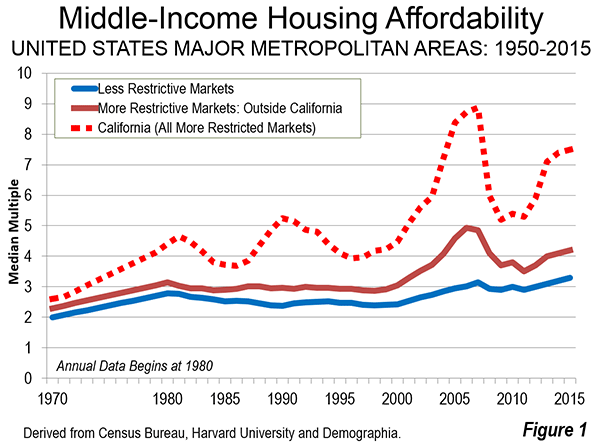
    California’s severely unaffordable housing is legendary, having escalated from approximately the average national price to income ratio in 1970. This is most evident in the four largest coastal metropolitan areas, Los Angeles, San Francisco, San Diego and San Jose. Out of the 87 major markets (over 1 million population) in nine nations, these markets ranked fourth, seventh and in a ninth place tie for the least affordable 8n the 12th Annual Demographia International Housing Affordability Survey. Their median multiples (median house price divided by median household income) required from 8.1 to 9.8 years income to purchase the median priced house. This compares to the affordability of these and other California markets which had median multiples of approximately 3.0 or less in 1970 and in prior years (Figure 1).

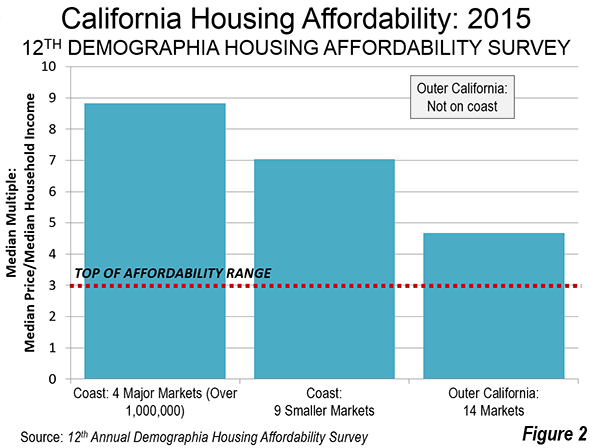
    The housing unaffordability of these markets, with an average median multiple of 8.8 is rivaled by the smaller coastal markets (such as Monterey County, San Luis Obispo, Santa Barbara and Ventura County), with their median multiple of 7.0. Both market categories are rated as severely unaffordable. But housing has become seriously unaffordable even in Outer California, where the average median multiple is 4.7(Figure 2). House prices have been escalating relative to incomes in Outer California since the housing bust, before which their housing affordability was even worse than now (below).

    Housing Affordability in Outer California

    A few examples will make the point. Riverside-San Bernardino, and exurban metropolitan area adjacent to Los Angeles had a severely unaffordable median multiple of 5.2 in 2015. Sacramento, had a seriously unaffordable median multiple of 4.7. Both of these major metropolitan areas reached far higher median multiples in the run-up to the housing bust, with Riverside San Bernardino reaching 7.6 and Sacramento reaching 6.6.

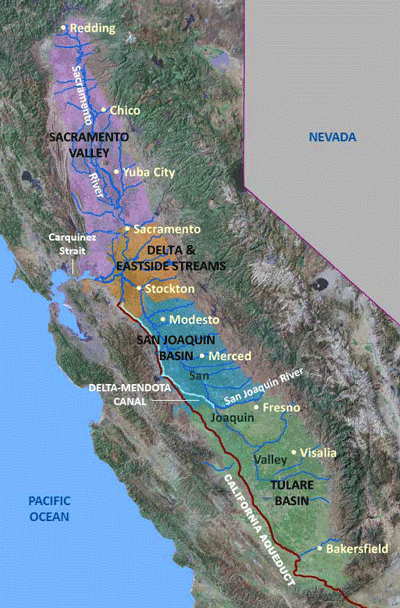
    But the problem is by no means limited to the largest metropolitan areas. Stockton, now officially a part of the larger San Jose-San Francisco combined statistical area as a result of a housing cost driven exodus of commuters from the Bay Area has a severely unaffordable median multiple of 5.3. Things were much worse in the run-up to the bust, at 8.6. Even long depressed Fresno, far from either the Bay Area or Los Angeles, is nearing severe unaffordability, with a median multiple of 5.0 and reached 7.2 during the bubble. More remote Chico, one of the smallest US markets in the Demographia survey also has a median multiple of 5.0 (see Central Valley map at the top).

    Modesto, a 2020 candidate for addition to the San Jose – San Francisco combined statistical area due to the overspill of households seeking houses they can afford, also has a seriously unaffordable median multiple of 4.5. Modesto reached 7.6 during the bubble.

    Among the 29 markets rated in California, the most affordable was Bakersfield, which in a few years is likely to follow Fresno into the over 1 million category. During the bubble, Bakersfield reached a median multiple of 6.6. Small town Visalia, nestled against the Sierra foothills, tied Bakersfield’s most affordable 4.3 median multiple, and reached an astounding 5.8 during the bubble. Hanford also tied for the most affordable.

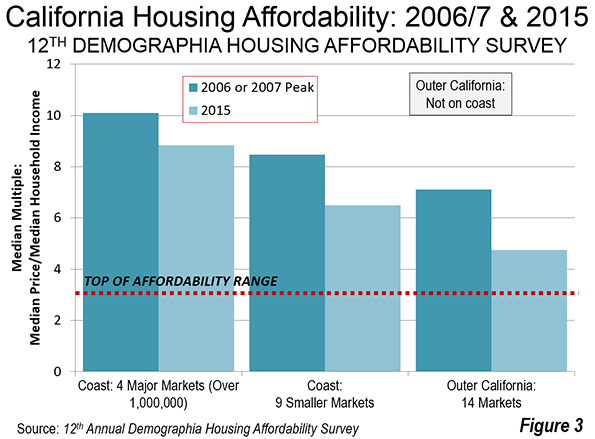
    The comparison to the bubble peaks is particularly important because it illustrates the volatility of housing markets. Even in small markets, house prices are prone to explode when demand exceeds supply, due in large part to land use regulatory and environmental law structure that restricts housing even in more remote areas,   driving prices up (See William A. Fischel, Regulatory Takings). Figure 3 shows that California house prices in each of the three geographic categories were even more unaffordable during the bubble than today.

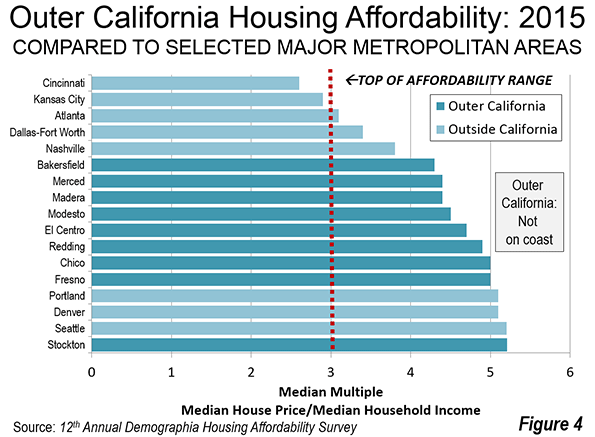
    Even at their current housing affordability levels, the housing markets of Outer California are considerably overpriced. This is indicated by Figure 2, which compares the median multiples in Stockton, Fresno, Bakersfield, Modesto, Redding, Chico, Merced, Madera and the Imperial Valley’s El Centro with severely unaffordable and overregulated Portland, Seattle and Denver, as well as Nashville and other major markets that are more affordable than any in California (Figure 4).

    Indeed, out of the 231 US markets in the Demographia International Housing Affordability Survey, the 27 California markets represent nearly half of the 58 most expensive.

    Meanwhile, a recent report by Zumper indicated among the 50 largest municipalities in the nation, four of the most expensive seven are also in California, with the city of San Francisco ranked number one, followed   San Jose at third, the city of Oakland at fifth and the city of Los Angeles at seventh. Eight of the most expensive municipalities out of the 100 largest are also in California, such as Palo Alto in the Bay Area, Coronado in the San Diego area and Santa Monica in the Los Angeles area.

    As if the regulatory and legal structure that combined with the artificially higher demand from loose lending policies were not enough, barely a decade later California is in the process of implementing one of the most radical land-use regulatory structure in a liberal democracy. It will be far more difficult in many areas to build the detached housing that is been the mainstay of the state, which already has the highest urban population density in the nation (see: “California declares war on suburbia"). This suggests that housing affordability is likely to worsen further.

    There is good reason for a both companies and middle income households to stay away from or leave California.

    More than Housing Affordability

    But people and businesses are moving to places like Nashville for reasons other than housing affordability. The state could hardly make it more clear that most business is not welcome. For at least 10 years, CEO Magazine has rated California as having the least favorable business climate. With competition like Illinois, Connecticut and New Jersey, to be ranked 50th with such regularity is a notable underachievement.

    Data recently released by the California Manufacturers & Technology Association (CMTA) indicated that California ranked last among the states in per capita attraction of manufacturing investments in 2015. Corporate relocation specialist Joseph Vranich continues to add to a long but for California unfortunate list of companies and jobs that have recently left the state (see: "California companies had for greatness – out of California).

    Of course, California is a beautiful place with one of the best climates in the world. But   millions of people and many companies have found greener pastures in Nashville, Austin, Dallas-Fort Worth, Houston, Charlotte, Atlanta and elsewhere. People will continue to visit, but the exodus is likely to continue.

    Wendell Cox is principal of Demographia, an international pubilc policy and demographics firm. He is a Senior Fellow of the Center for Opportunity Urbanism (US), Senior Fellow for Housing Affordability and Municipal Policy for the Frontier Centre for Public Policy (Canada), and a member of the Board of Advisors of the Center for Demographics and Policy at Chapman University (California). He is co-author of the “Demographia International Housing Affordability Survey” and author of “Demographia World Urban Areas” and “War on the Dream: How Anti-Sprawl Policy Threatens the Quality of Life.” He was appointed to three terms on the Los Angeles County Transportation Commission, where he served with the leading city and county leadership as the only non-elected member. He served as a visiting professor at the Conservatoire National des Arts et Metiers, a national university in Paris.

    Photo: Map of Central Valley (Sacramento Valley to the north, San Joaquin Valley to the south) courtesy of the U.S. Geological Survey

  • Working Class British Voters Led the European Union Rejection

    On Thursday night the first results from Britain’s referendum on pulling out of the European Union came in.

    A small clue to the way things were going last night was the vote in the North East.

    People in Newcastle are known locally as ‘takems’ (said with a short a, like tack um); those in Sunderland are called ‘makems’. It means that people in Sunderland make things and people in Newcastle take them. Sunderland is solidly industrial, while Newcastle, also a big industrial centre, is a market town. Newcastle voted to remain, but by the tiniest of margins. Sunderland voted to leave, 60-40. That was when we began to think that – not for the first time – the polls had got it wrong.

    As the night wore on the results came in, defying the pollster’s determination that the people would reject the referendum question and stick with the European Union.

    Of London Boroughs, Barking voted to leave, too. It was historically a ‘white flight’ borough, but today it is thronging with Poles and Africans. It is very working class. Islington, by contrast, was overwhelmingly for stay. Islington has working class wards, though these are mostly demoralised, and the borough deserves its reputation for being dominated by a precociously radical middle class.

    Most of all the vote is a popular reaction against the elite. Their view that the European Union is not for them is right. I have taken students to the Brussels Parliament, which is a bit like visiting the offices of the IMF. The only people that you see hanging around outside and waiting to see someone, are themselves very haut bourgeois. By contrast, if you go to the Palace of Westminster, you will see large crowds of school children, nurses, veterans, and ethnic minorities. Parliament is often very bad in its decisions and its cliquishness, but the people do look to it in a way that they will never look on Brussels. That law making should have passed so silently and sneakily off to the European Commission is not something that ordinary British people approve of, and they are right.

    The British Labour movement protested against the Maastricht Treaty back in 1991 that created the EU, and had already been committed to a position of withdrawing from the preceding EEC. Labour’s heartlands were in agreement. Over time, though, the temptation of the ‘European Social Chapter’, and the trade union leaders’ resentment at the Tories opt-out of that did tempt some labour leaders (though not their members) to support the EU. That in itself is a symptom of the unions’ loss of influence in their own right; they hoped that their European friends would offer them what their own campaigning could not.

    As the Labour Party became more distant, metropolitan and elitist, it sought to re-write the party’s policy to mirror its own concerns, and also to diminish working people’s aspirations for social democratic reform in their favour. They got rid of the socialist clause in the party’s constitution, Clause 4, diminished union leaders’ say so in making party policy, and, symbolically, they changed the party’s position on Europe from withdrawal to positive support. For younger graduates in London who were the party’s activists, that all seemed to make sense, but a chasm was opening up between the party and its working class redoubts in the Midlands and the North of England.

    There are many facets to this disaffection. People are angry about the NHS. Some of the mood of hostility towards Blair’s government was attached to the Iraq War.

    Latterly, the question of immigration became one that the labour voters came to distrust the Labour leadership on. In private the Cabinet did indeed talk about encouraging wide scale immigration, with the ambition of making the Conservative Party unelectable, by creating a ‘multicultural’ country. In a telling moment in the 2010 election Gordon Brown was caught by a radio mike complaining about a voter whom he had been introduced to. ‘That bigoted woman’, he called her. Suddenly everyone could hear the snobbery in his prissy voice. ‘Bigoted’ here was code for common, uneducated, or perhaps even ‘unwashed’.

    The EU issue was initially raised by the United Kingdom Independence Party (UKIP), which is to say the grassroots of the Conservative Party, peeling away from David Cameron’s leadership. UKIP in that way are a mirror image of the disaffection of the Labour vote. In time, UKIP candidates got some support in Labour constituencies. That was a clue that the disaffection of the Labour vote was about to form itself up around the referendum.

    Asked by pollsters why they had voted to leave the EU, some said it was immigration. But more said that it was the question of democracy. This is a word that seems to mean very little to the academics, government officials, constitutional lawyers and politicians, and yet, strangely, means a great deal to those whose access to it is most limited – the greater mass of the British public.

    Depressingly, the sulking metropolitans and ‘opinion formers’ (Ha!) dismissed this revolt of the lower orders as nothing more than race prejudice. But that says more about those that say it than those that it is said of. To them almost every expression of popular sentiment feels like fascism. They see fascism in the support for the English football team, and lurking in the bad tempered rants of ‘white van man’ as he makes his deliveries. An old drunk on a bus says something mean about immigrants and he is pilloried on YouTube and Facebook as the latest sign of incipient fascism.

    What they usually mean is that the common people have spoken, and spoken clumsily, without the tortuous manners of the intersectional left. But by and large the exiters were not angry with migrants so much as they were angry with the established order.

    A tipping point was the publication of a letter on the front page of the Times, signed by leading businessmen demanding ‘remain’. This came hot on the heels of the claims that all economists (the same ones who had told us that there was no danger of an economic meltdown in 2008) were for remain. Before that the leaders of all the major parties lined up to say that remain was the only viable result.

    Elsewhere in Europe we have seen this kind of consensus form up. The last time was around the proposed EU Constitution in 2004/5. As every respectable voice made it plain that the Constitution effectively making the EU into a superstate was needed, the ordinary people revolted. In referenda in France and Denmark it was rejected. The project was in tatters. The very solidity of the establishment behind the EU Constitution was the thing that sunk it. If this shower are for it, thought the mass of the people, then it must be rubbish. So it was with the EU referendum in Britain on 23 June. The solidity of the establishment case for staying was probably what decided the majority to leave.

    The ‘out’ decision leaves many questions. The traders have attacked the pound – well, they had made it clear that they did not like exit, so we can expect them to try to punish the voters. We will weather it, and the economy’s underlying strength will make them come back for sterling later on.  Shame on them.

    It is by no means clear that the vote to leave will lead to an actual ‘exit’. The prolonged process of leaving set out in the EU Treaty is effectively a ‘cooling off’ period, and a confident political leader – perhaps Boris Johnson, the star of the exit campaign – might well be tempted by some reforms. The EU itself will be shaken by the vote, and there are already signs that its leaders are moving away from the Federal structure of the Union in favour of a looser, intergovernmental agreement, that would allow greater sovereignty for its member states. That much is just an obvious attempt to accommodate what is already a groundswell of opposition to the Union that is much wider than Britain, taking in France, Spain, Greece and Portugal.

    One thing is for sure:  the vote shows that very few of the experts, the academics, the media, lawyers and politicians have any insight into the will of the people, or even understand the meaning of the words sovereignty and democracy.

    James Heartfield is author of The European Union and the End of Politics and an historian and political scientist based in London.

    Photo by flickr user Diamond Geezer licensed under Creative Commons.

  • Health and Class

    Late last year, economists Anne Case and Angus Deaton published a paper in the Proceedings of the National Academy of Science documenting the rising morbidity and mortality in mid-life white men and women in America, especially for those with a high school degree or less.  They attributed this increase, a reversal of historic trends, to an epidemic of alcoholism, other drug use disorders, and suicide. Their findings are a wake up call for the US. Not only is something seriously wrong — it’s getting worse.

    As a community psychiatrist (that is, one who works in the community providing publicly funded care) in Pittsburgh, I was not at all shocked to read the paper and the several others that followed and found essentially the same thing.  Working both in inner city black Pittsburgh and the more racially mixed Mon Valley, the primary site of Pittsburgh’s once vaunted steel mills, I have seen twenty years of increasing psychiatric burden and disability with what seemed to be a marked increase in mortality — all linked to increasingly fragmented, chaotic families, extraordinary work instability, trauma, violence, and alcohol and substance use.  While human services and health care were clearly in the picture in the lives of many (health care increasingly so with the Affordable Care Act), other critical institutions — steady work, solid education, high qualify day care, stable housing, organized communities – seemed to be less present, casualties of deindustrialization and neighborhood decline.  With the economic collapse of 2008 and the rise of the opiate epidemic, conditions have felt like they are in free fall, with tattered individuals and the remnants of families struggling to hang on.

    My day-to-day job is to do what I can to help people find ways to overcome their distress and rediscover their capacities and capabilities to find a way forward. Of course, I don’t do this alone. It requires a team effort to help suffering people recover and manage their illnesses and organize the resources they need to put a life together.  We have some resources to do this, such as the ACA’s expansion of Medicaid in Pennsylvania.  But still the observation of Julian Tudor Hart, a renowned British physician working among the miners in Wales, rings true: the people with the greatest need generally have the least access to resources. Hart called this the “Inverse Care Law.”

    For a long time and to this day, this has been the American approach to health care, though the ACA does a bit to address it.  Given this, some Americans may assume that the recent increase in mortality among white folks reflects a lack of access to needed care.

    The work of two other Brits, Thomas McKeown and Michael Marmot reveals the inadequacy of this belief.  McKeown made the trenchant observation that it wasn’t health care that made people healthy, but rather the conditions in which they lived. Marmot pressed this observation and, in a series of famous studies of civil servants in the British Government, found that health status was tied in a step-wise fashion with class.  Poor working-class people had worse health then their middle-class colleagues who in turn were less healthy than the highly paid executives.  These findings created a fire storm around the world, but some thirty years later, the idea has finally begun to find its way to the US in the form a focus on the “social determinants of health.” Where people live, their income, the resources available to them, the web of social relationships they experience, all come under this rubric. Health isn’t just about people’s lifestyle — whether they smoke or drink — or about their access to health care. It is fundamentally about the kinds of lives people live and how they are socially structured. Health is profoundly ecological– it reflects the social habitat and physical environment people live in.

    This new focus permits us to say that what’s happening to the health and well-being of poor white folks is clear evidence that the life worlds and social circumstances of their lives are falling apart.  Their social habitat is strained, and the strain is showing up in a looming body count.

    We could do more to make it easier for people to access the resources they need beyond health care and by tapping into their capabilities and capacities to find ways to flourish.  Steps in this direction include concepts like the “medical home”, an expanded version of accessible team- based primary health care that focuses on people’s well-being over the life course, providing preventive and clinical services, promoting health and connecting people to the resources needed for healthy living. In psychiatry, the recognition that people with psychiatric challenges have untapped capacities to recover — to find meaningful ways to live — is reshaping clinical approaches so they connect with and build on those capabilities. These innovations are all good, but they are woefully insufficient given the scale and scope of what the nation faces.

    To achieve what we need to achieve, our society needs to move the conversation about health and well-being upstream, away from a focus on health care alone, and link health and health care with general social policy.  The moves towards “the social determinants and processes of health,” “health in all policy,” “population health,” and “health impact assessments,” backed by a politics of social inclusion, are the ways forward to achieve health and social equity.

    The country we create determines the patterns of life and death of the people who live here. It’s not a job just for doctors and other health care providers. We are all stewards of the health of the people of this country. Increasing numbers of people won’t thrive and will die young until we fully embrace this responsibility.

    This piece first appeared in Working Class Perspectives.

    Kenneth S. Thompson MD is a public service community psychiatrist in Pittsburgh whose career has been focused on improving psychiatric care and achieving health equity.

    Ambulance photo CC BY-SA 2.5, https://commons.wikimedia.org/w/index.php?curid=678067

  • A Berning Rift Growing Among Democrats

    The mainstream media are having a field day, and rightfully so, chronicling the meltdown of the once-formidable Republican Party. Less focus has been placed on what may be equally, or greater, divisions emerging among Democrats, both in California and around the country.

    The largest gap within the party was revealed recently in Orange County, where Bernie Sanders denounced the Walt Disney Co. for paying “starvation wages” to most of its workers while rewarding the CEO with $46 million this year. To Sanders supporters, Disney is a clear “class enemy,” but to Hillary Clinton, the Disney brass represent a source of campaign cash, part of the fairly uniform support for her among establishment Democrats across the board.

    Increasingly, the Democratic Party is divided between two elements of its coalition – an oligarchy that supports Clinton and a base of workers, many of them younger, who favor Sanders. To the Clintonites, her positions on gay rights, the environment and feminism make her an acceptable progressive. However, to those who back Bernie, her embrace of, and by, the oligarchs, amid rising economic inequality, represents a glaring contradiction with someone supposedly leading “the party of the people.”

    Corporate Liberalism vs. Social Democracy

    Clinton’s ascendency reflects the gentrification of the Democratic Party. Since the 1990s, argues historian Michael Lind, the Democrats have evolved from the party of the people to become, increasingly, an instrument of those in media, technology, entertainment and finance who dominate our post-industrial economy. In contrast, Republicans, increasingly isolated from these rising corporate powers, are being forced, often unwillingly, to become the party of populist American nationalism.

    Certainly, Clinton, more than any other candidate in modern times, symbolizes the convergence of economic and political power. She enjoys across-the-board support from Hollywood, Silicon Valley, Washington’s K Street lobbyists and Wall Street. Clinton also personally collected a cool $21 million in speaking fees from a host of powerful Wall Street financial and other big corporate interests during 2013-15. She certainly appears like a future president bought and paid for.

    Read the entire piece at the Orange County Register.

    Joel Kotkin is executive editor of NewGeography.com. He is the Roger Hobbs Distinguished Fellow in Urban Studies at Chapman University and executive director of the Houston-based Center for Opportunity Urbanism. His newest book, The Human City: Urbanism for the rest of us, will be published in April by Agate. He is also author of The New Class ConflictThe City: A Global History, and The Next Hundred Million: America in 2050. He lives in Orange County, CA.

    Photo by Michael Vadon (Own work) [CC BY-SA 4.0], via Wikimedia Commons

  • Finally! Great New Affordable Bay Area Housing!

    These are highly educated well paid workers at a San Francisco tech company. They’re mostly young. Some are single. Some are newly coupled. Some are married with young children. There are exceptions, but they tend to want to live in a vibrant urban neighborhood with a short commute rather than a distant suburb.


    Screen Shot 2016-05-27 at 11.08.39 PM

    Screen Shot 2016-05-27 at 11.07.30 PM

    Screen Shot 2016-05-27 at 11.08.07 PM

    Screen Shot 2016-05-27 at 10.51.05 PM

    Screen Shot 2016-05-28 at 1.45.52 AM

    Screen Shot 2016-05-28 at 1.46.17 AM

    Screen Shot 2016-05-28 at 12.17.05 AM

    Some enjoy living in a rented apartment above a trendy wine bar right on the edge of the downtown core. They can effortlessly pop down for a drink or a bite to eat with friends. When the weather is good they can ride a bicycle to work and skip the traffic congestion for a healthy commute.

    Screen Shot 2016-05-28 at 1.42.07 AM

    Screen Shot 2016-05-27 at 10.51.21 PM

    Screen Shot 2016-05-28 at 12.01.20 AM

    Screen Shot 2016-05-28 at 12.15.42 AM

    Others choose to own a loft style condo above shops. They can step outside their door and immediately find good food, good company, clothes, groceries, a hairdresser… most daily needs are close at hand.

    Screen Shot 2016-05-27 at 11.47.16 PM

    Screen Shot 2016-05-27 at 11.49.00 PM

    Screen Shot 2016-05-27 at 11.48.28 PM

    Screen Shot 2016-05-27 at 11.48.44 PM

    Screen Shot 2016-05-27 at 11.51.15 PM

    Still others love a little detached cottage in a courtyard with shared garden space. This arrangement provides all the benefits of a traditional home on a smaller scale.

    Screen Shot 2016-05-27 at 11.47.41 PM

    Screen Shot 2016-05-27 at 10.58.08 PM

    Screen Shot 2016-05-27 at 10.58.38 PM

    Screen Shot 2016-05-27 at 10.58.24 PM

    Then there are those who gravitate toward a regular stand alone single family home – of various styles, sizes, and price points.

    IMG_0794 (1024x694)

    Screen Shot 2016-05-27 at 10.59.59 PM

    Screen Shot 2016-05-28 at 1.44.50 AM

    Screen Shot 2016-05-28 at 12.06.05 AM

    Screen Shot 2016-05-27 at 10.56.40 PM

    Screen Shot 2016-05-27 at 10.52.34 PM

    In this new development all of these options are available on a single block just a ten minute bike ride from downtown. This is exactly what San Franciscans desperately want and someone has finally figured out how to build it at a price people can afford…

    Screen Shot 2016-05-28 at 12.16.10 AM

    Screen Shot 2016-05-28 at 2.17.00 AM

    Screen Shot 2016-05-28 at 2.21.31 AM

    Screen Shot 2016-05-28 at 2.21.04 AM

    Screen Shot 2016-05-28 at 2.20.38 AM

    Screen Shot 2016-05-28 at 2.20.21 AM

    …in Nashville. Uber, Lyft, Eventbright, and many other tech companies that began in San Francisco have all opened branch offices in Nashville. The standard offer is simple. Relocate to Tennessee, take a 30% pay cut, and enjoy a much higher quality of life with much more cash left over at the end of each month. Go ahead. Soak up the complimentary affordable home ownership.

    John Sanphillippo lives in San Francisco and blogs about urbanism, adaptation, and resilience at granolashotgun.com. He’s a member of the Congress for New Urbanism, films videos for faircompanies.com, and is a regular contributor to Strongtowns.org. He earns his living by buying, renovating, and renting undervalued properties in places that have good long term prospects. He is a graduate of Rutgers University.

  • Trump’s Industrial Belt Appeal

    In his still improbable path to the White House, Donald Trump has an opening, right through the middle of the country. From the Appalachians to the Rockies, much of the American heartland is experiencing a steady decline in its fortunes, with growing fears about its prospects in a Democratic-dominated future. This could prove the road to victory for Trump.

    The media  like to explain Trump’s appeal by focusing on the racial and nationalistic sentiments of his primarily white supporters in places like the Midwest and in small towns. Perhaps more determinative are the mounting economic challenges facing voters in that part of the country. Much of this has to do with an industrial structure facing growing challenges from a high dollar, decreasing commodity prices and a pending tsunami of environmental regulation.

    Unlike the Democrats’ coastal strongholds, which depend increasingly on such professions as media, software, finance, and high-end business services, the middle swath of the country depends far more on manufacturing, resource extraction, and agriculture. All these so-called “tangible” industries are facing serious declines, which in a close election could swing some critical states such as Ohio, Colorado, Wisconsin, Indiana, Michigan, and Iowa into the Republican column. Seven of the 10 most manufacturing-dependent metro areas in America are in the Midwest battleground states. Another lies in yet another purple state, North Carolina. 

    Economic Slowdown in Mid-America

    When President Obama ran for re-election in 2012, the tangible economy was on a roll. Super-charged by the federal bailout, the car industry was roaring back, restoring jobs and confidence in the country’s midsection. The president was even described by The Washington Post as a “man on a mission” to save American manufacturing. And the two states then with the fastest declines in unemployment since the onset of the Great Recession—Ohio and Michigan—are in the Midwest.

    At the same time, Obama benefited from the resurgence of domestic oil and gas production that   stimulated growth in steel, heavy equipment, and industrial sector employment. This fortunate confluence was fortuitous for the Democrats, who carried most of the states outside the South buoyed by this nascent industrial rebirth. Good times in coal country helped the president in parts of Virginia; the energy boom helped lock up Colorado for him.

    Hillary Clinton likely will not enjoy a similar tailwind this year. Manufacturing indexes have tended downward over the past year, and the energy sector has been in full-scale retreat. This not only impacts oil patch bastions Texas, Louisiana, and Oklahoma, which are unlikely to vote Democratic anyway, but also the battlegrounds states Pennsylvania and Ohio. Agricultural economies in the midsection are also reeling.

    Clinton will argue that job growth is on the rise nearly everywhere, but more than half of the increase has come in low-wage sectors such as retail and food service, which is one key reason  for persistently weak income growth.

    The damage is not yet universal, but can be seen clearly in many areas. Many Rust Belt and Appalachian regions are once again hemorrhaging residents. In a recent survey of metropolitan economies for Forbes, economist Michael Shires and I traced the job growth in communities across the country. The bottom 10 among the 70 largest metropolitan areas reads like a stroll down Rust Belt Lane: Hartford, Conn., Milwaukee, Detroit, Albany, N.Y., Newport News, Va., Birmingham, Ala., Cleveland, Newark, N.J., Pittsburgh, Buffalo and — in last place — Rochester, once one of the beacons of industrial innovation in the country and now part of New York’s upstate disaster area.

    Last year, amid some decent employment growth nationally, almost all these areas suffered sub-1 percent job declines after enjoying growth rates well above that in previous years. More grievously affected are a host of smaller communities, many of them in the Midwest and industrial Northeast, several already seeing negative job growth. At the bottom of the list are places like Johnstown, Pa., and Elmira, N.Y., where the Democrats’ “hope and change” promise has failed to reverse dismal local economies.

    Enter Trump 

    Throughout his divisive campaign, Donald Trump has fattened up on these voters, winning by landslides in places like upstate New Yorkcentral and western Pennsylvania, the industrial suburbs of Detroit, northern Indiana and the resource-dependent parts of Colorado. In hard-hit Erie County, N.Y., home to Buffalo, Trump won two-thirds of the primary vote.

    Also appealing to similar populist sentiment, Bernie Sanders has won some of the same areas, often decisively. For his part, Trump’s only serious Rust Belt setbacks occurred in Ohio (where John Kasich ran as a virtual favorite son candidate), Iowa (where evangelicals still wield outsized influence) and Minnesota, which is arguably the most post-industrial of the central states. Recent announcements by such large companies as Ford and United Technologies  to move jobs to Mexico have reinforced Trump’s appeal.

    Trump’s support, as Nate Silver has shown, is not comprised only of knuckle-dragging Neanderthals. On average, they earn above-average incomes and boast education levels that also exceed the national average. Some are professionals and merchants on Main Street, who acutely ride the ups and downs of the tangible economy. These voters may also be susceptible to rants about Mexican “rapists” and certainly would not favor a massive incursion of Muslim refugees. But their primary concerns are economic, not social. If they really favored regressive social policies, Ted Cruz was their man.

    The trajectory of the Democratic race—as well as that of the economy—could help Trump expand his appeal to such voters. Hillary Clinton once tended to be supportive of industrial and energy development; her State Department gave tacit approval to the Keystone XL Pipeline. Now, under pressure from Bernie Sanders’ left-wing legions, she has backed away from support for this organized-labor-backed project. The divisions between the public sector unions and those in the industrial sector could boost Trump’s turnout in states where manufacturing and energy still matter.

    To make matters more difficult, Clinton may be saddled at the convention with a ban on fracking. This stance warms the hearts of bicoastal enviros, but is unpopular in large parts of the nation’s heartland. Likewise, the Obama administration’s all-out assault on fossil fuels has already cost Clinton any shot at formerly Democratic-leaning West Virginia, and is likely to hurt her across  theAppalachian belt, which includes portions of Pennsylvania, North Carolina, Virginia and Ohio. Even if oil and gas prices rise, the Obama proposals for higher taxes and regulation of energy seem destined to slow any recovery in this high-paying, largely blue-collar industry.

    In addition, Trump is showing unanticipated strength in several key states dependent on coal-fired electricity. He’s currently running even with Clinton in Ohio and Pennsylvania, both of which twice went for Obama. This should be enough to keep Clinton’s advisers, who are planning to deploy massive resources to these states, awake at night.      

    In this respect, Clinton faces a difficult situation. Ever more dependent on her party’s post-industrial urban core, she will be hard-pressed to moderate her stance on environmental issues.  Her predecessor and her husband were able to finesse this ground by feinting toward the moderate middle in campaign years, but such ideological contortionism is getting harder to pull off.

    Megabuck donors like San Francisco’s Tom Steyer are committed to forcing Clinton to embrace   progressive green orthodoxy. This will leave many mid-America workers and businesspeople feeling abandoned and, thus, potentially more receptive to Trump’s pitch. Ultimately, suggests historian Michael Lind, Trump could presage the transformation of the GOP into a middle-class populist party, with a strong Midwestern as well as Southern base, while the Democrats rest their hopes on an unlikely coalition of the coastal gentry, the hyper-educated, minorities, and the poor.

    So far, the crass New York billionaire has played brilliantly on middle-American resentments, many of them well-founded. He promises repeatedly to cut a “better deal” for them. If he can convincingly make his case, Donald Trump also might yet close the most successful real estate deal of his lifetime: occupancy of the White House.

    This piece originally appeared at Real Clear Politics.

    Joel Kotkin is executive editor of NewGeography.com. He is the Roger Hobbs Distinguished Fellow in Urban Studies at Chapman University and executive director of the Houston-based Center for Opportunity Urbanism. His newest book, The Human City: Urbanism for the rest of us, will be published in April by Agate. He is also author of The New Class ConflictThe City: A Global History, and The Next Hundred Million: America in 2050. He lives in Orange County, CA.

  • De-Industrialization and the Displaced Worker

    Much has been made of working class pain in this election, but the problems go well beyond that.  I don’t like the 1% vs. 99% frame, but it captures something important about our society, namely a sort of bifurcation that has occurred between top and bottom. Roughly the top 20% are doing quite well, and increasingly live in communities surrounded by others like themselves. The bottom 80% does not seem to be faring so well on a variety of social and economic statistics.

    The policies offered by the mainstream of both parties has more or less boiled down to “more of the same stuff we’ve always pitched.” Clearly, the public is looking for something different.

    That’s the subject of my column now out in the May issue of Governing magazine called “De-Industrialization and the Displaced Worker.”  Here’s an excerpt:

    In George O. Smith’s science fiction short story “Pandora’s Millions,” society collapses when the invention of a “matter replicator,” like the ones from Star Trek, instantly renders most of the economy, and money itself, obsolete. Being a short story, this is resolved quickly with the invention of a substance that can’t be duplicated, followed by rebuilding the economy and society around services. Real life doesn’t always recover so quickly from disruptions, as we are finding out.

    Unsurprisingly, this has generated discontent. Back through to the 1980s and ’90s, this was mostly limited to displaced industrial workers. Today that has grown to a much broader spectrum, from young master’s degree holders with piles of student loan debt who are stuck working at Starbucks to corporate middle managers losing their jobs to outsourcing or foreigners working here under H1-B visas.

    This has percolated through to the political system, with the rise of Donald Trump and Bernie Sanders, both questioning many of the premises of the current economic system. America is more receptive to these arguments than many ever would have believed possible. That’s because the current system has lost legitimacy in the minds of many. Not only did it fail to deliver the promised benefits to them, but then government turned around and bailed out the big banks in the financial crash.

    Click through to read the whole thing.

    Aaron M. Renn is a senior fellow at the Manhattan Institute, a contributing editor of City Journal, and an economic development columnist for Governing magazine. He focuses on ways to help America’s cities thrive in an ever more complex, competitive, globalized, and diverse twenty-first century. During Renn’s 15-year career in management and technology consulting, he was a partner at Accenture and held several technology strategy roles and directed multimillion-dollar global technology implementations. He has contributed to The Guardian, Forbes.com, and numerous other publications. Renn holds a B.S. from Indiana University, where he coauthored an early social-networking platform in 1991.

    Image by Flickr/Mirko Tobias Schäfer – CC BY 2.0

  • Scandinavian Women Do Well, Except at the Top

    In which part of the world should we expect most women to reach the top? The answer has to be the Nordic countries. According to The Global Gender Gap report, for example, Iceland is the most gender equal country in the world followed by Norway, Finland and Sweden. Yet as I will discuss below, this has not translated in women making it to “the top”, as one might expect. This a paradox that I will seek to address.

    Around the world, the Nordic countries are often idealized as the most gender equal places in the world. To a large degree, this admiration is warranted. But it is time to realize that the very same system is holding back women’s ability to reach the top.

    To begin with, the Nordics have a unusual gender equal history. The tradition of gender equality has roots in Viking culture. For example, Scandinavian folklore is primarily focused on men who ventured on longboats to trade, explore and pillage. Yet the folklore also includes shiledmaidens, women chosen to fight as warriors. Byzantine historian John Skylitzes records that women were indeed participating in Nordic armies during the 10th century. The fact that women were allowed to bear arms, and train as warriors, suggests that gender segmentation in early Norse societies was considerably more lax – or at least more flexible – than other parts of contemporary Europe. Evidence also suggests that women in early Nordic societies could inherit land and property, that they kept control over their dowry and controlled a third of the property they shared with their spouses. In addition, they could, under some circumstances at least, participate in the public sphere on the same level as men.

    Medieval law, which likely reflects earlier traditions, supports this notion. Medieval inheritance laws in Norway for example followed family relations through both male and female lines. Additionally, women could opt for a divorce. These rights might not seem impressive today, but they were rather unusual in a historical context. In many contemporary European and Asian societies, the view was that women simply belonged to their fathers or husbands, having little right to property, divorce or inclusion in the public sphere.

    Nordic gender egalitarianism continued after the Viking age, particularly in Sweden. In much of the world, women were excluded from participating, at least fully, in the rise of early capitalism during the 18th and 19th centuries. In essence, free markets and property rights were institutions that initially excluded women. Although Sweden and the other Nordic countries were far from completely egalitarian, they challenged contemporary gender norms by opening up early capitalism for women’s participation.

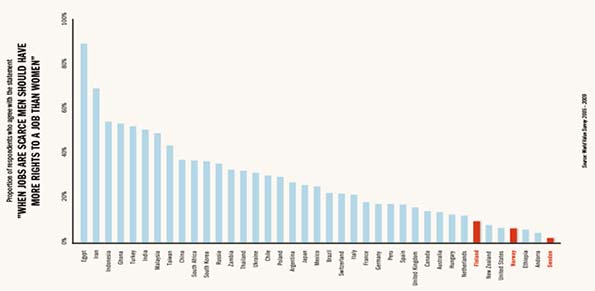
    As shown below, the World Value Survey has asked respondents around the world whether they believe that men should be prioritized over women if jobs are scares. In modern market economies, fewer agree with this notion. In Switzerland for example, 22 per cent believe that men should have more right to a job than women, compared to 16 per cent in the United Kingdom and 14 per cent in Canada and Australia. Sweden has the lowest share agreeing with this view, merely 2 per cent. Norway (6 per cent) and Finland (10 per cent) are also amongst the countries with egalitarian views.

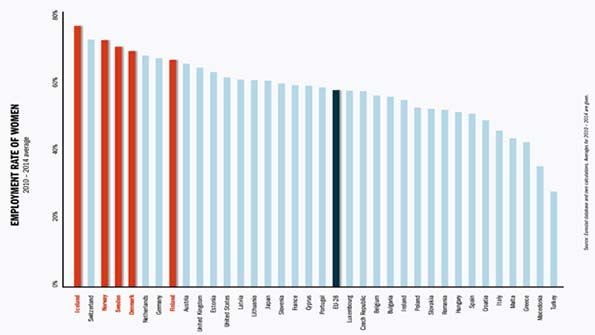
    In addition, the Nordic welfare states have encouraged women to enter the labor market early on. Still today Nordic countries are ahead of most of Europe in this regard. Child care cost and paid maternity, services provided largely by the public sector in the Nordic welfare states, can in part explain the high labor participation amongst both parents. Such systems are much more extensively funded by the public sector in the Nordics compared to other modern economies, and particularly so compared to the Anglo-Saxon nations. Although even here, the United States, still not a full welfare state, does surprisingly well.

    A long history of gender equality, gender equal norms, many women actively participating in the labor market and family friendly welfare policies – surely this should be seen as the recipe for many women reaching the top of the business world? In the new book The Nordic Gender Equality Paradox I show that this is not the case. In Nordic countries surprisingly few women have made to the top echelons.   

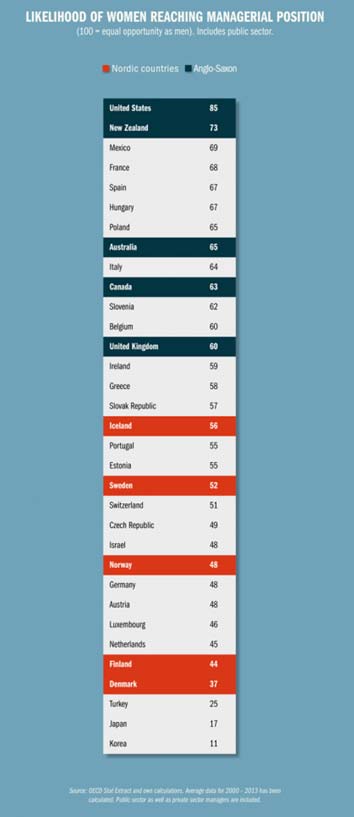
    The OECD gathers information about the proportion of employed persons which have managerial responsibilities in different developed economies. In the table below the share of women managers in different countries is shown as a percentage of the share of male managers. This calculation yields a measure of the likelihood of the average employed women to reach a managerial position compared to the average employed man. The likelihood of a women reaching a managerial position as compared to the same likelihood for a man in the United States is found to be 85 per cent. This is far higher than any other country in the study. As a comparison, the same share is 60 per cent in the United Kingdom and 52 in Sweden. Norway (48 per cent), Finland (44 per cent) and Denmark (37 per cent) score even lower.

    It should be emphasized that this measure includes public sector managers, which inflates the figures for Nordic countries compared to if private sector managers had been studied. The data paints a clear picture: The United States, where welfare state programs do not subsidize women’s parental leave has more women reaching managerial positions than any of the Nordic welfare states.

    Why is it that Nordic countries fail to reach their gender equal potential? Shouldn’t these countries be heads and shoulders above the US when it comes to the share of women climbing to the top? Progressive theorists would naturally assume this. But in reality there is a paradox here; the egalitarianism of the Nordics has clear limits.   At the end of 2014 for example, The Economist ran a story entitled A Nordic mystery

    “Visit a typical Nordic company headquarters and you will notice something striking among the standing desks and modernist furniture: the senior managers are still mostly men, and most of the women are [program administrators]. The egalitarian flame that burns so brightly at the bottom of society splutters at the top of business.”

    As I explain in The Nordic Gender Equality Paradox there is a logical answer to the apparent paradox: policy matters. Numerous studies support the conclusion that the large welfare states in the Nordics, although designed to aid in women’s progress, in fact are hindering the very same progress. Social democratic systems do provide a range of benefits for women, such as generous parental leave systems and publicly financed day care for children. The models however also have features that are detrimental to woman’s careers.

    To give an illustrative example, public sector monopolies in women-dominated areas such as health and education seem to substantially reduce the opportunities for business ownership and career success amongst women. Welfare state safety nets in particular discourage women from self-employment. Overly generous parental leave systems encourage women to stay home rather than work. Substantial tax wedges make it difficult to purchase services that substitute for household work, which reduces the ability of two parents to engage fully in the labor market.

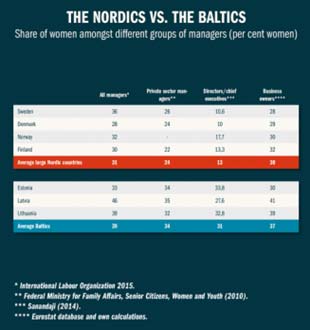
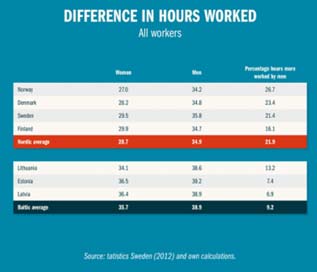
    The Nordic welfare model has, perhaps unintentionally, created a model where many women work but seldom in the private sector and seldom enough hours to be able to reach the top. For example, it might seem as a puzzle why the Baltic countries – which have much more conservative and family oriented cultures – have a higher share of women amongst managers, top executives and business owners than their Nordic neighbors. As shown below, a key factor is difference in working time. In the Nordic societies the average employed man works fully 22 per cent more hours than the average working women. In the Baltic model, where families have greater choice in organizing their lives compared to the Nordic welfare states, the gap is only 9 per cent. On top of this comparison, which looks at working individuals, many Nordic women also take long parental leaves, paid to do so by the welfare state, and thus fall behind in their careers. Of course Baltic mothers are also much concerned for the upbringing of their children. However, many of them solve the equation by getting help from family, perhaps grandmother, to watch the children or buy services to alleviate household work – something easier to do in low-tax countries.

    Thus, for all their gender equal progress, the Nordic countries in fact have relatively few women entrepreneurs, managers and executives. And there is really not a paradox why this situation has developed. It’s all about the policy choices made in the Nordics.

    As is clear, an expansive welfare state may be good for some things, but expanding the ranks of managers for women is not one of them. The feminist heritage that dates back to the age of the Vikings needs to be combined with a more free-market and small government approach if Nordic societies are to fulfill their gender equal potential. Perhaps this is also a lesson to the rest of the world, where progressive policies are often seen as the recipe for promoting women’s careers.

    Nima Sanandaji is the president of the European Centre for Policy Reform and Entrepreneurship (www.ecepr.org) and a research fellow at the Centre for Policy Studies and at the Centre for Market Reform of Education. His latest book, The Nordic Gender Equality Paradox, can be ordered here.