Tag: middle class

  • Manhattan Ultra-Luxury ‘Battling the Serpent of Chaos’

    The deceleration of China and resulting commodities crash have created a problem for developers of ultra luxury condominiums.

    The ancient Egyptians believed that the sky was a solid dome, the belly of the goddess Nut who arched her body from one side of the horizon to the other. Every day, the sun god Ra emerged in the east and sailed in his boat across the sky until dusk when he disappeared in the west by dipping below the surface of Nun, the ocean upon which the whole flat earth floated.

    This story would have been useful two years ago when Manhattan real estate was soaring and many participants were proclaiming that the sky was the limit. It turns out that that particular sky, the ‘real estate sky’, is not as infinite and rich in wonders as the real sky. It is instead very finite like the sky of ancient Egyptian cosmology, its hard boundary formed not by Nut’s belly but by the marginal buyer’s stomach for paying ever rising prices.

    Until recently, the strong Chinese economy and resulting surge in commodity prices had fueled an economic boom in many developing countries. With this boom came rapid wealth to a segment of the population sometimes referred to as the oligarchy, or the world elite, or the global UHNW (ultra high net worth) class. And with that wealth, largely earned within the borders of countries with an unpredictable polity, came the logical and prudent decision to place some of it abroad where the likelihood of seizure or expropriation by unfriendly authorities was deemed to be low or nonexistent.

    There seemed to be a large conduit, a money superhighway, running beneath the world’s oceans through which trillions of dollars flowed smoothly for thousands of miles from that Chinese demand to that commodities boom to that sudden wealth and finally to this prudent decision. A great many of this conduit’s outlets were invisible and hidden in the hushed basements of Swiss or other offshore private banks. Yet others were semi-visible in the proliferation of hedge funds, private equity funds and other ventures solely dedicated to the management of paper assets.

    And finally some outlets were very visible in the real estate markets of London, New York, Miami and other cities. The trillions of dollars on the money superhighway traveling inbound from Russia, China, Brazil, Qatar and other places have seeded and fertilized Manhattan’s Billionaire’s Row on 57th street and other parts of Midtown, resulting in the sudden emergence, like weeds out of the ground, of tall and super-tall condominium towers.

    If they were trees instead of buildings, they would follow the normal cycle of nature rationing their reserves in winter and flourishing in the summer. But human constructs are less well calibrated and real estate cycles can be difficult to navigate. It takes a long time to carry a new building from conception to delivery. Few developers have the wherewithal or the resources to make big plans in the trough of a bust. But many embark on long cycle projects during boom times, accepting the risk that completion may not come before the next downturn.

    IMG_4249

    15 Central Park West.

    Until now, the way to market these new condominiums was to sell as many units as possible pre-construction or during construction, thereby transferring the time-related risk to the buyer. This approach worked beautifully in recent years as evidenced by the huge success of the Time Warner Center, 15 Central Park West and of a good part ofOne57, the first in this cycle among several tall ultra-luxury towers.

    How did we get here in the first place? And why was Manhattan a choice destination for this foreign wealth? The answer is that, in addition to offering the promise of secrecy and safety, new condominiums benefited from lax regulation and zoning and preferential tax treatments.

    When secrecy was no longer as readily on offer at Swiss private banks, foreigners shifted their sights to other havens and found US real estate to be a uniquely welcoming alternative. Here, it was still possible for agents to transact via shell companies that were organized onshore or offshore, ostensibly to conceal the identity of foreign parties who preferred to remain anonymous.

    A recent Washington Post article explains:

    What many Americans might not realize is that foreign-owned shell companies play a big role in the U.S. economy through the real estate market. When purchased through a shell company, an offshore company or a trust, U.S. real estate offers wealthy foreigners a stable and secretive investment.

    In the last quarter of 2015, 58 percent of all property purchases of more than $3 million in the United States were made by limited liability corporations, rather than named people. Altogether, those transactions totaled $61.2 billion, according to data from real estate database company Zillow.

    And further:

    The U.S. government doesn’t ask real estate brokers to monitor their clients for money laundering risks, the way that banks and other financial institutions – and real estate brokers in some other countries — are required to do. The 2001 Patriot Act gave the Treasury Department the ability to do this, but lobbying from the real estate industry has helped secure an exemption for the last 15 years.

    One57

    One57 dominates today but taller condominiums are now under construction.

    Last year, an extensive report by the New York Times titled Towers of Secrecy investigated shell companies that invest in Manhattan real estate. The report estimated that in six of Manhattan’s most expensive buildings including 15 Central Park West, One57, The Plaza and the Time Warner Center, shell companies owned between 57% and 77% of the condominiums.

    Across the United States in recent years, nearly half the residential purchases of over $5 million were made by shell companies rather than named people, according to data from First American Data Tree analyzed by The Times.

    In addition to favorable regulation welcoming this wave of cash, New York’s tax policy also made it easier for developers to meet the surging demand. Some ultra-luxury buildings received tax abatements initially intended to encourage the construction of affordable housing.

    Today however, the money flow, safety, secrecy, regulation and tax policy that enabled the boom are all threatening to reverse course at the same time, creating a new reality that may be problematic for investors and developers.

    It is a new reality that could also be problematic for the city. Money in Swiss private banking accounts can be easily withdrawn but money withdrawn from luxury condos with limited local appeal leaves a large footprint behind. Foreign money can be quickly gone but the buildings will be here quasi-forever.

    China’s economy has softened, commodities have crashed and the money flow from emerging markets to midtown Manhattan has slowed from a gusher to a stream, or perhaps a trickle. As a result, the profitability of many condominiums that are now under construction looks less assured than it was eighteen or twenty-four months ago.

    In addition, there are new calls for better monitoring of shell companies and for disallowing tax abatements in the case of super luxury apartments.

    This seems to all be coming at a bad time with several of the newest towers now rising above street level and boosting the pre-construction inventory. The surge in supply is taking place just as demand is slackening.

    A top Manhattan broker told populyst that the high luxury segment (apartments priced over $10 million) had buckled under a worsening macro environment, with signed contracts running at 38% below last year. Meanwhile, new supply is up 5.4% from last year and expected to continue growing.

    Sales at some of the new condominiums are likely to do well while others suffer. Because of its location and the success of 15 Central Park West designed by the same architect Robert A. M. Stern, it is fair to expect that 220 Central Park South will do fine by attracting demand from New Yorkers and wealthy Americans. Other buildings with less enviable locations will probably do well in their upper reaches but may have trouble selling mid-height units where views do not clear surrounding buildings.

    IMG_4248

    220 Central Park South.

    Asking prices are already being adjusted downward. Extell Development lowered its total sellout price by more than $200 million to $1.87 billion for its One Manhattan Squareproject. Toll Brothers has had price reductions at 1110 Park Avenue and 400 Park Avenue South. World Wide Group and Rose Associates have followed suit at 252 East 57th Street. And at 111 East 57th, JDS Development Group and Property Markets Group will wait about a year before launching sales at their ‘Billionaires’ Row’ tower.

    The broader market seems to also be coming under pressure. A recent study by research firm Miller Samuel for the Real Deal estimated that “by the end of 2017, Manhattan will have five years of excess inventory”.

    Roughly 14,500 units are expected to hit the market between 2015 and 2017But by the end of 2017, just over 5,000 of those units are expected to have sold, and going by the current rate of sales, it would take more than five years to sell all that excess inventory.

    The analysis looks at all new units that have launched or are set to launch in Manhattan over a three-year period, across all price points. It assumes the same rate of sales the new development market saw during the second half of 2015, which equates to just under 1,850 closed sales per year.

    Based on that absorption rate, more than 9,400 new units would be unsold by the end of 2017.

    What may retrenchment look like for Manhattan now? According to a recent New York Post article,

    In the past five years, about $8 billion worth of apartments worth $5 million or more have been bought, or three times higher than years previous. Most troubling is that 50 percent of these have been bought for cash, forked out by shell companies controlled by persons unknown.

    And further:

    An end to secrecy is supported by the G7, United Nations and the Organization for Economic Cooperation and Development. The concern is that countries with hot money outflows are being destabilized, while countries inundated with illicit cash are developing real estate bubbles and high housing costs for ordinary residents.

    The biggest losers are China, where $1.39 trillion left between 2004 and 2013; Russia, with $1 trillion hidden, and Mexico, with an outflow of $528 billion.

    In some African nations, the outflow of funds is so sizable that it is shrinking the size of their economies and sabotaging their societies.

    Meanwhile, in New York, the flood of buying by persons unknown is damaging the housing market. Between 2010 and 2015, the average square-foot price of a residence in New York City jumped from $1,000 to $1,450, an increase of 45 percent.

    The bottom line is that there are now many factors conspiring to slow down the tens of billions of dollars moving from emerging markets into US and European property markets. Profitability models for individual projects drawn during the boom are now incorporating less ambitious assumptions. Can the global economy reaccelerate in the next two years to vindicate the initial return projections? Anything is possible but this would require a stabilization of the Chinese economy and some recovery in commodity prices.

    Instead of the soaring rocket of boom years, the real estate cycle is more akin to the journey of the sun god Ra, who at night “visited the underworld, a watery realm of the demons of the dead, where he battled with the serpent of chaos, and victoriously returned to the day each morning”.

    Sami Karam is the founder and editor of populyst.net and the creator of the populyst index™. populyst is about innovation, demography and society. Before populyst, he was the founder and manager of the Seven Global funds and a fund manager at leading asset managers in Boston and New York. In addition to a finance MBA from the Wharton School, he holds a Master’s in Civil Engineering from Cornell and a Bachelor of Architecture from UT Austin.

  • Black Residents Matter

    Black lives matter, we’re told—but in many American cities, black residents are either scarce or dwindling in number, chased away by misguided progressive policies that hinder working- and middle-class people. Such policies more severely affect blacks than whites because blacks start from further behind economically. Black median household income is only $35,481 per year, compared with $57,355 for whites. The wealth gap is even wider, with median black household wealth at only $7,133, compared with $111,146 for whites, according to a study by Demos and the Institute on Assets and Social Policy.

    How, then, are cities faring in meeting the aspirations of their black residents, judged especially by the ultimate barometer: whether blacks choose to move to these cities, or stay in them? Among major American cities, three main typologies emerge: the high-flying progressive enclaves of the West, the historically large cities of the Northeast and the Midwest, and the fast-growing boomtowns of the South. Though results vary to some extent, the broad trend is clear: the most progressive-minded cities are either seeing a significant exodus of blacks or, never having had substantial black populations, are failing to attract them. These same cities, home to some of the loudest voices alleging conservative insensitivity to blacks, are failing to provide economic environments where blacks can prosper.

    In theory, prosperous, growing western cities—the San Francisco Bay Area, Portland, Seattle, and Denver—should find it easier to provide upward mobility, as they have fewer disadvantaged people. Far from the South and not part of the Rust Belt industrial complex, they attracted far fewer blacks during the twentieth century’s Great Migration, when millions of blacks moved north. As a result, their black populations are small, compared with those of eastern cities—just 5.6 percent in the city of Portland, for example, compared with 53.4 percent in Cleveland and 46.9 percent in St. Louis. And many western cities are driving their small number of black residents out.

    Portland is part of the fifth-whitest major metropolitan area in America. Almost 75 percent of the region is white, and it has the third-lowest percentage of blacks, at only 3.1 percent. (America as a whole is 13.2 percent black.) Portland proper is often portrayed as a boomtown, but the city’s tiny (and shrinking) black population doesn’t seem to think so. The city has lost more than 11.5 percent of its black residents in just four years. Metro Portland’s black population share grew by 0.3 percentage points from 2000, but that trailed the nation’s 0.5 percentage-point growth. This implies that some of Portland’s blacks are being displaced from the transit- and amenity-rich city to the suburbs that progressives themselves insist are inferior.

    The San Francisco Bay metro area has lost black residents since 2000, though recent estimates suggest that it may have halted the exodus since 2010. The Los Angeles metro area, too, has fewer black residents today than in 2000. The performance in the central cities is even worse. America’s most liberal city, San Francisco, is only 5.4 percent black, and the rate is falling. It’s a similar tale in Seattle—“one of the most progressive cities in the United States,” as a Black Lives Matter protester noted. One city bucking the western trend is Denver. Though the Rocky Mountain city has a small black population—6.1 percent in the region and 9.5 percent in the city proper—that population is growing in both areas, if slowly.

    These figures might not be important if they merely reflected a choice by blacks to move to more auspicious locations, but the evidence suggests that specific public policies in these cities have effectively excluded and even driven out blacks. Primary among them are restrictive planning regulations that make it hard to expand the supply of housing. In a market with rising demand and static supply, prices go up. As a rule, a household should spend no more than three times its annual income on a home. But in West Coast markets, housing-price levels far exceed that benchmark. According to the Demographia International Housing Affordability Survey, the “median multiple”—the median home price divided by the median household income—should average about 3.0. But the median multiple is 5.1 in Portland, 5.1 in Denver, 5.2 in Seattle, 8.1 in Los Angeles and San Diego, 9.4 in San Francisco, and 9.7 in San Jose. As the Demos/IASP report found, differences in homeownership rates between whites and blacks account for a large share of the racial wealth gap. Policies that put the price of homeownership out of reach for black families exacerbate the problem.

    Even some on the left recognize how development restrictions hurt lower- and middle-income people. Liberal commentator Matt Yglesias has called housing affordability “Blue America’s greatest failing.” Yglesias and others criticize zoning policies that mandate single-family homes, or approval processes, like that in San Francisco, that prohibit as-of-right development and allow NIMBYism to keep out unwanted construction—and, by implication, unwanted people. They don’t mention the role of environmental policy in creating these high housing prices. Portland, for example, has drawn a so-called urban-growth boundary that severely restricts land development and drives up prices inside the approved perimeter. The development-stifling effects of the California Environmental Quality Act (CEQA) are notorious. California also imposes some of the nation’s toughest energy regulations, putting a huge financial burden on lower-income (and disproportionately black) households. Nearly 1 million households in the Golden State spend 10 percent or more of their income on energy bills, according to a Manhattan Institute report by Jonathan Lesser. While liberals are quick to point out that in suburban communities, land-use restrictions that appear race-neutral can be functionally discriminatory, they don’t acknowledge that their own environmental-based restrictions on housing and energy are similarly exclusionary.

    The Windy City’s black population loss accounted for the lion’s share of the city’s total shrinkage during the 2000s.

    In some cases, western cities’ support for gentrification has come at the expense of long-standing black communities. In Portland, residents of the historically black Albina neighborhood complained about bike lanes—a progressive fetish—being built in their neighborhood. In Oakland, recent upscale arrivals got the government to cite Pleasant Grove Baptist Church, a fixture in the city for 65 years, for creating a public nuisance—because its gospel-choir practice was disturbing the newcomers.

    During the Great Migration, cities of the Midwest and the Northeast were industrial magnets, sucking in vast quantities of labor not just from the American South but also from Europe. As northern industry declined during the Rust Belt era, the great northern cities fell on trying times, and black residents, who had struggled to gain equal opportunity in factory jobs and in housing, were hit hard. Racial turbulence, often including riots, intensified, and helped drive a white exodus. Suburb-bound whites left behind an often-impoverished black underclass in segregated neighborhoods that, in many cases, remain so today.

    The most distressed cities in this region are the usual suspects: Detroit, Cleveland, Flint, and Youngstown. All have declining black populations, both in their urban cores and region-wide. Others, like St. Louis, have maintained their black populations only through natural increase (births outnumbering deaths). They are losing black residents to migration.

    The greatest demographic transition is taking place in Chicago. The Windy City’s black population loss of 177,000 accounted for the lion’s share of the city’s total shrinkage during the 2000s. Another 53,000 blacks have fled the city since 2010. In fact, the entire metro Chicago area lost nearly 23,000 blacks in aggregate, the biggest decline in the United States.

    By contrast, in northern cities with more robust middle-class economies—even if job growth doesn’t match Sunbelt levels—black populations are expanding. Since 2010, for example, metro Indianapolis added more than 19,000 blacks (6.9 percent growth), Columbus more than 25,000 (9 percent), and Boston nearly 40,000 (10.2 percent). New York’s and Philadelphia’s black population growth rates are low but positive, in line with slow overall regional growth. Washington, D.C., a traditional hub of black American life, is seeing declining black population share in the district itself, but the overall D.C. region continues to show solid black population growth.

    The somewhat unlikely champion for northern black population growth is Minneapolis–St. Paul. Though its black population makes up a much smaller proportion than many of its midwestern peers—at only 8 percent in the region and 19.5 percent in the city—Minneapolis’s black population has grown at a strong rate. Since 2010, the black population in the city has grown by 15,000 people, or 23 percent. The region added 30,400 black residents, growing by 12.1 percent. Part of the Minneapolis story (and that of Columbus as well) involves an influx of Somali immigrants—the metropolitan area has more Somalis than anywhere else in the United States. But immigration doesn’t explain everything. Minneapolis is also the third-leading destination for blacks leaving Chicago (behind Atlanta and Davenport, Iowa). About 1,000 black Chicagoans make the move north every year.

    Obviously, many blacks like what they see in places like Minneapolis, Indianapolis, and Columbus. One key is a development environment that keeps housing affordable. This is dramatically clear in Minneapolis, a liberal, historically white city often likened to western cities like Seattle and Denver. But being more housing-development-friendly, and also perhaps in part because of its famously brutal winters, Minneapolis is much more affordable than those cities, with a home-price median multiple of only 3.2. Similarly, in Columbus (with a median multiple of 2.9) and Indianapolis (also 2.9), black families can afford the American dream. When cities get the basics (planning policy, job growth, and reasonable taxation levels) right, even tough winters are no obstacle to a growing population—of whites and blacks.

    Where else do blacks go when they leave declining Rust Belt cities? Some seek opportunity in better-off regional cities, but others head to smaller regional communities that, if anything, are even worse off. Census Bureau data suggest that a significant number of blacks leaving Chicago are ending up in struggling downstate Illinois communities like Danville or Carbondale, where they’re unlikely to find economic opportunity. Why move to these places? One answer: they’re dirt cheap. But there’s a particular reason for that—demand has collapsed along with local economies. This creates a false allure. Harvard economist Edward Glaeser noted that some failing cities become so cheap that they turn into “magnets for poor people.” This left-behind population of blacks in places with low opportunity will prove challenging for these regions. The North also remains racially stratified. Milwaukee, New York, and Chicago are the three most segregated regions in the country. The maps of where black and white residents live in cities like Detroit shock the conscience. Urban school districts tasked with educating predominantly black students are failing miserably. Powerful public-employee unions make reform a difficult prospect.

    But for those blacks leaving the West, Midwest, and Northeast, one destination dominates: the South. A century ago, in search of economic and social opportunity, blacks were leaving the South to go north and west; today, they are reversing that journey, in what the Manhattan Institute’s Daniel DiSalvo dubbed “The Great Remigration” (Autumn 2012). DiSalvo found that blacks now choose the South in pursuit of jobs, lower costs and taxes, better public services (notably, schools), and sunny weather for retirement. The new arrivals aren’t solely working-class, either. Even better-off blacks, with household incomes over $100,000, are heading south from cities like Chicago.

    Historically, Southern blacks lived in rural areas. A large rural black population remains in the South today, often living in the same types of conditions as rural whites, which is to say, under significant economic strain. But the new black migrants to the South are increasingly flocking to the same metro areas that white people are—especially Atlanta, the new cultural and economic capital of black America, with a black population of nearly 2 million. The Atlanta metro area, one-third black, continues to add more black residents (150,000 since 2010 alone) than any other region.

    In Texas, Dallas has drawn 110,000 black residents (11.3 percent growth) and Houston just under 100,000 (9.2 percent) since 2010. Austin, a rare liberal city in the South, remains, at 53.4 percent, the whitest major Texas metro—Dallas and Houston double its black population share—but it, too, has seen strong black population growth. Miami, with its powerful Latino presence that includes both historically American as well as Afro-Latinos, also added about 100,000 blacks (8.3 percent). Today, Dallas, Houston, and Miami are all home to more than 1 million black residents.

    Many smaller southern cities—including Charlotte, Orlando, Tampa, and Nashville—are also seeing robust black population growth. Even New Orleans has seen a rebound in its black population since 2010. Not surprisingly, these southern cities are extremely affordable. A combination of pro-business policies combined with a development regime that permits housing supply to expand as needed has proved a winner. Among these southern cities, only Miami, with its massive influx of Latin American wealth, is rated as unaffordable, with a median multiple of 5.6. In addition to their sensible policies, many of these southern cities have also viewed their black communities not as a problem to be solved but as a potential civic asset and engine of growth. Atlanta embraced its emerging status as the capital of black America. Houston famously opened its doors and offered temporary shelter to thousands of poor black residents of New Orleans displaced by Hurricane Katrina. Many of those refugees stayed in Houston, attracted by its job opportunities and quality of life.

    Blacks are returning to southern cities, like Atlanta, drawn by economic opportunity and lower costs, especially compared with progressive cities like San Francisco, where restrictive housing policies have made living unaffordable for many. JIM WILSON/THE NEW YORK TIMES/REDUXBlacks are returning to southern cities, like Atlanta, drawn by economic opportunity and lower costs, especially compared with progressive cities like San Francisco, where restrictive housing policies have made living unaffordable for many. JIM WILSON/THE NEW YORK TIMES/REDUX
    These regional trends reveal two basic patterns. First, like whites, blacks are attracted by strong, broad-based economies. Pro-growth polices that allow workaday, not just elite, businesses to flourish are foundational to inclusive success. Second, with lower household incomes, black families are vulnerable to high housing costs. A few high-cost cities attract black residents; but for the most part, blacks are flocking to cities that are not only economically vibrant but generally affordable. Even strong urban economies can’t keep blacks from being displaced from cities, such as many on the West Coast, where housing costs remain stratospheric.

    Another conclusion revealed by the data: when it comes to how state and local policies affect black residents, the track record of the most liberal cities in the United States is truly dismal. These results should be troubling to progressives touting blue-state planning, economic, and energy policies as models for the nation. After all, if wealthy cities like San Francisco, Portland, and Seattle—where progressives have near-total political control—can’t produce positive outcomes for working-class and middle-class blacks, why should we expect their urban approach to succeed anywhere else?

    This piece first appeared at The City Journal.

    Aaron M. Renn is a senior fellow at the Manhattan Institute, a contributing editor of City Journal, and an economic development columnist for Governing magazine. He focuses on ways to help America’s cities thrive in an ever more complex, competitive, globalized, and diverse twenty-first century. During Renn’s 15-year career in management and technology consulting, he was a partner at Accenture and held several technology strategy roles and directed multimillion-dollar global technology implementations. He has contributed to The Guardian, Forbes.com, and numerous other publications. Renn holds a B.S. from Indiana University, where he coauthored an early social-networking platform in 1991.

  • Millennial Home Ownership: Disappointment Ahead in Some Places?

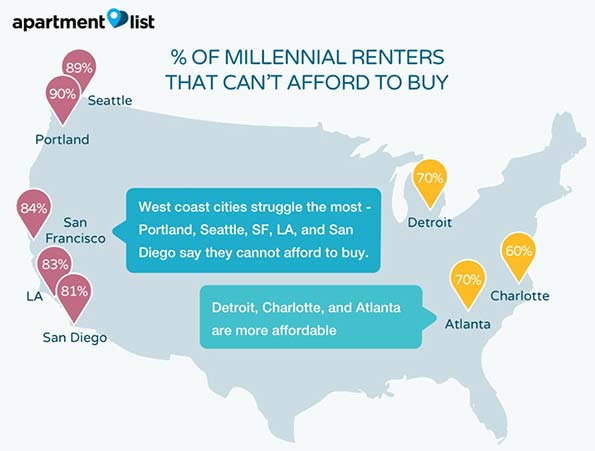
    Millennial renters overwhelmingly plan on buying their own homes, though affording them could be far more challenging than they think. This is an important conclusion from a renters’ survey by apartmentlist.com, an apartment search website (See: The Affordability Crisis: Are Millennials Destined to be Renters?). Apartmentlist.com matched results from its own survey of prospective renters that visit its site with housing market data from more than 90 metropolitan areas around the country, The most revealing finding:  Millennials intend to purchase their own homes, but that housing affordability is the greatest barrier. According to apartmentlist.com, the problem is the greatest on the West Coast, New York and Miami (See Figure “% of Millennial Renters that Can’t Afford to Buy”, from apartmentlist.com):

    In nearly all the metros we looked at, affordability was the #1 reason for delaying homeownership, but millennials on the west coast struggled the most: Portland, San Diego, Seattle, Los Angeles, and San Francisco all had more than 80% of renters listing affordability as a concern. Miami and New York, expensive metros with many cost-burdened renters, were #6 and #7 on the list.

    Perhaps surprisingly, two metropolitan areas that have been among the greatest beneficiaries of the housing affordability driven net domestic migration from coastal California, Portland and Seattle, scored the worst on affordability as a barrier to purchasing homes (90 percent and 89 percent respectively). These areas were once much less expensive in the past, but are rapidly catching up with California in terms of unaffordability.

    The Preference for Home Ownership

    The apartmentlist.com survey found that 79 percent of Millennials eventually plan to become home or apartment owners, while only six percent expect to rent for their whole lives. The balance (15 percent) are not sure. This 79 percent preference for home ownership is well above the current homeownership rate of approximately 64 percent.

    The preference for home ownership was pervasive in the apartmentlist.com data. Among the 50 metropolitan areas with more than 1,000,000 population, none scored below two thirds (67 percent) in Millennial home ownership preference. This is, again, above the national home ownership rate. The lowest home ownership preference among these was in Las Vegas. The highest preference for home ownership was in Rochester, at 94 percent. Charlotte and Salt Lake City also scored a 90 percent home ownership preference.

    Millennials indicated a strong preference for home ownership even in metropolitan areas that have depressed home ownership rates. In 2015, Los Angeles had the lowest home ownership rate of any major metropolitan area, at 49 percent, yet 76 percent of the area’s Millennials intend to own their own homes. In New York, with only a 50 percent homeownership rate, 74 percent of Millennials plan on buying their own homes. In San Jose, with only a 51 percent home ownership rate, 74 percent of Millennials aspire to buy their own homes. In San Diego, the home ownership rate was 52 percent, yet the interest in home ownership was half-again higher (78 percent). In San Francisco, where the home ownership rate is 56 percent, 76 percent expressed an interest in owning their own homes (home ownership rates calculated from Census Bureau quarterly data from 2015).

    The story is the same in the metropolitan areas often characterized as magnets for Millennial migration. In Portland and Denver, 81 percent of Millennials anticipate owning their own homes. Boston (78 percent), Seattle (77 percent) and Minneapolis-St. Paul (77 percent) are not far behind.

    Saving for Decades

    This data suggests that many Millennials could need to relocate to afford their own homes. The really innovative contribution of the apartmentlist.com research is as estimate of how long it will take the average Millennial to save enough money for a down payment on a starter home, which according to Trulia, is generally defined as the lower third of the market.

    Apartmentlist.com develops an estimate for each metropolitan area, using monthly savings rates, existing savings and the potential for financial assistance (for example from relatives) in obtaining enough for the down payment. In the most costly market, San Francisco, the average Millennial will need more than 28 years to build up enough funding for a down payment in San Francisco. This means that older Millennials would be old enough (62) to qualify for early retirement benefits from Social Security by the time they have enough to pay the down payment on a starter home. Sacramento is nearly as challenging, where it would take another 27 years to accumulate a down payment. Things are not that much better in Los Angeles (20 years), San Diego (19 years) and Denver (18 years).

    Optimistic Expectations and Disappointment

    But the most important bottom line conclusion of the research is what apartmentlist.com calls the “affordability gap.” This is the difference between the actual time required to accumulate a down payment and the time expected by survey respondents. The biggest affordability gap is in San Francisco, where respondents expected down payment requirements that would take only 11 years more to save. The reality, according to the study, is 28 years, more than 2.5 times that figure. In Sacramento, respondents expected that it would take 16 years, still far short of the more realistic 27 years. In Los Angeles, San Diego and Denver, it is likely to take from eight to ten years more to save enough for a down payment than survey respondents estimate.

    Setting up for More Domestic Migration

    In contrast, in a number of other metropolitan areas, such as Houston, Dallas-Fort Worth, Atlanta, Philadelphia and Kansas City, Millennials have over-estimated the size of down payments necessary to enter the housing market.

    For some time, domestic migration trends in the United States has been principally about moving from more expensive metropolitan areas to less expensive metropolitan areas. The apartmentlist.com data suggests that this trend could continue. To achieve their dreams of home ownership and to avoid a life of renting, many Millennials may move to places where housing is priced more for livability.

    Wendell Cox is principal of Demographia, an international pubilc policy and demographics firm. He is a Senior Fellow of the Center for Opportunity Urbanism (US), Senior Fellow for Housing Affordability and Municipal Policy for the Frontier Centre for Public Policy (Canada), and a member of the Board of Advisors of the Center for Demographics and Policy at Chapman University (California). He is co-author of the “Demographia International Housing Affordability Survey” and author of “Demographia World Urban Areas” and “War on the Dream: How Anti-Sprawl Policy Threatens the Quality of Life.” He was appointed to three terms on the Los Angeles County Transportation Commission, where he served with the leading city and county leadership as the only non-elected member. He served as a visiting professor at the Conservatoire National des Arts et Metiers, a national university in Paris.

    Photo by Bigstockphoto.com.

  • Class and the EU referendum

    On June 23rd, voters in the UK get a say on whether to remain in the European Union (EU). The UK first joined what was then called the European Economic Community (EEC) back in 1973, and in a 1975 vote, 67% voted to stay in the EEC. The issue was fairly settled until Conservative Prime Minister David Cameron, under pressure from the right wing of his party and anti EU sentiment, promised an in/out referendum in the Party’s manifesto for last year’s General election. The stakes here are high, and no one really knows what the result of a ‘Brexit’ (a neologism for British Exit) would be.

    In recent polls, opinion seems fairly evenly divided, with roughly 40% each for staying and going.  While a crucial 20% remain undecided, momentum seems to be with the ‘out’ side. Sentiment towards the EU cuts across party lines in the UK. Broadly speaking, the political establishment want to remain, though significant numbers of supporters, especially in the Tory Party, wish to go.  While initially hostile to the EEC, many on the left and in the trade union movement have come to embrace Europe because of its promotion of progressive labour law and working conditions directives, even though the UK has opted out of many of these.

    But what about the question of class in all of this? In many ways, class is a central factor, though it is rarely mentioned in debate or in the mainstream media. The UK Independence Party (UKIP), which has been a threat to both Conservative and Labour parties, has made immigration central to its campaigns. UKIP draws much of its support from the working-class, especially those who feel marginalised by the political mainstream, and one of the biggest reasons for this is immigration. According to a recent survey, 55% of voters see immigration as the most important issue in the upcoming referendum.  Of course, the issue is being mixed up with the ongoing refugee crisis and the desire of many non-EU economic migrants to come to Britain. This is a difficult and touchy subject for all political parties and for understandable reasons. But immigration was an issue even before refugees began streaming in from the Middle East, because one of the main planks of the EU is the free movement of goods and labour. Any citizen of the EU can choose to live and work in any other member state, and millions of people have chosen to do just that. Migration within the EU, which was seriously underestimated by the previous Labour government, has had very different outcomes in different labour markets. Many eastern and southern Europeans have been attracted to Britain by the promise of relatively high wages, job vacancies, and the fact that English is widely spoken across the continent.

    The biggest losers in this migration process have been the indigenous UK working class, who now have to compete with millions of semi-skilled and unskilled workers from across the EU. While there is plenty of anecdotal evidence that UK workers are being discriminated against by recruitment agencies, the best evidence of this practice comes from a high profile case in the English midlands where local people have been effectively excluded from the 3,000 jobs created at a distribution warehouse owned by sports clothing retailing firm Sports Direct.  The company apparently preferred to recruit directly from Poland. For working-class voters, the EU’s free market in labour appears to be more about big corporate profits than worker mobility.

    Immigration has an impact beyond access to employment. It also affects housing, schooling, and a host of other public services. All of these factors raise questions about the long term stability and sustainability of working-class communities. In many areas in the UK, from big cities to smaller towns, working-class people bear the brunt of all of these issues, and this has turned many towards UKIP and away from Labour as their natural home. Brexit begins to look attractive for those most marginalised by the effects of the free market, who also benefit least from the more positive aspects of EU membership. This situation has been confounded for many by the ways in which, after the recession of 2007/8, the EU has liberalised its markets and toned down its hitherto strong commitment to social legislation. Most notably, this has seen the EU in secret negotiations with the US over The Transatlantic Trade and Investment Partnership or TTIP.

    Nothing about the EU referendum is clear or straightforward. Whatever the result of the ballot, the motivations of voters in terms of class may not be clear. The EU had and still has the potential to improve the lives of millions of working-class citizens across Europe, but too often the interests of big business and social elites trump those of ordinary people.

    This piece first appeared in Working-Class Perspectives.

    Tim Strangleman, University of Kent

    Photo by Xavier Häpehttp://www.flickr.com/photos/vier/192493917/, CC BY 2.0

  • Geography and the Minimum Wage

    Most commentary on California’s decision to increase the state minimum wage to $15 over time is either along the lines of it being a boon to minimum-wage workers and their families or a disaster for California’s economy.  Neither is accurate.  Different regions sill see different outcomes.  Central California, the great valley that runs from Bakersfield to Redding, once again, will bear a disproportionate burden. 

    Some workers’ income will increase, but hardly enough to afford a standard of living that most readers would find acceptable.  At 40 hours a week and working 52 weeks a year, the minimum-wage worker will earn $31,200 a year before taxes.  Try living on that in San Francisco or Santa Barbara.

    Then, there are the workers who will lose their job, or never get one in the first place.

    A $15 an hour wage would devastate some economies, but California is different.  Individuals and families may be devastated.  Regions may be devastated.  Coastal California, with the possible exception of Los Angeles and the far northern counties, will do just fine.  You will probably not be able to see an effect in their data.

    Central California is another story.

    California is in transition from a tradable goods and services producing economy to a consumption and non-tradable services producing economy.  Tradable goods and services are goods and services that can be consumed far from where they are produced.  Manufacturing is the classic example of tradable products, but thanks to the internet, services are also increasingly tradable. 

    These days, many services that were once non-tradable are tradable.  Tax preparation, legal research, accounting, and term-paper writing are examples of tradable services that were once non-tradable.  As a friend of mine says, anything done at a computer can be done anywhere in the world.

    Non-tradable services are those that must be consumed where they are produced.  Lawn care, haircuts, and home maintenance are some examples.

    The distinction is important because a minimum wage increase affects each differently.

    The initial impact of a minimum wage increase is to increase the cost of the goods or services, tradable or non-tradable.  It’s what happens after the increase in cost that makes the difference.

    Consider a minimum wage increase on one side of a street and not the other side.  You might consider walking across the street for a burrito, cup of coffee, or haircut, if the price is cheaper there.  This is the substitution effect.  It will be almost non-existent for non-tradable services with a statewide minimum wage increase.  No one will drive to Arizona for a haircut or cup of coffee. 

    Non-tradable services are left with only a price effect, to be discussed in a bit.

    Tradable producers, though, face a formidable substitution effect.  They are competing with producers worldwide.  If they raise their prices, it is likely that enough customers will switch to other producers that tradable producers will be forced to relocate for lower-wage workers of go out of business.  If they lack monopoly power, they are unlikely to be able to absorb the cost increase.

    One impact of California’s minimum-wage increase, then, will be an acceleration of California’s transformation to non-tradable services production and the permanent loss of tradable sector jobs, outside of fields like software.

    It is fundamental to economics that the higher the cost of any good or service, the less that will be consumed.  This is the price effect, and it affects tradable producers differently than non-tradable producers.

    Unless they have monopoly power, tradable producers will not see a price effect.  The world price will remain the same.  Total world consumption will stay the same.  The distribution of sellers, however, will change.  Agriculture is an excellent example of competitive world markets.  California will likely provide a smaller share of the world’s agricultural output.

    If the tradable producer has monopoly power, the price effect may be large or small.  If it is small, they will see a small decline in sales.  If it is large, they may have to absorb the increase, sacrificing some of their monopoly profits.

    Non-tradable producers will face a price effect.  How big that price effect is depends on the wealth of their customers and how essential the service is to the consumer.  A wealthy person will probably not change their behavior because of, say, a ten percent increase in the cost of haircuts.  A poor person may reduce the frequency of haircuts.

    Tradable sector and non-tradable sector businesses will attempt to minimize the cost increase of a minimum wage hike.  This is most easily achieved by replacing some labor with capital.  This is the production function effect.  Assembly line workers may be replaced with robots.  Waiters may be replaced with tablets at the table, as we’ve already seen in some restaurants.

    Some would argue that there is another effect, an income effect.  The idea is that the increased income, and spending of minimum-wage workers will more than offset the price and substitution effects.  This violates another fundamental economic principle, the one that asserts that there are no free lunches.  The minimum wage earner’s new income is not new wealth miraculously provided by the minimum-wage fairy.  For every new dollar the minimum-wage worker has to spend, someone else has one less dollar to spend. In fact, due to inefficiencies (distortions in product mix and markets resulting from non-market prices) created by the transfer, someone else must forego more than one dollar in order to create the dollar provided by wage increase.

    Analysis of price and substitution effects implies that different California regions will be affected differently by the minimum wage increase.

    Because wages are generally lower in Central California than in Coastal California, the minimum wage increase will be more impactful in Central California, amplifying both price and substitution effects relative to Coastal California.  Central California’s economy is also more dependent on tradable-goods production than is Coastal California, it will, therefore, be hurt more by the decline in tradable-goods producers.  Similarly, because Central California’s income is less than Coastal California’s, it will also see a greater price effect on its non-tradable producers.

    Central California is seemingly in perpetual recession.  Even in good times, many Central California counties see double-digit unemployment.  Colusa County’s unemployment rate was over 20 percent in the most recent data release.  The region also sees disparate impacts from California’s high energy costs, water policies, and regulatory infrastructure, all of which hit them much harder.

    Coastal Californians underestimate the economic differences between California’s regions.  They are huge.  California simultaneously has some of America’s wealthiest communities and some of its poorest.  It’s important that we remember that California, with about 12 percent of America’s population, has 35 percent of the nation’s welfare recipients.

    Most of California’s wealthy coastal citizens never see California’s poor inland communities.  Yet, wealthy Coastal Californians — particularly from San Francisco — dominate state policy.  They implement policy as if the entire state were as wealthy as the communities they live in.  The minimum wage increase is just the latest example.

    Decency would seem to require that California find ways to accommodate the circumstances and needs of our least advantaged citizens and regions.  We don’t though.  Instead we create policy that hurts our least advantaged and makes their challenging lives even more so.

    Bill Watkins is a professor at California Lutheran University and runs the Center for Economic Research and Forecasting, which can be found at clucerf.org.

    Unemployed woman photo by BigStockPhoto.com.

  • Aristocracy of Talent: Social Mobility Is the Silver Lining to America’s Inequality Crisis

    Yes, wealth concentration is insane. But the ways in which wealth is shifting are surprising—and give reason for a little optimism.

    In an age of oligarchy, one should try to know one’s overlords—how they made their money, and where they want to take the country. By looking at the progress of the super-rich — in contrast with most of us — one can see the emerging and changing dynamics of American wealth.

    To get a sense of these trends, researcher Alicia Kurimska and I  tapped varying analyses from the Forbes 400 list of richest Americans. No list, of course, captures all the relevant data, but the Forbes list (I am a regular contributor to that magazine’s website) allows us to look not only at who has money now, but how the dynamics of wealth have changed over the past decade or more.

    The bad news here is that our oligarchs are getting richer, and, unlike in the decades following World War II, they are primarily not taking us on the ride. Indeed at a time when middle-class earnings have stagnated for at least a decade and a half,   the oligarch class is making out like bandits. This, of course, extends to much of the infamous “top 1 percent.” The share of income of the top 1 percent of households in the US increased from 10 percent in 1979 to upwards of 20 percent in 2010, as famously found by economist Thomas Piketty and Emmanuel Saez. 

    But if the highly affluent are thriving, the super-rich are enjoying one of the brightest epochs since the days of the robber barons. These people , according toa study by economists Steven N. Kaplan and Joshua D. Rauh, the top 0.0001 percent of 311.5 million US individuals. In constant 2011 dollars, their wealth has grown seven-fold since 1992 — from $214 billion in 1982 to $1.525 trillion in 2011. This at a time when most Americans have endured little or no real income growth.

     What we are talking about is a concentration of wealth and power unprecedented since the turn of the last century. According to an analysis by the left-leaning Institute for Policy studies, America’s 20 wealthiest people own more wealth than the entire bottom half of the population—152 million people in 57 million households. The top 100 own as much wealth as the entire 44.5 million-strong African-American population  (there are only two African Americans on the list), and the top 200 have more than the entire 55 million-strong Latino population (there are 15 Latinos on the list). To make an international comparison, the 400 have more wealth than the GDP of India, arguably the most up and coming big economy on the planet. 

    The Rise of the self-made

    Not all the news is bad, however. The proportion of the 400 who inherited their money has been steadily decreasing. There are more self-made billionaires than existed in the 1980s. Kaplan and Rauh report that since the 1980s the share who grew up wealthy fell from 60 percent to 32 percent. 

    This does not mean so much the return of Horatio Alger — the share who grew up poor remained constant at 20 percent — but that most super-wealthy came from affluent but not rich families, which gave them some head start, notably in education.They did not hand the keys to the kingdom to their offspring. Rather than country clubbers clipping coupons, the rich since the 1980s have become largely, if not entirely, self-made.  

    But origins are not the only thing that has changed in this era of oligarchy. So too have the industries that create the wealth — largely represented by the shift toward technology and finance — and, not surprisingly, where that wealth tends to concentrate. These shifts are already changing not only our economy, but also the outlines of political power, as industries friendlier to Democrats, notably tech and finance, supplant those, notably energy, that have long been associated, particulary in the last decade,  with the Republicans.

    The shift in the fortunes of the super-rich reflect changes in our industrial structure over the past third of a century. The big winners have been in scalable businesses  where capital is king and rapid accumulation possible. Rauh and Kaplan, for example, report that the big winners have emerged  not only in tech, but also include owners of retail and restaurant chains, tech firms and private finance, including hedge funds  Over the period between 1982 and 2012, finance’s share grew the most, followed by technology and mass-retailing.

    Who’s losing ground? The big losers are a bit counter-intuitive. Despite all the attacks on “big oil,” energy has actually suffered the biggest decline in terms of presence on the Forbes list. Energy, for example, used to account for about 21 percent of the 400,  but that has shrunk to about 11 percent. Equally puzzling, amidst a high-end building boom (not so much for the hoi polloi), real estate’s share has dropped about as much. Perhaps less surprising are the losses among non-tech based consumer industrial companies. 

    Since 2012, the year the Rauh study was completed, the tech billionaires have, if anything, expanded their presence, while it’s likely that, with the drop in energy prices, the oil barons will slip even further. On the 2014 list, for example, in terms of dollar gains, five of the top six were from the tech sector, led by Mark Zuckerberg, whose fortunes increased by a remarkable $15 billion (Warren Buffett was the lone exception). Mark Zuckerberg’s gains were larger than the $12 billion increase between Charles and David Koch, even at the peak of the energy boom.

    Fully half of the top 10 on the list came from the tech community, with the balance made up of Wall Street/finance people (Buffett and Michael Bloomberg) along with the Kochs and David Walton, the youngest son of Wal-Mart founder Sam Walton.

    The New Geography of Wealth

    Perhaps more surprising has been the shift in the location of the rich. Despite the rise of the tech oligarchs, the biggest gainers over the past decade have not occurred in California but in New York, Florida and Texas. This reflects not only the power of Wall Street and the investment class (some of whom have decamped to Florida), but the growing diversification of the Texas economy. 

    Oil, of course, still plays a critical role among the Texas rich, but it’s much more than that now. The richest people in the Lone Star Stateinclude Alice Walton, the Ft. Worth-based heir to the retail fortune, but also Austin tech mogul Michael Dell, Dallas financier Andy Beal, and San Antonio supermarket mogul Charles Butt. The first energy billionaire, pipeline entrepreneur Richard Kinder, clocks in as fifth richest Texan. Even if energy remains weak for the next decade, Texas seems likely to keep producing gushers of billionaires.

    If we break the rich list by region, it’s no surprise that New York, long the nation’s premier financial center, would rank first, with 82 billionaires. In second place is the San Francisco area, with 54 billionaires, most of them tied to technology. The Bay Area, with about one-third of the population, surpasses third-place Los Angeles, with 34. Miami ranks fourth with 27, Dallas fifth with 19; each is ahead of the traditional second business capital, Chicago, which ranks sixth with 15, just a few paces ahead of  Houston with 12.

    The Future of Oligarchy  

    What is the future trajectory of wealth in America? One thing seems certain: the twin tech capitals of Bay Area and Seattle, now home to nine of the 400, are likely to expand their reach. One clear piece of evidence is age; people generally do not get richer when they retire. In contrast, virtually all self-made billionaires under 40 are techies

    Of course, the biggest growth can be expected in the Bay Area, particularly as tech people think of new ways to “disrupt” our lives – for our own good, of course. Whole industries such as music, movies, taxis, real estate are increasingly controlled from the Valley; as these companies wax, many of the old fortunes made in these fields will begin to wane. This is also true across the board in retail, where Seattle’s Jeff Bezos now looms as a colossus greater than any individual chain of traditional stores.

    Ultimately what will make “the sovereigns of cyberspace,” to quote author Rebecca MacKinnon, so dominant is precisely what made John D. Rockefeller so rich: control of markets. Google, for example, accounts for over 60 per cent of Internet searches. It and Apple control almost 90 percent of the operating systems for smartphones. Similarly, over half of American and Canadian computer users use Facebook, making it easily the world’s dominant social-media site. 

    And soon, they, like the old Wall Street elites or the energy barons, may be able to regard the government as yet another subsidiary. They will benefit greatly from the likely electoral victory of the Democrats, who are increasingly dependent on tech contributions, while the old economy oligarchs already in retreat, in energy, manufacturing and real estate, fade before them. 

    The prognosis for the future of American wealth, then, is for an ever-expanding role for both tech and private investors, and a gradual shift away from basic industries that are geared to our diminishing middle class. This may not be good for America but will be wondrous indeed for the ever more powerful, and outrageously wealthy, new ruling class.

    This piece originally appeared at The Daily Beast.

    Joel Kotkin is executive editor of NewGeography.com. He is the Roger Hobbs Distinguished Fellow in Urban Studies at Chapman University and executive director of the Houston-based Center for Opportunity Urbanism. His newest book, The Human City: Urbanism for the rest of us, will be published in April by Agate. He is also author of The New Class ConflictThe City: A Global History, and The Next Hundred Million: America in 2050. He lives in Orange County, CA.

  • Trumpism: America’s Berlusconi Moment

    Trump envisioned and created today’s city of white boxes for rootless new money types, who dominate the city even as they leave little mark here.

    An old joke—that in heaven, the Italians do the cooking; in hell, they run the government—feels a lot darker now that American politics are taking an Italian turn.

    Since the fall of Il Duce, Italy has had a staggering 62 governments, and while American doesn’t have that problem yet, our political system is showing all the signs of decline—an inability to come to any consensus, the increased vulgarity of discourse, the utter incompetence of an impenetrable bureaucracy and the growth of extra-constitutional fascist and Mob-like “familial” —run modes of governance—with which Italians have long and unhappy familiarity.

    Let’s start with Donald Trump, who the American left now routinely deems an American fascist in the mold of Benito Mussolini. Like Trump, Mussolini (a former journalist) rose rapidly to power as his country was disintegrating from within. Then, too, nationalist resentments were reaching a fever pitch as a large part of the populace—and especially the middle and working classes—lost its remaining faith in the system as economic conditions decayed.

    In 1919, for example, there were “cost of living” riots throughout the peninsula as the old governing class lost its grip on the state. Fascism, as Mussolini himself suggested, was predicated on strength—on the use and threat of violence. The disruptive hooliganism of Trump supporters at his rallies evokes the frenzied, violent environment in which Il Duce claimed power in the 1922 “March on Rome,” and held it he was finally ousted and arrested in 1943.

    As the Financial Times’  Martin Wolff wrote, Trump follows a pattern that “embodies how great republics meet their end.”

    But past results, as the fine print says, are no indicator of future ones and the comparisons between Trump and Mussolini seem overdrawn. Take a breath and recall that Ronald Reagan and George W. Bush, too, were widely dismissed as “fascists” or even Nazis in their time.

    Trump clearly has an authoritarian personality , and he appeals to those with that bent, but he’s hardly a true heir to Mussolini. For one thing, Mussolini, like Hitler, was not born into money; they emerged from the life-or-death struggles of the Great War. Unlike those two, Trump does not boast an organized paramilitary black or brown shirt movement.  

    It is in the nature of his appeal where Trump does resemble the fascist leaders. His followers, like theirs, are people who feel left out of the calculations of the political class in both parties.

    In this sense, he shares much with the nationalist parties on the rise across Europe, drawing support from the middle class disgusted by politicians kowtowing to identity and radical green politics, from voters who feel the ruling parties serve not their interests but their donors and well-heeled interests, and who, despite their protestations of comity with their concerns, actually hold their electorate in various shades of contempt.tired of being told that changes they can feel hurting them, are actually helping them, tired of electing politicians who then ask them: “Who are you going to be believe: Me or your lying eyes?”

    Members of America’s white working and middle classes, argues Michael Lind, have become an outsiders, even pariahs in their own county: “Lacking any establishment advocates and sympathetic intellectuals, on left, right or center, many white working class Americans have therefore turned to demagogic outsiders like Trump. Where else are they to go?”

    The Donald speaks not only to the their fears haunting the middle class, but also their pride: he wants them to be proud of the country’s past. Some insist the real Italian model may not Mussolini but a more contemporary figure, former Prime Minister Silvio Berlusconi. Like Trump Berlusconi was a successful entrepreneur and  also  a loudmouth.   who appealed to Italians by denouncing “political correctness” as well as the weakness and corruption endemic to the Italian state.   

    If so, there’s some room for hope. Unlike Mussolini, Berlusconi never succeeded in overturning the constitutional order.

    Whichever comparison is more apt, there’s little doubt that iIn the run-up to the seemingly inevitable, horribly depressing face-off with Trump, we can count on Hillary Clinton and her reliable press minions to keep raising these Italianesque models. Trump will be dressed as a fascist, or even a Nazi, for breaking with the politically correct consensus. Like Berlusconi, he will be investigated for his numerous moral lapses—both personal and business—and, by November, will be about as attractive to much of the electorate as Mitt Romney without his noblesse oblige or respectability.

    American Donna

    If Trump is tarnished, that’s a good thing. But ihis political demise would sadly t’s one that opens the door to another ugly Italian model, the less public but arguably more effective one followed by Hillary Clinton and much of the Democratic Party.

    Clinton, notes journalist Jamelle Bouie  reflects  a machine model, with  control of the party itself as a goal.  Rather than an ideological figure, she “appeals to stalwarts and interest groups (like banks and industry) far more than voters who choose on ideology and belief.”

    This approach approximates, more than anything, the structure—though not the actual violence—of the Mafia, with “families.” .These groups that represent distinct, sometimes interlocking, interests, each functioning with almost total dominion over its respective turf but able to process competing demands through a central “commission” like the New York based one founded in 1931—when organized crime, incidentally, was under assault by fascist Italy.

    Under a second President Clinton, the Democrats will operate under a similar system, with Wall Street, tech oligarchs, greens, feminists, gays, African-Americans, public sector unions, universities, Latinos,  urban land speculators sitting around the table and her as il capo di tutti capi.

    She won’t have much patience for legal niceties, having already pledged to circumvent Congress if they won’t do her bidding. What drives progressives crazy.  about the former Secretary of State is not centralism – they generally supported Barack Obama’s rule by decree – but the very pragmatism that grows naturally  out of this kind of familial structure.

    These “families” have already played a critical role in helping bankroll the Clinton machine, both in the form of the family Foundation, whose donations have reached close to $3 billion,  and her campaign. Raising money from the oligarchy, as Bernie Sanders has noted,  makes it much less likely she will challenge their vital interests in a concertedfashion.go after their influence.

    Under a Hillary Clinton Administration, the Commission will be far more important than either under her husband or Barack Obama. Unlike these two articulate and charismatic leaders, Clinton inspires little loyalty outside of the “families.” She will not, for example, tackle entrenched interests like the teachers’ unions, which, to his credit, President Obama has been willing to do.   

    To be sure, a Commission-style government may not seem as scary as one run by an unpredictable and vulgar billionaire. Yet it could prove, in its own way, even more effectively authoritarian. Already critical Democratic “families” such as the universities, the tech world  and even the media have become centers of  censorship and ideological conformity.  Their cultural influence, already pervasive, is likely to become even greater.

    And in choosing a Mafia model, Clinton is adopting a system that lasted longer than thefascisti and thrived through  systematic intimidation of its rivals.  A Clinton Commission  may not cause sleepless nights, as a prospective Trump Administration might , but it hardly represents an edifying future for this most, at least to date, successful of republics.

    This piece first appeared in The Daily Beast.

    Joel Kotkin is executive editor of NewGeography.com. He is the Roger Hobbs Distinguished Fellow in Urban Studies at Chapman University and executive director of the Houston-based Center for Opportunity Urbanism. His newest book, The Human City: Urbanism for the rest of us, will be published in April by Agate. He is also author of The New Class ConflictThe City: A Global History, and The Next Hundred Million: America in 2050. He lives in Orange County, CA.

    Berluscony photo by alessio85 (flickr) [CC BY 2.0], via Wikimedia Commons

  • What Happens When Walmart Dumps You

    The first knock on Walmart was that it gutted the mom-and-pop businesses of small-town America. So what happens to those towns when Walmart decides to leave?

    What is the future of American retail? The keys might be found not only in the highly contested affluent urban areas but also in the countryside, which is often looked down upon and ignored in discussion of retail trends.

    Yet these small towns, as well as middle- and working-class suburbs, have produced many of the dominant trends in American retail, from discount chains to super-stores. So, too, could these communities create a new trend, as some of the former innovators, such as Walmart, have begun to close stores, leaving some towns and villages bereft of convenient, affordable retail.

    This year the world’s largest retail chain announced it was closing 154 stores, most of them “express” centers and other smaller stores that serve primarily small-town and urban markets, such as Oakland, California. The effect has been worst in poorer towns, notably in the Southeast and Appalachia, where there is little alternative retail in place.

    Walmart’s move, driven by flagging sales and profits, represents a shift away from the very working-class and small-town customers who drove its rise. It also reflects a growing disinterest among retailers in serving the nation’s beleaguered middle and working classes. One in six Walmart customers, notes one University of Michigan study, received food stamps in 2013, with an estimated average household income of $40,000 or less.

    In contrast, online shoppers, now a primary focus for Walmart, tend to be more affluent, with 55 percent of e-commerce shoppers living in households with incomes greater than $75,000. As Walmart and many other traditional “brick and mortar” stores have struggled with declining sales, online merchants have enjoyed an average growth of more than 11 percent annually since 2011. In this game, Walmart is clearly playing catch up.

    The other big Walmart bet seems to be superstores, which compete directly with ascendant retailers such as Costco. Yet these moves are crushing for smaller towns, who are generally too small to accommodate large centers. Say what you will about Walmart—historically low wages, mediocre selection, less than attractive stores—the Arkansas-based juggernaut brought affordable products from around the world to thousands of small communities and suburbs. Before then, smaller communities often were forced to either travel great distances to more urban locations or shop at small, often overpriced local stores.

    Back to the Futurem—and the Past?

    Now once again small towns are threatened with becoming desiccated islands cut off from the high-precision magnificence of American retail. In some cases, they might even become “food deserts,” cut off even from reasonably priced grocery items. This includes not only small towns but some hard-luck suburbs near major cities.

    No surprise then that some communities now resent Walmart for having essentially invaded Main Street, laid it to waste, and then abandoning it. Some places where Walmart have come in, such as Whitewright, Texas, a town of 1,600 in the northern reaches of the state, saw the retailer come in just last year, drive out of business some long-standing local stores, notably the longtime local grocery, and now, as part of its strategic change, leaving the town with little in the way of retail options.

    Tales of “the Walmart effect” on small towns, of course, are legion. In exchange for access to more affordable goods, communities sacrificed much that was unique—the local haberdasher, the mom-and-pop mini-department stores, the one-of-a-kind hamburger joint. In the 40 years after the first Walmart opened in Rogers, Arkansas, in 1962, the number of specialty retailers declined by 55 percent nationwide. In the same time period, the number of retail chain store locations , including Walmart, nearly doubled. Research conducted at Iowa State University in the ’90s found that, after a Walmart opened in a town, sales at specialty stores—sporting goods, jewelry, and gift shops—dropped by 17 percent within 10 years.

    Yet, fortunately, this may not prove to be the disaster that many predict. The new realities of retail, notably the inexorable shift toward online retail, suggests that rural communities and small towns are not as cut off as one might have expected. The ability to access Amazon in a small, remote Central Valley town in California is not much different from accessing Amazon in Los Angeles. For anyone even marginally computer literate, the retail world is more accessible than ever, but this time through a finger click than a stroll down the aisle.

    The Proliferation of Channels

    None of this suggests that the retreat of big boxes from smaller towns and some urban areas will be painless. Yet those who see this trend as the harbinger of the end of malls or Main Streets may be in for a surprise. Rather than die off, bricks-and-mortar shopping will change, adding new elements and moving from ever greater uniformity to more variety and differentiation, which are critical to independent business’s survival. Much of this change will take place in small towns, but also in suburban areas, which have long been the happy hunting ground of big boxes.

    Why not in the big cities? One of the chief ironies of our times is that chains and their attendant sameness now define much of our most sophisticated urban core—Starbucks on every corner, global brands and restaurants serving the same trendy cuisine. The recovery of large cities, suggests New York researcher Sharon Zukin, has also made them more alike by “bringing in the same development ideas—and the same conspicuous textual allusions and iconic corporate logos inevitably affixed to downtown architectural trophies—to cities across the globe.” Efforts to make the city “safer and less strange to outsiders’ eyes”—tourists, expatriates, media producers, and affluent consumers—are making one global city barely indistinguishable from another.

    At the same time suburbs and even smaller towns are becoming more diverse, and one of the chief causes of this diversity is the spread of millennials, with their own specific needs, into the peripheral areas surrounding core cities. This movement, once dismissed as inconceivable by some urbanists, is becoming more evident as census data show. And with more millennials entering their family-forming years, suggests economist Jed Kolko, this trend to suburbs and possibly smaller towns will only accelerate.

    The other great game-changer has been the rapid movement of ethnic minorities, particularly immigrants and their descendants, to suburbia. Roughly 60 percent of Hispanics and Asians already live in suburbs; more than 40 percent of non-citizen immigrants now move directly to suburbs. Between 2000 and 2012, the Asian population in suburban areas of the nation’s 52 biggest metro areas grew 66.2 percent, while in the core cities the Asian population expanded by 34.9 percent. Of the top 20 cities with an Asian population of more than 50,000, all but two are suburbs.

    As ethnics and millennials gather in suburbs and even small towns, we are starting to see the emergence of new retail forms in suburban areas. Orange County, California, for example, has long been seen as an area dominated by chains, and the largely suburban county is indeed sprinkled with scores of shopping centers, some of them massive, ranging from more working-class shopping centers in such cities as Orange or Santa Ana to more elite retail centers such as South Coast Plaza and Newport’s Fashion Island.

    Yet at the same time, the area is seeing the growth of new, unique retail districts that appeal to millennials, ethnics, and their descendants. Anaheim, for example, heretofore known for Disneyesque blandness, now features a thriving Packing District, a converted fruit-packaging structure now filled with numerous vendors, most of them local products such as confectionary, ethnic food and locally brewed beer. Several other projects, many in former office parks, have opened in places like Costa Mesa, drawing large numbers of suburbanites to unique agglomerations of smaller stores.

    Ethnic change is also transforming the retail environment in both suburbs and smaller towns. Throughout Southern California, Chinese, Korean, Vietnamese, and Mexican markets now proliferate. New developments in places like Irvine—now roughly 40 percent Asian—are filled with ethnic restaurants, shops, and boutiques. Similar trends can be seen in the emerging immigrant hubs, notably in Dallas-Fort Worth and Houston, but also in parts of New Jersey, Westchester, Northern Virginia, suburban Chicago, and in Seattle suburbs like Bellevue and Federal Way. Even the main street in Grand Island, Nebraska, home to meatpacking plants, is lined with, of all things, Honduran, Salvadoran, Mexican, and Haitian restaurants.

    At the same time, numerous suburban communities, particularly those with old downtowns dating from their agricultural pasts, have revived their own Main Streets. These areas may have a Walmart or Target nearby, or even adjacent, but now they also sport shopping, restaurant, and other cultural options, as well as an opportunity for promenading, once an important small-town activity. The list of communities doing this extends from places in Southern California—such as the old towns of Orange, Fullerton, and Laguna Beach—to older eastern towns like Montclair, New Jersey; Rockville Centre on Long Island; Naperville outside Chicago; as well as Carmel, Indiana. We may not be returning to Bedford Falls before the onslaughts of banker Henry Potter in It’s a Wonderful Life (1946), but smaller towns and suburban shopping area may prove far better able to adjust to the digital age than many suspect.

    Retail’s Increasingly Diverse Future

    Despite the erosion from online sales, the country’s retail structure is not about to go away. Even though overall department stores are doing poorly, as are some malls, many are also doing well, particularly in ethnic areas and more affluent suburbs. The importance of brick-and-mortar retail is still compelling enough that even Amazon may soon build its own physical bookstores; several other online sites have already done so.

    Of course, not all communities or Main Streets will thrive as the Walmarts and other large chains begin to cut back. There will indeed be many communities that continue to depopulate as younger people move away, and there is little hope that large retailers will come back to such places as markets dwindle and as more shoppers order online.

    Yet not all small towns, much less suburbs, face such a difficult future. Many smaller communities, particularly in attractive parts of the country, are beginning to see a wave of migration from aging boomers, who arrive with both significant cash and also often well-developed consumer tastes. Far more seniors, for example, retire to rural or semi-rural communities (PDF) than to urban districts. In certain areas—for example, Rocky Mountains towns, parts of inland California, and the hill country of Texas—may find their retail base growing, even if this means very different kinds of stores and services.

    Some small towns—and suburbs even more so—will be transformed by immigrants and millennials, who may want to set up their own unique shops along the very Main Streets once targeted by firms like Walmart. In wealthier communities, this may mean more boutiques and high-end restaurants. But among less affluent areas, other institutions, such as cooperatives—300 already nationwide and another 250 on the way, as well as farmers markets—could provide some of the products that many once found at Walmart.

    These changes may prove far more positive in the long run than many anticipate. A future with a slightly lower Walmart or other big-box footprint poses not just a challenge to communities once seen as unable to resist mass retailing but also a once in a lifetime opportunity. As the retail world become more digitally focused, and less big-box-dominated, there is a golden opportunity to restore the geographic and local diversity that has seemed doomed for nearly a half-century, but now may enjoy a new burst of life.

    This piece originally appeared in The Daily Beast.

    Joel Kotkin is executive editor of NewGeography.com. He is the Roger Hobbs Distinguished Fellow in Urban Studies at Chapman University and executive director of the Houston-based Center for Opportunity Urbanism. His newest book, The Human City: Urbanism for the rest of us, will be published in April by Agate. He is also author of The New Class ConflictThe City: A Global History, and The Next Hundred Million: America in 2050. He lives in Orange County, CA.

    Wal-Mart photo by Mike Kalasnik from Fort Mill, USA [CC BY-SA 2.0], via Wikimedia Commons

  • The Great Vancouver Exodus: Why I’m Almost Ready to Leave the City

    It was one of those Sundays in early January when you wake up to bright, stark sunlight streaming through your blinds.

    My fellow Vancouverites might know the one. It’s been grey and dreary for months. You open your curtains to a brave new world and see, with sudden, startling clarity, all of the dust that had gathered in the cracks of your life while you had been hibernating through the long winter.

    Every year, on this particular day in January, I find myself wandering around the city alone in an unsettled daze—one hand on this first pulse of summer, wondering how, with all of the dust and cracks, I can keep on pushing forward.

    It was freezing out, being January and a cloudless day, but I needed to get out of the house.

    At that point, I had been “home” in Vancouver for a month after spending half a year in Europe.

    In that month, I spent a lot of time with my head between my hands complaining to friends about how torn I was between feeling the need to put my adult life together in my hometown and wanting to get on a plane back to Europe in search of a new place to call home.

    My best girlfriend then said to me, “Get away from the city. Go for a walk. Go to Stanley Park, wander into the forest and think about it. What do you really want? What makes you happy? Don’t think about what society says you should be doing. Think about what you should be doing.”

    “But it’s coooooold,” I said.

    “Oh princess,” she said. “Suck it up, bundle up, and thank me later.”

    And so, on that particular day in January, I dug out my warmest clothes, which, either ironically or coincidentally, looked very Pacific Northwest—red plaid flannel shirt, TNA Sea-To-Sky sweater (that one every girl in Vancouver owns), dark jeans, brown combat boots, fur-lined parka, knit gloves, and white toque (that’s what we call beanies in Canada).

    I walked to the SkyTrain (the Vancouver metro) and rode towards the glass towers rising out of Vancouver’s downtown core. I passed the offices of the Central Business District where all lights had been switched off for the weekend, and to the far end of the downtown Vancouver peninsula where the 1001-acre Stanley Park is located.

    I meandered into the park. West Georgia Street turned into Lost Lagoon into a forest trail where the light got darker and the trees thicker with every step I took.

    In the month that I had been “home,” I had come across a lot of questions, which were driving me to bouts of insomnia, frenzies of SkyTrain platform pacing, and uncharacteristically melodramatic speech.

    Away from the bustle of the city and my 9 to 5 job, I was able to start working through these questions.

    “Am I meant to settle down in this city, or is my home to be elsewhere in the world?”

    “Is it wiser for me to lay the foundations for my future in Vancouver, or should I start digging elsewhere?”

    “If I am meant to stay, do I have the courage to do so?”

    “If I am meant to leave, do I have the courage to do so?

    As I wandered deeper into Stanley Park, the din of traffic from the Lions Gate Bridge fading into a cacophony of crows in the trees and my breath misty puffs in the crisp January air, I found my answers.

    And it broke my heart.

    It’s time to leave Vancouver.

    There is an interesting phenomenon that has been occurring at an increasingly rapid pace over the past number of years.

    We call it the “Exodus of Millennials,” or, as I like to put it “The Great Vancouver Exodus.” 

    There is an affordability crisis in this city. Vancouver is ranked the 2nd least affordable city in the world next to only Hong Kong. Considering what it costs to live in places like New York or London, our dilemma here should be quite apparent.

    Housing prices have grown at an alarming rate. As of 2016, 91% of single-family homes are valued at over $1 million. Our salaries have not grown to match.

    One of my best friends is a realtor. For years, she has been saying, “Get into the market as soon as you can.”

    The rest of us who are less educated in real estate would talk about waiting for the real estate bubble to burst.

    I entered the industry myself recently and began paying attention to trends and numbers. Vancouver’s bubble isn’t going to burst anytime soon. It’s either get in as soon as possible, or get out of town.

    It’s ridiculous, really.

    Let me put it this way.

    For four years, I worked full-time. One of my offices was on Burrard where the rent per square foot is the second highest in Canada. One of my other offices was a block away and I had an unobstructed view of the Olympic Cauldron. I spent a lot of time ordering people around.

    You’d think I was doing pretty well for myself.

    In those four years, I first lived in a 300 sq. ft. apartment that cost 1/3 of my salary and was located on Drake between the noisy Granville and Burrard Bridges. I then moved to Commercial Drive and lived in an unremarkable 1-bedroom walk-up that hadn’t been updated since the 70s. Every so often, I’d come across a stray silverfish.

    In that time, I tried to save for a down payment. Four years of saving later, all I could afford was a single-roomed shoe box in an up-and-coming (read: will be safe in 20 years) neighborhood.

    It was then that I decided it wasn’t worth spending my hard-earned money on a shoe box that I’ll nevertheless be paying off for twenty years. So I bought myself a one-way ticket to Europe instead.

    Note: the person I used to share the apartment on Commercial Drive with now lives up the street. He pays $850 a month (1/4 of his salary) for a 75 sq.ft. bedroom in a 100-year-old house shared with some ten people. The house is so old it appears impossible to keep clean, every stair is caving in the center, and the floorboards are obnoxiously squeaky. It recently sold for $1.4 million.

    Over the past few years, I have found myself at increasingly more going-away parties.

    “My start-up got funded in New York,” says one departee (yes, I made that word up).

    “I just got promoted to head office in Toronto,” says another.

    And every one of them says things like, “I’m moving to San Francisco, London, Berlin, Madrid, Paris, Beijing, Hong Kong, Singapore, whatever, because I can’t afford to be here anymore.”

    For the most part, my core group of about five friends remained unaffected. However, having spoken at length to them recently, I realized that they are all seriously considering joining the Exodus.

    They all started thinking about it at the same time. Their timelines for leaving fall within the same year. Their reasons for leaving are similar. My consideration of the aspects of my own Exodus line up perfectly with theirs.

    In fact, in the month that I’ve been “home,” one of my closest friends has already made it to San Francisco.

    My best girlfriend is in the process of saving to move somewhere tropical with her husband so they can work as diving instructors.

    Even the realtor, who has been making a killing off of our real estate market, is ready to go.

    “I’m going to London next year to get my Master’s,” she said. “We are so secluded here and I feel like there’s a lot more I could be doing for both myself and the world.”

    I’ve seen the outrageous amounts of money realtors pull in. She has all of the makings of a realtor—smart, driven, ambitious, organized, well-spoken, well-dressed, attractive, and trustworthy—and she is good at it.

    For someone like her want to give up a real estate market like Vancouver is saying something.

    When it comes to business, Vancouver is a satellite city. I dare even say that Canada is a satellite country.

    As a marketer who often works cross-border with the US, I have always been miffed at the huge discrepancy between marketing budgets allotted to the US vs. Canada.

    “There just isn’t enough of a market in Canada,” I’m always told.

    Fun fact: the entire population of Canada can fit into the State of California.

    When it comes to international business, Canada usually concedes to the decisions of the US division. When it comes to national business, Vancouver usually concedes to Toronto.

    If you’ve never experienced this, allow me to tell you that it is frustrating to have to follow directions from a voice over a phone located three time zones away and in a completely different part of the country.

    Therefore, everyone is leaving. Those of the ambitious, career-oriented kind are all fleeing for greener (and more affordable) pastures elsewhere. This is happening so rapidly and thoroughly that the entire future of the Vancouver economy is being threatened.

    Twenty-five countries later, I still think Vancouver is one of, if not the most beautiful city in the world.

    But it is precariously poised to become a ghost town and I am far from ready for the afterlife.

    And so, all reason is pointing me to join the Exodus.

    By this point, I had wandered from the north end of Stanley Park to the south end.

    I sat down on a bench by the water somewhere between Second and Third Beach facing the sunset.

    I was terrified. Is it really true that I am meant to leave everything familiar because I am being priced out of the housing market in my hometown?

    Yet I silently thanked my best girlfriend.

    My head was clear.

    I need to leave Vancouver.

    My walk ended at the stone-stacked Inukshuk at the far end of English Bay. The Inukshuk is an iconic symbol of Vancouver, having been the basis for our 2010 Winter Olympics logo.

    I stood there for a while, watching the last orange rays of sunset disappear behind the mountains and shivering in the winter chill.

    I realized I was saying goodbye.

    It’s almost time to join the Exodus.

    Grace Pacifica Chen is a Vancouver-based marketing consultant, brand manager, travel blogger, and creative writer. Follow her on Twitter and Instagram @pacificachen.

  • Now They Get It: Health, Class, and Economic Restructuring

    In the past few months, many commentators have responded to a recent study that shows increasing death rates among middle-aged white Americans. Some have suggested that the increase is the consequence of material poverty resulting from economic restructuring and the neoliberal agenda over the last several decades.

    Globalization, trade liberalization, deregulation, privatization, and reductions in the welfare state have not only led to downsizing in many industries, they have also reduced wages and benefits, contributing to growing economic inequality. The nature of many jobs has also changed. Work has been intensified, hours have become increasingly irregular, and workers face anxieties about the loss of their jobs and electronic monitoring of their work. These changes leave workers feeling vulnerable and stressed, and that together with anti-union laws and poorly enforced labor laws limit their ability to fight back. As someone who taught courses in Occupational Safety and Health for many years, I am all too aware that these workplace stresses and the limits of workers’ agency are associated with increases in cardiovascular disease, physical and mental disorders, and acute injuries. In other words, while research has focused on increasing mortality rates, changes in work also contribute to increased health problems, which may, in turn, explain the increases in alcoholism and drug abuse that Anne Case and Angus Deaton see as key factors in the rising death rates.

    Workplace stress and insecurity are among the “hidden injuries of class” that compound material poverty. As people adapt to changes in and the loss of work, they become more isolated, and, too often, lose their sense of community and self worth. Worse, they internalize insecurity, blaming themselves for problems at work or for not being able to find a decent job or support their families. That people blame themselves should not surprise us, given the persistent ideal of the American Dream, which promises that individual effort will pay off in upward mobility. No wonder people who have lost jobs or who are working hard but still struggling economically see their challenges as a moral failure or character flaw.

    For anyone who has studied the social costs of deindustrialization, none of this is news. In the 1980s, Harvey Brenner determined that for every one percent increase in unemployment there were 650 homicides, 3300 admissions to state mental hospitals, 500 deaths by cirrhosis of the liver, 20,000 deaths by suicide. Other studies focused on displaced workers in the late twentieth century showed increases in incarceration, insomnia, headaches, smoking, child and spousal abuse and stomach disorders, not to mention suicide and drug and alcohol abuse. In many ways, the current research shows not a new trend but rather the long-term impact of economic restructuring and neoliberalism on workers’ lives.

    What is new is that these patterns no longer seem to apply primarily to the working class. While Case and Deaton note that poorer and less-educated white people had even higher mortality rates, their study suggests that the pattern also applies to the middle class. This may be what most surprised commentators, for whom the report offered dramatic evidence of an important change in American culture. As Paul Krugman suggested, “We’ve seen this kind of thing in other times and places – for example, in the plunging life expectancy that afflicted Russia after the fall of Communism. But it is a shock to see it, even in an attenuated form, in America.” Krugman and others asked how this could happen. In an interview with Vox, Deaton commented that the middle-aged white people in his study had “lost the narrative of their lives.” While this certainly applies for many in the working class, as Sherry Linkon noted in November, it is also true for growing numbers of middle-class Americans who may have been even more invested in the American Dream.

    Also new is the racial pattern. In the 1970s and 80s, death rates for African Americans rose, but in recent decades, they have fallen as the rates for whites have risen. Andrew Cherlin suggests that the difference could be explained by people’s perceptions of how they are doing compared with others like them. As Cherlin writes, “It’s likely that many non-college-educated whites are comparing themselves to a generation that had more opportunities than they have, whereas many blacks and Hispanics are comparing themselves to a generation that had fewer opportunities.” Put simply, if white working-class people see themselves as losing ground, they may be more likely to consider suicide or engage in self-destructive behaviors.

    The impact of economic restructuring on material poverty and health has a long history. In the last 40 years, increases in poverty and the declines in the health of the working class were rationalized as “acceptable” losses associated with major economic change. But what has changed is the demographic landscape. No longer are mortality and morbidity issues associated primarily with the working-class and African Americans. Now, job loss and economic insecurity are impacting the middle class and whites.

    I’m reminded of an old adage: when poverty comes in the door, love goes out the window. As middle-class whites increasingly experience the kind of economic insecurity that became normal for so many working-class people years ago, some are losing not just love but also their health and even their lives.

    This essay was first published by the Working-Class Perspectives blog, which offers weekly commentaries on current issues related to working-class people and communities.

    John Russo is a visiting fellow at Kalmanovitz Initiative for Labor and Working Poor at Georgetown University and at the Metropolitan Institute at Virginia Tech. He is the co-author with Sherry Linkon of Steeltown U.S.A.: Work and Memory in Youngstown (8th printing).