Tag: middle class

  • “To the Suburb!” Lessons from Minorities and the New Immigrants

    This essay is part of a new report from the Center for Opportunity Urbanism called “America’s Housing Crisis.” The report contains several essays about the future of housing from various perspectives. Follow this link to download the full report (pdf).

    When I was in college the suburbs were vilified. It was the mid-2000s, and here we were, enlightened coeds having one last hurrah in the flat Midwestern expanse before finding our place in the world, and there really was only one world to find: the city.

    A lot was fueling this. Some of us were reacting to Walmart childhoods, the big box strip malls a symbol for all that embarrassed us about America – corporate consumerism, excess materiality, a primacy on efficiency over heart. Others found in urban contrasts a call to heal social divides. But whether motivated by altruism or hipsterdom, the city seemed like the only place to live a meaningful, “authentic” existence. We were taught that the suburbs were vanilla, bland, buffers for Boomers to hibernate with their own kind. Cities, by contrast, offered risk, adventure, diversity and grit.

    Fast-forward a decade, and these differences have faded and even reversed. Sure, cities in the mold of New York, San Francisco, Chicago and Los Angeles still appeal to the young and mobile. But, lately, as housing prices in the most appealing urban cores skyrocket across the country, metropolitan centers find their middle class aspirants fleeing for greener and less expensive pastures.

    Today, many suburbs are remaking themselves as formidable incubators for social mobility and globalism, their sprawl punctuated by street signs in other languages, strips of ethnic eateries, self- confident civic innovation and a fresh aura of hope.

    This suburban blossoming represents an underreported shift in settlement
    patterns of our new immigrants and minorities. Where “To the city! To the city!” was the unquestioned mantra of newcomers landing on Ellis Island in  the first wave of mass migration between 1880 and 1924, today’s Latin Americans, Asians, Africans and African Americans are voting with their feet in a new direction. “To the suburb!” – if it didn’t sound like a minivan’s whimper – would be the banner of the day.

    SOME FACTS

    It would take a hermit lifestyle not to notice the demographic sea change that’s swept the United States over the last three decades. European immigration, once the mainstay of growth for the U.S., fell 32 percent, even amidst the continent’s hard times, from 2010 to 2013. In 1980, Mexicans accounted for the most populous group of foreign-born at 2.2 million, followed by Germans at 849,000. By 2010, the Mexican population had more than quintupled while European immigrants had fallen from being 36.6 percent of the total foreign- born population in 1980 to 12.1 percent in 2010. Mainland China now follows Mexico at 2.2 million, with Indians and Filipinos close behind at 1.8 million each. Today, the sending regions with the largest numerical increases in the number of immigrants living in the United States since 2010 are East Asia (up 642,000), South Asia (up 594,000), Sub-Saharan Africa (up 282,000), the Middle East (up 277,000), the Caribbean (up 269,000), and Central America (up 268,000).

    The swell of these “new immigrants” has revived perennial American questions around national identity that ever undergird our migration policy debates. The issues touch almost every region, with suburbs and smaller cities in the country’s interior feeling them most acutely. Where Los Angeles, New York City and Chicago were once the obvious gateways to build an American life, now the cities in the South and West are increasingly attracting the foreign-born. Since 2000, 76 percent of the growth in the immigrant population has occurred in these smaller metropolises, with Pittsburgh, Indianapolis, Oklahoma City and Columbus growing the fastest. A related trend is that as of 2007, four in 10 immigrants now move directly from overseas to the suburbs, eclipsing the urban experience that had always been the landing pad.

    The Brookings Institution came out with an important report last year detailing these shifts. In 2000, more than half of the nation’s immigrants lived in the suburbs of our largest metros. According to census data from 2000-2013, that number is now up to 61 percent.

    More than a third of the 13.3 million new suburbanites between 2000 and 2010 were Hispanic, with whites accounting for a mere fifth of suburban growth in that same period. Between 2000 and 2012, the Asian population in suburban areas of the nation’s 52 biggest metro areas grew 66.2 percent, while that in the core cities grew only by 34.9 percent. African Americans have also been steadily moving from inner cities to the suburbs. The 2010 Census showed that each one of the nation’s 20 largest metro areas saw a significant decrease in their proportion of black residents, with African Americans as a group shrinking from 65 percent urban in 2000 to 49 percent in 2010.

    The regional details are even more striking. Since 2000, the suburban immigrant population has doubled in 20 metro areas. In 53 metro areas, the suburbs accounted for more than half of immigrant growth, including nine metros in which all of the immigrant growth occurred on the periphery: Chicago, Cleveland, Detroit, Grand Rapids, Jackson, Los Angeles, Ogden, Rochester, and Salt Lake City. Atlanta and Seattle, long skirted by immigrants and even now ranking outside the top 10 largest immigrant destinations, each added more immigrants to their populations than did Chicago, San Francisco, Boston, or Los Angeles. Crucially, since 2000, not one metro area has seen its foreign-born population in the suburbs decrease.
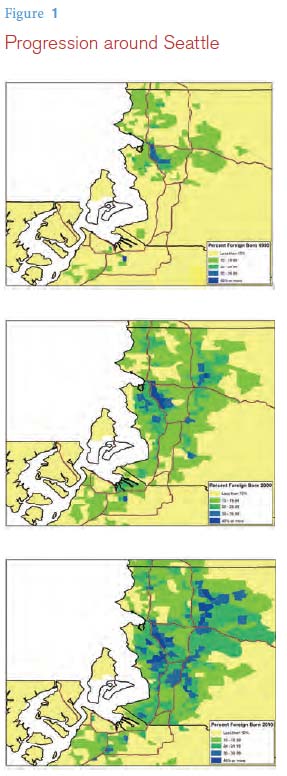
    What this means is that the suburbs as a whole are now equally, if not more diverse, than the populations living in most urban cores. They also are generally less ethnically segregated.  Go to a Starbucks in Sugar Land, Texas, and you’re more likely to stand in a line resembling the United Nations than anything you’d find in the center of Manhattan. Same goes for Fairfax, Virginia, where the demographics far out-pixelate Washington, D.C. 29.5 percent of Fairfax residents are foreign born, compared to 13 percent in D.C. 16.4 percent of Fairfax’s residents are also of Hispanic origin and 19.2 percent are Asian, compared to only 10.4 percent Hispanic and 4 percent Asian in D.C.ix Irving City and Carrollton just outside Dallas see their foreign born comprising 35 and 28 percent of their residents, respectively, while Dallas proper caps at only 23 percent. In Washington State, 34 percent of Bellevue is foreign born, while Seattle’s foreign born stands at a mere 17.7 percent.

    It’s important to note that this movement to the periphery does follow overall population settlement patterns observed since 2000 – it is not simply an immigrant or minority phenomenon. As elite urban hubs suffer from high housing prices, experiencing then a widening chasm between the very rich and the very poor, the suburbs have become a harbor for the middle class to find more reliable footing. And while my suburban-raised college classmates and I turned our noses up at their presumed provinciality, an Aspen/Atlantic poll from three months ago showed that most Americans still consider a family-oriented, suburban neighborhood closest to their “ideal” in terms of where to live, with 53 percent of whites, 53 percent of African Americans, 53 percent of Hispanics and 63 percent of Asians aspiring to this future.

    Recognizing that immigrant and minority migration patterns mirror shifts undergone by the population at large, there remains a texture to the suburban shift specific to both the contexts and the aspirations of today’s immigrant and minority groups, a texture laden with distinct promises and challenges as many pioneer lives on a more sprawling landscape. Here is a closer look at why the New America is suburbanizing, and what this may bode for the future.

    THE CASE OF HOUSTON

    Take a drive westward from almost any major airport today and you’ll see these worlds unfurling. In Houston, now the most ethnically diverse metropolitan area in the country, its white population is increasingly concentrated inside the inner loop (particularly millennial singletons) with everyone else settling beyond. As of 2013, over half of the city’s immigrant population—56 percent—live in Houston’s suburban municipalities, with 80 percent of the growth of the area’s foreign-born population since 2000 occurring in the suburbs.

    This diversity shapes how I live.  One recent Sunday, after waking up at 6:30 AM for a game of tennis with some Vietnamese friends who’d trekked in to Houston’s inner loop from Sugar Land, I found myself traveling the world in a zip code. The court transitioned to church at an all-black Methodist congregation 32 minutes from Houston’s downtown, followed by a Peruvian brunch at a rotisserie chicken eatery sitting just across the street from a large Indo-Pakistani shopping plaza. I then wandered over to the neighboring Hispanic mall known as PlazAmericas before taking a right on Bellaire Boulevard to peruse flavors of shaved ice at Chinatown’s Dun Huang Plaza and sampling Korean pears at the pristine Super H, with Latino shelf-stockers backing the Korean cashiers. Café Beignets, a Vietnamese interpretation of New Orleans charm, nourished with fried dough in the middle of a “Saigon Houston Plaza” that seemed to take its aesthetic cues from Pottery Barn, Asian-accented. All manner of sacred architecture beckoned from behind the strip malls, with the Buddhist Teo Chew Temple peeking out from beneath the tree tops and a dozen Spanish and African-speaking church signs within view around the corner.
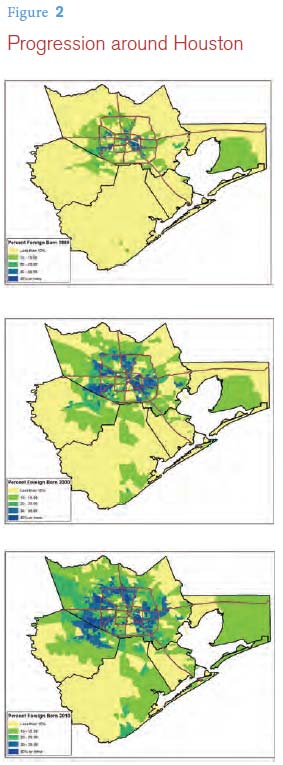
    This was all a suburban version of “verges” – the vortexes where civilizations clash and conceive a fresh dynamism. Only in this case it wasn’t Istanbul; it was the Beltway crossing route 59.

    Houston rightly carries a reputation as one of the most welcoming cities in the U.S. While cultural traditions from elsewhere are invited to express themselves, the first question most Houstonians ask is not, “Where are you from?” but “Where are you headed?” The environment is future-oriented, open and adaptable. Buildings are torn down one month and rebuilt the next. There’s something for everyone, and the more outsiders come for jobs and the hope to establish a stable and happy life, the more Houston is texturizing to reflect the values and needs of the globe within it.

    “I think Houston offers people an opportunity to entrench themselves,” says John Tran, a second-generation Vietnamese lawyer in his mid-thirties, living in Sugar Land, also the town of his childhood. “It’s one of those places that gives people time to assimilate at the same time that it also gives them time to develop their own identity.”

    The sprawl invites a tension to play out between tradition and innovation, stability and risk.

    “The message is: Do it your own pace, do it your way, you have a home here,” Tran says.

    This is a great opportunity as well for the realtors and homebuilders as they reinvent the sprawling landscape to suit the aesthetic tastes of their diversifying clientele. Local architect Tim Cisneros is currently working on a $10 million dollar Indian wedding facility in Sugar Land that will be capped by a helipad and bridge built to withstand an elephant’s weight for the groom’s entrance. Cisneros serves some of Houston’s most entrepreneurial immigrants, his portfolio including a Chinese museum of history and culture (“Forbidden Gardens”), multiple Indian restaurants and a Messianic Jewish worship center.
    Each project involves an anthropological education. Cisneros recalls:

    “When I was in the running to design a Daoist temple, I had to go to this ritual. They’d put the various names of the architect candidates into a calligraphic gold pot with sparks and smoke. My job depended on whether some karma favored my name.”

    Cisneros now calls Houston his “favorite third world city,” hinting both at its development potential and the ambience that appeals to today’s new immigrants. From the tropical climate, to the zone-free real estate possibilities, to the hodge-podge aesthetic that disorients and welcomes anyone looking to make a mark, there’s both a familiarity to those coming from the developing world but also a chance to enjoy greater personal space than they were allowed in cities like Seoul, Abuja or Delhi.

    “The immigrants we work with,” says
    Cisneros, “they think they’ve died and gone to heaven. They don’t get caught up in the fact that their father’s generation wasn’t born here.” There’s opportunity, and perhaps more importantly, a sense of limitless sky.

    THE PERCEPTION OF MORE CHOICE AND OPPORTUNITY

    For most of U.S. history, immigrants have been concentrated in iconic cities. Early waves of European immigrants initially moved into neighborhoods close to the factories and shops that employed them. Go to Manhattan’s lower east side and you’ll still catch a whiff of the German, Irish and Jewish flavor that defined this neighborhood at the turn of the 20th century. As increasing numbers of immigrants have flocked to the suburbs at the turn of this century, however, it’s clear the new immigrants are reshaping the geography of opportunity.

    To dig into this, I’ve spent the last few months interviewing national migration experts and district school superintendents, exploring the growing array of suburban social services and attending a wide variety of religious services and cultural celebrations in the most diverse county in the nation—Fort Bend, just west of Houston. What’s come to the surface, amidst all the variance in regional patterns of settlement, is the issue of agency. Choice, or lack thereof, is the fault line in the nationwide trend toward suburban living. Some move because they can and choose to – the suburbs have attractive features worth pursuing. Others are forced out as they’re displaced by gentrification, changes in local labor demand, and, sometimes, black-white racial tensions.

    “You’ve got two streams of immigrants flowing out of the urban core,” says Stephen Klineberg, founder of the Houston-based Kinder Institute. “One contains the engineers, doctors and information technology professionals, many of whom are Asians and Africans that enter this country with higher educational levels than many native- born Anglos, and the other contains the poor and uneducated, most of whom are black and Hispanic. Where the upper middle class of Asians and Africans tend to go where the property values are higher, where the schools are good and the jobs plentiful, [poor] blacks and Hispanics are increasingly being clustered in low-cost areas, getting pushed farther and farther out.”

    These ethnic delineations may be too sweeping — there are many upper income Mexicans and Africans, for example — but Randy Capps of the Migration Policy Institute at least agrees on the pattern. “Your distressed communities are going to attract people who have no choice,” he says. “The poorest people are going to be increasingly transient, namely, poor blacks and Hispanics.”

    For those with the capacity to move of their own accord, choice itself explains the reasons for the suburban move. Behind the practical appeal of lower housing prices, more jobs and better schools, every immigrant I interviewed alluded to the air of untapped possibilities that they no longer sensed in dense urban cores. The growing magnetism of a city like Houston, for instance, along with other suburban cities in the South and West, is in part rooted  in the sense that you don’t have to be a part of the establishment to move up. Social mobility is possible for those with the wherewithal to climb.

    “The American Dream is alive and well here,” said one restaurant owner. “If you want to make it, you can. I haven’t been able to find that possibility in other cities.” Other suburban dwellers agreed. “Urban density doesn’t grant easy permission for the imagination,” said a Vietnamese couple. “Suburban landscapes at least invite you to try to make your own mark.”

    THE IMPORTANCE OF HOME OWNERSHIP

    If more space and choice lie at the core of most minorities’ hopes, buying a home seems the first logical step to securing them. For immigrants in particular, transitioning from renter to homeowner is an important milestone in committing to the United States. The question is: Where is this transition now possible? And are immigrants and minorities more willing to take the  leap into far-flung coordinates because owning a home is more critical to their civic credibility than it is for today’s average native citizen?
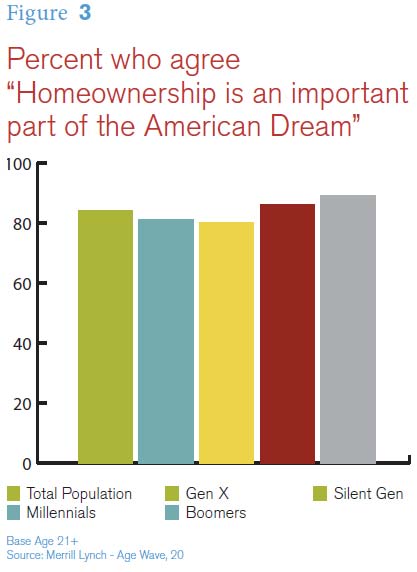
    There’s some data to suggest that in a society increasingly accepting of a “rentership” mentality, immigrants remain more likely to strain for permanence. The national homeownership rate has been declining for ten consecutive years.xii You see this pronounced especially amongst the young. Those in the prime of their adulthood, between 35 to 44 years of age, are buying homes at a low rate not seen since the 1960s. And for minorities, the numbers dip lower – the gap between white and minority home ownership is 25.5 percentage points.

    However, when you look at the maps detailing migrations of minorities and immigrants, and where they tend to be growing, they are growing fastest in places where houses are being bought. According to a report by the Research Institute for Housing America, immigrants accounted for nearly 40 percent of the net growth in homeowners between 2000 and 2010; in the 1970s they represented just over 5 percent of the growth. Meanwhile, the foreign born have been moving towards ownership, with renting growth happening only in the states that have become tough for prospective homeowners – e.g. California, the Washington D.C. area, New York, New Jersey, Massachusetts, Connecticut and Illinois.xiv In the current decade, California and New York are projected to be the only two states where foreign-born homeowner growth declines. Texas and Florida, by contrast, are attracting foreign- born buyers in droves, with net increases of 492,000 and 342,000 projected.
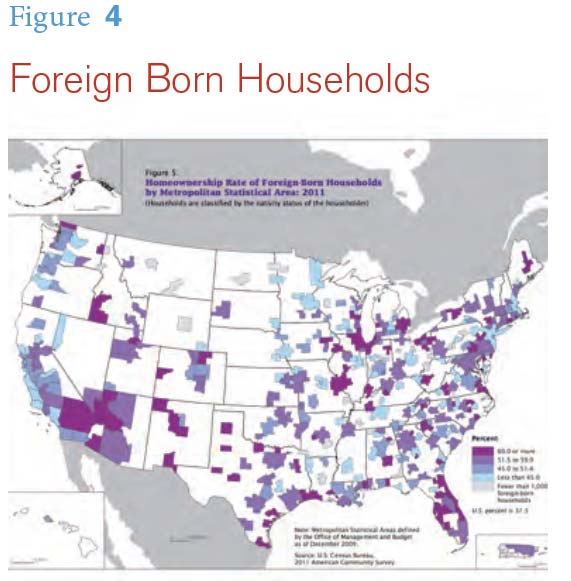
    As Hispanic and Asian homeownership in particular is climbing, they’re buying in the second-ring suburbs and even exurbs where they are settling in large numbers. We can see this by looking at maps of several major metropolitan areas such as San Francisco, New York, and Chicago.

    Obviously, when home ownership is the top priority, where it can be affordably attained becomes all the more relevant. Aspiring homeowners tend to want to live around other homeowners – there’s a like-attracts-like buzz of “I want to be around other people who are making it.” Minorities also seem  to be maintaining the more traditional American idea that homeownership equals the final seal of adulthood.

    “Buying a house was important,” says Tran, the 35-year old lawyer who lives with his wife in Sugar Land, a town in Fort Bend County. “It was roots being planted, physically and emotionally. If marriage was the emotional commitment, the house was the physical aspect of that.”

    The Trans’ neighbors, an African American couple named Geoff and Robin Boykin, agree.

    “As a minority, owning a home gives you a level of credibility in the community that renting won’t,” Boykin says. “When we first moved to this neighborhood, we rented, just to be sure, and when people would come up and ask us about it, there was an underlying feeling of embarrassment. Like we were second-class citizens. Perhaps especially because we’re the only black couple in this neighborhood.”

    Geoff grew up in Brooklyn, New York, “where you don’t even think about buying.” But when he met a 24-year old who owned a house in Houston, he thought, “Wait a second. Where can you buy a house at age 24?” He moved to Texas to follow suit. Southwestern sprawl offered an opportunity to get established, cheaper.

    Suburbs have always been family- friendly, at least by brand, and as Caucasian family size continues to shrink, those Hispanic and African American still having children, even three to four, kids want to be in safer, more affordable family-oriented neighborhoods.

    “You are now more likely to have inter-generational communities in  the suburbs,” says Randy Capps of the Migration Policy Institute.

    Tim Cisneros, the architect who serves some of Houston’s most entrepreneurial immigrants, says that his clients typically want something “colonial or traditional, to show they’ve assimilated. They also want big, to host multi-families.”

    "It’s now the Indians and wealthy Mexicans building the McMansions in the exurbs,” says Cisneros. “In Sugar Land. Pearland. The Woodlands [just north of Houston] is like going to private
    Mexico now. With armies, guards, the whole nine yards of the Mexican elite.”

    If homeownership remains one of the more important seals of legitimacy for
    today’s immigrants and minorities, it’s also a tool for consumer status – in this case one’s civic and cultural status.

    “With many immigrants,” Cisneros says, “the shinier it is, the more expensive they assume it to be and thus more attractive. More ’making it’ in America.”

    On the other side of the real estate spectrum, of course, are those who are getting priced out of longstanding ethnic enclaves that lie closer to the city center. Ron Castro is a sociology and psychology teacher at Spring Woods High School in Spring Branch, a gentrifying suburb straddling Houston’s second freeway loop, and says that in 15 years of teaching, house prices have climbed from $90,000 to $400-500,000.

    “Folks I used to know can’t  afford to live here anymore,” he says. “Everyone’s saying, ’we’ll be on our way out pretty soon.’”

    “In ten years, these mini-mansions pop up. The neighbor can’t afford that. I don’t see how low-income people survive another 10 to 15 years here in Spring Branch.”

    JOBS, SCHOOLS AND AN ECONOMY AGING BACKWARDS

    Most of today’s middle class economy is now found outside of central downtowns. Suburbs and exurbs accounted for 80 percent of job growth between 2010 and 2013.
    Irvine and Santa Clara in California, Bellevue just outside Seattle, and Irving, a Dallas suburb, have higher job to resident worker ratios than their closest core municipality. The booming technology sector is adding most of its jobs to suburbanized areas like Raleigh-Durham, Dallas-Ft. Worth and Orange County, attracting high-skilled Indian and East
    Asian employees, in particular.
    And, as “live, work, play” locations proliferate, it isn’t just a matter of where the jobs are located, but also where the highest quality of integrated living – work + leisure + community – may be found.

    “Sugar Land’s Town Center has everything you need,” says Geoff Boykin, who works for Coca Cola two miles from his home. “All the amenities – restaurants, Home Depot, a movie theater, the gym – I love the convenience.”

    At the same time, many suburbs are developing multi-purpose complexes  of community and leisure that complement their growing professional class, while telecommuting is on the rise, especially amongst millennials. For younger minorities and adult children of immigrants, commuting to work is no longer a must. So long as a suburb is relatively close to a freeway entrance, other desires like strong recreational possibilities and a good night life can take the front seat. The Internet has lessened the need for many to weigh the variable of long commutes.

    Rental properties for small businesses – many of which are owned and run by immigrants – are almost universally cheaper in the suburbs. And as more and more millennials are moving to  the suburbs, businesses are noticing the outflow of their consumption habits.

    “My clientele here is getting older, less willing to spend,” says Yoichi “Yogi” Ueno, the owner of a Japanese Sushi restaurant in Rice Village inside Houston’s inner loop. A few years ago he decided to open another more casual location in Fort Bend County on Bellaire Boulevard, in part to attract the freer flow of youthful wallets.

    “The well-educated, higher income younger people are having kids and moving out to exploding suburbs like Sugar Land and Katy,” Ueno says. “They now have more vibrancy. I may move this restaurant out there one day. I think business may be better.”
    For those with kids, of course, the historic sense that the suburbs have better schools and safer streets remains true, and of acute appeal to those looking to give their offspring a secure and promising future. There’s also more educational choice in the suburbs, and with lower costs of living, the possibility to send one’s child to a private school becomes easier.

    “For many Asian families in particular,” says a Vietnamese couple with one middle schooler and two elementary-age sons, “living where the schools are ’good’ becomes the number one priority.”

    THE PRE-EXISTING CULTURAL CLIMATE

    The movement of immigrants to the suburbs draws more to the same places. Just as immigrants in the first wave of mass migration went where families had already set up house and shop, today’s suburbanizing immigrants report a stronger sense of belonging and feeling welcomed in the suburbs, compared with urban cores too entrenched in established legacies and racial histories to leave room for more. There is also more of a chance for coherence and authenticity in immigrant expression in the suburbs, manifested most obviously in ethnic restaurants and supermarkets, distinctive religious congregations and social networks.

    “In the suburbs, I can run a sushi restaurant more like they do in Japan,” says Yoichi Ueno. “Here, closer to the city, with more of an affluent and white clientele, I had to invite in a chef to introduce things like California rolls [to appease American tastes]. In Japan we don’t actually sell those rolls!”

    These commercial enclaves are attractive in both entrepreneurs and their customers.

    “I like being in a Latina neighborhood,” says high school teacher Ron Castro, who’s chosen to stay in what some consider a less desirable suburb outside the loop. “There’s a Fiesta out here. A carniceria.”

    There are also scads of religious communities in the suburbs, the spires of sacred structures peeping just behind the strip malls. With secularism predominant in elite urban hubs, faiths from all over the world are finding welcome and freedom of expression in the wide open spaces where immigrants and minorities are settling. Religion remains a central artery for those beginning new lives, providing a sense of ethnic identity and continuity, social services and social status.

    SOME BROADER OBSERVATIONS ABOUT TODAY’S SUBURBAN ECOLOGY

    As I’ve wandered through and sampled the flavors of various suburban communities in Houston and elsewhere (including Charlotte, Dallas, northern Virginia and Chicagoland), it is clear there is a more textured political climate developing there. Most minority suburban dwellers I spoke with sounded progressive on immigration and the role of government in providing social services, and conservative on business regulation. The flourishing of the family was clearly important, even in its traditional expression, but those interviewed skirted any political commentary on that front.

    The suburbs also appear to be eclipsing the city as centers for civic renewal and volunteerism, though more empirical study of this is needed. Every suburban resident I interviewed was involved in at least one local initiative, such as Moms against Drunk Driving, seasonal clean-up effort and local arts & craft festivals. This stands in stark contrast to the average single professional renting a loft downtown, most of whom are involved in loose social diasporas but otherwise see the city as a one-way consumption opportunity.

    Some of this may have to do with life stage, and the higher proportion of families in suburbs—the attendant reality being that kids naturally invite parental involvement in the milieu of their upbringings. But the sense of voluntary generosity is also a testament to the growing presence (and confidence) of immigrants in the suburbs, who show higher rates of volunteering both inside their ethnic networks and, with growing levels of affluence, beyond them.

    Finally, the influx of immigrants demonstrates how suburbs are where a strong sense of community can be built and sustained. I repeatedly noticed how rare I was as a single car-user in parking lots that otherwise saw piles of kids tickling each other in the back seat – particularly the case for lower to middle class Hispanic and African American neighborhoods. In a Peruvian restaurant in Fort Bend on a Sunday afternoon, I was the lone millennial eating lunch solo and scrolling through my iPhone, the other tables raucous with the laughter of children and grandfathers in church attire. It struck me that the suburbs, with all of their automobile dependence, remains a relative bastion of strong community feeling and sense of obligation. Contrary to the general academic and media portrayal of suburbs as hotbeds of alienation and anomie, they are becoming bastions against the seduction of a consumerist, individual autonomy.

    COMPLEXITIES AND CHALLENGES

    As stated at the outset, it is in many ways impossible to speak about “the suburbs” in a generic sense. There remain two streams of movement outward: one rooted in choice and the other in forced displacement. But there also remain important caveats to these selling points, caveats that illuminate the open questions around the future of suburban life and human flourishing within it. The first is the challenge of isolation and integration, especially as the suburbs continue pixelating in ethnic and cultural diversity.

    Houston, for instance, is a city that welcomes the stranger, but its layout is sprawling, enticing for those with gumption can prove intimidating for those torn from their native support structures (or lacking them in the first place). Social services slim down the further you get from the Beltway. Public transportation is sparse, and sustaining driver’s licenses can be tricky for the undocumented. Information is under-institutionalized and rife for predatory activity – immigration lawyers and mortgage brokers, both. For those with few resources, life can be a constant struggle.

    Public schools feel the brunt of these rapid demographic shifts, with diversifying student populations outpacing the cultural training of teachers. H.D. Chambers is the superintendent of the most diverse district in Texas – Alief – and he says the avalanche of students coming from economically disadvantaged backgrounds (800 new Burmese refugees amongst them), combined with those coming with little to no English knowledge, make providing a strong educational experience profoundly difficult.

    “I’m talking about diversity that’s deeper than color of skin,” Chambers says. “It’s about diversity of life experiences, and what these kids face when they go home. Many of their parents can’t help them. How do we teach them to interact with others? How
    do you prepare these sorts of kids for a global economy and the world at large?”

    Not all immigrants – particularly the children of the foreign born – appreciate the suburban edition of the American Dream their parents foisted upon their upbringings.

    Raj Mankad is the editor of an architecture magazine housed at Rice University, and as a child emigrated from India to a cul de sac in Mobile, Alabama. Years later, as an adult, he asked his parents why they opted for the spacious suburbs after the chaotic yet cozy density of living in India. They answered in classic 1.0 form: As an immigrant, you want to go for the opposite of what you left behind.

    “We arrived with five dollars in our pockets,” they told him. “We could not buy expensive things or houses in the best neighborhoods. And we grew up with very little, sharing bedrooms with all our siblings, sleeping on the floor, walking to school without shoes. So when we arrived in the United States, we wanted exactly the opposite.”

    Raj has since rejected a lifestyle he finds plastic for a hipper, culturally creative and environmentally conscious life with his Caucasian wife and two young kids in Houston’s Montrose corridor. He rides a bike to work and aspires to start his own spiritual community inside the loop.

    “I want my kids to understand their Hindu heritage, but the temples are in the suburbs, and I don’t want to schlep out an hour for a religious service. I want to start my own spiritual community, but not in a conservative way.”

    The price may be high compared to what his Indian American peers are choosing on the periphery, but it’s his preferred assimilation – honest, expensive, and full of uncomfortable tensions.
    CONCLUSION

    People have any number of reasons for move to suburban locales. But it’s not just the cash nexus at operation here. There’s also the emergence of more mysterious and fascinating blends of culture and community in ways that will shape our perceptions of what constitutes the best of American life.

    Suburbs used to be a device to “protect” people from the Other. No longer. Many now foster the creation of hybrid identities, tight yet pluralistic communities, alternate information loops and various commercial exper- iments. As immigration in particular plays out through the quotidian experiences of today’s suburban blends, the institutions and leaders within these communities could be critical to formulate policy reform, especially as it relates to questions around integration. More broadly, the suburbs will be the battleground where debates around home ownership, social mobility, and the promise and challenge of a pluralistic society will need to be waged.

    If you’re interested in the New America, keep an eye on your suburbs. They’re not as peripheral as the horizon would suggest, and may even be at the nexus of what is next.

    This essay is part of a new report from the Center for Opportunity Urbanism called “America’s Housing Crisis.” The report contains several essays about the future of housing from various perspectives. Follow this link to download the full report (pdf).

    Anne Snyder is a fellow at the Center for Opportunity Urbanism and covers stories within the vortex of immigration, social class and values. Prior to living in Houston she worked at The New York Times, World Affairs and the Ethics and Public Policy Center.

  • We Now Join the U.S. Class War Already in Progress

    Neither Trump nor Sanders started the nation’s current class war—the biggest fight over class since the New Deal—but both candidates, as different as they are, have benefited.

    Class is back. Arguably, for the first time since the New Deal, class is the dominant political issue. Virtually every candidate has tried appealing to class concerns, particularly those in the stressed middle and lower income groups. But the clear beneficiaries have been Trump on the right and Sanders on the left.

    Class has risen to prominence as the prospects for middle and working class Americans have declined. Even amidst a recovery, most Americans remain pessimistic about their future prospects, and, even more seriously, doubt a bright future (PDF) for the next generation. Most show little confidence in the federal government, although many look for succor from that very source.

    To understand class in America today, one has to look beyond such memes as “the one percent” or even the concept of “working families.” As Marx understood in the 19thcentury, classes are often fragmented, with even the rich and powerful divided by their economic interest and world view. In our complex 21st century politics, there’s a big divergence among everyone from the oligarchic classes to those who inhabit, or fear they will soon inhabit, the economic basement.

    The Fragmented OligarchiesThe Techies versus the Tangibles

    This confounding election stems, as much as anything, from the growing divisions among America’s business elite. These divisions have existed in some form in the past, but may never have been so gaping as today.

    On one side, we have the tangible industries—manufacturing, homebuilding, agriculture, logistics and especially energy—which often find themselves on the bad side of progressive regulation. Once these industries split their political contributions between the two major parties, but increasingly they are heading into the GOP camp.

    This is particularly notable in the energy industry. With progressives clamoring for the virtual destruction of the fossil fuel industry as soon as possible, executives feel compelled to back the GOP. They know that as the green movement ups its demands, their heads are on the collective chopping block. In 1990, energy firms gave almost as much to Democrats as Republicans; in 2014 they gave over three times as much to the GOP. Other tangible sectors, including agriculturehomebuilding and chemical manufacturing, which depends on cheap energy, seem also be leaning to the GOP.

    These corporate interests used to dominate fund-raising, but they are increasing out-gunned and out-spent by the rising tech and media sectors. This is where the big money is: In America , the media-tech sector in 2014 accounted for five of the top ten wealthiest people. And just this year, the fortune of the poster boy of social media, Mark Zuckerberg,exceeded that of the Koch brothers, the much demonized scions of the old economy.

    And these new style oligarchs are, for the most part, much younger than their tangible industry rivals. Indeed, virtually all self-made billionaires under 40 are techies. And where once tech folk supported middle of the road candidates, there has been a steady “leftward” drift for the last 15 years. In 2000, the communications and electronics sector was basically even in its donations; by 2012, it was better than two to one Democratic. Microsoft, Apple, and Google—not to mention entertainment companies—all overwhelmingly lean to the Democrats with their donations.

    This shift has occurred as the tech industry has moved away from its roots in aerospace and manufacturing to software and media. This realignment has relieved Silicon Valley of many traditional concerns with labor, energy prices, and basic infrastructure. When you are moving bits and bytes instead of building machines and circuits, you have less pressing interest in maintaining roads and having access to cheap energy. When virtually all your employees have degrees from elite colleges, or are imported technocoolies from India, you worry less about the cost of living or managing unions.

    The Obama years have solidified these ties. Many former Obama aides now work for firms such as Uber, AirBnB, Google, Twitter, and Amazon. Tech also leans strongly towards cultural progressivism—support for gay marriage, abortion rights and unrestricted immigration—and sympathy for the administration’s initiatives on climate change. They are not too concerned about higher energy prices for the middle and working classes, or their negative impact on basi cindustries. Climate change politics not only allows Silicon Valley and its Wall Street supports to feel better about themselves. It has also allowedventure firms and tech companies to profiteer on subsidies.

    But class issues muck up this alliance of manna and idealism. Despite their hip and cool image, the tech oligarchs remain very much ruthless capitalists when it comes to preserving and expanding their wealth. Although Bernie Sanders rarely attacks the tech oligarchs directly, they recognize him as a threat. “They don’t like [Bernie] Sanders at all,” notes San Francisco-based researcher Greg Ferenstein, who has been polling internet company founders for an upcoming book. “He’s an egalitarian liberal,” Ferenstein explains. “These people are tech liberals. Equality is a non-issue in Silicon Valley.”

    Sanders seems not to get the memo—he prefers to demonize Wall Street—butThe Washington Post, owned by super-oligarch Jeff Bezos, has taken particular pains to cut the Vermont socialist down to size. No surprise here, given the controversy over labor relations at Amazon, which, unlike Facebook or Google, actually has to employ blue collar workers.

    Most gentry and “tech liberals” appear to be aligning their vessels with Hillary Clinton’s now listing “armada” of well-heeled tech, financial, and other cronies. Some of these same people have also donated quite generously to the ethically challenged Clinton Foundation.

    And what about Wall Street, the biggest and most deserving target for class rage? Of course, the masters of the universe don’t like Bernie, the one candidate sure to oppose their interests. They are more than ready for Hillary, who, as Sanders repeatedly points out, has been taking their money in gigantic gobs. Security firms, for example, are thelargest donors to Clinton’s super-pak, lagging behind only Jeb Bush in terms of money from this detested part of our economy.

    Yet the more Wall Street money dominates the race in both parties, the less voters seem willing to listen. Their GOP favorites have either lost or are on the way out, including Marco Rubio, who seemed poised to win Wall Street support with his confounding proposal—amidst concern with inequality and rapacious profiteering—advocating a zero capital gains rate. Unable to unite, they are now facing the real, unnerving possibility of Donald Trump or Ted Cruz as the party standard-bearer.

    The Divided Middle Orders: The Yeomanry vs. the Clerisy

    Big contributors may determine who stays in a race, and sometimes who wins, but most elections are settled by the middle class, which constitutes something close to half the population, and likely more of the electorate. Yet like the oligarchs, the middle class is also deeply divided between competing factions and interests.

    The largest section of the middle class consists of what I call the yeomanry. This includes some 28 million small business owners, many of whom employ one of more family members. Spread across a variety of fields, this sector constitutes the class most opposed to the Obama program. In fact, according to Gallup, in 2012 three-fifths of all small business owners opposed Obama’s policies.

    The reasons for this opposition are obvious. Progressive policies like higher minimum wages and stricter environmental and labor laws hit small businesses harder than bigger firms, which have the staff and resources to adapt to the regulatory vise. Once seen as the leading, creative edge of the economy, small business has not done well under Obama: for the first time in modern history, more firms (PDF) are going out of business than staying solvent.

    But there’s another, more ascendant part of the middle class—highly educated professionals, government workers, and teachers—who have done far better under President Obama. In 2012, professionals generally approved of his regime, according to Gallup,by a 52 to 43 percent margin. These voters have become a critical part of the democratic coalition; indeed eight of the nation’s ten wealthiest counties—including Westchester County in New York, Morris County in New Jersey, and Marin County in California—all went Democratic in 2012.

    These middle income workers increasingly do not work for the private economy; they occupy quasi-public jobs dependent on public dollars than private markets. Universities, a core Democratic constituency have been hiring like mad: between 1987 and 2011, they added 517,636 administrators and professional employees, or an average of 87 every working day.

    This educated and often well credentialed middle class tends towards progressive politics; in fact, university professors have become ever more leftist, outnumbering conservatives six to one. Indeed, those voters with advanced degrees were the only group of whites by education to support Obama in 2012.

    In modern America, these people serve largely as a clerisy, hectoring the public and instructing them how to live. A bigger state is not a threat to them, but a boon. No surprise that public unions and academics have emerged as among the largest and most loyal donors to Democrats.

    The Democratic race is a largely a battle over securing the loyalty this class. Clinton tends to dominate the already established clerisy—most notably the teachers unions and gay and feminist lobbies—and among older progressives. But the leaders are being deserted by the followers: Sanders won a decisive 56 percent of college educated primary voters in New Hampshire.

    The Lower Classes: The Precariat and the Traditional Lower Class

    More Americans see themselves as belonging to the lower classes today than ever in recent times. In 2000 some 63 of Americans, according to Gallup, considered themselves middle class, while only 33 percent identified as working or lower class. In 2015, only 51 percent of Americans call themselves middle class while the percentage identifying with the lower classes rose to 48 percent.

    The bulk of this population belongs to what some social scientists call the “precariat,” people who face diminished prospects of achieving middle class status—a good job, homeownership, some decent retirement. The precariat is made up of a broad variety of jobs that include adjunct professors, freelancers, substitute teachers—essentially any worker without long-term job stability. According to one estimate, at least one-third of the U.S. workforce falls into this category. By 2020, a separate study estimates, more than 40 percent of the Americans, or 60 million people, will be independent workers—freelancers, contractors, and temporary employees.

    This constituency—notably the white majority—is angry, and with good cause. Between 1998 and 2013, white Americans have seen declines in both their incomes and their life expectancy, with large spikes in suicide and fatalities related to alcohol and drug abuse.They have, as one writer notes, “lost the narrative of their lives,” while being widely regarded as a dying species by a media that views them with contempt and ridicule.

    In this sense, the flocking by stressed working class whites to the Trump banner—the New York billionaire won 45 percent of New Hampshire Republican voters who did not attend college—represents a blowback from an increasingly stressed group that tends to attend church less and follow less conventional morality, which is perhaps one reason they prefer the looser Trump to the bible thumping Cruz, not to mention the failing Ben Carson.

    Many Trump supporters are modern day “Reagan Democrats.” Half of Trump’s supporters, according to a YouGov survey, stopped their education in high school or before. Trump’s message appeals to these voters in part by preserving social security and other entitlements. He appeals to populist rather than the usual GOP free market sentiment, and decisively won all voters making under $50,000 a year. Tellingly, among Iowa Republican voters who called themselves “moderate or liberal,” Trump trounced Cruz, and duplicated the feat again in New Hampshire.

    Conservative intellectuals dismiss Trump as both too radical and not conservative enough. He offends pundits in both parties by pushing things verboten in polite circles, such as trade with China, which has been responsible for the bulk of U.S. manufacturing losses. He also has embraced curbs on immigration, something that rankles the established leaders in both parties.. “There’s a silent majority out there,” Trump says. “We’re tired of being pushed around, kicked around, and being led by stupid people.”

    But if older, white Trumpians reflect the precariat’s past, young people flocking to Sanders’s camp may represent its future. Sanders destroyed Clinton among those under 30, winning their votes in both the Iowa caucuses and New Hampshire by six to one. These young voters may differ from generally older and whiter Trump voters on many key issues, but they also face a precarious future and diminished prospects. Over the past 40 years, few groups (PDF) have seen their incomes drop more than people under 30.

    In a decade, these millennials will dominate our electorate and as early as 2024 outnumber boomers at the polls. They may be liberal on many social issues, but their primary concerns, like most Americans, are economic, notably jobs and college debt . Fully half, notes a recent Harvard study (PDF), already believe “the American dream” is dead.

    For many millennials, Clinton style incrementalism is less than enough. A recentyougov.com poll found some 36 percent of people 18 to 29 favor socialism compared to barely 39 percent for capitalism, making them a lot redder than earlier generations. No surprise that Sanders beat Clinton among younger voters. As one student, a Sanders backer, recently asked me, “Why should I support her. How is she going to make my life better?”

    Below the precariat lie the traditional lower classes. Almost 15 percent of Americans live in poverty (PDF), and the trend over time has gotten worse. More than 10 million millennials are outside the system, neither in the labor force or education. This is just the cutting edge of a bigger problem: a labor participation rate which is among the lowest in modern history.

    The low-income voters are helping both Trump and Sanders. The Vermont socialist won an astounding 70 percent of the votes among people making less than $30,000 a year. Trump’s largest margins were among both these voters and those making under $50,000 annually, who together accounted for 27 percent of GOP primary voters.

    Class as the New Defining Issue

    We are now experiencing a growth in class-based politics not seen since the New Deal. During the long period of generally sustained prosperity from the ’50s to 2007, class issues remained, but were increasingly subsumed by social issues—civil and gay rights, feminism, environment—that often cut across class lines. Democrats employed liberal social issues to build a wide-ranging coalition that spanned the ghettos and barrios as well as the elite neighborhoods of the big cities. Similarly, Republicans cobbled together their coalition by stressing conservative social ideas, free market economics, and a focus on national defense; this cemented the country club wing with the culturally conservative suburban and exurban masses.

    The chaos and constant surprises of this campaign represent the beginning of a new political era shaped largely by class. In November Trump hopes to ride the concerns of the white working class to victory in the rustbelt to overcome Hillary Clinton’s coastal edge. Close to 20 percent of Democrats, according to Mercury Analytics surveys, plan to support Trump as their champion. In the coming months, the donor class, politicians, and pundits will be forced to address the needs of Trump’s supporters, as well as those of Sanders’ youth precariat in ways mainstream politicians have avoided for years.

    As class politics reshape American politics, we are entering territory not explored for at least a half century. Our political culture is being rocked in ways few would have anticipated just a few months ago.

    Joel Kotkin is executive editor of NewGeography.com. He is the Roger Hobbs Distinguished Fellow in Urban Studies at Chapman University and executive director of the Houston-based Center for Opportunity Urbanism. His newest book, The Human City: Urbanism for the rest of us, will be published in April by Agate. He is also author of The New Class ConflictThe City: A Global History, and The Next Hundred Million: America in 2050. He lives in Orange County, CA.

    Photo by Max Goldberg from USA (Bernie @ ISU) [CC BY 2.0], via Wikimedia Commons

  • Can GOP Fatten Up Around the Middle?

    At a recent breakfast in Washington, D.C., a rising young Republican senator explained the divisions in his party in a particularly succinct manner: a conflict between the donor base and the GOP rank-in-file.

    “The donor class,” this senator told me, “really cares about one thing: lower taxes. Most in the party don’t see this as the most crucial issue.”

    Although some donors care about other issues, including Israel and, sometimes, social issues, the big money in the party is focused on reducing tax burdens. After all, if you are an investment bank, pharmaceutical firm or oil company, your concerns involve finding ways to avoid, or at least slow down, the taxman.

    In the past, many grass-roots Republicans may have shared this concern, but other issues – like a weak economy, rising inequality and crime, as well as terrorism – increasingly may become more important. The very nature of the current recovery, beneficial to the donor class but not so much for the vast majority of Americans, works against the traditional antitax focus of the GOP. Does anyone on Main Street believe lower capital-gains taxes, which would preserve more of the wealth of hedge funders, corporate hegemons and venture capitalists, helps them?

    Read the entire piece at The Orange County Register.

    Joel Kotkin is executive editor of NewGeography.com and Roger Hobbs Distinguished Fellow in Urban Studies at Chapman University, and a member of the editorial board of the Orange County Register. He is also executive director of the Houston-based Center for Opportunity Urbanism. His newest book, The New Class Conflict is now available at Amazon and Telos Press. He is also author of The City: A Global History and The Next Hundred Million: America in 2050. He lives in Orange County, CA.

    Photo by Gage Skidmore from Peoria, AZ, United States of America (Donald Trump) [CC BY-SA 2.0], via Wikimedia Commons

  • Losing the Narrative of Their Lives

    study released a few weeks ago, conducted by Anne Case and Angus Deaton, documented a significant increase in the death rate among the white working class in the US, much of it due to suicide and substance abuse. In one interview about the report, Deaton suggests that the reason for the increase is the increasing economic insecurity this group faces. As he told Vox’s Julia Bellus, they have “lost the narratives of their lives.” Not surprisingly, op-eds flew right and left about this report, from Rod Dreher in The American Conservative and R.R. Reno in First Things to Paul Krugman in the New York Times and Harold Meyerson in the Washington Post. This study is the latest contribution to an expanding public discussion about changes in white working-class culture, which Jack Metzgar has traced in a series of posts here about books by Andrew CherlinRobert Putnam, and others.

    As both Ross Douthat and Krugman note in their New York Times columns responding to the study, the rising death rate cannot be explained solely in economic terms. Douthat rejects the claims of some conservatives, including Reno, that the report reflects the consequences of liberal policy and moral decline, arguing that we must recognize that “stagnating wages” play a part in changing social patterns. But, he argues, what matters most is how economic changes have left white working-class people with “a feeling thatwhat you were supposed to have has been denied you.” As Krugman puts it, they were “raised to believe in the American Dream, and are coping badly with its failure to come true.”

    While, as Metzgar has pointed out, recent studies of white working-class culture often begin with problematic assumptions, they nonetheless (and sometimes inadvertently) make clear that economic restructuring has social consequences that extend far beyond the factory floor or corporate offices. We are rightly concerned not only with what this means for income inequality and social justice but also for the quality of people’s lives and the way working-class experience translates into politics. As Dreher argues, we can draw a clear connection between the “dispossession” of the white working class and the popularity of Donald Trump. The “politics of resentment” that John Russo and I traced in Youngstown twenty years ago seems to have become a national pattern.

    If we want to understand the social and cultural patterns fully, I would argue, we must consider not only the material conditions or social structures that shape economic experience but also how people interpret those experiences and construct their identities in response to them. We would do well to attend not only to statistical evidence but also to stories, which provide insight into how people experience and make sense of economic and social changes. This is the kind of insight that literature can provide. By representing the social world through the stories of individuals, fiction, especially, can help us understand what large-scale change looks and feels like on a personal, subjective level.

    The long-term effects of deindustrialization – what I refer to as its half-life – have generated not only measurable social patterns like rising death rates but also a growing body of literature. If you want to understand the “lost narrative” of contemporary working-class lives, you might well begin with these books.

    In Coal Runby Pennsylvania writer Tawni O’Dell, we meet a character who exemplifies the lost sense of self as well as the addiction, anger, and self-destructive behavior reflected in the rising death rates. Ivan Zoschenko is a former high school and college football star who has returned to his home town, where the last of the local mines is about to shut down. He feels like a failure, especially in comparison with his hard-working miner father, who taught him the importance of finding a sense of purpose through one’s work. Working as a deputy sheriff, Ivan mediates domestic disputes spurred by the town’s economic struggles, and in the process he reconnects with his working-class community and gains a renewed sense of purpose and belonging.

    Philipp Meyer offers a less hopeful story in American Rustwhich follows two young men in a former steel town, both struggling to figure out their futures. One, known as the smartest kid in his high school class, dreams of escaping his hometown, studying astrophysics, and working at a research institute, but as the sole caregiver for his father, who was seriously injured in an accident in the steel mill, he cannot bring himself to leave. His dream remains beyond his reach. His best friend, Billy Poe, can’t even imagine a future for himself, and when he is jailed for a murder he didn’t commit, he gives up. In his eyes, “this place had been waiting for him. There were those who had capabilities and those who didn’t and even in his glory days he had known it, known they would figure it out one day, a bullet he would never dodge.” Meyer’s characters are younger than the middle-aged white working-class people whose death rates Case and Deaton tracked, but they display a similar sense of hopelessness.

    Indeed, deindustrialization literature suggests that – as Jennifer Silva found in her study, Coming Up Short – younger working-class people have inherited a feeling of being at once trapped and betrayed, though often with a fuzzier idea of exactly how they have been let down. Two contemporary novels focused on workers in service jobs highlight this well. In Stewart O’Nan’s Last Night at the Lobsterwe follow restaurant manager Manny DeLeon through his last shift at a suburban Red Lobster that is about to close. He takes pride in his work, but that provides only partial compensation for the conflicts he experiences in his interactions with both the corporation and the other workers, yet he sees no other options for himself.

    Finally, one of the most entertaining but also troubling novels I’ve read about contemporary working-class life is Grady Hendrix’s Horrorstör. Designed as a mock-Ikea catalog, the novel highlights the soul sucking working conditions of corporate retail through the encounters of the “partners” (sales clerks) of Orsk, an Ikea knock-off, with a horde of zombies. The zombies were imprisoned on that site in the 1830s, when it was the Cuyahoga Panopticon, run by a sadistic warden who believed that hard labor was a “moral treatment that will mend your degraded minds,” while also generating profits for him. While readers may laugh at the line drawings of torture devices like the Alboterk treadmill desk, complete with spikes and shackles, the novel also critiques the limitations that working-class people face when working conditions are exploitative and wages stagnant. As the main character laments, “for all the fighting, all the struggle, all the scrimping, and saving, and double shifts” of recent years, she never has enough money to buy gas and food, and she is always in debt. Rather than recognizing the external causes of her difficulties, however, she internalizes the situation and accepts her fate, believing that this is what she deserves, what “she’d been born to do: wear a uniform and work a register. . . . to answer phones in call centers, to carry bags to customers’ cars, to punch a clock, to measure her life in smoke breaks.”   Reading this novel, it’s easy to understand why some might turn to drugs and alcohol, or even to suicide.

    Among the most troubling insights from these novels is this: most of these novels focus on characters who are younger than the subjects of Case and Deaton’s study, which suggests a disturbing pattern as the next generation of working-class people come of age. High rates of addiction, depression, and suicide may well continue as some struggle with what has become a long-term “dispossession,” while others accept low expectations as a new normal, as Silva observed in her study. Like the protagonist of Horrorstör, working-class people may come to believe that low wages, poor working conditions, and perpetual struggle are what they deserve. And that is the stuff of tragedy.

    This article first appeared at Working-Class Perspectives.

    Sherry Linkon is a Professor of English and Director of the Writing Program at Georgetown University.  She is co-author, with John Russo, of Steeltown USA: Work and Memory in Youngstown(Kansas 2002) and is working on a book-length study of contemporary American literature about deindustrialization.

  • Deindustrialization, Depopulation, and the Refugee Crisis

    The refugee crisis facing Western nations has begun to peak both demographically and politically.  The United Nations has reported that more than 6.5 million Syrians have fled to neighboring countries and Europe, and even nations that until recently welcomed refugees are frantically trying to change immigration policy or protect borders. In contrast, as migration has swelled the population in some places, in others, like the Rust Belt of the United States, depopulation undermines future economic development.  Some have begun to ask whether population trends can or should determine policy. The answer is yes.

    To understand the significance of depopulation in the Rust Belt, imagine that a plague hit the Midwest and four million people had vanished. What would be the economic consequences for the region, its institutions and for individuals?  Deindustrialization has operated much like a plague, and just as with a plague, the long term social and economic costs are substantial. The region can’t “just get over it.”  Deindustrialization, and the depopulation associated with it, continues to be a drag on the region both economically and socially.

    For example, in Youngstown, Ohio, steel mills began closing almost 40 years ago.  The city’s population is now around 62,000, a decline of more than 50 percent since the 1970s.  A community once known at the “City of Homes” now has more than 4000 vacant properties. Youngstown’s economic redevelopment program has largely failed. Attempts at economic redevelopment around prisons, fracking, 3-D printing and casinos have had only limited success, at best. They seem more like examples of the economics of desperation than serious efforts to revitalize the local economy. Appeals by business and government leaders to redefine this as a  “shrinking city” and exhortations for the community to exhibit “adaptive resilience” have proven shallow.  With little economic growth, such approaches feel too much like cruel optimism.

    Youngstown mayor John McNally has said that his most important task is to stop the depopulation.  A city like Youngstown needs to stop the hemorrhaging and get an infusion of energy.  Would the city gain by encouraging refugees to move to Youngstown? Other communities have tried this approach, encouraging immigrants to move to depopulated areas and gaining new economic activity in the process. Weather-challenged Winnipeg, the capital of Manitoba, has taken advantage of the Manitoba Provincial Nominee Program, which “selects applicants who demonstrate they have the potential and the desire to immigrate and settle themselves and their families in the Canadian province of Manitoba.” Immigrants may apply through different categories such as General, Family Support, International Student, Employer, Strategic Initiative, or Business Immigration. An Economic Development study reports that Winnipeg’s metropolitan population has grown to 780,000, 100,000 higher than earlier projections. The population increase includes about 85,000 immigrants. Between 2009-2014, the local economy stabilized with unemployment below the national average and higher labor force participation and wage growth. In 2014, the city was touted by KPMG as the No. 1 low cost manufacturing location in aerospace, chemical, electronics assembly, pharmaceuticals and telecommunications equipment in North America.

    On a smaller scale, some locations have also stemmed depopulation through the employment of existing ethnic enclaves as portal communities. Even in places like deindustrialized metro Detroit, depopulation was offset by an influx of Mexican and Middle Eastern immigrants into existing enclaves, transforming areas that were thought of as ghost towns. While traditional immigrant/refugee communities, like those in the Detroit Metro region were quite large, much of the new resettlement has been more geographically diverse and dispersed than it once was. For example, over 70,000 Bosnian refugees have resettled in St. Louis within the region over the last 20 years.

    The New York Times reported in 2014 that new immigrants are more often to be found in midsize cities, like Dayton, Ohio than in New York, Chicago, and other large cities.   Like Youngstown, Dayton had lost over 40% of its population.  But city officials embraced immigration by establishing a “Welcoming Dayton” plan in 2011. The plan encouraged new immigrants and refugees to relocate in this Southwestern Ohio community and developed support groups to help newcomers adjust to their new community.  Most of the new growth in Dayton has been the result of the relocations and the city is in the process of accelerating the plan.

    Another example is Utica, New York. In 2002, this deindustrialized city established the Mohawk Valley Resource Center for Refugees (MVRCR). Over 10,000 immigrants, largely from Bosnia and Vietnam, relocated to the Utica Area.  The 2012 U.S. census reports that 17.6 percent of Utica’s population was foreign born and 26.6 could speak a language other than English. NPR reported that the resettlement succeeded in part because Utica had low housing costs and many low-skilled jobs that were unfilled as result of depopulation. Refugees found jobs as meat cutters, greenhouse workers, and nursing home attendants. Some saved enough money to go into business themselves. They bought low-priced homes and rehabbed them, began to pay taxes, and purchased goods and services. No doubt, the refugees initially generated costs to taxpayers in terms of housing subsidies, Medicaid, Welfare, and education, but over time, repopulation stemmed depopulation and provided a glimmer of hope for economic revitalization.

    Winnipeg, Dayton, and Utica are examples of small-scale attempts at repopulation using relatively small-scale government initiatives and ethnic portal communities. But the scale of today’s refugee crisis suggests the need for larger scale efforts, including, perhaps, a national program.  For example, the German government has developed an administrative formula that distributes refugees and asylum seekers among the 16 German states.  According to Thomas Greven, a political scientist at the Free University of Berlin, the distribution plan is based primarily on population and economic data, with the most refugees assigned to the depopulated parts of East Germany. The hope is that these new arrivals will develop their own micro-economies that will contribute to the revitalization of the region.

    No doubt, the surge in refugees in Germany has caused resentment toward the policy and government in the short term.  Yet the German government has announced its willingness to accept 800,000 new refugees largely from the Syrian war, promised greater economic aid to state and local communities, and enlisted German companies to cope with the influx of refugees. While the German efforts reflect ethical and moral commitment, there is more to the story. The German population has been dropping for some time. Its population has become older and new birth rates are among the lowest in the world.  The German government and business leaders understand that “demographics are destiny,” and if it is to be a leader in economic growth it needs not only more people but also younger people – like the refugees.

    Will any large immigration/refugee repopulation policy be considered in the US? It does not appear so given some recent attempts – by localities, states, and even the U.S. Congress — to discourage immigration and refugees. But the Federal government has final authority over immigration policy matters. If the US were to follow Germany’s approach and offer relocation incentives, Rust Belt communities have the infrastructure and housing to accommodate many refugees. In turn, the new immigrants could establish microeconomic communities, compliment established markets, invest earnings and consume in the local economy and become a source for new tax revenue.

    No doubt, this will be a political challenge given the current zeitgeist. But such a policy would be moral and ethical and in the best traditions of America. It could also help boost the economies of cities that are still struggling to recover from deindustrialization.  One thing that is for certain, if St. Louis can resettle 70,000 Bosnians in a15 year period, the US can certainly accommodate more than the 10,000 Syrian refugees currently slated for resettlement, especially in the deindustrialized and depopulated in the Rust Belt.

    John Russo is a visiting fellow at Kalmanovitz Initiative for Labor and Working Poor at Georgetown University and at the Metropolitan Institute at Virginia Tech. He is the co-author with Sherry Linkon of Steeltown U.S.A.: Work and Memory in Youngstown (8th printing).

  • Cherry Hill: The Winners

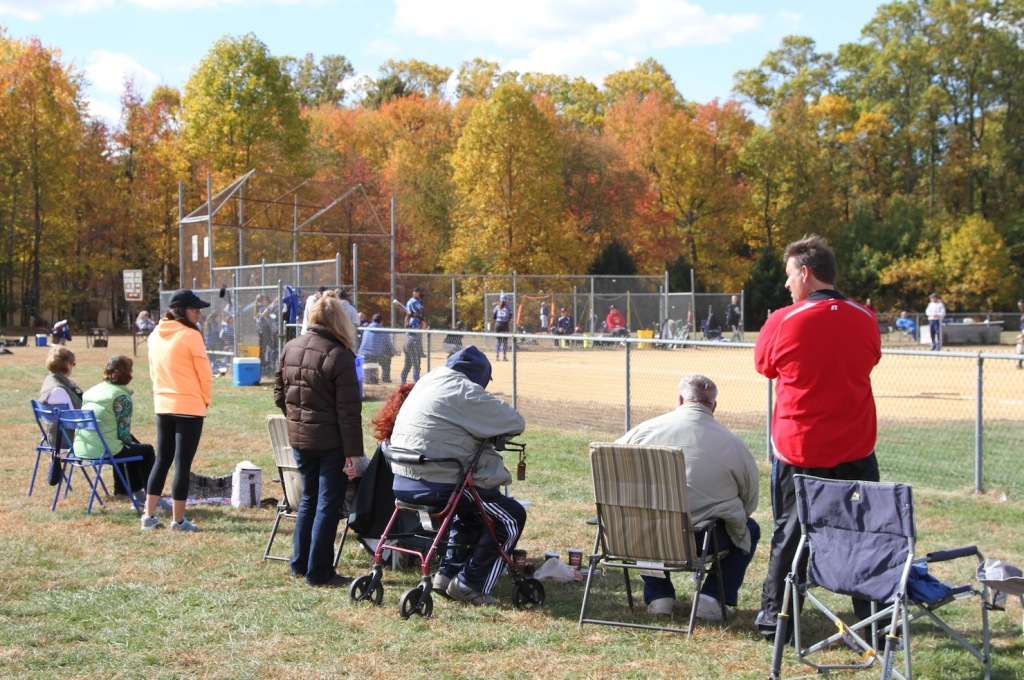
    This is Cherry Hill. It is by far the most desirable suburb in this part of southern New Jersey as measured by all the usual metrics. Property values are high. Public schools are great. The municipal government is lean and responsive. This is as good as the American Dream gets.


    Screen Shot 2015-11-17 at 2.50.46 PM

    Screen Shot 2015-11-17 at 2.51.14 PM

    Screen Shot 2015-11-17 at 2.52.55 PM


    Screen Shot 2015-11-17 at 2.52.03 PM

    Screen Shot 2015-11-17 at 2.50.22 PM

    Screen Shot 2015-11-17 at 3.06.03 PM

    Screen Shot 2015-11-17 at 3.06.42 PM

    Screen Shot 2015-11-17 at 3.05.02 PM

    Screen Shot 2015-11-17 at 3.11.13 PM

    The families who live here are overwhelmingly well educated professionals, often first and second generation immigrants who have discovered the high quality of life on offer. What was once a nearly 100% white enclave is now a diverse multi-cultural community. You’re just as likely to live next door to Hindus, Jews, Greek Orthodox, or Muslims, as the main line Protestants that dominated the area in previous decades. When proponents of suburban living talk about the success of the suburban development pattern this is the kind of place they often refer to.

    Screen Shot 2015-11-17 at 2.56.58 PM

    Screen Shot 2015-11-17 at 2.55.15 PM

    Screen Shot 2015-11-17 at 2.56.28 PM

    Screen Shot 2015-11-17 at 2.55.44 PM

    If you’re raising children you really can’t ask for a better environment. It’s safe, clean, and (most importantly) your kids will rub shoulders with the kids of equally successful families – which is what exclusive suburbs and premium school districts are really all about. Cherry Hill has successfully filtered out the riffraff.

    Screen Shot 2015-11-17 at 4.09.10 PM

    Screen Shot 2015-11-17 at 4.26.18 PM

    Cherry Hill has a middle-of-the-road population when it comes to social issues, but it’s decidedly conservative when it comes to money. It has embraced all the usual cost savings techniques to keep the budget tight and taxes as low as possible. Traditional in-house departments have been dissolved in favor of contract services with low cost private firms for things like waste management, school buses, and landscaping. Sales tax revenue has been boosted by cultivating the most successful regional shopping mall in the area. Class A suburban office parks deliver commercial property taxes to help subsidize the shortfall from residential taxes.

    Screen Shot 2015-11-17 at 4.08.41 PM

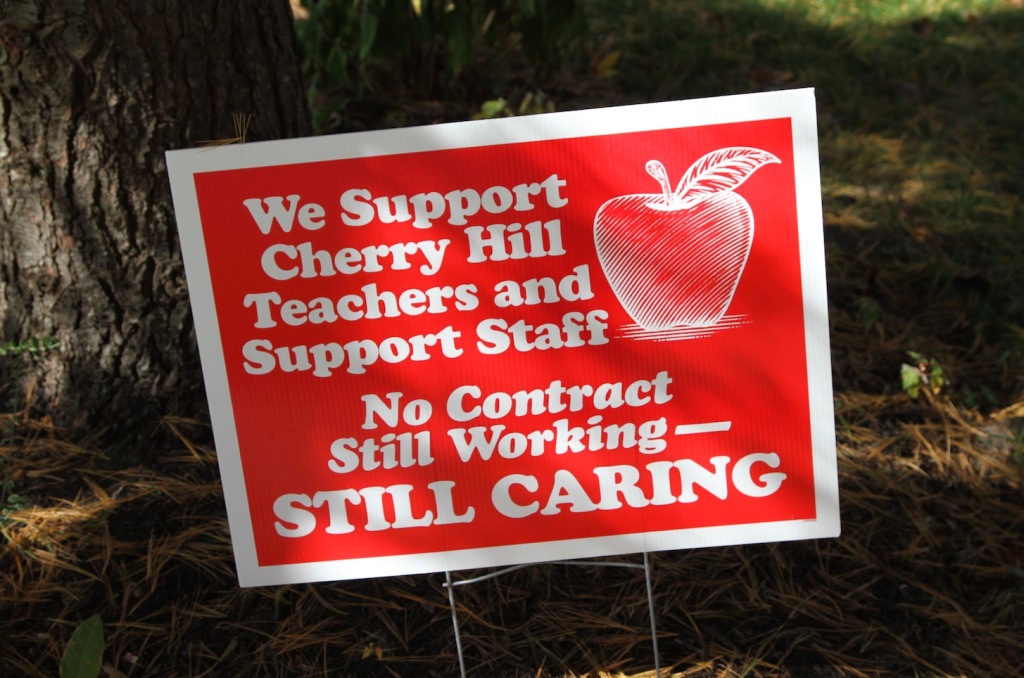
    And yet… there are problems. The average homeowner in Cherry Hill pays about $8,000 a year in property tax. Some of the larger homes pictured above pay on the order of $23,000 a year. You can blame teachers and cops and their “extravagant” salaries and pensions, but schools and public safety are the primary attractions to living in Cherry Hill. Outsourcing to low wage alternatives for these public services may not really work over the long term – although Cherry Hill keeps pushing that envelope. And the cost of maintaining a huge amount of very expensive attenuated public infrastructure like roads, sewers, and water pipes is rapidly getting out of control.

    Screen Shot 2015-11-17 at 3.59.48 PM

    Screen Shot 2015-11-17 at 5.54.35 PM

    Screen Shot 2015-11-17 at 5.54.06 PM

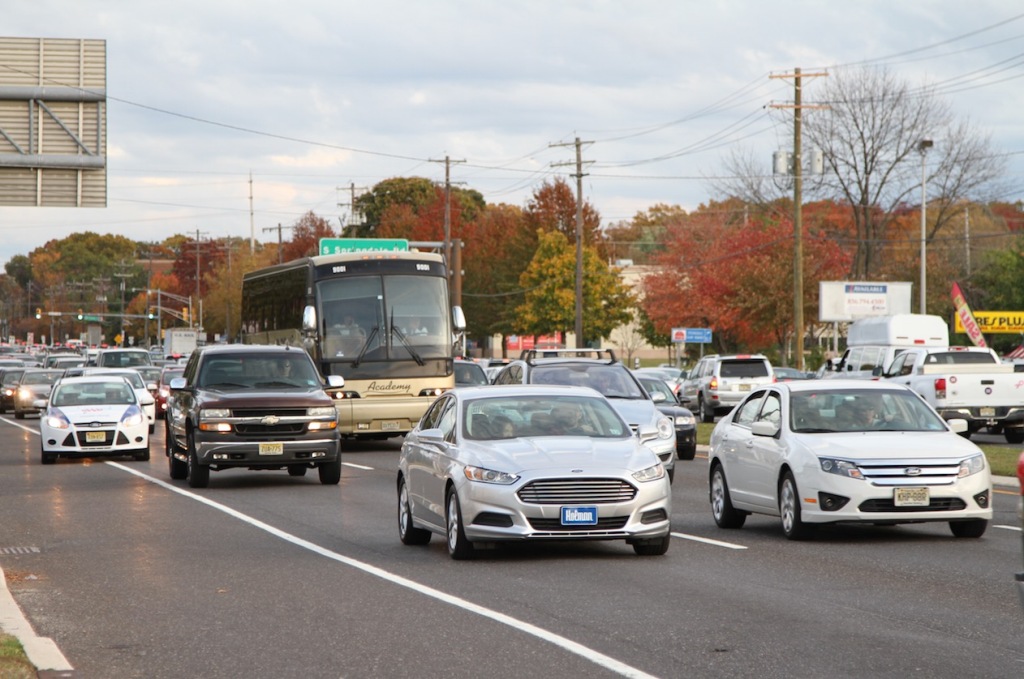
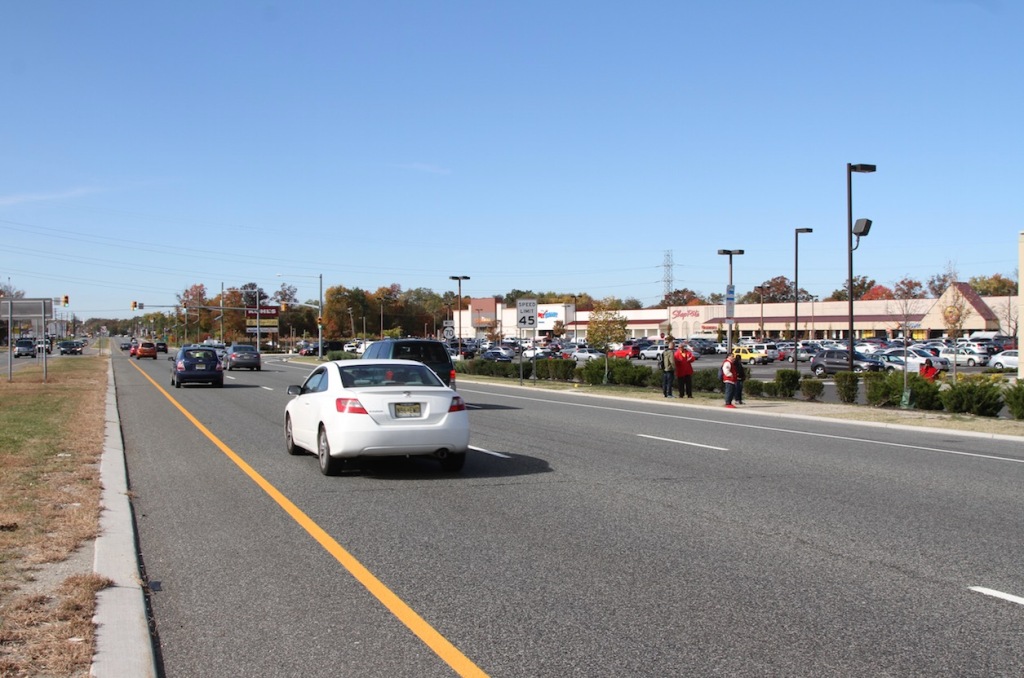
    Here’s another problem with Cherry Hill. This is what passes for the public realm. All the emphasis has been placed on private space. The homes, the tree lined subdivisions, the quality retail establishments, and the hermetically sealed professional centers are pristine. But in between there’s nothing that even comes close to a pleasant commons. Route 70 is “Main Street.” That’s all you get. Of course, the people who self select in to Cherry Hill don’t care. They’re inside their homes, shops, offices, and cars 100% of the time. There’s simply no need for a public realm. It’s a fully private pay-per-view environment.

    Screen Shot 2015-11-17 at 4.01.15 PM

    Screen Shot 2015-11-17 at 3.59.17 PM

    Screen Shot 2015-11-17 at 3.50.30 PM

    Screen Shot 2015-11-17 at 4.10.16 PM

    Screen Shot 2015-11-17 at 4.13.11 PM

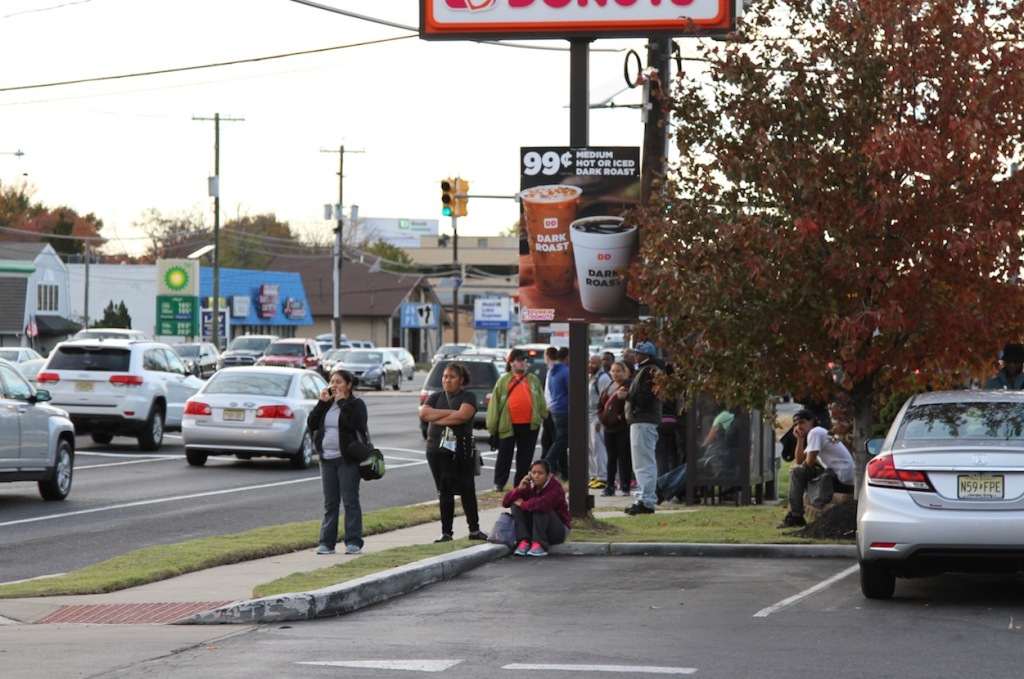
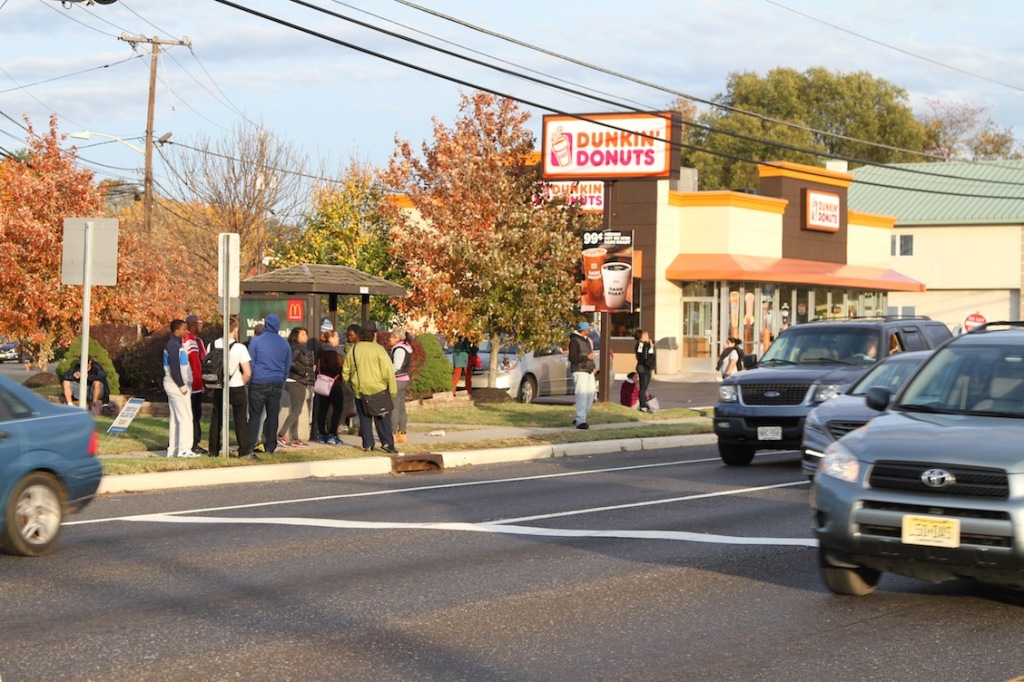
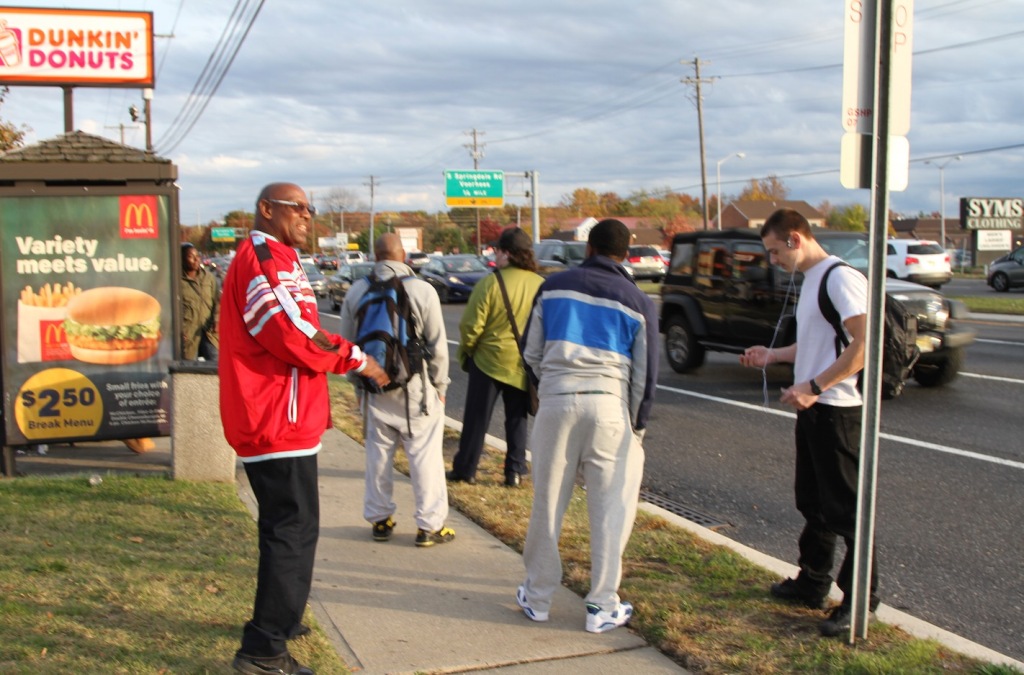
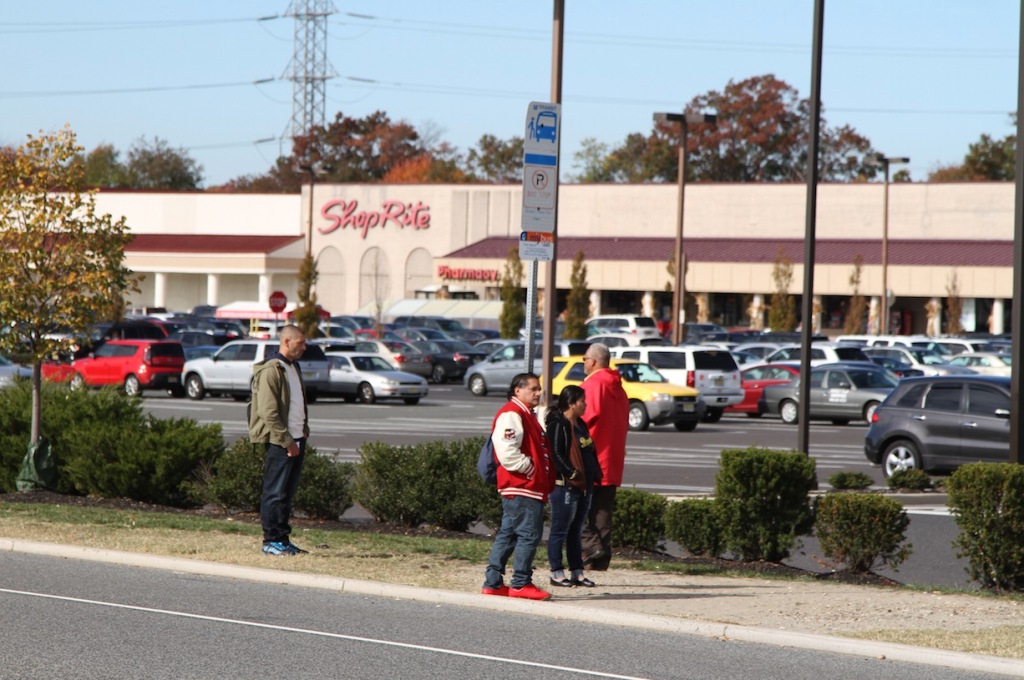
    Unless you’re one of these poor bastards standing on the side of the highway waiting for a bus that may or may not arrive sometime within the next hour. These people can’t afford to live in Cherry Hill or own private vehicles so they commute on crappy inadequate public transit to and from neighboring low income suburbs.

    Cherry Hill is a giant wealth sponge. It soaks up the segment of the population that can afford to live the best version of a suburban life. That means there are many other suburbs – the vast majority – that become the also-ran towns of fair-to-middling suburbs with just-okay schools and mediocre shops. And then there are the lower income suburbs farther out that can’t quite manage to bootstrap themselves up above the poverty line.

    The dominant conversation in America today centers on the bleakness of inner city ghettos and the extravagance of newly gentrified urban elite neighborhoods. The reality is that most Americans live in the suburbs. A small number of people live in a few great places like Cherry Hill. The overwhelming bulk of the population, including the poor and large downwardly mobile middle class, now live in failing cheap anonymous declining suburbs that no one talks about – until they erupt Ferguson style.

    I’m just sayin.

    John Sanphillippo lives in San Francisco and blogs about urbanism, adaptation, and resilience at granolashotgun.com. He’s a member of the Congress for New Urbanism, films videos for faircompanies.com, and is a regular contributor to Strongtowns.org. He earns his living by buying, renovating, and renting undervalued properties in places that have good long term prospects. He is a graduate of Rutgers University.

  • How Land Use Regulations Hurt the Poor

    Sandy Ikeda and I have published a new Mercatus paper on the regressive effects of land use regulation. We review the empirical literature on how the effects of rules such as maximum density, parking requirements, urban growth boundaries, and historic preservation affect housing prices. Nearly all of the studies on the price effects of land use regulations find that — as supply and demand analysis would predict — these rules increase the price of housing. While the broad consensus on the price effects of land use regulations is probably to no surprise to Market Urbanism readers, some policy analysts continue to insist that in fact rules requiring detached, single family homes help cities maintain housing affordability.

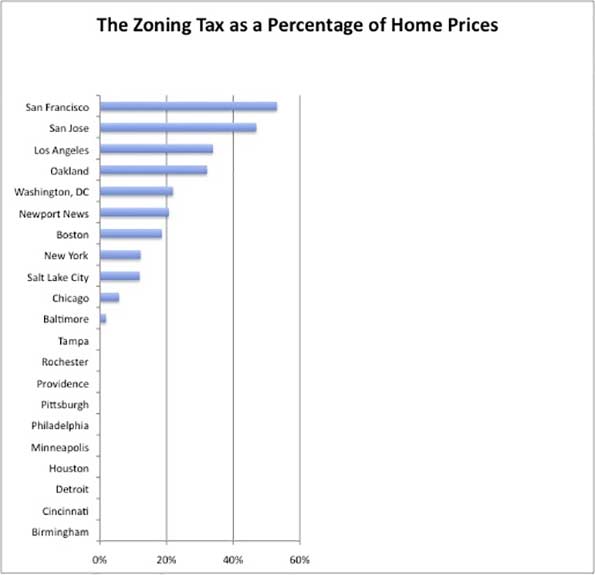
    Ed Glaeser, Joseph Gyourko, and Raven Saks estimate the effects of regulations on house prices in their paper “Why Is Manhattan So Expensive? Regulation and the Rise in Housing Prices.” They estimate what they call the “zoning tax” in 21 cities. The zoning tax indicates the proportion of housing costs that are due to land use regulations. The chart below shows the percentage of housing costs that this “tax” accounts for:

    The zoning tax as calculated by Edward Glaeser, Joseph Gyourko, and Raven Saks in 'Why Is Manhattan So Expensive? Regulation and the Rise in House Prices' (2003).

    The zoning tax as calculated by Edward Glaeser, Joseph Gyourko, and Raven Saks in “Why Is Manhattan So Expensive? Regulation and the Rise in House Prices” (2003).

    Policies that increase housing costs have a clear constituency in all homeowners, but they hurt renters and anyone who is hoping to move to an expensive city. The burden of land use regulations are borne disproportionately by low-income people who spend a larger proportion of their income on housing relative to higher income people. These regressive effects of land use policy extend beyond reducing welfare if the least-advantaged Americans. Additionally, rules that increase the cost of housing in the country’s most productive cities reduce income mobility and economic growth.

    In our paper Sandy and I also discuss proposals for reducing the inefficiency of cities’ current land use regulation practices. David Schleicher has proposed some of innovative policy improvements, including a zoning budget that a city can implement to commit itself to permitting a certain amount of new development. A zoning budget would create a situation in which local policymakers are forced to make tradeoffs between different land use restrictions, as opposed to the current situation in which there is no limit to policies restricting building. Another proposal that Schleicher suggests is a tax increment local transfer, or a TILT. With TILTs, homeowners who live near new development would receive some portion of the additional property taxes that the city raises by allowing the development. The purpose of TILTs is to reduce NIMBY opposition to development.

    We hope that our paper will be a helpful resource to those looking for an accessible overview of this area of research and point to future research opportunities for institutional reforms to allow for the construction of affordable housing.

    This piece first appeared at Market Urbanism.

    Emily Washington is a policy research manager for the Mercatus Center at George Mason University. She manages the Spending and Budget Initiative and State and Local Policy Project portfolios. Her writing has appeared in USA Today, The Christian Science Monitor, Economic Affairs, and The Daily Caller. She contributes to the blogs Neighborhood Effects and Market Urbanism.

  • Are We Heading for An Economic Civil War?

    When we speak about the ever-expanding chasm that defines modern American politics, we usually focus on cultural issues such as gay marriage, race, or religion. But as often has been the case throughout our history, the biggest source of division may be largely economic.

    Today we see a growing conflict between the economy that produces consumable, tangible goods and another economy, now ascendant, that deals largely in the intangible world of media, software, and entertainment. Like the old divide between the agrarian South and the industrial North before the Civil War, this threatens to become what President Lincoln’s Secretary of State, William Seward, defined as an “irrepressible conflict.”

    Other major economic divides—between capital and labor, Wall Street versus Main Street—defined politics for much of the 20th century. But today’s tangible-intangible divide is particularly tragic because it undermines America’s peculiar advantage in being a powerhouse in both the material and non-material worlds. No other large country can say that, certainly not China, Japan, or Germany, industrial powerhouses short on resources, while our closest cousins, such as Canada, Australia, and New Zealand, remain, for the most part, dependent on commodity trade.

    The China syndrome and the shape of the next slowdown

    Over the past decade, the United States has enjoyed two parallel booms that combined to propel the economy out of recession. One was centered in places like Houston, Dallas-Ft. Worth, Oklahoma City, and across much of the Great Plains. These areas were all located in the first states to emerge from the recession, and benefited massively from a gusher in energy jobs due largely to fracking.

    At the same time, another part of the economy, centered in Silicon Valley as well as Seattle, Austin, and Raleigh/Durham, has also been booming. Though far more restricted than their counterparts in the “tangible” economy in terms of both geography and jobs, the tech/digital economy did not lag when it came to minting fortunes. By 2014, the media-tech sector accounted for six of the nation’swealthiest people. Perhaps more important, 12 of the nation’s 17 billionaires under 40 also hail from the tech sector.

    Until China’s economy hit a wall this fall, these two sectors were humming along, maybe not enough to restore the economy to its ’90s trim robustly enough to improve conditions in many parts of the country. But as China begins to cut back on commodity purchases, many key raw material prices—copper and iron to oil and gas as well as food stuffs—have fallen precipitously, devastating many developing economies in South America, Africa, the Middle East, and Southeast Asia.

    Plunging prices are also beginning to hurt many local economies in the U.S., particularly in the “oil patch” that spreads from west Texas to North Dakota. This is one reason why overall economic growth has fallen, and is unlikely to revive strongly in the months ahead. Overall, according to the most recent numbers, job growth remains slow and long-term unemployment stubbornly high while labor participation is stuck at historically low levels. Much of this loss is felt by the kind of middle and working class people who tend to work in tangible industries.

    But it’s not just the much maligned energy economy that is in danger. The recovery of manufacturing was one of the most heartening “feel good” stories of the recession. Every Great Lakes state except Illinois now enjoys an unemployment rate below the national average, and several, led by the Dakotas, Minnesota, Nebraska, and Iowa, boast unemployment that is among the lowest in the nation. Now a combination of a too-strong dollar, declining demand for heavy equipment, and falling food prices threaten economies throughout the Great Lakes and the Great Plains.

    Waging war on the tangible economy

    President Obama’s emphasis on battling climate change—aimed largely at the energy and manufacturing sectors—in his last year in office will only exacerbate these conflicts. For one thing, the administration’s directive to all but ban coal could prove problematic for many Midwest states, including several—Iowa, Kansas, Ohio, Illinois, Minnesota, and Indiana—that rely the most on coal for electricity. Not surprisingly, much of the opposition to the Environmental Protection Agency’s decrees come from heartland states such as Oklahoma, Indiana, and Michigan. The President’s belated rejection of the Keystone Pipeline is also intensely unpopular, including among traditionally Democratic-leaning construction unions.

    These policies have also succeeded to pushing the energy industry, in particular, to the right. In 1990 energy firms contributed almost as much to Democrats as to Republicans; last year they gave more than three times as much to the GOP.

    In contrast, the tech oligarchs and their media allies largely embrace the campaign against fossil fuels. Environmental icon Bill McKibben, for example, has won strong backing in Silicon Valley for his drive to marginalize oil much like the tobacco industry was ostracized earlier. Meanwhile the onetime pragmatic interest in natural gas as a cleaner replacement for coal is fading, as the green lobby demands not just the reduction of fossil fuel but its rapid extermination.

    Embracing the green agenda costs Silicon Valley little. High electricity prices may take away blue collar jobs, but they don’t bother the affluent, well-educated, Telsa-driving denizens of the Bay Area, who also pay less for power. But those rates are devastating to the less glamorous people who live in California interior. As one recent study found, the average summer electrical bill in rich, liberal andtemperate Marin County was $250 a month, while in impoverished , hotter Madera, the average bill was twice as high.

    Many Silicon Valley and Wall Street supporters also see business opportunities in the assault on fossil fuels. Cash-rich firms like Google and Apple, along with many high-tech financiers and venture capitalist, have invested in subsidized green energy firms. Some of these tech oligarchs, like Elon Musk, exist largely as creatures of subsidies. Neither SolarCity nor Tesla would be so attractive—might not even exist—without generous handouts.

    In this way California already shows us something of what an economy dominated by the intangible sectors might look like. Driven by the “brains” of the tech culture, the ingenuity of the “creative class,” and, most of all, by piles of cash from Wall Street, hedge funds, and venture capitalists, the tech oligarchs have shaped a new kind of post-industrial political economy.

    It is really now a state of two realities, one the glamorous software and media-based economy concentrated in certain coastal areas, surrounded by a rotting, and increasingly impoverished, interior. Far from the glamour zones of San Francisco, the detritus of the fading tangible economy is shockingly evident. Overall nearly a quarter of Californians live in poverty, the highest percentage of any state. According to a recent United Way study, almost one in three Californians is barely able to pay his or her bills.

    Silicon Valley’s political agenda

    For the time being, with the rest of the economy limping along, the tech oligarchs seem, if anything, ever more arrogant and sure that they will define the future of the country’s politics. At a time when most small business owners hold Obama in low regard, the Democratic Party can consider the tech sector as an intrinsic part of its core political coalition. In 2000 the communications and electronics sectorwas basically even in its donations; by 2012 it was better than two to one democratic.

    Once largely apolitical or non-partisan in their approach, firms like Microsoft, Apple and Google now overwhelmingly lean to the Democrats. President Obama has even enlisted several tech giants—including venture capitalist John Doerr, Linked In billionaire Reid Hoffman, and Sun cofounder Vinod Khosla—to help plan his no doubt lavish and highly political retirement.

    The love-fest between Obama and Silicon Valley grows from a common belief in being extraordinary. The same media that has marveled at Obama’s celebrated brilliance also hails Silicon Valley’s ascendency as a triumph of brains over brawn.

    Yet in reality many traditional industries such as energy and manufacturing still depend on skilled engineers. Indeed, after Silicon Valley, the biggest concentration of engineers per capita (PDF) can be found in brawny metros like Houston and Detroit. New York and Los Angeles, which like to parade as tech hotbeds, rank far behind.

    In contrast to engineers laboring in Houston or Detroit, those who work in Silicon Valley focus largely on the intangible economy based on media and software. The denizens of the various social media, and big data firms have little appreciation of the difficulties faced by those who build their products, create their energy, and grow their food. Unlike the factory or port economies of the past, those with jobs in the new “creative” economy also have little meaningful interaction with working class labor, even as they finance politicians who claim to speak for those blue collar voters.

    This may explain the extraordinary gap between the economies—and the expectations—of coastal and interior California. The higher energy prices and often draconian regulations that prevented California from participating in the industrial renaissance are hardly issues to companies that keep their servers in cheap energy areas of the Southwest or Pacific Northwest and (think Apple) manufacture most if not all of their products in Asia.

    In the process the Democrats, once closely allied with industry, are morphing into a post-industrial party. Manufacturing in strongholds like Los Angeles, long the industrial center of the country, continues to erode. In a slide that started with the end of the Cold War, Southern California’s once-diverse industrial base has eroded rapidly, from 900,000 jobs just a decade ago to 364,000 today. New York City, which in 1950 boasted 1 million manufacturing jobs, now has fewer than 100,000. Overall, manufacturing accounts for barely 5 percent of state domestic product in New York and 8 percent in California, compared to 30 percent in Indiana and 19 percent in Michigan.

    This divide could become decisive in the election. In contrast to advances in energy, autos, and homebuilding, which produced good blue collar and middle-skilled jobs, the benefits of the current tech boom have been limited, both in terms of job creation (outside of the Bay Area) and increased productivity, for the vast majority of voters.

    This underlying economic conflict is redefining our politics less along lines of ideology and more in terms of interests. Increasingly states that follow the Obama line on energy, such as New York and California, are not contestable for Republicans. But elsewhere—beyond the coasts—there may be greater resistance.

    Among those who are likely to revolt are those workers and entrepreneurs in the oil patch, those who build heavy machinery, and those who grow large quantities of food. The recent Republican win in Kentucky was in part based on opposition to anti-coal regulations coming from the Obama administration. As the EPA ramps up its regulatory onslaught, one can expect energy-dependent industries and regions to recoil, particularly at a time when their industries are headed into a recession. Republicans claims that regulatory policies hurt the tangible economies will gain traction if car factories and steel mills start shutting down again, while farmers plant fewer soybeans and developers build fewer suburban homes.

    The emergence of an economic civil war?

    Hillary Clinton may praise the economic progress under President Obama, and win the nods of those in the tech, media, and financial community who have done very well on his watch. There’s enough momentum from these industries to guarantee that the entire West Coast and the Northeast will fold comfortably, and predictably, into the Clinton column, despite rising concern about crime, homelessness, and loss of middle class jobs. But the very same policies that attract the tech world voter to Clinton will just as certainly alienate many working class and middle class Democrats in places like Appalachia, the Gulf Coast, and particularly the politically pivotal Great Lakes.

    The stakes could be huge. If the Republicans can convince most voters in the middle of the country that the coastal-driven policy agenda is a direct threat to their interests, the GOP will likely carry the day. But if the Democrats can convince the country that coastal California and New York City represent the best future for us all, then get ready for Hillary, because nothing else—certainly not the old social issues—will stop her.

    This piece first appeared at The Daily Beast.

    Joel Kotkin is executive editor of NewGeography.com and Roger Hobbs Distinguished Fellow in Urban Studies at Chapman University, and a member of the editorial board of the Orange County Register. He is also executive director of the Houston-based Center for Opportunity Urbanism. His newest book, The New Class Conflict is now available at Amazon and Telos Press. He is also author of The City: A Global History and The Next Hundred Million: America in 2050. He lives in Orange County, CA.

  • So Much For The Death Of Sprawl: America’s Exurbs Are Booming

    It’s time to put an end to the urban legend of the impending death of America’s suburbs. With the aging of the millennial generation, and growing interest from minorities and immigrants, these communities are getting a fresh infusion of residents looking for child-friendly, affordable, lower-density living.

    We first noticed a takeoff in suburban growth in 2013, following a stall-out in the Great Recession. This year research from Brookings confirms that peripheral communities — the newly minted suburbs of the 1990s and early 2000s — are growing more rapidly than denser, inner ring areas.

    Peripheral, recent suburbs accounted for roughly 43% of all U.S. residences in 2010. Between July 2013 and July 2014, core urban communities lost a net 363,000 people overall, Brookings demographer Bill Frey reports, as migration increased to suburban and exurban counties. The biggest growth was in exurban areas, or the “suburbiest” places on the periphery.

    How could this be? If you read most major newspapers, or listened to NPR or PBS, you would think that the bulk of American job and housing growth was occurring closer to the inner core. Yet more than 80% of employment growth from 2007 to 2013 was in the newer suburbs and exurbs. Between 2012 and 2015, as the economy improved, occupied suburban office space rose from 75% of the market to 76.7%, according to the real estate consultancy Costar.

    These same trends can be seen in older cities as well as the Sun Belt. Cities such as Indianapolis and Kansas City have seen stronger growth in the suburbs than in the core.

    This pattern can even be seen in California, where suburban growth is discouraged by state planning policy but seems to be proceeding nevertheless. After getting shellacked in the recession, since 2012 the Inland Empire — long described as a basket case by urbanist pundits — has logged more rapid population growth  than either Los Angeles and even generally healthy Orange County. Last year the metro area ranked third in California for job growth, behind suburban Silicon Valley and San Francisco.

    To those who have been confidently promoting a massive “return to the city,” the resurgence of outer suburbs must be a bitter pill. In 2011, new urbanist pundit Chris Leinberger suggested outer ring suburbs were destined to become “wastelands” or, as another cheerily described them, “slumburbs” inhabited by the poor and struggling minorities chased out of the gentrifying city.

    In this worldview, “peak oil” was among the things destined to drive people out of the exurbs . So convinced of the exurbs decline that some new urbanists were already fantasizing that suburban three-car garages would be “subdivided into rental units with street front cafés, shops, and other local businesses,” while abandoned pools would become skateboard parks.

    This perspective naturally appeals to people who write most of our urban coverage from such high-density hot spots as Brooklyn, Manhattan, Washington, D.C., or San Francisco. And to be sure, all these places continue to attract bright people and money from around the world. Yet for the vast majority, particularly families, such places are too expensive, congested and often lack decent public schools. For those who can’t afford super-expensive houses and the cost of private education, the suburbs, particularly the exurbs, remain a better alternative.

    Even as Houston, like other Sun Belt cities, has enjoyed something of a renaissance in its inner core, nearly 80% of the metro area’s new homebuyers last year purchased residences outside Beltway 8, which is far to west of the core city.

    If you want to know why people move to such places, you can always ask them. On reporting trips to places like Irvine, California, Valencia, north of Los Angeles, or Katy, out on the flat Texas prairie 31 miles west of Houston, you get familiar answers: low crime, good schools and excellent access to jobs. Take Katy’s Cinco Ranch. Since 1990, the planned community has grown to 18,000 residents amid a fourfold expansion in the population of the Katy area to 305,000.

    To some, places like Cinco Ranch represents everything that is bad about suburban sprawl, with leapfrogging development that swallows rural lands and leaves inner city communities behind. Yet to many residents, these exurban communities represent something else: an opportunity to enjoy the American dream, with good schools, nice parks and a thriving town center.

    Nor is this a story of white flight. Roughly 40% of the area’s residents are non-Hispanic white; one in five is foreign born, well above the Texas average. Barely half of the students at the local high school are Caucasian and Asian students have been the fastest-growing group in recent years, with their parents attracted to the high-performing schools.

    “We have lived in other places since we came to America 10 years ago,” says Pria Kothari, who moved to Cinco with her husband and two children in 2013. “We lived in apartments elsewhere in big cities, but here we found a place where we could put our roots down. It has a community feel. You walk around and see all the families. There’s room for bikes –that’s great for the kids.”

    Here Come The Millennials

    Potentially, the greatest source of exurban and peripheral revival lies with the maturation of the millennial generation. Millennials — born between 1982 and 2002 — are widely portrayed as dedicated city dwellers. That a cohort of young educated, affluent people should gravitate to urban living is nothing new. The roughly 20% who, according to an analysis by demographer Wendell Cox, live in urban cores may be brighter, and certainly more loquacious, than their smaller town counterparts, dominating media coverage of millennials. But the vast majority of millennials live elsewhere — and roughly 90% of communities’ population growth that can be attributed to millennials since 2000 has taken place outside of the urban core.

    To be sure, millennials are moving to the suburbs from the city at a lower rate than past generations , but this is more a reflection of slower maturation and wealth accumulation.

    According to U.S. Census Bureau data released last month, 529,000 Americans ages 25 to 29 moved from cities out to the suburbs in 2014 while 426,000 moved in the other direction. Among younger millennials, those in their early 20s, the trend was even starker: 721,000 moved out of the city, compared with 554,000 who moved in.

    This may well reflect rising cost pressures, as well as lower priced housing many millennials can afford. Three-quarters, according to one recent survey, want a single-family house, which is affordable most often in the further out periphery.

    Future trends are likely to be shaped by an overlooked fact: as people age, they change their priorities. As the economist Jed Kolko has pointed out, the proclivity for urban living peaks in the mid to late 20s and drops notably later. Over 25% of people in their mid-20s, he found, live in urban neighborhoods; but by the time they move into their mid-30s, it drops to 18% or lower. In 2018, according to Census estimates, the number of millennials entering their 30s will be larger than those in their 20s, and the trend will only get stronger as the generation ages.

    Some might argue that millennials will be attracted to more urban suburbs, places like Bethesda, Md.; Montclair, N.J.; or the West University or Bellaire areas of Houston, all of them located near major employment centers with many amenities. These suburban areas are also among the most expensive areas in the country, with home prices often in the millions. And a number of older inner ring suburbs, as we saw in the case of Ferguson, are troubled and have lost population — even as the number of residents in downtown areas have grown.

    So when millennials move they seem likely to not move to the nice old suburbs, or the deteriorating one, but those more far-flung suburban communities that offer larger and more affordable housing, good schools, parks and lower crime rates.

    Among the research that confirms this is a study released this year by the Urban Land Institute, historically hostile to suburbs, which found that some 80% of current millennial homeowners live in single-family houses and 70% of the entire generation expects to be living in one by 2020.

    The Future Of Exurbia

    Far from being doomed, exurbia is turning into something very different from the homogeneous and boring places portrayed in media accounts. For one thing exurbs are becoming increasingly ethnically diverse. In the decade that ended in 2010 the percentage of suburbanites living in “traditional” largely white suburbs fell from 51% to 39%.  According to a 2014 University of Minnesota report, in the 50 largest U.S. metropolitan areas, 44% of residents live in racially and ethnically diverse suburbs, defined as between 20% and 60% non-white.

    And how about the seniors, a group that pundits consistently claim to be heading back to the city? In reality, according to an analysis of Census data, as seniors age they’re increasingly unlikely to move, but if they do, they tend to move out of urban cores as they reach their 60s, and to less congested, often more affordable areas out in the periphery. Seniors are seven times more likely to buy a suburban house than move to a more urban location. A National Association of Realtors survey found that the vast majority of buyers over 65 looked in suburban areas, followed by rural locales.

    Trends among millennials, seniors and minorities suggest that demographics are in the exurbs’ favor. The movement to these areas might be accelerated by their growing sophistication, as they build amenities long associated with older cities, such as town centers, good ethnic restaurants and shops, diverse religious institutions and cultural centers. At the same time, the growth of home-based business — already larger than transit ridership in two-thirds of American metropolitan areas and growing much faster — increases the need for larger homes of the sort found most often in the outer rings.

    Rather than regard these communities as outrages to the urban form, planners and developers need to appreciate that peripheral developments remain a necessary part of our evolving metropolitan areas. With a new generation looking for affordable homes, good schools and low crime, it seems logical that many will eventually leave core cities that offer none of the above. The future of exurbia is far from dead; it’s barely begun.

    This piece first appeared at Forbes.

    Joel Kotkin is executive editor of NewGeography.com and Roger Hobbs Distinguished Fellow in Urban Studies at Chapman University, and a member of the editorial board of the Orange County Register. He is also executive director of the Houston-based Center for Opportunity Urbanism. His newest book, The New Class Conflict is now available at Amazon and Telos Press. He is also author of The City: A Global History and The Next Hundred Million: America in 2050. He lives in Orange County, CA.

  • How Commuters Get Railroaded by Cities

    With more than $10 billion already invested, and much more on the way, some now believe that Los Angeles and Southern California are on the way to becoming, in progressive blogger Matt Yglesias’ term, “the next great transit city.” But there’s also reality, something that rarely impinges on debates about public policy in these ideologically driven times.

    Let’s start with the numbers. If L.A. is supposedly becoming a more transit-oriented city, as boosters already suggest, a higher portion of people should be taking buses and trains. Yet, Los Angeles County – with its dense urbanization and ideal weather for walking and taking transit – has seen its share of transit commuting decline, as has the region overall.

    Since 1980, before the start of subway and light-rail construction, the percentage of Angelenos taking transit has actually dropped, from 7.0 percent to 6.9 percent, while the region (including the Inland Empire and Ventura County) has seen the transit share drop from 5.1 percent to 4.7 percent. These reductions in ridership have been experienced both on the rail and bus lines.

    The simple truth is that this region is just not structured to run largely on rails. We should not prioritize our transit dollars on trying to remake our region into something resembling New York, or even San Francisco, but in serving the needs, first and foremost, of those who remain dependent on public transit.

    Read the entire piece at The Orange County Register.

    Joel Kotkin is executive editor of NewGeography.com and Roger Hobbs Distinguished Fellow in Urban Studies at Chapman University, and a member of the editorial board of the Orange County Register. He is also executive director of the Houston-based Center for Opportunity Urbanism. His newest book, The New Class Conflict is now available at Amazon and Telos Press. He is also author of The City: A Global History and The Next Hundred Million: America in 2050. He lives in Orange County, CA.