Tag: migration

  • Observations on Exurban Trends

    Getting the Migration Story Straight: Analysts continue to misunderstand the recent metropolitan area census estimates. Much of the misunderstanding arises from a misinterpretation of a chart produced by the Brookings Institution, which indicates that the rate of population growth has fallen in exurban counties and was, last year, less than the rate of growth in what Brookings calls emerging suburbs and "city/high density suburbs." However, the Brookings chart characterizes  only total population growth, which is the combination of the natural growth rate, net international migration and net domestic migration. In other words, the Brookings Institution chart includes both people who move between areas of the United States and the net of those who move from outside the United States, are born or died.

    Perhaps the most befuddled was the Arch Daily, which says that "people are leaving the suburbs and once again flocking to the cities…"  In fact exurban and suburban areas continue to grow, though their growth rates have fallen. The highly touted decline in exurban growth rates is for one year only (2010-2011) and represents only the first year in the last 20 that the exurban has trailed that of the "city/high density suburbs." It is also the first year out of the last 20 that the "city/high density suburbs" did not trail both the suburbs and exurbs.

    However, aggregate growth rates say nothing about moving to or from cities. Only one of the components of population change, domestic migration, can possibility indicate movement from the suburbs and exurbs to the cities. People who migrate from outside the nation, for example, are not moving from suburbs to the city (the suburbs of Paris don’t count). People who are born or die are not migrating from the suburbs to the cities (where they might come from or are going has been the source of endless debate through history). The only people who can possibly be moving from suburbs and exurbs to the city are domestic migrants —people who move within the United states.

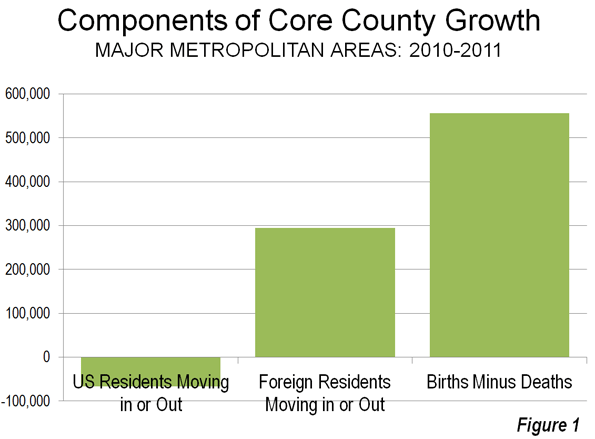
    Figure 1 indicates the components of population change in the core counties of the nation’s 51 metropolitan areas with more than 1,000,000 population (there are no city level migration data).

    • There was a net gain in natural growth of 556,000 (births minus deaths)
    • There was a net gain in international migration of 295,000 (people who moved from outside the nation to the core counties.
    • There was a net loss in domestic migrants of 67,000. These US residents moved  away from the core counties.
    As we indicated in Still Moving to the Suburbs and Exurbs: The 2011 Census Estimates, there was net domestic migration to the suburbs and exurbs between 2010 and 2011. There was net domestic migration out of the central counties (there is no "city" migration data). This is illustrated in Figure 2, which has been annotated to make the actual moving of people clear.
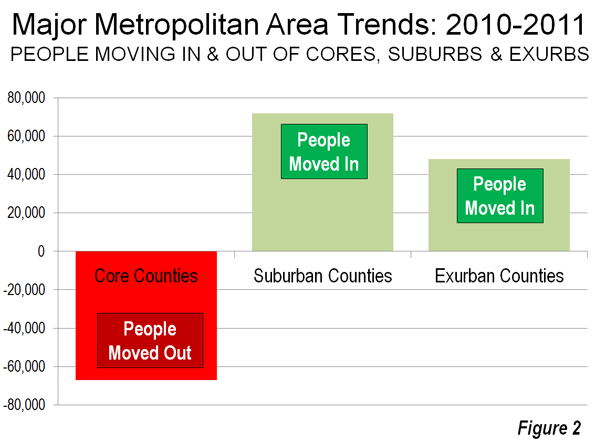
    If it should ever occur, it will be very clear when people are moving to the cores from the suburbs and exurbs. There will be PLUS domestic migration numbers to the core counties and MINUS domestic migration numbers from the suburbs and exurbs. Until that time any flocking (though that is too strong a word for current trends) will be away from the cores and to the suburbs and exurbs.

    Of course, in the greatest economic downturn in more than 75 years, domestic migration has slowed considerably. It is not surprising, therefore that population growth rates in the exurbs and suburbs have fallen, since far fewer people are moving.

    All Domestic Migration was to the Suburbs: Finally, all of the net domestic migration in the nation was to the suburbs and exurbs of the nation’s major metropolitan areas (Also see Figure 2).

    On the Health of Exurban Housing Markets

    On a related subject, University of South Florida Professor Steven Polzin offered an interesting comment on the Planetizen site:

    While I have not explicitly researched the distribution of home foreclosures as a function of the transportation costs of residents, I would caution analysts to more fully explore the nature of the housing foreclosure trend before jumping to the assumption that transportation costs were a significant contributor to geographically differential rates of foreclosure. Foreclosures were more prominent in homes purchased more recently relative to the housing crash. These new home purchasers were more often highly leveraged, had little equity in their home, and in many cases younger workers with less job seniority and more susceptible to layoffs. In addition, in fringe areas that had been growing there was a high concentration of homes all purchased recently. Thus, new growth areas were more susceptible to both foreclosures and the cascading effect of home depreciation spreading based on nearby foreclosed properties.

    In a new suburb a young financially extended family may lose their job, have no equity in the house and quickly lose their house. Its depreciated value is soon reflected in adjacent appraisals cascading the stress throughout relatively fragile neighborhoods. On the other hand in established neighborhoods only a relatively small share of the homes changed hands near the peak of the building bubble. Thus, many of those homeowners had far more equity in their home and perhaps more job seniority and security enabling them to whether a housing downturn. In addition, the diversity of home ages and types and the less frequent occurrence of foreclosed properties will control the pace at which home value depreciation will cascade through the neighborhood.

    If commuting cost was as big a contributor to suburban fringe foreclosure rates then one would have expected downtown condominiums to weather the housing bubble. In many locations like Florida large clusters of new downtown residential properties suffered the same rapid depreciation as did suburban fringe areas. The concentration of new units seemed to be more critical than the location.

    Similar sentiments have been posted on these pages from time to time, such as here and here.

  • On The Move

    Overall migration rates in America appear to be down in the wake of the Great Recession, reaching the lowest levels recorded since the 1940’s. While some statisticians argue that changes in data collection over time have led to an overstatement of such changes, there seems little doubt that “interstate migration has been trending downward for many years,” regardless of recent recessionary effects. That said, Americans remain a mobile people. Each year, millions of Americans make an interstate move. While overall migration rates may be down, “the commonly held belief that Americans are more mobile than their European counterparts still appears to hold true.” In good times and bad, the draw of opportunity in a new state still remains a siren call for many Americans.

    Adding a bit of information on current American migration patterns, Atlas Van Lines, a major American moving company, recently released it’s annual data on interstate moves. A plurality of states (24) had a balance between inbound and outbound moves. Magnet states included the upper south (TN and NC), the capital region (DC, VA, and MD), and hubs of energy production, including North Dakota, Texas, and Alaska. Many Midwest and Great Lakes states had more outbound movers than inbound. While the Atlas numbers don’t mesh completely with Census migration estimates, they may lend some support to Wendell Cox’s argument that domestic migration may be returning to some sort of normalcy. Simply put, people continue to go where they can find work, economic opportunity, reasonable costs of living, and good weather.

  • The Trend Away from Illinois

    Illinois has become famous for producing Barack Obama, but now another sort of fame is in the news. The Illinois Policy Institute has come out with a devastating report on “the state of Illinois”:

    Illinois residents are fleeing the state. When people leave, they take their purchasing power, entrepreneurial activity and taxable income with them. For more than 15 years, residents have left Illinois at a rate of one person every 10 minutes.

    Recent data from the Internal Revenue Service shows that, in 2009, Illinois netted a loss of people to 43 states, including each of its neighbors – Wisconsin, Indiana, Missouri, Kentucky and Iowa. Over the course of the entire year, the state saw a net of 40,000 people leave Illinois for another state.

    The data reflects a continuation of a trend of out-migration from Illinois that has lasted more than a decade. Between 1995 and 2009, the state lost on a net basis more than 806,000 people to out-migration. 

    When people leave, they take their income and their talent with them. In 2009 alone, Illinois lost residents who took with them a net of $1.5 billion in taxable income. From 1995 to 2009, Illinois lost out on a net of $26 billion in taxable income to out-migration.

    Illinois lost one person every 10 minutes between 1995 and 2009. Will the people who stay in Illinois demand reform before more wealth and jobs leave the state?

  • Florida Rising

    New Internal Revenue Service migration data, compiled by the Tax Foundation, confirms that more people are again moving to Florida than are moving out. After a loss in the number of 30,000 domestic migrants ("exemptions") in 2008-9 as indicated on tax returns, Florida added 30,000 in 2009-10. This is still a far lower net migration than before the burst of the housing bubble, but is an indication that Florida has returned to growth. Florida’s migration turnaround was recently noted in new American Community Survey data (see Domestic Migration: Returning to Normalcy?). Additionally, in 2009-10, Florida ranked third out of the 50 states and DC in personal income gains from net domestic migration relative to 2009. Only Montana (#1) and South Carolina (#2) did better.

  • Younger Crowds are Right in the Middle

    When looking for a place to settle down, one might consider cities with active cultural scenes or intellectual communities. However, young people today are looking beyond those factors and moving to where the jobs are. Portland, for example, has a thriving social scene and is one of the nation’s leaders in attracting college graduates, but it ranks 40 as the best place for young adults. A high cost of living, stagnant job growth, and a 9.6 percent jobless rate among 18 to 34 year-olds have tarnished Portland’s reputation as the dream city for life after graduation.

    You can see the economic shift in this country by looking at the best cities for young people. The Southwest is now the haven for those in their 20s and 30s looking to establish their lives and careers. Austin, which ranks number one on the list, has the highest annual employment-growth rate in America at 2.8 percent. This has increased the concentration of 18 to 34 year-olds in its metro area to 28 percent, the most of all cities in the study and well above the average of 23.1 percent. Washington, D.C., Raleigh, Boston, Houston, Oklahoma City, Dallas-Fort Worth and Tulsa round out the top eight.

    However, economics do not dictate everything. North Dakota, which has one of the lowest unemployment rates in the country, is still not a major draw for those right out of college. The cities that have attracted young people in droves not only offer employment and lower costs of living, but also provide some sort of cultural scene. However, if the recession continues to limit job growth on the coasts, North Dakota may build its metro areas to cater to younger crowds, and thus provide them with more than just a steady, good-paying job. Fargo has seen positive net migration every year since 2003, and the state of North Dakota was positive for the first time this decade in 2009. The middle of the country is slowly becoming hot place to be.

  • Vancouver: Moving to the Suburbs

    A few weeks ago, The New York Times touted purported savings that a household would save by living in the core city of New York (in Brooklyn) instead of the suburbs (South Orange, New Jersey). The article downplayed the 1,000 fewer square feet the money bought in Brooklyn and did not consider the 40% higher cost of living.

    The Province in Vancouver has now followed with a near identical story, except that the urban household in will make do with even less space. The city of Vancouver household will live in 800 square feet, or 1,200 fewer square feet in the high rise condominium than in a suburban Coquitlam detached house used in the comparison. Like The Times, The Province is little concerned with the smaller size of the house and misses the fact that the cost of living is from 10% to 20% less in the suburbs and exurbs than it is in the city of Vancouver.

    Nonetheless, according to Tsur Somerville, director of the University of British Columbia UBC Centre for Urban Economics and Real Estate, who assisted in developing the figures for The Province, “If all they cared about were the dollars, they wanted to have $600,000 worth of real estate and then minimize their out-of-pocket costs, all else being considered, then being in the city is better,” A commenter appropriately notes the volatility of strata (condominium association) fees, which suggests that out-of-pocket costs could rise significantly.

    Canadians are not listening to “their betters” any more than Americans. US Census data indicates a continuing strong migration of people from the central cities and strong migration to the suburbs, despite heroic efforts on the part of the media and others to mask the reality.

    “Being in the city” may be preferable to some in the Vancouver area, however not to the majority of the age group (25 to 44 years) most likely to move is voting for the suburbs, according to a recent Statistics Canada report. According to the report:

    “… there continues to be a migration of many young adults and families from central municipalities to surrounding municipalities, while few move in the opposite direction.”

    For every one person who moved from the suburbs to the city of Vancouver between 2001 and 2006 (in the age group):

    • Among all in the age group, 1.8 people moved to the suburbs from the city for every person moving to city from the suburbs.
    • Among those in the age group with advanced degrees, 1.7 people moved to the suburbs for every person moving to the city.
    • Among those earning $100,000 to $150,000, 3.4 people moved to the suburbs for every person moving to the city. The ratio fell to 2.0 times for those making over $150,000.
    • More than 25% of the age group population who had their first children between 2001 and 2006 moved to the suburbs from the city, more than five times as many as moved to the city from the suburbs.

    A table in the Statistics Canada report shows people in “creative class” occupations moving in greater numbers to the suburbs than to the city.

    However, not everyone is moving in larger numbers to the suburbs.

    • More of the lowest income people are moving to the city than to the suburbs.
    • Artists have moved in greater numbers to the city than to the suburbs.
    • University professors and other university personnel have moved in greater numbers to the city than to the suburbs, perhaps explaining why so many in these groups misunderstand the direction of the migration.

    The Statistics Canada report provided a similar analysis for Canada’s two larger metropolitan areas, Toronto and Montreal. In Toronto, moves to the suburbs were 3.5 times moves to the city, while in Montreal 2.7 central city dwellers moved to the suburbs for every suburbanite moving to the city. This does not, however, necessarily indicate that the exodus to the suburbs is stronger in Toronto and Montreal. It is rather an indication of the fact that these two central cities represent a larger share of their metropolitan population than Vancouver. This means that more of the core out-migration is captured in Toronto and Montreal.

    So, the media continues the “drumbeat” and the people keep marching — in the opposite direction.

  • U-Haul to Ohio?

    If one measures a state’s popularity on the cost of U-Haul rentals, then Ohio is losing out to the sunny Florida beaches big time. The one-way rental fees for a 26-foot U-Haul truck show a significant disparity in the cost to go from Florida to Ohio and the cost to go from Ohio to Florida. The rate for going from Miami to Cleveland is $1,000 compared to $1,457 if the destination was swapped, resulting in a 45.7% premium to leave Ohio. That percentage still pales against the 50.4% premium to go from Cleveland to Tampa or the whopping 56% premium to go from Cleveland to Orlando. U-Haul is offering deep discounts for Ohio-bound travelers, which hopefully for Ohio, will attract more people.

    This is not unique to Florida either. U-Haul rates to go to and from states like Texas and Pennsylvania reflect the same pattern. Some speculate that Ohio’s higher taxes are to blame for the exodus, but who knows; maybe Ohioans just want a change of scenery.

  • Phantom Exodus Driven by Phony Cost Comparisons

    If Tara Siegel Bernard of The New York Times is right, (city of) New Yorkers must be among the most irrational people in the world. In “High-Rise or House with Yard,” she describes the purported financial advantages of living in a co-op apartment in Brooklyn versus suburban South Orange, New Jersey.

    The irrationality is that, despite the money that households can save by staying in the city, a net more than 350,000 left for the suburbs between 2000 and 2007, as E. J. McMahon and I found in Empire State Exodus, which summarized IRS inter-county migration data. Indeed, each of the city’s five boroughs lost domestic migrants to the suburbs during the period. An analysis by The New York Times itself found that the city had lost net domestic migrants to every suburban county in the metropolitan area as well as to every county in newly exurban northeastern Pennsylvania. This includes Allentown-Bethlehem and Scranton-Wilkes Barre, toward which New Jersey land use regulations have driven new development.

    “High Rise or House with Yard” stands alone in claiming that New York City is less costly than its suburbs. The most recent (and authoritative) ACCRA cost of living index for Brooklyn is a full 40% higher than in the South Orange (the Newark-Elizabeth area). This is before considering the fact that the Brooklyn home is a 1,000 square foot coop apartment with two bedrooms and one bath, while the suburban home is a 2,000 square foot house in South Orange with four bedrooms and 2.5 baths. Smaller apples may well be less expensive than bigger oranges. The Times also assumes that the suburban resident will commute by train to Manhattan, at more than $400 per month. It is also possible that, like 80% of South Orange commuters, the new suburbanite may choose to work in the New Jersey suburbs. Maybe New Yorkers are not all that irrational after all.

    Moreover, people are moving even further than the suburbs and exurbs, with almost as many people moving from New York City even further away. The latest Bureau of the Census data indicates that every borough experienced a net domestic migration loss between 2000 and 2009. More than 1.2 million residents left New York City, nearly as many people as live in the cities of Washington and Boston combined.

    • Manhattan lost more than a 140,000 net domestic migrants, more people than live in the city of Hartford.
    • Brooklyn lost nearly 450,000 net domestic migrants, more people than live in the city of Miami.
    • Queens lost a 420,000 net domestic migrants, nearly as many people as live in the city of Cleveland.
    • The Bronx more than 200,000 net domestic migrants, more people than live in the city of Providence, Rhode Island.
    • Staten Island did much better, losing only 5,000 net domestic migrants. But then, much of Staten Island looks more like suburban New Jersey than New York City

    In the face of these losses of which at least some at The New York Times are aware, the article notes that “Many empty-nesters are giving up the high-maintenance house in the suburbs in exchange for the attractions of city life.” Not that many.

    Photo: New Jersey Suburbs

  • LA the Least Gentrified Major City?

    Los Angeles has been “gentrified” and made more stable in many of its areas by immigrant settlement, but the phenomenon of Anglo “gentrification” – what used to be “yuppies” or their more contemporary counterparts (original “yuppies” are now in their 50s) upgrading a formerly “bad” neighborhood by pushing up rents and squeezing out existing relatively poor folks – is rarer in Los Angeles than in almost any other American city.

    The closest thing to it has occurred in a few “paleo-urbanist” beach communities. (“Paleo-urbanist” means planned to New Urbanist specifications, but nearly a century ago!) And I think the reason for it has to do with the massive projects by the Irvine Company especially in the 60s and 70s. These projects, plus the nearby existence of Newport Beach – already a “watering spot” for the WAS (WASP but including Catholics, this being California) – plus the riots of 1965, plus the perception that the air in the Irvine and Newport region was less polluted at a time when smog was worse than now, led to a massive secessio patriciorum, a secession of the patricians, It was a physical manifestation of Christopher Lasch’s The Revolt of the Elites. Corporate headquarters relocated en masse. Second homes near Newport Bay often became first homes. Many of the people that might otherwise be gentrifiers in Los Angeles were removed to the first great Edge City, at the head of Newport Bay.

    Los Angeles proper ultimately recovered from the Great Secession. It did so with the help of immigrants on the one hand, and the entertainment industry on the other. In days of old “Hollywood” and “Los Angeles” had been two separate cities occupying the same space. Outsiders who were concerned with the film industry often didn’t refer to “LA” at all, but to “Hollywood” or “The Coast.” “LA” was the rather bourgeois city that happened to occupy the same physical space.

    I remember, for example, when Los Angeles magazine was socially conservative enough to declare, “Why is it they never organize against the popular smut [pornography] – movies like Beach Party, for instance?” This is unimaginable now. I also remember how few were the movie stars in attendance at the openings of the major Music Center (now LA Performing Arts Center) in 1964 and 1967.

    It is now recognized that Hollywood is at the center of cultural life in Los Angeles. The two largest political parties in the state are the Hollywood Democrats and the Eastside LA Democrats, with quite different social priorities. The third party, the Republicans, is desperately trying to hold on to its veto on taxation and the budget. As a matter of fact, the terms Westside and Eastside are used a lot more now. When I lived in Hancock Park in my high school years, I had somewhat of a perception that I was in the exact middle. Wilshire Boulevard, the grand prestigious street of Los Angeles, had, because of foolish zoning, a strip of vacant lots where it went by the Hancock Park residential district (not to be confused with the city park of the same name, two miles west, where LACMA and the Page Museum are}. These lots were not built on until the 70s, when condos were allowed there.

    The so called “Park Mile” did provide a separation between the Miracle Mile on one side and the Wilshire Center – not in those days Koreatown, and in fact a serious rival to Downtown – but the separation between West and East has grown sharper as the Miracle Mile has faded a bit, and Koreatown is what it is and not a rival of Downtown any more. The perceived border between Westside and Eastside LA seems to run near Vine Street, through Old Hollywood and Hancock Park.

    Pasadena and Santa Monica, both singularly uncool places 40 years ago, have become among the coolest parts of the city. Remarkably, Pasadena and nearby areas were the main source of the secessio patriciorum of 40 years ago. The vacuum has been filled in a very interesting way!

    In contrast, downtown San Diego feels a lot like downtown Denver, except with palm trees and water. Both of those downtowns fill up on weekends at night with hard-partying young Anglos, not exactly to be seen on Broadway in LA at any hour. If there was a secessio patriciorum in San Diego, it was only to the UCSD area near La Jolla, much closer. If the secessio had gone, say, to Carlsbad, and upper class San Diegans had relocated to Carlsbad and La Costa en masse, downtown San Diego might be the ethnic wonderland Downtown LA now is. Carlsbad may be 30 miles away but the few Carlsbadians I know seem a lot more loyal to San Diego than OCers are to Los Angeles. Who knows?

    Howard Ahmanson of Fieldstead and Company, a private management firm, has been interested in these issues for many years.

  • I Heart Des Moines

    Forbes Magazine just released its “Best Places for Business and Careers” list and it’s no surprise to me that Des Moines, Iowa just landed in the top spot. Nearly 5 years ago, I’d have said the same thing you may have just muttered. “Des Moines…that’s fly over country…who’d want to live and work THERE?” I fully appreciate your logic with our cold winters, humid summers, and ag-centric heritage. But weather and corn fields aside, the Des Moines metro, a circle consisting of about half a million people, has captured my heart and I’ve become its most passionate evangelist.

    After a lifetime of Southern California bustle, my wife wasn’t exactly thrilled about my desire to abandon our friends and family infrastructure. But ultimately she wanted me to have more than a view from the windshield of a Honda Civic and to be a stay-at-home mom for our kids. We began to see clearly that reaching goals for entrepreneurship, more family time, and more civic engagement were unattainable in our current location. We were ready to reclaim our time, live with less hassle, and stretch a bit.

    So in 2005, we executed geographic arbitrage landing in Clive, Iowa, a beautiful community on the West side of the Des Moines metro. Soon the memory of my 2.5 hour daily plunge into freeway hell was fading. Views of the beaches and mountains from the window of the 6:20AM flight to DFW became real life experiences on urban bike trails and fishing at the lake blocks from my house. A 20-minute drive from end-to-end, the Des Moines metro area defines easy living and 70 miles equals 60 minutes. (I’m still chronically early to my appointments.)

    During those first months here a local business blogger who’d been reading my copious posts on “Why Des Moines?” reached out to me. After coffee and a few introductions, my personal and business network began to flourish. It was hard to comprehend how quickly anyone who’s willing could reach top level contacts in business, associations, and in government. Before long I was shopping a business plan to investors and prominent business owners in town. I was even introduced to State House representatives who cared about my thoughts on what’s happening in their districts. (I went 33 years never meeting a Congressman in CA.) I realized that within a few phone calls I could reach top decision makers, corporate leaders, and legislators and they were willing to listen to me. My business createWOWmedia is growing rapidly now and I’m reaping the benefits of 2.5 years of head down execution and statewide relationship building. I had the time, the energy, and the start up capital through my CA home sale to stop dreaming and start doing. The Des Moines metro gave me that opportunity and I’m thankful for it.

    I’ve figured out that if you’re willing to endure a couple months spent largely indoors or bundled up that the trade-offs are magical and worth their weight in gold. I wouldn’t trade what I’ve found here for anything. The Des Moines metro and the state of Iowa as a whole offer so much…and ask so little in return. Des Moines is easy living defined.

    Am I worried about a massive influx of new Iowans pouring in from Western states based on this piece and Forbes’s recommendations? No chance. But if you do decide to take the plunge and reclaim your life from the concrete jungle, shoot me an email and I’d be happy to guide you. That’s what good neighbors and Iowans do.

    Doug Mitchell is a Southern California refugee who moved his family to Des Moines, Iowa to build a better life. Doug can be reached at doug@createWOWmedia.com or on twitter @doug_mitchell