Tag: New Jersey

  • USDOT Rail Grants to Obligate Taxpayers

    The US Department of Transportation has announced a competitive grant program to reallocate funding that was refused by Florida for a proposed high speed rail line from Tampa to Orlando. The line was cancelled by Governor Rick Scott because of the prospect for billions of dollars of unplanned obligations that could have become the responsibility of the state’s taxpayers.

    Eligibility: Eligible applicants are states, groups of states, Amtrak or other government agencies that authorized to "provide intercity or high-speed rail service on behalf of states or a group of states. The grant program requires recipients of grants (read "taxpayers") to provide financial support to intercity and high speed rail passenger rail programs in the event that cost and ridership projections are optimistic (a routine occurrence).

    Obligation to Pay for Cost Overruns: As in the program announced in 2009. the state, group of states, government agency will be required to demonstrate its financial capacity (that is, the capacity of their taxpayers) to pay for cost overruns (page 9). This open-ended liability led Governor Chris Christie of New Jersey to cancel a new transit-Hudson River rail tunnel, which had costs that were escalating out of control that would be the obligation of the state’s taxpayers. Governor Christie and Governor Scott were both aware of the disastrous record of major infrastructure cost overruns, such as in the Boston Big Dig project, the Korean high-speed rail program and the overwhelming majority of passenger rail projects in North America and Europe, according to a team led by Oxford University Professor Bent Flyvbjerg.

    Obligation to Pay Operating Costs: Moreover, inaccurate passenger and revenue forecasts have been pervasive in high-speed rail systems, as has been documented by Flybjerg, who found that cost overruns occurred in nine out of ten projects:

    … we conclude that the traffic estimates used in decision making for rail infrastructure development are highly, systematically and significantly misleading.

    This is illustrated by the fact that even a decade and one-half after the Eurostar London to Paris and London service was opened, ridership remains 60 percent below projection. Ridership on the Taiwan and Korea high speed rail systems has been one-half or more below projections. Our analysis of the Tampa to Orlando line revealed exceedingly high ridership projections, which were inexplicably raised even higher in a new report just released. Failure to achieve ridership projections increases the likelihood that a line will need operating subsidies, which would be the ultimate responsibility of taxpayers under the USDOT program.

    Federal Grant Repayment Obligation: Moreover, taxpayers of any grant recipient would be required to repay part or all of the federal grant if a sufficient level of service is not maintained for a period of 20 years (page 41). The operation of this provision is illustrated by recent Florida experience. Tri-Rail, the Miami area’s commuter rail service only narrowly escaped having to repay $250 million when its service level was deemed to not meet requirements of a federal grant by early in the Obama presidency. Tri-Rail was rescued by a state subsidy of nearly $15 million annually, which restored an artificially high level of service.

    Intercity and High Speed Rail Program: The federal intercity and high-speed rail program is largely limited to upgrades of Amtrak-type service. Before Governor Scott’s decision, only two of the programs (Florida and California) would have achieved international standard high speed rail speeds.  
  • Confirming International Research: Hudson Tunnel Costs Explode

    Governor Chris Christie of New Jersey is looking like a prophet now. In late October, the Governor cancelled a new tunnel across the Hudson River between New Jersey and New York City, because of the potential for cost overruns, which would be the responsibility of New Jersey taxpayers. By that point, the cost of the tunnel had escalated at least $1 billion to $9.7 billion. The tunnel was to have doubled New Jersey Transit and Amtrak capacity into Penn Station from New Jersey.

    Now Amtrak proposes to build the tunnel itself, a scaled down version of the previous tunnel. The new tunnel would increase capacity for New Jersey Transit and Amtrak trains by 65 percent.

    However, the cost is not scaled down. For one-third less the capacity, initial estimates place the cost of the new tunnel at 40 percent more ($13.5 billion) than the already escalated cost of the cancelled tunnel.

    Of course, it is likely that if planning and construction proceed, the cost of the tunnel could increase substantially beyond initial estimate. This virtual inevitability is indicated in international research by Oxford University professor Bengt Flyvbjerg and others.

  • Rasputin’s Tunnel?

    First, New Jersey Governor Chris Christie cancelled the proposed intercity and suburban rail tunnel between New Jersey and Manhattan because of the financial obligations its out-of-control costs could impose on the state’s taxpayers. Then he delayed the final decision, under pressure from Secretary of Transportation Ray LaHood and other supporters of the tunnel. In the end, the proponents were unable to provide the financial guarantees necessary to keep New Jersey from having to pay more than it had committed and Christie cancelled the tunnel for good. Or so it appeared.

    Now, the tunnel may be back. Mayor Michael Bloomberg of New York City has studies underway that could lead to extending subway Line 7 from a station at 34th Street and 11th Avenue to New Jersey instead.

    Early press reports suggest the line can be built for $5.3 billion, which is approximately one-half the cost of the previous proposal. It is more likely that Governor Christie will buy the Brooklyn Bridge with tax money than this amount is in the “ball park.” The subway tunnel would be only four blocks (15 percent) shorter than the cancelled tunnel.

    The previous tunnel had the less than attractive name, “Access to the Regional Core.” Given the back and forth history of this project, a more appropriate name might be “Rasputin’s Tunnel,” after the Russian mystic whose enemies failed in multiple attempts to murder (though in the end, they succeeded).

  • Governor Christie Cancels Under-Construction Tunnel in Unprecedented Move

    New Jersey governor Chris Christie reaffirmed his decision to cancel the “access to the regional core” tunnel across the Hudson River from New Jersey to New York. Christie had suspended his previous decision pending discussion of alternatives with the US Department of Transportation.

    In the final analysis, according to Christie, none of the alternatives would have capped New Jersey’s liability at its present level, which assumed a project cost of $8.7 billion. Christie told the Moorestown Community House, “No more blank checks from the taxpayers of New Jersey, not on my watch.”

    Current estimates for the project have range from $9.8 billion to more than $12 billion, which would require New Jersey to pay an additional $1.1 billion to $3.3 billion, since under the funding agreement approved by former governor John Corzine, New Jersey was responsible for any cost overruns. In fact, based upon the experience with other projects (such as Boston’s Big Dig), New Jersey could have seen its bill run to another $10 billion or more.

    Christie’s decision is unprecedented. This may be the first time in decades that a major infrastructure project already under construction has been cancelled because its costs had spiraled out of control. Such cost performance has been the rule, rather than the exception. Major research by Oxford University professor Bent Flyvbjerg, Nils Bruzelius (a Swedish transport consultant) and Werner Rottenberg (University of Karlsruhe and former president of the World Conference on Transport Research) covering 80 years of infrastructure projects found routine under-estimation of costs and over-estimation of ridership and revenue (Megaprojects and Risk: An Anatomy of Ambition ).

  • Phantom Exodus Driven by Phony Cost Comparisons

    If Tara Siegel Bernard of The New York Times is right, (city of) New Yorkers must be among the most irrational people in the world. In “High-Rise or House with Yard,” she describes the purported financial advantages of living in a co-op apartment in Brooklyn versus suburban South Orange, New Jersey.

    The irrationality is that, despite the money that households can save by staying in the city, a net more than 350,000 left for the suburbs between 2000 and 2007, as E. J. McMahon and I found in Empire State Exodus, which summarized IRS inter-county migration data. Indeed, each of the city’s five boroughs lost domestic migrants to the suburbs during the period. An analysis by The New York Times itself found that the city had lost net domestic migrants to every suburban county in the metropolitan area as well as to every county in newly exurban northeastern Pennsylvania. This includes Allentown-Bethlehem and Scranton-Wilkes Barre, toward which New Jersey land use regulations have driven new development.

    “High Rise or House with Yard” stands alone in claiming that New York City is less costly than its suburbs. The most recent (and authoritative) ACCRA cost of living index for Brooklyn is a full 40% higher than in the South Orange (the Newark-Elizabeth area). This is before considering the fact that the Brooklyn home is a 1,000 square foot coop apartment with two bedrooms and one bath, while the suburban home is a 2,000 square foot house in South Orange with four bedrooms and 2.5 baths. Smaller apples may well be less expensive than bigger oranges. The Times also assumes that the suburban resident will commute by train to Manhattan, at more than $400 per month. It is also possible that, like 80% of South Orange commuters, the new suburbanite may choose to work in the New Jersey suburbs. Maybe New Yorkers are not all that irrational after all.
    Moreover, people are moving even further than the suburbs and exurbs, with almost as many people moving from New York City even further away. The latest Bureau of the Census data indicates that every borough experienced a net domestic migration loss between 2000 and 2009. More than 1.2 million residents left New York City, nearly as many people as live in the cities of Washington and Boston combined.

    • Manhattan lost more than a 140,000 net domestic migrants, more people than live in the city of Hartford.
    • Brooklyn lost nearly 450,000 net domestic migrants, more people than live in the city of Miami.
    • Queens lost a 420,000 net domestic migrants, nearly as many people as live in the city of Cleveland.
    • The Bronx more than 200,000 net domestic migrants, more people than live in the city of Providence, Rhode Island.
    • Staten Island did much better, losing only 5,000 net domestic migrants. But then, much of Staten Island looks more like suburban New Jersey than New York City

    In the face of these losses of which at least some at The New York Times are aware, the article notes that “Many empty-nesters are giving up the high-maintenance house in the suburbs in exchange for the attractions of city life.” Not that many.

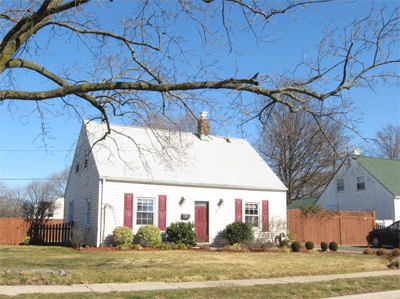
    Photo: New Jersey Suburbs

  • $300,000-$400,000 for a Levittowner?

    An article in The Wall Street Journal details the difficulties that were faced by home owners caught in the Goldman Sachs/John Paulson finance scheme (“The Busted Homes Behind a Big Bet“). The article calls the situation a “dizzyingly complex transaction, involving 90 bonds and a 65-page deal sheet. But it all boiled down to whether people … could pay their mortgages.” There is plenty of blame to go around, but surely there were both big winners and big losers is these deals. The big winners were Goldman Sachs and John Paulson. The big losers were the homeowners, though they were not without blame, since they were not forced to take out the excessively large mortgages.

    The striking thing about this story, however, is the photograph of a Levittown style house in Aberdeen township, New Jersey, a distant suburb nearly 40 miles from New York City. The picture in the article cannot be directly linked, and the best view is on an interactive slide show linked to the article. We have provided a photograph of a near somewhat smaller house in Levittown (see photo).

    In 2006, the owner had refinanced the house with a $308,750 loan, indicating a value more than triple that of comparable housing in much of metropolitan America.

    Levittown, of course, was the late 1940s housing development on Long Island that set the stage for the automobile oriented suburban expansion that did so much to create the largest and most affluent middle class in the world. The Levittown houses were very small, starting at about 750 square feet, though many have been expanded. It was not long before suburban housing became larger, eventually rising to the present 2,250 square foot median. The Wall Street Journal’s Aberdeen township house is under 1,500 square feet, according to Zillow and was built in 1953.

    The Wall Street Journal article misses a significant point. How could such a modest (and doubtless comfortable) house have become so valuable that it could justify refinancing for more than $300,000? The answer is simple. During the real estate bubble, house prices in New Jersey exploded. The state’s restrictive land use regulation largely prohibit new housing on the suburban fringe, leaving prices nowhere to go but up and up strongly. Between 2000 and 2006, the median house value in Monmouth County, where Aberdeen Township is located, rose 125% (according to US Bureau of the Census data). 2006 data for Aberdeen township is not readily available.

    By the peak of the bubble, the median value house in Monmouth County was 5.8 times the median household income, up from 3.0 times in 2000. In 2000, prices were even lower in Aberdeen township, at 2.3 times incomes – well within the 3.0 standard that defined housing affordability for at least one-half century.

    While owners were borrowing $300,000 or more on their modest early 1950s houses in Aberdeen township, households were buying brand new houses of the same size for under $120,000 in Dallas-Fort Worth, Atlanta, Houston, Indianapolis and a host of other metropolitan areas where the American Dream had not been outlawed. Expansion of the housing supply was allowed, and prices stayed within historic norms. For example, in Indianapolis, house prices were less than one-half that of Monmouth County, after adjusting for income levels.

    Meanwhile, a judgment of $370,000 has been entered against the owner of the Aberdeen township Levittowner. The auction in late April by the Monmouth County Sheriff for a price that is probably closer to its real value if it had been in a rationally regulated jurisdiction: $100.