Tag: New York

  • Bringing Soviet Planning to New York City

    New York City Mayor Bill de Blasio wants to bring the same policies that worked so well in the Soviet Union, and more recently in Venezuela, to New York City. “If I had my druthers, the city government would determine every single plot of land, how development would proceed,” he says. “And there would be very stringent requirements around income levels and rents.”

    As shown in the urban planning classic, The Ideal Communist City, soviet planners also believed they were smart enough to know how every single plot of land in their cities should be used. The cities built on their planning principles were appallingly ugly and unlivable. They were environmentally sustainable only so long as communism kept people too poor to afford cars and larger homes.

    If de Blasio believes in this planning system so much, why doesn’t he implement it in New York City? The biggest obstacle, he says, is “the way our legal system is structured to favor private property.” He blames housing affordability problems on greedy developers who only build for millionaires.

    The reality is that, under the control of private property owners, New York City housing was quite affordable in 1969. It was only when planners began to interfere with private property rights that housing prices spiraled out of control.

    In 1969, New York City median family incomes were $,9692 and median home prices were $25,700, for a value-to-income ratio of 2.7. This was affordable because, at 5 percent interest, someone could devote 25 percent of their income to a mortgage that is 2.7 times their income and pay off the loan in 15 years. Housing was even more affordable in the suburbs, as value-to-income ratios in the New York metropolitan area were 2.6.

    By comparison, value-to-income ratios in 2015 were 8.8 for the city and 5.1 for the metropolitan area. Even at today’s 3 percent interest rates, someone buying a home that is 8.8 times their income could devote a third of their income to the mortgage and not be able to pay it off in 40 years.

    What happened since 1969 to make housing so much less affordable? Contrary to de Blasio, one thing that didn’t happen is that developers got greedier. While there is no accurate measure, I am sure that people were just as greedy in 1969 as they are today. The human desire to accumulate wealth hasn’t changed in thousands of years, which is one reason why the kind of socialism that de Blasio favors never works.

    Instead, one thing that happened was rent control. New York state first imposed rent control in 1950, but the law exempted rental housing built after 1947, and other housing was gradually deregulated through 1969. But in 1969, New York passed a new law that applied rent control to all housing, thus discouraging anyone from building new rental housing.

    Another thing that happened was the city’s historic preservation ordinance, which was passed in 1965 and which has gradually restricted more and more of the city from redevelopment. More recently, New York City responded to unaffordable housing by passing an inclusionary zoning ordinance which provides affordable housing for a tiny number of people at the expense of making it less affordable for everyone else.

    New Jersey and Connecticut did their part by passing statewide growth management laws, thus restricting people’s ability to escape New York City’s high housing prices by moving to the suburbs. Connecticut first passed its law in 1974 and New Jersey in 1986.

    All of these actions are examples of the kind of government control that de Blasio supports, and all of them contributed to the high housing costs that de Blasio objects to. The next time he wants to find a greedy person to blame for unaffordable housing, he should look in a mirror.

    This piece first appeared on The Antiplanner.

    Randal O’Toole is a senior fellow with the Cato Institute specializing in land use and transportation policy. He has written several books demonstrating the futility of government planning. Prior to working for Cato, he taught environmental economics at Yale, UC Berkeley, and Utah State University.

    Photo: Kevin Case from Bronx, NY, USA (Bill de Blasio) [CC BY 2.0], via Wikimedia Commons

  • The Great Transit Rip-Off

    Over the past decade, there has been a growing fixation among planners and developers alike for a return to the last century’s monocentric cities served by large-scale train systems. And, to be sure, in a handful of older urban regions, mass transit continues to play an important — and even vital — role in getting commuters to downtown jobs. Overall, a remarkable 40 percent of all transit commuting in the United States takes place in the New York metropolitan area — and just six municipalities make up 55 percent of all transit commuting destinations.

    But here’s an overlooked fact: Transit now serves about the same number of riders as it did in 1907, when the urban population was barely 15 percent of what it is today. Most urban regions, such as Southern California, are nothing like New York — and they never will be. Downtown Los Angeles may be a better place in which to hang out and eat than in the past, but it sorely lacks the magnetic appeal of a place like Manhattan, or even downtown San Francisco. Manhattan, the world’s second-largest employment center, represents a little more than 20 percent of the New York metropolitan area’s employment. In Los Angeles, by contrast, the downtown area employs just 2 percent.

    Transit is failing in Southern California

    As we demonstrate in a new report for Chapman University, our urban form does not work well for conventional mass transit. Too many people go to too many locales to work, and, as housing prices have surged, many have moved farther way, which makes trains less practical, given the lack of a dominant job center. But in its desire to emulate places like New York, Los Angeles has spent some $15 billion trying to evolve into what some East Coast enthusiasts call the “next great transit city.”

    The rail lines have earned Mayor Eric Garcetti almost endless plaudits from places like the New York Times. Yet, since 1990, transit’s work trip market share has dropped from 5.6 percent to 5.1 percent. MTA system ridership stands at least 15 percent below 1985 levels, when there was only bus service, and the population of Los Angeles County was about 20 percent lower. In some places, like Orange County, the fall has been even more precipitous, down 30 percent since 2008. It is no surprise, then, that, according to a recent USC study, the new lines have done little or nothing to lessen congestion.

    This experience is not limited to L.A. Most of the 19 metropolitan areas with new mass transit rail systems — including big cities like Atlanta, Houston, Dallas and even Portland, Ore. — have experienced a decline in transit market share since the systems began operations.

    Read the entire piece at The Orange County Register.

    Joel Kotkin is executive editor of NewGeography.com. He is the Roger Hobbs Distinguished Fellow in Urban Studies at Chapman University and executive director of the Houston-based Center for Opportunity Urbanism. His newest book is The Human City: Urbanism for the rest of us. He is also author of The New Class ConflictThe City: A Global History, and The Next Hundred Million: America in 2050. He lives in Orange County, CA.

    Wendell Cox is principal of Demographia, an international public policy and demographics firm. He is a Senior Fellow of the Center for Opportunity Urbanism (US), Senior Fellow for Housing Affordability and Municipal Policy for the Frontier Centre for Public Policy (Canada), and a member of the Board of Advisors of the Center for Demographics and Policy at Chapman University (California). He is co-author of the “Demographia International Housing Affordability Survey” and author of “Demographia World Urban Areas” and “War on the Dream: How Anti-Sprawl Policy Threatens the Quality of Life.” He was appointed to three terms on the Los Angeles County Transportation Commission, where he served with the leading city and county leadership as the only non-elected member. He served as a visiting professor at the Conservatoire National des Arts et Metiers, a national university in Paris.

    Photo: Esirgen (Own work) [CC BY-SA 3.0], via Wikimedia Commons

  • The Arrogance of Blue America

    In the wake of the Trumpocalypse, many in the deepest blue cores have turned on those parts of America that supported the president’s election, developing oikophobia—an irrational fear of their fellow citizens.

    The rage against red America is so strong that The New York Time’s predictably progressive Nick Kristoff says his calls to understand red voters were “my most unpopular idea.” The essential logic—as laid out in a particularly acerbic piece in The New Republic—is that Trump’s America is not only socially deplorable, but economically moronic as well. The kind-hearted blue staters have sent their industries to the abodes of the unwashed, and taken in their poor, only to see them end up “more bitter, white, and alt-right than ever.”

    The red states, by electing Trump, seem to have lost any claim on usually wide-ranging progressive empathy. Frank Rich, theater critic turned pundit, turns up his nose at what he calls “hillbilly chic.” Another leftist author suggests that working-class support for Brexit and Trump means it is time “to dissolve” the “more than 150-year-old alliance between the industrial working class and what one might call the intellectual-cultural Left.”

    The fondest hope among the blue bourgeoise lies with the demographic eclipse of their red-state foes. Some clearly hope that the less-educated “dying white America,“ already suffering shorter lifespans, in part due to alcoholism and opioid abuse, is destined to fade from the scene. Then the blue lords can take over a country with which they can identify without embarrassment.

    Marie Antoinette Economics

    In seeking to tame their political inferiors, the blue bourgeoisie are closer to the Marie Antoinette school of political economy than any traditional notion of progressivism. They might seek to give the unwashed red masses “cake” in the form of free health care and welfare, but they don’t offer more than a future status as serfs of the cognitive aristocracy. The blue bourgeoisie, notes urban analyst Aaron Renn, are primary beneficiaries of “the decoupling of success in America.” In blue America, he notes, the top tiers “no longer need the overall prosperity of the country to personally do well. They can become enriched as a small, albeit sizable, minority.”

    Some on the left recognize the hypocrisy of progressives’ abandoning the toiling masses. “Blue state secession is no better an idea than Confederate secession was,” observes one progressive journalist. “The Confederates wanted to draw themselves into a cocoon so they could enslave and exploit people. The blue state secessionists want to draw themselves into a cocoon so they can ignore the exploited people of America.”

    Ironically, many of the most exploited people reside in blue states and cities. Both segregation and impoverishment has worsened during the decades-long urban “comeback,” as even longtime urban enthusiast Richard Florida now notes. Chicago, with its soaring crime rates and middle class out-migration, amidst a wave of elite corporate relocations, epitomizes the increasingly unequal tenor of blue societies.

    In contrast the most egalitarian places, like Utah, tend to be largely Trump-friendly. Among the 10 states (and D.C.) with the most income inequality, seven supported Clinton in 2016, while seven of the 10 most equal states supported Trump.

    If you want to see worst impacts of blue policies, go to those red regions—like upstate New York—controlled by the blue bourgeoise. Backwaters like these tend to be treated at best as a recreational colony that otherwise can depopulate, deindustrialize, and in general fall apart. In California, much of the poorer interior is being left to rot by policies imposed by a Bay Area regime hostile to suburban development, industrial growth, and large scale agriculture. Policies that boost energy prices 50 percent above neighboring states are more deeply felt in regions that compete with Texas or Arizona and are also far more dependent on air conditioning than affluent, temperate San Francisco or Malibu. Six of the 10 highest unemployment rates among the country’s metropolitan areas are in the state’s interior.

    Basic Errors in Geography

    The blue bourgeoisie’s self-celebration rests on multiple misunderstandings of geography, demography, and economics. To be sure, the deep blue cites are vitally important but it’s increasingly red states, and regions, that provide critical opportunities for upward mobility for middle- and working-class families.

    The dominant blue narrative rests on the idea that the 10 largest metropolitan economies represents over one-third of the national GDP. Yet this hardly proves the superiority of Manhattan-like density; the other nine largest metropolitan economies are, notes demographer Wendell Cox, slightly more suburban than the national major metropolitan area average, with 86 percent of their residents inhabiting suburban and exurban areas.

    In some of our most dynamic urban regions, such as Phoenix, virtually no part of the region can be made to fit into a Manhattan-, Brooklyn-, or even San Francisco-style definition of urbanity. Since 2010 more than 80 percent of all new jobs in our 53 leading metropolitan regions have been in suburban locations. The San Jose area, the epicenter of the “new economy,” may be congested but it is not traditionally urban—most people there live in single-family houses, and barely 5 percent of commuters take transit. Want to find dense urbanity in San Jose? You’ll miss it if you drive for more than 10 minutes.

    Urban Innovation

    The argument made by the blue bourgeoisie is simple: Dense core cities, and what goes on there, is infinitely more important, and consequential, than the activities centered in the dumber suburbs and small towns. Yet even in the ultra-blue Bay Area, the suburban Valley’s tech and STEM worker population per capita is twice that of San Francisco. In southern California, suburban Orange County has over 30 percent more STEM workers per capita than far more urban Los Angeles.

    And it’s not just California. Seattle’s suburban Bellevue and Redmond are home to substantial IT operations, including the large Microsoft headquarters facility. Much of Portland’s Silicon Forest is located in suburban Washington County. Indeed a recent Forbes study found that the fastest-growing areas for technology jobs outside the Bay Area are all cities without much of an urban core: Charlotte, Raleigh Durham, Dallas-Fort Worth, Phoenix, and Detroit. In contrast most traditionally urban cities such as New York and Chicago have middling tech scenes, with far fewer STEM and tech workers per capita than the national average.

    The blue bourgeois tend to see the activities that take place largely in the red states—for example manufacturing and energy—as backward sectors. Yet manufacturers employ most of the nation’s scientists and engineers. Regions in Trump states associated with manufacturing as well as fossil fuels—Houston, Dallas-Fort Worth, Detroit, Salt Lake—enjoy among the heaviest concentrations of STEM workers and engineers in the country, far above New York, Chicago, or Los Angeles.

    Besides supplying the bulk of the food, energy, and manufactured goods consumed in blue America, these industries are among the country’s most productive, and still offer better paying options for blue-collar workers. Unlike a monopoly like Microsoft or Google, which can mint money by commanding market share, these sectors face strong domestic and foreign competition. From 1997-2012, labor productivity growth in manufacturing—3.3 percent per year—was a third higher than productivity growth in the private economy overall.

    For its part, the innovative American energy sector has essentially changed the balance of power globally, overcoming decades of dependence on such countries as Saudi Arabia, Russia, and Venezuela. Agriculture—almost all food, including in California, is grown in red-oriented areas—continues to outperform competitors around the world.

    Exports? In 2015, the U.S. exported $2.23 trillion worth of goods and services combined. Of the total, only $716.4 billion, or about a third, consisted of services. In contrast, manufactured goods accounted for 50 percent of all exports. Intellectual property payments, like royalties to Silicon Valley tech companies and entrepreneurs, amounted to $126.5 billion—just 18 percent of service exports and less than 6 percent of total exports of goods and services combined, barely even with agriculture.

    Migration and the American Future

    The blue bourgeoisie love to say “everyone” is moving back to the city; a meme amplified by the concentration of media in fewer places and the related collapse of local journalism. Yet in reality, except for a brief period right after the 2008 housing crash, people have continued to move away from dense areas.

    Indeed the most recent estimates suggest that last year was the best for suburban areas since the Great Recession. In 2012, the suburbs attracted barely 150,000 more people than core cities but in 2016 the suburban advantage was 556,000. Just 10 of the nation’s 53 largest metropolitan regions (including San Francisco, Boston, and Washington) saw their core counties gain more people than their suburbs and exurbs.

    Overall, people are definitively not moving to the most preferred places for cosmopolitan scribblers. Last year, all 10 of the top gainers in domestic migration were Sun Belt cities. The list was topped by Austin, a blue dot in its core county, surrounded by a rapidly growing, largely red Texas sea, followed by Tampa-St. Petersburg, Orlando, and Jacksonville in Florida, Charlotte and Raleigh in North Carolina, Las Vegas, Phoenix, and San Antonio.

    Overall, domestic migration trends affirm Trump-friendly locales. In 2016, states that supported Trump gained a net of 400,000 domestic migrants from states that supported Clinton. This includes a somewhat unnoticed resurgence of migration to smaller cities, areas often friendly to Trump and the GOP. Domestic migration has accelerated to cities between with populations between half a million and a million people, while it’s been negative among those with populations over a million. The biggest out-migration now takes place in Los Angeles, Chicago, and New York.

    Of course, for the blue cognoscenti, there’s only one explanation for such moves: Those people are losers and idiots. This is part of the new blue snobbery: Bad people, including the poor, are moving out to benighted places like Texas but the talented are flocking in. Yet, like so many comfortable assertions, this one does not stand scrutiny. It’s the middle class, particularly in their childbearing years, who, according to IRS data, are moving out of states like California and into ones like Texas. Since 2000, the Golden State has seen a net outflow of $36 billion dollars from migrants.

    Millennials are widely hailed as the generation that will never abandon the deep blue city, but as they reach their thirties, they appear to be following their parents to the suburbs and exurbs, smaller cities, and the Sun Belt. This assures us that the next generation of Americans are far more likely to be raised in Salt Lake City, Atlanta, the four large Texas metropolitan areas, or in suburbs, than in the bluest metropolitan areas like New York, Seattle, or San Francisco—where the number of school-age children trends well below the national average.

    This shift is being driven in large part by unsustainable housing costs. In the Bay Area, techies are increasingly looking for jobs outside the tech hub and some companies are even offering cash bonuses to those willing to leave. A recent poll indicated that 46 percent of millennials in the San Francisco Bay Area want to leave. The numbers of the “best and brightest” have been growing mostly in lower-cost regions such as Austin, Orlando, Houston, Nashville, and Charlotte.

    Quality of Life: The Eye of the Beholder

    Ultimately, in life as well as politics, people make choices of where to live based on economic realities. This may not apply entirely to the blue bourgeoisie, living at the top of the economic food chain or by dint of being the spawn of the wealthy. But for most Americans aspiring to a decent standard of living—most critically, the acquisition of decent living space—the expensive blue city simply is not practicable.

    Indeed, when the cost of living is taken into consideration, most blue areas, except for San Jose/Silicon Valley, where high salaries track the prohibitive cost of living, provide a lower standard of living. People in Houston, Dallas, Austin, Atlanta, and Detroit actually made more on their paychecks than those in New York, San Francisco, or Boston. Deep-blue Los Angeles ranked near the bottom among the largest metropolitan areas.

    These mundanities suggest that the battlegrounds for the future will not be of the blue bourgeoisie’s choosing but in suburbs, particularly around the booming periphery of major cities in red states. Many are politically contestable, often the last big “purple” areas in an increasingly polarized country. In few of these kinds of areas do you see 80 to 90 percent progressive or conservative electorates; many split their votes and a respectable number went for Trump and the GOP. If the blue bourgeoisie want to wage war in these places, they need to not attack the suburban lifestyles clearly preferred by the clear majority.

    Blue America can certainly win the day if this administration continues to falter, proving all the relentless aspersions of its omnipresent critics. But even if Trump fails to bring home the bacon to his supporters, the progressives cannot succeed until they recognize that most Americans cannot, and often do not want to, live the blue bourgeoisie’s preferred lifestyle.

    It’s time for progressives to leave their bastions and bubbles, and understand the country that they are determined to rule.

    This piece first appeared on The Daily Beast.

    Joel Kotkin is executive editor of NewGeography.com. He is the Roger Hobbs Distinguished Fellow in Urban Studies at Chapman University and executive director of the Houston-based Center for Opportunity Urbanism. His newest book, The Human City: Urbanism for the rest of us, was published in April by Agate. He is also author of The New Class ConflictThe City: A Global History, and The Next Hundred Million: America in 2050. He lives in Orange County, CA.

    Photo: Rafał Konieczny (Own work) [CC BY-SA 4.0], via Wikimedia Commons

  • The Brooklynization of Brooklyn

    The New Brooklyn: What It Takes to Bring a City Back
    by Kay Hymowitz

    My City Journal colleague Kay Hymowitz has written a number of great articles on Brooklyn, the borough that is her home. This inspired her to write a great book on the topic of the transformation of Brooklyn called The New Brooklyn.

    It starts with a two-chapter history of the borough from its earliest settlement to the present day, followed by a series of chapters looking at Brooklyn today. This includes the transformation of Park Slope (where she and her husband moved in the early 1980s), Williamsburg, Bed-Stuy, and the Navy Yard.

    But she recognizes that Brooklyn is not all hipster gentrifiers. It is still a borough of immigrants and still too often poverty. A quarter of Brooklyn’s residents are below the poverty line. So she also presents case studies of this other face of the new Brooklyn, including the looking at the Chinese of Sunset Park, the West Indians of Canarsie and the African-Americans of Brownsville.

    There’s a lot of great details in here. For example, that there were once slaves in Brooklyn:

    It’s worth lingering over this jarring fact: when you walk past the fine townhomes and churches of Brooklyn Heights, eat at a pizza joint in Bensonhurst, or wander through the art galleries of Bushwick, you are traversing land once tilled by African slaves – and a substantial number of them, given the small size of the white population.

    Also how NYCHA income limit rules helped segregate public housing that had formerly been at least partially integrated.

    NYCHA residents were required to move out once their income surpassed a certain ceiling. That made sense; public housing was supposed to be for those who couldn’t afford to live in private developments. The problem was that most of those who reached the income ceiling were white. Antipoverty advocates argued that it was only fair to give preference to the most disadvantaged on waiting lists. Perhaps; but as a result, upwardly mobile whites were replaced by poor black refugees both from the South and the cleared slums of other parts of New York.

    There are also some passages that would give Richard Florida the tingles:

    The postindustrial crowd settling in Park Slop had a somewhat different profile from their educated suburban cousins, a profile that continues to dominate gentrified neighborhoods everywhere. They were an artsy-literary bunch; today, we would call them the “creative class”…Whatever the reasons, the original gentrifiers were in conscious retreat from suburban conformity. Though gentrifier tastes have veered back towards mid-century modern, the Tiffany lamps, stained glass and Victorian antiques that the pioneers collected were a far cry from the harvest-gold kitchen appliances and plastic chairs and dishes favored by suburbanites.

    A few of the essays were previously published in City Journal, but the majority of the book is new. The writing is very accessible and not academic. The New Brooklyn provides not just a highly readable look at the current conditions in Brooklyn, but a sense of how we got to where we are. As someone who lacks in-depth knowledge of Brooklyn, I found it very informative.

    You can also listen to Kay talk about her book in a recent episode of the City Journal podcast.

    Aaron M. Renn is a senior fellow at the Manhattan Institute, a contributing editor of City Journal, and an economic development columnist for Governing magazine. He focuses on ways to help America’s cities thrive in an ever more complex, competitive, globalized, and diverse twenty-first century. During Renn’s 15-year career in management and technology consulting, he was a partner at Accenture and held several technology strategy roles and directed multimillion-dollar global technology implementations. He has contributed to The Guardian, Forbes.com, and numerous other publications. Renn holds a B.S. from Indiana University, where he coauthored an early social-networking platform in 1991.

  • Globalization’s Winner-Take-All Economy

    “If you are a very talented person, you have a choice: You either go to New York or you go to Silicon Valley.”

    This statement by Peter Thiel, the PayPal founder and venture capitalist, unsurprisingly caused a stir, given that he made it in Chicago. Simon Kuper had made a similar observation in the Financial Times when he described how young Dutch up-and-comers had their sights set on London, not Amsterdam. “Many ambitious Dutch people no longer want to join the Dutch elite,” Kuper wrote. “They want to join the global elite.”

    Populist movements in Europe and the United States have fueled talk of social and economic division, of a small class of winners at the top and a far larger group of increasingly disaffected lower-skilled workers at the bottom. This attitude seems to flow through to places as well, with global city winners like London and post-industrial losers like Flint, Mich.

    Because these divides cleave along social class, educational and cultural lines, they are clear and easy to see. But there’s another — less visible — divide cutting across the seemingly monolithic group of the successful. This one separates those who are indisputably winners from those whose success is ambiguous, more qualified and more contingent. This difference is the one between the hedge fund principal, raking in wealth seemingly effortlessly, and the young adult struggling to pay urban rent despite possessing an excellent degree and professional employment. It’s the difference between New York and Cincinnati — or even Chicago.

    The same forces of globalization that  have pulled top Midwest talent into Chicago from below are also acting on the city from above, drawing its talent further up the global city hierarchy. The knowledge economy favors the college degreed over the less educated, but those with the highest and most differentiated skills are most favored, while those whose skills are second tier — less perfectly in tune with the emerging economy — are more vulnerable to competitive pressures.

    It’s easy to see that the Flints of this world have struggled. Less visible are the stresses put on second-tier cities — the Chicagos and Cincinnatis — from a system that is disproportionately giving the greatest rewards to those at the very top of the hierarchy while threatening even the seemingly successful cities with being left behind.

    Economist Richard Florida calls this phenomenon “winner-take-all urbanism.” It’s the superstar athlete or celebrity effect transposed into the urban world. Just as A-list stars earn far more than the merely famous, the top business talent and the top cities are reaping disproportionate riches over the merely prosperous.

    This divide is harder to spot because the people and places involved are often superficially similar. The people in both possess university degrees. They share similar cultural norms, aspirations and politics. The places they live in all have their farm-to-table restaurants, tech startups, artisanal coffee roasters and bicycle commuter infrastructure. As with a sports team, they all wear the same uniform. But some are all-stars while others are role players who are more easily replaced.

    When young workers or artists struggle to find an affordable apartment in a global capital, this isn’t just proof of a failure to deregulate housing development. It’s also a marketplace sending a powerful signal that their position among the winners of society is much more precarious than they might imagine. Most would agree that there are some businesses and people who shouldn’t be in New York or San Francisco. We shouldn’t expect a peanut butter spread of talent and economic activity across the country. The nature of the industries concentrated in these places produces a higher-end specialization. So there will be some economic value line below which it isn’t viable to be there.

    There’s an argument to be made that building more housing to reduce rents can draw the line lower. But that still presumes a line. When aspirational millennials — or even older people like me — can’t afford the current rent, that’s a signal that they are near or below that line. In a time in which rewards seem to be skewed to the top, that should be worrisome to them personally, not just to the poor or working classes.

    Similarly, cities that remain a notch below the top tier should be worried. Chicago’s financial crisis, population loss, violent crime spike and other problems suggest fundamental structural challenges facing the city. And if even Chicago is not fully achieving the global-city status it craves, shouldn’t other cities be worried?

    Yet the leaders of these cities, and the ambiguously successful people who live in them, have tended to identify themselves as among the winners. They haven’t really grappled with the fact that the global economy puts them at risk. It’s not just people in Flint or Youngstown, Ohio, who are being buffeted by globalization. If these people and cities ever came to view themselves as at risk, they could become a powerful voice for reforming the system to be more equitable while retaining its fundamentally open character. They are the exact potential champions for change in a system that badly needs it so that we can broaden the pool of success.

    Unfortunately, those among the ranks of the second-tier successful have instead sided with the global capitals and the global elite to defend the economic status quo, leaving the reform fight to the populists who prefer an overly closed system. They may yet discover to their chagrin that the very system they so vigorously supported will ultimately become their own undoing.

    This piece originally appeared in Governing Magazine.

    Aaron M. Renn is a senior fellow at the Manhattan Institute, a contributing editor of City Journal, and an economic development columnist for Governing magazine. He focuses on ways to help America’s cities thrive in an ever more complex, competitive, globalized, and diverse twenty-first century. During Renn’s 15-year career in management and technology consulting, he was a partner at Accenture and held several technology strategy roles and directed multimillion-dollar global technology implementations. He has contributed to The Guardian, Forbes.com, and numerous other publications. Renn holds a B.S. from Indiana University, where he coauthored an early social-networking platform in 1991.

    Photo: Kevin D. Hartnell (Own work) [CC BY-SA 3.0 or GFDL], via Wikimedia Commons

  • The End of Eyes on the Street

    Jane Jacobs talked about the “sidewalk ballet” of her neighborhood and the importance of eyes on the street. But her conception of that, one where shopkeepers policed the sidewalks in front of their stores and kept an eye out for neighborhood kids, is far away from what we have today.

    My latest post looking at this is over at City Journal and is called “The End of Eyes on the Street“:

    “The bedrock attribute of a successful city district is that a person must feel personally safe and secure on the street among all these strangers,” wrote Jane Jacobs in The Death and Life of Great American Cities. Jacobs is revered as an urban prophet, but key facets of her prescription for how to keep streets safe and maintain thriving urban neighborhoods are increasingly being ignored in New York today.

    Key to safe and thriving sidewalks is what Jacobs called “eyes on the street”: people taking an active interest in what’s happening around them. Citizen vigilance, she believed, was even more important than the police. Public peace, she wrote, was “kept primarily by an intricate, almost unconscious network of voluntary controls and standards among the people themselves, and enforced by the people themselves.” Some eyes on the street were more important than others–especially those belonging to local business owners. “Storekeepers and other small businessmen are typically strong proponents of peace and order themselves,” Jacobs observed. “They hate broken windows and holdups; they hate having customers made nervous about safety.”

    Click through to read the whole thing.

    What’s amazing to me is that at the same time we’re told we can’t do anything about things like a panhandler following my wife a block down the street cursing at her because she refused to give him money (which happened recently), or when we can’t stop mentally ill people from pushing people in front of subway trains and killing them (as happened yesterday at Times Square), we have immense effort being put into farcical items like stopping “microaggressions.” It certainly belies a lot of the rhetoric around what we can and can’t do in society.

    Aaron M. Renn is a senior fellow at the Manhattan Institute, a contributing editor of City Journal, and an economic development columnist for Governing magazine. He focuses on ways to help America’s cities thrive in an ever more complex, competitive, globalized, and diverse twenty-first century. During Renn’s 15-year career in management and technology consulting, he was a partner at Accenture and held several technology strategy roles and directed multimillion-dollar global technology implementations. He has contributed to The Guardian, Forbes.com, and numerous other publications. Renn holds a B.S. from Indiana University, where he coauthored an early social-networking platform in 1991.

    Photo: Andy C (Own work) [CC BY-SA 3.0 or GFDL], via Wikimedia Commons

  • Corporate Mustard Showroom Helps Explain New York’s Retail Rent Crisis

    The story of skyrocketing rents has two components: residential and commercial.

    My New York neighborhood, the Upper West Side, features fairly stable residential rents, but commercial rents seem to have been soaring. This has caused the familiar angst over the loss of neighborhood businesses to the ubiquitous bank branches and drug stores.

    But today even chains are getting priced out. The quintessential marker of gentrification, Starbucks, was recently forced to relocate in my neighborhood. They vacated their stores at 67th and Columbus when the landlord raised their rent to $140,550/month.

    You’ve got to sell a lot of grande’s to cover that kind of rent check. How many businesses can realistically survive at this location? (Maybe none – it’s still vacant).

    A block up the street, another store helps illustrate the forces sending retail rents through the roof. It’s the Maille “mustard boutique” at 68th and Columbus pictured above.

    Maille is a supermarket brand of dijon mustard. It’s a product of Unilever, the Anglo-Dutch food and consumer products giant. You may not know Unilever, but you know their brands, including Hellman’s, Dove, Lipton, and even Ben and Jerry’s.

    This particular location provides mustard tastings, and sells dijon in a variety of flavors not typically available. I believe they also have some vinegars. I was once needed some dijon and purchased a jar of their regular flavor for $7 – which is $3 more it sells for at the grocery store a few blocks away.  They apparently charge as much as $99 for a jar of black truffle mustard.

    I don’t know what their monthly rent is. It’s a smaller, mid-block store than the former Starbucks location. Based on square footage equivalents, the rent would be somewhere around $30,000 a month.

    Can you really sell enough mustard to cover that kind of rent (to say nothing of the “mustard sommelier” and other employees they have on staff and all the other costs of operations)? I see people in the store, but it’s never crowded. And it’s rare to see someone walking out with a shopping bag.

    It strikes me as dubious that this store could even break even, much less turn a profit that would earn the required return on invested capital.

    But ultimately it doesn’t matter if this store makes money or not. The rent isn’t even a rounding error to Unilever and can easily be justified as a marketing expense.

    If there’s one thing it’s not hard to find in this world, it’s gourmet mustard. This neighborhood needs a corporate mustard showroom like it needs a hole in the head.

    But we have one anyway. And there’s actually a second location in the Flatiron. These are the only Maille stores in the US, save for what appears to be a popup going into a Connecticut mall.

    You can tell a lot of amazing “only in New York” stories. But this is an example of a bad one. These showrooms may be exclusive to the city, but they put upward pressure on retail rents and make it harder for actual neighborhood serving businesses to make it. (This location was closed over the summer for a sidewalk replacement project and I was hopeful it wouldn’t reopen – alas, it was to be denied).

    Multiply two Maille mustard showrooms by all the other major corporations who use NYC as a branding platform, and it’s easy to get a sense as to why retail rents are so high in Manhattan.

    Aaron M. Renn is a senior fellow at the Manhattan Institute, a contributing editor of City Journal, and an economic development columnist for Governing magazine. He focuses on ways to help America’s cities thrive in an ever more complex, competitive, globalized, and diverse twenty-first century. During Renn’s 15-year career in management and technology consulting, he was a partner at Accenture and held several technology strategy roles and directed multimillion-dollar global technology implementations. He has contributed to The Guardian, Forbes.com, and numerous other publications. Renn holds a B.S. from Indiana University, where he coauthored an early social-networking platform in 1991.

    Photo: Maille mustard “boutique” on Columbus Ave at 68th St.

  • Carnegie Deli and Other Bad New York Restaurants

    When you’re a kid, there are certain cartoons you just love. That love remains over time as your warmly think back on childhood memories. It lasts, that is, until you foolishly go back and watch an episode of two of a favorite show, what which point you say, “Holy cow! That show is terrible.”

    I was thinking of this as I read the surprisingly large press that greeted the news that New York’s Carnegie Deli will be closing. It even made the front page of the Financial Times print edition this weekend.

    About 10 or 15 years ago I decided to go check Carnegie Deli out. The food was awful.

    I couldn’t finish my sandwich – not because it was so big, but because it was so bad.

    As all these old line NYC businesses go under one by one, replaced by something suitably gentrified, everybody is bemoaning the loss of places they used to patronize over the years.

    What you don’t get from reading these is just how terrible most of these businesses actually were.

    Carnegie Deli was a case in point. When’s the last time your average New Yorker actually ate there? How much of this sentimental attachment to these places comes from people who used to go them long ago but never patronize them anymore building them up in their minds the way we build up our childhood cartoons? A lot, I suspect.

    Not every genre of old-school NYC business is bad. The hardware stores I’ve been in have been solid. But restaurants in particular are mostly awful.

    Crain’s New York did a big piece on the disappearance of the New York diner. There’s a reason for this. Diners in New York are horrible, at least the ones in Manhattan. I’ve never once been to a good one – and I keep trying new ones. My benchmark dish is the turkey club. In Manhattan the turkey is invariably so dry I can’t finish it, even with a glass or two of water. (The outer boroughs may fare better. I’ve had great diner food on Staten Island, for example).

    I don’t have the sentimental attachment to these places because I’m a newcomer to the city. I would still love to see places like Carnegie Deli survive, but ultimately the quality is just not there.

    These places are failing the marketplace test, not just because of rising rents, but because they are selling a product that might have worked in the 1970s but is no longer up to par in the 21st century.

    Aaron M. Renn is a senior fellow at the Manhattan Institute, a contributing editor of City Journal, and an economic development columnist for Governing magazine. He focuses on ways to help America’s cities thrive in an ever more complex, competitive, globalized, and diverse twenty-first century. During Renn’s 15-year career in management and technology consulting, he was a partner at Accenture and held several technology strategy roles and directed multimillion-dollar global technology implementations. He has contributed to The Guardian, Forbes.com, and numerous other publications. Renn holds a B.S. from Indiana University, where he coauthored an early social-networking platform in 1991.

    Photo Credit: Jtmichcock CC BY-SA 3.0

  • Is Peter Thiel Right About Chicago?

    Peter Thiel recently made one of his trademark provocative statements by saying, “If you are a very talented person, you have a choice: You either go to New York or you go to Silicon Valley.”

    The problem for Thiel was that he said this while speaking at an event in Chicago. No surprise, it didn’t go over well. An enquiring questioner wanted to know, “Who comes to Chicago if first-rate people go to New York or Silicon Valley?”

    Thiel sputtered a bit and suggested he was employing hyperbole, but said “It’s an extremely important question, and it’s the type of question that we don’t ask enough,” though admitting he isn’t sure “exactly what Chicago should be doing right now.”

    After being initially reported by the Chicago Tribune, the story was picked up by Vanity FairChicagoist, and Crain’s. A blogger named John Carpenter posted a sharp retort at Forbes.

    Having lived nearly 20 years in Chicago and now two in New York, I’ve had a few observations about the differences between the two cities that I’ve resisted posting because it would inevitably be seen as taking a cheap shot at a city I chose to leave. But given the hook of Thiel’s comments, I decided to take the plunge.

    Is Thiel right? Factually speaking, no. Obviously there are first-rate people in places other than San Francisco or New York. Given its size, history, status, etc. Chicago has a number of them.

    But Thiel is highlighting something real with uncomfortable implications for the Windy City.

    Cities of Ambition

    Let’s rephrase Thiel slightly and we’ll get a stronger statement: if you’re a person with global-scale ambition, you move to either New York or Silicon Valley.

    There’s a lot of truth to this version of the statement. Think about the egos and the ambition of the people in Silicon Valley. People like Thiel (Paypal, Palantir, others), Mark Zuckerberg (Facebook), and Travis Kalanick (Uber) practically define Silicon Valley. In New York, think about the incredible ambition of a Michael Bloomberg or a Donald Trump – two radically different people to be sure, but both extremely ambitious.

    How many of these kinds of people live anywhere in the US outside those two cities? A few. You can think of Bill Gates (Microsoft) and Jeff Bezos (Amazon) in Seattle. Or Elon Musk (Tesla, Space X, et. al) who lives in LA. But there aren’t many. It’s telling that Mark Zuckerberg started at Harvard and moved to the Valley. It’s similar for Mark Andreesen (Netscape) and many others before them.

    The bottom line is that the ambition level in Silicon Valley and New York is simply off the charts. That kind of ambition is not what you find in Chicago (or pretty much anywhere else). It can exist from time to time – think Barack Obama – but is a big anomaly.

    If you are someone who is dreaming big – really big – it helps to be in an environment where other people are dreaming big. That means NYC or SF.

    America’s New Upper Class Elite

    Charles Murray’s book Coming Apart charted the rise of a new upper class, an elite – the people who really call or influence the shots in American business, politics, culture, etc – that increasingly lives in self-segregated bubbles of others just like them.

    These bubbles of the American elite are heavily concentrated in four coastal cities:

    [I]t is difficult to hold a nationally influential job in politics, public policy, finance, business, academia, information technology, or the media and not live in the areas surrounding New York, Washington, Los Angeles, or San Francisco. In a few cases, it can be done by living in Boston, Chicago, Atlanta, Seattle, Dallas, or Houston—and Bentonville, Arkansas—but not many other places.

    Murray here puts Chicago in a special class; it’s one of the handful of cities outside the Big Four where it’s possible to be part of the national elite. That’s not nothing. But clearly there’s a big gap in there.

    Murray undertook a variety of quantitative analyses to try to sleuth out the geography of the new elite. One of them was to look at where the graduates of elite schools lived, particularly the Big Three of Harvard, Princeton, and Yale (HPY). Here is what he found:

    As mature adults, fully a quarter of the HPY graduates were living in New York City or its surrounding suburbs. Another quarter lived in just three additional metropolitan areas: Boston (10 percent), Washington (8 percent), and San Francisco (7 percent). Relative to the size of their populations, the Los Angeles and Chicago areas got few HPY graduates—just 5 percent and 3 percent, respectively. Except for the Philadelphia and Seattle areas, no other metropolitan area got more than 1 percent.

    There’s an East Coast bias to these schools as we might expect, but New York has over eight times as many HPY grads as Chicago. San Francisco has over two times as many, and notably has more than much larger Los Angeles. This is pretty remarkable given that the region’s focus is technology, not exactly what comes to mind when you think HPY (although Gates and Zuckerberg tell a different tale, even if not actually graduates).

    So Murray’s research also foots to Thiel’s observation in a generalized sense.

    Personal Observations

    I had four of my own previous observations.  First a pre-observation: I never noticed any difference between the caliber of Accenture people in Chicago vs. New York. (It generally seemed to me that in the consulting space, the talent level of Accenture employees was pretty consistent across geographies). Obviously I had a network that included a lot of Accenture type corporate people in Chicago, whereas in New York my network is more skewed to policy, media, finance, and startups (though includes quite a few Accenture people too).  These network differences obviously shape my personal experiences, but my observations are consistent with Murray and with some others who lived in both cities and with whom I’ve compared notes.

    With that, my observations are:

    1. New York has a higher horsepower rating. Growing up in Laconia, I was a straight-A student and valedictorian of my high school without studying. Similarly, I was simply smarter than most people in college. As I moved up in life, the competition got tougher, obviously, but even at Accenture I basically just had more horsepower to throw at problems than most. (You may recall that I was also somewhat lazy during this period). In New York, that’s just not true. I am constantly around people who are at least as smart as I am, if not smarter. You can’t just think you can get ahead here by throwing more MIPS at the problem than the next guy, because he’s just as good as you or more so.
    2. New Yorkers have incredibly vast and wide-ranging knowledge. That famous New Yorker cover portrays NYC as an incredibly provincial place. And it is. But I continue to be astonished about how much New Yorkers know about what’s going, not just around the world but across the country. A couple years before moving there I was visiting the city and had dinner with Fred Siegel in Brooklyn. When I mentioned Indianapolis, he proceeded to provide a number of extremely accurate and insightful comments about the city. I was taken aback. What were the odds he would know anything about Indianapolis? I’ve since come to see that kind of encyclopedic knowledge as commonplace. People in NYC are connected to networks and have their fingers on the pulse of what is going on all over the country and the world. I’ve similarly ceased to be amazed every time I run into someone with a vast array of cultural knowledge. People here are just like that. This is a world away from the much less connected and more limited expanse of knowledge in Chicago.
    3. Chicago is Big Ten, New York is the Ivy League. The numbers above illustrate this well. Chicago is dominated by Big Ten grads and Notre Damers. New York has a vast seat of Ivy League and other elite school grades.  This is well attested above, so no more on that.
    4. New Yorkers are connected to the highest levels of politics, business, media, and culture. This is almost a truism, but it’s remarkable when you actually experience it. This is where the sausage is made. (I suspect one can get a similar feeling in DC, or in SF for tech, or Houston for energy). A friend of mine who was also a long time Chicago area resident that now lives in Philadelphia observed, “Chicago doesn’t know they’re not in the game. They’re in a game, but they’re not in the game.”

    None of these is probably news in a sense. They were things I could have probably told you before. But intellectual awareness of truth is one thing, visceral experience of it is another.

    The Draw of New York and San Francisco

    Now, none of this is to say one must live in NYC. I love it, but when I was two years into living in Chicago, I loved that city even more.  Some people have a transformational experience in college as they are exposed to new experiences, ideas, people, etc. That wasn’t the case for me. But I did have that in Chicago. Moving to Chicago was personally transformational for me in a way that moving to New York was not. (Of course, I was much younger then too). And there are lots of places in America that I think I could enjoy living in. Let’s not invest too much in NYC and SF.

    On the other hand, let’s not invest too little either. It’s clear that Greater Greater New York, and the Bay Area, are uniquely dominant and have a unique draw. It’s the same with London in Europe. (No surprise that the top overseas expansion destination for Chicago based firms is London. Boeing has 2,000 people in London – four times as many as at its Chicago HQ – and plans to double that. Where do you think the top intercontinental investment location for London firms is?)

    If you want to get a sense of this, just read Ted Gioia’s piece in the latest City Journal abouthow New York became the capital of jazz, displacing New Orleans and Chicago, and beating back a midcentury challenge from LA.  And Michael Agovino’s piece in the Village Voice, “Almost Famous, Almost Broke: How Does a Jazz Musician Make It in New York Now?”  As Gioia puts it,

    Jazz has gone global. Just like your job, your mortgage, and the cost of gas at the pump, the music now responds to global forces. As a jazz critic, I now need to pay attention to the talent coming out of New Zealand, Indonesia, Lebanon, Chile, and other places previously outside my purview. Almost every major city on the planet now has homegrown talent worthy of a worldwide audience.

    Yet one thing hasn’t changed on the jazz scene: New York still sits on top of the heap. Great jazz artists often don’t come from Manhattan, but they struggle to build a reputation and gain career traction if they don’t come to Manhattan. The recent sensation over Indonesian jazz prodigy Joey Alexander is a case in point. At age eight, this formidable youngster had already caught the attention of jazz icon Herbie Hancock, and at nine, he beat out 43 musicians (of all ages) from 17 countries to win a prestigious European competition. A year later, Alexander’s parents moved to New York, realizing that even the greatest prodigy in jazz needed what only that city could offer.

    And as Joel Kotkin, who frequently speaks to audiences full of civic leaders around the country, told me, “No matter where I go, invariably the richest guy in the room has a kid in either New York or San Francisco.”

    Chicago: The Semi-Elite City

    This problematic status of Chicago as “semi-elite” is really at the root of many of its problems. It’s something I’ve talked about before, such as by noting its global city functions are weaker, and resultantly it spins off far less wealth and tax revenue. Or my notion that it’s the duck-billed platypus of cities.

    This isn’t unique to Chicago. It affects other cities like Amsterdam. Simon Kuper of the Financial Times wrote a column on the rise of the global capital about how young up and comers in the Netherlands had their sights set on London, not Amsterdam. As he put it, “Many ambitious Dutch people no longer want to join the Dutch elite. They want to join the global elite.”

    As with Thiel, I don’t have the answer to this problem, but he’s absolutely right that it’s one that’s too seldom asked, but which needs to be squarely faced. Studying and comparing notes with these other cities like Amsterdam and how they are coping with this problem might be a good start.

    In the meantime, to end on a positive note, I do think there are fields where one could unquestionably have top level talent and ambition, and move to Chicago in search of success.  I would include aspiring comedians, chefs, architects, and indie rockers in this list. There may be others. Protecting and building on these while finding a strategic response may be another good place to start.

    Aaron M. Renn is a senior fellow at the Manhattan Institute, a contributing editor of City Journal, and an economic development columnist for Governing magazine. He focuses on ways to help America’s cities thrive in an ever more complex, competitive, globalized, and diverse twenty-first century. During Renn’s 15-year career in management and technology consulting, he was a partner at Accenture and held several technology strategy roles and directed multimillion-dollar global technology implementations. He has contributed to The Guardian, Forbes.com, and numerous other publications. Renn holds a B.S. from Indiana University, where he coauthored an early social-networking platform in 1991.

    Photo Credit: Berlin, Germany, March 19, 2014. Hy! Summit – Image by Dan Taylor. www.heisenbergmedia.com

  • New York, Two States of Mind

    Is New York City helping or holding back Upstate New York?

    Towards the end of times, when all of mankind congregates in a final purgatory to draw the main lessons of this grand adventure called Life, there will be special attention paid to the centuries’ long efforts at harmonizing individual happiness with the needs of the collective. There will be seminars on leadership and war. There will be a thick chapter on the blessings and dangers of science. There will be a long section, co-written by poets and undertakers, on the success of freedom and the failure of tyranny. There will be wonder and consternation about religion and the nature of the universe. And there will be, inevitably, extensive reporting on economic ideology.

    Here, a slim primer on laissez-faire will easily outshine ponderous encyclopedic tomes on communism, socialism and other failed -isms. Capitalism, the word and the theory, will be presented as a zealous and perhaps unnecessary attempt at creating a code for laissez-faire, something that occurs naturally. Cronyism will be understood as the corruption and distortion of laissez-faire and the phrase crony capitalism will be dismissed as an oxymoron and an unwarranted amalgamation.

    Finally, there will be a footnote on dirigisme, or the state’s effort at orchestrating and controlling economic growth by directing public and private funds towards its own selection of industries and businesses. Some will call it national industrial policy, or picking winners and losers. Others will deride it as a pretext for cronyism to assert itself under the guise of policy. There will be references to its various forms and intensities in France under De Gaulle, in Japan with MITI and in many other places.

    It will be mentioned in passing by bemused Americans that it was also tried once upon a time in New York State and that it led to the same dead end of wasted resources and corruption. Among the evidence presented will be reports of public/private investments organized by the state’s government in the early 2000s and the uncovering of a scandal in 2016.

    New York, Two States of Mind

    Meanwhile, if we rewind and zoom in on present day New York, it is clear that there is no other state in the nation like the Empire State. It has New York City, a dynamic universal metropolis, and it has a huge land area Upstate that is demographically and economically stagnant. No other state is so economically polarized. In California, Texas and Florida, the population and wealth are less geographically concentrated.

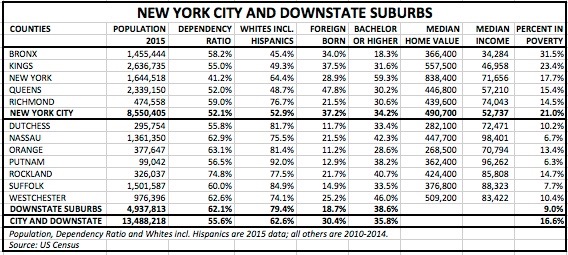
    On many measures, New York City and State have little in common. Consider the following:

    New York City covers less than 1% of New York State’s land area and is home to 43% of the State’s population. Including downstate suburbs, the New York City metro area adds up to 65% of the state’s population.

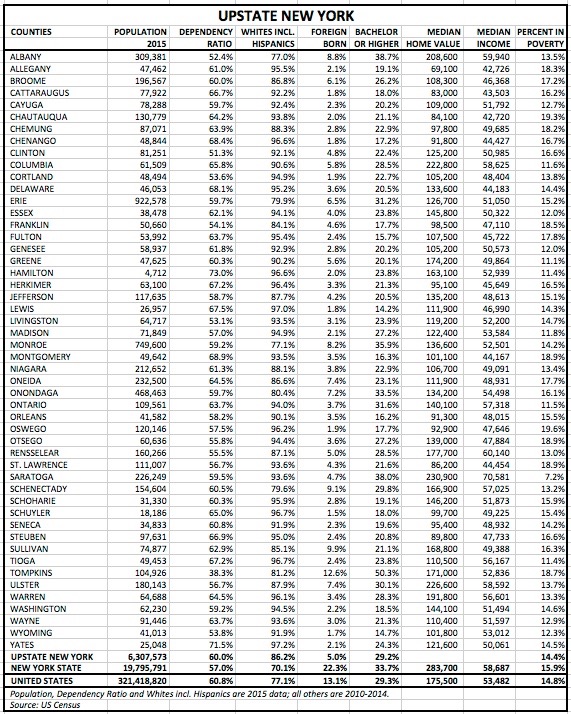
    In the City, 53% of people are white (including hispanics) and 37% are foreign-born. Outside the City, 83% are white and 11% foreign-born. If you exclude seven downstate counties that are near the City (see tables), the percentage of the Upstate population who are foreign-born drops to 5%. By way of comparison, the entire US population is 77% white and 13% foreign-born. So New York City is less white and much more foreign-born than the United States. And New York State is more white and much less foreign-born.

    Because there is a higher percentage of poor people in the City, notably in the Bronx, the median household income at $52,737 is lower than the $58,687 for the state overall. However the average income is much higher in the City due to its high-paying jobs in law, media, finance and health care. The weight of the 1% or 5% highest earners would be more visible in the average than in the median. As shown in the table, the median income in the downstate suburbs is significantly higher than in the City or Upstate. The median household income in the United States is $53,482.
    screen-shot-2016-09-19-at-3-01-43-pm-2


    Home values are much higher in the City and surrounding counties than in the rest of the state. In the City, the median home value is $491,000 whereas a median home can be obtained in most counties Upstate for less than $200,000. The higher ratio of median home value to median income underlines the greater income disparity in the City.

    In New York county (Manhattan), the median home value is $838,000 or 12 times the median household income of $72,000. This would be unsustainable if the average income did not deviate significantly from the median, or in other words, if there was not a small percentage of people earning large and very large incomes every year. In Manhattan, the average income of the top 1% is $8.1 million. And the average income of the bottom 99% is $70,468. The ratio of the first to the second is 116. (sources: Economic Policy Institutehowmuch.net).

    By contrast, in Allegany county for example, the median home value is only 1.6 times the median income. The average income of the top 1% is $358,554 million and that of the bottom 99% is $25,595. The ratio of the first to the second is 14.

    In the United States overall, the median home value is $175,500, or 3.3 times the median income. In 2013, the average income of the top 1% was $1.1 million and that of the bottom 99% was $45,567, resulting in a ratio of 25.
    screen-shot-2016-09-19-at-3-01-38-pm-2


    It is tempting to conclude from these figures that New York City is doing very well and that New York State is doing, depending on one’s perspective, as well or as poorly as the rest of the country. But on closer scrutiny, both the City and the state face some challenges that are unique to New York.

    Stagnant Demographics

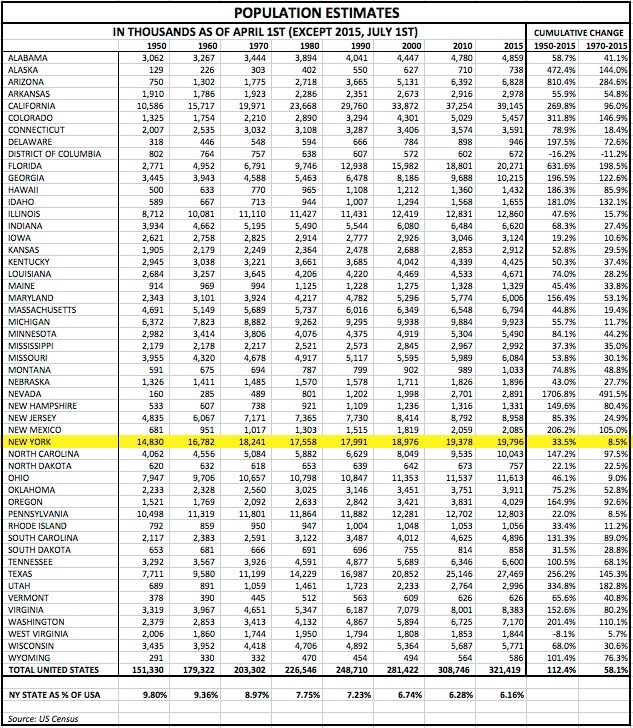
    The most obvious is the fact that the size of New York’s population has barely budged in the past forty-five years except for getting older. In 1970, there were 18.2 million people in New York State and in 2015 only 19.8 million. This change amounts to an 8% cumulative increase over 45 years, a very low figure compared to the 58% growth in the US population over the same period.
    screen-shot-2016-09-19-at-11-16-10-am-2


    If there had been instead a modest annual population growth rate of 0.5% due to new births, the cumulative growth over 45 years would have come to 25%. Further, because New York City is a magnet for new immigrant arrivals, one would expect that cumulative growth to have exceeded 25%. Instead, the 8% figure over 45 years means that there has been a steady large migration of New Yorkers towards other states.

    New York State had 9% of the country’s population in 1970 and 6.2% in 2015. The state and City have not been choice destinations except for people seeking employment in specific industries or for recent immigrants looking for a social gateway into the United States via their own national communities.

    Also worth noting is the fact that the state’s entire population growth (800,000 people) since 2000 has been concentrated in the City and downstate suburbs. The size of the population Upstate has flatlined for years while getting older.

    Of course, this stagnation is partly explained by the large migration over several decades of Americans heading to sun belt and mountain states in the West, South and Southwest. No doubt the invention of affordable air conditioning and the expansion of the interstate highway network facilitated this exodus from North to South.

    Other legacy large industrial states like Pennsylvania and Ohio also show weak single digit growth in the period 1970 to 2015. But neither has a large universal metropolis like New York City and neither shows as great a divide between its largest city and Upstate region. Meanwhile the populations of California, Colorado, Texas and Utah have doubled or more than doubled in 1970-2015, as have those of Southeastern states like Florida, Georgia and the Carolinas. Arizona has quadrupled and Nevada grown six fold, albeit from a low base in both cases.

    A closer to home comparison is only marginally more comforting. If New York State was a state on its own today, its demographics would compare poorly to those of its neighbors. Next door Vermont and New Hampshire have both grown smartly despite lacking a significant industrial base and large metro areas. The largest employers in both states are IBM and a collection of ski resorts, hospitals, colleges, retail stores and insurers/banks/asset managers. New Hampshire has also benefited from its proximity to Boston, with some tax-minded commuters choosing to declare residence in the southeastern corner.

    Part of this may be a public relations issue. Both New England states have done a better job than New York in associating their names with autumn foliage, winter sports and summer boating even though New York has similar colors, ski areas and lakes.

    pictures-126

    Vermont or Upstate New York?

    And compared to New England, Upstate is rarely showcased in movies. Wikipedia has long lists of movies set in New England and in New York City but no such list for New York State. In the 1987 movie Baby Boom, management consultant J. C. Wiatt (Diane Keaton) escapes New York City’s chaos and complexity, and dumps New York State without a thought on her way to a simpler life in Vermont that ends up delivering not only space, beauty and peace but also greater wealth and even romance.

    Weather can also be an important factor. Some parts of New York State get much more snow and have many more overcast days every year than do Vermont, New Hampshire, Pennsylvania and Ohio.

    Policies for Upstate

    Nonetheless, if weather is the work of Providence, government policy is very much man-made and should be designed to capitalize on the state’s assets and to mitigate its handicaps. The empirical evidence so far is that policy has not done enough to improve conditions Upstate.

    To the South and West, both Pennsylvania and Ohio have enjoyed a better economy than Upstate thanks in part to the shale energy boom while New York maintains a ban on fracking. It can afford to do so thanks to its large tax revenues coming from the City. According to a 2011 Rockefeller Institute study, in 2010 New York City contributed 48.7% of the state’s tax revenues. The downstate suburbs contributed an additional 23.6%, leaving a modest 27.7% coming from the rest of Upstate.

    These revenue percentages don’t deviate significantly from the weight of the population in the various regions. But the same Rockefeller Institute study showed that expenditures are more favorably weighted towards Upstate which received 42.2% of the state’s spending while the City and downstate suburbs received 40% and 17.7% respectively. In other words, Upstate has not been self-sufficient in terms of tax expenditures vs. tax receipts and has been receiving funds from the metro area.

    Some will allege that this is how a state should operate. Less productive areas receive assistance from more productive ones. But New York State could do better by making itself more tax-friendly to businesses and households. Our populyst state-by-state analysis shows that a median household in New York keeps 82.5% of its income after taxes, a percentage that places the state in the lowest quintile of all states on this measure. By contrast, a median household in Florida, Tennessee, Nevada, Texas or Washington State keeps over 88% of its income. The difference in after-tax take-home incomes would be even greater for higher earning households.

    The table below shows total and per capita state government tax collections for fiscal year 2013. On a per capita basis, New York State is in the first highest quintile for all state taxes, and second only to Connecticut for individual and corporate income state taxes. Among states with large populations, it is comfortably first in both categories, higher than California, Illinois, Pennsylvania and Ohio, and much higher than low-tax Texas and Florida.


    None of this may be a surprise, given that New York routinely ranks among the highest-tax states in the country. But instead of cutting taxes across the board and letting the market work its magic, the state has opted to launch a number of targeted public and public/private initiatives to reenergize the economy Upstate.

    Start-Up NY offers tax free zones to research-oriented businesses. In order to qualify, a business must partner with a university and must operate in one of the sectors targeted by the program.

    Judging by this recent announcement, the impact so far has been helpful on a local level but negligible in improving the state’s overall condition:

    Governor Andrew M. Cuomo today announced that 18 new businesses will join START-UP NY, relocating or expanding their operations across the state through innovative tax-free zones associated with public colleges and universities. These 18 businesses have committed to create at least 135 new jobs and invest nearly $10 million over the next five years in Western New York, the Southern Tier, Central New York, the Capital District, New York City and Long Island.

    and further:

    START-UP NY now has commitments from 172 companies to create at least 4,175 new jobs and invest more than $229.2 million over the next five years in New York State.

    That comes to  an average of 24 jobs and an investment of $1.33 million per company, small figures in a state of 19 million people and a GDP of $1.4 trillion. Perhaps the choice of a few sectors and the required linkage to a college should be removed and a tax abatement should be offered to all startups.

    Though its impact is small, Start-Up NY at least has the distinction of a hip dynamic name. By contrast, other initiatives that have a greater immediate dollar impact are encumbered by vaguely Soviet-sounding names such as the Regional Economic Development Council Initiative and the Upstate Revitalization Initiative.

    In both of these initiatives, development funds are allocated to New York’s ten regions through a process of competitive applications. From the former’s website:

    This year, the 10 Regional Councils once again competed for funding and assistance from up to $750 million in state economic development resources as part of Round V of the REDC competition. Additionally, the Governor established a new competition in 2015 – the Upstate Revitalization Initiative – to award a total of $1.5 billion to three regions, which will help to transform local economies by providing $500 million over the next five years to support projects and strategies that create jobs, strengthen and diversify economies, and generate economic opportunity within the region. Of the state’s 10 regions, seven were eligible for the URI competition: Finger Lakes, Southern Tier, Central New York, Mohawk Valley, North Country, Capital District, and Mid-Hudson.

    quick scan of the dollars awarded in these initiatives shows that many, though not all, are earmarked for marginal improvements or investments and are unlikely to lead to large economic returns.

    The Inevitable

    If this was the only problem with dirigisme, we might simply lament it as a well-intentioned but wasteful approach to economic growth. However, it is usually accompanied by an increase in cronyism and corruption. The fact that the state has been collecting a tax surplus in the City and diverting it Upstate created an opportunity for administrators to play favorites in awarding contracts and to contravene the rules of competition that usually prevail in a free market. When this kind of opportunity emerges, it is inevitable that someone will seize on it.

    And so the scandal that has just broken with the charging of nine people in Governor Cuomo’s entourage should not come as a surprise. City Journal takes a similar view:

    Eager to revive the depressed counties of New York’s heartland and Southern Tier, Cuomo lacked the courage to use his considerable influence with the Albany legislature to prune taxes and pare regulation. His solution was to bury the problem in tax dollars. This approach isn’t intrinsically criminal, but it does attract people of low degree, some of whom have recently been posting bail. And it betrays poor judgment on Cuomo’s part—in the policies he pursues, in the people he trusts, and in the electorate at large.

    The New York Post is equally skeptical of government-orchestrated public-private investments:

    The cloud of alleged corruption now surrounding billions of dollars in state economic development investments is an outgrowth of Cuomo’s highly secretive and centralized management style.

    Compared to previous Albany-directed corporate-welfare binges, Cuomo’s approach has featured a uniquely close intertwining of government and corporate interests — complete with state ownership of the means of production.

    To an outside observer, it may have seemed curious that development of a solar-panel factory in Buffalo [the case being investigated] was being guided by a state college administrator in Albany.

    This free market distortion is primarily systemic at its root. It grows naturally from the state’s involvement in the economy. As noted by City Journal, bad systems have a way of empowering bad actors. It is likely therefore that more revelations will surface about more malpractice elsewhere in the state’s initiatives.

    Now would be a good time to re-evaluate the overriding economic strategy. So far, the state’s initiatives have weighed in favor of a top-down set of targeted solutions instead of a blanket laissez-faire approach that would foster growth from genuine grassroots entrepreneurship. But this experiment with dirigisme has led to the usual distortions of cronyism and wasted or misallocated resources. The state should consider stepping back from its deeper involvement and instead moving forward with lower tax rates for middle-income households and with lower regulation for businesses.

    New York City’s high paying jobs generate the tax receipts needed to meet spending needs in the rest of the state. But the surplus from City tax revenues can also be seen as the enabler of bad policy and as the reason why the state has not implemented the fiscal policies needed Upstate. The City is a huge asset for the state but it may be holding back the measures needed to reignite a demographic and economic revival in all of New York.

    This at least could be the conclusion drawn when we look back from the future at our present predicament. But so far, the Governor has shown no inclination of changing course, stating after the charges surfaced:

    I am more committed to western New York’s revitalization than ever before… We are not going to miss a beat.

    Note: The dependency ratio in the tables is calculated as the sum of people aged less than eighteen and more than 65, divided by the number of people aged 18-65.

    This piece first appeared at Populyst.net.

    Sami Karam is the founder and editor of populyst.net and the creator of the populyst index™. populyst is about innovation, demography and society. Before populyst, he was the founder and manager of the Seven Global funds and a fund manager at leading asset managers in Boston and New York. In addition to a finance MBA from the Wharton School, he holds a Master’s in Civil Engineering from Cornell and a Bachelor of Architecture from UT Austin.