Tag: New York

  • The Hudson Tunnel: Issues for New Jersey

    New Jersey Governor Chris Christie sent shockwaves through the transportation industry on last Thursday when he cancelled the under-construction ARC (Access to the Regional Core) rail tunnel under the Hudson River from New Jersey to New York (Manhattan).

    The Governor accepted the Access the Regional Core (ARC) Executive Committee’s recommendation to “pull the plug” on the expensive project because of cost overruns. The project was to have cost $8.7 billion, but could escalate up to $14 billion according to the Governor’s office. All of any such cost overrun would have to be absorbed by the state of New Jersey, which like many other states is in dire financial straits.

    Christie said:

    “I have made a pledge to the people of New Jersey that on my watch I will not allow taxpayers to fund projects that run over budget with no clear way of how these costs will be paid for. Considering the unprecedented fiscal and economic climate our State is facing, it is completely unthinkable to borrow more money and leave taxpayers responsible for billions in cost overruns. The ARC project costs far more than New Jersey taxpayers can afford and the only prudent move is to end this project.”

    Governor Christie indicated that the project could become New Jersey’s “Big Dig,” referring to the Boston highway project that he said escalated in cost by 10 times (that is not a typo).
    Yet supporters of the tunnel were unanimous in their condemnation of Christie’s move, from Paul Krugman of The New York Times to the Regional Plan Association.

    New Jersey Senator Frank Lautenberg announced that Christie had backed down, noting his “reversal of yesterday’s decision to kill” the tunnel project. Referring to a meeting between US Secretary of Transportation Ray LaHood and Governor Christie, Lautenberg said “The Secretary was clear with Governor Christie: if this tunnel doesn’t get built, the three billion dollars will go to other states. We can’t allow that to happen.” Lautenberg listed a litany of benefits such as a reduction of greenhouse gas emissions by 70,000 tons annually. He also noted that New Jersey would have to reimburse the federal government the $300 million it had received for the tunnel. Senator Robert Menendez added that “New Jersey taxpayers don’t want to own a $600 million hole to nowhere.”

    However, under examination, it is unclear whether Christie had “reversed” his position. Christie agreed to consider “options to potentially salvage” a tunnel project based upon options (not made public) offered by LaHood. New Jersey and Federal officials will be meeting on the matter over the next two weeks. Christie, however, reaffirmed his concern about project finances, stating that” the ARC project is not financially viable “ and its expectation “to dramatically exceed its current budget remains unchanged. ” The Newark Star-Ledger cited state officials as saying that the decision does not represent a reversal of Christie’s original decision.

    Thus, everything may be up in the air. Given that, here are a few issues the state of New Jersey may like to consider as it finalizes its decision:

    1. Exaggerating the Need for the Project The new rail tunnel is to serve a purported increase in commuter rail ridership to Manhattan jobs in the future. The project’s Final Environmental Impact Statement says that Midtown Manhattan’s employment will grow from its present 2.6 million by another 500,000 by 2030. This is unlikely. Manhattan’s entire employment (not just Midtown) peaked at 2.4 million in 2008. One might expect the planners could have gotten something so simple correct. Manhattan employment remains below 2001 levels and never rose more than 35,000 even at the peak of the last boom (annual figure, from 2001). The consultants also are projecting a 1.6 million population increase west of the Hudson River (New Jersey suburbs along with the New York counties of Rockland and Orange) by 2030. However, the New Jersey and New York metropolitan counties to the west of the Hudson are more likely to grow only 1.1 million, based upon official state projections (Note). The questionable population and employment projections reveal that the “need” for the new tunnel may have been grossly overstated.

    2. Exporting New Jersey Jobs to New York Why should New Jersey pay to build more capacity so that its people can work across the state line? Why should they not work in New Jersey? New Jersey is often thought of an economic afterthought in Manhattan centric media and business interests (such as by The New York Times). In fact only a small share of New Jersey commuters travel to Manhattan for work. Even in the New Jersey counties that border New York, only 12% of commuters work in Manhattan. In the other New York metropolitan area counties in the metropolitan area, the figure drops to 5%.

    The trends here are also important. Since 1956, every new job in the New York metropolitan area has been created outside Manhattan (Manhattan’s employment is 400,000 lower now than back then). New Jersey depends on New Jersey far more than it does New York. New Jersey has developed successful new office complexes in Jersey City, New Brunswick, along the I-287 Belt Route and elsewhere. Perhaps New Jersey should seek to minimize work trip lengths and encourage the next 500,000 jobs to be created in the state rather than in New York. Downtown Newark, for example, has excellent transit access and could use substantial new employment investment. This might prove more beneficial for New Jersey and its taxpayers.

    3. Costs Could Rise Even Higher The tunnel could easily climb in cost beyond the now feared $14 billion. Big Dig cost escalation continued almost to the project’s opening. There is no reason to expect it will be different with the Hudson tunnel. It has been reported that one of LaHood’s options is simply to lower cost projections. New Jersey should buy that option only if the federal government underwrites all of the cost overruns. However, such a deviation from federal policy would bring stiff opposition from other parts of the country.

    4. The Cost of Reducing Greenhouse Gas Emissions Like so many transit projects, the reduction of greenhouse gas (GHG) emissions is raised as a benefit of the tunnel. But at what cost? Each of the 70,000 annual tons of greenhouse gas emissions removed would require a capital expenditure of $16,000. The present market price for greenhouse gases is $20 per ton. New Jersey could accomplish the same objective for just $1.4 million annually.

    The Decision Much rides on Governor Christie’s decision. It may be better for the state to have a $600 million tunnel to nowhere than a $14, $20 or $25 billion tunnel that may not really be needed. Moreover, frustration is building with Washington’s “plunder” philosophy that encourages wasting money at home, so that another state doesn’t get the chance. Digging the nation out of its present (and future) malaise seems likely to require fresher thinking than this.

    If Governor Christie musters the courage to stop this project now, it could be a shot across the bow of an international vendor and consulting engineering community that has routinely low-balled costs only to later jack them up, confident that no project would be canceled once started.

    ——–

    Note: This figure is derived using New York 2030 projections and New Jersey 2025 projections, increased by the 2020-2025 growth rate to project 2030 population.

    Wendell Cox is a Visiting Professor, Conservatoire National des Arts et Metiers, Paris and the author of “War on the Dream: How Anti-Sprawl Policy Threatens the Quality of Life

    Photo: Hudson River looking south between Lower Manhattan and Jersey City (photo by author)

  • Decade of the Telecommute

    The rise in telecommuting is the unmistakable message of the just released 2009 American Community Survey data. The technical term is working at home, however the strong growth in this market is likely driven by telecommuting, as people use information technology and communications technology to perform jobs that used to require being in the office.

    In 2009, 1.7 million more employees worked at home than in 2000. This represents a 31% increases in market share, from 3.3 percent to 4.3 percent of all employment. Transit also rose, from 4.6% to 5.0%, an increase of 9% (Note). Even so, single occupant automobile commuting also rose, from 75.7% to 76.1%, despite the huge increase in gasoline prices. The one means of transport that continued to decline was car pooling, which saw its share decline from 12.1% in 2000 to 10.0% in 2009.

    The increase in working at home was pervasive in scope. The share of employees working at home rose in every major metropolitan area (over 1,000,000 population), with an average increase of 38%. The largest increase was in Charlotte – ironically a metropolitan area with large scale office development in its urban core – with an 88% increase in the work at home market share. In five metropolitan areas, the increase was between 70% and 80% (Richmond, Tampa-St. Petersburg, Raleigh, Jacksonville and Orlando). Only five metropolitan areas experienced market share increases less than 20% (New Orleans, Salt Lake City, Rochester, Buffalo and Oklahoma City). Nonetheless, the rate of increase in the work at home market share exceeded that of transit in 49 of the 52 major metropolitan areas. Transit’s increase was greater only in Washington, Seattle and Nashville (where the transit market share is miniscule).

    The working at home market share increase was also strong outside the major metropolitan areas, rising 23%.

    Working at home is fast closing the gap with transit. In part driven by the surge in energy prices since earlier in the decade, transit experienced its first increase since data was first collected by the Bureau of the Census in 1960. Yet working at home is growing more rapidly, and closing the gap, from 1.7 million fewer workers than transit in 2000 to only 1.0 million fewer in 2009. At the current rate, more people could be working at home than riding transit by 2017. This is already the case in much of the country outside the New York metropolitan area, which represents a remarkable 39 percent of the nation’s transit commuters. Taking New York out of the picture, 31% more people (1.35 million) worked at home than traveled by transit, more than 4 times the 7% difference in 2000 (Table 1, click for additional information).

    Table 1
    Transit & Work at Home Share of Commuting
    Major Metropolitan Areas: 2000 & 2009
      Transit Work at Home
    Metropolitan Area 2000 2009 2000-2009 2000 2009 2000-2009
    New York 27.4% 30.5% 11.4% 2.9% 3.9% 32.6%
    Los Angeles 5.6% 6.2% 11.6% 3.5% 4.8% 35.3%
    Chicago 11.3% 11.5% 2.0% 2.9% 4.0% 37.1%
    Dallas-Fort Worth 1.8% 1.5% -13.3% 3.0% 4.1% 37.0%
    Philadelphia 8.9% 9.3% 3.7% 2.9% 3.9% 35.0%
    Houston 3.2% 2.2% -29.2% 2.5% 3.4% 37.4%
    Miami-West Palm Beach 3.2% 3.5% 9.7% 3.1% 4.5% 48.0%
    Atlanta 3.4% 3.7% 8.7% 3.5% 5.6% 59.9%
    Washington 11.2% 14.1% 26.6% 3.7% 4.5% 22.7%
    Boston 11.2% 12.2% 9.8% 3.3% 4.3% 31.9%
    Detroit 1.7% 1.6% -4.7% 2.2% 3.1% 40.1%
    Phoenix 1.9% 2.3% 17.5% 3.7% 5.3% 44.3%
    San Francisco-Oakland 13.8% 14.6% 6.0% 4.3% 6.0% 40.5%
    Riverside 1.6% 1.8% 9.0% 3.5% 4.6% 32.6%
    Seattle 7.0% 8.7% 25.0% 4.2% 5.1% 23.6%
    Minneapolis-St. Paul 4.4% 4.7% 6.4% 3.8% 4.6% 20.6%
    San Diego 3.3% 3.1% -7.0% 4.4% 6.6% 50.2%
    St. Louis 2.2% 2.5% 14.2% 2.9% 3.5% 22.5%
    Tampa-St. Petersburg 1.3% 1.4% 11.0% 3.1% 5.5% 75.7%
    Baltimore 5.9% 6.2% 5.8% 3.2% 3.9% 23.2%
    Denver 4.4% 4.6% 4.3% 4.6% 6.2% 36.4%
    Pittsburgh 5.9% 5.8% -2.9% 2.5% 3.2% 28.5%
    Portland 6.3% 6.1% -3.0% 4.6% 6.1% 32.9%
    Cincinnati 2.8% 2.4% -13.4% 2.7% 3.8% 40.3%
    Sacramento 2.7% 2.7% 0.8% 4.0% 5.4% 33.1%
    Cleveland 4.1% 3.8% -8.1% 2.7% 3.4% 25.0%
    Orlando 1.6% 1.8% 15.4% 2.9% 4.9% 71.4%
    San Antonio 2.7% 2.3% -12.5% 2.6% 3.4% 29.0%
    Kansas City 1.2% 1.2% 4.6% 3.5% 4.3% 24.7%
    Las Vegas 4.4% 3.2% -26.8% 2.3% 3.3% 45.1%
    San Jose 3.4% 3.1% -9.6% 3.1% 4.5% 44.4%
    Columbus 2.1% 1.4% -35.0% 3.0% 4.1% 36.7%
    Charlotte 1.4% 1.9% 32.2% 2.9% 5.4% 88.1%
    Indianapolis 1.3% 1.0% -22.2% 3.0% 3.7% 24.7%
    Austin 2.5% 2.8% 11.7% 3.6% 5.9% 64.6%
    Norfolk 1.7% 1.4% -17.7% 2.7% 3.4% 27.9%
    Providence 2.4% 2.7% 12.8% 2.2% 3.6% 64.5%
    Nashville 0.8% 1.2% 38.5% 3.2% 4.3% 34.6%
    Milwaukee 4.2% 3.7% -12.5% 2.6% 3.2% 25.3%
    Jacksonville 1.3% 1.2% -9.1% 2.3% 4.0% 73.8%
    Memphis 1.6% 1.5% -8.1% 2.2% 3.1% 41.3%
    Louisville 2.0% 2.4% 20.2% 2.5% 3.1% 22.9%
    Richmond 1.9% 2.0% 6.5% 2.7% 4.7% 76.8%
    Oklahoma City 0.5% 0.4% -13.0% 2.9% 3.1% 4.7%
    Hartford 2.8% 2.8% -1.3% 2.6% 4.0% 53.6%
    New Orleans 5.4% 2.7% -50.3% 2.4% 2.9% 19.2%
    Birmingham 0.7% 0.7% -2.3% 2.1% 2.7% 29.5%
    Salt Lake City 3.3% 3.0% -10.1% 4.0% 4.7% 17.8%
    Raleigh 0.9% 1.0% 10.7% 3.5% 6.0% 74.4%
    Buffalo 3.3% 3.6% 7.9% 2.1% 2.3% 8.3%
    Rochester 2.0% 1.9% -4.3% 2.9% 3.3% 13.7%
    Tucson 2.5% 2.5% 1.8% 3.6% 5.0% 36.3%
    Total 7.5% 8.0% 6.4% 3.2% 4.4% 37.7%
    Other 1.0% 1.2% 12.3% 3.4% 4.2% 23.0%
    National Total 4.6% 5.0% 9.2% 3.3% 4.3% 30.9%
    Major metropolitan areas: Over 1,000,000 population in 2009
    Metropolitan Area definitions as of 2009
    Data from 2000 Census and 2009 American Community Survey

    The rise of working at home is illustrated by the number of major metropolitan areas in which it now leads transit in market share. In 2000, working at home had a larger market share than transit in 28 of the present 52 major metropolitan areas. By 2009, working at home led transit in 38 major metropolitan areas, up 10 from 2000. Between 2000 and 2009, the working at home market share increased nearly 6 times as much as the transit share in the major metropolitan areas (38.4% compared to 6.4%).

    Working at Home Leaps Above Transit In Portland and Elsewhere: Perhaps most surprising is the fact that Portland now has more people working at home than riding transit to work. This is a significant development. Portland is a model “smart growth” having spent at least $5 billion additional on light rail and bus expansions over the last 25 years. Portland was joined by other metropolitan areas Houston, Miami-West Palm Beach, New Orleans and San Jose, all of which have spent heavily on urban rail systems. Working at home also passed transit in Cincinnati, Hartford, Las Vegas, Raleigh and San Antonio (Table 2).

    Table 2
    Work at Home Share Greater than Transit
    Major Metropolitan Areas
    Atlanta Houston Norfolk Sacramento
    Austin Indianapolis Oklahoma City Salt Lake City
    Birmingham Jacksonville Orlando San Antonio
    Charlotte Kansas City Phoenix San Digo
    Cincinnati Las Vegas Portland San Jose
    Columbus Louisville Providence St. Louis
    Dallas-Fort Worth Memphis Raleigh Tampa-St. Petersburg
    Denver Miami-West Palm Beach Richmond Tucson
    Detroit Nashville Riverside
    Hartford New Orleans Rochester
    Indicates working at home passed transit between 2000 and 2009

    Further, the shares are close enough at this point that working at home could surpass n transit in Milwaukee, Cleveland and Minneapolis-St. Paul in the next few years.

    Transit: About New York and Downtown

    As noted above, transit also has gained during this decade. However, the gains have not been pervasive. Out of the 52 major metropolitan areas, transit gained market share in 29 and lost in 23. As usual, transit was a New York story, as the New York metropolitan area saw its transit work trip market share rise from 27.4% to 30.5%. New York accounted for 47% of the increase in transit use, despite representing only 37% in 2000. New York added nearly 500,000 new transit commuters. This is nearly five times the increase in working at home (106,000). Washington also did well, adding 125,000 transit commuters, followed by Los Angeles at 73,000 and Seattle at 41,000.

    Transit’s downtown orientation was evident again. This is illustrated by the fact that more than 90% of the increased use in the major metropolitan areas occurred in those metropolitan areas with the 10 largest downtown areas (New York, Los Angeles, Chicago, Philadelphia, Houston, Atlanta, Washington, Boston, San Francisco and Seattle). Among these, only Houston experienced a decline in transit commuting.

    Implications

    Working at home has been the fastest growing component of commuting for nearly three decades. In 1980, working at home accounted for just 2.3% of commuting, a figure that has nearly doubled to 4.3% in 2009. This has been accomplished with virtually no public investment. Moreover, this seems to have happened without any loss of productivity. Companies like IBM, Jet Blue and many others have switched large numbers of their employees to working at home. These firms, which necessarily seek to provide the best return on their investment for stockholders and owners would not have made these changes if it had interfered with their productivity.

    Over the same period, and despite the recent increases, transit’s market share has fallen from 6.4% of commuting in 1980 to 5.0% in 2009. At the same time, gross spending over the period rose more than $325 billion (inflation and ridership adjusted) from 1980 levels. Inflation adjusted expenditures per passenger mile have more than doubled since that time.

    Given the remarkable rise of telecommuting, its low cost and effectiveness as a means to reduce energy use, perhaps it’s time to apply at least some of our public policy attention to working in cyberspace. It presents a great opportunity, perhaps far greater and far more cost-effective than the current emphasis on new rail transit systems.

    ———-

    Note: Work trip market share reflects transit in its strongest market, trips to and from work. Transit’s overall impact, measured by total roadway and transit travel (passenger miles) is approximately 1%, compared to the national work trip market share of 5%.

    Wendell Cox is a Visiting Professor, Conservatoire National des Arts et Metiers, Paris and the author of “War on the Dream: How Anti-Sprawl Policy Threatens the Quality of Life

    Photograph: DDFic

  • A Mass Transit New England Ramble

    To escape the summer crowds in the Hamptons, I rode the S92 bus (fare $1.50) for almost three hours, as it cruised the south and north forks of Long Island, before leaving me at the ferry that connects Orient Point to New London, Connecticut.

    I might end up late to some meetings, but this way I could monitor the progress of the American Recovery and Reinvestment Act of 2009, at least as it pertains to the more than $8 billion earmarked for high-speed trains, if not buses and ferries.

    Not many Hampton People leave on a local bus, which in this case was filled with Latino day laborers, giving it the air of a John Steinbeck novel. I was headed to New England, and I wanted to see if I could make a circuit to Providence, Boston, Amherst, and Keene entirely on public transportation.

    Conclusion: Mass transit works better as a White House sound bite than as a way to get around New England.

    The S92 rolled through the Hamptons to Riverhead, the county seat, where the Latinos got off, leaving me with the driver (from Masuria in Poland) to pass by the North Fork vineyards, which are vast and sophisticated. When I was young, only winos drank Long Island vintages; now it can cost $40 a bottle.

    The ferry to New London made the crossing in local fog banks, which obscured Plum Gut, but parted for the run into New London, the American Gibraltar. I saw a surfacing submarine and, at the ferry terminal, a sculpture of the playwright Eugene O’Neill, shown as a boy gazing out to sea (even though he spent most of his adult life looking at bad marriages rather than the waves).

    The train to Providence ran along the snug harbors around Mystic and Stonington, although inexplicably it arrived forty-five minutes late. Brown University and some local technology companies are the reason that the Rhode Island capital does not feel like a failed mill town. My friend on the local newspaper whispered that the well reputed university is long on celebrity children, and short on academic excellence.

    I switched to the Massachusetts Bay Transportation Authority (MBTA) for the hour run into Boston’s Back Bay Station. It ran with the air conditioning on full blast, as if it were a rolling meat locker. The rail car had wifi, a commuter train novelty for me, and much appreciated.

    The $15 billion Big Dig, to bury the city’s interstates, not to mention the U.S. Treasury, is largely completed. Even so, much of downtown feels like an exit ramp, usually named after one of the Kennedys. Boston is not one of the cities where I am at home, but I appreciate the glimpses of the Freedom Trail and thinking I might have to make way for ducklings.

    After my Boston meetings, I headed for Amherst in central Massachusetts. Traveling by bus would have meant changing in Springfield, as would have Amtrak (estimated travel time, about four hours). Instead, I took a MBTA commuter train to North Leominster, a gritty mill town now given over to Jiffy Lube and donuts.

    The Amherst area has thousand of students from eastern Massachusetts, but few plans to improve its bus or train connections. Nor is it possible to take public transportation from Amherst one hour north to Keene, New Hampshire. Had I wanted to do so, I would have had to first go south to Springfield, then back up to Bellows Falls, Vermont, spend the night, and connect the following morning to Keene on Greyhound (“safe, reliable, courteous, and slow”).

    I surrendered and rented a car.

    Before leaving Amherst, I visited the Emily Dickinson House, where I had the good luck to join Ms. Casey Clark’s tour. She made the reclusive Emily come to life: by quoting from her work (“Forever is composed of nows”), and pointing to the solitary window table where Dickinson wrote many of her 1,800 poems, the passionate Tweets of the nineteenth century.

    I had not been to Amherst College since October 1963, when as a nine-year old boy I was taken to see President John F. Kennedy dedicate the new Robert Frost Library.

    On this visit, I recalled seeing JFK’s helicopter land on the football field, and his motorcade along the main street. His bright red hair and toothy smile are etched in memory. He sat on the back of an open car; the President as prom queen. Even to a rapturous boy, he looked vulnerable. Less than a month later, he died in the same convertible.

    For the benefit of my university-bound children, I joined a campus tour. After exhaustive inspections of laundry rooms, showers, dorms, lounges, and food courts — why are colleges marketed as subdivisions? — I gave up and drove to Brattleboro, Vermont, another mill town that is trying make a go of spinning cappuccino.

    My New England ramble ended on Amtrak’s Vermonter, a train that goes from northern Vermont to Washington, probably in about the same amount of time that the Indians took to make the journey in canoes. The train poked across Massachusetts, idled in Springfield, and then picked up speed south of Hartford, where we crossed the Connecticut River.

    The biggest problem with American public transportation is that it lacks a critical mass. The infrequent service is more of a problem than the slow speeds, which could be padded over with comfortable seats, wifi, and better coffee. Amtrak has only one train a day north of Springfield, which in turn has one train to Boston and spotty bus service. Little wonder everyone drives.

    Why throw money at high-speed rail when Amtrak runs on such dilatory schedules? Spend the money, instead, on more traditional rail cars and engines, which are in short supply, or hire some Swiss conductors and engineers to keep to the schedules.

    Amherst to Princeton, New Jersey, where I was headed, is a five–hour car ride. I made the trip by train in a leisurely eight hours, with the proximity of an AmCafé and a power outlet for my computer, to write this article.

    I appreciated not having to drive on the interstate or sit on a cramped bus, although the station waits were maddening. The train crew changes were frequent, suggesting a company hostage to union rules and feather bedding. To my knowledge, Emily Dickinson never wrote a poem about Amtrak. If she had, it might read:

    I cast my Fate upon the Rails –
    As if a spirit on Indian trails –
    We stopped, and shuddered, and watched our steps –
    And sweated during A/C fails

    Leaving out the $80 cost of the rental car, my travels cost less than $125. And although I loved being on trains and ferries, there is something shabby about public transportation, as though it’s headed for obscurity, rather than for the President’s brave, new high-speed world.

    Back home, the question on my mind was: If you had $8 billion, would you let Amtrak manage it?

    Matthew Stevenson is the author of Remembering the Twentieth Century Limited, winner of Foreword’s bronze award for best travel essays at this year’s BEA. He is also editor of Rules of the Game: The Best Sports Writing from Harper’s Magazine. He lives in Switzerland.

    Photo: Black-backed gull and Sea Jet high-speed ferry, New London, Ct.
    By L’eau Bleue

  • Summer in the Hamptons: UnReal Estate

    If you are looking for a place where you can, in your day dreams, ride out the recession, might I suggest one of the Hamptons? These are the celebrity-drenched villages that stretch for thirty miles across the sand dunes and potato fields of Long Island’s South Fork, which ends at Montauk Point and its lighthouse.

    Why the Hamptons for a depression-era exile? For starters, if you’re a seller, the Hamptons remain Paradise. Fishermen’s cottages start at $1 million, oceanfront property goes for about $7 million an acre, and the street value of guacamole rivals that of cocaine.

    When I was growing up on Long Island (although closer to New York City than the East End), the Hamptons were popular, but not in the league of Newport, Malibu, or Key Biscayne. Southampton was notable for the childhood home of Carl Yastrzemski, the Boston Red Sox star. Montauk had a few old inns associated with railroad developments, and party fishing boats with names like the “The Codfather.”

    Then as now, the beaches and the surf were invigorating. To spend time in the Hamptons, however, it wasn’t necessary to have the wealth of Stephen Spielberg, Jerry Seinfeld, or Martha Stewart (whose Hampton Style mansions I have passed when out biking).

    Now, however, the Hamptons have become as mythical as Camelot, a place where for $26.7 million you can buy an oceanfront “cottage” that looks like a departure lounge at Raleigh-Durham Airport.

    Part of the reason for this North Atlantic bubble is that the Hamptons allow tourists and residents to imagine themselves as extras in a romantic comedy.

    If you have never been, it’s best to imagine the towns, once fishing and potato farming villages, as Hollywood backlots, although to play a leading role it helps to cultivate eccentricity. For example:

    When Jerry Seinfeld bought his estate off Further Lane in East Hampton, he put in a baseball diamond, prompting his neighbors to insist that he screen the backstop, less someone think it was a public park.

    In one of her piques of anger or carelessness, Martha Stewart apparently ran over her neighbor’s gardener.

    The writer George Plimpton was arrested for shooting off fireworks.

    As told in the documentary film Grey Gardens, in the 1970s East Hampton authorities and the ASPCA raided the house belonging to Jacqueline Kennedy Onassis’s aunt, who lived in a 28-room beachfront mansion with stray cats, broken windows, and unpaid electricity bills.

    The house now belongs to the former Washington Post editor, Ben Bradlee, and his wife, Sally Quinn. I have puzzled over the connection between an East Hampton estate and Richard Nixon’s Watergate scandal, which Bradlee broke. Was one a reward for the other?

    Even in World War II, the Hamptons had a make-believe aura. The local newspaper ran ads for “War Damage Insurance…resulting from enemy attack,” just in case your infinity pool got taken in some crossfire.

    According to the popular legend (well packaged by J. Edgar Hoover’s FBI), on a foggy night in June 1942, a German U-boat landed four spies on Amagansett beach, plus enough money, weapons and explosives to make a dent in Pennsylvania’s Horseshoe Curve and New York’s Hell Gate Bridge.

    A Coast Guardsman patrolling the beach came across the bumbling Germans, who claimed (in slightly accented English) to be local “Fischermenn” but then offered a $300 bribe to the officer to forget about the encounter.

    The spies-like-us buried their stash in the sand, including a hat with a Nazi insignia (now that’s covering your tracks), and walked to the train station, where they bantered with the ticket agent, presumably about the weather in Berlin. Some days later in New York, Hoover’s G-men busted the ring. It’s impossible not to wonder whether the FBI scripted such turgid summer theater from the beginning.

    Technically, Montauk is not part of the Hamptons. Traditionally a fishing village, it is responsible for many East End legends, including the rumor that Howard Hughes was secluded here in one of his darkened rooms.

    In 1792 President George Washington authorized the construction of the Montauk Lighthouse. Now it’s part of a state park, which charges $8 for parking and $9 per person for admission, and where bicycles and picnickers are treated as public nuisances.

    In the Spanish-American war, Teddy Roosevelt and the Rough Riders were stationed at Montauk, although with so few rations that they had to live off food baskets from local housewives. Later, Montauk harbor became the preserve of bootleggers, who would land hooch and drive it to the Hamptons .

    Through much of the early twentieth century, speculators traded land around Montauk, on the theory that it would become the “Miami of the North” or a commercial port for transatlantic shipping. Neither ever happened, although the Pennsylvania and Long Island railroads ran sleeping car service to the end of the island. Clearest proof of the Great Depression was the news in 1932 that the Pennsylvania had suspended its parlor cars from Pittsburgh to Montauk.

    What do people “do” in the Hamptons? The beach and the surf are the main attractions, and near them are tennis courts and golf courses, not to mention all sorts of boutiques, including those selling skimpy $3,000 cocktail dresses.

    What many visitors like to do is drive up and down Route 27, the only east-west corridor through the Hamptons. At all hours it is clogged with black SUVs, with tinted windows, that give the Hamptons the air of a parking lot at a Russian night club.

    Full-time residents have an additional burden: their vacations are spent at various “benefits” to support libraries, whales, wetlands, and rain forests, all of which can be saved for about $1,000 a table.

    The East Hampton Star, the local newspaper, and a great one at that, chronicles the summer charitable works with celebrity pictures and half-page invitations, all of which, as best as I can determine, promise to deliver the presence of Alec Baldwin.

    Leaving aside the $100 guacamole and the multi-million dollar cottages, there is still a lot to love about the real-world in the Hamptons. The beach is glorious, and the sea breezes deal with most New York City heat waves. The view of the ocean and the dunes at sunset is timeless. I still like biking to the Montauk lighthouse, despite the Route 27 traffic and gruff staff.

    One reason I return to the Hamptons is that it reminds me of childhood summers, which involved trips to the same beaches, sometimes by train. On still nights, lying in bed, I can hear the engine whistles of the Long Island Railroad, echoing at grade crossings in distant cornfields. They remind me of F. Scott Fitzgerald’s boats, those that “beat on, against the current, borne back ceaselessly into the past.”

    Photo By Jeff Pearce, Montauk Lighthouse

    Matthew Stevenson is the author of Remembering the Twentieth Century Limited, winner of Foreword’s bronze award for best travel essays at this year’s BEA. He is also editor of Rules of the Game: The Best Sports Writing from Harper’s Magazine. He lives in Switzerland.

  • High Cost of Living Drives New York’s Fiscal Deficit with Washington

    Between now and the end of the year, a hot political topic here in New York will be whether to let the Bush tax cuts expire for people in the highest income bracket, as the Obama administration proposes, or whether to extend those cuts for everyone. Advocates taking the latter position will correctly argue that higher rates will be especially harmful to New York, because of the large number of wealthy people, who live here.

    What is not likely to be discussed, however, is that because of the exorbitant cost of living in New York and the surrounding suburbs, federal taxes take a supersized bite out of the incomes of all New Yorkers, who in the vast majority are not wealthy at all. The result is that here in New York City, which is arguably the poorest city in America when it comes to what people can actually afford, we end up subsidizing other states and localities, where people pay less to Uncle Sam, even as they enjoy a higher standard of living than we do.

    How could this be? The answer is that because New York and the surrounding suburbs are so expensive, businesses have to pay higher salaries to recruit people to work for them. According to the ERI Economic Research Institute, a leading data survey company that helps corporate clients set compensation packages and calculate the cost of doing business throughout the United States and elsewhere, these higher salary costs are substantial.

    They calculate, for example, that a typical registered nurse in metropolitan New York earns $82,712 versus a national average of $65,464. In the case of an accountant, they calculate a figure of $74,388 versus a national average of $58,712. In the case of an administrative assistant, as they define those job responsibilities, they calculate a figure of $59,243 versus $47,961 nationally. And finally, they also provide data for someone working as a janitor. Here the figure they calculate is $38,142 versus $31,220.

    Sounds great. Who doesn’t want a higher salary? But unfortunately, it’s not that simple. The problem is that the IRS doesn’t care how much you can actually buy with your hard earned dollars. They just want to see the number printed on your W-2. And as we all know, the more you make, the more you pay.

    For the average registered nurse in New York, filing as an individual, and assuming no special deductions or one-time credits, the tax bite amounts to $14,381 versus $10,219 for the average registered nurse in the rest of the country. An accountant here pays $12,444 versus $8,531 nationally. For an administrative assistant, the figure is $8,656 versus $5,844. And in the case of a janitor, the figure is $3,899 versus $2,864.

    But wait, it gets worse than that. Based on data from the federal Bureau of Economic Analysis, it turns out that the cost of living in the New York metropolitan area is significantly higher than the difference in salaries alone would indicate. According to their data, the cost of living here is 45 percent higher than in the rest of the country or approximately twice the difference in salaries.

    Yes, employers have to pay more to recruit people to work here in New York, but they don’t have to make up the whole difference. Economists refer to this as money illusion, which is their way of saying that people find it difficult to distinguish between the nominal value of money and the true purchasing power of that money in the marketplace.

    If we recalculate salaries to take into account the cost of living, it turns out that the federal tax premium that New Yorkers have to pay is even greater. Thus, if the tax bite were to reflect the actual standard of living for a registered nurse in New York, the real tax would be $8,106 instead of the actual tax of $14,381 or a difference of $6,275. For an accountant, the difference would be $5,775. For an administrative assistant, it would be $4,352, and for a janitor, $1,778.

    The lessons here are clear. In the short term, New York’s Congressional delegation needs to restrain efforts to raise taxes in Washington, D.C., because the impact here will be greater than elsewhere. And in the longer term, we need to determine why the cost of living in New York is so high and then implement the reforms necessary to fix the problem and give New Yorkers a standard of living that is competitive with rest of America.

  • New York Commuting Profile: From Monocentrism to Edgeless City

    The US Bureau of the Census has just released detailed county to county and place (municipality) to place work trip flow tables. This new data is the most comprehensive since the 2000 census and covers 2006 to 2008.

    The county to county data is particularly useful for analysis in the nation’s largest metropolitan area (Note 1), New York. The New York metropolitan area has more than 19 million people and stretches across 6,700 square miles of land area, one half of it in the urban area, which is the urban footprint that includes all areas, including suburbs, in the continuous urbanization (3,350 square miles) and the other half rural (Note 2). This area is composed of 23 counties, which makes far finer grain analysis possible than in Los Angeles, with just two counties or San Diego, where its single county precludes any county based metropolitan area analysis.

    The New York metropolitan area’s counties extend east to west from Suffolk on Long Island to Pike in Pennsylvania and north to south from Putnam in the Hudson Valley to Ocean on the New Jersey shore. Surprisingly, it does not include Fairfield and New Haven counties in Connecticut, which have strong economic ties to the urban area (and which are a part of the larger, Census designated “combined statistical area”). Indeed, major parts of these two counties can be considered part of the New York urban area (Note #3).

    Median house age is a useful indicator of the urban form in segments of a metropolitan area. This examination breaks the New York metropolitan area into rings. The core is New York County (Manhattan, where the median construction date of owned dwellings is 1942). The first ring is the other four boroughs of New York City. The inner ring includes counties outside the city in which the median aged house was built in the 1950s, while the outer ring includes counties in which the median aged house was built in the 1960s or later. The one anomaly is Staten Island (Richmond County) which although politically part of the city of New York, demonstrates a mean housing age closer to that of the outer ring (median construction date 1971). Visually it resembles late suburban New Jersey much more than it does the rest of the city. However, Staten Island’s strong ties to the city justify its classification with the other boroughs.

    Comparatively Centralized: New York is one of the most centralized large urban areas in the high income world,with only Tokyo ranking higher among areas over 5 million population. The Manhattan business district, located to the south of 59th Street is the world’s second largest (following Tokyo’s Yamanote Loop). But in terms of employment density Manhattan has more than double the employment density. What was, at least until recently, indisputably the world’s most spectacular skyline leads many to conclude that nearly everyone works in Manhattan.

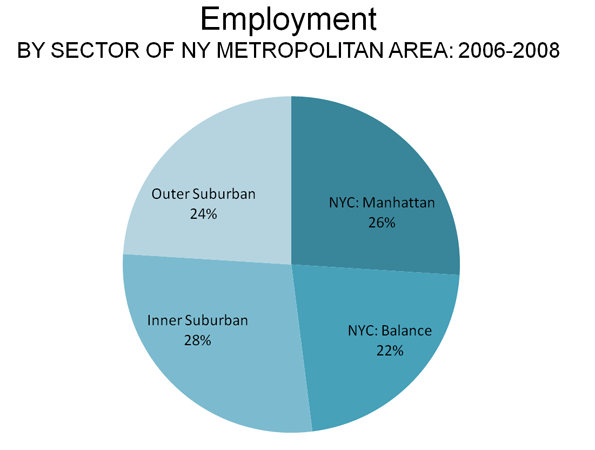
    A Highly Decentralized Metropolitan Area: Yet in reality, New York is a highly decentralized metropolitan area. Approximately 74% of employment is outside Manhattan and the jobs are comparatively evenly dispersed among the sectors. There is more employment in the inner ring suburbs than in Manhattan (28%). Even the outer ring is competitive has nearly as many jobs, at 24%. Finally, the balance of the city, the four boroughs, has 22% of the employment (Figure 1).

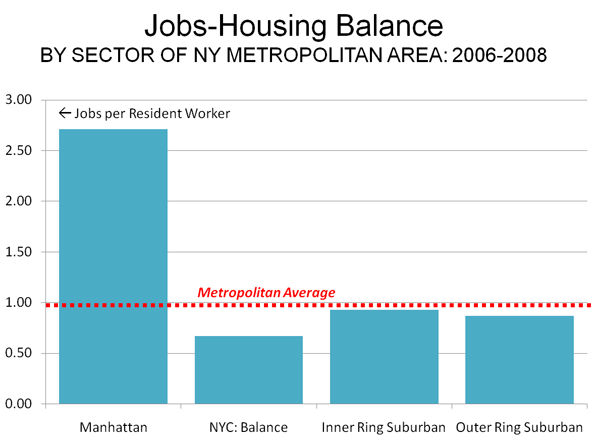
    Wide Variations in the Jobs-Housing Balance: It is hard to understate the intensity of Manhattan’s central business district employment. Manhattan has 2.71 jobs for every resident worker. An important tenet of modern urban planning theory is to achieve a balance of jobs and housing. Manhattan’s jobs/housing imbalance is certainly the most acute of any county in the United States, yet it is to Manhattan that purveyors of smart growth densification policies are routinely drawn.

    Manhattan’s huge excess of jobs contrasts with employment the rest of the the city, where the jobs-housing balance at the county level is 0.67, the lowest in the metropolitan area. The inner ring suburbs have the highest jobs-housing balance at 0.93, while the outer suburbs have a jobs-housing balance of 0.87 (Figure 2), nearly one-third higher than the non-Manhattan boroughs (three of which are more dense than any major municipal jurisdiction in the nation). The city’s strongest jobs-housing balance is in Brooklyn (Kings County), at 0.72, which is lower than all of the suburban counties except for the most remote (Pike, Putnam and Sussex).

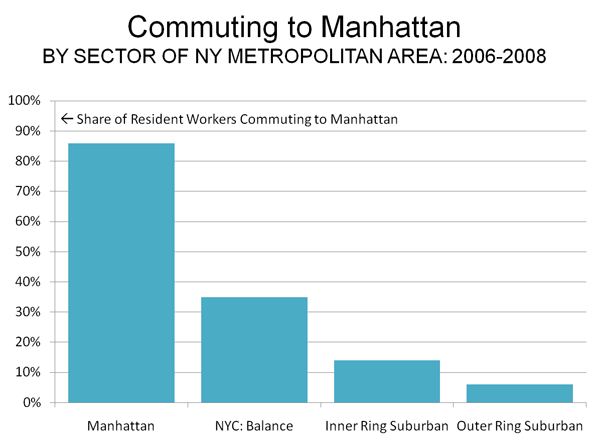
    Manhattan’s Impact: Diminishing Rapidly with Distance: There is no doubt that Manhattan remains the core of the New York economy, but that is less true the further you go out. While nearly 70% of the core’s workers commute from outside Manhattan, the employment influence of Manhattan drops off like the temperature falls the further you get away from a fireplace.

    86% of Manhattan’s resident workers have jobs in Manhattan, but only 35% of workers living in the city’s other boroughs work in Manhattan. This falls off to 14% in the inner suburban counties and 6% in the outer suburban counties (Figure 3). In Sussex County and Ocean County, New Jersey, only 2% of resident workers commute to Manhattan.

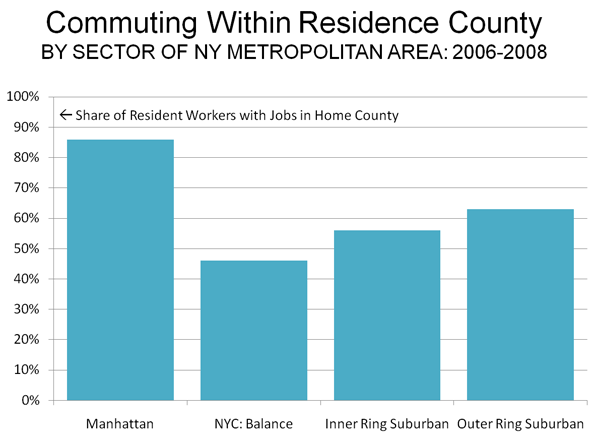
    Working Close to Home: At the same time a larger number of resident workers outside Manhattan work in their home counties than work in Manhattan. In the balance of the city, 46% of workers have jobs in the same counties. The inner suburban counties employ 56% of their resident workers, while the outer suburban counties employ 63%. Overall, 58% of New Yorkers work in their county of residence, more than double the share that work in Manhattan (Figure 4). In Richmond County (Staten Island), Suffolk County and Rockland counties in New York and Pike County, Pennsylvania, more than 80% of jobs are filled by local residents.

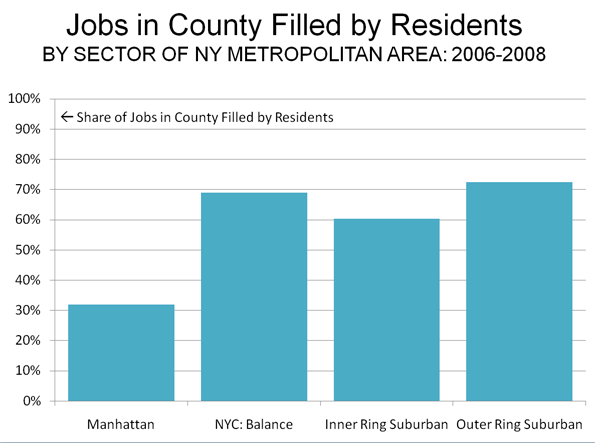
    Local Workers Generally Come from the Same Counties: A review of the residential location of workers by job location reinforces the dominantly local nature of commuting in New York. Overall, 56% of jobs are filled by residents of the same county. The figure is the highest in the outer ring suburban counties, at 73%. The inner ring suburban areas draw 60% of their workers from the same county, while the balance of the city draws 69%. In Manhattan, with its seriously out of balance jobs and housing, just 32% of the jobs are filled by it residents (Figure 5).

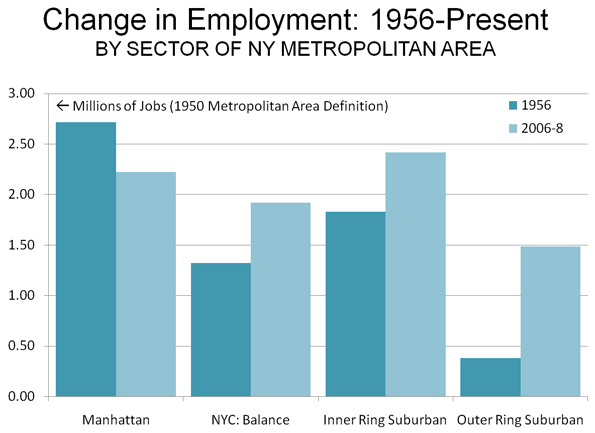
    Dispersion: Past and Present. All of this is a huge change from a half-century ago. In 1956 (according to data in the classic Anatomy of A Metropolitan Area, by Edgar M. Hoover and Raymond Vernon), Manhattan accounted for 43% of the metropolitan area’s employment (1950 metropolitan definition). Since that time, employment has fallen substantially in Manhattan and risen elsewhere. There have been gains in the outer boroughs, related principally to the strong population growth Queens and Staten Island. There were also gains in the inner suburban counties. The strongest gains were in the outer suburban counties (Figure 6).

    The dispersion is continuing. As Ed McMahon and I showed in Empire State Exodus, there is considerable migration from New York to Pennsylvania, as people are moving to metropolitan areas such as Allentown and Wilkes-Barre. Obviously, as the modest level of commuting from the outer counties of metropolitan New York indicates, relatively few of these people are commuting to Manhattan. This impression may be more a product of the fact the Manhattan-based media only recognizes workers when they actually make it into town; those who stay in the periphery, it seems, might as well live on another planet.

    New York, with as by far the strongest central business district in the nation, still has moved from virtual monocentrism, to the Edge Cities polycentrism of Joel Garreau and increasingly even to the amorphous Edgeless Cities employment dispersion of Robert Lang. The strong core continues to regenerate, but no longer exerts anything like its former dominant influence.

    ——-

    Note 1: For complete data.

    Note 2: For a description of urban terms (metropolitan area, urban area, etc).

    Note 3: Demographia World Urban Areas includes the continuous urbanization of southwestern Connecticut as a part of the New York urban area.

    ——-

    Table 1
    COMMUTING IN THE NEW YORK METROPOLITAN AREA (2006-2008): SUMMARY BY GEOGRAPHIC RING
    RINGS Ring Jobs/Housing Balance (Jobs per Resident Worker) Workers Employed in Residence County Share of Jobs Filled by County Residents Workers Employed in New York County (Manhattan) Average One-Way Work Trip Time (Minutes): Residence Average One-Way Work Trip Time (Minutes): Workplace Median Year Owned Housing Built
    NYC: Manhattan 1 2.719 86.3% 31.7% 86.3%                30.3                49.1 1942
    NYC: Balance 2 0.674 46.4% 68.8% 35.6%                42.0                37.3 1939-1971
    Inner Ring 3 0.927 56.0% 60.4% 14.4%                30.5                29.1 1950-1956
    Outer Ring 4 0.870 63.1% 72.5% 6.2%                31.3                26.0 1967-1983
    New York MSA 1.000 57.6% 57.6% 26.1%                34.5                35.5 1955
    Derived from American Community Survey data (2006-2008)
    Note: MSA work trip times (residence and work location) differ because commuters from outside the MSA are included


    Table 2
    COMMUTING IN THE NEW YORK METROPOLITAN AREA (2006-2008): SUMMARY BY COUNTY
    COUNTIES Ring Jobs/Housing Balance (Jobs per Resident Worker) Workers Employed in Residence County Share of Jobs Filled by County Residents Workers Employed in New York County (Manhattan) Average One-Way Work Trip Time (Minutes): Residence Average One-Way Work Trip Time (Minutes): Workplace Median Year Owned Housing Built
    New York Co., NY 1 2.719 86.3% 31.7% 86.3%                30.3                49.1 1942
    Bronx Co., NY 2 0.676 44.3% 65.6% 36.8%                41.1                35.7 1950
    Kings Co., NY 2 0.721 51.2% 71.0% 36.7%                42.3                39.0 1939
    Queens Co., NY 2 0.645 42.4% 65.7% 36.0%                42.0                37.5 1949
    Richmond Co., NY 2 0.585 47.3% 80.8% 26.3%                42.7                29.8 1971
    Bergen Co., NJ 3 0.960 56.7% 59.1% 15.0%                29.3                27.2 1956
    Essex Co., NJ 3 1.052 53.6% 50.9% 9.7%                30.8                31.8 1953
    Hudson Co., NJ 3 0.892 47.1% 52.8% 23.6%                32.4                35.1 1950
    Passaic Co., NJ 3 0.797 45.3% 56.8% 4.3%                27.0                28.0 1954
    Union Co., NJ 3 0.969 50.7% 52.3% 7.1%                33.0                27.6 1954
    Nassau Co., NY 3 0.884 59.1% 66.8% 14.8%                31.6                30.0 1954
    Westchester Co., NY 3 0.928 67.3% 72.6% 19.9%                33.6                27.7 1955
    Hunterdon Co., NJ 4 0.736 49.5% 67.2% 3.7%                31.4                28.2 1978
    Middlesex Co., NJ 4 0.943 58.5% 62.0% 7.7%                26.9                25.8 1968
    Monmouth Co., NJ 4 0.880 63.4% 72.0% 8.2%                33.2                23.8 1970
    Morris Co., NJ 4 1.097 58.7% 53.5% 5.4%                29.4                31.2 1967
    Ocean Co., NJ 4 0.723 63.4% 87.7% 2.0%                31.1                21.3 1977
    Somerset Co., NJ 4 0.988 46.7% 47.3% 5.6%                31.0                31.1 1978
    Sussex Co., NJ 4 0.565 44.5% 78.8% 2.3%                38.2                23.7 1972
    Putnam Co., NY 4 0.441 30.9% 70.1% 8.0%                37.0                24.4 1967
    Rockland Co., NY 4 0.763 61.2% 80.1% 12.0%                29.8                25.1 1969
    Suffolk Co., NY 4 0.872 76.2% 87.4% 5.7%                29.8                23.5 1967
    Pike Co., PA 4 0.574 45.9% 80.0% 4.6%                44.1                25.2 1983
    New York MSA 1.000 57.6% 57.6% 26.1%                34.5                35.5 1955

    ——-

    Wendell Cox is a Visiting Professor, Conservatoire National des Arts et Metiers, Paris and the author of “War on the Dream: How Anti-Sprawl Policy Threatens the Quality of Life

    Photo: Levittown (Nassau County): Inner Suburban (photo by author)

  • Mass Transit: The Great Train Robbery

    Last month promoters of the Metropolitan Transit Authority’s Los Angeles rail projects, both past and future, held a party to celebrate their “success.” Although this may well have been justified for transit-builders and urban land speculators, there may be far less call for celebration among L.A.’s beleaguered commuters.

    Despite promises that the $8 billion invested in rail lines over the past two decades would lessen L.A.’s traffic congestion and reshape how Angelenos get to work, the sad reality is that there has been no increase in MTA transit ridership since before the rail expansion began in 1985.

    Much of the problem, notes Tom Rubin, a former chief financial officers for the MTA’s predecessor agency, stems from the shift of funding priorities to trains from the city’s more affordable and flexible bus network. Meanwhile, traffic has gotten worse, with delay hours growing from 44 hours a year in 1982 to 70 hours in 2007.

    Sadly, this situation is not unique to Los Angeles. In cities across the country where there have been massive investments in light rail–from the Portland area to Dallas and Charlotte, N.C., and a host of others–the percentage of people taking transit has stagnated or even declined. Nationwide, the percentage of people taking transit to work is now lower than it was in 1980.

    None of this is to argue that we should not invest in transit. It even makes sense if the subsidy required for each transit trip is far higher than for a motorist on the streets or highways. Transit should be considered a public good, particularly for those without access to a car–notably young people, the disabled, the poor and the elderly. Policy should focus on how we invest, at what cost and, ultimately, for whose benefit.

    In some regions with large concentrations of employment, downtown major rail systems often attract many riders (although virtually all lose lots of money). The primary example would be the New York City area, which is one of only two regions (the other being Washington, D.C.) with over one-fifth of total employment in the urban core. In the country as a whole barely 10% of employment is in the city; and in many cities that grew most in the 20th century, such as Dallas, Miami, Los Angeles and Phoenix, the central business district’s share falls well under 5%.

    Some other urban routes–for example between Houston’s relatively buoyant downtown and the massive, ever expanding Texas Medical Center–could potentially prove suitable for trains. But most transit investments would be far more financially sustainable if focused on more cost-efficient methods such as rapid bus lanes, which, according to the Government Accountability Office, is roughly one-third the cost of light rail.

    Making the right choices has become more crucial during the economic downturn, even in New York City. The city and the federal government continue to pour billions into a gold-plated Second Avenue subway but now plan to cut back drastically on the bus service that serves large numbers of commuters from the outer boroughs and more remote parts of Manhattan.

    Ultimately the choice to invest in new subways and light rail as opposed to buses reflects both a class bias and the agenda of what may best described as the “density lobby.” The people who will ride the eight-mile long Second Avenue subway, now under construction for what New York magazine reports may be a total cost of over $17 billion, are largely a very affluent group. The new subway line will also provide opportunity for big developers to build high-density residential towers along the route. In contrast, the bus-riders, as the left-of-center City Limits points out, tend to be working- and middle-class residents from more unfashionable, lower-density districts in the Bronx, Queens, Brooklyn and Staten Island.

    The proposals for High Speed Rail–a favorite boondoggle of the Obama administration and some state administrators–reveals some of the same misplaced fiscal priorities. California’s State Treasurer, Democrat Bill Lockyer, has lambasted the proposed HSR line between Los Angeles and the Bay Area, suggesting the state may not be able to sell private investors on between $10 billion and $12 billion in bonds without additional public subsidies.

    Other prominent Democrats as well as the State Auditor’s office have challenged the promoters’ claims about the viability of the system and its potential drain on more reasonable priced transit project.

    This issue funding priorities was raised recently by the current administrator of the Federal Transportation Authority, Peter Rogoff, who questioned the wisdom of expanding expensive rail and other transit projects when many districts “can’t afford to operate” their own systems. He noted that already almost 30% of all existing “transit assets” are in “poor or marginal condition.”

    Ultimately we need to ask what constitutes transit’s primary mission: to carry more people to work or to reshape our metropolitan areas for ever denser development. As opposed to buses, which largely serve those without access to cars, light rail lines are often aimed at middle-class residents who would also be potential buyers of high-density luxury housing. In this sense, light rail constitutes a critical element in an expanded effort to reshape the metropolis in a way preferred by many new urbanists, planners and urban land speculators.

    The problem facing these so-called visionaries lies in the evolving nature of the workplace in most parts of the country, where jobs, outside of government employment, are increasingly dispersed. Given these realities, transit agencies should be looking at innovative ways to reach farther to the periphery, in part to provide access to inner-city residents to a wider range of employment options. Considering more than 80% of all commuter trips are between areas outside downtown, priority should be given to more flexible, less costly systems such as rapid commuter bus lines, bus rapid transit, as well as subsidized dial-a-ride and jitney services that can work between suburban centers.

    If reducing energy use and carbon emissions remains the goal, much more emphasis should be placed as well on telecommuting. In many cities that have invested heavily in rail transit–Dallas, Denver and Salt Lake City, for example–the percentage of people working from home is now markedly larger than those taking any form of mass transit. Since the approval of the Dallas light rail system in the 1980s, for example, the transit share of work trips has dropped from 4.3% to 2.1%; the work-at-home share has grown from 2.3% to 4.3%.

    In fact, people who work from home now surpass transit users in 36 out of 52 metropolitan areas with populations over 1 million–and receive virtually no financial backing from governments. Yet if New York, home to roughly 40% of the nation’s transit commuters, was taken out of the calculations, at-home workers already outnumber the number of people taking transit to work; and since 2000 their numbers have been growing roughly twice as fast as those of transit riders.

    Clearly we should not spend our ever more scarce transit resources on a nostalgia crusade to make our cities function much the way they did in the late 1800s. Instead, we need to construct systems reflecting the technology and geographic realities of the 21st century and place our primary focus on helping people, particularly those in need, find efficient, economically sustainable ways to get around.

    This article originally appeared at Forbes.com.

    Joel Kotkin is executive editor of NewGeography.com and is a distinguished presidential fellow in urban futures at Chapman University. He is author of The City: A Global History. His newest book is The Next Hundred Million: America in 2050, released in February, 2010.

    Photo: Michael | Ruiz

  • Supporting Small Business in NYC: The Harlem Metro Market Project

    The Harlem Community Development Corporation has come up with a rather unique plan to combat high real estate prices in the district. It proposes establishing an open-air market under the Metro North tracks spanning one mile, or 22 city blocks. This new market would accommodate about 900 vendors, helping to increase the now low number of local entrepreneurs and independent retail stores in Harlem.

    The market would not only attract vendors, but tourist traffic as well, which would help rejuvenate a neighborhood hampered by soaring commercial real estate costs. It costs anywhere from $125 to $225 per square foot for commercial space in Harlem’s prime locations, resulting in only 42 stores for every 10,000 residents. The Metro market project would ease pressure on small, independent retailers and allow potential entrepreneurs the chance to create viable businesses in the city.

    This need for such a project reflects the economic trends and challenges facing the larger New York urban area’s middle class. New York City has the nation’s highest cost of living, and like the rest of the nation, is still experiencing the effects of the recession. The middle class, including small business owners facing high rents, struggles to make the six-figure salaries needed to meet the city’s high cost of living.

    Harlem’s Metro market project, which would encourage an independent entrepreneurial spirit, embodies the required plan of action for New York City. The city needs to find inventive ways to deal with its economic reality in order to reverse the recession and revitalize its appeal to the energetic and the ambitious.

  • Despite Transit’s 2008 Peak, Longer Term Market Trend is Down: A 25 Year Report on Transit Ridership

    In 2008, US transit posted its highest ridership since 1950, a development widely noted and celebrated in the media. Ridership had been increasing for about a decade, however, 2008 coincided with the highest gasoline prices in history, which gave transit a boost.

    Less reported was the fact that despite higher ridership, transit’s market share (of transit and motor vehicles) has fallen since the 1950s. In 1955, transit’s market share was over 10%. By 2005, transit’s share had dropped to 1.5%, but recovered only to 1.6% in 2008. Transit’s all time peak ridership was in 1945, driven up by World War II and gas rationing. It is thus not surprising that national transit ridership (boardings) declined 3.8% in 2009 as gasoline prices moderated.

    Market Share by Major Urban Area

    Demographia has released urban area roadway and transit market share estimates for 2008, based upon Federal Transit Administration and Federal Highway Administration data. The table below compares 2008 with 1983 market share data for 56 urban areas with a corresponding metropolitan area population of more than 900,000 (complete data).

    Urban Areas: Roadway & Transit Market Share: 2008
    Ranked by 2008 Transit Market Share
    With 25 Year (1983) Comparison
        2008 1983 Roadway Share % Change
    Rank Urban Area Roadway Share Transit Share:  Roadway Share Transit Share: 
    1 New York 89.0% 11.0% 87.7% 12.3% 1.5%
    2 San Francisco 95.0% 5.0% 93.7% 6.3% 1.4%
    3 Washington 95.5% 4.5% 96.1% 3.9% -0.6%
    4 Chicago 96.1% 3.9% 94.2% 5.8% 2.0%
    5 Honolulu 96.2% 3.8% 93.2% 6.8% 3.2%
    6 Boston 96.7% 3.3% 97.5% 2.5% -0.8%
    7 Seattle 97.2% 2.8% 97.6% 2.4% -0.4%
    8 Philadelphia 97.3% 2.7% 96.0% 4.0% 1.4%
    9 Portland 97.7% 2.3% 97.6% 2.4% 0.1%
    10 Salt Lake City 97.8% 2.2% 99.1% 0.9% -1.3%
    11 Los Angeles 98.1% 1.9% 98.1% 1.9% 0.0%
    12 Denver 98.2% 1.8% 98.5% 1.5% -0.3%
    13 Baltimore 98.3% 1.7% 97.7% 2.3% 0.6%
    14 Pittsburgh 98.6% 1.4% 97.3% 2.7% 1.3%
    15 Miami-West Palm Beach 98.7% 1.3% 98.8% 1.2% -0.1%
    16 Atlanta 98.8% 1.2% 98.0% 2.0% 0.8%
    16 Cleveland 98.8% 1.2% 98.0% 2.0% 0.8%
    16 Las Vegas 98.8% 1.2% 99.6% 0.4% -0.8%
    16 Minneapolis-St. Paul 98.8% 1.2% 98.8% 1.2% 0.0%
    16 San Diego 98.8% 1.2% 99.3% 0.7% -0.5%
    21 San Jose 99.0% 1.0% 99.0% 1.0% 0.0%
    22 Austin 99.1% 0.9% 99.7% 0.3% -0.6%
    22 Houston 99.1% 0.9% 99.0% 1.0% 0.1%
    22 Milwaukee 99.1% 0.9% 98.3% 1.7% 0.8%
    22 Sacramento 99.1% 0.9% 99.0% 1.0% 0.1%
    22 San Antonio 99.1% 0.9% 98.7% 1.3% 0.4%
    27 St. Louis 99.2% 0.8% 99.0% 1.0% 0.2%
    28 Buffalo 99.3% 0.7% 98.5% 1.5% 0.8%
    28 Providence 99.3% 0.7% 98.9% 1.1% 0.4%
    30 Charlotte 99.4% 0.6% 99.3% 0.7% 0.1%
    30 Cincinnati 99.4% 0.6% 98.7% 1.3% 0.7%
    30 Dallas-Fort Worth 99.4% 0.6% 99.4% 0.6% 0.0%
    30 Hartford 99.4% 0.6% 98.7% 1.3% 0.7%
    30 Orlando 99.4% 0.6% 99.7% 0.3% -0.3%
    30 Phoenix 99.4% 0.6% 99.4% 0.6% 0.0%
    30 Rochester 99.4% 0.6% 98.9% 1.1% 0.5%
    30 Tucson 99.4% 0.6% 98.9% 1.1% 0.5%
    38 Detroit 99.5% 0.5% 98.8% 1.2% 0.7%
    38 Fresno 99.5% 0.5% 99.3% 0.7% 0.2%
    38 New Orleans 99.5% 0.5% 97.4% 2.6% 2.2%
    38 Norfolk-Virginia Beach 99.5% 0.5% 99.2% 0.8% 0.3%
    38 Riverside-San Bernardino 99.5% 0.5% 99.6% 0.4% -0.1%
    43 Columbus 99.6% 0.4% 98.6% 1.4% 1.0%
    43 Louisville 99.6% 0.4% 98.9% 1.1% 0.7%
    43 Memphis 99.6% 0.4% 99.4% 0.6% 0.2%
    43 Tampa-St. Petersburg 99.6% 0.4% 99.5% 0.5% 0.1%
    47 Bridgeport 99.7% 0.3% 99.8% 0.2% -0.1%
    47 Jacksonville 99.7% 0.3% 99.4% 0.6% 0.3%
    47 Kansas City 99.7% 0.3% 99.4% 0.6% 0.3%
    47 Nashville 99.7% 0.3% 99.4% 0.6% 0.3%
    47 Raleigh 99.7% 0.3% 99.9% 0.1% -0.2%
    47 Richmond 99.7% 0.3% 99.1% 0.9% 0.6%
    53 Indianapolis 99.8% 0.2% 99.3% 0.7% 0.5%
    54 Birmingham 99.9% 0.1% 99.5% 0.5% 0.4%
    54 Oklahoma City 99.9% 0.1% 99.9% 0.1% 0.0%
    54 Tulsa 99.9% 0.1% 99.6% 0.4% 0.3%
    Unweighted Average 98.7% 1.3% 98.3% 1.7% 0.4%
    All Urban Areas Combined 98.4% 1.6% 97.5% 2.5% 0.9%
    Based upon passenger miles
    Core urban areas in metropolitan areas with more than 900,000 population in 2009.
    Derived from Federal Transit Administration and Federal Highway Administration data
    Los Angeles and Mission Viejo urban areas combined
    San Francisco, Concord and Livermore urban areas combined
    Historic transit market share data at http://www.publicpurpose.com/ut-usptshare45.pdf
    Maryland commuter rail (MARC) assigned to Washington, DC

    In 1983, transit systems started receiving support from federal taxes on gasoline. This was also the first year that the National Transit Database reported on the same annual basis as it does today. One justification for using funds from road users was the hope of attracting people from cars to transit. The national data above and the urban area below show that the overwhelming share of new travel has, nonetheless, continued to be captured by motor vehicles rather than transit. Among the 56 urban areas, 13 experienced gains in transit market share from 1983 to the peak year of 2008, while 37 posted losses and six had no change. Transit was able to capture only 0.9% of new urban travel between 1983 and 2008, while roadways captured 99.1%. (Note 1).

    The Top 10: Still a New York Story

    #1: New York: The nation’s predominant urban area remains New York, with an 11.0% transit market share. In 2008, 41% of the national transit ridership (passenger miles) was in New York, with much of it either in or focused upon New York City. The New York City Transit Authority, and a host of local public and private systems, principally serve New York City destinations and account for a remarkable 38% of the nation’s transit ridership. Even so, transit’s market share dropped from 12.3% in 1983. As a result, the roadway market share in New York increased 1.5% between 1983 and 2008, the fourth largest gain in the nation. Transit attracted 8.7% of the new demand between 1983 and 2008, while roadways attracted 91.3%.

    #2: San Francisco: San Francisco had the nation’s second highest transit market share in 2008, at 5.0%. This is a decline from 6.3% in 1983. Nonetheless, San Francisco moved up from 6th place in 1983. This produced a 1.4% increase in the roadway market share between 1983 and 2008, the fifth largest gain in the nation. Transit accounted for 2.2% of the new demand, while roadways attracted 97.8%.

    #3: Washington: Washington placed third in transit market share in 2008, at 4.5%. This represents a gain from 3.9% in 1983 and an improvement from 6th place. Washington was the only urban area among the top five to experience an increase in transit market share. Much of Washington’s transit increase was on its expanding Metrorail system and the MARC commuter rail system (most of the ridership on this Maryland based system commutes to Washington. Overall, transit in Washington has attracted 5.1% of new travel over the past 25 years, while roadways attracted 94.9% of new demand.

    #4: Chicago: Chicago ranked fourth in transit market share, at 3.9%. In 1983, Chicago had ranked 3rd, with a market share of 5.8. The roadway market share in Chicago increased 2.0% from 1983 to 2008, the third largest road travel gain in the nation. Transit attracted 1.3% of new demand over the period in Chicago, while roadways attracted 98.7%.

    #5: Honolulu: Honolulu ranked fifth in transit market share, at 3.8%. This is a significant drop from 1983, when Honolulu ranked 2nd in the nation, with a transit market share of 6.8%. Honolulu’s roadway market share gain was the largest in the nation between 1983 and 2005, at 3.8%. Transit ridership also dropped in Honolulu from 1983 to 2008, so that roadways accounted for all new travel.

    #6: Boston: Boston ranked sixth in transit market share in 2008, at 3.3%. This is a gain from 2.5% in 1983, when Boston ranked 9th. Much of Boston’s increase is attributable to its commuter rail expansion. Transit captured 4.1% of new demand, while roadways attracted 95.9%.

    #7: Seattle: Seattle’s principally all bus transit system ranked 7th in 2008 with a market share of 2.8%. This is an increase from 2.4% in 1983, when Seattle ranked 10th. Transit captured 3.1% of new travel over the past 25 years, while roadways accounted for 96.9%.

    #8: Philadelphia: Philadelphia slipped from the 5th largest transit market share in 1983 (4.0%) to 8th in 2008, at 2.7%. Philadelphia’s transit system, one of the most comprehensive in the nation, captured just 1.4% of new travel over the last quarter century, while roadways captured 98.6%.

    #9: Portland: Portland ranked 9th in transit market share in 2008, at 2.3%. This is a decline from 2.4% in 1983 and occurred despite opening the most extensive new light rail system in the nation over the period. Transit attracted 2.2% of new travel over the period, while roadways attracted 97.8%.

    #10: Salt Lake City: Salt Lake City, at 10th, is a new entrant to the top 10 transit market share urban areas, with a share of 2.2%. In 1983, Salt Lake City ranked 34th, with a transit market share of 0.9%. Even with this increase, however, roadways captured the bulk of new travel, at 96.2%, while transit attracted 3.8%, due to transit’s small 1983 base.

    Other Urban Areas: There were also notable developments among the urban areas that did not place in the top 10 in 2008 transit market share.

    Las Vegas: Las Vegas improved its ranking more than any other urban area, moving from 49th in 1983 to 16th in 2008 (in a tie with Atlanta, San Diego, Cleveland and Minneapolis-St. Paul). In 1983, Las Vegas had a transit market share of 0.4%, which improved to 1.2% in 2008. This was an especially notable achievement, because Las Vegas experienced substantial population growth over the period. During the period, Las Vegas established a 100% competitively contracted transit system, the only such transit system in the nation and has seen ridership expand by more than 10 times. Nonetheless, as in other gaining urban areas, such as Salt Lake City and Washington, the transit ridership base was so small that roadways captured nearly all the new demand, at 98.6% (transit obtained 1.4%).

    Atlanta: Atlanta both (1) was the fastest growing larger urban area in the developed world between 1983 and 2008 and (2) built the second most new rail capacity in the nation, in its expansion of the MARTA Metro (trailing only Washington’s Metro). Yet, Atlanta’s transit market share fell from 2.0% to 1.2% between 1983 and 2008, with transit attracting only 0.9% of new travel.

    New Rail Urban Areas: Transit market shares generally failed to increase in urban areas opening new light rail or metro systems over the period (excludes urban areas with new rail systems that were not open at the beginning of fiscal year 2008).

    • Six urban areas with new rail systems experienced market share declines, including Portland, Baltimore, Houston, Sacramento, St. Louis and Buffalo.
    • Four urban areas with new rail systems had static transit market shares, including Los Angeles, Minneapolis-St. Paul, San Jose and Dallas-Fort Worth.
    • Three urban areas with new rail systems experienced transit market share increases. The largest increase was in Salt Lake City (and the largest of any urban area). Denver and Miami-West Palm Beach also experienced increases.

    Where from Here? It might have been expected that transit would have attracted far higher ridership numbers when gasoline prices achieved such heights. Yet, nationally, transit market share increase was only from 1.5% to 1.6%, even as roadway demand was declining modestly.

    Transit’s principal marketing problem lies in its problem serving destinations outside downtown. Downtowns typically account for only 10% of urban area employment. Some trips in an urban cannot even be made on transit. For example, Portland’s extensive transit system connects only about two-thirds of the jobs and residences within the (Tri-Met) service area (Note 2). Further Tri-Met’s award deserving internet trip planner shows that some trips to outside downtown destinations can require more than two hours, even when light rail is used.


    Note 1: This data relates only to passenger transportation. Urban roadways, unlike transit, also carry a substantial amount of local and intercity freight, which is not reflected in this data.

    Note 2: According to Metro’s 2004 Regional Transportation Plan, 78% of the residences and 86% of the jobs in the Tri-Met service area were within walking distance (1/4 mile) of a transit stop. This means that approximately 67% of residences and jobs are within 1/4 mile of a transit stop (0.78 * 0.86). Metro’s plans envision this figure dropping to 59% by 2020 (this data does not include Clark County in Washington, part of which is in the urban area).

    Wendell Cox is a Visiting Professor, Conservatoire National des Arts et Metiers, Paris. He was born in Los Angeles and was appointed to three terms on the Los Angeles County Transportation Commission by Mayor Tom Bradley. He is the author of “War on the Dream: How Anti-Sprawl Policy Threatens the Quality of Life.

  • Time to Dismantle the American Dream?

    For some time, theorists have been suggesting that it is time to redefine the American Dream of home ownership. Households, we are told, should live in smaller houses, in more crowded neighborhoods and more should rent. This thinking has been heightened by the mortgage crisis in some parts of the country, particularly in areas where prices rose most extravagantly in the past decade. And to be sure, many of the irrational attempts – many of them government sponsored – to expand ownership to those not financially prepared to bear the costs need to curbed.

    But now the anti-homeowner interests have expanded beyond reigning in dodgy practices and expanded into an argument essentially against the very idea of widespread dispersion of property ownership. Social theorist Richard Florida recently took on this argument, in a Wall Street Journal article entitled “Home Ownership is Overvalued.”

    In particular, he notes that:

    The cities and regions with the lowest levels of homeownership—in the range of 55% to 60% like L.A., N.Y., San Francisco and Boulder—had healthier economies and higher incomes. They also had more highly skilled and professional work forces, more high-tech industry, and according to Gallup surveys, higher levels of happiness and well-being. (Note)

    Florida expresses concern that today’s economy requires a more mobile work force and is worried that people may be unable to sell their houses to move to where jobs can be found. Those who would reduce home ownership to ensure mobility need lose little sleep.

    The Relationship Between Household Incomes and House Prices

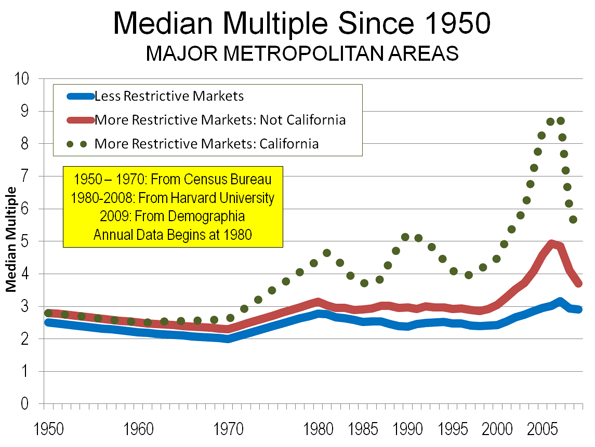
    It is true, as Florida indicates, that house prices are generally higher where household incomes are higher. But, all things being equal, there are limits to that relationship, as a comparison of median house prices to median house prices (the Median Multiple) indicates. From 1950 to 1970 the Median Multiple averaged three times median household incomes in the nation’s largest metropolitan areas. In the 1950, 1960 and 1970 censuses, the most unaffordable major metropolitan areas reached no higher than a multiple of 3.6 (Figure).

    This changed, however, in some areas after 1970, spurred by higher Median Multiples occuring in California.

    William Fischel of Dartmouth has shown how the implementation of land use controls in California metropolitan areas coincided with the rise of house prices beyond historic national levels. The more restrictive land use regulations rationed land for development, placed substantial fees on new housing, lengthened the time required for project approval and made the approval process more expensive. At the same time, smaller developers and house builders were forced out of the market. All of these factors (generally associated with “smart growth”) propelled housing costs higher in California and in the areas that subsequently adopted more restrictive regulations (see summary of economic research).

    During the bubble years, house prices rose far more strongly in the more highly regulated metropolitan areas than in those with more traditional land use regulation. Ironically many of the more regulated regions experienced both slower job and income growth compared to more liberally regulated areas, notably in the Midwest, the southeast, and Texas.

    Home Ownership and Metropolitan Economies

    The major metropolitan areas Florida uses to demonstrate a relationship between higher house prices and “healthier economies” are, in fact, reflective of the opposite. Between August 2001 and August 2008 (chosen as the last month before 911 and the last month before the Lehman Brothers collapse), Bureau of Labor Statistics data indicates that in the New York and Los Angeles metropolitan areas, the net job creation rate trailed the national average by one percent. The San Francisco area did even worse, trailing the national net job creation rate by 6 percent, and losing jobs faster than Rust Belt Pittsburgh, St. Louis, and Milwaukee.

    Further, pre-housing bubble Bureau of Economic Analysis data from the 1990s suggests little or no relationship between stronger economies and housing affordability as measured by net job creation. The bottom 10 out of the 50 largest metropolitan areas had slightly less than average home ownership (this bottom 10 included “healthy” New York and Los Angeles). The highest growth 10 had slightly above average home ownership (measured by net job creation). Incidentally, “healthy” San Francisco also experienced below average net job creation, ranking in the fourth 10.

    Moreover, housing affordability varied little across the categories of economic growth (Table).

    Net Job Creation, Housing Affordability & Home Ownership
    Pre-Housing Bubble Decade: Top 50 Metropolitan Areas (2000)
    Net Job Creation: 1990-2000 Housing Affordability: Median Multiple (2000) Home Ownership: Rate 2000
    Lowest Growth 10  7.4%                                2.8 62%
    Lower Growth 10 14.9%                                3.1 63%
    Middle 10 22.8%                                3.2 64%
    Higher Growth 10 30.9%                                2.6 61%
    Highest Growth 10 46.9%                                2.9 63%
    Average 24.7%                                2.9 62%
    Calculated from Bureau of the Census, Bureau of Economic Analysis and Harvard Joint Housing Center data.
    Metropolitan areas as defined in 2003
    Home ownership from urbanized areas within the metropolitan areas.

    Home Ownership and Happiness

    If Gallup Polls on happiness were reliable, it would be expected that the metropolitan areas with happier people would be attracting people from elsewhere. In fact, people are fleeing with a vengeance. During this decade alone, approximately one in every 10 residents have left for other areas.

    • The New York metropolitan area lost nearly 2,000,000 domestic migrants (people who moved out of the metropolitan area to other parts of the nation). This is nearly as many people as live in the city of Paris.
    • The Los Angeles metropolitan area has lost a net 1.35 million domestic migrants. This is more people than live in the city of Dallas.
    • The San Francisco metropolitan area lost 350,000 domestic migrants. Overall, the Bay Area (including San Jose) lost 650,000, more people than live in the cities of Portland or Seattle.

    Why have all of these happy people left these “healthy economies?” One reason may be that so many middle income people find home ownership unattainable is due to the house prices that rose so much during the bubble and still remain well above the historic Median Multiple. People have been moving away from the more costly metropolitan areas. Between 2000 and 2007:

    • 2.6 million net domestic migrants left the major metropolitan areas (over 1,000,000 population) with higher housing costs (Median Multiple over 4.0).
    • 1.1 net domestic migrants moved to the major metropolitan areas with lower house prices (Median Multiple of 4.0 or below).
    • 1.6 million domestic migrants moved to small metropolitan areas and non-metropolitan areas (where house prices are generally lower).

    An Immobile Society?

    Florida’s perceived immobility of metropolitan residents is curious. Home ownership was not a material barrier to moving when tens of millions of households moved from the Frost Belt to the Sun Belt in the last half of the 20th century. During the 2000s, as shown above, millions of people moved to more affordable areas, at least in part to afford their own homes.

    Under normal circumstances (which will return), virtually any well-kept house can be sold in a reasonable period of time. More than 750,000 realtors stand ready to assist in that regard.

    Of course, one of the enduring legacies of the bubble is that many households owe more on their houses than they are worth (“under water”). This situation, fully the result of “drunken sailor” lending policies, is most severe in the overly regulated housing markets in which prices were driven up the most. Federal Reserve Bank of New York research indicates that the extent of home owners “under water” is far greater in the metropolitan markets that are more highly restricted (such as San Diego and Miami) and is generally modest where there is more traditional regulation, such as Charlotte and Dallas (the exception is Detroit, caught up in a virtual local recession, and where housing prices never rose above historic norms, even in the height of the housing bubble). Doubtless many of these home owners will find it difficult to move to other areas and buy homes, especially where excessive land use regulations drove prices to astronomical levels.

    Restoring the Dream

    There is no need to convince people that they should settle for less in the future, or that the American Dream should be redefined downward. Housing affordability has remained generally within historic norms in places that still welcome growth and foster aspiration, like Atlanta, Dallas-Fort Worth, Houston, Indianapolis, Kansas City, Columbus and elsewhere for the last 60 years, including every year of the housing bubble. Rather than taking away the dream, it would be more appropriate to roll back the regulations that are diluting the purchasing power and which promise a less livable and less affluent future for altogether too many households.

    Note. Among these examples, New York is the largest metropolitan area in the nation. Los Angeles ranks number 2 and San Francisco ranks number 13. The inclusion of Boulder, ranked 151st in 2009 seems a bit curious, not only because of its small size, but also because its advantage of being home to the main campus of the University of Colorado. Smaller metropolitan areas that host their principal state university campuses (such as Boulder, Eugene, Madison or Champaign-Urbana) will generally do well economically.

    Photograph: New house currently priced at $138,990 in suburban Indianapolis (4 bedroom, 2,760 square feet). From http://www.newhomesource.com/homedetail/market-112/planid-823343

    Wendell Cox is a Visiting Professor, Conservatoire National des Arts et Metiers, Paris. He was born in Los Angeles and was appointed to three terms on the Los Angeles County Transportation Commission by Mayor Tom Bradley. He is the author of “War on the Dream: How Anti-Sprawl Policy Threatens the Quality of Life.