Tag: New York

  • Life Is Beautiful in America When You’re Paul Krugman

    I live on the Upper West Side in New York and love it. But when Paul Krugman wrote a blog post using the UWS an example of what’s right in America – “If you want to feel good about the state of America, you could do a lot worse than what I did this morning: take a run in Riverside Park” –  I had to respond.  Not only is the UWS obviously unrepresentative of America, but many people see its prosperity as purchased at least in part at their expense.

    My piece “Paul Krugman’s Bubble” is now online at City Journal:

    Most Americans have never heard of gorgeous Riverside Park. In fact, they may have only a vague idea about the Upper West Side of Manhattan, the neighborhood where Riverside Park is located. But they understand that life on the Upper West Side—and places like it—is fabulous for the people who live there. Such places have boomed thanks to changes in the economy, but also from deliberate government policies designed to make them prosper. Wall Street, unlike Main Street, got bailed out during the financial crash. Most Americans may not be able to tell you what TARP stands for, or what quantitative easing is, but they have a good understanding of who profited the most from them—and that such people often take morning jogs in places like Riverside Park.

    Click through to read the whole thing.

    Aaron M. Renn is a senior fellow at the Manhattan Institute, a contributing editor of City Journal, and an economic development columnist for Governing magazine. He focuses on ways to help America’s cities thrive in an ever more complex, competitive, globalized, and diverse twenty-first century. During Renn’s 15-year career in management and technology consulting, he was a partner at Accenture and held several technology strategy roles and directed multimillion-dollar global technology implementations. He has contributed to The Guardian, Forbes.com, and numerous other publications. Renn holds a B.S. from Indiana University, where he coauthored an early social-networking platform in 1991.

    The Upper West Side of New York – Image via City Journal

  • Resurrecting the New York Subway

    The subway is crucial to mobility in the city of New York. Over the last 10 years, ridership increases on the subway have been more than that of all other transit services in the United States combined. It was not always this way.

    In  New York Post article entitled "How Bratton’s NYPD Saved the Subway System,"the Manhattan Institute’s Nicole Gelinas describes the depths of the problem in 1990, when there were 26 homicides on the subway. Of course, there is nothing more important to civil society than order, and the threat to life and limb on the subway led to a significant ridership loss after 1980.

    Gelinas notes that the murder of a Utah youth that year "would help propel Rudy Giuliani into the mayor’s office three years later, as Democratic voters turned to a Republican prosecutor to get a seemingly ungovernable city under control." Gelinas tells the story of how new transit police chief William Bratton brought the subway under control and helped to make possible the highest ridership levels since World War II. Gelninas notes that " Policing played a huge role in making Gotham’s subways safe, as it did in reducing crime throughout the city. In fact, the New York crime turnaround began in the subways, and what the police discovered about violence underground would prove essential to the broader battle for the city’s streets."

    Bratton played an important role in this city-wide progress, after he was appointed as New York City’s police commissioner by Mayor Rudy Giuliani. His success and is widely considered to have been influencial in the more effective policing strategies that have been, at least in part, credited with much lower urban crime rates in the last century. Indeed, the urban core (downtown) residential renaissance evident in many cities would not have been possible otherwise.

  • Bye-Bye Big Apple!

    Central Park jogs and carriage rides, Broadway shows, world-class museums and restaurants, the allure of Times Square: these are the things that make downtown New York City so appealing… for tourists. But for those who aren’t just visiting — for the millions who live and work in this bustling, densely populated area — the relationship with the core of the Big Apple can be equal parts love and hate.

    New York City life isn’t for everyone, and if you’re among the folks who feel like their dreams of thriving have been reduced to hopes of surviving, take a look at these benefits of moving away from central New York City:

    Better Weather — New York City has nice weather… on occasion. Take this past winter: In January, Winter Storm Jonas was the heaviest snowstorm on record in New York City with 27.5 inches of snow, according to the National Oceanic Atmospheric Administration. If nothing else, moving out of the city can put you in a better climate. According to How Money Walks, between 2000 and 2010, 600,000 people left NYC for states with better weather, such as Florida, North Carolina and California.

    More Transportation Options — Sure, the notion of not needing a car to get around the city seems like a perk. But being subject to the times and route limitations of a mass transit system that is seldom running correctly is no picnic either. Fortune rated Brooklyn, Queens and Manhattan first, second and fourth in their worst places for driving, thanks to massive traffic during all hours of the day and nowhere to park. Transporting stuff around town can also be a nightmare. Grocery shopping is limited to how much you can carry into your apartment, which can lead you to more expensive and seamless ways to get meals, like take-out and delivery. Moving out of the city will allow you to enjoy the benefits of driving a car.

    Affordable Housing — It’s no secret that New York City is one of the least affordable places to live, and in the heart of the city, astronomical rents for even the tiniest of apartments are the norm. For many, the only way to afford living in NYC is to have multiple roommates and work more than one job. Moving out of the city will open up a whole new world of affordable housing, where terms like ‘plenty of space,’ ‘quiet neighborhood,’ and ‘convenient and safe location’ add a new dimension of quality to your life. Especially for those that are beginning to raise a family with the dream of buying a house or apartment, it’s something to consider. In addition, all of New York state has a high tax burden compared with other states. NYC is trying to combat those leaving the city with government programs such as START-UP NY, which gives new businesses the opportunity to operate tax-free for ten years through partnerships with universities. But taxes, on top of high rents and living expenses like entertainment, groceries and transportation, add up.

    Friendlier People — Put over eight million people in a concrete jungle where they need to work hard every day just to make ends meet and you’ve got a recipe for rudeness. The stereotypically blunt, pushy, stubborn New Yorker portrayed in movies is often exaggerated, but the fact remains that people are too busy fighting the crowds and rushing to and from work to take time for social pleasantries. And in a town that never sleeps, where people work all hours of the day, it can be hard to establish real social connections. Moving out of New York City to a less densely populated area where people live at a slightly slower pace won’t guarantee that you’ll meet friendlier people. But it will definitely increase the odds. Plus, you’ll have fewer tourists to deal with.

    More Opportunities for Recreation — Getting out of the city by car, train, plane or bus can be exhausting. It takes real planning to find a recreational area that’s not too far away or too crowded. Plus, animal lovers will notice that living with a dog outside of NYC is much more doable. NYC has a lot to offer, but for the typical resident, there’s never enough time or money to enjoy it.

    Moving away from New York City to a suburb that offers nearby outdoor recreational activities is great for the mind, body and spirit. And once in your new location, you can visit New York and enjoy it in the best way possible — as a tourist.

    Cary Teller is an Oregon native with a flair for fashion and organic gardening. She’s passionate about writing, and enjoys hiking, reading, cooking, and playing with her rescue pit bull, Mazie.

    Flickr photo by Kevin Case: Sixth Avenue in midtown New York City.

  • Can Southland be a ‘New York by the Pacific’?

    Throughout the recession and the decidedly uneven recovery, Southern California has tended to lag behind, particularly in comparison to the Bay Area and other booming regions outside the state. Once the creator of a dispersed, multipolar urban model – “the original in the Xerox machine” as one observer suggested – this region seems to have lost confidence in itself, and its sense of direction.

    In response, some people, notably Los Angeles Mayor Eric Garcetti, favor creating a future in historical reverse, marching back toward becoming a more conventional, central core and transit-dominated region – a kind of New York by the Pacific. Eastern media breathlessly envision our region transforming itself from “car-addicted, polluted and lacking in public transit” into a model of new-urbanist excellence.

    Here’s a basic problem. Their L.A. of the future – the one that wins plaudits from places like GQ magazine – essentially negates the region’s traditional appeal, offering the middle and even working classes, a suburban-like lifestyle in one of the world’s great global cities.

    Vive la difference

    UCLA’s Michael Storper correctly notes how far the Southland has fallen behind its traditional in-state rival, the San Francisco Bay Area. Storper correctly traces much of this gap to the domination of the Los Angeles tech sector by aerospace firms and the fact that this area also had a broad base of nontech-oriented manufacturing.

    Can we become a second San Francisco? Regions, like people, do not easily transform themselves into something else. For one thing, the Los Angeles area’s diverse industrial legacy tended to attract a larger share of historically poorer blacks and Hispanics than the Bay Area, whose population is 33 percent black and Hispanic. In contrast, 55 percent of the five-county Southland area’s population has either Hispanic or African American backgrounds, according to data from the 2014 American Community Survey.

    Read the entire piece at The Orange County Register.

    Joel Kotkin is executive editor of NewGeography.com. He is the Roger Hobbs Distinguished Fellow in Urban Studies at Chapman University and executive director of the Houston-based Center for Opportunity Urbanism. His newest book, The Human City: Urbanism for the rest of us, will be published in April by Agate. He is also author of The New Class ConflictThe City: A Global History, and The Next Hundred Million: America in 2050. He lives in Orange County, CA.

  • New York’s Incredible Subway

    The New York subway is unlike any other transit system in the United States. This system extends for 230 miles (375 kilometers) with approximately 420 stations. It serves the four highly  dense boroughs of the city (Manhattan, Brooklyn, Queens and the Bronx), each of which is 20 percent or more denser than any municipality large municipality in the United States or Canada. Much of the fifth borough, Staten Island, looks very much like suburban New Jersey and has no subway service, though has a more modest system, the Staten Island Railway.

    Overall, the older Metros (Note 1), New York’s subway, along with London’s Underground and the Paris Metro dominated the world’s urban rail systems for decades. Until the recent emergence of Chinese urban areas (Beijing and Shanghai), London had the longest extent of track in the world, followed by New York.

    As one of the original Metros in the world, it might be thought that the New York City Subway’s best days are over. That would be a mistake. It is true that ridership reached a peak in the late 1940s and dropped by more than half between the late 1970s and the early 1990s. However, since that time ridership has more than doubled, according to American Public Transportation Association data. And it is not inconceivable that new records may be set in the years to come.

    Perhaps the most incredible thing about the New York City Subway has been its utter dominance of the well-publicized national transit ridership increases of the last decade. According to annual data published by the American Public Transportation Association (APTA), ridership on the New York City Subway accounts for all of the transit increase since 2005. Between 2005 and 2015, ridership on the New York City Subway increased nearly 1 billion trips. By contrast, all of the transit services in the United States, including the New York City Subway, increased only 800 million over the same period. On services outside the New York City subway, three was a loss of nearly 200 million riders between 2005 and 2015 (Figure 1).

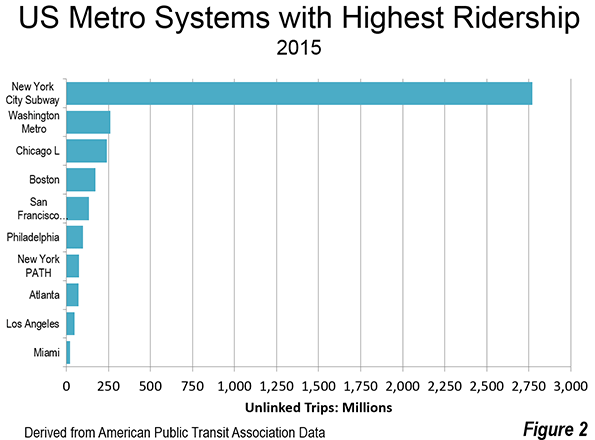
    The New York City subway accounts carries nearly 2.5 times the annual ridership of the other nine largest metro systems in the nation combined (Figure 2). This is 10 times that of Washington’s Metro, which is losing ridership despite strong population growth , probably partly due to safety concerns (see America’s Subway: America’s Embarrassment?). Things have gotten so bad in Washington that the federal government has threatened to close the system (See: Feds Forced to Set Priorities for Washington Subway).

    The New York City subway carries more than 11 times the ridership of the Chicago “L”, though like in New York, the ridership trend on the “L” has increased impressively in recent years. The New York City subway carries and more than 50 times the Los Angeles subway ridership, where MTA (and SCRTD) bus and rail ridership has declined over the past 30 years despite an aggressive rail program (See: Just How Much has Los Angeles Transit Ridership Fallen?).

    With these gains, the New York City Subway’s share of national transit ridership has risen from less than one of each five riders (18 percent) in 2005 to more than one in four (26 percent) in 2015. This drove the New York City metropolitan areas share of all national transit ridership from 30 percent in 2005 to over 37 percent in 2015.

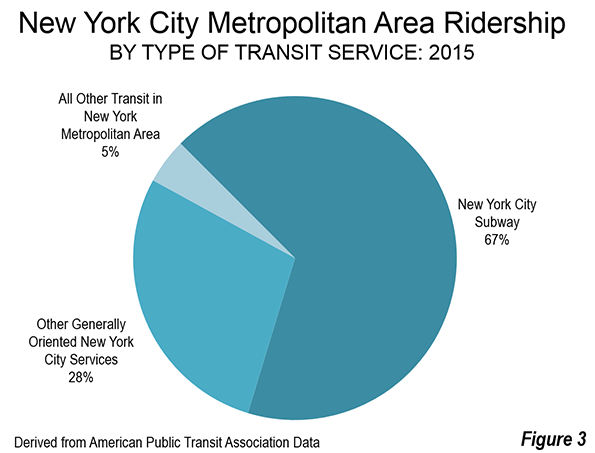
    Subway ridership dominates transit in the New York City metropolitan area as well, at 67 percent. Other New York City oriented transit services, including services that operate within the city exclusively and those that principally carry commuters in and out of the city account for 28 percent of the ridership. This includes the commuter rail systems (Long Island Railroad, Metro-North Railroad and New Jersey Transit) and the Metro from New Jersey (PATH) have experienced ridership increases of approximately 15 percent over last decade (Note 2).

    Other transit services, those not oriented to New York City, account for five percent of the metropolitan area’s transit ridership (Figure 3). By comparison, approximately 58 percent of the population lives outside the city of New York. The small transit ridership share not oriented to New York City illustrates a very strong automobile component in suburban mobility even in the most well-served transit market in the country.

    Last year (2014), APTA announced that the nation’s transit ridership had reached the highest in modern history, having not been higher since 1957. In fact, the ridership boom that produced the record can be attributed wholly to the New York City Subway. If New York City Subway ridership had remained at its 2005 level, overall transit ridership would have decreased from 9.8 billion in 2005 to 9.6 billion in 2015. The modern record of 10.7 billion rides would never have been approached.

    Thus, transit in the United States is not only a "New York Story," but it has also been strongly dependent on the New York Subway in recent years. After decades of decline, the revival of the New York subway is a welcome development.

    Note 1: “Metro” is the international generic term for grade separated rapid transit systems. In the United States, the Federal Transit Administration refers to this transit mode as "heavy rail."

    Note 2: Separate data is not available in the APTA reports on the for-profit commuter bus operators serving the city of New York from New Jersey.

    Wendell Cox is principal of Demographia, an international pubilc policy and demographics firm. He is a Senior Fellow of the Center for Opportunity Urbanism (US), Senior Fellow for Housing Affordability and Municipal Policy for the Frontier Centre for Public Policy (Canada), and a member of the Board of Advisors of the Center for Demographics and Policy at Chapman University (California). He is co-author of the “Demographia International Housing Affordability Survey” and author of “Demographia World Urban Areas” and “War on the Dream: How Anti-Sprawl Policy Threatens the Quality of Life.” He was appointed to three terms on the Los Angeles County Transportation Commission, where he served with the leading city and county leadership as the only non-elected member. He served as a visiting professor at the Conservatoire National des Arts et Metiers, a national university in Paris.
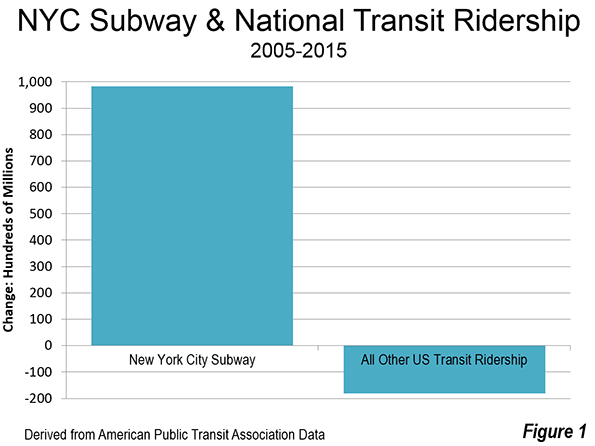
    Photo: New York City Subway diagram by CountZ at English Wikipedia, CC BY-SA 3.0

  • Manhattan Ultra-Luxury ‘Battling the Serpent of Chaos’

    The deceleration of China and resulting commodities crash have created a problem for developers of ultra luxury condominiums.

    The ancient Egyptians believed that the sky was a solid dome, the belly of the goddess Nut who arched her body from one side of the horizon to the other. Every day, the sun god Ra emerged in the east and sailed in his boat across the sky until dusk when he disappeared in the west by dipping below the surface of Nun, the ocean upon which the whole flat earth floated.

    This story would have been useful two years ago when Manhattan real estate was soaring and many participants were proclaiming that the sky was the limit. It turns out that that particular sky, the ‘real estate sky’, is not as infinite and rich in wonders as the real sky. It is instead very finite like the sky of ancient Egyptian cosmology, its hard boundary formed not by Nut’s belly but by the marginal buyer’s stomach for paying ever rising prices.

    Until recently, the strong Chinese economy and resulting surge in commodity prices had fueled an economic boom in many developing countries. With this boom came rapid wealth to a segment of the population sometimes referred to as the oligarchy, or the world elite, or the global UHNW (ultra high net worth) class. And with that wealth, largely earned within the borders of countries with an unpredictable polity, came the logical and prudent decision to place some of it abroad where the likelihood of seizure or expropriation by unfriendly authorities was deemed to be low or nonexistent.

    There seemed to be a large conduit, a money superhighway, running beneath the world’s oceans through which trillions of dollars flowed smoothly for thousands of miles from that Chinese demand to that commodities boom to that sudden wealth and finally to this prudent decision. A great many of this conduit’s outlets were invisible and hidden in the hushed basements of Swiss or other offshore private banks. Yet others were semi-visible in the proliferation of hedge funds, private equity funds and other ventures solely dedicated to the management of paper assets.

    And finally some outlets were very visible in the real estate markets of London, New York, Miami and other cities. The trillions of dollars on the money superhighway traveling inbound from Russia, China, Brazil, Qatar and other places have seeded and fertilized Manhattan’s Billionaire’s Row on 57th street and other parts of Midtown, resulting in the sudden emergence, like weeds out of the ground, of tall and super-tall condominium towers.

    If they were trees instead of buildings, they would follow the normal cycle of nature rationing their reserves in winter and flourishing in the summer. But human constructs are less well calibrated and real estate cycles can be difficult to navigate. It takes a long time to carry a new building from conception to delivery. Few developers have the wherewithal or the resources to make big plans in the trough of a bust. But many embark on long cycle projects during boom times, accepting the risk that completion may not come before the next downturn.

    IMG_4249

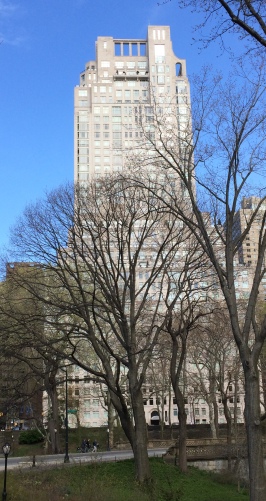
    15 Central Park West.

    Until now, the way to market these new condominiums was to sell as many units as possible pre-construction or during construction, thereby transferring the time-related risk to the buyer. This approach worked beautifully in recent years as evidenced by the huge success of the Time Warner Center, 15 Central Park West and of a good part ofOne57, the first in this cycle among several tall ultra-luxury towers.

    How did we get here in the first place? And why was Manhattan a choice destination for this foreign wealth? The answer is that, in addition to offering the promise of secrecy and safety, new condominiums benefited from lax regulation and zoning and preferential tax treatments.

    When secrecy was no longer as readily on offer at Swiss private banks, foreigners shifted their sights to other havens and found US real estate to be a uniquely welcoming alternative. Here, it was still possible for agents to transact via shell companies that were organized onshore or offshore, ostensibly to conceal the identity of foreign parties who preferred to remain anonymous.

    A recent Washington Post article explains:

    What many Americans might not realize is that foreign-owned shell companies play a big role in the U.S. economy through the real estate market. When purchased through a shell company, an offshore company or a trust, U.S. real estate offers wealthy foreigners a stable and secretive investment.

    In the last quarter of 2015, 58 percent of all property purchases of more than $3 million in the United States were made by limited liability corporations, rather than named people. Altogether, those transactions totaled $61.2 billion, according to data from real estate database company Zillow.

    And further:

    The U.S. government doesn’t ask real estate brokers to monitor their clients for money laundering risks, the way that banks and other financial institutions – and real estate brokers in some other countries — are required to do. The 2001 Patriot Act gave the Treasury Department the ability to do this, but lobbying from the real estate industry has helped secure an exemption for the last 15 years.

    One57

    One57 dominates today but taller condominiums are now under construction.

    Last year, an extensive report by the New York Times titled Towers of Secrecy investigated shell companies that invest in Manhattan real estate. The report estimated that in six of Manhattan’s most expensive buildings including 15 Central Park West, One57, The Plaza and the Time Warner Center, shell companies owned between 57% and 77% of the condominiums.

    Across the United States in recent years, nearly half the residential purchases of over $5 million were made by shell companies rather than named people, according to data from First American Data Tree analyzed by The Times.

    In addition to favorable regulation welcoming this wave of cash, New York’s tax policy also made it easier for developers to meet the surging demand. Some ultra-luxury buildings received tax abatements initially intended to encourage the construction of affordable housing.

    Today however, the money flow, safety, secrecy, regulation and tax policy that enabled the boom are all threatening to reverse course at the same time, creating a new reality that may be problematic for investors and developers.

    It is a new reality that could also be problematic for the city. Money in Swiss private banking accounts can be easily withdrawn but money withdrawn from luxury condos with limited local appeal leaves a large footprint behind. Foreign money can be quickly gone but the buildings will be here quasi-forever.

    China’s economy has softened, commodities have crashed and the money flow from emerging markets to midtown Manhattan has slowed from a gusher to a stream, or perhaps a trickle. As a result, the profitability of many condominiums that are now under construction looks less assured than it was eighteen or twenty-four months ago.

    In addition, there are new calls for better monitoring of shell companies and for disallowing tax abatements in the case of super luxury apartments.

    This seems to all be coming at a bad time with several of the newest towers now rising above street level and boosting the pre-construction inventory. The surge in supply is taking place just as demand is slackening.

    A top Manhattan broker told populyst that the high luxury segment (apartments priced over $10 million) had buckled under a worsening macro environment, with signed contracts running at 38% below last year. Meanwhile, new supply is up 5.4% from last year and expected to continue growing.

    Sales at some of the new condominiums are likely to do well while others suffer. Because of its location and the success of 15 Central Park West designed by the same architect Robert A. M. Stern, it is fair to expect that 220 Central Park South will do fine by attracting demand from New Yorkers and wealthy Americans. Other buildings with less enviable locations will probably do well in their upper reaches but may have trouble selling mid-height units where views do not clear surrounding buildings.

    IMG_4248

    220 Central Park South.

    Asking prices are already being adjusted downward. Extell Development lowered its total sellout price by more than $200 million to $1.87 billion for its One Manhattan Squareproject. Toll Brothers has had price reductions at 1110 Park Avenue and 400 Park Avenue South. World Wide Group and Rose Associates have followed suit at 252 East 57th Street. And at 111 East 57th, JDS Development Group and Property Markets Group will wait about a year before launching sales at their ‘Billionaires’ Row’ tower.

    The broader market seems to also be coming under pressure. A recent study by research firm Miller Samuel for the Real Deal estimated that “by the end of 2017, Manhattan will have five years of excess inventory”.

    Roughly 14,500 units are expected to hit the market between 2015 and 2017But by the end of 2017, just over 5,000 of those units are expected to have sold, and going by the current rate of sales, it would take more than five years to sell all that excess inventory.

    The analysis looks at all new units that have launched or are set to launch in Manhattan over a three-year period, across all price points. It assumes the same rate of sales the new development market saw during the second half of 2015, which equates to just under 1,850 closed sales per year.

    Based on that absorption rate, more than 9,400 new units would be unsold by the end of 2017.

    What may retrenchment look like for Manhattan now? According to a recent New York Post article,

    In the past five years, about $8 billion worth of apartments worth $5 million or more have been bought, or three times higher than years previous. Most troubling is that 50 percent of these have been bought for cash, forked out by shell companies controlled by persons unknown.

    And further:

    An end to secrecy is supported by the G7, United Nations and the Organization for Economic Cooperation and Development. The concern is that countries with hot money outflows are being destabilized, while countries inundated with illicit cash are developing real estate bubbles and high housing costs for ordinary residents.

    The biggest losers are China, where $1.39 trillion left between 2004 and 2013; Russia, with $1 trillion hidden, and Mexico, with an outflow of $528 billion.

    In some African nations, the outflow of funds is so sizable that it is shrinking the size of their economies and sabotaging their societies.

    Meanwhile, in New York, the flood of buying by persons unknown is damaging the housing market. Between 2010 and 2015, the average square-foot price of a residence in New York City jumped from $1,000 to $1,450, an increase of 45 percent.

    The bottom line is that there are now many factors conspiring to slow down the tens of billions of dollars moving from emerging markets into US and European property markets. Profitability models for individual projects drawn during the boom are now incorporating less ambitious assumptions. Can the global economy reaccelerate in the next two years to vindicate the initial return projections? Anything is possible but this would require a stabilization of the Chinese economy and some recovery in commodity prices.

    Instead of the soaring rocket of boom years, the real estate cycle is more akin to the journey of the sun god Ra, who at night “visited the underworld, a watery realm of the demons of the dead, where he battled with the serpent of chaos, and victoriously returned to the day each morning”.

    Sami Karam is the founder and editor of populyst.net and the creator of the populyst index™. populyst is about innovation, demography and society. Before populyst, he was the founder and manager of the Seven Global funds and a fund manager at leading asset managers in Boston and New York. In addition to a finance MBA from the Wharton School, he holds a Master’s in Civil Engineering from Cornell and a Bachelor of Architecture from UT Austin.

  • Why Jersey City is the New Brooklyn

    For hundreds of years, New York City has been viewed by Americans and foreigners alike as the default capital of the United States. Though not the official political capital city, New York, New York has been commonly viewed, and certainly among its own residents, as the de facto center for American culture, music, sports, food, and art.

    Although far more people migrate out of the New York area than come, it remains a primary destination for those who—in the words of Frank Sinatra—want to be a part of it.

    However, today being “a part of it”—particularly in Manhattan and the fashionista parts of Brooklyn—is a lot more difficult than it once was. It no longer involves just a suitcase and a dream. Those looking to move out to the Big Apple increasingly difficult, largely due to huge costs for housing.

    The chorus of complaints about skyrocketing real estate prices has become an ever growing occurrence in the area, as most New York City residents and newcomers alike struggle to make ends meet. For well over a decade Manhattan has been so popular, and so expensive, that the real estate boom has spread to other boroughs—in particular, the western reaches of Brooklyn, only a short subway ride from Manhattan.

    Once a significant and yet often ignored part of New York City, Brooklyn has for decades held its own identity within the city, usually in variance with more self-conscious Manhattan. However, in this most recent decade, we have seen a shift in that identity. Increasing gentrification and a multitude of new residents have transformed the area and created an unfortunate spike in house prices in their wake. An area that was once populated by longtime family residents and iconic brownstones, is now seeing giant penthouses selling for upwards of $4 million. In fact, as early as 2012, we were already seeing Brooklyn being labeled as the second most expensive place to live in the US.

    Brooklyn neighborhoods like Park Slope, DUMBO, Downtown and Williamsburg have seen an influx of new residents along with the resulting spikes in real estate prices. Even the recent trend of supertall residential buildings springing up throughout Manhattan has begun to infest Brooklyn, with developers planning new towers much taller than anything the borough has seen in the past. While longtime Brooklyn residents with rent-controlled and rent-stabilized properties, as well as current Brooklyn homeowners, have little to worry about, all of this is making for an increasingly prohibitive market for anyone hoping to move to the borough.

    The result of all of this has been a natural shift in the popularity of Brooklyn as a viable destination for new, young residents. So, while—not too long ago—Brooklyn was being touted as the new Manhattan, we are now seeing a rise in other cities vying to claim the coveted title of becoming the “new Brooklyn.” Of course, both of these New York boroughs will still remain popular, but generally younger people, at least those without jobs at Goldman Sachs or trust funds, simply cannot afford the new and skyrocketing prices required to make them their new home.

    Thus, with Manhattan and Brooklyn now both out of reach for many New York real estate shoppers, the much maligned state of New Jersey is suddenly becoming more appealing; and in particular, we are seeing the rise of the conveniently located municipality of Jersey City. Jersey City is located directly across the Hudson River from downtown Manhattan, and just like New York in the early 1990s the city is fast shedding its once dangerous reputation and emerging as an appealing option as a uniquely livable area.

    At one time, most residents of the area east of the Hudson River lumped Jersey City into “everything west of the Hudson.” In other words, it was dismissed out of hand immediately. However, more people are starting to learn that Jersey City is its own unique location, itself comprised of a number of distinct neighborhoods with individual charms and flavors. And most important of all, affordability.

    “Three or four years ago, when you would mention Jersey City to people who didn’t know the area, you’d get a concerned look,” Natalie Miniard, the owner of JCity Realty, told the New York Times, “now everybody wants to know more. It’s a much different conversation.”

    Generally the most desirable section of Jersey City for newcomers is downtown, thanks to its proximity to the Hudson River and concentration of trendy bars and restaurants. Popular spots here include the Jersey City location of Brooklyn’s Barcade, Skinner’s Loft, the Iron Monkey and the Roman Nose.

    And it’s convenient, too. Right in the middle of downtown Jersey City is the Grove Street PATH train station. Like every PATH station in Jersey City, Grove Street offers speedy service to several locations in Manhattan 24 hours a day, seven days a week. Unlimited monthly PATH cards are actually cheaper than monthly NYC subway Metrocards, and you can even use pay-per-ride Metrocards on the PATH. As an added bonus for residents, surrounding the Grove Street station is a pedestrian plaza which regularly hosts food fairs and street festivals.

    Of course, the gentrification train chugs on, and as with the more popular neighborhoods in Brooklyn, downtown Jersey City is already becoming so popular that many new residents are seeking even more affordable sections of the city. One such neighborhood is Journal Square, which is in close proximity to the Journal Square PATH station. Local flavor abounds in the Journal Square area, and prices in the neighborhood are still lower than downtown, despite being not too far in distance. A bit further from downtown Jersey City is the neighborhood known locally as the Heights.

    The Heights is a large section of Jersey City with plenty of lower priced options for real estate shoppers, thanks in part to being not quite as close to the PATH as Journal Square or downtown. However, the Heights is an area jam-packed with plenty of its own great shopping and local restaurants, especially along the main thoroughfare of Central Avenue. Most of the Heights is still within reasonable walking distance to the Journal Square PATH station, and walking from the Heights to the nearby city of Hoboken is also an option.

    With a variety of lively, singular neighborhoods and close proximity to Manhattan, Jersey City already boasts several parallels with the borough of Brooklyn. Though it cannot yet compete in terms of culture and “street cred,” developers are rushing to construct tens of thousands of new, affordable residential properties, hopping on the newest fashionable real estate bandwagon while it is still hot. What this means is that it is certainly the right time to move to Jersey City. Housing prices are lower across the board than in most sections of Brooklyn—and certainly anything in Manhattan—and the options for condos, rental apartments and even entire houses are multiplying by the day. And people are starting to take notice. An increasing influx of residence—according to the most recent US census data, the total number of residents increased by six percent between 2010 and 2014— revitalizing the cultural and social scene, and many more people are expected to soon follow. With all of this in mind, it would not be a surprise if in the next few years we find fewer people moving to New York City altogether, and many more looking to the exciting reborn metropolis of Jersey City.

    Cary is an Oregon native with a flair for fashion and organic gardening. She’s passionate about writing and enjoys hiking, reading, and cooking. When she isn’t writing about economics and real estate, or health and fashion, she is playing with her rescue pitbull, Mazie. 

  • Our Anemic Suburbs: Every Urban Area Needs its Outskirts — and New York City’s Are in Trouble

    New York City has prospered since the great recession of 2008, buoyed by an endless supply of free money from Washington that’s elevated the stock and real estate markets. But the broader metro region has struggled, in an ominous sign of tougher times to come.

    Little acknowledged in the discussion of New York’s “tale of two cities” is something beyond the control of Mayor de Blasio: the fading of the city’s once-thriving suburbs, even as the city grows more populous and more expensive.

    Although some urban boosters blame suburbs for city ills and wish for their demise, the truth is they depend upon one another. Suburbs, including in New York, have long provided a local outlet for people to migrate to from the urban core as they start families and otherwise age out of cloistered living. But in the outskirts of Gotham, this model now appears to be in decline.

    At a time when New York City itself is growing, the suburban dream here has slowly died, choked off by a difficult commutes, stagnant local economies, rapidly rising house prices and punishing property taxes. House prices have increased in New York’s suburbs in New York and New Jersey at double the increase of household incomes since 2000. In Suffolk and Passaic, N.J., they’ve tripled. The suburbs in New York also have among the nation’s highest property taxes.

    When New Yorkers get to the point they want to start a family and buy a house, those who can — the best and brightest — are no longer decamping for places like Great Neck or Scarsdale but appear to be leaving the region entirely.

    The decline is evident in Long Island, where there is very little new building and time seems to have stopped around 50 years ago. New restaurants, malls and cultural facilities are rare. Long Island and New Jersey have lost sports franchises to Brooklyn. Unlike in other regions, few businesses leave the city for the surrounding suburbs.

    Nor is this just a matter of mass migration to one or two places. Greater New York loses net migrants to virtually every big urban region of the country, including Los Angeles as well as such diverse places as Philadelphia, Washington, Boston, Atlanta, Dallas-Fort Worth and Houston.

    To some urbanists, this decline of New York’s suburban belt represents welcome news. After all, between 1950 and 2010, more than 95% of the region’s growth took place on its periphery, and worries focused on the hollowing out of the urban core.

    Since 2010, those trends have had a stunning reversal: The boroughs have added 316,000 people — a growth rate four times that of the burbs.

    But what makes urban boosters trill in ecstasy also suggests that greater New York is no longer a place that accommodates upward mobility.

    A lot of that comes down to the bottom line. Between property values and property taxes, the cost of suburban living in Nassau and Westchester no longer offers the relief it once did. Throw in arduous commutes, and even the appeal of a yard and a good school fades for many.

    The point comes into especially sharp focus when you stack New York City up against other big metro areas. Across the country, suburbs are still growing faster, often much faster, than cities, according to a Brookings Institution analysis of Census statistics.

    Many of those places — including Austin, Charlotte and Nashville — are experiencing a revival of both their cores and their suburban rings. In Houston, which has enjoyed one of the biggest inner-city booms in the nation, two-thirds of all new units are single-family houses, usually in the suburbs. This preponderance of single-family homes is common in the areas that New Yorkers are going to, such as Charlotte, Orlando and Dallas.

    Of the nation’s 52 largest metropolitan areas, New York had the lowest percentage of single-family homes, some 26%. Nor are enough new apartments being built to accommodate New Yorkers. Between 2011 and 2014, the New York region was 42nd in the percentage increase in the number of building permits issued.

    To some extent, the ailment reflects Gotham’s unique economic climate, increasingly dominated by key industries — tourism and hospitality, media and finance — that tend to concentrate in high-cost, high-density urban centers. These sectors, along with tourism, have driven New York’s recovery, unlike in the Bay Area, Raleigh or Austin, where technology has played the key role.

    Once, greater New York boasted a large and important technology industry (remember IBM?), but no longer. Despite the endless hype about New York being a “high-tech” capital, today the region suffers one of the lowest percentages of engineers per capita — 77th out of 85 large metro areas. Greater New York City is never going to be the next Silicon Valley.

    With no economic engine, but with property taxes among the highest in the nation, New York’s suburbs are a drag. In a recent ranking of the best places for jobs we developed for Forbes, New York City, although slipping somewhat, ranked a respectable 17th. But Northern New Jersey, Long Island and close-in parts of Connecticut were all near the bottom of the 70 metropolitan areas studied.

    The result is that even as the city swells, giddy with gentrification and Brooklynization, the region continues to hemorrhage people at the highest rate of any large metropolitan area. Over the past four years, 528,000 more people left for other parts of the country than came here from them.

    New Yorkers tend to think of the city as diverse and of suburbs as lily-white. But in other parts of the country, suburbs are increasingly the geography of opportunity not just for young families, but for immigrants and minorities in particular.

    New York is the exception. Few African-Americans head to Westchester, but many leave for the sprawling reaches of Atlanta, Dallas or Houston — places where they are twice as likely to own their own homes.

    It may be fine for the jaded offspring of the wealthy who can afford to stay in Gotham to look down on these new sunbelt residents and suburb-dwellers. But for many, these geographies offer unprecedented opportunity to live in safer and less poor areas.

    And the New Yorkers who leave — like migrants in general — tend to be those who are most ambitious. One doesn’t move to Texas to gain access to government benefits, which are much less generous there than in New York, but for greater opportunity.

    One could argue that New York City can thrive simply by drawing ever more highly educated millennials to the five boroughs. Between 2010 and 2014, the city gained 106,000 college-educated people ages 25 to 34, with nearly half of them moving to Brooklyn. The suburban rings gained barely 38,000.

    But new research shows the millennial rush to Gotham is already slowing. Between 2008 and 2010, according to an analysis by demographers at Cleveland State University, New York ranked a respectable eighth among the 40 largest metropolitan areas in terms of attracting young, college-educated people, growing by 15.6%. But it dropped to 27th between 2010 and 2013 with a growth rate of barely 5%.

    One reason for this shift: the rising cost of shelter. In New York City, market-rate renters now spend 40% of their incomes on rent, well above the national average of under 30%. Rents increased between 2010 and 2015 by a staggering 50%, while incomes for renters between ages 25 and 44 grew by just 8%.

    Some suggest that young New Yorkers will be willing to live in ever-smaller places, like the “micro-apartments” now being pushed by developers and the mayor, in order to stay in the city. But basic research does not support this assertion. As the price of housing in the city has skyrocketed, young people have instead begun opting for less expensive metropolitan areas entirely. People move to such places to live an urban lifestyle that, although hardly as exciting as New York, does not require living in a glorified shipping crate.

    Half-hearted attempts in places like Nassau to become a bit more urban haven’t helped, since they ignore the fundamental advantage — particularly to families — of a less dense, village-like atmosphere.

    And ignore trend stories about retirees moving back to the city. In fact, urban residence drops precipitously with age. Between 2000 and 2010, America’s dense urban cores registered a decline of more than 100,000 seniors, while the suburbs and exurbs gained 2.8 million.

    A final note of warning: If trends hold, and middle-class families with no affordable place to settle flee the region entirely, it is likely that New York’s already deepening inequality will get worse.

    As Mayor de Blasio continually reminds us, poverty here co-exists cheek-to-jowl with wealth. If it were a country, New York City would have the 15th highest inequality level out of 134 countries, landing between Chile and Honduras.

    To bridge this growing gap, the larger New York area needs homes not only for investment bankers and media moguls, but also for ordinary middle-class families. In a functioning economic ecosystem, those homes are naturally found in Levittown and other towns in the suburban rings.

    Which means the fate of de Blasio’s project to build a fairer city depends in no small part on the revival of the suburbs once considered escape valves from the five boroughs. If the suburbs continue to flail, the region — and the city itself — will suffer.

    This piece originally appeared in The New York Daily News.

    Joel Kotkin is executive editor of NewGeography.com and Roger Hobbs Distinguished Fellow in Urban Studies at Chapman University, and a member of the editorial board of the Orange County Register. He is also executive director of the Houston-based Center for Opportunity Urbanism. His newest book, The New Class Conflict is now available at Amazon and Telos Press. He is also author of The City: A Global History and The Next Hundred Million: America in 2050. He lives in Orange County, CA.

    Wendell Cox is Chair, Housing Affordability and Municipal Policy for the Frontier Centre for Public Policy (Canada), is a Senior Fellow of the Center for Opportunity Urbanism (US), a member of the Board of Advisors of the Center for Demographics and Policy at Chapman University (California) and principal of Demographia, an international public policy and demographics firm.He is co-author of the “Demographia International Housing Affordability Survey” and author of “Demographia World Urban Areas” and “War on the Dream: How Anti-Sprawl Policy Threatens the Quality of Life.” He was appointed to three terms on the Los Angeles County Transportation Commission, where he served with the leading city and county leadership as the only non-elected member. He served as a visiting professor at the Conservatoire National des Arts et Metiers, a national university in Paris.
  • Comparisons: Commuting in London and New York

    The world’s two leading Global Cities, London and New York are, according to most indicators, remarkably similar in their patterns of regional commuting. This is the conclusion from our recent review of commuting in London and commuting in New York. This analysis contrasts the results between the London Area (Greater London Authority, East and Southeast regions) and the New York combined statistical area, which stretches from New York state, to New Jersey, Connecticut and Pennsylvania. (A unique animated graphic illustrates the London commuting pattern, at "undertheraeder.com." The map is here and illustrates the size of the greenbelt in the London area).

    Population and Area

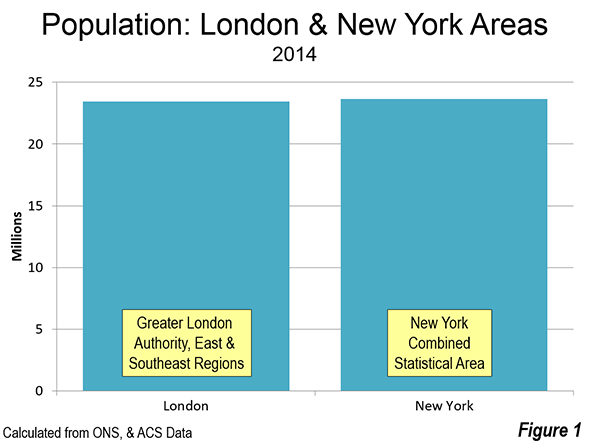
    The London and New York areas had almost identical populations in 2014. New York had 23.663 million residents and London had 23.431 million residents, just one percent less. London, however, is growing more rapidly, adding 1.1 percent per year since the 2011 census, while New York’s increase has been 0.8 percent annually since the 2010 census (Figure 1).

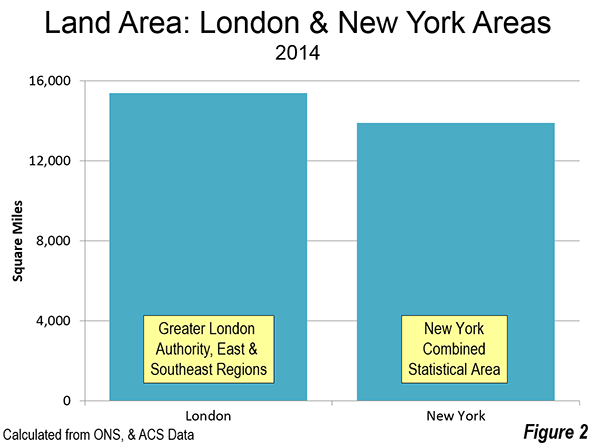
    The land areas are also similar (Figure 2). The London commute shed covers 15,400 square miles (39,800 square kilometers). The New York area is about 10 percent smaller, covering 13,900 square miles (36,000 square kilometers).

    Broadly, the two cities can be divided into similar sectors. Both have among the largest central business districts (downtowns or CBDs) in the world. The two central municipalities, the Greater London Authority and the city of New York both have somewhat over 8 million population. There is a first ring of counties located outside the Greater London Authority and the city of New York. Finally there are outer counties in both areas. The geographic areas are described in the "Geographical Note" below.

    Distribution of Employment

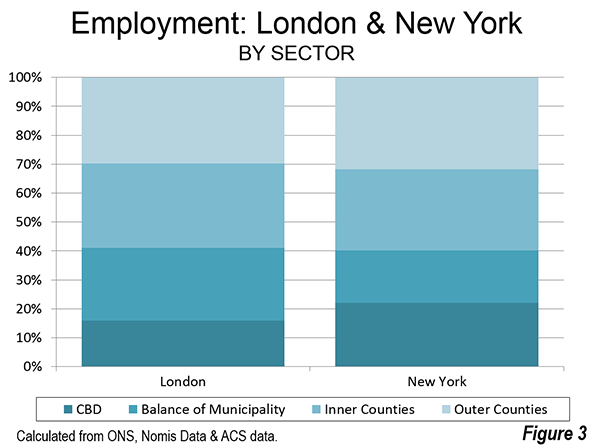
    In the distribution of employment between the two cities is remarkably similar (Figure 3). In each case, the suburban counties account for 60% of employment. In both London and New York, the outer counties have slightly more employment than the inner counties, though in both cases the inner counties and outer counties have approximately 30% of employment.

    This leaves approximately 40% of the employment for the central cities. In New York, 22% of the employment is in Manhattan, which contains the central business district. In London, a somewhat smaller 16% of the employment is in the five local authority areas that include the central business district (Camden, Lambeth, city of London, Southwark and the city of Westminster). The balance of the city of New York — the outer boroughs of the Bronx, Brooklyn, Queens and Staten Island, has just 18% of the area’s employment, while the balance of the Greater London Authority — outer London and the balance of inner London — has 25% of the area’s employment.

    Where People Live and Work

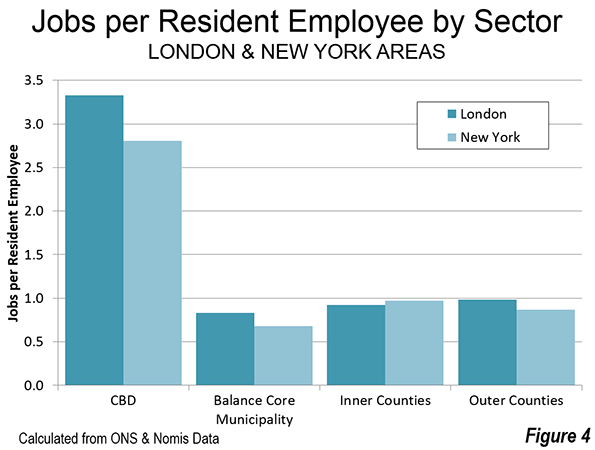
    The distribution of the jobs are relative to resident workers is also similar between London and New York. In both cities, the inner counties and the outer counties have nearly the same number of jobs as resident workers. In the case of London, there are 99 jobs per 100 resident workers in the inner counties and a somewhat smaller 92 in the outer counties. In New York, there are 97 jobs per resident worker in the inner counties and 87 in the outer counties. The largest imbalances in both areas occur in the core municipalities. There are approximately 330 jobs per 100 resident workers in the local authority areas containing London’s central business district. Manhattan, with New York’s central business district has a somewhat smaller 280 jobs per 100 resident workers. Indicating the draw of the central business district for workers living in the balance of both core municipalities, there are only 83 jobs for each 100 workers in the balance of the Greater London Authority and 68 in the balance of the city of New York (Figure 4).

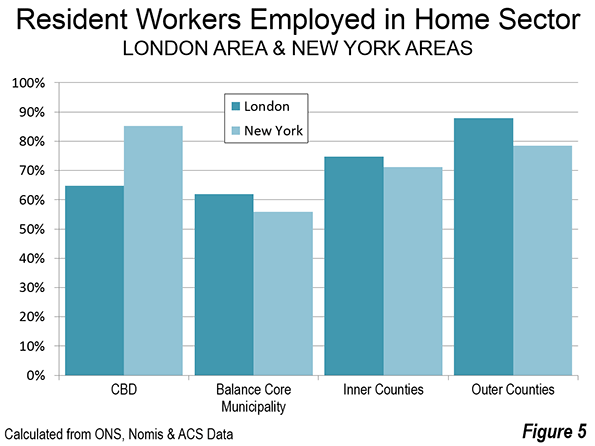
    In the two cities, most resident workers are employed in their home sector, 68% in New York and 67% in London. This is also the case in each of the sectors of the two cities. In New York, the largest percentage of resident workers (85%) is employed in Manhattan, with the central business district. The number is considerably smaller (64%) in the jurisdictions containing London’s central business district. In London, the largest share of resident workers employed in their own sector is 88% in the outer counties. In both cities, the inner counties also have a relatively strong balance of local residents, with 71% working in their home sector in New York and 75% in London. In both cities, the smallest number of resident workers employed in their home sectors are in the balance of the core municipality, 62% in London and 55% in New York (Figure 5).

    Commuting to the Central Business Districts

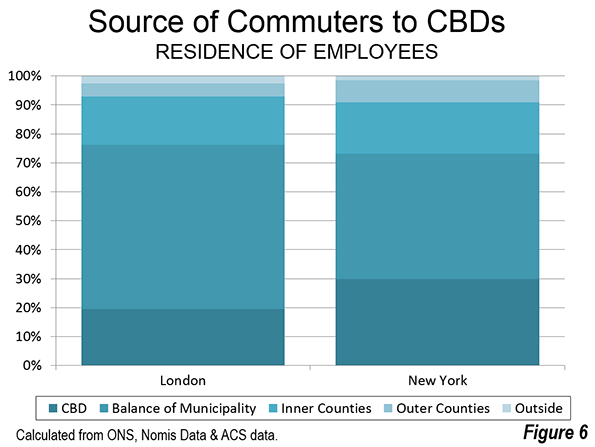
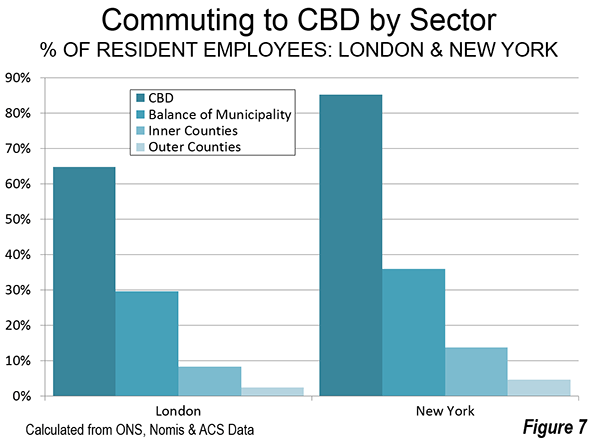
    The data indicates a surprisingly limited draw for the two central business districts. Often media articles and even academics presume that cities are monocentric — that most employees work in the central business district. This isn’t even close to being the case. In fact, the analysis of commuting in the New York and London areas shows that only in the sectors containing the central business districts does the central business district attract most of the resident workers. Even in the relatively jobs-poor balance of the two core municipalities, only 36% in New York and 30% in London work in the jurisdictions containing the CBDs. In the inner counties, the numbers are much smaller. Only 14% of New York inner county resident workers have employment in Manhattan, with an even smaller number, 8% of London’s inner county resident workers commuting to CBD jurisdictions. The numbers are even smaller in the outer counties, where only 4.6% of New Yorkers commute to Manhattan and 2.4% of Londoners commute to the CBD jurisdictions (Figure 6). 

    In both cases, approximately 75% of CBD employees are drawn from the core municipality. In New York, approximately 30% of the central business district employees are from Manhattan, while 43% are from the outer boroughs. In London, 19% of the central business district employees are from the five CBD jurisdictions and 57% are from the balance of the Greater London Authority.

    Manhattan is a somewhat stronger draw to the suburban counties, with 18% of employees from the inner counties and 8% from the outer counties. The London CBD draws 17% of its workers from the inner counties and 5% from the outer counties. Despite the comprehensive suburban rail system in New York and both suburban and national rail system in London, comparatively few workers commute from beyond the outer counties — 2.6% in London in 1.5% and New York (Figure 7).

    How Commuters Travel

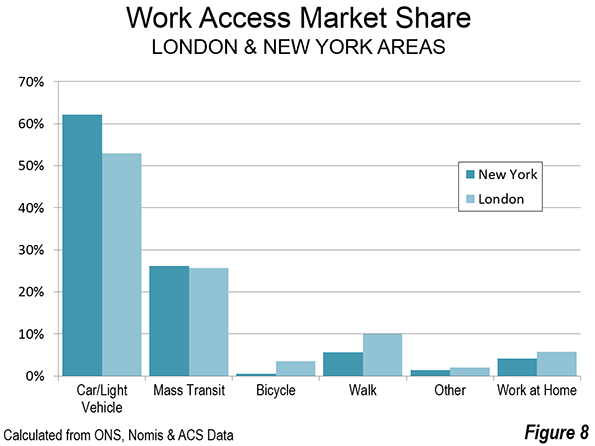
    There are also similarities between the commuting methods in the London and New York areas. In both cases, cars, vans and other light vehicles carry the majority of commuters, 53% in London and 62% in New York (Figure 8). Mass transit carries virtually the same share of commuters in both cities, at 26%. Many more Londoners walk to work the New Yorkers, at 10%, compared to less than 6%. Approximately 5.8% of London workers report working at home, somewhat more than New York’s 4.1% (Since the two nations use different census survey instruments, the data may not be completely comparable).

    Widely Dispersed Global Cities

    Ultimately the key finding is that the world’s two greatest Global Cities are widely dispersed. Despite the strength of their cores, the overwhelming majority of employment is in the suburbs. Only a small percentage of resident employees in the suburban areas work in the central business districts. A majority of resident workers is attracted to the CBDs only from the jurisdictions containing the CBDs themselves.

    —–

    Geographical Note: The geographical sectors are as follows:

    London (Greater London Authority, Southeast England and East England): The central business district is situated in a wide corridor on both sides of the Thames River. It is contained in local authority areas, including the city of London, the city of Westminster and the boroughs of Camden, Southwark and Lambeth. The inner counties border on the metropolitan greenbelt, which surrounds the Greater London Authority. They are Berkshire Buckinghamshire, Essex, Hertfordshire, Kent and Surrey. The outer counties are Cambridgeshire, East Sussex, Hampshire, Isle of Wight, Norfolk, Oxfordshire, Suffolk and West Sussex.

    New York (New York Combined Statistical Area): The area includes 35 counties, in eight metropolitan areas, including New York (NY-NJ-PA), Allentown-Bethlehem (PA-NJ),  Bridgeport-Stamford (CT), East Stroudsburg (PA), Kingston (NY), New Haven (CT), Torrington (CT) and Trenton (NJ). 

    —–

    Wendell Cox is Chair, Housing Affordability and Municipal Policy for the Frontier Centre for Public Policy (Canada), is a Senior Fellow of the Center for Opportunity Urbanism (US), a member of the Board of Advisors of the Center for Demographics and Policy at Chapman University (California) and principal of Demographia, an international public policy and demographics firm.

    He is co-author of the “Demographia International Housing Affordability Survey” and author of “Demographia World Urban Areas” and “War on the Dream: How Anti-Sprawl Policy Threatens the Quality of Life.” He was appointed to three terms on the Los Angeles County Transportation Commission, where he served with the leading city and county leadership as the only non-elected member. He served as a visiting professor at theConservatoire National des Arts et Metiers,a national university in Paris. 
    Photograph: Traffic in Bergen County, New Jersey (a  New York inner suburban county), by author.

  • Hooray For the High Bridge

    My latest article is online in City Journal and is a look at the restoration and reopening of the High Bridge in New York City. Part of the original Croton Aqueduct system that first brought plentiful clean water to New York, portions of the High Bridge are the oldest standing bridge in the city. Here’s an excerpt:

    It’s worth asking whether, with its $61 million price tag, the High Bridge project was really needed. Strictly speaking, the answer is: No. The structure was in no danger of falling down. And, just a half mile to the north, the Washington Bridge provides a functional, if unpleasant, pedestrian crossing over the Harlem River. Yet, the High Bridge is an important part of New York history and deserves its loving restoration. Spending serious money on outlying neighborhoods that are mostly minority and heavily poor to give their residents a humane environment instead of a minimalistic one shows that New York does care about all its citizens. Great cities don’t just do great things in a sanitized downtown Green Zone for visitors. They create greatness in their workaday neighborhoods, too, with projects that speak not merely to the pragmatic, but to the human spirit. The High Bridge restoration again shows what great commercial success allows a city to do for its citizens.

    Click through to read the whole thing.

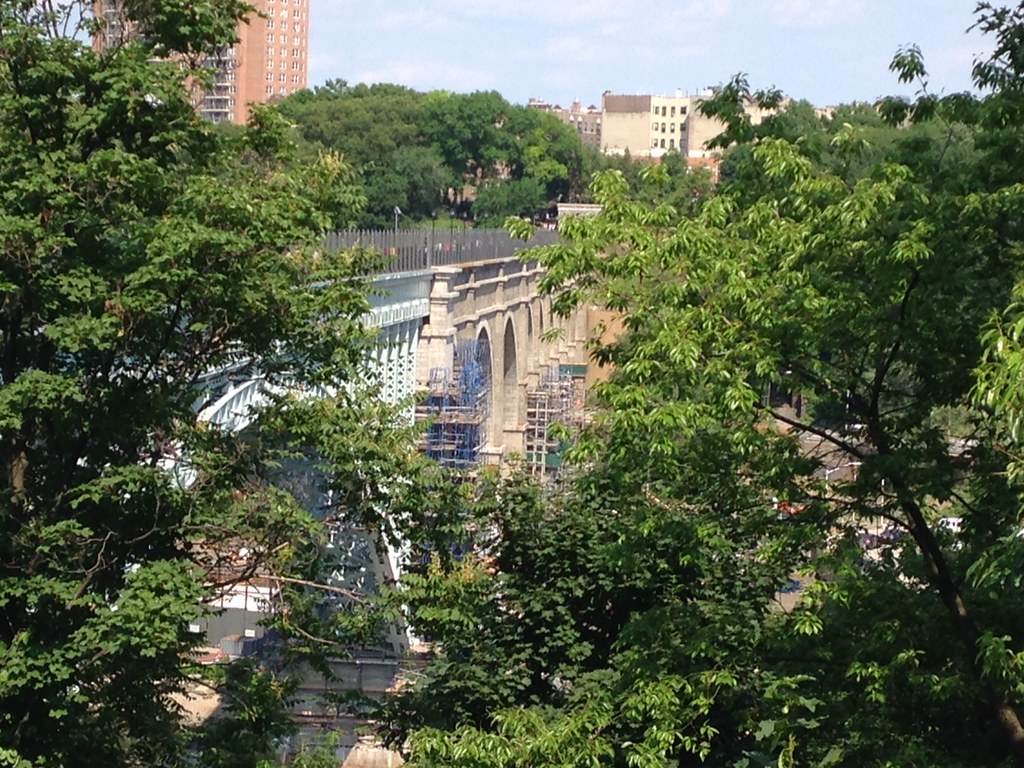
    Here are some additional pictures I took. First, the High Bridge peeking through the trees from the Manhattan heights. You can see both the original stone arch spans and the longer steel arch span.


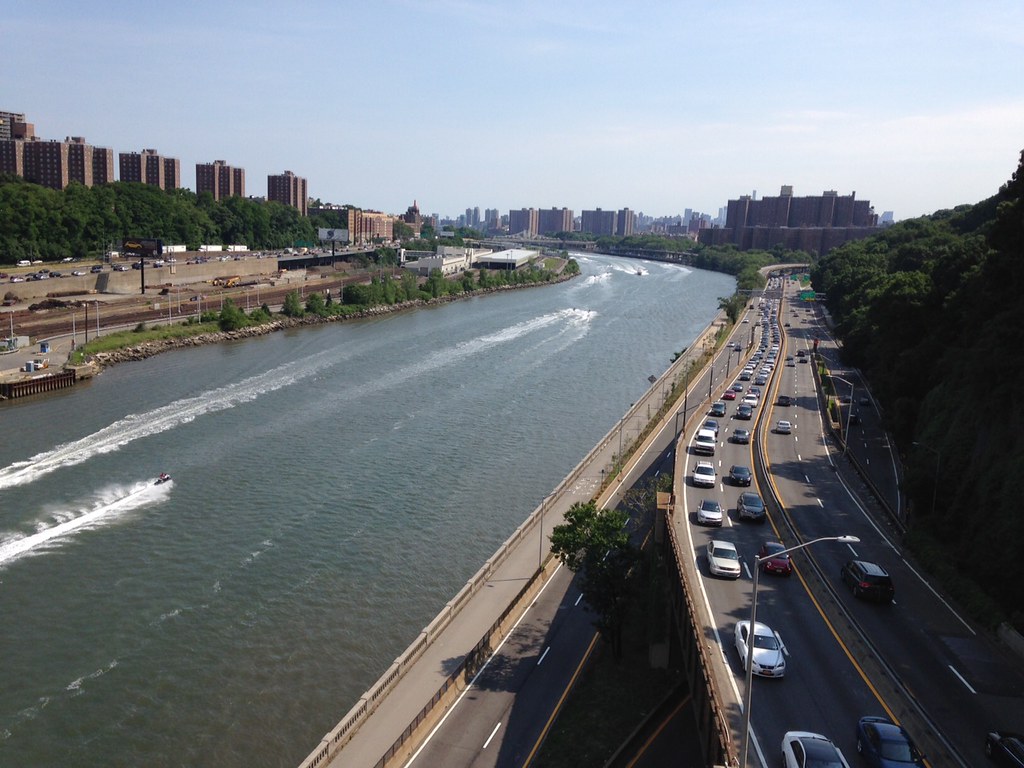
    Looking south:


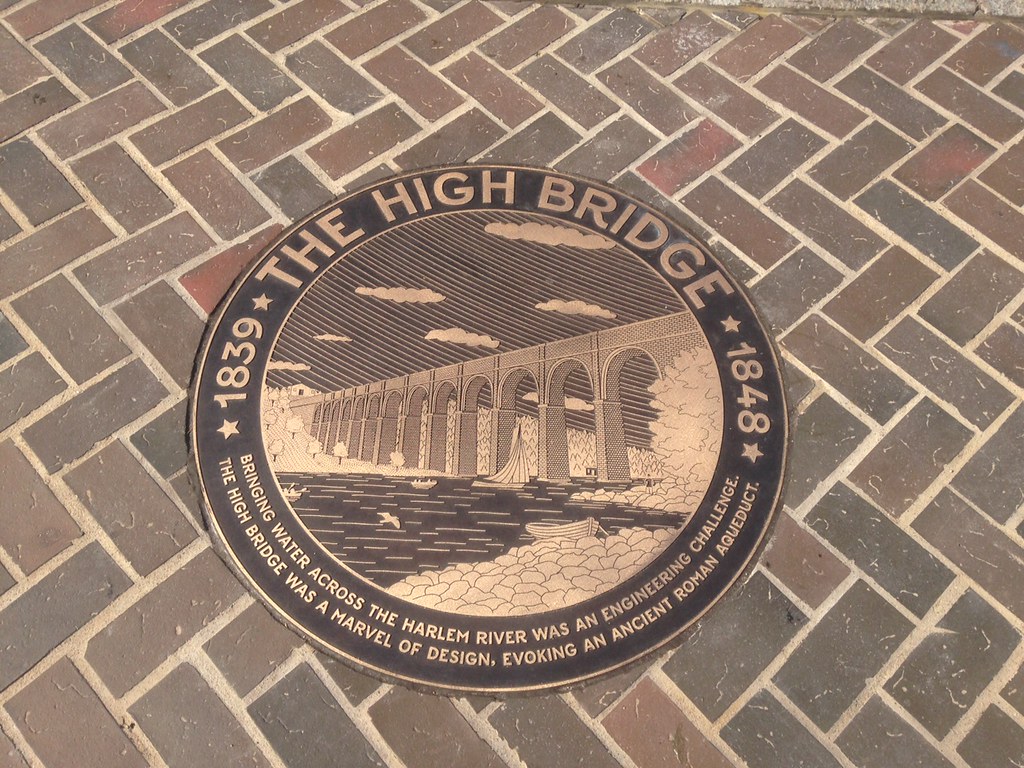
    Embedded seal in the bridge pavement with historical info. There are quite a few of these discussing various aspects of the project.


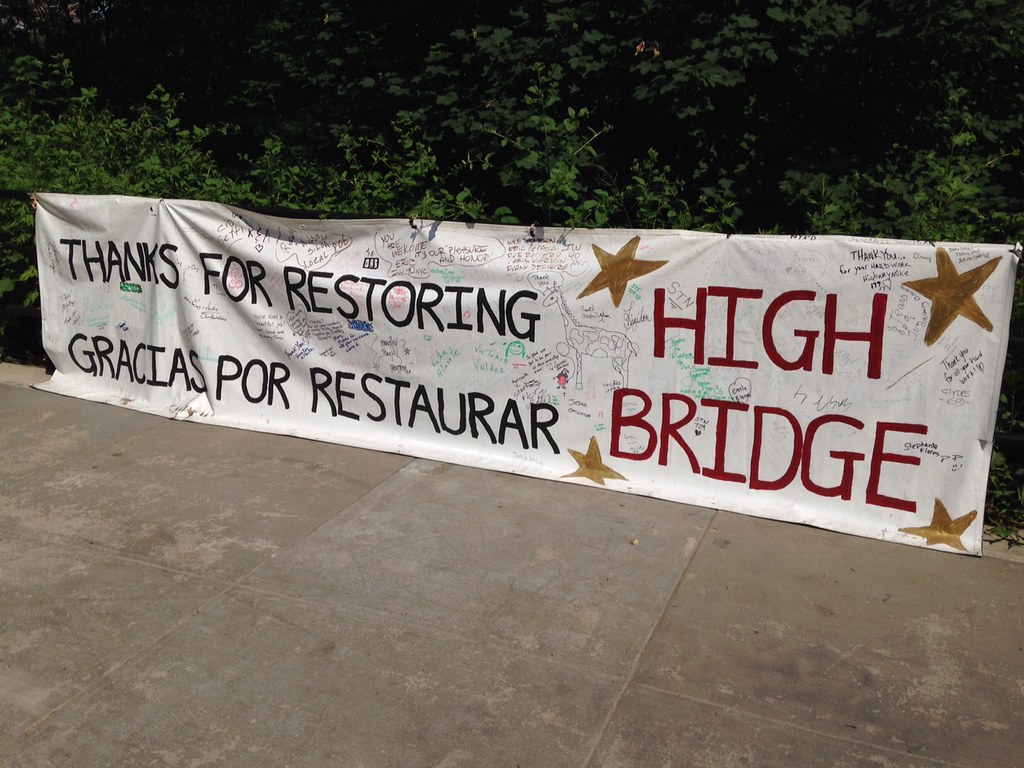
    The neighbors are fans:

    Aaron M. Renn is a senior fellow at the Manhattan Institute and a Contributing Editor at City Journal. He writes at The Urbanophile, where this piece first appeared.