Tag: New York

  • The Death of Nassau Coliseum: A Harbinger of Suburban Decline?

    Nassau Veterans Memorial Coliseum is one of the last remaining old time hockey rinks. But this will be the last year that the New York Islanders play there. The old barn has long been slated for replacement. It is an old building that requires expensive repairs. Many attempts were made to reach an agreement for a new arena with Nassau County. Sadly, the team’s new location will be at the Barclay’s Center in Brooklyn; on Long Island physically, but not a part of the island’s suburban tradition. The team will retain the name, but Long Island effectively is losing its team.

    Suburban Decline, Urban Ascent?

    Some observers, like Mark Byrnes in CityLab, see this shift as further evidence of suburban life and the elevation of the urban core.1 But instead it is another frustrating case of a small, highly visible not in my backyard (NIMBY) movement in suburbia on one hand, and, on the other, an unwanted development foisted upon urban residents without due process through eminent domain.

    Two Arenas

    The New York Islanders haven’t been very newsworthy for the last decade – save for their volatile ownership situation, but their transition from one of the National Hockey League’s oldest buildings in Long Island to a new building in Brooklyn has been a very public ordeal. It’s a story that involves local politicians thwarting construction of a new arena that would have cost taxpayers nothing, a failed referendum to finance an alternative proposal that would have required public funding, and ends with the Islanders moving out of Long Island into the controversial Barclay Centre. Even if the Barclay Centre proves to be a viable and enjoyable venue for the Islanders, it will forever remain one of the most disastrous developments in the history of professional sports.

    The Old Barn

    Nassau Coliseum is the second oldest active building in the National Hockey League. The arena was built on the site of decommissioned Army/Air force base Mitchell Field.2 Nassau County acquired the land in 1960, a year after closure. Nassau Coliseum officially opened on February 11, 1972.3 The cost of the project was $32 million ($179 million, adjusted for inflation).4 The Coliseum sits on 5 acres of a 77-acre plot in Uniondale, the rest of which is mainly surface parking.5

    The site is intersected by two major roadways, and is across the street from Hofstra University and a golf course. It is right down the street from Levittown, the prototypical post-war American suburb. It is the type of place where one might assume that building large scale projects should be relatively simple.

    The Lighthouse Project

    In 2000, software billionaire Charles Wang bought the Islanders for $190 million.6  High end estimates suggest that Wang might have lost as much as $208 million between 2000 and 2009 on the team in large part due to   having one of the least favourable lease agreements in professional sports.7.8 “The need to refurbish the ageing building provided a perfect opportunity to put the team on a solid financial footing.

    Wang proposed a plan to develop the area surrounding the arena. The Lighthouse Project was expected to take 8-10 years to complete at a cost of roughly $3.74 billion.9 The plan included a renovation of the Coliseum, a 60-story tower designed to look like a lighthouse, housing, athletic facilities, a new minor league baseball stadium, restaurants, and a new hotel.10 The transformation of the Coliseum would have entailed lowering the floor of the ice rink to accommodate additional seats, increasing capacity from 16,300 to 17,500 during hockey games, 18,500 for basketball games and 20,000 for concerts, while adding 50 luxury boxes.11

    The proposal would also have brought a 125,000-square-foot athletic complex including two ice rinks (a practice rink for the Islanders, and another for the public), a basketball court, and a fitness club where the Islanders and the Arena Football League’s New York Dragons (also owned by Wang) would have trained.12

    The project would also have included moderately priced housing, which is lacking in Long Island. Long Island County was also exploring enhanced public transportation to the future development, including bus rapid transit.13

    Phase two of the project would have included a conference center, a sports technology building, residences, and the 60-story lighthouse (including a 500 room luxury hotel).14

    Building a new arena on such a large parcel of land surrounded by sparse, low density development should have theoretically faced few obstacles, given that the owner was willing to finance the entire project. Unfortunately, the project drew the ire of some local residents. Robert Zafonte, president of the 3500 member East Meadow Civic and Community Association, had this to say:

    ”The high-rise disturbs me,” he said. ”It seems to be totally out of character with the nature of the suburban area here. It is not consistent with what Long Island is all about – residential, small homes. I don’t think it belongs here.15

    The Lighthouse Project was approved by the county in 2006, but stalled when Wang was unable to secure zoning approvals from the Town of Hempstead.16 Republican Town of Hempstead Supervisor Kate Murray, lobbied intensely by a small group of local residents, decided that the project would result in too much traffic.

    Not in My Backyard

    In an attempt to salvage the project, Charles Wang and the Lighthouse Development Group partnered with Rexcorp to create a scaled down version of the project. The most notable change was that the Lighthouse would now be 30 stories, rather than 60.17

    But as Pearl M. Kamer, chief economist of the Long Island Association pointed out, “When you cut density on any project, you cut revenue.” He argued that under the proposal, scaled back to meet Murray’s demands, it would be difficult if not impossible to generate enough revenue to finance the project.18 This meant that the new proposal would likely require public funding, in contrast to the original proposal which would have been entirely privately funded.

    Wang eventually reached an agreement with Nassau County to build a scaled down version of the Lighthouse Project, pending an August 2011 referendum. Since the stripped down project would have yielded less revenue than the original proposal, the project would only have been viable with $400 million in public financing.19 The funding would have necessitated a 4 percent property tax increase. Voters rejected the proposal by a 57-43 margin.20

    The End of the Lighthouse Project

    With the end of the Lighthouse Project, Wang entered into a 25 year lease with the Barclay Centre soon after. The Islanders will begin playing at the building in 201521, though they already played their first exhibition game at the arena on September 21st, 2013.

    Losing the Islanders will result in significant economic losses to the county. Nassau County’s comptroller estimated that had last year’s NHL lockout lasted a full season, the county would have lost $62.2 million in economic activity, and the Nassau County treasury would have lost $1.1 million in  of ticket taxes, as well as a share of concessions and parking fees.22  Those are substantial loses for a county of less than 1.4 million residents.

    While Charles Wang has frequently been blamed for the relocation, NHL Commissioner Gary Bettman lays the blame squarely at the feet of local politicians.

    "This is a situation that is not of the Islanders’ making,” he said. “The responsibility for what’s happened really lies with Nassau County and the Town of Hempstead. For the fans in Nassau, not just of the Islanders, but of circuses and rock concerts and the like, it’s a shame.23

    The Uncertain Future of the Coliseum

    Though this seems like the end of the Nassau Coliseum saga, the future of the arena is still up for debate. Barclay Centre part-owner Bruce Ratner has proposed a $229 redevelopment plan for the arena. The project would include renovating the Coliseum, building restaurants, an ice rink, bowling alley, movie theater and other facilities.24  

    The Ratner proposal faces many hurdles, including luring an American Hockey League (NHL farm team) club to replace the Islanders. The Islanders AHL affiliate, the Bridgeport Sound Tigers (also owned by Wang), could potentially move from Connecticut to fill that void. Additionally, the Islanders are still slated to play 6 home games (out of 41) per year at the Coliseum.25 One columnist at Forbes has speculated that Ratner, who would own both the Nassau Coliseum and part of the Barclay Centre, might well decide to keep the Islanders in Long Island after all if he can secure approval for the new project.26  

    Imposing an Arena on Brooklyn

    The Barclay Centre differs dramatically from the failed Lighthouse Project. The Barclay Centre was part of the $4.9 billion Atlantic Yards project built in run down commercial area of Brooklyn, despite local opposition. Mayor Bloomberg used eminent domain to seize the “blighted” land to allow for construction.

    Brooklyn had been without a sports franchise since 1957, when the Brooklyn Dodgers moved to Los Angeles.  

    The Barclay Centre was initially proposed in 2004 when real estate developer Bruce Ratner purchased the New Jersey Nets for $300 million. Ratner planned to move the franchise out of New Jersey and into the lucrative Brooklyn market. The project was initially projected to open in 2006.

    The attempt to use eminent domain to seize the land was brought before the New York Supreme Court, delaying the process. The court eventually ruled in Ratner’s favour.

    Ratner’s years of frustration with the project lead him to sell a majority share of the Nets to Russian businessman Mikhail Prokhorov for $200 million.

    Due to construction delays, the Nets signed a deal to play in Newark at the Prudential Centre until the Barclay’s Centre was complete.

    Construction of the $1 billion arena began in January of 2010. The Barclay’s Centre was open to the public on September 21, 2012. Just over a month later, the Islanders announced their agreement to play at the Barclay’s Centre.

    The Barclay Compromise

    The Barclay’s Centre wasn’t a bad solution to the stalemate in Nassau County. The arena is new, and Brooklyn is a lucrative sports market. The Long Island Railroad provides direct service to Atlantic Terminal, meaning it will be more convenient for many Long Island residents to access the Barclay’s Centre than Nassau Coliseum. However, the 15,813 seating capacity is far short of most modern NHL arenas, and many seats have partially obstructed views.

    At the same time, the failed Lighthouse Project was a missed opportunity for Nassau County. The community still hasn’t rebounded to its 1970 population, which fell by 100,000 during the 1970s. Estimates suggest that the $4.4 billion of private investment into the Lighthouse project would have created 75,000 construction jobs and 19,000 permanent jobs thereafter.27 Moreover, it would have resulted in expanded public transit options on Long Island. Lawrence Levy, executive director of the National Centre for Suburban Studies at Hofstra University in a 2009 interview described the project as “potentially a game-changer.”

    Even ignoring the direct economic losses, the failure of the Lighthouse Project sent a clear message to businesses that Long Island will only accept investment on its own terms. The fallout is impossible to measure.

    Wither Suburbia?

    There is an ongoing dialogue between observers over whether suburbia is a “market outcome”, or whether it is an artificial creation of government policy. The truth is likely in the middle. Suburban communities are regulated, subsidized, and taxed in many different ways. Zoning restricts the ability to build corner stores and cafes in residential neighbourhoods. Wasteful road projects connect many uneconomic housing developments to cities. Land-use regulations drive up land prices, which are passed on to homebuyers. Suburbia is certainly a market outcome in the sense that decreased transportation costs, dispersed entertainment and communications options, and preferences for larger backyards mean that many people would happily pay the market cost of suburban housing. But its particular shape is not a market outcome. Neither, for that matter, is the shape of any geographical area.  

    There are good reasons for regulating land-use. Separating factories that emit noxious odours from residential communities makes sense. The trouble is that land-use planning has gone from a health and safety measure to an economic tool. In Uniondale it was used to ensure that additional traffic didn’t impose costs on drivers, who would prefer not to bear the costs of congestion. In Brooklyn, it was used to ensure that developers and the municipal government could extract value from property that wasn’t on the market. The market outcome would have been allowing the Lighthouse Project to proceed, and the New Jersey Nets to remain in New Jersey (or perhaps to move to Uniondale). The Barclay’s Centre doesn’t represent a triumph of the city. It is the net result of contrasting political meddling in two different jurisdictions.

    Perhaps There Are No Real Lessons Here

    While we shouldn’t read too much into isolated incidents, there does seem to be an increasing propensity for suburban communities to prevent dense development – from the Bay Area to suburban Toronto –  and for cities to use eminent domain to ram through those same types of developments.  

    This is a story about politics, not economics. And sometimes politics leads to some really bad outcomes. That may well be all there is to it. Either way, the Islanders will be moving to Brooklyn next year. Fans should enjoy the old barn while it lasts. It is the last of a dying breed.

    Steve Lafleur is a public policy analyst with the Frontier Centre for Public Policy, an independent think tank based in Winnipeg, Manitoba. His primary research interests are housing and land use policies, transportation and infrastructure, criminal justice policy, immigration, inter-governmental fiscal relations, and municipal finances. His work has been featured in most Canadian newspapers including the Toronto Star and the National Post.

    1 http://www.citylab.com/politics/2012/11/islanders-move-harbinger-suburban-decline/3826/

    2 http://nysea.bizland.com/nysea/publications/proceed/2012/Proceed_2012_p221.pdf

    3 http://nysea.bizland.com/nysea/publications/proceed/2012/Proceed_2012_p221.pdf

    4 http://nysea.bizland.com/nysea/publications/proceed/2012/Proceed_2012_p221.pdf

    5 http://query.nytimes.com/gst/fullpage.html?res=9D01E5DD1538F930A35753C1A9629C8B63

    6 http://nysea.bizland.com/nysea/publications/proceed/2012/Proceed_2012_p221.pdf

    7 http://nysea.bizland.com/nysea/publications/proceed/2012/Proceed_2012_p221.pdf

    8 http://sports.espn.go.com/nhl/news/story?id=4129484

    9 http://en.wikipedia.org/wiki/The_Lighthouse_Project

    10 http://en.wikipedia.org/wiki/The_Lighthouse_Project

    11 http://query.nytimes.com/gst/fullpage.html?res=9D01E5DD1538F930A35753C1A9629C8B63

    12 http://query.nytimes.com/gst/fullpage.html?res=9D01E5DD1538F930A35753C1A9629C8B63&pagewanted=2

    13 http://query.nytimes.com/gst/fullpage.html?res=9D01E5DD1538F930A35753C1A9629C8B63&pagewanted=2

    14 http://query.nytimes.com/gst/fullpage.html?res=9D01E5DD1538F930A35753C1A9629C8B63&pagewanted=2

    15 http://query.nytimes.com/gst/fullpage.html?res=9D01E5DD1538F930A35753C1A9629C8B63

    16 http://www.newsday.com/long-island/nassau/inside-the-deal-to-remake-nassau-coliseum-1.6115950?utm_medium=twitter&utm_source=twitterfeed

    17 http://en.wikipedia.org/wiki/The_Lighthouse_Project

    18 http://www.nytimes.com/2010/07/25/realestate/25lizo.html?adxnnl=1&adxnnlx=1379883639-wcQ7dfnu7u1PMJZCGW8k9g

    19 http://www.nytimes.com/2011/08/02/nyregion/nassau-voters-reject-proposal-to-overhaul-coliseum.html?_r=0

    20 http://www.nytimes.com/2011/08/02/nyregion/nassau-voters-reject-proposal-to-overhaul-coliseum.html?_r=0

    21 http://www.nydailynews.com/sports/hockey/ice-job-brooklyn-nhl-islanders-leave-15-article-1.1191783

    22 http://nysea.bizland.com/nysea/publications/proceed/2012/Proceed_2012_p221.pdf

    23 http://www.newsday.com/sports/hockey/islanders/gary-bettman-says-he-likes-future-islanders-owners-1.9230790

    24 http://www.newsday.com/long-island/nassau/inside-the-deal-to-remake-nassau-coliseum-1.6115950?utm_medium=twitter&utm_source=twitterfeed

    25 http://www.lighthousehockey.com/2013/5/2/4293850/ratner-brooklyn-islanders-games-nassau-coliseum

    26 http://www.forbes.com/sites/tomvanriper/2013/08/16/brooklyn-islanders-not-so-fast/

    27 http://www.nytimes.com/2009/06/18/nyregion/18towns.html?_r=0
  • Brooklyn is Getting Poorer

    I’m trying to make more of an effort, whenever I write or talk about gentrification, to point out that the real issue is larger: that gentrification is only one aspect of income segregation – specifically, the part where the borders between rich and poor neighborhoods shift – and that the real problem is that we have such sharply defined rich and poor neighborhoods to begin with.

    I might also throw in that income segregation used to be much less severe.

    Anyway, one problem with our obsession with gentrification as the end-all of urban equity issues is that it discourages us from talking about other important things happening in our cities. In some instances, gentrification has become such a dominating narrative that it has completely erased broader trends that we really ought to be concerned about.

    Case in point: Brooklyn is getting poorer.

    Does that shock you? Were you under the impression that all of Brooklyn was in the process of becoming one giant pickle boutique? That would be forgivable, given that nearly every article filed from Brooklyn for a decade or so has been about gentrification. But no.

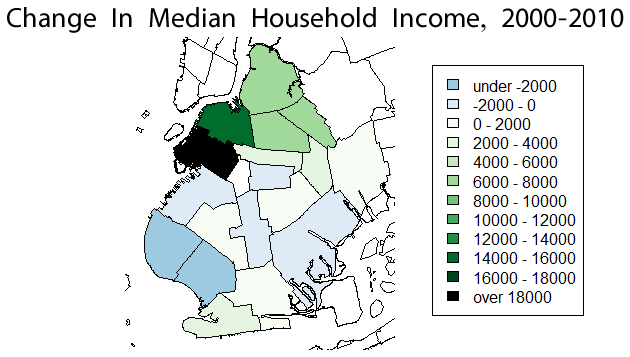
    I recently ran across a post from data-crunching blog extraordinaire Xenocrypt, which noted that from 1999 to 2011, median household income in Brooklyn fell from $42,852 to $42,752. That’s not a huge drop, obviously. The national median income fell from $56,000 to $50,000, so Brooklyn is actually catching up, sort of, to the country as a whole. But it still got poorer in absolute terms.

    Moreover, if you map (as Xenocrypt did) the borough’s neighborhoods by change in median income, you get a really striking picture:


    Credit: Xenocrypt.blogspot.com

    …which is that, indeed, a good three-fifths or so of Brooklyn is actually getting poorer. Have you read any articles about that? No, I will wager that you have not. Neither have I. I strongly suspect that is because they don’t exist – at least not in any outlet that might be considered mainstream.

    And what about housing prices?


    Brooklyn Gentrification Map: Increase, Decrease in Home Values 2004 vs. 2012
    Credit: http://www.citylimits.org/

    So in large parts of Brooklyn, real estate prices are falling.

    I have nothing particularly intelligent to say about this – these maps were news to me – except that it’s maybe the most dramatic example I’ve seen yet of just how limiting our fixation on gentrification is. I mean that both in a sort of journalistic sense, in that we’re being deprived of an accurate sense of what is actually going on in our cities, as well as from an advocate’s perspective: how can we claim to be working for fairer, more equitable, etc., cities, if we’re ignorant of their most basic economic and demographic changes?

    This post originally appeared in City Notes on May 3, 2014. Daniel Hertz is a masters student at the Harris School of Public Policy at the University of Chicago.

    Lead photo: “BK” by Theeditor93Own work. Licensed under CC BY-SA 3.0 via Wikimedia Commons.

  • Are Cool Downtowns the Solution to Suburban Ennui?

    Recently, former Nassau County Executive Tom Suozzi took a turn answering The Foggiest Five, a new segment that asks influential Long Islanders five questions regarding the future of the Nassau-Suffolk region. His answers gave an interesting look at our issues, and I appreciate the time he took answering the questions.

    Suozzi served Nassau’s County Executive from 2002 to 2009. Since Nassau is an older, first ring suburb, the County has limited opportunities for a complete overhaul of its physical imprint. In recent years, their redevelopment efforts have been skewed towards infill and revitalizing already-existing areas.

    His answers reflected Suozzi’s unique experience gained thanks to the years he ran Nassau County. When asked about the biggest change he’s witnessed on Long Island, Suozzi highlighted property taxes as a “root of all evil” of sorts concerning our regional problems. Suozzi gave five causes to our tax problem:
    1)Waste, Fraud and Abuse, 2) Long Island residents pay much more in income taxes to the federal and state governments that we get back in federal and state aid, 3) unfunded state mandates, 4) too many governments, and 5) lack of growth.

    It’s hard to argue with the realities Suozzi laid out. While we often squabble about our local land usage, the reality is that our costs are unsustainable. Further – we are getting diminishing return on our sky-high costs of living. Our infrastructure is still crumbling and inadequate, and our water quality is still being degraded.

    One possible solution, according to Suozzi, lies in his “cool downtowns” approach, building off  of the clusters, corridors and centers theory that has been mentioned for Long Island — and much of the nation — since the 1960s and early 70s. Suozzi writes:
    We have a few cool downtowns now but not enough. Rockville Centre, Garden City, Westbury and Great Neck have downtown rentals, offices, restaurants and shops that are all near train stations. Long Island residents flock to these parts for entertaining and relaxation. Mineola, Farmingdale, Glen Cove, Hempstead, Freeport and Long Beach are trying to create cool downtowns but to be successful, we need more of them. We need to create at least 20 cool downtowns so it will make sense to link them by bus and mass transit. 

    The planning theory behind Suozzi’s solution makes some sense, given the existence of numerous village-like nodes through the county. In Nassau, his vision for cool downtowns works easier than it does in neighboring Suffolk, mainly because of their limitations in infrastructure and generally later development. Further, economic and housing realities must be addressed.

    Simply put, Nassau is where the infrastructure is more conducive to mini-downtown intensification. However, what Suffolk lacks in infrastructure, it gains the advantage in sheer space. Suffolk’s developmental destiny isn’t fully charted yet as it is in Nassau. This means two things: it’s not too late to execute sound land use planning, and that we still have the opportunity to take action to reverse our fortunes, which would resonate across Route 110 into Nassau as well.

    It is important to realize that Suozzi’s downtown solution in of itself should not be an excuse to merely increase density on Long Island for the sake of increasing density. There will always be pressure from developers to densify well beyond local wishes, and seek subsidies to do so. These “cool downtowns” must mesh with comprehensive and regional strategies for attracting jobs to these targeted areas that take advantage of Long Island’s educated workforce.

    Also we should look at the quality of the density. Urban-like density alone does not create the atmosphere of a village; anyone who has spent time in the dense suburbs of cities like Seoul or even Los Angeles can tell you that. Tall structures and related commercial developments tend to be inhabited by generic stores with little resonance with the history and culture of their communities. Village systems work best when they develop organically, and grow, as much as possible, within the confines of already existing architecture or in new buildings that fit with local styles.

    Form also matters. There is a difference between the “little” downtown areas of Long Island that have charm, which is in a direct contrast to dense, almost urban centers. In our pursuit for suburban renewal, we cannot lose sight of what makes Long Island special, it terroir, if you will, of small communities that in many cases have been in existence for well over a century. Long Island may be expensive by national standards, but the staggering price increases in New York City for similarly appointed residential units, makes the Island comparatively affordable, and with excellent access to the city.

    While New York City has a variety of urban centers, Long Island’s approach to suburban revitalization should build off of Suozzi’s cool downtowns, but in a suburban manner. Part of the Island’s charm isn’t so much its Queens-like centers, but rather, villages such as Rockville Centre, Babylon and Patchogue – low slung, vibrant areas with good access to transit and the infrastructure needed to support their growth. By just blindly throwing density at Long Island’s regional issues, we are at risk of creating urban problems in a suburban environment.

    Long Island has other assets, particularly in terms of better schools. Many people who live in the city in their twenties and early thirties tend to look towards areas with good public schools, ample parks, and high levels of public safety. This is already leading to the much discussed growth of “hipsturbia” in the Hudson Valley river towns. Long Island could be a strong competitor for these people if it understands its’ primary appeal. 

    Finally for “cool downtowns” to work you must address the fundamental economic and demographic challenges facing the region. Although it can’t hope to compete head-to-heard with Manhattan for some very high end jobs, the area should be attractive to a lot of back office and specialized companies. If employment opportunities expand, then you might be able to more easily persuade younger workers to move to the Island, creating a consumer market for cool downtowns. Being “hip” isn’t enough, but getting more competitive and richer might work.

    Richard Murdocco writes regularly on land use, planning and development issues for various publications. He has his BA in both Political Science and Urban Studies from Fordham University, and his MA in Public Policy from Stony Brook University, and studied planning under Dr. Lee Koppelman, Long Island’s veteran planner. You can follow Murdocco on Twitter @TheFoggiestIdea, Like The Foggiest Idea on Facebook, and read his collection of work on urban planning at TheFoggiestIdea.org.

    "19 Main St Roslyn jeh" by Jim.henderson – Own work. Licensed under Creative Commons Zero, Public Domain Dedication via Wikimedia Commons

  • The World’s Most Influential Cities

    In the past century, the greatest global cities were generally the largest and centers of the world’s great empires: London, Paris, New York and Tokyo. Today size is not so important: Of the world’s 10 most populous cities, only Tokyo, New York and Beijing are in the top 10 of our ranking of the world’s most important cities. Instead, what matters today is influence.

    To rank the world’s global cities, I worked with urban geographer Ali Modarres, former Accenture analyst Aaron Renn and demographer Wendell Cox. We have attempted to go beyond some of the standard methods of evaluating the global importance of cities, which include assessing the concentration of support services available for multinationals, such as financial and accounting firms, or the size of the overall economy. Efficiency and access to capital and information, we believe, is more critical to being an important global city than number of jobs, and regional GDP is a false measure, since it doesn’t reflect whether the source is domestic or global economic activity.

    In order to quantify cities’ global influence, we looked at eight factors: the amount of foreign direct investment they have attracted; the concentration of corporate headquarters; how many particular business niches they dominate; air connectivity (ease of travel to other global cities); strength of producer services; financial services; technology and media power; and racial diversity. (Click here for a more detailed description of our methodology.) We found those factors particularly important in identifying rising stars that, someday, might challenge the current hegemony of our two top-ranked global cities, London and New York.

    Inertia and smart use of it is a key theme that emerged in our evaluation of the top global cities. No city better exemplifies this than London, which after more than a century of imperial decline still ranks No. 1 in our survey. The United Kingdom may now be a second-rate power, but the City’s unparalleled legacy as a global financial capital still underpins its pre-eminence.

    Ranked first in the world on the Z/Yen Group’s 2013 Global Financial Centres Index, which we used for our list, London not only has a long history as a dominant global financial hub, but its location outside the United States and the eurozone keeps it away from unfriendly regulators. Compared to New York, it is also time-zone advantaged for doing business in Asia, and has the second best global air connections of any city after Dubai, with nonstop flights at least three times a week to 89% of global cities outside of its home region of Europe.

    A preferred domicile for the global rich, London is not only the historic capital of the English language, which contributes to its status as a powerful media hub and major advertising center, but it’s also the birthplace of the cultural, legal and business practices that define global capitalism.London hosts the headquarters of 68 companies on the 2012 Forbes Global 2000 list and is a popular location for the regional HQs of many multinationals. (Our HQ ranking component, in which London ranks third, is based on GaWC’s 2012 Command and Control Index, which factors in company size and financial performance, as well as total number of Forbes Global 2k HQs).

    Beyond these traditional strengths, London has become Europe’s top technology startup center, according to the Startup Genome project. The city has upward of 3,000 tech startup sas well as Google’s largest office outside Silicon Valley.

    nearly four times that of second place Tokyo New York, which comes in a close second in our study (40 points to London’s 42), is home to most of the world’s top investment banks and hedge funds, and the stock trading volume on the city’s exchanges is and more than 10 times that of London.

    Like London, New York is a global leader in media and advertising, the music industry (home to two of the big three labels), and also one of the most important capitals of the fashion and luxury business. With iconic landmarks galore, international visitors spend more money in New York each year than in any other city in the world.

    The Challengers And Those Slowly Fading

    London and New York are clearly the leaders but they are not the hegemonic powers that they were throughout much of the 20thcentury, and their main competitors are now largely from outside Europe. Paris may rank third in our survey, but it is way below New York and London by virtually every critical measure, and the city’s future is not promising given that France, and much of the EU, are mired in relative economic stagnation.

    Rather than a true indication of global reach, Paris’ high ranking is partly the product of the city’s utter domination of the still sizable French economy and the concentration of virtually all the country’s leading companies there (it ranks fifth on GaWC’s Command and Control Index with 60 HQs of Forbes Global 2K companies).

    Elsewhere, Europe boast a veritable archipelago of globally competitive cities — Munich, Rome, Hamburg — but none is large enough, or unique enough, to break into the top 10 in the future. East Asia is likely to place more cities at the top of the list.

    For most of the last century, Tokyo has been Asia’s leading city. It is still the world’s largest city, with the largest overall GDP. In her seminal work on world cities, Saskia Sassen placed it on the same level as London and New York. Tokyo’s limitations resemble those of Paris — its high ranking stems partly from the extreme concentration of domestic companies — and it will be handicapped in the future by a severe demographic crisis, a lack of ethnic diversity and very determined regional rivals.

    China’s Global Cities

    China’s share of the world economy has grown from 5% in 1994 to 14% in 2012.The combined volume of trading on the Shanghai and Shenzhen stock exchanges already exceeds that of Tokyo, and Shenzhen’s volume is approximately three times that of nearby Hong Kong.

    Hong Kong still enjoys greater freedom than the rest of China and remains the largest financial center in the Asia-Pacific region, ranking third in the world after London and New York. The vast majority of the world’s major investment banks, asset managers, and insurance companies maintain their Asia-Pacific headquarters in the former British colony.

    But its preeminence is being threatened by Shanghai, traditionally Hong Kong’s chief rival, and Beijing. We ranked China’s capital eighth, ahead of Shanghai (19th). With the advantage of being the country’s all-powerful political center, Beijing is the headquarters of most large state-owned companies and is home to the country’s elite educational institutions and its most innovative companies.

    But right now the leading global city in East Asia is Singapore, which ranks fourth on our list. With a relatively small population of just over 5 million, Singapore’s basic infrastructure is among the best on the planet. Like Hong Kong, it also benefits from a tradition of British governance and law, one reason the World Bank ranked its business climate the world’s best; China ranked 96th. Singapore’s justice system is ranked 10th in the world in The Rule of Law Index.

    That is all drawing in international business: Singapore places first among global cities in our ranking of foreign direct investment, with a five-year average of 359 greenfield transactions. It’s a favored location in many industries for Asia-Pacific headquarters; a study by the consultancy Roland Berger named Singapore the leading location for European companies to establish an Asia-Pacific HQs.

    Singapore vies with Hong Kong as the financial center of Asia, ranking fourth in the world in that category.

    Global Capital of the Middle East

    Much of what we see in the media about Middle Eastern cities are scenes of destruction and chaos. Yet in a relatively quiet corner of the Arabian Peninsula, Dubai is ascending, ranked seventh on our list. Its globalization strategy hinges largely on its expanding airport, which includes the world’s largest terminal and an even larger airport under construction. It ranks first in the world in our air connectivity ranking, with nonstop flights at least three times a week to 93% of global cities outside of its home region.Its hub location and business-friendly climate have made it a favorite for companies looking to establish a Middle East headquarters or point of presence. As a crossroads of humanity, Dubai is unparalleled among global cities for its diversity: 86% of its residents are foreign born.

    North America

    Our rankings rewarded cities that are both ethnically diverse and, in some cases, dominate a critical industry. This is what we refer to as a “necessary city,” a place one must go to conduct business in a particular field, or to service a particular region of the world.

    This focus on the “necessary” city led to what will no doubt be a controversial result: a 10th place ranking for the San Francisco Bay Area, on the strength of its central role in the tech industry, tied on our list with Los Angeles and Toronto. The Bay Area did not even make the top 20 in the 2014 A.T. Kearney rankings, which placed both Chicago and Los Angeles in the top 10.

    Not long ago Los Angeles, North America’s second-largest metro area, saw itself as a potential rival to New York and a legitimate world city. Hollywood is nearly synonymous with the American entertainment industry and is by far the world’s largest in terms of revenue and influence. Last year the industry enjoyed exports of almost $15 billion.

    But L.A.’s share of entertainment employment is shrinking and its former second industry, aerospace, has declined significantly, losing over 90,000 jobs since the end of the Cold War. Several key companies have decamped from the metro area in recent years — Nissan, Occidental Petroleum, Toyota — for more business-friendly places.

    The situation is arguably worse in Chicago, which ties for 20th. The Windy City first rose to world prominence after overcoming rival St. Louis in the late 19th century. It boasts one of the world’s most diverse economies, but has not developed strong dominance in any industry. Chicago is an also ran in media and technology and, outside of commodities, is no longer a major global financial center.

    The big winner today is the Bay Area, which overwhelmingly dominates the list of technology leaders; not only is the metro area home to a glittering array of tech standouts, companies based elsewhere in the U.S., and in other countries, feel compelled to site operations there. Even a penny pinching retailer like Wal-Mart is growing its Silicon Valley presence.

    Other North American cities with a growing global footprint include 10th ranked Toronto, tied with Los Angeles and Bay Area. Toronto, as the economic capital of Canada, has becomes a focus for international investment into that stable and resource rich country. It is also among the most diverse cities on the planet — 46 % of its population is foreign born.

    Rising Stars

    In North America up and comers include No. 14 Houston, with its domination of the U.S. energy industry, a huge export sector and an increasingly diverse population. The Washington, D.C., metro area ranks 16th, a testament to the capital’s growth as an aerospace and technology center.

    Overseas, other urban centers that could move up in the future include No. 16 Seoul, Shanghai and No. 20 (tie) Abu Dhabi. But outside of Dubai no other cities in our top 20 come from the developing world. The Indian megacities Delhi and Mumbai rank in the low 30s along with Johannesburg in South Africa. In Latin America, the place to watch is No. 23 Sao Paulo. But until these areas can develop adequate infrastructure — from roads, transit and bridges to relatively non-corrupt judicial systems — none can be expected to crack the top 10, or even 20, for at least a decade.

    For the time being, the future of the global city belongs not to the biggest or fastest growing but the most efficient and savvy, and those with a strong historical pedigree. This raises the bar for all cities that wish to break into this elite club.

    No. 1: London

    FDI Transactions (5-Year Avg.): 328
    Forbes Global 2000 HQs: 68<
    Air Connectivity:  89%*
    Global Financial Centres Index Rank: 1

    * The air connectivity score is the percentage of other global cities outside the city’s region (e.g., for London, cities outside of Europe) that can be reached nonstop a minimum of three times per week.

    No. 2: New York

    FDI Transactions (5-Year Avg.): 143
    Forbes Global 2000 HQs: 82
    Air Connectivity:  70%
    GFCI Rank: 2

    No. 3: Paris

    FDI Transactions (5-Year Avg.): 129
    Forbes Global 2000 HQs: 60
    Air Connectivity:  81%
    GFCI Rank: 29

    No. 4: Singapore

    FDI Transactions (5-Year Avg.): 359
    Forbes Global 2000 HQs: N/A
    Air Connectivity:  46%
    GFCI Rank: 4

    No. 5: Tokyo

    FDI Transactions (5-Year Avg.): 83
    Forbes Global 2000 HQs: 154
    Air Connectivity:  59%
    GFCI Rank: 5

    No. 6: Hong Kong

    FDI Transactions (5-Year Avg.): 234
    Forbes Global 2000 HQs: 48
    Air Connectivity:  57%
    GFCI Rank: 3

    No. 7: Dubai

    FDI Transactions (5-Year Avg.): 245
    Forbes Global 2000 HQs: N/A
    Air Connectivity:  93%
    GFCI Rank: 25

    No. 8 (TIE): Beijing

    FDI Transactions (5-Year Avg.): 142
    Forbes Global 2000 HQs: 45
    Air Connectivity:  65%
    GFCI Rank: 59

    No. 8 (TIE): Sydney

    FDI Transactions (5-Year Avg.): 111
    Forbes Global 2000 HQs: 21
    Air Connectivity:  43%
    GFCI Rank: 15

    No. 10 (TIE): Los Angeles

    FDI Transactions (5-Year Avg.): 35
    Forbes Global 2000 HQs: N/A
    Air Connectivity:  46%
    GFCI Rank: N/A

    No. 10 (TIE): San Francisco Bay Area

    FDI Transactions (5-Year Avg.): 49
    Forbes Global 2000 HQs: 17
    Air Connectivity:  38%
    GFCI Rank: 12

    No. 10 (TIE): Toronto

    FDI Transactions (5-Year Avg.): 60
    Forbes Global 2000 HQs: 23
    Air Connectivity:  49%
    GFCI Rank: 11

    Remaining Cities

    City Region Rank

    Zurich

    Europe

    13

    Frankfurt

    Europe

    14

    Houston

    North America

    14

    Amsterdam/Randstad

    Europe

    16

    Seoul

    Asia-Pacific

    16

    Washington Metropolitan Area

    North America

    16

    Shanghai

    Asia-Pacific

    19

    Abu Dhabi

    Middle East

    20

    Chicago

    North America

    20

    Moscow

    Europe

    20

    Boston

    North America

    23

    Brussels

    Europe

    23

    Dallas-Fort Worth

    North America

    23

    Madrid

    Europe

    23

    Melbourne

    Asia-Pacific

    23

    São Paulo

    South America

    23

    Istanbul

    Middle East

    29

    Miami

    North America

    29

    Johannesburg

    Africa

    31

    Kuala Lumpur

    Asia-Pacific

    31

    Mumbai

    Asia-Pacific

    31

    Bangkok

    Asia-Pacific

    34

    Delhi

    Asia-Pacific

    34

    Geneva

    Europe

    34

    Atlanta

    North America

    37

    Berlin

    Europe

    37

    Seattle

    North America

    37

    Tel Aviv

    Middle East

    37

    Mexico City

    North America

    41

    Milan

    Europe

    41

    Montreal

    North America

    41

    Buenos Aires

    South America

    44

    Jakarta

    Asia-Pacific

    44

    Philadelphia

    North America

    44

    Cairo

    Middle East

    47

    Guangzhou

    Asia-Pacific

    47

    Ho Chi Minh City

    Asia-Pacific

    47

    Lagos

    Africa

    47

    Osaka

    Asia-Pacific

    47


    This piece originally appeared at Forbes.

    Joel Kotkin is executive editor of NewGeography.com and Distinguished Presidential Fellow in Urban Futures at Chapman University, and a member of the editorial board of the Orange County Register. His newest book, The New Class Conflict is now available for pre-order atAmazon and Telos Press. He is author of The City: A Global History and The Next Hundred Million: America in 2050. His most recent study, The Rise of Postfamilialism, has been widely discussed and distributed internationally. He lives in Los Angeles, CA.

    Photo: "City of London skyline at dusk" by jikatu – Licensed under Creative Commons Attribution-Share Alike 2.0 via Wikimedia Commons

  • Long Island Needs Regionalism

    Eric Alexander, the Executive Director of Vision Long Island, seems to be popping up everywhere on Long Island these days. He was recently quoted in The Corridor Magazine’s transportation and infrastructure issue as saying: “Academic conversations about regionalism is a 90s thing.” Similar to his condemnation on “academic” commentary concerning the downtown redevelopment trend, Alexander made it clear in the piece that he feels a local, downtown-centric approach is the way to go.

    Whether we like it or not, Long Island is a singular region.

    If Long Island’s developmental future is divided and segmented municipality-by-municipality, we, as a collective whole, will fail. The Village of Rockville Centre, one of Long Island’s much-touted “cool” downtown areas, shares the same aquifer system as Rocky Point. If a company abandons their corporate headquarters in Lake Success, residents in Suffolk feel the economic blow. Despite claims to the contrary by special interests and stakeholders, we are one Island. Our social, economic and environmental policies must reflect that fact.

    It is in the interest of builders, developers and stakeholders for Long Island’s developmental future to remain both segmented and divided under the guise of “localism”. Divide, and conquer, as the saying goes. When projects are looked at a regional level, they are more heavily scrutinized, and their impacts are more thoroughly explored.

    Here is a scenario:  A small village on Long Island is welcoming the economic windfall a particular development is slated to bring, while five miles north to the village, an unincorporated area fears their shops will wither thanks to the influx of shops proposed.  The Village does as they please, approving the development.  Now, the businesses in the unincorporated area lay stagnant thanks to the over-saturation of retail usage that the new development brought to the area.

    It’s Urban Planning 101: You don’t build what you don’t need. Much of the debate concerning Heartland, whose future lays with the Town of Islip, is that its impacts will resonate far beyond Islip.

    That’s the trouble with localism – it only benefits the locality, and often at the cost of other areas. Unfortunately for Mr. Alexander, some of Long Island’s issues are too big for the “locals know best” model he advocates for. Our fragile aquifer system transcends all geo-political borders, with poor land use decisions in one town impacting water quality in the next.

    Our Island is small enough for economic development policies to resonate far beyond the Village or Town level. While the Town of Babylon IDA and Town of Islip IDA squabble over wooing a manufacturing business, a lucky county in North Caroline will reap the rewards when they eventually steal them away from Long Island.  It’s one thing for a village to build more housing options, but successfully raising a new multifamily development isn’t the same thing as quantifying and addressing our marked regional need for different types of housing.

    Is it too “academic” to quantify our problems before taking the steps of addressing them? Is a protected aquifer system which supplies our region’s drinking water outdated like Zach Morris’ blocky cellphone or the Macarena?

    Localism at its worst puts immediate needs first, and Long Islanders as a collective second. Part of the challenge we face as a region is the segmented and fractured governmental systems that prevent us from significantly making any progress. The biggest public works and sweeping acts of environmental preservation in this region’s history were executed thanks to a solid foundation of regional thought. The Long Island Parkway System, LIRR and LIE weren’t built on the local scale. The preservation of 100,000 acres of Pine Barrens forest needed state legislation that trumped local zoning to be adequately protected. Suffolk County’s open space, water protection and farmland preservation programs weren’t locally-sourced, homegrown policies, but rather models emulated nationally thanks to their breadth and regional scale. 

    Regionalism at its worst is characterized by monolithic bureaucrats making decisions without any local input. This is why a balance must be struck between both approaches that blend our local sensibilities with a comprehensive regional approach. The commonalities between Long Island’s various towns, villages and even counties warrant regionalism with a local twist. Our common aquifer is the largest common tie, while our surface bodies of water constrain our physical space. Economically, Long Islanders in both counties work and commute to the Island’s employment centers, which are concentrated in a few distinct locations, while all municipalities share neighborhoods that span the socio-economic spectrum. Given the common traits, a regional approach undertaken by municipalities, helmed by non-biased professional planners would serve both the local and regional good. For too long, Long Island’s development future has been staked out by stakeholders and policymakers with something to gain by swaying in one direction or another.

    The best community planning efforts stem from public input, assessment of public needs and ample participation by the people who live and work in the area. The best environmental planning efforts use data and scientific study to advance the goals selected. A regional approach takes the best of both these approaches, and balances the needs of a region in a comprehensive manner. A local approach works under certain circumstances. When a neighborhood needs a community center, or seeks to improve their quality of life, the approach to development should be local. However, if the locality proposes development whose impacts resonate far beyond their municipal borders, a regional approach must be taken.

    There is a reason why conversations concerning Long Island’s future must be academic Mr. Alexander. We all feel the impacts of poor development choices. Sound regional planning isn’t something to dismiss as a “90s thing”, but rather, should be embraced for the betterment of Long Island’s future.  

    Richard Murdocco writes regularly on land use, planning and development issues for various publications. He has his BA in both Political Science and Urban Studies from Fordham University, and his MA in Public Policy from Stony Brook University, and studied planning under Dr. Lee Koppelman, Long Island’s veteran planner. You can follow Murdocco on Twitter @TheFoggiestIdea, Like The Foggiest Idea on Facebook, and read his collection of work on urban planning at TheFoggiestIdea.org.

    Long Island illustration by Wiki commons user Duffman.

  • New York, Legacy Cities Dominate Transit Urban Core Gains

    Much attention has been given the increase in transit use in America. In context, the gains have been small, and very concentrated (see: No Fundamental Shift to Transit, Not Even a Shift). Much of the gain has been in the urban cores, which house only 14 percent of metropolitan area population. Virtually all of the urban core gain (99 percent) has been in the six metropolitan areas with transit legacy cities (New York, Chicago, Philadelphia, San Francisco, Boston, and Washington).

    In recent articles, I have detailed a finer grained, more representative picture of urban cores, suburbs and exurbs than is possible with conventional jurisdictional (core city versus suburban) analysis. The articles published so far are indicated in the "City Sector Articles Note," below.

    Transit Commuting in the Urban Core

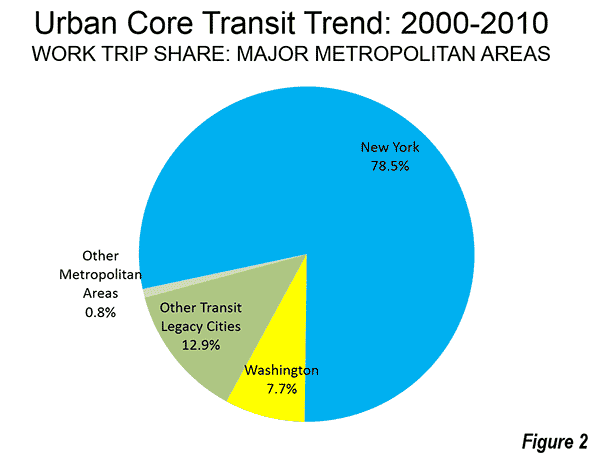
    As is so often the case with transit statistics, recent urban cores trends are largely a New York story. New York accounted for nearly 80 percent of the increase in urban core transit commuting. New York and the other five metropolitan areas with "transit legacy cities" represented more than 99 percent of the increase in urban core transit commuting (Figure 1). This is not surprising, because the urban cores of these metropolitan areas developed during the heyday of transit dominance, and before broad automobile availability. Indeed, urban core transit commuting became even more concentrated over the past decade. The 99 percent of new commuting (600,000 one-way trips) by transit in the legacy city metropolitan areas was as well above their 88 percent of urban core transit commuting in 2000.

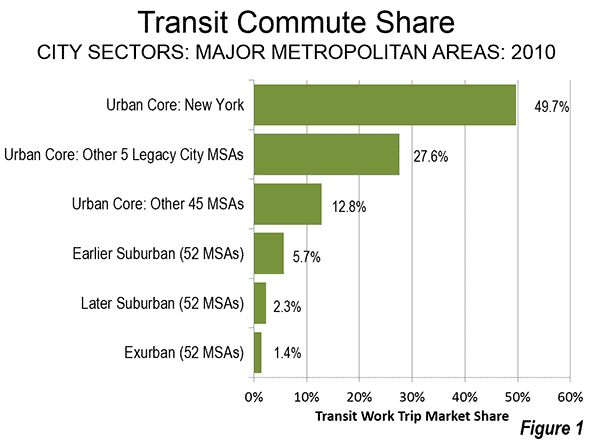
    New York’s transit commute share was 49.7 percent in 2010, well above the 27.6 percent posted by the other five metropolitan areas with transit legacy cities. The urban cores of the remaining 45 major metropolitan areas (those over 1,000,000 population) had a much lower combined transit work trip market share, at 12.8 percent.

    The suburban and exurban areas, with 86 percent of the major metropolitan area population, had much lower transit commute shares. The Earlier Suburban areas (generally median house construction dates of 1946 to 1979, with significant automobile orientation) had a transit market share of 5.7 percent, the Later Suburban areas 2.3 percent and the Exurban areas 1.4 percent (Figure 2).

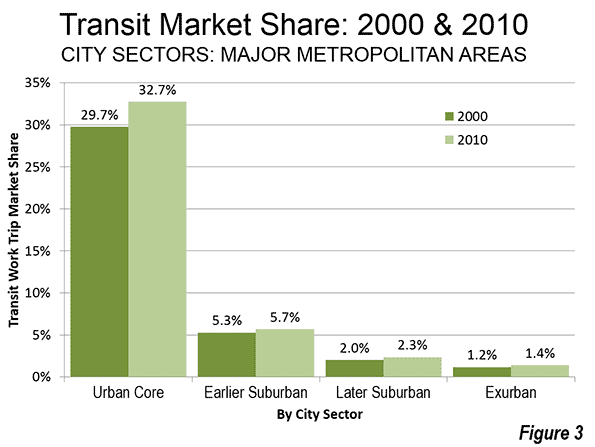
    The 2000s were indeed a relatively good decade for transit, after nearly 50 years that saw its ridership (passenger miles) drop by nearly three-quarters to its 1992 nadir. Since that time, transit has recovered 20 percent of its loss. Transit commuting has always been the strongest in urban cores, because the intense concentration of destinations in the larger downtown areas (central business districts) that can be effectively served by transit, unlike the dispersed patterns that exist in the much larger parts of metropolitan areas that are suburban or exurban. Transit’s share of work trips by urban core residents rose a full 10 percent, from 29.7 percent to 32.7 percent (Figure 3).

    There were also transit commuting gains in the suburbs and exurbs. However, similar gains over the next quarter century would leave transit’s share at below 5 percent in the suburbs and exurbs, because of its small base or ridership in these areas.

    Walking and Cycling

    The share of commuters walking and cycling (referred to as "active transportation" in the Queen’s University research on Canada’s metropolitan areas) rose 12 percent in the urban core (from 9.2 percent to 10.3 percent), even more than transit. This is considerably higher than in suburban and exurban areas, where walking and cycling remained at a 1.9 percent market share from 2000 to 2010.

    Working at Home

    Working at home (including telecommuting) continues to grow faster than any work access mode, though like transit, from a small base. Working at home experienced strong increases in each of the four metropolitan sectors, rising a full percentage point or more in each. At the beginning of the decade, working at home accounted for less work commutes than walking and cycling, and by 2010 was nearly 30 percent larger.

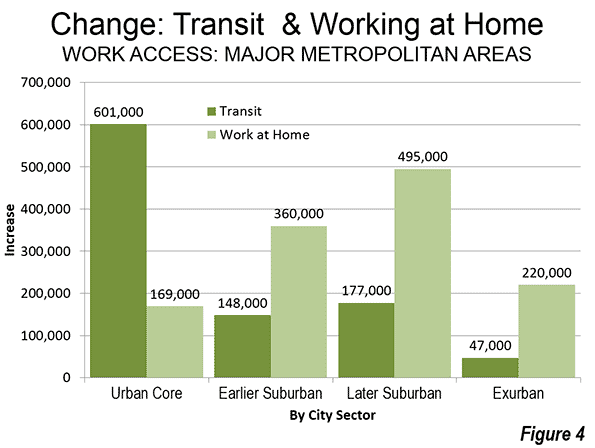
    The working at home largest gain was in the Earlier Suburban Areas, with a nearly 500,000 person increase. Unlike transit, working at home does not require concentrated destinations, effectively accessing employment throughout the metropolitan area, the nation and the world. As a result, working at home’s growth is fairly constant across the urban core, suburbs and exurbs (Figure 4). Working at home has a number of advantages. For example, working at home (1) eliminates the work trip, freeing additional leisure or work time for the employee, (2) eliminates greenhouse gas emissions from the work trip, (3) expands the geographical area and the efficiency of the labor market (important because larger labor markets tend to have greater economic growth and job creation, and it does all this without (4) requiring government expenditure.

    Driving Alone

    Despite empty premises about transit’s potential, driving remains the only mode of transport capable of comprehensively serving the modern metropolitan area. Driving alone has continued its domination, rising from 73.4 percent to 73.5 percent of major metropolitan area commuting and accounting for three quarters of new work trips. In the past decade, driving alone added 6.1 million commuters, nearly equal to the total of 6.3 million major metropolitan area transit commuters and more than the working at home figure of 3.5 million. To be sure, driving alone added commuters in the urban core, but lost share to transit, dropping from 45.2 percent to 43.4 percent. In suburban and exurban areas, driving alone continued to increase, from 78.2 percent to 78.5 percent of all commuting.).

    Density of Cars

    The urban cores have by far the highest car densities, despite their strong transit market shares. With a 4,200 household vehicles available per square mile (1,600 per square kilometer), the concentration of cars in urban cores was nearly three times that of the Earlier Suburban areas (1,550 per square mile or  600 per square kilometer) and five times that of the Later Suburban areas (950 per square kilometer). Exurban areas, with their largely rural densities had a car density of 100 per square mile (40 per square kilometer).

    Work Trip Travel Times

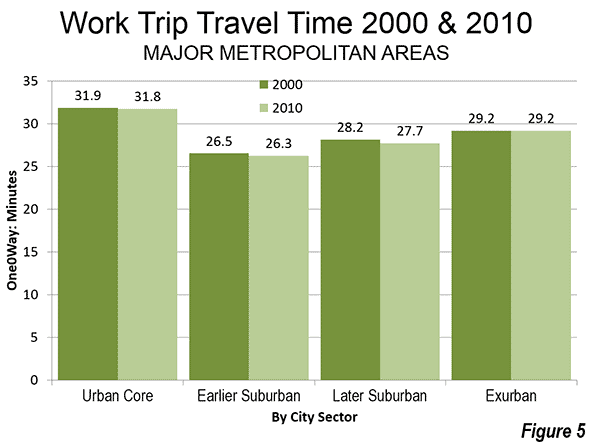
    Despite largely anecdotal stories about the super-long commutes of those living in suburbs and exurbs, the longest work trip travel times were in the urban cores, at 31.8 minutes one-way. The shortest travel times were in the Earlier Suburbs (26.3 minutes) and slightly longer in the Later Suburbs (27.7 minutes). Exurban travel times were 29.2 minutes. Work trip travel times declined slightly between 2000 and 2010, except in exurban areas, where they stayed the same. The shorter travel times are to be expected with the continuing evolution from monocentric to polycentric and even "non-centric" employment patterns and a stagnant job market (Figure 5).

    Contrasting Transportation in the City Sectors

    The examination of metropolitan transportation data by city sector highlights the huge differences that exist between urban cores and the much more extensive suburbs and exurbs. Overall the transit market share in the urban core approaches nine times the share in the suburbs and exurbs. The walking and cycling commute share in the urban core is more than five times that of the suburbs and exurbs. Moreover, the trends of the past 10 years indicate virtually no retrenchment in automobile orientation, as major metropolitan areas rose from 84 percent suburban and exurban in 2000 to 86 percent in 2010. This is despite unprecedented increases is gasoline prices and the disruption of the housing market during worst economic downturn since the Great Depression.

    —————————-

    Wendell Cox is principal of Demographia, an international public policy and demographics firm. He is co-author of the "Demographia International Housing Affordability Survey" and author of "Demographia World Urban Areas" and "War on the Dream: How Anti-Sprawl Policy Threatens the Quality of Life." He was appointed to three terms on the Los Angeles County Transportation Commission, where he served with the leading city and county leadership as the only non-elected member. He was appointed to the Amtrak Reform Council to fill the unexpired term of Governor Christine Todd Whitman and has served as a visiting professor at the Conservatoire National des Arts et Metiers, a national university in Paris.

    Photograph: DART light rail train in downtown Dallas (by author)

    —————————-

    City Sector Note: Previous articles in this series are listed below:
    From Jurisdictional to Functional Analyses of Urban Cores & Suburbs
    The Long Term: Metro American Goes from 82 percent to 86 percent Suburban Since 1990
    Functional v. Jurisdictional Analysis of Metropolitan Areas
    City Sector Model Small Area Criteria

  • The Ugly City Beautiful: A Policy Analysis

    When it comes to the future, Detroit and San Francisco act as poles in the continuum of American consciousness. Detroit is dead and will continue dying. San Francisco is the region sipping heartily from the fountain of youth. Such trajectories, according to experts, will go on indefinitely.

    Harvard economist Ed Glaeser has a grim outlook for the Rust Belt. “[P]eople and firms are leaving Buffalo for the Sunbelt because the Sunbelt is a warmer, more pleasant, and more productive area to live,” he writes in City Journal.

    Glaeser echoes this sentiment in a recent interview with International Business Times, saying “[s]mart people want to be around other smart people”, and the Rust Belt has a long slog ahead given that “post-industrial city migration is dominated by people moving to warmer climes”.

    But is this true? Is there a “brain drain” from the Rust Belt to the Sun Belt and Coasts? In a word: no. But Rust Belt leaders have bought this narrative hook line and sinker, and the subsequent hand-wringing has led to wasteful public investment.

    “Michigan’s cities must retain and attract more people, including young knowledge workers, to its cities by making them attractive, vibrant, and diverse places,” reads a 2003 memo from the National Governor’s Association about Michigan’s “Cool Cities” campaign.

    But the campaign struggled. “Government can’t mandate cool,” reflected Karen Gagnon, the former Cool Cities director. “As soon as government says something is cool, it’s not.”

    What’s worse, “cooling you city” with talent attraction expenditures can exacerbate economic disparities on the ground. Cities, like Chicago, are increasingly becoming bifurcated cities based on faulty assumptions that “trickle down urbanism” works. That said, the challenge of the day—for not only Rust Belt cities, but all cities—is not “brain drain”, but “brain waste”. Those cities who can best rebuild middle class communities tied to emerging markets will be the future of investment, like they were in the past.

    Through Rust-Colored Glasses

    When a people fall from grace, the sentiment of decline tends to stick. The Rust Belt’s demise is cemented. Meanwhile, the future is elsewhere. Like toward the sun. For instance, from 2000 to 2010, the Sun Belt metros of Houston, Dallas, Atlanta, Riverside, Las Vegas, Miami, Orlando, and Phoenix experienced the largest population growth. The biggest losers? It’s a “who’s who” of Rust Belt metros, led by Detroit, Cleveland, Pittsburgh, and Buffalo.

    America is a country governed by growth: big cars, big belt buckles, big houses, and big populations. Shrinkage is weakness. It is a sign of place failure. The problem here is that population growth is an ineffective, broad-brush measure when trying to understand regional underlying dynamics. A new study by Jessie Poon and Wei Yin in the journal Geography Compass called “Human Capital: A Comparison of Rustbelt and Sunbelt Cities” details exactly that.

    In it, the authors compare human capital levels between the Sunbelt metros in California (including San Francisco and L.A.), Nevada, New Mexico, and Arizona with Rust Belt metros in Michigan, Ohio, Indiana, Pennsylvania, and upstate New York. When it comes to share of population with a college degree, the authors find that the Rust Belt is experiencing a brain gain equal to their Sun Belt peers from 1980 to 2010. Poon and Wei also found that skill ratios of immigrants is higher in the Rust Belt than Sunbelt. The authors note that despite population decline, the Rust Belt continues “to be important sites of human capital accumulation”.

    The study coincides with recent work out of the Center for Population Dynamics that shows Greater Cleveland’s number of 25- to 34-year olds with a bachelor’s or higher increased by 23% from 2006 to 2012, as well as Pittsburgh economist Chris Briem’s work that shows the metros of Pittsburgh, Detroit, and Cleveland rank 1st,, 6th, 7th in the country respectively when it comes to the number of young adults in the labor force with a graduate or professional degree.

    Beyond human capital, the Rust Belt continues to produce and export wealth at a massive pace. The “Chi-Pitts” mega-region, which mirrors the Rust Belt boundaries with the addition of Minneapolis, generates $2.3 billion in economic output, second only to the “Bos-Wash” mega-region that makes up the Northeast Corridor.

    Also, using IRS migration data from the 2009-2010 period, a team of researchers led by Michal Migurski showed that Los Angeles County, New York County, and Cook County sent the most people and money to the rest of the United States. Detroit’s Wayne County was fourth. Cleveland’s Cuyahoga County was 9th, one spot ahead of San Francisco County. Speaking to Esquire, which published the work in a visual called “Where Does the Money Go”, Migurski explains the findings:

    "We realized that if you look at the biggest ‘losers,’ essentially what you’re looking at are the biggest cities in the U.S.," Migurski says. One of those losers: New York County, which lost $1,306,548,000 and 15,100 people. "But does that actually mean New York is a big loser?" Migurski asks. "One of our ideas was that, you’re not a loser if you’re losing money. You’re an exporter." The sort of exporter, he says, that boosts the rest of the U.S. economy. Traditional Sun Belt retirement areas comprise the gainers; areas like South Florida and Southern California in particular, create what Migurski calls "money sinks."

    Still, the notion of “loser” for Wayne and Cuyahoga County sticks, despite evidence to the contrary. But why? Why the constant “poor post-industrial people” sentiment, if not a low-grade captivation that comes with “ruin porn” rubbernecking?

    Well, if an ideal exists—you know, the experts beckon: be the “new” city, the “hot” city, the “creative” city—then a study in contrasts is necessary. The Rust Belt, with its connotations of smoke stacks and demographic decline, fits the bill.

    “[Richard] Florida suggests that Rustbelt cities’ high concentration of less creative blue-collar workers also produces unhappy residents,”Poon and Wei conclude in their Rust Belt/Sun Belt study. “We suggest that such a doom and gloom picture of urban and regional development for the uncool industrial Rustbelt needs to be tempered with a trend of brain gain that is growing across cities in the region.”

    But for this tempering to happen a clearer understanding of the importance of accumulating human capital needs to be ascertained. More exactly: Is it to put your city to work, or to “live-work-play”?

    Build it and they will…what?

    In his 1921 work Economy and Society, social scientist Max Weber details a city’s raison d’etre. Cities can be producer cities, wherein importance is derived from industries that demand national and international trade. Think Detroit and cars. Additionally, cities are consumer cities, in which growth is tied to how much is spent consuming goods and services in the local economy. Think eating, drinking, and buying houses.

    The cities that are the most economically robust have wealth generated from global production, which in turn enables local consumption. San Francisco’s tech economy drives it real estate market and artisanal toast scene. That is, if the question was “What came first, the farm-to-table chicken or the egghead?” The answer is “the egghead”, hands down.

    But this logic—i.e., in order to go to a restaurant, you need a job, and your job prospects are tied to the viability of your region’s global industries—is often turned on its head in economic development. Here, the goal is growth, no matter the rhyme or reason.

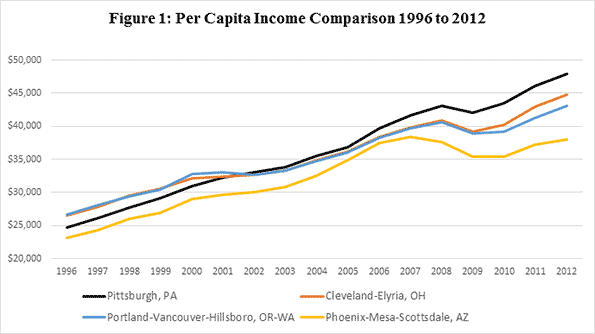
    “Like in many Sun Belt cities,” writes a Seattle Times columnist and Sun Belt expat, “Phoenix’s economic plan devolved into merely adding people, no matter the enormous long-term costs”. The columnist goes on to note that while the population has boomed, the city lags on most measures, such as per capita income (see Figure 1 below).

    Moreover, the Phoenixes of the world exist partly because of retired Baby Boomers and the disposable income that comes with it. The Sun Belt feeds off the legacy of production in the Northeast and Midwest. Other cities, like Portland, are fed by a not dissimilar dynamic. But it’s not the retired who come, rather the pre-retired.

    “The Portland metro area’s young college-educated white men are slackers when it comes to logging hours on the job,” lead’s a piece in the Oregonian about a study conducted last year, “and that’s one reason people here collectively earn $2.8 billion less a year than the national average.” Figure 1 demonstrates Portland’s sluggish income gains compared to Rust Belt peers Pittsburgh and Cleveland.

    Similarly, in a paper circulated by the Federal Reserve Bank of Atlanta, the author analyzed the top 86 “brain gain” metros in the nation to determine whether or not a region’s increase in human capital was paying off in terms of per capita income, labor force participation, poverty rate, and unemployment. The author found Portland was one of twelve metros that experienced zero economic outcomes. Pittsburgh scored 4 for 4. The authors suggest that talent attraction and retention—when untethered to production capacity—“may be largely inefficient, a kind of traditional economic development ‘buffalo hunting’”.

    Portland is perhaps America’s consummate lifestyle city. No doubt, the city has experienced a significant brain gain over the last decade. Portland is a talent attraction model. But it is not a talent producing or refining model. Rather, Portland is producing a scene that is run by the consumption of the scene’s aesthetic. Writes one young worker who left:

    “I can’t stay too long because I know if I stayed a day too long in Portland, I’d suddenly be happy to embrace the slow pace of the city and stop working… I’d end up getting sleeping real late every day, drink some coffee, maybe write some poetry on my porch (or not), and then find a part time job selling cigars like I had in college.”

    The lesson is that accumulating talent is not enough. There has to be something for the talent to do, or a context that fosters “doing”. It is also a warning for cities investing in the lifestyle game. Spending on creative class amenities ensures nothing. Creating a field of dreams won’t pay the bills. But it will run up the tab.

    The Ugly City Beautiful

    In 1998, the Chicago Sun-Times ran a piece called “Building the City Beautiful”. “The mayor of the city of Chicago, Richard M. Daley, is a big admirer of Martha Stewart,” it begins, before describing Daley’s plans to begin the "Martha Stewart-izing" of Chicago. The article goes on to quote a University of Illinois at Chicago professor who said Chicago is turning from a producer city to a consumer city. "The producer city was the industrial city — the smoke and the noise and the industrial jobs,” noted the professor. “The consumer city is the city of Starbucks, boutiques and so forth.”

    The professor was only partly right. By the 1990s, Chicago was indeed becoming brainier. But its emerging knowledge economy was an outgrowth of its “big shouldered” manufacturing base. Columbia University professor Saskia Sassen recently noted that pundits overlook this when examining the city’s transformation, with the bias being that “Chicago had to overcome its agro-industrial past, [and] that its economic history put it at a disadvantage”. Notes Sassen:

    [I]n my research I found that its past was not a disadvantage. In fact, it was one key source of its competitive advantage. The particular specialized corporate services that had to be developed to handle the needs of its agro-industrial regional economy gave Chicago a key component of its current specialized advantage in the global economy.

    Similar economic transformations from legacy cost to legacy asset are found throughout the whole of the Rust Belt. Pittsburgh, for instance, no longer provides the muscle for steel making, but it does act as the “brain center” for the world’s steel frame. How this came about is detailed in the article “Pittsburgh’s evolving steel legacy and the steel technology cluster”.

    With the arrival of the new economy also came “new economy” tastes. Sassen noted that when she arrived in to study in Chicago in the 90s she was greeted by “old lofts transformed into beautiful restaurants catering to a whole new type of high-income worker—hip, excited, alive.”

    In other words, local consumption patterns began setting up around the emergent worker demand. Going was the Italian Beef and arriving was pickled beets. This demand also impacted housing, with the attraction to urban living setting the stage for gentrification. This, in a nutshell, is the dynamic driving the transformation of urban neighborhoods nationwide: a new economy demands new workers which in turn demand a new kind of lifestyle. The problem, though, is that leaders have the causality backward, or that creating a new lifestyle will incur new worker supply and then poof: new industries. But as we see with Portland, it is not that easy. The industrial DNA and social history of your city matters more than the cosmetics atop the topography.

    Still, from a policy and strategy standpoint, it is easier just to make your city “cool”. And that’s exactly what Chicago has been doing at a significant pace. In a recent piece entitled “Well-healed in the Windy City”, author Aaron Renn details Mayor Rahm Emanuel’s policy of using tax-increment financing (TIF) to create geographic “winners” and “losers” across Chicagoland. “The true purpose of Chicago’s TIF districts—which now take in about $500 million per year,” writes Renn, “appears to be tending to high-end residents, businesses, and tourists, while insulating them from the poorer segments of the city.”

    The strategy was spelled out explicitly by Mayor Emanuel during a recent ribbon cutting for a bike path in Chicago’s Loop. Said Emanuel: “I expect not only to take all of their [Seattle and Portland’s] bikers but I also want all the jobs that come with this, all the economic growth that comes with this, all the opportunities of the future that come with this.”

    Notwithstanding the faulty logic in the strategy—e.g., if Portland lacks the jobs for its residents, how can it supply jobs for Chicagoans—the real problem is the costs associated with such bifurcated investment. In West and South Chicago, the byproducts of the City Beautiful approach are downright ugly. But they are not unexpected. They are the long-documented economic and social effects of concentrated poverty and segregation. Continues Renn:

    Safety levels in Chicago can no longer be plotted on a single bell-shaped curve for the entire city. Today, that curve is split into two—one distribution for the wealthy neighborhoods and one for the poor ones. A lack of resources is part of the problem: the police department is understaffed… While the city budget is tight, failing to increase police strength during a murder epidemic is a profound statement of civic priorities.

    Urban priorities flow from a perception of what is at stake. For long, the push for human capital accumulation has pitted city versus city amidst the backdrop of an urban popularity contest in which the “winner” is assured nothing outside of popularity. But victory in the vanity game is fleeting. The young and the restless are exactly that, and many people who come to New York or San Francisco, or for that matter Portland, leave as they get older and seek out affordable places to raise a family. What remains on the ground is the reality of brain waste. Without the prioritization of equitable, integrated middle-class neighborhoods a city’s progress will be always be disparate, if not illusory. Talent attraction is but part of a redevelopment process. So is talent refinement for those arriving and talent production for those in place. After all, neighborhoods are factories of human capital. Building people, not places, is what a successful city is all about.

    But to know this is to “know thyself”. The Rust Belt has been dying for some time now, so say the experts. The region has absorbed the projections, and given that desperate times call for desperate measures investment has been wasted. “[Creative class theory] is bad because it distracts from what’s important,” says Sean Stafford, author of Why the Garden Club Couldn’t Save Youngstown.

    Regaining focus entails removing the rust-colored glasses. Rust Belt leaders will see there are assets to work with, not to mention feel the freedom that comes with no longer being a study in contrast for those touting a future that really isn’t.

    Richey Piiparinen is Senior Research Associate at the Center for Population Dynamics at the Maxine Goodman Levin College of Urban Affairs at Cleveland State University. The Center for Population Dynamics at Cleveland State University’s Maxine Goodman Levin College of Urban Affairs aims to help partner organizations competitively position the region for economic and community development. It will do so through the lens of migration, applied demography, and culture.

    Lead photo courtesy of bctz Cleveland

  • The New Brooklyn: Girls Vs Ebbets Field?

    So much spit has flown on the topic of gentrification in New York City that it seemed at best superfluous and at worst suspicious for New York Times chief film critic A.O. Scott to say anything at all about the subject. But Scott couldn’t resist. In “Whose Brooklyn Is It, Anyway?” last month, Scott stuck a toehold into the debate sparked by film director Spike Lee, whose 7-minute rant against gentrification recently went viral. Lee compared the influx of white New Yorkers into the south Bronx, Harlem, Bedford-Stuyvesant, and Crown Heights to “motherfuckin’ Christopher Columbus,” and decried the pricing out of renters and the wholesale takeover of neighborhoods, whose schools and streets, he claimed, received few resources before the white interlopers arrived.

    Among the responders to Lee’s tirade was journalist Errol Louis, who accused Lee of hypocrisy. The filmmaker may have grown up in Fort Greene, Brooklyn, but the $32 million Upper East Side brownstone he just sold (or, as Louis argues, “flipped”), marked him as merely confused.

    Scott gets a lot wrong in his attempt to wade into this discussion, but he gets one thing right: “culture, rather than politics,” can be a fruitful area of investigation if “labor, wealth and power” are your lenses of choice. There is, of course, ample research on economic restructuring and gentrification, real estate and global capital, and spatial injustices in the history of the city. But sticking with culture—including popular culture—is also important. Scott’s headline indicated that he was “tracing urban change,” from Welcome Back Kotter to Girls. In his analysis, as waves of demographic changes occur television representations shift.

    He complicates this a touch by introducing the global branding of Brooklyn, but it isn’t quite clear how that branding is actually deployed. Through the ubiquity of artisanal shops? Scott’s partial answer is that this “New Brooklyn” found in “restaurants, real estate, and retail” is, in turn, seen—glorified? exaggerated? — on TV shows like Girls and 2 Broke Girls. In these shows, the borough “figures as a playground for the ambitious but not quite disciplined, broke but not really poor, mostly white, college-educated young.”

    But while Scott seems somewhat dubious of the images of Brooklyn represented by these shows, he ultimately writes as if he believes that TV or film can perfectly double reality, and, further, be trusted: “Girls” reflects a reality, but also popularizes a small sliver of experience as a global brand, and—here’s the nasty part—even is reality. Things have changed, he writes, as one can see in the development battles over Atlantic Yards: “the old Brooklyn mourned the loss of Ebbets Field, historic home of the Dodgers; the new Brooklyn reacted with ambivalence to the construction of Barclay’s Center, where the Nets now play.”

    Scott isn’t interested in how a show like Girls might change, absorb, or reinforce communities and/or realities. And he isn’t so much interested in what it might leave out. For Scott, the relationship between television shows and gentrification is fairly pat. This pits the “Old Brooklyn” against the new, as Scott trots out well-worn examples like the Honeymooners and Saturday Night Fever and The Squid and the Whale. Never mind that he could have easily chosen very different movies and TV shows—The Warriors or The Jeffersons or Willie Dynamite— but then the relationship would have been considerably less pat; the images and representations might have complicated his understanding of New York at a certain time, his simplistic vision of the Old Brooklyn of working-class aspiration and the New Brooklyn of handlebar moustaches.

    When we think of certain films or TV shows as “capturing” their time, we usually mean that they tap into an anxiety, a flavor, an aesthetic. TV shows, in their goofy approximations of urban life — think here the fake skyline of Friends—clearly remind us that cultural producers pick and choose symbols that they use to construct — represent, if you will — a certain reality. To what end? Pleasure, entertainment, authentication, maybe documentation. But these can be contested, too, and Scott’s insistence on ignoring the cultural sphere as its own field in which struggles for power take place (the power conferred by image and by representation) is troubling.

    In his tepid response via Twitter to Lee’s grouchy self-defense, Scott described his article as “reportage.” He identifies a correlation between a cheese store on his block and a cheese store in Girls and understands one as reflecting the other, yet longs for artists and writers to “discover” another Brooklyn, one that looks more like it did in Lee’s film Crooklyn, or Jonathan Letham’s novel Fortress of Solitude, when residents lived in “close, sometimes uncomfortable proximity to people in very different circumstances.” But he’s gotten himself into a pretzel here. Discontent with the world outside his window, he’s also vaguely discontent with the world on his TV.

    Coincidence? Like any representation, Girls might help us recognize something about ourselves; might deliver a particular kind of pleasure to a particular kind of audience. But there are brutalities and deceptions to be found in any artistic or cultural representation of a city, and Scott’s decision to switch hats from critic to commentator suggested something a little provocative: the potential for actual public debate related to representation and power and wealth.

    There’s a long history of artists protesting the way the Times evaluates and represents the outer borough neighborhoods of New York. In 1971, Robert Macbeth of the New Lafayette Theater in Harlem chided Times theater critic Mel Gussow for referring to a production at his theater as “defiantly parochial.” Although Gussow penned a glowing review, Macbeth took exception to the suggestion that the theatre company

    should have been something other than what they were…. Gussow, it seems, is saying that Black artists can and will and should only achieve full presence in his view when they are performing in his theatre, for him and his audience, like it was during slavery time…. Then he would be spared the long journey to the “narrow province” of Harlem. Harlem would come to him. And the artists of the province would insure that a transistorized translator would interpret their petty offerings for his “more universal” intelligence.

    In 2014, many critics still long for universal intelligence; it’s much easier than thinking about the particular, or what actual reportage on wealth, labor, and power in the Arts & Leisure section might be. All of the cultural elements at play here called for a rough and tumble sociology of culture approach, but in the end, we were left with a battle of wills (and egos). Lee and Scott engaged in a duel of authenticity: can Lee really speak as a victim of gentrification, or has the great leveler of wealth rendered him a gentrifier, in spite of his own self-identifications? Today’s duel of choice rages on at the expense of other questions: the lived experience of neighborhood in relation to cultural access, and the actual reach of cultural products.

    Rather than reflect on Girls as a true “copy” of the city, it would behoove Scott to demystify it. Why this curious game of pretending Girls is not the fruit of creative and commercial choices made in order to shape a particular urban experience? Why ignore labor issues and embedded assumptions about wealth and representation, in an article that purports to look at “labor, wealth, and power”? Perhaps the terrifying thing for Scott would be to question where the pleasure in watching Girls comes from– for him, and for audiences.

    Hillary Miller is Lecturer in the Program in Writing and Rhetoric at Stanford University, where she teaches in the Immersion in the Arts: Living in Culture program. Her current book project, “Drop Dead: Crisis and Performance in 1970s New York City,” looks at theater and community identity during the 1975 fiscal crisis.

    The “new” Brooklyn: Flickr photo by Matthew D. Britt, Barclays Center, Brooklyn, New York.

  • Insights into Planning for the Future From Long Island

    Recently, Long Island-based Foggiest Idea launched an all-new feature called The Foggiest Five, which asks influential Long Islanders five questions regarding the future of the region. The first participant was Andrew Freleng, who serves as Suffolk County’s Chief Planner. Freleng’s experience and dedication to the field made for the perfect first featured guest.

    The Foggiest Idea was started in 2010 as a dedicated effort to make land use and development issues approachable and understandable to the general public. Since its creation, the site has been used by journalists, policymakers and residents in order to research and understand the issues that shape their community. The Foggiest Five serves to present different viewpoints and perspectives on development issues, while at the same time adhering to strict urban planning principles often forgotten in the name of simplifying the issues for quick consumption.

    The feedback to the feature has been positive, with the first round of answers by Suffolk County’s Chief Planner Andrew Freleng generating much discussion on the Nassau and Suffolk’s future. Freleng’s segment can be read here.

    What makes Freleng’s commentary so compelling is that despite his entrenchment in the milieu of Long Island’s development scene, his instinct for and adherence to following sound planning principles is not only intact, but heightened. The questions presented were simple:
    1. What is your favorite part of living on Long Island?
    2. What is our greatest regional challenge?
    3. What is an easy first step to solving this challenge?
    4. What has been the biggest change that you’ve seen on Long Island during the course of your career?
    5. What do you think Long Island will be like in 20 years?

    The answers reflected greater undertones that showed an underlying frustration with the way land use planning is conducted on Long Island, and a sense of optimism that we can always improve.

    What was most compelling about Freleng’s answers was that he touched upon many aspects of regional development now often ignored. Those engaged with the issues forget that development issues are complex, and cannot solely be captured by buzzwords or agendas.

    In recent years, the conversation regarding the future of America’s definitive suburb has been dominated by involved stakeholders, "advocates" and politicians. All of these groups have something to gain when it comes to the successful promotion of hard, aggressive solutions that push for infrastructure improvements and increasing density yield. To have developers dictating the terms and conditions of the regional debate on housing is akin to having Oil Barons from Texas singularly dictating energy policy – it just doesn’t make sense. On Long Island, it truly is a case of the foxes watching the hen house when it comes to urban development.

    Long Island, like so many other regions nationwide, is a victim of its own success. The rapid expansion of both Nassau and Suffolk overwhelmed the municipalities preference for home-rule community building, allowing development to run rampant on any vacant lot from Elmont to Riverhead with very limited regulation until it was proven necessary by groundwater studies. These federally funded studies, conducted in the late 1970s through mid-1980s, provided the scientific justification for the county to pursue its nationally trailblazing open space preservation efforts and employ stricter land use controls.  

    In recent years, the solution to high cost of living, lack of affordable housing and limited economic opportunity has been clustered development in various downtown centers across Long Island, a concept backed by valid planning principles. However, the excellence is in execution, with developers taking the once-valid planning terms "walkable", "sustainable" and "mixed-use", and using them to justify large increases of density without the appropriate infrastructure upgrades to support it – all in the name of Smart Growth that lately has been anything but.

    The lessons learned from Nassau and Suffolk Counties can be applied broadly across the United States. First and foremost, planning is a mixture of public education, participation, and implementation. The minute any one of these aspects are forgotten by the municipality or developer looking to increase their yield, the legitimacy of their endeavor is compromised. Nationwide, the smart growth movement has been used to justify anything from storefront apartments to roundabouts. What is needed is a focus that doesn’t dumb down the concepts, but rather, presents them in an approachable manner.

    Overall, Freleng’s responses capture two distinct needs that get lost in the zeal to build “smart growth mixed-use walkable communities” to “plug the brain drain”: the need for further utilization of Transfer of Development Rights (TDR) in conjunction with increased efforts to preserve open space. These important land use tools, paired with the proper use of home-rule authority that maintains the distinct “sense of place” that Freleng mentions in his favorite part of living on the Island, can help Long Island not only be fiscally and environmentally sustainable, but help the region grow in future decades.

    As Chief Planner for the County, Freleng has worked on a multitude of projects both large and small, allowing him a unique perspective to the issues that many don’t share. When asked what Long Island’s greatest regional challenge is, Freleng succinctly responded:

    “…to recognize that there is a carrying capacity/saturation population to our island.  In that respect, finding a model for sustained economic growth is a huge challenge.”

    It’s very telling for a planner to state that the greatest challenge we face as a region is admitting that we have limits. He did not say that we need more development, nor did he claim that more growth is needed to capture millennials, as countless others have said when asked the same question. Those answers would serve as the easy way out. Unfortunately, many opt for that path. Development and growth is needed, but in the right places, and offset by equal (if not more) preservation.

    Freleng chose to point out the fact that despite what stakeholders and others claim, our land use decisions are determined by environmental factors first and economic interests second. For Long Island to remain competitive in the coming decades, we must start planning for the needs of our environment, not doing so as an afterthought. To be blunt, we as an Island cannot build our way to a solution to many of our regional challenges.

    Often, I write that the key to planning is maintaining the balance between Long Island’s environment, economy and social equity. In recent years, the tone and pace of the conversation regarding our approach to critical regional issues has been determined by involved stakeholders (housing groups, environmentalists and builders), and invested policymakers more concerned about the election cycle and maintaining their fiefdoms.

    Despite the stacked odds, Long Island must always have prevailing sense of optimism. Freleng’s final response noted that the Long Island of the future will have room for all generations, which is an encouraging sign we may finally be able to diversify our housing stock. Suffolk County Government seems to be optimistic that the Island’s carrying capacity can be increased thanks to advanced wastewater treatment techniques and traffic congestion management, two key factors that limit the Island’s growth. Advances in both would help ease the burdens of growth, but sound planning now is necessary for both to be successful.

    Now, more than ever, we must properly lay the foundation for a stronger, sustainable Long Island. If we just throw density at the issue, we’ll have a whole host of other problems that are far more extensive and expensive to deal with.

    Richard Murdocco writes regularly on land use, planning and development issues for various publications. He has his BA in both Political Science and Urban Studies from Fordham University, and his MA in Public Policy from Stony Brook University, and studied planning under Dr. Lee Koppelman, Long Island’s veteran planner. You can follow Murdocco on Twitter @TheFoggiestIdea, Like The Foggiest Idea on Facebook, and read his collection of work on urban planning at TheFoggiestIdea.org.

  • Focusing on People, Not Sprawl

    For seven decades urban planners have been seeking to force higher urban population densities through urban containment policies. The object is to combat "urban sprawl," which is the theological (or ideological) term applied to the organic phenomenon of urban expansion. This has come at considerable cost, as house prices have materially increased relative to incomes, which is to be expected from urban containment strategies that ration land (and thus raise its price, all things being equal).

    Smart Growth America is out with its second report that rates urban sprawl, with the highest scores indicating the least sprawl and the lowest scores indicating the most (Measuring Sprawl 2014).

    Metropolitan Areas and Metropolitan Divisions

    For the second time in a decade Smart Growth America has assigned a "sprawl" rating to what it calls metropolitan areas. I say "what it calls," because, as a decade ago, the new report classifies "metropolitan divisions" as metropolitan areas (Note 1). Metropolitan divisions are parts of metropolitan areas. This is not to suggest that a metropolitan division cannot have a sprawl index, but metropolitan divisions have no place in a ranking of metropolitan areas. Worse, metropolitan areas with metropolitan divisions were not rated (New York, Los Angeles, Chicago, Dallas-Fort Worth, Philadelphia, Washington, Miami, San Francisco, Detroit, and Seattle).

    This year’s highest rating among 50 major metropolitan areas (over 1,000,000 population) goes to part of the New York metropolitan area (the New York-White Plains-Wayne metropolitan division) at 203.36. The lowest rating (most sprawling) is in Atlanta, at 40.99. This contrasts with 2000, when the highest rating was in part of the New York metropolitan area (the New York PMSA), at 177.8, compared to the lowest, in the Riverside-San Bernardino PMSA portion of the since redefined Los Angeles metropolitan area, at 14.2. Boston is excluded due to insufficient data (Note 2)

    Rating Sprawl

    The sprawl ratings are interesting, though obviously I would have done them differently.

    Overall urban population density would seem to be a more reliable indicator (called urbanized areas in the United States, built-up urban areas in the United Kingdom, population centres in Canada, and urban areas just about everywhere else). For example, the Los Angeles metropolitan area (combining its two component metropolitan divisions), has an index indicating greater sprawl than Springfield, Illinois. Yet, the Los Angeles urban area population density is about four times that of Springfield (6,999 residents per square mile, compared to 1747 per square mile, approximately the same as bottom ranking Atlanta). The implication is that if Los Angeles were to replicate the individual ratings that make up its index, and covered (sprawled) over four times as much territory, it would be less sprawling than today.

    This case simply illustrates the fact that sprawl has never been well defined. Indeed, the world’s most dense major urban area, Dhaka (Bangladesh), with more than 15 times the urban density of Los Angeles and 65 times the urban density of Springfield, has been referred to in the planning literature as sprawling.

    Housing Affordability

    The principal problem with the report lies with its assertions regarding housing affordability. Measuring Sprawl 2014 notes that less sprawling areas have higher housing costs than more sprawling areas (Note 3). However, it concludes that the lower costs of transportation offset much more all of the difference. This conclusion arises from reliance the US Department of Housing and Urban Development (HUD) and US Department of Transportation (DOT) Location Affordability Index, which bases housing affordability for home owners on median current expenditures, not the current cost of buying the median priced home. Nearly two thirds of the nation’s households are home owners, and most aspire to be.

    HUD-DOT describes its purpose as follows:

    "The goal of the Location Affordability Portal is to provide the public with reliable, user-friendly data and resources on combined housing and transportation costs to help consumers, policymakers, and developers make more informed decisions about where to live, work, and invest." 

    Yet, a consumer relying on the Location Affordability Index could be seriously misled. The HUD-DOT index (Note 4) does not begin to tell the story to people seeking to purchase homes. The costs are simply out of pocket housing costs, regardless of whether the mortgage has been paid off and regardless of when the house was bought (urban containment markets have seen especially strong house price increases).An index including people who have no mortgage and people who have lower mortgage payments as a result of having purchased years ago cannot give reliable information to consumers in the market today.

    A household relying on this source of information would be greatly misled. For example, comparing Houston with San Jose, according to HUD-DOT, owned housing and transportation consume virtually the same share of the median household income in each of the two metropolitan areas. In Houston, 52.5 percent of income is required for housing and transportation, while the number is marginally higher than San Jose (52.9 percent).

    But the HUD-DOT numbers reflect nothing like the actual costs of housing in San Jose relative to Houston. The median price house in Houston was approximately $155,000, 2.8 times the median household income of $55,200 (this measure is called the median multiple) during the 2006-10 period used in calculating the HUD-DOT index. In San Jose, the median house price was approximately $675,000, 7.8 times the median household income of $86,300 (Figure 1).

    If the Location Affordability Index reflected the real cost for a prospective home owner (HUD-DOT costs including a market rate mortgage for the house), a considerable difference would emerge between San Jose and Houston. The combined San Jose Location Affordability Index for home owners would rise to 85 percent of median household income, a full 60 percent above the Houston figure, rather than the minimal difference of less than one percent indicated by HUD-DOE (Figure 2).

    Under-Estimating the Cost of Urban Containment

    There is a substantial difference between the HUD–DOT housing and transportation cost and the actual that would be paid by prospective buyers. Five selected urban containment markets indicate a substantially higher actual housing cost than reflected in the HUD–DOT figures. On the other hand, in the selected liberally regulated markets (or traditionally regulated markets), the HUD–DOE figure is much closer to the current cost of home ownership (Figure 3). This is a reflection of the greater stability (less volatility) of house prices in liberally regulated markets. Overall, based on data in the 50 major metropolitan areas, owned housing costs relative to incomes rise approximately 6 percent for each 10 percent increase in the sprawl index – that is, less sprawl is associated with higher house prices relative to incomes (Note 6).

    The increasing impacts of urban containment’s housing cost increases have been limited principally to households who have made recent purchases. The effect will become even more substantial in the years to come as the turnover of the more expensive housing stock continues.

    Granted, the 2006 to 2010 housing data includes part of the housing bubble and its higher house prices. However, house prices relative to incomes have returned to levels at or above that recorded during the period covered by Measuring Sprawl 2014 in "urban containment" markets, such as San Francisco, San Jose, Los Angeles, San Diego, Seattle, Portland, and Washington.

    Economic Mobility and Human Behavior

    Another assertion requires attention: economic mobility is greater in less sprawling metropolitan areas. The basis is research by Raj Chetty and Nathaniel Hendren of Harvard University and Patrick Kline and Emmanuel Saez of the University of California, Berkeley. However, the realities of domestic migration suggest caution with respect to the upward mobility conclusions, as is indicated in Distortions and Reality About Income Mobilityand in commentary by Columbia University urban planner David King.

    Virtually all urban history shows city growth to have occurred as people have moved to areas offering greater opportunity. Jobs, not fountains, theatres and art districts, drive nearly all the growth of cities. This means that there should be a strong relationship between the cities net domestic migration and the economic mobility conclusions of the research. The strongest examples show the opposite relationship.

    Domestic migration is strongly away from some metropolitan areas identified in the research as having the greatest upward income mobility also had substantial net domestic migration losses. For example, despite claims of high economic mobility New York, Los Angeles and the San Francisco Bay area, each lost approximately 10 percent of their population to net domestic migration in the 2000s. On the other hand, some metropolitan areas scoring the lowest in upward economic mobility drew substantial net domestic migration gains. For example, low economic mobility Charlotte and Atlanta gained 17 percent and 10 percent due to net domestic migration in the 2000s. Thus, the results of the economic research appear to be inconsistent with expected human behavior (Note 7).

    Sprawl: An Inappropriate Priority

    The new sprawl report is just another indication that urban planning policy has been elevated to a more prominent place than appropriate among domestic policy priorities. The usual justification for urban containment is a claimed sustainability imperative for its densification and anti-mobility policies. Yet, these policies are hugely expensive and thus ineffective at reducing greenhouse gas emissions, and thus have the potential to unduly retard economic growth (read "the standard of living and job creation"). Far more cost-effective alternatives are available, which principally rely on technology.

    There is a need to reverse this distortion of priorities. Little, if anything is more fundamental than improving the standard of living and reducing poverty (see Toward More Prosperous Cities). Housing is the largest element of household budgets and policies of that raise its relative costs necessarily reduce discretionary incomes (income left over after paying taxes and paying for basic necessities). There is no legitimate place in the public policy panoply for strategies that reduce discretionary incomes.

    London School of Economics Professor Paul Cheshire may have said it best, when he noted that urban containment policy is irreconcilable with housing affordability.

    ———

    Note 1: The previous Smart Growth America report used primarily metropolitan statistical areas (PMSAs), which have been replaced by metropolitan divisions. The primary metropolitan statistical areas were also subsets of metropolitan areas (labor market areas). This is problem is best illustrated by the fact that the Jersey City PMSA, composed only of Hudson County, NJ, is approximately one mile across the Hudson River from Manhattan in New York. Manhattan is the world’s second largest central business district and frequent transit service connects the two. Obviously, Jersey City is a part of the New York metropolitan area (labor market area), not a separate labor market.

    Note 2: Because of incomplete data, Boston is not given a sprawl rating in Measuring Sprawl 2014. A different rating system in the previous edition resulted in a Boston rating among the least sprawling. Yet, the Boston metropolitan area is characterized by low density development. Outside a 10 mile radius from downtown, the population density within the urban area is slightly lower than that of Atlanta (same square miles of land area used).

    Note 3: Higher house prices relative to household incomes are more associated with policies to control urban sprawl (such as urban growth boundaries and other land rationing devices), than with the extent of sprawl. More compact (less sprawling) urban areas do not necessarily have materially higher house prices. For example, in 1970, the Los Angeles urban area was one of the most dense in the United States, yet it was within the historical affordability range (a median multiple of less than 3.0). The emergence of Los Angeles as the nation’s most dense urban area in the succeeding decades (and 30 percent increase in density) is largely the result of a change in urban area criteria. Through 1990, the building blocks of urban areas were municipalities, which meant that many square miles of San Gabriel Mountains wilderness were included, because it was in the city of Los Angeles. Starting in 2000, the building blocks or urban areas became census blocks, which are far smaller and thus exclude the large swaths of rural territory that were included before in some urban areas.

    Note 4: The transport costs from the Location Affordability Index are accepted for the purposes of this article.

    Note 5: The current purchase housing cost is based on the average price to income multiple over the period of 2006 to 2010, relative to the median household income (calculated from quarterly data from the Joint Center for Housing Studies of Harvard University, State of the Nation’s Housing 2011). It is assumed that the buyer would finance 90 percent of the house cost at the average 30 year fixed mortgage rate with points over the period. The 10 percent down payment is allocated annually in equal amounts over the 360 months (30 years). The final annual cost estimate is calculated by adding the monthly mortgage payment and down payment allocation to the median monthly housing cost in each metropolitan area for households without a mortgage.

    HUD-DOT uses the "selected monthly owner cost" from the American Community Survey (ACS) for its cost of home ownership. According to ACS, “Selected monthly owner costs are calculated from the sum of payment for mortgages, real estate taxes, various insurances, utilities, fuels, mobile home costs, and condominium fees."

    Note 6: This is based on a two-variable regression estimation (log-log) with the sprawl index as the independent variable and the substituted housing share of income as the dependent variable for the 50 largest metropolitan areas (excluding Boston), It is posited that most of the variation in housing costs is accounted for by variation in land costs. Other significant factors, such as construction costs and financing costs in this sample vary considerably less. A sprawl index for each metropolitan areas represented by metropolitan divisions (not provided in the sprawl report) is estimated by population weighting.

    Note 7: Another difficulty with that research is that it measured geographic economic mobility at age 30, well before people reach their peak earning level. This is likely to produce less than reliable results, since those who achieve the highest incomes as well as the most educated such as medical doctors and people with advanced degrees) are likely to have larger income increases after age 30 than other workers.

    Wendell Cox is principal of Demographia, an international public policy and demographics firm. He is co-author of the “Demographia International Housing Affordability Survey” and author of “Demographia World Urban Areas” and “War on the Dream: How Anti-Sprawl Policy Threatens the Quality of Life.” He was appointed to three terms on the Los Angeles County Transportation Commission, where he served with the leading city and county leadership as the only non-elected member. He was appointed to the Amtrak Reform Council to fill the unexpired term of Governor Christine Todd Whitman and has served as a visiting professor at the Conservatoire National des Arts et Metiers, a national university in Paris.

    Suburban neighborhood photo by Bigstock.