Tag: Obama’s America

  • Do Home Energy Credits Need A Remodel?

    With the home building industry in peril, you would think that legislators would come up with immediate solutions to help foster new home construction. And there are now two well known Federal programs regarding housing: one is the $8,000 tax credit for first time home buyers, and the other is the 30% energy tax credit for a select few components of home remodeling.

    The $8,000 credit for first time home buyers is a good idea, and seems to have helped at least a few buyers purchase homes. Of course, it’ s not clear how many purchased bargains on previously owned homes and how many actually purchased new homes.

    The 30% energy tax credits are a different matter. I’m against the current incarnation of the program for a host of reasons:

    Problem No. 1: The 30% tax credit applies to only a few select items that somehow qualified, and there’s no (simple) way to get on the approved list. In addition, Energy Star certification assures that the “product” has gone through some scrutiny on performance and reliability. But what of the equally important installers?

    Problem No. 2: New construction gets very limited tax credits. When retrofitting existing houses, tax credits apply to the installation of efficient windows and insulation. But new construction (along with remodels) is not eligible unless it includes Geothermal, Solar Hot Water, or Solar Electricity. These benefits are meaningful only to those with enough income to make a credit of this size enticing. The middle and upper class homeowners who are willing to finance these upgrades hope that the after-tax benefits will make the investment worthwhile.

    In theory, of course, the ticky-tacky downtrodden neighborhoods built after World War II can also be upgraded…to become energy efficient ticky-tacky downtrodden neighborhoods. But the energy credit will not benefit those that need it the most: those in the lower income strata that find it difficult to survive from pay check to pay check. A 30% tax credit does them no good at all. Even if the tax credit made sense for downtrodden neighborhoods, none of the older homes would ever become nearly as energy efficient as new construction.

    As an example, let’s say 50 homes in a low income neighborhood did take advantage of the tax credits and upgraded their windows and insulation, and added geothermal design because that was the only option approved for the benefits. This would easily add up to well over $50,000 per home – at least $2,500,000 – of which almost a million dollars is funded by you, the tax payer.

    As an alternative, the 50 houses could be leveled, and excess streets abandoned to create a large developable contiguous tract of land. New home builders on the verge of bankruptcy, and even corporate national builders, could easily reinvent their business to build new urban neighborhoods using more efficient development patterns. To upgrade a new affordable home with more energy efficient windows would cost $2,000, an inch of foam insulation added to exterior walls would be another $2,000, and a high efficiency heating and cooling design just another $2,000. This highly efficient new home would use a fraction of the energy of an upgraded old home, and would add only $300,000 for all 50 homes. New neighborhoods could also have a fraction of the environmental impact of older ones, if planned using newer techniques. Low income families can live in new green neighborhoods, and the home building industry can find a new market while curbing sprawl at the same time…

    Any politicians reading this? (see study).

    Problem No. 3: The current tax credits promote overkill. Almost all the recent Green Certified Homes sold in the Minneapolis area had geothermal design as part of their package. Certainly a home builder increases profits by including a complex geothermal system instead of a simple, highly efficient and low cost conventional heating and cooling system. Building a new, well insulated home results in a significant reduction of heating and cooling energy needs, and the upgrade to a highly efficient system on a new home costs as little as $3,000 extra. But if the home design is not geothermal it will not get tax credits. A passive solar designed home gets free heat on sunny days — also not eligible for tax credits — but a $50,000 geothermal system is.

    Problem No. 4: The current tax credits are creating a false economy for the very few businesses that manufacture approved items. Without the tax credits, these suppliers and manufacturers would need to come in at a reasonable price point/payback ratio to generate the volume of sales necessary to be profitable. In other words, they would have to invent, innovate, and deliver systems that make sense or fail in the marketplace. As soon as the tax credit ends many will not survive. An article on energy tax programs of the 1980s and the “tin men” that sold under-performing systems shows how 95% of the manufacturers of that era went out of business when the Carter era tax benefits ended. What happens to the warranty and guarantees when the company is no longer around?

    So what’s the solution to the problems? Either fix the tax credit program, or do away with it.

    Make the program flexible enough so that new innovations can be accommodated, and make the system itself easy to access. This would encourage companies to be competitive, and give hope to start-ups that cannot right now get financing. The current application system favors well-funded, big corporations, and is far too restrictive in its scope. Have the tax credit apply to window and insulation upgrades above the “standard for code”, and include all heating and cooling systems that are above the 90% efficiency typically included in new construction. Even a tax credit limited to the price difference created by the upgrade would jump start both the green industry and new home construction.

    And while we’re jumpstarting…let’s not forget a little history. During the dot-com crash earlier this decade, unscrupulous promoters bilked investors out of billions of dollars on false promises. These promoters did not disappear, they simply moved to the next opportunity: mortgage and real estate. Quick profits from flipping real estate created an economy that was un-policed and unsustainable. Let’s not permit energy upgrades supported with a 30% tax credit to become the next unsustainable wave.

    Rick Harrison is President of Rick Harrison Site Design Studio and author of Prefurbia: Reinventing The Suburbs From Disdainable To Sustainable. His website is rhsdplanning.com.

  • Can Obama be deprogrammed?

    In my first foray into political life in the 1970s, I worked during college on the staff of a liberal Democrat in the Texas state Senate. Only a few years earlier, Patty Hearst had been kidnapped and brainwashed by the Symbionese Liberation Army, and a moral panic about cults seducing college kids was sweeping the nation. One result was the rise of a new, thankfully ephemeral profession: “deprogrammers” who for pay would kidnap a young person from a cult and break the spell, by means of isolation, interrogation and maybe reruns of “The Waltons.”

    A reactionary Republican state senator from the Houston area, who was heartily despised by my senator, introduced a bill granting parents the right to hire deprogrammers to kidnap adult children who belonged to what the parents regarded as cults and then confine them in motels for several weeks, subject to psychological coercion, without notifying the authorities. Needless to say, this deprogramming law was the greatest threat to the tradition of habeas corpus until another reactionary Texan was installed in the White House in 2001. The bill was laughed to death, when, during a hearing, the sponsor was asked if it could be used to deprogram young people who had joined a certain well-known cult. “Why, yes, Senator,” the Republican replied, “it would apply to cults like the Unitarians.”

    Boy, do we need deprogrammers now, to liberate Barack Obama from the cult of neoliberalism.

    By neoliberalism I mean the ideology that replaced New Deal liberalism as the dominant force in the Democratic Party between the Carter and Clinton presidencies. In the Clinton years, this was called the “Third Way.” The term was misleading, because New Deal liberalism between 1932 and 1968 and its equivalents in social democratic Europe were considered the original “third way” between democratic socialism and libertarian capitalism, whose failure had caused the Depression. According to New Deal liberals, the United States was not a “capitalist society” or a “market democracy” but rather a democratic republic with a “mixed economy,” in which the state provided both social insurance and infrastructure like electric grids, hydropower and highways, while the private sector engaged in mass production.

    When it came to the private sector, the New Dealers, with some exceptions, approved of Big Business, Big Unions and Big Government, which formed the system of checks and balances that John Kenneth Galbraith called “countervailing power.” But most New Dealers dreaded and distrusted bankers. They thought that finance should be strictly regulated and subordinated to the real economy of factories and home ownership. They were economic internationalists because they wanted to open foreign markets to U.S. factory products, not because they hoped that the Asian masses some day would pay high overdraft fees to U.S. multinational banks.

    New Dealers approved of social insurance systems like Social Security and Medicare, which were rights (entitlements) not charity and which mostly redistributed income within the middle class, from workers to nonworkers (the retired and the temporarily unemployed). But contrary to conservative propaganda, New Deal liberals disliked means-tested antipoverty programs and despised what Franklin Roosevelt called “the dole.” Roosevelt and his most important protégé, Lyndon Johnson, preferred workfare to welfare. They preferred a high-wage, low-welfare society to a low-wage, high-welfare society. To maintain the high-wage system that would minimize welfare payments to able-bodied adults, New Deal liberals did not hesitate to regulate the labor market, by means of pro-union legislation, a high minimum wage, and low levels of immigration (which were raised only at the end of the New Deal period, beginning in 1965). It was only in the 1960s that Democrats became identified with redistributionist welfarism — and then only because of the influence of the New Left, which denounced the New Deal as “corporate liberalism.”

    Between the 1940s and the 1970s, the New Deal system — large-scale public investment and R&D, regulated monopolies and oligopolies, the subordination of banking to productive industry, high wages and universal social insurance — created the world’s first mass middle class. The system was far from perfect. Southern segregationist Democrats crippled many of its progressive features and the industrial unions were afflicted by complacency and corruption. But for all its flaws, the New Deal era is still remembered as the Golden Age of the American economy.

    And then America went downhill.

    The “stagflation” of the 1970s had multiple sources, including the oil price shock following the Arab oil embargo in 1973 and the revival of German and Japanese industrial competition (China was still recovering from the damage done by Mao). During the previous generation, libertarian conservatives like Milton Friedman had been marginalized. But in the 1970s they gained a wider audience, blaming the New Deal model and claiming that the answer to every question (before the question was even asked) was “the market.”

    The free-market fundamentalists found an audience among Democrats as well as Republicans. A growing number of Democratic economists and economic policymakers were attracted to the revival of free-market economics, among them Obama’s chief economic advisor Larry Summers, a professed admirer of Milton Friedman. These center-right Democrats agreed with the libertarians that the New Deal approach to the economy had been too interventionist. At the same time, they thought that government had a role in providing a safety net. The result was what came to be called “neoliberalism” in the 1980s and 1990s — a synthesis of conservative free-market economics with “progressive” welfare-state redistribution for the losers. Its institutional base was the Democratic Leadership Council, headed by Bill Clinton and Al Gore, and the affiliated Progressive Policy Institute.

    Beginning in the Carter years, the Democrats later called neoliberals supported the deregulation of infrastructure industries that the New Deal had regulated, like airlines, trucking and electricity, a sector in which deregulation resulted in California blackouts and the Enron scandal. Neoliberals teamed up with conservatives to persuade Bill Clinton to go along with the Republican Congress’s dismantling of New Deal-era financial regulations, a move that contributed to the cancerous growth of Wall Street and the resulting global economic collapse. As Asian mercantilist nations like Japan and then China rigged their domestic markets while enjoying free access to the U.S. market, neoliberal Democrats either turned a blind eye to the foreign mercantilist assault on American manufacturing or claimed that it marked the beneficial transition from an industrial economy to a “knowledge economy.” While Congress allowed inflation to slash the minimum wage and while corporations smashed unions, neoliberals chattered about sending everybody to college so they could work in the high-wage “knowledge jobs” of the future. Finally, many (not all) neoliberals agreed with conservatives that entitlements like Social Security were too expensive, and that it was more efficient to cut benefits for the middle class in order to expand benefits for the very poor.

    The transition from New Deal liberalism to neoliberalism began with Carter, but it was not complete until the Clinton years. Clinton, like Carter, ran as a populist and was elected on the basis of his New Deal-ish “Putting People First” program, which emphasized public investment and a tough policy toward Japanese industrial mercantilism. But early in the first term, the Clinton administration was captured by neoliberals, of whom the most important was Treasury Secretary Robert Rubin. Under Rubin’s influence, Clinton sacrificed public investment to the misguided goal of balancing the budget, a dubious accomplishment made possible only by the short-lived tech bubble. And Rubin helped to wreck American manufacturing, by pursuing a strong dollar policy that helped Wall Street but hurt American exporters and encouraged American companies to transfer production for the U.S. domestic market to China and other Asian countries that deliberately undervalued their currencies to help their exports.

    By the time Barack Obama was inaugurated, the neoliberal capture of the presidential branch of the Democratic Party was complete. Instead of presiding over an administration with diverse economic views, Obama froze out progressives, except for Jared Bernstein in the vice-president’s office, and surrounded himself with neoliberal protégés of Robert Rubin like Larry Summers and Tim Geithner. The fact that Robert Rubin’s son James helped select Obama’s economic team may not be irrelevant.

    Instead of the updated Rooseveltonomics that America needs, Obama’s team offers warmed-over Rubinomics from the 1990s. Consider the priorities of the Obama administration: the environment, healthcare and education. Why these priorities, as opposed to others, like employment, high wages and manufacturing? The answer is that these three goals co-opt the activist left while fitting neatly into a neoliberal narrative that could as easily have been told in 1999 as in 2009. The story is this: New Dealers and Keynesians are wrong to think that industrial capitalism is permanently and inherently prone to self-destruction, if left to itself. Except in hundred-year disasters, the market economy is basically sound and self-correcting. Government can, however, help the market indirectly, by providing these three public goods, which, thanks to “market failures,” the private sector will not provide.

    Healthcare? New Deal liberals favored a single-payer system like Social Security and Medicare. Obama, however, says that single payer is out of the question because the U.S. is not Canada. (Evidently the New Deal America of FDR and LBJ was too “Canadian.”) The goal is not to provide universal healthcare, rather it is to provide universal health insurance, by means that, even if they include a shriveled “public option,” don’t upset the bloated American private health insurance industry.

    Education? In the 1990s, the conventional wisdom of the neoliberal Democrats held that the “jobs of the future” were “knowledge jobs.” America’s workers would sit in offices with diplomas on the wall and design new products that would be made in third-world sweatshops. We could cede the brawn work and keep the brain work. Since then, we’ve learned that brain work follows brawn work overseas. R&D, finance and insurance jobs tend to follow the factories to Asia.

    Education is also used by neoliberals to explain stagnant wages in the U.S. By claiming that American workers are insufficiently educated for the “knowledge economy,” neoliberal Democrats divert attention from the real reasons for stagnant and declining wages — the offshoring of manufacturing, the decline of labor unions, and, at the bottom of the labor market, a declining minimum wage and mass unskilled immigration. One study after another since the 1990s has refuted the theory that wage inequality results from skill-biased technical change. But the neoliberal cultists around Obama who write his economic speeches either don’t know or don’t care. Like Bill Clinton before him, Barack Obama continues to tell Americans that to get higher wages they need to go to college and improve their skills, as though there weren’t a surplus of underemployed college grads already.

    Environment? Here the differences between the New Deal Democrats and the Obama Democrats could not be wider. Their pro-industrial program did not prevent New Deal Democrats from being passionate about resource conservation and wilderness preservation. They did not hesitate to use regulations to shut down pollution. And their approach to energy was based on direct government R&D (the Manhattan Project) and direct public deployment (the TVA).

    Contrast the straightforward New Deal approaches with the energy and environment policies of Obama and the Democratic leadership, which are at once too conservative and too radical. They are too conservative, because cap and trade relies on a system of market incentives that are not only indirect and feeble but likely to create a subprime market in carbon, enriching a few green profiteers. At the same time, they are too radical, because any serious attempt to shift the U.S. economy in a green direction by hiking the costs of non-renewable energy would accelerate the transfer of U.S. industry to Asia — and with it not only industry-related “knowledge jobs” but also the manufacture of those overhyped icons of the “green economy,” solar panels and windmills.

    While we can’t go back to the New Deal of the mid-20th century in its details, we need to re-create its spirit. But short of confining them in motel rooms and making them watch newsreels about the Hoover Dam, Glass-Steagall, the TVA and the Manhattan Project, is it possible to liberate President Obama and the Democratic leadership from the cult of neoliberalism?

    This article first appeared at Salon.com

    Michael Lind is Whitehead Senior Fellow at the New America Foundation and Director of the American Infrastructure Initiative.

    Official White House Photo by Pete Souza.

  • One Step for Short-term Economic Stimulus, and One Giant Leap (backward) for U.S. Energy Sustainability

    The “cash for clunkers” (or CARS) program that was widely predicted to be extended by the Congress has been, if nothing else, a clear public relations win for the Obama Administration. It may also be, at least for the short-term, a shot in the arm for the beleaguered American auto industry (including domestic dealerships of foreign car companies, like Honda and Toyota). But the program’s extension may also be bad news for anyone who was hoping that candidate Obama’s campaign promises to fix our domestic energy policy would translate into something resembling a robust make-over.

    Don’t get me wrong; I am a huge fan of President Obama. And I am generally very supportive about what the Administration is trying to do. The President’s agenda is nothing if not ambitious, or may be better described as audacious. In no particular order, President Obama is seeking to fix the environment, reform the healthcare system, overhaul banking and financial services regulations, reverse a downwardly spiraling national and global economy, repair race relations in America, and get drivers to cease texting and talking on their cell phones while driving.

    And yet, one of President Obama’s greatest strengths may also be his greatest weakness: The willingness and ability to compromise, as it is the fundamental nature of compromise that the outcome will inevitably be less than ideal. This consequence of compromise can be seen clearly in the President’s efforts to secure Congressional approval of an additional $2 billion in funding for the CARS program.

    The initial concept behind CARS was elegant in its simplicity: give owners of “gas-guzzlers” (i.e. automobiles with highly inefficient internal combustion engines) a monetary incentive to trade their fuel inefficient vehicles for highly fuel-efficient replacements. The auto industry – albeit more centered in Tokyo than Detroit on this point – clearly is producing numerous passenger vehicles capable of achieving a combined city/highway rating of 30 miles-per-gallon (mpg) or more. Yet there remain a number of registered motor vehicles in the U.S. with substantially less than 18 mpg ratings under the program (any vehicle with a mpg rating above that is not worthy of the “clunker” moniker).

    If this was the Administration’s original goal for the CARS program, the $1 billion authorization could have had a considerable impact on fuel consumption. Assuming the maximum rebate of $4,500 on every trade-in, almost a quarter of a million (222,222 to be exact) fuel-inefficient vehicles would have been voluntarily taken off America’s roads. Great idea! Triple that program funding amount to $3 billion, coupled with the same lofty goal, and two-thirds of a million fuel inefficient cars would have been swapped out for highly fuel efficient cars. If the average driver puts 12,000 miles per year on a car, and the average improvement in fuel efficiency is 12 mpg (i.e. from 18 mpg to 30 mpg) the program would save 1,000 gallons of gas per car, per year, or 666,666,000 gallons of gas annually.

    If only this purpose – to incentivize drivers to purchase only the most fuel efficient vehicles – had remained the thrust of the CARS program. However, it seems that the elegant simplicity behind the CARS concept became intertwined in the “since the government now owns GM and Chrysler don’t you think we should do something to spur domestic car sales” debate. All of a sudden, light trucks (the product type on which the Big Three hung their hats and, subsequently, on which they were hung by their collective petard) became eligible provided they are more fuel-efficient than the millions of light trucks already registered and on domestic highways. So, instead of a rising fleet of truly efficient cars we now see sales of new SUVs of all sizes and dimensions, and not just the recently introduced hybrid versions, being allowed a “cash-for-clunkers” rebate. All that is necessary is for the trade-in vehicle to qualify under CARS and the newly purchased SUV achieve a paltry 18 combined mpg.

    In other words, the concept behind the initial legislation appears to have quickly devolved from “let’s incentivize the best consumer behavior possible when it comes to fuel efficiency” to “let’s get people to buy passenger cars, SUVs, and light trucks.” The Hummer H3, for example, with an MSRP of less than $45,000 (the maximum MSRP allowed under CARS), and a combined city/highway mpg of 18, could qualify for the rebate program (hoping the irony is not lost on anyone that a vehicle, the Humvee, that was the exclusive product of a publicly owned entity, the Defense Department, ended up being the product of another publicly owned entity, GM).

    There’s no doubt that CARS was wildly successful in its public debut, so much so that the $1 billion in federal rebate funds were projected to run out within the first 30 days of the program’s roll-out. Car dealerships and automakers were as ecstatic in their praise for the program as they were vociferous in their clamor to seek the additional $2 billion in Congressional funding. However, the pace at which the CARS rebates were utilized strongly suggests that the cash-for-clunkers program would have been equally successful even if Congress had stuck to the original premise of the program: To get car owners to trade in the worst mpg offenders for the exemplars of fuel efficiency. Instead, Congress and the Administration have botched the chance to make a real, lasting difference, while spending $3 billion in the process.

    So here are the “outcomes” of CARS thus far: According to cars.com, the top ten fuel-efficient cars sold in the U.S. range from the Honda Fit (32 combined mpg) to the Toyota Prius (46 combined mpg). However, based on statistics tracked by jalopnik.com, of the top ten new vehicles purchased using CARS rebates only two, the Toyota Prius (#1 in fuel efficiency and #4 in most-purchased) and the Honda Fit (#10 in fuel efficiency and #9 in most-purchased), are on both lists (see the table below). In fact the list of the most-purchased vehicles using CARS rebates appears to be comprised of more lower-priced cars (e.g. the Chevy Cobalt and Hyundai Elantra) and cars that were already very high-volume sellers before the economic downturn (e.g. Toyota Camry and Corolla).

    Ten Most-Purchased Vehicles Using CARS Rebate*

    Ten Most Fuel-Efficient Vehicles Sold in the U.S.**

    1

    Toyota Corolla

    1

    Toyota Prius 48/45/46 mpg

    2

    Ford Focus FWD

    2

    Honda Civic Hybrid 40/45/42 mpg

    3

    Honda Civic

    3

    Smart Fortwo 33/42/36 mpg

    4

    Toyota Prius

    4

    Nissan Altima Hybrid 35/33/34 mpg

    5

    Toyota Camry

    5

    Toyota Camry Hybrid 33/34/34 mpg

    6

    Hyundai Elantra

    6

    Volkswagen Jetta TDI 30/41/34 mpg

    7

    Ford Escape FWD

    7

    Ford Escape Hybrid*** 34/31/32 mpg         

    8

    Dodge Caliber

    8

    Toyota Yaris 29/36/32 mpg

    9

    Honda Fit

    9

    MINI Cooper/Clubman 28/37/32 mpg

    10

    Chevrolet Cobalt

    10

    Honda Fit 28/35/31 mpg

    *as posted on jalopnik.com Aug. 7th

    **as posted on cars.com Aug. 7th, city/hwy/combined mpg                             

    *** also includes Mercury Mariner/Mazda Tribute Hybrid

    Inasmuch as Congress has already approved the additional $2 billion for the CARS program – without improving the fuel efficiency goals the program incentivizes – then why don’t we at least be honest about it and just add the $3 billion CARS price tag to the federal auto industry bailout. Sadly, as it stacks up now, claiming that this program is all about fuel efficiency or domestic energy policy is a sham.

    Peter Smirniotopoulos, Vice President – Development of UniDev, LLC, is based in the company’s headquarters in Bethesda, Maryland, and works throughout the U.S. He is on the faculty of the Masters in Science in Real Estate program at Johns Hopkins University. The views expressed herein are solely his own.

  • Forget Second Stimulus; We Need Economic Vision

    As the American economy slowly heals, the Obama administration will no doubt claim some credit for its $787 billion stimulus — and perhaps even suggest doubling down for a second stage. Republicans, for their part, will place their emphasis on the “slow” part of the equation and persistent high unemployment, blaming the very same stimulus program.

    Whatever the politics, no new stimulus should be considered unless it deals with the fundamental illness undermining the country’s long-term economic prospects. Such a stimulus would address the country’s essential problem: persistent overconsumption amid underproduction.

    Neither party wants to address this issue because neither chooses to understand it. From the very beginning, the Obama administration has viewed the stimulus as a political issue, not an economic one. This became clear to me even before the election when I asked Obama’s campaign economic adviser, Austan Goolsbee, about “the goal” of the president-to-be’s program.

    All I got for my trouble was vague political rhetoric about improving the economy. Though some parts of the stimulus, such as extending health and unemployment benefits, were clearly justified, the whole program never sought to address the roughly $800 billion annual imbalance between American consumption and production.

    Instead, we have witnessed a grab bag of political handouts — Chicago machine politics on a grand scale — designed to placate key Democratic constituencies. Most have gone to what my old teacher Michael Harrington described as “the social-industrial complex” consisting of the education industry, social service providers and the various government bureaucracies.

    As a recent New America Foundation report makes clear, precious little has gone to the productive side of the economy that determines the country’s competitiveness and creates many high-paying blue-collar jobs. Infrastructure, a critical component of any productivity-enhancing strategy, has accounted for barely 10 percent of the package.

    The results have not been pretty for the productive sectors of the economy. Construction workers now have higher than 19 percent unemployment; jobs in this sector have fallen during the past year in 333 out of 352 metropolitan areas, with more than 200 plunging by double digits. Meanwhile, the hard-pressed manufacturing sector suffers more than 12 percent unemployment.

    Why this disinclination to fund the tangible parts of the economy? One reason may be that those working in construction and manufacturing — both blue-collar workers and white-collar professionals — do not wield the same influence in this law review administration as college professors, Service Employees International Union-organized workers or unionized teachers.

    One also senses that some militant environmentalists in the administration may be less than enthusiastic about anything associated with the entire carbon-creating part of the economy. Certainly, new factories, natural gas facilities, roads, ports and waterways don’t fit the professed passion of the president’s own science adviser, John Holdren, for the gradual “de-development” of the U.S. and other advanced economies.

    Even prospects for the auto industry — the one manufacturing sector that the administration has effectively annexed — are threatened by plans to enact policies that will “coerce” Americans out of their cars. This amounts to trying to “save” an industry by destroying it.

    For sectors not under government control — warehousing, fossil fuel energy, home construction and agriculture — the administration’s “green” regulatory regime could boost costs at the worst possible time. As a result, the coming recovery once again may be consumption-led and fail to improve our overall competitiveness. The biggest beneficiaries will most likely be Chinese manufacturers, German and Japanese automakers and, because of a lack of sufficient domestic alternatives, energy producers from Venezuela and the Middle East to Russia.

    If they had a collective IQ over 50, the still largely discredited Republicans could run strongly against this economic scenario. Yet, for the most part, they seem incapable of putting the national interest ahead of Wall Street’s profits and corporate excess.

    So no matter how much the conservatives complain, Obamanomics most likely will end up with results remarkably like those of Bushonomics: more consumption, less production, expanding public debt, asset inflation on Wall Street and a slowly declining middle-class standard of living. The only real difference will lie in who gets to rob the public — instead of pharmaceutical and oil companies, we get Gorite “renewable” energy traders and well-connected “green” venture capitalists.

    Americans need to place a pox on both these flawed models. We need a totally new approach that focuses on key productivity-enhancing investments such as improved transportation infrastructure — new roads, bridges, ports and waterways to meet the demands of an expanded economy for a growing population. We should be looking at modern equivalents of the New Deal electrification program, the GI Bill, the Eisenhower highway and the space program.

    Clearly, an infrastructure that is inadequate today will be utterly useless in 2050, when there are projected to be at least 100 million more Americans. Already, our energy-generating capacity in some parts sputters like that of a Third World country. Commodity exports, such as grains, unable to reach foreign markets because of a lack of rail cars and adequate waterways, are left to rot and feed rats.

    This is not the way to prepare ourselves for ever greater competition from countries such as China, India and Brazil. Americans must demand a program that, while perhaps financially painful now, will make it possible for our progeny to enjoy a prosperous future rather than a declining one.

    This article first appeared at Politico.

    Joel Kotkin is executive editor of NewGeography.com and is a presidential fellow in urban futures at Chapman University. He is author of The City: A Global History. His next book, The Next Hundred Million: America in 2050, will be published by Penguin early next year.

  • Millennials Think Globally, Act Locally

    The phrase, “Think Globally, Act Locally” has often been used by environmentalists to sum up a strategy devoted to conserving the earth’s scarce natural resources at the local level. More recently, business executives borrowed the idea to emphasize the need for building capabilities at the country or regional level even as they pursue global growth. But now the Millennial Generation, Americans born between 1982 and 2003, are giving the phrase an entirely new meaning as they pursue their efforts to change the world – one local community at a time.

    In contrast to the generational stereotypes many people hold of them, Millennials are very much concerned about and connected to the world around them – more so, in fact, than many older Americans. Responding to questions on foreign policy in a recent Pew Research Center survey, only 9% of Millennials were unable to express an opinion on how President Obama is doing in working with our allies, while almost a quarter of senior citizens had no opinion on the same subject. On the knotty question of Israeli/Palestinian relations, all but 7% of Millennials could tell survey researchers what they thought of American foreign policy in this area. On the other hand, 26% of senior citizens could not (see table below).

    In addition to its high level of concern with international matters, the Millennial Generation’s ability to make virtual friends instantaneously on Facebook or Twitter with Iranian protesters provides a unique perspective on how to deal with America’s foreign policy challenges.

    Perhaps most notable is how the Millennial Generation deals with the concept of “threats”. A majority of Millennials do see Al Qaeda, and the nuclear programs of North Korea and Iran as “major threats” to the United States, but by rates 15 to 20 points less than other generations. Other more intractable but less direct security concerns, such as the drug trade in Mexico, China’s emergence as a world power, or conflicts in the Mideast ranging from Pakistan to Palestine, are not considered a major threat among a majority of Millennials. To be sure, some of these attitudes may reflect the inevitable naiveté of young people, but we believe the underlying beliefs of Millennials suggest an alternative explanation.

    Millennials have been taught since at least high school that the best way to solve a societal problem is act upon it locally and directly. Tired of exalted rhetoric from Boomer leaders that rarely produced results and frustrated by their older Gen-X siblings lack of interest in pursuing any collective action to address broad social problems, Millennials have embraced individual initiative linked to community action. Eighty-five percent of college age Millennials consider voluntary community service an effective way to solve the nation’s problems. Virtually everyone in the generation (94%) believes it’s an effective way to deal with challenges in their local community. No wonder one of Barack Obama’s first legislative initiatives, the Kennedy National Service Act, was in response to the desire to serve of his most loyal constituency, the Millennial Generation.

    And when it comes to public service, Millennials are putting their money where their mouth is, although lack of opportunity in the private sector also could be accelerating this public service trend. Teach for America, which places new graduates in low-income schools, saw a 42% increase in applications over 2008. Around 35,000 students are now competing for about 4,000 slots. U.S. undergraduates ranked Teach for America and the Peace Corps among their top 10 “ideal employers,” ahead of the likes of Nike or General Electric.

    Scotty Fay, a recent University of Massachusetts graduate, typifies the continuing belief of her generation in the importance of collective action to cope with a challenging world. “If we excel and we’re able to keep ourselves working, we’ll be OK, we hope, because we haven’t experienced anything different than that,” says Fay, who worked two jobs on top of her full-time course load, and is now getting ready for her Peace Corps assignment in Guinea.

    First Lady Michelle Obama, in kicking off the administration’s “summer of service” initiative, made it clear that the administration sees this belief as key to America’s future. “This new Administration doesn’t view service as separate from our national priorities, or in addition to our national priorities – we see it as the key to achieving our national priorities.” Given the likelihood of continuing employment challenges for America’s newest workers, more and more Millennials are likely to gain their first work experiences performing some type of voluntary service.

    This penchant for public service shapes the beliefs of Millennials on how the United States should deal with the problems it faces around the world. In last year’s contest for the Democratic presidential nomination, Millennials believed Barack Obama was right and Hillary Clinton was wrong over whether to conduct direct talks with our enemies. And they thought Sarah Palin was completely off base when she declared in her acceptance speech at the convention that “the world is not a community and it doesn’t need an organizer.” In fact, Millennials believe that what the world needs most is thousands of community organizers, working on the ground to solve their own country’s problems, linked electronically, of course, to friends around the world.

    This is a trend that, appropriately, resonates outside our borders as well. Grassroots activism, led largely by young Iranians, produced protests that may yet topple one of the most autocratic regimes in the world. Activism of this type across the Mideast could result in regime changes of far greater consequence than the military conquest strategy the United States employed in Iraq. Given the distinctions Millennials make between the seriousness of direct military threats, such as terrorism and nuclear proliferation, as opposed to squabbles over power or territory, America’s foreign policy is likely to shift towards a more multi-lateral, institution-building focus as this generation assumes our country’s leadership. This will occur even as Millennials continue to express support for our military by word and deed – when that becomes the only available option.

    It may take a decade or two before we know how the Millennial Generation’s belief in the need to “think globally, act locally” will impact our overall foreign policy. But in the interim, the United States will surely benefit from the generation’s focus on rebuilding our country, as well as the world, one community at a time.

    Total Millennials Gen-X Boomers Silent & Older
    Obama favors… (6/09)          
    Israel too much 6% 5% 9% 6% 4%
    Palestinians too much 17% 9% 16% 20% 23%
    Right balance 62% 79% 62% 63% 47%
    DK 14% 7% 13% 11% 26%
    Compared with Bush Administration has Obama Administration made US (6/09)          
    Safer from terrorism 28% 40% 23% 29% 23%
    Less safe from terrorism 21% 16% 20% 23% 24%
    No difference 44% 38% 48% 43% 44%
    DK 7% 6% 9% 5% 9%
     Is each of following a "major threat" to well-being of US (6/09)          
    Islamic extremist groups like Al Qaeda 78% 59% 77% 86% 85%
    North Korea’s nuclear program 72% 51% 74% 75% 81%
    Iran’s nuclear program 69% 55% 67% 75% 76%
    Drug-related violence in Mexico 59% 42% 55% 61% 77%
    China’s emergence as world power 52% 31% 51% 59% 61%
    Political instability in Pakistan 50% 30% 45% 59% 63%
    Israel/Palestine conflict 49% 39% 45% 53% 58%
    In dealing with our allies does Obama…(6/09)          
    Push America’s interests too hard 8% 3% 10% 6% 11%
    Take account of allies’ interests too much 20% 13% 18% 25% 22%
    Strikes right balance 57% 76% 53% 59% 46%
    DK 15% 9% 18% 10% 22%
    Approve how Obama is handling foreign policy (6/09) 57% 59% 61% 52% 55%
    Is Obama’s approach to national security…(6/09)          
    Too tough 2% 1% 2% 5% 2%
    Not tough enough 38% 30% 37% 42% 41%
    About right 51% 64% 53% 46% 48%
    DK 8% 6% 8% 7% 10%
    Approve/Disapprove how Obama is handling North Korea (6/09)          
    Approve 51% 61% 50% 55% 38%
    Disapprove 23% 15% 26% 22% 25%
    DK 26% 24% 24% 23% 36%


    Morley Winograd and Michael D. Hais are fellows of the New Democrat Network and the New Policy Institute and co-authors of Millennial Makeover: MySpace, YouTube, and the Future of American Politics (Rutgers University Press: 2008), named one of the 10 favorite books by the New York Times in 2008.

  • The Blue-State Meltdown and the Collapse of the Chicago Model

    On the surface this should be the moment the Blue Man basks in glory. The most urbane president since John Kennedy sits in the White House. A San Francisco liberal runs the House of Representatives while the key committees are controlled by representatives of Boston, Manhattan, Beverly Hills, and the Bay Area—bastions of the gentry.

    Despite his famous no-blue-states-no-red-states-just-the-United-States statement, more than 90 percent of the top 300 administration officials come from states carried last year by President Obama. The inner cabinet—the key officials—hail almost entirely from a handful of cities, starting with Chicago but also including New York, Los Angeles, and the San Francisco area.

    This administration shares all the basic prejudices of the Blue Man including his instinctive distaste for “sprawl,” cars, and factories. In contrast, policy is tilting to favor all the basic blue-state economic food groups—public employees, university researchers, Silicon Valley, Hollywood, Wall Street, and the major urban land interests.  

    Yet despite all this, the blue states appear to be continuing their decades-long meltdown. “Hope” may still sell among media pundits and café society, but the bad economy, increasingly now Obama’s, is causing serious pain to millions of ordinary people who happen to live in the left-leaning part of America.

    For example, while state and local budget crises have extended to some red states, the most severe fiscal and economic basket cases largely are concentrated in places such as New York, New Jersey, Illinois, Pennsylvania, Michigan, Oregon, and, perhaps most vividly of all, California. The last three have among the highest unemployment rates in the country; all the aforementioned are deeply in debt and have been forced to impose employee cutbacks and higher taxes almost certain to blunt a strong recovery.

    The East Coastdominated media, of course, wants to claim that we have reached “the twilight” of Sunbelt growth. This observation seems a bit premature. Instead, traditional red-state strongholds such as the Dakotas, Idaho, Texas, Utah, and North Carolina, dominated the list of fastest-growing regions recently compiled for Forbes by my colleagues at www.newgeography.com.

    When the recovery comes, job growth also is most likely to resurge first in the red states, while the blue states continue to lag behind. For reasons as diverse as regulatory policy, aging infrastructure, and high levels of taxation, blue states continue to be more susceptible to recessions than their red counterparts.

    This assumption is borne out by an analysis of economic cycles by the website JobBait.com, which has found that since 1990 the states most vulnerable to economic downturns include the Great Lakes states of Michigan, Illinois, Ohio, and New York as well as Connecticut and California. Those most resistant have been generally red bastions such as the Dakotas, Nebraska, and Texas, and resource-rich states such as Alaska, Montana, New Mexico, and Wyoming.

    This suggests that even the hardest-hit red states, notably Florida and Arizona, are likely better positioned in the long term for a recovery. A generation of out-migration may be slowing down temporarily due to the recession, but many people moved to places such as Arizona, Florida, Texas, and Georgia over the first seven years of the decade; in contrast, the high-tax blue states, including New York, New Jersey, and California, lost 1,100 people every day between 1998 and 2007. Most of them headed to the red states.

    “When the economy comes back,” notes veteran California-based economist and forecaster Bill Watkins, “there will be a pent-up demand. People will compare and move to the places that are affordable and don’t have the fundamental tough tax and regulatory structures.”

    Devolution in Blue

    These demographic and economic trends will have a long-term political impact. The net in-migration states—almost all of them red—will gain new representatives in Congress after the next census while New York, Pennsylvania, Michigan, and perhaps even California could see their delegations shrink.

    In fact, amidst the Blue Man’s current political ascendency, the devolutionary process is likely to continue. Its roots are very deep, and will prove more difficult to reverse than media and policy claques suggest. In historic terms, blue states’ relative decline represents one of the greatest shifts of political and economic power since the Civil War.

    In the modern period that starts with the end of the Second World War, the states that are now blue were also, to a large extent, the best. They included the undisputed centers of finance, industry, culture, and education. Blue-state politicians also dominated both parties, either directly or behind the scenes.

    In contrast, the Red Man was disdained. As late as the 1940s, Los Angeles—still then very much in its red period—as well as Houston, Dallas, Charlotte, and Phoenix, were all not listed on the Social Register, the ultimate list of the socialite elite. You might visit Texas or invest in its oil, buy Los Angeles real estate, or winter in Scottsdale, but these were not places of consequence. These cities were not for civilized, serious people.

    Yet demographic forces changed this balance of power forever. In sharp contrast to Europe, often the preferred model for the Blue Man, the United States’ population exploded in the postwar era. This expansion could not be comfortably accommodated in the old cities.

    New demographics and timing shaped America’s urban patterns in largely unforeseen ways. Urban theorist Ali Modarres notes that America’s population over the second half of the 20th century grew by 130 million, essentially doubling, while the populations of France, Germany, and Britain together increased by 40 million, or 25 percent.

    In Europe slower population growth meant that planners could accommodate expansion through gradual expansion of existing cities. In contrast, America’s huge growth could only be accommodated by creating new places and vastly expanding others. This led to the growth of suburbs everywhere, but the bulk of expansion took place in vast emerging metropolitan areas such as Los Angeles, and later Phoenix, Dallas, Houston, Atlanta, Miami, and Las Vegas.

    This trend held up through much of the past decade. Nevada’s s population grew at four times the national increase of 8 percent while Arizona expanded three times as much and Florida twice the average. In contrast, growth in the blue states of the Northeast and Midwest generally stood well behind the national average.

    More important still, the new regions experienced a broad entrepreneurial explosion that reshaped the whole economy. In many cases, this growth came directly at the expense of the blue states. When major companies relocated they tended to leave places like New York, Pittsburgh, Cleveland, and Chicago for the burgeoning red cities.

    In 1950 Atlanta did not rank among America’s most important economic centers; 50 years later it stood among the most popular cities for large corporations and their subsidiaries. The same could be said for places like Houston, Dallas, and Charlotte. It was the quintessential American story, evidence, as Marxist scholar William Domhoff observed, that America’s “open class system is almost the opposite of a caste system.”

    Blue Man Economics

    Today two principles now drive the political economy of the blue states—and so shape the Obama administration today. The first one is the relentless expansion of public sector employment and political power. Although traditional progressives such as Franklin D. Roosevelt, Harry Truman, Fiorello La Guardia, and Pat Brown built up government employment, they never contemplated the growth of public employee unions that have emerged so powerfully since the 1960s.

    Public sector employees initially played a positive role, assuring that the basic infrastructure—schools, roads, subways, sewers, water, and other basic sinews of society and the economy—functioned properly. But as much of the private economy moved out of places such as New York, Illinois, and, more recently, California, public sector employment began to grow as an end to itself.

    Some blue-state theorists, columnist Harold Meyerson among them, have identified this new, highly unionized public sector workforce not so much an adjunct to the middle class but its essence. This has become very much the reality in many core blue regions—particularly big cities like New York, Chicago, and Detroit—as the private-sector middle class has drifted to the suburbs or out to the red states.

    Even before the recession these public-sector unions and their lavish benefits had become a major burden for blue states and cities. In California alone state pensions are now $200 billion underfunded. San Francisco has more than 700 retirees or their survivors earning pensions in excess of $100,000 per year. In New York, despite Mayor Michael Bloomberg’s occasional utterances about the city’s expanding pension system being “out of control,” city contributions to the pension system have grown fivefold under his watch. They now consume roughly one in ten dollars in the city budget.

    The only way to pay for these expenditures rests on the second key blue economic principle—the notion of an ever expanding high-end “creative economy.” This conceit is based on the notion that tangible things matter little and that, as former Wired magazine editor Kevin Kelly put it, “communication is the economy.”

    New York pioneered the idea that the economy could depend totally on the efforts of the talented few, mostly those on Wall Street but also those in the media and other “creative” industries. This formula has been widely accepted since New York Mayors John Lindsay and Ed Koch allowed New York City’s public sector to expand, often with borrowed money.

    Sadly this focus has tended to leave little room for a diverse economy that might employ an expanding, upwardly mobile middle class. Instead, companies and employees in these high-value industries tend to dominate almost all the attention of blue-state policy makers.

    Since this class had less need than traditional industries for basic infrastructure, a confluence of interest has emerged between the post-industrial elites and the public employees. Money raised from the monied post-industrial elite would essentially buy social peace by funneling largesse not into improving the roads, subways, or ports but into the pockets of the public employees.

    The Great Delusion and Its Blue-State Victims

    This elite strategy has served to bifurcate most blue states into an affluent core and a rapidly declining periphery. For example, California, a state whose shift from red to blue has given some heft to “progressives” everywhere, has experienced an increasing gap between a small sliver of wealthy metropolitan residents along the coast and an increasingly marginalized interior populated largely by middle- and working-class Hispanics.

    And then there is the imposition of increasingly stringent environmental regulation. This has hit hardest the essential sectors of the non-“creative class” economy such as manufacturing, warehousing, and agriculture. Basic industries depend more than finance or “creative” ones on reasonably priced energy and land, access to raw materials, and a sane regulatory regime. “In California,” notes economist Watkins, “everything has priority over the economy.”

    You can see the effects clearly in California. Climate change regulations work to constrain new construction of homes, particularly suburban single-family homes. Manufacturing industries, even relatively “clean” ones, make easy targets for carbon-hunting regulators. A recent Milken Institute report found that between 2000 and 2007 California lost nearly 400,000 manufacturing jobs, all this while industrial employment was growing in major competitive rivals such as Texas and Arizona.

    Trucking firms, saddled with harsh new deadlines to shift to cleaner vehicles, also are going out of business. Like manufacturers, many of these have historically been sources of upward mobility for largely Latino entrepreneurs and workers.

    Perhaps the most searing disaster is unfolding in the rich Central Valley. Large areas are about to be returned to desert—due less to a mild drought than to regulations designed to save obscure fish species in the state’s delta. Over 450,000 acres have been allowed to go fallow. Nearly 30,000 agriculture jobs—mostly held by Latinos—were lost just in May. Unemployment, 17 percent across the Central Valley, reaches to more than 40 percent in some towns such as Mendota.

    “We are getting the sense some people want us to die,” notes native son Tim Stearns, a professor of entrepreneurship at California State University at Fresno. “It’s kind of like they like the status quo and what happens in the Central Valley doesn’t matter. These are just a bunch of crummy towns to them.”

    A similar process of secular decline can also be seen in the peripheries of other blue states such as upstate New York, which has ranked near the bottom of job growth nationwide over the past 40 years. But nowhere has this occurred more completely than in Michigan.

    Under the leadership of Governor Jennifer Granholm, Michigan has sought to reinvent itself from an industrial powerhouse to a center of the “creative economy.” For much of her first term, Granholm focused on such inanities as promoting a “cool cities” program, following the notion that creating places for the terminally hip would help turn around her state’s economy.

    Yet in the end, Michigan stands at the worst end of almost every calculator, with the highest unemployment and rates of out-migration, and the worst cities for business. Its per capita income, which was 16th in the nation shortly before Granholm ascended as governor, has now dropped to 33rd, the lowest since the federal government has been keeping records.

    Detroit now suffers a 22 percent unemployment rate, the highest of any major city. Nearly one in three residents is on food stamps. But the pain goes well beyond Motor City. Altogether Michigan communities account for a remarkable six of the nation’s ten worst job markets, according to the most recent ForbesNew Geography survey.

    Waiting for Obama

    Many in the true blue states greeted Barack Obama’s election like the coming of a Messiah who would redress these serious problems. After all, it is widely believed in blue states that the red-state barbarians had looted the Treasury for their clients in the energy, industrial, home-building, pharmaceutical, and defense industries. Now the blue states, and their industries, would get payback. A vast expansion of public infrastructure, more emphasis on basic industry, and incentives for new entrepreneurial ventures could now help rapidly declining areas in the blue states.

    Yet hopes that Obama would emphasize such basic infrastructure now have been dashed. Instead, the stimulus has been largely steered to social service providers, “green” industries, and academic research. One reason, as we now know, is that feminists saw such an approach as too favorable to “burly men” who might not have been among the president’s core fan base.

    Sadly, many of those “burly men,” particularly the unemployed, still reside in the blue states. They might not be in the places inhabited by the post-industrial elites but they do live in the hardscrabble neighborhoods, industrial suburbs, and small towns from Michigan and upstate New York to California’s vast interior.

    Another group that may be unexpectedly hurt by the Obama policies will be the middle and upper middle classes in blue states. Already burdened by high rates of taxation locally and higher costs for everything from housing to education, these hardy souls—making more than $125,000 to $250,000 a year—now are about to find themselves heaped in with the “rich.” Higher federal tax rates, as proposed by the administration, could prove disastrous for many blue-state middle-income families.

    The Chicago Model: Obama’s ‘Closed Circle’

    This skewed allocation of resources reflects the administration’s roots in contemporary Chicago. It derives from a pattern of rewarding core constituencies as opposed to lifting up the whole economy.

    The financial bailout reflects one part of this. Money lavished on bankers and lawyers, most of them in New York and Chicago, represents relief to what is now a core Obama constituency. Indeed the whole Troubled Asset Relief Program mechanism is being run by what Simon Johnson, a former chief economist at the International Monetary Fund, has described as a “wonderfully closed circle.”

    This approach, notes University of Illinois political scientist Dick Simpson, comes naturally for an administration dominated by veterans of the Chicago machine. Politicians in the Windy City do not worry much about opposition—49 out of 50 aldermen are Democrats—and follow policies adopted by the small central cadre.

    Once the message is set upon, notes Simpson, Chicago Mayor Richard M. Daley operatives such as David Axelrod set about spinning things. This system is ideal for cultivating both media skill and political discipline during election season—something so evident in Obama’s brilliant campaigns against first Hillary Clinton and then John McCain, Simpson observes.

    But machine politics do not necessarily work out so well for the rest of the population. “The principle problem is that the machine is not subject to democracy,” notes Simpson, who remains hopeful for the Obama presidency. “There’s massive patronage, a high level of corruption . . . There’s a significant downside to authoritarian rule. The city could do much better.”

    To be sure, there has been considerable gentrification in Chicago, as in many cities. Chicago’s “revival” also has been a classic case of blue-state economics, driven largely by a now fading real estate boom, the financial industry, a growing college and university population, and tourism. But overall, from the point of view of most middle and working class residents, Chicago’s political system has proved inefficient and costly. This can be seen in demographic trends that show Chicago as the only one of few large U.S. cities to lose population. At the same time, the middle class, particularly those with children, continue to flee to the suburbs. Roughly half of all white families (as of 2005) leave when their children reach school age.

    Is There Hope for Blue America?

    Ultimately, waiting for Obama will not revive the blue states. Instead the best prospect lies in blue states healing themselves. Fortunately, there are some tentative signs of unrest. The same regime failure that stuck to Republicans in the wake of the Bush presidency soon may be felt by Democrats burdened with the failed legacy of Illinois Governor Rod Blagojevich, New Jersey Governor Jon Corzine, or New York Governor David Paterson. Even Illinois, the president’s home state, could go Republican, suggests political scientist Simpson, if the Republicans put up a viable, middle-of-the-road candidate.

    Powerful signs of mounting resistance have emerged in the most important state of all, California. The massive rejection of the budget agreement last spring was a blow to not only its architects, Governor Arnold Schwarzenegger and the Democrats in the legislature, but the general conventional wisdom that holds increased taxes as the key to addressing the state’s budget problem.

    Even in deep blue Los Angeles, the public sector machine built around onetime union organizer and current Mayor Antonio Villaraigosa has lost some recent battles, including an attempt to create a public sector union monopoly over the city’s solar industry. There is now greater appreciation of soaring public sector pension obligations as groups like the California Foundation for Fiscal Responsibility expose lists of public employees enjoying mega-pensions.

    Similar efforts have started in other states, and with private-sector pensions being cut around the country, anger over the emerging privileged class of public workers may well gain traction. Ultimately, more people in blue states will begin to realize that their states need to learn again how to compete against both their red counterparts and the rest of the world.

    There is no intrinsic reason blue states should continue to decline. They have created much of the industrial enterprise, technological innovation, and cultural vitality that made the United States the world’s preeminent country. The prospects for these places can certainly be brighter than they are today.

    This article originally appeared at the American.

    Joel Kotkin is executive editor of NewGeography.com and is a presidential fellow in urban futures at Chapman University. He is author of The City: A Global History. His next book, The Next Hundred Million: America in 2050, will be published by Penguin early next year.

    *State map courtesy of Mark Newman: http://www-personal.umich.edu/~mejn/election/2008/

  • Washington, DC: The Real Winner in this Recession

    No matter how far the economy falters, there is always a winner. And no city does better when the nation is at the brink of disaster than Washington, DC. Since December 2007, when the current recession formally began, the nation has lost approximately 6 million jobs. Only two states, Alaska and North Dakota, have lost a smaller percentage of jobs than Washington, DC, which has seen a job loss of 0.6%, or 4,400. Simply put, Washington has done better in this recession than 48 of the fifty states when it comes to job performance.

    This is not the first time that Washington flourished while the rest of the nation suffered. For the first few, largely prosperous decades of the 19th Century, the district was a backwater, growing more slowly than the national average. It was widely reviled as fetid, swampy place with little in the way of commerce, industry or culture. Even its great buildings were compared to “the ruins of Roman grandeur.”

    It was only during arguably our greatest national tragedy – the Civil War – that the District of Columbia grew into an urban center, more than doubling in population from 1860 to 1870. Soldiers from the northern states flocked to the District of Columbia before going to battle, a new military force was established to guard against a Confederate attack, and the management of the war itself became a major federal enterprise. Slavery was abolished in Washington prior to emancipation, and freed slaves added to the District’s growing population.

    During the 1930s, FDR created an entirely new set of federal agencies designed to create jobs by financing projects across the country. At the same time, to prevent abuses on Wall Street, Congress created new regulatory agencies, such as the Securities and Exchange Commission, which hired droves of young accountants and lawyers unable to find work in other cities across the country.

    The Second World War and the Cold War also played to Washington’s advantage, as a vast military-industrial complex rose to the fore. So it’s not surprising that now, with the nation in the midst of its worst downturn since the Great Depression, that Washington appears about to indulge in yet another orgy of growth.

    Washington has always been a one industry town: that’s why it has an intrinsically self-absorbed monotonic culture. Everyone there depends on government for their livelihood. It is fundamentally not a city of competitive industries, but a giant taxpayer-funded office park, surrounded by museums and memorials. The great presidents: Washington, Lincoln, and Jefferson, have their own monuments, while more recent leaders have concert halls and office buildings named after them.

    Today Washington, DC appears much as the twenty-first century version of a gold mining town, even if the gold, so to speak, is coming from taxpayers as well as foreign buyers of our increasingly debased US currency. The Bush Administration kicked off this boom when it created the third largest cabinet department, the Department of Homeland Security, (by consolidating unrelated federal agencies into one super-sized department) and made it the employer of airport baggage and security inspectors across the nation. A new federal agency deserves a new headquarters, of course. DHS is now rising on the site of St. Elizabeth’s Hospital in southeast Washington DC, a pre-stimulus stimulus for the District of Columbia.

    The passage of the American Recovery and Reinvestment Act may be only slowly stimulating the nation’s economy but it is already working wonders in DC. Everyone wants a piece of the action. There is a surge in the lobbying industry, with every school board, regional transit agency and county government hiring a lobbyist to guide them through the new federal grant programs.

    Tourism may be temporarily down in DC, but the hotels are filled with local law enforcement officials, university bureaucrats, and housing advocates all trying to create jobs with federal dollars. The National Telecommunications and Information Administration and the US Department of Agriculture have just nineteen months to spend $4.7 billion on broadband communications.

    To evaluate the thousands of proposals for federal funding, expert panels will convene in Washington, DC. Where else? Communities across the country may receive grants, but the hotel and restaurant industry in the nation’s capital will also prosper from this new federal program.

    The same process will follow other Obama initiatives. Health care and climate change legislation will produce the same rounds of hearings, a growing cadre of regulators and the corps of tassel-shoed lobbyists who will try to influence them.

    The heightened emphasis on transparency in government has compelled every federal department to build sophisticated websites to engage the public, to distribute information, and to conduct the entire process of awarding grants and contracts. The demand for website designers and managers has grown so quickly that a Los Angeles-based interactive advertising agency, “Sensis,” a minority owned and operated corporation, recently opened an office in the District of Columbia just to “capitalize on the federal government’s new interest in digital communications.”

    There is one unambiguous measure that signals the growth of business activity within a city. Until recently, taxi fares in the nation’s capital were based on zones. These made it very inexpensive for members of Congress to go to and from the Capital. Today, every DC taxi has a meter and the old-fashioned zone-based system has been abolished. Both the municipal government and taxi drivers understand that there are more dollars to be made from those seeking to influence government than those who actually make the laws.

    Ben Smith of Politico.com has recently pointed out that five new Washington-based reality television shows are in the planning stages, with Bravo ready to launch “The Real Housewives of Washington, DC.” It is no accident that the entertainment industry has discovered the District of Columbia. A city that thrives in a recession may become the Fantasyland of our generation.

    Mitchell L. Moss is Henry Hart Rice Professor of Urban Policy and Planning at NYU Wagner School of Public Service.

  • Telecommuting And The Broadband Superhighway

    The internet has become part of our nation’s mass transit system: It is a vehicle many people can use, all at once, to get to work, medical appointments, schools, libraries and elsewhere.

    Telecommuting is one means of travel the country can no longer afford to sideline. The nation’s next transportation funding legislation must promote the telecommuting option…aggressively.

    The current funding legislation, called SAFETEA-LU, is set to expire on September 30. On June 24, a House subcommittee approved a discussion draft of the new funding bill: the Surface Transportation Authorization Act of 2009. U.S. Representatives James L. Oberstar (D-MN) and John L. Mica (R-FL), Chair and Ranking Member, respectively, of the Transportation Committee are now sparring with the Obama Administration about just when Congress should focus on reauthorizing SAFETEA-LU; the lawmakers say now; the Administration says 18 months from now. Regardless of the timetable adopted, the measure the House and Senate ultimately pass must maximize the powerful benefits of internet-based travel.

    Whereas the infrastructure for cars, buses and trains consists of roads and rails, the infrastructure required for telecommuting is broadband. Fortunately for the framers of the new transportation package, the stimulus legislation already provides significant funding – over $7 billion – to expand access to broadband. The transportation legislation should provide more. It should also expressly encourage the use of that broadband to telecommute.

    Some Congressional leaders have called on their colleagues to recognize telecommuting as a full-fledged transportation mode. On May 14th, twelve members of the House wrote to both the House Transportation Committee and the House Committee on Energy and Commerce, requesting that they consider including some pro-commuter reforms as they design the nation’s new transportation and energy laws. Among their requests were initiatives to incentivize telecommuting.

    One strategy these lawmakers proposed for encouraging telework was to condition federal grants to states and localities for transportation infrastructure on their creation of bold incentives for telework. Why impose this condition? Telework limits the wear and tear on new roads and rails, as well as the demand for further construction. Thus, it protects the federal investment in such infrastructure and mitigates future costs.

    There is precedent for insisting that the recipients of federal funding for infrastructure focus on telework’s potential to reduce the need for that infrastructure. Federal law provides that executive agencies, when deciding whether to acquire buildings or other space for employee use, must consider whether needs can be met using alternative workplace arrangements such as telecommuting. Requiring state and local governments that seek federal aid for new roads to include telecommuting in their transportation plans would demonstrate the same kind of fiscal responsibility.

    Other lawmakers have introduced legislation specifically linking broadband and more conventional kinds of transportation infrastructure. Representative Anna G. Eshoo, a Democrat from California, together with Democratic Representatives Henry A. Waxman from California, Rick Boucher from Virginia and Edward J. Markey from Massachusetts, has sponsored the Broadband Conduit Deployment Act, a bill that would require new federal highway projects to include broadband conduits. Democratic Senators Amy Klobuchar from Minnesota, Blanche L. Lincoln from Arkansas and Mark R. Warner from Virginia have introduced companion legislation in the Senate.

    The proposal set forth in the two bills makes economic sense. It would be an unconscionable waste of taxpayer dollars to dig up roadways, expand and repave them and then dig them up again to lay the broadband pipes the stimulus bill made possible. If the pipes are installed while the roadways are under construction, they will be available when broadband providers are ready to get communities online.

    If passed, the Broadband Conduit Deployment Act would only strengthen the case that funding for infrastructure projects should be conditioned on state and local government efforts to facilitate telework. If, as they finance highway projects, American taxpayers also fund broadband, they should not then have to struggle to telecommute. They should be able to help contain transportation costs and, at the same time, easily make the greatest possible use of the broadband access they financed.

    What kind of steps to promote telework should states and localities be required to take if they want to qualify for federal transportation funding?

    Congress should insist that they provide telework tax incentives for both employees and employers; eliminate tax, zoning and other laws that are hostile to telework; and offer both public and private sector employers technical help in developing and implementing robust telework programs. The government grantees should be required to create such programs for their own employees. They should also be required to designate certain high traffic and high pollution days as telework days — days when employees are specifically urged to take the web to work — and to conduct public awareness campaigns about the benefits of telework.

    These benefits go beyond transportation infrastructure savings, emissions reductions, and congestion management. Telework can help businesses and government agencies reduce real estate, energy and other overhead costs and use the savings to avoid job cuts or to hire new staff. It can increase employers’ productivity by 20% or more, and enable them to sustain operations if an emergency, such as the recent swine flu outbreak, compels significant absenteeism.

    Telework enables Americans who cannot find work in their own communities – and cannot sell their homes – to look for more distant positions. It can help those still employed to lower their commuting costs and juggle competing work and family obligations. It can help older Americans who cannot afford to retire to continue working even when they no longer have the stamina for daily commuting. And it can help disabled Americans with limited mobility join or re-enter the workforce.

    When Congress finalizes its new transportation policy, it must exploit the tremendous mileage it can get from encouraging web-based travel. Conditioning funding to state and local governments on investment by those governments in pro-telework measures – and offering meaningful federal funding to promote telecommuting – is a dual strategy that would yield a greener and leaner transportation system.

    In the process, this strategy would advance crucial energy, economic, quality of life and contingency planning goals. A clear emphasis on the need for telework in the new transportation bill is essential to help the nation get to where it needs to go.

    Nicole Belson Goluboff is a lawyer in New York who writes extensively on the legal consequences of telework. She is the author of The Law of Telecommuting (ALI-ABA 2001 with 2004 Supplement), Telecommuting for Lawyers (ABA 1998) and numerous articles on telework. She is also an Advisory Board member of the Telework Coalition.

  • View from the UK: The Progressive’s Dilemma

    American progressives long have looked upon Britain’s Labour Party as an exemplar of how to prioritize social welfare without entirely alienating business. Unlike their European counterparts, whose overly suspicious view of wealth and overly generous view of social welfare spending make poor role models for America, the British Labour Party has brokered a “partnership” between wealth and welfare over the years more suitable to the American psyche.

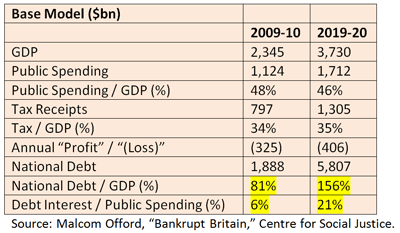
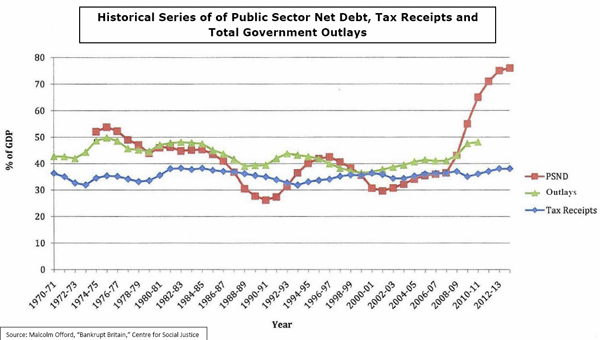
    Yet today that partnership is nearing collapse. For over a decade Britain’s supercharged financial sector fuelled the growth of an expansive state. But as the financial sector has cooled, Britain’s Labour party is now faced with the stark reality of burgeoning social welfare commitments, unprecedented public debt, and dubious upward mobility prospects for the ordinary citizen. The government has seemed more competent at creating upward mobility for civil servants who service the growing social welfare state than doing the same for the larger population who have to pay for it.

    Now the question for Labour – and the UK – is how to maintain an expansive social insurance program by somehow creating the kind of growth needed to pay for it. Once its “wealth creation strategy” of relying on a fecund banking sector fell apart, its project of providing income security rather than fostering income growth for ordinary people appears to be on the verge of failure.

    In order to maintain social welfare goals amidst a floundering economy, the UK has financed its shortfall through massive debt – something the average British household knows something about. Between 1997 and 2007 average household debt grew from 105 to 177 percent of disposable income. The US, of course, also experienced an explosion of household debt during the same period but not nearly to the same extent. At the end of 2007 America’s average household debt reached 106 percent of disposable income – essentially where the UK started 10 years earlier.

    The UK’s comfort with personal debt has now extended to the public realm. Even before the recession, Britain had $1.2 trillion of public debt, and by next year it will rise to $1.8 trillion, or 81 percent of GDP. If debt payment were a government agency, it would be the fourth largest in Britain. According to the London-based think tank the Centre for Social Justice, 21 percent of total public spending will be devoted to debt service in 2020, compared to 6 percent today. Public debt in the US, by comparison, will reach 60 percent of GDP by next year, and interest on the debt will rise from 4.6 percent to nearly 14 percent ten years from now. Labour’s legacy will be the Mount Everest of indebtedness it has left the current and subsequent generation.

    To put this in perspective, we need look no further than historic trends over the past 30 years. Public debt has tracked fairly proportionately with public spending in the UK during this period. During the economic stagnation of the late 1970s, public debt rose to nearly 50 percent of GDP. It hit its nadir at around 25 percent in 1990 after the Thatcher era, and then rose to around 35 percent, where it has remained ever since – until last year. Suddenly, debt has skyrocketed to more than 75 percent of GDP in the past year – an unprecedented level – and will rise to 100 percent by 2012 before swelling to 150 percent by 2020. In order to reduce debt to its 45 percent level of just a few years ago, public spending would need to be cut by a third. Given that one-fifth of all public spending will go to debt service in 10 years, cutting spending will prove politically impossible for a government – and perhaps an entire nation – that identifies ever expanding government-funded services as essential.

    Even more disquieting, tax receipts have mainly hovered around 35 percent of GDP regardless of the tax rate during the past 30 years. This means that raising tax rates – such as Labour’s proposal to lift the top tax bracket to 50 percent– have little effect as high earners move away or find other ways to protect their assets. Logically, if it hopes to cope with its debt obligations, Britain should therefore keep taxes as low as possible and cut public spending. But instead the UK drives full-speed ahead into the fog of debt without having any notion of how to service its future obligations.

    The UK is therefore faced with a thorny dilemma: on the one hand, it has spent decades creating a social welfare system that reduces risk and promises citizens protection from life’s vagaries, and on the other, it needs people to take risks in order to revitalize the economy. Government spending fostered risk avoidance precisely when Britain most needs an entrepreneurial class that can help diversify the economy away from finance and, to a lesser extent, tourism.

    The people most hurt by social welfare are young working class people – the very group Labour purports to represent. In the UK there’s much talk about the NEETs – young people in their late teens who are Not in Employment, Education, or Training. In 2000 there were 630,000 young people between the ages of 16 and 19 in this group. Today, that number totals 860,000, a 36 percent increase in less than a decade. This would be the equivalent of 4.5 million young people in the United States. If NEETs were a city, they would be the third largest metropolitan area in the UK.

    Increasing numbers of able-bodied young people dropping out of society altogether reflects a growing sense of hopelessness. According to the Gallup World Poll, only 20 percent of 25-34 year olds, and 25 percent of 35-49 year olds, thought the economic conditions in the UK were good before the current economic crisis. The UK’s NEET problem and economic pessimism were rampant when the going was good – something that can only be worse now.

    This is not merely the result of a profligate welfare state. The NEET problem has its origins in complex cultural phenomena. However, it is difficult to argue with the conclusion that an increasing economic resignation among Britain’s younger population is ill-timed for a government betting on future workers to pay the public mortgage.

    The US has a more diversified economy than the UK and likely suffers from less economic resignation, but it is beset with a similar dilemma. Despite historically unprecedented levels of public debt, albeit less extreme than Britain’s, the Obama administration appears to be pursuing an economic program that bears similarities to the Labour preoccupation with creating prophylactics against risk and hardship. In a matter of months, the US deficit has risen from 3.2 to 13.1 percent of GDP, according to the Congressional Budget Office.

    Even with President Obama’s widely doubted promises to cut the deficit in half, the CBO estimates a yearly shortfall of more than $1 trillion ten years from now. Even worse, there is precious little in the administration’s plans – including its grandiose claims about “green jobs” – that will create the growth necessary to carry such debt in the future. In fact many of the administration’s proposals – from its healthcare program to its auto company ownership and a more heavily regulated financial sector – could serve more to curb growth than encourage it. In addition, increased taxes on “the rich” will hit small businesses most grievously, the most plausible engine for growth.

    It appears the administration seems intent on following Labour’s folly of mortgaging the future. Without addressing the issue of how to unleash the entrepreneurial energies of the young generation, it’s hard to see how America will avoid falling into the morass in which its British cousins are now so perilously trapped.

    Ryan Streeter is Senior Fellow at the London-based Legatum Institute.

  • Did Homeowners Cause The Great Recession?

    The person who caused the current world recession can be found not on Wall Street or the city of London, but instead could be you, and your next-door neighbor–the people who put so much of their savings and credit to buy a house.

    Increasingly, conventional wisdom places the fundamental blame for the worldwide downturn on people’s desire–particularly in places like the U.K., the U.S. and Spain–to own their own home. Acceptance of the long-term serfdom of renting, the logic increasingly goes, could help restore order and the rightful balance of nature.

    Once considered sacrosanct by conservatives and social democrats alike, homeownership is increasingly seen as a form of economic derangement. The critics of the small owner include economists like Paul Krugman and Ed Glaeser, who identify the over-hot pursuit of homes as one critical cause for the recession. Others suggest it would be perhaps nobler to put money into something more consequential, like stocks.

    Homeowners also get spanked by leading new urbanists, like Brookings scholar and urban real estate developer Chris Leinberger. He lays blame for the downturn not on unscrupulous financiers but squarely on aspiring suburban home buyers. “Sprawl,” he intones, “is the root cause of the financial crisis.”

    If only we built more high-density, transit-oriented housing–which, incidentally, is not exactly thriving–the crisis could be happily resolved, he believes. This approach is echoed by big-city theoreticians like Richard Florida, who believes that both homeownership and the single-family house “has outlived its usefulness.” In his “creative age,” we won’t have much room for either single-family homes or owners. Instead, we will be leasing our ever-more-tiny cribs–just like yuppies with their BMWs–as we wander from job to job.

    To be sure, many people who bought homes in the last few years should not have qualified. Weak lending standards, promoted by both unscrupulous industry figures like Countrywide’s Angelo Mozillo as well as Congress–including the many “friends” receiving cut-rate loans from the disgraced mortgage firm–clearly made things worse.

    Yet the recent real estate debacles should not obscure the tremendous positives associated with homeownership. Widespread and diffuse ownership of property has been a critical element in successful republics, from early Rome and the Dutch Republic to the foundation of the United States. Jefferson held that “small land holders are the most precious part of a state.” In the ensuing generation, progressives embraced widespread ownership of property as central to democratic aims. Lincoln’s Homestead Act stands out as a prime example.

    Even by the 1940s, this model was only partially realized. Barely 40% of the population owned their homes. Homeownership remained confined largely to small-town denizens and the urban upper classes. No one in my mother’s family–growing up in the tenements of Brownsville, Brooklyn–even considered homeownership an achievable goal. It was hard enough simply to pay the rent and put food on the table.

    Yet by the 1960s, rising prosperity and government-subsidized loans helped most of my numerous aunts and uncles own their residence.

    Presidents from Roosevelt to Clinton all identified homeownership as a critical social goal. Government loan programs exploded as housing starts doubled in the post-war era. By 2005, the homeownership rate was approaching 70%.

    This trend also took place in other advanced countries, from the U.K. and Australia to Canada and Spain. It reflected what the Italian urbanist Edgardo Contini once referred to as “the universal aspiration.” In some cases, such as Japan, societies that had been divided between landlords and peasants for millennia now boasted a huge, and growing, cadre of small owners.

    In virtually every country, this was largely a suburban phenomenon. People bought houses where land was cheaper, stores and schools newer. Here, too, people could transcend the often confining social limits of the old neighborhood. It was also, as the novelist Ralph G. Martin, noted “a paradise for children.”

    Through all this, the chattering class never lost its contempt for homeowners and their suburban refuges. Old gentry long disliked the idea of dispersed ownership of property–even if many got rich selling their own estates to developers. Aesthetes disliked the seemingly banal housing tracts “rising hideously,” as Robert Caro put it, from the urban periphery. This critique was applied not only to Queens and Long Island but also to places like Milton Keynes or Basildon outside London, and greater Tokyo’s Chiba prefecture.

    Along with the fashion police, the new owners also took criticism from their urban betters, many of them also owners of country homes, for deserting the city. Some on the left feared the homeowners as a bastion of conservative politics. Architects, planners and developers identified them as opponents of their grand plans to refashion suburbia into a denser, more rental-oriented environment.

    Yet, despite the disdain, the dream of homeownership survived. Many boomers, who in their 1960s radical phase denounced suburban tracts as sterile and racist, meekly ended up buying homes there. So, increasingly, did middle-class minorities, whose rates of homeownership rose faster after 1994 than that of whites.

    To be sure, the financial crisis has led to a sharp drop in levels of homeownership, as occurred in the last big recession of the early 1990s. In the future, some suggest that aging boomers will force the home market to collapse even more due both to the current mortgage meltdown and changing demographics.

    Yet there are limits to how far homeownership will drop. Urban boosters, apartment-builders and greens–all advocates of expanding the renter class–tend to ignore several key facts. For one thing, the vast majority of boomers are holding onto their mostly suburban homes far longer than ever suspected. Many will remain there until forced into assisted living, nursing homes or the cemetery.

    Then we have the X generation, who, if anything, has favored large homes and exurbs in large numbers. In addition, behind them lie the large cohorts of millenials, who according to surveys conducted by generational chroniclers Morley Winograd and Mike Hais, prioritize the ownership idea even more than their boomer parents do.

    No doubt, the weak economy will slow this generation’s push into the home market. However, by the next decade, as this generation enters the late 20s and early 30s, they will find their economic footing and be ready to enter the market for houses in a big way.

    The real question then will become which companies and regions will meet the expanding demand. Over the past decade, we saw the demand for housing push middle-class families toward destinations as varied as Las Vegas and Phoenix, Austin, Houston, Dallas and Atlanta. Others have started heading to more affordable markets in the nation’s heartland, to the metropolitan areas like Kansas City, Des Moines and Sioux Falls.

    Rather than a source of economic weakness, this renewed quest for homeownership could underpin a sustainable recovery. As prices fall to reasonable levels, more people will qualify for reasonable loans. First, the empty houses and somewhat later, the condominiums now on the market will find buyers, in most places in a matter of a few years.

    This shift will create huge opportunities for a diverse set of geographies. For urban areas like New York or Los Angeles, there will be a unique–perhaps once in a generation–chance to induce middle-class people to settle down in big-city homes or condominiums. If they become homeowners, they will be more likely to stay than move elsewhere to the suburbs or other regions when the time comes to buy a home.

    Other, more affordable, less regulated and often more economically dynamic places like Texas and the Great Plains may realize even greater gains. Over time, we will likely see a recovery in some now-suffering parts of the Sunbelt. The renewal of home demand could also help revitalize many of our hardest-hit sectors, including construction and manufacturing.

    Sadly, some policymakers in Washington seem less than enthusiastic about this prospect. Many close to President Obama seem to dislike single-family homes and suburbs. Some embrace the policy which the British called “cramming,” essentially forcing people into ever smaller, denser units. Energy Secretary Steven Chu recently praised the notion of small apartments with numerous people. “You know, body heat keeps a lot of the apartment warm,” he suggested. You can’t do this in a big apartment with a few people.”

    My suspicion is that most Americans are not quite ready to become their own heaters, any more than modern farm families like having farm animals live with them–although they, too, generate warmth. Instead, we should explore less unpleasant ways to cut energy use though such things as incentives for decentralizing work, promoting home-based labor, more tree planning and effective insulation.

    An administration that places itself at odds with the “universal aspiration” that has driven growth in the advanced world for over a half-century could delay a full recovery unnecessarily. Advocacy of what amounts to declining living standards and a return to feudalism might also prove a less than successful political strategy.

    This article originally appeared at Forbes.

    Joel Kotkin is executive editor of NewGeography.com and is a presidential fellow in urban futures at Chapman University. He is author of The City: A Global History. His next book, The Next Hundred Million: America in 2050, will be published by Penguin early next year.