Tag: Obama’s America

  • Amid Obama’s Change is More of the Same

    The Obama administration has been, so far, hierarchical and even conservative in its thinking. Following and even surpassing the Bush administration’s reliance on an M.B.A.-trained elite, which drove the country nearly to ruin, the Obama approach seems to boil down to finding the smartest guy in the room, rather than utilizing people with hands-on experience or acquired wisdom.

    This fixation on hierarchy has been unexpected for an administration whose stock sold on the notion of being something other than the same old, same old. Yet as it turns out, the Obamanians seem to be as narrow, if not narrower, than their much-disdained predecessors.

    Early on, President Barack Obama’s magical mystery tour gained power in places you would not expect it to — winning critical victories in overwhelmingly white, socially conservative Great Plains and Midwestern states. Yet today, he has built one of the narrowest administrations, both ideologically and regionally, in recent memory.

    This trend became apparent in a new National Journal study of the administration’s top 366 officials. To be sure, the Obama team has more Hispanics, African-Americans and women than its predecessors. But beyond gender and color, the Journal reports, this is an administration of remarkable sameness.

    For one thing, people with practical business experience — outside of finance — have little role in formulating economic policy. This differs from the Bush administration’s tilt toward traditional autocracies; this is more rule by the cognitive elites. A history of real problem solving seems to matter less than the quality of university pedigrees; the Obama team appears to be a bit like a giant law review, drawing on only the best and brightest from places such as the University of Chicago, Oxford, Harvard and Stanford, as well as some elite think-tank denizens.

    This narrow gauge is even clearer geographically. There are few people around the president who come directly from exurbs or small towns; virtually all the inner circle hail from a handful of locales — Washington, Chicago, New York, Boston and the Bay Area. Remarkably, according to the National Journal, only 7 percent worked last year in a state carried by John McCain. Red appears to be one color that does not pass diversity muster for this administration.

    The danger here is not so much inexperience but a vision clouded by similar experiences and prejudices from the liberal wing of the baby boomer generation. The president remains broadly popular with the young, yet his administration is actually older than that of President George W. Bush. Obama may be a millennial matinee idol, but his administration appears boomer-dominated in its point of view.

    This may explain why Obama has focused so much on the old obsessions of left-leaning boomer elites — health care, civil rights, pacifistic foreign policy — and less on the issues, notably job and wealth creation, that matter most to those younger than 50. Even on the environment, an issue with great appeal to millennial Americans, his approach has been less community-based and consensual and more dogmatically and centrally directed than might appeal to a generation shaped by social networking and the Internet.

    Of course, Obama still could change course and evolve into the bold, innovative leader needed for these fast-changing times. However, to get there, he must be more than merely articulate. This president needs a surer and more current approach to dealing with epochal challenges whether on the public squares of Tehran or on this country’s Main Streets.

    This article first appeared at Politico.

    Joel Kotkin is executive editor of NewGeography.com and is a presidential fellow in urban futures at Chapman University. He is author of The City: A Global History. His next book, The Next Hundred Million: America in 2050, will be published by Penguin early next year.
  • America’s Energy Future: The Changing Landscape of America

    During the first ten days of October 2008, the Dow Jones dropped 2,399.47 points, losing 22.11% of its value and trillions of investor equity. The Federal Government pushed a $700 billion bail-out through Congress to rescue the beleaguered financial institutions. The collapse of the financial system in the fall of 2008 was likened to an earthquake. In reality, what happened was more like a shift of tectonic plates.

    History will record that the tectonic plates of our financial world began to drift apart in the fall of 2008. The scale of this change may be most visible in who controls the energy that powers our world.
    ***********************************

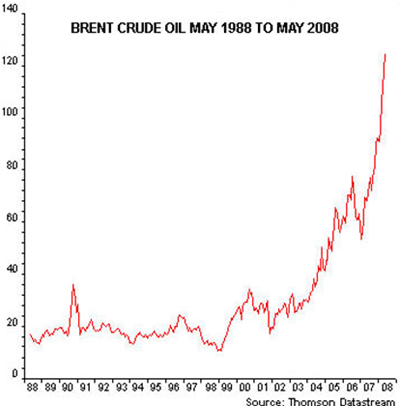
    May 2008 brought with it the highest price on record for Brent Crude Oil – $148 per barrel. At the pump that translated into prices in excess of $4.00 per gallon. A sixteen gallon fill-up of a Toyota Prius in Los Angeles cost its owner $72.00 and a fill-up of a twenty-five gallon Cadillac Escalade set its owner back more than $100.00. The largest transfer of wealth in the history of mankind was underway and consumers were feeling the pinch.

    The countries that border the Persian Gulf produce and export 20,000,000 barrels of oil per day. At its peak in May of 2008, the Persian Gulf producers (Saudi Arabia, Iran, Iraq, Kuwait, Qatar and the U.A.E) were receiving $3 billion per day, $90 billion per month and $1 trillion per year in revenues from the industrialized nations of the world, including the EU, North America and, most importantly, the rising powers of India and China.

    These Persian Gulf nations are mostly monarchies controlled by individuals, royal families or at best a few power brokers. American consumers abandoned their love affair with the SUV and Detroit’s assembly lines began to grind to a halt. New car sales which peaked at 17 million units in 2007 plummeted to a rate of 9.2 million within six months. The inventory of unsold vehicles built up and led inexorably to the bankruptcies of Chrysler and General Motors.

    At the same time, the airlines began charging for checked bags and discontinued the ubiquitous bag of peanuts as they reeled under the cost of jet fuel. Bellicose despots in oil rich lands outside the Middle East used their new found wealth to rattle their sabers. Russia, the world’s second largest oil producer after Saudi Arabia, began flying their venerable Backfire bombers to the American coast. Hugo Chavez of Venezuela, the world’s ninth largest oil producer, used his oil wealth to turn himself into an icon of the anti-gringo sentiment always beneath the surface throughout Latin America.

    Politicians, who placed America’s coastline off limits for drilling, were forced to recant their precious moratorium under the growing chorus of “Drill here and drill now”. Environmentalists, who destroyed the nuclear power industry with fearmongering over its safety, were increasingly on the defensive. T. Boone Pickens invested millions of his own money to promote wind farms – and more importantly natural gas – across America’s heartland. Sales of little known Jatropha seeds, a plant indigenous to India that produces an oil clean enough to run a diesel engine, skyrocketed. By the fall of 2008, the financial markets were buckling under the strain.

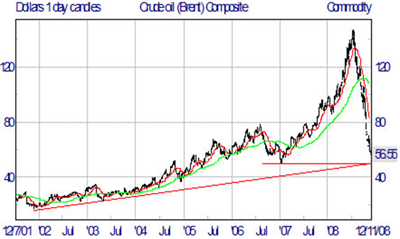
    As the economies of the world contracted, demand for oil plummeted and the price of crude collapsed. Terrified by the apparent mismanagement of the economy by the Republicans, Americans elected an untested junior Senator to the most powerful position in the world. Predictably, plans for alternative energy withered as prices plummeted and gas dropped to $1.50 per gallon. Russia, whose cost to develop crude is $50 per barrel, lost its swagger as its currency and stock market collapsed with the price of crude. The collapse of oil to $35 per barrel even silenced Hugo Chavez, at least for a moment.

    Sadly, the America public lost interest in energy as they were distracted by a 40% loss in their 401ks, corporate bankruptcies and the growing numbers of lay-offs. Politicians quickly shifted their focus from drilling, nuclear energy and independence from imported oil and began espousing the Obama administration mantra of “green energy” and “green collar jobs”. Unfortunately, these words are just a chimera since they are likely, even with massive subsidy, to produce only a small fraction of the nation’s energy for at least decade or two.

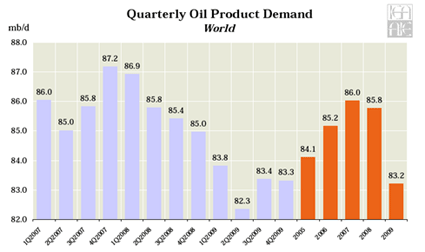
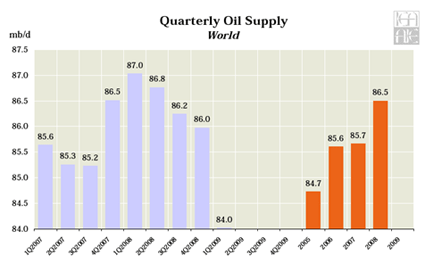
    These ephemeral goals only mask the real problem: America’s dependence on imported oil. The world demand for oil averages 85 mbd (million barrels per day). In the darkest days of the global financial crisis during the spring, when we stood at the abyss of The Great Depression, demand dropped to just 82.3 mbd. Conversely, world oil supply peaked at 87 mbd in 2007. This relative parity between supply and demand eliminates the elasticity that puts some control on prices. With literally no elasticity, speculators know that buyers will purchase every barrel of oil and prices rise. The proof of this market force is visible at the pump where gasoline has crested $3.00 per gallon in California and more than $2.66 per gallon nationwide. The United States consumes 20,000,000 barrels of oil per day or 24% of the world’s supply. In previous decades this was not a problem because the United States was a major producer of oil. But our peak production was reached in the 1970s when the US imported just 35% of its oil. Today we import more than 66% and no longer can influence the price of black gold. That price is now determined by despots in the Persian Gulf, Russia and Venezuela.

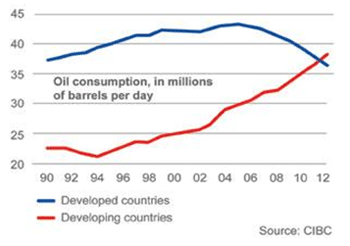
    This problem is not going away soon. According to the Energy Information Agency of the U.S. Government, the world demand for oil will require an additional 44 million barrels of oil every day to meet projected demand. The increase of demand is not going to come from the American or European markets. The developed nations through conservation, fuel standards, a reinvigorated nuclear power industry and, over time, the push for alternative fuels will actually reduce their consumption over the next twenty years. The push will come from India, Russia, Brazil, and of course China.

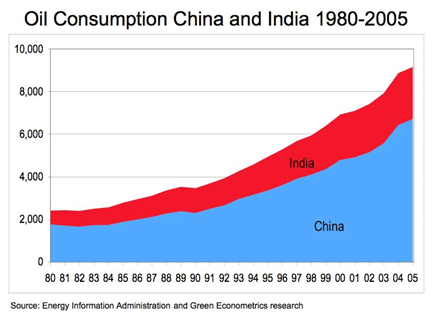
    India, with a population over one billion, has announced its version of the Interstate Highway System that opened America to its great Middle Class. After the acquisition of Jaguar and Land Rover, Tata Industries has begun production of the Nano, a car that sells for $2,000 in India. The demand for oil to power the cars for an educated and increasingly affluent Indian society will keep pressure on oil prices for years to come. India uses just 2.7 mbd today but expects that demand to grow to 4.5 mbd by 2030.

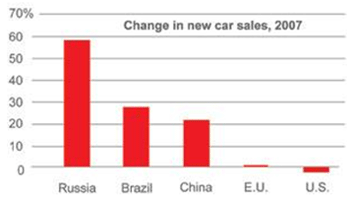
    There are now more than a billion Chinese. China consumed just 2 mbd of oil in 1990. Oil consumption jumped to 7.6 mbd in 2007 and is projected to grow to 15 mbd in 2030. The Chinese automobile industry grew at 21% last year while the US auto industry contracted by 40%. China displaced Germany as the third largest auto producer and will soon eclipse the damaged US auto industry which is contracting to a mere shadow of its former self. Chinese brands such as Chery and Geely, unknown to American consumers, may soon become as well known in America as Nissan or Hyundai.

    Demand will push oil over $100 barrels again. Vast capital will pour into the Persian Gulf, Russia and Venezuela once again. Into this tempest comes America with a thirst for 20,000,000 barrels each day. The major oil producers in the Middle East, Russia and Venezuela are not America’s friends. Russia will use its oil wealth to thwart the US and veto in the United Nations any effort to subdue the North Koreas and Irans of the world. China, with its surplus of US dollars, will continue to harvest natural resources around the world, and forge strategic alliances with the likes of Iran as it secures the flow of oil and natural resources to its industries for years to come.

    Meanwhile our politicians ignore our growing dependence on unfriendly nations and our weakening credit rating in the world to chase the chimera of green collar jobs and a green economy. Wind and solar will never power more than a minuscule fraction of America’s engines. America needs the equivalent of the Apollo moon project, a national challenge to move America off its dependence on foreign oil. We need simultaneous development of domestic oil and natural gas drilling, nuclear power, development of hydrogen fuel cells and clean coal technologies along with wind and solar power plants.

    A year from now the landscape of America will be forever changed. Five years from now, will American find the fortitude to grasp its energy independence? Or will our weak politicians in both parties keep their heads buried in the sand until China and India emerge to deny us what we are no longer in a financial position to demand?

    ***********************************

    This is the third in a series on The Changing Landscape of America. Future articles will discuss real estate, politics, healthcare and other aspects of our economy and our society. Robert J. Cristiano PhD is a successful real estate developer and the Real Estate Professional in Residence at Chapman University in Orange, CA.

    PART ONE – THE AUTOMOBILE INDUSTRY (May 2009)

    PART TWO – THE HOMEBUILDING INDUSTRY (June 2009)

  • Why Attitude Matters: How Nebraska is Reaping the Stimulus

    In what are tough times for most states, conditions for business remain surprisingly good in Nebraska. Like other states in the “zone of sanity” Nebraska is especially supportive of small businesses.

    Nebraska is one of a series out of mid-American outliers. In 2008 – a year of a severe national contraction – the state experienced a 3.6 percent growth in gross domestic product. Its current unemployment rate of just 4.4 percent stands at less than half the U.S. rate of 9.4 percent (latest available from Bureau of Labor Statistics).

    The state itself is in good financial shape, with a cash reserve over $500 million (including a $20 million to $30 million operating surplus every year since 2001). I believe there are two important factors fundamental to Nebraska’s health. The first lies in cooperation across levels and borders – which was described in my piece on regional cooperation in the Omaha World-Herald. This positive attitude toward growth and economic development in Nebraska extends through every level – you find it at the state, regional, county and city level. A supportive attitude toward development plays an important role in making things work.

    The second and perhaps more important factor critical to fostering an environment supportive of growth and prosperity lies with a broad acceptance of the benefits of on-going economic development as a source of continued quality of life. This attitude can be described – as opposed to the traditional NIMBYism seen so often in more crowded, coastal states – as “Yes, In My BackYard” or YIMBYism. Nebraska has pockets of pro-development populations, like Sarpy County, on the southern border of the city of Omaha.

    Before moving to Omaha, my business was based in Santa Monica, California. With a population of about 89,000, Santa Monica is a beautiful city consisting of smart people who often make foolish choices. Many residents in Santa Monica, like those in Portland and other NIMBY-areas of the country, oppose development in their neighborhoods.

    Many who live in million-dollar single-family homes in Santa Monica were opposed to building new middle-class jobs and homes in their neighborhood, although they often favor building homes for the poor, albeit somewhere not in their bailiwick. This promotes a “haves versus have-nots” social order, and also doesn’t make sense from a personal point of view. Whenever the growth debate was on the table (which it often is in Santa Monica), I would tell people, “Wouldn’t you like to build jobs and housing so your children can work and live in Santa Monica, too? Do you want your grandchildren to move to Texas? Because I assure you they are building middle-class jobs and housing in Texas.”

    In contrast I’ve found some pro-growth Nebraskans who relentlessly seek making development happen. For the mayors of the United Cities of Sarpy County, the emphasis is on cooperation as a path to success. Recent developments around my adopted hometown of Bellevue, Nebraska – home to Offutt Air Force Base and U.S. Strategic Command – provide a simple, straight-forward example of how YIMBYism works in practice.

    About seven years ago, the City of Bellevue, along with the Bellevue Chamber of Commerce, funded an economic development plan that could be used to set a community agenda for growth. The resulting plan highlighted several locations where development was feasible, desirable and likely to lead to greater growth. One of the initial designated areas is a 6.5 mile corridor along Fort Crook Road. “Fort Crook Road,” says Megan Lucas, President of the Bellevue Chamber of Commerce, “is the spine of Bellevue. Other nodes of economic development will fill-in around Fort Crook when it is ready to move forward.”

    The City and the Chamber then devised a development plan specific for the Fort Crook Road Corridor. The Fort Crook Road Plan was approved as part of a new comprehensive plan for City development – with zoning updated to accommodate retail development along the entire length. The long-range plan is to shift the road west, closer to an existing active railroad line, and to create a linear park along the median strip to connect two existing trail systems – the Lewis & Clark in the north and the Bellevue Loop of the Keystone Trail on south end.

    Two points make this specific example interesting. The foresight in developing the comprehensive plans for the area positioned it perfectly for the current environment. A good chunk of the Fort Crook Road Corridor is currently occupied by an abandoned concrete production facility. These blighted structures need to be demolished to get the property ready for development. But since the City already owns the property and a comprehensive development plan is in place, the project is “shovel ready” – those magic words that qualify any development project for federal stimulus funding under the American Recovery and Reinvestment Act of 2009.

    In contrast, there are hundreds of worthy projects in every state that will not qualify for Stimulus money because they fail to meet the “shovel ready” requirement. Part of the Fort Crook Road Plan made it through the initial review stages for stimulus funding in Nebraska. The project ranked in the top three in the state for eligibility and suitability. According to Mayor Ed Babbitt, some stimulus funding has been allocated to revise traffic signals in the corridor; funding to remove blighted structures will likely come later this year from an environmental clean-up fund.

    The second point that makes the Fort Crook Road Corridor an interesting example is that one of its biggest proponents – Megan Lucas – lives in the Corridor. The development and expansion of Fort Crook Road is in her backyard. She and many other residents in Bellevue are saying, “Yes, In My Backyard.” Even more recently, three cities in Sarpy County vied to be the location of a Triple-A ballpark to be built in cooperation with the Omaha Royals of the Pacific Coast League. YIMBY-ite residents far out-numbered the NIMBY-ites at every public forum on the choice of location. A positive attitude toward economic development has emerged as a major factor in getting ready for the stimulus – something many in the Obama bastions in the blue states might want to consider.

    Susanne Trimbath, Ph.D. is CEO and Chief Economist of STP Advisory Services. Her training in finance and economics began with editing briefing documents for the Economic Research Department of the Federal Reserve Bank of San Francisco. She worked in operations at depository trust and clearing corporations in San Francisco and New York, including Depository Trust Company, a subsidiary of DTCC; formerly, she was a Senior Research Economist studying capital markets at the Milken Institute. Her PhD in economics is from New York University. In addition to teaching economics and finance at New York University and University of Southern California (Marshall School of Business), Trimbath is co-author of Beyond Junk Bonds: Expanding High Yield Markets.

  • Why The Left Is Questioning Its Hero

    Much has been made by the national media and the markets about the emergence from our desiccated economic soil of what President Obama has called “green shoots.” But although the economy may already be slowly regenerating (largely due to its natural resiliency), we need to question whether these fledglings will grow into healthy plants or a crop of crabgrass.

    The political right has made many negative assessments of the president’s approach, decrying the administration’s huge jump in deficit spending and penchant for ever more expansive regulatory control of the economy. Polling data by both The New York Times and the Wall Street Journal shows some growing unease about both the expanding federal role in the economy and the growing mountain of debt.

    But this conservative critique, which includes sometimes shrill accusations of nascent “socialism,” isn’t the most important counter to Obamanomics. Perhaps more on point – and politically risky for the administration – are criticisms coming from his supposed bedfellows further to the left.

    One recent example comes from a new report issued by my old colleagues at the liberal-leaning New America Foundation called “Not Out of the Woods: A Report on the Jobless Recovery Underway.” It amounts to a blistering, if largely unintentional, critique of the administration’s policies, providing a sobering antidote to manufactured euphoria peddled by both presidential spin-meisters and some Wall Streeters.

    The report baldly asserts that the president’s programs are simply not sufficient to make up for a “huge job creation deficit” that is getting worse by the day. It estimates the country needs to generate 125,000 or more new jobs a month just to keep pace with population growth – something few see happening for at least several years.

    Even with little immediate hope for such employment gains, the report does cite government and private-sector projections of upward of 10% unemployment well into next year. More worrisome still, the authors assert that the administration’s current program is unlikely to create a return to a “normal” level of joblessness – to between 4% and 5% – until after the president’s first term.

    The New America report then goes on to make some even scarier observations. It claims unemployment rates are far higher in reality than official statistics reveal, citing calculations by Chairman of New America’s Economic Growth Program Leo Hindery of what they call “effective unemployment.” This also includes the millions now working part-time but seeking “full-time and productive work.”

    Hindery is no conservative. He was an adviser to John Edwards and, more recently, to the president himself. Yet his prognosis is grimmer than the ones offered by most right-wingers. He calculates that the real unemployment rate in the country last month was not 9.3%, which is the figure that was reported, but rather closer to an alarming 16.8%. By that measure, more than 30 million people are effectively out of work. That’s nearly one-fifth of the labor force.

    Given current economic policies, the report suggests, we can expect “a six-year recovery for what has been to date only a year-and-a-half recession.” Hiring by government and green industries are clearly not going to make up for the massive losses in productive sectors like manufacturing, business services, energy and agriculture.

    Against this grim background, the president’s program seems inadequate and even chimerical. To be sure, the massive bailout of institutions such as the big banks – as well as Chrysler and General Motors – has provided some reassurance to Wall Street that paper assets may continue their recent upward climb.

    Yet that will do precious little to make a dent in unemployment elsewhere in the economy. Treasury Secretary Timothy Geithner, chief economic guru Larry Summers and others might see “green shoots” for investors, but those could turn out to be more like crabgrass for the rest of us.

    In fact, finance is surviving the recession remarkably unscathed. Just compare the numbers. Since 2007, manufacturing (and other blue-collar-dominated sectors) lost 13% of its employment, while construction payrolls have plunged over 16%. Meanwhile, finance, the industry arguably most responsible for the economic meltdown, has dropped a mere 5% of its jobs. Today unemployment in the financial sector stands at less than 5%, compared with nearly 20% in construction and over 12% for manufacturing.

    So as hundreds of thousands of construction and factory workers are being sacrificed, many grandees of finance – like top executives of Bank of America and Citigroup – remain in their plush perches. Even proven financial demolition experts like Mark Walsh, who led Lehman Brothers’ disastrous march into toxic properties, are now being paid to clean up the mess they so brilliantly created.

    No wonder some factions of the left are becoming uneasy with their hero. Some privately admit that the administration – despite its pro-middle class rhetoric – has adopted an economic program that makes Ronald Reagan seem like the vox populi. One wonders how they will react later this year, when continued high unemployment meets massive, perhaps even record, Wall Street bonuses.

    This state of affairs, as the New America report correctly suggests, does not lead us down a path toward “a strong and sustained recovery.” Clearly, we need something more. For one thing, the country needs to reassert its ability to produce more of what it consumes. (See Joel Kotkin’s earlier column, “We Must Remember Manufacturing.”)

    Others on the left are also making this point, perhaps none more effectively than an article in the Nation called “The Case for Kenosha.” The piece, in short, skewers the Obama administration’s manhandling the auto industry and manufacturing sectors. It accuses Obama of taking the old industrial belt on a “wild ride” that will lead to more plant shutdowns and increased outsourcing to foreign factories. “With ‘fixes’ like these,” the article states, “it’s hard to imagine how Obama plans to fulfill his campaign promise to ‘revive and strengthen all of American manufacturing.’”

    This is not to say that the entire left side of the political spectrum opposes the administration’s economic policy. There is now more than one left in this country, and the gaps between these lefts are every bit as wide as those between, say, small-government libertarians, social conservatives and messianic global interventionists.

    To date, the administration has listed toward the agenda of what may be best described as the left’s gentry wing. These include activists at universities, urban planners and liberal nonprofits, many of whom see in Obama’s pro-green policies and multicultural agenda the fulfillment of their long-time fantasies.

    This, at times, puts them at odds with large parts of the middle- and working-class base of the Democratic Party. The administration’s plans to”coerce” people out of their cars for the alleged good of the environment probably does not offer much “hope” for those working at auto plants. Highly dependent as they are on stocks and asset inflation for their income, the gentry are not likely to object to the administration’s coddling of large financial institutions.

    Then there is the party’s populist contingent, whose inspiration comes more from FDR and Harry Truman than from the likes of Barney Frank and Nancy Pelosi. They are less likely to see much of a difference between a Timothy Geithner or a Hank Paulson. To them, the two Treasury secretaries have both been useful servants for the nation’s “economic royalists.”

    Of course, most conservatives might despair over the populists’ tendency to embrace statist solutions to our economic problems. But would-be inheritors of the Reaganite mantle should at least sympathize with their goal to restore broad-based upward mobility and close-to-full employment. Indeed, if the Republican Party figures out how to take command of the issues like job creation and social mobility, they could even become relevant once again.

    Right now, though, critiques from the left may be more effective than yammering from the still-clueless right. The president knows that talk of green shoots makes people and markets feel better. But unless those shoots show some staying power, the long-term economic consequences – and ultimately political ones, too, for the president and his party – could prove unwelcome indeed.

    This article originally appeared at Forbes.

    Joel Kotkin is executive editor of NewGeography.com and is a presidential fellow in urban futures at Chapman University. He is author of The City: A Global History. His next book, The Next Hundred Million: America in 2050, will be published by Penguin early next year.
  • GM, Business, and The Age of Small

    At its peak, General Motors employed 350,000 people and operated 150 assembly plants. It defined “big business” for America and the world.

    But GM was not always big. It grew through the acquisitions that it made in the early decades of the twentieth century. In those days, the automotive industry was populated by entrepreneurial small businesses led by people like Ransom Olds and Henry Ford. There were more than 200 automobile companies in the United States in 1920. By 1940, only 17 had survived.

    As with all businesses, success and failure was measured by a company’s ability to manage and adapt to change. Change in consumer expectations and demographics. Demands for lower prices and more features. Underlying all of this was the need to constantly improve, to challenge core assumptions, and attend to customer needs. The early automobile companies that could not adapt were driven out of business or forced to merge. In the end, we had the “Big Three” in control of all major American automotive brands.

    And so it was, but only for a time. Our economy is dynamic. It is always changing. This is why consumer products are always adding “new and improved” to even their most popular and profitable labels, and why companies produce competing products — like laundry detergents and cereals — within their brand. Control of shelf space is vital in retail, and an expanded offering of products maintains a company’s all-important market share.

    In a free economy, “Big” has some advantages. It has more resources and reach. “Big” companies can define a market and, to a point, control entry into it. But “Big” also has many disadvantages. It is unwieldy, bureaucratic, inflexible, slow to react and unresponsive to small events. This is why in a dynamic free economy “Big” gives birth to “Small”, which forces innovation and change, and ushers in the next Big Idea.

    Apple was started in a garage to challenge the giant IBM. Microsoft was founded by a college dropout who ran with a platform (Windows) that Xerox created and discarded. Hechinger’s was the first big box hardware store. It was overtaken by The Home Depot, which pioneered a better way to service clients with an even bigger box.

    America is all about good, better, best. Google is now the dominate internet search engine. A small part of its success has been its ability to become part of the vernacular. How many of us have said, “Let me Google that?” Microsoft is not sitting back and accepting Google’s success as a given. It recently launched “Bing”, with features not available on Google. Is Bing the next newer, better search engine? The market will determine if it is, once consumers take it out for a search or two and decide whether or not they like the results.

    The American automobile industry has reached the end of “Big.” GM recently sold its Saturn brand to Roger Penske, a former auto racer turned entrepreneur. Penske will likely bring new energy and focus to a brand that was only a small cog in a giant corporation. I bet that the brand will reemerge stronger in the marketplace. A Chinese company bought Hummer. SAAB is still looking for a new home. The remaining GM brands, including Cadillac and Buick, will be part of a newer and smaller company. This is the natural economic cycle. It is what would have taken place months ago, and saved the American taxpayer billions of dollars had we simply let GM go into an orderly Chapter 11 bankruptcy.

    The problem is that our federal government is attempting to control this process in order to achieve a desired result. Yes, looking at saving GM as a short term federal jobs program is a valid argument (albeit a God-awful expensive one). But we should not let these actions, taken in the midst of a crisis, instill the belief that government control of markets is a viable alternative to free markets that respond to consumer demand.

    The natural flow of our economy is big to small to big again. We are now entering an ‘Age of Small’ throughout our economy. It is an era in which new ideas will drive innovation, and the nimble will overtake the weak. The only thing that can derail this process is the permanent entry of big government into the mix.

    Government is the antithesis of a market economy. It is unwieldy, bureaucratic, inflexible, slow to react, and unresponsive to small events and to its own consumers.

    It is Big when we are at the right moment for Small.

    Dennis M. Powell is president and CEO of Massey Powell, an issues management consulting company located in Plymouth Meeting, PA.

  • Europe: No Longer A Role Model For America

    For decades many in the American political and policy establishment–including close supporters of President Obama–have looked enviously at the bureaucratic powerhouse of the European Union. In everything from climate change to civil liberties to land use regulation, Europe long has charmed those visionaries, particularly on the left, who wish to remake America in its image.

    “There is much to be said for being a Denmark or Sweden, even a Great Britain, France or Italy,” wrote political scientist Andrew Hacker in his 1971 book The End of the American Era .This refrain has been picked up again more recently by the likes of Washington Post reporter T.R. Reid and economist Jeremy Rifkin. Just last year, international relations scholar Parag Khanna shared his vision of a “shrunken” America lucky to eke out a meager existence between a “triumphant China” and a “retooled Europe.”

    But the tendency to borrow from the European toolbox may be somewhat questionable, particularly given that a growing number of Europeans are either uninterested–barely 40% bothered to vote in E.U. Parliament elections last week–or in open revolt against their own system of government. In the elections, for example, parties generally opposed to expanding E.U. power gained ground in countries as diverse as Hungary, Slovakia and the Netherlands. In Britain, the relatively small U.K. Independence Party, which even opposed membership in the U.N., out-polled the Labour Party and trailed only the Conservatives, who announced their own shift toward a more euro-skeptic point of view.

    Although the E.U.’s current top-down bureaucratic approach is clearly losing support, these recent events don’t necessarily mean the E.U. is doomed. It’s just that people who might be happy to accept a customs union and perhaps even a common currency are simply proving loath to hand over land use controls and environmental standards, much less foreign policy, to Brussels-based bureaucrats. At its root this move represents both a cry against control and a cry for greater autonomy.

    For the Obama administration, there may be some significant lessons here. Compared with Europeans, Americans are disposed to dislike too much central control. Turning Washington into a new Brussels, with regulations to cover virtually any human activity, could backfire both on the president and his party.

    But it’s also critical not to see Europe’s new tilt as affirming Reaganite cowboy capitalism. Many European countries, particularly the northern ones, are justly proud of the “social” models of capitalism they embrace. There are many policies–such as Danish incentives for industrial firms to greenify themselves, efficient universal health care and tough fuel economy standards for cars–that should be discussed and perhaps even adopted in some form in the U.S.

    In one sense, we should understand that Europeans are trying to protect their preferred standards when it comes to culture, social structure and lifestyle. They remain, if you will, fundamentally conservative in their efforts to preserve their well-established welfare states.

    But overall the anti-E.U. vote should make it clear that Europe’s overall economic system makes for a poor role model for our country. When the current economic crisis first hit, many European leaders–and their American fans, like Harvard economist Ken Rogoff–saw vindication for the E.U.’s economic policy and a much tougher road for the U.S. over the next year or two. Yet in reality, Europe already has suffered as much as we have from the downturn, and recovery there may also be even slower to emerge. In some countries, such as Greece and France, social unrest has been far more evident than here in the U.S.

    Simply put, European models do not necessarily work better–and when they do, they have occurred in part due to shifts away from strict welfare-state policies. As Sweden’s Nima Sanandaji and Robert Gindehag have argued the recent return to growth in places like Sweden came only after some modest reforms in both taxes and social benefits.

    Yet at the same time, even successful European countries–as well as the whole E.U.–generally experience slower growth than the U.S. with respect to measures like gross domestic product and job growth. This makes it an example of limited utility for America, a country that needs strong economic growth in order to maintain both its quality of life and overall social sustainability.

    The biggest source of divergence between the U.S. and the E.U. lies in demographic trends. For the most part, Europe is aging far more rapidly, and its workforce is shrinking. As demographer Ali Modarres notes, America’s population over the second half of the 20th century grew by 130 million, essentially doubling, while the populations of France, Germany and Britain together increased by 40 million, or 25%.

    As a result, there is virtually no European equivalent for cities like Houston, Phoenix, Las Vegas or Atlanta. American cities sprawl–and will likely continue to do so–because they are newer and because they are growing much faster in a country that is much vaster. Even with 100 million more people, the country will still be one-sixth as crowded as Germany.

    These differences will only become more stark. Opposition to immigration–from both Muslim countries and the E.U.’s own eastern periphery–is growing even in historically tolerant places like Great Britain, Denmark and Holland. Over time, migration into Europe is destined to slow. In Barack Obama’s wildly multicultural America, strong restrictionist sentiments have not gained much political ground, and, at most, efforts are directed not at reducing legal immigration but rather shifting it toward a more meritocratic model.

    So we can expect America’s population to continue growing at close to the highest rate in the advanced industrial world while Europe remains among the most rapidly aging places on earth. America’s fertility rate is 50% higher than Russia’s, Germany’s and Italy’s. By 2040, for example, the U.S. could have a greater population than the first 15 member nations of the European Union. Compare that prediction to 1950, when America had only half the population of Western Europe.

    These numbers point toward separate destinies for the U.S. and the E.U. Throughout history, low fertility and societal and economic decline have been inextricably linked, affecting such once-vibrant civilizations as ancient Rome, 17th-century Venice and, now, contemporary Europe.The desire to have children also reflects a fundamental affirmation of faith in the future and in values that transcend the individual. This is particularly true in affluent societies, where it is socially acceptable to remain childless and technology has made the decision not to have children easier to enforce.

    The U.S.’ demographic vitality will allow it to emerge from the current economic doldrums with more rapid growth than Europe–continuing a trend that has generally held for most of the past two decades. Innovation, largely a product of youthful indiscretion, also will continue to emerge more quickly stateside. Indeed, according to one recent European Commission survey, at the current rate of innovation, it would take 50 years for the E.U. to catch up to the U.S.

    Largely thanks to these demographic pressures, we could see an American economy twice the size of the E.U.’s by 2050. Unlike Europe, we have better prospects for growth, since there’s really no sustainable alternative for our society. In contrast, 40 years from now Europe’s economic growth rate is expected to fall 40%, due directly to the shrinking size of both its labor force and its internal market.

    We can ultimately expect two very different courses to develop. In America, the emphasis needs to be on sustained growth to prevent a massive decline in living standards. In contrast, Europe may be able to maintain a steady level of prosperity–even with lower growth, since its population will be either stagnant or declining–at least until the looming costs of maintaining a welfare state impose onerous economic burdens.

    Environmentally, Europe will become a “green” hero–because lower economic growth means a natural reduction in energy consumption and dreaded greenhouse gas emissions. Americans, on the other hand, will need to depend more on technological fixes–some of them from Europe–and embrace less economically damaging paths to growth. (These include promoting such things as working close to or at home and developing more fuel-efficient cars.)

    Neither Europe nor America–particularly given a much-reduced E.U. bureaucracy–has a better or worse model. We just have to recognize that these are, in the end, increasingly different societies: The former is focused on preservation of its hard-won peace and prosperity; the latter is challenged more by constant, major and sometimes even frightening change.

    Some may still hold out the hope that wise men in the old continent will present us with a road map to the future. But given the revolt going on against this mega-European ideal, we should understand that even many across the pond are having second thoughts about a future controlled by Brussels. Perhaps it’s better to recognize that most solutions to America’s problems–now and in the future–will be concocted not in Brussels, Berlin or Paris, but at home.

    This article originally appeared at Forbes.

    Joel Kotkin is executive editor of NewGeography.com and is a presidential fellow in urban futures at Chapman University. He is author of The City: A Global History. His next book, The Next Hundred Million: America in 2050, will be published by Penguin early next year.
  • State of the Economy June 2009

    Nobel Prize-winning economist Paul Krugman was quoted widely for saying that the official recession will end this summer. Before you get overly excited, keep in mind that the recession he’s calling the end of started officially in December 2007. Now ask yourself this: when did you notice that the economy was in recession? Six months after it started? One year? Most people didn’t even realize the financial markets were in crisis until the value of their 401k crashed in September 2008. Count the number of months from December 2007 until you realized the economy was in recession, add that to September 2009 and you’ll have an idea of when you should expect to actually see improvements in the economy.

    Douglas Elmendorf, Director of the Congressional Budget Office (CBO), testified on “The State of the Economy” before the House Committee on the Budget U.S. House of Representatives at the end of May. CBO sees several years before unemployment falls back to around 5 percent, after climbing to about 10 percent later this year. Remember this phrase: Jobless Recovery; it happens every time we have a recession. Employment historically does not increase until 6 to 12 months AFTER GDP starts to improve. Even Krugman admits that unemployment will keep going up for “a long time” after the recession officially ends.

    While some of us are worrying about stagflation – a stagnant economy with rising prices – the CBO report does a good job of describing why deflation is worse than inflation. Deflation would slow the recovery by causing consumers to put off spending in expectation of lower prices in the future. The risk associated with high inflation is primarily that the Federal Reserve would raise interest rates too fast, stalling the economy – similar to what Greenspan did to prolong the recession in the early 1990s. We think the real conundrum is this: how do you deal with an asset bubble without deflating prices? Preventing deflation now simply passes the bubble on to some other asset class at some future time.

    CBO calculates that output in the U.S. is $1 trillion below potential, a shortfall that won’t be corrected until at least 2013. New GDP forecasts are coming in August from CBO. They say the August forecast will likely paint an even gloomier picture than this already gloomy report. Hard to imagine!

    There are plenty of reasons that Krugman and others are seeing encouraging signs in the economy. Social Security recipients received a large cost-of-living adjustment, payroll taxes were lowered so that employees are taking home bigger paychecks, larger tax refunds, lower energy prices – all of these lead to an uptick in consumer spending in the first quarter of 2009. I checked in with Omaha-area Realtor Rod Sadofsky last week. He has seen an improvement in sales in the range of median-priced homes which he attributes to the $8,000 tax credit available to first-time homebuyers (or those who have not owned for at least three years). Along with an up-tick in that segment of the market, those sellers are able to move up to higher priced homes a little further up the range, further improving home sales. However, the tax incentive is scheduled to expire at the end of 2009. When the stimulus winds down…well, there will be no more up-ticks. CBO agrees with Rod and warns of a possible re-slump in 2010 when the effects of the stimulus money begin to wane.

    CBO’s Dr. Elmendorf has a way to solve this problem: to keep up consumer spending, he suggests that people should work more hours and make more money. Duh! We think we hear Harvard calling – they want their PhD back! CBO seems undecided about which came first in the credit markets: problems in supply or problems in demand?

    “Growth in lending has certainly been weak, but a large part of the contraction probably is due to the effect of the recession on the demand for credit, not to the problems experienced by financial institutions.”

    “Indeed, economic recovery may be necessary for the full recovery of the financial system, rather than the other way around.”

    We shouldn’t be so hard on Elmendorf. The report makes it clear just how difficult it has been to figure out 1) what happened 2) why it happened 3) what do we do about it and 4) what happens next. CBO seems to be reaching for answers while to us it is obvious they are missing the point by not even considering that manipulation has wrecked havoc on the markets. Whenever things don’t make sense to someone like the Director of the CBO, experience tells us there’s a rat somewhere.

    Regardless of how overly-complicated financial products may become, the economy really shouldn’t be that hard to figure out. Still, no one seems to know how far down the banks can go – if banks don’t lend to businesses, businesses close, people lose their jobs, unemployed people default on loans, banks have less to lend, and banks can’t lend to businesses…Seems we are damned if we do and damned if we don’t: too much borrowing caused the crisis; too little spending worsens it. Do they want us to keep spending money we don’t have?

    While Krugman is admitting that the world economy will “stay depressed for an extended period” CBO is reporting that “in China, South Korea, and India, manufacturing activity has expanded in recent months.” The other members of the G8, however, aren’t faring any better than we are: GDP is down 10.4 percent in the European Union, 7.4 percent in the UK and 15.2 percent in Japan. Canada – whose banks are doing just fine without a bailout, thank you very much – saw GDP decline by just 3.4 percent in the last quarter of 2008.

    Undaunted by nearly 10 percent unemployment – after predicting it would rise no higher than 8 percent – President Obama announced today that the White House opened a website for Americans to submit their photos and stories about how the stimulus spending is helping them. If they can’t manage the economy, they can still try to manage our expectations about the economy.

    Susanne Trimbath, Ph.D. is CEO and Chief Economist of STP Advisory Services. Her training in finance and economics began with editing briefing documents for the Economic Research Department of the Federal Reserve Bank of San Francisco. She worked in operations at depository trust and clearing corporations in San Francisco and New York, including Depository Trust Company, a subsidiary of DTCC; formerly, she was a Senior Research Economist studying capital markets at the Milken Institute. Her PhD in economics is from New York University. In addition to teaching economics and finance at New York University and University of Southern California (Marshall School of Business), Trimbath is co-author of Beyond Junk Bonds: Expanding High Yield Markets.

  • Britain’s Labour Lessons For Obama

    LONDON – The thrashing of Britain’s New Labour Party – which came in a weak third in local and European Parliament elections this week – may seem a minor event compared to Barack Obama’s triumphal overseas tour. Yet in many ways the humiliation of New Labour should send some potential warning shots across the bow of the good ship Obama.

    Labour’s defeat, of course, stemmed in part from local conditions, notably a cascading Parliamentary expense scandal that appears most damaging to the party in power. Yet beyond those sordid details lies a more grave tale – of the possible decline of the phenomenon I describe as gentry liberalism.

    Gentry liberalism – which reached its height in Britain earlier this decade and is currently peaking in the U.S. – melded traditional left-of-center constituencies, such as organized labor and ethnic minorities, with an expanding class of upper-class professionals from field like media, finance and technology.

    Under the telegenic Tony Blair, an Obama before his time, this coalition extended well into the middle-class suburbs. It made for an unbeatable electoral juggernaut.

    But today, this broad coalition lies in ruins. An urban expert at the London School of Economics, Tony Travers, suggests that New Labour’s biggest loss is due to the erosion of middle-class suburban support. The party also appears to be shedding significant parts of its historic working-class base, particularly those constituents who aren’t members of the public employee unions.

    Even some longstanding ethnic minorities, most notably the highly entrepreneurial South Asians, also show signs of drifting away from Labour. The only Labour supporters left, then, are the liberal gentry, the government apparatus and the most aggrieved minorities.

    This process started before the Parliamentary scandals, Travers adds. Last year a Conservative, Boris Johnson, was able to unseat the sitting Labour-ite mayor of London, Ken Livingstone, largely due to votes from the outer boroughs of the city.

    The shift reveals the weakening hold of gentry liberalism. At its core, gentry liberalism depends on massive profits in key sectors – largely finance and real estate – to maintain its affluence while servicing both its environmentally friendly priorities and redistributing wealth to the long-term poor.

    This has also allowed for a massive expansion of both the scope and size of government. Today government-funded projects account for close to half of Britain’s gross domestic product (GDP), and this share is heading toward its highest level since the late 1940s. In some depressed parts of country, like in the north of England, it stands at over 60%.

    As long as the City of London was minting money – much of it recycled from abroad – the government could afford to pay its bills. But with the economy in a deep recession, Labour can no longer count on the same sources to finance expanding government.

    Although the liberal gentry are not much affected by diminished job opportunities, higher taxes or reduced services, those problems do afflict the tax-paying working and lower middle classes who dominate suburban areas. “We are not [just] dealing with upward mobility,” notes Shamit Saggar, a University of Sussex social scientist with close ties to the Labour Party, “but also the prospect of downward mobility.”

    Both in Britain and America, these middle-income suburban voters remain by far the largest electoral bloc. Last year they divided their votes about evenly between Obama and John McCain, which helped the Democrats, along with the huge supermajorities Obama racked up in the urban core, forge an easy victory.

    In Britain, however, now these suburban as well as small-town voters are tilting to the right, notes Sarah Castells of the Ipsos-Mori survey organization. This is in large part because they no longer believe the Labour Party supports their aspirations. “This is where we see a shift to the Tories,” Castells explains.

    The now-diminished Labour base of public employees, minorities and these gentry liberals is not a sustainable electoral coalition. In total, Labour can’t count for more than one-quarter of the electorate.

    Although vastly different in their class status, these groups share a common interest in an ever-more-expansive state. For public sector workers and the welfare-dependent poor, there is the reasonable motive of self-interest. In contrast, the liberal gentry’s enthusiasm for expanded government stems increasingly from their embrace of environmental regulation, which has become something of a religion among this set.

    You have to wonder what average Brits must make of the likes of Jonathon Porritt, the head of the government’s Sustainable Development Commission – a member of the gentry in both attitude and lineage. The Eton-educated Porritt’s recent pronouncements include such gems as a call to restrict the number of children per family to two to reduce Britain’s population from 60 to 30 million. He also has scolded overweight people for causing climate change.

    These do not seem like sure electoral winners. Today extreme green policies that were once merely odd or eccentric are becoming increasingly oppressive, leading to even more actions that disadvantage suburban lifestyles. Environmental activists’ solution for the country’s severe housing shortage – particularly in the London region – is to cram the working and middle classes into dense urban units resembling sardine cans and force even more suburbanites off the road.

    Even so, large-scale house production over the past decade has lagged behind demand and, as a result, the tidy single-family home with a nice back garden so beloved by the British public may soon be attainable only by the highly affluent – and, ironically, that includes much of the gentry. What an odd posture for a party supposedly built around working-class aspirations.

    “New Labour has brought in ‘New Urbanism,’ and the results are not pretty,” suggests University of Westminster social historian Mark Clapson, as he showed me some particularly tiny, surprisingly expensive new houses outside of London.

    This kind of approach has gained some proponents among the Obama crowd. Recent administration pronouncements endorse such things as “coercing” Americans from their cars, fighting suburban “sprawl” and even imposing restrictions on how much they can drive. It makes you wonder what future they have in mind for our recently bailed-out auto companies.

    It’s possible that America’s middle-income voters will eventually be turned off by such policies, as is the case in Britain. President Obama’s remarkable genius for political theater may insulate him now, but it won’t for eternity. Over time, some of the Democrats’ hard-won, suburban middle-class support could erode.

    The key here may be the quality of the opposition. In Britain, the Conservatives may have found at least an adequate leader in David Cameron. People see him as a viable prime minister. Right now, the Republicans have no such figure, allowing themselves to be led by gargoyles like Rush Limbaugh and Newt Gingrich.

    Yet the president cannot count on Republicans’ continued ineptitude. There’s only so much tolerance in the U.S. – both for cascading public debt and ever-expanding government regulation.

    Of course, Obama still has time to get it right. But if he remains the prisoner of the gentry, he and his party could experience some of the pain now being inflicted upon their ideological counterparts across the pond.

    This article originally appeared at Forbes.

    Joel Kotkin is executive editor of NewGeography.com and is a presidential fellow in urban futures at Chapman University. He is author of The City: A Global History. His next book, The Next Hundred Million: America in 2050, will be published by Penguin early next year.
  • Stimulus Alert Stretches From the Center of L.A. to Suburban Atlanta

    The hundreds of millions of dollars in federal stimulus money are working their way through various systems, en route to a city near you.

    Give President Barack Obama credit for acting boldly to pump the funds into the economy – or take him to task for printing up money on the cuff.

    Either way, the time has come to shift your focus from Washington, D.C., and onto State Houses and City Halls throughout our land.

    You’ll need to keep an eye on your local government officials because our civic culture has grown corrupt, and it’s a cancer that’s widespread. Politicians still don’t quite understand that this is now an open secret – although they’ve at least begun to stir in the wake of the recent and resounding “no” that California voters gave to the latest request for a bailout of a sick system of government.

    Meanwhile, the stimulus money is beginning to flow as pundits slice and dice the results from the Golden State, and the federal funds offer the potential to allow local governments to ignore the clear message from voters who are fed up with corruption and waste. Consider that most local governments across the nation have enjoyed a long run of a strong economy with only a few, brief interruptions over the past 25 years. They’re out of shape, all balled up with bad habits. The stimulus money could serve to finance another year or two of bad behavior if the people don’t watch local government like hawks. And another year or two of bad habits will be too much for all of us.

    Any doubts that these bad habits exist can be dispelled by taking a look at a recent deal that had city officials in Los Angeles ready to spend $5.6 million for a small parcel of land to be turned into a park on the 400 block of S. Spring Street. They eventually cut the offer to $5.1 million – a savings of $500,000 that came only after ongoing coverage by the Los Angeles Garment & Citizen – a weekly community newspaper that covers the Downtown area of the city and surrounding districts – shed light on a number of questionable factors in the deal.

    Those questionable factors indicate that it’s time for everyone who is not a city official – the people, in other words – to take a second look at the situation. The recent coverage amounted to more than stories about a park, or even the price of the land. The stories pointed to systemic corruption in the process that city officials use in spending large sums of the public’s money.

    There are no individuals to single out here – not at this point, anyway. No one got caught with a hand in the cookie jar. That’s the main problem – the corruption of our civic culture is pervasive to the point that it’s tough to catch anyone with their hand in the cookie jar. We don’t even keep our cookies in a jar in Los Angeles anymore – they’re left out around City Hall for the taking by politicians and special interests.

    New rules and ethical standards are needed in Los Angeles – and it’s a safe bet that the same is in order for cities across the country. A good place to start would be a new rule to ensure that taxpayers never again see city officials offer to pay millions of dollars based on an appraisal commissioned on behalf of the seller of a piece of land—the very process originally used in the park deal in Los Angeles. There should be some standard that requires city officials to conduct their own appraisals on major purchases. Many cities have such expertise among their employees. If not, it is surely worth a few thousand dollars to hire an appraiser to work for the city’s interests on deals where a 0.1% savings would cover such extra costs, as was the case on the park land.

    The Garment & Citizen’s recent reporting also shed light on the fact that bureaucrats in City Hall currently have great leeway in such matters. Sometimes they order their own appraisal on land purchases—and sometimes they don’t. The decision seems to be left entirely to the discretion of unelected bureaucrats.

    The problem here is basic because the current set-up begs for abuse. Bureaucrats are human beings, after all, and subject to all of the problems and temptations that life brings. It’s also well known that the career bureaucrats in Los Angeles are subject to political pressure from any number of sources. That includes the 15 members of the Los Angeles City Council, who operate their districts much like personal fiefdoms. The City Council members tend to stay out of one another’s business in a pretense of some sort of legislative courtesy. What they’re really doing is withholding their best efforts at internal oversight, a failure that has helped send the people on a sorrowful journey from engaged participants in our democracy to cynics who don’t even bother to vote.

    The lack of standards on appraisals is only one of the problems that cropped up on the recent park deal. There are many more specific to real estate dealings – and you can just imagine how many additional pitfalls can be found in the way the city purchases motor vehicles, or paper products, or telecommunications services. And so on, and so on.
    It’s enough to make you wonder how many city deals could be trimmed by a half-million here or a couple of million there?

    We’re guessing plenty – and that tightening up on these sweetheart deals would go a long way toward solving the current budget crunch while maintaining many of the jobs and services that might be cut to close a looming $500 million deficit in the city’s budget in Los Angeles.

    You can bet there are plenty of similar savings to be had in State Houses and City Halls across the nation, too. Indicators abound in Gwinnett County, Georgia, just outside of Atlanta. Taxpayers in Gwinnett who want to avoid getting fleeced will apparently have to go a step further than a clear standard on appraisals for land deals. That seems to be the only lesson to take from a recent report in the Atlanta Journal-Constitution, which found that elected officials in Gwinnett County commissioned their own appraisal on a piece of land and still voted to pay twice the price.

    Some of the county commissioners in Gwinnett said that they approved the higher price because land appraisals are “all over the board” these days.

    Commissioner Mike Beaudreau opposed the deal, saying that the wide range of appraisals indicated that the matter should be given more study. He stood alone in his opposition, and the people of Gwinnett County are now set up to pay twice the appraised value for the land.

    So here’s the key question to consider: Will stimulus money paper over such deals in State Houses, County Commissions, and City Halls throughout our land?

    Only the people can say for certain.

    Jerry Sullivan is the Editor & Publisher of the Los Angeles Garment & Citizen, a weekly community newspaper that covers Downtown Los Angeles and surrounding districts (www.garmentandcitizen.com)

  • Cap and Trade: Who Wins, Who Loses

    President Obama recently announced his plan for environmental protection and Congress took up the debate. Called “Cap and Trade” Obama explained it simply in several public appearances. The government puts a limit on the total amount of carbon emissions that are acceptable in the United States. Carbon emissions come, basically, from burning carbon-based fuels – natural gas, petroleum and coal – in the production and use of energy. Users and producers of energy emit carbon dioxide (and other pollutants) into the atmosphere.

    As Richard Ebeling writes at the Mises Institute, under cap and trade “the government will formally nationalize the atmosphere above the United States.” The program bypasses fundamental questions like what is pollution, how much does it take to cause harm, who is harmed by it and linking the causation between pollution and harm. Fear of lawsuits, torts and injunctions (which could provide the answers) keeps the Administration from addressing these questions head-on. Reliance on the same, tired old source for solutions – Wall Street – ensures that those being harmed aren’t necessarily the ones who will benefit.

    Under Cap and Trade, each carbon-emitting entity – cars, power plants, factories, etc. – is allotted some share of that total limit, or Cap, permitted for carbon spewed into the air in the United States. For example, a power plant producing electricity for 50,000 homes and businesses might be allowed to emit 2 tons of carbon per year. That’s their “cap,” the maximum amount of carbon they are allowed to put in the air.

    Now for the “trade”: if that plant finds a cleaner way to produce the electricity needed for 50,000 homes and businesses, say only 1 tons of carbon per year, they can sell the right to emit 1 ton of carbon to a power plant that puts 3 tons of carbon into the air while generating electricity for 50,000 homes and businesses. The plant that buys the right to emit an extra 1 ton of carbon per year is not required to limit their emissions to 2 tons – they bought the right for the extra ton.

    It all sounds very lovely as long as the caps will control the total amount of carbon added to the air from the United States. The money gained by selling the rights for “unused” emissions will provide financial incentives to the makers and users of cars, power plants and factories to pay for the technology to be cleaner. Since the money spent to pay for the more efficient technology can be recovered in the Cap and Trade marketplace, the cost of the cleaner energy shouldn’t require higher costs to consumers of the now cleaner air.

    This is great if you live near a power plant that manages to reduce the carbon emissions into the air you breathe below the maximum cap level. Here’s the problem: what if you live next to the power plant that paid for the right to put an extra ton of carbon into the air? Two things happen. First, you will be paying for the extra carbon because the power company will have to charge more to pay the cleaner power company for the right to produce the extra ton of carbon. That leads to the second problem: the extra ton of carbon is being emitted into the air around your home. That means that you could end up paying more for your electricity, while also breathing more polluted air.

    Cap and Trade is not a solution, it is another money-making scheme cooked up by the “dangerous dreamers” of Wall Street. In the EU they at least have the good grace to call it a “Trading Scheme.” A global carbon trading market already exists. “Pollution rights” have been traded since the 1990s when the Environmental Protection Agency held the first auction of air emission allowances, or pollution rights, at the Chicago Board of Trade. Starting with sulfur dioxide allowances, other pollutants were added in the next ten years to eventually create a complete trading market on the Chicago Climate Exchange. “The right to use water or air is more valuable than food, and we can use the price system to allocate that right,” said Richard Sandor at the 2005 Milken Institute Global Conference (yes, that Milken). The Chicago Mercantile Exchange and the New York Stock Exchange are now prepared to expand the environmental markets for industrial pollution, also known as the carbon markets, into “futures and options on more than 40 U.S. and international indexes [for pollution rights].”

    But, really, do we want the same bunch of guys that gave us junk bonds, mortgage-backed securities and credit default swaps allocating air and water? Globally? Into the future?

    Like sending subprime mortgages throughout the global economy, this scheme will allow pollution rights to be bought and sold by anyone. So, it isn’t just the factory next door to the power generator in Detroit that will be emitting the extra tons of carbon – factories in other countries will be able to sell their carbon emitting rights to power companies in Detroit. It’s a great money-making scheme for a solar powered producer in Costa Rica – but a very bad deal for those breathing the air and paying for power in Detroit.

    The Cap and Trade scheme is being supported by President Obama’s main economic advisor, Larry Summers – who once said we should export pollution to Africa because their per capita figures are too low. “I think the economic logic behind dumping a load of toxic waste in the lowest wage country is impeccable and we should face up to that.”

    Cap and Trade gets the polluters mixed up with the victims of pollution. Shouldn’t the money generated from the sale of pollution rights accumulate to the persons harmed by the pollution? The idea that you can structure economic incentives to produce socially beneficial results really ends up being about creating paper profits for the money-traders at the expense of the people living with the pollution. This does not seem like a fair trade to me.

    Susanne Trimbath, Ph.D. is CEO and Chief Economist of STP Advisory Services. Her training in finance and economics began with editing briefing documents for the Economic Research Department of the Federal Reserve Bank of San Francisco. She worked in operations at depository trust and clearing corporations in San Francisco and New York, including Depository Trust Company, a subsidiary of DTCC; formerly, she was a Senior Research Economist studying capital markets at the Milken Institute. Her PhD in economics is from New York University. In addition to teaching economics and finance at New York University and University of Southern California (Marshall School of Business), Trimbath is co-author of Beyond Junk Bonds: Expanding High Yield Markets.