Tag: Obama’s America

  • How Obama Lost Small Business

    Financial reform might irk Wall Street, but the president’s real problem is with small businesses—the engine of any serious recovery. Joel Kotkin on what he could have done differently.

    The stock market, with some fits and starts, has surged since he’s taken office. Wall Street grandees and the big banks have enjoyed record profits. He’s pushed through a namby-pamby reform bill—which even it’s authors acknowledge is “not perfect”—that is more a threat to Main Street than the mega-banks. And yet why is Barack Obama losing the business community, even among those who bankrolled his campaign?

    Obama’s big problems with business did not start, and are not deepest, among the corporate elite. Instead, the driver here has been what you might call a bottom-up opposition. The business move against Obama started not in the corporate suites, but among smaller businesses. In the media, this opposition has been linked to Tea Parties, led by people who in any case would have opposed any Democratic administration. But the phenomenon is much broader than that.

    The one group that has fared badly in the last two years has been the private-sector middle class, particularly the roughly 25 million small firms spread across the country. Their discontent—not that of the loud-mouthed professional right or the spoiled sports on Wall Street—is what should be keeping Obama and the Democrats awake at night.

    Small business should be leading us out of the recession. In the last two deep recessions during the early 1980s and the early 1990s, small firms, particularly the mom and pop shops, helped drive the recovery, adding jobs and starting companies. In contrast, this time the formation rate for new firms has been dropping for months—one reason why unemployment remains so high and new hiring remains insipid at best.

    Here’s one heat-check. A poll of small businesses by Citibank, released in May, found that over three quarters of respondents described current business conditions as “fair or poor.” More than two in five said their own business conditions had deteriorated over the past year. Only 17 percent said they expect to be hiring over the next year.

    It’s not hard to see the reasons for pessimism. Entrepreneurs see bailed-out Wall Street firms and big banks recovering, while getting credit remains very difficult for the little guy. In addition, many small businesses are terrified of new mandates, in energy or health, which makes them reluctant to hire new people. Small banks—not considered “too big to fail”—fear that they will prove far less capable of meeting new regulatory guidelines than their leviathan competitors.

    The small business owners I’ve spoken to—like most of the public—generally don’t seem convinced about the effectiveness of the stimulus, even if the administration claims it helped us avert an economic “catastrophe.” Barely one fourth of voters, according to a recent Rasmussen poll, think it helped the economy.

    Obama’s troubles with the bigger firms are more recent. Initially, President Obama wowed the big rich, leading The New York Times to dub him “the hedge fund candidate.” By the time he won the election, he enjoyed wide support from the Business Roundtable, the Silicon Valley venture community and other titans.

    Initially, big business was happy with Obama’s stimulus plan, and more or less was ready to acquiesce to both his health-care reforms and cap and trade. After all, most large companies generally provide some health coverage to their employees. For Wall Street, cap and trade represents just one more wonderful way to arbitrage their way to more profits.

    Of course, some corporate titans will remain loyal to the White House. Take the lucky folks from Spanish- based Abengoa Solar, who are now getting $1.45 billion in federal loan guarantees for an Arizona solar plant that will create under 100 permanent jobs while providing expensive, subsidized energy to perhaps 70,00 homes. If this is stimulus, it’s less jarring than a decaf from Starbucks. Also let’s dismiss those on Wall Street who whine about the administration’s occasionally tough anti-business rhetoric. Wolves should have thicker skins. The Obama administration and Congress have delivered softball financial reform dressed up as major progressive change. They should be grateful, not petulant.

    But there’s clearly something more serious than hurt feelings at play here. The pain felt by small businesses is hitting the big boys, too. After three straight bad years, small businesses buy a lot less stock, business services, and equipment. Big companies can hoard their money and sport big profits, but ultimately they have to sell to consumers and small firms. Maybe that’s something that the media moguls—who after all have to sell to the hoi polloi—have been picking up on, too.

    This has led some Obama allies, like GE’s Jeffrey Immelt, to grouse that Obama does not like business, and vice versa. “Government and entrepreneurs are not in sync,” he explained to reporters in Europe. So, too, has Ivan Seidenberg, the head of the once Obama-friendly Business Roundtable, who denounced the administration recently for creating “an increasingly hostile environment for investment and job creation here in this country.”

    Among businesses of all sizes, there is now a pervasive sense that the administration does not understand basic economics. This is not to say they believe Obama’s a closet socialist, as some more unhinged conservatives claim. That would be an insult to socialism. Obama’s real problem is that he’s a product, basically, of the fantastical faculty lounge.

    For the most part, university professors do not much value economic growth, since they consider themselves, like government workers, a protected class. Many, particularly in planning and environmental study departments, also embrace the views of the president’s academic science adviser, John Holdren, who suggests Western countries undergo “de-development,” which is the opposite of economic growth.

    Of course, such ideas, if taken seriously, have economic consequences. You want to see the future? Come to California, where the regulatory stranglehold is killing our economy. Subsidizing favored interests also is not a winning strategy. There’s simply not enough money to maintain a federal version of Chicago-style baksheesh. The parlous state of Obama’s home state of Illinois—which manages to make even California or New York appear models of prudent management—demonstrates the futility of the subsidize-the-base game.

    The worst part is that none of this was necessary. A stimulus plan that helped workers and communities by recreating a WPA for the unemployed youths might have gained wide support on Main Street. Credits for hiring, reductions in payroll taxes or a regulatory holiday for small firms also might have bolstered business confidence. Business people, particularly at the grassroots level, would also like to see a return for the detested TARP in a freer flow of credit for their firms. They are not so much hostile to Obama as puzzled by his inability to address their needs.

    But for now, the stimulus is widely seen as a wasted opportunity and proof of Washington’s enduring incompetence. As a result, roughly 80 percent of Americans, according to Pew, say they don’t trust the federal government to do the right thing, which does not bode well for a second round of pump-priming.

    This leaves business turning back to the Republicans. Not because most see them as competent or even intelligent; GOP rankings are also at a low ebb. Business owners across the spectrum are forced to embrace the “party of no” because Obama and the Democrats have given them so little to say “yes” to.

    This article originally appeared in The Daily Beast.

    Joel Kotkin is executive editor of NewGeography.com and is a distinguished presidential fellow in urban futures at Chapman University. He is author of The City: A Global History. His newest book is The Next Hundred Million: America in 2050, released in February, 2010.

    Official White House Photo

  • The Democrats’ Middle-Class Problem

    Class, the Industrial Revolution’s great political dividing line, is enjoying Information Age resurgence. It now threatens the political future of presidents, prime ministers and even Politburo chiefs.

    As in the Industrial Age, new technology is displacing whole groups of people — blue- and white-collar workers — as it boosts productivity and creates opportunities for others. Inequality is on the rise — from the developing world to historically egalitarian Scandinavia and Britain.

    Divisions are evident here in the United States. Throughout the 2008 presidential campaign, Barack Obama lagged in appealing to white middle- and working-class voters who supported Hillary — and former President Bill — Clinton.

    Now, these voters, according to recent polls, are increasingly alienated from the Obama administration. Reasons include slow economic growth, high unemployment among blue- and white-collar workers and a persistent credit crunch for small businesses. These factors could cause serious losses for Democrats this fall — and beyond.

    This discontent reflects long-term trends. Since 1973, for example, the rate of growth of the “typical family’s income” in the United States has slowed dramatically. For men, it has actually gone backward when adjusted for inflation.

    The past few years have been particularly rough. About two in five Americans report household incomes between $35,000 and $100,000 a year. Right now, almost three in five are deeply worried about their financial situation, according to an ABC poll from March.

    This should give Democrats an issue, theoretically. But to date, Obama and his party seem incapable of harnessing the growing middle- and working-class unrest.

    In fact, according to recent polls, these have been the voters that Democrats and the president have been losing over the past year as the economic stimulus failed to make a major dent in unemployment.

    Part of this problem lies with the party’s base, which the urban historian Fred Siegel once labeled “the coalition of the overeducated and the undereducated.” Major urban centers like New York, Chicago and San Francisco might advertise themselves as enlightened, but they have lost much of their middle class and suffer the highest levels of income inequality.

    Representatives from these areas now dominate the party and reflect their bifurcated districts. They often stress the concerns of the educated affluent on issues like climate change and gay marriage, while their economic policies focus on the public-sector workers, “green” industries and maintaining the social welfare net.

    Not surprisingly, this agenda does little for the middle-class — mostly suburban — voters.

    Sen. Scott Brown (R-Mass.), for example, won his margin of victory in largely middle- and working-class suburbs, where many voters had backed Obama in 2008, according to demographer Wendell Cox. Brown lost by almost 2-to-1 among poor voters — and also among those earning more than $85,000 a year.

    Given the danger revealed by these numbers, Democrats and other center-left parties around the world should refocus their policies on issues — such as taxes, private-sector job creation and small business — that affect such voters.

    For this growing class divide can be found globally: In China, for example, technological change and globalization have produced a new proletariat that, unlike in the past, is disinterested in warmed-over Maoist ideology.

    Perhaps nothing demonstrates this more clearly than the unrest at the Foxconn Technology Group. Workers produce cool products — for companies like Apple, Dell and Nintendo — but under such oppressive conditions that some have been driven to suicide.

    Mounting protests about Foxconn’s employment practices, and a recent rash of strikes in China’s Honda plants, reveal the disruptive potential of this class conflict.

    Even as China’s corporations and government become richer, inequality is widening. Indeed, over the past 20 years, China has shifted from an income-distribution pattern like that of Sweden or Germany to one closer to Argentina’s or Mexico’s. By 2006, China’s level of inequality was greater than that of the United States or India.

    Not surprisingly, class anger has reached alarming proportions. Almost 96 percent of respondents, according to one recent survey, agreed that they “resent the rich.”

    China’s class divides may be extreme, but similar patterns can be found almost everywhere. From India to Mexico, economic growth has led to a striking increase in the percentage of urbanites living in slum conditions.

    In 1971, for example, slum dwellers accounted for one in six Mumbaikars. Today, they are an absolute majority.

    This almost guarantees greater class conflict in the future, even as India’s economy booms.

    “The boom that is happening is giving more to the wealthy,” said R.N. Sharma of Mumbai’s Tata Institute of Social Sciences. “This is the ‘shining India’ people talk about. But the other part of it is very shocking — all the families where there is not even food security.We must ask: ‘The “shining India” is for whom?’”

    This growing inequality in the developing world is already shaping global politics. The failure of the Copenhagen climate change conference can be largely ascribed to the unwillingness of China, India, Brazil and other developing countries to sacrifice wealth creation opportunities for ecological reasons.

    Like their counterparts in New Delhi and Beijing, politicians in wealthier countries also face class conflict.

    In Britain, for example, even a massive expansion of the welfare state has done little to stop the U.K. from becoming the most unequal among the advanced European democracies.

    Alienation among white working-class voters — particularly those in the public sector or with modest small businesses — may have contributed to the Labour Party’s poor showing in the recent elections, according to Liam Byrne, the former Labour treasury secretary.

    A similar phenomenon appears in Australia. Labor Prime Minister Kevin Rudd, an icon among upper-class liberals, resigned in large part because of a precipitous decline in the polls among middle- and working-class suburban voters.

    What is not clear is whether conservative parties can abandon their often slavish devotion to big corporate interests to take advantage of these new dynamics. For years, these parties have relied on divisive social issues, like immigration, to win working- and middle-class voters. But it’s possible that a focus on profligate government spending might yet increase the right’s appeal among mid-income voters.

    As this current shift to greater inequality continues, the self-styled “popular” parties’ tendency to ignore class issues could prove disastrous.

    Unless they start addressing class issues in effective ways, they may lose not just their historical base but the political future.

    This article originally appeared in Politico.

    Joel Kotkin is executive editor of NewGeography.com and is a distinguished presidential fellow in urban futures at Chapman University. He is author of The City: A Global History. His newest book is The Next Hundred Million: America in 2050, released in Febuary, 2010.

    Official White House Photo by Pete Souza

  • Economics: Green Shoots & Immigration

    A year ago we were hearing all about green shoots. Analysts claimed to find them everywhere.

    Today, we never see the term. In fact, there seems to be a growing malaise. By the end of June the first quarter’s Gross Domestic Product (GDP) estimate was revised downward a full half a percent, to 2.7 percent. Pundits are depressed. Our President and Secretary of the Treasury are telling the world that the United States cannot lead the world to sustained economic growth. Our Vice President announced that “there’s no possibility to restore eight million jobs lost in the Great Recession.” Our stock markets are down and volatile. Risk premiums have soared.

    What happened?

    Reality happened. The green shoots were always ephemeral, the result of massive government spending increases or temporary government programs. We had housing stimulus programs. We had Cash for Clunkers. We had foreclosure programs. We had bailouts.

    The increased spending and the various programs had an impact. Because of the way GDP is calculated, an increase in government spending results in an increase in GDP, but that is today’s GDP, not tomorrow’s. Tomorrow’s economic growth is a result of investment today, investment in physical capital, technology, and human capital.

    To the extent that government spending detracts from those investments, the growth we saw was cannibalized from the future. For example, the housing stimulus programs served only to change the timing of real estate purchases. Sales fell when the programs ended.

    Even worse, some programs resulted in temporary GDP growth, but were actually detrimental to long-term economic growth. The Cash for Clunkers program destroyed capital, since perfectly good cars were crushed. The foreclosure prevention programs delayed the needed decline in home ownership rates.

    The bailouts prevented assets from being transferred to more productive uses. Bailouts are inefficient, and they prolong periods of economic weakness. Uncertainty and risk premiums remain elevated, holding investment to a minimum, limiting short-term and long-term economic growth. They also leave a hangover of debt, which limits future growth.

    None of the programs addressed the underlying problems of the current economic circumstances, or paved the way for sustained economic growth. The immediate problem was that businesses, consumers, and governments were over-leveraged after September 2008’s asset-value collapse. The longer-term problem was insufficient investment, a result of years of credit-fueled consumption.

    What was needed was investment. What was provided was more credit-fueled consumption. You might be able to borrow your way to prosperity, but to do that you better be investing the borrowed funds. We didn’t do that. Instead we used the government as a bank to increase consumption. Credit-based consumption is not the way to long-term prosperity, regardless of who does the borrowing.

    And, while it appears that most of the decline in asset values has ended, over-leverage is still with us. Indeed, the increase in government leverage makes it more difficult to employ effective government intervention, government investment in productivity-enhancing capital and technology, and investment tax credits.

    Add to these factors the millions of American households, employed and unemployed, that remain over-leveraged. Millions of consumers have been unemployed for months, and many of those still working are uncertain about their future employment. Those who have the income to do so are attempting to pay down debt, and to reduce consumption in the process. The consumer is not likely to soon be a source of rapid economic growth.

    So, we have most or all of the problems of a year ago, but now, because of increased government debt, we have fewer options. Even worse, we now have new problems that were not present in September 2008.

    Today, sovereign default risks are significant and increasing. While potential sovereign debt problems in Europe have received a great deal of attention, the problems are not limited to the continent. Japan continues to have very high debt and deficits. Several U.S. states could also default. A failure of an American state is likely to have impacts very similar to the failure of a small European country.

    I don’t believe that the failure of a country is the most likely outcome, however. Instead, expect to see more international bailouts, just as you can expect to see the federal government bailout several American states.

    Our options are limited, but we do have one option that would provide immediate and sustained economic growth without increasing leverage. That option would be a massive increase in immigration.

    The initial benefits of a new wave of immigration would be seen remarkably quickly. Housing demand would increase, leading to renewed vigor in our real estate markets and the construction industry. Our inner cities would be renewed, as they always have been by immigration waves. New business formations would soar. The tax base would increase, helping to fund debt repayment and baby-boomer retirements.

    Many would oppose such an immigration increase. They worry about increasing job competition, unemployment, crime, and even more demand on welfare programs.

    These fears are misplaced. Criminals are easily sorted out by effective screening processes. People don’t migrate for welfare benefits, but if this is a concern, it is easy to deny immigrant access to social programs for some number of years after immigration. Similarly, people don’t migrate to be unemployed, and unemployment benefits can be denied to immigrants.

    People migrate to more effectively use their human and physical capital, their technology, and their labor. Effectively, immigration would provide new capital, technology, and labor. This is exactly what we need, and it is free. Immigration has served America well in the past. It can serve us well today.

    Red and Green, photo by Rupert Maspero

    Bill Watkins is a professor at California Lutheran University and runs the Center for Economic Research and Forecasting, which can be found at clucerf.org.

  • McChrystal Exit: Obama and His Generals

    General Stanley McChrystal may be the first commanding general in the history of warfare to be relieved of his command because he groaned over the receipt of an email from an ambassador, or because one of his aides whispered to a Rolling Stone reporter that the president had looked “intimidated” in a meeting with the military brass.

    In terms of carrying out strategy, it has been stated that the president had no military complaints about the heavy metal general, who was walking the impossibly thin red line between a general war in Afghanistan and a campaign waged only with assassinations and drone missiles.

    Just a month before his firing, McChrystal successfully packaged a tour of the White House and Capitol Hill for President Hamid Karzai. In earlier media campaigns — notably when the president flew into Kabul in the dead of night to lecture a pajama-clad Karzi over corruption — the Afghan president was deemed unworthy of an American war effort.

    However briefly, McChrystal had succeeded in integrating the Afghan government into the order of battle. So why was he sacked for humming a few bars of Satisfaction in the presence of a rock reporter?

    No doubt McChrystal had his enemies within the bureaucracy, including the ubiquitous ambassador Richard Holbrooke, and the U.S. ambassador in Kabul, former general Karl W . Eikenberry. Along with these two add in a legion of jealous Army politicos, all of whom would love to wear combat fatigues to a presidential photo-op.

    In relieving General McChrystal, perhaps as part of a search for his mojo, President Obama joins a long line of presidents who never figured out how to command their commanders. Here’s a brief summary of some of the more complicated relationships between American presidents and their field generals:

    President Lincoln— Often praised for his habits of command in the Civil War, he nevertheless promoted, endorsed, and endured the incompetence of such generals as McClellan, Meade, Burnside, Pope, and Rosecrans before winning the war with Grant and Sherman, both of whom would horrify a Senate confirmation hearing, let alone the editors of Rolling Stone.

    Grant was a drunk who killed thousands at Shiloh and Spotsylvania, and Sherman once celebrated the drowning of a boatload of reporters, pointing out that maybe their “heavy thoughts” had taken them to the bottom. He also burned Atlanta. Both understood how to win modern wars.

    President Madison— In the war of 1812, he had to endure generals who botched several invasions of Canada, allowed Washington to burn, and, in the case of Andrew Jackson at New Orleans, fought battles after the peace was signed. (But the Battle of New Orleans did more than Yorktown to forge American independence.)

    President Kennedy— He loathed his top generals, blaming them for the Bay of Pigs fiasco and for pushing him into Vietnam, saying “They always give you their bullshit about their instant reaction and split-second timing, but it never works out. No wonder it’s so hard to win a war.” Kennedy’s skepticism about the military command, however, pushed him to ignore their advice for invasion and air strikes in the Cuban Missile Crisis, possibly averting nuclear war.

    Presidents Carter and Johnson— In the style of the Obama White House, these two both micro-managed their war efforts. Jimmy Carter was the air traffic controller for Operation Blue Light, the failed attempt to rescue American hostages in Iran. Lyndon Johnson boasted that the Air Force could not hit so much as “a shithouse” in Vietnam without his authorization. Both presidencies were lost due to the foreign entanglements of the commander-in-chief.

    President Roosevelt— A successful example of a commander-in-chief; no president handled generals better than FDR, who was a shrewd judge of character. Roosevelt spent many months of the war in proximity to his fighting forces (including his own sons, who were serving officers). He vested authority in a number of competent commanders, starting with General George C. Marshall.

    Roosevelt was clear in his strategic objectives and did not meddle, for example, in the deployment of 30,000 troops. Nor did he fire General Patton when he slapped a fatigued soldier. Imagine what General MacArthur would have said about FDR to Rolling Stone? Would FDR have cared? (Eisenhower remarked: “I spent seven years under MacArthur studying dramatics.”)

    Despite all the media visibility around his decisions on Afghanistan, we know little about President Obama’s habits of military command. When he’s before large audiences, he is good at articulating the role he sees for the United States in the world. For better or worse, he is unafraid to offend traditional allies, such as Israel and Great Britain. He even sided against England in a recent flare-up around the Falkland Islands.

    Strategically, however, Obama rarely contradicts his military-industrial complex. Yes, he fired McChrystal, but he replaced him with his boss, mentor, and near Siamese twin, General David Petraeus, as if to imply that the only problem in Afghanistan was McChrystal’s joke about Vice President Biden.

    While hitching his political star to the Nobel Prize for Peace, Commander-in-Chief Obama continues to fund Israel’s war footing, stations forces in Iraq, widens the commitment in Afghanistan, attacks Pakistan with drones, and pushes for war sanctions against Iran. In the pulpit, he is Woodrow Wilson; in action, he’s George W. Bush.

    Nor has the Obama administration been able to articulate a coherent war aim behind the commitment of additional forces in Afghanistan. Look at the many mixed messages sent to Karzai, who depending on the week is “our man” or the next Diem.

    The president’s current directive to his generals is to avoid casualties, hold a mountainous country the size of Texas with eight divisions, foster rural development in places like Helmand, find bin Laden, pacify the federal tribal areas, make President Karzai look democratic, train the Afghan army and police, leer across the border at Iran, and prop up a wobbly government in Pakistan — although, politically speaking, all the administration wants is enough shock and awe so that the Republicans in the 2010 mid-term elections cannot paint it as “weak on terror” or having “lost” Afghanistan.

    In turning the strategic decisions about Afghanistan into an endless university teach-in (with all the allusions to “accountability,” “transitions,” and “benchmarks”), the president acts as if all the timing questions in this war were on his side. Let’s hope that the Taliban and other insurgents, especially those now planting car bombs in Islamabad, Baghdad, and Kabul, got the departmental memo that the United States would be on sabbatical in 2011.

    In 1815, Andrew Jackson felt he had to attack the British the very night he heard they had landed near New Orleans. By contrast, President Obama spent a leisurely year pondering the Weltanschauung of Afghanistan and publicly ruminating about strategic options. He now feels he can afford the luxury of sacking a field general for failing to sound reverential in an interview. Aren’t there better measures of a commander? (At Bellow Wood, a Marine officer said: “Retreat? Hell, we just got here.”)

    Before Lincoln could become the wartime president that we admire, he needed to find a general “who fights,” and he needed to articulate an acceptable and collective war aim, which he achieved with his Gettysburg address and Second Inaugural. He also had to come to the conclusion that Grant, drunk, made more sense than his other generals sober.

    President Barack Obama meets with Army Gen. Stanley McChrystal. Official White House photo by Pete Souza.

    Matthew Stevenson is the author of Remembering the Twentieth Century Limited, winner of Foreword’s bronze award for best travel essays at this year’s BEA. He is also editor of Rules of the Game: The Best Sports Writing from Harper’s Magazine. He lives in Switzerland.

  • The Changing Demographics of America

    Estimates of the United states population at the middle of the 21st century vary, from the U.N.’s 404 million to the U.S. Census Bureau’s 422 to 458 million. To develop a snapshot of the nation at 2050, particularly its astonishing diversity and youthfulness, I use the nice round number of 400 million people, or roughly 100 million more than we have today.

    The United States is also expected to grow somewhat older. The portion of the population that is currently at least 65 years old—13 percent—is expected to reach about 20 percent by 2050. This “graying of America” has helped convince some commentators of the nation’s declining eminence. For example, an essay by international relations expert Parag Khanna envisions a “shrunken America” lucky to eke out a meager existence between a “triumphant China” and a “retooled Europe.” Morris Berman, a cultural historian, says America “is running on empty.”

    But even as the baby boomers age, the population of working and young people is also expected to keep rising, in contrast to most other advanced nations. America’s relatively high fertility rate—the number of children a woman is expected to have in her lifetime—hit 2.1 in 2006, with 4.3 million total births, the highest levels in 45 years, thanks largely to recent immigrants, who tend to have more children than residents whose families have been in the United States for several generations. Moreover, the nation is on the verge of a baby boomlet, when the children of the original boomers have children of their own.

    Between 2000 and 2050, census data suggest, the U.S. 15-to-64 age group is expected to grow 42 percent. In contrast, because of falling fertility rates, the number of young and working-age people is expected to decline elsewhere: by 10 percent in China, 25 percent in Europe, 30 percent in South Korea and more than 40 percent in Japan.

    Within the next four decades most of the developed countries in Europe and East Asia will become veritable old-age homes: a third or more of their populations will be over 65. By then, the United States is likely to have more than 350 million people under 65.

    The prospect of an additional 100 million Americans by 2050 worries some environmentalists. A few have joined traditionally conservative xenophobes and anti-immigration activists in calling for a national policy to slow population growth by severely limiting immigration. The U.S. fertility rate—50 percent higher than that of Russia, Germany and Japan and well above that of China, Italy, Singapore, South Korea and virtually all the rest of Europe—has also prompted criticism.

    Colleen Heenan, a feminist author and environmental activist, says Americans who favor larger families are not taking responsibility for “their detrimental contribution” to population growth and “resource shortages.” Similarly, Peter Kareiva, the chief scientist at the Nature Conservancy, compared different conservation measures and concluded that not having a child is the most effective way of reducing carbon emissions and becoming an “eco hero.”

    Such critiques don’t seem to take into account that a falling population and a dearth of young people may pose a greater threat to the nation’s well-being than population growth. A rapidly declining population could create a society that doesn’t have the work force to support the elderly and, overall, is less concerned with the nation’s long-term future.

    The next surge in growth may be delayed if tough economic times continue, but over time the rise in births, producing a generation slightly larger than the boomers, will add to the work force, boost consumer spending and generate new entrepreneurial businesses. And even with 100 million more people, the United States will be only one-sixth as crowded as Germany is today.

    Immigration will continue to be a major force in U.S. life. The United Nations estimates that two million people a year will move from poorer to developed nations over the next 40 years, and more than half of those will come to the United States, the world’s preferred destination for educated, skilled migrants. In 2000, according to the Organisation for Economic Co-operation and Development, an association of 30 democratic, free-market countries, the United States was home to 12.5 million skilled immigrants, equaling the combined total for Germany, France, the United Kingdom, Australia, Canada and Japan.

    If recent trends continue, immigrants will play a leading role in our future economy. Between 1990 and 2005, immigrants started one out of four venture-backed public companies. Large American firms are also increasingly led by people with roots in foreign countries, including 15 of the Fortune 100 CEOs in 2007.

    For all these reasons, the United States of 2050 will look different from that of today: whites will no longer be in the majority. The U.S. minority population, currently 30 percent, is expected to exceed 50 percent before 2050. No other advanced, populous country will see such diversity.

    In fact, most of America’s net population growth will be among its minorities, as well as in a growing mixed-race population. Latino and Asian populations are expected to nearly triple, and the children of immigrants will become more prominent. Today in the United States, 25 percent of children under age 5 are Hispanic; by 2050, that percentage will be almost 40 percent.

    Growth places the United States in a radically different position from that of Russia, Japan and Europe. Russia’s low birth and high mortality rates suggest its overall population will drop by 30 percent by 2050, to less than a third of the United States’. No wonder Prime Minister Vladimir Putin has spoken of “the serious threat of turning into a decaying nation.” While China’s population will continue to grow for a while, it may begin to experience decline as early as 2035, first in work force and then in actual population, mostly because of the government’s one-child mandate, instituted in 1979 and still in effect. By 2050, 31 percent of China’s population will be older than 60. More than 41 percent of Japanese will be that old.

    Political prognosticators say China and India pose the greatest challenges to American predominance. But China, like Russia, lacks the basic environmental protections, reliable legal structures, favorable demographics and social resilience of the United States. India, for its part, still has an overwhelmingly impoverished population and suffers from ethnic, religious and regional divisions. The vast majority of the Indian population remains semiliterate and lives in poor rural villages. The United States still produces far more engineers per capita than India or China.

    Suburbia will continue to be a mainstay of American life. Despite criticisms that suburbs are culturally barren and energy-inefficient, most U.S. metropolitan population growth has taken place in suburbia, confounding oft-repeated predictions of its decline.

    Some aspects of suburban life—notably long-distance commuting and heavy reliance on fossil fuels—will have to change. The new suburbia will be far more environmentally friendly—what I call “greenurbia.” The Internet, wireless phones, video conferencing and other communication technologies will allow more people to work from home: at least one in four or five will do so full time or part time, up from roughly one in six or seven today. Also, the greater use of trees for cooling, more sustainable architecture and less wasteful appliances will make the suburban home of the future far less of a danger to ecological health than in the past. Houses may be smaller—lot sizes are already shrinking as a result of land prices—but they will remain, for the most part, single-family dwellings.

    A new landscape may emerge, one that resembles the network of smaller towns characteristic of 19th-century America. The nation’s landmass is large enough—about 3 percent is currently urbanized—to accommodate this growth, while still husbanding critical farmland and open space.

    In other advanced nations where housing has become both expensive and dense—Japan, Germany, South Korea and Singapore—birthrates have fallen, partly because of the high cost of living, particularly for homes large enough to comfortably raise children. Preserving suburbs may therefore be critical for U.S. demographic vitality.

    A 2009 study by the Brookings Institution found that between 1998 and 2006, jobs shifted away from the center and to the periphery in 95 out of 98 leading metropolitan regions—from Dallas and Los Angeles to Chicago and Seattle. Walter Siembab, a planning consultant, calls the process of creating sustainable work environments on the urban periphery “smart sprawl.” Super-fuel-efficient cars of the future are likely to spur smart sprawl. They may be a more reasonable way to meet environmental needs than shifting back to the mass-transit-based models of the industrial age; just 5 percent of the U.S. population uses mass transit on a daily basis.

    One of the urban legends of the 20th century—espoused by city planners and pundits (and a staple of Hollywood)—is that suburbanites are alienated, autonomous individuals, while city dwellers have a deep connection to their neighborhoods. As the 2001 book Suburban Nation puts it, once suburbanites leave the “refuge” of their homes they are reduced to “motorist[s] competing for asphalt.”

    But suburban residents express a stronger sense of identity and civic involvement than city dwellers. A recent study by Jan Brueckner, a University of California at Irvine economist, found that density does not, as is often assumed, increase social contact between neighbors or raise overall social involvement; compared with residents of high-density urban cores, people in low-density suburbs were 7 percent more likely to talk to their neighbors and 24 percent more likely to belong to a local club.

    Suburbs epitomize much of what constitutes the American dream for many people. Minorities, once largely associated with cities, tend to live in the suburbs; in 2008 they were a majority of residents in Texas, New Mexico, California and Hawaii. Nationwide, about 25 percent of suburbanites are minorities; by 2050 immigrants, their children and native-born minorities will become an even more dominant force in shaping suburbia.

    The baby boom generation is poised for a large-scale “back to the city” movement, according to many news reports. But Sandra Rosenbloom, a University of Arizona gerontology professor, says roughly three-quarters of retirees in the first bloc of boomers appear to be sticking close to the suburbs, where the vast majority reside. “Everybody in this business wants to talk about the odd person who moves downtown,” Rosenbloom observes. “[But] most people retire in place. When they move, they don’t move downtown, they move to the fringes.”

    To be sure, there will be 15 million to 20 million new urban dwellers by 2050. Many will live in what Wharton business professor Joseph Gyourko calls “superstar cities,” such as San Francisco, Boston, Manhattan and western Los Angeles—places adapted to business and recreation for the elite and those who work for them. By 2050, Seattle, Portland and Austin could join their ranks.

    But because these elite cities are becoming too expensive for the middle class, the focus of urban life will shift to cities that are more spread out and, by some standards, less attractive. They’re what I call “cities of aspiration,” such as Phoenix, Houston, Dallas, Atlanta and Charlotte. They’ll facilitate upward mobility, as New York and other great industrial cities once did, and begin to compete with the superstar cities for finance, culture and media industries, and the amenities that typically go along with them. The Wall Street Journal noted that commercial success has already turned Houston, once considered a backwater, into “an art mecca.”

    One of the least anticipated developments in the nation’s 21st-century geography will be the resurgence of the region often dismissed by coastal dwellers as “flyover country.” For the better part of the 20th century, rural and small-town communities declined in percentage of population and in economic importance. In 1940, 43 percent of Americans lived in rural areas; today it’s less than 20 percent. But population and cost pressures are destined to resurrect the hinterlands. The Internet has broken the traditional isolation of rural communities, and as mass communication improves, the migration of technology companies, business services and manufacturing firms to the heartland is likely to accelerate.

    Small Midwestern cities such as Fargo, North Dakota, have experienced higher than average population and job growth over the past decade. These communities, once depopulating, now boast complex economies based on energy, technology and agriculture. (You can even find good restaurants, boutique hotels and coffeehouses in some towns.) Gary Warren heads Hamilton Telecommunications, a call center and telecommunications-services firm that employs 250 people in Aurora, Nebraska. “There is no sense of dying here,” Warren says. “Aurora is all about the future.”

    Concerns about energy sources and hydrocarbon emissions will also bolster America’s interior. The region will be pivotal to the century’s most important environmental challenge: the shift to renewable fuels. Recent estimates suggest the United States has the capacity to produce annually more than 1.3 billion dry tons of biomass, or fuels derived from plant materials—enough to displace 30 percent of the current national demand for petroleum fuels. That amount could be produced with only modest changes in land use, agricultural and forest-management practices.

    Not since the 19th century, when the heartland was a major source of America’s economic, social and cultural supremacy, has the vast continental expanse been set to play so powerful a role in shaping the nation’s future.

    What the United States does with its demographic dividend—its relatively young working-age population—is critical. Simply to keep pace with the growing U.S. population, the nation needs to add 125,000 jobs a month, the New America Foundation estimates. Without robust economic growth but with an expanding population, the country will face a massive decline in living standards.

    Entrepreneurs, small businesses and self-employed workers will become more common. Between 1980 and 2000 the number of self-employed individuals expanded, to about 15 percent of the work force. More workers will live in an economic environment like that of Hollywood or Silicon Valley, with constant job hopping and changes in alliances among companies.

    For much of American history, race has been the greatest barrier to a common vision of community. Race still remains all too synonymous with poverty: considerably higher poverty rates for blacks and Hispanics persist. But the future will most likely see a dimming of economic distinctions based on ethnic origins.

    Since 1960, the proportion of African-American households at or below the poverty line ($22,000 annually for a family of four in 2008 dollars) has dropped from 55 to 25 percent, while the black middle class has grown from 15 to 39 percent. From 1980 to 2008, the proportion who are considered prosperous—households making more than $100,000 a year in 2008 dollars—grew by half, to 10.3 percent. Roughly 50 percent more African-Americans live in suburbs now than in 1980; most of those households are middle class, and some are affluent.

    The most pressing social problem facing mid-21st-century America will be fulfilling the historic promise of upward mobility. In recent decades certain high-end occupation incomes grew rapidly, while wages for lower-income and middle-class workers stagnated. Even after the 2008 economic downturn, largely brought on by Wall Street, it was primarily middle-class homeowners and jobholders who bore the brunt, sometimes losing their residences. Most disturbingly, the rate of upward mobility has stagnated overall, as wages have largely failed to keep up with the cost of living. It is no easier for poor and working-class people to move up the socio-economic ladder today than it was in the 1970s; in some ways, it’s more difficult. The income of college-educated younger people, adjusted for inflation, has been in decline since 2000.

    To reverse these trends, I think Americans will need to attend to the nation’s basic investments and industries, including manufacturing, energy and agriculture. This runs counter to the fashionable assertion that the American future can be built around a handful of high-end creative jobs and will not require reviving the old industrial economy.

    A more competitive and environmentally sustainable America will rely on technology. Fortunately, no nation has been more prodigious in its ability to apply new methods and techniques to solve fundamental problems; the term “technology” was invented in America in 1829. New energy finds, unconventional fuel sources and advanced technology are likely to ameliorate the long-prophesied energy catastrophe. And technology can ease or even reverse the environmental costs of growth. With a population of 300 million, the United States has cleaner air and water now than 40 years ago, when the population was 200 million.

    The America of 2050 will most likely remain the one truly transcendent superpower in terms of society, technology and culture. It will rely on what has been called America’s “civil religion”—its ability to forge a unique common national culture amid great diversity of people and place. We have no reason to lose faith in the possibilities of the future.

    This article originally appeared in Smithsonian Magazine

    Joel Kotkin is executive editor of NewGeography.com and is a distinguished presidential fellow in urban futures at Chapman University. He is author of The City: A Global History. His newest book is The Next Hundred Million: America in 2050, released in Febuary, 2010.

    Photo by clevercupcakes

  • G-20 Summit: There is No One Size Fits All

    There is one thing you need to remember as you listen to the debate about economic and fiscal policy at the G-20 Summit this weekend in Toronto: There is No One-Size-Fits All. There is not even a “One-Size-Fits Twenty.”

    Back in 2001, I summarized the few things about finance and economics that most scholars agree will support a growing economy and healthy capital markets:

    “Four strategies can be shown to generally promote stable national financial systems: 1) having independent rating agencies; 2) having some safety net; 3) minimizing government ownership and control of national financial assets; and 4) allowing capital market participants to offer a wide-range of services.”

    As of today:

    1) Our rating agencies are independent of government, but not from the financial institutions who buy the ratings (who also buy the government, but I’ll leave that story to Matt Taibbi over at Rolling Stone …); 2) we bankrupted the Federal Deposit Insurance Corporation in late 2009, before the end of the recession (and that doesn’t even count all the bailouts of Wall Street and Main Street); and 3) the government took ownership positions in all US major financial institutions during the bailout.

    I’ll come back to #4 to another time – Congress has vowed to ruin even that one before the 4th of July recess by passing the Wall Street Reform Act.

    The United States delegation to the G20 Summit consists of President Obama, his economic advisor Larry Summers and (your friend and mine) Treasury Secretary Tim Geithner. At least one of them should know better than to go around insisting that every nation at the meeting should have the same policy as the United States: damn the torpedoes, full speed ahead! In other words, just as Federal Reserve Chairman Ben Bernanke is firing up the helicopters, keep dropping dollar bills on the economy until something starts growing. In a letter sent to the G-20 leaders in advance of the Summit in Toronto, they made it clear that the rest of the G-20 countries should do the same. While President Obama writes in the letter that the G-20 should “commit to restore sustainable public finances in the medium term” the underlying context is that there should be more fiscal stimulus in the short term.

    I’m not the only economist to have said this before: When it comes to developing robust capital markets and a vibrant economy, there is no “one size fits all”. This lesson should be familiar to the US delegation. To make it clear, let’s look at the numbers.


    2000

    2001

    2002

    2007

    2008

    2009

    Consumer Inflation Rate

    Canada

    2.7%

    2.5%

    2.3%

    2.1%

    2.4%

    0.2%

    France

    1.7%

    1.7%

    1.9%

    1.5%

    2.8%

    0.4%

    Germany

    1.5%

    2.0%

    1.4%

    2.3%

    2.6%

    0.0%

    United Kingdom

    2.9%

    1.8%

    1.6%

    4.3%

    4.0%

    2.2%

    United States

    3.4%

    2.8%

    1.6%

    2.9%

    3.8%

    -0.4%


    Economic Growth Rate

    Canada

    5.2%

    1.8%

    2.9%

    2.7%

    0.4%

    -2.5%

    France

    3.9%

    1.9%

    1.0%

    2.3%

    0.4%

    -2.2%

    Germany

    3.2%

    1.2%

    0.0%

    2.5%

    1.3%

    -5.0%

    United Kingdom

    3.9%

    2.5%

    2.1%

    3.0%

    0.7%

    -4.8%

    United States

    3.7%

    0.8%

    1.6%

    2.0%

    0.4%

    -2.4%

    The numbers in question are 2007 through 2009, those associated with the current recession. I include 2000-2002 in the table to show what happened in the last recession, for a little perspective. The players in question are US, UK, France and Germany – I include Canada as a courtesy because they are the host country for the summit,. The first thing you’ll notice is that the US is the only one among the group that did not see positive prices increases last year – hence, their continued willingness to employ the cash-dropping helicopters.

    French Finance Minister Christine Lagarde is outspoken this week on the subject of getting the federal budget under control in France instead of expanding economic stimulus programs: she believes what’s best for France is to get the deficits under control, which means reducing the budget and not more spending. On this one, I’m with Minister Lagarde: Vive La Différence!

    There’s one more thing you need to know about economic growth and that is this: It takes more than a 2.4% increase to make up for a 2.4% decrease. Think of this way: if you start at 1,000 and reduce by 50%, you are left with 500. Now, at 500 if you get a 50% increase, you are only back to 750. To get from 500 back to 1,000, you need a 100% increase. As I wrote back in January: “At this rate, it will take 11 quarters (nearly 3 years) to catch up.” More government spending, however, will not provide a healthy long-term solution.

    Susanne Trimbath, Ph.D. is CEO and Chief Economist of STP Advisory Services. She will be participating in an Infrastructure Index Project Workshop Series throughout 2010. Her training in finance and economics began with editing briefing documents for the Economic Research Department of the Federal Reserve Bank of San Francisco. She worked in operations at depository trust and clearing corporations in San Francisco and New York, including Depository Trust Company, a subsidiary of DTCC; formerly, she was a Senior Research Economist studying capital markets at the Milken Institute. Her PhD in economics is from New York University. In addition to teaching economics and finance at New York University and University of Southern California (Marshall School of Business), Trimbath is co-author of Beyond Junk Bonds: Expanding High Yield Markets.

    Photo by carlossg

  • Millennial Surprise

    The boomer’s long domination of American politics, culture and economics will one day come to an end. A new generation–the so-called millennials–will be shaping the outlines of our society, but the shape of their coming reign could prove more complex than many have imagined.

    Conventional wisdom, particularly among boomer “progressives,” paints millennials–those born after 1983–as the instruments for fulfilling the promise of the 1960s cultural revolt. In 2008 the left-leaning Center for American Progress dubbed them “The Progressive Generation.” The center contrasted them favorably to the Xers, a cohort of 20 million fewer, and their “conservative views.”

    The case for the millennials’ left-leaning views can be traced to when the oldest millennials started to vote, in 2004. That year big loser John Kerry took the 18 to 29 vote by nearly 10 points. In the last election millennials supported Barack Obama over John McCain by a staggering 30 points. He outperformed McCain in every ethnic group, winning 54% of young white voters and a remarkable 76% of young Hispanics. Obama may still have won without millennial support, but only narrowly.

    This vote was shaped by important and perhaps lasting attitudes. Authors Morley Winograd and Michael Hais identified among these young voters a strong communitarian ethos, generally liberal social views and somewhat of a “green” agenda. They wrote that millennials’ embrace of the Democratic Party in 2008 could foreshadow a long-awaited leftward realignment paralleling that which occurred in the 1930s.

    Yet there are signs that millennial voters, if not shifting to the right, may have lost some of their progressive ardor. Recent polls suggest that younger voters are far less likely to vote this year than in 2008. Gallup reports that nearly half of voters ages 18 to 29 are not enthusiastic about turning up at the polls this November, a far higher number than senior or boomer voters.

    One reason for such a dramatic shift is likely the economy. The current recession has been very hard on younger workers–unemployment hits around 20% for workers between 16 and 24. The brunt of the recession has hit blue-collar, high school educated youths, but even the college crowd, the core of the Obama constituency, faces what appears to be dismal prospects in the years ahead.

    Not too surprisingly, a May Allstate-National Journal Heartland Monitor survey of voters 18 to 29 found only 45% of millennials still solidly behind the president’s economic agenda. This could have a depressing impact on the leftward lurch among millennials. Indeed one recent Harvard survey found only half of all young voters planned to vote Democratic for Congress this year, compared with 60% in 2006.

    If the downturn persists, we could see some changes in generational politics. In the 1970s a similarly dismal economy accompanied the boomers as they were entering the workforce in huge numbers. Then, as now, long-term unemployment and underemployment seemed the wave of the future.

    The hard times of the 1970s changed the politics of the boomers. The bungled presidency of Jimmy Carter did not do much for the credit of the Democratic Party. Boomers, who sided with Carter in 1976, ended up voting for Ronald Reagan in large numbers four years later. The relative prosperity of the Reagan years painted a basically conservative tinge to boomer voters, something that benefited both Republicans and more centrist Democrats like Bill Clinton.

    This change could occur again, but other factors may slow a rightward shift among millenials. Republican nativism–exemplified by the Arizona immigration law–may be a boon with boomer voters, who are overwhelmingly white (only one in four are non-white). In contrast, roughly two in five millennials are minority group members. The age group 18 and under is already majority “minority.”

    Another big factor will be social liberalism. On a host of critical issues–from interracial dating to gay marriage–millennials tend to be far more “progressive” than earlier generations. According to a recent Pew study, 63% of millennials believed society should accept homosexuality compared with only 48% of boomers.

    Millennials also tend to disapprove of such things as prayer in school compared with boomers or older generations. Although most express some religious commitment, there are more unaffiliated and basic non-believers than in previous generations. The GOP’s long-term embrace of a hard religious right positions will not pay off among millennial voters.

    Perhaps most troubling for Republicans–and this is a point emphasized by Winograd and Hais–are millennial views on government. Two-thirds, according to Pew, currently favor an expanded government role in the economy compared with roughly 40% of boomers. Not surprisingly, tea partiers, at least for now, are more likely to come from the older set than younger voters.

    Yet there is no lock for the Democrats. For one thing, expansive government is likely to be more attractive to those who are not yet paying taxes. As millenials head into their late 20s and early 30s, they may adopt different somewhat views. If the current public sector expansion proves ineffectual in creating jobs–after all not everyone can work for Uncle Sam–they could, like their boomer forebears, embrace a more private-sector oriented approach.

    More than anything else, both liberals and conservatives need to understand that this emerging generation may prove far less predictable than either side expects. Many “progressive” urbanists, for example, expect that most millenials will be happy to live in dense multifamily housing–largely as renters–as they enter their 30s. This is probably not altogether the case.

    Hais and Winograd argue that millenials may be more attracted to urban settings–as is often the case for younger, unmarried and childless people–than boomers and older generation. Yet their research also shows that more than twice as many–some 43%–identify suburbs as their “ideal place to live.” They embrace suburbs even more than boomers.

    Similarly, this generation also shares with the boomers a strong interest in homeownership–refuting the claim of some urban boosters that renting is the wave of the future. Instead they appear surprisingly traditional in terms of wanting marriage, kids and believing in following the rules. They may change things up, but still very much embrace the desire to achieve the “American dream.”

    In these and many ways, millennials are likely to continue redefining our society in ways that neither currently boomer dominated party will appreciate. Given the mess the boomers have left them, that may prove a difference worth celebrating.

    This article originally appeared in Forbes.com.

    Joel Kotkin is executive editor of NewGeography.com and is a distinguished presidential fellow in urban futures at Chapman University. He is author of The City: A Global History. His newest book is The Next Hundred Million: America in 2050, released in Febuary, 2010.

    Photo by rjason13

  • Is Pennsylvania History?

    On a recent whirlwind through Pennsylvania, I thought of James Carville, who popularized the notion that “It’s Philadelphia on one side, Pittsburgh on the other, and Alabama in the middle.” It’s a clever line, but between the Ohio and Delaware rivers he is missing a great American tapestry: the wreck of the Penn-Central, United flight 93’s final frantic moments, the social history of the Johnstown flood, and whether a state of steel and coal is past or present.

    Pennsylvania also reflects some broad truths about the nation, in particular, that stimulus plans can take forty years, the Amish have it right, the Civil War remains a personal wound, and Amtrak will never be the agent of high-speed rail.

    My first stop was Harrisburg, and I got there on a train that crossed through Amish country. I would imagine that as a community the Amish have the lowest debt-to-equity ratio in the country. There is something timeless and inspiring about their red barns and silos that flickered across the train windows, and no one needs to exhort the Amish to “Go Green.”

    In Harrisburg, as if a character in a novel by Theodore Dreiser, I walked with my grip from the station to a restaurant in the shadow of the state capitol. Later that evening I went to a high school graduation in the Concert Forum Hall, an elegant rotunda that was finished in the depths of the Depression.

    Around the circular walls are huge maps and timelines of world history. I passed the slow moments of the ceremony following Hadrian on his way into the Syrian desert and Marco Polo to the court of the Great Khan.

    Will the current stimulus money produce any buildings of such greatness? Somehow I doubt it. When the train went through Philadelphia, I saw a cheerful sign in an empty rail yard, with wording to the effect that the hot government money would get Americans back to work. The boast sounded unconvincing, as if everyone knows that stimulus money will end up funding deficits, national security advisors, and weapons contractors.

    General Robert E. Lee thought so much of Harrisburg and its strategic rail bridges that twice he embarked on campaigns to cut the main line of the Pennsylvania Railroad, and twice he failed, first at Antietam and then Gettysburg. The bridges over the Susquehanna remain, and their stone arches echo Avignon. The downtown — which looks in need of some stimulus — recalls the urban loneliness of Edward Hopper.

    From Harrisburg I drove west to Chambersburg and Mercersburg, strategic hamlets in the Civil War, but now a long way from the information superhighway. In 1864 Lee’s general, John McCausland, burned Chambersburg to the ground when the citizens failed to post his demanded ransom, which was $100,000 in gold, or $500,000 in currency (even terrorists are leery of inflated money); later, Chambersburg was the only northern town razed during in the war.

    President James Buchanan grew up in Mercersburg, a sleepy town notable today for its distinguished prep school. The log cabin in which he was born is now on the campus of Mercersburg Academy, and a nearby plaque notes that Buchanan served as U.S. Senator, ambassador to Russia and Great Britain, and Secretary of State before becoming the fifteenth president, impressive achievements for someone whose presidency is remembered as a failure, ruined by the Dred Scott decision and the drift to Civil War, which he did little to prevent.

    In a more recent conflict, United flight 93 crashed west of Mercersburg, near Shanksville, which echos the lonely farmland over which so much of the Civil War was fought. Conspiracy theories (a rare American growth industry) postulate that no plane crashed at Shanksville or that the one that did was destroyed by a missile, perhaps on orders from the trigger-happy Dick Cheney. (President Bush was finishing up My Pet Goat with the school kids.) Other theories claim that engine parts were found eight miles from the crash site and no plane debris larger than small fragments were located.

    A visit to the temporary Flight 93 memorial, however, puts to rest these and a number of other 9/11 conspiracy theories. About eighty percent of the plane was found at the site, although much of its was buried in the soft earth that had been strip mined; many local residents saw the plane hurtling intact toward the ground; the only debris found miles from the crash site was paper; and one of the engines flew several hundred yards — not miles — from the impact crater.

    The memorial to the victims of Flight 93 is budgeted to cost about $50 million, some of which has been privately raised. In design, it looks like the Vietnam Memorial in the middle of nowhere. No doubt it was a flush Congress that authorized the expenditure, even though the temporary memorial, a simple American flag at the crash site and a makeshift observation deck, looks like a better use of government resources. (Think of American tragedies remembered only with a statue in a traffic circle.)

    Forty Americans died at Shanksville. The death toll at Johnstown, just up the road, was more than two thousand when in 1889 a dam above the city broke and a wall of water washed over the gritty mill town. The tragedy is recalled in a series of memorials around the Little Conemaugh River Valley, and at a flood museum in Johnstown, which more recently has lost most of its steel production and its jobs.

    Not even the local filming of the 1977 movie Slap Shot with Paul Newman could save the economy of Johnstown, now laced with boarded storefronts, although it’s fun in the main square to imagine the presence of Coach Reggie Dunlop and the Hansons (“They brought their fuckin’ TOYS with ’em!”).

    A morality tale as well as a local disaster, blame for the Johnstown flood falls on The South Fork Fishing & Hunting Club, a mountain retreat of the super rich — Carnegie and Frick were members — that callously ignored warning signs that its South Fork Dam might give out. No wonder its so hard to win as a Republican in central Pennsylvania.

    I spent the night in Pittsburgh, no longer a steel city, but one given over to the service economy: in this case, sports stadiums, universities, finance, and hospitals. Old America made steel rails; new America entertains the masses.

    I left Pittsburgh on the The Pennsylvanian, Amtrak’s daily service to Philadelphia and New York, a remnant of the Pennsylvania Railroad, once the largest corporation on earth. After the Pennsylvania Railroad merged with the New York Central in 1968, the combined company failed less than three years later. The writer L.J. Davis said “it was more a death watch than a merger.” Penn-Central was the Enron of the 1970s. When it failed, it was the biggest bankruptcy in U.S. history.

    Here’s an overlooked cautionary tale about the delayed time reactions of government’s economic interventions: played out over thirty years, the Penn-Central merger was a big success. It took, however, the deregulation of the freight railroad business and the sale of the assets of Conrail (the successor to the bankruptcy) to the Norfolk Southern and CSX. When the dust settled, Penn-Central left the Northeast with two privately-owned railroads that are everything the shareholders had hoped for in 1968.

    On my return trip east, the train crossed the Allegheny Mountains on the Horseshoe Curve, ambled through Altoona and Lewistown, and then paused for almost forty-five minutes in Harrisburg and Philadelphia—an odd schedule for a railroad now talking up high-speed rail. Keep in mind that all the rail stimulus billions will bring is a return to the train speeds reached in the 1920s… the perfect metaphor for the illusions of government investment.

    What makes me hopeful about Pennsylvania’s future? I see optimism in the Amish red barns, the three rivers in Pittsburgh, the endurance of Johnstown, the four tracks of the main line, the federal-era houses in Harrisburg, the life of the Susquehanna, and the roadside markers like one in Chambersburg that reads: “On June 26, 1863, Gen. Robert E. Lee, and staff, entered this square.”

    What’s not to admire about a state that keeps its history so alive? I only wish it still had a steel industry and the Broadway Limited.

    Flickr Photo by Runner Jenny: 155th Pennsylvania Zouave Monument, Little Round Top, Gettysburg.

    Matthew Stevenson is the author of Remembering the Twentieth Century Limited, winner of Foreword’s bronze award for best travel essays at this year’s BEA. He is also editor of Rules of the Game: The Best Sports Writing from Harper’s Magazine. He lives in Switzerland.

  • Stimulus, Spending and Animal Spirits: How to Grow the Economy

    The most fanatical Keynesians are losing their composure. Brad DeLong, a prominent Berkeley economist and Keynesian, is virtually yelling that “We Need Bigger Deficits Now!”, emphasis his. Paul Krugman does DeLong one better, calling proponents of fiscal responsibility madmen.

    They are following the gospel of John Maynard Keynes, who famously advocated government deficits to pay people to dig holes, increasing demand and therefore economic activity. This is, to be polite, bunk.

    It is worse than that actually. The logic implies that any government expenditure funded by debt will result in sustained economic growth. The result has been a stimulus plan that completely lacks coherence. Instead, we have a hodgepodge of spending initiatives that provide a temporary illusion of growth, but that will leave us with little that is long-term, except for huge hangover of debt which will be a drag on economic activity for years.

    Keynesian stimulus theory comes about because of what is called a liquidity trap, a situation where the interest rate is zero, because no one wants to invest. The logic is that you can spend your way out of a liquidity trap; that by spending, government can increase sales. Eventually the increased sales will cause businesses to invest, driving interest rates up.

    It is an article of faith among Keynesian economists that if the stimulus is big enough, it will generate sustained long-term growth. Call this the Tinkerbell Principle. You only have to believe in animal spirits to have expectations of a better future.

    Consequently, when the spending doesn’t achieve the desired result, Keynesians always call for more deficit spending, just as we see in the above-linked DeLong and Krugman arguments. And, when that doesn’t work, like a broken record, they will call for more, but there can never be enough.

    There is a case to be made for expectations, but they need to be rational. The recession was similar to a bank run, which can kill a bank, even when there is no initial weakness to generate the run. In this case, we had a run on the world’s financial system. Call it a regime shift from a good equilibrium to a bad equilibrium.

    Can government spending alone bring us back to a good equilibrium? It can if you believe in animal spirits, but I don’t.

    I believe that people are not excessively stupid. Economists call this concept rational expectations, the idea that most people can see obvious consequences most of the time.

    I believe that people spend out of wealth: the value of the assets they hold and the present value of future income. This may not be an easily calculated number, but people keep track of it. It is something like a fielder’s response when a batter hits a ball. This is a complex problem, but fielders respond instantly. The fielders are moving in the correct direction at the correct speed to intercept the ball while the bat is still in motion.

    Finally, I believe that people try to smooth consumption. That is, they like to eat a little every day rather than go without for several days and binge on other days.

    Let’s analyze typical deficit-financed government spending programs using these beliefs. Somebody is going to have to repay the debt someday. It can be the person who receives the money, some other person who is currently working, or some future worker.

    If the person who receives the money is the one who must repay it, she will normally save it. Her wealth has not changed, she knows that she will have to repay the money, and she’s not excessively stupid. She’ll want the money there when she needs it. We saw this with the Bush “tax rebates.” Consumers saved the rebates, and the administration did not see the consumption boost they had anticipated.

    There is another possibility though. She could be what we call ‘liquidity constrained’, holding no cash and unable to borrow. Her wealth is still unchanged, but she wants to smooth consumption — keep it at a relatively steady level — so she may spend some or all of the money. However, this implies that her future spending stream will be reduced. We’re taking from tomorrow’s economy to support spending today. This may be justifiable on humanitarian grounds, but it doesn’t generate sustained long-term economic growth.

    Suppose it is another worker who will repay the government debt. His wealth has just decreased. He’ll spend less, and, also being a consumption smoother, he’ll start spending less right now. Again, there is nothing here to generate sustained long-term economic growth.

    Finally, suppose it is some future worker who will repay the debt. He or she will enter life or the workforce with a debt. I’ll ignore the ethical implications of enabling increased consumption by current citizens by imposing, without consent, debt on future workers; instead, I’ll stick just to the economics.

    Our future worker starts a career, absent some other endowment, with a negative net worth. Over the course of his career he’ll spend and invest less than if he had started with a zero net worth. Again, this is not a prescription for sustained long-term economic growth.

    What we have to face is that by borrowing to consume now, we are taking away from the future. This is just not the way to achieve sustained long-term economic growth.

    So what to do if you are a politician who thinks something must be done?

    The liquidity trap comes about because no one wants to invest. What government should do in response is try to increase demand for investment. This would increase economic activity now and in the future. Increased demand for investment can be created by investing in public capital that makes private capital more productive, and by lowering the cost of borrowing.

    When the government borrows and invests the money in projects that increase private capital’s productivity, it is increasing the return to capital. Increasing returns to private capital increases the demand for private capital and investment. Current and future economic activity is increased.

    We have lots of examples of these types of investments, including canals, dams, highways, public utilities like the Tennessee Valley Authority, and more.

    The other approach to increasing investment is to lower the interest rate. This is difficult to do directly when the interest rate is zero, but the government can achieve the same result another way. An investment tax credit effectively lowers investors’ borrowing costs.

    So, if the government is going to actively stimulate the economy, it would be far better to invest in public capital that improves the returns to private capital. It will also help to provide a meaningful investment tax credit. Consumers could then rationally expect their future income stream, hence their wealth, to improve. With increased wealth their spending will increase, and we will be on our way to sustained long-term economic growth.

    Flickr photo “Búho Real” by sıɐԀ ɹǝıʌɐſ

    Bill Watkins is a professor at California Lutheran University and runs the Center for Economic Research and Forecasting, which can be found at clucerf.org.

  • An American History Post 2010: The Great Deconstruction

    There is a great battle brewing – the proverbial paradox of the immovable object versus an irresistible force. The battle lines are drawn. On one side is the Greatest Generation, Americans over 60, middle class and mostly white. Mainstream media calls them The Tea Party and worse.

    On the other side is President Barack Obama and a younger generation of progressive Democrats who see the need for an ever more expansive government. The battlefield is spending and debt. The Greatest Generation, following World War II, bought homes with a 30-year mortgage and 20% down, and paid off those mortgages accumulating trillions in equity along the way. The Credit Card Generation – epitomized by both George W. Bush and his Democratic successor – nurtured the zero down, no doc, adjustable rate mortgage that allowed millions of homebuyers, who could not afford to purchase a home, to buy one. The bursting of the housing bubble cost trillions in lost equity and resulted in 2.8 million foreclosures in 2009.The figures tell the story.

    Spending

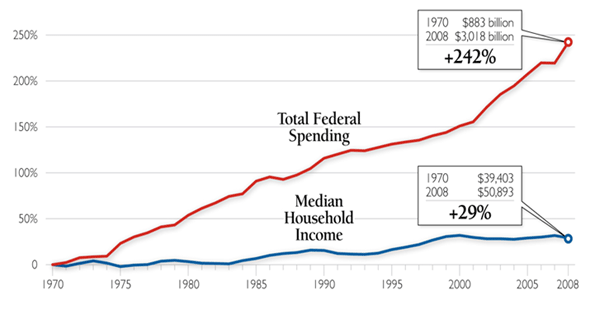
    According to the Office of Management & Budget (OMB), Federal spending has grown more than eight times faster than Household Median Income. Since 1970, middle-income Americans’ earnings have risen 29 percent, but federal spending has increased 242 percent (Percentage Change of Inflation-Adjusted Dollars, 2009). The Greatest Generation believes that spending by Washington politicians has grown out of control. They understand it is not a Republican or Democrat issue. They opposed the $800 billion TARP Bailout under Bush as much as Obama’s $800 Stimulus Bill. They opposed the trillion dollar Healthcare Bill recently enacted into law despite a clear majority opposed to its passage. They recognize that Social Security and Healthcare comprise huge unfunded obligations that will be passed on to their grandchildren.


    Source: Heritage Foundation

    Debt

    Since World War II, publicly held debt as a percentage of the economy (GDP) has remained below 50%. In 2008 when President Obama took office, it was 40.8 percent, nearly five points below the post-war average. According to the OMB, Obama’s budget would more than double this figure to 90 percent of Gross Domestic Product by 2020, levels not seen since World War II. (Greece’s debt level of 150% precipitated their meltdown). By 2020, Americans will spend more on interest payments on the Federal debt than on military spending. The Greatest Generation believes these debt levels to be unsustainable.


    Source: Heritage Foundation

    An Unsustainable Path

    In 1990, the federal budget was less than $2 trillion. Ten years later the federal budget was just $2.3 trillion. By 2010 the budget exploded to $4 trillion. The Obama budget projects a 43% growth to $4.3 trillion by 2019 according to the OMB. This massive increase over the $2.9 trillion budget Obama inherited in 2008 is not due to emergency spending alone but an intentional structural growth in government. Federal revenues have not kept pace with spending. The U.S. government was forced to borrow $1.5 trillion to pay its bills last year. The national debt is projected to increase from $13 trillion to $20 trillion by 2020 (Inflation-Adjusted Dollars, 2009). The path is unsustainable.


    Source: Heritage Foundation

    While the classic paradox of the immoveable object versus the irresistible force can never be solved, this battle will be settled at the ballot box in 2010 and 2012 when Americans determine the path their country will follow in the 21st Century. If the Greatest Generation prevails, many incumbent politicians will find themselves out of a job as collateral damage. A new wave of politicians will begin The Great Deconstruction.

    New Jersey Governor Chris Christie may be the prototype of this new generation of politicians. He was elected to deconstruct the dysfunctional government of New Jersey, an economy that resembles Greece. Christie inherited the nation’s worst state deficit — $10.7 billion out of a $29.3 billion budget. Christie is doing something unusual, honoring his campaign promises and acting like his last election is behind him. Christie epitomizes the politician the Greatest Generation craves, one willing to lose his job.

    Christie has already declared a state of emergency, signed an executive order freezing spending, and cut $13 billion in spending – in just two months. His first budget included 1,300 layoffs, cut spending by 9%, and privatized government services. The deconstruction of New Jersey has begun. New Jersey may be an unlikely place for The Great Deconstruction to begin, but it is a harbinger of things to come.

    The Great Deconstruction is a series written exclusively for New Geography. Future articles will address the impact of The Great Deconstruction at the national, state, county and local levels.

    Robert J. Cristiano PhD is the Real Estate Professional in Residence at Chapman University in Orange County, CA and Director of Special Projects at the Hoag Center for Real Estate & Finance. He has been a successful real estate developer in Newport Beach California for twenty-nine years.

    Other works in The Great Deconstruction series for New Geography
    The Great Deconstruction – First in a New Series – April 11, 2010
    Deconstruction: The Fate of America? – March 2010