Tag: Obama’s America

  • All In The Family

    For over a generation pundits, policymakers and futurists have predicted the decline of the American family. Yet in reality, the family, although changing rapidly, is becoming not less but more important.

    This can be traced to demographic shifts, including immigration and extended life spans, as well as to changes of attitudes among our increasingly diverse population. Furthermore, severe economic pressures are transforming the family–as they have throughout much of history–into the ultimate “safety net” for millions of people.

    Those who argue the family is less important note that barely one in five households–although more than one-third of the total population–consists of a married couple with children living at home. Yet family relations are more complex than that; people remain tied to one another well after they first move away. My mother, at 87, is still my mother, after all, as well as the grandmother to my daughters. Those ties still dominate her actions and attitudes.

    Critically, marriage, the basis of the family, is also far from a dying institution. Sociologist Andrew Cherlin notes that over 80% of Americans eventually get married, often after a period of cohabitation. Later marriages are also reflected in later childrearing. Younger women today may be less likely to have children, but far more older women are giving birth; since 1982 the number of those over 35 who give birth has more than tripled. This trend has accelerated and will continue to do so given advances in natal science.

    More important, people continue to value the stability and cohesion that only families can provide. According to social historian Stephanie Coontz, Americans today are more likely to be in regular contact with their parents than in the past. Some 90% consider their parental relations close, and far more children are likely to live with at least one parent now than they were as recently as the 1940s.

    To be sure, as Coontz makes clear, the 21st-century family will not reprise the Ozzie-and-Harriet norms of the 1950s. Everything from divorce to immigration and gay marriage is reshaping family relations. While Americans may “swing back” to a more family-oriented society, social historian Alan Wolfe notes, “it will be with a difference.”

    But family will remain the central force that informs our communities and economy. For example, when people move, a 2008 Pew study reveals, they tend to go to areas where they have relatives. Family, as one Pew researcher notes, “trumps money when people make decisions about where to live.”

    Perhaps nothing better illustrates this trend than the increase in multigenerational households. As people live longer and produce offspring later, family ties are strengthening. A recent Pew survey reveals that the number of households accommodating at least two adult generations has grown in recent years. Today the percentage of such multigenerational households–some 16%–is higher than any time since the 1950s and swelled by some 7 million since 2000. At the same time, the once rapid growth of single-person households, which nearly tripled since the 1950s, has begun to slow and, among those over 65, has declined in recent years.

    Rather than be hived off in isolation, grandparents are playing a larger role in family life, both as financial supporters and as sources of reliable child care. Living with or being close to grandparents is particularly important for younger Americans, many of whom are struggling to raise families in expensive regions such as New York or Los Angeles. As Queens resident and real estate agent Judy Markowitz puts it, “In Manhattan, people with kids have nannies. In Queens, we have grandparents.”

    As these caregivers age, in turn, they will require help for themselves. One welcome change, already evolving, is the number of older adults moving in with their children. Institutionalized care for people over 75, once seen as inevitable, has dropped since the mid-1980s, as more families hire part-time help or have aging parents move in with them.

    Today as many as 6 million grandparents live with their offspring, allowing, by one estimate, as many as half a million people to avoid nursing homes. Between 2000 and 2007, according to the Census Bureau, the number of people over 65 living with adult children increased by more than 50%. One California builder reports that one third of new home buyers want a “granny flat,” an addition to accommodate an aging parent. Roughly one third of American homes have the potential to create such units. In the coming decades homes that can be adapted to the changing needs of families will become an increasingly desirable commodity.

    Arguably the strongest force for continued importance of family comes from the two groups, ethnic minorities and millennials, who will shape the next few decades. Immigrants, particularly Latinos and Asians, are also far more likely to live in married households with children than are other Americans. They are also more than twice as likely, according to Pew, to live in households with at least two adult generations.

    The other key group will be the millennials, those Americans born since 1982. As noted generational researchers Morley Winograd and Mike Hais suggest in their landmark book Millennial Makeover, the rising “millennial” or “echo boom” generation–those born after 1983–enjoy more favorable relations with their parents: Half stay in daily touch, and almost all are in weekly contact.

    The millennials, Winograd and Hais suggest, generally do not share the generational angst that defined many boomers. Indeed three-quarters of 13-to-24-year-olds, according to one 2007 survey, consider time spent with family the greatest source of happiness, rating it even higher than time spent with friends or a significant other. And they seem determined to start families of their own: More than 80% think getting married will make them happy, and some 77% say they definitely or probably will want children, while less than 12% say they likely will not.

    The current tough economic conditions may be slowing family formation but is clearly bolstering close, long-term ties between children and parents. One quarter of Gen Xers, for example, still receive financial help from their parents, as do nearly a third of those under 25.This trend has been mounting since well before the recession. Ten percent of all adults younger than 35 told Pew researchers last year that they had moved in with their parents over the past year.

    Higher college debts, high home prices and a less-than-vibrant job market could all extend this virtual adolescence in which children maintain strong ties of dependence into adulthood. Although these conditions may increase support for more governmental assistance among some, young people are finding out there’s one institution that, despite political shifts, really can be counted on: the family.

    This article originally appeared at Forbes.com.

    Joel Kotkin is executive editor of NewGeography.com and is a distinguished presidential fellow in urban futures at Chapman University. He is author of The City: A Global History. His newest book is The Next Hundred Million: America in 2050, released in Febuary, 2010.

    Photo: driki

  • The Great Deconstruction – First in a New Series

    History imparts labels on moments of great significance; The Civil War, The Great Depression, World War II. We are entering such an epoch. The coming transformation of America and the world may be known as The Great Deconstruction. Credit restrictions will force spending cuts and a re-prioritization of interests. Our world will be dramatically changed. There will be winners and losers. This series will explore the winners and losers of The Great Deconstruction.

    ***

    The phrase, The Great Depression, was coined by British economist Lionel Robbins in a 1934 book of the same name. Its unexpected onset followed years of speculative growth during which economist Irving Fisher famously proclaimed, “Stock prices have reached what looks like a permanently high plateau.” The depression can be traced to the stock market crash of Black Tuesday, October 29, 1929, when stocks lost $14 billion in a single day. During the Great Depression that, followed, unemployment soared to 25%, a drought turned the farm belt into a dust bowl and international trade plummeted by two-thirds. The worldwide slump did not end until the advent of World War II.

    A similar, albeit less catastrophic, stock market collapse occurred in 2008. Following the speculative rise of a housing bubble, trillions of dollars in home equity and stock value were wiped out and 15 million Americans were left looking for work. Paul Krugman, columnist for the New York Times, labeled the worst downturn in nearly a century, The Great Recession. The Dow fell from a peak of 14,093 in October of 2007 to 6,626 in March of 2009. While Wall Street recovered half of its losses thanks to TARP, an $800 billion financial rescue package for the banks, Main Street has lagged behind. Home equity fell by $5.9 trillion. Housing starts plummeted from 2,075,000 in 2005 to 306,000 in 2009 decimating the construction industry. Foreclosure notices went out to 2.8 million homeowners in 2009 and 4,000,000 are projected for 2010. Eight million jobs have been lost and despite an $800 billion stimulus package, unemployment remains at 9.7%. Under-employment, the real jobless number, has reached 17%. Diversion of agricultural water to protect an endangered species in California and a severe drought has brought bread lines to the famously fertile Imperial Valley.

    Like the Great Depression before it, this recession will leave permanent scars on the people. The depression experience made our parents forever frugal. The Greatest Generation became savers, amassing trillions in home equity, stocks and savings accounts. In contrast, their spoiled and coddled children, the Baby Boomers, became the generation of instant gratification. Easy credit and home equity credit lines meant flat screen TVs, vacations, jewelry and jet-skis could be acquired instantly and paid for later. The Baby Boomers entered Congress, the state house and local government with the same attitude: buy now and pay later. Their largesse was fueled by a bubble mentality. Even though the Dot-Com Bubble burst in the late 90s, it was followed by the Housing Bubble of the 00s and a seemingly endless stream of revenue. A spending frenzy ensued with equity rich homeowners offered home equity lines of credit and credit cards with $100,000 limits.

    It wasn’t just consumers who went wild. In many states, such as California, so did the Legislature. In 1999, California rewarded its public employees with generous pensions (SB 400) that allowed retirement at age 50 with 90% of salary – for life. The California Legislative Analyst’s Office estimated the cost of SB 400 at $400 million per year. In 2009, the actual cost was $3 billion. The pension drain contributed to the $20 billion state deficit that California now faces. A Stanford Institute for Economic Policy Research report estimates California’s unfunded pension obligation at $500 billion.

    Cities in California matched SB 400, as did counties and municipal agencies, and it led to similar economic results. On April 6th, the City of Los Angeles announced furloughs for public employees, a 40% pay cut, effective immediately to help plug a $500 million deficit. Vallejo, a small city of 120,000 that generously paid its City Manager $600,000 per year and its firemen, $175,000, was forced to file for Chapter 9 Municipal Bankruptcy once the Great Recession dried up their honey pot.

    The problem has consumed municipal government across the nation. The Center on Budget and Policy Priorities recently estimated budget deficits for cities and counties would reach $200 billion this year. Detroit, with a $300 million deficit, has proposed leveling and returning huge sections of the decaying city to farmland.

    At the Federal level, the Obama Administration projects deficits of $1 trillion per year as far as the eye can see. The unfunded obligations for Social Security and Medicare are a staggering $107 trillion. Congressional Budget Office Director Douglas Elmendorf said, “U.S. fiscal policy is unsustainable, and unsustainable to an extent that it can’t be solved through minor changes. It’s a matter of arithmetic.”

    Elmendorf said fixing the problem will require fundamental changes and government would need to make changes in the large programs, Medicare, Medicaid and Social Security and the tax code, to get the deficit under control.

    When the Credit Card is Denied …

    Such deficits simply cannot be ignored. There will be an intervention. It may come from outside if China, Japan and the Saudis stop buying our debt. It could come from our children who may object to being forced to repay debt they did not spend. It will more likely come from our parents, The Greatest Generation, in the form of a credit intervention. Our parents may intervene, like they did back in the 60s when the Boomers experimented with sex, drugs and rock n roll. When some of us lost control, it was our parents who intervened and straightened us out. They may be forced to intervene once again. this time at the ballot box in November 2010. The Greatest Generation may send the politicians packing, impose order where chaos has reigned, and cut up the credit cards used by their spoiled and coddled Baby Boomer children. Have you noticed who attends the Tea Party rallies? They are retired, educated, tax paying middle class Americans – they look a lot like our parents.

    Deconstruction will take many forms and will encompass all that we know. Private industry has already shed 8 million jobs. The firing of private employees was low hanging fruit. Once untouchable social programs will be forced to disappear. Sacred cows will be slaughtered. Pet programs will be defunded. Even the military may have to learn to live with less. Further changes imposed will cut deep, reaching the union protected public employees and their constitutionally protected pensions. Just as General Motors was forced to abandon its venerable Pontiac brand along with Saturn, Saab and Hummer, unions will lose many of the benefits they obtained the last ten years. There will have to be changes to Medicare, Medicaid and even Social Security.

    We learned something from the health care fiasco. If we treat seniors, our parents, fairly and honestly, they will make the sacrifice. They were upset with the unfairness of the Cornhusker Kickback and the Louisiana Purchase. They became furious when Cadillac health care plans of union members received different treatment than theirs. Treated fairly, our parents will be part of the solution.

    Fifteen million Americans are looking for work. The jobs will not return soon. Thirty-three states have deficits that must be resolved by law. It will not happen without major sacrifice and draconian job lay-offs of public employees at the national, state, and local levels. The furloughs in Los Angeles only portend things to come. The Great Deconstruction has already begun.

    ***************************************

    The Great Deconstruction is a series written exclusively for New Geography. Future articles will address the impact of The Great Deconstruction at the national, state, county and local levels.

    Robert J Cristiano PhD is the Real Estate Professional in Residence at Chapman University and Director of Special Projects at the Hoag Center for Real Estate & Finance. He has been a successful real estate developer in Newport Beach California for twenty-nine years.

  • Jobs Will Rule November

    Health care lays behind him, financial reform and climate change ahead, but for President Barack Obama–and his opponents–there is only one real issue: jobs. The recent employment reports signal some small gains, yet the widespread prognosis for a slow, near-jobless recovery threatens the president and his party more than any major domestic challenge.

    Tea party activists and conservative ideologues often link the president’s dwindling popularity to an overreach on health care, but it all boils down to the old Clintonian adage: It’s the economy, stupid. Health care reform is simply too complex and its long-term effects too unknowable to be a winning issue for either side.

    The jobs deficit, on other the hand, is immediate and affects tens of millions of families. You can start with the highest-ever percentage of long-term unemployed on record. In recent months there have been roughly five to six applicants for every open position. Youth unemployment reaches near 20% for workers in their 20s–more than 25% for teenagers and over 43% for black teens. Even if the economy improves, according to the administration predictions, unemployment could remain close to double digits by the mid-term elections and over 8% by 2012.

    The prospect of long-term unemployment, and underemployment, is clearly damaging the “hope” brand once associated with the president. Recent CBS poll data show that 84% of Americans are worried about the economy.

    Over a third of those polled were concerned that someone in their household might lose their job. Some 52% identify the economy as the most important issue, while health care registered only 13%. Given the administration’s focus on health care and other issues–such as climate change–it’s not surprising that barely two in five of those polled approve of the president’s handling of the economy.

    Those inside the Washington bubble are too absorbed with political maneuverings to focus on the basic. The primary domestic challenges for the country lie not in addressing climate change, suburban sprawl or gay marriage, but spurring employment and generating new wealth.

    Part of our problem is that the two main parties are committed primarily to serving the interest of aligned constituencies .Republican dogmatism and canine-like obedience to short-term corporate profits contributed mightily to the economic meltdown. In its period in power , the GOP failed to either restrain Wall Street or address the nation’s indebtedness. No surprise then that many even moderate, middle-class voters opted for the Democrats over the past two elections.

    The question now is whether the Democrats are squandering their advantage. After almost 15 months in office, Democratic dogmatism–a mixture of faith in all forms of federal spending, “green jobs” and ever more regulation–has not exactly turbo-charged the economy. As a result, middle-class voters–those making $50,000 to $75,000 annually, have been slipping from the Democrats, according to a recent Wall Street Journal poll. These are precisely the voters who also put Scott Brown into the Senate.

    Yet the president’s situation is far from hopeless. Manufacturing payrolls are slowly beginning to grow, and industrial production is on the upswing. Survivor sectors such as health care continue to create new jobs. The bleeding may have finally stopped in construction, where the recession has been particularly devastating. Although the generally high-wage finance and information sectors continue to shrink, rapid growth in temporary business services could presage a new wave of permanent hires.

    These improvements suggest new opportunities for Obama. It allows him to point to a relatively stronger economy–particularly compared with Japan and the E.U.–as proof both of his policy acumen and our country’s overall vitality.

    This is when we really find out whether Obama is a thoughtful moderate of the campaign trail who embodies American exceptionalism or the hard-edged tool of the Democratic constituency groups. So far he has been a man of the left more comfortable with expanding the public sector than finding ways to boost private sector payrolls.

    The stimulus, crafted by old-dog Democrats like Nancy Pelosi and Harry Reid, with its emphasis on government workers and the university-industrial complex, solidified this notion. A public-sector-oriented approach has proved to have limited popular appeal, particularly at a time when many in the private sector regard the public workforce as an oppressive and overcompensated privileged class.

    Administration fiscal policy also erred in its focus on Wall Street. Obama, described during the 2008 campaign as the “hedge fund” candidate, has indeed done very well for this privileged class. Yet Democrats are hard-pressed to make the case that what’s good for George Soros is good for the USA.

    Now the question is whether the president can refocus on jobs. This will take, among other things, backing off the economically ruinous climate change agenda. Even the most gullible economic development officials are beginning to realize that “green jobs” are no panacea.

    In fact, as evident in Spain, Germany and even Denmark, over-tough green legislation can destroy the productive capacity of the most enlightened industries. Similarly in green strongholds like California and Oregon, the mounting climate change jihad could slow and even explode the incipient recovery by imposing ever more draconian regulation on businesses that can choose to migrate to less onerous locales.

    There are some hopeful signs of Obama’s repositioning. His recent moves embracing nuclear power and off-shore oil drilling, however inadequate, show that he’s at least trying to triangulate between the green purists and the unreconstructed despoilers. Some sort of moderated energy legislation–there’s no way to get the more radical House version through the Senate–would reassure businesses and the public that the president has jobs as his No. 1 priority.

    The well-funded, politically connected environmental lobby, no doubt, will try to head off any dissent from its agenda. But the same hard-boiled pol who threw his own pastor under the bus–remember Rev. Jeremiah Wright?–would seemingly be willing to diss pesky affluent white greens who, after all, have nowhere else to go politically.

    An equally good opportunity lies in the push for financial reform. As in the case of health care, the Republicans have a miserable record to defend. After all, the GOP dominated Congress and White House did little to rein in the out-of-control financial sector. Sure, there’s blame to go around for folks like Barney Frank but the buck was definitely with the Republicans, and they failed.

    Main Street businesses that felt ignored by the stimulus might look favorably on tough administration polices against big banks. Republicans could yet score points by opposing “too big to fail” provisions, as Mike Barone suggests, but one has to wonder if Republicans possess the moxie to stand up to large corporate interests, even detested ones.

    But right now the burden is on the president. Building on what is still a weak recovery, he must make clear that jobs and growth are his top domestic priorities. If he fails to communicate that message adequately, the voters, however leery of the Republicans, will rebuke him.

    This article originally appeared at Forbes.com.

    Joel Kotkin is executive editor of NewGeography.com and is a distinguished presidential fellow in urban futures at Chapman University. He is author of The City: A Global History. His newest book is The Next Hundred Million: America in 2050, released in Febuary, 2010.

  • March Madness: Good Sports In The White House?

    Given the news spin cycle, is it any wonder that the presidency has been reduced to a talk show, or that March Madness has better ratings than the wars in the Middle East? But American presidents might think about adopting a SportsCenter model — snappy replays, contrite Tigers — and drop Rush Limbaugh and James Carville as their founding fathers. The continental divide in American history isn’t that between Democrats and Republicans, or conservatives and liberals, but whether or not the president should be a good sport.

    I realize that embracing a president by his or her ability to play sports, or least talk about them, would saddle the country with leaders like Derek Jeter, Scottie Pippin, or Peyton Manning. But my take on the run of political leaders since Teddy Roosevelt cluttered up the White House with big game trophies is that modern presidents have had a complicated relationship with the national pastimes. Maybe it was the German strategist Clausewitz who said that sports is the extension of politics by other means?

    To be sure, presidents up to and including Barack Obama have played sports, and many have played their games well. I have no doubt that Bill Clinton shoots a reasonable, if erratic game of golf, or that former Yale baseball player George Herbert Walker Bush throws competitive horseshoes. But how many presidents would you have wanted in your fantasy league, and how many (think Richard Nixon) picked up the clubs only when a few photographers were in the rough?

    To see if there is a correlation between good presidents and good sportsmen, let’s sort out the players from the duffers. Those who could play the games: Teddy Roosevelt (rod and gun), Franklin Roosevelt (excellent at golf before polio, and sailing afterwards), Jack Kennedy (golf, girls, and touch football, although not in that order), Gerald Ford (football in college, tennis in the White House, the Pro-Am circuit in retirement), and the George Bushes (speed golf, cigarette boats).

    On the bench, so to speak, place: William Howard Taft (of sumo proportions), Woodrow Wilson (hard to imagine him playing much pond hockey, although he did ride horses), Warren Harding (are cards considered a sport?), Calvin Coolidge (“harrumph”), Herbert Hoover (a fan of the medicine ball), Harry Truman (although he was brisk walker), Lyndon Johnson (beagle handling does not count), Richard Nixon (despite the bowling poster in “The Big Lebowski”and installing lanes in the White House), Ronald Reagan (lifeguarding, horseback riding, the original Brush Clearer), and Jimmy Carter (knocked silly by a killer rabbit).

    I have my doubts about Dwight Eisenhower, who played 800 rounds of golf as president but still only had an 18 handicap, and Barack Obama, who despite his pick-up basketball and vacation golf has the shadow of a 37 (in bowling) hanging over his presidency. (Kids without barriers usually score better than 37. If the Birthers want proof of alien associations, they should look into this.)

    Sports and politics came together harmoniously with Franklin Roosevelt, who could never walk after his 1921 bout with polio. When he ran for the presidency in 1932, however, he began his campaign with a long sailing trip in the waters off New England, and the image of Roosevelt at the helm quelled whatever fears there might have been about his incapacity. Roosevelt was, in fact, an excellent sailor.

    Likewise, Jack Kennedy used sports to cover up a chronically bad back, Addison’s Disease, and a host of other ailments that had him under constant medical care. Instead of a bed-ridden presidential candidate, the public saw a “vigorous” man playing touch football on the lawn at Hyannis Port or heading out in a sailboat. In retrospect, the images of a robust president were as manufactured as those of Family Man Kennedy.

    The ability to talk about sports might add more to presidential success than the ability to play the games. Sports talk is one of the few common languages for much of the United States. Without any ability to speak it, a candidate on the campaign trail would find himself with a lot awkward pauses in the company of local politicos.

    The former radio sportscaster Ronald “Dutch” Reagan could obviously talk a good game. For much of his broadcasting career, all he had were the wire service reports of the action, and he would have to conjure the play-by-play, much as he later was attracted to invented economic theories (the Laffer Curve) or history (“I did not trade arms for hostages”). Few had the Gipper’s gift of small talk, and a lot of it revolved around sports.

    By this logic, President Obama ought to be one of the more successful American presidents. He occasionally joins the broadcast at half-time in key college basketball games, he picked the NCAA champion in his 2009 bracket, and he seems to enjoy golf. Why, then, are his approval ratings on a par with presidents who never hit a three-pointer?

    Part of the explanation can be gleaned in one of the many health care posts I have read recently. The correspondent was despairing of the President’s ability to convince the American people that health care reform was actually good for them, which prompted a digression into Obama’s wounded-duck throw with last year’s All-Star ceremonial pitch (apparently George W. Bush threw high heat) and, of course, the 37. Meaning: he’s losing the sports-bar, call-in radio constituency, which, when it comes to medicine, is only interested in steroids.

    By my logic, Bill Clinton got impeached not for groping an intern but for boasting he had broken 80 in a golf game. (In the words of Jack Nicklaus: “Eighty with fifty floating mulligans.”) Nor did Gerald Ford’s presidency ever recover from his erratic tee shots. Doubts surfaced about W not so much over Iraq as when it was reported that he had watched the Super Bowl by himself.

    The hope for the Obama presidency is that it will return to his sporting roots. On the campaign trail, he watched a lot of ESPN, and he is a long-time White Sox fan, perhaps even from the days of their Disco Demolition Night. After all, the athletically-challenged Nixon won four national elections on the strength of owning his own bowling ball (but was he a “sandbagger”?) and calling in a few plays to the Washington Redskins coach, George Allen (which, by the way, never worked.) Clearly, Obama has affection for his basketball, and my guess is that he spends more time than a president should thinking about the NBA draft. All are hopeful signs for his time in office.

    Matthew Stevenson is the editor, along with Michael Martin, of The Rules of the Game: The Best Sports Writing from Harper’s Magazine, published by Franklin Square Press, and the recently published Remembering the Twentieth Century Limited. He lives in Europe.

    Photo:

  • Immigrants Key to Economy’s Revival

    In Washington on Sunday, the tens of thousands of demonstrators demanding immigration reform looked like the opening round of the last thing the country needs now: another big debate on a divisive issue.

    Yet Congress seems ready to take on immigration, which has been dividing Americans since the republic was founded.

    But identifying immigrants as a “them,” as both their advocates and nativists do, misses the point. Immigrants — and their children — are the people who will help define the future “us.” They are also critical to the revival of the U.S. economy.

    This is particularly true on the entrepreneurial frontier.

    Overall, some of the country’s highest rates of entrepreneurship are found among immigrants from the Middle East, Cuba, South Korea and countries of the former Soviet Union. These recent arrivals regularly build new businesses — from street-level bodegas to the most sophisticated technology firms.

    Immigrants started one-quarter of all venture-backed public companies between 1990 and 2005. In addition, large U.S. firms are increasingly led by executives with roots in foreign countries, including 14 CEOs of the 2007 Fortune 100.

    Nowhere is this contribution more critical than in our major cities, many of which would be economically destitute without these immigrant communities.

    In Los Angeles County, for example, the self-employment rate among immigrants is more than 10 percent — almost twice that for the native-born. Nationwide, according to the last economic census, the number of all Latino establishments increased by nearly three times the national average, while those owned by all Asians expanded by two times.

    Immigrant contributions extend across a range of activities, from retail and food to culture. Asian immigrants, like the Italians and Jews before them, have concentrated in specific niche markets and then expanded beyond historic ghettos.

    Asian Indians, who began emigrating in large numbers starting in the 1970s, specialized in hotels and motels across the country. South Koreans opened greengroceries in New York and Los Angeles. Vietnamese became known for nail parlors, and Cambodians for doughnut stores. Overall, Asian enterprises expanded at roughly twice the national average in the first years of the new century.

    Perhaps most remarkable has been the movement of Asian immigrants into technology. In California, they account for a majority of such firms. Regions at the center of the high-tech economy — including Silicon Valley, Orange County and parts of suburban Seattle — are now heavily Asian-American. Although most of these new companies are small, some have grown sizable. The founders of Sun Microsystems, Yahoo, AST Research and Solectron are all of Asian descent — and are largely immigrants.

    This immigrant experience, says John Tu, president and co-founder of Kingston Technologies, the world’s largest independent producer of computer memory, has forced them to think differently.

    “The key thing is,” Tu said, “being an immigrant makes you flexible. … IBM, Apple and Compaq were inflexible. They told the memory customers: Take it or leave it. We thought about the customer and the relationship with the employees. I guess we didn’t know any better.”

    Yet the immigrant contribution goes beyond high-tech. In the years ahead, these new Americans, nonwhites and the “blended” population could reshape the national marketplace. Taken together, purchases by Asians, African-Americans and Native Americans, according to the Selig Center for Economic Growth at the University of Georgia, have exploded, growing far more rapidly than the national average.

    Combined with Latinos, these minorities could account for more than $2.5 trillion by 2010 — nearly one in every $4 of U.S. consumer spending.

    Perhaps nothing better illustrates these changes — and immigrants’ effect on daily life — than the shifts in that most basic of industries: food.
    In the old paradigm, ethnic groups such as Italians might cook traditional foods, like pizza, for their compatriots. Then, in a generation or two, they would reach out to the mainstream population. Meanwhile, immigrants, and particularly their children, acclimated to “American fare” like McDonald’s.

    But today, the shift from ethnic niche to mainstream is rapid. In Houston, once dominated by Southern cuisine, nearly one in three restaurants — overwhelmingly small, family-run businesses — serves Mexican or Asian cuisine. They account for more establishments than all the hamburger, barbecue and Italian restaurants put together.

    Nationwide, while pizza, hamburger and other traditional fast-food restaurants have stagnated, new chains selling quick, inexpensive Asian or Mexican food have flourished. Consider the successful Panda Express, started and owned by immigrants.

    By embracing, and being embraced by, immigrants, America can continue to build on its diversity. This allows the nation to retain its youthfulness, tap the global market and provide critical new spurs to innovation.

    America increasingly resembles Walt Whitman’s description, “not merely a nation, but a teeming Nation of nations.” The mid-21st-century United States can reflect that description — and aspiration — to our substantial long-term benefit.

    This article first appeared at Politico.

    Joel Kotkin is executive editor of NewGeography.com and is a distinguished presidential fellow in urban futures at Chapman University. He is author of The City: A Global History. His newest book is The Next Hundred Million: America in 2050, released in Febuary, 2010.

    Photo by SEIU International

  • America in 2050 — Where and How We’ll Live

    The presence of 100 million more Americans by 2050 will reshape the nation’s geography. Scores of new communities will have to be built to accommodate them, creating a massive demand for new housing, as well as industrial and commercial space.

    This growth will include everything from the widespread “infilling” of once-desolate inner cities to the creation of new suburban and exurban towns to the resettling of the American heartland — the vast, still sparsely populated regions that constitute the majority of the U.S. landmass.

    In order to accommodate the next 100 million Americans, new environmentally friendly technologies and infrastructure will be required to reduce commutes by bringing work closer to — or even into — the home and to find more energy-efficient means of transportation.

    Suburbs Rule

    Suburbia — the predominant form of American life — will probably remain the focal point of innovations in development. Despite criticisms that suburbs are culturally barren, energy inefficient or suitable only for young families, 80 percent or more of the total U.S. metropolitan population growth has taken place in suburbia, confounding oft-repeated predictions of its inevitable decline.

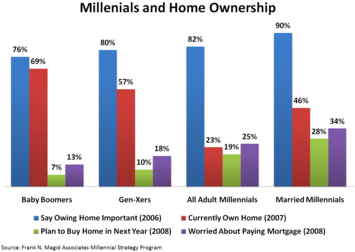
    This pattern will continue to the mid-21st century. The reasons are not hard to identify: Suburbs experience faster job and income growth, far lower crime rates (roughly one-third) and much higher rates of home ownership. While cities will always exercise a strong draw for younger people, the appeal often proves to be short-lived; as people enter their 30s and beyond, they generally prefer suburbs. This pattern will become more pronounced as the huge millennial generation — those born after 1983 — enters this age cohort.

    Over the next few decades, however, suburban communities will evolve beyond the conventional 1950s-style “production suburbs” of vast housing tracts constructed far from existing commercial and industrial centers. The suburbs of the 21st century will increasingly incorporate aspects of preindustrial villages. They will be more compact and self-sufficient, providing office space as well as a surging home-based workforce. Well before 2050 as many one in four or five people will work full or part time from home.

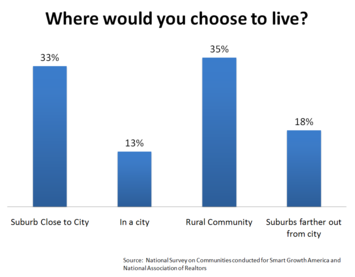
    Surveys of housing preferences consistently show that if given the choice, most Americans, particularly families, will still opt for a place with a spot of land and a little breathing room. And despite the coming population growth, most Americans will probably continue to resist being forced into density, and even with 100 million more people, the country will still be only one-sixth as crowded as Germany.

    The Rise of ‘Cities of Aspiration’

    The continuing appeal of suburbia does not mean that America’s urban centers are doomed. On the contrary, the United States will remain a nation of great cities. Throughout the history of civilization, cities have been engines for social, cultural and economic activity. The market for dense urban existence is likely to remain small compared with suburbs, but there will still be massive opportunities to provide for the roughly 15 million to 20 million new urban dwellers by 2050.

    Some urban areas such as San Francisco, Boston, Manhattan and the western edge of Los Angeles will remain highly attractive to the young, the affluent and the highly skilled, as well as some recent immigrants. After all, these cities contain many of the nation’s most vibrant cultural institutions, research centers, colleges and universities, and much of its most attractive architecture.

    These cities will sit atop the urban economic food chain, somewhat aloof from the rest of country, and will experience modest growth. But for most Americans, the focus of urban life will shift to cities that are more spread out and, by some standards, less intrinsically attractive.

    These new “cities of aspiration” — Phoenix, Houston, Dallas, Atlanta and Charlotte, N.C. — will perform many of the functions as centers for upward mobility that New York and other great industrial cities once did.

    Filling America’s Heartland

    Perhaps the least anticipated development in the nation’s 21st century geography will be the resurgence of the American heartland, often dismissed by coastal dwellers as “flyover country.” But as the nation gains 100 million people, population and cost pressures are destined to resurrect the nation’s vast hinterlands.

    Americans will head out to the hinterlands because they will find opportunities and perhaps a better quality of life. According to recent surveys, as many as one in three American adults would prefer to live in a rural area — compared with the 20-odd percent who actually do. Most Americans perceive rural America as epitomizing traditional values of family, religion and self-sufficiency and as being more attractive, friendly and safe, particularly for children.

    One critical factor in the heartland’s growing relevance is the advent of the Internet, which has broken the traditional isolation of rural communities. As the technology of mass communications improves, the movement of technology companies, business services and manufacturers into the hinterland is likely to accelerate. This will be not so much a movement to remote hamlets, but to the growing number of dynamic small cities and towns spread throughout the heartland.

    The heartland, consigned to the fringes of American society and economy in the 20th century, is poised to enjoy a significant renaissance in the early 21st. Not since the 19th century, when it was a major source of America’s economic, social and cultural supremacy, has the vast continental expanse been set to play so powerful a role in shaping the nation’s future.

    This article originally appeared at AOLNews.com.

    Joel Kotkin is executive editor of NewGeography.com and is a distinguished presidential fellow in urban futures at Chapman University. He is author of The City: A Global History. His newest book is The Next Hundred Million: America in 2050, released in Febuary, 2010.

    Photo: sparktography

  • America in 2050 — Strength in Diversity

    An ongoing source of strength for the United States over the next 40 years will be its openness to immigration. Indeed, more than most of its chief global rivals, the U.S. will be reshaped and re-energized by an increasing racial and ethnic diversity.

    These demographic changes will affect America’s relations with the rest of the world. The United States likely will remain militarily pre-eminent, but the future United States will function as a unique “multiracial” superpower with deep familial and cultural ties to the rest of the world.

    No Clear Majority

    The United States of 2050 will look very different from the country that existed just a decade ago, at the dawn of the new millennium. Between 2000 and 2050, the vast majority of America’s net population growth will come from racial minorities, particularly Asians and Hispanics, as well as a growing mixed-race population.

    By the middle of the 21st century, America will have no clear “majority” race. Today 30 percent of the U.S. population is nonwhite; in 2050 it may be nearly 50 percent. Latino and Asian populations are expected to triple. Today, because of high Latino birthrates, one in five American children under the age of 5 is Hispanic; increasingly most Hispanic growth will come from the children of those born in America.

    More Multiracial

    At the same time, these varying groups, and particularly their children, will become ever more multiracial in their outlook. The percentage of Americans of mixed race is growing significantly among people under 18; in California and Nevada mixed-marriage rates are at more than 13 percent, and in the rest of the Southwest a heavily Latino population increasingly intermarries with other ethnic groups.

    We will see more of this kind of interracial pairing in the future. According to market research firm Teen Research Unlimited, 60 percent of American teens say they have friends of different ethnic backgrounds. Even more telling, a 2006 Gallup Poll showed that 95 percent of young people (ages 18 to 29) approved of interracial dating — compared with only 45 percent of respondents over the age of 64. Likewise, a USA Today/Gallup Poll conducted in 2008 among teens showed that 57 percent have dated someone of another race or ethnic group, up 40 percent from when Gallup last polled teens on the question back in 1980.

    More Immigrants

    Europe also will continue to be a source of immigrants as many talented young Europeans continue to escape the continental nursing home by heading to the United States. But by far the largest groups of immigrants to the U.S. will come from Latin America, Africa, China and other developing countries. The United Nations estimates that 2 million people will move to developed countries annually until 2050, and more than half will come to the United States.

    Some of best educated and most successful, of course, will then go back home, as has been case throughout most of American history. But many more will stay, often for very mundane reasons, such as the chance to live in a dwelling larger than a shoebox or to have more than one child. Others will cherish the chance to live without worrying about the depredations of some party bureaucrat, caudillo or religious fanatic. These immigrants are not seeking a spot on the Titanic. They realize that, despite its many failings, America is uniquely able to reinvent and re-energize itself.

    Changing Landscape

    This greater diversity will become increasingly evident across an expanding landscape, including many once homogeneous areas like the Great Plains.

    But the new epicenter for diversity will lie in the once overwhelmingly white suburbs, which now increasingly are settled by minorities and immigrants. An absolute majority of our foreign-born population now lives in suburbia, up from 44 percent in 1980.

    Already the best places to find ethnic shopping complexes, Hindu temples and new mosques are not in the teeming cities but in the outer suburbs of places like Los Angeles, New York and Houston. In most immigrant-rich suburbs, you find alongside the temples and mosques churches and synagogues.

    Unique in the World

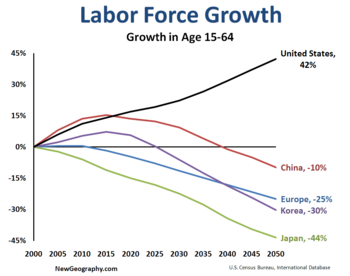
    In contrast to this growing diversity, the United States’ chief global rivals seem far less able to accommodate this level of interracial mixing. China, Japan and Korea are culturally resistant to diversity and unlikely to welcome large-scale immigration, even if much of their labor force has to go to work in walkers and wheelchairs.

    Given Europe’s current considerable problems integrating its immigrants, particularly Muslims, the continent seems ill disposed to open its doors further; Denmark and the Netherlands are considering measures to sharply restrict immigration.

    Economic Benefits

    The changing ethnic population in the U.S. will no doubt play a leading role in the next economic transition.

    Recent newcomers have already distinguished themselves as entrepreneurs, forming businesses from street-level bodegas to the most sophisticated technology companies. Between 1990 and 2005 immigrants started one-quarter of all venture-backed public companies.

    Large American companies are also increasingly led by people with roots in foreign countries, including 14 of the CEOs of the 2007 Fortune 100. Even corporate America — once the almost-exclusive reserve of native-born Anglo-Saxons — will become as post-ethnic as the larger society.

    The America of 2050 will seem, to some, a very different and even foreign country. Yet our continuing racial evolution confirms the basic dynamism of our society and its ability to adapt. Our experiment with creating what Walt Whitman in 1855 described as “the race of races” will represent one of the great accomplishments of mid-21st century America.

    This article originally appeared at AOLNews.com.

    Joel Kotkin is executive editor of NewGeography.com and is a distinguished presidential fellow in urban futures at Chapman University. He is author of The City: A Global History. His newest book is The Next Hundred Million: America in 2050, released in Febuary, 2010.

    Photo: chrisjfry

  • What American Demographics Will Look Like in 2050

    To many observers, America’s place in the world is almost certain to erode in the decades ahead. Yet if we look beyond the short-term hardship, there are many reasons to believe that America will remain ascendant well into the middle decades of this century.

    And one important reason is people.

    From 2000 to 2050, the U.S. will add another 100 million to its population, based on census and other projections, putting the country on a growth track far faster than most other major nations in the world. And with that growth — driven by a combination of higher fertility rates and immigration — will come a host of relative economic and social benefits.

    More fertile

    Of course the percentage of childless women is rising here as elsewhere, but compared to other advanced countries, America still boasts the highest fertility rate: 50 percent higher than Russia, Germany or Japan, and well above that of China, Italy, Singapore, Korea and virtually all of eastern Europe.

    As a result, while the U.S. population is growing, Europe and Japan are seeing their populations stagnate — and are seemingly destined to eventually decline. Russia’s population could be less than a third of the U.S. by 2050, driven down by low birth and high mortality rates. Even Prime Minister Vladimir Putin has spoken of “the serious threat of turning into a decaying nation.”

    In East Asia, fertility is particularly low in highly crowded cities such as Tokyo, Shanghai, Tianjin, Beijing and Seoul. And China’s one-child policy — and a growing surplus of males over females — has set the stage for a rapidly aging population by mid-century. South Korea, meanwhile, has experienced arguably the fastest drop in fertility in world history, which perhaps explains its extraordinary, if scandal-plagued, interest in human cloning.

    Even more remarkably, America will expand its population in the midst of a global demographic slowdown. Global population growth rates of 2 percent in the 1960s have dropped to less than half that rate today, and this downward trend is likely to continue — falling to less than 0.8 percent by 2025 — largely due to an unanticipated drop in birthrates in developing countries such as Mexico and Iran. These declines are in part the result of increased urbanization, the education of women and higher property prices. The world’s population, according to some estimates, could peak as early as 2050 and begin to fall by the end of the century.

    Younger and More Vibrant

    Population growth has very different effects on wealthy and poor nations. In the developing world, a slowdown of population growth can offer at least short-term economic and environmental benefits. But in advanced countries, a rapidly aging or decreasing population does not bode well for societal or economic health, whereas a growing one offers the hope of expanding markets, new workers and entrepreneurial innovation.

    In fact, throughout history, low fertility and socioeconomic decline have been inextricably linked, creating a vicious cycle that affected such once-vibrant civilizations as ancient Rome and 17th-century Venice and that now affects contemporary Europe , Russia and Japan.

    Within the next four decades, most of the developed countries in both Europe and East Asia will become veritable old-age homes: a third or more of their populations will be older than 65, compared with only a fifth in the U.S. By 2050, roughly 30 percent of China’s population will be older than 60, according to the United Nations. The U.S. will have to cope with an aging population and lower population growth, in relative terms, but it will maintain a youthful, dynamic demographic.

    More Hopeful About the Future

    The reasons behind these diverging trends is complex. In some countries, a sense of diminished prospects, combined with a chronic lack of space, appear to be the root causes for plunging birthrates. As Italians, Germans, Japanese, Koreans and Russians have fewer offspring — one recent survey found that only half of Italian women 16 to 24 said they wanted to have children — they will have less concern for future generations.

    In contrast, in the United States roughly three-quarters of young people report they plan to have offspring. Such individual decisions suggest that America, for all its problems, is diverging from its prime competitors, placing its faith in a future that can accommodate 100 million more people.

    As author Michael Chabon recently wrote, “In having children, in engendering them, in loving them, in teaching them to love and care about the world,” parents are “betting” that life can be better for them and their progeny.

    This article originally appeared at AOLNews.com.

    Joel Kotkin is executive editor of NewGeography.com and is a distinguished presidential fellow in urban futures at Chapman University. He is author of The City: A Global History. His newest book is The Next Hundred Million: America in 2050, released in Febuary, 2010.

    Photo: victoriapeckham

  • Scenario Two: An Optimistic view of the United States future

    This is the second in a two part series exploring a pessimistic and an optimistic future for the United States. Part One appeared yesterday.

    A positive assessment of US prospects rests on at least seven propositions. First, the current crisis is not inherently more threatening than many others, most notably the Civil War, the Great Depression, and two World Wars. Quality leadership, building on the resilient political and economic institutions of the country, will prove sufficient to bring about needed sacrifices and transformations. We have seen this many times in the past from the Progressive Era to the New Deal, the Second World War and the winning of the Cold War, which was a uniquely bipartisan triumph.

    Second, despite the ongoing problems of racial inequality and tensions about immigration, the United States has been uniquely successful in having peacefully achieved a truly multi-racial and multi-ethnic state. It has welcomed waves of diverse immigrants, and integrated them into a broader, ever changing society. This process has culminated symbolically and literally in the election of a multi-racial president, Barack Obama.

    Third, economic corruption and financial crises have been recurring phenomena, and the nation has emerged out of these because of the sheer magnitude of talent and natural resources. This has been aided by a deep entrepreneurial capacity and willingness to take risks, and, overall, a willingness of most to work hard to improve life for themselves and their families.

    Fourth is the existence of a large and literate population, willing to work, certainly the world’s finest university system and research establishment, over and over again engendering innovations that create future economies: e.g., the computer revolution. American secondary education is still in need of great improvement, but the US University remains a beacon to talent from around the world.

    Fifth, despite the noise and uproar, despite the continuing clash between the traditional and the modern or secular, the nation, through its independent courts and helped by governmental decentralization, e.g. the Federal system, the country remains the freest society in human history. Despite the appearance of power of the religious right under the Republicans since the 1970s, serious erosion in freedom of thought has been kept to a minimum. Similarly, the cult of political correctness, although annoying, has become, if anything, less potent and increasingly the butt of jokes.

    Sixth, and perhaps most important, we have to consider demography. Despite current unemployment and despite the imminent retirement of the baby boomer generation, the United States, alone among the richest economies, will continue to have a relatively favorable ratio of wage earners to the elderly. This will enable us to afford social security and Medicare. The new generation – known as millennials – will constitute a large source of new labor, innovation and entrepreneurs needed to propel our economy.

    Finally, there are a few positive trends, including modest recovery in housing and in auto sales, hints of some pulling back from the out-sourcing of services, and continuing innovation and marketing of new products and services. On the political side, although the current anti-incumbent mood will likely reduce Democratic margins in Congress and in several states in 2010, the sheer lunacy of the “tea party“ activists, many of them unreconstructed “know nothings” may actually hurt the Republican party more than the Democrats. People are constantly being reminded why, for all the failings of the Democrats, they tossed the Republicans from power in the first place.

    An optimistic scenario rests on the historical precedent of muddling through crises and then creating new waves of innovation in products and services, and on the presence of a large labor force willing and able to work. A vital question is whether the President and Congress will have the courage to ask voters to make short-term sacrifices: higher income taxes on the rich and reduced subsidies to entrenched interests across the board that will be needed to restore fiscal health. And finally there is the big question, are the American people ready to do with less today to build a better future for the next generation?

    Richard Morrill is Professor Emeritus of Geography and Environmental Studies, University of Washington. His research interests include: political geography (voting behavior, redistricting, local governance), population/demography/settlement/migration, urban geography and planning, urban transportation (i.e., old fashioned generalist).

    Photo: elycefeliz

  • Scenario One: A Pessimistic Forecast for the United States

    This is the first in a two part series exploring a pessimistic and an optimistic future for the United States. Part Two will appear tomorrow.

    I’m an old (76) 1950s type liberal, and have lived to see the election on the nation’s first mixed-race president, as well as some remarkable social change in the general status of women and ethnic minorities. The United States has a remarkable heritage of entrepreneurship and resilience in its democratic institutions. Yet there are cogent reasons to be fearful and pessimistic about our capacity to maintain our preeminence, at least in the medium run (10-15 years). I obviously hope I’m wrong, and look forward to attempts to undermine my thesis – including, tomorrow, my own.

    Consider the numbers 17, 49 and 60. Seventeen is the real unemployment rate, not the “official” ten, when we take into account those dropping out of the labor force, or giving up. Forty-nine is the real percentage of home ownership, in our “ownership” society, not the 68 percent from the census. For mighty Los Angeles, the real number is 44 percent. The difference is the stupendous number of households whose equity in the house is less than they owe on the mortgage. This house of cards has increasingly been the engine of national growth. Sixty is the number of votes in the US Senate needed to stop a filibuster, and together with inept leadership, is responsible for the absurd failure of Congress and the effective collapse of collegial democracy.

    Economists say we are in a recovery. What recovery? The small increase in house sales is due to temporary incentives, but including speculators buying up homes, many foreclosed, for yet greater inequality. The main gains in jobs, not fully offsetting wider losses, are in temporary construction tied to government-funded projects. The growth in jobs and the economy in the last 20 years has been in services, stuff we do for each other, and the main fuel has been the pyramiding of house values. That is over. How can we restore growth through more consumption if the majority of the population no longer has the resources to invest or spend?

    By far the most destructive accomplishment of almost 30 years of restructuring has been the reestablishment of extreme inequality, the emergence and power of the ultra-rich, both “progressive” and conservative in orientation, to levels last seen before the Great Depression.

    But perhaps the greater root of our malaise, and perhaps the downfall of the American Empire, lies in excessive globalization and the loss of our capacity to make stuff, the outsourcing of, first, manufacturing and now even of services. It is instructive that this is the same story of imperial Rome, although long dependent on its empire, by the time of its collapse it imported virtually everything from its tributary states. Its finances could no longer pay the Army which was largely made up of people from outside Italy.

    I’d agree that the main hope in the economic arena is via the small entrepreneur, but they face the immense monopolistic power of ever-larger global capital. I’m proud to live in Seattle, which at least dared to fight back, as in the one and only US general strike, in 1919, and in the WTO protests in 1999. Perhaps this is not so surprising since Seattle still makes things: planes (Boeing), ships (Todd) and trucks (PACCAR).

    The saddest irony is that even as maybe half of us celebrate a Black president, we have utterly failed to follow up on the political civil rights gains on the 1960s to incorporate Black Americans into the mainstream economy. The status of the Black male is, relatively, worse in 2009 than it was in 1969. I would not be surprised to see a reprise of the 1960s race riots. But it is also relevant to reflect on the declining state of the white male, suffering increased drop-out rates from high school, declining enrollments in college, all in the face of reduced job opportunities for the less skilled and educated, plus competition from immigrants, legal and illegal. Is it any wonder that both nativism and populism is rising anew?

    One might dare to believe that large Democratic majorities in Congress would give us hope for effective responses to this national malaise. But I’d say the current Congress rivals the infamous 80th congress that Harry Truman excoriated, for its “do nothingness”. On the surface we can correctly observe that the Republican party, increasingly conservative, is more than willing to wreck the country in order to regain power.

    But part of the problem is that we no longer have a conservative and a liberal party, in an economic sense. We have two bourgeois parties, with the “new” Democratic Party increasingly dependent on the wealthy educated elite as well as well-paid public workers, it long ago abandoned the working class and did nothing to constrain globalization and the rise of the toxic financial practices. Thus we should not be surprised that the populist know-nothing uprising could bring to power large numbers of proudly uneducated folks.

    In the final analysis for this pessimistic scenario, the underlying culprit is the inexcusable failure of the US educational establishment, the astounding incapacity of our public and private schools to teach people to think and reason. And part of the reason for this incapacity is the excessive power of religion, which values belief over reason, in our culture. And this is why decadent Europe – aging and tax-burdened – could come out of this recession and malaise better than the United States. Perhaps we’ll see a reverse migration of surplus underemployed young Americans returning to their aging historic motherlands!

    Richard Morrill is Professor Emeritus of Geography and Environmental Studies, University of Washington. His research interests include: political geography (voting behavior, redistricting, local governance), population/demography/settlement/migration, urban geography and planning, urban transportation (i.e., old fashioned generalist).

    Photo: hz536n