Tag: Oregon

  • The Limits of Portland’s Craft Economy

    Charles Heying, the author of Brews to Bikes: Portland’s Artisan Economy, covers Portland’s indie fashion, book and music sector, its recycling/reuse businesses, craft businesses, bike sector, technology businesses and non-profits.

    His thesis is that Portland represents a return to the craftsmanship that defined the pre-industrial age. Heying mostly denies that the artisan economy produces high-end goods for a limited market, and sees it as a broader shift in our society away from mass production. A critic of Richard Florida’s theories, he denies that cities should make cosmetic changes to attract well educated professionals. Instead, he sees the artisan economy as something that emerges from below, rather than imposed from above by local officials.

    But there are some problems with this thesis. Portland has many coffee roasters, but it also has many Starbucks. Silicon Forest, Portland’s tech hub, includes IBM, Intel and Techtronics. None of these firms are small, artisan firms. There are indie designers in Portland but Nike and Columbia Sportswear and Adidas also call Portland home. Sure, twelve percent of people in Portland bike, but that means a lot rely on the car as a primary mode of transportation. And only twelve percent of the beer consumed in Portland is craft beer. If ‘small is beautiful’ really defines this city, then why are there so many big companies lurking around?

    Artisanal enterprises come along with the advancement of information technology, but will in no way replace mass production. I don’t think there will be many small-scale train, airline or automobile companies. The mini-economy represents a side of us that doesn’t want the creative impulse to die, and wants a more socially responsible model, but it won’t shove aside the big model anytime soon.

  • Bridges Boondoggle, Portland Edition

    A couple weeks ago I outlined how the Ohio River Bridges Project in Louisville had gone from tragedy to farce. Basically none of the traffic assumptions from the Environmental Impact Statements that got the project approved are true anymore. According to the investment grade toll study recently performed to set toll rates and sell bonds, total cross river traffic will be 78,000 cars (21.5%) less than projected in the original FEIS. What’s more, tolls badly distort the distribution of traffic that will come such that the I-65 downtown bridge, which is being doubled in capacity, will never carry just what the existing bridge carries right now anytime during the study period, and won’t exceed the design capacity even slightly until 2050. Meanwhile, the I-64 bridge that will remain free will grow in traffic by 55% by 2030, when it will be 34% over capacity.

    A nearly identical scenario is playing out in Portland with the $2.75 billion I-5 Columbia River Crossing. Joe Cortright of Impresa consulting unearthed the information through freedom of information requests looking into the investment grade toll study on that is being conducted for that bridge. You can see his report here (there’s also a summary available).

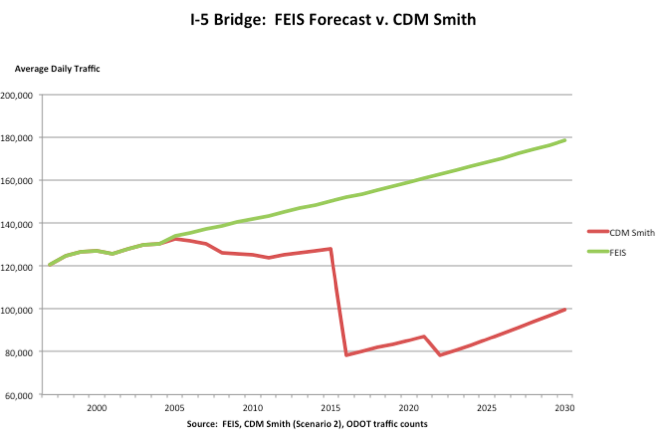
    I’ll highlight some of his truly eye-popping findings. Traffic forecasts are inflated, of course. The toll study is suggesting traffic increases of 1.1% to 1.2% per year when over the last decade traffic has actually declined by 0.2% per year on average even though there are no tolls. But it’s the addition of tolls that badly distort cross-river traffic and make a mockery out of the EIS. Here’s the money chart for the I-5 bridge itself:


    How is it possible that after building a gigantic multi-billion dollar bridge traffic declines? For the same reason as Louisville: tolling will cause huge amounts of traffic to divert to the I-205 free bridge. By 2016 traffic on I-205 would rise from 140,000 per day to 188,000 – and up to 210,000 by 2022 (full capacity).

    This is so eerily similar to the Louisville situation, that someone suggested, only half in jest I suspect, that they must be having “how to” training sessions on this stuff over at AASHTO HQ.

    Unlike Louisville, where a docile press is basically in cahoots with the state DOTs pushing the project, Portland’s media started asking questions. And one local paper even caught a civil engineering professor from Georgia serving on the independent review board for the project labeling the tolling scheme “stupid.” (Louisvillians take note).

    Oregon DOT director Matt Garrett released a letter in response in which he says, “This work is fundamentally different than the traffic analysis completed for the Final Environmental Impact Statement, and with very different goals in mind.” I agree. The FEIS was performed with the goal of getting this bridge the DOT wanted built approved. The toll study was designed to withstand financial scrutiny on Wall Street and be relied on in selling securities. I’ll let you be the judge of which is more likely to be closer to the truth. What’s more, Cortright addresses this very issue by saying in his report, “Neither federal highway regulations nor federal environmental regulations authorize or direct using multiple, conflicting forecasts for a single project, or using one set of traffic numbers for one purpose, and a different set for another.” I might also add that the DOTs in Louisville have not to the best of my knowledge made similar claims to explain away an identical discrepancy there. Nevertheless, the rest of Garrett’s letter acknowledges that I-5 will see a big traffic drop and there will be diversion from tolling. So he appears to just be doing the bureaucratic equivalent of “pay no attention to that man behind the curtain.”

    Again, want to know how it is that we spend so much money on transport infrastructure and get so little value? It’s because far too many of our highway dollars go into boondoggle mega-projects ginned up through political pressure (watch this space as I have another example coming soon) instead of into projects that make transportation sense. It may well be that there are legitimate problems with the existing I-5 river crossing, but these numbers give no confidence that the Oregon DOT has come up with a good or cost-effective plan for dealing with them. Unlike some, I do think we need to build more roads in America. Unfortunately our system is set up to ensure the survival of the unfittest instead of projects that make actual transportation and economic sense.

    Aaron M. Renn is an independent writer on urban affairs and the founder of Telestrian, a data analysis and mapping tool. He writes at The Urbanophile, where this piece originally appeared.

    Photo of current Columbia River crossing by Jonathan Caves.

  • Portland Metro’s Competitiveness Problem

    Portland Metro’s president, David Bragdon, recently resigned to take a position with New York’s Bloomberg administration. Bragdon was nearing the end of his second elected term and ineligible for another term. Metro is the three county (Clackamas, Multnomah and Washington counties) planning agency that oversees Portland’s land use planning and transportation policies, among the most stringent and pro-transit in the nation.

    Metro’s jurisdiction includes most of the bi-state (Washington and Oregon) Portland area metropolitan area, which also includes the core municipality of Portland and the core Multnomah County.

    Local television station KGW (Channel 8) featured Bragdon in its Straight Talk program before he left Portland. Some of his comments may have been surprising, such as his strong criticism of the two state (Washington and Oregon) planning effort to replace the aging Interstate Bridge (I-5) and even more so, his comments on job creation in Portland. He noted “alarming trends below the surface,” including the failure to create jobs in the core of Portland “for a long time.”

    Bragdon was on to something. Metro’s three county area suffers growing competitive difficulties, even in contrast to the larger metropolitan area (which includes Clark and Skamania counties in Washington, along with Yamhill and Columbia counties in Oregon). This is despite the fact that one of the most important objectives of Metro’s land use and transportation policies is to strengthen the urban core and to discourage suburbanization (a phenomenon urban planning theologians call “sprawl”).

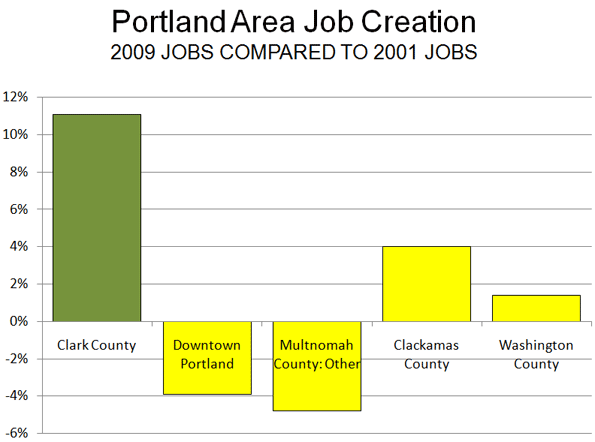
    Anemic Job Creation: Jobs have simply not been created in Portland’s core. Since 2001, downtown employment has declined by 3,000 jobs, according to the Portland Business Alliance. In Multnomah County, Portland’s urban core and close-by surrounding communities, 20,000 jobs were lost between 2001 and 2009. Even during the prosperous years of 2000 to 2006, Multnomah County lost jobs. Suburban Washington and Clackamas counties gained jobs, but their contribution fell 12,000 jobs short of making up for Multnomah County’s loss. The real story has been Clark County (the county seat is Vancouver), across the I-5 Interstate Bridge in neighboring Washington and outside Metro’s jurisdiction. Clark County generated 13,000 net new jobs between 2001 and 2009 (Figure 1).

    Domestic Migration: Not only are companies not creating jobs in the three county area, but people are choosing to locate in other parts of the metropolitan area.

    Between 2000 and 2009, the three counties – roughly 75% of the region’s total population in 2000 – attracted just one-half of net domestic migration into the metropolitan area. Washington’s suburban Clark County, across the Interstate Bridge, added a net 48,000 by domestic migration and has accounted for 40% of the metropolitan area’s figure all by itself.

    Core Multnomah County, which had nearly double Clark County’s 2000 population, added only 4,000 net domestic migrants, at a rate less than 1/20th that of Clark County. Suburban Clackamas and Washington counties did better, but between them achieved barely one-half of the Clark County rate.

    Exurban Columbia and Yamhill counties, outside the jurisdiction of Metro but inside the metropolitan area, added nearly 13,000 domestic migrants, more than three times that of Multnomah County, despite their combined population less than one-fifth that of Multnomah’s in 2000.

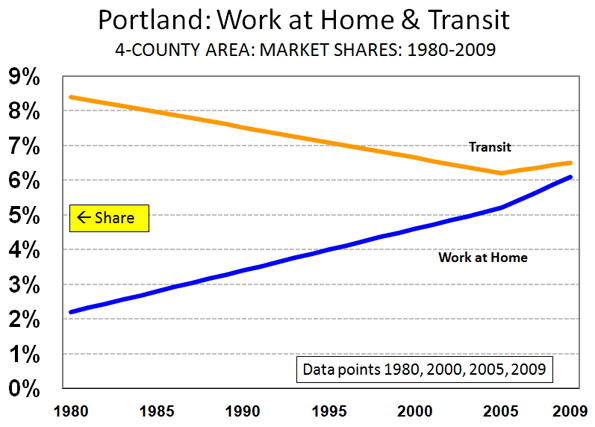
    Effects of Pro-Transit Policies: Portland’s unintended decentralization has even damaged the much promoted, and subsidized, public transit agencies. Despite Portland’s pro-transit policies, the three county transit work trip market share fell from 9.7% in 1980, before the first light rail line was opened, to 7.4% in 2000, after two light rail lines had opened. Two more light rail lines and 9 years later, (2009) the three county transit work trip market share had fallen to 7.4%, despite the boost of higher gasoline prices. The three county transit work trip market share loss from 9.7% in 1980 to 7.4% in 2009 calculates to a near one-quarter market share loss. By contrast, Seattle’s three county metropolitan area, without light rail until 2009, experienced a 5% increase in transit work trip market share from 1980 to 2009 (8.3% to 8.7%).

    While taxpayer funded transit was attracting less than its share of new commuters out of cars, one mode –unsupported by public funds – was doing very well. Between 1980 and 2009, working at home rose from 2.2% of employment to 6.2%. in the four county area (including Clark County). Thus, nearly as many people worked at home as rode transit to work in 2009 (Note). Already, working at home accounts for a larger share of employment than transit in the larger 7 county metropolitan area. All of this is despite Portland’s having spent an extra $5 billion on transit in the last 25 years on light rail expansions and more bus service. (Figure 2).

    Why is the Three County Area Doing Less Well? Why have Portland’s policies that are designed to help the core failed to draw jobs and people? People who move to the Portland area from other parts of the nation are probably drawn by the lower house prices in Clark County, where less stringent land use regulation has kept houses more affordable. New housing in Clark County is also built on average sized lots, rather than the much smaller lots that have been required by Metro’s land use policies. House prices are also lower in the exurban counties outside Metro’s jurisdiction.

    As Metro has forced urban densities up in the three county area and failed to provide sufficient new roadway capacity, traffic congestion has become much worse. A long segment of Interstate 5 in north Portland seems in a perpetual peak hour gridlock unusual for a medium sized metropolitan area, which is obvious from Google traffic maps that show average conditions by time and day of week. Even more unusual is the gridlock on a long stretch of the US-26 Sunset Highway that serves the suburban Silicon Forest of Washington County. A long overdue expansion will soon provide some relief on US-26. However transportation officials seem in no hurry to provide the additional capacity necessary to reduce both greenhouse gas emissions and excessive travel delays on Interstate 5 in north Portland. People who move to Clark or the exurban counties can avoid these bottlenecks by working closer to home or even in the periphery of the three county area.

    Portland has important competitive advantages, such as a temperate climate and marvelous scenery. It also helps to be close to hyper- uncompetitive California, which keeps exporting households to neighboring states. But a higher cost of living driven by policies that have kept prices 40% higher than before the housing bubble (adjusted for household incomes), and increasing traffic congestion make Portland’s three county area less competitive and nearby alternatives more attractive.

    This is not surprising. More intense regulation deters business attraction and expansion. An economic study by Raven Saks of the Federal Reserve Board concluded that … metropolitan areas with stringent development regulations generate less employment growth. At least part of the reason the Metro region’s diminished competitiveness lies with a failed strategy that appears to be having the exact opposite effect to what has been advertised – and widely celebrated – among planners from coast to coast.

    Note: 1980 three county data not available on-line.

    Wendell Cox is a Visiting Professor, Conservatoire National des Arts et Metiers, Paris and the author of “War on the Dream: How Anti-Sprawl Policy Threatens the Quality of Life

    Photograph: South Waterfront Condominiums, Portland. Photo by author

  • Welcome to Ecotopia

    In this era of tea-partying revolutionary-era dress-ups, one usually associates secessionism with the far right. But if things turn sour for the present majority in Washington, you should expect a whole new wave of separatism to emerge on the greenish left coast.

    In 1975 Ernest Callenbach, an author based in Berkeley, Calif., published a sci-fi novel about enviro-secessionists called Ecotopia; a prequel, Ecotopia Rising, came out in 1981. These two books, which have acquired something of a cult following, chronicle–largely approvingly–the emergence of a future green nation along the country’s northwest coast.

    Aptly described by Callenbach as “an empire apart,” this region is, in real life, among the world’s most scenic and blessed by nature. Many in this part of America have long been more enthusiastic about their ties to Asia than those with the rest of the country. It is also home to many fervent ecological, cultural and political activists, who often feel at odds with the less enlightened country that lies beyond their soaring mountains.

    Until the election of Barack Obama, the Pacific Northwest certainly was separating from the rest of America–at least in attitude. After George W. Bush’s victory the 2004 presidential election, the Seattle weekly The Stranger published an angry editorial about how coastal urbanites needed to reject “heartland values like xenophobia, sexism, racism and homophobia” and places where “people are fatter and dumber and slower.”

    Such a narrow, cynical view of the rest of the country is in line with Callenbach’s Ecotopia novels, in which the bad guys–representatives of American government and corporations–are almost always male, overweight and clueless about everything from technology to tending to the earth.

    Of course, would-be Ecotopians have much of which to be proud. The three great cities of the region–San Francisco, Portland and Seattle–easily rank among the most attractive on the continent. They all boast higher-than-average levels of education and–at least around San Francisco and Seattle–some of the world’s deepest concentrations of high-tech companies.

    Yet for all their promise, the Ecotopian regions cannot claim to have missed the current recession. Downtown Seattle currently suffers a vacancy rate in excess of 20%, the highest in decades; last year apartment rental rates dropped 13.8%, the steepest decline among American metros. Meanwhile vacancies in the Silicon Valley area south of San Francisco have soared to above 20%. By early this year, there was enough unoccupied office space in the Valley to fill 15 Empire State Buildings.

    This may seem a bit counter-intuitive for a region that boasts the headquarters of Microsoft, Costco, Amazon, Intel and Apple. But while such companies provide lots of high-wage employment, they are no longer enough to spark much growth across the region’s economy. The San Francisco area has actually lost jobs over the past decade and shows little sign of recovering its once prodigious growth rates.

    But easily the weakest of the economies has been Portland, which lacks the presence of major anchor firms like those in greater Seattle or the Bay Area. Portland’s unemployment rate has been well over 10% since late last year.

    A wave of youthful migration has made the city a slacker haven for the past decade and, in turn, exacerbated unemployment figures. Homeless kids now crowd the downtown area, which, although far from destitute, does appear pretty grungy in places.

    Yet, like the Ecotopians in the Callenbach novels, Portland residents and politicians seem nonplussed about their anemic economic performance. After all, the city voted heavily–despite solid opposition from the rest of the state–to raise Oregon’s taxes on wealthy individuals and corporations, a move likely to deter new in-bound investment.

    “You don’t have a big focus here on economic development,” observes Stephen B. Braun, dean of the School of Management at Portland’s Concordia University. “There’s much more emphasis on quality of life than on making a living.”

    The proof: Portland may have high unemployment, but the big idea around city hall is not how to promote jobs but about investing an additional $600 million in bike lanes.

    All these places, of course, avidly endorse green jobs even if there’s little prospect they could replace the jobs being lost in the fading blue-collar sectors. A growing green job sector needs a vibrant economy that produces things and builds new buildings, notions that have little currency across much of the region.

    This anti-growth attitude reflects that of Callenbach’s Ecotopia, which favors a “stable state” economy over job or wealth creation. Ecotopian politics explicitly ban both population increases and the private automobile.

    While the mayors of Portland, San Francisco and Seattle are hardly that extreme, they could propose policies that would make driving more burdensome. And they certainly seem to do wonders in chasing would-be baby-makers out of the city. All three cities have among the lowest percentages of children of any in the U.S.

    Perhaps the toughest issue facing the Ecotopian political economy lies with the issue of class. Callenbach’s Ecotopia adopts something of an anarchic socialism; the cities of the real ecotopia have tended toward ever greater class bifurcation.

    San Francisco, for example, boasts one of the highest per capita incomes in the nation and remains a favorite destination for inherited wealth, whether among individuals or nested in nonprofits. Yet according to the Public Policy Institute of California, if the cost of living is applied, San Francisco ranks high among urban counties in terms of its concentration of poverty.

    It doesn’t help that the city’s economy has been hemorrhaging corporate headquarters and mid-range middle-class jobs for decades. High-end workers commute to Google and other Valley companies, and others work in the financial or media sectors, but many mid-range jobs have been lost, many of them to more affordable business-friendly locales in places like Colorado.

    As middle-class jobs disappear, Ecotopia’s cities increasingly resemble restrictive communities that are anything but diverse. As analyst Aaron Renn has pointed out, Portland and Seattle stand as among the whitest big cities in the nation. And San Francisco’s once vibrant African-American population has been dropping for decades.

    In the coming years this pattern will likely become more pronounced in Seattle and Portland as well. These cities continue to attract many well-educated people, particularly from California, who in turn bring with them both significant accumulated wealth and anti-growth attitudes.

    Strict “green” planning regimes are also accelerating the decline of the local middle class by driving housing prices up, greatly diminishing the once wide affordability for the middle class. Seattle’s regulatory environment, according to one recent study, has bolstered housing prices in the region by $200,000 since 1989. The percentage of families who could afford a median price home in the area has fallen by more than half.

    Many observers see a similar outcome from Portland’s widely ballyhooed planning regime. Despite the massive acceptance by planners as something of a model for the restored city, the vast majority of all job and population growth in the region has occurred at the less pricey fringes, including across the river in Vancouver, Wash., which lies outside the fearsome Portland planning regime.

    So what is the future for the region, and particularly the eco-cities? If the country starts moving toward the center, and even the right, you can expect Ecotopian sentiment to rise again, perhaps not to the point of secession but expressed in attitude.

    But this may not be all bad. As America’s population grows and other regions rise, perhaps it’s helpful for the various parts of the country to experiment with different systems. Short of civil war, there’s something to be said for relentless, even if sometimes daft, experimentation at the local level. The rest of country may not follow all their strictures, but our would-be Ecotopians could produce some interesting and even usable ideas.

    This article originally appeared at Forbes.com.

    Joel Kotkin is executive editor of NewGeography.com and is a distinguished presidential fellow in urban futures at Chapman University. He is author of The City: A Global History. His newest book is The Next Hundred Million: America in 2050, released in Febuary, 2010.

  • Atlanta: Ground Zero for the American Dream

    The Atlanta area has much to be proud of, though it might not be obvious from the attitudes exhibited by many of its most prominent citizens. For years, local planners and business leaders have regularly trekked to planning’s Holy City (Portland) in hopes of replicating its principles in Atlanta. They would be better saving their air fares.

    Money Better Spent by Government than People? Most recently, Jay Bookman of the Atlanta Journal Constitution wonders whether taxes are high enough in Georgia and seems envious of the fact that Oregon’s voters approved tax increases in a recession, despite months of having one of the highest unemployment rates in the nation. Perhaps they were naïve enough to believe that the higher taxes would not stand in the way of attracting new business to the state. Or, perhaps the voters believed that, as a neighbor to basket case California, Golden State businesses might still flee to Oregon as an expensive but less congested environment (Note 1).

    Portland Transit: Nothing to Emulate: Bookman is also envious of Portland’s transit system with its light rail and commuter rail. Perhaps he is unaware of the “pecking order” of transit. Atlanta’s MARTA is superior to Portland’s MAX light rail in virtually every respect. MARTA a world class Metro. It is fully grade separated and averages about 70% faster than MAX, which is a revival of abandoned streetcar technology. It is thus not surprising that MARTA carries three times as much passenger demand as MAX, despite a total route length approximately the same as in Portland. Despite MARTA’s superiority to MAX, both the Atlanta and Portland transit systems share the transit curse of excessive costs. Atlantans are paying far less to subsidize their transit system than if they had unwisely, like Portland, extended it and taxed residents throughout the suburbs.

    Portland’s Embarrassing Commuter Rail Line: And, commuter rail does not appear to be a matter of pride in Portland at this point. Portland’s one commuter rail line celebrated its first year anniversary recently. Before the line opened, Tri-Met transit officials estimated that the line would “have 2,400 riders a day as soon as service begins.” The Wilsonville to Beaverton WES commuter rail line, however, never came close to that number. Daily ridership has been under 1,200. But the relative paucity of riders did not interfere with the transit agency’s spin and the media’s general sheepish agreement. At the one year anniversary a Tri-Met spokeswoman commented that “When you think about having 55,000 jobs lost in the region, that translates into fewer transit riders throughout the system and particularly during rush hour.” However, nowhere near the half of riders that failed to show for WES cannot be blamed on Portland’s high unemployment rate. If Portland were to return to unemployment levels of a year ago, WES would likely add no more than 50 daily riders.

    So, recession-ravaged Portland has built a commuter rail line that carries, at best, 0.5% of the capacity of adjacent freeways when it operates. Moreover, it has been costly. The line costs about $60 per passenger, only $2.50 of which is collected in fares. This means that the annual subsidy per passenger is nearly $15,000, almost enough to pay the annual mortgage cost on two median priced Atlanta homes.

    Portland Traffic Congestion Worse than Atlanta: Atlanta is renowned for its traffic congestion, which is a direct result of its failure to invest in the type of arterial grid that could provide substantial relief for its less than robust freeway system. Yet, based upon the latest Inrix National Traffic Scorecard, (GPS collected data for 2009), there is less peak period travel delay (as measured by the Travel Time Index) in Atlanta than in Portland, which is a reversal from data earlier in the decade (see note).

    Atlanta: Adding a New Zealand: Atlanta has no reason to look to Portland as a model, or anywhere else, for that matter. Coming out of World War II, the Portland metropolitan area was larger than the Atlanta metropolitan area (1950). Since that time, Portland has grown strongly, adding 1.5 million people. Atlanta has added more than three times as many people. The result is an economy that produces at least $150 billion more in wealth every year than Portland. Thus, the difference between Atlanta and Portland is more than the gross domestic product of New Zealand. For at least the last two decades, Atlanta has been the fastest growing large metropolitan area in the high-income world.

    Atlanta: Land of Opportunity: But perhaps the biggest draw about Portland for Atlanta leaders is its “growth management” (so-called “smart growth”) land use policies. Portland has drawn an urban growth boundary around its urbanization. Its land regulators commission “sun rises in the West” studies to deny the fact that this rationing of land increases house prices. There is, however, no question of the impact of more restrictive land use policies, from the World Bank to members of central bank boards to decorated economists such as Kat Barker of the Bank of England and Donald Brash, former governor of the Reserve Bank of New Zealand.

    The result is superior housing affordability. Late in the year, the median house price in Atlanta was 2.1 times median household incomes (the Median Multiple). By comparison, the Median Multiple in Portland was 4.2, indicating that house prices are twice as high relatively speaking in Portland. In 1990, before Portland implemented its more stringent smart growth policies, housing affordability in Portland was about equal to Atlanta.

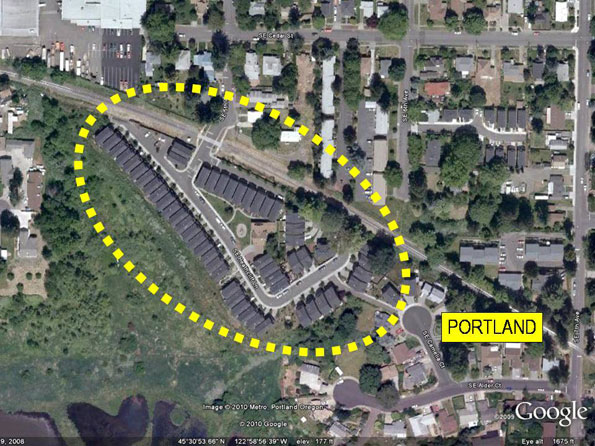
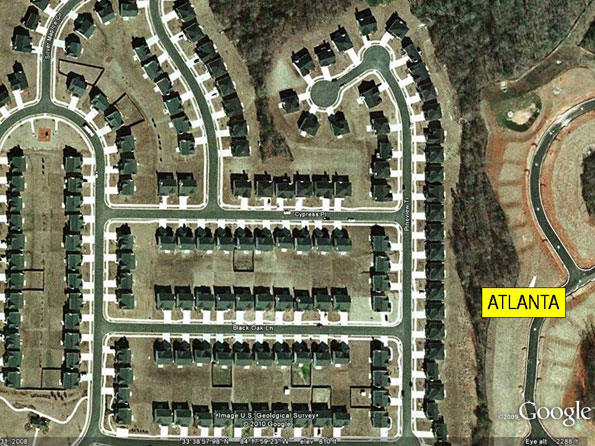
    But there is more to the story. Portland’s heavy handed planning policies are distorting product offerings so much that only the richest can afford more than a miniature back yard. This is illustrated by the images of new housing developments below in the suburbs of Portland and Atlanta (below). Both pictures are taken from approximately 1,500 feet above the ground.

    In the Portland example, virtually on the fringe of the urban area (the next urbanization is at least 10 miles away); houses are stacked in at more than 15 to the acre, with just a few feet between the roof-lines – vaguely reminiscent of third world shantytowns (Note 2). The more traditional suburban development that characterizes most of Portland is also shown on three sides of the overly dense new development.

    In the Atlanta example, houses have been recently built at about 4 to the acre, which has been the American suburban norm (except where land use regulations have required larger lots). The emerging sameness of Portland’s housing gives new meaning to the “ticky tack” criticism of suburbanization.

    Our 6th Annual Demographia International Housing Affordability Survey found Atlanta to be the second most affordable metropolitan area with more than 1,000,000 residents and the 17th most affordable metropolitan area out of 272 markets in six nations. Portland ranked 180th. Atlanta is truly a land of opportunity for young households and lower middle income households that can never hope of owning their own home in Portland’s pricey, growth management driven market.

    Rather than being a shameful example of metropolitan disaster, Atlanta remains one of the diminishing number of American urban areas where the American Dream can still be offered at a price that middle income households can afford. Atlanta has also emerged as one of the world’s best examples of ethnic diversity, not only in the core but also in the suburbs. More than half of the new residents in the suburbs have been non-Anglo since 1990 in Atlanta, about which it can proud. Atlanta is inferior only in the quality of is public relations and self-understanding. It should be a required stop for planners from Portland and beyond, for remedial education on injecting humanity and aspiration back into urbanization.


    Note 1: Bookman also notes in his column that Portland’s traffic congestion has not worsened at the rate I predicted in a 1999 Atlanta Constitution oped. I had not anticipated the huge gasoline price increases, which have materially reduced the rate of traffic growth virtually everywhere and made previous congestion increase rates unreliable as predictors of future growth.

    Note 2: For example, see the similar rooflines in a Dhaka shantytown near Gulshan at 23:47 North and 90:24 East in Google Earth. The principal difference in roof lines is the Dhaka slum’s lack of streets and cars, both of which seem consistent with the anti-mobility stance of “smart growth” planning.

    Wendell Cox is a Visiting Professor, Conservatoire National des Arts et Metiers, Paris. He was born in Los Angeles and was appointed to three terms on the Los Angeles County Transportation Commission by Mayor Tom Bradley. He is the author of “War on the Dream: How Anti-Sprawl Policy Threatens the Quality of Life.

    Photo: hyku

  • Oregon Tries to Catch California – On the way down!

    Oregon’s voters will soon give their judgment on Measures 66 and 67, measures that will raise income and corporate taxes in the recession-ravaged state – with unemployment at 11.1 percent, the eighth highest in the nation. Besides leaving the state with the highest marginal rate in the country, tied with Hawaii, more insidiously measure 67 will impose a minimum tax based on sales, not profits, implying an infinite marginal tax rate for low-profit companies.

    This is not good news for businesses and citizens of Oregon. In a report titled Tax Policy and the Oregon Economy: The Effects of Measures 66 and 67, Two Cascade Policy Institute economists, Eric Fruits and Randall Pozdena, thoroughly review the literature on the impacts of tax increases on jobs and domestic migration, and they rigorously analyze the measures’ impact on Oregon jobs and migration.

    They estimate the new measures through 2018, will cost Oregon employment losses of “approximately 47,000.”

    Finally, Fruits and Pozdena examine the impacts of measures 66 and 67 on migration. They find that adoption of measures 66 and 67 will result in the loss of approximately 80,000 Oregon tax filers with a loss of $5.6 billion in adjusted gross income.

    These results have to be taken as the minimum impacts. Fruits and Pozdena are careful researchers. They do nothing that is not completely defensible. Consequently, because of statistical issues, some of the potential impacts, particularly those of measure 67’s minimum tax based on sales are almost surely under measured.

    Clearly Oregon , where many residents look down on the increasingly bedraggled Golden State seems anxious to follow California’s decline trajectory. We all know how that story ends: high unemployment, domestic out-migration, declining jobs, declining opportunity, and a vanishing middleclass.

    I am not alone in seeing the warning signs.

    The PEW Center on the States issued a report in November 2009 titled Beyond California: States in Fiscal Peril. PEW created an index using foreclosure rates, job losses, state revenues, budget gaps supermajority requirements, and money-management practices. The index resulted in values ranging from 6, Wyoming, to 30 California. Higher values are bad here, and the closer to California’s 30, the more a state is at risk of California-style fiscal problems. Oregon, with a value of 26 is listed as one of nine states that the PEW researchers consider at high risk.

    Then there’s Small Business & Entrepreneurship Council’s recently released Small Business Survival Index. They use a much larger set of variables to create their index of public policy climates for entrepreneurship, a total of 39 indicators covering tax policy, regulation, crime rates, costs, and more. This index results in values ranging from 25.7 for South Dakota to 84 for the District of Columbia. As with the previous index, high numbers are bad. California, with a score of 77.7 is the second worst state, behind only New Jersey. Oregon’s score is 65.2, the 38th among states, and dangerously close to California’s score.

  • California Disease: Oregon at Risk of Economic Malady

    California has been exporting people to Oregon for many years, even amid the recession in both states.

    Indeed, the 2005 American Community Survey report shows that California-to-Oregon migration was 56,379 in 2005, the sixth-largest interstate flow in the United States. The 2000 census showed a five-year flow of 138,836 people, the eighth-largest over that time period. Until two years ago, Oregon was managing to absorb this population with mixed results, but generally as part of an expanding and diversifying economy. But that pattern has ended, at least for now.

    So now what will Oregon do with a suddenly excess population? California, at least, can say its emigres over time will reduce unemployment and reduce out-of-whack property prices. The immediate net benefits for Oregon are harder to discern.

    California’s massive economic collapse — which has resulted in 926,700 jobs lost from July 2007 through June 2009 and an unemployment rate of 11.6 percent — is now becoming Oregon’s problem. As Californians, largely for lifestyle and cost reasons, head north across the border, they have helped swell Oregon’s ranks of both unemployed and, perhaps equally important, underemployed.

    Our analysis of California migrants has shown a gradual reduction in their earnings over what they were earning in the Golden State. There also are less quantifiable impacts. Portland, a city attractive to many unemployed and underemployed younger Californians, could well be becoming the “slacker” capital of the world.

    There’s another major problem with the continuing California migration. Along with young people, newcomers to the state also include large numbers of the retired and semi-retired. These people generally have little interest in economic growth, whether for longtime state residents or their fellow, often younger emigres. Instead what they bring with them are political attitudes that could slow down the state’s economic recovery.

    Some might call this California disease. This refers to a chronic inability to make hard decisions as well as a general disregard for business and economic activity.

    California’s inability to plan or create new public infrastructure affects every part of the state’s economy. California was once a leader in building infrastructure, but that was in Pat Brown’s gubernatorial administration in the 1960s when California last planned a major infrastructure project.

    There are consequences to California’s inability to deal with infrastructure. Its freeways are parking lots. Its water problems are threatening the viability of Central Valley agriculture, one of the key drivers of the state’s economy. Its electrical system is so bad that every summer brings the fear of interruptions in the supply of electricity. Its universities are in decline. Its prisons are overcrowded.

    Another symptom of California disease is regulation and red tape that increases the uncertainty for any project and raises the cost.

    California projects can be in planning for years, and at the end of that planning process they may still be denied. The long delays are expensive. And as many would-be California developers will tell you, the uncertainty is a strong detriment to economic activity and development.

    We also see symptoms of California disease in tax policy. California no longer has the United States’ highest income tax rate. Big deal. With a top income tax rate of 10.3 percent, sales taxes that can reach 10.25 percent and a 33.9 cents-per-gallon gas tax, its total taxes are among the highest in the country.

    California’s regulatory climate also reflects the disease. Even as the state endures its most brutal recession in decades, it persists in unilaterally imposing new regulation, making the state less competitive with other states.

    In short, California is whistling past the graveyard, hoping that its economy will rebound, “because it always has.”

    Key symptoms of California disease are forgetting that quality of life begins with a job and negative domestic migration.

    With all the influx of Californians, it’s not surprising that Oregon shows some signs of California disease. It recently increased its tax rates so that Oregon’s highest-income taxpayers face marginal tax rates that match Hawaii’s for the highest in the nation. Oregon’s land-use planning had been extremely centralized for some time. Indeed, Oregon’s land-use planning may be the most centralized in the United States. This makes it harder for communities to control their own destinies, whether they want to grow or not.

    If Oregon does have California disease, the malady is surely not as advanced as it is in California. Oregon has lower gasoline taxes and lower property taxes than California. Oregon, in contrast with California, enjoys net positive domestic migration. It is also a good sign that a significant percentage of the people moving to Oregon from California are young folks. While it seems to many that the typical California immigrant is a wealthy aging baby boomer, the data show that he (or she) is still most likely a young person in his 20s or 30s, and often married with children. They are people who, if the economy grew, could have something to contribute to the economy as well as the cultural development of the state.

    But Oregon’s relationship with California remains a double-edged sword. On the one hand, Oregon has benefited from the inflow of cash and skilled workers. On the other hand, Oregon’s relationship with California has led to the current situation where at 12.2 percent for the month of June, Oregon has one of the highest unemployment rates in the United States.

    Oregon may be at a crossroads. The state is richly endowed with many of the components of a high quality of life. People want to live in Oregon, and they are moving to Oregon even in hard times. Yet as the population swells, there’s no concurrent growth in businesses and employment. Over time, this could pose serious problems. Remember, quality of life begins with a job, preferably a rewarding, well-paying job.

    However, Oregon must avoid making many decisions that led to California’s current situation. The costs of California disease are more than those reflected in the economic statistics. Devastated communities and families, and wasted opportunities, could infect this fair state for years to come.

    Joel Kotkin is author of “The City: A Global History.” Bill Watkins is director of the Center for Economic Research and Forecasting at California Lutheran University.

  • Oregon Fail: With Hard Times Ahead for Business and Real Estate, It’s Time to Look Small

    There is something about Oregon that ignites something close to poetic inspiration, even among the most level-headed types. When I asked Hank Hoell recently about the state, he waxed on about hiking the spectacular Cascades, the dreamy coastal towns and the rich farmlands of the green Willamette Valley.

    “Oregon,” enthused Hoell, president of LibertyBank, the state’s largest privately owned bank, from his office in Eugene, “is America’s best-kept secret. If quality of life matters at all, Oregon has it in spades. It is as good as it gets. It’s just superb.”

    As developer Shelly Klapper, a rare skeptic in the Beaver State, reminded me: “This is a state that buys its own hype.”

    Hype or not, however, Oregon is hurting – something that’s clear to even the most self-respecting narcissist. Over the past year, Oregon’s economy has fallen off a cliff just about as fast as any state in the union.

    A year ago, things seemed very different. Sunbelt boom states like California, Arizona and Nevada were already heading into deep recession, but green Oregon seemed oddly golden. Both its small cites and one big town, Portland, were outperforming the national norms. Oregonians saw their state as better – not only in terms of green and good, but also in terms of basic job growth.

    But since last winter, Oregon’s unemployment rate has soared from barely 5.5% to well over 8%, the sixth worst in the nation. Indeed, according to a recent projection by the University of California at Santa Barbara (UCSB), Oregon’s jobless rate could reach close to 10% by the end of the year.

    Well into 2010, Oregon’s overall economy will shrink more rapidly than the nation’s as a whole, notes UCSB forecaster Bill Watkins. He traces a sharp downturn there to many factors, including one of the toughest regulatory regimes in North America.

    In tough times, companies generally expand in localities that are friendly to commerce – say, states like Texas or nearby Idaho. Few would rate Oregon highly in that regard.

    “Oregon is mostly a place that focuses on the enjoyment of its space, and that makes [it] very vulnerable in these conditions,” Watkins says.

    The other big problem has to do with a lack of economic diversity. Oregon has been through tough times before. For much of its history, the state’s economy depended largely on harvesting its vast forests. Then, in the 1980s, the state developed a green bug, and decided it shouldn’t chop down Mother Nature for a living.

    In the ensuing decade, Oregon pioneered tough land-use regulations, curbing industries that relied on forest products and declaring war on suburban sprawl. Its main city, Portland, became the poster child of the “smart growth” movement by forcing up density, building an extensive light-rail system and restoring its urban core.

    Although widely praised, these stringent regulations also drove up land prices and, ironically, prompted many middle-class residents to move away, including across the border into Washington. Businesses, rather than cluster in the state’s core, continued to migrate to the outer rings; in the relatively healthy year of 2005, for example, barely 10% of Portland’s office space growth took place in the central district.

    “We give lip service to the economy here,” admits Klapper, a longtime Portland entrepreneur and a former official with the Port of Portland. “But, really, business is not a priority here.”

    For a while, Klapper notes, the tech sector seemed to offer the solution. In the ’80s and ’90s, chip makers fleeing even higher costs in California flooded into Oregon, which was proudly dubbed the “Silicon Forest.” In an unusual move, the state provided tax breaks to the chip makers, which helped. The state’s suburbs also proved attractive to tech workers who could afford a far better quality of life there, in terms of schools and housing, than they could in the Golden State.

    But as regulations tightened and costs to businesses and families increased, even the high-tech industry began to fade. Always a political bellwether state, Oregon has moved inexorably left, increasingly dominated by both its public sector and the particularly strong green movement. Semiconductor expansion soon started to go south – or in this case, further east (to Idaho) or across the Pacific to Asia.

    Only one thing remained to drive the economy: housing. A torrent of Californians were heading north – cashing out of the overpriced Bay Area, Sacramento and Los Angeles – and buying new homes in Oregon. Some sophistos sashayed their way into trendy places like Portland’s Pearl District, but many others looked to the charming smaller towns of the Willamette Valley and central Oregon.

    “When all else failed, it was people moving here that kept us going,” says Klapper, who was a major investor in the Pearl District renaissance. “California became our biggest industry.”

    This dependence turned into a debilitating addiction. When in 2007, the great California housing bubble collapsed, the inflow of people and dollars dropped off. Meanwhile, the remnants of lumber industry fell victim to the housing bust.

    Nowhere are the effects of this clearer than in Bend, a spectacular town of 75,000 located amid volcanic peaks in the center of the state. Californians had considered Bend a favorite spot for second homes and relocation. About a year ago, notes real estate appraiser Steve Pistole, prices were rising 2% a month, while those in Portland were “only” rising 8% a year.

    But to visit Bend now is to be in the eye of the housing hurricane, with nearly deserted housing tracts, woefully empty hotels and residential second-home developments. Unemployment in the housing arena, according to the UCSB, could reach 15% next year.

    We can also expect a further slide in housing prices. Oregon’s bubble, notes analyst Wendell Cox, inflated later than California’s, so prices, which have dropped more than 10% in the last year, could fall by that much or more in the next.

    Yet despite all these problems, many Oregonians remain optimistic. Some of this seems, at least fundamentally, a reflection of ideology. The inevitable huge surge of “green jobs” promised by the Obama administration has long been an article of faith in the state; it seems something like a story we’d tell our children to put them to sleep. State officials, for example, speak wistfully of replacing a recently shuttered Korean-owned Hynix chip plant with a facility to make solar panels.

    The bad news is this: 49 other states – some of which don’t pose such strong regulatory challenges – also hope to bring home some of these green jobs. So if business logic applies, the new factories that manufacture wind turbines, propellers or solar panels will end up in states like North Dakota or Texas, which have been the most successful, thus far, at attracting other manufacturing jobs.

    So what trail should Oregon blaze now? Pistole, the real estate appraiser, says it may be time to think small. Places like Bend, he notes, already attract former Silicon Valley veterans who like living close to trout streams, hiking trails and golf courses.

    “There is no magic bullet for Oregon,” says Pistole, who himself moved from California just three years ago. “But there could be lots of onesies, twosies, mom-and-pops. People still want to live here. We have to make it synergistic to live where you want and still make money. That’s the way we need to go.”

    Some entrepreneurs, like 38-year-old Michael Taus, are already setting up such small shops, some of them in their homes. A recent arrival from Los Angeles, Taus made it big as one of the founders of Rent.com, which was sold to eBay in 2005. He’s only lived in Bend for a few months, but he has already launched his own start-up and consults for several other local firms.

    Taus believes others of his generation will want to establish businesses in Oregon, lured by both its lifestyle and affordability. Some of the new business may be in software, Taus says, but others could sprout in specialty agriculture, wood products and other industries.

    “People are here for a reason. There’s a good amount of talent, and you can get more here,” he says earnestly. “There’s a great potential. We just have to get down to business.”

    This article originally appeared at Forbes.

    Joel Kotkin is executive editor of NewGeography.com and is a presidential fellow in urban futures at Chapman University. He is author of The City: A Global History and is finishing a book on the American future.
  • Oregon’s Immigration Question: Addressing the Surge in the Face of Recession

    The men huddle outside the trailer, eyeing the passing traffic. Handmade signs stapled to telephone posts speak for them: “Hire a Day Worker!” The site, a fenced-in lot at Northeast MLK and Everett Street, was launched in 2007, a testament both to Oregon’s recent immigration boom and lack of federal reform.

    Since then, Obama’s historic campaign, several wars and a global recession have pushed the immigration question from the national headlines. But in Oregon – where the surging migrant population is on a crash course with a withering economy – the issue is bound to reignite.

    Oregon’s economic boom, which started later than that in the rest of country, has ended. Unemployment has risen considerably. Oregon’s 9.0 percent unemployment rate was the nation’s 6th worst in December 2008 according to the Bureau of Labor Statistics.

    At the eye of the storm have been losses in the construction industry, a major employer of immigrants. The hard times there will put new pressure on local legislators and law officials to “clean out immigrants”. Oregonians should not give in to such misguided temptations. Oregon’s immigrants have played a historic role in enriching the state’s economy and can continue to do so if given the opportunity.

    Oregon’s immigration explosion is relatively new. The state’s foreign-born make up 9.5 percent of the population, with more than 60 percent of the immigrant population arriving after 1990, according to 2005 census data.

    The influx of Latinos to the state is even more recent. Estimates place 75 percent of Latinos coming between 1995 and 2005. Unlike other immigrants who tend to concentrate to urban and suburban areas, Latinos are dispersing across Oregon. Between 1990 and 2000, the Latino population doubled in 21 of Oregon’s 36 mostly-rural counties. Agriculture employment, cheap housing, and existing Latino communities attract the rural migration.

    Within the Portland metro area, the largest concentrations of foreign-born population live in Southeast Portland (Ukrainians, Russians, Romanians), Northeast Portland (Vietnamese, Africans), and Central Portland (Asians, Eastern Europeans), according to a study by the Urban Institute. Notably, more Russians and Ukrainians moved to Oregon’s suburbs between 2000 and 2005 than to any other region in the nation, according to a recent University of Oregon study.

    Currently, immigrants total over 11 percent of the state’s labor force, up from 5.4 percent in 1990. Yet native unemployment did not increase during this time period.

    One reason for this, argues MIT’s Tamar Jacoby in a recent Foreign Affairs article, is that the immigrant workforce should be viewed as complementary rather than competitive to the native workforce. For example, the business owner who can hire housekeepers and landscapers can devote more time to growing his business, and to leisurely expenditures that support other local businesses.

    Oregon’s diverse agricultural industries – ranking third nationally for labor-intensive crops – offer a more concrete example of the complimentary nature of immigrants.

    The state is home to a $325 million dairy and cattle milk production industry, a $778 million nursery and greenhouse industry, a $380 million fruit and nut industry, and a $200 million wine industry. All are primarily staffed by immigrants. In this case, immigrant labor allows Oregon’s agricultural sectors to thrive in the face of fierce import competition.

    Immigrants have historically had a strong entrepreneurial spirit. Nationwide, 25.3 percent of technology and engineering companies had at least one foreign born key founder, based on a Duke University study. Often with few resources or formal education, immigrant entrepreneurship can foster new kinds of services. The abundance of landscaping businesses and nail salons is a testament to such ingenuity. In 2005, over 6,000 Latino and 400 Slavic entrepreneurs operated throughout the Portland metro area, according to one University of Oregon study.

    Beyond providing jobs and fueling local economies, immigrant entrepreneurs bring the benefits of globalization to places like Oregon. They encourage trade and investment from their connections abroad.

    Immigrants pay taxes, buy houses, food, cars, and clothes just like native residents. Even illegal immigrants – which many immigration-demagogues label as the real problem – have taxes withheld from their paychecks. They also otherwise bring money to the state through sales taxes on local purchases. A study by the Oregon Center for Public Policy found that undocumented immigrants contribute between $134 million and $187 million in taxes annually to Oregon’s economy. These numbers represent only those coming from undocumented workers and exclude the significant investments made through entrepreneurship, agricultural support and the continual purchase of goods and services.

    Yet serious immigration reform is needed. A large portion of immigrants spends only stints working in the states, frequently sending money back home. The consequences of this go beyond the obvious fiscal drain. The stint worker will invest minimally in learning English, will often share rent in decrepit neighborhoods, and spend as little as possible in order to maximize savings for abroad.

    The problem facing Oregonians is not immigration per se – or even illegal immigration, which constitutes only 10 percent of the migration to the state. The real problem is stint immigrants, who invest little in the long-term health of their new communities and the economy of the state.

    The curious delusion about this point is that current federal legislation includes temporary-worker permits as key to reform. By giving only temporary permits to immigrants who might otherwise be coaxed into permanent stay, Washington is explicitly discouraging acculturation and encouraging capital drains.

    In large part, the real solution to the downsides of immigration lies in the permanent integration of Oregon’s new residents. When these residents feel they may be here permanently – without constant threat of deportation – they will be more likely to invest in their new communities and futures.

    Even the state’s recent job-shedding should not derail Oregonians’ historic acceptance of foreign residents. Oregon’s immigrants will stabilize agriculture and other service industries by providing cheap labor through hard times.

    If the incoming administration manages the recession correctly, Oregon’s economy will soon recover. To rebound quickly, the state will need to employ thousands – natives and immigrants – in the infrastructure and Green packages coming from Washington. Oregon’s post-recession economy, like its pre-recession economy, will depend on immigrant labor.

    A comprehensive understanding of Oregon’s immigration question must go beyond viewing the huddle of men on MLK and Everett every morning as mere numbers, bodies for pay.

    A true understanding of the issue will surface only by looking beyond the numbers to recognize these men’s potential, resourcefulness and culture as indispensable components that once shaped our nation’s identity and will continue to mold its future.

    Ilie Mitaru is the founder and director of WebRoots Campaigns, based in Portland, OR, the company offers web and New Media strategy solutions to non-profits, political campaigns and market-driven clients.

  • Oregon’s Fringes: A New Rural Alternative

    Once the bastion of a thriving rural middle class, Oregon’s rural communities are now barely scraping by. The state’s timber industry employed 81,400 residents at its peak in 1978. At the time, the industry made up 49% of all manufacturing jobs in the state according to the Oregon Employment Department.

    Since then, the recessions of the early eighties and nineties, increased land-use restriction, decreased timber supply, global competition and automation of the timber industry have devastated rural communities that relied on once-plentiful timber jobs. Total timber industry employment has dropped to barely 11,000. Long term forestry prospects are glum. The benefits of carbon sequestration, endangered species protections, growing green building industry and the desire to protect Oregon’s forests for recreation will continue to hamper extraction and employment opportunities.

    Meanwhile, residents of such places as the southwest town of Oakridge (pop, 4,000) are left with few options. As the last mill went in the early nineties, so did the jobs. Many left for employment in surrounding cities. Those who stay often work multiple minimum-wage retail shifts; a trailer or shared space is many times their only living option.

    Oregon’s rural places were wrecked not just because of the necessary industry shift (away from logging) but because of the lack of long-term planning required to accommodate that shift.

    The obvious decline in timber employment called for a multi-generational plan to re-invent the state’s rural communities. Instead, towns like Oakridge were allowed to sink until the situation became bleak enough to gain state attention. What followed was reactionary policy that mandated mostly welfare and other band-aid solutions.

    The current situation calls for a more drastic plan that will once again restore Oregon’s proud rural tradition. The initial step is recognizing that rural Oregon – if the state is to preserve its natural resources and provide healthy communities for its residents – must transition from a rural layout to denser small town formations. The state lacks the resources, population density and geographic appeal to allow all of rural Oregon to make this change.

    Instead, select areas with the potential for turn-around should be identified across the state and given special attention in making the transition. At best, this should come from the ground up: through the initiative of local communities. These “New Towns” will be allotted state resources and special legislation to reinvent themselves as more compact and sustainable communities with the capacity of attracting skilled workers and business alike.

    Rather than attempt to wrestle with every factor in the discussion of the New Town model, what follows is a broad outline of the more crucial considerations suggested by such an approach . This leaves much open to discussion, to which the reader is invited to contribute.

    First, Oregon’s historically strict land-use regulations need to be re-evaluated. Instead of discouraging development, it should be encouraged within the New Town boundaries by incentive packages to developers who add an element of “community value” to their projects. Projects that are built sustainably, offer employment, scenic access, cultural attractions, restaurants, and/or retail options will qualify for the incentives.

    Of course many oppose almost any further development across rural Oregon. But in reality we really have two options: either accept a future of rural disenfranchisement and resource extraction; or concentrate resources, re-zone, and intelligently build new, economically as well as environmentally sustainable towns across Oregon.

    Alternative energy companies such as SolarWorld, Vestas and Solaicx, Inc. are just a handful of the dozens of renewable energy companies running or planning new facilities in Oregon.

    Initially, these firms have clustered around Portland or its surrounding suburbs. But factors such as dwindling space and access to workers could drive these firms further outwards. The right incentives package, inexpensive land and labor would make the New Towns an attractive option for the green industry in the coming years.

    Green business could provide one foundation for these places. Once the green industry demonstrates confidence in the New Town model, other economic players would likely follow. These include industries – such as food processing, data centers and specialized services – that could also be nurtured successfully, as has occurred in smaller communities elsewhere in the region.

    The New Town proposal also offers a viable solution to Oregon’s expected population growth. Between 1980 and 2006, the Oregon population grew from 2.6 million to 3.7 million, an increase of 40.5 percent. By 2050 population growth for the state is projected at 5.8 million according to the Northwest Rural Development Center using U.S. Census data.

    The state’s population growth – mainly from immigration and domestic migrants – will be attracted to locales with affordable housing and job opportunities. So far this has translated into a largely urban migration. Growth within cities or in their surrounding suburbs increased by as much as 50%, while non-metro growth increased by only 19%.

    As long as jobs remain in or near the handful of cities Oregon has to offer, these trends will continue. Fortunately, the majority of newcomers are not drawn primarily by urban amenities. Inexpensive housing, job opportunities, and scenic attractions could compensate nicely for the increasing cost and congestion that accompanies urban living.

    The development of the suburbs stemmed from the desire to escape the urban core’s problems. The suburbs continue to surround our cities because of the resources and job availability. However, there is little reason that with the digital revolution and the coming green revolution, once-isolated towns cannot become self sustainable and very desirable.

    Many readers will feel uneasy by the suggestion of deliberately spurring growth in particular places while allowing others to wane. It seems to go against free market ideology and even to be unauthentic.

    Yet a change is needed. These places initially thrived because they were located near natural resources. By shifting from extraction industries, the basis of the local economy has shifted. The whole approach to town development needs to be readjusted to meet these new realities.

    Without a complete shift in how planners view and design for the spaces across the entire state, the rural poor will continue to struggle, while population increases will make our metropolitan areas less and less attractive. The New Town model could present a viable option to the contemporary problems Oregonians face and perhaps to other problems now only on the horizon.

    Ilie Mitaru is the founder and director of WebRoots Campaigns, based in Portland, OR, the company offers web and New Media strategy solutions.