Tag: Orlando

  • Florida: When Your Best (Place) Just Ain’t Good Enough

    Real estate broker Coldwell Banker handles corporate relocations for a large portion of our middle class. It recently released a survey of Suburbanite Best Places to Live. While it’s easy to dismiss as a sales tool for their realtors, the survey provides a fascinating glimpse of middle class, suburban preferences, influenced by our current economy. Coldwell Banker’s top honors go to Cherry Hills Village, Colorado, a suburb of Denver. Suburbs of Seattle, New York City, Washington, DC, and other prominent cities feature strongly on Coldwell Banker’s list, which highlights places that are sprinkled evenly throughout the United States. Notably missing are any communities in Florida.

    For a state with sunshine, beaches, and low taxes, Florida just doesn’t have the chops to get even one community onto the top 100 list.

    Weather, evidently, has little to do with our middle class’s desirable locations. Frigid Whitefish Bay, just south of Milwaukee, captured spot #100. Situated along the shore of Lake Michigan, this suburb of 14,000 doesn’t exactly have the kind of weather that makes people flock to the beach. Instead, it offers residents a strong sense of community, heritage, and a culture that values education and family. If you move here, you’ll find yourself within a suburban community with a high homeownership ratio, an educated population, and a quality of life that includes short commutes, low crime rates, close conveniences, and a tendency to eat at home.

    Suburban living has maintained a strong appeal for middle-class Americans due to the popularity of many of the factors on which Coldwell Banker based its rankings. While socialites prefer more urban, dense lifestyles (which is another list that Banker recently produced), suburbanites prefer backyards and quieter neighborhoods away from the hustle and bustle of the city; they don’t need to be near the action. Florida has all these things in abundance, except when compared to… almost everywhere else.

    Windermere, Florida’s top ranked suburb, came closest, ranking just below Whitefish Bay and a couple of others. Like most suburbs on the list, Windermere is on the periphery of a large metropolitan area (Orlando), and contains conveniences, good schools, parks, and recreation facilities.

    For much of its history, Florida represented the suburban American dream. The net benefits included an affordable cost of living and upward mobility, and Florida’s growth has consisted almost entirely of suburban densities. No one can accuse Florida developers of building communities that people didn’t want – the product was carefully researched to fit the market.

    In the late period of the boom, urban options were also developed, in the belief that a new demand for socialite “downtown” style living would emerge. Townhomes and condominiums rose in Florida’s primary and secondary urban markets. Even tertiary cities like Sanford, a historic agricultural town north of Orlando, begot a six-story condo. Those who migrated from Chicago and the dense Northeast now had a diverse set of choices, from rural to urban, with something to please everybody.

    It is perhaps this dilution of the market that has made Florida’s star fade a bit in relation to the national constellation of suburbs. If East Grand Rapids, Michigan (Coldwell Banker’s #8) can outrank the hundreds of suburbs around Tampa, Miami, Jacksonville, Tallahassee, and Orlando, there’s something else going on besides beauty.

    One thing that many of the top 100 have in common is a strong public education system. Florida, which has refused to invest in education, may now be harvesting the bitter fruit of this stubborn negligence. The state’s primary growth today continues to be in retirees who are uninterested in supporting education, and who control a large part of the state’s political power.

    Another aspect that the top 100 suburbs offer is safety. “Safety is a priority,” states the opening page of this survey, but it simply isn’t something that most people associate with the Sunshine State. A state that doesn’t offer a strong sense of personal safety isn’t going to rank highly, no matter what else is being offered. With two out of the ten most dangerous cities in the country, Florida seems more like the wild West than a suburbanite’s dream come true.

    Increasing public safety and public education are two efforts that government can do best, most people agree. Florida has spiraled downward on both fronts. The state’s leadership, by cutting taxes during the worst part of the recession, haven’t exactly helped the situation. With Florida’s new home sales up, the state’s economists are whistling a happy tune, convinced that the worst is over. But what Coldwell Banker is telling Florida is a different, darker story.

    Florida’s best offerings are attracting a population less interested in the core values stated in the Coldwell Banker survey – safety, good education, a sense of community – and so we continue to get more of the same. More population that reinforces Florida’s lack of investment in community, more population reluctant to put money into education, and more population that is quick to move somewhere else at the earliest opportunity seem to be Florida’s fate. This represents a lost opportunity to those who wish to see Florida make gains in these spheres – education, community, and safety. And it represents a lost opportunity to match up a truly beautiful place with truly involved people.

    Corporations seeking to relocate and recruit good people pay attention to these surveys. Florida’s low taxes may lure a few more down south, but if corporations need to attract and retain top talent, this survey points to where they are likely to go, regardless of the incentives our state has to offer.

    Places like Whitefish Bay, Wisconsin; Rossmoor, California; and Haworth, New Jersey will continue to gain in the type of population that share these same values. The middle class, fighting its way back from a threatened extinction, isn’t likely to take a chance on a place that has a rapidly degrading quality of life. Until Florida’s culture starts caring about the quality of its community, safety, and education, our state will continue to grow without flourishing as a place where people desire to be.

    Richard Reep is an architect and artist who lives in Winter Park, Florida. His practice has centered around hospitality-driven mixed use, and he has contributed in various capacities to urban mixed-use projects, both nationally and internationally, for the last 25 years.

    Bigstock photo: Florida Housing
  • Swing State Geography: The I-4 Corridor

    Overheated presidential politics have done few favors to Florida, except to put 132 miles of hot asphalt on everyone’s lips:  Interstate 4.  Completed in the late 1960s, this interstate (in fact, the only interstate highway to be entirely contained within one state) is known by millions who have  visited there at least once on vacation.  But the social and political reality in the world  around Interstate 4 is little known outside of Central Florida.  Like Ypres, the Flemish town continually under assault during World War 1, I-4 will receive the brunt of both side’s forces.  It deserves to be known a bit for its quirky uniqueness,   even if, like Ypres, it will recede to obscurity once the election is over.

    America’s other single-digit interstate, I-5 in southern California, has such a singular personality that its users refer to it as “the five.” Not so I-4, although many users spit when they say it. With the third highest accident rate in the nation with 1.58 fatal accidents per mile 2004-2008 , Interstate 4 is notorious   for its congestion, dangerous drivers and bad karma. A section of it is even rumored to be haunted.

    I-4 begins rather inauspiciously in Tampa, at a highway interchange with I-275 that even the state Department of Transportation calls “malfunction junction.”   Tampa itself is a brew of German, Italian, Spanish, and Cuban immigrants largely supplanted in the 1980s by in-migration from other states. With a port poised to take advantage of Tampa’s proximity to the Panama Canal, Tampa, and its sister city, St. Petersburg, offer a fantastic coastal setting for urban development. 

    Unfortunately, the two cities now squabble eternally over what has recently been diminishing economic opportunity, often leaving their geography a large, low-grade commercial wasteland. With little to offer except beaches and waterfront real estate, Tampa and St. Pete struggle for their existence. Their airport,  considered the world’s best in the 1980s and 1990s, has been overtaken by newer, better facilities in Orlando, Denver, and other international cities, and like Tampa in general, it suffers as a has-been. No matter; Tampa’s feisty nightlife has turned Ybor City from a quaint, vacant historic district into a wet-zoned bar district that still houses the best music scene in Central Florida.

    Over the bay, St. Petersburg features lovely waterfront sidewalk life with delightful galleries and museums, but it remains “God’s waiting room” with shuffleboard courts and early bird specials at local diners. Beautiful older neighborhoods surround both downtowns, but the outer-ring growth that reaches out beyond these prewar suburbs seems unremarkable and bland. The area, once a diverse mix of blue-collar industry and office workers, has lost a lot of both.

    St. Petersburg is set in Pinellas County, a peninsula that reaches downward just as the San Francisco bay area’s peninsula reaches upward.  But as San Francisco took off  Pinellas did not.  Even the gulf coast of Pinellas County, with beautiful beaches, fails to reach its potential, housing gritty, second-rate motels and paint-peeled condos catering to vacationers unable to afford Sarasota further on down the shore.

    Downtown Tampa these days possesses the sad, romantic air of places once important but now in a state of vanished grandeur. The sidewalks are harsh, bricky, and hot; almost no one traverses the sun-grilled open space at noon. Vacant, boarded-up storefronts are prevalent, punctuated by sleazy, vacant eateries. Channelside, a redeveloped area between downtown and the historic district, has suffered the blight of new, cheesy-looking condominiums built over storefronts, awaiting the throngs of young singles seeking an urban lifestyle but never quite arriving. Channelside looks like an empty stage set, et, “for lease” signs flapping in the breeze.

    Beltways like Interstate 4 can be dividers or uniters, and this one is both and neither at the same time.  East of Tampa, it makes little difference which side of I-4 you reside on; north of Interstate 4 is Temple Terrace and the University of South Florida, and south of Interstate 4 lies Brandon, an unincorporated town. Interstate 4 presents no barrier between the two sides, with fluid movement suggesting that in this section, I-4 presents no obstacle or defining boundary.

    Further east, however, one encounters the city of Lakeland, hanging like a pendulous fruit just south of the freeway. There is a rather fascinating notion that Florida’s urban areas are all aspects of one very large, complex web of urban settlement  most of whom are net consumers, taking in more than they produce. Unlovely Lakeland, the agro-industrial capital of central Florida, is just the opposite. Rich with phosphate, one of Florida’s only natural resources, Lakeland mines and processes this mineral for fertilizer and soap additives. It sends the phosphate by truck and by rail to the Port of Tampa for export.  Lakeland also processes orange juice and a variety of Florida’s agricultural products, and has clusters of food-packaging industries to support this activity. Lakeland, in the heart of what locals call “Florida Cracker country”, works hard and is definitively blue collar.

    North of I-4, Lakeland quickly fades into suburbs and ranchlands. Here, one passes through the Green Swamp, a wetlands that remains undeveloped and remote. An aviation museum reminds you that you are in Central Florida indeed, but little else of man’s handiwork is evident until US 27, an old, pre-war highway that runs along a nice, high ridge which brought so many people to Florida before the interstates came.

    As a boundary, Interstate 4 here is still largely symbolic, with a truck-stop cluster of gas stations and fast-food restaurants that eke out a living. On either side, however, the population remains rural and at this juncture, US 27 unites both sides of I-4, negating its myth as a boundary between red and blue Florida. By now, the alert traveler may have noticed that he is trending more northerly than easterly, and indeed Interstate 4 is slowly turning one to the north into the fringes of greater Orlando.

    At one time, Interstate 4 had seasonally fluctuating traffic. In the late summer heat, one could hit stretches of I-4 where no other cars could be seen on the horizon. Today, however, it frequently slows to parking-lot crawl on the outskirts of Lake Buena Vista. For this is the pleasantly named region in which Disney resides, and I-4 straddles this region. On the left side is Walt Disney World.  On the right side, Celebration:  Disney’s tribute to high-design community living.  Both sides lie within the Reedy Creek Improvement District, a self-governing singularity cleverly established by Walt Disney to prevent annoying regulation.

    The first time one arrives to this section of I-4, no matter what age, is special.  Little things like the power line pole artfully shaped like a Mickey Mouse or the words “Magic Kingdom” on the big green signboards.  Here, I-4 is a conduit of anticipation, a rim from which one anxiously departs to plunge into  a fantasy world.

    Flipping conventional wisdom on its head, cosmopolitan Orange County is mainly to the north of I-4, while Osceola County to the south is pretty much…well, country, in a Silver Spurs Rodeo sort of way. Osceola County houses a great deal of the service industry that maintains the machines of tourism. It also contains a large immigrant population, and the mix has raised tensions in this region. Presidential politics must intimately understand the problems of this county, or risk alienation of its voters over gaffes.

    As I-4 finally turns due north you pass through an area once considered Orange County’s back door, the county jail, large sewage treatment facilities, and Lockheed Martin all sit, surrounded now by development pressures and the occasional stray theme park. Universal Studios is surrounded by residents so close they can hear the screams from the roller coasters in their back yards. Holy Land is isolated, crammed against I-4’s huge wall; and the spectacle of International Drive, one of the most interesting and unstudied urban conditions ever, is visible from much of I-4 as one trends northward towards downtown.

    After twisting and turning through more blah suburbia, I-4 finally ascends to an elevated, straight bridge and threads its way past downtown Orlando.  This is actually, when traffic is flowing, a terrific urban experience, especially at night. To the right, Orlando’s small collection of meek towers, marked by the Captain Crunch hat of a failed condominium; to the left, the Magic’s basketball arena.  This drive continues northward through Orlando’s mosaic of adjacent towns. Younger than Florida’s average population, and largely from somewhere else, this region seems to be perpetually seeking itself, but never quite finding it. The allure of New York and Chicago seem to pick off the best and the brightest, but these folks are always backfilled with newcomers. With the leftist firebrand Alan Grayson   counterbalanced by the Tea Party’s right wing voice, Daniel Webster, the area will be critical in  this election season.

    Past Orlando’s heat and light, Interstate 4 traverses one last stretch of Florida’s untamed wilds, the Tomoka wetlands. This is the stretch that is rumored to be haunted, for traffic fatalities seem more common than normal as one traverses through region here. Perhaps the proximity of Cassadega , home to many spiritualists, has something to do with it, or perhaps the vengeful souls from a graveyard  supposedly under the roadbed are to blame. Either way, one is relieved to see signs of civilization when one finally reaches the end of Interstate 4 as it tees into I-95 near Daytona, Florida.

    One of many cities trying to reinvent itself, Daytona’s allegiance to Nascar and motorcycles is legendary, but it has suffered heavy joblessness and unsettlement in this Millennial Depression. With its share of overbuilt beachfront condos, an unusually blighted amusement park in the center of town, and a restless, angry inner-city population, Daytona’s dire straits resembles, in some ways, Detroit or other hard-hit areas. 

    And so, Interstate 4 begins and ends. Like Ypres, it may come to represent the battleground of an ugly war. The front at one end of I-4, St. Petersburg, represents genteel poverty, at the other the angry poor are looking for answers. In the middle, Orlando has the two extremes of political viewpoints personified by real candidates with passionate followers. Interstate 4, in the Orlando area, was a recipient of a new congressional district, thanks to population growth that continues into the state. What this population growth brings, and how it changes the character of this interesting, complex corridor, will be revealed after the election in November.

    Richard Reep is an architect and artist who lives in Winter Park, Florida. His practice has centered around hospitality-driven mixed use, and he has contributed in various capacities to urban mixed-use projects, both nationally and internationally, for the last 25 years.

    Interstate 4 sign photo by Bigstockphoto.com.

  • Localism As An Anti-Depressant

    Are we heading into a new era of local solutions?

    Western economists and governments usually measure the health of the job market by unemployment percentages, with unemployment defined as less-than-full-time employment. But the reality for many Americans today is more akin to the rest of the world. Dad may not have a full-time job, but instead works several part-time jobs – auto mechanic when there are customers, store clerk on the weekends, and perhaps furniture repair guy for the neighborhood. Mom probably has a few part-time jobs also: housekeeper at a nearby hotel, caterer, and babysitter. Children old enough to work may do odd jobs.

    This kind of economy may be more prevalent than economists think. It breeds neither hope nor health, especially since most remember the before-times.

    Active resistance to this dark vision likely means more local solutions to economic problems. Instead of the turnaround coming from above, it may instead come from below. Big oil, big finance, and their floundering politicians are not the place to look for answers anymore. This may come as no surprise to anyone who has watched the last four years worth of turmoil, but the media, which is caught up in this game, is missing a much bigger story.

    A good example from recent history is the turnaround performed by Boston’s North End neighborhood. Before World War II, this neighborhood was a classic immigrant community, and considered unhealthy, dangerous, and poor. After the war it was blacklisted by bankers who refused mortgages for home buyers, and the North End was cut off by the Central Artery highway running through the city. It became Boston’s odd, leftover district.

    But a mysterious thing happened to the North End. The nation’s great urbanist, Jane Jacobs, visited it in 1959 with the director of the Boston Housing Authority, who wanted to show her the neighborhood before it was razed in the name of urban renewal. What she saw was a vibrant, robust street life, beautifully restored buildings, tenements that had been repurposed for middle-income flats, and a sense of pride in the neighborhood. After researching the area, she discovered it had the lowest crime rate, disease rate, and mortality rate in the city. Jacobs successfully staved off the bulldozers, and the North End still exists as one of the most picturesque neighborhoods in America today.

    Because the North End was cut off by institutional investors, the neighborhood became economically introverted. Construction work was done on a cash or barter basis, and people made slow, incremental changes to their residences as the money became available. Instead of relying on banks for big credit infusions, North Enders relied on themselves.

    By the standards of mainstream economists like Paul Krugman, the economy seems to be unraveling. A different way to view this phenomenon is to see it as multiplexing: different channels are being created. When only one channel is effectively being considered, other channels are developed without much scrutiny.

    Tippy Perez is a typical example of someone who has tuned in to a local economic channel. As a paralegal for a large Orlando corporation with thousands of employees, Ms. Perez had job security, benefits, and the signature suburban lifestyle of the mainstream economy. Last year, however, she quit her job. “It was a dead-end job that wasn’t worth the fight anymore,” she stated. Between uncertain job security and the increasingly vicious corporate politics that come with the territory at such a large firm, her mainstream economy job simply could not hold her. After she quit Ms. Perez began a neighborhood pet-sitting service. Within a few months her home-based business has taken off, and she will never look back.

    It’s busy and demanding, and lacks such mainstream amenities as a 401K, vacation, and sick leave, and Ms. Perez left a fine professional career for the service industry. This move, however, has much greater appeal to her because she can regulate the pressure. The income, although smaller, comes with less stress. Corporate downshifters starting bike shops and farms have been around for some time, but those are usually stories of escape from an urban location. Ms. Perez is part of an increasing population that has chosen to stay in the same place, but to downshift out of the mainstream into the local economy, sometimes as local as the immediate neighborhood.

    Food trucks are another example. The restaurant world, so overrun by big brand franchises and chains, has been seriously challenged by a new form of dining with little overhead and a spicy, independent spirit. The popularity of these trucks comes from the fatigue we are suffering from the high prices and industrialized food production typical of so many restaurants today. Alert neighborhood organizations are combining food truck rallies with local farmers’ markets and other events to create new forms of public involvement. Without the regulatory burden that comes with public accommodations, food trucks are a sign of this new economy.

    The hallmark of each of these phenomena is its localism. As in the North End, no one is waiting for the big banks to come in and fix things. Instead, people are turning local needs into opportunities at a scale that is small enough that outside help is not needed. Under our very noses, a new economy is being born. Our towns and cities will adapt to this form long before it is noticed by the mainstream. The ingenuity and ambition of individuals will be the factors that bring us out of the Millennial Depression, and create a new economy for the future.

    Richard Reep is an architect and artist who lives in Winter Park, Florida. His practice has centered around hospitality-driven mixed use, and he has contributed in various capacities to urban mixed-use projects, both nationally and internationally, for the last 25 years.

    Flickr photo: Boston’s North End by P Medved

  • Midcentury Modern

    Midcentury modern tours now are taking place in cities all over the country. Renewed interest in this era capitalizes on the millennials’ interest in design from a time that seems almost impossibly optimistic compared to today’s zeitgeist. Most cities around the country boast a healthy building stock from this postwar period, nicknamed “the suburbs,” although these are ritually condemned – and designated for annihilation – by academics, urban land speculators and the urban clerisy.

    Yet the new interest in the mid-century modern form reflects its basic and enduring appeal. As the curious and the trendy take bus tours of these inner-ring neighborhoods, the forms of this era evoke a sense of great confidence and faith in the future, both of which seem to be lost in the obsession with neo-traditional forms that hearken to the pre-car era or to the cartoonlike, sculpture-as-architecture one sees in many urban centers.

    Suburban expansion after World War II reached out beyond the streetcar systems that created the traditional neighborhoods of the late 19thand early 20th Century. The returning GIs wanted something simple and affordable to begin their lives after serving their country. Confidence surged in America’s know-how and ability to solve even the deepest social problems. The triumph of science and technology was a palpable presence. The dark side, of course, was the atomic threat, restraining our enthusiasm but only a little.

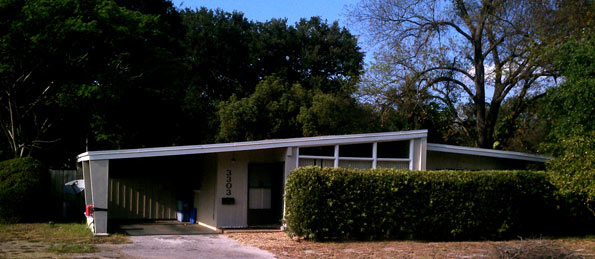
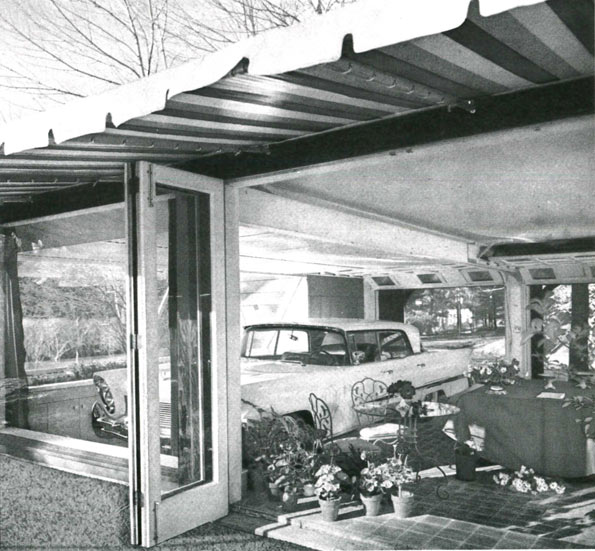
    In this midcentury era, planning and design began to be car-based. Residences were designed to show off the car, putting it out front for display – and some home plans even had tailfinned beauties in the living room


    Living Garage, photo from Populuxe by Thomas Hine

    Consumer goods were no longer accessed on foot; a new form of luxury consisted of driving up to the front door of a shop with parking in front. Front-loading houses and stores became unquestionably more efficient as a means to accommodate the new American lifestyle.

    Yet despite the auto-orientation, the architecture of this era retained the pedestrian scale and intimate feel that marked Main Street before World War 2. This both/and aesthetic marks the form of the 1940s and 1950s, with streamlined design styles like Art Deco Revival and materials like glass and stainless steel. Gentle angles suggested motion, and the theme of mobility was everywhere in the architecture.  Wider streets and lower, longer horizontal lines accommodated this theme and even today the architecture reinforces a feel of motion when driving past these structures.

    Modernism also formed a certain ethic. To be modern was more than a lifestyle choice; it was an acceptance of science, knowledge, and technology, free from preconceptions.  At the time, modernism elevated architecture above the style debate, and was considered even a shedding of styles. The politics of the time was similarly marked by Truman’s “straight talk”, and there was a shedding of rhetoric and posturing that lasted up until Joe McCarthy began once again a divide-and-conquer campaign against people.

    Translated to the suburbs, modernism meant practical homes, without the adornment that marked Victorian architecture. Instead, modernist residences were marked by deep horizontals and large picture windows, providing a sense of openness that was a hallmark of modernist thought. Floor plans also were open, allowing free movement through space, rather than cutting the house up into cluttered little parlors, dining rooms, or nooks. 

    Today, midcentury modern design is fetishized for mass consumption in magazines like Dwell that emphasize acquisitiveness over ethics. But back then, the design meant something else, something cleaner and more powerful. In the 1950s, modernism meant consumption, but even more, the modernism defined the quest for the inner self and a new, forward looking outlook.

    By reducing modernism to a sofa style or wallpaper pattern, we risk losing all that this era stood for.  Buildings from the 1950s have sustained themselves through multiple recessions, the rise of the internet, cultural acceleration, massive city growth, and globalism. So perhaps they point towards a real definition of sustainability by having good bones and adapting through all these changes.

    The current millennial generation seeks a practical domestic situation, much like returning GIs. Most would prefer to reduce car-trips, but are realistic about this goal, given the range of their travel. Most in this generation see right through car-free living claims; more than one of my students, when discussing walkability, stated that “I’m not gonna lug my groceries even a block in this heat.” The battle with the car is chiefly about making the car more efficient, and less ubiquitous through the use of telecommuting and on-line shopping. It is not about removing it from the scene entirely.

    So as McMansions have swollen to represent a kind of architectural obesity, they have made many midcentury neighborhoods unfashionable, for typically these older homes have one parking space, often in a carport, not a true garage. They also are front-loaded, a much more efficient planning concept than alleys, but then the car becomes part of the front façade. Millennials have a hard time understanding what’s wrong with that. Again, as one 28-year-old student put it to me, “It’s just a house, after all…what’s the big deal?”

    Developers seeking first-time homebuyers, however, respond to the regulatory climate, which favors solutions like garages on alleys, big homes on tight lots, and neotraditional styling.  Bonus density and other zoning incentives rig the game in favor of this highly regulated development pattern, even in the exurbs.  Here in Central Florida, the development zone nicknamed Horizon West has been codified to enforce these form-based principles, with stiff permitting fees and a highly participatory government staff to keep things on the straight-and-narrow.

    Keeping prices low with all this overburden requires developers to cut the cost of the home drastically, likely reducing lifespan of components and systems. Ironically, the house meeting these tortured standards of today is less sustainable than the house built in 1953, with better bones and an adaptable floor plan.

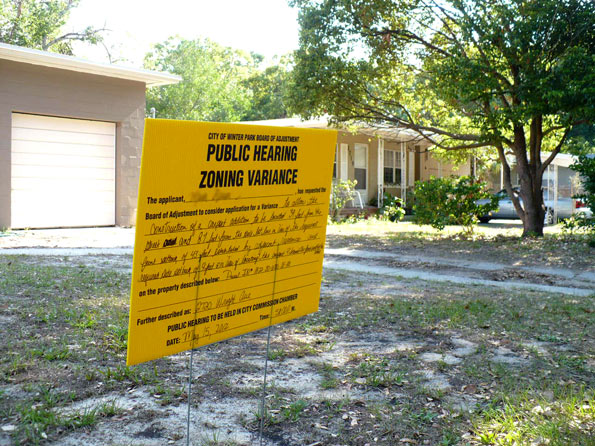
    Meanwhile, these 1950s neighborhoods are under attack for their very form. Cities, persuaded by planners to heal the effects of the car, cannot do so in a granular manner, so ordinances are passed  forbidding front-facing garages, or garages set back arbitrarily from the house front. These 1950s homes, with their carports, couldn’t be built today, and so are reduced to the status of heritage sites from a bygone era. In Winter Park, garages are banished to the rear on new homes, and if you are adding a garage to your midcentury home, it must be arbitrarily set back at least four feet from your front wall whether or not your lot can accommodate this arbitrary, and seemingly pointless, ordinance.

    Of course mid modern tours allow people to rediscover the essence of the 1950s, and these overlooked neighborhoods could be the springboard for a new era in modern planning.  Front-loaded neighborhoods can be successful when the architecture is designed at a human scale, and fine-grained integration of residential and commercial uses point to a future of home-office, cottage-industry, people-based industry once again.

    The Victorian era ended rather abruptly in the 1890s with a series of economic catastrophes that changed America’s middle class. Architecture switched to a more streamlined, Edwardian style – simple, flexible, and utilitarian forms that quickly gave rise to modernist design.  This current economic transition may well bode a similar outcome – design styles, often labeled “contemporary,” reduce the amount of architectural gingerbread and fussiness, reducing cost and maintenance, and may be favored by the coming generation for its cleanliness and utility.

    A new era that manages the car at a human scale, forgives people for wanting mobility and efficiency, and allows for contemporary exploration of style and design can and should inform new neighborhood planning. Midcentury suburbs, rediscovered by popular interest, can point the way to a middle ground between mcmansion-style subdivisions and neotraditional fussiness, and maybe even help us rediscover our confidence and faith once again.

    This essay is a summary of Richard Reep’s talk “Populuxe and the Atomic Bungalow” given at the 3rd annual Colloquium on Historic Preservation, hosted by Friends of Casa Feliz, Winter Park, Florida in April 2012.  Richard and his wife, Kim Mathis, hosted a midcentury modern tour in their own 1950s home for the colloquium.

  • Megalopolis and its Rivals

    Jean Gottman in 1961 coined the term megalopolis (Megalopolis, the Urbanized Northeastern Seaboard of the Unites States) to describe the massive concentration of population extending from the core of New York north beyond Boston and south encompassing Washington DC. It has been widely studied and mapped, including by me. (Morrill, 2006, Classic Map Revisited, Professional Geographer).  The concept has also been extended to describe and compare many other large conurbations around the world.

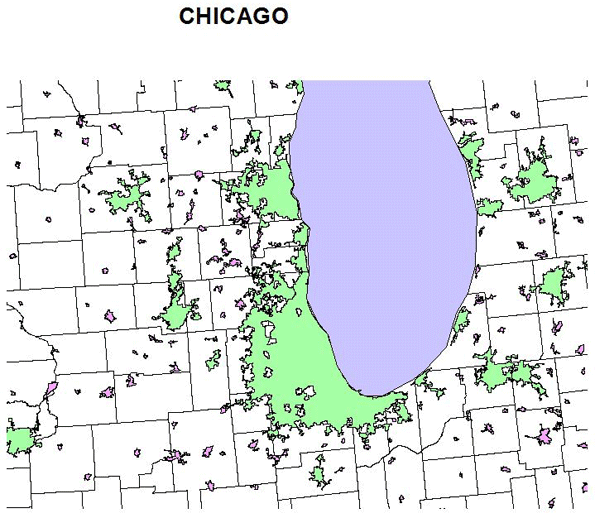
    Maybe it’s time to see how the original has fared?   And what has happened to other metropolitan complexes in the US, most notably Los Angeles, San Francisco, Chicago and should we say Florida?


    Table 1 summarizes the population of Megalopolis from 1950 to 2010 and Table 2 compares Megalopolis with other US mega-urban complexes.  Megalopolis grew fastest in the 1950s and 1960s, with growth rates of 20 and 18.5 percent. The  northeast has since been outpaced by the growth in other regions, but growth was still substantial in the last decade. Megalopolis added almost 3 million people, by 6.8 %, to reach an amazing 45.2 million.

    Table 1: Growth of Megalopolis 1950-2010
    Year Population Change % Change
    2010 45,357 2,983 7
    2000 42,374 5,794 15.8
    1990 36,580 2,215 6.4
    1980 34,365 360 1.2
    1970 34,005 5,436 18.5
    1960 29,441 4,910 20
    1950 24,534

    From Table 2 I note four major subregions of Megalopolis: Boston, New York, Philadelphia and Washington, DC. New York is still the biggest player, but the locus of growth over time has shifted South. This reflects the increasing world importance of Washington, DC. New York’s almost 20 million may not surprise, but the fact that greater Boston has grown to almost 9.5 million may be more surprising.  The Washington-Baltimore area grew by far the fastest at almost 15 percent (not much sign of shrinkage of government!). In contrast New York, Boston and Philadelphia’s growth was relatively paltry.

    Table 2: Megalopolis and Its Rivals
    Place
    2010 Pop
    2000 Pop
    Change
    % change
    Megalopolis
      New York 19,923 19,209 717 3.7
      Boston   9,445 8,967 478 5.3
      Philadelphia 8,415 76,781 773 9.5
      Baltimore-Washingt 7,403 7,681 960 14.9
    All 45,181 42,302 2,888 6.8
    Chicago 10,817 10,305 512 5
    Los Angeles 12,151 11,789 362 3.1
      Central 903 857 46 5.4
      North 928 634 294 46
      East 2,884 2,105 475 37
      South 3,543 3,210 337 10.4
    All Los Angeles 20,404 18,599 1,810 9.8
    San Francisco-Sacramento
      San Francisco 7,330 6,946 384 5.5
      Sacramento 3,171 2,604 572 22
    All San Francisco-Sacramento 10,501 9,550 951 10
    Florida
      Miami 6,027 5,311 716 13.5
      Tampa 4,818 3,894 974 25.3
      Orlando 2,915 2,193 722 33
      Jacksonville 1,483 1,191 2,242 24.5
    All Florida 15,243 12,544 2,699 21.5

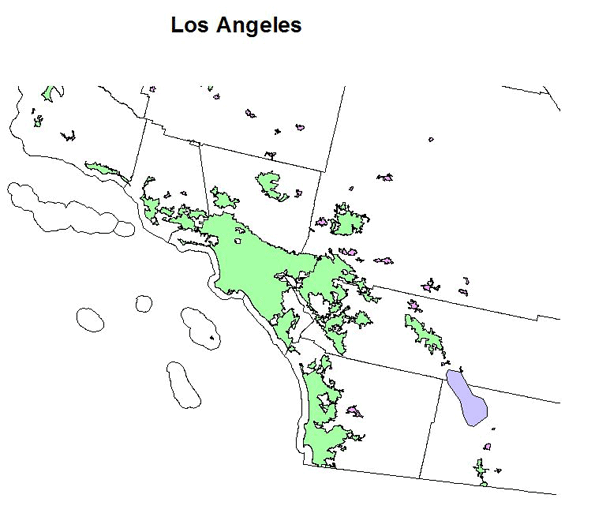
    Greater Los Angeles is the second largest conurbation, with some 20.4 million, growing by 1.8 million, and 10 percent from 2000. In the table I distinguish between the core Los Angeles urbanized area and the satellite urbanized areas west, north, south and east. The core LA area grew by only 3 percent, while the spillover areas to the north and east had astonishing growth, at 46 and 37 percent over the decade.  These include several places with a fairly long history, such as Riverside and San Bernardino, San Diego and Santa Barbara, but many are rapidly growing large suburbs and exurbs, a spillover of growth from the Los Angeles core. Much of the fastest growth has been in  Mission Viejo, Murietta-Temecula, Indio, Lancaster, Santa Clarita and Thousand Oaks.

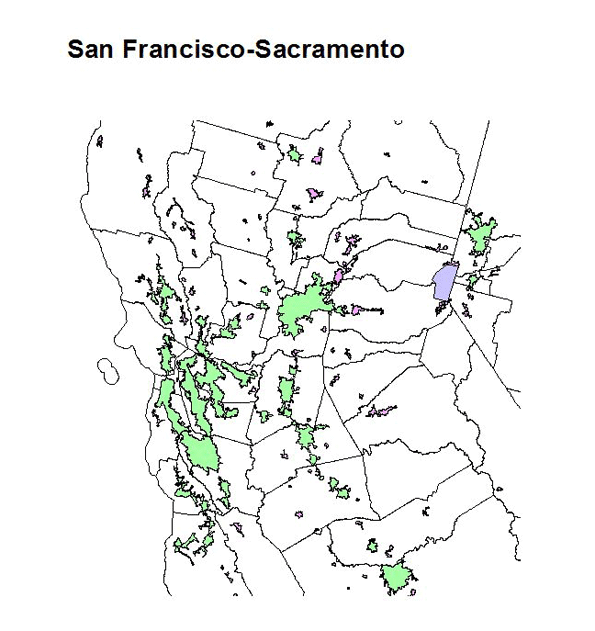
    For greater San Francisco, I distinguish two subregions, the Bay area of San Francisco-San Jose (west) and Sacramento (central valley).  Some might consider these totally distinct, but they have become one in a conurbation sense, as evidenced by commuting patterns. Many people live in the less costly Central Valley area but commute to the expensive Bay Area cities. Together, the conurbation is now 10.5 million, up 10 percent from 2000. The central valley (Sacramento) portion grew far more rapidly than San Francisco-San Jose (22 percent compared to 5.5 percent).  

    Compared to its rivals the Chicago conurbation has grown less rapidly but is still large, with a population of 10.8 million in 2010 , growing 512,000 (5 percent) since 2000.  Chicago and Milwaukee are the well-known core cities, but there are also less well known components with far faster growth such as Round Lake-McHenry and West Bend, WI.   

    Florida

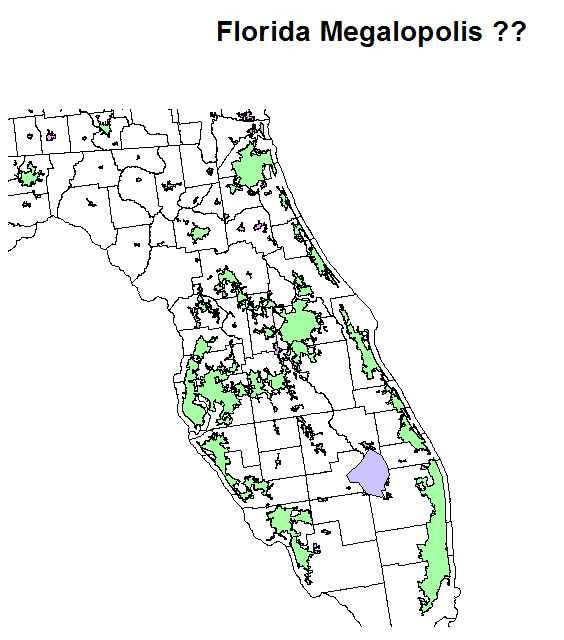
    The more interesting and difficult conurbation to try to define is what might be called the Florida archipelago. Greater Miami has long been recognized as a conurbation, but I contend that virtually all the urbanized areas of the state are in effect a complex web of urban settlement, with little clear demarcation. This is in part a reflection of   rapid and expansive  growth.  Nevertheless it makes sense to recognize four sub-regions, centered on Miami, Tampa-St. Petersburg, Orlando and Jacksonville. 

    Together these areas have reached an astonishing 15.2 million, up 2.7 million or 21.5 percent in one decade.  Because settlement is spread across the state in such a web-like fashion with no single dominant center, they constitute a newish form of urban concentration. Besides the well-known centers such as   Miami, Tampa-St. Petersburg ), Orlando and Jacksonville,  there are many satellite cities, often quite large. These include North Port, Cape Coral  encompassing older Ft. Meyers, Bonita Springs, Kissimmee, Palm Bay-Melbourne, Palm Coast-Daytona, and Port St. Lucie.  An interesting but hard to answer question is how much of Florida’s phenomenal growth is a result of transfer of people and accumulated wealth from the North (and especially from the original Megalopolis).

    The United States is a large and diverse country, with many other giant cities and a vast countryside. But it is important to realize the importance of these megalopolitan areas, with an aggregate population of 102.6 million, one third of the nation’s population.

    What’s next? Look for the rise of now just somewhat smaller conurbations such as Houston, Dallas, Atlanta, Minneapolis, Seattle, Phoenix, and Denver. In terms of numbers and rates of growth Texas is a front runner, but its stars do not coalesce into a megalopolis, at least not yet. The belt of urban growth from Atlanta, through Greenville, SC, Charlotte to Raleigh-Durham is also a likely future conurbation candidate.

    Richard Morrill is Professor Emeritus of Geography and Environmental Studies, University of Washington. His research interests include: political geography (voting behavior, redistricting, local governance), population/demography/settlement/migration, urban geography and planning, urban transportation (i.e., old fashioned generalist).

  • Why Downtowns Fail and How They Can Come Back

    To many Florida developers in the last decade, downtown condo towers seemed to make a lot of sense. They were sold as the logical locale for active seniors and millennials, great affordable starter homes, and best of all, investments.  Reinvigorating downtowns became fashionable currency in many of Florida’s second and third tier cities. 

    Sadly, many of these new structures have turned into hulking shadows today in places such as Delray Beach, Tampa, and Orlando. Many of Florida’s core urban districts suffer the dark windows, unoccupied balconies, vacant storefronts and wide open sidewalks that signify the opposite of thriving urbanity.  Repairing this false renaissance in downtowns requires city leaders to see the central business district for what it really is: just another suburb needing attention to stay healthy, safe, and productive.

    Suburbs are heavily marketed by their developers with product launches, public relations campaigns and lavish sales centers.  Downtowns, on the other hand, produce websites, but rarely have more, relying instead on the desirability of a downtown address to fill up space.  Rental apartments in former condominiums are competing with the slickly marketed suburbs for people.

    In terms of buying, the suburbs are winning, with the more desirable single-family detached dwelling now suddenly affordable.  Suburbs are comfortable, safe, and familiar to most buyers.  Downtowns are seen as edgy, transitional, and alien to many people, but they are attracting adventurous renters and a few buyers here and there who want to create a new scene.  A scene is one thing; a stable social network and a feeling of safety and security is entirely another.

    What downtowns lack is the sense of neighborhood that many inner-ring suburbs have, and the outer-ring suburbs are effectively gaining.  Until downtowns start reinventing their identity, they will have a difficult time selling a sense of place among the empty lots and decaying infrastructure.  Touring the downtown residential properties today is like touring a movie set, with new developer inventory garishly contrasting with the older, grown-in building stock. Few dare to tread past the end of the fresh concrete sidewalk, and the urban infill efforts are sporadic and unconnected. But, unfortunately, this has always been the case.

    Central Florida’s downtowns have languished for years, raising the question of their reason for existence.  Competing with, and often losing to, suburban fringe developments like Westshore in Tampa, the decline of these downtowns began years ago.  Sanborn maps (fire insurance documents from the early 20th century) reveal that neither Orlando nor Tampa ever really had fully built-out downtowns.  Warehouses, garages, residences and small hotels have coexisted with empty lots forever in these cities.  While their potential has always been high, they have never realized it.

    Perhaps we ask too much from the current form of our cities.  Our urban core regulatory structure and property values are geared towards a level of development that never occurred, and might never occur, while the suburban fringe has no such constraint put upon it.  It is past time to think of our downtowns a bit differently, put aside our emotional ties to them as “centers”, and begin to look at them as neighborhoods.

    Compared to suburban tracts, Florida’s downtowns have a stiffer regulatory environment, with downtown development boards and aesthetic police to prevent all but the most deep-pocketed players from entering the game.  These citizen-led authorities may be emboldened with pure intentions, but they tend to focus on nitpicky, hair-splitting trivia.  Arguments about the size of a fence or the color of a stucco band seem absurd to most people who wonder when an empty lot might eventually boast thriving businesses once again.  Downtowns, with their guardians of taste, may be preventing the horror of chain link fence in the district, but are unconsciously slowing the growth of any real soul as well.

    Tampa’s “Channelside” expanded this city’s downtown eastward towards the Latin Quarter, Ybor City.  With one of Florida’s tiniest Central Business Districts at 1 square mile, Tampa saw grand marble bank lobbies go dark, repurposed to host blueprinters serving the local design and construction industry.  It was a post-apocalyptic experience to see industrial-size copy machines busy at work where a once proud bank traded money.  But such has been the fate of Tampa’s downtown, left behind by edge cities like Westshore and eastern fringe suburban development.

    The hard work of downtown redevelopment, however, took second priority to the easier work of condemning empty industrial warehouse tracts between Tampa’s downtown and its port.  Selling off large chunks to developers, Tampa created a new Channelside district, where a lovely two bedroom condominium can be had for $157,000 .

    Orlando’s downtown has no natural boundaries, but blends into 1920s historic neighborhoods, and it saw many condominium towers rise up as well.  Mostly rental units today, many of these have suffered through a phase when recent college graduates roomed together in granite countertop heaven, turning the luxury towers into post-college dormitories complete with drunken pool parties, busted drywall, and beer bottles littering the hallways.  Such behavior is characteristic of transitional residents, who have little investment in their surroundings and are for the most part barely past adolescence.  The downtown model isn’t working too well for adults, but it isn’t working too well for these post-adolescents, either.

    Downtowns would do well to reconsider their model, relax the beauty boards, and allow a greater variety of development, mixing in affordable residential ownership.  People who come to stay downtown for the longer term will be the ones who can turn them into neighborhoods. Currently, the downtowns of Central Florida only have business or commercial interactions, with a few still going to church downtown. The idea of a network of social interactions easily fits into a suburban neighborhood, where neighbors see each other, their kids play together, and they casually meet and converse. This model does not fit a downtown in Central Florida at the present moment.

    This function has to be transplanted into downtowns if they are to keep their relevance.  Rather than imagine the resurgence of the downtown as urban center – which never really took hold in much of Florida – cities need to realize that their next step is to start aggressively turning downtown into an alternative form of suburb.  Suburbs have consumer necessities like grocery and drug stores, conveniently accessible by driving; maybe in downtowns a bit of walking is OK.  Suburbs have consistent identities; maybe in downtowns a new set of sidewalks is in order.  Neighborhoods with loyal residents also have spontaneity and variety; maybe in downtowns the beauty police could give it a rest.  Suburbs have relative safety and security; in downtowns this must be provided also, and is non-negotiable.

    Such an idea may be anathema to many of Florida’s urban designers.  Yet, what downtowns need is what makes the suburbs so successful: safety, continuity, and ease of contact with neighbors.  Recasting a downtown as a suburb simply acknowledges the sense of neighborhood that most people now can only find on the suburban frontier.

    The exciting prospect of turning downtowns into neighborhoods may be the hard work of the next generation of urban residents. Achieving true neighborhoods again in the once-thriving cores of Florida’s cities means that the older building stock, mixed with the new, will begin to have meaning once again.   The heritage of these places and the stories these buildings tell is rich and vibrant. The ability to sustain them into the 21st century means that their contribution will not be lost.  Reintegrating our older centers with the rest of the city will make them some of the most interesting and varied places of all.

    Richard Reep is an Architect and artist living in Winter Park, Florida. His practice has centered around hospitality-driven mixed use, and has contributed in various capacities to urban mixed-use projects, both nationally and internationally, for the last 25 years.

    Photo courtesy of BigStockPhoto.com.

  • Florida’s Quick Rebound

    Adding nearly 119,000 people in 2011, Florida has capped a decade of steady population increase  to see the state grow 19% since 2000.  Despite 2009, an historic year where more people left than arrived, the overall net growth of Florida has yielded two additional congressional seats, moving the state well on its way towards the becoming third most populous state in the nation.  This ascendancy brings new responsibility to the shoulders of the state’s leaders, and the direction this state takes in the coming years will depend upon how Florida reacts to this influx of new population.  It is time for true leadership to find appropriate voice for our state on the national scene.

    Contrary to the predictions of many within the urbanist intelligentsia, Florida’s farm counties grew the fastest. Osceola County, just south of bustling Orlando, grew by 55%; sleepy Sumter County, northwest of Orlando, grew by 75%; and Flagler County, home to historic St. Augustine, nearly doubled in population. Tampa, Orlando, and Miami have each seen their healthy share of immigration, but Florida’s rural areas have dramatically increased their appeal over a decade ago.

    At first this trend might be puzzling.  Lacking urban amenities such as museums, transit, and Starbucks, parts of rural Florida seem almost timeless.  Wildwood and Leesburg, nestled in the center of Florida, lack both beaches and theme parks.  They have one thing, however, that the urban areas do not have:  affordable housing.  And this is the elusive reality that must be turned around by Florida’s leadership if the state is to grow in a responsible manner.

    The Miami-Dade market has plenty of supply, but the average home lists for $509,000 .  Up in Wildwood, the home lists for $175,000, and you get a lot more house for your money.  People are voting with their feet for affordability.

    It’s not the price alone that seems to be putting people off, however.  Naples, which lists homes even higher than Miami, saw growth over the past ten years at a pace two and a half times that of Miami, and is expected to continue to grow at the same pace through 2015.  Anecdotally, it seems that newcomers have relocated to their vacation homes after selling off their other high-priced property, usually in the north. They sometimes reduced their expectations of what they can receive for their old houses and then permanently located where they prefer to live. If the buyers are older, they still likely made a nice profit over the past few decades.

    In Orange County, meanwhile, relieved realtors are finally starting to say goodbye to distressed properties.  Appraiser Lee Barnes commented that “foreclosures and short sales are 40% fewer, compared to this time last year,” and in an economy fueled by growth, the welcome sight of occupied rooftops means that commercial real estate is beginning to come back.  In fact, Orlando is near the top of the list in expected home price gains for 2012, a dramatic turnaround for the region.

    Florida’s comeback is timed with some key changes in regulating real estate development.  With state oversight all but vanquished by the governor, starving local counties welcome the property tax dollars associated with new growth.  No other revenue, apart from a sales tax, provides much cash to operate government in the Sunshine State. This makes growth a priority.

    But economic activity occurs in two forms:  growth (making more stuff) and development (making stuff better).  Quietly, in the past decade, Florida has added biomedical research clusters to its twin engines of growth and tourism, and this promises to increase greater resilience to the state economy.

    Some signs, however, point to Florida abandoning this strategy and continuing its boom-bust mentality.  The Governor, already warning the legislature of budget cuts in 2012, has expressed disappointment that the job creation return is poor on the State’s venture capital invested in bringing Scripps, Nemours, and other cutting-edge research organizations. He claims that are simply not adding jobs fast enough for his taste.  Abandoning these investments could mean that the organizations reduce their presence or even abandon the state.

    At the same time, Florida’s cities seem to be uncertain about how to tackle the problem of adding density without reducing affordability.  Land prices haven’t wavered much in the recession, with stubborn property owners holding on to assets that won’t sell, and they may benefit from this land-banking strategy in the long run.  Many who escape the Rust Belt and come to Florida express shock at the cost of living in the Sunshine State and are further dismayed over the quality of schools and surprising amount of congestion.  This mismatch between cost of living and quality of life may be part of the reason why Florida’s five largest cities were listed among the nation’s “saddest” in a recent Time poll .

    Casino gambling, a typical 1990s way to boost revenue, is being entertained by the Legislature, but other ideas should be considered as well.  For one thing, investment in the future means a better education system, perhaps a higher priority than ostrich food subsidies (currently exempt from state sales tax ).  Closing tax loopholes and fixing some long-broken parts of Florida’s tax code will help gain some badly-needed revenue.

    Very large infrastructure projects are also important to make Florida competitive.  On the east coast, NASA’s 60-year-old facilities need a major overhaul to continue providing America a spaceport for the 21st century and to pave the way for private space exploration.  This will maintain the deep investment in human capital of which Floridians were once justly proud.  The spaceport has a great deal of synergy with the National Simulation Center, located in Orlando, which is currently the country’s premier provider of military simulation and training.

    In more than one region, the Florida Venture Capital Act has brought world-class biomedical research laboratories, making dramatic advancements in cancer, diabetes, children’s health, and other key areas.  Already surging ahead and competing with area like Boston’s Research Center and the Silicon Valley, Florida must keep its edge in this field by continuing investment in the Venture Capital Fund.

    On the west coast, the Tampa Port Authority is already preparing for the widening of the Panama Canal, working in collaboration with ports of Mobile and Houston to partner with ocean carriers.  Continuing this investment and modernizing the logistics of truck and railroad traffic into the port is critical to make this economic engine prevail in the 21st century.

    Such infrastructure investment will improve Florida’s already existing assets, allowing for prosperity and upward mobility to occur within the state.  Competing with Texas will be difficult, given Florida’s lack of petrochemical resources, but the state’s native industry, tourism, has already made it a world-class destination. Florida’s leadership has already entered the national stage by saying “no” to high speed rail, but it has yet to define what it will say “yes” to.  Without intelligent citizen input, the state will likely fall back on its traditional pattern of being a passive receiver of investment and people, but not a creator of great new enterprises. 

    In contrast to states like California and Texas, Florida has been willing to be eternally passive; Disney World is a classic example.  Florida, a grateful recipient of this California enterprise, has benefitted secondarily, but the real power of this company still resides in Burbank.  This story is played out over and over again, with real estate developers from Dallas and Atlanta continuing to define the face of the state, aided and abetted by Wall Street investors who see Florida primarily as a waterfront real estate asset with some moderate margins available in between coasts.

    It is time for Florida to start doing, instead of being done to.  With investment in real infrastructure, good education and intelligent leadership, Florida can assume its responsibility as one of America’s new high-profile states, capable of exporting science, technology, and culture.  Our population growth contains within it the seeds of a bright future once we fix what is broken about our beautiful state.

    Richard Reep is an Architect and artist living in Winter Park, Florida. His practice has centered around hospitality-driven mixed use, and has contributed in various capacities to urban mixed-use projects, both nationally and internationally, for the last 25 years.

    Photo courtesy of BigStockPhoto.com.

  • Central Florida: On the Cusp of Recovery?

    Central Florida is poised at the cusp of a major turnaround, and its response to this condition will either propel the region forward, or drag it backward.  This cusp condition is brought about by a train and a road; neither of which have begun yet but both of which appear imminent.  Sunrail uses existing 19th century railroad tracks as a commuter spine through Orlando’s disperse, multipolar city.  The Wekiva Parkway completes a beltway around Orlando, placing it with Washington DC, Houston and other ringed cities.  Before either gets built, the region deserves some analysis on their combined effect, and how they can be nudged onto a pathway to make the region better.

    Sunrail brings with it mythology  about how trains affect cities.  In what has now become the standard, tired kabuki dance between developer interests and municipal ones.

    Not surprisingly, heavy regulation has entered the scene, with the avowed goal of creating dense urban pockets along even largely rural  train stops. This has sparked rising property values which may end up  frustrating the dream of transit-oriented development (TOD).  Affordable dwellings and meaningful employment within a half-mile of a train stop must be created in order to make this development work, but unless Central Florida can spark this, the new train will likely suffer from the same fate as the vast majority of its sunbelt counterparts:  low ridership and increasing tax subsidies.

    Inserting TOD into 17 locations in Central Florida is a bold experiment. In order for it to work, the rising costs of housing will need to be addressed, and Central Florida can take advantage of this ambition to succeed.  Orlando home sales are coming back, thanks to the mild climate and desirable lifestyle. That is very different, however, from guaranteeing that the economics of the rail commuter will make it worth discarding the single-family detached American Dream in favor of a relatively new model that has an unproven track record.

    Orlando also seems to be blithely going about the business of creating another ring of traffic around itself, descending into the same level where Atlanta’s Perimeter, the DC Beltway, and other like-kind roads live.  The Wekiva Parkway, long considered unneeded, is now being designed to complete the ring around Orlando, and will cross 25 miles of pristine wetlands that is a vestige of once-vast water resources of the region. 

    The Expressway Authority proposes this ring as an alternative to existing roads to serve the “growth needs of this area,” it conceded recently that this road segment made little economic sense except as a toll road accessing a new suburban single-family home development carved out of the swamps by one of the Governor’s chief fundraisers .  The asset value of this ring road may be more private than in the public interest.

    Traditionally agricultural land interlaced with wetlands, The Wekiva area to the northwest of Orlando has avoided large-scale Florida style bulldozing.  All this will change if the Governor is successful in eliminating water management regulations , freeing up much of Florida, including this corner of Orlando, for speculation.

    The local press, quick to criticize Alaska’s Bridge to Nowhere and always ready to jump on environmental issues, meekly ponders  the need for this $2 billion highway.  Maybe the elevated design, intended to be more ecologically friendly, makes it OK, despite the safety problems and high maintenance associated with this design.  Florida’s history is littered with the drawings of many other elevated highways eventually built on grade to save cost.  Once approved, the Wekiva Parkway may quickly be brought down to earth as well, displacing wetlands and agricultural land.

    The Wekiva Parkway will open up land supply which indeed will allow for more growth.  Done right, the asphalt will make land available that could be useful to the area’s economy.  It will bring traffic to historic, but presently lonely Sanford, potentially infusing the economy of this once-vibrant rail town.  Using principles of scarcity, land values could reflect people’s high desire to live in rural areas with all the services and guarantees that 21st century suburban life offers: fire and police protection, state-of-the-art infrastructure, and free pizza delivery.  It could invigorate neighboring towns that are currently struggling for survival.

    The risk is that such a road will simply allow more investment into Florida real estate without giving Florida much back in exchange.  Florida, already strained to meet its current population needs, should not simply trade another commercial strip for water resources that benefit many species and contribute to the region’s resilience. Rather, development models should emulate the best of America’s conservation development happening in states where water rights are scarce.  Connecting local employers with residential areas will enhance the value of both, and strategically keeping rural agricultural areas intact will preserve the region’s present land use diversity.

    Well managed development that conserves resources and balances broader needs with private interests will elevate the state’s prospects at this critical juncture.  One more bit of the original subtropical wilderness represents an asset for both present and future generations. With the right approach, the Wekiva Parkway can provide an enlightened model of low-density development that respects the value of open space.

    In town, Sunrail presents denser development as an alternative.  The normal pathway, however, seems to pit the profit-seeking real estate developer against ever higher regulatory burdens, which eventually make his product unaffordable to those coming here to escape high costs and regulations in other cities.  Keeping both employment and housing affordable are critical to achieving success with any of these projects.

    Moving product down the value chaindoes not do well current system, which leaves out the very people who Sunrail supposedly will benefit.  Density is one of those characteristics that seems to be about good timing: if you have it today, like San Francisco or New York, this is largely the result of history;  if you do not have it today, like Orlando, it is risky and probably a dubious proposition.

    The road and the train open up land that must be carefully stewarded to create opportunities for meaningful employment and affordable housing, both of which are presently scarce commodities.  The concept of transit-oriented development needs a success story, and Sunrail provides 17 opportunities to find one; meanwhile, the road presents a danger as well as an opportunity for Florida’s wetlands.  As the region slowly recovers from the recession, the two projects together should be carefully considered by the region’s citizens and leadership to truly redefine Central Florida’s identity for the 21st century.

    Richard Reep is an Architect and artist living in Winter Park, Florida. His practice has centered around hospitality-driven mixed use, and has contributed in various capacities to urban mixed-use projects, both nationally and internationally, for the last 25 years.

    Photo courtesy of BigStockPhoto.com.

  • Florida Repeals Smart Growth Law

    The state of Florida has repealed its 30-year old growth management law (also called "smart growth," "compact development" and "livability"). Under the law, local jurisdictions were required to adopt comprehensive land use plans stipulating where development could and could not occur. These plans were subject to approval by the state Department of Community Affairs, an agency now abolished by the legislation. The state approval process had been similar to that of Oregon. Governor Rick Scott had urged repeal as a part of his program to create 700,000 new jobs in seven years in Florida. Economic research in the Netherlands, the United Kingdom and the United States has associated slower economic growth with growth management programs.

    Local governments will still be permitted to implement growth management programs, but largely without state mandates. Some local jurisdictions will continue their growth management programs, while others will welcome development.

    The Need for A Competitive Land Supply: Growth management has been cited extensively in economic research because of its association with higher housing costs. The basic problem is that, by delineating and limiting the land that can the used for development, planners create guides to investment, which shows developers where they must buy and tells the now more scarce sellers that the buyers have little choice but to negotiate with them. This can violate the "principle of competitive land supply," cited by Brookings Institution economist Anthony Downs. Downs said:

    If a locality limits to certain sites the land that can be developed within a given period, it confers a preferred market position on those sites. … If the limitation is stringent enough, it may also confirm a monopolistic powers on the owners of those sites, permitting them to raising land prices substantially.

    This necessity of retaining a competitive land supply is conceded by proponents of growth management. The Brookings Institution published research by leading advocates of growth management, Arthur C Nelson, Rolf Pendall, Casey J. Dawkins and Gerrit J. Knapp that makes the connection, despite often incorrect citations by advocates to the contrary.   In particular they cite higher house prices in California as having resulted from growth management restrictions that were too strong.

    even well-intentioned growth management programs … can accommodate too little growth and result in higher housing prices. This is arguably what happened in parts of California where growth boundaries were drawn so tightly without accommodating other housing needs

    Nelson, et al. also concluded that “… the housing price effects of growth management policies depend heavily on how they are designed and implemented. If the policies tend to restrict land supplies, then housing price increases are expected” (emphasis in original). 

    In other words, if growth management policies do not maintain a competitive land supply, house prices are likely to rise in response. This is basic economics. Restricting the supply of any good or service in demand is likely to lead to higher prices, all things being equal.

    The loss of a competitive land supply was seen during the real estate bubble in the unprecedented escalation of house prices in California (which was already high), Oregon, Washington, Phoenix, Las Vegas, parts of the Northeast and Florida. In these markets, the demand from more liberal lending standards was much greater than the land available for development under growth management plans and government land auctions.  By contrast, house prices generally stayed within historic norms in metropolitan areas where land supplies were not constrained by growth management programs, such as Dallas-Fort Worth, Houston, Atlanta, Austin, Indianapolis, Kansas City and elsewhere.

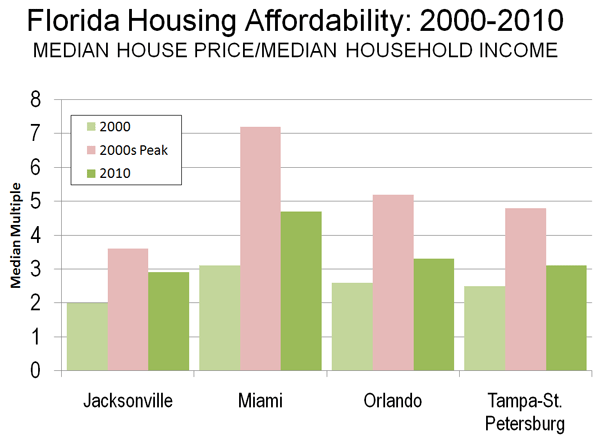
    Housing Price Escalation in Florida: In 2000, the four Florida metropolitan areas with more than 1,000,000 population had Median Multiples (median house price divided by median household income) near or below the historic norm of 3.0. By late in the next decade, all four metropolitan areas reached unprecedented levels of unaffordability. In Miami, the Median Multiple reached 7.2. In Orlando, the Median Multiple peaked at 5.2, 70 percent above the historic norm. In Tampa-St. Petersburg, the Median Multiple peaked at 4.8, 60 percent above the historic norm. The peak in Jacksonville was a more modest 3.6, though this was still an 80 percent increase.

    By 2010, the Median Multiple has declined to hear the historic norm in Orlando and Tampa-St. Petersburg and slightly below in Jacksonville. The Median Multiple remained well above the historic norm in Miami, at 4.7.

    When Supply Lags Behind Demand: Florida’s housing cost escalation may have been surprising, since Florida has a reputation for liberal land-use regulation. However, the growth management act had long since turned the state toward a shortage of land supply relative to demand as described by Wachovia Bank in a 2005 analysis.

    "While all the stars seem to be perfectly aligned on the demand side, the supply of housing in Florida has been much more problematic. Even though residential construction has soared to new highs recently, the supply of housing has lagged woefully behind demand in recent years. This has been particularly true for single-family homes, where population growth, a rising homeownership rate, and strong demand for second homes and vacation properties created a demand for 560,000 new single-family homes between mid 2000 and mid 2004. During this period builders only delivered 540,000 units. When you add in the growing demand for townhouses and condominiums, buyers were looking to purchase 675,000 new homes during this period, while builders were supplied just 570,000 units. No wonder prices have been surging!

    The chief impediment to new construction has been a shortage of developable land. The shortage primarily results from a growing resistance to new development. The state is not running out of space. Nearly every community in Florida and the state itself are looking at some type of limitations on new residential development. While well intentioned, these initiatives are making it more time consuming and expensive to build homes in Florida. Others are taking land off the market, designating areas for green space, or preserving space for industrial development. The net result has been dramatically higher land prices across much of the state."

    The point of the Wachovia analysis is that unless there is a sufficient supply of land, the price of housing is likely to rise. Having a lot of land is not enough. There must be enough land to accommodate demand at affordable land and housing prices (Note).

    The Florida action is the most successful reversal of house price increasing growth management regulations to date.

    Other Advances: There have, however, then more modest advances.

    After taking office in 2003, Minnesota Governor Tim Pawlenty replaced the board of directors of the Metropolitan Council in Minneapolis-Saint Paul. The previous board had been spent on the following Portland style growth management policies, including the enforcement of a variant of the urban growth boundary. The new board exhibited more liberal attitudes toward residential development, and the housing bubble did not produce the extent of housing affordability in the Twin Cities that occurred in growth management areas such as Portland, California and Florida.

    The Conservative- Liberal coalition government of the United Kingdom has proposed modest relaxation of some of the world’s most restrictive land use regulations, which could lead to an improvement of housing affordability in the nation. Kate Barker, who was then a member of the Monetary Policy Committee of the Bank of England was commissioned to examine land-use regulation and housing affordability in England and found a strong association between the loss of housing affordability and restrictive land use policies. This association between Britain’s strong land use regulation and higher house prices was noted in the early 1970s research led by Sir Peter Hall of the University College, London.

    For the Future: The relaxation of overly restrictive growth management policies could not have come at a better time. With the squeeze on the middle-class getting tighter, fewer households can afford higher   housing costs associated with growth management areas. Moreover, responsive to the political consensus for job creation, more home construction will bring return more good-paying construction jobs in Florida.

    Wendell Cox is a Visiting Professor, Conservatoire National des Arts et Metiers, Paris and the author of “War on the Dream: How Anti-Sprawl Policy Threatens the Quality of Life

    —–

    Note: There has been a similar misunderstanding of the housing markets in Las Vegas and Phoenix, where developable land appears to stretch virtually to the horizon. However, what is usually missed is that both metropolitan areas are hemmed in by government land, some of which is periodically auctioned. During the housing bubble, the price per acre of residential land at auction in both metropolitan areas rose as much as the price for land rose over a similar period in Beijing, with its huge land price increases.

    Photo: Orlando (by author)

  • Can Florida Escape the Horse Latitudes?

    When it comes to the winds of change, Florida remains in the horse latitudes.  This zone of the Atlantic around 30 degrees latitude was so named by ship captains because their ships, becalmed in the water, seemed to move faster when they lightened their load by throwing off a few horses.  Florida’s governor Rick Scott, who campaigned on a promise to create 700,000 jobs in this state, appears to have adopted the same tactic by throwing overboard the Department of Community Affairs, the state agency that regulated real estate development.  Other bureaucracies may be next in line if the state doesn’t show signs of improvement soon.

    Billy Buzzett, appointed head of this bureaucracy, was in Orlando last week to discuss the new future of Florida growth management.  Growth will now be lightly monitored by the Department of Economic Opportunity , which is in charge of reviewing development plans, and will handle unemployment benefits as well.  Mr. Buzzett stated that the department’s mission will also include items such as weatherization of structures for hurricanes. All of this is good, but it’s a puzzling mix to throw into a single bureaucracy.  Obviously, real estate regulation is not the focus of this governor, who saw regulation as one of the chief obstacles to creating jobs in this state.

    The Department of Community Affairs was created in 1985 to set some standards for quality of life as well as for environmental protection.  Failing at both tasks, the DCA came under fire during the last election cycle as a statewide referendum (Amendment 4) on growth gained support from people tired of seeing forests converted into strip malls.  The referendum, narrowly defeated, would have people vote in Cailfornia-style ballots for such changes.  This may have been a bad idea, based on how California’s growth controls have stifled its once vibrant economy.

    In this era of minimal new building, the reinvention of growth management may be seen as a way to pass the time while we wait for the economy to recover.  In reality, however, there are some very large implications in the future.

    Governor Scott wants the state to be more like Texas, which regulates with a far lighter hand and seems to be navigating through this particularly horrid recession better than other big states.  Texas has growth and does not have an onerous, time-consuming process which weeds out all but the deepest pocketed investors.  Unlike Texas, however, Florida has few natural resources like oil and mineral wealth to fall back on for revenue, and therefore deregulates itself without any diversification of income stream.

    What this means to the local economy will be hard to predict.  Certainly, the DCA was able to negotiate with private developers, and helped to shield cities and counties from a lot of the pressure from out-of-state interests.  Without the DCA, it will be interesting to watch which of Florida’s regions stand up to this pressure and which regions, starved for cash, cave in to the pressures of growth.

    Although defeated, Amendment 4 clearly scared the real estate interests to death.  Legislation now prevents anything like that from happening again.  While real estate development clearly needs to be left in the hands of professionals, it also seems to have risen to the top of citizens’ awareness.  Whether it stays there or not is up to the state’s citizens, most of whom immigrated from elsewhere in search of the good life.  Growth benefitted the lowest economic class by creating cheap housing, construction jobs and access to consumer goods.  Florida, however, by grabbing the bottom tranche of workers, has missed a chance to build a more vertically integrated middle class with higher skilled workers.

    Orlando in particular is in an unfortunate situation, as it has no natural hard boundaries like the sea.  Like Atlanta, Central Florida’s metropolitan area can grow in concentric rings forever and ever, gobbling up more agriculture, wetlands, and forests.  Such a development pattern puts value on the rim, rather than in the center, leaving the older parts of the city devoid of investment, energy, and hope.  With private interests, whose mission is to grab the low hanging fruit, in chargethere will be little redevelopment of these interior districts, despite the sunk costs of infrastructure that could give them an edge. 

    Making more stuff is the business of growth.  Making stuff better is the business of development.  And development is what older neighborhood areas like this sorely need.  Successful in-fill redevelopment, in both suburban and urban locations, can still happen if employment can be added to the mix.

    It is up to our region’s leadership to turn this pattern around, and start valuing our real estate a little differently than in the past.  For example, debasing our wetlands to their mere economic value overlooks their larger value in terms of biodiversity.  Bringing wetlands and agriculture into our growth management policy would be a good first step towards creating a sustainable future for Central Florida.  Florida’s environmental movement need not turn into a shrill anti-growth machine as has happened elsewhere, but should be a partner with the real estate interests to protect the more long-term natural assets that bring so many to the Sunshine State in the first place.

    Recycling also need not be just the job of the utility department.   Recycling land through the EPA’s brownfield program is already underway by many municipalities, and provides a vehicle to reinvent neighborhoods that have failed. 

    As always, clean water will be the limiting factor to growth.  Already a concern of Florida, the state is divided into various water management districts, who regulate how clean water can be removed from the aquifer, and what kind of dirty water can be put into it.  No doubt this regulation will be under assault next.

    Without Secretary Buzzett’s new department, Florida is already showing signs of new employment opportunities and diversity.  Military spending in Florida is up, thanks to the National Center for Simulation, and medical research spending is continuing at a steady pace.  These were added to the mix of growth, tourism, and agriculture upon which Florida has traditionally relied. More jobs that revolve around these two industries will include support technology, computer science, manufacturing, and services. 

    These industries grew despite the regulatory burden of the state.  What is dangerous about Secretary Buzzett’s new department is its blasé treatment of the public’s genuine desire for better environmental management and a better quality of life.  Like many places, Florida has its share of “not in my backyard” sentiment reacting against more development.  The anger voiced in 2010 through Amendment 4, however, represented something new and deeper:  a collective sense that enough is enough.  Speculative development, built during the boom and remaining unoccupied to this day, is in every community, urban and rural.  Few believe that the empty condos, ghost town subdivisions, empty strip shopping centers, and vacant office parks are improvements over what was there before, and fewer still want this kind of insanity to return.

    So the death of the DCA, which allowed speculative development to the point of embarrassment, may have been a good thing.  Employment-based growth, which so far has eluded Florida’s regions, may now have a chance to take place.  With the new industries arriving, job creation is already a reality – no horses had to be thrown overboard to make that happen. What Florida needs now is some leadership at the local level to promote more employment-based growth that is slow, but sure, and that is sustainable for the long haul.   

     Richard Reep is an Architect and artist living in Winter Park, Florida. His practice has centered around hospitality-driven mixed use, and has contributed in various capacities to urban mixed-use projects, both nationally and internationally, for the last 25 years.

    Photo: Desiree N. Williams