Tag: Orlando

  • Exaggerating in Orlando: Sunrail

    For decades taxpayers have paid billions to finance major transportation project cost overruns far exceeding the routinely low-ball forecasts available at approval time. This has been documented in a wide body of academic literature, the most important of which was conducted by Bent Flyvbjerg of Oxford University, Nils Bruzelius University of Stockholm and Werner Rothengatter of the University of Karlsruhe in Germany (Megaprojects and Risk: An Anatomy of Ambition).

    Major project advocacy, however, has descended to a new low of unprecedented and absurd exaggeration. This is evident in the current public policy debate about the Sunrail commuter rail project in Orlando. Two examples make the point

    Exaggeration #1: Job Creation: The Central Florida Partnership claims that Sunrail will create 10,000  jobs. "almost immediately." This would be quite an accomplishment. The Sunrail project is currently projected to cost approximately $850 million for just the first segment. Every cent of the likely cost overruns will be on a blank check drawn the account of Florida taxpayers.

    At Sunrail’s claimed rate of job creation,  the Obama Administration’s $800 million "shovel ready" stimulus program (enacted in 2009), would have "almost immediately" produced more than nine million jobs. By now, the unemployment rate would have been reduced to little above 2 percent, lower than at any point in the more than 60 years of available data. Of course, and predictably, the stimulus program did no such thing, not least because a job created by public spending is likely to destroy more than one sustainable job in the private sector.

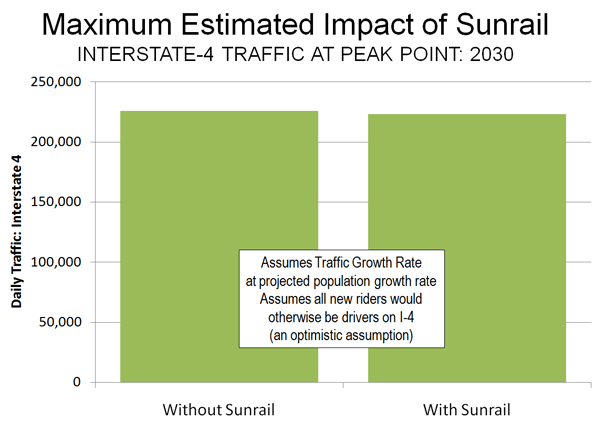
    Exaggeration #2: Sunrail Will Make a Difference: The proponents imply that Sunrail will carry a significant number of trips in the Orlando area, claiming that the line will carry one lane of freeway traffic and that it will give central Florida residents an alternative to high gasoline prices. In fact, even if Sun Rail reaches its ridership projections, it would take a full day of train travel to remove less than an hour’s peak hour freeway volume. Needless to say, no one will notice any fewer cars on the freeway (Figure).

    Further, Sunrail will not provide an alternative to the overwhelming majority of central Floridians, since it will attract only 1,850 new round-trip riders per day by 2030 (Sunrail’s number). Spending $850 million on Sunrail is the same as the taxpayers giving each new rider a gift of $450,000.

    The Need to Set Rational Priorities: All of this is occurring in the face of an national fiscal crisis so severe that even the AARP has expressed its willingness to consider cuts to Social Security. As an AARP spokesperson put it "You have to look at all the tradeoffs." Indeed.

  • Orlando’s Sunrail: Blank Checks Induced by Washington

    We are supposedly living in an age of austerity, but many federal programs are leading many states into overspending and potential fiscal insolvency.  Transit spending is a case in point, as is indicated by the proposed Orlando Sunrail commuter rail project.

    How Washington Induces Higher State and Local Spending: For decades, the federal government has encouraged state and local governments to build expensive projects, as is the case in Orlando. Under the Federal Transit Administration (FTA) "New Starts" program, state and local governments can obtain federal funding for such projects, contingent on their taxpayers providing "matching funding." This can be in the form of higher taxes, budget increases or in unplanned subsequent expenditures that are higher than projected. The responsibility for cost overruns and operating subsidies belong exclusively to state or local taxpayers.

    Inaccurate Cost Forecasts: This can prove very expensive. European researchers Bent Flyvbjerg, Nils Bruzelius and Werner Rottengather (Megaprojects and Risk: An Anatomy of Ambition) and others have shown that new rail projects routinely cost more than planned (Note 1).

    Flyvbjerg et al found that the average rail project cost 45 more than projected and that 80 percent cost overruns were not unusual. Cost overruns were found to occur in 9 of 10 projects. Moreover, they found that despite increased attention to these cost blow-outs, final costs continue to be far above the projections presented to public officials and the taxpayers at approval time. Further, they found that ridership and passenger fares also often fell short of projections, increasing the need for operating subsidies.

    Moreover, urban rail systems are of questionable value. Transport economist Clifford Winston of the Brookings Institution has noted that "the cost of building rail systems are notorious for exceeding expectations, while ridership levels tend to be much lower than anticipated" and that "continuing capital investments are swelling the deficit." 

    Federal policies, however, often force state and local taxpayers to guarantee the accuracy of notoriously inaccurate cost projections. The standard FTA "full funding agreement," a prerequisite for federal funding, requires state or local taxpayers to pay for any cost overruns. Further, if the projects are not completed, state and local taxpayers are required to pay back the federal grants (more on Florida’s experience with that later).

    Sunrail: The "Sunrail" commuter rail project is planned to parallel Interstate 4 in the Orlando metropolitan area. From the perspective of Florida taxpayers, the tragedy is that the project has proceeded so far. Project forecasts say that in 2030, Sunrail will add only 1,850 new round trip riders daily to Orlando’s already sparse transit ridership (barely half a percent of travel). Even if all Sunrail trips were for employment, it would not even be a "drop in the bucket" in a metropolitan area likely to add more than 400,000 jobs by 2030. Further, despite inferences to the contrary, this will have less than negligible impact on traffic congestion. It is likely that traffic on Interstate 4 will increase by at least 100,000 cars daily by 2030 (Note 3), many times the cars that Sunrail could possibly remove, even under its probably exaggerated ridership projections.

    Sunrail also will do little to increase job access to jobs in a metropolitan area where less than two percent of employment can be reached by the average commuter in 45 minutes using transit, according to Brookings Institution research. By contrast, at least more than 80 percent of jobs in the Orlando metropolitan area are reached in 45 minutes by car, and more than 55 percent in 30 minutes. Despite the high costs of all this and Sunrail’s negligible effect on regional mobility, politics may preclude cancellation of the project.

    Sunrail’s first phase is projected to cost $350 million (after a half-billion dollar right-of-way purchase). The Federal Transit Administration intends to pay a maximum of $175 million for the project. State taxpayers (through the Florida Department of Transportation) will be required to match that funding with another $175 million, though that amount could grow.

    Florida Taxpayers Already Burnt Once: In addition in paying for likely Sunrail cost overruns, Florida taxpayers would be obligated to fund service levels that satisfy the Federal Transit Administration. Otherwise the federal government can demand that taxpayers send the money back. This is no idle threat. When the Miami commuter rail system (Tri-Rail) provided service levels deemed insufficient, FTA demanded a return of $250 million in federal grants. This repayment was averted only by a state bailout that provided up to $15 million in annual subsidies to increase the service levels (Note 2).

    Essentially then, to obtain federal funding for Sunrail, Florida taxpayers must write a blank check out to a rail construction industry that has repeatedly demonstrated an inability to build rail projects for promised amounts.

    Negotiating a Way Out? Florida taxpayers, however, may have some options to avoid writing the blank check. In March, the US Department of Transportation (USDOT) desperately sought to find governments in Florida willing to provide a blank check to fund the now cancelled Tampa to Orlando high-speed rail line, with costs that were so low that they had "big cost overruns" written all over them.

    In a February 27 letter USDOT told local officials the federal grant repayment provisions were negotiable. Based upon this policy latitude available to USDOT, Florida officials could seek less unreasonable terms with USDOT. For example, a revision might be negotiated to limit Florida’s cost overrun liability to amounts resulting from state actions. Further, Florida should seek agreement that it does not have to operate service levels that are greater than required by demand or can be afforded. This would prevent a repeat of the unhappy Tri-Rail experience.  

    Provisions such as these would provide important protections to Florida taxpayers, who could otherwise be forced to pay hundreds of millions in cost overruns and higher operating subsidies and potentially higher taxes.

    Lessons for Taxpayers: Projects like Orlando’s Sunrail provide important lessons for the nation. The stimulus, now winding down, boosted questionable spending policies well outside the Beltway. Washington needs to stop writing blank checks on taxpayer accounts. It’s time for the feds to stop inducing state and local governments to mimic its fiscal irresponsibility.

    —–

    Notes

    1. Flyvbjerg is a professor at Oxford University in the United Kingdom. Bruzelius is an associate professor at the University of Stockholm. Rothengatter is head of the Institute of Economic Policy and Research at the University of Karlsruhe in Germany and has served as president of the World Conference on Transport Research Society (WCTRS), which is perhaps the largest and most prestigious international association of transport academics and professionals.

    2. The Florida Department of Transportation has made agreements local governments to participate in funding of Sunrail cost overruns. However, in the event that local governments are unable to pay their share, it may be expected that the state will pay, as it did in bailing out Miami’s Tri-Rail (discussed above).  

    3. Assumes that automobile traffic would grow at the projected population growth rate (based upon University of Florida population projections). 

    —–

    Wendell Cox is a Visiting Professor, Conservatoire National des Arts et Metiers, Paris and the author of “War on the Dream: How Anti-Sprawl Policy Threatens the Quality of Life

    Photo: Downtown Orlando (by author)

  • Orlando: Uncle Sam Meets Mickey Mouse

    Hawks and doves disagree on whether World War II ended the Great Depression.  Depending on which species of bird squawks louder, military spending may be the only way out of our current financial malaise.  In many ways it is already happening, although it is a surreptitious and quiet influence felt mostly in the high-tech economic sector.  Defense growth in one of the most unlikely places – Orlando, Florida – has already begun to diversify the region’s income stream, create a new urban corner of Central Florida, and tap into some of the natural allies and partners that already exist here.  Mickey Mouse is now sharing Orlando with Uncle Sam as the militarization of the local economy increases.

    America’s current rough patch, as Dr. Roger Siebert recently wrote about , seems to be deeper than any in recent memory, and recalls the 1930s.  During that time, isolationism was only cured by a slap in the face:  Pearl Harbor.  Today’s isolationism, so vigorously voiced in the calls to depart Afghanistan, seems to echo that period.  Enlistment in the military isn’t exactly vigorous, and intervention in troubled regions is not on the radar screen of even the most ardent hawk.  America seems too self-involved at the moment to care.

    Yet at this very same time, Pentagon spending is quietly rising in the modeling, simulation, and training fields.  Already employing 53,000 Floridians, 9,000 more than the state’s hallowed agriculture industry, this growth sector is hugely dependent upon a high-skilled, high-wage workforce.  The ability to train soldiers, sailors, and pilots without the expense of actual bombs and equipment has clearly demonstrated its benefits to the satisfaction of the military brass, making it inevitable that more is to come.

    Co-located next to Florida’s premier high-tech medical research park, Lake Nona, the National Simulation Center is the most common name used to describe the efforts underway at the Central Florida Research Park on the east side of town.  More importantly, however, the Center is adjacent to the University of Central Florida.  Already the second largest university in the country, UCF is home to much of this Center’s local 18,000 workforce.   With Navy, Air Force, and Marines research and training, the Simulation Center has quietly become the world’s largest military simulator .

    Regionally, it leverages its old Naval Training Center roots and proximity to NASA facilities at Cape Canaveral to capture workers, skill sets, and continuous research and improvement.    While the town struggles with slumping tourism and anemic population growth, the high-tech military industry is rapidly taking over as one of the biggest new economies to hit Florida.

    Spinoffs from military research can only benefit Central Florida’s attractions and rides, as future tourists will be able to experience more and more virtual thrills in addition to more traditional meatspace rides and shows.   In the meantime, it remains a quiet partner in diversifying the economy.

    In the 1990s, the Naval Training Center left Orlando, ostensibly because it duplicated facilities that the Navy had elsewhere.  Its developable land, close to downtown Orlando, became Baldwin Park, and the old barracks, classrooms, and laboratories were quickly bulldozed for lucrative residential real estate.  Few were aware that the functions of the Orlando Naval Training Center were downsized, not eliminated, and were quietly relocated to the east side of town.

    The Training Center evolved into the National Simulation Center. As a research-intensive industry, it capitalized on its new proximity to the University of Central Florida’s campus, and began an interchange with the engineering and computer science programs at that school.  UCF, today with over 50,000 students, has quickly grown to become the nation’s second largest university, just behind Ohio State.  UCF’s own Research Park has grown to rival the fabled Research Triangle in North Carolina, due to the synergy between military and higher education.

    Its new location also moved the Training Center a little bit closer to the Kennedy Space Center as well.  The Navy has always had a presence at Cape Canaveral, and with the employee base around the Space Center available less than an hour’s commute away, the Training Center has already benefitted from the availability of this highly skilled workforce who has suffered from the ebb and flow of NASA’s political fortunes.

    Medical research being conducted by Scripps, Burnham, and Nemours will also benefit from this activity, as they are all building new facilities at Lake Nona.  This medical research campus will employ many with the same skills, education, and training as the Simulation Center, and provide choices for the scientists and engineers living in Lake Nona’s suburbs.  This makes the residential real estate around Lake Nona a bright spot in Central Florida’s otherwise horrendous housing market .

    Surrounding the Simulation Center, small companies have already started feeding creativity and innovation into the giant maw of the military, and spinoffs – commercialization of its technology – have also benefitted larger companies such as Orlando’s game design team at Electronic Arts and the military contractor Lockheed Martin.  This supply chain, once established in Orlando, gives localized sustainability to this industry and suggests that it has achieved a foothold among the tourism, agriculture, and growth industries firmly established in Central Florida.

    Geographically, East Orlando is difficult to develop.  Like the surface of swiss cheese, land above the flood plain, traditionally agricultural, is interlaced with wetlands and lakes, and it has been historically ignored for the broad swaths of low-hanging fruit closer to the theme parks and population centers on the west side of town.  Pressure to develop, however, has suddenly put this area in the spotlight, and controversial proposals by homebuilders and other owners have raised questions about whether Florida should stay on its historic pathway of man vs. nature.   Infrastructure – roads, utilities, and other unglamorous investment – still doesn’t exist in much of East Orlando.  Because development has historically been in small pockets fragmented by the area’s mosaic of wetlands, connectivity and sheer mass will be difficult to achieve without great cost to the environment.

    Yet this does not have to be so.  Dense development can happen with respect to nature, as proven by countries such as Germany and Sweden .  If left to the same old forces that developed the rest of Florida, it is unlikely that East Orlando will experience any innovation regarding development strategy, and Central Florida will host the same old battles of environmentalists vs. developers again and again.  The state’s growth strategy – leaving it up to private interests – may have already guaranteed this outcome.

    If, however, innovation transcends the research mission and influences the style of development to support this research, then the military and medical centers in East Orlando have a chance to provide a true, new pathway to the future.  Like Victor Gruen’s 1963 concept for Valencia, which recognized such modern aspects of society such as the car, East Orlando could be planned as an employment-based community within the context of nature using contemporary science and technology.  Orlando, the ephemeral city home to amusement parks and orange groves, could become a model for development to influence other areas struggling with the same questions.

    Militarization of the economy may become a vehicle for true change.  The cluster of military agencies and private businesses, headed by Lockheed Martin, all revolve around this economy and provide a badly-needed shot in the arm of Orlando’s workforce.  With high-salary, highly educated workers, global connectivity, and a growth engine no less than the Department of Defense, Orlando can be assured of some good times ahead while the tourism and housing sectors recover.  The region’s leadership must think carefully how to embrace this new savior, and what the greater implications are for the future.

    Richard Reep is an Architect and artist living in Winter Park, Florida. His practice has centered around hospitality-driven mixed use, and has contributed in various capacities to urban mixed-use projects, both nationally and internationally, for the last 25 years.

    Photo by Research Development Engineering Command

  • Condo Culture: How Florida Became Floridastan

    Welcome to Griftopia. The Florida housing industry needs a karmic rebalancing. Our recent roar of building new structures is echoed today by the squeaks and pops of a different type of construction industry. Invasive testing – the architectural equivalent of a biopsy – seems to be on the rise. Saws, hammers, and cranes can be heard through the quiet suburban developments and subdivisions around Florida, as shingles and stucco are cut off in small patches to reveal serious problems within.

    Like the hidden defects in mortgage-backed securities and other arcane instruments of finance, these flaws are covered up and papered over, but are no less damaging. They are also just as revealing about our collective haste to accommodate growth.

    Few other places saw as much suburban expansion as Florida did, beginning in the 1990s and lasting right up until the bursting of the 2008 real estate bubble. Old hands in the Florida real estate development game see the cycle as never-ending, stretching all the way back to Ponce de Leon, whose “fountain of youth” was perhaps the state’s first marketing gimmick. The most recent bust, however, provides important lessons, should future cycles include speculators and regulators alike feeding at the trough. Rapid growth breeds errors, compromises, and sloppiness which have dire, lasting consequences.

    Pundits are assigning blame for the Millennial Depression up and down the economic ladder, and certainly the Florida housing boom and bust provides many examples of all that went wrong. The largest developers, driven by stockholders and Wall Street to seek rapid growth and high profits, gambled that Florida’s population boom would last forever. With the good addresses already taken, “B” properties close to interstates, under flight paths and adjacent to sensitive wetlands began to see activity. Low density reduced the developers’ risks and reduced construction costs, as well.

    The Florida condominium – outwardly appearing as an apartment complex — was a home ownership product for the masses. As long as the product lasted 30 years (or however long it took to pay off the mortgage), no one much cared about its quality and stability as an asset. Anonymous, stick-built stucco boxes, baking in the Florida sun, seemed the perfect solution to meet the demands of stockholders and investors, and the regulatory pathway was smoothed over to keep the production line rolling.

    Immigrants from abroad and from other parts of the country bought their own piece of the American Dream: gated entries, warrens of tight garages, patches of St. Augustine grass, buggy-whip sized oak trees and tightly wrapped stucco and glass boxes. Balconies are common, although the tiny decks and the heat preclude much enjoyment of the outdoors. Designed to prevent neighbors from meeting or children to freely play, these contemporary cracker box condos sullenly sweat in the heat. Still, they gave a much-needed step-up for the vast service workforce looking for a way out of the rental market and into an ownership position, and buyers can perhaps be forgiven for overlooking the cheapness of construction in favor of a new way to prosperity and success.

    The demand, however, outstripped the ability to deliver. Design and construction delays simply due to over-commitment and lack of manpower meant that corners were cut, compromises were made, and slop was tolerated. It was as if the investment mania on Wall Street – in journalist Matt Taibbi’s words, “griftopia” – had trickled down to the field superintendents, masons, and framing crews. A collective haste gripped much of the state’s growth industry, haste that is cause for regret today.

    A ten-year-old stucco building may look to be in perfectly good shape from the outside. When entering the bland, beige entry hall, however, the tang of mold immediately invades one’s nose. Once water has been trapped in a building it breeds a most sinister fungus.

    Condominium units that suffer this malady are ascending the legal chain one by one across the girth of the state. First, individual owners collect themselves and confront their homeowner’s association. HOAs bombarded with complaints succumb quickly to “condo chaser” attorneys who promise to split the goodly sums they can rake off the insurance companies that covered the contractors and design professionals involved in the mess. And then, discovery begins.

    It takes about a week to vivisect a low-rise building. Ordinarily, the stucco walls are saw-cut down to the bone, and the plaster comes off in a solid sheet, revealing metal strap ties and sheathing tissue within. The sheathing panels themselves are made of glued together wood chips – so-called “oriented strandboard” – only as strong as the glue itself. Removal of the sheathing layer reveals the deep ligaments and structural bones of the building.

    Buildings designed in Texas, Ohio, Georgia, and elsewhere populate the Florida landscape. These buildings have almost no roof eave at all, as if the fierce Florida sun didn’t matter. The skin-tight stucco may not be Portland cement plaster, because dryvit (an acrylic latex substitute for stucco invented after World War II to quickly rebuild Europe) has become a popular substitute. The windows are set at the outside of the wall, with no shading at all on the glass. The effect is that the building looks as stretched tight as a balloon.

    Unfortunately, such a combination frequently admits water into tiny cracks and crevices, and the water has no way to seep out. Revealing the interior guts of a building is the only way to uncork mold and rust horrors that are otherwise invisible. Insidious ants wind their way into the dark spaces between walls and floors where water and food are available.

    Biopsies on sick buildings reflect our collective errors of judgment, and the healing process will be lengthy and expensive. Designs that do not reflect the harsh realities of Florida’s hot, wet climate are certainly responsible for some of the errors. Designs that did not acknowledge the scarcity of experienced construction crews were also responsible, because construction takes teamwork and skill. And contractors, encouraged to cut costs in order to boost their own bottom lines, cut time or cut labor to get the job done faster.

    Designers and contractors may also legitimately point the finger back at clients who pushed hard. A collective irrationality set in towards the end of the last decade. More work had to be done by fewer people, less experience was available to go around, and in the heat of the moment steps could be skipped in the name of innovation. The consequences are being felt only now.

    A huge, sad pile of lost resources, our vanishing wood and raw materials, must be hauled off to clean these errors out of the system. Sadder to see are the homeowners, as they pack up and move out of their mold-infested units. But saddest of all is the apparent inability of the industry to learn from its own mistakes.

    Let’s hope that this time around it can happen differently. Reject growth for growth’s sake. Florida, hooked on this drug for too long, deluded itself into filling up wetlands and paving more and more space.

    Instead, as the tide rolls in once again, Florida can make a pact with itself to invest in development, rather than growth. Redeveloping older, inner cores of cities where services and employment are already in place can go a longer way towards making the state a sustainable, diverse place to live than paving one more tract of raw land mowed down for home lots can.

    Revamp the state’s development culture. Private developers have written Florida’s growth management code, and gradually increased the requirements so that only the largest and most deep-pocketed developers can compete. Protecting neither the environment nor quality of life very well, the development regulations are in dire need of rewriting, with a different set of requirements that favor smaller-scale development and redevelopment, and encourage affordability.

    In the meantime, discovery continues. More leaky roofs, more fungus-infested units, and more attics seething with ants, testimony to our collective haste and greed. As the nation slowly recovers economically, Florida has paused for breath on the pathway to healthy construction. Before the next boom, its development industry would be wise to use this break in the action to consider the alternatives.

    Richard Reep is an Architect and artist living in Winter Park, Florida. His practice has centered around hospitality-driven mixed use, and has contributed in various capacities to urban mixed-use projects, both nationally and internationally, for the last 25 years.

    Photo by the author.
  • Florida Metropolitan Areas Disperse; City of Miami Continues to Densify

    Miami: The Miami metropolitan area grew 11 percent between 2000 and 2010 according to the recently released census count. The population growth was from 5,008,000 in 2000 to 5,575,000 in 2010. This growth, only modestly above the national average, caused Miami to slip behind Dallas-Fort Worth and Houston, to become the nation’s 7th largest metropolitan area. The Miami metropolitan area was expanded after the 2000 census to include not only the core county of Miami-Dade, but also Broward (Fort Lauderdale) and Palm Beach (West Palm Beach) counties.

    The historical core municipality, the city of Miami, grew from 362,000 to 399,000 and accounted for 7 percent of the metropolitan area growth. Miami is unique among the nation’s historic core municipalities in having densified in every census period since 1960, despite not annexing new territory and not having substantial greenfield space for development.

    The suburbs captured 93 percent of the growth. Growth was modest in all counties, but was the greatest in the most outlying, Palm Beach, at 17 percent.

    Orlando: The Orlando metropolitan area grew nearly 30 percent between 2000 and 2010 according to the recently released census count. Orlando grew from 1,645,000 in 2000 to 2,134,000 in 2010. The historical core municipality, the city of Orlando, grew from 194,000 to 238,000 and accounted for 9 percent of the metropolitan area growth. The suburbs captured 91 percent of the metropolitan area growth, expanding their population by 31 percent. Outlying (Osceola 55 percent) and Lake (41 percent) counties grew the fastest.

    Tampa-St. Petersburg: The Tampa-St Petersburg metropolitan area grew 16 percent between 2000 and 2010 according to the recently released census count. The population growth was from 2,396,000 in 2000 to 2,448,000 in 2010. The historical core municipality, the city of Tampa grew from 303,000 to 336,000 and accounted for 8 percent of the metropolitan area growth. The suburbs captured 92 percent of the growth. The fastest growing counties were both outlying, Pasco (35 percent) and Hernando (32 percent).

    Jacksonville: The Jacksonville metropolitan area grew nearly 20 percent between 2000 and 2010 according to the recently released census count. Jacksonville grew from 1,123,000 in 2000 to 1,346,000 in 2010. The historical core municipality, the city of Jacksonville, grew from 736,000 to 822,000 and accounted for 39 percent of the metropolitan area growth. The city of Jacksonville is essentially combined with Duval County has a largely suburban form and includes rural areas. The consolidation occurred between the 1960 and 1970 censuses, with the new jurisdiction covering nearly 25 times that of the old (768 square miles as opposed to 32 square miles), while the population of the new jurisdiction was somewhat more than 2.5 times that of the old. Jacksonville covers more than twice the land area than New York City and has approximately one-tenth the population.

    The suburbs captured 61 percent of the growth. The fastest growing counties were both outlying, St. John’s (54 percent) and Clay (36 percent), which captured more than one-half of the metropolitan area growth.

  • Can Common Sense, and maybe Mickey, Save Orlando’s Transit Mess?

    The week’s debate about high-speed rail has once again polarized our populace, inflamed irrationality, and sent everyone back to their familiar corners.  Little constructive debate is possible when major newspapers are flailing the governor for rejecting money and the seemingly global revolutionary fervor is gripping local citizens who rallied in protest Wednesday night around downtown Orlando’s Lake Eola.  None of this will do any good for the service workers trying to get to their jobs in the theme parks or for downtown cube dwellers streaming to scattered office parks. With or without light rail the city inches closer and closer to the traffic hell of Atlanta, or worse even, DC. After all, both cities already have large rail transit systems.

    What will do some good is a creative discussion of some real change that can occur to improve our commute.

    We must recognize that we are stuck with our cars.  They aren’t going away.  We can’t wish them away. We have to make them better fast, because with changes blowin’ in the wind and with oil jumping back up over $100 a barrel.

    The high-speed bullet train – a sort of latter-day interstate highway program – sounded like a great idea at first, a welcome alternative to the ardor of air travel and the gas-sucking monotony of driving.  It has shortcomings, however, it will likely prove obscenely expensive, and once one gets to the destination, one is typically relegated to more driving.

    Nor is this some form of effective industrial policy.  The things will be built overseas – Germany, Japan or most likely China –  a great jobs program for someone else.  And tourists, who vastly prefer the freedom of car rental and driving, aren’t likely to use it except as a novelty for one of their visits to our wonderful place.  Perhaps the bitterest part of the bullet train pill: it will indebt our children and grandchildren to pay off landowners giving up their land in eminent domain – which produces nothing – and the cost of complex machines made overseas. The bullet train ends up being a clumsy solution imposed from above, rather than a grassroots solution to our real problems. 

    Any frequent driver on Interstate 4 between Orlando and Tampa can tell you there are four basic kinds of traffic: tourists in buses or cars; freight, in the form of tractor-trailers: business travelers (who need the flexibility of a car on the other end): and personal travelers.  Instead of targeting an expensive solution at just the smallest form of traffic, personal travel, a 4-part solution is suggested, all of which would add up to far less than $2 billion that minimally the high-speed line would have cost.

    1.  Trains can be good – for freight.  There are already freight lines running between Tampa and Orlando.  Getting the freight off of tractor-trailers and onto these freight lines, where it is vastly cheaper to move goods, should be a no-brainer for the state.  Use some of the DOT money to modernize freight depots along the pathway, incentivize freight customers to move their goods onto trains, and this will vastly improve the situation.
    2. Tourists can drive – at a price.  Our state should be treat itself with higher regard and also encourage a culture of sustainability for those visiting us.  Higher taxes on rental cars should be charged, and the taxes placed in an environmental fund to remove some of the unsightly development that has defaced our region, and return it to the special place it once was.
    3. Give business travelers an alternative.  If there were an affordable air shuttle between Tampa and Orlando, at the right price it would be full.  Little Embraers (made in Melbourne, by the way) taking off from FBOs at Orlando Executive Airport, Sanford Airport, and Orlando International Airport and landing in Tampa airfields would be worth $100 a seat, if the time/cost tradeoff were analyzed.  Ybor City for lunch, anyone?
    4. Give personal drivers an alternative.  For the cost of less than 50 miles of new road, a totally independent alternative to I-4 is waiting out there.  The first link of this road would connect Tampa’s Crosstown Express to Lakeland’s Western Beltway.  The next link of this road would connect the Western Beltway to the Greenway at Celebration.   Drivers will be able to go from downtown Tampa to downtown Orlando without their wheels touching I-4 even once.  Nice.

    And now, for the big one.  Right smack in the middle of the white-hot I-4 corridor lays a large, private entity, Disney, has been operating a private, train-based mass transit system for the last 40 years.  High labor costs?  Yes.  Fossil fuel driven?  Yes.  This entity has been strangely silent over the entire debate.

    If this entity were to wake up and seize the opportunity before it, one might see a true train that works.  First of all, the monorail was planned with some sense: it connects dense areas together.   If Disney were to offer to build, as a private development, extensions of its monorail reaching out to Tampa on one side and Orlando on the other, the air rights for this system could be along government-owned I-4 (no imminent domain costs).  This entity is also highly encouraged to charge market rate and to make a profitable venture out of operating this system. And the taxpayers would not be stuck with the bill.

    A vision for transit between Tampa and Orlando needs to be truly holistic, taking into account all types of traffic connecting the two regions.  This vision also needs to be locally driven, taking advantage of local strengths and assets already in place.  The high speed bullet train does none of this.  Instead, a multi-faceted solution that provides flexibility at both ends, leverages our current strengths, and partners with the strongest player in the region has a chance of truly making a difference in the present tense and likely future budget climate  This is what sustainability is truly about, and is what our future generations deserve.

    Richard Reep is an Architect and artist living in Winter Park, Florida. His practice has centered around hospitality-driven mixed use, and has contributed in various capacities to urban mixed-use projects, both nationally and internationally, for the last 25 years.

    Photo by Joe Penniston

  • Tampa to Orlando High-Speed Rail: Keeping Promises to Taxpayers?

    Florida’s Tampa to Orlando high-speed rail project could be barreling down the tracks toward taxpayer obligations many times the $280 million currently advertised. That is the conclusion of my Reason Foundation report, The Tampa to Orlando High-Speed Rail Project: Florida Taxpayer Risk Assessment.

    The 84 mile, purportedly $2.7 billion project is administered by Florida Rail Enterprise (a part of the Florida Department of Transportation) and would be built by a private builder/operator selected through a competitive process. There are a number of reasons to believe that there is slim prospect of limiting the obligation of Florida taxpayer to the promised $280 million.

    Capital Cost Overruns: The International Experience

    The international experience indicates that Florida taxpayers will indeed be fortunate if the bill is only $280 million. A team led by Oxford University professor Bengt Flyvbjerg found that passenger rail systems typically have cost overruns of 45 percent. Such a cost overrun would increase the bill for Florida taxpayers to $1.5 billion.

    Capital Cost Comparison to California

    However, the capital cost overrun could be even greater. The Tampa to Orlando line cost per mile is less than half that of the first segment of the California high-speed rail line, despite factors that should make the Florida line more expensive..

    In California, there is a concern that the eventual $45 billion or more required to complete the 500 mile route may not be obtained. As a result, the first segment (Borden to Corcoran in the agricultural San Joaquin Valley) is being built so that it can be used by the existing Amtrak service should the high-speed rail line not be fully completed.

    Thus the shorter $4.2 billion California segment excludes various elements that will need to be upgraded later for high-speed rail trains to operate. The $4.2 billion does not include the funding for trains, electric power infrastructure, train yards, train maintenance facilities and administrative facilities. More of the construction will be in agricultural and rural areas than in Florida which will tend to make the California project less costly. There will be only two “Amtrak” quality stations, as opposed to the five far more expensive high-speed rail stations on the Tampa to Orlando line.

    For example, Florida Rail Enterprise characterizes the potential Tampa station as having the “potential to be one of the most visible, dominant and iconic architectural features of the city.” This hardly suggests a process driven by cost control.

    The Tampa to Orlando line does have two cost advantages relative to the California line, including that right-of-way has largely already been obtained and that there will be less construction on viaducts. These factors however, seem unlikely to compensate for the elements that are excluded from the California costs.

    The Tampa Orlando high-speed rail line would cost $3 billion more if its cost per mile equals that of the California segment. All of these additional costs would be the responsibility Florida taxpayers and would raise their bill to nearly $3.3 billion (Figure).

    International Research: Subsidizing Operating Losses

    There is reason to believe that the line will suffer day to day operating losses, despite claims of Florida Rail Enterprise to the contrary.

    Just as the international research indicates costs are often understated, ridership and revenue is often overstated. Flyvbjerg’s team found that projections were, on average, 65% higher than the eventual actual ridership. If the Tampa to Orlando line were to match this average, Florida taxpayers would have pay $300 million more just over the first 10 years of operation to make up for operating losses. This would raise the bill for Florida taxpayers to $3.6 billion ($3.3 billion plus $300 million) with more likely after 10 years.

    The Tampa to Orlando Market: Operating Losses

    The Tampa to Orlando high speed rail line may not achieve even the already discounted average ridership performance evident in the international research. This would mean an even greater revenue shortfall and more in bills for Florida taxpayers.

    The Tampa to Orlando line will provide virtually no intercity travel time advantage compared to the car. It will, in fact, cost more than driving. It will cost a lot more in the likely event that an expensive taxi ride or a car rental at is required the destination. Even so, the ridership projections can be characterized as stratospheric. Florida Rail Enterprise assumes two thirds of the ridership of Amtrak’s Acela Express on the Northeast Corridor, despite the fact that the Acela market has eight times the population of the Tampa to Orlando market.

    Moreover, the Tampa to Orlando line will operate at average speeds 34 to 70 percent below that of high-speed rail trains in China, Japan and France. This is because the train will operate as a local shuttle between the Orlando International Airport, International Drive and Walt Disney World.

    The Bottom Line

    These risks combine to threaten Florida taxpayers with many times the claimed $280 million cost, like Massachusetts taxpayers, who were forced to pay much of the $16 billion in cost overruns on the “Big Dig” highway project. The risk to Florida taxpayers would be in contrast to the billions Governor Christie is saving New Jersey taxpayers by cancelling the “Access to the Regional Core” Hudson River tunnel for which costs were spiraling, consistent with the international research.

    Choices

    This would seem to be no time to saddle already overburdened taxpayers with additional and predictable obligations. Obviously, Florida taxpayers could be spared these risks by canceling the project.

    However, the lure federal funding could prove to be irresistible. If so, the state should provide ironclad provisions to limit taxpayer subsidies to the promised $280 million. The builder/operator should assume all financial risks and there should be no state financial guarantees. Further, megaprojects like the Tampa to Orlando line can be “too big to fail,” and it could be nearly impossible to stop construction once it is started, even as costs balloon. Thus, only the independently operable Orlando tourist shuttle segment (Orlando International Airport to International Drive and Walt Disney World) should be initially built. The extension to Tampa could be built later in the unlikely event that there is enough left of the $2.7 billion.

    Keeping Promises

    These decisions will soon be made by newly elected Governor Rick Scott, whose has stated that his evaluation will be driven by the impact on Florida taxpayers.

    Doc Dockery, former chairman of the now-defunct Florida High Speed Rail Authority and financier of a now repealed constitutional amendment that required building high speed rail has “pooh-poohed” the risk of cost overruns, noting that the Florida Department of Transportation “has said repeatedly” that any bidder must “give a fixed price. This means no cost overruns.” He continues, “how can this be more plainly stated?” Regrettably, the experience reveals the rhetoric to fall far short of what is required to protect taxpayers.

    If construction proceeds, the Governor and state will be exposed to an over-whelming challenge to keep the $280 million promise to taxpayers. If they succeed, it will be a first. Chances are they won’t.

    Photo: Concept for “iconic” Tampa station. Available at floridahighspeedrail.org.

    Wendell Cox is a Visiting Professor, Conservatoire National des Arts et Metiers, Paris and the author of “War on the Dream: How Anti-Sprawl Policy Threatens the Quality of Life

  • Health Care Development in Central Florida

    By Richard Reep

    In this still cooling economy, Florida seems to be continually buffeted by a perfect storm of unemployment, record foreclosures, and stagnant population growth. As the state continues to suffer, the health care industry has unfolded two planning efforts aimed at building some economic momentum.

    Florida Hospital’s Health Village, an urban revitalization of one of Orlando’s older core neighborhoods, is one planning effort to watch. The other, Lake Nona, is a classic suburban mixed-use campus planned around R&D facilities gilded with stellar names like Scripps and Nemours, occurring in the southeast periphery of Orlando. The vastly different values of their developers underscore the striking contrasts between the development strategies of Health Village and Lake Nona.

    Lake Nona, a small lake just east of Orlando’s airport, is a new development centered around six major research facilities, four of which are under construction. Financing came from a 2006 program, the Florida Capital Formation Act, that has contributed millions to start up biomedical research in the state. Florida’s state venture capital fund lured Scripps, Nemours, Burnham, and M. D. Anderson. Two state universities are also participating, as well as the Veterans Administration with a new facility. This taxpayer investment was supplemented by Tavistock, the master developer of Isleworth fame, and smaller contributions by city, county, and other private investors all creating the impetus to develop this campus.

    Lake Nona’s Robert Adams described his “model” as San Diego’s biomedical cluster, which combines commercial, clinical, research, and educational facilities forming. Employment, in the form of the research facilities, was preceded by a country club and an indistinct mix of Florida residential building types – estate homes, smaller single family homes, and multifamily clusters that are sprinkled amongst golf courses, pretty lakes, and remnant pockets of old Florida wilderness. It’s obvious upon visiting the campus that this is first and foremost a real estate development scheme. Like most developers, Tavistock programmed the uses and zones as if all the land, being flat, were relatively equal in nature except for the slightly more lucrative edges of lakes and the even more lucrative engineered waterways. Currently, the Town Center is an open, flat D-shaped parcel conveniently accessed from Orlando’s beltway, the 417. A comfortable, safe land development scheme with all the usual regulatory battles is underway, and eventually Orlando will find a new, attractive community themed around medical research competing with other new developments for market share.

    In contrast, Florida Hospital selected, among its multiple sites in the state, about 96 acres squeezed between two close, parallel roads (Orange Avenue and Interstate 4) in a dense part of the city where the Adventist Health System quietly bought up dozens of individual parcels of 1930s era Orlando. Like most neighborhoods still suffering in the shadow of Eisenhower’s grand interstate system, this one has languished, and Florida Hospital intends to convert this neighborhood into a Health Village campus anchored by its adjacent hospital campus in a slow, organically grown and financed process.

    Orange Avenue bisects this Health Village, with towering hospital facilities on one side and an aged, mostly 2-story commercial neighborhood on the other. Much of the older residential stock is past its useful life, and owners, grateful for a buyer to release them from the ragged edge of Interstate 4, quickly sold out and left. Inserting the Burnham Institute’s Clinical Research Institute for Diabetes will be the latest revitalization project, and the interior land is intended for residential development catering to hospital professionals and staff within walking distance.

    With 17 hospital locations in Florida alone (the Adventist Health System operates medical facilities throughout the South and Midwest), the choice to locate a health village in a congested urban site is an interesting one. The city deal-making involved in such a move is reminiscent of the negotiations for New York’s Lincoln Center near Columbus Circle in the 1960s, and is rare in Florida where land is cheap. At first glance, it seems like Florida Hospital willingly hamstrung itself with this strategy, as compared to the huge blank slate being developed by Tavistock in Lake Nona.

    Tavistock also has eyes firmly watching the global health care market, and hopes to compete with San Diego, Research Triangle, Dubai’s Medical City, Singapore’s Biopolis, and other stellar research clusters. Lake Nona’s growth potential is relatively large, assuming a smooth flow of funding and continuation of markets. The science-themed real estate development brochures for Lake Nona exude a breezy, hip confidence, putting biomedical research in the background and projecting an alluring lifestyle in the foreground.

    Instead of amping up its marketing campaign to overcome its vastly smaller size, Florida Hospital’s Health Village eschews marketing altogether, as if it is too busy developing it to talk about it. The Adventist Health System is not visibly interested in the temporal nature of global markets, and its stated position as a Christian health care institution quietly suggests that reviving a struggling neighborhood – an exercise most developers would shy away from – is worth the effort. Florida Hospital’s ultimate end appears to be planned on a much longer timescale.

    Both projects are refreshing pathways for Florida, as they represent an attempt to develop future jobs away from the dependence on tourism and second home development. Of the two, right now Lake
    Nona seems much more poised for growth. With a vision for 16,000 jobs at maturity, Lake Nona hopes to capture a substantial portion of the real estate growth attached to those jobs, which is the tried-and-true Old Florida model. Shopping areas, recreational activities, and lifestyle creation will add one more new neighborhood cluster to a multipolar, decentralized region at the expense of 7,000 acres of Florida’s natural environment.

    In contrast, Florida Hospital’s urban build out will benefit existing neighborhoods, certainly a new concept for Floridians. In this respect, Florida Hospital’s tiny contribution to growth (some 800 new residential units are proposed to replace the 150 existing homes) is more than offset by its larger contribution to Orlando’s development as a city. And it delivers this at no expense to Florida’s natural environment.

    Each model offers something to a revived Florida. Florida Hospital’s campus in congested Orlando is instructive as a model for economic activity in the urban future. Religious institutions may become a more important force in the community, given the lack of wealth creation by the standard players in Wall Street and real estate speculation.

    Tavistock could contribute as well, particularly as a move towards a new modality of wealth creation that transcends the traditional Florida focus on consumption activities: shopping malls, hotels, and theme parks. Placing the region on the world stage as a contender in health research can move Florida away from its failed model and towards a future shaped by important diversifications of its employment base.

    Richard Reep is an Architect and artist living in Winter Park, Florida. His practice has centered around hospitality-driven mixed use, and has contributed in various capacities to urban mixed-use projects, both nationally and internationally, for the last 25 years.

    Photo pf Lake Nona development by saikofish

  • Florida: Amendment 4 Pushes the Reset Button on Development

    by Richard Reep

    Like a heroin addict going cold turkey, Florida appears poised to get off the growth drug this coming fall. If massive overbuilding, unemployment, depopulation, and a tourist-chasing oil slick weren’t enough, Florida’s voters are in the mood to vote yes on a referendum called Amendment 4, which would make every future change to the state’s comprehensive plan subject to voter approval, rather than be reviewed through a representative public process. The referendum capitalizes on short-term voter outrage over everything. But in the long term, Florida will likely languish in the twilight of missed opportunities as businesses relocate elsewhere to avoid risky, lengthy public campaigns to build their presence in this state.

    Between 1845 and 2009 Florida became the fourth most populous state in the nation. Because of its immense desirability, land developers have become legitimate partners in Florida politics, and have dictated much of its growth management legislation in the modern era. A byproduct of this process, however, has been increasing resentment among those who came for affordability and a low-density lifestyle, as cow pastures and orange groves got mowed down for subdivisions and malls.

    Traffic and congestion, which many migrants thought they would magically leave behind up north, came with them. Since before the 1980s, the popular press has published article after article about citizens who came for the good life, only to see nature replaced by concrete. Many who came seemed genuinely puzzled about this transformation, as if they expected that human activity would have no noticeable impact.

    Laissez-faire politicians kept the debate from becoming a serious topic, for the land seemed limitless, and the state’s leadership preferred not to dignify this seeming selfishness with a response. The response to those who wanted to lock the door after they had arrived was silence. This time around, emotions have acquired a larger momentum in the form of Amendment 4. Those who support it, such as writer Dori Sutter of the Orlando Sentinel, claim that Florida is overbuilt and has the ability “to create jobs and revenue and to accommodate population growth of more than 80 million people.”. In other words, Sutter’s point is that the current growth management model will accommodate an additional 60 million people over Florida’s current population – if the future immigrants are content to use this model exactly as it is drawn today, with no exceptions.

    Right now is an opportune moment for Florida to clean up its act. Voters might be more likely to approve housekeeping moves to repurpose abandoned properties and improve the aesthetics of the built environment. This kind of activity, however, depends upon businesses moving in, and most business owners handle enough risk without adding a political campaign to their plates. If Florida resembled, say, Europe in its sense of place, then Amendment 4 would be a stroke of genius.

    As it is, Amendment 4 would be the mother of all reset buttons, and voters who push this button in November would freeze the state’s built environment at its worst, not its best. This pause would bifurcate the state’s economic pathway away from the previous course of growth for growth’s sake, and set the stage to diversify the economy and allow Floridians to discover their own destiny through direct democracy. As such, it represents a grand experiment in process, replicating New England-style town hall debates over the nature and the future of the community.

    In the long term, however, this new pathway is far from guaranteed to make for a better process. For one thing, rational facts and figures hold little stock compared to emotional appeals during an election campaign, and every change to the built environment will face as many detractors as it will supporters. Decision-making will likely result in as many bad calls as the process does now.
    Property development is a complex, high-stakes game involving many public and private players. Emotional appeals to voters will tend to reduce this process to matters of style and aesthetic appeal, glossing over technical issues. And, when these matters are put to broad votes, safe pathways will likely win over innovative pathways and inventive ideas, further miring the state in the past. This is why property development has historically been left to the government to handle, with representative democracy in the form of public development commissions, and limited participation by way of public hearings.

    Those who want to put every 7-11 and office building to the vote recognize the change that it would make to Florida’s growth management process, as well as to the state itself. This season of voter outrage seems to be the moment to punish Florida’s favorite villain, the evil developer, as well. Florida seems to have hit an impasse where the current process has yielded an unfavorable product. While citizen input has largely gotten the state where it is today, the results are widely viewed as unsatisfactory.
    Currently, no compelling argument has been put forth against Amendment 4. Homebuilders and developers protest that the process is fine as it stands. Citizen boards, administrative review boards, and public hearing stakeholders are made up of Floridians who approve a Comprehensive Plan every five years, and then review changes to the Comprehensive Plan when landowners request these changes to suit their needs. Sophisticated and complex, this process already involves environmental protection, detailed technical work, and deep pockets.

    Those put in charge of growth management find it hard to say “no” when the state’s property tax coffers, (along with sales taxes) fund much of the public realm. Since growth — development — funds much of the state government’s activities, growth management acts as a financial conduit, one hardly likely to be restricted by those in charge of it. Saying “no” is just not part of the process.

    If the process represents a public conversation about how a city or a region should grow, disgust with the conversation has risen to new levels. Floridians are in the mood for grand solutions: witness last October’s vote in Miami for Miami 21, a form-based zoning code that replaces the zoning process with a product, a Master Plan, of sorts, for the city. Miami 21 appears to be stopping the conversation by limiting future generations’ ability to influence the pathways on which the city may economically develop.

    Amendment 4, rather than reforming the process, also tries for a grand solution. Public debate will be characterized by posturing and politicizing, hardly conducive to rational discussion of complex, technical issues. Where growth is already been well-managed, this might be acceptable, as these regions will organically fine-tune their infrastructure. Where growth has been poorly managed, however, lack of services, traffic congestion, and patchwork development patterns will punish residents and governments alike with declining property values and reduced quality of life.
    The long-term consequences will inexorably reshape Florida’s future, and income from activities other than real estate development will have to be considered for the very first time in Florida’s history. Gaming – already looming large in Florida’s future – is one possibility. A state income tax is a distant possibility, although a state with a large, low-wage service population will likely be unsatisfied with this kind of shot in the arm.

    Thomas Jefferson said, “The government you elect is the government you deserve,” and Florida’s government managed growth in a way that Floridians deserve. Today, with profound disgust at the result, voters appear poised to start over, this time without the government’s help. If growth is no longer Florida’s favorite drug, then with Amendment 4 the state will suffer through cold turkey as businesses relocate elsewhere. A diverse, robust economy may or may not result from this dramatic change. If it does, then Florida will truly get the state that it deserves, and emerge stronger from the depths to which it has sunk. If, however, this move cripples the state’s recovery, then politicians will have some hard work ahead to reestablish trust among voters, and adapt the state’s revenue system and growth management system to a new, no-growth public mentality.

    Flickr photo of a vintage Florida postcard by Mary-Lynn

    Richard Reep is an Architect and artist living in Winter Park, Florida. His practice has centered around hospitality-driven mixed use, and has contributed in various capacities to urban mixed-use projects, both nationally and internationally, for the last 25 years.

  • Beyond Neo-Victorianism: A Call for Design Diversity

    By Richard Reep

    Investment in commercial development may be in long hibernation, but eventually the pause will create a pent-up demand. When investment returns, intelligent growth must be informed by practical, organic, time-tested models that work. Here’s one candidate for examination proposed as an alternative to the current model being toyed with by planners and developers nationwide.

    Cities, in the first decade of this millennium, seem to be infected with a sort of self-hatred over their city form, looking backward to an imagined “golden era”. The most common notion is to recapture some of the glory of the last great consumerist period, the Victorians. During this time, from the 1870s to the early 1900s, many American towns and cities were formed around the horse-drawn wagon and the pedestrian. This created cities with enclaves of single-family homes and suburbs that seem quaint and tiny in retrospect to today’s mega-scale subdivisions and eight-lane commercial strips.

    One bible for the neo-Victorians was “Suburban Nation,” a 2000 publication seething with loathing and anger over urban ugliness. In a noble and earnest effort to repair some of the aesthetic damage, the writers proposed a grand solution. Their goal was essentially to swing the development model back to the era of the streetcar and the alleyway, the era when cars were not dominant form-givers and families lived in higher density and closer proximity.

    In the last decade, this movement gained traction with hapless city officials often tired of hearing nothing from their citizens but complaints over traffic and congestion. They embraced the New Urbanist movement which promised to turn the clock back to an era of walkable live/work/play environment of mixed neighborhoods. In the new model, the car would at last be tamed.

    Yet, looking at most of these communities, the past has not created a better future. More often they have created something more like the simulated towns lampooned by “The Truman Show”. These neo-Victorian communities ended up with some of the form of that era, but devoid of employment and sacred space. They also created social schisms of low-wage, in-town employers and high-salary, bedroom community lifestyles marking not the dawn of a new era but the twilight of late capitalism as the service workers commute into New Urbanist villages while the residents commute out.

    Meanwhile, planners who believe that practical design solutions and the vast quantity of remnants from the tailfin era are “almost all right” have remained quietly on the sidelines. This silent retreat, a natural reaction, now puts many good places in jeopardy as the activist planners try to “fix” neighborhoods and districts that were not broken to begin with. We risk losing some of the important postwar building form that well serves the needs of its users and, rather than being blacklisted, should be held up as a valid, comparative model for use by developers seeking to build good city form when the pent-up development demand returns.

    It is time to hit back. Midcentury modern – the era from about 1945 to 1955 – has become a darling style of the interior design world, has yet to be recognized as a valid model for urban development. For too long, neighborhoods built in this era have been treated poorly by the planning community. Yet this period created a critical transition between the archaic beloved streetcar suburbs and the 1980s commercial car-must-win planning. They provide a valuable, forgotten lesson when the middle class’s newfound prosperity was expressed by low-density, car-oriented mixed-use districts that were still walkable and expressed through their form a certain heroic optimism about the future.

    With building fronts set back just enough for parking, yet still close together to give a pleasant pedestrian scale, these little districts remain abundant in the landscape of our towns and cities – nearly forgotten in the fight over form, perhaps because they are doing just fine. They were built when everyone was encouraged to get a car, but before the car became a caveman club pounding our suburban form into big box “power centers” and endless, eight-lane superhighways of ever-receding building facades. These districts were developed before the local hardware store was replaced by Home Depot and many remain intact, thriving, and chock-full of independent business owners. Many of these are true mixed-use districts – with light industrial, second floor apartments, retail and other uses peacefully coexisting.

    In small commercial districts developed in the late 1940s and early 1950s, a balance was struck between the traditional town form and the car, a balance that has been forgotten in the planning war being waged today. This era produced many neighborhoods and districts that are “almost all right”, in the words of noted Philadelphia architect and thinker Robert Venturi, when defending Las Vegas to the prissy academic community.

    To go right to a case study, take the Audubon Park Garden District in Orlando, Florida. Adjacent to Baldwin Park, a Pritzker-funded New-Urbanist darling of 2002, this district is a vintage collection of mixed-use commercial, residential, and industrial buildings constructed in the 1950s. Set back from the curb approximately 42 feet, the mostly one-story storefronts allow parking in front yet are visible and accessible to pedestrians. The car is accommodated in the front of the store, making access easy and convenient, yet the pedestrian can walk also from place to place without long, hot trudges. Drivers see the storefronts. Scale is preserved. (See attached file for street elevations).


    View Larger Map

    The architecture, instead of recalling nostalgic, Victorian styles, is influenced by the art deco and populuxe styles of the Truman era, when America was united, self confident, and victorious. And the businesses reflect an organic mix serving neighborhood needs, their storefronts and facades created by themselves, not by some Master Planner, theming consultant, or fussy formgiving designer. Here, one finds customers in dialogue with shopkeepers, blue collar and creative class mixed together, a few apartments over their stores, and a localism that has endured for fifty-odd years, largely forgotten because it works.

    Places like this three-block district, and others like it, need to be championed. Decoding just what works here, and how it elegantly accommodates the car and the pedestrian, is critical to counterbalance the coercive impact of the New Urbanist movement and present a working model to future developers.

    When New Urbanism was a fledgling movement, it represented a necessary alternative to car-dominated planning principles, and offered a choice where there previously was none. Today, the rhetoric of this movement has sadly forced out all other choices and emphasized one form – that of the streetcar era – over all others. This increasingly authoritarian movement shuts out all other choices today, and now threatens places like Audubon Park with its singular vision by sending in planners to “workshop” an ideal, Victorian makeover. Such actions, if implemented, will destroy the healthy, functioning connective tissue that makes up vast portions of our urban environment for the sake of a romantic notion of form over substance.

    Instead of enforced, and often overpriced, nostalgia, we would do better to seek out districts planned after the car and have worked through time, and hold them up as valid choices to implement when planners are considering a development. These districts, whether a single building, a collection, or a whole community, will become important models as the pendulum swings back from the extremes that it reached by 2007 and 2008.

    For too long, planners and developers have chosen to be silent in the face of the often strident rhetoric espoused by “smart growth” and New Urbanist ideologues. Meanwhile, a tough analysis of New Urbanism’s successes has yet to be seriously undertaken, and alternative models presented. Cities across the nation are considering a move to form-based codes which would lock out districts like Audubon Park and doom existing ones to Victorian makeovers. Useful, diverse and workable places will be destroyed to fit a “one size fits all” ideology.

    So before midcentury modern becomes just another furniture style, a window of opportunity exists to fight back. These kinds of districts dot the cities and towns of America and deserve to be held up as alternative models for new development. Instead of a dogmatic slavishness to nostalgia, planners and developers need to stand up to the preachers of preapproved form, and look for multiple solutions for future urban form. Smart growth should not supersede the arrival of a more flexible, diverse approach of intelligent growth.

    Richard Reep is an Architect and artist living in Winter Park, Florida. His practice has centered around hospitality-driven mixed use, and has contributed in various capacities to urban mixed-use projects, both nationally and internationally, for the last 25 years.