Tag: Orlando

  • Numbers Don’t Support Migration Exodus to “Cool Cities”

    For the past decade a large coterie of pundits, prognosticators and their media camp followers have insisted that growth in America would be concentrated in places hip and cool, largely the bluish regions of the country.

    Since the onset of the recession, which has hit many once-thriving Sun Belt hot spots, this chorus has grown bolder. The Wall Street Journal, for example, recently identified the “Next Youth-Magnet Cities” as drawn from the old “hip and cool” collection of yore: Seattle, Portland, Washington, New York and Austin, Texas.

    It’s not just the young who will flock to the blue meccas, but money and business as well, according to the narrative. The future, the Atlantic assured its readers, did not belong to the rubes in the suburbs or Sun Belt, but to high-density, high-end places like New York, San Francisco and Boston.

    This narrative, which has not changed much over the past decade, is misleading and largely misstated. Net migration, both before and after the Great Recession, according to analysis by the Praxis Strategy Group, has continued to be strongest to the predominately red states of the South and Intermountain West.

    This seems true even for those seeking high-end jobs. Between 2006 and 2008, the metropolitan areas that enjoyed the fastest percentage shift toward educated and professional workers and industries included nominally “unhip” places like Indianapolis, Charlotte, N.C., Memphis, Tenn., Salt Lake City, Jacksonville, Fla., Tampa, Fla., and Kansas City, Mo.
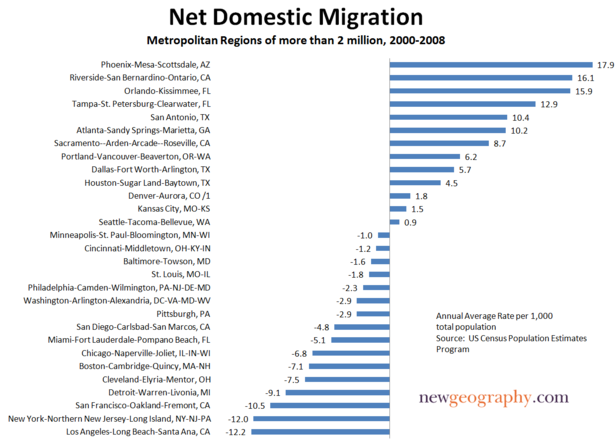
    The overall migration numbers are even more revealing. As was the case for much of the past decade, the biggest gainers continue to include cities such as San Antonio, Dallas and Houston. Rather than being oases for migrants, some oft-cited magnets such as New York, Boston, Los Angeles and Chicago have all suffered considerable loss of population to other regions over the past year.
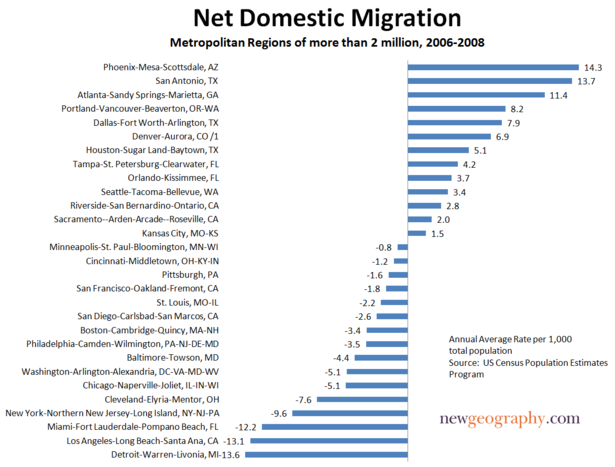
    Much the same pattern emerges when you look at longer-term state demographic patterns. A recent survey by the Empire Center for New York State Policy found that the biggest net losers in terms of per capita outmigration between 2000 and 2008 were, with the exception of Louisiana, all blue state bastions. New York residents lead in terms of rate of exodus, closely followed by the District of Columbia, Michigan, Pennsylvania, Massachusetts and California.

    An even greater shock to the sensibilities of the insular, Manhattan-centric media, the report found that most of the movement from the Empire State was not from the much-dissed suburbia, but from that hip and cool paragon, New York City. This can not be ascribed as a loss of the unwanted: According to the report, those leaving the city had 13% higher incomes than those coming in.

    How can this be, when everyone who’s smart and hip is headed to the Big Apple? This question was addressed in a report by the center-left, New York-based Center for an Urban Future. True, considerable numbers of young, educated people come to New York, but it turns out that many of them leave for the suburbs or other states as they reach their peak earning years.

    Indeed, it’s astonishing given the many clear improvements in New York that more residents left the five boroughs for other locales in 2006, the peak of the last boom, than in 1993, when the city was in demonstrably worse shape. In 2006, the city had a net loss of 153,828 residents through domestic out-migration, compared to a decline of 141,047 in 1993, with every borough except Brooklyn experiencing a higher number of out-migrants in 2006.

    Of course, blue state boosters can point out that the exodus has slowed with the recession, as opportunities have dried up elsewhere. True, the flood of migration has slowed across the nation. Yet it has only slowed, not dried up. When the economy revives, it’s likely to start flowing heavily again.

    More important, the key group leaving New York and other so-called “youth-magnets” comprises the middle class, particularly families, critical to any long-term urban revival. This year’s Census shows that the number of single households in New York has reached record levels; in Manhattan, more than half of all households are singles. And the Urban Future report’s analysis found that even well-heeled Manhattanites with children tend to leave once they reach the age of 5 or above.

    The key factor here may well be economic opportunity. Virtually all the supposedly top-ranked cities cited in this media narrative have suffered below-average job growth throughout the decade. Some, like Portland and New York, have added almost no new jobs; others like San Francisco, Boston and Chicago have actually lost positions over the past decade.
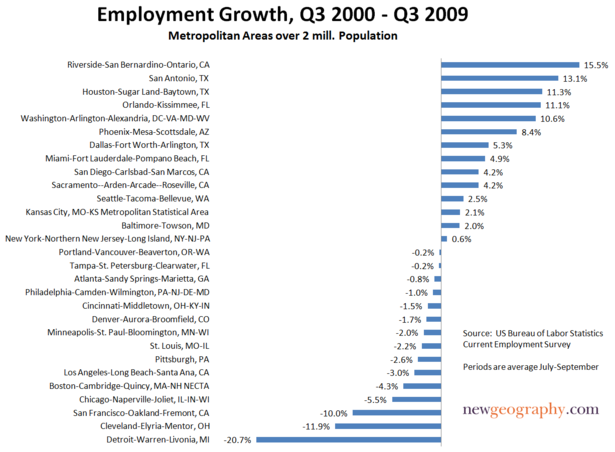
    In contrast, even after the current doldrums, San Antonio, Orlando, Houston, Dallas and Phoenix all boast at least 5% more jobs now than a decade ago. Among the large-narrative magnet regions only one–government-bloated greater Washington–has enjoyed strong employment growth.

    The impact of job growth on the middle class has been profound. New York City, for example, has the smallest share of middle-income families in the nation, according to a recent Brookings Institution study; its proportion of middle-income neighborhoods was smaller than that of any metropolitan area except Los Angeles.The same pattern has also emerged in what has become widely touted as America’s “model city”–President Obama’s adopted hometown of Chicago.

    The likely reasons behind these troubling trends are things rarely discussed in “the narrative”–concerns like high costs, taxes and regulations making it tough on industries that employ the middle class. One clear culprit: out of control state spending. State spending in New York is second per capita in the nation (anomalous Alaska is first); California stands fourth and New Jersey seventh. Illinois is down the list but coming up fast. Over the past decade, while its population grew by only 7%, Illinois’ spending grew by an inflation-adjusted 39%.

    The problem here is more than just too-large government; it lies in how states spend their money. Massive public spending increases over the past decade in California, New Jersey, Illinois and New York have gone overwhelmingly into the pockets and pensions of public employees. It certainly has not flowed into such basic infrastructure as roads, bridges and ports that are needed to keep key industries competitive.

    The American Association of State Highway Transportation, for example, ranked New York 43rd in the country and New Jersey dead last in terms of quality of roads. Some 46% of the Garden State’s roads were rated in poor condition, compared with the national average of 13%, even as the state’s spending reached new highs. The typical New Jersey driver spends almost $600 a year in auto repairs necessitated by the poor conditions of the roads.

    In contrast, states in the South and parts of the Plains tend to pour their public resources into productive uses. Cities like Mobile, Ala., Houston, Charleston, S.C., and Savannah, Ga., have been investing in port facilities to take advantage of the planned widening of the Panama Canal. The primary goal is to take business away from the increasingly expensive, overregulated and under-invested ports of the Northeast and West Coast. Similarly, places like Kansas City and the Dakotas are looking to boost their basic rail and road networks to support export-heavy industries.

    Even in the face of the Obama administration’s strongly urban-centric, blue state-oriented economic policy, these generally less than hip places appear poised to grow as the economy recovers. Virtually all the top 10 economies that have withstood the recession come from outside the “youth-magnet” field: San Antonio; Oklahoma City; Little Rock, Ark.; Dallas, Baton Rouge, La.; Tulsa, Okla., Omaha, Neb.; Houston and El Paso, Texas. The one exception to this rule, Austin, also benefits from being located in solvent, generally low-tax Texas.

    This continued erosion of jobs and the middle class from the blue states and cities is not inevitable. Many of these places enjoy enormous assets in terms of universities, strategic location, concentrations of talented workers and entrenched high-wage industries. But short of a massive and continuing bailout from Washington, the only way to reverse their decline will be a thorough reformation of their governmental structure and policies. No narrative, no matter how well spun, can make up for that reality.

    This article originally appeared at Forbes.com.

    Joel Kotkin is executive editor of NewGeography.com and is a distinguished presidential fellow in urban futures at Chapman University. He is author of The City: A Global History. His next book, The Next Hundred Million: America in 2050, will be published by Penguin Press early next year.

  • Report from Orlando: The Spirit Rocks On

    By Richard Reep

    “In hard times, people turn to God or alcohol” jokes Bud Johnson of Constructwire, a database that tracks planning and construction projects nationwide. Johnson, 50, is an industry veteran and has never seen a recession like this in his career. “This is an exceptionally broad-based downturn,” he says, “and Orlando has been hit harder than most in the South, what with your only real industries being housing and tourism.” Both industries have been trapped like mammoths in a glacier as the credit market stays stubbornly frozen in a modern banking Ice Age.

    At the bottom of the glacier, however, the meltwater continues to flow, and bars and liquor stores seem to be thriving. With 10 new ABC stores open this year, this privately held Orlando-based liquor retailer is doing just fine, enabling many of us to stay sane, if not sober, while waiting for The Recovery. The alchoholic spirits are not the only mood-shifting business doing well in these hard times. Sacred space may not be exactly booming, but religious buildings are being built at a more comfortable pace than nearly any other building type in Central Florida.

    “Ecclesiastical architecture is falling at a rate close to that of a paper airplane, while my other building types have the glide ratio of a rock,” says Peter Kosinski, the architect responsible for the renovation of St. James Cathedral in downtown Orlando. With most other projects on hold, including a share of churches, Kosinski Architecture has still seen most of his religious work proceed, despite the Great Recession. Funding largely comes from donations, and for secular not-for-profits cultural outfits like United Arts, giving has evaporated. Spiritual needs, however, seem to be drawing a steady stream of money to expand or add to temples, churches, synagogues, and other sacred spaces to meet a growing demand in the Central Florida area.

    If the credit Ice Age is a part of a great karmatic rebalancing, it was long overdue and has hit especially hard in our overheated, consumer-driven culture. The cynics, who knew the cost of everything and the value of nothing, drove sacred space largely underground as new subdivisions engorged Orlando with not a square inch reserved for community worship. Religious uses simply don’t fit the profit model of late capitalism, and while our older neighborhoods are dotted with small, walk-to churches, not a cross can be found in the landscape of most newer developments. To the development industry, collective religious worship represents someone else’s unprofitable land sale.

    Cobbling together 15 or 20 acres therefore became a new art form for many evangelical pastors as the late 20th century saw the rise of the megachurch. These huge, Sunday-traffic-nightmares offer sophisticated audio/visual Christian themed entertainment in an arena setting, a perfect way for many to fulfill their spiritual needs. Others, stuck in these vast residential tracts devoid of sacred space, use the house-church method, gathering in groups of 8 or 10 at a member’s residence, taking heart in what Pope Gregory the Great (an early leader) stated: “The real altar of God is the mind and the heart of the just.” And some do both.

    Either way, the religious needs of the people of Central Florida are expanding, and the sanctuaries, temples, synagogues, and mosques are noticeably busier. The 2-year-old Guang Ming Temple, housing the local Renzai Humanist Buddhists, is experiencing a surge in attendance locally. Temple Director Chueh Fan confirms that there is a strong need for a communal spiritual facility. “We feel the hardship of people right now,” she states. “Although the Asian community here is stable, we have been growing over the last 2 years. And we are a middle-sized temple; there are some much bigger in other states.” Guang Ming offers Dharma classes in Spanish, English, Vietnamese and Chinese, and class enrolment is growing quickly.

    Other clerics, such as Reverend Reginald Dunston, also see a need for more religious-based education, and are planning new schools as well as sanctuaries. “Agape Word Ministry is planning a bible-based school,” he explains, “as an alternative to the schools in the area.” Other pastors, such as Jeff Cox of Salem Lutheran Church in Bay Hill, agree that it is important to expand their offerings to include a religious-based education. Education is the one tangible asset that a community is willing to purchase from a house of worship, and while most religions in America struggle for relevance, their schools remain in demand.

    Christianity, exploding in a pluralism not seen since the Reformation, is especially sensitive to its status as the dominant American religion. While over 4,000 new churches open nationwide annually, another 3,700 close, according to David T. Olson in his 2008 book “The American Church in Crisis.” This is near status quo, despite population growth, suggesting a shift away from collective religious worship for many. Hispanics, traditionally more observant, are building megachurches at a far faster clip than non-Hispanics, pointing to a loss of interest in collective Christianity for the majority of the population.

    Locally then, the house of worship is entering a phase of experimentation as new forms, such as megachurches, are tried; it is discarded altogether by the house-church movement; and it is growing in some religions such as Buddhism, with their new temple, and Judaism, with the construction of the new JCC South Campus on Apopka Vineland Road. The mainline Christian denominations that dominate downtown’s skyline serve less and less as a model for new buildings as malls are repurposed, warehouse buildings are adapted, and more novel programs and designs are tried.

    Hindu, Jain, and Muslim traditions are also represented in Orlando, and generally playing to full houses. The Masjid Al-Haqq mosque on West Central Boulevard on a Friday afternoon was brimming full, with more worshippers arriving by car and by foot. Collective spiritual worship of all forms is clearly a rising force within Orlando, and space on pews, benches, chairs and prayer mats are at a premium.

    Missing from many lives, crucial to others, religion is at an odd crossing in Central Florida’s history. To balance empty pocketbooks, some people are filling their cups with booze but others are also imbibing a perhaps long-delayed return to spirituality. This return, however, is marked by a mosaic of multiple religions, rather than a return to the few mainstream denominations that characterized early Orlando’s growth. If Bud Johnson is right, and this surge in spirituality lasts through The Recovery, Orlando will see a boom in new religious architecture that might make up for lost time, creating a revival in sacred space in the Central Florida landscape.

    Richard Reep is an Architect and artist living in Winter Park, Florida. His practice has centered around hospitality-driven mixed use, and has contributed in various capacities to urban mixed-use projects, both nationally and internationally, for the last 25 years.

  • The White City

    Among the media, academia and within planning circles, there’s a generally standing answer to the question of what cities are the best, the most progressive and best role models for small and mid-sized cities. The standard list includes Portland, Seattle, Austin, Minneapolis, and Denver. In particular, Portland is held up as a paradigm, with its urban growth boundary, extensive transit system, excellent cycling culture, and a pro-density policy. These cities are frequently contrasted with those of the Rust Belt and South, which are found wanting, often even by locals, as “cool” urban places.

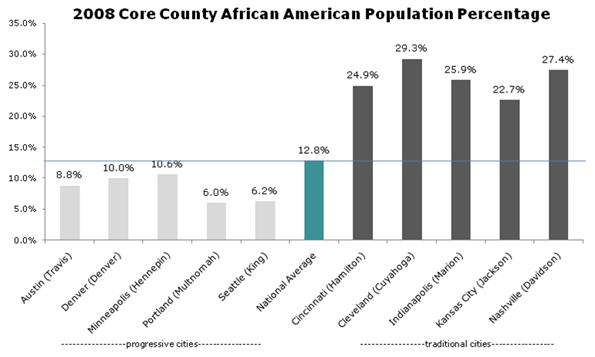
    But look closely at these exemplars and a curious fact emerges. If you take away the dominant Tier One cities like New York, Chicago and Los Angeles you will find that the “progressive” cities aren’t red or blue, but another color entirely: white.

    In fact, not one of these “progressive” cities even reaches the national average for African American percentage population in its core county. Perhaps not progressiveness but whiteness is the defining characteristic of the group.

    The progressive paragon of Portland is the whitest on the list, with an African American population less than half the national average. It is America’s ultimate White City. The contrast with other, supposedly less advanced cities is stark.

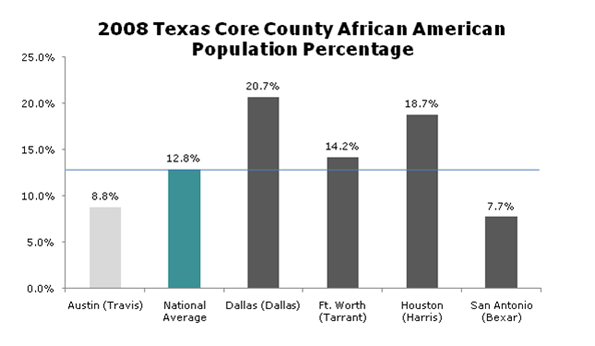
    It is not just a regional thing, either. Even look just within the state of Texas, where Austin is held up as a bastion of right thinking urbanism next to sprawlvilles like Dallas-Ft. Worth and Houston.

    Again, we see that Austin is far whiter than either Dallas-Ft. Worth or Houston.

    This raises troubling questions about these cities. Why is it that progressivism in smaller metros is so often associated with low numbers of African Americans? Can you have a progressive city properly so-called with only a disproportionate handful of African Americans in it? In addition, why has no one called these cities on it?

    As the college educated flock to these progressive El Dorados, many factors are cited as reasons: transit systems, density, bike lanes, walkable communities, robust art and cultural scenes. But another way to look at it is simply as White Flight writ large. Why move to the suburbs of your stodgy Midwest city to escape African Americans and get criticized for it when you can move to Portland and actually be praised as progressive, urban and hip? Many of the policies of Portland are not that dissimilar from those of upscale suburbs in their effects. Urban growth boundaries and other mechanisms raise land prices and render housing less affordable exactly the same as large lot zoning and building codes that mandate brick and other expensive materials do. They both contribute to reducing housing affordability for historically disadvantaged communities. Just like the most exclusive suburbs.

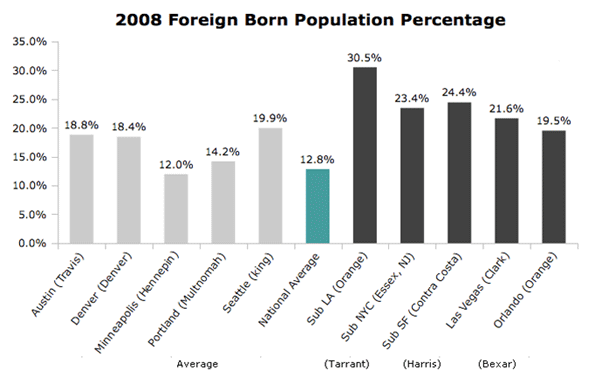
    This lack of racial diversity helps explain why urban boosters focus increasingly on international immigration as a diversity measure. Minneapolis, Portland and Austin do have more foreign born than African Americans, and do better than Rust Belt cities on that metric, but that’s a low hurdle to jump. They lack the diversity of a Miami, Houston, Los Angeles or a host of other unheralded towns from the Texas border to Las Vegas and Orlando. They even have far fewer foreign born residents than many suburban counties of America’s major cities.

    The relative lack of diversity in places like Portland raises some tough questions the perennially PC urban boosters might not want to answer. For example, how can a city define itself as diverse or progressive while lacking in African Americans, the traditional sine qua non of diversity, and often in immigrants as well?

    Imagine a large corporation with a workforce whose African American percentage far lagged its industry peers, sans any apparent concern, and without a credible action plan to remediate it. Would such a corporation be viewed as a progressive firm and employer? The answer is obvious. Yet the same situation in major cities yields a different answer. Curious.

    In fact, lack of ethnic diversity may have much to do with what allows these places to be “progressive”. It’s easy to have Scandinavian policies if you have Scandinavian demographics. Minneapolis-St. Paul, of course, is notable in its Scandinavian heritage; Seattle and Portland received much of their initial migrants from the northern tier of America, which has always been heavily Germanic and Scandinavian.

    In comparison to the great cities of the Rust Belt, the Northeast, California and Texas, these cities have relatively homogenous populations. Lack of diversity in culture makes it far easier to implement “progressive” policies that cater to populations with similar values; much the same can be seen in such celebrated urban model cultures in the Netherlands and Scandinavia. Their relative wealth also leads to a natural adoption of the default strategy of the upscale suburb: the nicest stuff for the people with the most money. It is much more difficult when you have more racially and economically diverse populations with different needs, interests, and desires to reconcile.

    In contrast, the starker part of racial history in America has been one of the defining elements of the history of the cities of the Northeast, Midwest, and South. Slavery and Jim Crow led to the Great Migration to the industrial North, which broke the old ethnic machine urban consensus there. Civil rights struggles, fair housing, affirmative action, school integration and busing, riots, red lining, block busting, public housing, the emergence of black political leaders – especially mayors – prompted white flight and the associated disinvestment, leading to the decline of urban schools and neighborhoods.

    There’s a long, depressing history here.

    In Texas, California, and south Florida a somewhat similar, if less stark, pattern has occurred with largely Latino immigration. This can be seen in the evolution of Miami, Los Angeles, and increasingly Houston, San Antonio and Dallas. Just like African-Americans, Latino immigrants also are disproportionately poor and often have different site priorities and sensibilities than upscale whites.

    This may explain why most of the smaller cities of the Midwest and South have not proven amenable to replicating the policies of Portland. Most Midwest advocates of, for example, rail transit, have tried to simply transplant the Portland solution to their city without thinking about the local context in terms of system goals and design, and how to sell it. Civic leaders in city after city duly make their pilgrimage to Denver or Portland to check out shiny new transit systems, but the resulting videos of smiling yuppies and happy hipsters are not likely to impress anyone over at the local NAACP or in the barrios.

    We are seeing this script played out in Cincinnati presently, where an odd coalition of African Americans and anti-tax Republicans has formed to try to stop a streetcar system. Streetcar advocates imported Portland’s solution and arguments to Cincinnati without thinking hard enough to make the case for how it would benefit the whole community.

    That’s not to let these other cities off the hook. Most of them have let their urban cores decay. Almost without exception, they have done nothing to engage with their African American populations. If people really believe what they say about diversity being a source of strength, why not act like it? I believe that cities that start taking their African American and other minority communities seriously, seeing them as a pillar of civic growth, will reap big dividends and distinguish themselves in the marketplace.

    This trail has been blazed not by the “progressive” paragons but by places like Atlanta, Dallas and Houston. Atlanta, long known as one of America’s premier African American cities, has boomed to become the capital of the New South. It should come as no surprise that good for African Americans has meant good for whites too. Similarly, Houston took in tens of thousands of mostly poor and overwhelmingly African American refugees from Hurricane Katrina. Houston, a booming metro and emerging world city, rolled out the welcome mat for them – and for Latinos, Asians and other newcomers. They see these people as possessing talent worth having.

    This history and resulting political dynamic could not be more different from what happened in Portland and its “progressive” brethren. These cities have never been black, and may never be predominately Latino. Perhaps they cannot be blamed for this but they certainly should not be self-congratulatory about it or feel superior about the urban policies a lack of diversity has enabled.

    Aaron M. Renn is an independent writer on urban affairs based in the Midwest. His writings appear at The Urbanophile.

  • Live by the Specialty, Die by the Specialty

    By Richard Reep

    Regions have a bad habit of getting into ruts. This is true of any place that focuses exclusively on one industry – with the possible exception of the federal government, which keeps expanding no matter what. This reality is most evident in places like Detroit, but it also applies to one like Orlando, whose tourist-based economy has been held up as a post-industrial model.

    This has not been helped by recent diktats from DC Central Control. As reported in the Wall Street Journal, the Ephemeral City, among others, has now been branded a Sybaris. Private interests continue to book conferences in Central Florida due to its good value, but the closed circle of federal government has prudishly proscribed the family leisure capital of the world in favor of destinations like Chicago. Central Florida’s chagrined congressional delegation, caught in reaction mode, will fight to remove this ban, but the damage has been done. A cold new era has firmly settled into the Sunshine State’s former playground.

    Since welcoming Walt Disney with open arms in 1964, Orlando proudly built its reputation as a family leisure destination. With over 116,000 hotel rooms, Orlando competes with Las Vegas in both the national and global tourism market. Indeed, Europeans, Middle Easterners, Asians, and Latin Americans make Orlando their playground, and if physical evidence is needed, the exquisitely messy honky-tonk of North International Drive testifies to this reality.

    Many couldn’t fault this strategy – at least until until now. Orlando’s mania for tourism, supported by local, regional and state policies, yielded growth beyond the wildest dreams of this once-sleepy agricultural town at a railroad crossing among orange groves and cattle ranches.

    But in the current economy, leisure can be seen as a waste of time and money. “I think Orlando got put on the list of not to go because of the perception that it is a resort and vacation area,” read a July email from a Department of Agriculture employee to an Orlando conference planner. Business in Central Florida has slowed to a trickle, anxiety is increasing and doors are closing. It seems that Orlando’s tourism bubble has popped with visitorship dropping from a high of nearly 50 million in 2005, to a projected high barely above 43 million in 2009, and while civic leaders are huffing and puffing to blow it back up again, Central Florida’s leisure industry is a shadow of its former boisterous self.

    Corporate trainers, state and local government conferences, not-for-profits, trade associations, and incentive groups still find Central Florida a decent place to hold meetings. Airfare is cheap, the vast quantity of hotel rooms makes for competitive rates. The renewed emphasis on bringing the family along makes Orlando a natural fit for many groups seeking a destination, especially in the winter. They may book rooms in more affordable Osceola County rather than pricey Orange County, but are still a few minutes’ drive from Disney’s front door, the beach, and dozens and dozens of food and shopping outlets. Some hotel owners are even contemplating new meeting rooms to keep up with shifting demand.

    The new mood in Washington, however, does not favor Orlando as a destination. Central Florida may be a good value, but this is irrelevant to the equation, for it is the overriding perception of Orlando that seems to worry our national government’s travel planners. And this perception tells us quite a bit about the real thinking that is happening at the federal level.

    If the new policy were to plan trips only to destinations under the median cost, it would send a message that government does not want to waste money. It might also send federal conferences to destinations in overlooked parts of America that could open beltway eyes to the bleak turmoil enveloping so much of the country, despite the steady drumbeat of recovery news.

    Meanwhile, sellers already know that Washington is really the only game in town, as businesses turn towards grant programs, rebates, and other incentives to backfill lost private sector revenue in goods and services. But if one looks closely at the actual investment pattern, Washington seems to favor the financial market, green energy, and possibly its own future health care program – none of which plays to Orlando’s strengths. This extremely narrow set of interests belies a harsh ideology, as harsh as the ideology it replaced, and as bad for the average citizens of America.

    Yet for all this, Central Florida should share some of the blame. Orlando cursed itself by growing around a single specialty, rather than a diverse set of interests. Favoring theme parks over agriculture was certainly an opportunistic decision, but reinforcing tourism and ignoring all other investment has proved a vast miscalculation. The Sunshine State could have been #1 in solar energy research by now, making it Obama’s darling. So Central Florida, without any other true industry, now grovels at the government’s feet to restore itself into good graces and allow a National Park Service meeting to take place at the Ramada Inn again. It is likely that Orlando will be shut out of this closed circle for some time to come.

    Central Florida’s best hope lies in a recovery of the private sector economy, a regained sense of profitability by corporations, and a renewed faith in the future by individuals. Lacking these now, Central Florida hibernates, its giant engines of escapism in low gear, mothballed, or abandoned.

    One almost hopes The Recovery will be delayed long enough to suffer some sense into the politicians and business leaders who can diversify the economy of the region. After all many of things that attract tourists – low costs, good infrastructure, warm weather – should also lure entrepreneurs, skilled workers and capital, foreign and domestic. You wonder why our leaders have not yet thought of this, or put a plan to diversify into action.

    Richard Reep is an Architect and artist living in Winter Park, Florida. His practice has centered around hospitality-driven mixed use, and has contributed in various capacities to urban mixed-use projects, both nationally and internationally, for the last 25 years.

    Photo by Carlos Cruz.

  • Confronting Street Art

    By Richard Reep

    Street art has been around since ancient times, with the triple theme of craft, sabotage, and branding. Paris’ “Blec le rat” and New York’s Taki 183 were early pioneers in street art. Today, street art has spread into nearly every city with artists, media, and collectors. Skateboards, tattoos, stickers, and spray paint are but a few examples of the craft of the street. The adrenalin rush an artist feels in executing his work is augmented by the urban thrill of working at night, rushing to leave behind a signature before the police come. The chief aim of most street art is branding, as the artist’s main form of expression is to create a recognizable personal logotype.

    On the street, the city’s public space in general has slowly been eviscerated by our culture of consumption, for it provides an antiquated, nearly obsolete physical format for civic discourse. Long ago proclaimed dead by noted architect Daniel Liebeskind, physical public space has precipitously declined in value to most of the citizens of the city. In its place has risen virtual public space – first television, which was a one-way path, and then the internet, which provides a two-way path.

    Yet physical public space continues to serve as medium of the new Street Art form. Stickers, tags, skateboards, and tattoos are all viewed on the street, offering a means to carry this new art form into the next century. The so-called “cutting edge” artists have retreated into their private studios to conceive their next moves in video or computers, but the street artists have taken over the city.

    The elite artists may inhabit the galleries but street artists proclaim their brand of art as supreme. Globalism is achieved by hard work: Artists like Barry McGee or Banksy are no longer confined to one city; Space Invader, having successfully placed his own particular brand across the face of Paris, now has spread to London and New York, making his own global art tour as a form of civic art.

    Viewing a piece of graffiti at once causes a reaction of fear and a perception of danger. Can anyone claim the same immediate, visceral reaction to anything seen in a gallery or museum? This art form reaches people at such a gut level that it trumps most of the work of other artists being exhibited and discussed in the art world. Street artists use this to their own advantage, and their craft reinforces what McLuhan described so well in his epigram “the medium is the message.” The content of the piece is almost irrelevant; the viewer’s reaction is the same regardless of the tag’s content or author.

    Street art is tied into a larger urban culture, and expresses the visual aspect of this larger milieu. As Western mainstream culture retreats from the street into the air-conditioned, connected bubbles of the suburbs, street art and its culture expands to fill the empty space. The zone emptied by the suburbanites does indeed reek of death, more so today, as public investment in the city dwindles or becomes remarkably predictable or prosaic. Budget cuts in schools, government facilities, and even basic street maintenance presage an ever higher level of decay and disrepair, of neglect and abandonment of our shared space, and those who inhabit this space are simply documenting what they see and returning it back to us. We cannot escape the messages of street art, for they are everywhere, embedded into the context. Some are more overt, and some are covert – only noticed, for example, when waiting for a red light – but they are there, reminding us that there is life amidst the emptiness.

    Graffiti’s barrage of skulls, vacant-eyed cartoon children, and other signs of death and destruction are easy to ignore, but they are telling us something important about the urban environment. The sooner we stop and examine this evidence, the sooner we can begin a process to find common ground, and to seek out a shared vision that does not divide the urban world into an us-and-them mentality. Street art simply puts visual form to the voices we have so long shut out of the urban conversation.

    In Orlando, the trend of giving street artists “permission walls,” or walls where they have permission to paint their work, has tamed and channeled some of the sabotage. By allowing graffiti artists to work with permission, they are free to develop their craft without fear of getting caught before completion, and the artwork becomes a colorful, mural-sized effort to which the artists can point with pride. These permission walls encourage friendly competition between teams, or crews, and there is a sense of pride among them for having created something with great exposure.

    Two permission walls exist to the east of downtown Orlando, but it is the cluster of warehouses at 630 E. Central that showcase graffiti artwork at its best. Artist Robin Van Arsdol owns part of this cluster and has been sponsoring an international graffiti conference for several years, bringing in artists from Europe, the Caribbean, and North America for a weekend of painting at his studios. Driving by his property offers a study in converting urban form into art, and perhaps suggests the visual future of more than one city.

    The graffiti artists have offered a philosophical change-up that should not be overlooked. The conversation about postmodern art seemed to have reached a dead end some time ago; artists
    first threw out figure, then form, then color, then the frame, and then wandered into their process itself as an art form. Graffiti artists begin with the end: their signature, or tag, becomes the art,
    and by using this as the starting point, and the city as their canvas, they unconsciously offer a new beginning to think about the relationship between art and the city.

    We must accept the challenge that graffiti artists offer us. We need to confront this takeover of the physical urban form and push back. Street art constitutes a fresh, interesting language. It is the language of a city that is weak and divided. We must hear what graffiti says to us as a society, and retake our physical urban character as a common, broad place that offers secure, sacred, and special places for all citizens. By ignoring graffiti art, we postpone our treatment of the urban malaise. By confronting it and bringing it into the mainstream, we can better treat our urban condition and improve the city as a dwelling place for the benefit of all.

    Richard Reep is an Architect and artist living in Winter Park, Florida. His practice has centered around hospitality-driven mixed use, and has contributed in various capacities to urban mixed-use projects, both nationally and internationally, for the last 25 years.

  • Urban Backfill vs. Urban Infill

    By Richard Reep

    Wendell Cox recently reported on the state of so-called “urban infill” efforts, and analyzed which cities are experiencing an increase in their density. This report shows some surprising trends. Cities such as Pittsburgh, which claim to be successful at “infilling”, are actually dropping in density, in part because of low birth rates and lack of in-migration.

    What may be the next trend might be called urban agriculturalization or “urban backfill”. In the past, urban infill used to make sense. Where a concentration of people already existed, and where infrastructure was in place, development between existing structures seemed inevitable. With the accessibility allowed by the car, urban infill became a choice among others, including the suburban frontier. Urban infill became, for most cities, a rarity.

    Current attempts to encourage infill over fringe development may be too little too late, as the cost and regulatory environment favors fringe development. Expenditures on public safety rose as building codes dictated an increasing level of safety in urban cores, not just for the occupants of the building, but for the building itself. Driven higher because of the perceived desirability of a downtown, costs soared out of control as elaborate, complex zoning processes meant high fees to a team of consultants necessary to steer projects through multiple public hearings. These generated some pricey computer graphics, but often no guaranteed outcome.

    Aesthetics also have become highly regulated as well, with design boards composed of interested citizens, reducing the design process to design-by-committee. By the early part of this century, urban infill became an Olympian sport, leaving most of an urban area’s empty lots and dilapidated buildings vacant.

    To further burden the urban infill developer, right now a new form of regulation is entering the scene, that of the so-called smartcode which regulates the last untouched part of the exterior of a structure: its overall form. With rigid codes and design staffs, cities can now create for themselves a vision, supplemented with pretty pictures, of the imagined future, where building patterns need to be just-so. An urban infill developer must now adhere to someone else’s opinion of where his front door is, and whether he has a front porch.

    So, in reality, these urban parcels sit abandoned and income-free, with the biggest real estate growth market being in “for sale” signs, as owners try to unload these properties on a greater fool ready to do battle for the cause of urban infill. It is a no-win scenario for cities.

    Back fill provides an alternative below the line. Overlooked spaces are being discovered by many people as ideal for temporary use, and with only a small cost for a license or permit, new marketplaces, street performances, and other people-intensive activities are rushing in to fill the void. Again, a city with any savvy will try to apply a regulatory and fee drag on this activity; fortunately for the citizens, this usually takes a long time, and in the meantime, many cities are acquiring the look of a genteel form of Blade Runner, with person-to-person commerce taking place among the currently decaying and abandoned edifices and infrastructure.

    Still other parts of the city are trying to beautify their abandoned spaces by planting them, sometimes with gardens, figuring lush landscapes can hide the fact that their core is not as desirable as it once was. And still others fence them off, creating a new canvas for graffiti artists and advertising, and returning the abandoned spaces into wilderness.

    All of this belongs to the study of old field succession, which traditionally has been an agricultural science. For urban cores, this approach suggests a new way to reuse abandoned space. Increasingly, agriculture may not belong exclusively to the rural condition, but can be adapted to the city itself.

    In some areas such as Orlando, entrepreneurs have discovered this reverse-flow effect, which has been useful in so many other endeavors. By applying the standards of agriculture to the urban core, interesting and useful businesses are springing up. Near Orlando’s downtown area, for example, Dandelion’s Café is licensed not as a restaurant but as an agricultural kitchen, allowing it to operate under the Florida Department of Agriculture rather than the Florida Department of Health. This freedom does not compromise public safety – people still get sick from food in Department of Health regulated restaurants – but cleverly avoids the intensive state oversight, permits and fees associated with most restaurants.

    In College Park, the City’s empty land has been converted into a community garden, offering small plots of land for rental to surrounding property owners to cultivate produce. This is not a new idea; urban community gardens exist in cities worldwide. But as the current economic conditions squeeze incomes, creative use of outdoor space to reduce the grocery bill has engendered a new microfarming movement, and may have staying power as people rediscover a sense of shared purpose.

    All this creates a new form of development, which might be characterized as urban backfill. Urban backfill projects include any temporary uses of space for food, commerce, or entertainment. These even include temporary sacred places – the streetcorner preacher, for example, and his congregation. Still other abandoned spaces seemed destined for decay: overgrown weeds, saplings, and mice are turning urban vacant lots into true pastoral scenes that provide surrounding buildings with glimpses of unregulated nature.

    Cities can hold off this backfill for only so long. If Twitter can enable a revolution, ad hocracy can certainly enable free commerce and discourse in a democracy. Temporary uses suggest a vitality that cannot be denied or regulated to death, and suggest that cities consider a new way of looking at these spaces. Urban backfill provides an opportunity to reinvent the American city and create economic and social value where now none exists. It can also help establish both a renewed sense of place that can also nurture new ways for a city to evolve organically and naturally.

    Richard Reep is an Architect and artist living in Winter Park, Florida. His practice has centered around hospitality-driven mixed use, and has contributed in various capacities to urban mixed-use projects, both nationally and internationally, for the last 25 years.

  • Tracking Business Services: Best And Worst Cities For High-Paying Jobs

    Media coverage of America’s best jobs usually focuses on blue-collar sectors, like manufacturing, or elite ones, such as finance or technology. But if you’re seeking high-wage employment, your best bet lies in the massive “business and professional services” sector.

    This unsung division of the economy is basically a mirror of any and all productive industry. It includes everything from human resources and administration to technical and scientific positions, as well as accounting, legal and architectural firms.

    Overall there are roughly 17 million professional and business services jobs, 4 million more than manufacturing. This makes it twice as big as the finance sector and five times the size of the much-ballyhooed tech sector. While its average salary – roughly $55,000 a year – is somewhat lower than in those other elite sectors, its wages are still higher than those in all the other large sectors, like health. The sector’s $1 trillion in total pay per year accounts for nearly 20% of all wages paid in the nation; finance and tech together only account for $812 billion.

    More than that, the business and professional services sector has encompassed the fastest-growing part of the high-wage economy. Employment in lower-wage sectors like education has also grown quickly. But employment in other sectors that pay their employees well, such as technology, has remained stagnant; jobs in some, such as manufacturing, have fallen sharply. Critically, the business services sector – particularly at the better-paying end – seems to have weathered the current recession better than these other high-wage sectors.

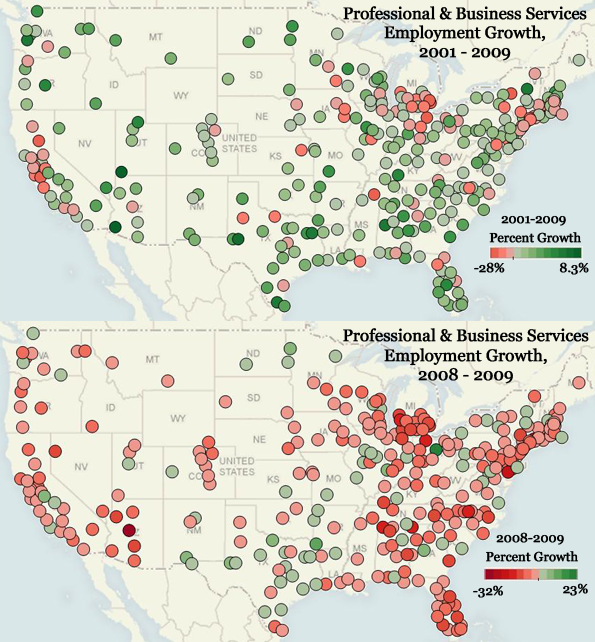
    The crucial question remains: In what regions is this critical economic cog booming? In a new analysis with my colleagues at the Praxis Strategy Group, we examined Bureau of Labor Statistics employment data for this sector, keeping an eye on trends over both the last year and the last decade. Some of the metropolitan areas that boasted short-term growth in this sector also maintained steady employment success over the long-term, which suggests that these particular cities have sturdy economies that aren’t as prone to intense boom-bust cycles.

    At the top of our list of best places is greater Washington, D.C., and its surrounding suburbs in Virginia and Maryland. Government jobs may drive that economy, but it is the lawyers, consultants and technical services firms who harvest the richest benefits. As New York University public policy professor Mitchell Moss observes, Washington has emerged as the “real winner” in the recession – not just for public-sector workers but private-sector ones too.

    Fastest Growing Professional and Business Services Sectors
    Area Name Jobs in Sector 2009
    (thousands)
    Sector Share of Jobs 2009
    (percent of total)
    Growth 2008 – 2009
    (percent growth)
    Cumulative Growth 2001 – 2009
    (percent growth)
    2001-2009 Job Change (thousands) 2008-2009 Job Change (thousands)
    Northern Virginia, VA 355.2 27.2% 1.5% 22.4% 65.0 5.2
    Washington-Arlington-Alexandria, DC-VA-MD-WV 558.7 23.0% 0.9% 22.8% 103.6 5.1
    Austin-Round Rock, TX 112.4 14.4% 3.3% 18.7% 17.7 3.6
    Houston-Sugar Land-Baytown, TX 382.3 14.7% 0.9% 19.2% 61.5 3.2
    Virginia Beach-Norfolk-Newport News, VA-NC 106.6 14.0% 2.8% 8.0% 7.9 2.9
    Bethesda-Frederick-Rockville, MD 125.7 21.9% 2.1% 9.0% 10.4 2.6
    Wichita, KS 31.5 10.1% 3.5% 16.4% 4.4 1.1
    Chattanooga, TN-GA 25.9 10.6% 4.3% 11.8% 2.7 1.1
    Peoria, IL 23.0 12.1% 4.5% 43.2% 6.9 1.0
    Rochester, NY 61.8 11.9% 1.5% 1.9% 1.1 0.9
    Augusta-Richmond County, GA-SC 31.0 14.5% 3.0% 7.5% 2.2 0.9
    Mansfield, OH 5.1 9.1% 19.4% 4.1% 0.2 0.8
    Kennewick-Pasco-Richland, WA 20.8 22.2% 4.2% 20.2% 3.5 0.8
    St. Louis, MO-IL 195.4 14.6% 0.4% 3.9% 7.4 0.8
    Fayetteville-Springdale-Rogers, AR-MO 33.5 16.2% 2.2% 34.2% 8.5 0.7
    Macon, GA 12.1 11.9% 5.5% 31.2% 2.9 0.6
    Pittsburgh, PA 158.9 13.9% 0.4% 14.5% 20.1 0.6
    Fresno, CA 30.7 10.3% 1.9% 23.3% 5.8 0.6
    Provo-Orem, UT 23.3 12.4% 2.5% 16.7% 3.3 0.6
    Charleston-North Charleston-Summerville, SC 42.2 14.3% 1.3% 31.1% 10.0 0.5

    Over the past year, parts of northern Virginia – ground zero for the so-called “beltway bandits” who work in industries the government depends on to do its job – have enjoyed the fastest growth in business and professional services, adding over 5,200 jobs despite the current downturn.

    Other areas around the nation’s capital have also seen strong growth. The Washington D.C.-Arlington-Alexandria area, for example, came in second on our list, gaining nearly 5,100 positions, while No. 6 the Bethesda-Frederick-Rockville, Md., metro area added 2,600. In addition, yet another Virginia area – No. 5-ranked Virginia Beach-Norfolk-Newport News, a center for military-related industries – gained nearly 2,900 jobs in this sector.

    It’s far too early to thank the free-spending ways of Barack Obama’s administration for all this growth. As anyone can tell you, the Bush White House and its Republican Congress were not exactly models of fiscal restraint. Plus, Washington and Northern Virginia have seen growth in their business services sectors over the last several years, in the period stretching from 2001 to 2009. Together those two metros added over 165,000 new jobs in this critical, high-wage sector.

    Of course, you don’t have to head to Washington to find a high-paying job – although you might not be able to escape unpleasant summer weather. The other major group of business-services hot spots includes Austin, Texas, at No. 3, and Houston, at No. 4. These Lone Star local economies have continued to thrive not only during the current recession but also over the last decade.

    The others winners include farther-afield locales in Kansas, Tennessee, Illinois and New York. These areas could be gaining both from companies seeking to lower costs and from the new capabilities for remote work due to the Internet. Even though they didn’t make our list, a host of smaller communities – like Mansfield, Ohio; Provo, Utah; and Charleston, S.C. – also enjoyed significant growth in the business services sector over the past year.

    So if these are the places where this segment of the economy is growing and high-paying jobs are easier to come by, where is the opposite true? The worst cities on our list span three archetypes: Rust Belt basket cases, Sunbelt flame-outs and expensive big cities. Perhaps the toughest losses were in Michigan: Detroit and the Warren-Troy metro area suffered big setbacks both in the last year and over the last decade.

    Fastest Declining Professional and Business Services Sectors
    Area Name Jobs in Sector 2009
    (thousands)
    Sector Share of Jobs 2009
    (percent of total)
    Growth 2008 – 2009
    (percent growth)
    Cumulative Growth 2001 – 2009
    (percent growth)
    2001-2009 Job Change (thousands) 2008-2009 Job Change (thousands)
    Phoenix-Mesa-Scottsdale, AZ 289.2 16.0% -10.8% 7.9% 21.2 -35.1
    Warren-Troy-Farmington Hills, MI 202.5 18.5% -12.0% -21.2% -54.4 -27.7
    Chicago-Naperville-Joliet, IL 633.6 16.8% -4.1% -2.9% -19.0 -27.0
    Los Angeles-Long Beach-Glendale, CA 574.7 14.3% -4.2% -3.4% -20.4 -25.2
    Atlanta-Sandy Springs-Marietta, GA 390.3 16.4% -5.9% -1.3% -5.1 -24.4
    Orlando-Kissimmee, FL 170.9 16.2% -8.5% 7.7% 12.3 -16.0
    Santa Ana-Anaheim-Irvine, CA 261.9 18.0% -4.7% 4.0% 10.2 -12.8
    Minneapolis-St. Paul-Bloomington, MN-WI 253.4 14.4% -4.6% -4.6% -12.2 -12.3
    Edison-New Brunswick, NJ 164.5 16.3% -6.7% -2.6% -4.4 -11.9
    Detroit-Livonia-Dearborn, MI 108.9 14.7% -9.5% -20.9% -28.8 -11.4
    Indianapolis-Carmel, IN 120.3 13.4% -8.3% 13.6% 14.4 -10.8
    Riverside-San Bernardino-Ontario, CA 133.7 11.2% -6.5% 36.0% 35.4 -9.2
    Tampa-St. Petersburg-Clearwater, FL 223.2 18.5% -3.7% 12.3% 24.5 -8.6
    New York City, NY 595.7 15.8% -1.4% -0.8% -5.1 -8.4
    Newark-Union, NJ-PA 163.5 16.0% -4.7% -0.5% -0.8 -8.0
    Bergen-Hudson-Passaic, NJ 130.6 14.6% -5.8% -9.1% -13.0 -8.0
    Milwaukee-Waukesha-West Allis, WI 107.6 12.9% -6.6% -1.7% -1.8 -7.6
    Miami-Miami Beach-Kendall, FL 139.1 13.4% -4.7% 2.2% 3.0 -6.8
    Oakland-Fremont-Hayward, CA 158.0 15.6% -4.0% -7.1% -12.2 -6.7
    Las Vegas-Paradise, NV 108.2 12.1% -5.8% 38.1% 29.9 -6.6
    Boston-Cambridge-Quincy, MA 308.8 18.2% -2.0% -6.8% -22.5 -6.4
    Sacramento–Arden-Arcade–Roseville, CA 106.1 12.3% -5.6% -1.8% -1.9 -6.3
    Cleveland-Elyria-Mentor, OH 137.8 13.3% -4.3% -5.2% -7.6 -6.1
    Denver-Aurora-Broomfield, CO 207.0 16.9% -2.9% 4.0% 8.0 -6.1

    Consistent job losses in business services in these areas – some 54,000 in the Troy area since 2001 – reveal the clear connection between employment in business services and in the region’s fundamental auto industry. It turns out that elite services often prove dependent on basic industry. When industrial plants shut down, it’s not just blue-collar workers and company executives that suffer; as a result, these firms will use fewer lawyers, accountants, architects and technical consultants.

    A similar picture emerges in cities like Phoenix, which lost about 35,000 business-services jobs in just one year. This loss stems from the collapse of the housing bubble, which powered the rest of the regional economy. The same meltdown caused smaller but still significant reversals in one-time boomtowns like Orlando, Fla., Atlanta and Southern California’s Santa Ana region, which encompasses Orange County, where business service employment dropped by double-digit rates over the past year.

    Yet these same areas should see some recovery, perhaps more so than the traditional auto manufacturing-focused towns. Phoenix, Orlando and other Sun Belt locations – including a host of other areas in Florida – all saw increasing employment in business services over the past decade. If the economy comes back, along with a stabilization of the residential real estate market, business-services job growth will likely begin to take off again. After all, the fundamental reasons for the success of these areas, such as warm weather, lower costs and the need to serve a growing population, have not fundamentally changed.

    Perhaps most perplexing is the fate of some of the other places on our worst cities list, particularly the biggest metropolitan areas. The professional and business services sector is widely considered ideal for large, cosmopolitan centers, since lots of industries require support. But Chicago experienced a huge chunk of job losses – almost 25% – in this sector during the last year. Other big cities, including Los Angeles, Minneapolis and New York, also suffered.

    This is not a new phenomenon. These and other big cities, like Boston and San Jose, San Francisco and Oakland in California, have been shedding these types of jobs since 2001. These losses, however, have been concentrated at the lower-wage end of the business service pyramid, in areas like human resources and administration. These are the positions that companies can fill more easily and cheaply using the Internet or by hiring in less expensive outposts.

    That’s why Washington and its environs, which has seen across-the-board business growth, remain the great exception. Many business-services jobs outside the beltway appear to be becoming more nomadic, based in places where firms face lower costs and where workers can afford to live well on middle-income salaries. Even the long-term resiliency of higher-wage employment like law and accounting in traditional business hubs like New York could be at risk over time, with some jobs shifting to less expensive locales or even overseas.

    The changing nature of business services presents a boon to some communities and a challenge to others as they seek to survive and thrive in spite of the current recession. How some cities manage to grow this segment of their economies may well presage which parts of the country will thrive best during the years of recovery – and beyond.

    This article originally appeared at Forbes.

    Joel Kotkin is executive editor of NewGeography.com and is a presidential fellow in urban futures at Chapman University. He is author of The City: A Global History. His next book, The Next Hundred Million: America in 2050, will be published by Penguin early next year.

  • Downtown Character and Street Performers

    By Richard Reep

    Carmen Ruest, Director of Cirque de Soleil, recently revealed her start as a street performer, or busker, in Canada. The interviewer did not hesitate to contrast this with the current state of Downtown Orlando, which forbids street performers. Eliminating this ban will improve Orlando’s urban consciousness, both downtown and elsewhere, and improve the city in general.

    The Downtown Development Board (an arm of city government) has long stated its mission to promote arts-based businesses downtown. In the nineties, this board even had special incentives for independent creative enterprises to encourage a local arts scene. Only later did the city give in to the temptation to go for the big box retailers, and all bets were suddenly off.

    Meanwhile, street performers continue to provide local color that graces cities of Europe, Canada, and elsewhere in the United States. Often, tales of tourists include encounters with creative street performers that make the trip; willingly parting with some money for a brief but engaging performance can be a bit of spice in an otherwise overstimulating experience. Such spontaneity is not allowed in Orlando, which ranks among the world’s top tourist destinations.

    The street performer connects with the pedestrian in a unique way: not in the safety of the theater, not in a venue where tickets are taken, and not at a scheduled time. Instead, the performer seeks the audience, and gives the performance first, then hopes for compensation. This puts the onus on the performer to be compelling, original, and brief. In short, the performer has got to have soul. There is no better training ground for future actors and entertainers than the street.

    Meanwhile, Orlando’s downtown arts scene is slowly gentrifying, with a variety of galleries and even artist’s studios. On the third Thursday every month, artists and art lovers from Avalon tour galleries up Pine Street, along Orange Avenue to the City Arts Factory, and some are even brave enough to filter up Magnolia Street to Redefine Gallery.

    However, for anyone who has visited other downtowns, this can be a rather antiseptic experience. If Orlando is serious about Downtown as a tourist venue, perhaps the city should focus a little more on the quality of the experience.

    Right now, spontaneity is missing from Downtown Orlando. The notion of public space is founded on the ability of citizens to express themselves within this space, and by encouraging positive forms of self-expression. If Orlando follows this venerable tradition downtown, the city might be surprised to find the benefits may far outweigh any disadvantages.

    Certainly with the city’s budget cuts, the Police Department has more important places to prioritize cops’ time rather than busting illegal street performance. By legalizing this activity, the shrinking resources of law enforcement can be spent elsewhere, thus improving the general safety and security of the city.

    To encourage the art scene, Downtown has instituted Third Thursdays, an art walk that mimics the ones popularized in the nineties in Scottsdale, Arizona and elsewhere. To experiment with street performers, the pathway taken by the Third Thursdays crowd would be an excellent place to start. If the city were to license street performers and monitor the activity along Pine Street and Orange Avenue, it could be a testing ground for this idea. Given the crowd’s affinity for art, street performers could become another attraction in itself. After all, the walk between galleries includes a lot of blank sidewalk time.

    For Downtown Orlando, it is time to fight fire with fire. Disney is successful because it recreates that lost-in-time feeling of walking in an urban environment and encountering balloon artists, saxophonists, mimes, and other characters. But at Disney and other theme parks this is all carefully choreographed and timed. If the downtown folks were to provide a spontaneous alternative, the city would have a new parking problem as people come to experience this. This proposal is not as ambitious as all that; it is simply to try it for the art walk. That’s once a month on three or four blocks. The city might even collect a license fee, and then let them do their thing.

    For lovers of performance art, the City of Orlando has proposed a new Performing Arts venue to be financed by bond money. However, the City’s Performing Arts Center boosters cannot find anyone else interested in funding this huge trophy. There may be some karmatic justice in the relationship between the City’s distaste for street performers and the City’s evaporating dream of a Performing Arts Center. By allowing and regulating street performers, the City might find itself with a newfound interest in performing arts in general.

    The urban consciousness of the city can be measured in many ways, and one way to measure it is how the citizens of the city use its public spaces. Orlando, with its torpid downtown, has little to lose by experimenting with street entertainment. Perhaps this will help the soul of the city come back to life, and create what has always been missing – an authentic sense of place for the region.

    Richard Reep is an Architect and artist living in Winter Park, Florida. His practice has centered around hospitality-driven mixed use, and has contributed in various capacities to urban mixed-use projects, both nationally and internationally, for the last 25 years.

  • Life After Sunrail

    With their tails between their legs, Central Florida’s leaders returned from Tallahassee in early May without funding from the Florida Senate for Sunrail, the region’s proposed commuter rail system. This failure to convince the state Senate to fund Sunrail is a major political defeat for the 1.8 million people who were said to be served by this train. This failure now gives Central Florida a chance to recreate its growth scenario from scratch, without relying on commuter rail to cure the region’s ills.

    Blame bad timing: In a low-tax state with a down economy, asking for that kind of money takes nerve. “The loss of Sunrail may…have implications for efforts to reconstruct Interstate 4,” stated Harold Barley, Executive Director of Metroplan Orlando, a publicly funded organization that studies and advocates transportation projects in the region. Barley’s understatement is almost droll, for the defeat signals a significant political loss, years of wasted effort, and a rejection (for the second time) of massive federal startup money. In short, the calculus of Central Florida’s growth must start again almost from zero.

    The leaders now will lick their wounds, but is it really time to ask “what comes next?” Many of the arguments in favor of Sunrail echo the arguments that Wendell Cox devastated earlier in The New Geography. After their first defeat in 1999, the leaders of the region spent ten years convincing themselves of the merits of commuter rail, but without selling the same goods to others in the state of Florida. This region’s population now waits, while the leaders decide whether to sink ten more years into trains, or abandon this dream and begin writing a new story for Orlando.

    It is time to find a growth vision that is viable, and can be implemented within the power of the region’s leadership. Commuter rail’s biggest claim was to take one lane off the region’s only north-south highway (Interstate 4), replacing this lane with trains on an existing track. The track runs like a twisty, bent stick right up through the center of the region, and the track’s original usage as a freight system has been largely passed by the region’s growth. Sunrail’s other claims included significant travel time savings, encouragement of transit-oriented development, and retainage of 20 percent of the region’s federal gas taxes (why aren’t we getting this money now?). These claims will never be tested against reality; meanwhile, many of the smaller towns served by the system are likely expressing quiet relief that commuter rail’s financial burden will not be turned over to them in 2017.

    No doubt, this loss is disappointing to those who envision Washington DC, Atlanta, New York, Boston, or other entrained cities as a model. Yet it constitutes a perfect signal to create a unique vision for Orlando. Unlike the regions mentioned above, Orlando’s economy is shockingly monocultural, devoted mostly to tourism and supporting industries. The most significant way Central Florida can better its future is to attract and retain other forms of employment, rather than build another rigid transportation spine of questionable sustainability.

    Of course, transportation choices can help, but the question of rail seems academic at this point. Diversification of transportation away from a single imagined commuter rail means, for one thing, that the regional bus system should become more effective than it currently is. Lynx currently operates one bus type (huge), and this “one size fits all” solution misses opportunities and makes for slow rides with multiple transfers. Lynx is referenced in commuter rail’s promotional literature, which vaguely promised “enhanced bus service” to feed commuter rail stops. If Lynx was indeed poised to enhance bus service, then that act is more important now than ever. What are we waiting for?

    Instead of a rigid stick up the center of a dispersed, multipolar city, the new wave of commuter transportation might look more like an octopus, which has no backbone and multiple wiggly arms. No backbone means the system may resemble a network, rather than a trunk with branches. Wiggly might mean that smaller vehicles service localized neighborhood routes, and it also might mean that the routes could change depending on development and growth patterns. If either of these sounds questionable from a cost point of view, weigh them against the cost of commuter rail and they will look like amazing bargains. Whether a bureaucratic government agency like Lynx can handle this assignment may also be questionable. Perhaps the solution could involve private services, much like the commuter systems that were born in earlier times – the streetcars in San Francisco, for example – which operated for profit.

    Some will argue that trains are sexy compared to buses, but it is time to look at what really is sexy: having a real choice to commute while saving money. The form of this new transportation system may be electric jitneys, rubber-tired trolleys, or lake-hopping hovercraft; what is more important than form is their functional qualities. The transportation planners, from the federal level down to the local level, need to truly understand the needs of people and respond to them in a more fine-grained way. Diversification may mean trying different ideas until one is found that works.

    Diversification could also mean less transportation. If the goal of a commuter rail system was to take cars off the interstate, then perhaps the leadership could meet this goal by promoting employment-based growth, rather than growth for its own sake. Neighborhoods that support an employment center are what built the region – think Lake Eola around downtown, or Winter Park around Rollins College. Getting back to that will allow density clusters that have sustainable value, rather than be form-based simulacra of antique small towns.

    Density clusters can be positive parts of a city, where residential and employment bases are intertwined, and need not drive affordability up out of reach. Orlando, as an aspirational city, is currently more affordable than most, and the multiple-center model of Orlando never seemed to quite fit the single-spine commuter rail model. Cluster spacing allows for lower-density infill regions which can appeal to both middle class and affluent families. True commuter rail serviced the late 19th century single-center city quite well, but it would be hard to effectively service the late 20th century multiple-center, edge-city conditions of Orlando. With no natural boundaries, the region will continue to grow in all directions, and continue to regenerate itself within the urban centers that collapse and renew themselves through generations.

    Losing a battle could mean winning a war. The Orlando region has for too long been thought of as an ephemeral city composed of theme parks. Losing its commuter rail system will reinforce this perception, but it can also shock the region’s leadership into more profound thinking and action. By taking advantage of this loss, and shaking off the distraction of trains, the region can truly concentrate on diversification of its population and creating a flexible, cost-sustainable, multi-centered transportation system that could ably serve Central Florida’s needs for the future.

    Richard Reep is an Architect and artist living in Winter Park, Florida. His practice has centered around hospitality-driven mixed use, and has contributed in various capacities to urban mixed-use projects, both nationally and internationally, for the last 25 years.

  • The Worst Cities for Job Growth

    One of the saddest tasks in the annual survey of the best places to do business I conduct with Pepperdine University’s Michael Shires is examining the cities at the bottom of the list. Yet even in these nether regions there exists considerable diversity: Some places are likely to come back soon, while others have little immediate hope of moving up. (Please also see “Best Cities For Job Growth” for further analysis.)

    The study is based on job growth in 336 regions – called Metropolitan Statistical Areas by the Bureau of Labor Statistics, which provided the data – across the U.S. Our analysis looked not only at job growth in the last year but also at how employment figures have changed since 1996. This is because we are wary of overemphasizing recent data and strive to give a more complete picture of the potential a region has for job-seekers. (For the complete methodology, click here.)

    First let’s deal with the perennial losers, the sad sacks of the American economy. Mostly cities in the nation’s industrial heartland, these places have ranked toward the bottom of our list for much of the past five years. Eleven of the bottom 16 regions on our list are in two states, Ohio and Michigan. In fact, the Wolverine State alone accounts for the bottom four cities: Jackson, Detroit, Saginaw and Flint.

    Unfortunately, there’s not much in the way of short-term – or perhaps even medium- or long-term – hope for a strong rebound in those places. President Obama seems determined to give the automakers, for whom Michigan is home base, far rougher treatment than what he meted out to ailing companies in the financial sector.

    In addition, new environmental regulations may not help auto production, since it necessitates some carbon-spewing and therefore perhaps unacceptable levels of greenhouse gas emission.

    However, not all of Michigan’s problems stem from Washington or the marketplace. Many of the locations at the bottom of the list remain inhospitable to business. To be sure, housing is cheap – in Detroit, property values are fast plummeting toward zero – but running a business can be surprisingly expensive in these hard-pressed places.

    In fact, according to a recent survey by the Tax Foundation, Ohio has an average tax burden roughly similar to New York, California, Massachusetts and Connecticut. But while the others are comparatively high-income states, Ohio residents no longer enjoy that level of affluence.

    Can these places come back? It is un-American to abandon hope, but there needs to be a radical shift in strategy to focus on creating new middle-class jobs. Some Midwestern cities, like Kalamazoo and Indianapolis, have made some successful efforts to diversify their economies, encouraging start-ups and trying to be business-friendly.

    But those are exceptions. Cleveland, one of our worst big cities, could spark a renaissance by revamping its port and nearby industrial hinterland. Once the world economy improves, it could re-emerge – building on the existing knowledge and skills of its production- and design-savvy population – as a hub for manufacturing and exports.

    But right now, Cleveland does not seem to be pursuing such opportunities. As Purdue’s Ed Morrison has pointed out, local leaders there seem to “confuse real estate development with economic development.”

    So Cleveland will focus on inanities such as convention business and tourism, believing we all fantasize about a week enjoying the sights along Lake Erie. Yet even high-profile buildings like the Rock and Roll Hall of Fame and Museum, completed in 1986, have not transformed a gritty old industrial town into a beacon for the hip and cool.

    Old industrial cities like Cleveland are better off focusing on their locational advantages – access to roads, train lines and water routes – while offering a safe, inexpensive and friendly venue for ambitious young families, immigrants and entrepreneurs.

    Meanwhile, cities with formerly robust economies – like Reno, Nev., Las Vegas, Orlando, Fla., Tampa, Fla., Fort Lauderdale, Fla., West Palm Beach, Fla., Jacksonville, Fla., and Phoenix – are more likely to rebound. These areas topped our list for much of the 2000s; their success was driven first by surging population and job growth and later by escalating housing prices.

    But the collapse of the housing bubble and a drop in large-scale migration from other regions has weakened, often dramatically, these perennial successes. “We could rely on 1,000 people a week moving into the area,” notes one longtime official in central Florida. “These people needed services, houses and bought stuff. Now the growth is a 10th of that.”

    Instead of waiting for the real estate bubble to return, these areas should choose to focus on boosting employment in fields like medical services, business services and light manufacturing. In much of Florida and Nevada, there’s also a need to shift away from a reliance on tourism, an industry that pays poorly on average and is always subject to changes in consumer tastes.

    We can even be cautiously optimistic about some of these former superstars. After all, observes Phoenix-based economist Elliot Pollack, the existing reasons for moving to Arizona, Nevada or Florida – warm weather, relatively low taxes and generally pro-business governments – have not disappeared. “There’s no change in the fundamentals,” he argues. “It’s a transition. It’s ugly, and there’s pain, but it’s still a cycle that will turn.”

    Once the economy stabilizes, Pollack says he expects the flow of people and companies from the Northeast and California to Phoenix and other former hot spots will resume, once again lured by inexpensive real estate, better conditions for business and a generally more up-to-date infrastructure.

    The Problem with California
    So what about California? The economic well-being of many metropolitan areas in the Golden State has been sinking precipitously since 2006. This year, three California regions – Oakland, Sacramento and San Bernardino-Riverside – have sunk down into the bottom 10 on the large cities list. That’s a phenomenon we’ve never seen before – and never expected to see.

    Like other Sun Belt communities, California suffered disproportionately from the housing bubble’s bust, which has devastated both employment in construction-related industries as well as much of the finance sector. But some, like economist Esmael Adibi, director of the Anderson Center for Economic Research at Chapman University, where I teach, think a real estate turnaround may be imminent.

    Among the first to predict the potential for a real estate bubble back in 2005, these days Adibi is more upbeat, pointing to rising sales of single-family homes, particularly at the lower end of the market. California’s inventory of unsold homes is now down to about six months’ worth, a figure well below the national average of 9.6 months.

    It seems not everyone is ready to abandon the Golden State – but still, recovery in California may prove weaker than in surrounding states. One forecaster, Bill Watkins, even predicts unemployment could reach 15% next year, up from about 11% today. California, most likely, will see only an anemic recovery in 2010 even if growth picks up elsewhere.

    Much of the problem lies with the state’s notoriously inept government. The enormous budget deficit will almost certainly lead to tax increases, which will fall mostly on the state’s vaunted high-income entrepreneurial residents. Stimulus funds won’t do much good either, Adibi notes, since “the state is grabbing all of the federal stimulus money” to keep itself afloat.

    A draconian regulatory environment also could dim California’s prospects for growth. Despite double-digit unemployment, the state seems determined not only to raise taxes but also to tighten its regulatory stranglehold.

    This is a stark contrast to what happened in the 1990s during the last deep recession. At that time, leaders from both political parties pulled together to reform the state’s regulatory and tax environment. Almost everyone recognized the need to improve the economic climate.

    But an even deeper recession, it seems, hardly troubles today’s dominant players – public employees, environmental activists and gentry liberals who largely live along the coast. The state has recently passed a draconian Assembly bill aimed to offset global warming by capping greenhouse gas emissions – a measure that seems designed to discourage productive industry.

    “This is becoming a horrible place to produce anything,” says Watkins, who is executive director of the Economic Forecast Project at the University of California, Santa Barbara.

    California’s lawyers, though, might stay busy. Attorney General Jerry Brown has threatened to sue anyone who grows their business in unapproved, environment-threatening ways. To be sure, this promise may have relatively little impact on the more affluent, aging coastal communities – but it could wreak havoc on younger, less tony areas in the state’s interior. Many of the local economies there still rely on resource-dependent industries like oil, manufacturing and agriculture.

    It’s sad because California has the capacity to recover more quickly than the rest of the country if the state moderates its spending and stops regulating itself into oblivion. This current round of legislation is so dangerous precisely because it could eviscerate the heart of the economy by slowing down entrepreneurial growth, the state’s greatest asset.

    Even in hard times, there are people with innovative ideas trying to bring them to market – and not just in Hollywood- and Silicon Valley-based industries but in a broad range of fields, from garments to agriculture, aerospace and processed foods. The desire to increase regulation reflects a peculiar narcissism and arrogance of the state’s ruling elites, who believe the genius of San Francisco’s venture capitalists and Los Angeles’ image-makers alone are enough to spark a powerful recovery.

    This is delusional. True, California still has a lead in everything from farm products to films to high-tech manufacturers. But it has been slowly losing ground – to both other states and overseas competitors. CEOs and top management might stay in the Golden State, but they increasingly send outside its borders all jobs that don’t require access to the local market, genius scientists or talented entertainers.

    “There’s a feeling in California that we will come back, no matter what, because we are California,” Watkins says. “The leadership is swallowing Panglossian Kool-aid. Some very smart people, a beautiful climate and nice beaches is not enough to guarantee a strong recovery.”

    This article originally appeared at Forbes.

    Joel Kotkin is executive editor of NewGeography.com and is a presidential fellow in urban futures at Chapman University. He is author of The City: A Global History and is finishing a book on the American future.