Tag: Philadelphia

  • Will a Dying City Finally Turn to Immigrants?

    Cuyahoga County Treasurer Jim Rokakis, who is based in Cleveland, estimates that new census numbers might show Cleveland’s population to be 325,000, a whopping 153,000 drop in 10 years! That would be an average of 15,000 people leaving Cleveland every year.

    That’s 1,250 people jumping ship every month,

    312 people fleeing the wreckage every week,

    45 people evacuating every day, or

    2 people running out of Cleveland every hour, 24/7, the whole year, for 10 straight years.

    Even conservative estimates have us losing 10 percent of our population this decade, the fastest rate of decline of any major American city (except New Orleans). And still, remarkably, we hear no alarm bells from City Hall, no calls of urgency, just a commitment to stay the course and manage the decline.

    While the extent of the exodus is debateable, it’s obvious that Cleveland, a city that once boasted 1 million residents, is not on the bright path to rebirth.

    Maybe we don’t really understand the problem.

    New York City and Chicago, like most major cities, see significant out-migration of their existing residents each year. What is atypical is that Cleveland does not enjoy the energy of new people moving in.

    Put simply, the city needs the fresh optimism and pluck of new immigrants, the most likely source of New Clevelanders.

    New immigrants are inherently mobile,and can move to Cleveland as part of secondary migration from New York City or other gateway cities. Many would be excited to pursue their American Dream right here on the shores of Lake Erie. In part due to the presence of immigrant language cable television and the internet, they can come to Cleveland and still retain ties to their native culture. Immigrants are moving to far more isolated places, such as Fargo, North Dakota.

    The great shame is that this was once proud city of immigrants (nearly 1/3 foreign-born in the early 20th century). But it now only 5% of its population is foreign-born, well-below the national average of 12%.

    But none of this impresses Mayor Frank Jackson who summarily dismisses immigrant-attraction initiatives like those in Philadelphia and those being discussed now in Detroit. Yet the basic reality is that immigration provides the only way for cities like Cleveland to generate the kind of numbers needed to make up for decades of mass out-migration.

    In numerous cities around the country, economic development professionals and foundations are looking at ways to tap the immigrant market. This will not only counter local depopulation and stabilize local the housing market, but will also attract a new wave of urban entrepreneurs, investors and consumers.

    They also realize that a globally diverse city would act as a magnet for the young, international and minority professionals leading the New Economy. These people could help catalyze a transformation to a more entrepreneurial, globally-connected and innovation-based local economy.

    Philadelphia Mayor Michael Nutter announced his plans to recruit 75,000 newcomers within five years to fill the city’s abandoned homes. And he’s targeting immigrant newcomers who have recently arrived in New York City.

    In Detroit, the New Economy Initiative (a $100 million regional fund for economic development), the Skillman Foundation, and the Greater Detroit Chamber of Commerce are conducting a community-wide discussion about ways to rebuild the city by attracting immigrants and international resources and promoting new intercultural partnerships for the benefit of all its citizens.

    Other cities consider immigrant-attraction strategies, but Cleveland City Hall ignores the very people most likely to move to Cleveland: immigrants looking to own their first homes and to start their new businesses.

    Pittsburgh-based PNC Financial Services Group conducted a study on Northeast Ohio’s economy and concluded that that the region is likely to suffer even after the rest of the country recovers from the recession. PNC’s Senior Economist and author of The Econosphere, Craig Thomas, found that attracting immigrants would help the region’s economy through investments in housing stock and start-ups.

    “As people leave, it really does take international folks to come in, open up stores and fill up neighborhoods,” Mr. Thomas told Crain’s Cleveland Business.

    But Mayor Jackson insists that efforts like those in Philadelphia and supported by economists like Mr. Thomas are not for Cleveland. As he began his second term, he said that he is positioning the City to compete in the global economy by building from within by using what he calls “self-help.”

    But not many are left to help. And by the time the policy is seen as a failure, even more will be gone.

    As people leave, so do businesses, from neighborhoods and many parts of downtown where vacancy rates have skyrocketed.

    As Cleveland’s downward spiral continues, the local leadership appears clueless on how to stop it.

    Richard Herman is the co-author of Immigrant, Inc.: Why Immigrant Entrepreneurs Are Driving the New Economy (and how they will save the American worker) (John Wiley & Sons, 2009). Herman is the founder of an immigration and business law firm in Cleveland, Ohio, which serves a global clientele in over 10 languages. He is the co-founder of a chapter of TiE, a global network of entrepreneurs started in 1992 in Silicon Valley by immigrants from India. For more information on immigrant entrepreneurship and rust belt revival, see www.ImmigrantInc.com ; www.youtube.com/user/Immigrantinc2010 ; www.ohio.tie.org . Contact Richard at richard.t.herman@gmail.com or 216-696-6170.

    Photo by ScallopHolden.com

  • Special Report: Infill in US Urban Areas

    One of the favored strategies of current urban planning is “infill” development. This is development that occurs within the existing urban footprint, as opposed that taking place on the fringe of the urban footprint (suburbanization). For the first time, the United States Bureau of the Census is producing data that readily reveals infill, as measured by population growth, in the nation’s urban areas.

    2000 Urban Footprint Populations

    The new 2007 estimates relate to urban areas or urban footprints as defined in 2000 and are produced by the American Community Survey program of the Bureau of the Census. Urban areas are the continuous urbanization that one would observe as the lights of a “city” on a clear night from an airplane. It is the extent of development from one side of the urban form to the other. Further, urban areas are not metropolitan areas, which are always larger and are defined by work trip travel patterns. Metropolitan areas always include adjacent rural areas, while urban areas never do.

    The Process of Infill

    Although embraced with often religious passion within the urban planning community, infill is neither good nor bad in terms of social or environmental impact. Infill always increases population densities and that means more traffic. If road capacity is increased sufficiently, traffic congestion can be kept at previous levels. If on the other hand, nothing is done, traffic congestion is likely to increase along with population. This means slower traffic and more stop and go operations, which inevitably increases the intensity of air pollution with the potential to cancel out any reductions in greenhouse gas emissions (GHG) that might occur if average car trip lengths decline. Similar difficulties can occur with respect to other infrastructure systems, such as sewer and water. Expanding roads, sewer and water systems in already developed areas can be far more expensive than new systems on greenfield sites. Regrettably, boosters of infill routinely ignore these issues.

    But infill has been going on for years, along with suburbanization, both in the United States and in other first world nations. This is indicated by the general densification trend that occurred in US urban areas between 1990 and 2000 and the longer term densification trends that occurred in a number of southwestern urban areas, such as Los Angeles, San Jose, Riverside-San Bernardino, Phoenix, Dallas-Fort Worth and Las Vegas. All these traditionally “sprawling” areas have, in fact, been densifying since 1960 or before. Since 2000, 33 of the nation’s 37 urban areas with a population exceeding 1,000,000 population experienced population infill to their 2000 urban footprints.

    Infill in Traditionally Regulated Markets (More Responsive Markets)

    Infill is a natural consequence of the traditional post-World War II land use regulation, which tends towards accommodating both demographic growth and market forces. This has been replaced by more prescriptive (often called “smart growth”) land use regulation in some urban areas. Under traditional regulation, suburban development followed a “leap frog” process, moving ever further out. This is roundly condemned in today’s planning literature and among leading academics and policy makers.

    Leap frog development occurs where urban development skips over empty land and creates a less continuous urban fabric. Land is developed based upon the interplay between sellers and buyers. Due to fewer planning restrictions, no seller can be sure that their land will be purchased since there is always plenty of land that buyers can otherwise purchase. This keeps land prices down. In the more responsive markets, it is typical for land and site infrastructure costs to be 20 percent of the total price land and house price.

    Infill occurs as land that has been “leaped” over is subsequently purchased for development. Again, because buyers have plenty of choices, prices of the infill land remains low, so that land and infrastructure costs remain relatively affordable in relationship to the overall new house purchase price.

    The result is an urban area that is generally continuous, though with a transitional “ragged edge.” The ragged edge enabled the broad expansion of home ownership that occurred in the decades following World War II by keeping house prices low.

    Infill in More Prescriptive Markets (Smart Growth)

    The infill process is quite dramatically different in more prescriptive markets. Infill might be mandated as a percentage of total development or by severely limiting the development allowed to occur closer to the urban fringe. Sellers of land on which development is permitted have disproportionate power to charge higher prices because the planning regime seriously limits the availability of alternative sites for buyers. This, of course, flows through to house prices. The share of land and site infrastructure can rise to two-thirds of the house and land cost. The urban area may have a “clearer” edge, but at a significant loss in housing affordability.

    Infill Trends in the 2000s

    The new infill estimates indicate that American urban areas continue to densify. Between 2000 and 2007, the 33 of the 37 urban areas of more than 1,000,000 population experienced densification in their 2000 urban footprints. The average population infill increase was 5.6 percent (See Table the following table).

    Population Infill in 2000 Urban Footprints
    2000-2007
      Population Change: 2000 Urban Footprint Population Density of 2000 Urban Footprint in 2007  
    Urban Area 2000 Census 2007 Estimate Change % Rank Rank
    Riverside–San Bernardino, CA       1,506,816      1,800,117     293,301 19.5% 1         4,110 8
    Atlanta, GA       3,499,840      4,118,485     618,645 17.7% 2         2,100 36
    Austin, TX         901,920      1,051,962     150,042 16.6% 3         3,308 17
    Las Vegas, NV       1,314,357      1,518,835     204,478 15.6% 4         5,311 5
    Houston, TX       3,822,509      4,370,475     547,966 14.3% 5         3,377 16
    Portland, OR–WA       1,583,138      1,779,705     196,567 12.4% 6         3,755 12
    Phoenix, AZ       2,907,049      3,254,634     347,585 12.0% 7         4,078 9
    Dallas–Fort Worth, TX       4,145,659      4,549,281     403,622 9.7% 8         3,236 18
    Orlando, FL       1,157,431      1,267,976     110,545 9.6% 9         2,799 24
    San Antonio, TX       1,327,554      1,440,794     113,240 8.5% 10         3,540 14
    Tampa–St. Petersburg, FL       2,062,339      2,209,067     146,728 7.1% 11         2,754 25
    Sacramento, CA       1,393,498      1,488,647       95,149 6.8% 12         4,034 10
    Seattle, WA       2,712,205      2,896,844     184,639 6.8% 13         3,040 21
    Miami, FL       4,919,036      5,243,679     324,643 6.6% 14         4,703 6
    Washington, DC–VA–MD       3,933,920      4,174,187     240,267 6.1% 15         3,611 13
    Denver, CO       1,984,887      2,087,803     102,916 5.2% 16         4,192 7
    Indianapolis, IN       1,218,919      1,278,687       59,768 4.9% 17         2,316 34
    Columbus, OH       1,133,193      1,175,132       41,939 3.7% 18         2,960 22
    Kansas City, MO–KS       1,361,744      1,408,900       47,156 3.5% 19         2,413 31
    Virginia Beach, VA       1,394,439      1,442,494       48,055 3.4% 20         2,742 26
    San Jose, CA       1,538,312      1,588,544       50,232 3.3% 21         6,110 2
    Los Angeles, CA     11,789,487    12,171,625     382,138 3.2% 22         7,302 1
    Cincinnati, OH–KY–IN       1,503,262      1,546,730       43,468 2.9% 23         2,305 35
    Baltimore, MD       2,076,354      2,133,371       57,017 2.7% 24         3,128 19
    San Diego, CA       2,674,436      2,747,620       73,184 2.7% 25         3,514 15
    New York, NY–NJ–CT     17,799,861    18,223,567     423,706 2.4% 26         5,440 4
    Minneapolis–St. Paul, MN       2,388,593      2,438,359       49,766 2.1% 27         2,727 27
    Chicago, IL–IN       8,307,904      8,467,804     159,900 1.9% 28         3,992 11
    St. Louis, MO–IL       2,077,662      2,103,040       25,378 1.2% 29         2,540 30
    Milwaukee, WI       1,308,913      1,324,365       15,452 1.2% 30         2,719 28
    Boston, MA–NH–RI       4,032,484      4,077,659       45,175 1.1% 31         2,350 33
    Providence, RI–MA       1,174,548      1,183,622        9,074 0.8% 32         2,353 32
    Philadelphia, PA–NJ–DE–MD       5,149,079      5,178,918       29,839 0.6% 33         2,880 23
    San Francisco, CA       3,228,605      3,214,137      (14,468) -0.4% 34         6,099 3
    Detroit, MI       3,903,377      3,831,575      (71,802) -1.8% 35         3,041 20
    Pittsburgh, PA       1,753,136      1,687,509      (65,627) -3.7% 36         1,981 37
    Cleveland, OH       1,786,647      1,705,917      (80,730) -4.5% 37         2,641 29
    Total  116,773,113  122,182,066  5,408,953 5.6%
    Data from US Bureau of the Census

    Riverside-San Bernardino, long castigated as a “sprawl” market, had the largest population infill, at 19.5 percent. Atlanta ranked number two, at 17.7 percent. This is a real surprise, since Atlanta was the least dense major urban area in the world in 2000, ranked second in 2000s infill. As a result, it is likely that Pittsburgh- often held up as a model of urban regeneration – is now the world’s least dense major urban area. On the other hand, if Atlanta’s infill rate continues, its 2000 urban footprint will be more dense than that of Boston by 2015.

    Austin ranked third, adding 16.6 percent population to its 2000 urban footprint. Las Vegas ranked fourth, with a 15.6 percent increase in its 2000 urban footprint. The density of Las Vegas is increasing so rapidly that by the 2010 census its 2000 urban footprint will be more dense than the 2000 New York urban footprint, should the current rates continue.

    Perhaps most surprising of all is that Houston ranked fifth, added 14.3 percent to its 2000 urban footprint. This may surprise those who have denounced Houston’s largely deregulated regulatory environment, both in the city and in unincorporated county areas in the suburbs. Yet overall Houston’s infill exceeded that of smart growth model Portland. The Rose City stood at sixth, adding 12.4 percent to its 2000 urban footprint.

    Perhaps equally surprising, Portland remains less dense than average for a western urban area. Its 2000 urban footprint density trailing Los Angeles, San Jose, San Francisco, Las Vegas, Denver, Riverside-San Bernardino, Phoenix and Sacramento, while leading only San Diego and Seattle.

    The top ten were rounded out by Phoenix (7th), Dallas-Fort Worth (8th), Orlando (9th) and San Antonio (10th). It is worth noting that like Houston, the unincorporated suburbs of Austin, Dallas-Fort Worth and San Antonio have largely deregulated land use regulation, yet these urban areas ranked high in infill.

    Interestingly some of the greatest infill growth also took place in the fastest growing, traditionally “sprawling” cities. Atlanta also had the largest numeric increase in the population of its 2000 urban footprint, at more than 600,000. Houston was a close second, at nearly 550,000.
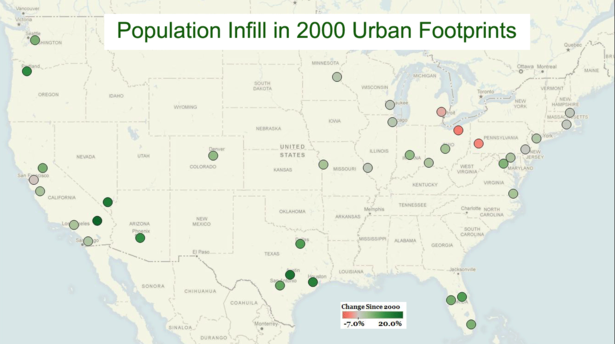
    In contrast, population losses since 2000 in the urban footprints of Cleveland, Pittsburgh, Detroit and San Francisco, means these urban areas experienced no population infill. San Francisco’s loss enabled San Jose to move into second position nationally after Los Angeles in the population density of its 2000 urban footprint.

    How the Core Cities Fared

    The core cities (municipalities) attracted, on average, their population share. Approximately 30 percent of the infill growth occurred inside the core cities. Even this figure may be a bit high, due to the impacts of annexation

    All of the infill in Philadelphia, Baltimore, Chicago, Providence and Minneapolis-St. Paul occurred outside the core cities. The city of Portland attracted barely 10 percent of its urban area infill, despite highly publicized (and subsidized) infill projects such as the Pearl District. Core cities attracted the largest share of infill growth in such diverse cities as San Antonio, San Jose, Columbus, Phoenix and New York.

    Note: Additional information available at http://www.demographia.com/db-uzafoot2007.pdf

    Wendell Cox is a Visiting Professor, Conservatoire National des Arts et Metiers, Paris. He was born in Los Angeles and was appointed to three terms on the Los Angeles County Transportation Commission by Mayor Tom Bradley. He is the author of “War on the Dream: How Anti-Sprawl Policy Threatens the Quality of Life.

  • The Republican Party, Pennsylvania and Arlen Specter

    Senator Arlen Specter switched parties. A five term Senator switching parties is certainly news, but it also represents a far greater statement about the challenges facing the Republican Party in Pennsylvania going forward.

    Pennsylvania has been a dependable “Blue State” in presidential races since 1988. Currently, Democrats have a 1.2 million voter registration advantage. Less than a decade ago the margin was less than 500,000. What changed over the past decade?

    The changes in the political and demographic make-up of the five county Philadelphia region forced Specter’s flip. Specter’s base had been eroding as a result of other popular Democratic politicians seeking statewide and national offices and needing moderate Republicans to switch parties to support them in tough Primary Elections.

    It began with now Governor Ed Rendell who faced a fierce Primary Election in 2002 against Bob Casey, Jr. – the son of a former Pennsylvania Governor. The former Philadelphia Mayor needed a strong turnout in the Philadelphia area and he managed to flip more than one hundred thousand Republicans for the primary.

    Rendell defeated Casey by 162,648 votes statewide, but his victory total was 305,641 in the five county Philadelphia area where he won 81.3% of the vote and 56.5% of his total vote statewide.

    The 2002 primary proved the central role of the Philadelphia region, especially the suburbs. Rendell was able to win even while losing the total vote in the other 62 counties of Pennsylvania. The shift in moderate Republicans in the suburbs to Rendell was the critical factor.

    This was again the case in the general election; Rendell would carry this region by 515,000 votes on his way to winning his first term as Governor by 323,827.

    The 2002 election marked a turning point in Pennsylvania politics. From that point forward no candidate for statewide office could win without carrying at least one of the four suburban Philadelphia counties. All were becoming increasingly Democratic in voter registration.

    In the 2004 Primary, Arlen Specter faced conservative ex-Congressman Pat Toomey. Specter likely underestimated the impact of the change is southeast voting patterns. He was overconfident that his moderate Republican suburban base would carry the day. They did, but more narrowly than most suspected. Specter won the election by 17,146 votes statewide but he carried the southeast by 41,719 votes.

    Like Rendell in 2002, Specter lost the rest of the state but won in the five county region by enough of a margin to secure victory statewide. Unlike Rendell, his total in the southeast region only accounted for 31.4% of his statewide total votes as compared to Rendell’s 56.5%.

    Also, significant was the fact that he only defeated Toomey, who is far more conservative than former Senator Rick Santorum, by 34,669 votes in the four suburban counties. The moderate base was shifting to the Democrats, leaving the remnants of the GOP more conservative. This was a harbinger of Specter’s diminishing prospects as a Republican.

    Specter won the primary with 166,944 votes from the southeast region. Two years earlier in the primary, Mike Fisher, the Republican candidate from Pittsburgh who was running for Governor without opposition, won 161,103 Republican votes in this region. Fisher outpolled Specter’s 2004 vote in 2 of the 5 counties. It was only the last minute support Specter received from President George W. Bush and Senator Rick Santorum that saved Specter from defeat in 2004.

    In the General Election, Specter walloped his Democratic opponent Joe Hoeffel, a former southeast Congressman and Montgomery County Commissioner, by nearly 600,000. He would carry all five counties in the southeast by wide margins mainly because he had significant support from Democrats and Independents.

    The trend of greater Democratic power – and Specter’s dependence on them – continued to build. In 2006, Bob Casey defeated incumbent Senator Rick Santorum by 17.4 percentage points statewide despite the fact that Santorum would spend $31 million and was the number three in Republican Senate Leadership. Casey would carry all five counties in the southeast region proving that conservative Republicans could no longer win in this critical area in a contested General Election. By 2008, Barack Obama put the icing on the cake. The President racked up huge margins in the southeast repeating what Rendell had done in 2002. The change was now complete.

    It is safe to say that Arlen Specter simply could not win a Republican Primary Election in 2010. This said it is also safe to say that he would have likely won the General Election with relative ease regardless of who was the Democratic candidate. This is the dilemma that faced a Republican Party increasingly alienated from Specter, but facing increasingly stiff odds in its former suburban Philadelphia strongholds.

    The question now is will the Republican Party stand with conservative Pat Toomey to challenge Democrat Arlen Specter in the General Election? With promised support from President Obama, Vice President Biden and Governor Rendell the likelihood of a primary challenge for Specter is remote in his new party.

    Revenge is rarely as sweet as anticipated. It seems unlikely that a conservative Republican can win statewide without support in the Philadelphia suburbs. But data and history show that this is highly unlikely for a conservative Republican. There’s a cost to party purification. Unless the Republicans can find a way to appeal to the wayward suburban voters, it will take a major shift in the political dynamic – perhaps a more decided Democratic move to the left – to put Pennsylvania back in play.

    Dennis M. Powell is president and CEO of Massey Powell an issues management consulting company located in Plymouth Meeting, PA.

    Photo: KyleCassidy

  • Pennsylvania – Political Positioning or Realistic Chance?

    The keystone of the McCain campaign’s victory scenario during the final weeks was a surprise victory in Pennsylvania despite that fact that polls (Real Clear Politics had the gap at 7 points on Election Day) clearly showed Obama comfortably ahead. Why?

    Pennsylvania has a Democratic Governor from Philadelphia who was elected twice with sizable margins. Democrats have gotten a big boost over the past two years in voter registration. The political shift from Republican to Democratic in the Philadelphia suburbs is nearly complete – at least when it comes to statewide and federal offices.

    This said, no Democratic candidate has ever held the statewide office of Attorney General. The State Senate had a 29 – 21 Republican advantage going into the election and until 2006 Republicans in the State House held 110 seats to the Democrats 93 (currently 102 – 101 Democratic).

    In other words, statewide the sum of Republican parts remains greater than Republican voter registration. It was this anomaly that very likely gave McCain hope for winning Pennsylvania by running more a regional than statewide campaign.

    This strategy was likely bolstered by what was perceived to be still disaffected Hillary voters. Senator Clinton carried the state by more than 200,000 votes and captured nearly 55 percent of the vote. In Pennsylvania, the divisions between the electoral bases of the two Democratic primary candidates were most clear. Clinton carried the older, rural and lower income Democrats while Obama won the better educated, urban and minority bases. The Clinton Democrats are the same “swing voters” Republicans need to win in the more hotly contested districts.

    Obama won 7 of 67 counties in the Primary Election. Obama’s only significant victory was in Philadelphia County which he carried by 130,000 votes. Obama won only two of the four Philadelphia collar counties. Meanwhile, Clinton won many of the state’s rural counties by margins of 2 – 1 or greater.

    Yet potential weakness for Obama did not overcome the huge challenges facing the McCain campaign. Democrats now outnumber Republicans by 1.1 million registered voters statewide. According to the Pennsylvania Department of State, Democratic registration grew by 855,000 or 14 percent over the past year while GOP registration shrank by 4 percent or 145,000 voters. In 2000, the difference between the parties was less than 500,000. George W. Bush lost Pennsylvania in 2004 having a much more favorable electoral environment than did McCain in 2008.

    The framework for statewide Democratic victories was established by Governor Ed Rendell in 2002. In that race, Rendell won the five counties that comprise the Greater Philadelphia region by 515,000 votes. The vote in the rest of the state, which he lost, didn’t really matter. This is in large measure the model Obama would follow to victory.

    McCain has a far more difficult road to victory. He needed to emulate Republican U. S. Senator Arlen Specter’s 2004 victory, which was based on limiting his losses in Philadelphia County to 270,000 votes and winning Delaware, Bucks, Chester and Montgomery Counties (collar counties) by 145,000 votes. This enabled him to achieve a nearly 600,000 vote victory statewide – the highest margin for any statewide Republican candidate in recent history.

    The other victory scenario was that used by Republican Attorney General, Tom Corbett in 2004. Corbett won statewide by around 100,000 votes. Corbett lost Philadelphia by almost 400,000 votes, but he won all four collar counties albeit with 90,000 less votes than Specter.

    On Tuesday, McCain ended up looking more like a far more strident conservative candidate, former U. S. Senator Rick Santorum who lost to now Senator Bob Casey by more than 700,000 votes in 2006. In that election, Santorum got only 15 percent of the vote in Philadelphia County and lost the collar counties by 175,000 total votes. This was a swing of nearly 320,000 votes compared to those won by Specter two years earlier.

    So why did McCain play the Pennsylvania card? Maybe it was the belief that the state’s “Hillary Voters” still felt disaffected from Obama. It may also have been that he had to believe in Pennsylvania in order to have even the most remote chance at victory. Hoping for an October surprise, he thought Pennsylvania would keep him in the game. Without Pennsylvania the election was almost surely lost with states like Virginia, Ohio, and Florida trending toward Obama.

    In the end, McCain lost Pennsylvania by more than 600,000 votes and one Republican incumbent in Congress lost in the Erie region. Obama won Philadelphia and it collar counties big, basically replaying Rendell model.

    But does this mean that Pennsylvania is now a solid “Blue State?” The answer here is mixed. Republican incumbent Attorney General won statewide by nearly 400,000 votes. The Republican State Senate has seemingly increased its caucus by one Member to 30 – 20. The State House, at this writing, remains in Democratic control by a margin of 104 – 99. Certainly this was not a big change election.

    What we saw here was an anti-Bush vote in Pennsylvania that followed the national trend of wanting a change of direction. Locally, voters seem just fine with a status quo that may tilt a bit blue, but still has room for dashes of red.

    One thing for sure, at least for now the politically powerful southeast collar counties hold the key to winning statewide in Pennsylvania. A candidate must win at least one of these counties to have any hope of a statewide victory.

    Dennis M. Powell is president and CEO of Massey Powell an issues management consulting company located in Plymouth Meeting, PA.

  • Pennsylvania: Where the Collar Counties Are the Big Dogs

    Pennsylvania, as with most states, can be analyzed politically by looking at a few key counties and how they break in a political campaign.

    Historically, the four collar counties of Philadelphia broke heavily Republican and neutralized the advantage Democrats had coming out of Philadelphia. Over the past decade this trend has reversed itself — and with it the political balance in the state.

    Over the past eight years Pennsylvania has gained some 500,000 voters but the Democrats have doubled their lead over Republicans to over one million. In short, since 2000 Democrats have outgained Republicans in Pennsylvania by a ratio of 39:1. The significant growth in Independents is now a major factor in GOP victory in statewide elections.

    The City of Philadelphia has been solidly Democratic for generations. The big changes are in the four suburban “collar counties” around Philadelphia which account for 17.6 percent of the state’s voters. Starting in 2000, Republican registration in the Philadelphia suburbs has dropped by 85,494 voters or 10.1 percent.

    On the Democratic side is a far different story. Registration increased by 220,149 voters or 45.5 percent from its 2000 level. The Republican advantage now stands at a mere 55,557 voters and the number of straight ticket voters has dropped.

    This surge in registration reflects a shift in voting patterns that have existed in these counties for decades starting at the top of the ticket and slowly working their way down to local levels of government. In 2000, Al Gore defeated George W. Bush by 204,840 votes in Pennsylvania with the four collar counties going to Gore by 54,346 votes. This region supplied Gore with 27 percent of his victory margin in Pennsylvania despite Republicans having a 357,200 voter registration advantage at that time.

    In 2002, Ed Rendell defeated Mike Fisher for governor by 323,827 votes. Rendell won all four collar counties and when Philadelphia is included the southeast region supplied Rendell with a 515,441 vote margin, negating the vote in the rest of Pennsylvania which Fisher, a former State Senator and then current Attorney General, won handily.

    In 2004, John Kerry defeated then President Bush in Pennsylvania by 144,248 total votes. Kerry did not win all our collar counties. He lost to Bush in Chester County and his margins in the three others were far less than Rendell’s two years earlier. But, other Republicans including Senator Arlen Specter survived by winning in this increasingly contested territory.

    Increasingly this trend has moved down the ballot. In 2006 when State Auditor General Bob Casey, Jr. trounced incumbent Senator Rick Santorum statewide by 708,206 votes, Casey won all four collar counties by significant margins. Also, two Republicans in the U.S. House of Representatives were replaced by Democrats as Patrick Murphy, an Iraq war vet, won the seat in Bucks County while Joe Sestak, a retired Navy admiral, defeated incumbent scandal-tainted Rep. Curt Weldon in Delaware County by a wide margin. Today, three of the four collar counties are represented by Democrats in Congress.

    The lessons are clear. Democrats are gaining in the collar counties, particularly when conservatives like Santorum head the ticket. Republican moderates like Specter, however, have remained competitive in these suburbs, and thus have survived the Democratic onslaught.

    Not surprisingly, the Obama campaign hopes to paint John McCain as a right-wing clone of President Bush. If he is successful, then McCain will likely lose the collar counties, and with them Pennsylvania. In a best case scenario for the Democrats, 2008 could mirror Governor Rendell’s 2002 triumph where wins in the collar counties and Philadelphia make up for losses elsewhere in the state.

    McCain, however, is not without hope. If he is able to position himself as a reformer willing to work against the interests of his party for the broader interests of the country, he could win two or even three of the collar counties. If he does that Pennsylvania could become the keystone of an unconventional victory in November.

    Dennis M. Powell is president and CEO of Massey Powell an issues management consulting company located in Plymouth Meeting, PA.

  • Boomers Go Back to College? – A Letter from Pennsylvania

    The “boomers” is a generation born between 1946 and 1964. They gave us the youth culture, hippies, Woodstock, peace movement, women’s liberation, computers, flexible work environments, consumer electronics and consumption on the grand scale to mention only a few.

    Boomers have enjoyed a wonderful economy in the main that has enabled them to build wealth and live middle class lifestyles. They stay fit. They eat healthy foods. They look young compared to people of previous generations at their age.

    But alas they are graying and have reached the point in their lives where choices need to be made about how to continue to live lives that are both enriching and fulfilling.

    There were 78 million boomers in the United States in 2005 according the census data. By 2006, 330 of them an hour were turning 60. Growing older means different choices and greater financial challenges for them. Fidelity Investments estimates that “boomers” on average have less than $40,000 in retirement savings. Few will have traditional pensions. Most of their wealth is tied up in real estate.

    Medical costs will increase by nearly 50 percent as they pass 65. The Social Security Administration estimates that there will be only 2.1 workers for retiree by 2031. This is down from 3.3 today. As a result many boomers will continue to work out of necessity while they seek a simpler and scaled down lifestyles.

    An annual survey conducted on behalf of Del Webb, a developer of retirement communities, found that 36 percent of boomers plan to move when they become “Empty Nesters” and 55 percent of boomers plan to move when they retire. One interesting finding in the study is that, “boomers are twice as likely as those currently aged 59 – 70 to prefer an active adult community that is part of a multi-generational neighborhood.”

    One key question facing empty nester and retired “boomers” may be where can they go to find a quality lifestyle, affordable living, part-time employment opportunities and multi-generational interaction? The answer may well be college towns that proliferate in places like Pennsylvania – a state with more than one hundred institutions of higher education. Many are located in beautiful towns.

    Websites like www.collegetownlife.com provide links to college towns where boomers may consider relocating. At www.bestplaces.net you can compare the demographics of where you currently live to those of a college town. I currently live in suburban Philadelphia. If I were to move to State College, Penn., home of Pennsylvania State University’s main campus, here is what I would find.

    First, I would be living in a town that is six times larger than my current community, but less than one percent the size of my current region. The median age would fall from 42 to 23 years. In my current community, nearly 40 percent of the population is 50 years or older, but in State College only about 10 percent fall into this demographic.

    A lot of things would remain the same in terms of gender and racial mix, but I would have to get use to a community in which 75 percent of the population is single with no children and the number of people who are married drops from 60 percent to 15 percent.

    In my current community the median home prices is $344,000 while in State College it is $235,000. My current cost of living index in 126 while in State it would stand at 100. Average income in my current community is $66,500 while in State College it is $22,500. My school district spends more than $9,000 per student in State College it is a little over $7,500 which reflects real estate taxes.

    State College offers robust cultural activities through Pennsylvania State University. The University has schools of music and performing and fine arts and a number of concert halls, museums, lecture halls, libraries, theatres and auditoriums with near daily attractions and activities. Also, the community is safe and offers a host of recreational activities.

    Pennsylvania State University is the largest in Pennsylvania and adds to the vibrancy of State College, but there are also more than one hundred other college towns and communities in Pennsylvania where “boomers” may find everything they are looking for and more as they transition for work to active retirement and toward their golden years.

    These towns offer everything from wooded rural locations to stylish suburban or urban neighborhoods. They represent a great alternative to those boomers who want to do far more than fade away.

    Dennis M. Powell is president and CEO of Massey Powell an issues management consulting company located in Plymouth Meeting, PA.

  • Keeping Kids Downtown – A Philadelphia Approach

    As children return to classes in Philadelphia this week, more than half of the kindergarteners attending three downtown public elementary schools will come from their immediate middle-income neighborhoods. Three private schools that also serve this area, drawing over 70 percent of their enrollment from downtown families, are bursting at the seams. Having doubled and tripled pre-school programs over the last half decade, each is now physically expanding to accommodate the 11,200 children, born to downtown parents between 2000 and 2005. But you don’t need birth or enrollment numbers to see what’s happening; just look for strollers, new toy and book stores, and parents and babysitters in the playgrounds.

    For almost two decades, journalists and academics have been heralding the return of the middle class to the downtown of American cities and their transformative effect on housing, retail and the use of public spaces. But there haven’t been many stories on children because, until recently, there haven’t been many kids downtown. Downtown markets have largely been driven by young, childless professionals and empty-nesters.

    In a detailed look at downtown demographics, Eugenie L. Birch’s “Who Lives Downtown” (The Brookings Institution, November 2005) also noted that the number of new housing units and residents downtown may be welcome, but still represent a quite small phenomena both in absolute and relative regional terms. As with any new product, most downtowns started with what’s easiest: catering to those who value proximity to work and have more interest in theaters and cafes than schools and playgrounds.

    In a typology of 45 central cities, Birch also highlighted five fully-developed downtowns – Boston, Midtown and Lower Manhattan, Chicago, and Philadelphia – which were relatively large (averaging 43,623 households), densely settled (averaging 23 households per acre) and were home to almost half of the nation’s downtown households. These cities share several characteristics: strong downtown employment, well-developed middle class neighborhoods with diverse housing options, and the fact that they’ve been at it awhile – adding households each decade since 1970. Terms like pioneers and early settlers went out of vogue in these cities more than thirty years ago.

    For mayors, business and civic leaders in places just beginning to repopulate downtown, these more developed places suggest an agenda for the coming decade. As cities got cleaner and safer in the 1990s, as employers sought more tech-savvy workers, downtown populations got larger and younger. In 2000, nearly a third of dwellers in the five fully-developed downtowns were between the ages of 25 and 34. It’s become a cliché to note how television programs like “Seinfield” and “Friends” reflected and influenced the attitude about cities among the generation that came of age in the 1990s. Well here’s another truism: when downtowns fill with young professionals who all have been watching “Sex and the City,” someone’s bound to get pregnant.

    The experience in Philadelphia is illustrative. Since the 1960s, the downtown population has been steadily growing. But as families had children, most moved to the suburbs. Some remained for pre-school, but the 2000 census counted 26 percent fewer 5-9 year olds downtown than the number of children under age five. But a citywide, ten-year tax abatement passed in 1997 altered the trend, prompting over 10,000 new units of city center housing and pushing downtown’s population over 90,000. Between 1970 and 2000 the number of 25-34 year-olds also doubled from 15 to 30 percent of downtown’s population.

    While young professionals and empty nesters initially defined the market, a 2006 survey of downtown residents found that 21.6 percent of 35-44 year olds and 22.3 percent of 45-54 year olds had children living with them. After deferring child-rearing for careers in downtown office buildings, hospitals and universities, a growing number were staying in town as they had children. A 2005 survey of 37 downtown day-care centers documented a 43 percent increase in enrollment.

    The state takeover of the Philadelphia school district in 2001 created an opening to capitalize on this trend. Like many big city school districts, the majority of Philadelphia public school students come from disadvantaged families. Underfunded schools were plagued by poor performance, inflexible bureaucracies and union rules. But the new School Reform Commission (SRC) was empowered and funded by the state to make dramatic change. A dynamic new superintendent, Paul Vallas, aggressively pushed diversified management, operating some schools as public, some as charter, contracting others out privately. But all schools were given new resources; principals were empowered to make change; and teachers and students were held equally accountable for improved performance.

    With school test-scores and public image rising, the Center City District (CCD), a business-supported improvement district, partnered with the Philadelphia School District on a downtown schools initiative. Recognizing that the primary mission of the public schools was to provide quality options for families with limited means and limited choice, both the SRC and the CCD saw advantages if public schools could capture a growing share of families who traditionally selected private schools or simply left the city.

    Working with school principals and parent groups, the CCD built websites for the first time for 13 elementary public schools in and adjacent to downtown. A master website, www.CenterCitySchools.com, highlights all public, private, charter and parochial schools that serve downtown and “the opportunity to be more involved in your child’s life through the unique shared experiences that come from working, playing, living and learning right here.” Ads placed in parent-oriented newspapers and civic association newsletters promote the website and school events. The CCD, school district and nearly all the private, parochial and charter schools participated in two well-attended school fairs in the fall of 2005 and 2006 that showcased the educational options available for parents.

    Five years on, the leadership of the school district has changed. But the momentum continues to build as energized parent groups this fall continue to reshape their schools, pushing for improvements to curriculum, arts programs and playgrounds. Demographic trends have provided an opportunity for Philadelphia and for all center cities to reinvent themselves again: this time as places for families and children.

    Paul R. Levy is President and CEO of the Center City District in Philadelphia. Information about the organization and reports on demographic and housing trends can be found on the website www.CenterCityPhila.org.

  • Rural Pennsylvania – Refocusing Economic Development Strategies

    James Carville, the gifted political strategist and pundit, once reportedly referred to Pennsylvania as, “Pittsburgh and Philadelphia with Alabama in between.” And to be sure, many urban sophisticates share this belief.

    But this perception comes from a different time when Pennsylvania’s cities boasted huge, overwhelmingly Democratic populations while the suburban and rural areas, albeit sparsely populated, were culturally aligned bastions of red state Republicanism.

    Yet over the past several decades Pennsylvania’s populations and politics have shifted. The southeastern cities of Philadelphia, Lancaster, Harrisburg, York, and the Allentown-Bethlehem-Easton corridor now comprise one vast urban region stretching from the Susquehanna to the Delaware River. The other three urban regions include Wilkes-Barre-Scranton, Pittsburgh and Erie. Beyond these urban areas, are the 48 counties that comprise rural Pennsylvania.

    The expansion of urban Pennsylvania has ushered in not only demographic changes but also political changes in suburban areas. Today there is only one Republican member of Congress whose district resides mostly in the four suburban southeastern counties of Bucks, Montgomery, Delaware and Chester. These counties have been solidly Republican for generations. The same political trend can be observed at the State Senate and State House levels where seats held by Republicans for over one hundred years are electing Democrats.

    In the process rural Pennsylvania has lost much of its traditional political clout in Harrisburg. Although their populations have grown faster that he rest of the state – mainly due to the in-migration of “downshifting” Baby Boomers — rural counties have also been losing their economic power as well.

    This can be seen by the fact that rural Pennsylvania is falling behind in terms of income and jobs. A Pennsylvania State University state titled, “Pennsylvania’s Rural Economy: An Analysis of Recent Trends,” found that in the 1960s rural workers earned 84 cents for every dollar an urban worker earned. By 1999, that number fell to 73 cents.

    Similarly, a March 2007 study by the Brookings Institute found a household income gap of nearly $9,000 per year between rural and urban Pennsylvanians. Brookings also shows an education gap. In 2000, 19.3 percent of rural residents had not completed high school and 15.4 percent had completed college compared with 17.7 percent and 25.1 percent in urban areas.

    Much of this has to do with a long-standing economic transition. Rural Pennsylvania, has been losing its former jobs — many of them well-paying union positions — in mining, textiles, stone, clay and glass and primary metals. These have been replaced by generally lower wage jobs in health care, education, restaurants, and social services.

    As a result, rural Pennsylvania has been shifting from a region that produced wealth to a region that consumes and services wealth. In 1969, 78 percent of income came from earnings. In 1999, this percentage has been reduced to 62 percent. Income from retirement doubled as a percentage while income from dividends, interest and rent increased from 11 percent to 18 percent over the same period as reported by Penn State.

    The shifting employment trends in rural Pennsylvania offer a glimpse into the spiraling downside of economies that either do not grow or have job growth without real wage growth. The region is left with a stagnant tax base where local governments can provide basic services only by continuing to raise taxes. These taxes make it difficult to attract new business and retain existing industry.

    The question is what can be done to reverse the trend. Rural Pennsylvania has untapped strengths: abundant natural resources, strong work ethic, solid communities and high quality of life. These are the qualities on which to build the future for this vast region.

    Sadly, however, these strengths are barely taken into account in Pennsylvania’s economic development strategies. These primarily have focused on tourism, entertainment, and attracting high tech jobs to the state. Billions have been invested to build new stadiums in our urban areas and convention centers across Pennsylvania. This kind of investment has done very little to capitalize on the inherent strengths of our rural communities.

    Nor has the state really addressed the economic impact of $4 gasoline on our economy and quality of life. Some people say that this shift will herald a return to our urban centers and mass transportation. Others see the rebirth of manufacturing in America as logistics costs coupled with rapid inflation in countries like China and Vietnam depreciate their advantage as cheap manufacturing centers.

    This possible shift in global trade offers a unique opportunity for rural Pennsylvania which has the workforce, the low land costs and a location — the area is within ten hours of 40 percent of the US economy — well-suited for global competition. But sadly the state — unlike many in the southeast and Texas — is taking little action to build new infrastructure to move goods and services quickly and efficiently between ports, rail and roads.

    Such jobs in trade, distribution and manufacturing could be critical to a revival in rural Pennsylvania’s economy. These are family wage jobs that often pay 10 percent higher wages than similar jobs in other industries according to The Business Roundtable. High energy prices also make the area’s resources competitive again. Coal is now in play as is new exploration for natural gas. Rural Pennsylvania can benefit from new coal gasification technologies as well as new gas exploration in its rural center.

    These jobs as well as those in manufacturing and logistics can only grow by implementing a new economic strategy which focuses not only on stadium and convention centers but upon basic infrastructure. Such a strategy would help link these communities with national and global markets and facilitate the expansion of manufacturing and mining as well as making it easier for high-tech service companies to locate in rural areas.

    It is time to make a basics-oriented approach the cornerstone of a determined effort to turn around rural Pennsylvania. These communities are great places to live and raise a family, and are populated by hard-working, motivated people. What they need now is a commitment to the kind of infrastructure investment that will allow them a decent shot at an economic renaissance.

    Dennis M. Powell is president and CEO of Massey Powell an issues management consulting company located in Plymouth Meeting, PA.

  • Suburbs Thriving, Cities Stagnating in Keystone State

    The headline in the Philadelphia Inquirer said it all, “Philadelphia’s population shrinking, though region’s is growing.” This in the midst of what is purported to be a condominium boom in its thriving center city.

    But facts are facts: Philadelphia’s population has dropped 4.5 percent. This ranks it first among the top-25 U.S. cities in population loss from 2000-2007. This data causes you to pause and rethink the real impact of major public investments in the city spurred on by a governor who is the city’s former two-term mayor.

    For one, gambling was supposed to bring good jobs to the city. The two winning bidders each created projects on the Delaware River, but these projects are stuck in a protracted political battle and their fate at these riverfront locations is uncertain along with the thousands of jobs they have promised.

    Part of the problem for the casinos is that a new vision has been created for the Delaware Riverfront. The Penn Praxis plan envisions recreation and greenways, not gambling for this area of the city. As a result, the gaming interests are being asked to consider building somewhere else within the city.

    There is also the Pennsylvania Convention Center. The first phase was built into the old Reading Railroad terminal on east Market Street. Supporters contend that it has spurred a hotel and restaurant boom in the city and there is validity to this position.

    But work rules issues have plagued the center since its inception. The result has been that most convention groups have chosen not to return because of arcane union rules that made it beyond difficult to do simple things like set up a booth or get electric power to a display. Negotiations have brought some relief, but problems remain to be solved.

    Despite these problems the convention center is now slated to expand about two blocks west of its current location. The costs have escalated dramatically and now exceed $800 million . This is an increase of nearly $100 million since the deal to move forward was approved and buildings were condemned and razed.

    On July 12, Governor Rendell hinted that he was having second thoughts about the viability of the expanded center when he said that the center is “getting to the point where the cost will outweigh the benefit.” These remarks were made while the governor was signing legislation that would increase the taxes on a hotel room in Philadelphia by more than 15 percent to pay for tourism promotion and the convention center.

    Stadium Economics
    Public dollars have also helped to fund a new football and baseball stadium in South Philadelphia. Citizens Bank Park is a real gem of a baseball stadium – a fun family entertainment venue where the Philadelphia Phillies play 82 games a year. Across the street is Lincoln Financial Field where the Philadelphia Eagles play their games as well as Temple University. There are only 20 – 25 games played there each year. The Phillies stadium cost $458 million and the Eagles complex $512 million, most of which came from public investment.

    What has been the economic impact of this investment? Has the neighborhood been revitalized by this investment? The short answer is no. They are basically commuter stadiums where fans come, see, and go.

    Rick Eckstein, who is a professor at a local university and author of Public Dollars, Private Stadiums: The Battle over Building Sports Stadiums, has studied the economic impact of public investment in stadium projects. He concludes, “I have been studying and writing about publicly financed stadiums for more than 10 years and cannot name a single stadium project that has delivered on its original grandiose economic promises, although they do bring benefits to team owners, sports leagues and sometimes players.”

    Over the years billions of dollars has been invested in tourism and entertainment projects and the results are clear: the projects required more dollars than originally thought and the promises of profound economic benefits have never materialized as expected.

    Philadelphia is a lot more fun than it was 20 years ago, but its economy remains stagnant and its core population continues to leave to find opportunity elsewhere.

    There is also another trend resulting from this kind of pubic investment. The more public money that is poured into a region the more taxes and fees follow.

    In Pennsylvania, these kinds of investment go far beyond Philadelphia. Pittsburgh has two new stadiums costing a total of more than $1 billion and a new $375 million convention center that is touted as, “the cornerstone of western Pennsylvania’s hospitality industry.”

    Erie has the Bayfront Convention Center at $44 million and funded it with a new five percent hotel room tax. The Altoona region has Blair County Convention Center & Sports Facility Authority a $50 million project funded with $48 million in federal and state grants. The City of York invested economic and political capital in securing a $28 million revenue bond to fund a minor league baseball stadium. The City of Chester just was awarded a soccer franchise and is planning a new stadium to go along with the new casino as core projects to revitalize its economy.

    When we look back at the billions of dollars that has been spent on these projects and the results, you are left to wonder whether or not these dollars could have been spent more wisely in other areas to build an economy on sturdier foundation.

    The results have not been encouraging. Population growth in Pennsylvania between April 2000 and July 2006 was a mere 1.3 percent. Private non-farm employment decreased 0.1 percent according to the U.S. Census Bureau. Pennsylvania’s senior population continues to be among the highest in the nation at 15.2 percent in 2006.

    Philadelphia lagged behind the national average of the percent of the population with a bachelor’s degree by 4.5 percentage points in 2000; Pittsburgh’s mean household income was nearly $12,000 below the national average. None of the major cities in Pennsylvania gained population during the early years of this century.

    Suburban Growth
    Meanwhile there is a very different story in suburban and rural counties. Montgomery County’s population grew at a rate nearly three times that of the State of Pennsylvania and Bucks County grew by nearly four times. In Berks County, the next county beyond Philadelphia’s four suburban collar counties, population growth was a healthy 7.4 percent and household income exceeded the national average.

    In rural Monroe County, located outside of Wilkes-Barre, population spiked by nearly 20 percent over six years while in Pike County, northeast of Scranton, we saw staggering growth of 25.7 percent and household income exceeding the national average.

    The people of Pennsylvania want what every other American wants for their families: a nice home, good schools, quality government services and a safe community. They are abandoning cities because they cannot keep this promise to their middle-income wage earners.

    However, they are finding what they want in Pennsylvania’s first and second ring suburbs and in rural communities that don’t invest in stadiums, convention centers or entertainment to build their economies. Instead these communities provide a quality of life that attracts people and the jobs are following.

    An economy built on tourism and entertainment provides very few family wage jobs. These funds would likely be better invested in quality of life and infrastructure in order to create high wage, blue collar jobs in the global economy.

    If not, people will continue to vote with their feet as they look for opportunity beyond the casino, restaurant and tourism industries and a better quality of life outside of cities that are increasingly being viewed as opportunity-free zones.

    Dennis M. Powell is president and CEO of Massey Powell an issues management consulting company located in Plymouth Meeting, PA.