Tag: Pittsburgh

  • Population Growth as the Cure for the Incredible Shrinking City?

    The 1957 sci-fi classic The Incredible Shrinking Man reads like a Rust Belt city script. In it, the lead actor is afflicted with the anti-natural: shrinkage in a world of growth. The rest becomes existential. From the movie review blog “Twenty Four Frames”:

    He hates being a scientific experiment and a spectacle for the media. He is no longer the everyday 1950′s image of the middle class, white picket fenced American man. Instead, he now fights for survival in his own house where everyday objects are now the enemy to his existence. Finally, he must face the biggest question of all. If he continues to shrink, will he eventually even exist?

    Such is the mood behind revitalization efforts in shrinking city America, particularly the Rust Belt. There, population decline has been occurring for decades. It still occurs. The Cleveland metro lost nearly 83,000 people from 2000 to 2012. The Pittsburgh metro lost over 67,000. This is in contrast to the region’s “greenfield economies”—defined as “the set of conditions that flow from building on new territory or exploiting new markets vs. the redevelopment of old places”. For example, the geographically-expanding Columbus metro added 260,000 people from 2000 to 2012. The top feeder region into Columbus was Greater Cleveland.

    The dynamics behind these demographic patterns are fairly intuitive. Population gains and losses are a factor of a region’s employment picture. Cleveland Fed economist Joel Elvery explains:

    Urban economists like to divide a regional economy into two sectors: tradable and nontradable. The tradable sector produces goods and services that are sold outside of the region; the nontradable sector produces goods and services for use in the region…If the industries that make up the tradable sector are growing nationally, then the region will most likely grow. If the tradable sector is struggling, eventually the region will also struggle.

    In the case of Cleveland, one of the region’s main tradable sectors is manufacturing. That said, technological advances in manufacturing means it takes less people to make a product. In the 1950s an auto worker made on average seven cars per year. A worker can make 28 today. The effect of the increased productivity is a loss of jobs. The effect of job loss is a declining population.

    Put a fork in the Rust Belt, right?

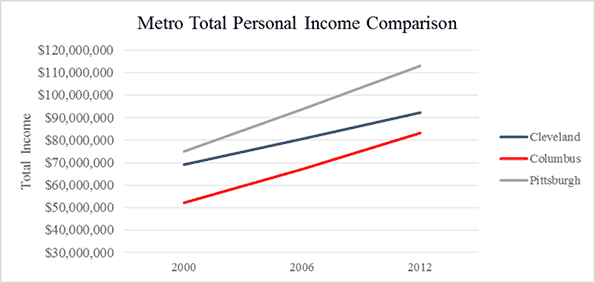
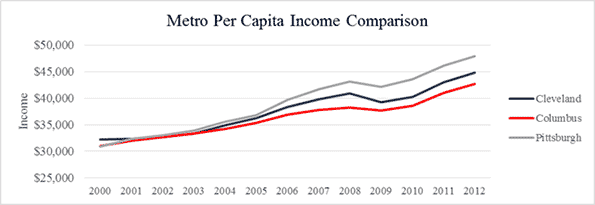
    Not exactly. Figure 1 shows the metro per capita income for Cleveland, Pittsburgh, and Columbus. The metros’ incomes were even around 2003, but then Pittsburgh and Cleveland began diverging from Columbus around 2005. Of importance here is that Pittsburgh and Cleveland have had higher per capita income growth than Columbus despite their declining population. This goes against the grain of traditional urban development thinking in which growth is god.

    Figure 1: Source, US Bureau of Economic Analysis via Telestrian

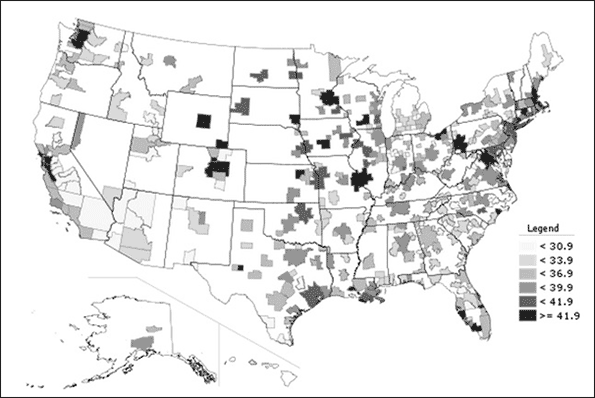
    Looking at real per capita income at purchasing power parity (PPP), or income adjusted for inflation and how far a dollar goes in a given metro, the trends hold. The map below shows the real per capita income (PPP) for all metros for the United States. Notice Greater Cleveland and Greater Pittsburgh stand out, with values at or above $42,000 a year. In fact, in ranking the nation’s largest metros (over 1 million people), the highest real per capita metros were Hartford, Boston, and San Francisco, followed by Pittsburgh 6th and Cleveland 11th. Not bad for “dying” metros. Columbus clocked in at 28th, while peer Rust Belt metro Detroit was 44th out of 51.

    Map: Map of real per capita personal income adjusted for inflation (in 2005 chained dollars) and regional purchasing power. In thousands of dollars (2011). Source, U.S. Bureau of Economic Analysis via Telestrian.

    Why is greater per capita income growth happening in the Rust Belt compared to Columbus? We have to keep in mind that a rising per capita income is not necessarily associated with a robust economy, particularly for regions that have flat or declining populations. Specifically, a metro, such as Cleveland, can gain in per capita income simply due to a significant out-migration of low- and middle-income workers. Such a scenario could prove problematic if the area’s total personal income is decreasing across time, because then the overall economy is contracting.

    But this is not the case. Figure 2 shows the total personal income for the three metros from 2000 to 2012. Both Cleveland’s and Pittsburgh’s total personal income levels increase despite declining populations. This effect has been called “growth without growth” by the Brookings Institution, and it occurs when a workforce is becoming more educated and productive at the same time overall population declines.

    Figure 2: Source, US Bureau of Economic Analysis

    This is what is happening in the Cleveland metro. Data from a new study I co-authored with Jim Russell out of the Center for Population Dynamics at Cleveland State University showed that from 2000 to 2012, Greater Cleveland gained over 63,000 educated residents, while simultaneously losing nearly 74,000 residents without a college degree. Over two-thirds of this brain gain occurred between 2006 and 2012. The fastest growing cohort was for college-educated Greater Clevelanders 65 and plus—a 30% increase. The number of Greater Clevelanders with a college degree aged 25 to 34 increased by 23%. Conversely, the vast majority of the out-migration was made by people aged 35 to 44 without a 4-year degree.

    This population dynamic is partly the result of Cleveland’s restructuring from a labor- into a knowledge-based economy. Specifically, growing tradable industries, like STEM and health care employment—which have driven job growth in Cleveland—are able to attract and retain skilled residents, whereas slower-growth industries are “pushing” less skilled workers elsewhere. Many of these non-degreed workers find a better return on investment in areas that are gaining in population, particularly if they are employed in the local consumer economy. Think laborers and much of the service class. This notion is supported by the fact that from 2000 to 2011, the average income of a person that moved from Greater Cleveland to Greater Columbus was $38,000 a year. Such a re-positioning of less-educated workers partly explains that while the Columbus metro is gaining on Greater Cleveland in total income, it is not the case with per capita income. Notes the Cleveland Fed: “Per capita income growth [in Columbus] is under increasing pressure to continue rising as population growth exceeds income growth”.

    So yes, Cleveland shrinks. But it is not about brain drain, but about rational choice theory. And while population loss is troubling for any city, it is in many respects a necessary demographic result as a region like Greater Cleveland transitions from brawn- to brain-intensive work.

    Think of this as a “one step at a time” approach to the existential plight that is the incredible shrinking city—meaning Cleveland’s migration needs are currently about quality, not quantity. This is because economic growth is not likely to be achieved through an increase in local consumption. Local jobs are created from emerging tradable industries, not vice versa—five service jobs are made for every new high-skill job in fact. And emerging industries are created via human capital, not consumer demand.

    “Consumer demand does not necessarily translate into increased employment,” writes John Papola in Forbes. “That’s because ‘consumers’ don’t employ people. Businesses do.”

    So where does Cleveland go from here?

    It needs to look to Pittsburgh. The sister Rust Belt city has had a human capital formation that has been nothing short of astonishing. University of Pittsburgh economist Chris Briem calculated that the metro ranked fifth in the nation when it came to the percentage of young adult workers with a bachelor’s degree, behind only Boston, San Francisco, D.C., and Austin. What’s more, Greater Pittsburgh ranked first for the highest concentration of young adult workers with a graduate or professional degree.

    “Change in the Pittsburgh economy is reflected in many ways,” writes Briem, “but probably no more profoundly than in the educational attainment of its workforce”.

    Greater Cleveland doesn’t perform too shabbily either, ranking 17th in the nation in the number of young adult workers with a bachelor’s degree, and 7th in the nation for young workers with a graduate or professional degree, ahead of knowledge hub darlings Seattle and Austin.

    In other words, Cleveland’s got something to build on: the quality of its young adult workforce. So instead of dumping money on brain drain boondoggles, or expending significant public expenditure on things like hotels and casinos that intend to drive economic growth from consumption on up, the region needs to pull out all the stops on growing a critical mass of talent. Because, as my colleague Jim Russell puts it, “talent is the new oil”.

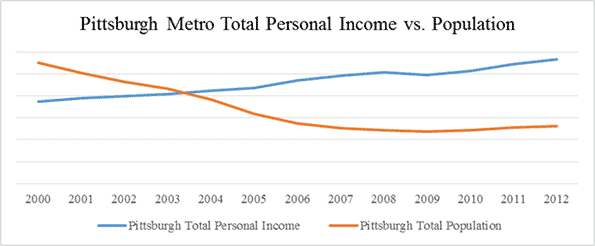
    Eventually, once the region’s new economy sectors are revved up, then job growth for both skilled and less skilled work will increase, making the region amenable to population gain. This is the case in Pittsburgh, where population loss has recently turned into a slight gain after decades of decline (See Figure 3).

    Figure 3: Source, American Community Survey, Bureau of Economic Analysis

    But until that growth happens the Rust Belt will be stubbornly mired in its existential crisis. Shrinking, struggling, and wishing on silver bullets and outdoor chandeliers. But maybe there is room for measured hope. More exactly, we shrink therefore we are?

    "I was continuing to shrink, to become… what? The infinitesimal? What was I? Still a human being?,” wonders the incredible shrinking man in the film’s closing monologue. “Or was I the man of the future?”

    Well, considering what the cost of living is doing to the coasts, maybe the notion of Pittsburgh as the city of the future isn’t so farfetched. The Clevelands of the world would be wise to wager so, and then model accordingly.

    Richey Piiparinen is a Senior Research Associate who leads the Center for Population Dynamics at the Levin College of Urban Affairs at Cleveland State University. His work focuses on regional economic development and urban revitalization.

    Top image: Courtesy of Universal Pictures

  • To Rebuild, the Midwest Must Face Its Real and Severe Problems

    Despite well-publicized problems that earned it the nickname of the “Rust Belt”, on paper the Midwest possesses some formidable strengths. These include the largest concentration of engineers in America, world class educational institutions, a plethora of headquarters of global champions ranging from Proctor and Gamble to Caterpillar to the Chicago Mercantile Exchange, the world’s greatest reserves of fresh water, and an expanding immigrant population.

    Yet with limited exceptions, these have been around for a while, but haven’t produced much growth across the region. Instead, outside of an archipelago of successful outliers (mostly select parts of major metros or college towns), the region has seen its population, job, and income growth badly trail the nation.  During the 2000s US population grew by 9.7%, the Midwest* 3.8%. For jobs, the US lost 1.5% but the Midwest 7.8%.

    Reversing this requires not just leveraging strengths and building on assets, but facing the very real and severe structural challenges that plague the region. However, most of the strategies out there remain outside the region’s essential DNA:

    • Economic clusters like high tech startups or water industries are in effect attempts to build new success enclaves outside the system.
    • Rebuilding downtowns into urban playgrounds for the upscale often takes place against a backdrop of vacant lots, abandoned structures, and depopulation – in other words, empty space.
    • The Rust Belt Chic movement suggests that many of the problems are actually the solution.  But while there are intriguing and important elements to this, it bypasses core issues.

    These are all good as far as they go, but they require little broad-based reform (as opposed to district or enclave based solutions) to structural problems and thus are limited in what they can achieve.

    What are these structural problems? Among the key ones are:

    1. Racism. The modern history of Midwest cities is enmeshed in the history of race relations, particularly between black and white. Places like Chicago and Milwaukee remain among the absolutely most segregated in America. Race riots have been defining feature of cities ranging from Detroit to Cincinnati (which had a race-influenced riot as recently as 2001). In all of these places, a large population of black residents live in segregated neighborhoods plagued with problems ranging from poor schools to low quality housing to a lack of jobs.  Significant social distress has resulted. 

    There are signs the Great Migration that brought blacks north in search of factory work is reversing, with black residents actually seeing more welcoming environments and better economic opportunities in Southern metro areas like Atlanta, Houston, and Charlotte. As well, historically it’s been the more ambitious who leave, not such a good thing for the people and places left behind.

    2. Corruption.  Midwest cities ranging from Chicago to Detroit to Cleveland are famous as cesspools of corruption and cronyism. Systems like Chicago’s “aldermanic privilege” tradition that gives city council members almost dictatorial control over their districts produce environments of almost required tacit corruption even if no laws are violated. In other cities, it’s well known that your approvals will go much faster if you hire the right wired-up subcontractors, lawyers, or lobbyists. While this type of environment exists at some level everywhere, it’s very bad in many Midwest cities and badly degrades an already challenged business climate.

    3. Closed Societies. Contrary to the assertions of Robert Putnam and Bowling Alone, a lot of Midwest places suffer from an excess of social capital. As Sean Safford noted in Why the Garden Club Couldn’t Save Youngstown, excessively dense social networks can create a hermetically sealed environment into which new ideas can’t penetrate or get a hearing.  There are many reports of newcomers to Midwest cities saying that they have difficult making friends and penetrating the social networks in places as diverse as Minneapolis and Cleveland. In Cincinnati and St. Louis expect that the first question you’ll be asked is “Where did you go to high school?” which tells you everything you need to know about those cities.  Immigration has ticked up in recent years, but overall the Midwest has done a poor job of attracting outsiders.

    4. Two-Tier Environment and Resulting Paralysis.  Despite the plethora of high end companies, educated workers, and top quality universities, the Midwest economy was traditionally based on moderately skilled labor in agriculture and industry. This forged a work force that places too low value on education and which can even be suspicious of people with too much of it. Today’s agriculture and manufacturing concerns, at least the ones with jobs that pay more than subsistence wages, require much higher levels of skills and education than in the past. What’s more, with the global macro-economy favorable to larger cities and talent based industries, larger metros have comparatively done well while most smaller towns have struggled. As a result, their quality of life and services have so badly degraded they are no longer attractive to “discretionary residents” (those with the means and opportunity to leave), which perpetuates a downward spiral as the educated flock to bigger cities. That’s why manufacturers complain they can’t find workers with skills, even if those skills are just passing and drug test and showing up to work everyday. This produces massive inequities, resentment, and policy confusion. What’s more, realistically many very poorly performing communities may never recover.

    Beyond these core issues, many places have aging infrastructure, massive blight issues, a regulatory environment not suited to the 21st century, and severe fiscal problems. All of these are extremely difficult problems to resolve, but that does not mean they don’t need to be faced, and overcome.

    Unsurprisingly, the Midwest has not been a particularly competitive region.  There will continue to be bright spots ranging Des Moines to Madison to the greater Chicago Loop to the fracking fields of western Pennsylvania, but until the region faces up to its problems don’t expect a major turnaround anytime soon.

    Aaron M. Renn is an independent writer on urban affairs and the founder of Telestrian, a data analysis and mapping tool. He writes at The Urbanophile.

  • Rust Belt Chic And The Keys To Reviving The Great Lakes

    Over four decades, the Great Lakes states have been the sad sack of American geography. This perception has been reinforced by Detroit’s bankruptcy filing and the descent of Chicago, the region’s poster child for gentrification, toward insolvency.

    Yet despite these problems, the Great Lakes’ future may be far brighter than many think. But this can only be accomplished by doubling down on the essential DNA of the region: engineering, manufacturing, logistics, a reasonable cost of living and bountiful natural resources. This approach builds off what some local urbanists, notably Jim Russell, have dubbed “rust belt chic.”

    With a population of 58 million, the Lakes region boasts a $2.6 trillion economy equal to that of France and far larger than the West Coast’s. (We define the region geographically as comprising the western ends of New York and Pennsylvania, northeastern Minnesota, and Ohio, Indiana, Illinois, Michigan and Wisconsin.) Despite the growth in auto manufacturing in the South, the Great Lakes region still accounts for the vast majority of jobs in the resurgent industry, now operating at record levels of capacity.

    Since 2007, Michigan, Indiana, Ohio and Wisconsin have ranked among the top five states for growth in industrial jobs, adding a half million new manufacturing jobs since 2009.

    To build on this progress the region needs to focus on its human assets. This starts with by far the nation’s largest concentration of engineers, some 318,000, which stems from the oft unappreciated fact that manufacturing employs the majority of scientists and engineers in the nation. It also accounts for almost 70% of corporate research and development. This includes disciplines such as mechanical engineering, which according to a recent EMSI study, has enjoyed steady job and income growth over the past 20 years.

    Another critical asset is the concentration of skilled trades, the workers most sought after by employers, according to a recent Manpower survey. To keep this advantage, the area needs to focus on educating its workforce — particularly in neglected inner city neighborhoods — with skill training for jobs that actually exist and are expected to grow. This is already occurring in some states, such as Ohio.

    To be sure, traditional manufacturing jobs, particularly for the unskilled and semi-skilled, likely will never come back in large numbers. But the earnings level for skilled workers will remain well above the national average, and may increase even further as shortages develop.

    Some dismiss such blue-collar strengths as a critical weakness. They suggest that area residents might decamp for places like Silicon Valley where they can find livelihoods cutting hair and providing other personal services for the digerati.

    Of course, no sane Great Lakes leader would endorse this approach in public, but many, instead of embracing “rustbelt chic” prefer to recreate a faux version of America’s left coast. This obsession goes back at least a decade, reaching its most risible level during the time of former Michigan Gov. Jennifer Granholm. Her strategy focused on turning its cities — including Detroit — into “cool” burgs.

    This clearly did little to turn around either already beleaguered state or cities; “cool” did not save Detroit from bankruptcy. Indeed cool represents just one variation in a myriad of Rust Belt elixirs, including casinos, convention centers, “and creative class oriented arts districts. Virtually all the strategies being adopted in Detroit have already been applied in Cleveland, including by the same entrepreneur, Quicken Loans Chairman Dan Gilbert, with very little tangible economic benefit.

    Yet despite this history, Detroit — the poster child of public malfeasance — once again is pinning its hopes on luring the “creative class” to Motor City. It starts with the usual stab at subsidizing housing, office and retail around the central core. This is being jump-started by taking Quicken Loans jobs already in the area’s suburbs, meaning little net regional advantage.

    Even more absurd, Michigan taxpayers are being asked to pony up to as much as $440 million for a new stadium in Detroit for the Red Wings hockey team. In contrast to this beneficence, many remaining established, older smaller neighborhood businesses — many of them deeply entrenched in the Rust Belt economy — get stuck with ever higher tax bills and reduced levels of public service.

    To be sure, this approach can succeed in building hipster cordon sanitaire — a miniaturized but utterly derivative urban district — that can be shown to investors and visiting, and usually core-centric, journalists. It also can enrich speculators and those politicians who service them, but represents a marginally effective means of reviving the city, much less the regional, economy.

    Instead of chasing hipsters , Cleveland urban strategist Richey Piiparinen suggests cities such as his rebuild their economies from the ground up, tapping the strong industrial skills, work ethic and resilient culture deeply embedded in the region. Large factories may not return en masse to Cleveland, Detroit or Chicago, but a strong industrial economy and a culture embracing hard work could stir growth in service-related fields as well.

    Geography and location provide other opportunities . The area’s natural resources — the Great Lakes contain one-fifth of the world’s supply of fresh water — constitute a profound competitive advantage against drought stricken economies in the Inland West, the southern Great Plains and parts of the Southeast. Water is an essential element in many industrial processes, including fracking, a serious issue in parts of the Rust Belt. Miles of attractive coastline could be used to lure not only factories, but high-tech businesses, tourists and educated professionals who can choose their location.

    The Great Lakes also are a natural conduit for the $250 billion trade with Canada, with its vast resource-based economy and growing population . Instead of funding better bars, art galleries and sports venues, or hoping to attract tourists and conventioneers to traipse to Cleveland in December, what the region really needs, noted a recent Brookings report, is better infrastructure, such as bridges, ports, freight rail and roads.

    Critical too are the region’s strong engineering schools. Of the nation’s top 10, four — Carnegie Mellon, Purdue, the University of Michigan, and the University of Illinois at Champagne-Urbana — are located in the Rust Belt. The Great Lakes may not be home to the Ivy League, but it remains the nursery of practical applied intelligence.

    Emerging demographic trends could also play a positive role. The millennial generation will soon be approaching the age when they wish to start businesses, get married, have children and buy homes. A good target would be those seeking a single-family home and a reasonable cost of living; both are increasingly difficult to attain in much of the Northeast and coastal California where the cost of housing, even adjusted to income, can be easily two to three times higher.

    Indeed, despite decades of demographic stagnation, the region already boasts higher percentages of people under 15 than the Northwest, the Northeast (including New York) and has about the same percentage of kids as the rapidly growing Southeast. For a new generation, the Great Lakes could emerge as a destination, not a place to avoid.

    This requires the region becoming more attractive to newcomers, whether from abroad or within the country. As urban analyst Aaron Renn suggests, the Great Lakes has to become more culturally open to outsiders and immigrants. Cities such as Cleveland, Chicago, and Detroit were once magnets for immigrants from Europe and people coming from America’s rural hinterlands, notably the south.

    Restoring appeal to outsiders does not mean denying the region’s proud past, and throwing away its historic assets, but instead focusing on its core values. For many reasons — geography, weather, history — the region cannot remake itself into California, the Pacific Northwest or the Northeast Corridor. Instead the Great Lakes can best restore its legacy as an aspirational region by focusing on the very real things that constitute its historic DNA.

    Joel Kotkin is executive editor of NewGeography.com and Distinguished Presidential Fellow in Urban Futures at Chapman University, and a member of the editorial board of the Orange County Register. He is author of The City: A Global History and The Next Hundred Million: America in 2050. His most recent study, The Rise of Postfamilialism, has been widely discussed and distributed internationally. He lives in Los Angeles, CA.

    This piece originally appeared at Forbes.

    Great Lakes map by BigStock.

  • Is the “Rust Belt” a Dirty Word?

    Many people hate the term “Rust Belt”. They dislike the aesthetics of the Rust Belt. For others, the term is less loaded, but rather a moniker denoting who we are. Consider me in the latter camp. But I often cross paths with those who loathe the term, or more exactly any notion of there being a Rust Belt culture.

    For instance, I recently ran into a top official for the City of Cleveland. We shook hands, discussed backgrounds, before the individual put a name to a book I co-edited called Rust Belt Chic: A Cleveland Anthology, which is a collection of stories detailing what it means to be a Clevelander, a Rust Belter. The official let on she didn’t care for the term “Rust Belt”, and in fact found the idea of celebrating a Rust Belt culture backwards and distasteful. I told the official there was a new generation taking ownership of having grown up in a post-industrial reality, and that make no apologies for it. The official insinuated those people are not in positions of power, so what does it matter. I responded in ten years many will be, and so it matters a lot.

    Anyway, the conversation stayed with me for a few weeks, if only because it was a living, breathing example of what needs to go in Cleveland, if not the whole of the Rust Belt; namely, shame and false pride. Both characteristics go together. Said philosopher Lao Tzu:

    Pride attaches undue importance to the superiority of one’s status in the eyes of others; And shame is fear of humiliation at one’s inferior status in the estimation of others. When one sets his heart on being highly esteemed, and achieves such rating, then he is automatically involved in fear of losing his status.

    Shame. It’s pretty thick in these parts, and it’s linked to the region’s nickname, “The Rust Belt”. After all, rust connotes disuse, or of being left behind. Yet we are only shameful because the region did have status. We were a proud region once, as our forefathers and foremothers built this country. They protected this country. They enabled the defeat of Hitler. No hyperbole on that last part.

    Specifically, before being the “Rust Belt” the region was the “Arsenal of Democracy”, which was a term coined by Detroiter Bill Knudsen in his conversation with a weary and worried President Roosevelt on the eve of WWII. At the time of the talk, May 28th, 1940, America had the 18th largest army in the world, and so what FDR needed from Knudsen was reassurance Detroit’s industrial infrastructure could produce weapons at a pace unimaginable. Knudsen replied Detroit’s manufacturing might could transform into the country’s “Arsenal of Democracy”, with term eventually gaining traction in an FDR fireside chat dated December 29, 1940. In it, the President states:

    We must be the great arsenal of democracy. For us this is an emergency as serious as war itself. We must apply ourselves to our task with the same resolution, the same sense of urgency, the same spirit of patriotism and sacrifice as we would show were we at war.

    Obviously, the area succeeded, with Pittsburgh having produced one-fifth of the Allied forces steel from 1940 to 1945 alone.


    Courtesy of Seeking Michigan

    Needless to say, the region has had a lot to be proud of. But then macroeconomic forces took hold. Things globalized, and thus the way we lived and the things we did became obsolete. Shit happened. Shit is still happening. Yet part of the reason this is so is because we cannot let go. Being proud turned into stubborn pride, particularly for the region’s leadership who is hanging on to the illusion that yesterday will happen as long as we adhere to the same thought processes and power structures that held tow during the region’s heyday. But then yesterday doesn’t happen. Year after year it doesn’t happen. The pride becomes desperation. The pride becomes false. Said William Blake:

    Shame is pride’s cloak.

    And so with the collective shame comes collective temptation and desperation. Casinos will save the cities. Convention centers will save the cities. If only the cities will beautify enough. If only we had an outdoor chandelier. Or a suburban-type downtown mall. Or a tech district. Or a critical mass of microbreweries and boutiques. Or whatever anyone else doing. Anyone else, but us.

    Meanwhile, such city transformations erode the region’s true competitive advantage, which is who we are, and the various potentials inherent in our ability to persevere, i.e., our “learned resilience”. Writes Erie, PA native and economic development blogger Jim Russell:

    What I mean is seeing opportunity hiding in a community struggling with survival. There’s just something about Youngstown that stirs passion in me. I’m not gawking at ruin porn or glossing over everything that is wrong. I love Rust Belt cities. I love Rust Belt culture. I’m proud to be from the Rust Belt. That’s what Rust Belt Chic now means to me. It’s personal. It’s who I am. For Pittsburgh, I could sense the tide turning. I see the same transformation taking place in other Rust Belt cities. A pejorative, Rust Belt-ness is an asset. It’s a starting point for moving forward, not a finish line or a civic booster campaign.

    There is indeed a growing movement of Rust Belt pride taking hold. Yet it is not a false pride, rather a pride that’s derived from an acceptance of having become rust. Such can be immeasurable for the psychogeography of the region. After all, says William James,

    Acceptance of what has happened is the first step to overcoming the consequences of any misfortune.

    Richey Piiparinen is a writer and policy researcher based in Cleveland. He is co-editor of Rust Belt Chic: The Cleveland Anthology. Read more from him at his blog and at Rust Belt Chic.

  • Visions of the Rust Belt Future (Part 2)

    There are interesting developments being played out in the Rust Belt. Some cities, like Detroit, seem to be embarking whole hog down the creative class path. Others, like Pittsburgh, have their own thing going on, a thing loosely delineated as the “Rust Belt Chic” model of economic development, with no modest amount of success. How a given Rust Belt city reinvests will have a large say in its future.

    Part 1 of this series examined the nascent creative classification of Detroit. Part 2 analyzes whether or not there is a new way forward for post-industrial cities, using the lessons from Pittsburgh and Cleveland as a guide.

    Rust Belt Chic

    Rust Belt Chic is the opposite of Creative Class Chic. The latter [is] the globalization of hip and cool. Wondering how Pittsburgh can be more like Austin is an absurd enterprise and, ultimately, counterproductive. I want to visit the Cleveland of Harvey Pekar, not the Miami of LeBron James. I can find King James World just about anywhere. Give me more Rust Belt Chic.—Jim Russell, Talent Geographer and economic development blogger at Pacific Standard.

    ***

    Pittsburgh has been referred to as “hell with the lid taken off”. It’s not a compliment, with the moniker originating from an 1868 travelogue written in The Atlantic Monthly. But the reference is a misquote. From the piece:

    On the evening of this dark day, we were conducted to the edge of the abyss, and looked over the iron railing upon the most striking spectacle we ever beheld … It is an unprofitable business, view-hunting; but if any one would enjoy a spectacle as striking as Niagara, he may do so by simply walking up a long hill to Cliff Street in Pittsburg, and looking over into — hell with the lid taken off.”

    As stated, the context of the piece has been lost to the narrative of the Rust Belt malaise, with one Pittsburgh local writing: “It was practically a love letter to the city, yet that damned ‘hell with the lid taken off’ line is all that survives”.

    This Rust Belt notion of “hell with the lid taken off”, “Shittsburgh”, and Cleveland as the “Mistake by the Lake” flows from a certain reality, as the post-industrial transition hasn’t exactly been a sun-bathing. But the lore is also partly contrived, since it’s derived from a stubborn stereotyping of the Rust Belt as a backwater you go to die. Such rigid yet malleable beliefs are “mesofacts”, or cognitions which—while not necessarily reflecting reality—nonetheless influence reality, particularly the act of migration. Writes Samuel Arbesman, the founder of the term:

    [I]magine you are considering relocating to another city. Not recognizing the slow change in the economic fortunes of various metropolitan areas, you immediately dismiss certain cities. For example, Pittsburgh, a city in the core of the historic Rust Belt of the United States, was for a long time considered to be something of a city to avoid.

    Mesofacts are an issue for Rust Belt cities. But the  resultant civic booster pandering comes off as desperation, with the image makeover usually but a process to “hip” your city into something, anything else. In fact there has been ample shame in being Rust Belt. Shame for having been post-industrialized. Abandoned. Idled from what the culture is known for: hard work. The collective sense has affected how the future is plotted.  Buffalo, St. Louis, Dayton yearn to be Las Vegas, Miami, Portland, New York. In fact, as we speak, Cleveland is planning a “transformational” vibrancy effort that entails hanging a Rodeo Drive-like outdoor chandelier in its theatre district. It will hang not a mile away from a neighborhood, Central, with a 70% poverty rate. Such dissonance-ensuing efforts kills recovery efforts. Said Jean de la Fontaine:

    “Everyone has his faults which he continually repeats: neither fear nor shame can cure them”.

    The alternative is for a city to know itself,  to chart its own way. Let others copycat their way to oblivion, or to become, according urbanist Aaron Renn, some “sort of mini-Brooklyn instead of who they really are at heart”. But this isn’t easy. It requires a collective and sustained effort, and a conceptual frame that can guide the process. This, then, is the central driving tenant of Rust Belt Chic economic development. It is not a process of “kumbaya-ing”, but a strategy sourced through that basic wisdom of the ages: “Know Thyself”.


    Courtesy of Red, White, and Blueprints

    Below details the experiences of Pittsburgh and Cleveland using the Rust Belt Chic lens, particularly showing how an awareness of its legacy costs and legacy opportunities can be used to build emerging economies and evolving societies.

    The New Economy: Neither Extraction nor Retention

    A reality for the Rust Belt is that people left. Cleveland’s population declined by one-third in the 1970s. Pittsburgh’s exodus occurred in the 1980s. In fact, the whole of the region exported people, with states like California historically benefiting. Commonly, domestic outmigration has been viewed akin to leprosy, with angst-ridden brain drain initiatives haranguing people to stay put. This is a prime example of a mesofact-driven policy that does more harm than good. Rather, understanding how to leverage the fact your citizens are everywhere would be wise in an economy where connection matters more than place. This is the view in international economic development. Rust Belt cities should get wise. How Sweden thinks:

    Swedish Foreign Affairs Minister Carl Bildt believes it’s essential to embrace globalization. “I want to have more of the world in Sweden and more of Sweden in the world,” he told me. Sweden isn’t afraid of brain drain, he said. Instead, “we encourage our young people to study abroad and to work abroad.” Many return, but even those who don’t help to connect Sweden to what Mr. Bildt calls “the global flow of ideas.”

    This “global flow of ideas” is not just talk. It has legs. Writes leading Rust Belt Chic thinker, and colleague, Jim Russell: “Moving from one place to another is an economic stimulus. People leaving Cleveland promotes growth.”
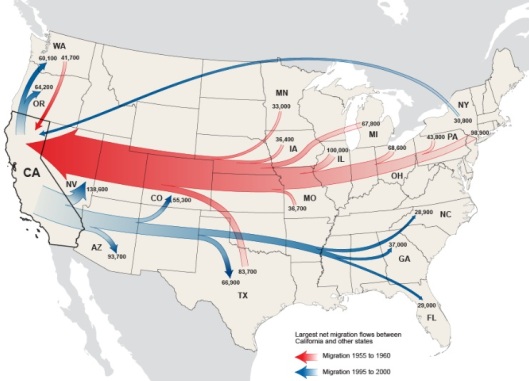
    Courtesy of the Census.

    Courtesy of the Census.

    How does this work exactly?

    Think of an act of migration as a lying down of fiber optics, with each trip thickening the network between two points in space. Often, cluster relationships begin forming. Take Los Angles and Pittsburgh. For years, the best talent would be poached at Carnegie Mellon. On the surface, this meant Pittsburgh would grow the talent and California, though an employer such as Disney Labs, would reap the rewards.

    Brain drain, right? Thus, spend money to herd the nerds, and make your talent inert for the sake of a Census count. Or, as Russell writes: “Pittsburgh is dying. Time to pony up the jingle and get Richard Florida to save the day.”

    Well, as Ernest George Ravenstein wrote in “The Laws of Migration, 1885”, “Each main current of migration produces a compensating counter-current”, and this is exactly what happened between Pittsburgh and Los Angeles. For instance, as the cost of attracting talent into “spiky locales” started becoming prohibitive, alternatives were sought. For Disney Labs, one was locating an R&D center near Carnegie Mellon, with the decision influenced by the networks formed through by Pittsburgh’s “brain drain”. Count Google and Apple as two others bellying up in the Rust Belt backwater. As is Schell Games, an educational gaming company with a founder born in Jersey, educated in Pittsburgh, and refined in Los Angeles. Located in the South Side neighborhood of Pittsburgh, the company totaled a quarter of a billion dollars in sales in 2011. A similar process is being played out in Cleveland between Case Western, University Hospitals, and Philips Technology in the field of medical imaging. These are just some of the  relational opportunities across the whole of the Rust Belt.

    Digging further, there is something else going on here, particularly as it relates to the Rust Belt’s legacy asset of growing talent. To wit, other regions, like Portland, attract talent, but their educational ecosystems are less developed. The Rust Belt educates. It mines talent. Exports talent. For instance, according to the Chronicle of Higher Education, the top 10 states for out-of-state freshman enrollment reside in the Midwest (Pennsylvania is 1, Ohio is 7).

    Why does this matter? Because much like the industrial epoch before it, the innovation economy—to buy a term from Economist Enrico Moretti—is converging; that is, it is becoming less “spiky” and looking for leverage. Thus, the “rise of the rest”. From the Harvard Business Review:

    It goes without saying that no matter how much talent a company might have, there are many more talented people working outside its boundaries. Yet all too many companies focus solely on acquiring talent, on bringing talent inside the firm. Why not access talent wherever it resides?

    The overall lesson here is this: Rust Belt cities need to get over lamenting the Chicken Little-like strategy that is plugging the brain drain. Let your people go. Let them grow. Concentrate on the network.  The trend of jobs constricting its supply line to talent is likely to grow. Welcome to the “talent economy”.

    “Cool” Exhaustion

    Venture capitalist Brad Feld recently said, “The cities that have the most movement in and out of them are the most vibrant”. The statement speaks to the reality that Pittsburgh et al. won’t shrink their way to growth, as in-migration is needed. On that score, there’s some indication of Rust Belt demographic inflows, indicating changes of a mesofact shift.

    For example, people are returning to Pittsburgh, with a positive net migration for the past five years. In fact, U-Haul’s latest annual survey marks Pittsburgh as the top growth city in the U.S. There’s some movement back to Cleveland as well. My past research for the Urban Institute showed a net inflow of 25- to 34-year olds in the city’s downtown, as well as its surrounding inner-core neighborhoods. Other Cleveland neighborhoods and inner-ring suburbs are seeing a net inflow of young adults as well. Also, migration patterns from 2005 to 2010 flowed net positive to Cleveland’s Cuyahoga County from the “spiky” counties of Chicago’s Cook County and Brooklyn’s King County.

    Will the trend grow? Here, it’s necessary to infer why it is occurring, so as to emphasize the inherent competitive advantages Rust Belt cities have to offer.

    Part of the psychogeographic attraction that Cleveland and Pittsburgh have is the fact they are not Portland, Brooklyn, or any other variety of venerable hot spots engaging in an  arms race of mod. Industrial cities maintain distinct cultures comprised of unique histories that are manifested by both elegant and unpolished bones. In short, the Rust Belt is real places, with real people. Wrote a New York City cyclist and author on his recent trip entitled “It’s Monday, I’m Back, And Cleveland!”:

    Portlanders ride around on bespoke bicycles wearing artisanal fanny packs and eating kimchi quesadillas out of food trucks.  Clevelanders watch “The Deer Hunter” and eat rabbit and tubular meats while basking in the warm glow of their leg lamps…

    …Cleveland has its own unique take on the whole “artisanal” phenomenon.  For example, in Brooklyn people open stores where they only sell olive oil or mayonnaise, or where some Oberlin graduate will give you an old-timey shave with a straight razor and a leather strop for $75.  In Cleveland, this guy sits outside his shop making bats.


    Courtesy of Bike Snob NYC

    Rust Belt cities, then, got their own thing going on, something at variance with the universal creative class typology said to attract “young and the restless”. To engage in copycatting would be a tragedy for Cleveland and Pittsburgh to adopt—like re-branding a flower by eroding its scent.

    Joi Ito, the head of MIT’s Media Lab, agrees, saying city making is not about heavy-handed creative class endeavors, but about backing off, letting things emerge. But again, this requires city self-awareness, which, according to Ito, “has to do with the character of the city, the character of the people, the character of the mayor”. In other words, the answers for a city are inside of it. Not inside the idea of outside programming.

    And by being self-aware, Cleveland and Pittsburgh could position themselves as places for the “cool exhausted”, or places about community, affordability, and family. Places that contain good single-family housing stock. Places with coffee shops, taverns, and backyards. Places not prone to the dichotomy of micro-apartments v. McMansions but rather rest in a middle-grounding sweet spot that is projected to be attractive to the next generation of homebuyers. Says a newcomer to Pittsburgh from Brooklyn:

    Moving to Lawrenceville was one of the smartest things we’ve done.  It’s a visually, historically, and socially stimulating neighborhood with a stronger sense of community than I’ve experienced anywhere else.

    No doubt,  in-migration of all types is needed—i.e., Pittsburgh’s and Cleveland’s foreign-born rates are at historic lows— but the low-hanging fruit is Rust Belt refugees, or “boomerangers”, many Global City graduates. Russell, who has been examining the phenomenon for years, sees this variant of return migration as a potential game-changer for historically declining Rust Belt cities, particularly because it represents a counter flow to the donut hole-patterning of urban decline. “This is happening, and it’s on a scale much larger than expected,” Russell says. “We are busy catching up to a trend. The Rust Belt Chic migration is a particular form of return migration: Rust Belt suburb-to Big City-to grandpa’s neighborhood”.

    Economically speaking, such migrants pack a wallop, as the act of migration is primarily an entrepreneurial act. Such is illustrated in a recent New York Times piece called “Replanting the Rust Belt”. In it, they profile Cleveland chef Jonathan Sawyer who moved back home from New York to raise his family. Yet he was also determined “to help the city transcend its Rust Belt reputation”. Once there, Sawyer “foraged for people”, eventually setting up a local food ecosystem that “connects mushroom farms, bean gardens, Italian bakeries, Amish dairies, noodle makers, butchers and the basement and backyard of his own house”.

    Migrants like Sawyer are economic change agents. Pittsburgh and Cleveland need to scale them up, and then do everything they can to eliminate barriers so they can forage properly.

    Bowling with Strangers

    As the middle class re-enters and gentrifies inner city Rust Belt neighborhoods, consequences will arise. Still, desperate city leaders are happy with any trade-offs, as is evidenced by Detroit’s economic development czar George Jackson recent declaration that: “I’m sorry, but, I mean, bring it on [gentrification]. We can’t just be a poor city and prosper.”

    Such conceptions are common in government, institutionalized even. Notes Neil Smith:

    Gentrification became a systematic attempt to remake the central city, to take it back from the working class, from minorities, from homeless people, from immigrants…What began as a seemingly quaint rediscovery of the drama and edginess of the new urban “frontier” became in the 1990s broad-based market driven policy.

    It is widely understood gentrification does little to eliminate the systemic problems facing not only the Rust Belt, but most communities: that of segregation and inequality. There needs to be a prioritizing of the underlying neighborhood dynamics that offer both hope and challenges for a path forward. To that end, given the rapidity of demographic and housing change in the industrial Midwest—i.e., it’s “brokenness”—consider the Rust Belt as good a living “lab” as any.

    For instance, certain demographic shifts in various Rust Belt cities are going against longstanding patterns, particularly the organic evolution of mixed neighborhoods. The integration is coming from several angles, which is largely due to the “benefits” of a depressed housing market. For instance, in Ohio City, one of Cleveland’s gentrifying neighborhoods, the percentage of black residents increased from 24% of the population to 34% from 1990 to 2010, whereas the percentage of whites declined 58% to 50%. Given that Ohio City is one of the areas seeing an inflow of 25- to 34-year old residents, there appears to be  a meet-up of lower-to-middle-income black families that have migrated from the East Side of Cleveland with younger suburban and exurban whites. The same demographic patterns are occurring in other Cleveland neighborhoods such as Edgewater, Old Brooklyn, and Kamm’s Corners, as well numerous suburbs, suggesting a “shake-up” of social capital paradigms that have kept Cleveland not only geographically segregated, but psycho-sociologically segregated.

    “Social capital”, you say?

    Yes. Most often social capital is talked about in good terms only, a la Putnam’s seminal book Bowling Alone But as illustrated in the paper “Why the Garden Club Couldn’t Save Youngstown”, too much social capital kills. For example, too much trust in others like you can parallel not enough trust in others unlike you, leading  to immobility, insularity, and stagnation of ideas.  What is needed in Cleveland and Pittsburgh is less social capital, or more movement, more outsiders, and more crossing of such psychogeographic divides as the Cuyahoga River, which has served to divide the  city of Cleveland between the East and West Sides. These “shake-ups” that are occurring fosters the heterogeneity necessary to reverse Cleveland’s declining, patriarchal course.


    “My Hometown”. Courtesy of Plain Dealer

    But simple diversification of neighborhoods won’t do the trick. For instance, a white teen may go to a diverse high school but it doesn’t mean she will have black friends. This filtering along entrenched historical fault lines happens in neighborhoods as well. The scene in D.C.:

    Both groups [whites and blacks] feel entitled and resent the other’s sense of entitlement. Over time the neighborhood’s revitalization engineers a rigid caste system eerily reminiscent of pre-1965 America. You see it in bars, churches, restaurants and bookstores. You see it in the buildings people live in and where people do their shopping. In fact, other than public space, little is shared in the neighborhood. Not resources. Not opportunities. Not the kind of social capital that is vital for social mobility. Not even words.

    What is partly occurring here relates to a controversial finding of Putnam’s, or that diversity can decrease social capital—perhaps too much. “People living in ethnically diverse settings appear to ‘hunker down’”, writes Putnam, or “to pull in like a turtle”.

    Why?

    Part of the reason is that neighborhood diversity can equate to living “by” each other and not “with” each other. As such, neighborhood integration is still raw in the American zeitgeist, with heterogeneity, according to Putnam, engendering mistrust and too little social capital. A next step is needed. Here, community leaders should heed lessons from the concept of creative destruction. From the article “The Downside of Diversity”:

    If…diversity, at least in the short run, is a liability for social connectedness, a parallel line of emerging research suggests it can be a big asset when it comes to driving productivity and innovation…

    … In other words, those in more diverse communities may do more bowling alone, but the creative tensions unleashed by those differences in the workplace may vault those same places to the cutting edge of the economy and of creative culture.

    This, then, represents a key opportunity for Cleveland and Pittsburgh to reconstitute a new American neighborhood model by harnessing the potential inherent in its integrating neighborhoods. This opportunity is perhaps greater in Rust Belt communities given—as of yet—the absence of housing market pressure that tends to filter people along similar demographic lines. The mission is simple: how can cities foster mobility without a complete sacrifice of trust? This entails thinking about social capital in a new way: neither a presence nor absence of it, but a continuum of social capital with insularity based on comfortability on one end, and insularity based on mistrust on the other. The sweet spot of social capital is somewhere in the middle, which entails not bowling with your buddies or bowling alone, but bowling with strangers—until they no longer aren’t.

    Why is this so important?

    Where people live informs them no less than where they go to school. Neighborhoods are factories of human capital. America needs to go past the gentrification model of revitalization. The cities that still have a fighting chance, like in the Rust Belt, should lead.

    Richey Piiparinen is a writer and policy researcher based in Cleveland. He is co-editor of Rust Belt Chic: The Cleveland Anthology. Read more from him at his blog and at Rust Belt Chic.

    Lead photo courtesy of Spicy Biscotti.
  • Genealogy Of Rust Belt Chic

    Some people don’t like the term “Rust Belt”. Others absolutely hate the word “chic”. Please don’t call the shifting mesofacts of dying Great Lakes cities “Rust Belt Chic”. Given the reaction, a lot of it negative, I decided to blog about how I came up with Rust Belt Chic. Way back in 2006, Shittsburgh was associated with a kind of urban chic. The South Side Slopes celebrated in the New York Times:

    “If Pittsburgh’s market were on steroids like New York’s, this would’ve happened a long time ago,” said one developer, Ernie Sota, referring to the recent spark of interest here. “But Pittsburgh’s kind of like an eddy. Things move slowly here.”

    Mr. Sota, 56, is a prolific local developer who is constructing a series of nine ‘green’ town houses, called Windom Hill Place, into a lush hillside here. He was drawn to the Slopes by the views and villagelike feel, which, for him, conjure memories of visits to Prague and Budapest.

    It’s just kind of quirky, funky and real, more organic, built by Europeans and other immigrants,” he explained. “The only other American cities that I find as geographically interesting are maybe San Francisco and Asheville, N.C.”
    Emphasis added. At the time, I thought of Sota’s sense of Pittsburgh place as unique to the city. I’m not from Pittsburgh. I don’t live in Pittsburgh. I didn’t go to school there. I’m a geographer. Pittsburgh appeals to my sensibilities. Pittsburgh is my Paris.

    The geographic scope of Pittsburgh urban chic became Rust Belt Chic upon meeting Phil Kidd and John Slanina in Erie, PA for a Rust Belt Bloggers summit. They introduced me to Youngstown. I was hooked.

    Rust Belt Chic always will be ironic. People are attracted to shrinking city hellholes. However, the hellhole part is misunderstood. What I mean is seeing opportunity hiding in a community struggling with survival. There’s just something about Youngstown that stirs passion in me. I’m not gawking at ruin porn or glossing over everything that is wrong. I love Rust Belt cities. I love Rust Belt culture. I’m proud to be from the Rust Belt. That’s what Rust Belt Chic now means to me. It’s personal. It’s who I am.

    For Pittsburgh, I could sense the tide turning. I see the same transformation taking place in other Rust Belt cities. A pejorative, Rust Belt-ness is an asset. It’s a starting point for moving forward, not a finish line or a civic booster campaign. Rust Belt Chic is in the same vein as rasquache:

    Rasquache sensibility that has become an important component of Chicana and Chicano art. The word, rasquache can be used in several senses. Its most common use is negative and relates to an attitude that is lower class, impoverished, slapdash and shallow. For this reason Tomás Ybarra Frausto who has written the cogent essay “Rasquachismo: A Chicano Sensibility” begins by stating, “One is never rasquache, it is always someone else, someone of a lower status, who is judged to be outside the demarcators of approved taste and decorum (in Richard Griswold del Castillo and others, Chicano Art: Resistance and Affirmation, 1965-1985. Los Angeles: Wight Gallery, UCLA, 1991, p. 155)

    However, as the case of several other terms and concepts (most notably the term and concept Chicano itself, which traditionally had a negative sense), the Chicano movement has turned the traditional notion of rasquache on its head. This important Chicano cultural sensibility has been particularly used to address, by means of a stance of resistance that is humorous and ironic rather than confrontational or hard-edged, the harrassments of external authorities such as the police, the immigration service, government officials, social services bureaucrats, and others. Chicano art that is rasquache usually expresses an underdog, have-not sensibility that is also resourceful and adaptable and makes use of simple materials including found ones, such as Luján’s cardboard, glue, and loose sand. 

    Rust Belt Chic turns the traditional notion of Rust Belt on its head. The Rust Belt is lower class, impoverished, slapdash, and shallow. At least, that’s how it looks from the coast, in New York City. Rust Belt Chic as a place to be is a form of resistance. It’s also a hot new trend and a threat to those neighborhoods that make my heart beat faster. From San Antonio:

    “I see a lot of progressiveness happening lightning quick now. When I came from Los Angeles as a visitor in 1992, I saw all these magic spaces you could rent for 300 or 400 a month. But I would laugh because there was little or nothing going on. I could get together some event with a friend or two and everybody thought it was so cool and innovative – I was just copping what I had seen in LA.

    San Antonio has gotten a lot more popular with Austin and California types discovering what a jewel this town is. Eclectic little restaurants and coffee places and shops growing up along Broadway and throughout Southtown. We’re being seen by a lot more cutting edge people by being open to contemporary signage and logos and creative design. With that, unfortunately, comes more expensive retail spaces and taxes are going up.

    There is a charm and real-ness to San Antonio I hope we don’t lose in the process. San Antonio is a non-materialistic town; people aren’t looking at your shoes or what kind of car you drive. When I leave San Antonio, it’s that real-ness that brings me back, every time. I left LA, and I left Austin because I got so tired of the trendy-ness. We’re growing fast, we’re drawing an eclectic market that will support artists. However, there will be a compromise. I don’t want to see it get too uptight.”

    –Robert Tatum

    Pittsburgh is Rust Belt Chic Paris. San Antonio is Rasquache Paris. When Richey Piiparinen and I were in San Antonio to do fieldwork, we were both struck by the Rust Belt Chic qualities of the city. At the time, we weren’t familiar with rasquache. We are now. I see a lot of similarities between Pittsburgh and San Antonio, particularly the way both places are under-appreciated. They enjoy a cult following. Hopefully, neither one will become the next Austin or Portland.

    Rasquache is further along, much further, than Rust Belt Chic. In fact, Rust Belt Chic is rasquache:

    This called to mind a passage I’d read in Have You Seen Marie? It’s an unusual book for a writer whose work has been at turns bawdy, avant-garde, and politically trenchant. Entirely autobiographical, Marie is a short, illustrated story with a childlike tone about Cisneros searching the streets of King William for a friend’s lost cat while mourning the loss of her mother, who died in 2010. I read Cisneros the passage I’d thought of: “ ‘King William has the off-beat beauty of a rasquache, and this is what’s uniquely gorgeous about San Antonio as a whole.’ ”

    She smiled. “Rasquache is when you make or repair things with whatever you have at hand. You don’t go to Home Depot. If you have a hole in your roof, you put a hubcap on there. Or you fix your fence with some rope. That’s rasquache. And then there’s ‘high rasquache,’ which is a term the art critic Tomás Ybarra-Frausto coined. He lives here. Danny Lozano knew high rasquache. He’d serve you Church’s fried chicken on beautiful porcelain and use Lalique crystal for flowers he’d cut from an empty lot.”

    “And that was one of the qualities that drew you to King William?”

    “Not just King William but San Antonio. A kind of elegance of found things. San Antonio has that soul. It’s not, ‘We gotta copy what we saw in New York.’ No! It’s going to come out of our own idea of what we think is beautiful.” She stared at me as if to make sure I understood. “But that’s also what’s getting lost. People feel like the city’s got to look like someplace else. Our mayor needs a stylist. He thinks he has to dress like a Republican. Pues, he’s Chicano! He’s got this gorgeous indigenous look, and he would look so cool if Agosto Cuellar, one of our local designers, dressed him, or someone like Franco, or Danny, or John Phillip Santos—he dresses totally San Antonio cool. He should do a style column for Texas Monthly.”

    I allowed that Santos, who is a regular contributor to this magazine, does have singular style (the last time I saw him, in December, he was wearing a horsehair charro tie and ringneck python boots) but joked that there might be a preponderance of leather pants in his fashion advice. Cisneros waved the joke aside.

    “Our problem is that we can’t recognize or celebrate what we have. We have this inferiority complex in Texas that we have to look elsewhere. Well, who knows more about inferiority than Chicanos? We grew up being ashamed because the history that is taught to us makes us ashamed. The whole colonial experience surrounding the Alamo is meant to make you feel ashamed.”

    In writer Sandra Cisneros, I sense a kindred spirit. As a Rust Belt native, Erie no less, I felt ashamed. I come from failure. I have no culture worth celebrating. Anywhere else must be better. That’s why we leave. Brain drain.

    I, too, was drawn to King William while in San Antonio. It is New Orleans (creole) and Pittsburgh (parochial). It’s like nothing I’ve experienced before. I get that boom town vibe of a place that is cool before anyone knows it is cool:

    Russell has seen what’s coming before. “When the buzz starts – when San Antonio embraces the brain gain, goes in the right direction on the talent economy and hipsters start to get wise to the neighborhood assets that are here – once the hipsters get wind of it – you’ll have to beat them away with a stick,” he said.

    I think that’s the concern of Robert Tatum. About a year ago, such a notion was unfathomable to Cleveland. What will the compromise with gentrification look like in Ohio City? Will somebody utter the words, “He dresses totally Cleveland cool”?

    Danny Lozano knew high rasquache. He’d serve you Church’s fried chicken on beautiful porcelain and use Lalique crystal for flowers he’d cut from an empty lot.

    Rust Belt Chic is served.

    Jim Russell is a talent geographer with particular interest in the Rust Belt. Read his blog at Burgh Diaspora, where this piece originally appeared.

  • Why Inmigration Really Matters, Particularly to the Rust Belt

    Cleveland Mayor Frank Jackson’s recent comment about immigration has drawn some local ire. At his annual remarks on the state of the city, the Mayor—in response to a question of how Cleveland can end its population decline by attracting immigrants—stated: “I believe in taking care of your own”.

    To be fair, the Mayor contextualized the statement by inferring that the best attraction strategy is to build a city that works for those who reside in it. In some respects I agree. In fact America attracts immigrants not because of “attraction strategies”, but because it offers the prospects of a better quality of life. So, if a city can nail that down, well, that is a hell of a pull.

    The problem, though, is that historically inward-facing legacy cities such as Cleveland have had a hard time moving the needle toward progress because fresh blood is lacking, and so a “taking care of your own” strategy often devolves into policies that simply further fossilize the status quo.

    Why?

    Because such cities—with low rates of inmigration, and a long lineage of social capital that can tip to the side of insularity and territorial encampment—have too much inertia, which is defined as “the resistance of an object to change its state of motion or rest”.

    Inertia is real, not simply in physics, but in organizational behavior, such as city politics and policy. And the more historical it is, the thicker the status quo, and thus the harder it is for a city to change—meaning the future, or the momentum of the city, can be like a train chugging to constant stops of stagnation unless a “force outside the system…act[s] upon the system for a long enough period of time to have any effect on changing the momentum.”

    Enter the importance of outsiders, be they immigrants, returning expats, or just new people from other parts of the country. Without them cities get stuck. People see the same things, talk the same things over. Bullshit territorial divides like East- versus West-side of the Cuyahoga River reign, effectively cutting a city’s “brain” in half. Business is business as usual, then. Hence the post-industrial-sixty-year decline.

    Writes Aaron Renn over at Urbanophile:

    I previously noted how it generally takes a critical mass of outsiders, enough to create a constituency for change in its own right, to drive real disruptive change in a community. These are the people who aren’t invested in the status quo. Absent that, getting reform that works will be a difficult challenge.

    Echoes migration expert and blogger Jim Russell:

    Without migration, there are no cities. An urban landscape is more than a draw for talent. Metros thrive on churn, both the influx and egress of people…

    … The very act of moving, particularly to the top tier of global cities, is entrepreneurial. You are surrounded by risk-takers and innovation. The competition is fierce. The cream of the crop is seeking any edge, looking for any opening.

    I am learning about the power of migration first hand. You see, I am a lifelong Clevelander, a West Sider, one well-versed in the how things are customarily done around here, and what thoughts and words are commonly produced if only through a Rust Belt inertia that can be cloaked in “tradition”. My partner, Andiara Lima, is a relative newcomer from Vale do Aço, or the “Steel Valley” of Brazil. Before I met her I was ignorant to the presence of the Brazilian community in Cleveland. Now, I no longer am, and the experience provides me with on-the-ground lessons as to the importance of migration in evolving the Rust Belt “way”.

    brazil house party


    For instance, individually speaking, my panorama is being broadened, with the dominant cultural connotations of Cleveland defined primarily by whiteness or blackness taking a needed hit. For instance, I was at a Brazilian-hosted house party not long back, and it was like nothing I ever experienced. The dining room was cleared, bodies moved, sweat poured, people screamed and shook ass. A band was set up to play bossa nova along a window seat. And it was happening all in the neighborhood of my childhood, but way beyond my childhood. Rather a feeling of something forward.  Not just past. Not identity politics, but a freshness needed so that crusty legacy and power can be dampened if only to bust identity politics up.

    No doubt, these identity politics hurt the region’s ability to welcome and catalyze emerging groups. For instance, I am reminded of a recent Facebook comment on a local politician’s page that discussed a community forum about how Cuyahoga County government reform would affect race relations. The commenter notes:

    The whole panel was black or white people. The Asians and Latinos were in the back of the room wondering “what about us?”

    “What about us?”

    It’s a good question, and one local leaders shouldn’t underestimate given the region’s need for fresh blood. And we aren’t just talking bodies, but talent, as migrants are “economic ass-kickers”, particularly due the fact that migration is in itself an act of entrepreneurialism.

    For instance, my partner Andiara studies the Brazilian trade market for a local investment company. Her informational network into the country, both professionally and informally, is deep. For me, she is a link between two Rust Belt worlds, shattering my sense of restrictive locality for a borderless view that gets me thinking about how to position Cleveland not just regionally, but globally.

    For Cleveland, she is a reserve for local industry that should be both cultivated and tapped, especially since—as the US Ambassador to Brazil recently said at Cleveland’s Union Club—“Brazil is an economic and democratic power the United States needs as a partner”.


    And there is Luca Mondaca and Moises Borges, both acclaimed Brazilian musicians who are plugging (into) and broadening (out) Cleveland’s musical legacy. Yet there is frustration, particularly for Luca, as she feels isolated, untapped, and sometimes lost in the culture of a city that—while desperate for freshness—has difficulty getting beyond the inertia that comes with being comfortably stale. And while I am hopeful that the city is in fact becoming more welcoming—and that the opportunity afforded by the region’s affordability and legacy assets can further open the inmigrant sluicegates—passive optimism is not an option.

    Neither is parochial playmaking.

    In fact, Andiara Lima, Luca Mondaca, and Moises Borges are Cleveland’s “own”. But without that recognition, they may not be for very much longer.

    Richey Piiparinen is a writer and policy researcher based in Cleveland. He is co-editor of Rust Belt Chic: The Cleveland Anthology. Read more from him at his blog and at Rust Belt Chic.

  • Rust Belt Cities: Invest in Odysseus, Not Barney Fife

    Given its legacy of shrinking, the Rust Belt has issues. The issues arose naturally, and relate to the fact things leave, or that so much has left. Particularly, when things leave, the mind—both the individual and the collective city mind—can get protective and restrictive. Neediness arises. The smell of desperation ensues like a pall that can tend to hang over cities, influencing decision making on all levels.

    Enter “brain drain”, or that term coined to refer to the outmigration of an area’s educated citizens, particularly it’s young. You know the drill: Johnny goes to State college, comes back home for a spell, but then leaves Cleveland, Ohio for Chicago or New York. That is brain drain. And city leaders hate it, spending billions of dollars to stop it—often at the cost of coming off ridiculous, lame.

    For instance, in Pittsburgh, there was a civic booster campaign thought up to keep educated folks from going. It was called “Boarder Guard Bob”. According to researcher Chris Briem, “Bob” was a Smokey-the-Bear-type of public service announcement made into a Barney Fife character, with the billboard-size messaging of “Bob” intended to “stop young people at Western Pennsylvania’s borders before they had a chance to leave for other cities”. And while this particular retention strategy (luckily) never went to print, various “plug the brain drain” strategies persist in one form or another at exorbitant cost to taxpayers.

    But beyond the near-pitiful messaging, there are major problems with the brain drain approach, especially from an economic development perspective. For example, when, as a community, you are intentionally telling your citizen’s not to go, you are asking them to sacrifice personal development for the benefit of a place. To this point, my colleague, Jim Russell—a leading thinker in brain drain boondoggles and blogger at Burgh Diaspora—says it best, stating: “Discouraging geographic mobility is the same as restricting access to higher education”. In other words, it’s like telling Johnny to stick with his high school diploma so as to forego leaving the community for a 4-year degree.

    What’s more, getting people to stay put does little to grow a local economy. In fact it hurts it. Because leaving home is often a rite of passage. It develops a person. I mean, can you imagine if there was no odyssey in the epic Odyssey? If so, Odysseus wouldn’t be the changed man with perspective and experience as he was when he returned back to his homeland, and so there’d be no “there” there. In this sense, the Rust Belt needs to engage their young to embark on their own “Hero Journey” if only to gain skills and broaden geographic connections. This is international economics 101 (see China, India, Brazil, etc.). It should be a domestic economic priority for the Rust Belt, and it would be if only the Cleveland’s of the world could let go of the protectionism that defines their longstanding existential fears of shrinking into one big pile of ruin porn.

    Of course confidently encouraging outmigration is part and parcel with an understanding that many expats will “boomerang” back. But many are, and at a faster rate. To wit: as the alpha cities of the America like NYC get too expensive or creatively-class cute, many Rust Belt refugees are pivoting back from a certain left-wanting lifestyle if only for the opportunity, tradition, and honest-to-god reality that is “Rust Belt Chic”. And when they do, they often become “economic ass kickers”, which is term Russell uses to exemplify the fruits of the Hero Journey that is not only individually experienced, but felt in the local economy as well.

    Take Sean Watterson, the co-proprietor of the wildly successful restaurant the Happy Dog on Cleveland’s Near West Side. He moved back from D.C. because, according to a recent Plain Dealer article, “Cleveland-ness is like Polish-ness or Irish-ness. It’s an ethnicity”. Here, Watterson not only runs a great hot dog business, but uses his establishment to advance a circulation of ideas by hosting a variety of events like “Life, the Universe, and Hot Dogs”, which is a series hosted by researchers from the Institute for the Society of Origins. Another big hit is the live performances by members of the Cleveland Orchestra called Classical Revolutions.

    Cool sounding events, sure. But there is more to it than that, as such happenings spark cross-fertilization between parts of Cleveland—the blue collar West Side and the intelligentsia of the East Side—that have long been divided, often at the cost of Cleveland as a place of cultural and economic innovation. And how exactly does Watterson’s own “Hero Journey” come into play in his self-stated goal to break down barriers “between east and west and between high culture and low culture”? It likely relates to the fact he experienced experience outside of a legacy city bubble that enabled him to see and cross bridges that others have difficulty envisioning.

    Now, does this mean that cities simply need to let people leave to prosper? Obviously not. If the place expats are boomeranging back to is stagnant and disparate, with openness and connection disabled by a collective insular mentality that: “that’s just the way things are done around here”, well, the boomeranging effect won’t hold. And the economic ass-kickers won’t ass-kick.

    The goal, then, of cities should be on fostering return migrant connections, or to know who they are, why they are there, and to help get them together so that their collective unchained perspective can pop bubbles of inert status quo. This need is real. For instance, take this first-hand return migrant account published in Rust Belt Chic by Dana Marie Textoris:

    Funny how your location-based identity, your physical and mental place in the world, can flip like a switch: Before I was a Clevelander managing to make it in San Francisco….right now I feel a lot like a San Franciscan stuck in Cleveland. In either place, I felt just a little bit Other. A bit of a novelty. Just a tad on the outside looking in. Where does that leave me? Where is home? As I type this, I realize, with sort of an internal groan, that the place I’m left in, the guide to what I’m searching for, is probably just right here, inside me, where my two lives — West Coast and Midwest — are now combined. I’m not really a true Clevelander anymore…I’ve picked up way too much San Francisco for that. The balance I’ve become, a little of this and that, is just what I’m hoping I’ll find, one day.

    So, to all Rust Belt cities—this is where your attention must be turned: not on the ones who are leaving for good reason, but on those returning who have not left for good. They have brought the path of their self-discovery back to your doorstep.

    Don’t close the door by screaming at the backs of others.

    Richey Piiparinen is a writer and policy researcher based in Cleveland. He is co-editor of Rust Belt Chic: The Cleveland Anthology. Read more from him at his blog and at Rust Belt Chic.

  • The New Places Where America’s Tech Future Is Taking Shape

    Technology is reshaping our economic geography, but there’s disagreement as to how. Much of the media and pundits like Richard Florida assert that the tech revolution is bound to be centralized in the dense, often “hip” places where  “smart” people cluster. Some, like Slate’s David Talbot, even fear the new tech wave may erode whatever soul is left to increasingly family free, neo-gilded age San Francisco.

    Such claims have been bolstered by the tech boom of the past few years — especially the explosion of social media firms in places like Manhattan and San Francisco. Yet longer-term trends in tech employment suggest such favored media memes will ultimately prove well off the mark. Indeed, according to an analysis by the Praxis Strategy Group, the fastest growth over the past decade in STEM (science, technology, engineering and mathematics-related) employment has taken place not in the most fashionable cities but smaller, less dense metropolitan areas.

    From 2001 to 2012, STEM employment actually was essentially flat in the San Francisco and Boston regions and  declined 12.6% in San Jose. The country’s three largest mega regions — Chicago, New York and Los Angeles — all lost tech jobs over the past decade. In contrast, double-digit rate expansions of tech employment have occurred in lower-density metro areas such as Austin, Texas; Raleigh, N.C.; Columbus, Ohio; Houston and Salt Lake City. Indeed, among the larger established tech regions, the only real winners have been Seattle, with its diversified and heavily suburbanized economy, and greater Washington, D.C., the parasitical beneficiary of an ever-expanding federal power, where the number of STEM jobs grew 21% from 2001 to 2012, better than any other of the 51 largest U.S. metropolitan statistical areas over that period.

    The question is whether the last two to three years, during which places like San Francisco, New York and Boston have enjoyed stronger STEM growth than their peripheries, represents a paradigm shift or is just a cyclical phenomenon. As with tech in general, the long-term trends are not so city-centric; over the past decade,  the core counties nationwide overall have lost about 1.1% of their tech jobs while more peripheral areas have experienced a gain of 3.5%.

    Today’s urban tech boom looks a lot like a rerun of the dot-com boom of the late 1990s. In that period media-savvy dot-com startups proliferated in such places as South of Market in San Francisco and the Silicon Alley in lower Manhattan. At their height, these firms and their founders were as likely to be covered in the fashion and lifestyle sections as on the business pages.

    Yet by the early 2000s, many of these dot-com darlings had merged, been acquired or simply gone out of business. Anchored largely on hype, they fell victim to flawed business models, and rapid industry consolidation.  In San Francisco, for example, tech employment crashed from a high of 34,000 in 2000 to barely 18,000 four years later. Silicon Alley suffered a similar downward trajectory, losing 15,000 of its 50,000 information jobs in the first five years of the decade.

    The peaking social media boom, marked by the weak performance of Facebook’s IPO last year, suggest another bust at the end of the “hype cycle.” Urban darlings such as  San Francisco’s Zynga and Chicago’s Groupon have floundered in spectacular fashion. More are likely to join them.

    These firms may have generated buzz, but they have done not so well at the mundane task of making money. One problem may be that  the most avid users of social media are largely young people from the “screwed” generation who lack much in the way of spending power — a clear turnoff to advertisers. Now , with venture capital flows declining overall,  cooler heads in the Valley are shifting bets to more business-oriented engineering and research-intensive fields more grounded in marketplace realities.

    And what about the future of the Valley — still home to virtually all the Bay Area’s top tech firms? Its glory days as a job generator and economic exemplar seem to have passed. Between 1970 and 1990 the number of people employed in tech in the Valley more than doubled to 268,000, and then burgeoned to over 540,000 in the 1990s. At the peak of the last tech boom in 2001, the unemployment rate in Santa Clara County was a tiny 3%; the Silicon Valley Manufacturing Group confidently predicted there would be another 200,000 jobs by 2010.

    However, at what may be the peak of the current boom, the number of tech jobs in the Valley remains down from a decade ago and unemployment is over 7.7%, just around the national average. In reality, social media was never going to reverse the downward trajectory in the rate of job growth. Old-line companies like  Hewlett-Packard or Intel, with over 50,000 employees in the U.S. alone, were capable of creating a broad range of opportunities for workers; in contrast, the social media big three of Facebook, LinkedIn and Twitter together have less than 6,500 employees.

    As the social media industry matures and consolidates,   employment is likely to continue shifting to less expensive, business-friendly areas. The Bay Area, where the overall cost of living is 68% higher than the national average and housing is the most expensive in the nation, may continue to attract and retain only the highest-end, best-paid workers. But for the most part they will follow the path of established tech firms such as  Apple, Intel, Adobe, eBay and IBM  to lower-cost places like Austin, Columbus and Salt Lake City. A similar phenomena also can be seen in other urban-centered industries, such as entertainment and finance where  virtually all employment growth is in places like St. Louis, Des Moines and Phoenix, even as the largest centers, New York, Chicago, Boston, Los Angeles and San Francisco have suffered significant job losses.

    Demographic forces may further accelerate these trends. The critical fuel for tech growth, educated labor, is now expanding faster in places like Columbus, Austin, Raleigh, Dallas and Houston than in Boston, San Jose and San Francisco. The old centers may still enjoy a lead in brains, but other places are catching up rapidly.

    Companies may also discover that with many millennials starting to hit their 30s, some may seek to leave their apartments to buy houses and start families. In California new local regulations essentially ban the construction of new single-family homes in some of the state’s biggest metro areas, pricing this option out of reach for all but a few, and forcing a key demographic group to seek residence elsewhere.

    Under these conditions, Silicon Valley will be forced to rely increasingly on inertia and mustering of financial resources than innovation. As a result, the nation’s tech map will continue to expand from the Bay Area, Boston, Seattle and Southern California to emerging metropolitan areas in North Carolina, Texas, Utah, Colorado and the Pacific Northwest. In the future parts of Florida, Phoenix, and even Great Plains cities like Sioux Falls and Fargo could also achieve some critical mass.

    Ultimately, one of the main dynamics of the information age — that even sophisticated tasks  can be done from anywhere — works against the dominion of single hegemonic industry centers like Wall Street, Hollywood and Silicon Valley. The tech sector is particularly vulnerable to declustering, due in large part thanks to the freedom from geography created by technologies of its own making.   Silicon Valley may continue to reap riches from the periodic technology  gold rush , but in the longer term, tech growth will continue its long-term dispersion to ever more parts of the country.

    STEM Occupations in the Nation’s 51 Largest Metropolitan Areas
    MSA Name 2001 – 2012 Growth 2005 – 2012 Growth 2010 – 2012 Growth 2012 Location Quotient LQ Change, 2001 – 2012
    Washington-Arlington-Alexandria, DC-VA-MD-WV 21.1% 12.7% 3.7% 2.19 10.6%
    Riverside-San Bernardino-Ontario, CA 18.6% -1.4% 2.2% 0.57 1.8%
    San Antonio-New Braunfels, TX 18.3% 17.2% 4.5% 0.83 1.2%
    Baltimore-Towson, MD 17.9% 11.4% 3.9% 1.37 15.1%
    Raleigh-Cary, NC 17.9% 14.6% 6.2% 1.53 0.0%
    Las Vegas-Paradise, NV 17.2% -2.6% 0.8% 0.52 4.0%
    Salt Lake City, UT 16.3% 18.1% 7.4% 1.16 4.5%
    Houston-Sugar Land-Baytown, TX 15.7% 17.2% 6.6% 1.20 -2.4%
    Seattle-Tacoma-Bellevue, WA 15.4% 22.2% 6.7% 1.86 8.1%
    Jacksonville, FL 13.0% 6.5% 2.4% 0.87 8.7%
    Austin-Round Rock-San Marcos, TX 12.2% 17.2% 9.1% 1.82 -8.5%
    San Diego-Carlsbad-San Marcos, CA 11.3% 8.0% 2.1% 1.38 6.2%
    Columbus, OH 10.4% 12.8% 4.7% 1.27 7.6%
    Orlando-Kissimmee-Sanford, FL 9.4% -1.1% 0.8% 0.84 -3.4%
    Indianapolis-Carmel, IN 6.9% 6.5% 2.7% 1.04 2.0%
    Nashville-Davidson–Murfreesboro–Franklin, TN 6.7% 3.5% 2.4% 0.77 -1.3%
    Sacramento–Arden-Arcade–Roseville, CA 6.4% 3.5% 0.4% 1.33 2.3%
    Oklahoma City, OK 5.5% 9.6% 6.4% 0.89 -1.1%
    Pittsburgh, PA 5.3% 10.3% 4.9% 1.07 5.9%
    Virginia Beach-Norfolk-Newport News, VA-NC 4.8% 2.3% 0.5% 1.10 3.8%
    Charlotte-Gastonia-Rock Hill, NC-SC 4.3% 8.2% 5.7% 0.99 -3.9%
    Kansas City, MO-KS 4.0% 5.8% 4.6% 1.12 4.7%
    Richmond, VA 3.8% 4.4% 3.4% 0.99 0.0%
    Cincinnati-Middletown, OH-KY-IN 3.7% 5.5% 6.8% 1.02 4.1%
    Buffalo-Niagara Falls, NY 3.2% 6.4% 3.6% 0.90 4.7%
    Dallas-Fort Worth-Arlington, TX 3.1% 11.4% 5.5% 1.19 -5.6%
    San Francisco-Oakland-Fremont, CA 2.5% 15.0% 9.9% 1.63 5.8%
    Phoenix-Mesa-Glendale, AZ 2.3% 3.5% 3.9% 1.05 -6.3%
    Minneapolis-St. Paul-Bloomington, MN-WI 2.2% 6.7% 5.9% 1.31 1.6%
    Portland-Vancouver-Hillsboro, OR-WA 1.6% 6.4% 5.4% 1.19 -3.3%
    Louisville/Jefferson County, KY-IN 0.9% 9.6% 6.9% 0.76 0.0%
    Denver-Aurora-Broomfield, CO 0.5% 10.8% 3.7% 1.43 -2.1%
    Atlanta-Sandy Springs-Marietta, GA -1.0% 5.5% 6.5% 1.07 -2.7%
    Boston-Cambridge-Quincy, MA-NH -1.3% 11.2% 6.0% 1.64 -1.2%
    Providence-New Bedford-Fall River, RI-MA -1.5% -1.6% 1.9% 0.88 2.3%
    Philadelphia-Camden-Wilmington, PA-NJ-DE-MD -2.8% -1.4% 1.4% 1.06 -1.9%
    Hartford-West Hartford-East Hartford, CT -4.5% 1.5% 0.3% 1.10 -3.5%
    New York-Northern New Jersey-Long Island, NY-NJ-PA -4.6% 2.8% 3.2% 0.90 -6.2%
    St. Louis, MO-IL -4.8% -1.7% 1.4% 1.05 -0.9%
    Milwaukee-Waukesha-West Allis, WI -6.1% -0.8% 4.0% 1.00 0.0%
    Tampa-St. Petersburg-Clearwater, FL -6.3% -4.3% 2.5% 0.89 -3.3%
    Miami-Fort Lauderdale-Pompano Beach, FL -6.4% -8.3% 0.6% 0.67 -8.2%
    Los Angeles-Long Beach-Santa Ana, CA -7.1% -3.5% 3.1% 0.98 -5.8%
    Memphis, TN-MS-AR -7.3% -4.0% 0.7% 0.62 -4.6%
    Cleveland-Elyria-Mentor, OH -8.8% -2.1% 4.3% 0.89 1.1%
    Chicago-Joliet-Naperville, IL-IN-WI -10.8% -1.4% 3.5% 0.87 -7.4%
    Birmingham-Hoover, AL -11.4% -8.0% -2.0% 0.76 -8.4%
    Rochester, NY -12.0% -2.1% 4.1% 1.14 -10.2%
    San Jose-Sunnyvale-Santa Clara, CA -12.6% 12.4% 8.3% 3.18 -4.8%
    New Orleans-Metairie-Kenner, LA -16.0% -7.4% -2.4% 0.74 0.0%
    Detroit-Warren-Livonia, MI -17.7% -10.3% 10.5% 1.42 -3.4%
    Analysis by Mark Schill, Praxis Strategy Group
    Data Source: EMSI 2012.4 Class of Worker – QCEW Employees, Non-QCEW Employees & Self-Employed 

    The LQ (location quotient) figure in the table above is the local share of jobs that are STEM occupations divided by the national share of jobs that are STEM occupations. A concentration of 1.0 indicates that a region has the same concentration of STEM occupations as the nation. The analysis covers 80 STEM occupations in all industries.

    Joel Kotkin is executive editor of NewGeography.com and a distinguished presidential fellow in urban futures at Chapman University, and a member of the editorial board of the Orange County Register . He is author of The City: A Global History and The Next Hundred Million: America in 2050. His most recent study, The Rise of Postfamilialism, has been widely discussed and distributed internationally. He lives in Los Angeles, CA.

    This piece originally appeared at Forbes.com.

    Computer engineer photo by BigStockPhoto.com.

  • The End of the Road for Eds and Meds

    In the last few decades, as suburbanization and deindustrialization devastated so many cities, they turned to two sectors that seemed not only immune to decline, but were actually growing: universities and hospitals. The so-called “eds and meds” sectors, often related through university affiliated hospitals, became a great stabilizer for many places. For example, the fabled Cleveland Clinic cushioned the blow of manufacturing decline in that city.  Après steel, a city like Pittsburgh practically saw themselves as defined by an eds and meds economy, with the new economic pillars being the University of Pittsburgh Medical Center and Carnegie-Mellon University.

    Perhaps unsurprisingly, these sectors have come to dominate so many cites’ economic development strategies. It’s harder to find a major city that isn’t touting some variation of a life sciences “cluster” as a strategic industry than one who is, and local medical schools and hospital complexes feature prominently in this. Similarly, technology transfer from schools is supposed to power startups, while in many cities growth in the number of students itself is supposed to be an engine of growth. For example, there are 65,000 students in the so-called “Loop U” collection of colleges in downtown Chicago, and education growth has been a bulwark of the Loop economy.

    Yet in reality, overreliance on eds and meds is problematic. Firstly, these tend to be non-profit, and thus reduce the tax base in cities that are dependent on them. In danger of bankruptcy, Providence, Rhode Island was forced to ask for special contributions from Brown University and RISD, for example. Also, as quasi-public sector type entities, eds and meds are seldom a source to dynamism in communities in and of themselves.  Indeed, universities are among the most conservative of institutions in many respects.  Witness the firing and re-hiring of University of Virginia president Teresa Sullivan, for example, or faculty protests against the appointment of Indiana Governor Mitch Daniels as Purdue University’s next president due to his lack of an academic background.

    But for cities hanging their hat on eds and meds growth, a more fundamental problem now looms: these industries are at the end of their growth cycle. Spending on healthcare and college tuition costs has been skyrocketing at rates greater than inflation for years.  Here’s a chart, via Atlantic Cities, showing job creation by sector since 1939:


    If eds and meds employment has been going up continuously since 1939, what’s the problem?  None, so long as it started from a low base at a time when other productive sectors of the economy were likewise growing strongly. But as sectors like manufacturing went into decline or stagnated, eds and meds has continued to increase relentlessly, accounting for an ever larger  portion of total growth.  For example, between 1990 and 2008, eds, meds, and government accounted for about 50% of all national job growth.

    Unsurprisingly, with growth in jobs exploding, costs have followed. Medical costs and tuition have been growing at twice the rate of inflation, and at an increasingly divergent rate, as this chart from Carpe Diem shows:

    Clearly, such a trend cannot go on indefinitely. As the US starts to groan under the weight of spending on health care and higher education, it’s clear that, as a society, we need to be spend less, not more on these items as a share of national output.  Some cities with unique strengths, like Boston, with its many specialized biotech firms, or Houston, with the world’s largest medical center, may thrive in this environment, but the vast majority of cities are likely to be very disappointed in where eds and meds growth will take them.

    The problem with health care is most obvious. Aggregate spending on health care has been exceeding the inflation rate for many years. According to a report by McKinsey, spending on health care has consistently grown faster than GDP:


    The net result is a sector that has been consuming an increasing portion of the national economy.  Health care spending is projected to consume fully 20% of the entire US economy by 2021.

    The health care reform act will do little to nothing to rein in this cost. It’s difficult to see how in fact the trend will slow. But with the federal government (especially through Medicare) accounting for more and more total health care coverage, $16 trillion in national debt, and large deficits and unfunded entitlements, one can safely assume that whatever can’t go on forever, won’t. Eventually the government will be forced to take action to stabilize health care spending.

    If the health care cost crisis has long been known, the public is just waking up to the crisis in higher education costs.  Skyrocketing tuition has driven the cost of many colleges through the roof.  This traditionally didn’t bother students, who were assured that a college education the key to a good job that would easily allow loans to be repaid.  In a global age where even knowledge economy jobs are subject to offshore competition, and a recession that’s kept many young people — including many now deeply in debt — unemployed or underemployed.  There is now about $1 trillion of it outstanding, much of it non-dischargeable in bankruptcy:


    This student loan spike was created by many of the same dubious forces that led to the housing crisis. Indeed, some have said that student loans are the next subprime crisis, and commentators like Glenn Reynolds talk of a higher education “bubble”.

    The overall economy will come back at some point, but it’s clear that America is reaching the point at which it can no longer pile more debt onto the backs of students. This by itself will serve to moderate tuition increases at most institutions. There is also a significant amount of reform the current system obviously needs that, if implemented, would also tend to moderate tuition increases.  For example, it doesn’t seem unreasonable to suggest that colleges ought to have some skin in the game for these loans being repaid. Or that cheaper online education might substitute for physical classrooms in some cases.

    Regardless of how it plays out, when you look at spending in aggregate in America, it’s clear increases in health care and higher education spending cannot keep increasing at current rates.  This means that it just isn’t possible for all the cities out there dreaming of eds and meds glory to realize their dream. America simply can’t afford it.

    Whether the end of the great growth phase in eds and meds comes 1, 5, or 10 years from now can’t be predicted. But come in the reasonably near future it will, and that’s when the bulk of the cities that put all their chips in those baskets will receive a very rude awakening.

    Aaron M. Renn is an independent writer on urban affairs and the creator of Telestrian, a data analysis and mapping tool. He writes at The Urbanophile, where this piece originally appeared.

    Hospital photo by Bigstock.