Tag: Pittsburgh

  • Pittsburgh’s Tunnel of LOV

    Before Pittsburgh’s light-rail “Tunnel to Nowhere” under the Allegheny River came along, my favorite Port Authority boondoggle was the Wabash Tunnel under Mt. Washington.

    Most Pittsburghers know all they need to know about the notorious “Tunnel to Nowhere.”

    Still under construction and still disrupting downtown Pittsburgh after three years, it’s the 1.2-mile, $528 million extension of “The T” (Pittsburgh’s light-rail line to the South Hills suburbs) from Gateway Center under the Allegheny River to the North Shore (where the Steelers’ and Pirates’ subsidized playpens are).

    The “Tunnel to Nowhere’s” humorless fathers and mothers at the Port Authority of Allegheny County, the local Big Transit franchise, prefer to call it “The North Shore Connector.”

    But whatever they call it, their baby is still probably going to cost upwards of $.7 billion by the time it’s done in 2012. That’s when it will begin providing desperately needed cheap public transportation to its key customer base — Steeler and Pirates fans too lazy to walk across one of four bridges that already connect downtown and the ballparks.

    As for the humble Wabash Tunnel, most Pittsburghers have never heard of it and it’s a statistical certainty that most of them have never passed through its innards since it quietly opened in early 2005.

    Originally part of the grandiose “Airport Busway” plan, the tunnel’s rebirth is a textbook case of the confluence of dumb federal regulations, “free” federal transportation money, and criminally stupid local transit officials. As a local historian nicely explains and illustrates in “Pittsburgh’s Money Pit,” the tunnel has a long, sad and bankrupt life.

    To turn it into the Wabash HOV and make it suitable for car traffic, the Port Authority had to pour about $40 million in federal, state and local tax money into it. The ramps from the tunnel portals on each side of the hill to the existing road levels were about $10 million.

    Even if it had connected to an underused $326 million busway as planned, the Wabash would have been a waste of everyone’s money. As a stand-alone tunnel for cars under Mt. Washington, the hill that separates Downtown Pittsburgh from the city’s southern suburbs, it was and still is worthless.

    Paul Skoutelas, in 2005 the Port Authority’s Chief Exaggerating Officer, tried to justify the 3,600-foot tunnel by saying the Wabash HOV would alleviate commuter congestion on the Fort Pitt and Liberty bridges, the two main arteries into downtown from the south.

    That claim was always an absurdity bordering on a lie, since 200,000 vehicles a day used the two bridges in 2005 and the Wabash was projected at its peak – in 2015 — to handle a whopping 4,500 vehicles a day.

    That 4,500-car projection – a typical example of the phony projections Big Transit monopolies make when they justify their future fiascos – will only materialize if an earthquake closes off every other route from the south to downtown.

    Five years after it opened, the Wabash is what everyone knew it would be – a $40 million low-occupancy joke that costs the Port Authority of Allegheny County hundreds of thousands of dollars a year to maintain.

    When I drove through the Wabash LOV Friday, Dec. 3, during rush hour, I found myself riding in the only car in the tunnel. It was so lonely in that yellow tube at 6 p.m. that I decided to stop midway, jump out and take the picture at the top of the page.

    Back in 2007, the number of cars using the Wabash LOV tunnel every day was about 150 – a cost per trip to taxpayers of about $12, according to a local think tank. In the upside-down world of Big Transit accounting, that’s probably a bargain.

    For some strange reason, the Port Authority doesn’t bother to keep track of the number of vehicles using the Wabash each day on its otherwise statistic-filled Web site. I’ve got a couple of calls into my friends who do the PR for the Port Authority.

    They’ll eventually call me back with the official figures. But even if they don’t, it’s safe to assume that the Port Authority’s tunnel of LOV is still a long way from hitting that phony 4,500 projection.

    Bill Steigerwald, a free-lance libertarian writer who recently retired from daily newspaper journalism, loves his native Pittsburgh but hates the political and corporate power brokers who’ve been damaging the city for 60 years. His columns are archived at the Pittsburgh Tribune-Review and his 2000 article for Reason magazine on the city’s abuse of eminent domain powers is here.

    Photo: Evening rush hour in the Wabash LOV Tunnel at 6 p.m. Dec. 3, by author.

  • Is Pennsylvania History?

    On a recent whirlwind through Pennsylvania, I thought of James Carville, who popularized the notion that “It’s Philadelphia on one side, Pittsburgh on the other, and Alabama in the middle.” It’s a clever line, but between the Ohio and Delaware rivers he is missing a great American tapestry: the wreck of the Penn-Central, United flight 93’s final frantic moments, the social history of the Johnstown flood, and whether a state of steel and coal is past or present.

    Pennsylvania also reflects some broad truths about the nation, in particular, that stimulus plans can take forty years, the Amish have it right, the Civil War remains a personal wound, and Amtrak will never be the agent of high-speed rail.

    My first stop was Harrisburg, and I got there on a train that crossed through Amish country. I would imagine that as a community the Amish have the lowest debt-to-equity ratio in the country. There is something timeless and inspiring about their red barns and silos that flickered across the train windows, and no one needs to exhort the Amish to “Go Green.”

    In Harrisburg, as if a character in a novel by Theodore Dreiser, I walked with my grip from the station to a restaurant in the shadow of the state capitol. Later that evening I went to a high school graduation in the Concert Forum Hall, an elegant rotunda that was finished in the depths of the Depression.

    Around the circular walls are huge maps and timelines of world history. I passed the slow moments of the ceremony following Hadrian on his way into the Syrian desert and Marco Polo to the court of the Great Khan.

    Will the current stimulus money produce any buildings of such greatness? Somehow I doubt it. When the train went through Philadelphia, I saw a cheerful sign in an empty rail yard, with wording to the effect that the hot government money would get Americans back to work. The boast sounded unconvincing, as if everyone knows that stimulus money will end up funding deficits, national security advisors, and weapons contractors.

    General Robert E. Lee thought so much of Harrisburg and its strategic rail bridges that twice he embarked on campaigns to cut the main line of the Pennsylvania Railroad, and twice he failed, first at Antietam and then Gettysburg. The bridges over the Susquehanna remain, and their stone arches echo Avignon. The downtown — which looks in need of some stimulus — recalls the urban loneliness of Edward Hopper.

    From Harrisburg I drove west to Chambersburg and Mercersburg, strategic hamlets in the Civil War, but now a long way from the information superhighway. In 1864 Lee’s general, John McCausland, burned Chambersburg to the ground when the citizens failed to post his demanded ransom, which was $100,000 in gold, or $500,000 in currency (even terrorists are leery of inflated money); later, Chambersburg was the only northern town razed during in the war.

    President James Buchanan grew up in Mercersburg, a sleepy town notable today for its distinguished prep school. The log cabin in which he was born is now on the campus of Mercersburg Academy, and a nearby plaque notes that Buchanan served as U.S. Senator, ambassador to Russia and Great Britain, and Secretary of State before becoming the fifteenth president, impressive achievements for someone whose presidency is remembered as a failure, ruined by the Dred Scott decision and the drift to Civil War, which he did little to prevent.

    In a more recent conflict, United flight 93 crashed west of Mercersburg, near Shanksville, which echos the lonely farmland over which so much of the Civil War was fought. Conspiracy theories (a rare American growth industry) postulate that no plane crashed at Shanksville or that the one that did was destroyed by a missile, perhaps on orders from the trigger-happy Dick Cheney. (President Bush was finishing up My Pet Goat with the school kids.) Other theories claim that engine parts were found eight miles from the crash site and no plane debris larger than small fragments were located.

    A visit to the temporary Flight 93 memorial, however, puts to rest these and a number of other 9/11 conspiracy theories. About eighty percent of the plane was found at the site, although much of its was buried in the soft earth that had been strip mined; many local residents saw the plane hurtling intact toward the ground; the only debris found miles from the crash site was paper; and one of the engines flew several hundred yards — not miles — from the impact crater.

    The memorial to the victims of Flight 93 is budgeted to cost about $50 million, some of which has been privately raised. In design, it looks like the Vietnam Memorial in the middle of nowhere. No doubt it was a flush Congress that authorized the expenditure, even though the temporary memorial, a simple American flag at the crash site and a makeshift observation deck, looks like a better use of government resources. (Think of American tragedies remembered only with a statue in a traffic circle.)

    Forty Americans died at Shanksville. The death toll at Johnstown, just up the road, was more than two thousand when in 1889 a dam above the city broke and a wall of water washed over the gritty mill town. The tragedy is recalled in a series of memorials around the Little Conemaugh River Valley, and at a flood museum in Johnstown, which more recently has lost most of its steel production and its jobs.

    Not even the local filming of the 1977 movie Slap Shot with Paul Newman could save the economy of Johnstown, now laced with boarded storefronts, although it’s fun in the main square to imagine the presence of Coach Reggie Dunlop and the Hansons (“They brought their fuckin’ TOYS with ’em!”).

    A morality tale as well as a local disaster, blame for the Johnstown flood falls on The South Fork Fishing & Hunting Club, a mountain retreat of the super rich — Carnegie and Frick were members — that callously ignored warning signs that its South Fork Dam might give out. No wonder its so hard to win as a Republican in central Pennsylvania.

    I spent the night in Pittsburgh, no longer a steel city, but one given over to the service economy: in this case, sports stadiums, universities, finance, and hospitals. Old America made steel rails; new America entertains the masses.

    I left Pittsburgh on the The Pennsylvanian, Amtrak’s daily service to Philadelphia and New York, a remnant of the Pennsylvania Railroad, once the largest corporation on earth. After the Pennsylvania Railroad merged with the New York Central in 1968, the combined company failed less than three years later. The writer L.J. Davis said “it was more a death watch than a merger.” Penn-Central was the Enron of the 1970s. When it failed, it was the biggest bankruptcy in U.S. history.

    Here’s an overlooked cautionary tale about the delayed time reactions of government’s economic interventions: played out over thirty years, the Penn-Central merger was a big success. It took, however, the deregulation of the freight railroad business and the sale of the assets of Conrail (the successor to the bankruptcy) to the Norfolk Southern and CSX. When the dust settled, Penn-Central left the Northeast with two privately-owned railroads that are everything the shareholders had hoped for in 1968.

    On my return trip east, the train crossed the Allegheny Mountains on the Horseshoe Curve, ambled through Altoona and Lewistown, and then paused for almost forty-five minutes in Harrisburg and Philadelphia—an odd schedule for a railroad now talking up high-speed rail. Keep in mind that all the rail stimulus billions will bring is a return to the train speeds reached in the 1920s… the perfect metaphor for the illusions of government investment.

    What makes me hopeful about Pennsylvania’s future? I see optimism in the Amish red barns, the three rivers in Pittsburgh, the endurance of Johnstown, the four tracks of the main line, the federal-era houses in Harrisburg, the life of the Susquehanna, and the roadside markers like one in Chambersburg that reads: “On June 26, 1863, Gen. Robert E. Lee, and staff, entered this square.”

    What’s not to admire about a state that keeps its history so alive? I only wish it still had a steel industry and the Broadway Limited.

    Flickr Photo by Runner Jenny: 155th Pennsylvania Zouave Monument, Little Round Top, Gettysburg.

    Matthew Stevenson is the author of Remembering the Twentieth Century Limited, winner of Foreword’s bronze award for best travel essays at this year’s BEA. He is also editor of Rules of the Game: The Best Sports Writing from Harper’s Magazine. He lives in Switzerland.

  • Go to Middle America, Young Men & Women

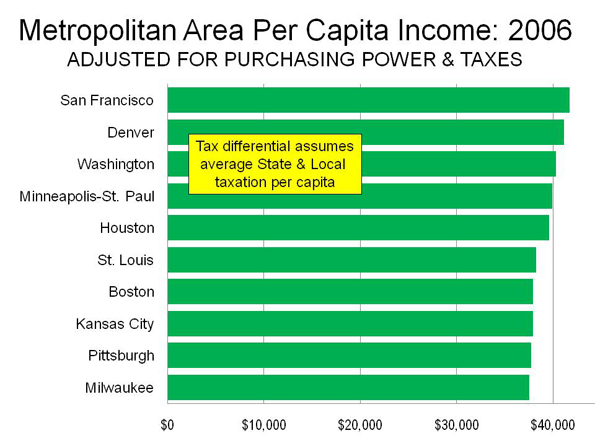
    A few weeks ago, Eamon Moynihan reviewed economic research on cost of living by state in a newgeography.com article. The results may seem surprising, given that some of the states with the highest median incomes rated far lower once prices were taken into consideration. The dynamic extends to the nation’s 51 metropolitan areas with more than 1,000,000 population (See Table).

    There is a general perception that the most affluent metropolitan areas are on the east coast and the west coast. Indeed, 8 of the 10 metropolitan areas with the highest nominal per capita income in 2006 were on the two coasts. These included San Francisco, San Jose and Seattle on the west coast and Washington, Boston, New York, Hartford and Philadelphia on the east coast. Middle-America is represented by Denver and Minneapolis-St. Paul. However, as anyone who has lived on the coasts and Middle America knows, a dollar in New York or San Francisco does not buy nearly as much as a dollar in Dallas-Fort Worth or Cincinnati.

    Per Capita Income: Purchasing Power Parity
    US Metropolitan Areas over 1,000,000 Population
        2006 Per Capita Income  
    Rank Metroplitan Area Purchasing Power Adjusted Nominal Nominal Rank
    1 San Francisco $46,287 $57,747 1
    2 Washington $45,178 $51,868 3
    3 Denver $44,798 $44,691 8
    4 Minneapolis-St. Paul $44,326 $44,237 9
    5 Houston $42,815 $43,174 11
    6 Boston $42,571 $50,542 4
    7 Pittsburgh $41,716 $38,550 20
    8 St. Louis $41,613 $37,652 27
    9 Milwaukee $41,572 $39,536 19
    10 Baltimore $41,451 $43,026 12
    11 Seattle $41,448 $45,369 6
    12 Kansas City $41,329 $37,566 28
    13 Hartford $41,104 $44,835 7
    14 New Orleans $40,935 $40,211 16
    15 Philadelphia $40,725 $43,364 10
    16 Dallas-Fort Worth $40,643 $39,924 17
    17 Cleveland $39,997 $37,406 30
    18 Indianapolis $39,843 $37,735 26
    19 Chicago $39,752 $41,591 14
    20 Richmond $39,282 $38,233 22
    21 New York $39,201 $49,789 5
    22 Birmingham $39,057 $37,331 31
    23 Cincinnati $38,691 $36,650 36
    24 Nashville $38,680 $37,758 25
    25 Detroit $38,670 $38,119 24
    26 Charlotte $38,632 $38,164 23
    27 Miami $38,555 $40,737 15
    28 San Jose $38,505 $55,020 2
    29 Jacksonville $38,413 $37,519 29
    30 Louisville $38,262 $36,000 41
    31 Oklahoma City $38,156 $35,637 42
    32 Las Vegas $37,691 $38,281 21
    33 Salt Lake City $37,381 $35,145 45
    34 San Diego $37,358 $42,801 13
    35 Rochester $37,066 $36,179 38
    36 Columbus $37,058 $36,110 39
    37 Atlanta $36,691 $36,060 40
    38 Memphis $36,501 $35,470 44
    39 Tampa-St. Petersburg $36,260 $35,541 43
    40 Portland $36,131 $36,845 35
    41 Buffalo $36,091 $33,803 48
    42 Norfolk (Virginia Beach metropolitan area) $35,418 $34,858 46
    43 Raleigh $35,087 $37,221 32
    44 San Antonio $34,913 $32,810 50
    45 Providence $34,690 $37,040 34
    46 Austin $33,832 $36,328 37
    47 Phoenix $33,809 $34,215 47
    48 Sacramento $32,750 $37,078 33
    49 Los Angeles $32,544 $39,880 18
    50 Orlando $32,095 $33,092 49
    51 Riverside-San Bernardino $25,840 $27,936 51
    Source:        
    http://www.bea.gov/scb/pdf/2008/11%20November/1108_spotlight_parities.pdf

    Purchasing Power Parity: Things change rather dramatically when purchasing power is factored in. Some years ago, international economic organizations, such as the Organization for Economic Cooperation and Development, the World Bank and the International Monetary Fund began using costs of living by nation to compare national economic performance, rather than currency exchange rate. This practice, called “purchasing power parity” is based upon the recognition that there may be substantial differences in the cost of living between nations.

    This can be illustrated by comparing Switzerland and the United States. For years, Switzerland has had a higher per capita GDP than the United States on an exchange rate basis. Switzerland’s gross domestic product per capita was $53,300 in 2006, nearly 30% above that of the United States ($42,000). However price levels in Switzerland are so high that incomes do not go nearly as far as the exchange rate would suggest. Once adjusted for purchasing power parity, the Swiss GDP per capita in 2006 drops to $39,000, well below that of the United States. Much of the difference has to do with regulation. The more liberal economy of the United States produces a lower cost economy than in Switzerland, or for that matter most of Western Europe. The US economic advantage would be even greater measured on a household basis, since US households include nearly 10% more members (generally children) than those in Western Europe.

    The same concept was applied by the Department of Commerce Bureau of Economic Analysis researchers in their review of purchasing power parities between US metropolitan areas in 2006. When purchasing power is factored in, five of the top metropolitan areas in nominal per capita income (not adjusted for purchasing power) drop out and are replaced by other metropolitan areas rarely thought of as among the nation’s most affluent.

    Among the three west coast nominal leaders, San Francisco remains as #1, in both nominal and purchasing power adjusted per capita income. Seattle dropped from 6th to 11th position. However, the real surprise is San Jose, which dropped from 2nd position to 28th.

    The east coast regions ranked among the top 10 metropolitan areas in nominal income also were decimated by their high costs, with only Washington (which rose from 3rd to 2nd) and Boston (which fell from 4th to 6th) remaining. New York fell from 5th to 21st, Hartford from 7th to 13th and Philadelphia from 10th to 16th.

    The two non-coastal metropolitan areas in the nominal top 10 remain, with Denver rising from to 3rd and Minneapolis-St. Paul rising from 9th to 4th.

    It can be argued that Middle-America replaced the five metropolitan areas dropping out of the top ten. Houston, long one of the most disparaged metropolitan areas among urbanists, occupies the 5th position (compared to its 11th ranking in the nominal list). Three of the new entrants are confirmed members of the Rust Belt: Pittsburgh (7th), St. Louis (8th) and Milwaukee (9th). Finally, there is a new east coast entrant, blue-collar Baltimore (10th).

    The Impact of Taxes: But that is just the beginning. Taxes also diminish the purchasing power of households. Unfortunately, there is virtually no readily available information on state and local taxation by metropolitan area. There is, however state and local government taxation data at the state level. If it is assumed that this data is representative of metropolitan differences (weighted proportionately by state in multi-state metropolitan areas), there would be changes in rank among the top 10. Denver would displace Washington in the number two position, closing more than one-half the gap with San Francisco. Even more surprisingly, St. Louis would move ahead of both Boston and Pittsburgh to rank 6th. Kansas City would leap over #11 Seattle, Baltimore, Milwaukee and Pittsburgh to rank 8th, trailing #7 Boston by $25, not much more than the price of a Red Sox standing room ticket. Pittsburgh would occupy the #9 position and Milwaukee #10 (See Figure).

    More than Housing: The largest differences in purchasing power stem from housing, with east coast and west coast metropolitan areas having generally higher housing costs. As a result of the housing bust and the larger house price drops in those areas, purchasing power adjusted incomes could recover relative to those of Middle America. However, the high cost of living on the east and west coasts extend to more than housing prices. Generally, according to proprietary (and for sale) ACCRA cost of living data, the west coast and east coast metropolitan areas have higher costs of living even without housing. These differences are largely in grocery costs, which probably reflects the anti-big box store planning regulations and politics that exist in many of these areas. Grocery costs in the more affluent middle-American metropolitan areas tend to be lower.

    Other Surprises: Outside the top 10 most affluent metropolitan areas, there are other surprises. Urban planning favorite Portland ranks 40th, just above Buffalo. Rust Belt Cleveland ranks 17th, a few positions above New York. Kansas City, with its highly decentralized civic architecture, ranks 12th, just behind Seattle. Indianapolis (17th) is more affluent than Chicago (18th) and both are more affluent than New York.

    Five of the bottom 10 metropolitan areas are in the south, including Virginia Beach, Raleigh, Austin, San Antonio and Orlando. But perhaps the biggest surprise of all is that four of the five lowest ranking metropolitan areas are in the southwest: Phoenix (47th), Sacramento (48th), Los Angeles (49th) and Riverside-San Bernardino (51st).

    The Dominance of Middle America: But among the 10 most affluent metropolitan areas in the nation, six or seven may be counted as Middle-America (depending on how Baltimore is classified). Only three are from the original group that supplies 8 of the top metropolitan areas when purchasing power is not considered.


    Related articles:
    Gross Domestic Product per Capita, PPP: World Metropolitan Regions
    Gross Domestic Product per Capita, PPP: China Metropolitan Regions

    Photograph: Pittsburgh

    Wendell Cox is a Visiting Professor, Conservatoire National des Arts et Metiers, Paris. He was born in Los Angeles and was appointed to three terms on the Los Angeles County Transportation Commission by Mayor Tom Bradley. He is the author of “War on the Dream: How Anti-Sprawl Policy Threatens the Quality of Life.

  • Pittsburgh Renaissance?

    In the third of a three part New Geography series on Pittsburgh for the G-20 summit, Aaron Renn assesses Pittsburgh’s value as a model region for other cities suffering decline.

    As the G-20 leaders prepare to convene in Pittsburgh, expect the recent chorus of praise for that city’s transformation to reach a crescendo. Pittsburgh, once the poster child for industrial decline and devastation, is now the media darling as an exemplar of how to turn it around. The New York Times talks about how “Pittsburgh Thrives After Casting Steel Aside” while the New York Post informs us that “Summer in Pittsburgh Rocks”. The Economist named Pittsburgh America’s most livable city. This emerging reputation for cracking the code on revitalization is prompting struggling burgs like Cleveland and Detroit to ask what lessons the Steel City holds for them.

    But does reality live up to the hype? Has Pittsburgh really turned the corner? For the most part, a look at the data suggests otherwise:

    1. Population Is Shrinking. The city of Pittsburgh has lost over 50% of its population since its peak and it is still declining. Just since the 2000 census Pittsburgh has lost nearly 25,000 people – over 7% of its population. The metro area is shrinking too, making Pittsburgh one of only a handful of large metro areas with the dubious distinction of population decline. Others on that list: Buffalo, Cleveland, Detroit, and New Orleans. Since 2000, metro Pittsburgh has actually lost a greater percentage of its population than metro Detroit.
    2. People Are Leaving. Part of Pittsburgh’s population loss is a result of a rare case of more deaths than births. But the region has net outmigration too. Few other stats are so telling about a city. Is this a place people are voting with their feet to move to or leave from? They may come to school or an internship at a local hospital, but, more often than not, they are not putting down roots. With more people moving out than moving in, Pittsburgh is clearly not a destination city
    3. International Immigrants Are Staying Away. Metro Pittsburgh’s foreign born population percentage was 2.6% in 2000 – very low. The Pittsburgh Technology Council summed it up best when it said, “Our region has negligibly grown its foreign born population.” Contrast Pittsburgh with the national average for foreign born population of 5.7%, and regions like Boston (11.2%), Denver (9.3%), and even Detroit (6.1%).
    4. Poverty Is High. Pittsburgh’s economic area poverty rate is worse than all cities benchmarked against it by Pittsburgh Today at 11.6% versus 9.3% in Milwaukee, 9.9% in Cincinnati, and 10.5% in Cleveland among 14 comparison cities.
    5. The City Is in Debt – Bigtime. Pittsburgh is buried under a mountain of liabilities. Its unfunded pension liability is over $1 billion. Its annual interest on its debt is $352 per capita, far higher than peer cities. Pittsburgh Quarterly is very direct: “Put simply, compared with all the benchmark regions, Pittsburghers have been saddled by their governments with relatively huge amounts of public debt.”

    Still, by other measures Pittsburgh is, if not thriving, certainly outperforming both the Rust Belt and the nation as a whole. Its July metro unemployment rate of 7.8% is well below the national average. In the last 12 months, Pittsburgh lost 2.8% of its jobs, which is a much better performance than regions like Chicago (-4.5%), Atlanta (-4.9%), and Portland (-5.8%). Its housing market, having never boomed to begin with, has not experienced the declines of most of the rest of the country, making it a Rust Belt outpost of the “zone of sanity”.

    Pittsburgh has a large “eds and meds” sector, led by the University of Pittsburgh, whose medical center employs over 25,000 people, and Carnegie-Mellon University. Pittsburgh was early to the game in this approach, with steel fortunes powering the development of these institutions starting in the 1950s. There are now seven universities within a five mile radius of downtown.

    Eds and meds employment is quasi-public sector. It can be a source of stability, but it’s not proved to be the source of dynamism that you see in Silicon Valley, around Boston or even Madison. Sure, there have been some high tech successes in Pittsburgh, but the city is far from a hub of the innovation economy.

    Pittsburgh’s downtown remains an employment center with a density uncommon in a Rust Belt full of cores defined more by parking lots than vital streetscapes. Pittsburgh has long had a rich fabric of dense, urban neighborhoods, and many of those are strengthening. The city’s geography retains its charm, and a lot of former industrial areas along the three rivers have been repurposed for recreational use.

    The truth is that the Pittsburgh story is still being written. It’s still more “green shoots” than a true renaissance so far. Until its migration statistics change course, and it demonstrates sustained and growing economic dynamism, the city cannot claim to have truly turned itself around. Still, the signs of progress are better than in places like Cleveland and Detroit.

    What accounts for this? A few success factors come to mind:

    1. Passion for the City. Older river cities like Cincinnati and New Orleans tend to have strong provincial cultures, with all the good and bad that implies. You see this in Pittsburgh in the unique local “yinzer” dialect, traditions like the cookie table at weddings, and of course the Steeler Nation. There’s a strong attachment to the native soil in Pittsburgh, even for those who left.
    2. Starting Early Into the Cycle. Jane Jacobs pegged Pittsburgh’s economic stagnation to 1910. The steel industry collapsed decades ago. Pittsburgh had troubles before other cities, so it is figuring out how to deal with them before other cities. It takes a long time to recover from a hundred years of status quo thinking.
    3. Shrinkage. There’s no longer a need for a Fort Pitt to project military power. The steel industry is gone and with it the need for thousands of steelworkers. Part of the issue in the Rust Belt is that there is no longer any economic raison d’etre for some of these big cities. Pittsburgh long was too big for its role in today’s economy, so shrinkage was good. This also created the rather unique institution of the Pittsburgh diaspora, best known through the Steeler Nation. Like the Indian and Chinese diasporas, it’s a network of people who went out, made connections in the world, built new skills, etc. that Pittsburgh can now tap into, as tirelessly documented by Jim Russell.
    4. The Totality of the Collapse. On Wall Street they call it “capitulation”, where the markets hit bottom and there is no positive sentiment. You have to hit that bottom to start back up. Pittsburgh went through a civic devastation when the steel industry collapsed the likes of which few American cities have seen. This shock to the system created the conditions necessary for change that a more gradual decline would not have.
    5. Dramatic Educational Improvements. The Chicago Fed reported that Pittsburgh’s national rank for percentage of adults who were high school grads went from 55th to 3rd. And for college grads it went from 69 to 37. These are amazing numbers.

    Is the Pittsburgh model transplantable elsewhere in the Rust Belt? In the short term, no. Pittsburgh’s successes of today are rooted in 30 years of steel industry collapse, shrinkage, and boosting its brain power. The auto industry restructuring eventually might bring a needed jolt to Detroit and other Rust Belt cities, but recovery is a long term game that requires sustained commitment over many years to things like education. Pittsburgh has achieved some of this, perhaps not as spectacularly as the media suggests, but in ways that are still useful for other Rust Belt cities to ponder.

    Aaron M. Renn is an independent writer on urban affairs based in the Midwest. His writings appear at The Urbanophile.

  • Hyping Pittsburgh: With the Global Economy in Dire Straits, Hell with the Lid Blown Off Never Looked Better

    As host of the G-20 summit, Pittsburgh briefly will sit in the global spotlight. In this second article of a three part series featuring Pittsburgh, rust belt observer Jim Russell digs into migration and education trends and what it may mean for the region.

    Chris Briem (the blogger behind Null Space) jokingly called it the “Mystic Order of the Yinzerati”. He would later take the idea about the influence of Pittsburgh expatriates more seriously. I’ve referenced talk about a conspiracy theory involving the diaspora and how the current US President seems to favor the Steel City. How else does one explain the location of the upcoming G-20 economic summit?

    Site Selection magazine is the latest conduit for Pittsburgh’s aggressive image makeover. By now, the narrative is polished. As an active consumer of all media about Pittsburgh, I find the story stale. The lines are well-rehearsed and remind me of an article I read last year in the New York Times or a decade ago in the Wall Street Journal. More often than not, I would discover that the writer of the glowing review has a Pittsburgh connection.*

    Recently, a journalist from Forbes interviewed me about the Pittsburgh renaissance. I mentioned the positive press the city has received and how the Burgh Diaspora seemed to be behind it all. At that point, she confessed that she was from Pittsburgh. The result? Pittsburgh is an archetype for the thriving 21st century city.

    I’m an avid Pittsburgh booster and I would bet that this round of rebranding will finally take root. However, that doesn’t mean I believe everything I read. Left out are all the challenges the region faces. Local bloggers fret about the city pension crisis getting swept under the rug, pointing out that the many myths used to promote Pittsburgh are disingenuous. Some natives have gone so far as to suggest that all the propaganda is nothing more than gilding a turd. After all, the population of Pittsburgh is still in decline. What about the brain drain?

    Ironically, the brain drain from Pittsburgh is the reason why I’m so bullish on this region’s future. Taking notice of the prolific Yinzerati, I began to see talent out-migration in a different light. Not every Rust Belt city could marshal the kind of sustained campaign that has benefited the New Pittsburgh. The more fantastic the fabrication, the more impressive the media blitz would seem. Surely expatriates from other shrinking cities could do the same. I’ll tell you why they haven’t.

    As brain drain is commonly understood, every region suffers from the same affliction. But the exodus from Pittsburgh was exceptional. Chris Briem charted the difference between unemployment rates in Pittsburgh and the national average from 1970 to present day. You might note that right now, never has the job market looked relatively better. What should really stand out is how bad the economy was in the early 1980s. It was a remarkable period of out-migration for young talent, robbing Pittsburgh of almost an entire generation.

    As I began to understand the connection between educational attainment and geographic mobility, I speculated that Pittsburgh’s brain drain was the result of a substantial investment in local human capital. The chronic decline in population is the result of successful workforce development policy. At least, that was my theory.

    Bill Testa, who works for the Federal Reserve Bank of Chicago, provided the evidence I was seeking. Compared with other Rust Belt cities and the nation over the period 1969-2006, Pittsburgh has anemic total employment growth. Strangely, Pittsburgh is a cohort outlier (in positive respects) if we consider gains in per capita income.

    Testa hints at the reason behind the surprising statistic:

    While Pittsburgh ranked low in college attainment in 1970, its gains in this metric since then have been the most rapid. Perhaps not accidentally, Pittsburgh’s growth in per capita income also outpaced other cities in the region.

    Pittsburgh did a great job of educating its populace. This policy would betray the region during the hard times of the early 1980s. Dynamic labor mobility found expression in the only avenue available, relocation. The Mysterious Order of the Yinzerati was born.

    Pittsburgh hasn’t been able to cash in on the diaspora dividend until the last decade. As I noted above, positive spin about Pittsburgh isn’t anything new. During the early 1990s, the work of urban planner Paul Farmer was nationally admired. Cities such as Minneapolis hoped to mimic Pittsburgh success. Former mayor Tom Murphy, not remembered fondly in Pittsburgh, enjoys a strong reputation as a wizard of downtown revitalization almost everywhere else. I imagine the Burgh Diaspora actively evangelizing their hometown’s dramatic transformation. But if anyone was listening, they didn’t move there on the advice of these expatriates.

    The demographics quietly improved. What little immigration there was tended to be highly educated. Furthermore, the numbers of college educated residing in Pittsburgh are becoming more concentrated. All the while the population continues to decline and that’s what makes the front page, which brings me back to positive publicity push leading up to the G-20.

    Pittsburgh is finally ready to take advantage of the spotlight. With the global economy in dire straits, hell with the lid blown off never looked better. The underlying numbers, such as unemployment, are relatively strong. Pittsburgh is a place of brain gain, not drain. When national growth returns, people will begin to move again. Pittsburgh will be one of the places they will consider.

    Thanks to the considerable influence of the Yinzerati, historic federal expenditures will rain down on the land of Three Rivers. Chris Briem can tell you how many Yinzers end up in Washington, DC. Or, ask the head coach of the Washington Redskins. The point is that even if you don’t know much about Pittsburgh, many people inside the beltway do. The G-20 is just the tip of the iceberg.

    *For the record, my Pittsburgh connection is through my wife who grew up in the North Hills.

    Read Jim Russell’s Rust Belt writings at Burgh Diaspora.

  • Pittsburgh Didn’t Volunteer for G20

    As host of the G-20 summit, Pittsburgh briefly will sit in the global spotlight. With this article by longtime Pittsburgh resident and columnist Bill Steigerwald, New Geography opens a three part series looking at this intriguing metropolis from the point of view of planning, demography and economic performance.

    Pittsburgh didn’t volunteer to host the G-20 Summit that is coming here next week to inflict so much civic pain and disruption.

    It was entirely President Obama’s call. He apparently thought it would be a good idea to have the finance ministers and central bankers of the world’s top 20 economies hold one of their city-disrupting conferences in downtown Pittsburgh on Sept. 24-25.

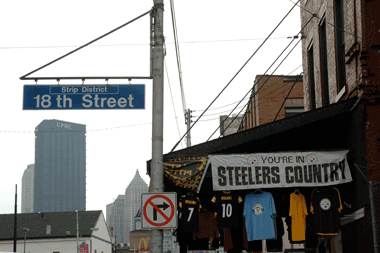
    Perhaps Mr. Obama, who will chair the G-20, thought he was doing the financially strapped city of Pittsburgh a favor by sending 4,000 foreign bureaucrats and media folk here to spend their Euros and Yen on Steelers T-shirts and game jerseys.
    Maybe he thought placing the G-20 meeting in Western Pennsylvania – a disproportionately Caucasian and socially conservative corner of America where his 2008 vote totals were disappointing – would pay him political dividends in the 2012 election.

    In either case, the president was sadly mistaken.
    Except for the local booster & tourism sector – who’d welcome a Category 8 hurricane to Pittsburgh as long as the international media covered it and said nice things about their no-longer smoky city – it’s safe to say everyone in this town who doesn’t work in the homeland security industry wishes they had never heard of the G-20.

    As months of local media stories have made plain, the conference is not only going to be a huge public annoyance, it’s going to be a lose-lose situation for everyone – especially the city government.

    Any economic benefits to the local GDP from the arrival of 4,000 visitors with fat expense accounts will be outweighed by the cost of protecting property from the tens of thousands of leftist protestors, angry anarchists and professional window-breakers who stalk G-20 meetings around the world.

    To maximize security and minimize destruction, the Secret Service and local authorities will fortify most of the Golden Triangle, the photogenic downtown business district squeezed between the Allegheny and Monongahela rivers as they meet to create the Ohio River.
    Barricades will be erected. Cars and mass transit will be diverted. Several major construction sites will be sealed off to deny protestors dangerous things to throw. Most downtown businesses probably will close. City schools and colleges will shut down.

    The predicted cost to local public coffers for hiring, feeding and equipping additional police and paying overtime will be at least $20 million, most of which will be reimbursed by the federal government.

    Whatever the final bill is, hosting the G-20 is an “honor” the city of Pittsburgh and its taxpayers didn’t need and can’t afford. The city is already bankrupt and in state receivership because of the generous pension deals it’s promised but won’t be able to pay for.

    The city of Pittsburgh looks fabulous and robust when its skyline and riverbanks are shown on TV during Steelers home games. But it’s really the capital city of an economically stagnant, over-taxed, over-regulated, steadily depopulating metropolitan region that has been horribly governed for 60 years.

    The private-public power-brokers who’ve run the city have wasted billions on a never-ending series of destructive urban renewal projects, redevelopment boondoggles and wasteful mass-transit projects.

    Almost nothing has been built in downtown Pittsburgh or on its riverbanks in the last 20 years without being handed millions in public subsidies – whether it was PNC Financial Service’s almost completed downtown skyscraper, a gorgeous Lazarus department store that went bust in the ‘90s or the shiny new homes for the Pirates, Steelers and (soon) the Penguins.

    If curious G-20 attendees have time to stroll around the city’s abandoned downtown streets on Thursday and Friday, they will have no trouble finding evidence of City Hall’s current crop of fiascoes-in-the making.

    Right in front of fancy Fifth Avenue Place, for example, is a deep trench where busy Stanwix Street should be.
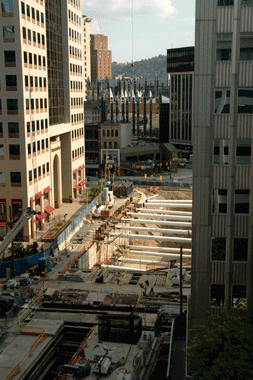
    It’s not where a Scud missile hit during the first Gulf war. It’s the construction zone of one end of the local mass transit system’s infamous “Tunnel to Nowhere.”

    The 1.2-mile light-rail extension goes from Gateway Center downtown under the Allegheny River to the North Shore, where its other end has been tearing asunder the wasteland of former parking lots between the subsidized new homes of the Steelers and Pirates for several years.

    The twin light-rail tunnel – cleverly built under a river in the “City of Bridges” so as to maximize the cost and provide unions and construction companies with six or seven years of high-paid make-work – will allegedly carry 4.2 million riders a year in the distant transit future.

    That impressive but fraudulent projection comes out to about 11,000 “riders” a day – which actually represents only 5,500 human commuters making a (two-ride) round trip commute. A large proportion of those annual riders, by the way, will be baseball or football fans.

    All that socially correct “mass transit” will end up costing at least $650 million, with federal and state taxpayers picking up about 97 percent of the tab. Except for yours truly and the conservatives on the Pittsburgh Tribune-Review’s editorial page, virtually no one in local politics or the media questioned or challenged the lunacy of building the transit tunnel.
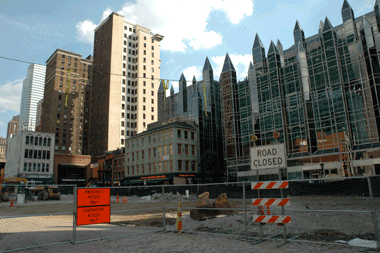
    Another wasteland in the middle of downtown that G-20-goers might visit is the flattened construction site that used to be Market Square.

    Once upon a time, before City Hall planners began demolishing and rebuilding huge chunks of downtown in the 1950s; it was what urbanists are supposed to encourage: an actual square with markets.

    Then, in the 1960s, the city took it over and transformed it into a poorly designed, commerce-free urban park with trees, grass and heavy city bus traffic. The public space delighted crowds of lunching office workers at midday but the rest of the time it was a lawless playpen for about 100 homeless people, drunks and drug pushers.
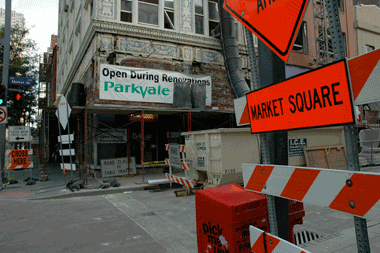
    Today the area around Market Square, last refurbished in the 1990s, hardly has a live store or restaurant left standing. It is waiting to be turned into its next reincarnation – a $5 million European-style piazza with no vehicles piercing its heart and no low walls and green spaces for social misfits to reside.

    On one edge of battered Market Square is Fifth Avenue, which has been tortured constantly by City Hall for about 25 years.

    In the early 1980s, its street surface was torn up for several years so the city’s rinky-dink light-rail subway could be built beneath it. Not long after that, Fifth Avenue was rendered virtually impassable to shoppers for a couple years while the city slowly redid its sidewalks and curbs.

    Then, in the late 1990s, Fifth was targeted by City Hall for a preposterously stupid and destructive redevelopment scheme.

    The crude 1960s-style renewal project would have misused eminent domain power to clear-cut Fifth Avenue and Forbes Avenue, wipe out nearly 100 businesses and build what amounted to an outdoor suburban mall anchored by a Nordstrom store.

    Fortunately, that plan was miraculously stopped by an alliance of preservationists and property rights defenders. But is it any wonder that after a quarter century of torture by city planners Fifth Avenue became “dilapidated” and in need of serious redevelopment?

    As G-20 attendees will learn if they bother to walk a few moments from their hotels, the nightmare on Fifth Avenue continues. Its northern end is currently being torn down, fixed up, blocked to pedestrians or under construction.

    PNC Financial is putting the final touches on its new 23-story, $178 million headquarters – which received $48 million in state and local subsidies and wiped out half a block of retail storefronts. Meanwhile, up the street, the lovely stone tomb the city erected in the late 1990s for Lazarus has been all but given away to a local developer who’s converted it into a pricy condo and office space that still has 32 of its 65 units to sell.

    Whenever the national media rediscover the glories of Pittsburgh’s clear skies and affordable livability, which they seem to do every four years, they never stick around long enough to note the failings of its governments and politicians.

    Taxes on property and people and businesses are too high. The city schools are absurdly expensive and ineffective. The roads and 1950s parkways are old, narrow and crumbling. Public services are often poor or costly. Unions and Democrats wield the sort of uncontested political power that’s never good for a municipality.

    Yes, it is still true, as the national media and local booster sector never tire of repeating, that the “City of Champions” and its suburbs are a great place in which to live, raise a family, grow old and die peacefully.

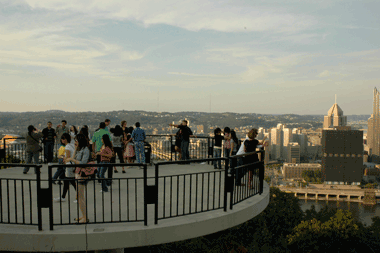
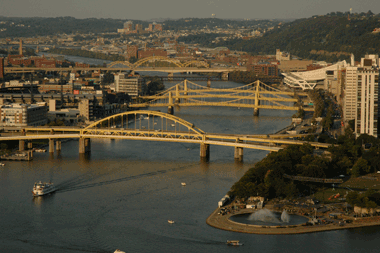
    With its famous three rivers and hills and bridges and skyscrapers and hillside homes and urban neighborhoods and spectacular views and historic downtown buildings, Pittsburgh is rich in natural and man-made charm.

    Toss in a cost of living 17 percent below the national average and low crime rates, lots of good affordable housing, major-league super-teams like the Steelers and Penguins, great museums like the Carnegie and top universities like Carnegie Mellon and Pitt – Pittsburgh does deserve to be ranked highly on those meaningless most-livable city lists.

    It’s also true – as some in the national media latched on to earlier this year – that compared with many other parts of the country, Pittsburgh has not suffered greatly in the current recession.

    Pittsburgh has an unemployment figure lower than the national average, a very low home-foreclosure rate and stable-to-slightly-rising housing prices.

    But Pittsburgh’s good fortune was not, as out-of-town media claimed, because its wise leaders had figured out how to dodge a severe economic downturn. Or because – as President Obama has been led to believe – the region’s post-industrial “eds and meds” service economy is particularly healthy or even resilient.

    Pittsburgh’s relatively impressive economic statistics are pretty much the 30-year norm for Pittsburgh – in times of national booms or busts. They probably won’t change for the better unless the spectacularly rich Marcellus shale natural gas deposits lying underneath western Pennsylvania are exploited, which may not happen for decades or ever happen at all.

    There’s one thing about Pittsburgh’s future that is a near certainty: It’s going to have fewer residents next year than it has today.

    Since the mid-1990s, Pittsburgh has had more deaths than births each year. Between 2000 and 2006, in fact, it had 21,045 more deaths than births, earning it the distinction of being the largest metropolitan area where deaths outnumber births.

    That negative ratio wouldn’t be so bad if immigrants from anywhere else were flocking to Pittsburgh. But they aren’t. Metro Pittsburgh has the lowest percentage of foreign-born residents of any major city – 3 percent – compared to 12.5 percent nationally.
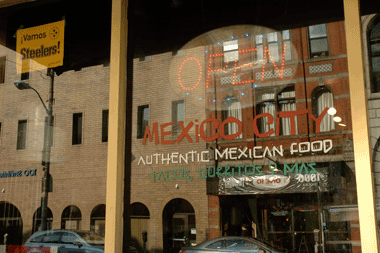
    Pittsburgh has only about 7,000 immigrants from Latin America – second to the 7,800 who hail from India. Only 16,000 international immigrants arrived in metro Pittsburgh between 2000 and 2006, dead last among the 25 largest cities.

    Post-industrial decline, out-migration, too many older people, more deaths than births, too few immigrants from Mexico and Georgia – they’ve all contributed to Pittsburgh’s incredible six-decade population decline.

    In 1950, Pittsburgh was the country’s 12th biggest city. It had 676,806 citizens in a metropolitan area of about 2.5 million.

    Today the metro population, ranked 22nd, is down to 2.35 million and Pittsburgh’s surviving population of 310,000 live in the country’s 59th biggest city – right behind Aurora, Colo., a growing municipality that will never have to worry about getting stuck with hosting a G-20 summit.

    Photos by Bill Steigerwald.

    Bill Steigerwald, a free-lance libertarian writer who recently retired from daily newspaper journalism, loves his native Pittsburgh but hates the political and corporate power brokers who’ve been damaging the city for 60 years. His columns are archived at the Pittsburgh Tribune-Review and his 2000 article for Reason magazine on the city’s abuse of eminent domain powers is here.

  • Why The ‘Livable Cities’ Rankings Are Wrong

    Few topics stir more controversy between urbanists and civic boosters than city rankings. What truly makes a city “great,” or even “livable”? The answers, and how these surveys determine them, are often subjective, narrow or even misguided. What makes a “great” city on one list can serve as a detriment on another.

    Recent rankings of the “best” cities around the world by the Economist Intelligence Unit, Monocle magazine and the Mercer quality of life surveys settled on a remarkably similar list. For the most part, the top ranks are dominated by well-manicured older European cities such as Zurich, Geneva, Vienna, Copenhagen, Helsinki and Munich, as well as New World metropolises like Vancouver and Toronto; Auckland, New Zealand; and Perth and Melbourne in Australia.

    Only Monocle put a truly cosmopolitan world city – Tokyo – near the top of its list. The Economist rankings largely snubbed American cities – only Pittsburgh made it anywhere near the top, at No. 29 out of 140. The best we can say is most American cities did better than Harare, Zimbabwe, which ran at the bottom. Honolulu got a decent No. 11 on the Monocle list and broke into the top 30 on Mercer’s, as did No. 29 San Francisco. But regarding American urban boosters, that’s all, folks.

    To understand these rather head-scratching results, one must look at the criteria these surveys used. Cultural institutions, public safety, mass transit, “green” policies and other measures of what is called “livability” were weighted heavily, so results skewed heavily toward compact cities in fairly prosperous regions. Most of these regions suffer only a limited underclass and support a relatively small population of children. In fact, most of the cities are in countries with low birthrates – Switzerland’s median fertility rate, for example, is about 1.4, one of the lowest on the planet and a full 50% below that of the U.S.

    These places make ideal locales for groups like traveling corporate executives, academics and researchers targeted by such surveys. With their often lovely facades, ample parks and good infrastructure, they constitute, for the most part, a list of what Wharton’s Joe Gyourko calls “productive resorts,” a sort of business-oriented version of an Aspen or Vail in Colorado or Palm Beach, Fla. Honolulu is an exception, more a vacation destination than a bustling business hub.

    Yet are those the best standards for judging a city? It seems to me what makes for great cities in history are not measurements of safety, sanitation or homogeneity but economic growth, cultural diversity and social dynamism. A great city, as Rene Descartes wrote of 17th century Amsterdam, should be “an inventory of the possible,” a place of imagination that attracts ambitious migrants, families and entrepreneurs.

    Such places are aspirational – they draw people not for a restful visit or elegant repast but to achieve some sort of upward mobility. By nature these places are chaotic and often difficult to navigate. Ambitious people tend to be pushy and competitive. Just think about the great cities of history – ancient Rome, Islamic Baghdad, 19th century London, 20th century New York – or contemporary Los Angeles, Houston, Shanghai and Mumbai.

    These represent a far different urbanism than what one finds in well-organized and groomed Zurich, Vienna and Copenhagen. You would not call these cities and their ilk with metropolitan populations generally less than 2 million, “bustling.” Perhaps a more fitting words would be “staid” and “controlled.”

    Peace and quiet is very nice, but it doesn’t really encourage global culture or commerce. Growth and change come about when newcomers jostle with locals not just as tourists, or orbiting executives, but as migrants. Great cities in their peaks are all about this kind of yeasty confrontation.

    Alas, comfort takes precedence over dynamism in these new cities. Take the immigration issue: Unlike Amsterdam in its heyday or London or New York today, most northern European countries have turned hostile to immigration and many have powerful nativist parties. These are directed not against elite corporate executives or academics, but newcomers from developing countries. In some cases, resentment is stoked by immigrants taking advantage of well-developed welfare systems that worked far better in a homogeneous country with shared attitudes of social rights and obligations.

    Of course, these cities aren’t total deadweights. After all, Switzerland has its banks, Helsinki boasts Nokia and Denmark remains a key center of advanced and green manufacturing technology. For its part, Vancouver gets Americans to shoot cheap movie and TV shows with massive tax breaks and will host the Winter Olympics. But none can be considered major shapers of the modern world economy.

    The one American city favored by The Economist, Pittsburgh, represents a pale – and less attractive – version of these top-ranked European, Canadian or Australian cities. Its formerly impressive array of headquarters has shrunk to a handful. Once the capital of steel, it now pretty much depends on nonprofits, hospitals and universities.

    You will be hearing a lot more about Pittsburgh – the city has a prodigious PR machine funded largely by nonprofit foundations and universities – as it gets ready to host the G-20 meeting next month. Fans claim that the former steel town has developed a stable – if hardly dynamic – economy. Its torpidity is being sold a strength; boom-resistant in the best of times, it’s also proved relatively recession-proof as well.

    In this sense, Pittsburgh represents the American model of the slow-growth European city. This may appeal to those doing quality-of-life rankings, but not to those who have been fleeing the Steel City for other places for generations. Immigrants are hardly coming in droves either – Pittsburgh ranks near last among major metropolitan areas in percentage of foreign-born residents. As longtime local columnist and resident Bill Steigerwald notes, since 1990 more Pittsburghers have been dying than being born. If this represents America’s urban future, perhaps it’s one that takes its inspiration from Alan Weisman’s “A world without us.”

    Yet the future of urbanism, here and abroad, will not be Pittsburgh. Based on current preferences, something like 20 million – or more – people will have moved to U.S. cities by 2050. Most will likely settle in more dynamic places like New York, Los Angeles, Houston, Phoenix, Dallas, Chicago and Miami. These cities have become magnets for restless populations, both domestic and foreign-born. They also contain all the clutter, constant change, discomfort and even grime that characterize great cities through history.

    But it’s economics that drives migrants to these dirtier, busier metropolitan centers. Many of the cities at the top of the livability lists, by contrast, are also among the world’s most expensive. They generally also have high taxes and relatively stagnant job markets.

    Many U.S. cities, however, offer far more materially to their average residents than their elite European counterparts do. American cities, when assessed by purchasing-power parity, notes demographer Wendell Cox, do very well indeed. Viewed this way, the U.S. boasts eight of the top 10 – and 37 of the top 50 – metropolitan regions in terms of per capita income.

    The top city on Cox’s list, San Jose, Calif., epitomizes both the strengths and weaknesses of the American city. The heartland of Silicon Valley, the San Jose region has generated one of the world’s most innovative – and well-paid – economies. On the other hand, its mass transit usage is minuscule, its cultural attributes measly and its downtown hardly a tourist destination.

    Meanwhile, pricey and scenic Zurich, No. 2 on the Mercer list and No. 10 on The Economist rankings, comes in 74th when considering adjusted per capita income. Economist favorite Vancouver, one of the most expensive second-tier cities on the planet, ranks 71st. For the average person seeking to make money and improve his or her economic status, it usually pays not to settle in one of the world’s “most livable” cities.

    This is not to say that rambunctious urban centers like Los Angeles, New York or London couldn’t learn from their more “livable” counterparts. Anyone who has braved the maddening crowds in Venice Beach, Times Square or London’s Piccadily knows a city can have too much of a good thing. Los Angeles could use a more efficient bus system. Better-maintained subways and commuter trains in New York would be welcome by millions as they would in Greater London.

    Ultimately great cities remain, almost by necessity, raw (and at times unpleasant) places. They are filled with the sights and smells of diverse cultures, elbowing streetwise entrepreneurs and the inevitable mafiosi. They all suffer the social tensions that come with rapid change and massive migration. New York, Los Angeles, London, Shanghai, Mumbai or Dubai may not shoot to the top of more elite, refined rankings, but they contain the most likely blueprint of our urban future.

    This article originally appeared at Forbes.

    Joel Kotkin is executive editor of NewGeography.com and is a presidential fellow in urban futures at Chapman University. He is author of The City: A Global History. His next book, The Next Hundred Million: America in 2050, will be published by Penguin early next year.

  • The Republican Party, Pennsylvania and Arlen Specter

    Senator Arlen Specter switched parties. A five term Senator switching parties is certainly news, but it also represents a far greater statement about the challenges facing the Republican Party in Pennsylvania going forward.

    Pennsylvania has been a dependable “Blue State” in presidential races since 1988. Currently, Democrats have a 1.2 million voter registration advantage. Less than a decade ago the margin was less than 500,000. What changed over the past decade?

    The changes in the political and demographic make-up of the five county Philadelphia region forced Specter’s flip. Specter’s base had been eroding as a result of other popular Democratic politicians seeking statewide and national offices and needing moderate Republicans to switch parties to support them in tough Primary Elections.

    It began with now Governor Ed Rendell who faced a fierce Primary Election in 2002 against Bob Casey, Jr. – the son of a former Pennsylvania Governor. The former Philadelphia Mayor needed a strong turnout in the Philadelphia area and he managed to flip more than one hundred thousand Republicans for the primary.

    Rendell defeated Casey by 162,648 votes statewide, but his victory total was 305,641 in the five county Philadelphia area where he won 81.3% of the vote and 56.5% of his total vote statewide.

    The 2002 primary proved the central role of the Philadelphia region, especially the suburbs. Rendell was able to win even while losing the total vote in the other 62 counties of Pennsylvania. The shift in moderate Republicans in the suburbs to Rendell was the critical factor.

    This was again the case in the general election; Rendell would carry this region by 515,000 votes on his way to winning his first term as Governor by 323,827.

    The 2002 election marked a turning point in Pennsylvania politics. From that point forward no candidate for statewide office could win without carrying at least one of the four suburban Philadelphia counties. All were becoming increasingly Democratic in voter registration.

    In the 2004 Primary, Arlen Specter faced conservative ex-Congressman Pat Toomey. Specter likely underestimated the impact of the change is southeast voting patterns. He was overconfident that his moderate Republican suburban base would carry the day. They did, but more narrowly than most suspected. Specter won the election by 17,146 votes statewide but he carried the southeast by 41,719 votes.

    Like Rendell in 2002, Specter lost the rest of the state but won in the five county region by enough of a margin to secure victory statewide. Unlike Rendell, his total in the southeast region only accounted for 31.4% of his statewide total votes as compared to Rendell’s 56.5%.

    Also, significant was the fact that he only defeated Toomey, who is far more conservative than former Senator Rick Santorum, by 34,669 votes in the four suburban counties. The moderate base was shifting to the Democrats, leaving the remnants of the GOP more conservative. This was a harbinger of Specter’s diminishing prospects as a Republican.

    Specter won the primary with 166,944 votes from the southeast region. Two years earlier in the primary, Mike Fisher, the Republican candidate from Pittsburgh who was running for Governor without opposition, won 161,103 Republican votes in this region. Fisher outpolled Specter’s 2004 vote in 2 of the 5 counties. It was only the last minute support Specter received from President George W. Bush and Senator Rick Santorum that saved Specter from defeat in 2004.

    In the General Election, Specter walloped his Democratic opponent Joe Hoeffel, a former southeast Congressman and Montgomery County Commissioner, by nearly 600,000. He would carry all five counties in the southeast by wide margins mainly because he had significant support from Democrats and Independents.

    The trend of greater Democratic power – and Specter’s dependence on them – continued to build. In 2006, Bob Casey defeated incumbent Senator Rick Santorum by 17.4 percentage points statewide despite the fact that Santorum would spend $31 million and was the number three in Republican Senate Leadership. Casey would carry all five counties in the southeast region proving that conservative Republicans could no longer win in this critical area in a contested General Election. By 2008, Barack Obama put the icing on the cake. The President racked up huge margins in the southeast repeating what Rendell had done in 2002. The change was now complete.

    It is safe to say that Arlen Specter simply could not win a Republican Primary Election in 2010. This said it is also safe to say that he would have likely won the General Election with relative ease regardless of who was the Democratic candidate. This is the dilemma that faced a Republican Party increasingly alienated from Specter, but facing increasingly stiff odds in its former suburban Philadelphia strongholds.

    The question now is will the Republican Party stand with conservative Pat Toomey to challenge Democrat Arlen Specter in the General Election? With promised support from President Obama, Vice President Biden and Governor Rendell the likelihood of a primary challenge for Specter is remote in his new party.

    Revenge is rarely as sweet as anticipated. It seems unlikely that a conservative Republican can win statewide without support in the Philadelphia suburbs. But data and history show that this is highly unlikely for a conservative Republican. There’s a cost to party purification. Unless the Republicans can find a way to appeal to the wayward suburban voters, it will take a major shift in the political dynamic – perhaps a more decided Democratic move to the left – to put Pennsylvania back in play.

    Dennis M. Powell is president and CEO of Massey Powell an issues management consulting company located in Plymouth Meeting, PA.

    Photo: KyleCassidy

  • Rust Belt Outliers

    What kind of migration patterns will emerge as a result of the current economic downturn? The recession is uneven; some places are much worse off than others. Those differences can give labor cause to move. Economic geographer Edward Glaeser thinks cities with marginal manufacturing legacies should attract a lot of people because the well-educated, living in dense urban environments, should get through the crisis relatively unscathed. If Glaeser is correct, then shrinking Rust Belt cities can expect more of the same even after the recovery begins in earnest. Pittsburgh brains should continue to drain.

    Ironically, the latest US Census data indicate that the population decline in the Rust Belt is slowing as a result of less out-migration. A contracting economy has, according to demographer William Frey, helped to stop the bleeding from cities such as “Buffalo, N.Y., Pittsburgh and Cleveland.” One of the cited factors for decreasing geographic mobility is the collapse of the real estate market. Job seekers are stuck in their current place of residence.

    Another pressure to stay put is the economic climate of typical Sun Belt destinations such as Charlotte, NC or Phoenix. Unemployment there might be much worse than what you are seeing in your current location. There is no reason to move because the situation is bad everywhere. The “pull” factors have all but disappeared.

    Of course, evaporating home equity and massive layoffs throughout the country are not mutually exclusive. These two forces could be working in concert to stem the tide from struggling Rust Belt cities and the explanation of the waning migration is quite reasonable. But I’m not so sure it makes sense in the case of Pittsburgh.

    During the mortgage meltdown, the Pittsburgh real estate market has remained remarkably resilient. While foreclosures have decimated Cleveland, Pittsburgh’s prudent financial industry stayed away from bad loans. Pittsburgh is now rated as one of the most stable real estate markets in the entire country. Home ownership isn’t holding back the out-migration of Pittsburghers.

    As for unemployment, the job market is much better in the Pittsburgh region than it is in Charlotte, NC. That’s why solvent financial institutions in Southwestern Pennsylvania are advertising employment opportunities in Pittsburgh South (a.k.a. Charlotte). For those with the ability to relocate, Pittsburgh has a much better job market than Charlotte.

    But if we are talking about Pittsburgh out-migration, we should mention Washington, DC, the #1 destination for those seeking better opportunities than they can find near home. Charlotte is pretty far down that list. Sun Belt economic distress is causing Pittsburghers not to migrate as much to the sunbelt, thus pinpointing the reason for the dramatically falling (from the 2005 peak) net out-migration. In contrast, DC is still a viable job market, with numbers trending towards population gains.

    Are more people moving to Pittsburgh? Few seem to consider the possibility. Perhaps William Frey has access to out-migration data that aren’t public, which is why he lumped Pittsburgh in with Cleveland and Buffalo. But less out-migration doesn’t mean that there isn’t more in-migration. Pittsburgh attracting more talent from other regions would be news.

    Despite the manufacturing legacy that Glaeser details, there are Rust Belt cities that have bucked the population trends. Chattanooga, historically an industrial river city much like Pittsburgh, has begun to grow again after decades of shrinking. Pittsburgh isn’t necessarily doomed to being a shadow of its former self and may well separate even more than it already has from the Rust Belt pack.

    Staying with Glaeser’s observations, the economic geography of Pittsburgh might help us understand why migration fueled growth is possible. Manufacturing cities tend to lack a critical mass of highly educated talent and economic activity is less concentrated. Among Midwestern cities, Pittsburgh’s gains in college attainment since 1970 “have been the most rapid.” Pittsburgh’s human capital assets are much improved. And despite the obvious sprawl, Pittsburgh also enjoys considerable economic density. Its college corridor is just five-miles long, connecting downtown with the University of Pittsburgh and Carnegie Mellon University. Internationally renowned research universities are located in close proximity to the central business district.

    Might the above assets translate into greater in-migration? Perhaps, but the odds are against it. However, something unusual is going on in Pittsburgh. Whether or not that will inform job growth and economic development remains to be seen.

    Read Jim Russell’s Rust Belt writings at Burgh Diaspora.

  • Even the Super Bowl Can’t Defend Pittsburgh From a Recession

    Somebody call the New York Times. The national economic meltdown has finally come to Pittsburgh, a city-region where you’ll want to be on the day the world ends because you’ll still have several years to live.

    Sunday’s Super Bowl game between the mighty Steelers and the upstart Arizona Cardinals – teams representing regions going in exactly opposite socioeconomic directions since 1950 – has eclipsed all non-sports news coming from Pittsburgh.

    Pro football, which Pittsburgh continues to excel at despite 60 years of economic decline, brutal population loss and criminally inept public sector mismanagement, is a seasonal religion every fall no matter how well the Steelers do. But when the Steelers make it to the Super Bowl, as they did this year for an NFL record seventh time, the region and its 2.3 million people are paralyzed by a religious fervor that can be culturally embarrassing.

    “Go Stillers” signs appear everywhere. Secretaries, retail clerks and TV news anchors wear black-and-gold Steelers garb on game Fridays and during the playoffs. If Ben Roethlisberger game jerseys had collars, an embarrassing number of professional men would wear them under their suits. The Pittsburgh public schools have instituted a two-hour delay Monday morning in an effort to thwart what should be a severe epidemic of the usual morning-after-Steeler-Sunday-night game flu among teachers. Eat n’ Park, a venerable and highly profitable family restaurant chain that ordinarily wouldn’t close if a meteor struck downtown Pittsburgh, has won enormous goodwill because it’s decided to close at 3 p.m. on Sunday so its several thousand employees can not only watch the Super Bowl but have several hours to prepare the sacred sandwiches and dips and dress up for it. If the Steelers lose, the whole town will be on a suicide watch till March.

    Even the Steelers’ success on and off the field could not defend Pittsburgh from the recession forever, however. For the last two months national publications that should have known better (like the Times) came to Pittsburgh, looked around at its service sector-university-government economy, and declared that it was some sort of model for other city-regions because it was apparently recession proof.

    Of course, reality turned out to be not so kind. Pittsburgh’s unemployment rate and stable housing prices were relatively better than the national figures only because its deindustrialized economy was already so stagnant that it never experienced fast job growth or a recent real estate boom and therefore couldn’t go bust.

    The latest regional numbers, as reported by PittsburghToday.org, a useful web site devoted to documenting the economic reality of the Pittsburgh region as well as boosting it, showed job losses accelerating in December for the second straight month.

    Compared to December of 2007, Pittsburgh had 7,500 fewer jobs in December 2008. November’s revised numbers, according to PittsburghToday’s Harold Miller, showed a net loss of 1,600. These numbers, while negative, are minuscule in a region with over 1.1 million jobs. In December jobs were up slightly year-over-year in health care, higher education, professional and business services, mining and construction, Miller reported, but about 10,000 lost jobs in leisure and hospitality, retail and manufacturing offset those gains.

    Miller, per usual for a professional civic booster, looked for and found a few relative silver linings in Pittsburgh’s permanently gray clouds: The job loss – 0.6 percent in December – was small compared to Detroit, which has lost 5 percent of its jobs in the last year. And compared to Cleveland – Pittsburgh’s rival in all things, including pro football, population loss and the rate of post-industrial economic decline – the former Steel City did better.

    The capital of Steeler Nation lost only 1 manufacturing job in 2008 for every 5 lost by the Cleveland, a city whose hapless Browns finished 4-12. But even if the Steelers – who are narrow favorites – whip the Cardinals Sunday and win their sixth Super Bowl in seven tries, it won’t do much to protect Pittsburgh from eventually being hurt harder by the national recession/depression.