Tag: population

  • The Great Dakota Boom

    The Census Bureau released their yearly population estimates today. As noted by Wendell Cox, the estimates showed signs of the South’s continued leadership in population expansion. While the overall numbers of people involved are much smaller, the Dakotas, in particular North Dakota, also showed signs of growth worthy of note. According to the Census Bureau, North Dakota now has an estimated population of around 683,000, up over 11,000 in just one year. This made it the 6th fastest growing state in the nation over the past year- a notable achievement in its own right for a state more accustomed to dealing the challenge of outmigration.

    However, the most interesting thing about the new estimate is that it represents a new record population for the state. There have never been more North Dakotans then there are today. The previous high count was about 680,000 way back in 1930. With the onset of the depression, the state entered a long period largely marked by periods of population decline and stagnation.

    As a lifelong North Dakotan, I’ve occasionally found myself having difficulty coming to grips with our state’s recent prosperity. North Dakotans can be a self effacing lot, and it sometimes seems that there’s a still a healthy dose of skepticism among my fellow citizens regarding our current good fortune. We’re not used to being on top like this, seeing our often ignored home highlighted in the press for its economic strength and tagged as “the state the recession forgot.” For decades, we’ve been trying to find ways to deal with what seemed an inexorable cycle of rural decline and depopulation. While the new estimate is just a number, it does serve to break a bit of a psychological barrier for the state. We’re not just making up lost ground anymore- we’re now in uncharted territory and building beyond previous limits. It’s a refreshing change.

    Historians refer to the 1880s and period from 1900-1915 as the “Great Dakota Booms”. Growth was unchecked in what became North and South Dakota, and the population soared as immigrants poured into the region in search of economic opportunity. While oil has taken the lead role in place of land in this performance, it appears that our corner of the nation is in another “Great Dakota Boom” for many of the same reasons. Hopefully it will prove lasting. I, and my fellow North Dakotans will just have to learn to deal with prosperity. Call it “How North Dakota (and Matthew) Learned to Stop Worrying and Love the Boom”.

    All in all, it’s a good time to be a Nodak.
  • Population Growth in Australia Has Normalized

    Yesterday’s Daily Telegraph contained an interesting article on the increasing number of Australians departing Australia permanently:

    OVERALL migration from Australia has soared to a record high – with 88,000 leaving in the past year, almost half from NSW.

    The stampede abroad is a 90 per cent increase 10 years ago, figures from the Department of Immigration show.

    Half the emigrants are Australian-born who have chosen to start new lives in Britain (15,119), New Zealand, (14,596), the US (8046 and Singapore (6952)…

    At the same time, the number of people emigrating to Australia has dropped, by 9 per cent to 127,458 in the past year, making the ratio of departures to arrivals a record high…

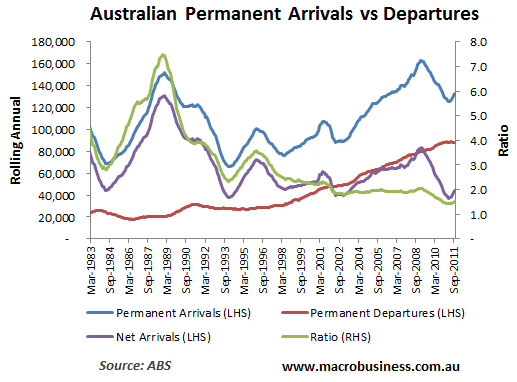
    Upon reading this article, I decided to crunch the numbers to determine how Australia’s migration numbers are tracking. The below chart shows the permanent arrivals vs permanent departures numbers alluded to in the above article. The ratio of arrivals to departures is also shown:


    As you can see, the number of net permanent arrivals into Australia – around 45,000 for the 12 months to September 2011 – is well below the long-run average (around 65,000). The ratio of arrivals to departures is also in long-term decline and currently sits at a 35-year low of 1.5 times.

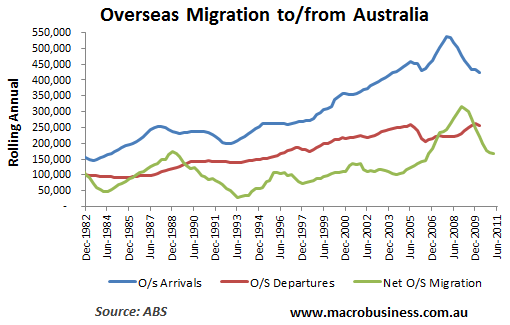
    However, the broader net overseas migration (NOM) statistics published by the Australian Bureau of Statistics, which measures in/out migration of anyone residing/leaving Australia for a period of 12 months or more (rather than permanently), paints a different picture.

    According to these statistics, NOM is still above long-term trends, but has declined sharply from the peak level seen in the year to September 2008, from around 315,000 to 170,000:


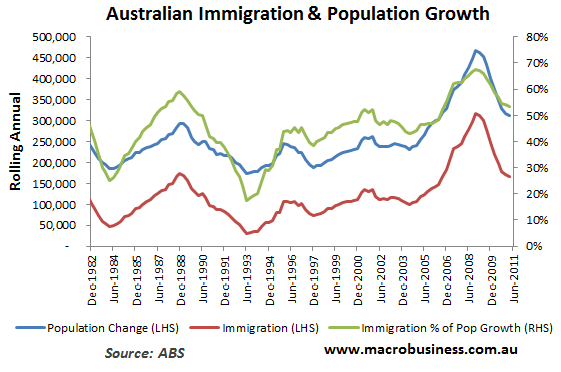
    With the decline in NOM, Australia’s population growth has also fallen significantly, from a peak of just under 470,000 in the year to September 2008 to just under 320,000. The share of population growth coming from immigration has also fallen over the same period from a peak of 67% to 54%.


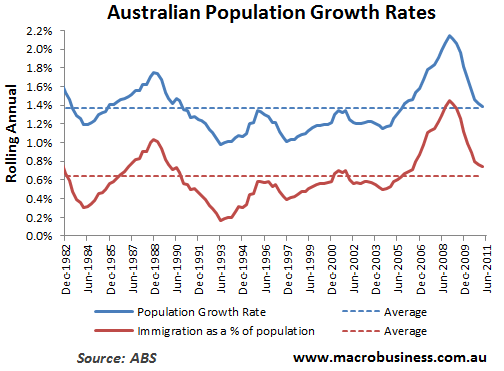
    Finally, in percentage terms, it appears that Australia’s population growth and immigration are returning to average levels after surging in the 3 years to 2008:


    With the ABS scheduled to release the June quarter NOM data in mid-December, it will be interesting to see whether Australia’s NOM mirrors the permanent arrivals/departures figures and registers another fall.

    This piece originally appeared at Macrobusiness.

    Leith van Onselen writes daily as the Unconventional Economist at MacroBusiness Australia. He has held positions at the Australian Treasury, Victorian Treasury and currently works at a leading financial services company. Follow him @leithVO.

  • Shanghai: Torrid Population Growth

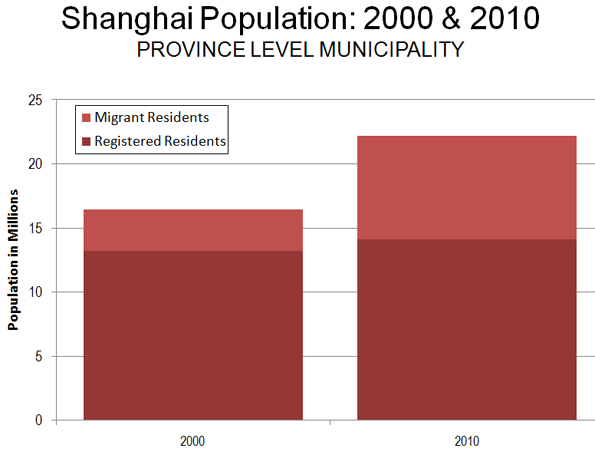
    The population of the provincial level municipality of Shanghai exceeded 22 million at the end of 2010, according to the Shanghai Population and Family Planning Commission. The population of 22.21 million exceeds the 2000 population of 16.41 million by 35 percent. This growth of nearly 6 million is more people than live in all but three Western European urban areas (Paris, London and Essen-Dusseldorf).

    Virtually all of the population gain was among migrant (non-permanent) residents who lack official Shanghai registration (Shanghai Hukou status). The migrant population rose from 5.9 million to 8.1 million, an increase of 153 percent (Estimates place the number of non-permanent urban residents of China as high as 200 million). There were 14.1 million permanent residents (with Shanghai Hukou status), a seven percent increase from the 2000 figure of 13.8 million (Figure).

    Non-permanent residents, who must have lived in Shanghai for six months to be counted, now account for 36.4 percent of the provincial level municipality’s population, nearly double the 19.4 share in 2000.

    Results are expected soon from the China national census, which began in November of 2010. Ding Jinhong, director of East China Normal University’s School of Social Development has suggested that the census may report a population as much as 23 million, with a non-permanent resident population of 9 million.

    It is estimated that the Shanghai urban area, which is wholly contained within the provincial level municipality, will have a mid-year 2011 population of 18.7 million, with a land area of 1,125 square miles (2,900 square kilometers). The Shanghai urban area, the 10th largest in the world, has a population density of 16,500 per square mile or 6,400 per square kilometer.

    This urban density is more than double that of Western European urban areas with more than 500,000, however it is less than one-fourth that of the Mumbai urban area. As in Mumbai, there has been substantial population dispersion from the core to suburban areas, with only 14 percent of growth in the urban core (generally inside the inner-ring expressway) between 1982 and 2000.

    The population density of the provincial municipality, which is analogous to a metropolitan area and includes considerable rural land, is much lower, at 9,100 per square mile (3,500 per square kilometer).

  • Final Census Results: Core Cities Do Worse in 2000s than 1990s

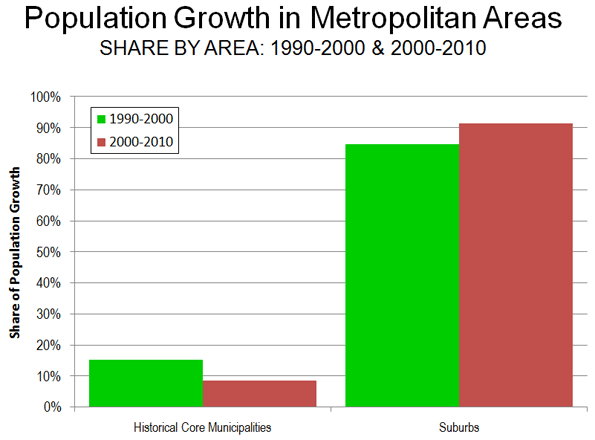
    Based upon complete census counts for 2010, historical core municipalities of the nation’s major metropolitan areas (over 1,000,000 population) captured a smaller share of growth in the 2000s than in the 1990s.

    The results for the 50 metropolitan areas (New Orleans excluded due to Hurricane Katrina and Tucson unexpectedly failed to reach 1,000,000 population) indicate that historical core municipalities accounted for 9 percent of metropolitan area growth between 2000 and 2010, compared to 15 percent in the 1990-2000 period. Overall, suburban areas captured 91 percent of metropolitan area population growth between 2000 and 2010, compared to 85 percent between 1990 and 2000.

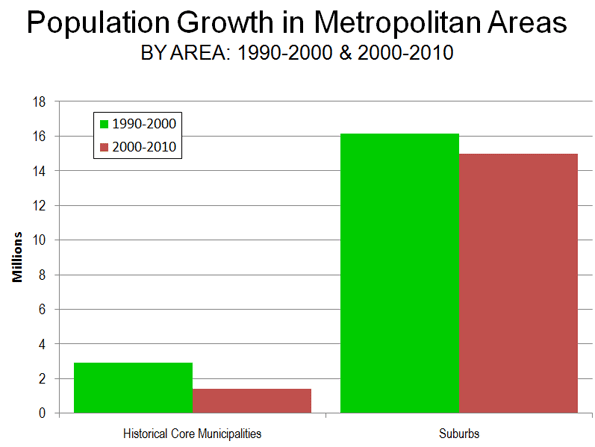
    Total population growth in the historical core municipalities was 1.4 million, nearly all of it in municipalities with a largely suburban form (such as Phoenix, San Antonio and Charlotte). This compares to an increase of 2.9 million during the 1990s.

    Suburban areas (areas in metropolitan areas outside the historical core municipalities) grew 15.0 million, down from 16.1million.

    Overall, the major metropolitan areas added 14 percent to their populations in the 2000s, down from 19 percent growth in the 1990s. The historical core municipalities grew 4 percent, compared to the 1990s rate of 7 percent. Suburban areas grew 18 percent, compared to the 1990s rate of 26 percent (all data unweighted).


  • Chicago’s Unique Population Loss of the 1 Million Plus Cities

    There are only 9 cities in the United States with populations over 1 million. The list includes New York, Los Angeles, San Diego, Philadelphia, Chicago, Phoenix, Houston, San Antonio, and Dallas. With this afternoon’s release of Census 2010 numbers for New York City, the final 2010 data is in.

    Of these 1 million or more cities, only Chicago lost population over the last decade, yet the media seems to be in love with Mayor Daley.  The New Yorker called Mayor Daley “America’s most successful mayor.” Newsweek is equally “impressed” with Daley’s performance, saying “Daley also leaves behind a glittering metropolis that Chicagoans rightly love and outsiders can only envy.”

    Chicago’s 200,000 person loss shows Mayor Daley’s failed legacy as Mayor. Daley leaves office with a smaller population than when he took office in 1989. Numbers are stubborn things. There was no Chicago comeback of the middle class to experience bad public schools, high taxes, and corruption.  Almost no one predicted Philadelphia would gain population while Chicago declined. Mayor Daley’s legacy appears to be built on smoke and mirrors. A fawning media of urban reporters puffed up Daley for years. According to the numbers, Mayor Daley is America’s worst Mayor leaving Rahm Emanuel with intractable problems. Is it more accurate to call Mayor Daley the white man’s Coleman Young?

  • New York City Population Growth Comes Up Short

    Just released census counts for 2010 show the New York metropolitan area historical core municipality, the city of New York, to have gained in population from 8,009,000 in 2000 to 8,175,000 in 2010, an increase of 2.1 percent. This is the highest census count ever achieved by the city of New York.

    Nonetheless, the figure was 245,000 below the expected level of 8,420,000 (based upon 2010 Census Bureau estimates). The higher population estimate had been the result of challenges by the city to Census Bureau intercensal estimates. The city of New York attracted 29 percent of the metropolitan area growth. Approximately 43 percent of the metropolitan area’s population lives in the city.

    Overall, the New York metropolitan area grew from 18,323,000 to 18,890,000, an increase of 3.1 percent. The suburbs grew approximately twice as rapidly as the city of New York, at 4.0 percent, and attracted 71 percent of the metropolitan area growth.

  • Charlotte Continues Strong Growth

    According to US Census Bureau data, the Charlotte (NC-SC) metropolitan area grew 32 percent, from 1,330,000 to 1,758,000 between 2000 and 2010. The historical core municipality, the city of Charlotte grew from a 2000 base of 568,000 to 731,000 in 2010 (an increase of 29 percent). The city of Charlotte is largely of a post-World War II suburban form. The city of Charlotte attracted 38 percent of the metropolitan area growth.

    The suburbs grew at a 35 percent rate, higher than that of the city of Charlotte. The suburbs captured 62 percent of the metropolitan area growth.

  • Slow Growth in Providence: City Grows

    The Providence (RI) metropolitan area was one of the slowest growing in the 2000 to 2010 period, according to counts just released by the Census Bureau. Providence grew 1.1 percent, from 1,583,000 to 1,601,000. The historical core municipality, the city of Providence gained 2.5 percent, from 174,000 to 178,000 and grew faster than the suburbs, like neighboring Boston. The city of Providence reached its population peak in 1940, at 254,000.

    Even so, the suburbs attracted 75 percent of the metropolitan area growth.

  • Declining Detroit

    The historical core municipality of the Detroit metropolitan area, the city of Detroit, continued its steep population decline between 2000 and 2010. The new census count indicates that the city dropped to 733,000 residents, from 951,000 in 2000. This drop of 25 percent was the largest in any census period since 1950, when the city peaked at a population of 1,850,000. Even so, the percentage decline from 1950 of 61.4 percent remains less than that of city of St. Louis, which has experienced the steepest population decline of any municipality that has reached 500,000 population in modern times (62.7 percent).

    The decline did not extend to the suburbs, which gained a modest 2.3 percent between 2000 and 2010. Suburban growth has also been substantial since 1950, with 2.2 million new residents added.

    However, the suburban growth was not enough to erase the impact of the city of Detroit decline. The Detroit metropolitan area fell from 4,452,000 in 2000 to 4,296,000 in 2010, a loss of 3.6 percent. The loss was the greatest among major metropolitan areas reporting up to this time. Nonetheless, even with the huge city of Detroit loss, the Detroit metropolitan area has grown more than 30 percent and more than 1,000,000 people.

  • Boston: The Outlier

    The new 2010 census results for the Boston metropolitan area show the historical core municipality, the city of Boston, increasing its population at a greater rate than that of its suburbs. Thus far, Boston is the only historical core municipality with essentially the same boundaries as in 1950 that has experienced a growth rate greater than the suburbs in the 2000 to 2010 period. Boston grew from 589,000 to 617,000, an increase of 4.8 percent. Even so, the city remained more than 20 percent below its historic peak of 801,000 in 1950. Further, even with its faster growth, the city of Boston captured only 18 percent of the metropolitan area growth between 2000 and 2010. The city of Boston contains 14 percent of the metropolitan area population.

    By comparison, the suburbs grew 3.5 percent and accounted for 82 percent of the metropolitan area growth.

    Overall, the Boston metropolitan area, which stretches from Massachusetts into New Hampshire grew from 4,391,000 to 4,552,000, for a growth rate of 3.7 percent, approximately one-third of the national growth rate between 2000 and 2010. This growth rate is the same as in Los Angeles and Milwaukee, which were the slowest growing major metropolitan areas (population over 1,000,000) reporting so far, with the exception of Cleveland, Detroit and Pittsburgh, which lost population.

    Boston retains its position as the nation’s 10th largest metropolitan area, having passed losing Detroit and been passed by Atlanta.