Tag: population

  • Dispersion in Delaware

    The 2010 census data, just released, shows a strong trend toward dispersal in Delaware. The state’s largest county, New Castle, added eight percent to its population, rising from 500,000 to 538,000. All of that gain in the county was outside the city of Wilmington, which lost three percent of its population (from 73,000 to 71,000). Wilmington and New Castle County is a former metropolitan area that has been engulfed by the growth of the larger Philadelphia metropolitan area. Philadelphia has spread from its Pennsylvania base, with a large share of the metropolitan area now in New Jersey, along with New Castle County in Delaware and Cecil County in Maryland.

    Delaware’s other two counties, both to the south of New Castle County, are growing rapidly as the population moves outside metropolitan areas. Kent County, with the state capital in Dover, gained 28 percent from 127,000 to 162,000. Southern most Sussex County added 26 percent to its population, rising from 157,000 to 197,000. Thus, much smaller Sussex County added more people than New Castle County, which began the decade of the 2000s with three times the population.

  • Raleigh: Suburbanizing the City and Suburbs

    New 2010 Census results indicate that the Raleigh metropolitan area (Raleigh-Cary) grew 42 percent from 2000 to 2010. This growth rate is projected to be the highest of any metropolitan area in the nation for the 2000 to 2010 period.

    The historical core municipality of Raleigh grew strongly, from 288,000 to 404,000, a gain of 40 percent. This gain was aided by annexations that added nearly 30 percent to the area of the municipality (from 113 to 143 square miles). The annexations of recent decades have left the city of Raleigh with an overwhelmingly suburban urban form. In 1950, at the beginning of the post-World War II suburban boom, the city of Raleigh had a population of 66,000, living in a land area of only 11 square miles.

    The suburbs (area outside the city of Raleigh) gained nearly two-thirds of the metropolitan area growth (65 percent) and now have 64 percent of the population. Over the last ten years, the suburbs have grown 43 percent.

    The core urban area of Raleigh was one of the least densely populated in a major metropolitan areas in 2000, with under 1,700 persons per square mile, at slightly less than Charlotte, Nashville and Atlanta.

  • City of St. Louis Suffers Huge Population Loss

    According to just-released 2010 Census results, the city of St. Louis experienced an unexpected loss in population from 348,000 in 2000 to 319,000 in 2010. This was surprising since the latest population estimate was 357,000 (2009). The new population figure however provided exoneration for the Census Bureau, which had been challenged six separate times during the decade on its city of St. Louis population estimates. The higher 2009 population estimate was the cumulative effect of those six successful challenges. In fact however, without the challenges the city of St. Louis population would have been 311,000, much closer to the final count of 319,000 people.

    Among the world’s municipalities that have ever achieved 500,000 population non-have lost so much as the city of St. Louis. The new figure of 319,000 people is 63 percent below the 1950 Census peak of 857,000 people. Indeed, the 2010 population is nearly as low as the population in the 1870 census.

    Even so, the population loss of the last decade belies the progress that has been made in converting warehouse buildings, office buildings and other disused structures into urban residential areas, especially along Washington Avenue. These developments, among the largest in the United States, however, fell far short of preventing the population loss.

    The St. Louis Metropolitan area did much better. In 2010, the metropolitan area had a population of 2,813,000, up from 2,699,000 in 2000, a gain of four percent. The loss in the city was eight percent, while the suburbs gained six percent.

  • Seattle, Denver & Portland: Slowing Growth Rates & Convergence

    Just released 2010 Census data indicates that the growth rates of the Seattle, Denver and Portland metropolitan areas fell significantly in the 2000s compared to the 1990s.

    Seattle: Seattle metropolitan area population growth fell to 13 percent in the 2000s compared to 19 percent in the 1990s. The metropolitan area population in 2010 was 3,439,000, up from 3,041,000 in 2000. The historical core municipality of Seattle grew eight percent between 2000 and 2010 (from 563,000 to 608,000), while the suburbs grew 14 percent. The suburbs attracted 89 percent of the metropolitan population growth.

    Denver: The Denver metropolitan area experienced a decline in growth rate from 32 percent to 17 percent, while the population increased from 2,179,000 to 2,543,000. The historical core municipality of Denver grew eight percent, from 554,000 to 600,000. The suburbs grew 20 percent and accounted for 83 percent of the metropolitan area population growth.

    Portland: In the Portland Metropolitan area growth declined to 15 percent from 27 percent, with a population rising from 1,928,000 to 2,226,000. The historical core municipality of Portland grew 10 percent (from 529,002 583,000), while the suburbs gained 17 percent. The suburbs attracted 82 percent of the metropolitan population growth.

    Convergence: These slower population growth rates indicate a convergence with the growth rates achieved by middle American metropolitan areas for which data is available. Indianapolis grew 15 percent and Oklahoma City grew 14 percent, more than Seattle and slightly less than Denver and Portland.

  • City of Chicago Falls to 1910 Population Level.

    The Bureau of the Census has just reported that the city of Chicago lost more than 200,000 people between 2000 and 2010. At 2,696,000, this takes Chicago to its lowest population since 1910, and nearly 1,000,000 fewer than its census population peak of 3,621,000 in 1950. In 1910, the city had a population of 2,185,000, and increased in 1920 to 2,702,000.

    The Bureau of the Census had estimated Chicago’s population at 2,851,000 in 2009, down from the 2000 census count of 2,897,000. Chicago is the seat of Cook County, which lost 180,000 between 2000 and 2010, though outside the city of Chicago, Cook County gained approximately 20,000 residents.

  • South Dakota’s Growth Is Noticeable in the Midwestern Arena

    According to the 2010 Census population data for the United States, the Midwest region was the slowest growing of the four Census regions, at a 3.9% increase overall. South Dakota led the Midwest for population with an increase of 7.9%, while the lowest was the battered state of Michigan at -0.6%. These numbers seem to suggest a shift from the Rust Belt to the Great Plains.

    This is more apparent when considering CNN Money’s list of the top 100 best cities to live in for 2010. Four cities represented the Dakotas on this list while only one city, Ann Arbor, stood for Michigan at number 46. The four cities from the Dakotas were Bismarck, ND at 74; Sioux Falls, SD at 77; Fargo, ND at 86; and finally Grand Forks, ND at 97.

    The odds seem to be against the growing state of South Dakota when compared to the once-great Michigan. Michigan has 32 Fortune 500 companies (the largest being GM, Ford, and Dow), a notable IT strength, three well-known universities (University of Michigan, Michigan State University, and Wayne State University), and is one of the biggest leaders of industrial research and development. However, Michigan’s weaknesses lie in its disintegrating manufacturing industries whereas South Dakota has attained a more promising outlook.

    South Dakota’s major city is Sioux Falls in Lincoln county, which has been named one of the “best counties to find a job” with a 67% increase in job growth in the last decade. Sioux Falls has been named one of the “best places to start a business” by CNN where operating a business costs an estimated 45% less there than it does in New York City. It also boasts a crime rate that is half the national average, is home to offices of many financial giants including Citibank and Wells Fargo that come to the state for its slackened usury laws and positive banking regulations, and has some of the region’s leading hospitals. A determined arts scene and a strong retail sector round out the package.

    Can Sioux Falls be compared to the crumbling Detroit? When considering Sioux Falls to be the major hub of its region (the most proximate major cities are Omaha and Minneapolis, both over 150 miles away) it’s no wonder that many people are flocking there to be a part of its thriving economy that can’t be found for miles. Detroit, on the other hand, is a homogenous product in a competitive market. Other Rust Belt cities find themselves in a corresponding situation, offering a similar lifestyle while depending on declining industries.

  • Surprise, Frisco and Beaumont Among Fastest Growing

    The Bureau of the Census has updated its city (municipality or local government area) population estimates for 2009. Predictably, anti-suburban interests saw more indication of the elusive (read non-existent) exodus from the suburbs to the central cities. One analyst even suggested that a “high quality” of life in one central city (Washington, DC) might have kept people from moving to the suburbs. In fact, since 2000, nearly 40,000 people (domestic migrants) have moved out of the city of Washington and in the last year, the city gained 4,500 residents while the suburbs gained 13,700.

    In contrast, Buffalo News reporter Jack Ray looked at the data and noted that some cities in that metropolitan area were growing rather quickly, while others were losing population. Generally, he found that outer suburban communities were growing more quickly. Ray’s analysis was reflective of trends around the nation.

    There are nearly 20,000 incorporated cities, towns and villages in the United States. Population trends in these cities show that urban areas are growing most strongly on their suburban fringes or even in their exurbs. For example, two-thirds of the fastest growing 100 municipalities in the nation were suburbs or exurbs in the nation’s major metropolitan areas (those with more than 1,000,000 population). The other third were all municipalities in smaller metropolitan areas or outside metropolitan areas.

    The extent of this growth on the edge is illustrated by an examination of the nation’s municipalities of 25,000 or greater population that grew more than 25% between 2000 and 2009.

    • Among the 89 municipalities that grew 50% or more, 59 were in major metropolitan areas and all were suburbs (nearly all near the urban fringe) or exurbs. The total population growth among these suburbs and exurbs was 2.2 million from 2000 to 2009, for an average growth rate of 91%. These major metropolitan suburbs and exurbs grew 1.8 million, while the municipalities outside the major metropolitan areas added 400,000.
    • Among the 119 municipalities that grew between 25% and 50%, 69 were in major metropolitan areas. This included 67 suburbs and exurbs. It also included 2 central cities, Raleigh (39%) and Atlanta (28%). These major metropolitan area suburbs and exurbs gained 1.7 million residents, while the two central cities gained a total of 200,000. The municipalities outside the major metropolitan areas grew 1,000,000.

    Combined, the fastest growing suburbs and exurbs with more than 25,000 population grew more than 3.5 million, while the municipalities outside the major metropolitan areas grew 1.5 million, for a combined growth of more than 5.0 million. The smaller high growth municipalities (under 25,000), nearly 1,200 of them, both major metropolitan and outside, grew another 2.5 million.

    The fastest growing municipalities, excluding the two central cities of Raleigh and Atlanta, accounted for nearly one-third of the nation’s growth between 2000 and 20009.

    Most of the fast growing suburbs and exurbs have names that are simply not recognizable. Yet, a half-dozen added nearly as many or more new residents than all of the 20-plus central cities combined in the major metropolitan areas that do not have large swaths of suburbanization inside their borders. These include such places as Phoenix suburb, Surprise, Dallas-Fort Worth suburb Frisco and Riverside-San Bernardino suburb Beaumont.

    In Crabgrass Frontier: The Suburbanization of the United States, Kenneth Jackson noted that central Philadelphia began losing population in the early 19th century. The dispersion of America continues.

    Photograph: Exurbs of New York: Pike County, Pennsylvania

  • Decentralized Growth and “Interstate” Highways in China

    Andrew Batston of The Wall Street Journal writes of China’s decentralization, with the growing employment in interior urban areas. Until the last decade, most of China’s spectacular urban population and employment growth had occurred on the East Coast, especially in the world’s largest megaregions of the Pearl River Delta (Hong Kong-Shenzhen-Dongguan-Guangzhou-Foshan-Jiangmin-Zhongshan-Zhuhai-Macao), the Yangtze Delta (Ningbo-Shaoxing-Hangzhou-Shanghai-Suzhou-Wuxi-Changzhou-Nangjing) and Beijing-Tianjin. Millions of migrant workers had traveled to the East Coast from the interior to take jobs paying far more than they could earn at home.

    But that has changed. Industrial production and jobs have expanded substantially in the interior, making it possible for people to take jobs closer to home, in Chongqing, Chengdu, Xian, Changsha, Wuhan, Shenyang, Taiyuan and many more urban areas. This is a fortuitous development, because the mega-regions are already sufficiently populated and could have well grown far larger if the interior development had not taken place.

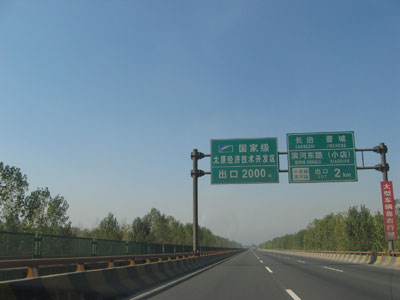
    However, jobs have become more plentiful in the interior. China’s growing US interstate standard expressway (freeway) system has been an important contributor to this development. Like the US system, there are no grade crossings and all roadways have at least two lanes of traffic in each direction.

    Now, a number of interior urban areas are now within a day’s truck drive of the East Coast ports and those that are not are within two days. According to China Daily, the 65,000 kilometers (over 40,000 miles) of the national expressway system is open. This does not include extensive provincially administered systems, such as in Beijing, where four full freeway ring roads are open and a fifth is at least half complete (Beijing has six ring roads, but the first is not a freeway). Shanghai has an extensive locally administered freeway system, as do some other urban areas.

    By comparison, the US interstate system is approximately 46,000 miles (this excludes 1,000 miles of 2-lane interstate designated conventional highway in Alaska), and a total of 57,000 miles including non-interstate freeways. China is expected to displace the United States in freeway mileage by the end of the decade, when plans call for more than 60,000 miles.

    Photograph: National Expressway Route G-040 near Taiyuan, Shanxi

  • Let’s Not Fool Ourselves on Urban Growth

    There has been a lot written lately about the return to the city. I’ve noted myself how places like central Indianapolis have reversed decades of population declines. That’s exciting. And the New York Times, for example, just trumpeted how “smart growth is taking hold” in America.

    But let’s not kid ourselves here. In my view this represents a possible inflection point, but it is way too early for the type of triumphalist rhetoric being bandied about by advocates.

    Let’s take a look at the change in the regional population share in core counties in 2009 vs. 2008 for the Midwest cities I typically focus on.

    City  Core County Share Change   2009 Core County Share   2008 Core County Share 
    Columbus 0.02% 63.83% 63.81%
    Pittsburgh 0.02% 51.74% 51.72%
    Milwaukee (0.01%) 61.52% 61.53%
    Minneapolis-St. Paul (0.02%) 50.84% 50.86%
    Chicago (0.06%) 55.19% 55.24%
    Louisville (0.07%) 57.33% 57.41%
    Kansas City (0.11%) 34.13% 34.25%
    Cincinnati (0.17%) 39.37% 39.54%
    St. Louis (0.18%) 47.68% 47.86%
    Indianapolis (0.23%) 51.09% 51.32%
    Cleveland (0.26%) 61.00% 61.26%
    Detroit (0.32%) 43.47% 44.06%

    For St. Louis, I use St. Louis city + St. Louis County as the core. For Minneapolis-St. Paul, I used Hennepin+Ramsey as the core.

    As you can see, only two regions managed to increase core county share of population, and these by a minuscule amount. Everyone else lost core county share. Keep in mind that even these “core” counties have many places with suburban characteristics. Now you might prefer a purely core city measure, and if so, be my guest. But don’t be surprised if the data gets even worse in many cases. Even in Chicago, which might have experienced the biggest urban core construction boom in America, the city lost population while Cook County gained it. Looking at the core city would make Chicago’s share loss worse.

    I think this shows there is still some work to do, to put it mildly.

    So why the difference versus the EPA study the NYT trumpets? Well, for one thing, the EPA study is worthless as a measure of urban health. They measure only new building permits, not people. This I think taps into a subtle suburban mindset in our outlook, that new housing units must represent net new inventory and net new people moving in, but in urban areas that’s not necessarily the case.

    The sad fact is, many of our urban cores have experienced significant housing abandonment and demolition. So in addition to construction of net new units, there’s a countervailing force of reduction. For example, the greater downtown area of Indianapolis has been seeing lots of construction. But the regional center comprehensive plan noted that between 1990 and 2000, the net number of dwelling units actually decreased. “The actual number of housing units declined over the 10-year period as some housing became dilapidated or was demolished and as some projects were emptied to await renovation (the Census only counts habitable units).”

    What’s more, as yuppies move in, and others move out, there is bound to be an effect on household sizes. Is it is really a good idea to price out larger immigrant families to the inner ring suburbs so that DINK’s can move in? How’s that for the environmental footprint of the region?

    I’m glad we’ve got big increases in urban construction and even population increases in some neighborhoods, but let’s not get ahead of ourselves by trumpeting a “fundamental shift”, as the EPA does, when the demographics don’t back it up.

    The New York Times article is also a disappointment. It fails to do any independent analysis of the data and only talks to people who are cheerleaders for the study, making it a sad piece of journalism.

    Someone recently described me as an “apologist for sprawl”. I in no uncertain terms reject that label. I am a passionate urban advocate who wants to see our core cities thrive and prosper. I want more growth there. I live in a city in a walkable neighborhood and rarely drive.

    But advocacy research of the type urbanists are quick to decry in others does a disservice to the cause. To change the trajectory of our cities and our built environment in America, we need to start with something called “reality”. I am optimistic that there’s a change in the air. But let’s not make claims about “fundamental shifts” that are simply not supported by any realistic look at the totality of the data.

    This post first appeared at The Urbanophile.
  • World Urban Areas and Population Projections

    Our colleague and frequent NewGeography contributor Wendell Cox of Demographia.com recently released the latest edition of his World Urban Areas and Population Projections publication.

    This 5th comprehensive edition includes:

    • Ranking of the largest world urban areas (over 2,000,000 population).
    • Population, urban land area and density estimates for all 763 identified urban areas with more than 500,000 population, comprising 49 percent of the world urban population.
    • Population, urban land area and density estimates for 1,370 urban areas of all sizes, comprising 53 percent of the world urban population.
    • Population projections for the world’s largest urban areas in 2025 & 2030 (over 2,000,000 population).
    • Summary of United Nations world population projections and summary by gross domestic product, purchasing power parity (from 4th Edition)
    • Charts on urban density and prosperity (from 2nd Edition)
    • Documentation

    Check it out.