Tag: Portland

  • Portland Housing Stupidity Grows

    Here’s an incredibly stupid idea to deal with Portland’s housing affordability problems: Multnomah County proposes to build tiny houses in people’s backyard. The people will get to keep the houses on the condition that they allow homeless people to live in them for five years.

    That’s supposed to be an incentive. For five years, you have to share your yard with a homeless person who may be suffering from a variety of problems, after which you get to keep whatever is left of the tiny home. But as one Portland neighborhood activist points out, what homeless people need is healthcare and social work, not to be warehoused in someone else’s backyard.

    I suspect homeowners are going to be wary of this offer because they will have little control who lives in their yard. Not only would the homeowners be required to maintain the tiny houses while the homeless person or people lived in them, Portland is making it increasing difficult for landlords to evict unwanted tenants.

    Update: Despite my pessimism, 580 homeowners have “inquired about hosting a homeless family in their backyards.” Initially, the county will build four, and if it can raise the funds, it will build as many as 300 more.

    More important, this plan is stupidly expensive. The county estimates that each 220-square-foot tiny house will cost $75,000. That’s $341 per square foot! There are an estimated 3,800 homeless people in Portland, so housing them all this way would cost $285 million. That assumes one person per tiny house; some may house two, but housing people in tiny homes will also attract more homeless people into the area.

    There’s also a not-so-hidden agenda here: “creating a denser, more affordable city.” At least, that’s the plan. The reality is density doesn’t make cities more affordable. In fact, the densest cities tend to be least affordable.

    In Portland, people who build tiny houses in their yards face a huge increase in property taxes. That’s because, under Oregon law, their existing home is taxed at its 1996 value, plus a small annual increase for inflation, while new construction is taxed at today’s value. Thus, a new, 220-square-foot tiny house may be taxed more than the 2,000-square-foot house it shares a lot with.

    Multnomah County says it will “try” to waive property taxes for people willing to accept tiny houses for homeless people in their yards, at least for the five years that homeless people live in them. How generous! Mercy, thy name is Multnomah County! Except really, it’s name is Stupid.

    Randal O’Toole is a senior fellow with the Cato Institute specializing in land use and transportation policy. He has written several books demonstrating the futility of government planning. Prior to working for Cato, he taught environmental economics at Yale, UC Berkeley, and Utah State University.

    Photo: DubbaG [GFDL or CC-BY-SA-3.0], via Wikimedia Commons

  • Portland Columnist Calls for Abandonment of the WES Commuter Rail Line

    Portland Tribune columnist (see "My View: WES is a Mess: Time to Pull the Plug") Bill MacKenzie took the occasion of a Tri-Met (transit agency for the Oregon side of the Portland, OR-WA metropolitan area) approval to purchase two used Budd Rail Diesel Cars (RDC) for the Wilsonville to Beaverton commuter rail line to call for its abandonment.Fconcl In addition to the $1.5 million purchase cost, $550,000 will be required for refurbishment. When then are ready for service, they will surely older than most Tri-Met employees, since the last Budd RDC’s were built in the early 1960s.

    He mocks the agency’s general manager, Neil MacFarlane, who justified the purchase as necessary to accomodate future passenger growth: "Oh sure, plan for massive ridership growth,"MacKenzie scoffs. He continues, In early 2009, TriMet predicted WES would have 2,400 daily riders its first year of operations and 3,000 by 2020." In 2015, the line carried fewer than 1,900 riders each weekday, and its cost per boarding was more than four times that of buses (not counting capital costs).

    He concluded that: "Even if WES reaches 3,000 average daily boardings, operating costs per boarding ride will remain much higher than for buses and MAX. The fact is, WES is a train wreck. It’s time to shut it down."

  • Super Bowl: Super Subsidy Sunday

    Imagine what it would cost to fly from New York to Los Angeles if the country tolerated a National Airline League? Answer: about what a “personal seat license” will cost at the new City of Champions Stadium in Los Angeles, say $28,000.

    In the latest shifting of NFL deckchairs, the League raided St. Louis, San Diego, and Oakland — cities that need things to cheer about — and told team owners that they are free to move to Los Angeles, the city of tomorrow, because of its willingness, today, to chip in on the construction of a $2.66 billion stadium in Inglewood, a city within Los Angeles, for the Rams and possibly the Chargers. Around the opulent new stadium the league will even have an NFL campus, maybe for all those ‘communications majors’ who play in the game?

    Rather than take subsides on its construction bonds, the new LA stadium prefers to limit its local taxes until “costs are amortized.” That way it can boast: “No tax dollars or public funding will be used for the construction of the City of Champions Revitalization Project, including the new stadium.” The operative phrase is “for the construction.” Afterwards, the football depletion allowance will kick in, big-time.

    The reason that the National Football League can move around its franchises is because Congress, in the Sports Broadcasting Act of 1961, deemed professional football a sacred national resource and conferred an exemption from anti-trust rules on the manufacturers of professional football.

    Instead of running a sport where there is no limit on teams or competition, the NFL is the pigskin equivalent of OPEC, and its main function isn’t to govern a league of competitive teams, but to protect monopoly pricing and practices.

    The National Football League runs on backhand payments to athletic organizations, sweetheart contracts, and monopoly pricing, in addition to screwing over its fan base by moving teams around. Its reward for urban price fixing isn’t prosecution for collusion under antitrust laws (it is exempt). Instead, it is awarded a national day of reverence, Super Sunday, during which 30 seconds of ad time costs $5 million, and the strategic national stockpile of guacamole is severely threatened.

    The owners don’t actually own teams, but are general partners in a football trust, which allows them to share equally in all television revenues and collectively ‘bargain’ with concussed players, who are only free agents after five years of indentured service. By then, most are broken men. The league’s attitude toward the declining mental of health of its retired players could be summarized as “So sue me”.

    Yes, a few stars make big money, for a while, but teams are rarely on the hook for long-term guaranteed contracts and salaries are “capped,” they say, “in the interest of competition.”

    Although NFL teams wave the flags of their home cities (best understood as their allocated captive markets), hometown fans have no sway over their local teams, which can pack up their pads in the night and move, as long as the new location is authorized by the League.

    Nevertheless, St. Louis will still get the pleasure of paying off $100 million in outstanding debt on the Rams’ Edward Jones stadium, even though the team will be playing in LA.

    What keeps NFL teams constantly on the move? Promises of state and city subsidies for new, multibillion stadiums, and then the granting of nearly all local revenues to the owner.

    The new Santa Clara stadium, home to the hype of Super Bowl 50, has $950 million in hidden public finance, even though while the deal was being made the city was laying off teachers and firefighters.

    According to Stadium Subsidy Trickle-Down Economic Theory, a new NFL stadium helps to ‘revitalize’ some downtrodden city. In reality, stadiums add little to urban life other than mountains of debt and part-time jobs for Sunday ushers and parking lot attendants.

    The reason that NFL teams do little for their home cities is that the league’s economic model is akin to strip mining or wildcat drilling. Unlike coal or natural gas, though, the price of the harvested commodity is controlled at the league’s head office, although still for the benefit of absentee landlords. National revenues are shared, while local revenues flow into the pockets of the team’s owner, often a billionaire.

    If, instead of a football trust, the US had an open market for gridiron services, when there was a demand in a growing city for a pro team tryouts would be held for players, and shareholders would gather to invest in the new franchise. Maybe when the franchise got good enough, it could compete with more established teams.

    Think about it: if the city of Green Bay (population about 104,000) can support a championship team which is owned by the fans, it means that there are 278 larger cities in the country that could well duplicate its model and host professional football. Instead, only 31 other cities have pro teams, thanks to the league’s attitude toward parity and level playing fields. Metropolitan areas with populations greater than two million that don’t have a team include San Antonio, Las Vegas, Portland (Oregon), and Orlando, St. Louis and, possibly soon, San Diego and Oakland. Many other large American cities could easily support three or four professional teams.

    All that these outlier cities can do to get a franchise is to promise the NFL ownership monopoly stadium subsidies and political tolerance for continuing the anti-trust exemption. Cities that want to keep their teams (such as San Diego) can pay ransom money in the form of a new, subsidized stadium and other favors. Challenge this payoff system and the league will vote away your team faster than you can say antidisestablishmentarianism.

    The irony of Los Angeles now becoming the holy grail of two, or even three football teams is that, in the past, the city has had several franchises —ironically, the Rams, Chargers, and Raiders — and all left because the fan base preferred the beach and the Lakers to Sunday afternoons in the archaic LA Memorial Coliseum.

    What has changed since Sid Gilman coached the Los Angeles Chargers in 1960 is that shared NFL television contracts make it irrelevant whether fans show up or not for the in-studio fan game experience, although generally most stadiums sell out.

    What of the cities that have ransomed their future to an NFL team? How have they fared? Just because Forbes Magazine values pro football franchises at between $2 and $3 billion does not mean that the citizenry sees much benefit from having a team.

    For example, the Hackensack Meadowlands Giants are now said to be worth $2.8 billion, but New Jersey taxpayers are still paying interest on the old Giants Stadium, where the end zone was rumored to be Jimmy Hoffa’s resting place, and which was torn down so that a new stadium could be built in its place (“without public money”).

    Most cities get a paltry rental stream from their subsidized ballparks, and that’s it. From the Seahawks, owned by Microsoft bigwig Paul Allen, Seattle gets $1 million a year in stadium rental income, while the team rakes in more than $200 million. And state taxpayers are on the hook for some $300 million in outstanding CenturyLink stadium bonds. (The 12th man abides.)

    No wonder Allen’s $160 million yacht has been out tearing up the coral reefs of the Caribbean. Even to Hoffa, that red zone opportunity would be worth some dabbin’.

    Matthew Stevenson, a contributing editor of Harper’s Magazine, is the author most recently of Remembering the Twentieth Century Limited, a collection of historical travel essays, and Whistle-Stopping America. His next book, Reading the Rails, will be published in 2016. He went to his first professional football game in 1960, and saw the New York Titans plays the Dallas Texans. He lives in Switzerland.

    Flickr photo by Mike Morbeck: Cam Newton of the Carolina Panthers

  • How Portland Is a Lot Like Texas

    One theme I always hammer is that you have to look at proposed policy solutions in the context of the area where you want to apply them.

    A great example of this is Portland’s Urban Growth Boundary (UGB). The UGB, a policy that limits suburban development outside of a line drawn around the Portland region, is widely admired and perhaps even seen a type of holy grail policy in terms of preventing sprawl.

    Obviously restricting development outside the UGB raised demand for land inside of it and thus housing prices. Portland’s median home price multiple – that is, the median home price divided by the median household income – is 4.8. The average household in Portland would need to spend 4.8 times its annual income to buy a house there.  This compares with 2.9 in Kansas City, 3.0 in Columbus, and 3.9 in Austin.

    So Portland is less affordable than many similar sized housing markets around the US.

    But despite this, Portland remains the most affordable major West Coast metro area.  That’s because housing prices in other major coastal cities are even higher, including Seattle (5.2), Los Angeles (8.0), San Diego (8.3), the Bay Area (9.2), and Vancouver (10.6).

    So even while its home prices have risen, Portland remains the cheapest major city to live apart from Sacramento (4.7).  That is, even with the UGB Portland has a big cost advantage over its regional competition. In short, it’s cheap.

    In this way, the attraction of Portland is a lot like Texas. Its draw is more a cost arbitrage play for people leaving San Francisco than an upgrade to superior urbanism from the interior. As it happens, California refugees make up the bulk of the net migrants into Portland.

    The Texas comparison is relevant on the tax front too. Portland is one of the rare places you have the potential for double border tax arbitrage. Washington state has no income tax and Oregon has no sales tax. While only a limited number of people can take advantage of both (you have to both live and work in Washington to avoid the income tax), being able to zero out one or more major tax categories is a win.

    This is not to say that Portland is a lousy place to live. It’s fantastic as near as I can tell. The point is that Portland was able to put in place policies to create good enough urbanism to lure a certain number of San Franciscans without compromising its competitive position because it was in a high cost neighborhood.

    The story would be very different for a place like Oklahoma City or Columbus. These cities are in low cost regions, and if they undertook policies that raised their housing prices, they’d rapidly find themselves the most expensive market in their area.

    Cloning Portland’s UGB is simply not a viable policy for most interior cities, even if they had the political alignment to make it happen.

    There are many policies that can be broadly implemented across cities. The general principle is to first understand why a policy worked in the original context, then ask whether it is applicable to the target context, and if so how to implement it most successfully.

    Aaron M. Renn is a senior fellow at the Manhattan Institute and a Contributing Editor at City Journal. He writes at The Urbanophile, where this piece originally appeared.

  • Driving Farther to Qualify in Portland

    Portland has been among the world leaders in urban containment policy. And, as would be predicted by basic economics, Portland has also suffered from serious housing cost escalation, as its median multiple (median house price divided by median household income) has risen from a normal 3.0 in 1995 to 4.8 in 2014.

    One of the all too predictable effects of urban containment policy is at least some households will drive even farther to "qualify" for mortgages than before. Single-family detached houses have been the national preference in housing in the United States (and a number of other nations) for decades. Significant "leakage" can occur as people skip over the urban growth boundaries, inside of which housing has become unaffordable. For example, after the 2010 census, San Joaquin County, with its seat of Stockton, was added to the San Francisco Bay combined statistical area (CSA). Combined statistical areas are combinations of metropolitan areas have a somewhat weaker economic connection, as defined by commuting patterns than within metropolitan areas (Note 1).

    As in the San Francisco Bay Area, more Portlanders are now commuting from outside the metropolitan area in large enough numbers that four additional, metropolitan areas are now included in the Portland CSA.

    Driving to Qualify from Corvallis and Albany

    Perhaps most notable addition is Corvallis, seat of Benton County and home of Oregon State University. Corvallis is rather exurban to Portland, even though it is now officially in Portland’s commuting belt. At least 15 percent of resident workers in Benton County travel to one of the central counties of the Portland metropolitan area (Clackamas, Multnomah and Washington in Oregon and Clark in Washington) or vice versa. This is no 30 minute commute. Corvallis is 85 miles from downtown Portland. It is 65 miles from the nearest potential Portland MSA employment in southern Clackamas County. Further, the Corvallis metropolitan area is not adjacent to the Portland metropolitan area. To get to the Portland metropolitan area by the most direct route, a Benton County commuter passes through two other metropolitan areas Albany and Salem.

    This would be a very long commute, even by comparison to the nation’s largest metropolitan regions. Take New York, for example. The New York CSA extends from outside of New Haven, Connecticut, to beyond Allentown, Pennsylvania, to beyond Toms River, New Jersey and includes all of Long Island. Yet some of the farthest reaches of New York are no closer to Manhattan than Corvallis to Portland. These include Bethlehem, Pennsylvania, New Haven, Connecticut, and Port Jervis, New York. Philadelphia, beyond the New York CSA, is only slightly farther away (90 miles).

    Or, consider Los Angeles, which its undeserved reputation for sprawl. The Los Angeles CSA is the second largest in the nation. Yet, Banning, which sits on the mountain pass leading to Palm Springs is 85 miles from Los Angeles. San Clemente, the southernmost point in the CSA is only 60 miles from downtown. The expansive Portland commuter shed suggests that, in some ways, Portland, already far less dense, is also more sprawling.

    Expansions for Linn, Marion, Polk and Cowlitz Counties

    The Portland CSA added two more metropolitan areas in the Willamette Valley. Albany (Linn County), only about 15 miles closer than Corvallis is one. Salem, the state capital, was also added. Salem includes Marion and Polk counties and is 45 miles from Portland. To the north, Longview, Washington (Cowlitz County) was also added. By comparison with Corvallis, Longview seems close, at less than 50 miles from Portland.

    The Portland CSA now stretches 175 miles from the southern Linn County border to the northern Cowlitz County border. There it has collided with the southerly expanding Seattle CSA, which now includes Lewis County (Centralia-Chehalis), 85 miles from downtown Seattle.

    However, this does not imply 175 miles of continuous urbanization. Like all metropolitan areas, combined statistical areas, including Portland, have far more rural land than urban land.

    Dispersing in the Metropolitan Area

    Perhaps the greatest irony is that an “urban containment” policy designed to prevent sprawl could well be accelerating it. Higher prices, in part due to this policy, have forced more people to look ever further for housing that is affordable.

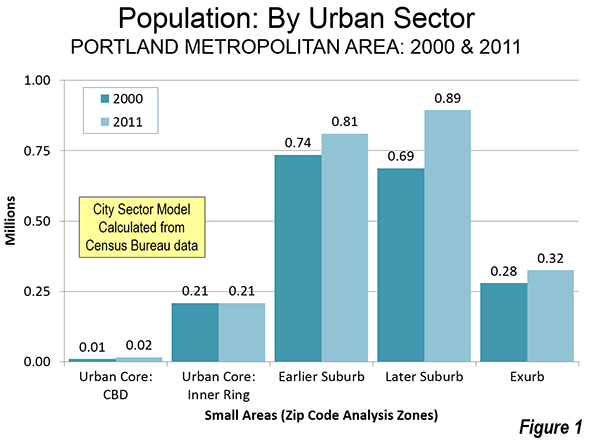
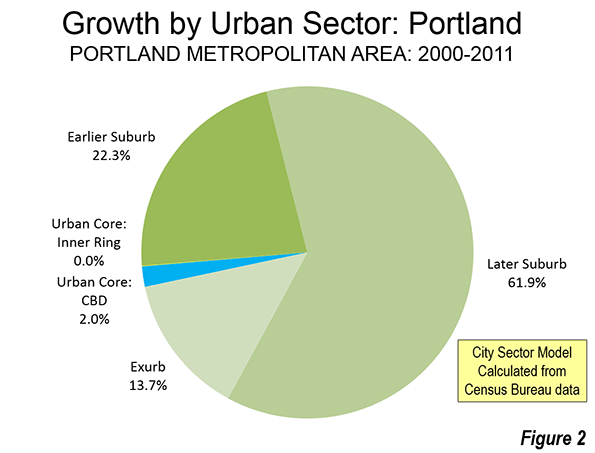
    Approximately 98 percent of Portland’s population growth between 2000 and 2011 occurred in the suburbs (Note). There was a small, but significant percentage growth around the central business district, but its addition of fewer than 7,000 residents paled by comparison to the more than 325,000 added to the suburbs and exurbs. The balance of the urban core, (the inner ring) grew by little more than 100, which is glacial for an urban sector with more than 200,000 residents (less than 0.1 percent).

    None of this should be surprising. The attractive inner city developments, especially the Pearl District, do not provide for the economic needs or wants of most people, as the population trend data indicates. Few households are drawn to buy less than one-half the space they want at nearly three times the price per square foot they would pay in outer suburbs like Forest Grove, Wilsonville or Hazel Dell.

    Job Dispersion

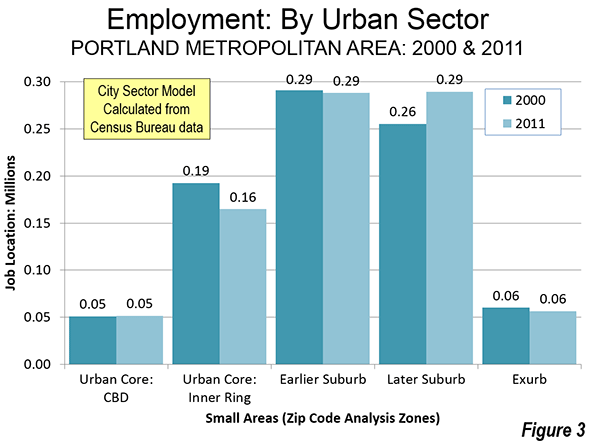
    Fortunately for both the suburbanites and an exurbanites, Portland’s job market also dispersed between 2000 and 2011, meaning that a smaller percentage of commuting was to downtown or the balance of the urban core (Figure 3). That makes it easier to drive to qualify. It turns out that while planners plan, people usually make choices that suit their basic needs rather than those of a particular urban ideology.

    Note 1: Metropolitan areas are defined by commuting patterns. Oversimplifying, metropolitan areas are organized around central counties that contain all or part of large urban areas ("built-up" urban areas). All such counties are included in the metropolitan area as well as any counties that have a strong commuting interchange with the central counties. For example, in the case of Portland, the central counties are Multnomah, Washington and Clackamas in Oregon and Clark in Washington. Columbia and Yamhill in Oregon are outlying counties as well as Skamania in Washington. Combined statistical areas are created from combinations of metropolitan areas that meet a weaker commuting interchange threshold. A complete description of the commuting thresholds that apply to metropolitan areas and combined statistical areas is found here.

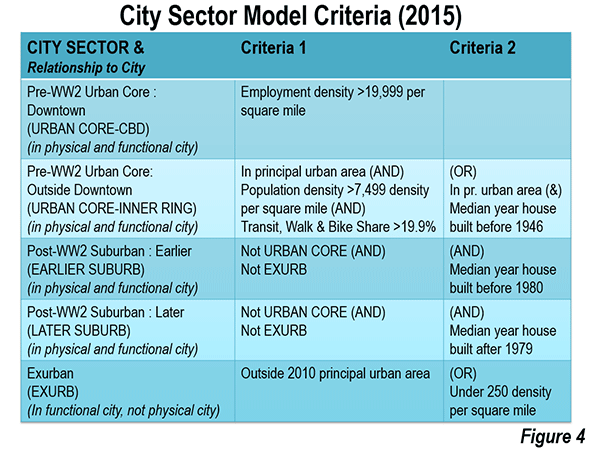
    Note 2: Based on the City Sector Model (Figure 4), which classifies small areas (ZIP codes, more formally, ZIP Code Tabulation Areas, or ZCTAs) in metropolitan area in the nation based upon their behavioral functions as urban cores, suburbs or exurbs. The criteria used are generally employment and population densities and the extent of transit, versus car use. The purpose of the urban core sectors is to replicate, to the best extent possible, the urban form as it existed before World War II, when urban densities were much higher and when a far larger percentage of urban travel was on transit. The suburban and exurban sectors replicate automobile oriented suburbanization that began in the 1920s and escalated strongly following World War II. The data from 2000 is from the 2000 census. The 2011 data is from the 2009-2013 American Community Survey (mid-year 2011).

    Photo: Benton County Courthouse, Corvallis (in the Portland commuter shed) by Gregkeene (Own work) [CC BY 3.0 us or CC BY-SA 3.0], via Wikimedia Commons

    Wendell Cox is principal of Demographia, an international public policy and demographics firm. He is co-author of the "Demographia International Housing Affordability Survey" and author of "Demographia World Urban Areas" and "War on the Dream: How Anti-Sprawl Policy Threatens the Quality of Life." He was appointed to three terms on the Los Angeles County Transportation Commission, where he served with the leading city and county leadership as the only non-elected member. He served as a visiting professor at the Conservatoire National des Arts et Metiers, a national university in Paris. Wendell Cox is Chair, Housing Affordability and Municipal Policy for the Frontier Centre for Public Policy (Canada), is a Senior Fellow of the Center for Opportunity Urbanism and is a member of the Board of Advisors of the Center for Demographics and Policy at Chapman University.

  • The “Inner Cleveland” of Trendy Cities

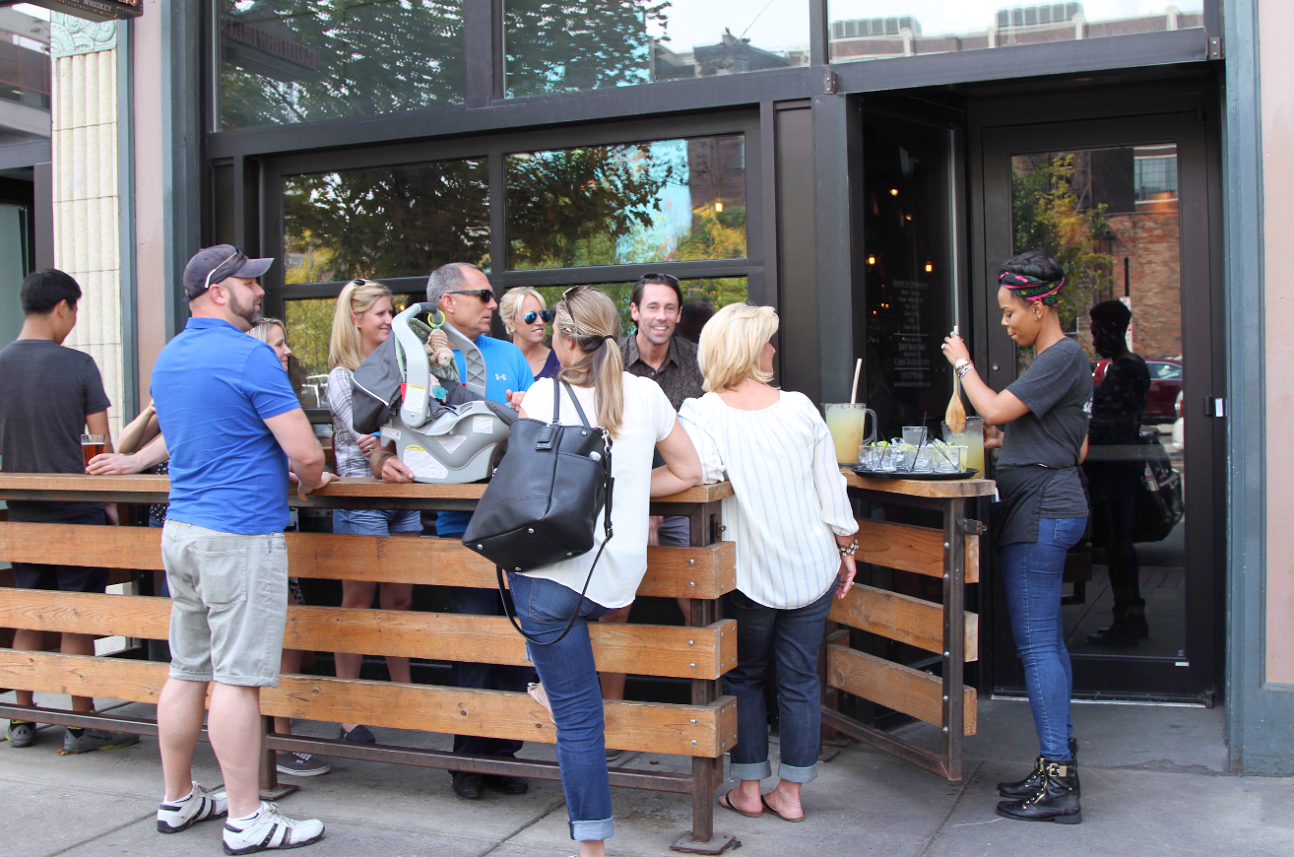
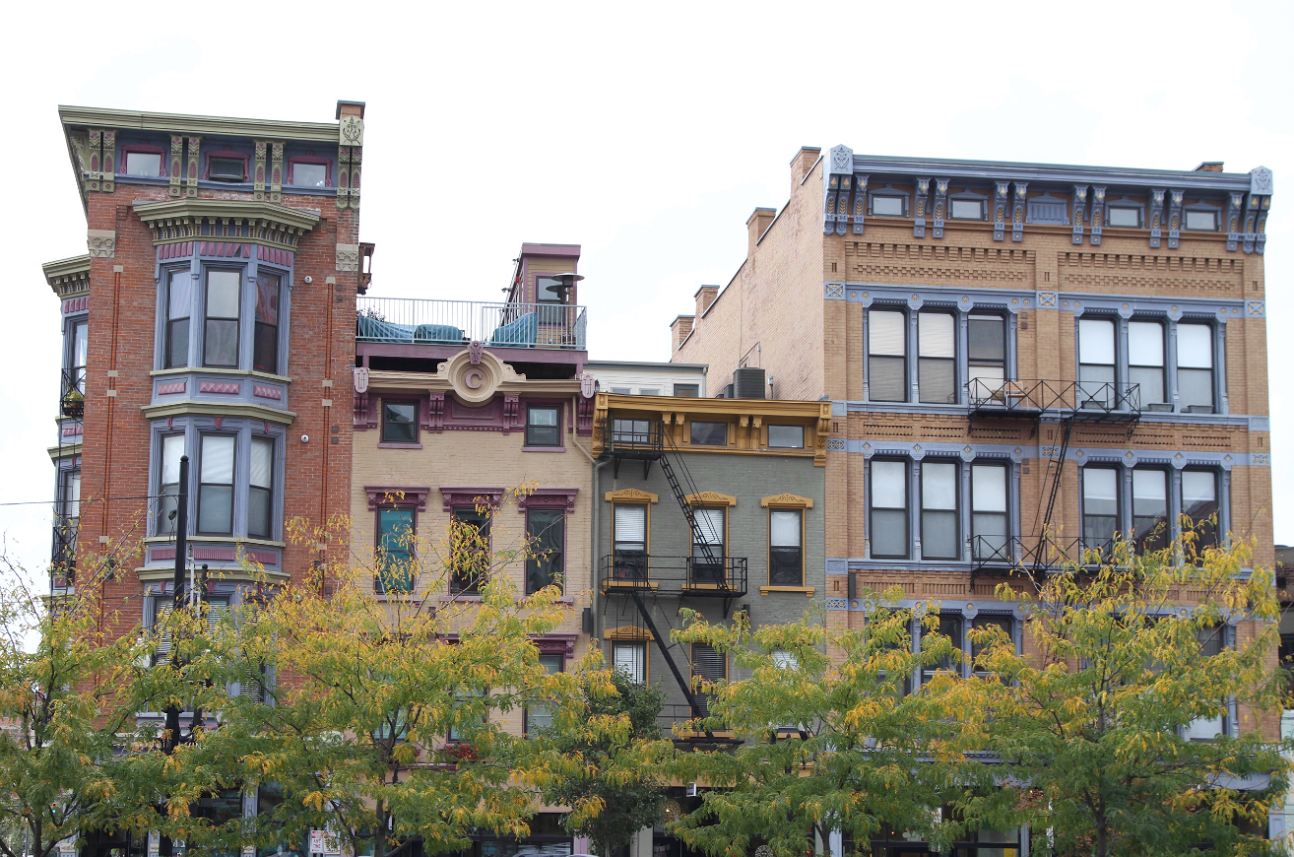
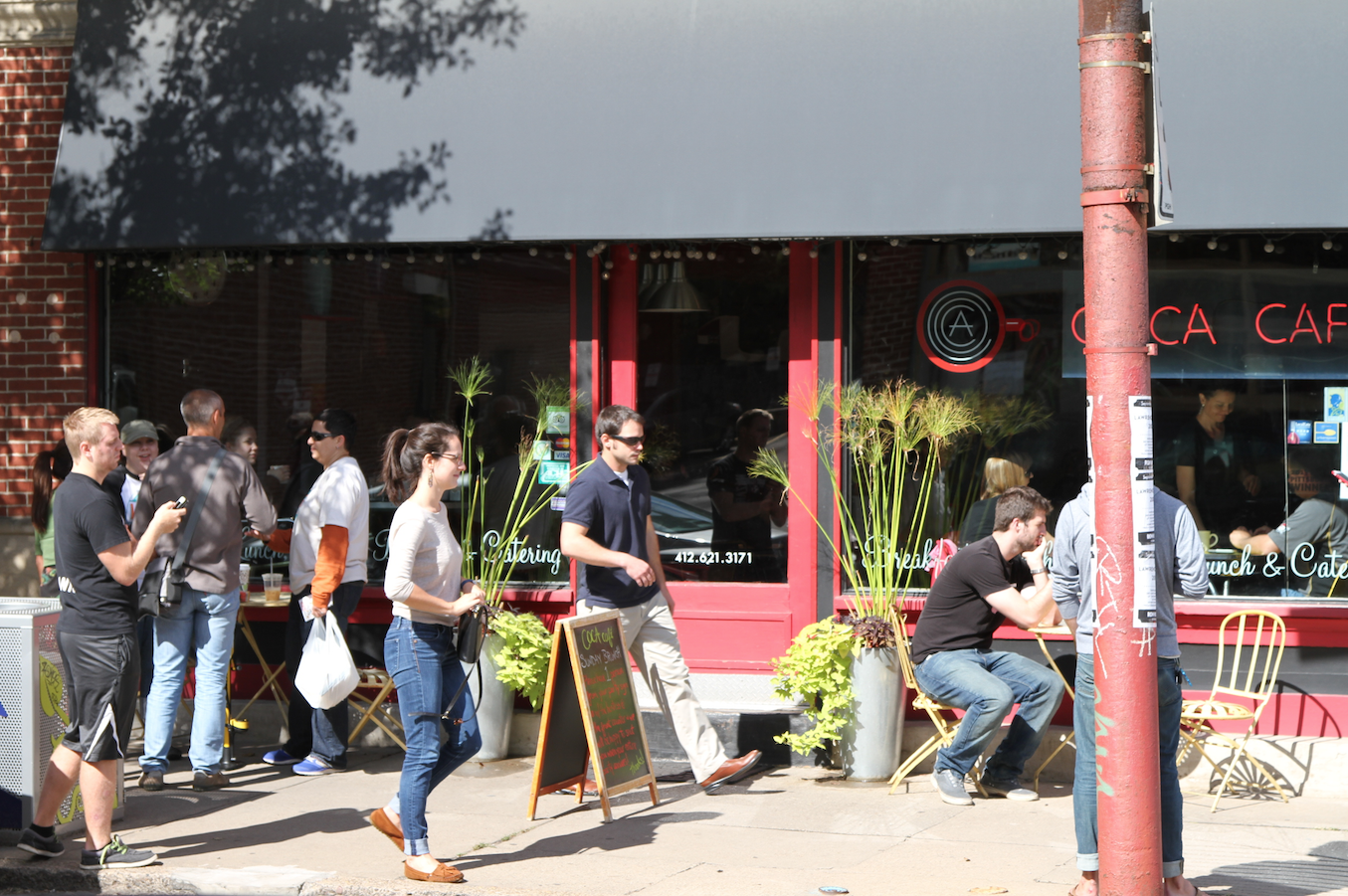
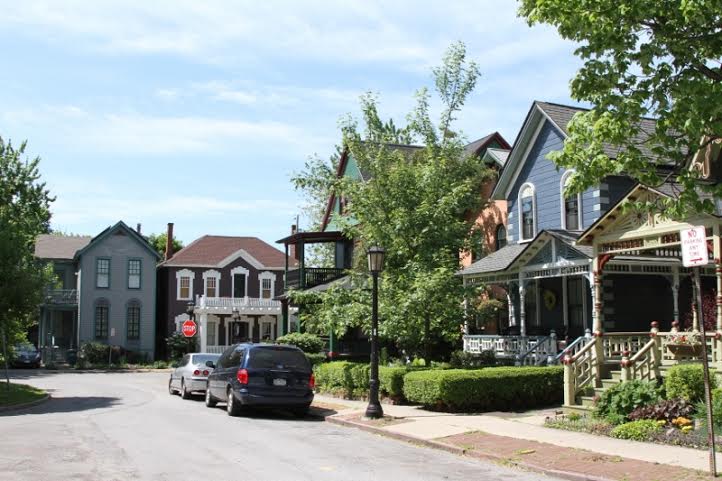
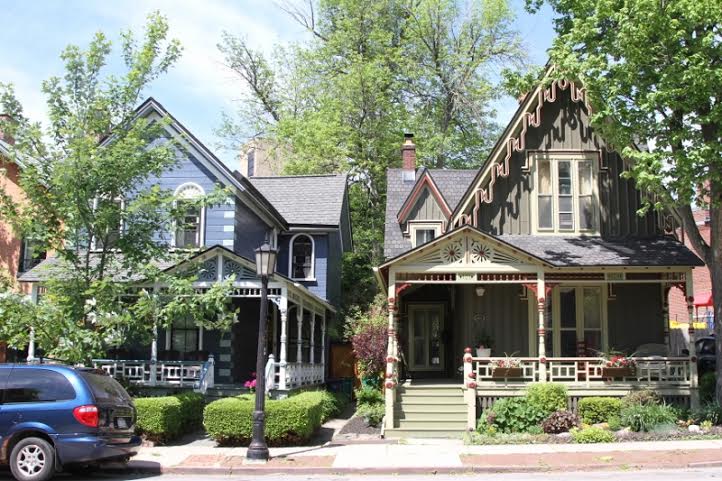
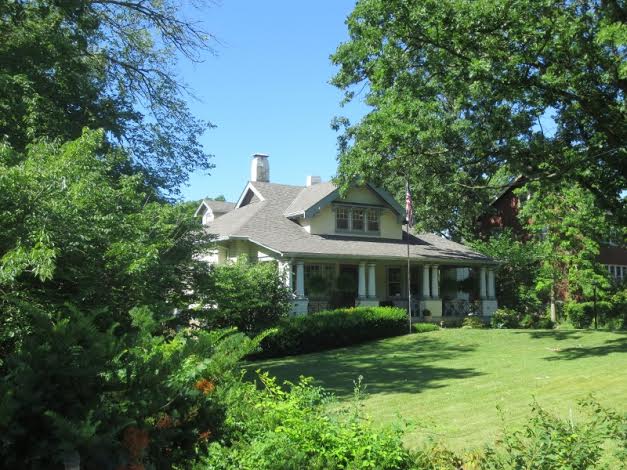
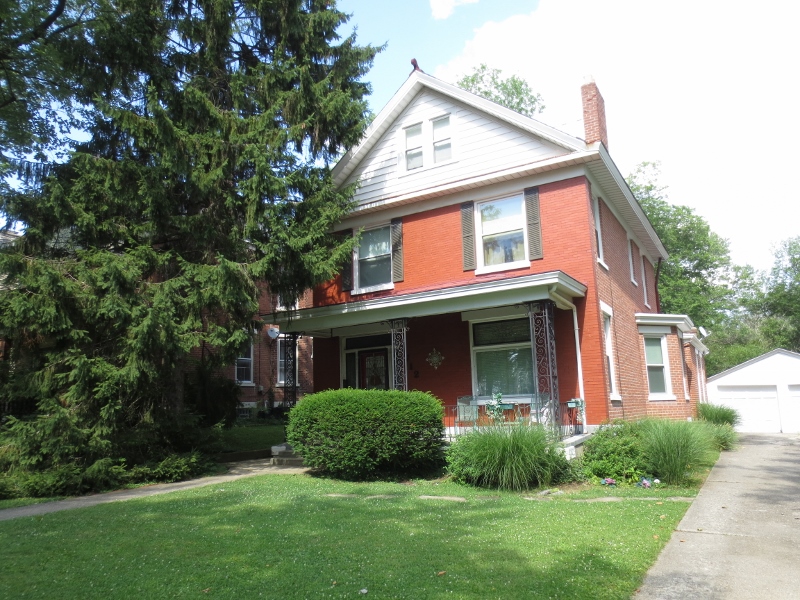
    Check out these photos and try to guess where they were taken. If you thought Cleveland, Pittsburgh, Detroit, Buffalo, Cincinnati, or a dozen other Rustbelt towns you’d be mistaken, although your confusion is completely understandable. It’s actually Portland, Oregon – that bastion of liberal, crunchy, hippie, yuppie, hipster, eco-friendliness. Go figure. I’m not putting down Portland. Portland is great. I love Portland. I’m making a point about the reputation of some cities and how we perceive places differently based on a lot of vague stereotypes. If the only images we ever saw of Portland all looked like this it would be hard to persuade people to migrate there – even if the photos don’t portray the complete reality on the ground.

    IMG_0087 (800x533) IMG_0100 (800x533) IMG_0093 (800x533) IMG_0126 (800x533)

    To be perfectly honest, Portland is a small blue collar city out in the sticks with a fairly recent trendy overlay. Its economy is fair-to-middling. Stable, but nothing to write home about. It’s primary source of dynamism comes from inflows of cash, talent, and people from other more expensive west coast cities who seek out a higher quality of life at a lower price point. That migration is fueled by the popular image many people have about the city more than the reality on the ground. Over time this branding becomes a self-fulfilling prophecy. Now check out these next photos.

    Screen Shot 2014-10-27 at 9.19.36 PM Screen Shot 2014-10-27 at 9.17.00 PM unnamed-9 unnamed-8 Screen Shot 2014-11-15 at 9.45.23 AM unnamed

    When you look at these pictures what do you think of? Portland? Seattle? Boston? Chicago? It’s actually Cincinnati.

    Screen Shot 2014-10-11 at 5.35.40 PM Screen Shot 2014-10-11 at 11.14.59 PM Screen Shot 2014-10-11 at 11.11.00 PM Screen Shot 2014-10-11 at 11.32.50 PM Screen Shot 2014-10-11 at 11.28.35 PM

    How about these photos? San Francisco? Maybe a cool part of LA? Nope. It’s Pittsburgh.

    buf4
    buf7 unnamed buf6 buf5 buf1

    How about these photos? Brooklyn? Chicago? Boston? How about Buffalo? Yep. Buffalo.

    IMG_0576 (800x533) IMG_0577 (800x533) IMG_0565 (800x533) IMG_0714 (800x533) (2)

    Are you looking for a great walkable vibrant neighborhood, but really want a single family home with a patch of garden to go along with all the cool nearby shops and fun stuff on Main Street? Maybe something with a bit of historic charm instead of a cookie cutter tract home? Well, for north of $500,000 you can get one of these great places in Portland. Or…

    buf2
    buf3 buf1 buf2

    For about $200,000 you could get something like this in Buffalo. Don’t have $200,000? If you’re willing to work on a fixer upper in a transitional neighborhood really close to the areas that have already gentrified you can find something for $50,000.

    4 unnamed-7 Cincy 34 
    Cincy 33
    Cincy 51 -1
    3 unnamed-2

    How about one of these in Cincinnati for between $50,000 and $200,000?

    Will you make as much money in Cincinnati, Pittsburgh, or Buffalo as you might in Seattle, Chicago, or Brooklyn? No. But when your housing cost has been radically reduced you really don’t need nearly as much cash. It isn’t how much you earn that matters. It’s how much you have left over at the end of the month that determines how well you live. Personally I spend 90% of my life within a five block radius of my apartment in San Francisco. Do I love having ready access to the rest of an amazing city? Absolutely. Could I afford to enjoy most of what San Francisco has to offer if we hadn’t bought our place a million years ago when the Mission was still a cheap funky neighborhood? Not even close.

    Here’s my advice to both young people who are just starting out as well as older people who are struggling to manage in a tough economic environment. Stop fighting expensive housing markets. Stop trying to wedge yourself into an overpriced shoe box apartment in a mediocre neighborhood in a top tier city. Stop driving an hour and a half out to an isolated subdivision just to hold on to your status in a big metroplex. It’s not worth it. The interior of the country is absolutely full of amazing places at a price you can comfortably afford. Give yourself and your family a big raise and leave the coast behind.

    John Sanphillippo lives in San Francisco and blogs about urbanism, adaptation, and resilience at granolashotgun.com. He’s a member of the Congress for New Urbanism, films videos for faircompanies.com, and is a regular contributor to Strongtowns.org. He earns his living by buying, renovating, and renting undervalued properties in places that have good long term prospects. He is a graduate of Rutgers University.

  • Paving Over Hunan? The Portland Model for China

    For two centuries, people have crowded into urban areas, seeking higher standards of living than prevail in the rural areas they abandoned. Nowhere is this truer than in China. In just four decades, it has risen from 17.4 percent to 55.6 percent urban, adding nearly 600 million city residents. This has been accomplished while lifting an unprecedented number of people out of poverty.  

    Yet in the future, China faces tough urbanization challenges. The United Nations forecasts that another 200 million residents will be added to the cities by 2035, increasing the urban population by nearly another one-third.

    Los Angeles Style Suburbs in China?

    For years, western planners have sought to impose their visions of the future on China’s cities (see: China Should Send the Western Planners Home). There are more recent rumblings from Britain. Writing in The Guardian, Bianca Bosker finds considerable fault with Chinese cities. In criticizing China’s perceived copying of US and European models, her article conveys an impression that detached housing (called "villas in China) makes up a large part of China’s suburbs, as in the United States ("Why Haven’t China’s Cities Learned from America’s Mistakes?" with an intriguing subtitle "Faceless estates. Sprawling suburbs. Soulless financial districts … are in vogue in China").

    Having traveled widely within all but two of China’s 25 largest cities, I would have to disagree. You have to look hard to find detached housing in China. This is quite unlike the case in US suburbs, as well as those of Japan, Britain, France, Germany, Canada, Australia and elsewhere.

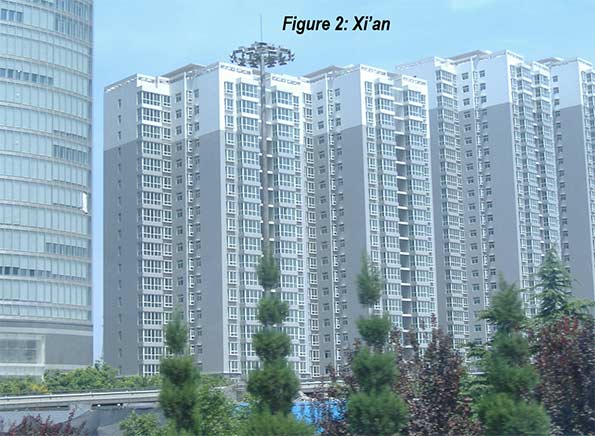
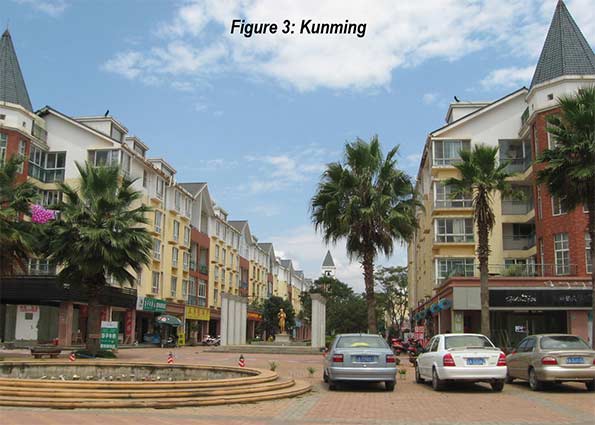
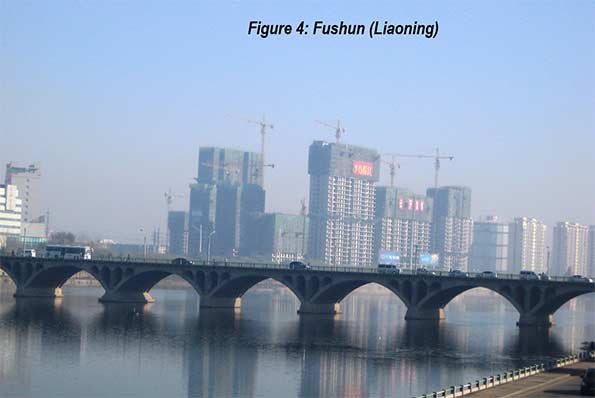
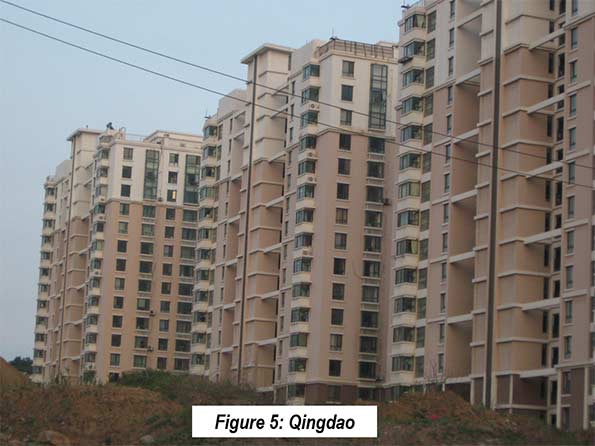
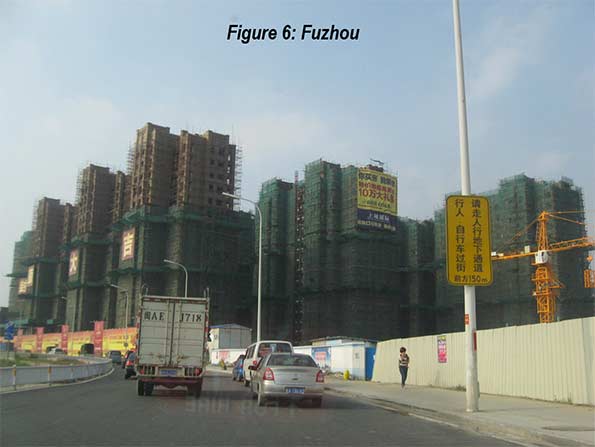
    In fact, the suburban areas of Chinese cities are largely high-rise and mid-rise multi-family buildings, with their attendant high densities. Detached housing has accounted for between 4 and 6 percent of new housing floor space. The actual percentage of detached units is probably smaller, since their average floor space of detached housing is greater. The type of housing in the photographs at the bottom of the article (Figures 2 through 6) is typical of China’s suburbs.

    Bosker also criticizes about China’s "towers in the park" high-rise development, noting that "The desire to escape sardine conditions in these superblocks, where greenery often consists of sickly shrubs gasping between six-lane roads, has in turn multiplied the number of land-devouring compounds like Rancho Santa Fe." In fact, villa developments like Rancho Santa Fe, nearby Shanghai’s Honquiao Airport, are very high income enclaves, and small. Rancho Santa Fe itself occupies less than 90 acres and the gross average lot size is approximately one-quarter acre (1/10 hectare), smaller than the average middle income suburban lot in the United States. No ordinary “tower in the park" resident can afford to move to the pricey villa developments.

    California’s High Urban Densities

    The article also condemns the "urban sprawl" of Los Angeles and California (this is nothing new).  However, the reality is that Los Angeles is the most dense major urban area in the United States (and thus the least sprawling) and nearly as dense as Toronto. Further, California has the highest urban density of any state, leading even New York. The average urban density of the state and even that of smaller California cities, such as Fresno, Stockton, Modesto and Salinas, is more than that of urban planning Nirvana Portland (below).

    Los Angeles: Land of Gridlock?

    The article calls Los Angeles the "land of gridlock," and there is no doubt that its traffic is intense. Yet, Los Angeles ranks only in a 20th place tie with Paris out of 125 cities in the latest Tom Tom Traffic Index. Traffic is worse in Brussels and Rome, almost as bad in London and far worse in places like Moscow, Istanbul, Rio de Janeiro, Mexico City and Sao Paulo. In spite of the traffic congestion, Los Angeles has the shortest work trip travel times of any world megacity for which there is data, the result of its dispersed residential and employment pattern (call it "sprawl" if you like).

    In Los Angeles, suburban residents have shorter work travel times than people living in the urban cores, which is the general situation among US major metropolitan areas (more than 1,000,000 population). This is to be expected, since lower densities are associated with less traffic congestion and shorter travel times.

    Paving Over Hunan?

    Ms. Bosker suggests that China may be poised to follow the "Portland model." A planner is quoted: “Portland is a really great model.” That, I would suggest, depends on your perspective.

    The Portland model has its philosophical roots in the British Town and Country Planning Act of 1947. As early as 1973, Sir Peter Hall and his colleagues characterized the Act having had the "reverse effect" an important policy goal, to benefit less affluent households, by virtue of the house price escalation that ensued.

    Portland has drawn an urban growth boundary around the city beyond which development is generally prohibited, and within which there is insufficient space to maintain competitive land prices. Portland has also has sought to attract people out of their cars by both building an extensive light rail system and   loath to provide new highway capacity to meet demand.

    After more than 30 years of its urban containment ("smart growth") policy, Portland’s urban density remains at only 1,350 per square kilometer (3,500 per square mile), less than one-quarter that of China’s cities with more than 500,000 population (5,750 per square kilometer/14,900 per square mile). Los Angeles is twice as dense as Portland. Portland’s urban density is closer to that of the world’s most sprawling large urban area, Atlanta, than it is to that of Los Angeles. Planning whipping boy Houston is only 15 percent less dense than Portland.

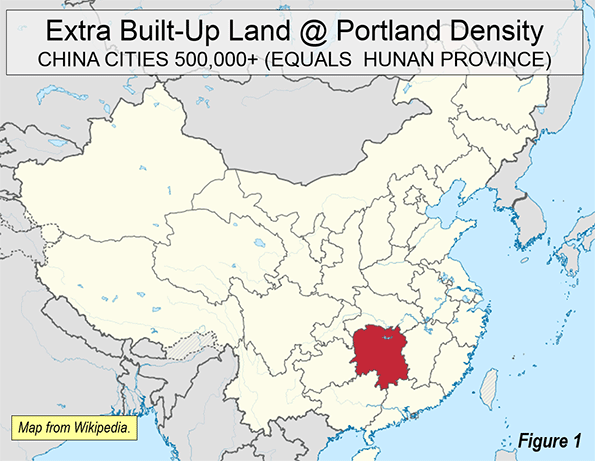
    To equal Portland’s density, Chinese cities would need to expand their footprints by 210,000 square kilometers (80,000 square miles). This would require the equivalent of paving over Hunan province (Figure 1), the state of Minnesota or the combination of England and Scotland.

    Portland is no model to copy, unless all you care about is inputs (like light rail and not building freeways and suburban housing). The outputs tell a completely different story. In 1980 (the last data before the first light rail line was opened) 65.1 percent of commuters drove alone to work. By 2012, that figure had increased to 70.8 percent. Transit was down from 8.4 percent to 6.0 percent. Approximately one-quarter as many people worked at home as commuted by transit in 1980 (2.2 percent). By 2012, more people in the Portland metropolitan area worked at home than rode transit (6.4 percent).

    This is not surprising. Portland’s "model" transit system (now with five light rail lines) can get the average commuter to only 8 percent of the jobs in 45 minutes. This is not very attractive in contrast to travel by automobiles, which provides access to virtually 100 percent of the jobs in less time (30 minutes).

    Meanwhile, Portland’s anti-highway policies have been rewarded with some of the most rapidly increasing traffic congestion in the United States. In the early 1980s, Portland ranked 47th worst out of the 101 US urban areas ranked by the Texas A&M Transportation Institute. By 2011, Portland’s traffic congestion had deteriorated to sixth worst, a stunning failure for a city with a population that doesn’t even rank the top 20. Meanwhile, Houston, castigated for its wide freeways, has improved from the worst traffic congestion in the middle 1980s to four positions better than Portland (10th), despite adding having added three times as many new residents as Portland.

    American Cities

    If outputs are more important than inputs (which I suggest is true), then US cities do very well. They have the highest incomes in the world, occupying 36 of the top 50 positions in gross domestic product per capita. They have some of the most affordable housing in the world, if cities following the Portland model are excluded. They have shorter work trip commutes and less traffic congestion than their peers in other high income world nations. And, they are poised for huge progress in environmental protection. The US Department of Energy forecasts large reductions in gross greenhouse gas emission from the national automobile fleet in the coming decades.

    Overwhelmingly, the growth of cities happened because rural residents sought higher standards of living and an escape from lower incomes and poverty, in rural areas. Few, if any moved to cities for wise urban planning, for "soulful financial districts" or to commute by light rail. Overall, US city outputs correspond very well with the purpose of cities — which is why they attracted residents.

    China: Setting its Own Course

    No one could have predicted China’s urban progress that was to follow in the decades following Deng Xiao Ping’s assumption of power. China’s cities have provided for their growing number of citizens. By that standard, both Chinese and American cities have done very well. China has charted its own urbanization course and seems likely to do so in the future. It is unlikely to seek to follow the advice of western critics whose plans fail the needs of their own citizens, much those in a complex, rapidly changing place like China.

    Top photograph: Suburban development, Changsha, Hunan. (All photographs by author).

    Wendell Cox is principal of Demographia, an international public policy and demographics firm. He is co-author of the “Demographia International Housing Affordability Survey” and author of “Demographia World Urban Areas” and “War on the Dream: How Anti-Sprawl Policy Threatens the Quality of Life.” He was appointed to three terms on the Los Angeles County Transportation Commission, where he served with the leading city and county leadership as the only non-elected member. He was appointed to the Amtrak Reform Council to fill the unexpired term of Governor Christine Todd Whitman and has served as a visiting professor at the Conservatoire National des Arts et Metiers, a national university in Paris.

  • The Ugly City Beautiful: A Policy Analysis

    When it comes to the future, Detroit and San Francisco act as poles in the continuum of American consciousness. Detroit is dead and will continue dying. San Francisco is the region sipping heartily from the fountain of youth. Such trajectories, according to experts, will go on indefinitely.

    Harvard economist Ed Glaeser has a grim outlook for the Rust Belt. “[P]eople and firms are leaving Buffalo for the Sunbelt because the Sunbelt is a warmer, more pleasant, and more productive area to live,” he writes in City Journal.

    Glaeser echoes this sentiment in a recent interview with International Business Times, saying “[s]mart people want to be around other smart people”, and the Rust Belt has a long slog ahead given that “post-industrial city migration is dominated by people moving to warmer climes”.

    But is this true? Is there a “brain drain” from the Rust Belt to the Sun Belt and Coasts? In a word: no. But Rust Belt leaders have bought this narrative hook line and sinker, and the subsequent hand-wringing has led to wasteful public investment.

    “Michigan’s cities must retain and attract more people, including young knowledge workers, to its cities by making them attractive, vibrant, and diverse places,” reads a 2003 memo from the National Governor’s Association about Michigan’s “Cool Cities” campaign.

    But the campaign struggled. “Government can’t mandate cool,” reflected Karen Gagnon, the former Cool Cities director. “As soon as government says something is cool, it’s not.”

    What’s worse, “cooling you city” with talent attraction expenditures can exacerbate economic disparities on the ground. Cities, like Chicago, are increasingly becoming bifurcated cities based on faulty assumptions that “trickle down urbanism” works. That said, the challenge of the day—for not only Rust Belt cities, but all cities—is not “brain drain”, but “brain waste”. Those cities who can best rebuild middle class communities tied to emerging markets will be the future of investment, like they were in the past.

    Through Rust-Colored Glasses

    When a people fall from grace, the sentiment of decline tends to stick. The Rust Belt’s demise is cemented. Meanwhile, the future is elsewhere. Like toward the sun. For instance, from 2000 to 2010, the Sun Belt metros of Houston, Dallas, Atlanta, Riverside, Las Vegas, Miami, Orlando, and Phoenix experienced the largest population growth. The biggest losers? It’s a “who’s who” of Rust Belt metros, led by Detroit, Cleveland, Pittsburgh, and Buffalo.

    America is a country governed by growth: big cars, big belt buckles, big houses, and big populations. Shrinkage is weakness. It is a sign of place failure. The problem here is that population growth is an ineffective, broad-brush measure when trying to understand regional underlying dynamics. A new study by Jessie Poon and Wei Yin in the journal Geography Compass called “Human Capital: A Comparison of Rustbelt and Sunbelt Cities” details exactly that.

    In it, the authors compare human capital levels between the Sunbelt metros in California (including San Francisco and L.A.), Nevada, New Mexico, and Arizona with Rust Belt metros in Michigan, Ohio, Indiana, Pennsylvania, and upstate New York. When it comes to share of population with a college degree, the authors find that the Rust Belt is experiencing a brain gain equal to their Sun Belt peers from 1980 to 2010. Poon and Wei also found that skill ratios of immigrants is higher in the Rust Belt than Sunbelt. The authors note that despite population decline, the Rust Belt continues “to be important sites of human capital accumulation”.

    The study coincides with recent work out of the Center for Population Dynamics that shows Greater Cleveland’s number of 25- to 34-year olds with a bachelor’s or higher increased by 23% from 2006 to 2012, as well as Pittsburgh economist Chris Briem’s work that shows the metros of Pittsburgh, Detroit, and Cleveland rank 1st,, 6th, 7th in the country respectively when it comes to the number of young adults in the labor force with a graduate or professional degree.

    Beyond human capital, the Rust Belt continues to produce and export wealth at a massive pace. The “Chi-Pitts” mega-region, which mirrors the Rust Belt boundaries with the addition of Minneapolis, generates $2.3 billion in economic output, second only to the “Bos-Wash” mega-region that makes up the Northeast Corridor.

    Also, using IRS migration data from the 2009-2010 period, a team of researchers led by Michal Migurski showed that Los Angeles County, New York County, and Cook County sent the most people and money to the rest of the United States. Detroit’s Wayne County was fourth. Cleveland’s Cuyahoga County was 9th, one spot ahead of San Francisco County. Speaking to Esquire, which published the work in a visual called “Where Does the Money Go”, Migurski explains the findings:

    "We realized that if you look at the biggest ‘losers,’ essentially what you’re looking at are the biggest cities in the U.S.," Migurski says. One of those losers: New York County, which lost $1,306,548,000 and 15,100 people. "But does that actually mean New York is a big loser?" Migurski asks. "One of our ideas was that, you’re not a loser if you’re losing money. You’re an exporter." The sort of exporter, he says, that boosts the rest of the U.S. economy. Traditional Sun Belt retirement areas comprise the gainers; areas like South Florida and Southern California in particular, create what Migurski calls "money sinks."

    Still, the notion of “loser” for Wayne and Cuyahoga County sticks, despite evidence to the contrary. But why? Why the constant “poor post-industrial people” sentiment, if not a low-grade captivation that comes with “ruin porn” rubbernecking?

    Well, if an ideal exists—you know, the experts beckon: be the “new” city, the “hot” city, the “creative” city—then a study in contrasts is necessary. The Rust Belt, with its connotations of smoke stacks and demographic decline, fits the bill.

    “[Richard] Florida suggests that Rustbelt cities’ high concentration of less creative blue-collar workers also produces unhappy residents,”Poon and Wei conclude in their Rust Belt/Sun Belt study. “We suggest that such a doom and gloom picture of urban and regional development for the uncool industrial Rustbelt needs to be tempered with a trend of brain gain that is growing across cities in the region.”

    But for this tempering to happen a clearer understanding of the importance of accumulating human capital needs to be ascertained. More exactly: Is it to put your city to work, or to “live-work-play”?

    Build it and they will…what?

    In his 1921 work Economy and Society, social scientist Max Weber details a city’s raison d’etre. Cities can be producer cities, wherein importance is derived from industries that demand national and international trade. Think Detroit and cars. Additionally, cities are consumer cities, in which growth is tied to how much is spent consuming goods and services in the local economy. Think eating, drinking, and buying houses.

    The cities that are the most economically robust have wealth generated from global production, which in turn enables local consumption. San Francisco’s tech economy drives it real estate market and artisanal toast scene. That is, if the question was “What came first, the farm-to-table chicken or the egghead?” The answer is “the egghead”, hands down.

    But this logic—i.e., in order to go to a restaurant, you need a job, and your job prospects are tied to the viability of your region’s global industries—is often turned on its head in economic development. Here, the goal is growth, no matter the rhyme or reason.

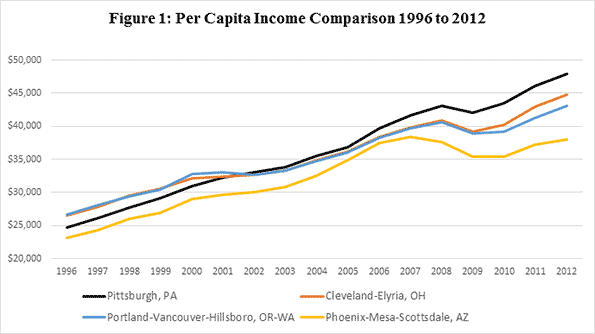
    “Like in many Sun Belt cities,” writes a Seattle Times columnist and Sun Belt expat, “Phoenix’s economic plan devolved into merely adding people, no matter the enormous long-term costs”. The columnist goes on to note that while the population has boomed, the city lags on most measures, such as per capita income (see Figure 1 below).
    Moreover, the Phoenixes of the world exist partly because of retired Baby Boomers and the disposable income that comes with it. The Sun Belt feeds off the legacy of production in the Northeast and Midwest. Other cities, like Portland, are fed by a not dissimilar dynamic. But it’s not the retired who come, rather the pre-retired.

    “The Portland metro area’s young college-educated white men are slackers when it comes to logging hours on the job,” lead’s a piece in the Oregonian about a study conducted last year, “and that’s one reason people here collectively earn $2.8 billion less a year than the national average.” Figure 1 demonstrates Portland’s sluggish income gains compared to Rust Belt peers Pittsburgh and Cleveland.

    Similarly, in a paper circulated by the Federal Reserve Bank of Atlanta, the author analyzed the top 86 “brain gain” metros in the nation to determine whether or not a region’s increase in human capital was paying off in terms of per capita income, labor force participation, poverty rate, and unemployment. The author found Portland was one of twelve metros that experienced zero economic outcomes. Pittsburgh scored 4 for 4. The authors suggest that talent attraction and retention—when untethered to production capacity—“may be largely inefficient, a kind of traditional economic development ‘buffalo hunting’”.

    Portland is perhaps America’s consummate lifestyle city. No doubt, the city has experienced a significant brain gain over the last decade. Portland is a talent attraction model. But it is not a talent producing or refining model. Rather, Portland is producing a scene that is run by the consumption of the scene’s aesthetic. Writes one young worker who left:

    “I can’t stay too long because I know if I stayed a day too long in Portland, I’d suddenly be happy to embrace the slow pace of the city and stop working… I’d end up getting sleeping real late every day, drink some coffee, maybe write some poetry on my porch (or not), and then find a part time job selling cigars like I had in college.”

    The lesson is that accumulating talent is not enough. There has to be something for the talent to do, or a context that fosters “doing”. It is also a warning for cities investing in the lifestyle game. Spending on creative class amenities ensures nothing. Creating a field of dreams won’t pay the bills. But it will run up the tab.

    The Ugly City Beautiful

    In 1998, the Chicago Sun-Times ran a piece called “Building the City Beautiful”. “The mayor of the city of Chicago, Richard M. Daley, is a big admirer of Martha Stewart,” it begins, before describing Daley’s plans to begin the "Martha Stewart-izing" of Chicago. The article goes on to quote a University of Illinois at Chicago professor who said Chicago is turning from a producer city to a consumer city. "The producer city was the industrial city — the smoke and the noise and the industrial jobs,” noted the professor. “The consumer city is the city of Starbucks, boutiques and so forth.”

    The professor was only partly right. By the 1990s, Chicago was indeed becoming brainier. But its emerging knowledge economy was an outgrowth of its “big shouldered” manufacturing base. Columbia University professor Saskia Sassen recently noted that pundits overlook this when examining the city’s transformation, with the bias being that “Chicago had to overcome its agro-industrial past, [and] that its economic history put it at a disadvantage”. Notes Sassen:

    [I]n my research I found that its past was not a disadvantage. In fact, it was one key source of its competitive advantage. The particular specialized corporate services that had to be developed to handle the needs of its agro-industrial regional economy gave Chicago a key component of its current specialized advantage in the global economy.

    Similar economic transformations from legacy cost to legacy asset are found throughout the whole of the Rust Belt. Pittsburgh, for instance, no longer provides the muscle for steel making, but it does act as the “brain center” for the world’s steel frame. How this came about is detailed in the article “Pittsburgh’s evolving steel legacy and the steel technology cluster”.

    With the arrival of the new economy also came “new economy” tastes. Sassen noted that when she arrived in to study in Chicago in the 90s she was greeted by “old lofts transformed into beautiful restaurants catering to a whole new type of high-income worker—hip, excited, alive.”

    In other words, local consumption patterns began setting up around the emergent worker demand. Going was the Italian Beef and arriving was pickled beets. This demand also impacted housing, with the attraction to urban living setting the stage for gentrification. This, in a nutshell, is the dynamic driving the transformation of urban neighborhoods nationwide: a new economy demands new workers which in turn demand a new kind of lifestyle. The problem, though, is that leaders have the causality backward, or that creating a new lifestyle will incur new worker supply and then poof: new industries. But as we see with Portland, it is not that easy. The industrial DNA and social history of your city matters more than the cosmetics atop the topography.

    Still, from a policy and strategy standpoint, it is easier just to make your city “cool”. And that’s exactly what Chicago has been doing at a significant pace. In a recent piece entitled “Well-healed in the Windy City”, author Aaron Renn details Mayor Rahm Emanuel’s policy of using tax-increment financing (TIF) to create geographic “winners” and “losers” across Chicagoland. “The true purpose of Chicago’s TIF districts—which now take in about $500 million per year,” writes Renn, “appears to be tending to high-end residents, businesses, and tourists, while insulating them from the poorer segments of the city.”

    The strategy was spelled out explicitly by Mayor Emanuel during a recent ribbon cutting for a bike path in Chicago’s Loop. Said Emanuel: “I expect not only to take all of their [Seattle and Portland’s] bikers but I also want all the jobs that come with this, all the economic growth that comes with this, all the opportunities of the future that come with this.”

    Notwithstanding the faulty logic in the strategy—e.g., if Portland lacks the jobs for its residents, how can it supply jobs for Chicagoans—the real problem is the costs associated with such bifurcated investment. In West and South Chicago, the byproducts of the City Beautiful approach are downright ugly. But they are not unexpected. They are the long-documented economic and social effects of concentrated poverty and segregation. Continues Renn:

    Safety levels in Chicago can no longer be plotted on a single bell-shaped curve for the entire city. Today, that curve is split into two—one distribution for the wealthy neighborhoods and one for the poor ones. A lack of resources is part of the problem: the police department is understaffed… While the city budget is tight, failing to increase police strength during a murder epidemic is a profound statement of civic priorities.

    Urban priorities flow from a perception of what is at stake. For long, the push for human capital accumulation has pitted city versus city amidst the backdrop of an urban popularity contest in which the “winner” is assured nothing outside of popularity. But victory in the vanity game is fleeting. The young and the restless are exactly that, and many people who come to New York or San Francisco, or for that matter Portland, leave as they get older and seek out affordable places to raise a family. What remains on the ground is the reality of brain waste. Without the prioritization of equitable, integrated middle-class neighborhoods a city’s progress will be always be disparate, if not illusory. Talent attraction is but part of a redevelopment process. So is talent refinement for those arriving and talent production for those in place. After all, neighborhoods are factories of human capital. Building people, not places, is what a successful city is all about.

    But to know this is to “know thyself”. The Rust Belt has been dying for some time now, so say the experts. The region has absorbed the projections, and given that desperate times call for desperate measures investment has been wasted. “[Creative class theory] is bad because it distracts from what’s important,” says Sean Stafford, author of Why the Garden Club Couldn’t Save Youngstown.

    Regaining focus entails removing the rust-colored glasses. Rust Belt leaders will see there are assets to work with, not to mention feel the freedom that comes with no longer being a study in contrast for those touting a future that really isn’t.

    Richey Piiparinen is Senior Research Associate at the Center for Population Dynamics at the Maxine Goodman Levin College of Urban Affairs at Cleveland State University. The Center for Population Dynamics at Cleveland State University’s Maxine Goodman Levin College of Urban Affairs aims to help partner organizations competitively position the region for economic and community development. It will do so through the lens of migration, applied demography, and culture.

    Lead photo courtesy of bctz Cleveland

  • Portland Light Rail Revolt Continues

    In a hard fought election campaign, voters in the city of Tigard appear to have narrowly enacted another barrier to light rail expansion in suburban Portland. The Washington County Elections Division reported that with 100 percent of precincts counted, Charter Amendment 34-210 had obtained 51 percent of the vote, compared to 49 percent opposed.

    The Charter Amendment establishes as city policy that no transit high capacity corridor can be developed within the city without first having been approved by a vote of the people. High capacity transit in Portland has virtually always meant light rail.

    In a previous ballot issue, Tigard voters had enacted an ordinance requiring voter approval of any city funding for light rail. Similar measures were enacted in Clackamas County as well as King City in Washington County. Across the Columbia River in Clark County (county seat: Vancouver), voters rejected funding for connecting to the Portland light rail system. After the Clackamas County Commission rushed through a $20 million loan for light rail (just days before the anti-light rail vote), two county commissioners were defeated by candidates opposed to light rail, with a commission majority now in opposition.

    Further, a Columbia River Crossing, which would have included light rail to Vancouver was cancelled after the Washington legislature declined funding. In a surreal aftermath, interests in Oregon seriously proposed virtually forcing the bridge on Washington, fully funding the project itself. A just adjourned session of the Oregon legislature failed to act on the proposal, which now (like Rasputin) appears to be dead.

    At the same time, Portland’s transit agency faces financial difficulty and has been seriously criticized in a report by Secretary of State. The agency has more than $1 billion in unfunded liabilities and carries a smaller share of commuters than before the first of its six light rail and commuter rail lines was opened. Moreover, the latest American Community Survey data indicates that 3,000 more people work at home than ride transit (including light rail and commuter rail) to work in the Portland metropolitan area. Before light rail (1980), transit commuters numbered 35,000 more than people working at home. Over the period, transit’s market share has dropped one-quarter.

  • The Limits of Portland’s Craft Economy

    Charles Heying, the author of Brews to Bikes: Portland’s Artisan Economy, covers Portland’s indie fashion, book and music sector, its recycling/reuse businesses, craft businesses, bike sector, technology businesses and non-profits.

    His thesis is that Portland represents a return to the craftsmanship that defined the pre-industrial age. Heying mostly denies that the artisan economy produces high-end goods for a limited market, and sees it as a broader shift in our society away from mass production. A critic of Richard Florida’s theories, he denies that cities should make cosmetic changes to attract well educated professionals. Instead, he sees the artisan economy as something that emerges from below, rather than imposed from above by local officials.

    But there are some problems with this thesis. Portland has many coffee roasters, but it also has many Starbucks. Silicon Forest, Portland’s tech hub, includes IBM, Intel and Techtronics. None of these firms are small, artisan firms. There are indie designers in Portland but Nike and Columbia Sportswear and Adidas also call Portland home. Sure, twelve percent of people in Portland bike, but that means a lot rely on the car as a primary mode of transportation. And only twelve percent of the beer consumed in Portland is craft beer. If ‘small is beautiful’ really defines this city, then why are there so many big companies lurking around?
    Artisanal enterprises come along with the advancement of information technology, but will in no way replace mass production. I don’t think there will be many small-scale train, airline or automobile companies. The mini-economy represents a side of us that doesn’t want the creative impulse to die, and wants a more socially responsible model, but it won’t shove aside the big model anytime soon.