Tag: Portland

  • Special Report: Infill in US Urban Areas

    One of the favored strategies of current urban planning is “infill” development. This is development that occurs within the existing urban footprint, as opposed that taking place on the fringe of the urban footprint (suburbanization). For the first time, the United States Bureau of the Census is producing data that readily reveals infill, as measured by population growth, in the nation’s urban areas.

    2000 Urban Footprint Populations

    The new 2007 estimates relate to urban areas or urban footprints as defined in 2000 and are produced by the American Community Survey program of the Bureau of the Census. Urban areas are the continuous urbanization that one would observe as the lights of a “city” on a clear night from an airplane. It is the extent of development from one side of the urban form to the other. Further, urban areas are not metropolitan areas, which are always larger and are defined by work trip travel patterns. Metropolitan areas always include adjacent rural areas, while urban areas never do.

    The Process of Infill

    Although embraced with often religious passion within the urban planning community, infill is neither good nor bad in terms of social or environmental impact. Infill always increases population densities and that means more traffic. If road capacity is increased sufficiently, traffic congestion can be kept at previous levels. If on the other hand, nothing is done, traffic congestion is likely to increase along with population. This means slower traffic and more stop and go operations, which inevitably increases the intensity of air pollution with the potential to cancel out any reductions in greenhouse gas emissions (GHG) that might occur if average car trip lengths decline. Similar difficulties can occur with respect to other infrastructure systems, such as sewer and water. Expanding roads, sewer and water systems in already developed areas can be far more expensive than new systems on greenfield sites. Regrettably, boosters of infill routinely ignore these issues.

    But infill has been going on for years, along with suburbanization, both in the United States and in other first world nations. This is indicated by the general densification trend that occurred in US urban areas between 1990 and 2000 and the longer term densification trends that occurred in a number of southwestern urban areas, such as Los Angeles, San Jose, Riverside-San Bernardino, Phoenix, Dallas-Fort Worth and Las Vegas. All these traditionally “sprawling” areas have, in fact, been densifying since 1960 or before. Since 2000, 33 of the nation’s 37 urban areas with a population exceeding 1,000,000 population experienced population infill to their 2000 urban footprints.

    Infill in Traditionally Regulated Markets (More Responsive Markets)

    Infill is a natural consequence of the traditional post-World War II land use regulation, which tends towards accommodating both demographic growth and market forces. This has been replaced by more prescriptive (often called “smart growth”) land use regulation in some urban areas. Under traditional regulation, suburban development followed a “leap frog” process, moving ever further out. This is roundly condemned in today’s planning literature and among leading academics and policy makers.

    Leap frog development occurs where urban development skips over empty land and creates a less continuous urban fabric. Land is developed based upon the interplay between sellers and buyers. Due to fewer planning restrictions, no seller can be sure that their land will be purchased since there is always plenty of land that buyers can otherwise purchase. This keeps land prices down. In the more responsive markets, it is typical for land and site infrastructure costs to be 20 percent of the total price land and house price.

    Infill occurs as land that has been “leaped” over is subsequently purchased for development. Again, because buyers have plenty of choices, prices of the infill land remains low, so that land and infrastructure costs remain relatively affordable in relationship to the overall new house purchase price.

    The result is an urban area that is generally continuous, though with a transitional “ragged edge.” The ragged edge enabled the broad expansion of home ownership that occurred in the decades following World War II by keeping house prices low.

    Infill in More Prescriptive Markets (Smart Growth)

    The infill process is quite dramatically different in more prescriptive markets. Infill might be mandated as a percentage of total development or by severely limiting the development allowed to occur closer to the urban fringe. Sellers of land on which development is permitted have disproportionate power to charge higher prices because the planning regime seriously limits the availability of alternative sites for buyers. This, of course, flows through to house prices. The share of land and site infrastructure can rise to two-thirds of the house and land cost. The urban area may have a “clearer” edge, but at a significant loss in housing affordability.

    Infill Trends in the 2000s

    The new infill estimates indicate that American urban areas continue to densify. Between 2000 and 2007, the 33 of the 37 urban areas of more than 1,000,000 population experienced densification in their 2000 urban footprints. The average population infill increase was 5.6 percent (See Table the following table).

    Population Infill in 2000 Urban Footprints
    2000-2007
      Population Change: 2000 Urban Footprint Population Density of 2000 Urban Footprint in 2007  
    Urban Area 2000 Census 2007 Estimate Change % Rank Rank
    Riverside–San Bernardino, CA       1,506,816      1,800,117     293,301 19.5% 1         4,110 8
    Atlanta, GA       3,499,840      4,118,485     618,645 17.7% 2         2,100 36
    Austin, TX         901,920      1,051,962     150,042 16.6% 3         3,308 17
    Las Vegas, NV       1,314,357      1,518,835     204,478 15.6% 4         5,311 5
    Houston, TX       3,822,509      4,370,475     547,966 14.3% 5         3,377 16
    Portland, OR–WA       1,583,138      1,779,705     196,567 12.4% 6         3,755 12
    Phoenix, AZ       2,907,049      3,254,634     347,585 12.0% 7         4,078 9
    Dallas–Fort Worth, TX       4,145,659      4,549,281     403,622 9.7% 8         3,236 18
    Orlando, FL       1,157,431      1,267,976     110,545 9.6% 9         2,799 24
    San Antonio, TX       1,327,554      1,440,794     113,240 8.5% 10         3,540 14
    Tampa–St. Petersburg, FL       2,062,339      2,209,067     146,728 7.1% 11         2,754 25
    Sacramento, CA       1,393,498      1,488,647       95,149 6.8% 12         4,034 10
    Seattle, WA       2,712,205      2,896,844     184,639 6.8% 13         3,040 21
    Miami, FL       4,919,036      5,243,679     324,643 6.6% 14         4,703 6
    Washington, DC–VA–MD       3,933,920      4,174,187     240,267 6.1% 15         3,611 13
    Denver, CO       1,984,887      2,087,803     102,916 5.2% 16         4,192 7
    Indianapolis, IN       1,218,919      1,278,687       59,768 4.9% 17         2,316 34
    Columbus, OH       1,133,193      1,175,132       41,939 3.7% 18         2,960 22
    Kansas City, MO–KS       1,361,744      1,408,900       47,156 3.5% 19         2,413 31
    Virginia Beach, VA       1,394,439      1,442,494       48,055 3.4% 20         2,742 26
    San Jose, CA       1,538,312      1,588,544       50,232 3.3% 21         6,110 2
    Los Angeles, CA     11,789,487    12,171,625     382,138 3.2% 22         7,302 1
    Cincinnati, OH–KY–IN       1,503,262      1,546,730       43,468 2.9% 23         2,305 35
    Baltimore, MD       2,076,354      2,133,371       57,017 2.7% 24         3,128 19
    San Diego, CA       2,674,436      2,747,620       73,184 2.7% 25         3,514 15
    New York, NY–NJ–CT     17,799,861    18,223,567     423,706 2.4% 26         5,440 4
    Minneapolis–St. Paul, MN       2,388,593      2,438,359       49,766 2.1% 27         2,727 27
    Chicago, IL–IN       8,307,904      8,467,804     159,900 1.9% 28         3,992 11
    St. Louis, MO–IL       2,077,662      2,103,040       25,378 1.2% 29         2,540 30
    Milwaukee, WI       1,308,913      1,324,365       15,452 1.2% 30         2,719 28
    Boston, MA–NH–RI       4,032,484      4,077,659       45,175 1.1% 31         2,350 33
    Providence, RI–MA       1,174,548      1,183,622        9,074 0.8% 32         2,353 32
    Philadelphia, PA–NJ–DE–MD       5,149,079      5,178,918       29,839 0.6% 33         2,880 23
    San Francisco, CA       3,228,605      3,214,137      (14,468) -0.4% 34         6,099 3
    Detroit, MI       3,903,377      3,831,575      (71,802) -1.8% 35         3,041 20
    Pittsburgh, PA       1,753,136      1,687,509      (65,627) -3.7% 36         1,981 37
    Cleveland, OH       1,786,647      1,705,917      (80,730) -4.5% 37         2,641 29
    Total  116,773,113  122,182,066  5,408,953 5.6%
    Data from US Bureau of the Census

    Riverside-San Bernardino, long castigated as a “sprawl” market, had the largest population infill, at 19.5 percent. Atlanta ranked number two, at 17.7 percent. This is a real surprise, since Atlanta was the least dense major urban area in the world in 2000, ranked second in 2000s infill. As a result, it is likely that Pittsburgh- often held up as a model of urban regeneration – is now the world’s least dense major urban area. On the other hand, if Atlanta’s infill rate continues, its 2000 urban footprint will be more dense than that of Boston by 2015.

    Austin ranked third, adding 16.6 percent population to its 2000 urban footprint. Las Vegas ranked fourth, with a 15.6 percent increase in its 2000 urban footprint. The density of Las Vegas is increasing so rapidly that by the 2010 census its 2000 urban footprint will be more dense than the 2000 New York urban footprint, should the current rates continue.

    Perhaps most surprising of all is that Houston ranked fifth, added 14.3 percent to its 2000 urban footprint. This may surprise those who have denounced Houston’s largely deregulated regulatory environment, both in the city and in unincorporated county areas in the suburbs. Yet overall Houston’s infill exceeded that of smart growth model Portland. The Rose City stood at sixth, adding 12.4 percent to its 2000 urban footprint.

    Perhaps equally surprising, Portland remains less dense than average for a western urban area. Its 2000 urban footprint density trailing Los Angeles, San Jose, San Francisco, Las Vegas, Denver, Riverside-San Bernardino, Phoenix and Sacramento, while leading only San Diego and Seattle.

    The top ten were rounded out by Phoenix (7th), Dallas-Fort Worth (8th), Orlando (9th) and San Antonio (10th). It is worth noting that like Houston, the unincorporated suburbs of Austin, Dallas-Fort Worth and San Antonio have largely deregulated land use regulation, yet these urban areas ranked high in infill.

    Interestingly some of the greatest infill growth also took place in the fastest growing, traditionally “sprawling” cities. Atlanta also had the largest numeric increase in the population of its 2000 urban footprint, at more than 600,000. Houston was a close second, at nearly 550,000.
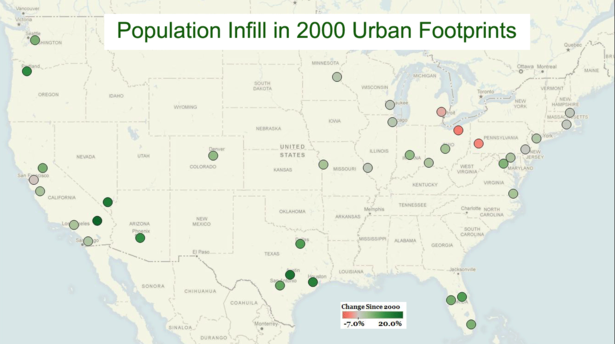
    In contrast, population losses since 2000 in the urban footprints of Cleveland, Pittsburgh, Detroit and San Francisco, means these urban areas experienced no population infill. San Francisco’s loss enabled San Jose to move into second position nationally after Los Angeles in the population density of its 2000 urban footprint.

    How the Core Cities Fared

    The core cities (municipalities) attracted, on average, their population share. Approximately 30 percent of the infill growth occurred inside the core cities. Even this figure may be a bit high, due to the impacts of annexation

    All of the infill in Philadelphia, Baltimore, Chicago, Providence and Minneapolis-St. Paul occurred outside the core cities. The city of Portland attracted barely 10 percent of its urban area infill, despite highly publicized (and subsidized) infill projects such as the Pearl District. Core cities attracted the largest share of infill growth in such diverse cities as San Antonio, San Jose, Columbus, Phoenix and New York.

    Note: Additional information available at http://www.demographia.com/db-uzafoot2007.pdf

    Wendell Cox is a Visiting Professor, Conservatoire National des Arts et Metiers, Paris. He was born in Los Angeles and was appointed to three terms on the Los Angeles County Transportation Commission by Mayor Tom Bradley. He is the author of “War on the Dream: How Anti-Sprawl Policy Threatens the Quality of Life.
  • Portland: A Model for National Policy?

    United States Secretary of Transportation Ray LaHood and Washington Post columnist George Will have been locked in debate over transit. Will called LaHood the “Secretary of Behavior Modification” for his policies intended to reduce car use, citing Portland’s strong transit and land use planning measures as a model for the nation. In turn, the Secretary defended the policies in a National Press Club speech and “upped the ante” by suggesting the policies are “a way to coerce people out of their cars.”

    These are just the latest in a series of media accounts about Portland, usually claiming success for its policies that have favored transit over highway projects as well as its “progressive” land use policies. Portland has also become the poster child for those who advocate planning restrictions and subsidies favoring higher density development in parts of the urban core.

    Indeed if Secretary LaHood has his way, Portland could become The Model for federal transportation policy. So perhaps it is appropriate to review what it has accomplished.

    Portland’s Mediocre Results

    Portland’s record of transit emphasis began more than 30 years ago, when the area “traded in” federal money that was available to build an east side freeway to build its first light rail line. The east side light rail opened in 1986. Since that time, Portland has significantly increased its transit service, especially opening three more light rail lines (West Side, North Side and Airport) as well as a downtown “streetcar.”

    Portland’s Static Transit Market Share: With these new lines and expanded service, Portland has experienced a substantial increase in transit ridership. Passenger miles have increased more than 130 percent since 1985, the last year before the first light rail line was opened. This is an impressive figure.

    However, over the same period, automobile use increased just as impressively. In 1985, approximately 2.1 percent of motorized travel in the Portland urban area was on transit and it remained 2.1 percent in 2007, the latest year for which data is available.

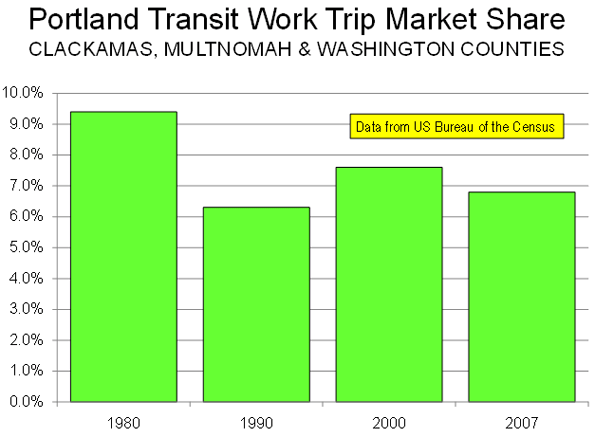
    Portland’s Declining Transit Work Trip Market Share: One of transit’s two most important contributions to a community is providing an alternative to the automobile for the work trip (the other important contribution is mobility for low income citizens). Work trip rider attraction is important because much of this travel is during peak periods, when roadways are operating at or above full capacity. In 1980, the last year for which data is available before the first light rail line opened, United States Bureau of the Census data indicates that transit’s work trip market share was 9.5 percent in the Portland area counties of Clackamas, Multnomah and Washington covered by Portland’s strong land use policies. Yet despite this, and the transit improvements, the work trip market share has not grown. By 1990, transit’s market share had dropped a third, to 6.3 percent. It rose to 7.6 percent in 2000 and by 2007 had fallen back to 6.8, despite opening two new light rail lines since 2000 (Figure 1). Remarkably, transit’s 2007 work market share was 28 percent behind its 1980 share and had fallen 10 percent since 2000.

    Figure 1:

    Yes, Portland did increase its transit use, but failed to increase the share of travel on transit and the proportion of people riding transit to work declined.

    Driving the Portland Evangelism: GHG Emissions

    Secretary LaHood’s affection for Portland appears to principally be that its policies can materially assist in the objective of reducing greenhouse gas (GHG) emissions. The data is available to test that claim.

    We examined GHG emissions per capita by transit in Portland and the urban personal vehicle fleet, including cars and personal trucks (principally sport utility vehicles). Overall, including upstream emissions (such as refining and power production), transit in Portland is about 50 percent more GHG friendly per passenger mile than the 2007 vehicle fleet. If all of the increase in transit passenger miles from 1985 to 2007 replaced automobile passenger miles, then reduction of approximately 50,000 GHG tons can be said to have occurred as a result in 2007 (though as is indicated below, things are not that simple).

    That sounds like a large number, until you consider that Portland traffic produces more than 8,000,000 GHG tons per year. Transit’s expansion has reduced GHG emissions by approximately 0.6 percent annually over 22 years. This pales in comparison to the 83 percent national reduction over a 45 year period that would be required by the Waxman-Markey bill being considered by Congress.

    The Cost of GHG Emission Reduction

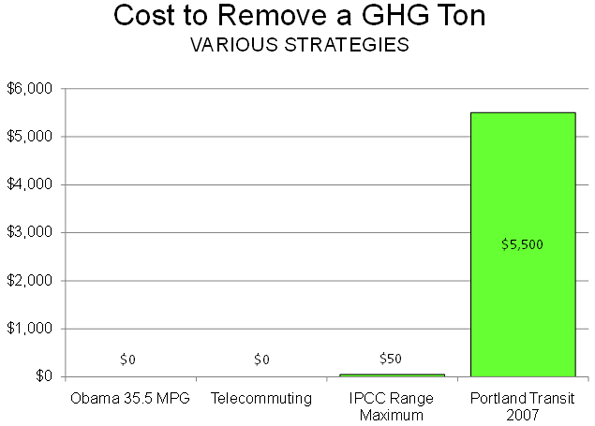
    Moreover, GHG emission reduction requires a context. Not all GHG emission reduction strategies make sense. Given the widely held principle that GHG emission removal must not hobble the economy, it is crucial that costs (per ton of GHG removed) be a principal criteria. If excessively costly strategies are employed, the result will be wasted financial resources, which will translate into diminished economic growth and higher levels of poverty. According to the United Nations Intergovernmental Panel on Climate Change (IPCC), between $20 and $50 per ton is the maximum amount necessary to accomplish deep reversal of CO2 concentrations between 2030 and 2050. It is fair to characterize any amount above $50 per ton as wasteful and likely to impose unnecessary economic disruption.

    Even that cost may be high. The current “market rate” is about $14 per ton, which appears to approximate the amount that figures such as former vice-president Al Gore, Speaker of the House Nancy Pelosi and California Governor Arnold Schwarzenegger pay to offset their GHG emissions from flying.

    Portland Costs of GHG Emission Reduction

    This $14 to $50 range provides the context for comparing the cost of GHG emission reduction through transit expansion in Portland. Annual transit costs in Portland more than tripled from 1985 to 2007 (including inflation adjusted operating costs and the annual capital costs of the light rail lines), an annual increase of more than $325 million. This figure is reduced to capture the consumer cost savings from reduced automobile gasoline and maintenance costs. The final result is a cost of approximately $5,500 per ton of GHG removed.

    This is 110 times the IPCC $50 maximum and nearly 400 times the Gore-Pelosi-Schwarzenegger standard. If the United States were to spend as much to remove each ton of the likely 83 percent national reduction target, the cost would be $30 trillion annually, more than double the gross domestic product. To call the Portland GHG cost reduction figure extravagant would be an understatement.

    Traffic Congestion Increases GHG Emissions

    There is not a one-to-one relationship between reduced driving levels and reduced GHG emissions. As traffic congestion increases, urban travel speeds decline and “stop-and-start” traffic increases, fuel consumption is reduced (miles per gallon declines). Some or even all of the supposed gain from reduced driving can be negated by the higher GHGs from traveling in greater traffic congestion.

    Portland’s traffic congestion has increased substantially since before light rail. Further, by 2007 Portland’s traffic congestion had become worse than average for a middle-sized urban area and worse than in much larger Dallas-Fort Worth, Atlanta, Philadelphia and Phoenix.

    Further, according to information in the Texas Transportation Institute’s Annual Mobility Report, the amount of gasoline wasted due to peak period traffic congestion in Portland rose 18,000,000 gallons from 1985 to 2005 (latest data available, adjusted for the population increase), simply due to greater traffic congestion. The increase in GHG emissions from this excess fuel consumption is estimated to be approximately 200,000 tons annually. This is four times the estimated reduction in GHG emissions that was assumed to have occurred from the increase in transit ridership.

    The bottom line: The Portland model inherently produces more congestion and increases GHG emissions. Failure to expand roadways to meet demand and forced densification increase traffic congestion.

    Better Models

    The ineffectiveness of Portland’s model strategies in GHG emission is in contrast to other strategies. Between 2000 and 2007, the share of people working at home in Portland rose more than one quarter. If transit and working at home should continue their 2000s rates, transit’s work trip share will be less than that of working at home by 2015. Working at home eliminates the work trip, resulting in substantial GHG emission reductions and does it at a cost of $0.00 per ton.

    Another approach is the Obama Administration’s automobile fuel efficiency strategy. About the same time as the LaHood-Will debate was heating up, the President announced that automobile manufacturers would be required to increase their corporate average fuel efficiency for cars and light trucks to 35.5 miles per gallon by 2016, a 75 percent performance improvement from that of the present fleet. If this fuel efficiency could be achieved in Portland today, the reduction in GHG emissions would be more than 40 percent. This new policy would eventually close 90 percent of the gap between personal vehicles and transit in Portland.

    President Obama indicated that this strategy is costless. The higher costs that consumers will pay for cars will be more than made up by the fuel cost savings. Thus, according to the President, this policy costs $0.00 per ton of GHG emissions removed, less than the IPCC’s $50 and less than Portland’s $5,500. Of course, it is not possible to achieve 35.5 miles per gallon now, but it will be (Figure 2).

    Figure 2:

    The best hybrid cars now achieve 50 miles per gallon, which makes them less GHG intensive than transit in Portland. President Obama has gone further, indicating the potential for developing 150 mile per gallon cars. The curtain could be rising on a future of cars that emit less GHG emissions per passenger mile than transit. People and officials genuinely concerned about GHG emissions should applaud these advances. On the other hand, people and officials who value coercive behavior modification more than GHG emission reduction are likely to resist.

    The Consequences of Coercing People Out of Cars

    Moreover, Portland policies ignore a crucial factor: how automobiles facilitate economic growth and employment. Generally, the research indicates that the economic performance of metropolitan areas is enhanced by greater mobility. Moreover, no transit system provides the extensive mobility made possible by the automobile, not in America and not even in Europe. Coercing people out of cars coerces some out of employment and into poverty.

    Even where transit service is available, it generally takes longer than traveling by car. In 2007, travel to work by transit took 3:50 (three hours and 50 minutes) per week longer than driving in the nation’s largest metropolitan areas. With all of Portland’s transit improvements, it still takes approximately 3:15 longer per week to commute by transit than by driving. It appears that Secretary LaHood would add more than three hours (time many don’t have) to our work trip each week.

    The Land Use Cost

    The second plank of The Model is strong land use regulation (smart growth), which economic research shows to materially increase house costs, which would lead to a lower standard of living.

    Time to Turn Off the Ideological Autopilot

    The policies of The Model Portland have no serious potential for reducing GHG emissions and could even make it worse. On the other hand, the rapidly developing advances possible from improved vehicle technology, something the Administration espouses, show great promise. Behavior modification a la The Model turns out not only to be undesirable, but also unnecessary.

    Wendell Cox is a Visiting Professor, Conservatoire National des Arts et Metiers, Paris. He was born in Los Angeles and was appointed to three terms on the Los Angeles County Transportation Commission by Mayor Tom Bradley. He is the author of “War on the Dream: How Anti-Sprawl Policy Threatens the Quality of Life.

  • Oregon Fail: With Hard Times Ahead for Business and Real Estate, It’s Time to Look Small

    There is something about Oregon that ignites something close to poetic inspiration, even among the most level-headed types. When I asked Hank Hoell recently about the state, he waxed on about hiking the spectacular Cascades, the dreamy coastal towns and the rich farmlands of the green Willamette Valley.

    “Oregon,” enthused Hoell, president of LibertyBank, the state’s largest privately owned bank, from his office in Eugene, “is America’s best-kept secret. If quality of life matters at all, Oregon has it in spades. It is as good as it gets. It’s just superb.”

    As developer Shelly Klapper, a rare skeptic in the Beaver State, reminded me: “This is a state that buys its own hype.”

    Hype or not, however, Oregon is hurting – something that’s clear to even the most self-respecting narcissist. Over the past year, Oregon’s economy has fallen off a cliff just about as fast as any state in the union.

    A year ago, things seemed very different. Sunbelt boom states like California, Arizona and Nevada were already heading into deep recession, but green Oregon seemed oddly golden. Both its small cites and one big town, Portland, were outperforming the national norms. Oregonians saw their state as better – not only in terms of green and good, but also in terms of basic job growth.

    But since last winter, Oregon’s unemployment rate has soared from barely 5.5% to well over 8%, the sixth worst in the nation. Indeed, according to a recent projection by the University of California at Santa Barbara (UCSB), Oregon’s jobless rate could reach close to 10% by the end of the year.

    Well into 2010, Oregon’s overall economy will shrink more rapidly than the nation’s as a whole, notes UCSB forecaster Bill Watkins. He traces a sharp downturn there to many factors, including one of the toughest regulatory regimes in North America.

    In tough times, companies generally expand in localities that are friendly to commerce – say, states like Texas or nearby Idaho. Few would rate Oregon highly in that regard.

    “Oregon is mostly a place that focuses on the enjoyment of its space, and that makes [it] very vulnerable in these conditions,” Watkins says.

    The other big problem has to do with a lack of economic diversity. Oregon has been through tough times before. For much of its history, the state’s economy depended largely on harvesting its vast forests. Then, in the 1980s, the state developed a green bug, and decided it shouldn’t chop down Mother Nature for a living.

    In the ensuing decade, Oregon pioneered tough land-use regulations, curbing industries that relied on forest products and declaring war on suburban sprawl. Its main city, Portland, became the poster child of the “smart growth” movement by forcing up density, building an extensive light-rail system and restoring its urban core.

    Although widely praised, these stringent regulations also drove up land prices and, ironically, prompted many middle-class residents to move away, including across the border into Washington. Businesses, rather than cluster in the state’s core, continued to migrate to the outer rings; in the relatively healthy year of 2005, for example, barely 10% of Portland’s office space growth took place in the central district.

    “We give lip service to the economy here,” admits Klapper, a longtime Portland entrepreneur and a former official with the Port of Portland. “But, really, business is not a priority here.”

    For a while, Klapper notes, the tech sector seemed to offer the solution. In the ’80s and ’90s, chip makers fleeing even higher costs in California flooded into Oregon, which was proudly dubbed the “Silicon Forest.” In an unusual move, the state provided tax breaks to the chip makers, which helped. The state’s suburbs also proved attractive to tech workers who could afford a far better quality of life there, in terms of schools and housing, than they could in the Golden State.

    But as regulations tightened and costs to businesses and families increased, even the high-tech industry began to fade. Always a political bellwether state, Oregon has moved inexorably left, increasingly dominated by both its public sector and the particularly strong green movement. Semiconductor expansion soon started to go south – or in this case, further east (to Idaho) or across the Pacific to Asia.

    Only one thing remained to drive the economy: housing. A torrent of Californians were heading north – cashing out of the overpriced Bay Area, Sacramento and Los Angeles – and buying new homes in Oregon. Some sophistos sashayed their way into trendy places like Portland’s Pearl District, but many others looked to the charming smaller towns of the Willamette Valley and central Oregon.

    “When all else failed, it was people moving here that kept us going,” says Klapper, who was a major investor in the Pearl District renaissance. “California became our biggest industry.”

    This dependence turned into a debilitating addiction. When in 2007, the great California housing bubble collapsed, the inflow of people and dollars dropped off. Meanwhile, the remnants of lumber industry fell victim to the housing bust.

    Nowhere are the effects of this clearer than in Bend, a spectacular town of 75,000 located amid volcanic peaks in the center of the state. Californians had considered Bend a favorite spot for second homes and relocation. About a year ago, notes real estate appraiser Steve Pistole, prices were rising 2% a month, while those in Portland were “only” rising 8% a year.

    But to visit Bend now is to be in the eye of the housing hurricane, with nearly deserted housing tracts, woefully empty hotels and residential second-home developments. Unemployment in the housing arena, according to the UCSB, could reach 15% next year.

    We can also expect a further slide in housing prices. Oregon’s bubble, notes analyst Wendell Cox, inflated later than California’s, so prices, which have dropped more than 10% in the last year, could fall by that much or more in the next.

    Yet despite all these problems, many Oregonians remain optimistic. Some of this seems, at least fundamentally, a reflection of ideology. The inevitable huge surge of “green jobs” promised by the Obama administration has long been an article of faith in the state; it seems something like a story we’d tell our children to put them to sleep. State officials, for example, speak wistfully of replacing a recently shuttered Korean-owned Hynix chip plant with a facility to make solar panels.

    The bad news is this: 49 other states – some of which don’t pose such strong regulatory challenges – also hope to bring home some of these green jobs. So if business logic applies, the new factories that manufacture wind turbines, propellers or solar panels will end up in states like North Dakota or Texas, which have been the most successful, thus far, at attracting other manufacturing jobs.

    So what trail should Oregon blaze now? Pistole, the real estate appraiser, says it may be time to think small. Places like Bend, he notes, already attract former Silicon Valley veterans who like living close to trout streams, hiking trails and golf courses.

    “There is no magic bullet for Oregon,” says Pistole, who himself moved from California just three years ago. “But there could be lots of onesies, twosies, mom-and-pops. People still want to live here. We have to make it synergistic to live where you want and still make money. That’s the way we need to go.”

    Some entrepreneurs, like 38-year-old Michael Taus, are already setting up such small shops, some of them in their homes. A recent arrival from Los Angeles, Taus made it big as one of the founders of Rent.com, which was sold to eBay in 2005. He’s only lived in Bend for a few months, but he has already launched his own start-up and consults for several other local firms.

    Taus believes others of his generation will want to establish businesses in Oregon, lured by both its lifestyle and affordability. Some of the new business may be in software, Taus says, but others could sprout in specialty agriculture, wood products and other industries.

    “People are here for a reason. There’s a good amount of talent, and you can get more here,” he says earnestly. “There’s a great potential. We just have to get down to business.”

    This article originally appeared at Forbes.

    Joel Kotkin is executive editor of NewGeography.com and is a presidential fellow in urban futures at Chapman University. He is author of The City: A Global History and is finishing a book on the American future.

  • Oregon’s Immigration Question: Addressing the Surge in the Face of Recession

    The men huddle outside the trailer, eyeing the passing traffic. Handmade signs stapled to telephone posts speak for them: “Hire a Day Worker!” The site, a fenced-in lot at Northeast MLK and Everett Street, was launched in 2007, a testament both to Oregon’s recent immigration boom and lack of federal reform.

    Since then, Obama’s historic campaign, several wars and a global recession have pushed the immigration question from the national headlines. But in Oregon – where the surging migrant population is on a crash course with a withering economy – the issue is bound to reignite.

    Oregon’s economic boom, which started later than that in the rest of country, has ended. Unemployment has risen considerably. Oregon’s 9.0 percent unemployment rate was the nation’s 6th worst in December 2008 according to the Bureau of Labor Statistics.

    At the eye of the storm have been losses in the construction industry, a major employer of immigrants. The hard times there will put new pressure on local legislators and law officials to “clean out immigrants”. Oregonians should not give in to such misguided temptations. Oregon’s immigrants have played a historic role in enriching the state’s economy and can continue to do so if given the opportunity.

    Oregon’s immigration explosion is relatively new. The state’s foreign-born make up 9.5 percent of the population, with more than 60 percent of the immigrant population arriving after 1990, according to 2005 census data.

    The influx of Latinos to the state is even more recent. Estimates place 75 percent of Latinos coming between 1995 and 2005. Unlike other immigrants who tend to concentrate to urban and suburban areas, Latinos are dispersing across Oregon. Between 1990 and 2000, the Latino population doubled in 21 of Oregon’s 36 mostly-rural counties. Agriculture employment, cheap housing, and existing Latino communities attract the rural migration.

    Within the Portland metro area, the largest concentrations of foreign-born population live in Southeast Portland (Ukrainians, Russians, Romanians), Northeast Portland (Vietnamese, Africans), and Central Portland (Asians, Eastern Europeans), according to a study by the Urban Institute. Notably, more Russians and Ukrainians moved to Oregon’s suburbs between 2000 and 2005 than to any other region in the nation, according to a recent University of Oregon study.

    Currently, immigrants total over 11 percent of the state’s labor force, up from 5.4 percent in 1990. Yet native unemployment did not increase during this time period.

    One reason for this, argues MIT’s Tamar Jacoby in a recent Foreign Affairs article, is that the immigrant workforce should be viewed as complementary rather than competitive to the native workforce. For example, the business owner who can hire housekeepers and landscapers can devote more time to growing his business, and to leisurely expenditures that support other local businesses.

    Oregon’s diverse agricultural industries – ranking third nationally for labor-intensive crops – offer a more concrete example of the complimentary nature of immigrants.

    The state is home to a $325 million dairy and cattle milk production industry, a $778 million nursery and greenhouse industry, a $380 million fruit and nut industry, and a $200 million wine industry. All are primarily staffed by immigrants. In this case, immigrant labor allows Oregon’s agricultural sectors to thrive in the face of fierce import competition.

    Immigrants have historically had a strong entrepreneurial spirit. Nationwide, 25.3 percent of technology and engineering companies had at least one foreign born key founder, based on a Duke University study. Often with few resources or formal education, immigrant entrepreneurship can foster new kinds of services. The abundance of landscaping businesses and nail salons is a testament to such ingenuity. In 2005, over 6,000 Latino and 400 Slavic entrepreneurs operated throughout the Portland metro area, according to one University of Oregon study.

    Beyond providing jobs and fueling local economies, immigrant entrepreneurs bring the benefits of globalization to places like Oregon. They encourage trade and investment from their connections abroad.

    Immigrants pay taxes, buy houses, food, cars, and clothes just like native residents. Even illegal immigrants – which many immigration-demagogues label as the real problem – have taxes withheld from their paychecks. They also otherwise bring money to the state through sales taxes on local purchases. A study by the Oregon Center for Public Policy found that undocumented immigrants contribute between $134 million and $187 million in taxes annually to Oregon’s economy. These numbers represent only those coming from undocumented workers and exclude the significant investments made through entrepreneurship, agricultural support and the continual purchase of goods and services.

    Yet serious immigration reform is needed. A large portion of immigrants spends only stints working in the states, frequently sending money back home. The consequences of this go beyond the obvious fiscal drain. The stint worker will invest minimally in learning English, will often share rent in decrepit neighborhoods, and spend as little as possible in order to maximize savings for abroad.

    The problem facing Oregonians is not immigration per se – or even illegal immigration, which constitutes only 10 percent of the migration to the state. The real problem is stint immigrants, who invest little in the long-term health of their new communities and the economy of the state.

    The curious delusion about this point is that current federal legislation includes temporary-worker permits as key to reform. By giving only temporary permits to immigrants who might otherwise be coaxed into permanent stay, Washington is explicitly discouraging acculturation and encouraging capital drains.

    In large part, the real solution to the downsides of immigration lies in the permanent integration of Oregon’s new residents. When these residents feel they may be here permanently – without constant threat of deportation – they will be more likely to invest in their new communities and futures.

    Even the state’s recent job-shedding should not derail Oregonians’ historic acceptance of foreign residents. Oregon’s immigrants will stabilize agriculture and other service industries by providing cheap labor through hard times.

    If the incoming administration manages the recession correctly, Oregon’s economy will soon recover. To rebound quickly, the state will need to employ thousands – natives and immigrants – in the infrastructure and Green packages coming from Washington. Oregon’s post-recession economy, like its pre-recession economy, will depend on immigrant labor.

    A comprehensive understanding of Oregon’s immigration question must go beyond viewing the huddle of men on MLK and Everett every morning as mere numbers, bodies for pay.

    A true understanding of the issue will surface only by looking beyond the numbers to recognize these men’s potential, resourcefulness and culture as indispensable components that once shaped our nation’s identity and will continue to mold its future.

    Ilie Mitaru is the founder and director of WebRoots Campaigns, based in Portland, OR, the company offers web and New Media strategy solutions to non-profits, political campaigns and market-driven clients.

  • Portland and L.A: Not Exactly Long-Lost Brothers

    One of these cities is the perennial Cinderella to urban planners; the other the ugly sister who always crashes the party. One is the well-planned “City of Roses” (no, not Pasadena), a bastion of mass-transit and controlled development along the Columbia River while its gargantuan sister to the south eschews all such enlightened principles.

    That’s the gist at least from this paean to Portland in the LA Times today about what the city could learn from its lithe Northern cousin.

    A few key differences between these two:

    • The vast majority (90%) of job growth in Portland has been in the suburbs

    • Portland is actually far less dense than LA

    • It has a tiny population of immigrants and poor vis-a-vis LA

    • The city is losing families and children and rivals San Francisco for having the lowest percentage of its population under the age of 18 of any major U.S. city.

    And he doesn’t mention Portland’s greatest comparative advantage to LA: amazing beer!

    One thing both cities have in common right now: two of the most dynamic music scenes in the country.

    —-

    Here’s Joel Kotkin’s piece about Portland a few years ago.