Tag: rail

  • Honolulu Rail Costs Balloon, Ridership Projections Called High

    Hawaii Governor Linda Lingle has released an independent analysis of the proposed Honolulu rail program to the public and to elected officials. The report was commissioned by the state Department of Transportation. Infrastructure Management Group, CBRE Richard Ellis and Thomas A Rubin performed the equivalent of a “due diligence” report on the project, and according to the Honolulu Star-Advertiser, indicated that the project would rise in cost by $1.7 billion to $7.0 billion for the 20 mile long line.

    In addition, the consultants indicated that operating subsidies could be substantially higher than forecast, and that the city of Honolulu could become saddled with heavy debt by the project. Further, the consultants noted the likelihood that ridership projections might not be met.

    Post-rail transit system usage and fare revenue are likely to be substantially lower than that projected in the current Financial Plan, since the Plan’s projection would require an unprecedented and unrealistic growth in transit utilization for a city that already has one of the highest transit utilization rates in the country.

    The findings of cost escalation and over-projection of ridership have been noted as a fairly routine occurrence in international infrastructure research.

    —–

    Note: Honolulu rail project planning documents indicated greenhouse gas emission reductions as a benefit of the project. Demographia published an analysis indicating that the impact on greenhouse gas emissions either a marginal increase or a marginal decrease depending upon performance. It was projected that any reduction would have been at costs per ton many times above international standards.

  • Soccer Moms Against Rail Transit in Tampa

    On election day, the voters of Hillsborough County, Florida (Tampa) will vote on a one-cent sales tax that would fund transit (75%) and roads (25%). Part of the funding would be used to build a new light rail line, which is the focus of campaigns on both sides.

    The proponents are the usual well financed coalition of business, rail construction companies and consulting engineers, who could well profit from the program going forward.

    The opposition, however, is unusual. It is a direct outgrowth of the growing citizen involvement from the TEA Party and 912 Project. These groups have broken new ground in raising general issues of government waste and public expenditure policy. This could be an important step toward balancing the spending proclivities of special interest groups with taxpayer interests in spending no more than is necessary to provide essential public services.

    In Tampa, the rail opposition goes by multiple names, including “No Tax for Tracks” and Smartmoms. The more interesting of the terms is Smartmoms, or “Suburban Moms Against the Rail Tax.” They might have just as accurately called themselves “Soccer Moms Against the Rail Tax,” reflecting the demographic that has been so important in recent elections.

    I recall being told by a disappointed former federal official that one of his greatest disappointments was to learn that there was no constituency for economic efficiency. This may be changing, if the developments in Tampa are any indicator.

    I had the privilege of speaking at one of their rallies recently and wonder whether Tampa might represent a new birth of citizen questioning of large spending projects. Their revulsion at the “if we don’t take the federal money, Baltimore will” line of thinking was refreshing. One key to restoring a more prosperous America will be to minimize this mutual plunder, by which Washington seduces local areas to buy things they never would with their own money. A new day could be dawning.

    —-

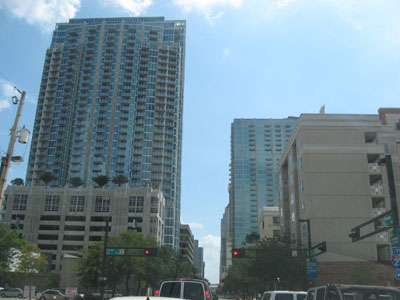
    Photo: Downtown Tampa (by the author)

  • California’s Cities Should Look to Oxfordshire

    California, now in the midst of a heated debate on high-speed rail, could learn a thing or two from a few small villages in England about consolidating their opposition. Residents from five villages in Oxfordshire created the Villages of Oxfordshire Opposing HS2 (High-Speed Rail 2) action group to voice their concerns about the proposed project.

    HS2 would link London and Birmingham by 2025, going through Finmere, Mixbury, Fingford, Fulwell, and Newton Purcell in north Oxfordshire. Not only would the rail line greatly alter the countryside landscape, but it would also create an immense amount of noise pollution. Trains would run through these villages at 250 mph about every three minutes. On top of that, rail authorities are giving out little information to citizens who are growing frustrated.

    The Chairman of Villages of Oxfordshire Opposing HS2, Bernie Douglas, wants the group to influence rail authorities to route the line away from the area and raise awareness about the detriments of a high-speed rail line in the countryside. He has certainly succeeded in the latter goal. The group’s meeting in April drew more than 80 people from an area with only 100 homes. However, their efforts for the former cause have been largely in vain. Transport Minister Phillip Hammond and HS2 Ltd, the company behind the project, have not responded to the group’s letters.

    There is hope for Oxfordshire, though. A spokesman for the Department of Transport claims that “No final decision will be made on whether to proceed with a high-speed rail line or on its route until any scheme has undergone a full public consultation.” If this is true, it is almost certain that the rail line will not run through Oxfordshire.

    Cities on the Peninsula have similarly started to band together to oppose the California Rail Authority, who has decided against using the much preferred trench system to cut costs, but opposition remains scattered throughout many different groups. Lawsuits from a few cities and organizations have driven the authority to reconsider the trench system, but the project seems like it will continue to progress, much to the dismay of many unhappy California residents.

    Palo Alto, Menlo Park, and Atherton, who are at the forefront of the opposition, need to gather support from other cities on the Peninsula to truly affect the future of high-speed rail in the state. It is easy for the California Rail Authority, backed by Governor Schwarzenegger, to defend its position from a few cities, but a united Peninsula coalition would be a tough obstacle to overcome. Maybe Burlingame, San Mateo, and their neighbors should take a page out of the book of Oxfordshire and use collective action to more effectively voice their concerns.

  • Commuter Rail Brings Slower Transit in Austin

    Commuter rail is often sold to the public as a faster means of travel than buses. This can be true if the drive to the park and ride lot is short and your destination is within walking distance of a station. However, it is apparently not true in Austin.

    The Austin American-Statesman reports that bus riders showed up at a Capital Metro hearing this week to oppose cancellation of two express bus routes that parallel the new commuter rail line. Their complaint? Taking the train takes longer.

    As has become typical for new urban rail projects, Austin’s commuter rail line is carrying considerably fewer riders than projected. During its first month of service, daily ridership averaged 900 (450 each way), less than one-half the projected 2,000. This is less than 1/100th of Capital Metro’s daily bus ridership.

  • Transit in Los Angeles: Celebrating the Wrong Thing

    Los Angeles area transit officials celebrated 20 years of urban rail at a Staples Center event on July 23. Over the past 20 years, Los Angeles has opened 2 metro (subway) lines, 4 light rail lines and two exclusive busways (though apparently busways aren’t worth celebrating). Surely, there is no question but that Los Angeles has been successful in opening a lot of new transit infrastructure.

    At the same time, however, The Los Angeles Times reported that Professor James Moore of the University of Southern California, blames the disproportionate financial attention paid to rail projects reduced transit ridership by 1.5 billion (with a “b”) over the same period. The reason is, as Tom Rubin put it, is that many more people can be carried for the same money on buses, “Had they run a lot of buses at low fares, they could have doubled the number of riders.” Rubin was chief financial officer of the Southern California Rapid Transit District, one of the two predecessors of the present transit agency (MTA). The other was the Los Angeles County Transportation Commission, to which I was appointed to three terms.

    Transportation experts were also quoted to the effect that the rail system has done little to reduce traffic congestion or increase the use of mass transit much beyond the level in 1985, when planning for the Metro Blue Line began. Indeed. Traffic congestion has gotten much worse, and traffic volumes have increased materially. Our recent article showed that transit market shares had declined.

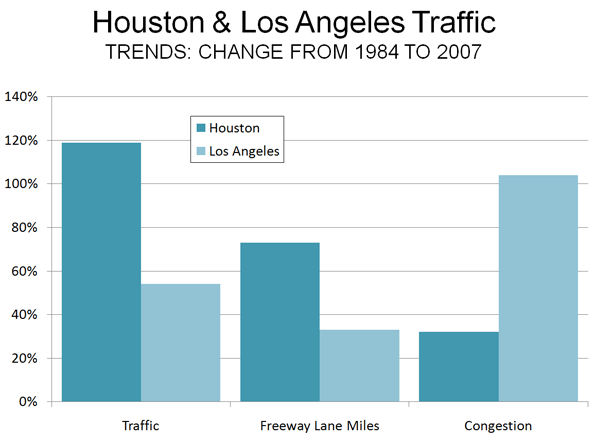
    These results are in stark contrast to Houston, which in 1984 had the worst traffic congestion in the nation. Houston set about to solve the problem by expanding its roadway capacity. Since 1984, Houston’s traffic grew twice as fast as that of Los Angeles, and population grew three times as fast (at least in part because many Californians were moving to Texas). Houston also added freeway mileage at double the percentage rate of Los Angeles. The reward was an increase in traffic congestion less than one-third that of Los Angeles (Figure). The most recent INRIX Scorecard shows Los Angeles traffic congestion to be more than 2.5 times as intense as Houston’s.

    Spending money on the right things makes a big difference. One can only wonder how different things might have been if Los Angeles had invested in the capacity people need (more roads) rather than in politically correct transit facilities that have no potential to reduce traffic congestion or to improve mobility and economic performance.

    There is a lesson from Los Angeles experience both for other areas and other government functions. The test of government performance is outputs, not inputs. Thus, it is appropriate to celebrate large transit market share increases or significant improvements in student achievement, not how many miles of rail are built or how much money is spent on education.

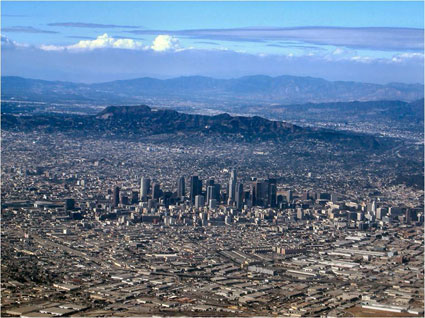
    Photograph: Los Angeles and the San Fernando Valley (by the author)

  • The Fifth Estate Clarifies US Driving and Transit Figures

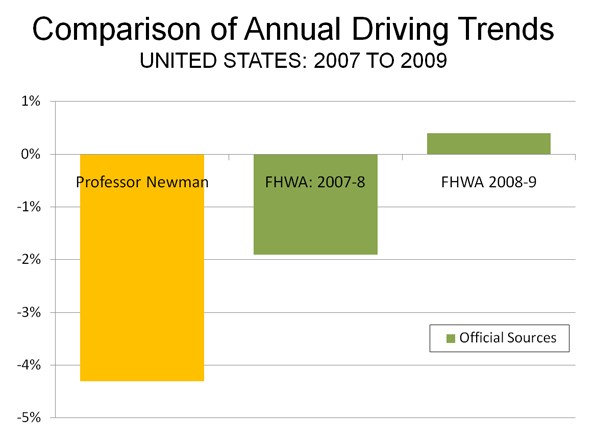
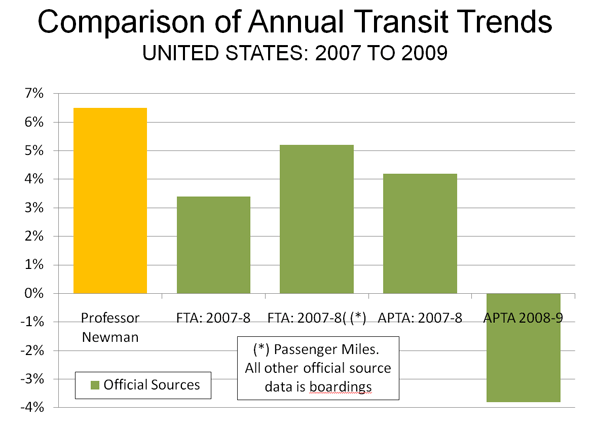
    Late on July 26 (Washington time), The Fifth Estate corrected the attribution by Professor Peter Newman of Curtain University to the effect that driving was down 43% and transit up 65% in the United States. This issue had been the subject of my column on the same morning. It was a simple decimal error (in the reporting) and has now been corrected on the site. Driving is now reported as being down 4.3% and transit up 6.5%. Professor Newman provided slides with the data to Ms. Tina Perinotti, who forwarded them to me.

    While the new figures are less inconsistent with the official figures than the former, there are still material inconsistencies.

    Driving Trend: Official Data: The slides provided simply refer to the two figures as relating to the past year, without a source or specific period. The 4.3% driving decline is more than double the largest annual decline reported by the official source for such information, the Federal Highway Administration (Figure 1).

    Transit Trend: Official Data: We reviewed the data published from the official sources for transit data (the American Public Transportation Association and the Federal Transit Administration) and found no recent annual data indicating a 6.5% increase in ridership (either in boardings or in passenger miles). Much of the transit ridership gain from 2007 to the peak year of 2008 was lost in 2009, according to data posted by APTA in early March (Figure 2). A later first quarter report by APTA indicates further losses. Moreover, as we indicated in our article, the percentage decline in transit use since the peak year of 2008 is many times that of the decline in driving.

    Not All Percentages Are the Same: Care must also be used in comparing percentage changes between transit and driving, because so little travel is on transit. For example, a one percent increase in roadway urban travel converts to about one-third of a mile per person per day. A one percent increase in transit use converts to about 30 feet per person per day, about the same distance as walking from one side to the other of the average bedroom and back.


    Note: It is possible that the 4.3% driving decline was taken from an interim Federal Highway Administration report indicating that driving declined 4.3% in March 2008 compared to March 2007 (a monthly comparison, not a year on year comparison). This FHWA report, however, is subject to annual revision based upon the more comprehensive Highway Performance Monitoring System, which in 2009 revised the March 2008 such that the annual change became 2.7%.

  • CA State Treasurer Skeptical of High-Speed Rail

    California High Speed Rail officials and the Governor’s office seem to be suffering from selective hearing. Lawmakers and experts at the University of California’s Institute of Transportation continue to challenge the high-speed rail project’s viability due to precarious statistical projections on ridership and cost. One wonders if developers will reconsider upon hearing California treasurer Bill Lockyer’s recent criticisms.

    Lockyer’s first major issue lies with the basics: the ability to raise enough capital from private sources needed to complete the project. The Rail Authority claims it would need $10 to $12 billion from private investment alone, although some analysts think that, like most of the monetary figures associated with the rail line, this number will ultimately grow. Investors are reluctant to fund such a risky venture, as nothing proposed in this project has proven stable or certain. If investors do indeed close their checkbooks, there is no way the Rail Authority will complete the project.

    Lockyer doesn’t think selling the idea in smaller chunks would work either. He questions the willingness of anyone to buy state bonds for the HSR, even though voters approved $9.95 billion worth in November 2008.

    Despite these reservations, Governor Schwarzenegger is protecting the funding promises made in the 2008 ballot measure. The Rail Authority is also ignoring the warnings of Lockyer and others. They are also trying to start building in the Bay Area in order to meet deadlines for federal funding. But the way things are going, it looks as if federal funding is all they will get. As more and more powerful people add their names to the list of skeptics, the high-speed rail line seems that much closer to complete failure.

    Rather than overriding their critics and spending money they may not get, the Rail Authority should invest in consumer confidence. They need more concrete plans and more promising statistics to create a market for this line because right now, most think the project will turn out to be nothing more than a huge budgetary debacle.

  • University of California Report Calls Cambridge Systematics High-Speed Rail Ridership Forecast Unreliable

    A just-released report by the Institute of Transportation Studies at the University of California-Berkeley finds that the ridership projections prepared by Cambridge Systematics (CS) for the California high speed rail system are “not reliable.”

    Authors Samer Madanat (director of ITS-Berkeley and a professor of civil and environmental engineering), Mark Hanson (UC-Berkeley professor of civil and environmental engineering) and David Brownstown (chair of the Economics Department at UC-Irvine) essentially reported that the projections had such large error margins that the system could either lose a lot of money or make a lot of money:

    … the combination of problems in the development phase and subsequent changes made to model parameters in the validation phase implies that the forecasts of high speed rail demand-and hence of the profitability of the proposed high speed rail system-have very large error bounds. These bounds, which were not quantified by CS, may be large enough to include the possibility that the California HSR may achieve healthy profits and the possibility that it may incur significant revenue shortfalls.

    Biased High Speed Rail Projections: Given the overwhelming history of upwardly biased ridership and revenue projections in major transport projects, it seems far more likely that reducing the margins of error would produce projections with much smaller ridership numbers and major financial losses. Major research by Oxford University professor Bent Flyvbjerg, Nils Bruzelius (a Swedish transport consultant) and Werner Rottenberg (University of Karlsruhe and former president of the World Conference on Transport Research) covering 80 years of infrastructure projects found routine over-estimation of ridership and revenue (Megaprojects and Risk: An Anatomy of Ambition). The evidence is so condemning that Dr. Flyvbjerg has referred to the planning processes for such projects as consisting of “strategic misrepresentation” and “lying” (his words) to advance projects that might not otherwise be implemented.

    Broad Concern about the Reliability of California High Speed Rail Projections: The University of California report joins other reports that have questioning the veracity of the Cambridge Systematics projections. During the run-up to the 2008 statewide bond issue, the California Senate Transportation and Housing Committee, chaired by Senator Alan Lowenthal (D-Long Beach) indicated concerns. Illustrating continuing concerns, the committee commissioned the University of California study.

    Doubts have been expressed by the California Legislative Analyst and the California State Auditor. The Reason Foundation Due Diligence Report, authored by Joseph Vranich and me in 2008 estimated the ridership projections to be at least 100% high (see High Speed Rail: Untimely Extravagance presented at the Heritage Foundation last week in Washington).

    Investment Grade Projections Far Lower: The Cambridge Systematics ridership projections publicized that were used in the statewide bond election were more than 150% above the “investment grade” projections that had been produced by Charles Rivers Associates for the California High Speed Rail Authority a decade ago. Even “investment grade” projections can be high, as the recent bond default and bankruptcy of the Las Vegas Monorail indicates. In that case the “investment grade” ridership projections were 150% above the actual achieved average, nonetheless bond holders lost their investments. (Our 2000 report accurately projected the Monorail ridership).

    Undermining GHG Emissions Reduction Claims: Meanwhile, the California high speed rail proposal has come under criticism with respect to its environmental claims. The high speed rail line has been promoted as a means for reducing greenhouse gas (GHG) emissions in the state. Yet another recently released University of California report indicates that it could take as long as 71 years to save enough GHG emissions by attracting airline passengers and drivers to cancel out the emissions produced in constructing the project. More defensible ridership projections could lengthen this period considerably.

    Response to Criticism: The body of the University of California high speed rail study is 10 pages, followed by approximately 40 pages of comments and response by Cambridge Systematics and a letter from the California High Speed Rail Authority requesting that the University of California authors to consider the comments. This review is performed by the University of California authors, as they reject virtually all Cambridge Systematics criticisms in the final four pages of the report.

    Photograph: Cover of Megaprojects and Risk: An Anatomy of Ambition

  • Curbing Euro-Envy

    Times are tough in the newspaper business. For example, The New York Times used to have a robust fact-checking department. Either the staff has been laid off or maybe they can’t keep up with the errors, either of which could explain the op-ed piece “Europe Energized.”

    Hill’s piece is classic cheerleading. He would have us believe that Europe has significantly reduced its reliance on oil, as its governments have enticed the citizenry out of cars and into mass transit and planes. Starting with the contention that Europe has the same standard of living as the United States, he indicates that Europe has made much greater progress in reducing energy use and carbon emissions.

    In fact, Europe does not enjoy the same standard of living as the United States. In 2009, the gross domestic product (purchasing power parity) was approximately one-third less ($14,000 less). For most households in Europe and the United States, that is a not an inconsequential amount of money. One reason for Europe’s lower rates of energy consumption is its historically lower income levels.

    Hill claims substantial reductions in oil consumption relative to the United States. However, Europe has not sworn off oil. Indeed, according to International Energy Agency (IEA) data, Europe’s oil consumption per capita dropped only marginally more than that of the United States between 1980 and 2006. Nor has Europe done a better job of becoming more energy efficient. Measured in tons of oil equivalence, the United States has reduced its per capita energy consumption more than Europe since 1980, again based upon IEA data. It is, of course, easier to reduce oil consumption with near static population growth.

    EU data indicates that mass transit’s market share in Europe has been declining for decades (like in the United States). Further, despite all the new high speed rail lines, cars and airplanes have accounted for the greatest travel increases. In 1995, airplanes carried a slightly smaller volume (passenger kilometers) than passenger railways, including high speed rail. By 2008, airlines were carrying 37% more passenger kilometers than rail, despite a huge expansion of high speed rail. Since 1995, at least 15 passenger kilometers have been traveled by car for every additional passenger kilometer traveled by rail, high speed or not. Meanwhile, Europe’s truck dependent freight system is less fuel efficient than America’s, which relies to a greater degree on freight railroads.

    None of this is to suggest that Europe does not lead the United States in some fields. There is no question that cars get much better mileage in Europe. By 2020, new cars are scheduled to achieve more than 60 miles per gallon, which is near double the US expectation. Europe is leading the way in automobile fuel efficiency and is demonstrating the massive extent to which improved fuel efficiency can accomplish tough environmental goals.

    Yet, curiously, no interest has been expressed by the Euro-Envious to implement European highway speed limits. Recently, Italy raised maximum speeds on some roads to 93 miles per hour, France, Austria, Denmark, Slovenia and others have 81 mile per hour limits and there are no speed limits on much of the German autobahn system. No US speed limits are this high.

    Having happily lived both within the pre-1200 (AD) boundaries of Paris and the urban fringes of four major US urban areas, it seems that both sides of the Atlantic have their strengths and weaknesses. Detailing them requires getting the facts right.
  • Rail Transit Expansion Reconsidered

    More than two years ago we suggested in these pages that the era of multi-billion dollar system-building investments in urban rail transit is coming to an end. We wrote: “The 30-year effort to retrofit American cities with rail infrastructure, begun back in the Nixon Administration, appears to be just about over. The New Starts program is running out of cities that can afford or justify cost-effective rail transit investment. To be sure, federal capital assistance to transit will continue, but its function will shift to incrementally expanding existing rail networks and commuter rail services rather than embarking on construction of brand new rail systems.” (“Urban Rail Transit and Freight Railroads: A Study in Contrast,” February 18 2008).

    Now comes a startling new revelation from a senior U.S. DOT official that even rail extensions may be at risk. Speaking at a National Summit on the Future of Transit before an audience of leading transit General Managers on May 18, Federal Transit Administrator Peter Rogoff questioned the wisdom of expanding rail networks when money is badly needed to maintain and modernize existing facilities:

    “At times like these, it’s more important than ever to have the courage to ask a hard question: if you can’t afford to operate the system you have, why does it make sense for us to partner in your expansion? If you can’t afford your current footprint, does expanding that underfunded footprint really advance the President’s goal for cutting oil use and greenhouse gases… Or are we at risk of just helping communities dig a deeper hole for our children and our grandchildren?”

    In Rogoff’s judgment, the first priority for the transit industry is to follow the precept “fix it first.” “Put down the glossy brochures, roll up our sleeves, and target our resources on repairing the system we have,” he told the assembled transit officials. Transit systems that don’t maintain their assets in a state of good repair risk losing riders, he warned. The Administrator cited the preliminary results of an FTA study of the financial needs of 690 public transit systems across America that show a $78 billion backlog of deferred maintenance. Fully 29 percent of all transit assets are “in poor or marginal condition.” The challenge facing transit managers is to resist the siren call of new construction and devote money to the “unglamorous but absolutely vital work of repairing and improving our current systems.”

    At first blush Rogoff’s position would appear to go counter to the Administration’s announced policy of favoring public transit. Hasn’t Transportation Secretary Ray LaHood repeatedly championed public transit as an alternative to highway expansion? Hasn’t the Administration’s proposed Fiscal Year 2011 budget include major commitments to funding new rail lines in Denver, Honolulu, Minneapolis and San Francisco? Hasn’t the Federal Transit Administration dropped the former emphasis on cost-effectiveness as an evaluation factor in rail project selection in favor of a broader range of factors? All true.

    But fiscal realities can do wonders to bring federal officials down to earth. The Transit Account of the Highway Trust Fund is barely solvent. The U.S. DOT budget will grow by only one percent in 2011. With commendable consistency and fairness, the Administration seems to have decided to apply the same investment standard to transit as it has preached and laid down for highways: Forget about massive capacity expansion; focus on getting the most out of the assets already in place by maintaining them in a state of good repair. To critics of the DOT’s new posture – and there will be some – a good answer could be: It’s just a different way of looking at what it means to be pro-transit.