Tag: Recession

  • Time Magazine Gets it Wrong on the Suburbs

    Time Magazine’s Sam Frizell imagines that the American Dream has changed, in an article entitled "The New American Dream is Living in a City, Not Owning a House in the Suburbs." Frizell further imagines that "Americans are abandoning their white-picket fences, two-car garages, and neighborhood cookouts in favor of a penthouse view downtown and shorter walk to work." The available population data shows no such trend.

    Frizell’s evidence is the weak showing in single family house building permits last month and a stronger showing in multi-family construction.

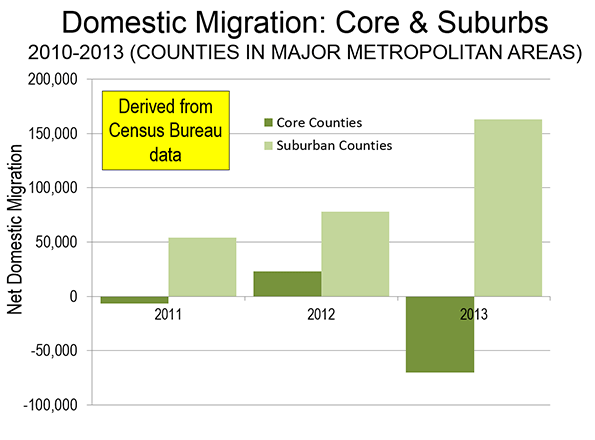
    This is just the latest in the "flocking to the city" mantra that is routinely mouthed without any actual evidence (see: Flocking Elsewhere: The Downtown Growth Story). The latest Census Bureau estimates show that net domestic migration continues to be negative in the core counties (which include the core cities) of the major metropolitan areas (those with more than 1,000,000 residents). The county level is the lowest geographical level for which data is available.

    At the same time, there is net domestic inward migration to the suburban counties. Moreover, much of the net domestic migration to metropolitan areas has been to the South and Mountain West, where core cities typically include considerable development that is suburban in nature (such as in Austin, Houston and Phoenix). As the tepid "recovery" has proceeded, net domestic migration to suburban counties has been strengthened (see: Special Report: 2013 Metropolitan Area Population Estimates), as is indicated in the Figure.
    There is no question but that core cities are doing better than before. It helps that core city crime is down and that the South Bronx doesn’t look like Berlin in 1945 anymore. For decades, many inclined toward a more urban core lifestyle were deterred by environments that were unsafe, to say the least. A principal driving force of this has been millennials in urban core areas. Yet, even this phenomenon is subject to over-hype. Two-thirds of people between the ages of 20 and 30 live in the suburbs, not the core cities, according to American Community Survey data.

    To his credit, Frizell notes that the spurt in multi-family construction is "not aspirational," citing the role of the Great Recession in making it more difficult for people to buy houses. As I pointed out in No Fundamental Shift to Transit: Not Even a Shift, 2013 is the sixth year in a row that total employment, as reported by the Bureau of Labor Statistics was below the peak year of 2007. This is an ignominious development seen only once before in the last 100 years (during the Great Depression).

    In short, urban cores are in recovery. But that does not mean (or require) that suburbs are in decline.
  • What Jobs?

    According to the Bureau of Labor Statistics, there were 290,000 more jobs in the US this month than there were last month. Twenty percent of those jobs were added by the federal government. While the federal government added 69,000 new jobs last month, every other level of government – including the post office – cut an average of 2,250 jobs. State governments were hardest hit last month, cutting 5,000 jobs.

    Since April 2009, the federal government has added 119,000 jobs while state and local governments cut 215,000 jobs.

    Compared to April 2009, more than 500,000 jobs have been added in employment services. Another 329,000 jobs were added in the healthcare industry. These must be the “green shoots” that we were so looking forward to last summer because the overall economy lost 1,380,000 jobs in the last year.

    Eighty percent of the jobs increase last month was added in the private sector. Of the jobs created in the private sector, only 22 percent were in goods producing industries; about half of the goods producing jobs added in the last month can be attributed to the bailout of the auto industry. In the last 12 months, the U.S. civilian population increased by 2.1 million persons. The labor force has remained about constant at 154.7 million. The difference – explained in the details of today’s jobs report – is attributable to discouraged workers, involuntary part-time workers, and marginally attached workers.

  • Drew Carey and John Stossel Tell Cleveland to Learn From Houston

    What started as a humble video segment for Reason TV has mushroomed into a lot of positive PR for Houston (and less than positive for Cleveland).  It started with famous actor and comedian Drew Carey working with the libertarian Reason Foundation on a video series about saving Cleveland, his hometown.  Houston is held up as a “best practice” example for land use regulation.  There are lots of suggestions and positive comparisons to Houston on red tape (minutes 29:20 thru 32), zoning (37:30), and opportunity (47:50). Yours truly has a short cameo at 38:55. (If you want to be able to jump around, the trick is to start playing it, then hit Pause. You’ll see the grey loading indicator continue to download the video. Come back later after it’s fully loaded and you’ll be able to jump to any point you like.)
    After the series was released to the internet and Forbes declared Cleveland the Most Miserable City in America, John Stossel at FOX Business News picked it up.  A friend of mine loaned me a DVD of the 45 minute show (thanks Nolte), but I haven’t been able to find it online.  There are shorter segments about it here and here.  The first one jumps right into talking about Houston 16 seconds in, and the second one jumps into Houston around 40 seconds and 58 seconds in.  The Cleveland newspaper writes about the show here.
    Unfortunately, one of the professors he has on the show to present the other side brings up another one of those Houston myths that just won’t die: that you can build anything next to anything, including a strip club next to a day care center or school.  No, we have narrow nuisance and SOB regulations to prevent that.   We also have private deed restrictions. You don’t have to prescriptively control everything to prevent the worst-case scenarios.
    Then Bill O’Reilly picks up the story in an interview with Stossel (hat tip to Jessie):

    STOSSEL: People go to where the weather is good. We already have…

    O’REILLY: Well, you can’t blame the city for the weather. I mean, look at Chicago. Great city, bad weather. Boston, come on. You can’t blame the city for the weather.
    STOSSEL: You can rank them for that. And you can blame the politicians for saying we’re going to raise taxes to build our wonderful projects, and that’s going to make things better. The cities that prosper like Houston are the cities that have fewer rules and lower taxes.
    O’REILLY: But remember Houston used to be the crime capital? They cleaned that place up pretty well.
    STOSSEL: But Cleveland has 22 zoning categories. Houston has none.
    O’REILLY: Twenty-two zoning categories? Very hard.
    STOSSEL: In Cleveland, to start a business, a politician bragged, “We could get you in there in just 18 months.” In Houston, one day.
    O’REILLY: One day? The problem with no zoning is you can have, you know, the No-Tell Motel right next to you. And…
    STOSSEL: You could. But that rarely happens. And it’s not an ugly city, Houston.
    O’REILLY: No, I didn’t say it was ugly. Who said it was ugly?
    STOSSEL: Lots of people. No zoning. The city planner said it will be ugly. You will have…
    O’REILLY: We have a lot of Houstonians watching “The Factor,” and I love going to Houston. All right. There you are, the Forbes magazine list, and Stossel laying it down.

    We’ve come a long way.  Five or ten years ago, you couldn’t find many people – including libertarians – that were willing to hold Houston up as a land-use model in public because our reputation was so bad.  But now they do, and it’s (slowly) changing our national reputation for the better.

    This post originally appeared at HoustonStrategies.com

  • The State of Illinois’ Long Term Decline

    Barack Obama’s home state is in the news but not for positive reasons. Fitch downgraded Illinois debt. At the end of March, according to the Bond Buyer:

    Fitch Ratings late Monday downgraded Illinois’ general obligation rating one notch to A-minus and warned of possible further action by leaving the state’s credit on negative watch ahead of $1.3 billion of short- and long-term GO issuance in three deals over the coming weeks.
    Gov. Pat Quinn had hoped that the General Assembly’s passage last week of pension reforms would stave off any negative rating actions and buy the state some additional time to address a nearly $13 billion budget deficit and liquidity crisis in the current legislative session.

    Fitch isn’t Illinois’ only problem. The Chicago Tribune wrote a devastating editorial concerning Illinois’ economic performance:

    once-thriving Illinois in February had 475,000 fewer jobs than it did in November 2000. Even replacing every one of those jobs wouldn’t fix the sorry state of this state: Factoring in population growth over the last decade, Illinois needs 600,000 new jobs just to get the employment level back to where it was. The cumulative cost to Springfield of those lost jobs: $6 billion in tax revenues through fiscal ’09 and, barring some miracle, $10 billion through fiscal ’11.

    Illinois politicians keep trying to blame job losses on the Great Recession. But this is only the latest bad patch in two decades during which Illinois has lagged the nation at growing jobs. Geoffrey Hewings, head of the U. of I.’s Regional Economics Applications Laboratory, says something else has to explain why Illinois unemployment keeps running well above the national rate: “Our economy looks like the U.S. economy” in terms of its blend of manufacturing, service and other sectors. “Yet since 1990, we’ve underperformed the U.S. in job creation.”

    In fact, for the decade before this recession began, other researchers have pegged Illinois’ job creation rate at 48th in the U.S., ahead of moribund Ohio and Michigan. Can’t blame recession for that.

    Illinois lawmakers spent much of the last 20 years treating private-sector employers as if they were stupid — unable to understand that they and their workers eventually would have to pay for too much state spending, borrowing and promises of future obligations — none more egregious than the now severely underfunded retirement benefits for public employees.

    This kind of editorial might scare away future business expansion in Illinois. It wasn’t easy for the Tribune to write this one because it’s so negative that it even might scare advertisers away. But, the truth can’t be ignored much longer. Special interest groups are thriving, but taxpayers are not. The long time Illinois Speaker of House is more responsible than any individual for Illinois’ persistent financial problems. Illinois declines, but Madigan’s property tax appeals law firm thrives.

  • Recessions Destroy Lives

    Thursday a man flew an airplane into the Austin, Texas, IRS Building. The Left claimed he was a “Tea bagger,” their vulgar term for Tea Partiers, apparently because he was anti-government. The Right claimed he was a whacky leftist, apparently because he was critical of Bush. A Muslim group claimed he was a terrorist, apparently because he wasn’t a Muslim.

    They all miss the point, and quite frankly, the attempt to make political points out of personal tragedy is pretty disgusting.

    Today, there is a report of a Moscow, Ohio, man who bulldozed his home before it was foreclosed. No doubt someone somewhere will try to make political hay out of this man’s misfortune. That will be as misguided as the response to the Texas man’s misfortune.

    What these events really do is highlight the human costs of recessions, costs that increase in recession severity and duration. These are the more extreme examples, but the fact is, people’s lives are ruined in recessions. Some working families will suffer a permanent decrease in income. Some of our young people will never recover from a bad start to their working lives. Some families will be destroyed because of financial stress. Some individuals will commit suicide. A few will do things like bulldoze their home or fly into a building.

    To ask how big a problem we have is to ask how many are unemployed and how long have they been unemployed. Here are the numbers as of January 2010:

    • 14.8 million Americans were out of work and looking for a job.
    • 6.3 million Americans had been out of work over six months.
    • 9.3 million Americans were underemployed
    • Over half of unemployed Americans had been out of work for over 19 weeks.
    • The unemployed American’s average unemployment duration was 30 weeks.
    • 4.5 million Americans had left the labor force.

    All of these people deserve our sympathy. They also deserve more from our society and our leaders. Most of them are in their current circumstances through no fault of their own. Even worse, our political class appears to be far more interested in election, reelection, rewarding supporters, partisanship, and political purity than they are in providing the environment for job creation. They have also failed to provide a humane safety net, one that provides at least a minimum standard of living, maintains dignity, and provides appropriate incentives.

  • Is Illinois ‘Bankrupt’?

    While California’s much publicized budget battles have made the dire financial straights faced in Sacramento a topic of regular media conversation, other states are also experiencing major fiscal woes. According to experts interviewed by Crain’s Chicago Business, Illinois currently finds itself in a state of de facto bankruptcy, with the state’s ledgers appearing “to meet classic definitions of insolvency: Its liabilities far exceed its assets, and it’s not generating enough cash to pay its bills.”

    According to Crain’s, “While California has an even bigger budget hole to fill, Illinois ranks dead last among the states in terms of negative net worth compared with total expenditures.” The state had a record $5.1 Billion in bills past due at year’s end, has failed to pay some vendors for months, and has seen the average time to pay a bill double to nearly 92 days. The state also faces rapidly mounting pension obligations, and has seen it’s ability to borrow restricted by its worsening credit rating. Facing piles of liabilities, and recession reduced receipts, the state is currently “living hand to mouth, paying bills as revenues come in each day, building up cash when special payments are coming due. Cash on hand varies from day to day, sometimes dipping below $1 million”.

    A business or municipality facing such financial challenges might be tempted (or forced) to seek the shelter of bankruptcy protection in order to place it’s books in order. States, however, do not have recourse to that option under existing federal law. As a result “rather than having a court restructure its finances as in a bankruptcy filing, a state [has]to reorganize its spending and debt on its own.” Lawmakers in Springfield, faced with a situation that is bankruptcy in all but name, will have to make difficult decisions regarding future taxes and services.

  • Municipal Budget Mess

    A recent report from the National League of Cities projects a grim financial situation for many municipal governments during the next three years. According to the report the municipal sector “likely faces a combined, estimated shortfall of anywhere from $56 billion to $83 billion from 2010-2012.” Such shortfalls will be “driven by declining tax revenues, ongoing service demands and cuts in state revenues”. Facing large deficits, cities around the nation may be forced to “cure revenue declines and spending pressures with higher service fees, layoffs, unpaid furloughs, and drawing on reserves or canceling infrastructure projects”.

    The process of belt tightening has already begun in cities across the nation. In Michigan, the city of Jackson is asking municipal workers to take pay cuts to help close a $900,000 budget deficit. Toledo, Ohio, another rust belt city hard hit by the recession, may face a deficit of up to $44 million, and is being forced to consider “mid-contract union concessions, cutting city spending, and possibly asking the voters to increase the city’s 2.25 percent income tax.”

    In California, already challenged by record state deficits, the city of Los Angeles may have a budget shortfall of $1 billion by 2013, “driven primarily by escalating employee pension costs and stagnant tax revenues”. For the current fiscal year the city faces a deficit of $98 million. Under such budget conditions, the city’s administrative officer projects substantial cuts to city services will be “unavoidable”.

    With states already facing their own set of budget challenges, the League of Cities is calling on the federal government to intercede. According to the League, “in the absence of additional federal intervention, a deepening local fiscal crisis could hobble the nation’s incipient recovery with more layoffs, furloughs, cancelled infrastructure projects, and reduced services.” However, with an exploding federal debt load and federal budget deficits running at all time highs, municipal cries for increased aid may face a lukewarm reception in Washington, DC. Support for expanded stimulus efforts might prove lacking, with signs beginning to emerge that a mild economic recovery is underway, and many of the already passed stimulus dollars yet to be spent.

    For now, cities facing deficits will have to find ways to solve the shortfall on their own. If they are unable to bridge the gap, municipalities may find themselves forced, like the city of Vallejo, California,to file for Chapter 9 bankruptcy protection.

  • The Case for Walking Away

    First American CoreLogic, a real estate research company, recently released data on negative equity mortgages for the third quarter of 2009. The situation is stark. Nearly one in four U.S. mortgages (23%) is currently underwater, with the borrower owing more than the property is currently worth. According to First American, when mortgages “near” negative equity are tallied, the total number of mortgages near or currently underwater is around 14 million- “nearly 28 percent of all residential properties with a mortgage nationwide.”

    Being underwater does not necessarily mean that a borrower is at risk of default. Although foreclosures and payment delinquencies are currently at record levels nationwide in the wake of the popped real estate bubble, most borrowers facing negative equity continue to make their mortgage payments. While being underwater “is the best predictor for loan defaults,” according to Sam Khater, economist with First American, “if you have your job and don’t encounter economic shock, you’ll most likely keep paying on your home.”

    But should you keep paying if you’re underwater? Brent White, an Associate Professor of Law at the University of Arizona has examined the situation, and argues in a recent discussion paper that homeowners “should be walking away in droves.” According to White, millions of homeowners “could save hundreds of thousands of dollars by strategically defaulting on their mortgages.”

    Such a strategic move comes with consequences for the borrower- most notably a negative impact on one’s credit score. This has a quantifiable cost, but White states that “a few years of poor credit shouldn’t cost more than few thousand dollars,” and notes that individuals can rebuild their credit rating over time, and can “plan in advance for a few years of limited credit.”

    Such costs are, argues White, “minimal compared to the financial benefit of strategic default.” White makes use of the hypothetical example of a California couple purchasing an average priced ($585,000), averaged sized home in 2006 to demonstrate the case for default:

    “Though they still owe about $560,000 on their home, it is now only worth $187,000. A similar house around the corner from Sam and Chris recently listed for $179,000, which, with a modest 5% down, would translate to a total monthly payment of less than $1200 per month – as compared to the $4300 that they currently pay. They could rent a similar house in the neighborhood for about $1000.

    Assuming they intend to stay in their home ten years, Sam and Chris would save approximately $340,000 by walking away, including a monthly savings of at least $1700 on rent verses mortgage payments… If they stay in their home on the other hand, it will take Sam and Chris over 60 years just to recover their equity”

    White argues that in such cases, borrowers are better off taking a short-term hit to their credit, and strategically defaulting to escape a long-term, crushing financial burden. By staying in the home, borrowers are taking money that could otherwise be saved for retirement or used for other purposes, and throwing it away to service a liability that is unlikely to show positive equity in their lifetime.

    Such advice seems most likely to appeal to those upside-down in particularly hard-hit areas of the country, including California, Florida, Nevada and Arizona. However, as noted, most homeowners are sticking it out, and continuing to pay their mortgages. According to White, many who might otherwise make such a decision avoid doing so due to “fear, shame, and guilt,” sentiments which are “actively cultivated” by the government and financial industry to keep homeowners from walking away.

    It remains to be seen if underwater borrowers will overcome fear of the consequences and take White’s advice to strategically default. Mortgage lenders most likely hope that his ideas remain firmly in the minority- as one mortgage executive stated in comments reacting to White’s report, the argument for strategic default is “incredibly irresponsible and misinformed,” and, if widely embraced, has the potential to “‘tear apart the very basis’ upon which mortgage lending rests”. Losing otherwise performing mortgages to strategic default, whatever the economic sense for borrowers, could be yet another blow to an already reeling industry.

  • Recession Job Losses and Recovery in Midwest Cities

    The Windy Citizen pointed me at coverage of metro area job losses in the recession. Here is how the 12 cities I principally cover in this blog stacked up, sorted in descending order of percentage losses:

    1. Detroit; 139,600 jobs; -7.5%
    2. Milwaukee; 44,800; -5.2%
    3. Cleveland; 54,100; -5.1%
    4. Chicago; 206,200; -4.5%
    5. Indianapolis; 40,200; -4.4%
    6. Cincinnati; 42,200; -4.0%
    7. Louisville; 22,900; -3.7%
    8. Minneapolis-St. Paul; 63,100; -3.5%
    9. St. Louis; 43,900; -3.3%
    10. Pittsburgh; 32,800 – 2.8%
    11. Kansas City; 21,900; -2.1%
    12. Columbus, Ohio; 19,600; -2.1%

    A couple things that jump out of me from this are that Chicago and Indianapolis are doing far worse than conventional wisdom views of their overall economic health. Both regions are getting clobbered. The Pittsburgh story gets some additional ammunition, as does my view that Columbus is the next Midwestern star.

    Recession Job Recovery

    So when will the jobs come back? Nobody knows for sure, but an organization called IHS Global Insight has predicted the year in which employment will match its pre-recession peak in various major US cities (via IBJ News Talk):

    • Kansas City: 2011
    • Columbus: 2012
    • Indianapolis: 2012
    • Louisville: 2013
    • Minneapolis-St. Paul: 2013
    • Pittsburgh: 2013
    • Chicago: 2014
    • Cincinnati: 2014
    • St. Louis: 2014
    • Cleveland: After 2015
    • Detroit: After 2015
    • Milwaukee: After 2015

    Visit Aaron’s blog at The Urbanophile.

  • Decline in Construction and its Effect on Gender

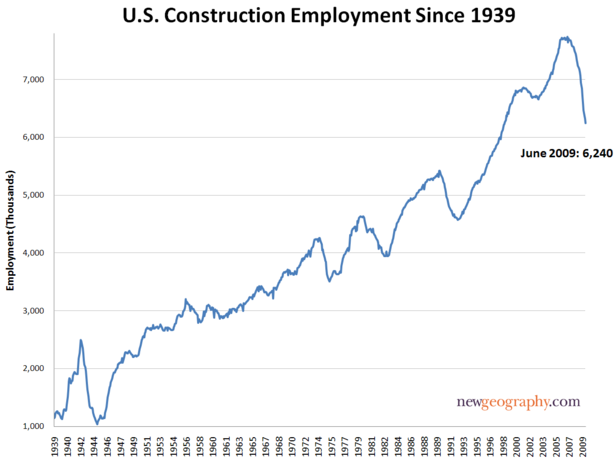
    Unemployment in the construction sector increased by 79,000 in June, according to a report The Associated General Contractors of America released earlier this month. Over the past year, that number has grown to 992,000.

    Even more alarming is the disparity between the construction worker unemployment rate, over 17.4 percent, and the national average for all sectors, around 9.7. Construction employment is crumbling before our eyes.

    The current economic climate has not proven friendly to construction on the whole as state and local revenue continues to decline and little demand for commercial or retail facilities, as well as shrinking orders for new facilities, puts construction in a perilous zone.

    Though as recent as last November, President-elect Obama had conjured up a program to rebuild the nation’s infrastructure.

    The $787 billion American Recovery and Reinvestment Act would modernize roads, bridges, schools, and public transportation – among other things – and reinvigorate the floundering construction and manufacturing industries.

    However, this “shovel ready” stimulus plan did not sit well with women’s groups who wanted nothing to do with a stimulus package that only created jobs for “burly men.”

    These women’s groups seemed to misjudge the president-elects original plan designed to “stop the hemorrhaging in construction and manufacturing while investing in physical infrastructure that is indispensable for long-term economic growth” and instead turned the stimulus into an issue of gender politics. But from the first complaint, onward, the construction and manufacturing industries stood no chance.

    Obama changed his plan, adding health, education, and “other human infrastructure components” to his proposal.

    A report entitled “The Job Impact of the American Recovery and Reinvestment Plan” released on January 10, estimated that the number of jobs created that were likely to go to women was around 42%, a non-too disheartening figure when women “held only 20 percent of the jobs lost in the recession.” The report concluded that the stimulus package would now “skew job creation somewhat towards women.”

    The act was signed into law on February 17 and over the past four and a half months some unfortunate figures have appeared. As noted previously, the construction industry is in a downfall, while there is a growing discrepancy between female unemployment rate (8 percent) and male unemployment rate (10.5 percent) – the highest male-female jobless rate gap in the history of the BLS [Labor Department] data back to 1948.

    All this data, however, has pushed the issue of gender-politics above the issue of human need. Now which group of people should make their voices heard? Let’s hear from women in the construction industry.